




Abstract
In this article, we outline our view of how concentration shields against distraction. We argue that higher levels of concentration make people less susceptible to distraction for two reasons. One reason is that the undesired processing of the background environment is reduced. For example, when people play a difficult video game, as opposed to an easy game, they are less likely to notice what people in the background are saying. The other reason is that the locus of attention becomes more steadfast. For example, when people are watching an entertaining episode of their favorite television series, as opposed to a less absorbing show, attention is less likely to be diverted away from the screen by a ringing telephone. The theoretical underpinnings of this perspective, and potential implications for applied settings, are addressed.
We sometimes become so mentally involved in an entertaining or challenging task that we fail to notice what happens in our surrounding environment. While playing a game of Tetris, for example, we might pick up what is said on the radio in the background when playing at the slow levels, but as the speed of the game increases, we may even fail to notice when somebody mentions our own name. This phenomenon is often referred to as concentration in everyday language and plays a surprisingly subservient role in current scientific views of the human mind. In this article, our intention is to detail how concentration shields against distraction.
Two general factors influence people’s level of concentration: exogenous factors such as time pressure and intellectual challenge (an increase in task difficulty has to be compensated for to maintain a desired level of performance) and endogenous factors such as motivation and trait capacity for attentional engagement (some can engage more fully in their task). Concentration varies from high to low, depending on these factors. The concept of concentration is therefore related to that of focused attention, but they are not equivalent. While focused attention refers to the ability to selectively attend to parts of all incoming stimuli (like a “spotlight”; Heitz & Engle, 2007), concentration refers to the degree of attentional engagement (Hughes, Hurlstone, Marsh, Vachon, & Jones, 2013; Linnell & Caparos, 2013). Concentration is also related to but distinguishable from effort (Sarter, Gehring, & Kozak, 2006) and motivation (Engelmann, Damaraju, Padmala, & Pessoa, 2009). While the latter two concepts refer to the deliberate attempt to try harder, higher levels of concentration do not necessitate greater effort (although concentration and effort often go hand in hand, such as when higher task difficulty is compensated for). An expert gamer, for example, may reach high states of concentration without much effort when playing a favorite video game.
Vast research has studied concentration in the context of a within-modality paradigm, whereby the to-be-attended targets and the to-be-ignored distracters are presented in the same, visual modality (Lavie, 2010). Here, task difficulty—and hence attentional engagement (Linnell & Caparos, 2013)—is typically manipulated by varying the number of distracters in the visual field, an approach that is confounded with dilution (Benoni & Tsal, 2013). Our way of circumventing this problem is to use a cross-modal paradigm wherein targets and distracters are presented in different modalities. Another advantage of the cross-modal approach is that performance effects cannot be attributed to peripheral factors such as masking (e.g., the inability to detect targets because they are masked by distracters); instead, they can be attributed to central factors within the cognitive system. Moreover, an important methodological advantage of the cross-modal paradigm is that it makes it possible to measure neural processing of irrelevant information without the confound of variation in task performance.
How Concentration Shields Against Distraction
Attenuated processing of information in the background
We believe that people notice less of their background environment when they concentrate harder. To test this hypothesis, Sörqvist, Stenfelt, and Rönnberg (2012) manipulated task difficulty within the n-back task. Participants were asked to view a sequence of letters (e.g., l, m, c, m, v, d, k, v . . .) and to press a button when the letter they currently saw was identical to the one n steps back in the sequence. The task was easy when n = 1, as this meant participants only had to press the button when the current letter was identical to the most recent letter. The task became increasingly difficult as the size of n—and participants’ cognitive load (the number of items that had to be maintained in mind to fulfill the task requirements)—increased, and to compensate, the participants had to concentrate harder.
As the visual sequence of the n-back task unfolded, participants were also presented with a sequence of rapidly presented tones. The participants were told to ignore the sounds, as they were irrelevant to the task, but the extent to which participants’ auditory systems responded to the sounds was measured. As can be seen in Figure 1, fewer neurons in the brainstem fired in response to the background sound when the visual task was difficult in comparison to when it was easy. The responsiveness was highest in a control condition wherein the participants did not perform a visual task, but were instead asked to deliberately listen to the sounds. Higher task difficulty, then, makes people concentrate harder to maintain their desired level of performance. As a result, there is an attenuated processing of the background environment.
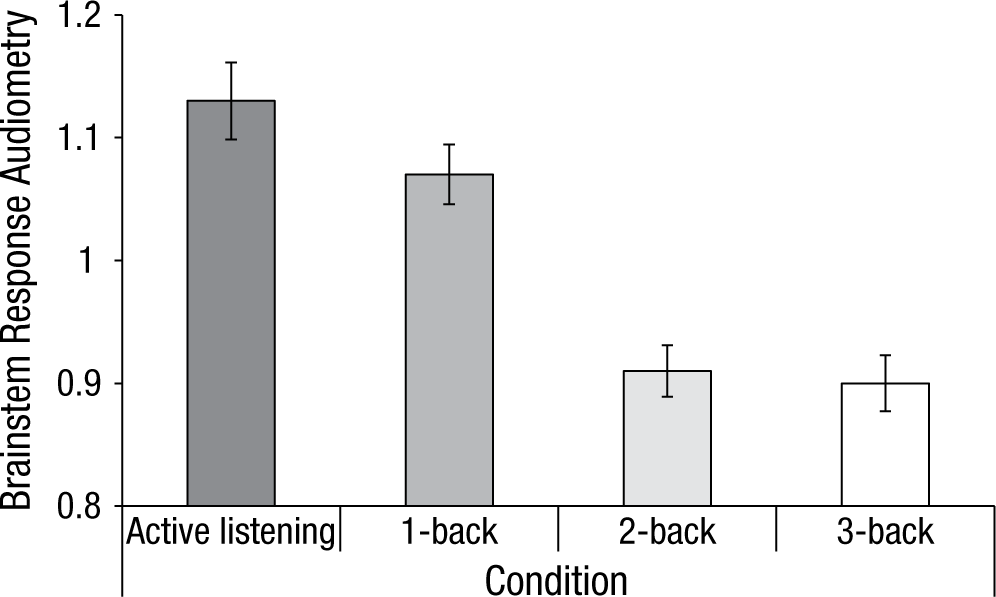
The auditory system’s responsiveness (as indexed by auditory brainstem responses) to a sound in four conditions: one wherein the participants actively listened to the sound and three wherein the participants conducted the n-back task (3-back = high difficulty, 1-back = low difficulty). Error bars show standard errors of the means. Adapted from “Working Memory Capacity and Visual-Verbal Cognitive Load Modulate Auditory-Sensory Gating in the Brainstem: Toward a Unified View of Attention,” by P. Sörqvist, S. Stenfelt, and J. Rönnberg, 2012, Journal of Cognitive Neuroscience, 24, p. 2150. Copyright 2012 by MIT Press. Adapted with permission.
A more steadfast locus of attention
One way to study attention capture in the laboratory is to ask participants to view a sequence of visually presented items, either against a background of sound or in silence, and to report back as many items as they can remember after presentation. If the sound contains a deviating element, such as the letter K in the sequence MMMMMMK, attention is captured. This can be measured by the cost it imposes on task performance: Sound with deviating elements impairs performance in comparison with sound with no deviating elements.
Our view is that people’s locus of attention (the stimulus source they are focusing on) becomes more steadfast (i.e., not as easily diverted by a task-irrelevant stimulus) when they concentrate (Sörqvist, Marsh, & Nöstl, 2013). To test this hypothesis, Hughes et al. (2013) manipulated task difficulty by making it harder to perceive the to-be-recalled visually presented items. In the high-difficulty condition, the items were masked by visual noise (high encoding load), while in the low-difficulty condition, the items were presented without visual noise. Auditory deviants produced the typical impairment to performance in the low-difficulty condition, but when the visually presented items were difficult to perceive, a sound with deviating elements produced no more disruption than a sound without deviating elements (Fig. 2). It seems, therefore, as if higher encoding load makes people better able to resist the call for attention from the surrounding environment. Similarly, sound loses its ability to capture attention when cognitive load (manipulated with the n-back task) is high (SanMiguel, Corral, & Escera, 2008). In sum, when task difficulty is high, people make a compensatory upward shift in concentration in order to maintain their desired level of performance. As a result, people’s locus of attention becomes more steadfast.
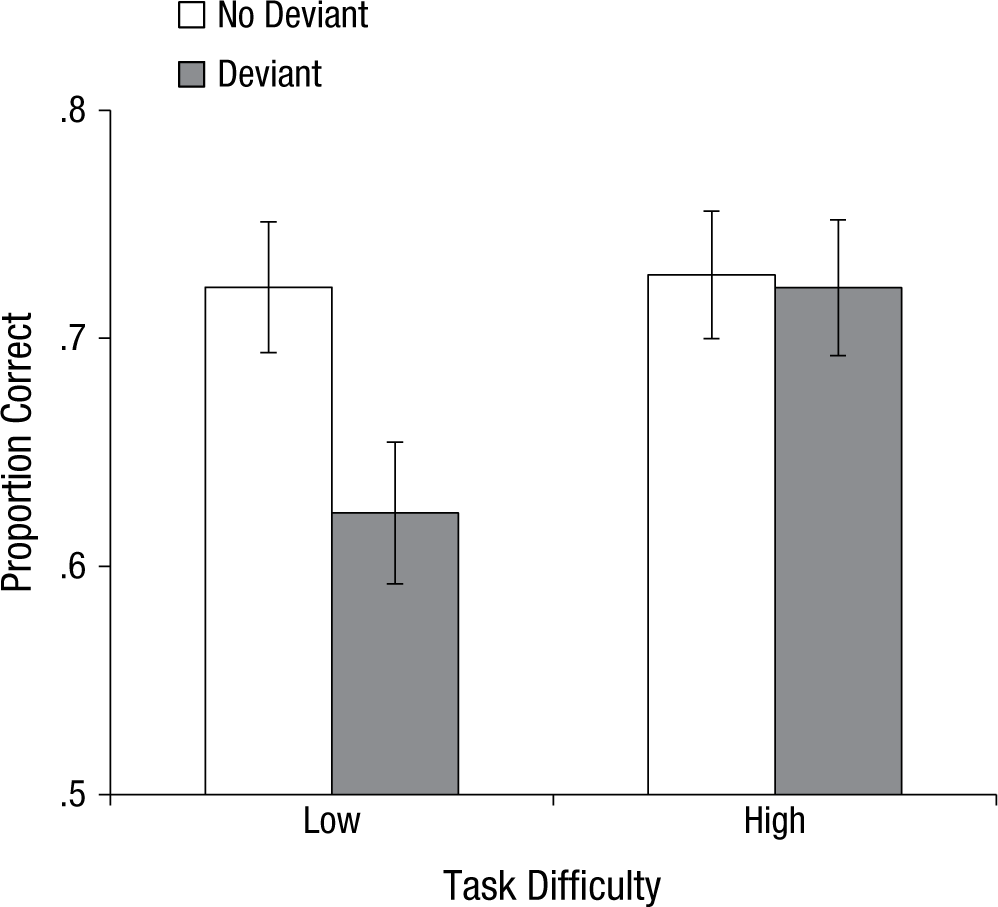
Proportion of correct responses for “no deviant” and “deviant” trials in low-difficulty and high-difficulty task conditions (Hughes, Hurlstone, Marsh, Vachon, & Jones, 2013). Error bars show standard errors of the means.
How People Differ in the Capacity to Concentrate
Individual differences in working memory capacity (WMC) are typically measured with complex span tasks (combining recall of word lists with simultaneous distractor activities) and are assumed to reflect differences in people’s ability to stay focused on what is relevant and resist distraction (Engle, 2002). The WMC concept is embedded in our view of concentration as an endogenous factor determining an individual’s capacity for attentional engagement. In support of this view, high-WMC individuals are typically less distracted by unwanted sound (Sörqvist & Rönnberg, 2014), and WMC is related to both shield mechanisms: High-WMC individuals show a more substantial attenuation of background-environment processing when task difficulty is high (Fig. 3; Sörqvist, Stenfelt, & Rönnberg, 2012), and they show a greater resistance to attention capture (Fig. 4; Sörqvist, 2010), possibly by means of active inhibition of task-irrelevant processing (Conway, Cowan, & Bunting, 2001; Marsh, Beaman, Hughes, & Jones, 2012; Marsh, Sörqvist, Hodgetts, Beaman, & Jones, 2015).
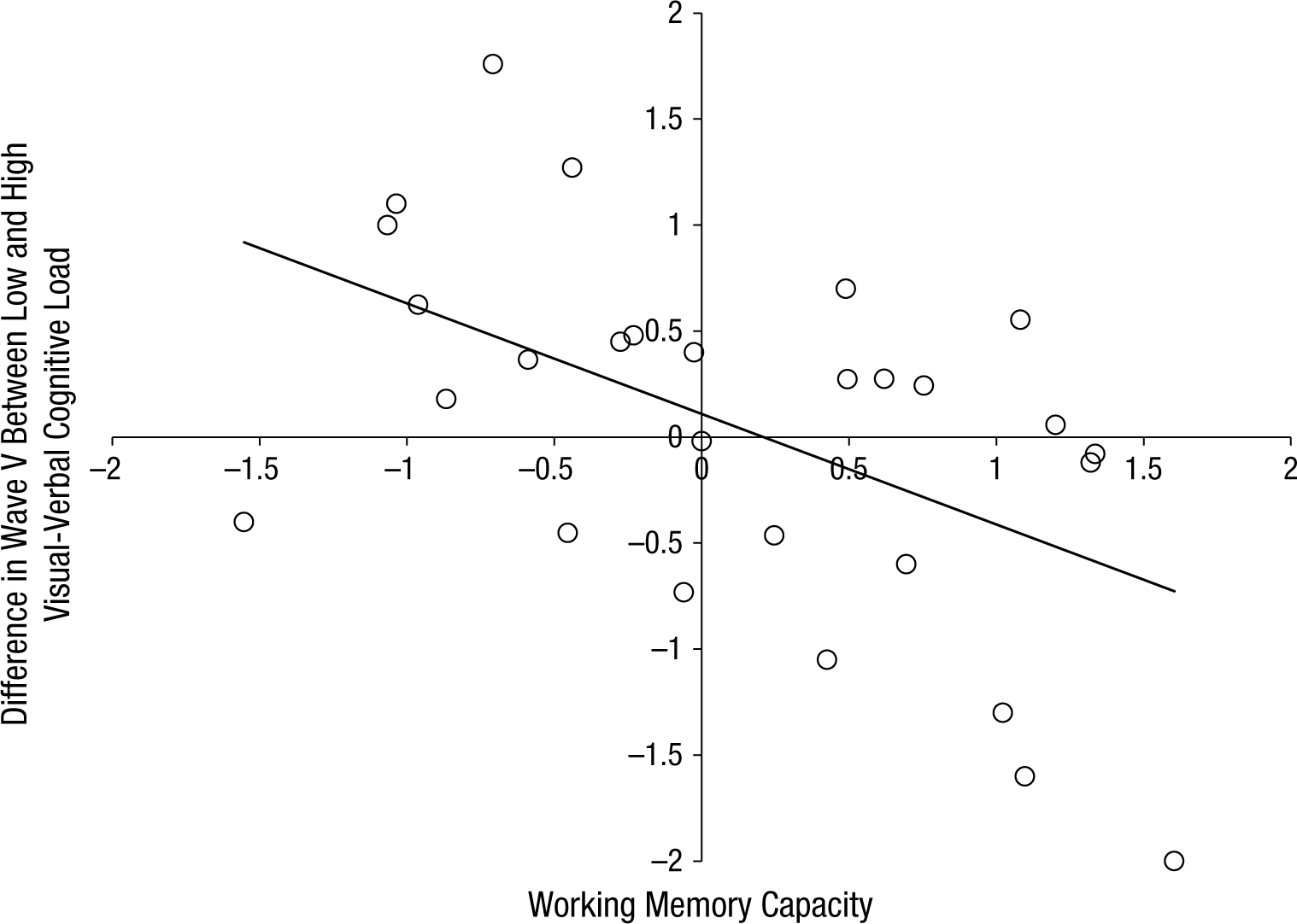
The relationship (z values) between individual differences in working memory capacity (x-axis) and the modulation of the auditory brainstem response (ABR) as a function of visual-verbal task difficulty (y-axis; Sörqvist, Stenfelt, & Rönnberg, 2012). Lower values on the y-axis represent a greater suppression of the ABR as task difficulty increases. The ABR is indexed by Wave V (the ABR recording results in five “waves,” and Wave V is typically the most reliable).
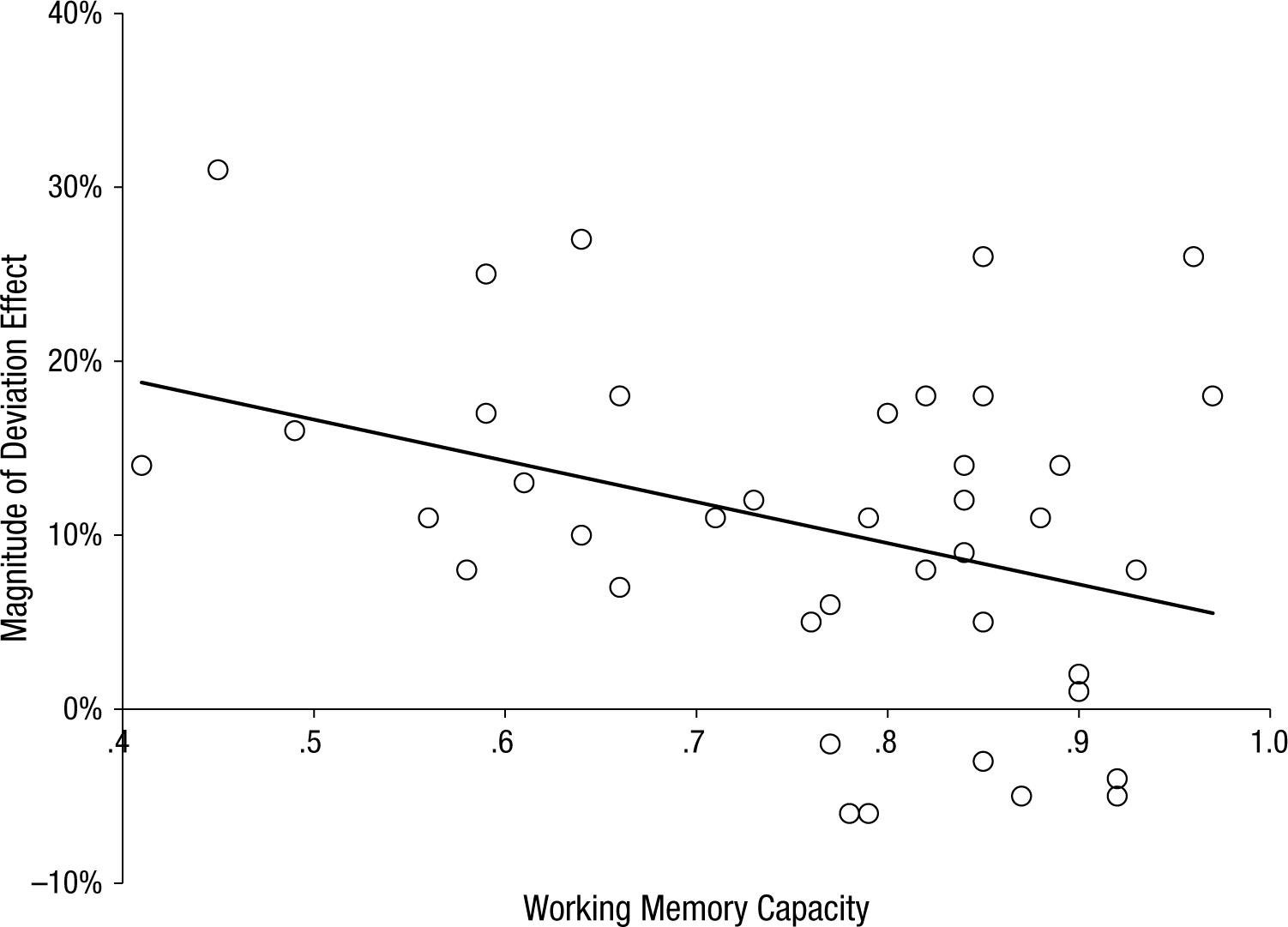
The relationship between individual differences in working memory capacity (operation span score) and the magnitude of the deviation effect (i.e., disruption to performance caused by a surprising sound; Sörqvist, 2010).
How Concentration Shields Against Distraction at Work
When people read and try to remember texts (Bell, Buchner, & Mund, 2008) or undertake some other office-related task (Sörqvist, Nöstl, & Halin, 2012), they typically perform worse when working against a background of speech in comparison with silence. However, the extent to which people are distracted by background sound depends on their level of concentration. The applied relevance of task-difficulty/concentration manipulations has been shown in the context of proofreading and prose memory (Halin, Marsh, Haga, Holmgren, & Sörqvist, 2014; Halin, Marsh, Hellman, Hellström, & Sörqvist, 2014). More specifically, when to-be-read material is presented in a normal, easy-to-read font, performance is impaired by background speech, but when the to-be-read material is presented in a difficult-to-read font (or masked by visual noise), the disruptive effects disappear. Exogenous factors such as task difficulty can, hence, prevent distraction within the workplace. This conclusion is further corroborated by analyses of endogenous factors showing that high-WMC individuals are less susceptible to disruption in the low-difficulty condition (i.e., in which the font is easy to read) in comparison to their low-WMC counterparts, but not in the high-difficulty condition (Halin, Marsh, Hellman, et al., 2014)—it could be that low-WMC individuals are aided by higher task difficulty, reaching higher states of concentration than they can when the task is too easy.
Conclusions
Concentration shields against distraction because (a) undesired processing of the background is reduced and (b) the locus of attention becomes more steadfast. We believe these two mechanisms are separable; the former is associated with active suppression or inhibition of distraction, the latter with distracter blocking as a consequence of greater facilitation of attention to the attended stimulus (cf. Egner & Hirsch, 2005). While distraction with an external source has been the main focus of this article, the same mechanisms should also shield against internally generated distraction (Unsworth & McMillan, 2014), because it is likely that the same attention mechanisms underpin selection of a subset of information, whether this information has an external or internal source (Anderson, 2003). In support of this assumption, both perceptual load (Forster & Lavie, 2009) and high WMC (Kane & McVay, 2012) appear to protect against mind wandering and task-unrelated thoughts.
The conclusions raise some intriguing questions for future research: Short-term benefits arise from increased demands on concentration—via reduced distractibility—but are there long-term costs (e.g., exhaustion)? Can accidents caused by human factors, like mind wandering, be prevented by increasing demands for concentration? Can schoolchildren with attentional disabilities be aided by an individually tailored balance of task difficulty? Moreover, a classic question in cognitive psychology concerns how “early” irrelevant information is filtered. The effects of increased concentration are seen in brainstem activity—a part of the auditory system that incoming sound passes through before it reaches the “conscious” part of the brain (i.e., the cortex). An interesting endeavor for future research would be to find the earliest parts of the processing chain that are influenced by concentration.
Footnotes
Declaration of Conflicting Interests
The authors declared that they had no conflicts of interest with respect to their authorship or the publication of this article.
Funding
The writing of this article and a significant portion of the findings reviewed here were financially supported by Stiftelsen Riksbankens Jubileumsfond Grant P11-0617:1, awarded to P. Sörqvist.