



Abstract
To improve foam expansion and the stability of the foamed gel selected as the starting point, three foaming agents with relatively higher foam expansion and three foam stabilizers were used to determine optimum gradient and composition of the gel. Sodium laurate and dodecyl trimethyl ammonium bromide at a proportion of 2:3 were observed to produce the desirable foaming property and also created the largest foaming volume after the addition of 0.2% polyethylene glycol as the foam stabilizer. Different concentrations of gelatinizing and cross-linking agents were added to the foamed gel containing the foaming agent and the foam stabilizer. The most suitable ratio of the gelatinizing agent and the cross-linking agent determined on the basis of volume of foam dewatering after the addition of foam stabilizer for 6 h was 0.6%:0.5%. The resulting foamed gel was evaluated for rheological and plugging properties and a decrease in the viscosity of the gel and better plugging effect on coal seam were observed.
Introduction
Spontaneous combustion of coal is one of the major disasters that occur in coal mines, causing casualties and economic losses as well as serious environmental pollution. 1 –4 Currently, the main tools used for the prevention and control of spontaneous combustion of coal in the coal mines include grouting, 5,6 inhibitor, 7 –10 inert gas, 11 –15 gel, 16 –19 foam, 20 –23 and foam resin. 24 These tools have played significant roles in such cases although they have also exhibited certain inadequacies. For instance, inert gases easily diffuse and often run out of the injection zone with air leak, gels exhibit low fluidity and the permeability regions in them are also limited, the three-phase foams are difficult to solidify and stable only for 8–12 h, and the organic foams are expensive and come with the possibility of undergoing an exothermic reaction. Novel materials are, therefore, required for decreasing the probability of spontaneous combustion of coal.
A foamed gel is a disperse system in which a gas disperses uniformly in the gel. 25 Foamed gel possesses the properties of both gel and foam, combining the advantages of the three-phase foam and gel and the composite gel injection, without exhibiting the inadequacies of any of these. This results in a great improvement in the fire preventing and extinguishing effects. 26 –28 Many scholars have been successful in combining gel with foam for the application in mine fire prevention and extinguishing, which highly enhanced the ability of firefighting. 29 –31 However, foam expansion and stability of the foam were observed to remain relatively low. Therefore, selecting the most desirable properties of both gel and foam to create novel firefighting foamed gel materials to be used in mines is of great significance. In the present study, using the improvement in foam expansion and stability of the foamed gel as the starting point, the effects of foaming agent on foam expansion, stability, viscosity, and the plugging property of the foamed gel were analyzed, which provided a solid foundation for its field application and for further research for the development of novel foamed gels.
Experiments
Materials
Sodium laurate was obtained from Chemical Reagent Co. Ltd of Guoyao Group, China. Dodecyl trimethyl ammonium bromide (DTAB) and polyethylene glycol were purchased from Tianjin Komeo Chemical Reagent Co. Ltd, China. Glycerol, polyacrylamide (PAM), and sodium bicarbonate were supplied by Tianjin Kaitong Chemical Reagent Co. Ltd, China. Aliphatic alcohol polyoxyethylene ether sodium sulfate (AES) was obtained from Chengdu Aikeda Chemical Reagent Co. Ltd., China. All the materials were used as obtained from the manufacturer without further purification.
Selection of foaming agents
Foaming agent, also referred to as frother or foam agent, 32 is a substance that strengthens the foaming capacity of foam and generates a large amount of uniform and stable, fine, and smooth foam via chemical or physical processes conducted under certain conditions.
While selecting a foaming agent, the environmental impact of the chemicals to be used must be considered as well. The foaming agents with environment-friendly and noncorrosive features are the first choices in this regard. Therefore, through literature review and comparison, three foaming agents with relatively higher foam expansion were selected for the present study: sodium laurate, DTAB, and AES.
Sodium laurate, also referred to as sodium dodecanoate, is an anionic surfactant, which is used as an auxiliary chemical or industrial surfactant and a foaming agent. DTAB (also called laurtrimonium bromide) is a member of quaternary ammonium salts. It has a typical cation–anion amphiphilic structure of a surfactant and may be used as a wetting agent in oil-based drilling fluids for oilfield development and also as a foaming agent in foamed gel for coal exploitation. AES, an anionic surfactant, is used as detergent, industrial emulsifier, foaming agent, and wetting agent.
Selection of foam stabilizers
Subsequent to foaming with a foaming agent, bubbles break easily due to water loss. Therefore, foam stabilizers are required to boost the foaming and stability of the foamed gel. Addition of foam stabilizers is generally advantageous, as it increases the viscosity of the foaming solution, reduces foam dewatering, and extends the service life of foam, with the only exception of the disadvantage of excessive viscosity causing certain adverse influences on foaming. After the literature review, glycerol, PAM, and polyethylene glycol were selected as the foaming agents. Glycerol, also referred to as “glycerin,” is a good solvent used for numerous inorganic salts and gases. PAM exerts a strong flocculation effect and allows gel usage in water treatment, oil exploitation, papermaking, mining, and various other fields. Polyethylene glycol is highly soluble and is good in lubricity, thickening, and other properties, as a consequence of which it is widely used in several industries. It may also serve as a foam stabilizer during foaming.
Selection of gelatinizing and cross-linking agent
Gelatinizing agent is the material that gradually gelatinizes the turbid liquid of latex or other analog into a soft gel, simultaneously maintaining the shape of the gel. The cross-linking agent functions as a bridge between the linear molecules by connecting them through chemical bonds to form a cross-linked net-like structure. On the basis of review of the documented literature, PAM and sodium bicarbonate were selected as the gelatinizing and the cross-linking agents, respectively. Sodium bicarbonate, commonly referred to as “baking soda,” decomposes when heated and produces CO
Foamed gel preparation
(i) Gradient tests were conducted using the concentrations of 0.4%, 0.5%, 0.6%, 0.7%, and 0.8% of the three foaming agents to determine the optimum concentration of the foaming agents for foaming. Sodium laurate (0.4 g) was added into a 500-mL beaker, followed by the addition of 100 mL of distilled water measured using a 250-mL measuring cylinder. The beaker was then placed in a constant-speed electric agitator at 1000 r/min for 2 min. Subsequently, the mixing liquid was immediately poured into a 500-mL measuring cylinder, and the foam volume was recorded. The same steps were applied to sodium laurate used in quantities of 0.5, 0.6, 0.7, and 0.8 g, as well as to DTAB and AES for gradient tests; the foaming volumes obtained at different concentrations were recorded. After the determination of the optimum concentration for foaming, the two foaming agents, which registered the largest foaming volume, were mixed in different proportions (1:1, 1:2, 1:3, and 2:3) to confirm the one proportion, which was optimal.
(ii) When the optimal ratio was confirmed, foaming agents were mixed in the best ratio, following which glycerol, PAM, and polyethylene glycol were added in concentrations of 0.1% and 0.2%, respectively. The resulting mixture was subjected to agitation at 1000 r/min in the constant-speed electric agitator for 2 min. In each agitation, 100 mL from the foaming solution was poured into a 500-mL measuring cylinder, and the volume of foam-dewatering during a period of 6 h was recorded; therefore, the foam stabilizer is determined at the optimum concentration.
(iii) PAM at the concentrations of 0.5% and 0.6% was mixed with 0.3%, 0.4%, and 0.5% sodium bicarbonate, respectively, and the resulting mixture was added to a 250-mL beaker, followed by the addition of 10 mL water to achieve efficient stirring in a constant-speed electric agitator. The gelation time was recorded to confirm the concentration ratio of the gelatinizing agent to the cross-linking agent.
(iv) The eventual chemicals, as well as their concentration ratios, were determined. Finally, the preparation of foamed gel for the plugging test was performed.
Measurements and analysis of properties of prepared foamed gel
Measurements and analysis of foam expansion
The effect of the different concentrations of the foaming agent on the foaming volume is shown in Figure 1. It was observed that the foam volume first increased to a certain value, following which it remained almost stable with the increase in the concentration of the foaming agent. This could have been due to the ceasing of the surface tension decline when the gas–liquid interface would have got filled with the foaming agent as the foaming agent concentration approached critical micelle concentration. 33 –35
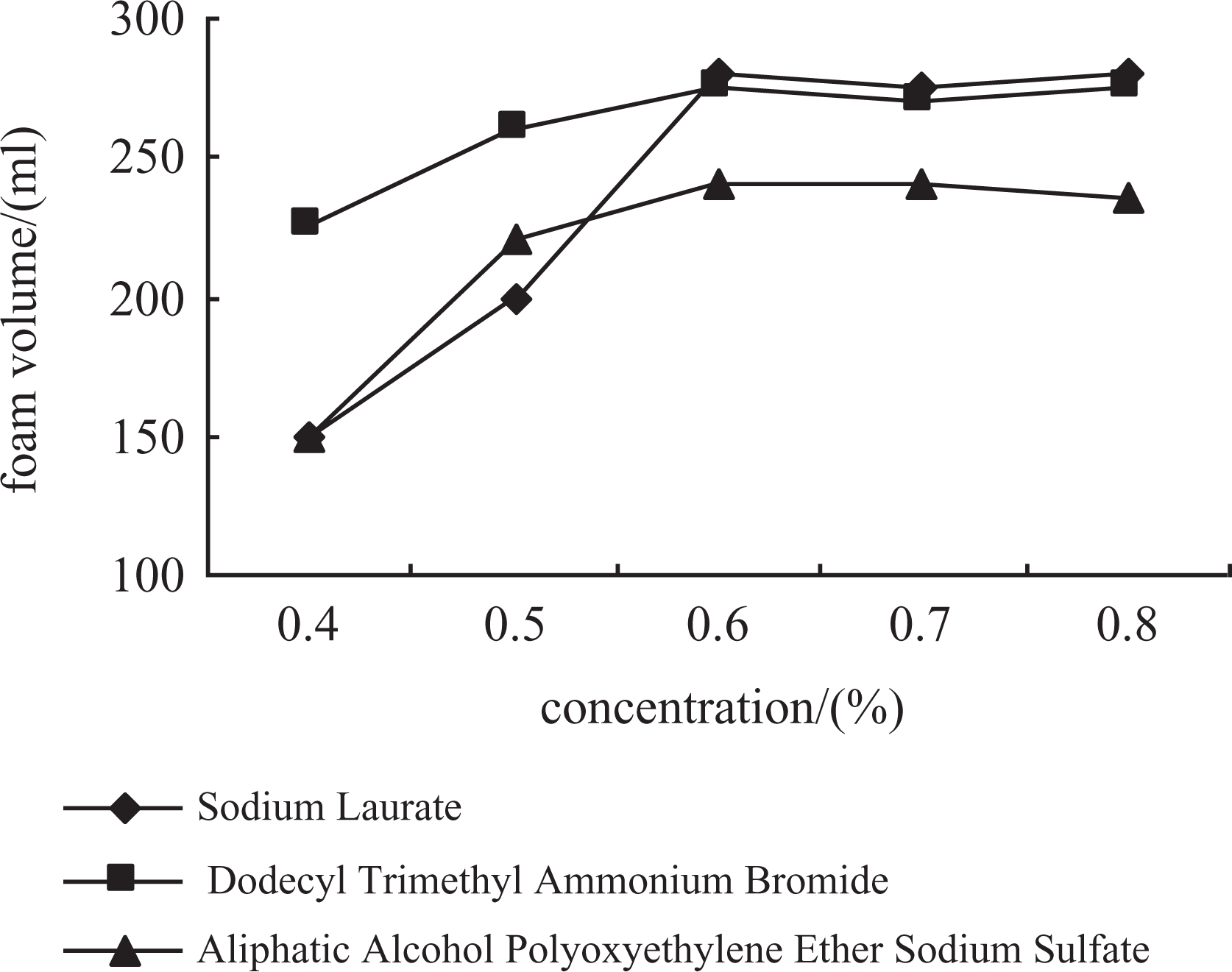
Changes in foaming volume at different concentrations of foaming agents.
When the concentration of the foaming agent was 0.6%, both sodium laurate and DTAB exhibited higher foamability in comparison to that of the AES; the foaming volumes reached 280 and 270 mL, respectively. In addition, compared to the solutions containing AES, the ones containing sodium laurate and DTAB exhibited a lower surface tension, which was advantageous for the foaming process. Therefore, sodium laurate and DTAB were determined as the foaming agents with the additive concentration of 0.6%.
Measurements and analysis of foam expansion after compound composition
The selected foaming agents, sodium laurate and DTAB, with the additive concentration of 0.6% were used in ratios of 1:1, 1:2, 1:3, 2:3, 2:1, 3:1, and 3:2 to evaluate foam expansion (Table 1). As observable from Table 1 and Figure 1, the addition of compound foaming agents resulted in a more pronounced foam expansion and foaming effect compared to the use of only one foaming agent. At a ratio of 2:3, these foaming agents resulted in a foaming volume of up to 320 mL and the foam expansion value of 0.64, which was apparently higher than the corresponding values obtained for the other compound proportions used. The compound proportion of 2:3 of sodium laurate and DTAB was, therefore, selected as optimal for foaming.
Foam volumes from the two foaming agents at different proportions.

Effect of foam stabilizer on foam expansion
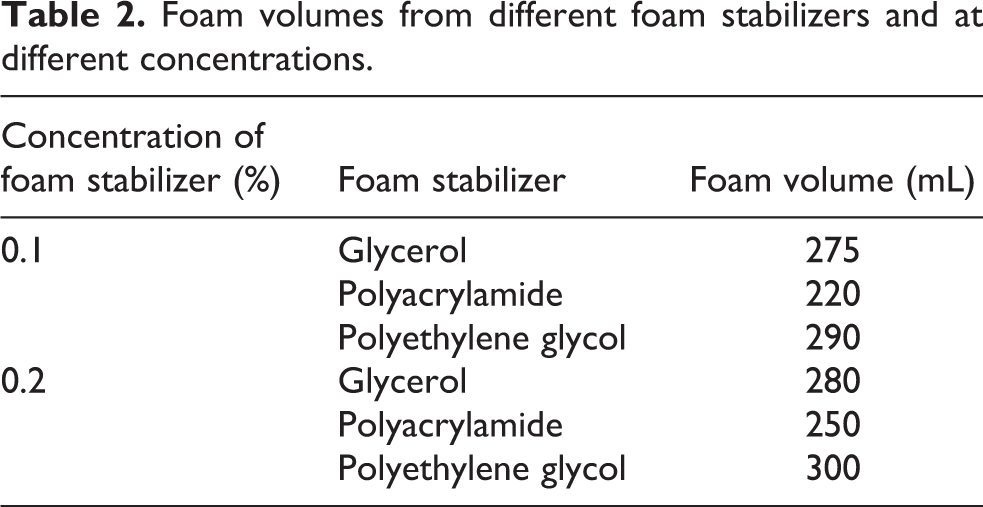
Glycerol, PAM, and polyethylene glycol were added in concentrations 0.1% and 0.2%, respectively, into the mixture of compound foaming agents, sodium laurate and DTAB, mixed at a volume ratio of 2:3; this was followed by thorough mixing. In each case, 100 mL foam was poured into a measuring cylinder (Figure 2), and after 6 h, the volume of foam-dewatering was determined (Table 2). The addition of a foam stabilizer into the compound foaming agent was observed to improve the surface viscosity between the foams and the stability of the foam and reduce the foam volume. The increased volume of foam-dewatering observed in the cases of glycerol and PAM suggested that, at the same concentration, the property of foam stabilizing of polyethylene glycol was comparatively better, and even further better if the concentration was increased. Therefore, polyethylene glycol was selected as the foam stabilizer with an optimum concentration of 0.2%.

Volumes of foam dewatering at 6 h after the addition of foam stabilizer. (a) 1% Glycerol, (b) 1% polyacrylamide, (c) 1% polyethylene glycol, (d) 2% glycerol, (e) 2% polyacrylamide, and (f) 2% polyethylene glycol.
Foam volumes from different foam stabilizers and at different concentrations.
Effect of the gelatinizing and cross-linking agent on gelation time
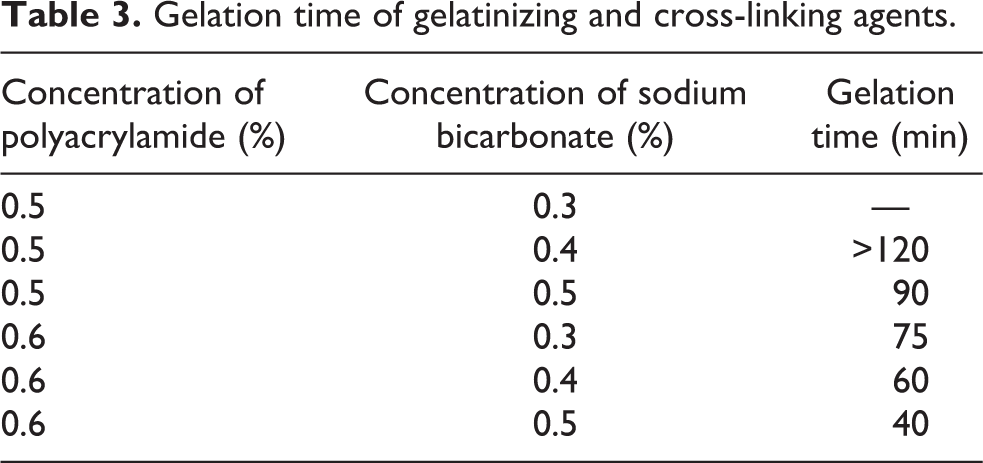
PAM used at concentrations 0.5% and 0.6% was allowed to react with sodium bicarbonate at concentrations 0.3%, 0.4%, and 0.5%, to determine the optimum gelation time under various concentration ratios. The results of these experiments are presented in Table 3.
Gelation time of gelatinizing and cross-linking agents.
According to a previous study, 35 the gelation time of the gelatinizing and cross-linking agents should be within 15–20 min, since an extended time leads to the flow of the foamed gel to a lower position, leaving the fire in the higher level uncovered, while the insufficiency causes the gelatinization of the foamed gel in the pipelines during the injection, blocking the regular delivery and causing the perfusion process to fail.
As presented in Table 3, when the concentration of the gelatinizing agent was maintained constant, the gelation time was decreased with the increase in the concentration of the cross-linking agent, and when the concentrations of the gelatinizing agent and the cross-linking agent were 0.5% and 0.3%, respectively, gel-forming was unachievable. However, when the concentrations of gelatinizing agent and the cross-linking agent were 0.6% and 0.5%, respectively, the gelation time recorded was 40 min, which was close to that required for perfusion. Moreover, the other concentrations of the gelatinizing and cross-linking agents resulted in an extended gelation time, which, as stated earlier, could not cover the fire in the higher level. Therefore, a concentration of 0.6% of PAM for the use as a gelatinizing agent and a concentration of 0.5% of sodium bicarbonate for the use as a cross-linking agent satisfied the requirements of the foamed gel.
Rheological properties of foamed gel
The change in the viscosity of the foamed gel at different shearing rates of the rheometer was determined at room temperature (25°C). Ten tap positions, between the minimum speed of 5 r/min and the maximum speed of 500 r/s, were set. Viscosities of the foamed gel with the shearing rates of the rheometer were documented (Figure 3).

Relations between viscosities of the foamed gel and shearing rates of the rheometer.
The viscosity of the foamed gel decreased rapidly with the increasing shear rate, and then, it decreased slowly, exhibiting a character of shear-thinning, which implied that the foamed gel was a pseudoplastic fluid. 25 This behavior could be explained by the fact that when the shearing rate was increased continuously, partial foam underwent a structural change due to shearing, causing the foam to crack and the viscosity to decrease. Foamed gel has a stereo-network structure; therefore, while a new network structure is being produced by progressive foaming, the established one is destroyed due to the change in the shear rate, lowering the rate of the foamed gel in comparison to the speed of structural damage caused by shearing, which eventually results in the overall viscosity of foamed gel being reduced.
Plugging experiment
According to an earlier study, a simple experimental facility was developed for the foamed gel plugging test. 36 This facility consisted of an organic glass cylinder, pressure pump, pressure gauge, and other units. The organic glass cylinder was 300 mm high. A porous plate made of organic glass located at a distance of 100 mm from the bottom of the cylinder divided the internal cylinder into two sections: the upper and the lower sections. The upper section was filled with coal briquette, while the lower section was a cavity for pressure delivery. A pressure gauge with a measurement range of 0–0.4 MPa was installed at a height of 50 mm above the porous plate.
Foamed gel was injected into the experimental facility, and 10 min later the pressure pump was turned on to generate pressure until the pressure gauge stabilized at a certain value. While the pressure was being generated (the pressurization process), the pressure in the cavity increased in variation with time. When the pressurization was terminated, the pressure decreased and reached at a stable value of 0.2 MPa after 45 min (Figure 4). This could be explained by the presence of certain small gaps between the coal briquette materials, which did not allow the injected foamed gel to gel immediately and rather flow slowly to the lower ground. Under the impact of pressure, the foamed gel wriggled for being equally distributed between these gaps, reducing the pressure in the cavity. Subsequently, when these gaps were blocked, the pressure stabilized to a certain value gradually. This implied that the injected foamed gel in the coal seam spread over to be uniformly dispersed, such that they were gelled and the coal seam fracture was blocked.

Pressure variation during the plugging experiment.
Conclusions
In the present study, foaming agents and their concentrations were determined first using the concentration gradient tests. After the addition of different concentrations of foam stabilizers as well as gelatinizing and cross-linking agents, the foaming ability, stability, rheological property, and the plugging effect of the cementitious system were determined, and the following conclusions were established: (i) Gradient tests conducted using various foaming agents at different concentrations revealed the sodium laurate and DTAB as the most suitable foaming agents, while their optimum foaming concentration was determined to be 0.6%. The use of different compounds for the gel resulted in better foaming outcomes compared to the use of a single foaming agent. The best outcome was obtained at an optimum ratio of 2:3 and the foaming volume of up to 320 mL. (ii) The addition of different foam stabilizers to the best foaming agent improved the viscosity between foam surfaces and polyethylene glycol was found to be as the best one at an optimum concentration at 0.2%. In terms of gelatinizing and cross-linking agents, PAM and sodium bicarbonate produced best outcomes at a concentration ratio of 6:5, and the prepared foamed gel was observed to exhibit a lower viscosity. (iii) The prepared foamed gel was finally used in the plugging experiment. According to the experimental data, after being poured into broken coal briquettes, the foamed gel spread uniformly over the gaps between the coal seams, and when they were gelled, the coal seam fractures were effectively blocked.
Footnotes
Declaration of conflicting interests
The author(s) declared no potential conflicts of interest with respect to the research, authorship, and/or publication of this article.
Funding
The author(s) received no financial support for the research, authorship, and/or publication of this article.
