




Abstract
This article aims to advance our understanding of the communication of science conducted within the framework of externally funded research projects, also known as project-based science communication. It deploys semi-structured interviews to explore the experiences and perceptions of 26 communication specialists, project managers and other professionals who have been involved in the Communication & Dissemination Work Packages of Horizon 2020 and Horizon Europe projects. Interviewees regard the communication of European Union-funded projects as beneficial, both personally and for society as a whole—in the latter case, primarily in instrumental terms. They identify several challenges to their communication functions, ranging from working conditions to structural factors such as project size or project duration, to the relationship with researchers and other partners. Many interviewees also hold a critical opinion of the current communication practices within European Union-funded projects and acknowledge the potentially detrimental effects of the multiplication of projects with attached communication responsibilities. The ultimate purpose of this article is to elicit interest in project-based science communication within the science communication scholarly community.
Keywords
1. Introduction
Externally funded research projects nowadays represent one of the most important institutional settings for the communication of science (Koivumäki and Wilkinson, 2020; Palmer and Schibeci, 2014). Funding agencies have progressively introduced the submission of a viable communication plan contributing to broadening the ‘societal impact’ of research initiatives as a requirement in their competitive calls for projects (Gertrúdix et al., 2021; Koivumäki and Wilkinson, 2020; Palmer and Schibeci, 2014). The expected growth of competitive grant funding as an instrument of research policy and research funding in the foreseeable future (Reale, 2017) may afford project-based science communication (PBSC) even greater prominence.
PBSC can be defined as the communication of science topically related to, and organisationally taking place within the framework of, externally funded research projects. Partners involved in these research initiatives carry out communication activities of various kinds, aimed at informing audiences about the project’s mission, objectives and progress and often addressing the science that undergirds the project as well (Gertrúdix et al., 2021; Palmer and Schibeci, 2014). Accordingly, PBSC can be regarded as a distinct set of communication practices embedded in what M. Bucchi and B. Trench have conceptualised as the ‘social conversation around science’ (Bucchi and Trench, 2021). This category provides an umbrella term that encompasses the multitude of practices and formats, from institutional communication by academic institutions to the presence of science in pop culture, that belong to the contemporary science communication landscape. It is thus contended that PBSC represents one of the concrete institutional settings through which ‘society talks about science’ (Bucchi and Trench, 2021).
Prior research on PBSC has taken two different directions. On the one hand, there has been a strong focus on the ‘policy priorities’ of funding agencies and how they frame the type of science communication to be fostered through grant funding (Conceição et al., 2020; Weingart et al., 2021). On the other hand, a burgeoning but still marginal strand of literature on PBSC has investigated the communication outputs by projects mandated to develop and implement a communication plan (Arboledas-Lérida, 2025; Gertrúdix et al., 2021). What remains underexplored and undertheorised is precisely the space that lies between these two levels, namely, the agency of communication professionals and other experts (including project managers and, in some cases, researchers themselves) who are entrusted with, or otherwise directly or indirectly involved in, communication activities within the framework of externally funded research projects. 1 PBSC experts are key actors in translating funding agencies’ general orientations into concrete communication practices. Therefore, by surveying their experiences, opinions and attitudes regarding PBSC, we stand to gain valuable insights into the opportunities and challenges posed by PBSC as a science communication practice, as well as into the broader social, economic and political factors impinging on their communication duties.
This article addresses agency in connection with PBSC by drawing on 26 semi-structured interviews with PBSC experts who have been directly or indirectly involved (e.g. in coordination and supervisory roles) in the communication activities of research projects funded under Horizon 2020 or Horizon Europe, the two most recent—and better resourced—Framework Programmes (FPs) for Research and Innovation of the European Commission. 2 This study forms part of a broader project investigating the social, economic and organisational realities that underlie the communication of European Union (EU)-funded projects. The article focuses on how interviewees perceive that both they themselves and society at large benefit from PBSC; the challenges they confront in their daily communication practices, including issues pertaining to funding or available budgets; and their general perceptions of the communication of EU-funded projects and of PBSC writ large.
The article is structured as follows: Section 2 outlines the theoretical framework and guiding themes that underpin the empirical analysis. Section 3 explains the sampling procedure and the methodology deployed, while section 4 presents the main results. Section 5 brings the article to a close by discussing these findings and indicating future avenues of research.
2. The distinctness of PBSC
This section draws on extant literature in science communication and cognate fields to introduce and discuss some of the distinguishing features of PBSC as an institutional setting for the communication of science. For reasons of space, I dwell primarily on those aspects that will be of greater relevance to the subsequent empirical analysis.
The ‘institutional mandate’ in PBSC
Unlike many other communication activities, PBSC constitutes a distinct configuration of science communication owing to the presence of a discernible ‘institutional mandate’ (per Fecher and Hebing, 2021; see also Rose et al., 2020). This mandate is enforced by funding agencies, which require grantees to conduct communication and public engagement initiatives during the course of their projects (Koivumäki and Wilkinson, 2020; Palmer and Schibeci, 2014). The European Commission, the focal funding body for this study, provides an illustrative example: Since the beginning of Horizon 2020, it has established the communication of the research actions as a legal obligation with which all beneficiaries must comply. This condition has been maintained under Horizon Europe. While other funding agencies may have adopted a less stringent approach (Palmer and Schibeci, 2014), the pressures on researchers to generate ‘societal impact’ are widespread (Loroño-Leturiondo and Davies, 2018; Norn et al., 2024)—and so too are funding agencies’ initiatives to propel science communication via their own funding programmes (Koivumäki and Wilkinson, 2020; Palmer and Schibeci, 2014).
Science communication is both enabled and constrained by virtue of the presence of the institutional mandate inherent in PBSC. The example of EU-funded projects illustrates how this mandate opens up multiple possibilities, especially when it is accompanied by material support for communication: several EU-funded projects under Horizon 2020 and Horizon Europe include a separate Communication & Dissemination Work Package (C&D WP), through which multiple communication activities and actions undertaken over entire duration of the project are organised, coordinated and given general orientation. Especially in larger and better-resourced initiatives, communication actions may become highly sophisticated, including the creation of a ‘brand’ logo, colour palette and other visuals, as well as a particular communication style, recurrent themes and central arguments to be communicated. Importantly, C&D WPs are evaluated with respect to how they align with the ‘broader impacts’ of the project, which means that communication is expected to aid in advancing the project’s overarching goals. If funding agencies afford sufficient recognition and importance to them (Conceição et al., 2020; Weingart et al., 2021), more ‘dialogic’ or ‘participatory’ science communication initiatives are likewise possible within the institutional setting created by PBSC.
However, the ‘institutional mandate’ may also bring about constraints and misaligned incentives. Worthy of mention in this respect is that PBSC is premised on competitive grant funding, a funding mechanism whose distinguishing feature is that funding is allocated on a competitive basis—that is, through competition between research consortia and their projects (Franssen and de Rijcke, 2019; Reale, 2017). Projects must be both ‘excellent’ and ‘cost efficient’ to be awarded funds (Arboledas-Lérida, 2024), whereby grant funding creates an incentive for cost-cutting (Geuna, 2001) with ambivalent impacts for science communication: while a sound and compelling C&D WP may increase the chances of a project being awarded a grant, an opposing pressure to keep costs as low as possible may negatively impinge on the scope and ambition of communication activities. Therefore, there is a trade-off that all incumbent parties (research consortia, principal investigators, communication professionals themselves) must navigate.
In the case of the European Commission, it is well known that the ‘institutionalisation’ of science communication through grant funding already began with the Fifth FP (1998–2002) (Conceição et al., 2020). The novelty for Horizon 2020 and Horizon Europe resides in the fact that the communication of the project and its outcomes constitutes a legal obligation applying across all missions or research pillars, funding calls, project types (Innovation Action, Coordination, Support Action, etc.), intermediary agencies (including, among others, the EUROATOM or the European Research Council (ERC)) and funding levels. In other words, at least in principle, all projects financed by the European Commission must submit and implement a separate C&D WP. The figures are telling: a total of 55,526 projects have been funded under Horizon 2020 (35,426) and Horizon Europe (20,100) until December 2025. 3 Even when allowance is made for factors that may hamper communication in some projects—such as research topic (e.g. defence-related projects) or project size—these numbers attest to the nonnegligible influence by the European Commission and the ‘institutional mandate’ created through funding programmes on the science communication landscape across Europe. Also relevant to the present concerns is that the ‘institutional mandate’ thus articulated leads to the proliferation and multiplicity of research projects with attached C&D WPs (see Koivumäki and Wilkinson, 2020).
Relationships between scientists and communicators in PBSC
While it is generally acknowledged that science communication has long since become an obligation for researchers (Miller, 2001)—and empirical work has shown that many researchers willingly embrace communication duties (Loroño-Leturiondo and Davies, 2018; Rose et al., 2020)—the dispute over who is primarily responsible for science communication—scientists or communication professionals—continues, with no end in sight (Banse et al., 2025; Biermann et al., 2025; Koivumäki and Wilkinson, 2020). The issue of responsibility attribution may become even more pronounced with the emergence and development of PBSC as a science communication practice.
The few studies that have explored the problem of the division and attribution of communication responsibilities in connection to PBSC have underscored that grant funding and the attached communication responsibilities may result in a ‘bypassing’, as it were, of ‘traditional’ communication structures in universities and research centres (Koivumäki and Wilkinson, 2020; see also Biermann et al., 2025). Not only are researchers more directly involved in communication activities in and through projects, but the communication requirements issued by funding agencies may result in additional and contradictory pressures for communication professionals as well (Koivumäki and Wilkinson, 2020), especially when responsibilities for both institutional and project communication overlap, their goals and missions are not properly aligned, and workloads increase (Koivumäki and Wilkinson, 2020). More generally, it has proved difficult to achieve a proper alignment of objectives and communication practices between scientists and communication professionals under the aegis of PBSC (Koivumäki and Wilkinson, 2020; see also Banse et al., 2025; Biermann et al., 2025).
My contention is that the tensions and conflicts between researchers and communication professionals obtaining in the case of PBSC generally could be magnified by several orders of magnitude within EU-funded projects, given the particular embedding of communication responsibilities in them. As indicated above, most projects are expected to develop a separate work package dedicated to informing audiences about the project and its outcomes, as well as the science underpinning the whole endeavour. This already drives a wedge between communication tasks and research proper. More importantly, in larger consortia, the C&D WP is often managed, or otherwise led, by a single partner. Communication partners are usually communication or marketing agencies (or, less frequently, communication departments of scientific organisations). In other words, C&D WPs display a neatly structured division of labour that is not to be found in other science communication activities or settings, especially when researchers also act as science communicators. 4 Moreover, this configuration entails that communicators depend on other partners to contribute to communication activities (e.g. by participating in interviews, by collaborating in specific tasks, distributing content), yet the inverse does not necessarily apply. The situation is potentially rife with frictions and conflicts, similar in some respects to other contexts equally marked by ‘uncooperative researchers’ impinging on communicators’ duties (Biermann et al., 2025), but also possibly posing unique challenges on its own.
Funding in PBSC
Funding is a critical factor in science communication activities. In their multicountry analysis, Entradas and Santos (2021) show that funding is positively associated with the communication activities undertaken by research institutes across all the countries studied and for the three science communication formats considered. In turn, Wilkinson et al. (2023) find that the lack of resources is one of the main deterrents to engaging in science communication activities for science communication actors. It can therefore be expected that funding represents an issue in the case of PBSC as well. Despite its commitment to fostering science communication through grant funding, the European Commission has allocated relatively limited resources to science communication under both Horizon 2020 and Horizon Europe (Conceição et al., 2020). 5
Yet there is some ambivalence concerning the relationship between funding and the communication activities in EU-funded projects. For the 50 top projects per level of funding led by Spanish institutions under Horizon 2020 (up to 2018), Gertrúdix et al. (2021) found no relationship between funding and communication activities. However, for Horizon Europe projects also led by Spanish institutions (up to December 2023), Arboledas-Lérida (2025) identified a positive and statistically significant relationship. Since these macroanalyses have not clarified the impact of funding on the communication of EU-funded projects, additional insights can be gained by directly investigating the perceptions of communication professionals of how funding conditions their daily practices and the range of communication activities they can undertake. It should also not be forgotten that PBSC creates contradictory incentives with respect to communication work packages (see ‘The “institutional mandate” in PBSC’): while a sound and compelling C&D WP may be beneficial at the stage of project evaluation, the need to be ‘cost efficient’ (Geuna, 2001) and to keep costs low across the board introduces a disincentive. There are many more dimensions imbricated in the question of funding for communication activities than merely the total volume of funding.
Personal and societal benefits of PBSC
Over the years, the attention of science communication scholars has partially shifted from the communication practices of scientists to those of professional science communicators (e.g. Biermann et al., 2025; Davies, 2020; Koivumäki and Wilkinson, 2020; Wilkinson et al., 2023), in what has been described as the ‘organisational turn in science communication’ (Schäfer and Fähnrich, 2020). Undoubtedly, the proximate reason for this shift is the growing professionalisation of science communication activities that has taken place (Trench, 2017). Most of the work conducted along these lines, however, has concentrated on professional science communicators at universities and academic research centres (Biermann et al., 2025; Koivumäki and Wilkinson, 2020; for a partial exception, see Wilkinson et al., 2023). The group of PBSC experts with whom we are concerned has not been properly addressed. We thus possess virtually no understanding of their motivations to engage in this science communication practice, nor of how they perceive the impacts—both positive and negative—of their own work on society.
Concerning this latter aspect, Davies (2020) reported that many science communication scholars and educators she interviewed were very positive in their appraisal of science communication’s function in society. Concerning the societal role that these professionals attribute to science communication, Davies (2020) identifies six categories: ‘Accountability’, ‘Pragmatic roles’, ‘Cultural benefits’, ‘Enhancement of democracy’, ‘Promotion’ and ‘Economic functions’. My work aims to test whether such perceptions are likewise generalisable to the case of practitioners involved in the communication of EU-funded projects. Gaining a deeper understanding of this issue is both timely and appropriate, given that prior scholarship has warned that the multiplication of research projects with attached communication plans may have detrimental effects (see Koivumäki and Wilkinson, 2020)—a far cry from all those perceptions of science communication as inherently virtuous—so that there may develop a potential disconnect between perceived and actual societal impacts of PBSC.
Throughout this section, it has been elucidated that PBSC represents a distinct institutional setting of the ‘social conversation around science’, distinguishable by the following characteristics: (1) the existence of an institutional mandate imposed by funding agencies; (2) a structured relationship between scientists and communication professionals, underpinned by an extensive division of labour and (3) funding as a multifaceted issue. It has also been indicated that we need to gain knowledge of the perceived benefits both for society and for PBSC experts stemming from PBSC, as well as how they assess the institutional setting for science communication created by funding agencies through grant funding.
On the basis of this theoretical reconstruction of PBSC as a science communication practice, the following research questions are addressed:
RQ1. What are the perceived benefits and opportunities that the communication of EU-funded projects brings to PBSC experts? What are their perceptions of the societal impacts of PBSC?
RQ2. What challenges must PBSC experts tackle when communicating EU-funded projects? Is funding generally perceived as one of these challenges?
RQ3. What are their views on current practices in the communication of EU-funded projects, and on the mechanisms and regulations implemented by funding agencies to foster science communication through grant funding?
3. Methodology
As this study enquires into PBSC and the communication of EU-funded projects through PBSC experts’ experiences and perceptions, semi-structured interviews are regarded as an appropriate methodology to answer the research questions proposed above. Not only have semi-structured interviews proved suitable for qualitative inquiry into the subjective dimensions of phenomena (Saldaña, 2016), but their potential as a research method has also been leveraged in recent analyses of PBSC (Koivumäki and Wilkinson, 2020) and of the structured relationships between scientists and communication professionals (e.g. Biermann et al., 2025).
Research participants were selected on the basis of prior work conducted by the author on the communication activities of Horizon 2020 and Horizon Europe projects led by Portuguese, Polish and Spanish institutions, resulting in a comprehensive dataset of publicly available contacts of professionals (or their institutions) involved in these projects’ C&D WPs. This dataset was further enriched through web searches and snowball sampling, the latter procedure benefitting in particular from the author’s past professional experience in the communication of EU-funded research projects.
Potential candidates were approached via email, with a reminder email following 1 week later and with additional contact through social media when necessary. Eighty-one communication professionals and project managers were contacted. In total, 26 PBSC experts accepted the invitation and were interviewed. The point of data saturation was reached relatively early for many of the topics covered, so it was concluded that additional interviews were not necessary. Informed consent was obtained from all participants prior to the interview using an Informed Consent Form adapted from the World Health Organization (see Annex II of Supplemental Materials). Interviews were conducted between March and July 2025. They took place online, were audio-recorded and lasted between 30 and 60 minutes. During the transcription process, interviews were fully anonymised, and all references to specific places, events or situations that could eventually lead to identification were also suppressed. A final draft of the article was sent to participants prior to the submission to the journal, inviting them to provide additional feedback. Only one participant answered, suggesting minor changes to improve the readability of quoted excerpts from her own interview. Annex I of Supplemental Materials includes the research questions that are relevant to the present study.
The material was analysed using an abridged version of the iterative thematic coding proposed by Bingham and Witkowsky (2022), employing three rather than five coding cycles. The first coding cycle combined inductive and deductive categories in an open coding process. The latter were deployed primarily to identify general themes that had been highlighted as relevant in prior literature (e.g. the functions of science communication by Davies, 2020). The second coding cycle was purely inductive, focused on emerging topics lacking prior theoretical grounding. The third cycle refined, streamlined and validated the coding system by contrasting it with the available literature. This laid the groundwork for higher-level analysis and reporting. MaxQDA was used to analyse the material.
4. Empirical results
Table 1 provides descriptive statistics about the 26 participants in the interviews in terms of job position and educational background. Their countries of residence include Portugal, Spain, Germany, Poland, Italy, Malta, Lithuania, Cyprus, France, the Netherlands and the United Kingdom. It should be noted, however, that several interviewees work remotely, and their location may not correspond to that of their company or institution. Interviewees were overwhelmingly female, suggesting that the field of communication within EU-funded projects reflects the gendered character of science communication practice writ large (Wilkinson et al., 2022). In terms of educational background, the majority of interviewees hold a bachelor’s or master’s degree related to communication fields (Communication-related), while some come from science, technology, engineering and mathematics fields (STEM). Other specialisations (Other) include fields as diverse as economics, ecotourism, European affairs or literary studies. The majority of interviewees work as PBSC experts, fully dedicated to the communication of multiple EU-funded projects (SC Managers). Also represented are Project communicators, the category designating PBSC experts working in one single research project and possibly hired on a fixed-term basis; Project managers, who are generally responsible for the coordination and supervision of the whole project—including the C&D WP—and who must often assume science communication activities (in my dataset, two out of three project managers conducted communication activities); and Heads of communications unit in academic institutions, with involvement in both institutional communication and the communication of projects led or participated in by their institution. As indicated above, the concept of PBSC experts is used throughout as an encompassing category.
Interviewees’ educational background and current profession.
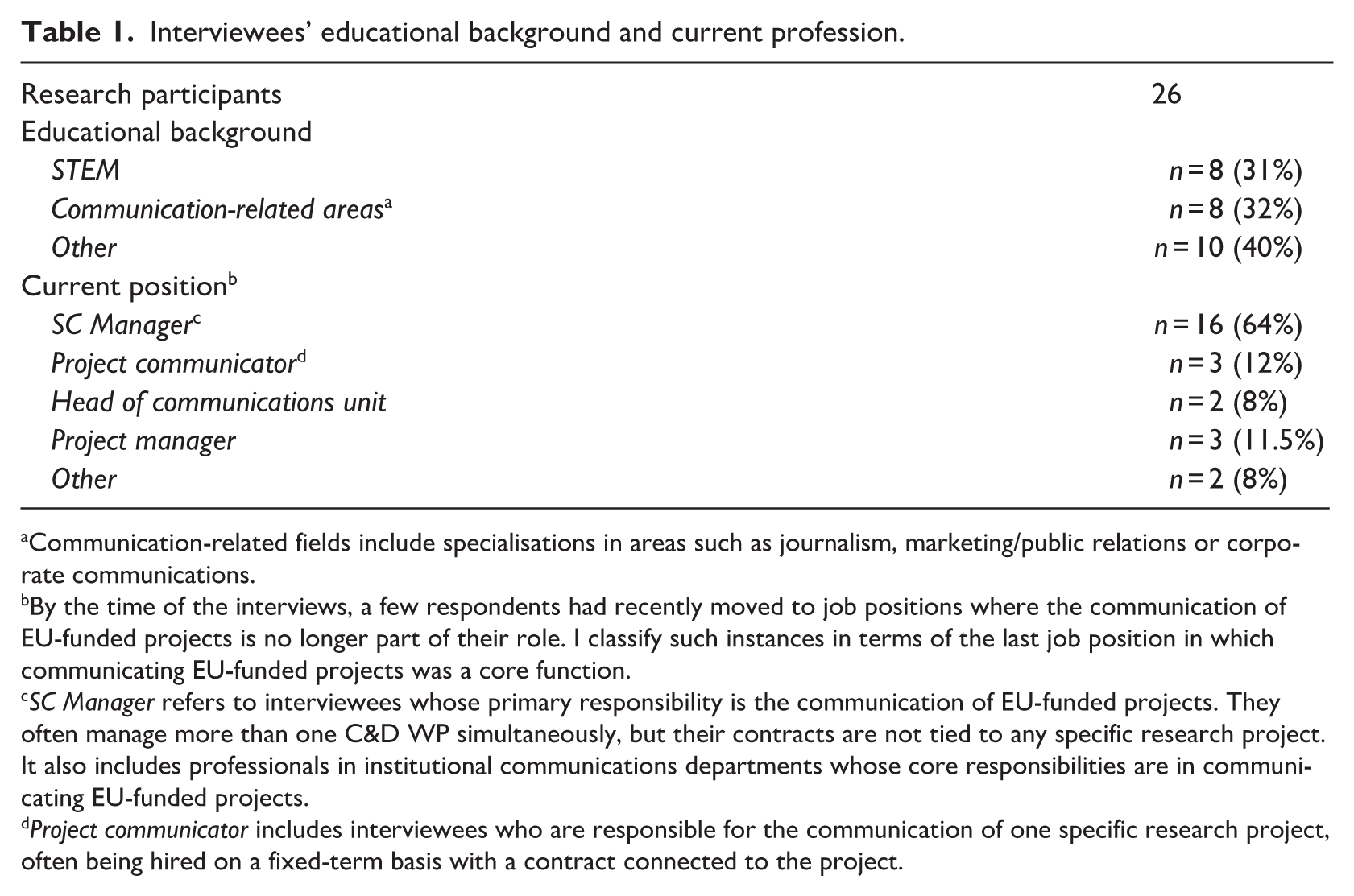
Communication-related fields include specialisations in areas such as journalism, marketing/public relations or corporate communications.
By the time of the interviews, a few respondents had recently moved to job positions where the communication of EU-funded projects is no longer part of their role. I classify such instances in terms of the last job position in which communicating EU-funded projects was a core function.
SC Manager refers to interviewees whose primary responsibility is the communication of EU-funded projects. They often manage more than one C&D WP simultaneously, but their contracts are not tied to any specific research project. It also includes professionals in institutional communications departments whose core responsibilities are in communicating EU-funded projects.
Project communicator includes interviewees who are responsible for the communication of one specific research project, often being hired on a fixed-term basis with a contract connected to the project.
Personal and societal benefits of PBSC
Interviewees report a wide range of motivations and personal benefits arising from their involvement in the communication of EU-funded projects, of which three stand out: (1) the opportunity to learn about science, (2) the relationships established within research consortia and (3) the possibility of acquiring, developing, and/or implementing communication skills. The following three quotations illustrate each of these categories: I kind of feel like working in European projects, there are so many different fields. So, it’s like every time you meet a partner, you’re talking with them, it’s like learning something new. (. . .) For example, AI healthcare, the technical part—is not something I will get in touch with in my daily life. So, it’s really interesting to learn about that. And it’s also very inspiring. (Interviewee 09, SC Manager) [The] most positive I always found in European projects was the, . . . this sounds a bit cliché maybe, but the team spirit that I found in consortia. You have all these people from different companies and different countries who speak different languages. Also, companies with different interests, sometimes. (. . .) But I always really found it very admiring how these people [could] work together towards a common goal, each using their own expertise. (Interviewee 16, SC Manager) And, also, [as] communication is creative, I would say, so there’s always a part where you can be creative, and so you can explain the same point, concept, but in another way, from another perspective with a different format. So that’s, I think, very, very, very positive and very nice to do in science communication. (Interviewee 13, SC Manager)
In terms of the actual or potential benefits for society arising from the communication of EU-funded projects, responses were coded according to the roles of science communication identified by Davies (2020). Instrumental benefits (in Davies’ terminology, Pragmatic roles) took precedence over others. The main social benefit of the communication of EU-funded projects, to use Interviewee 03’s words, is that citizens can keep up with ‘what is happening at the European level—all those researchers that are being carried out’ (Interviewee 03, SC Manager). Democracy- and governance-related benefits (in Davies’ account, Enhancing democracy) and Culture are likewise mentioned often. Cultural benefits are framed by interviewees in ostensibly more mundane terms than the experts surveyed by Davies, foremost in connection with education and scientific literacy.
It’s important that people who do not have scientific literacy, . . . people who work [and] did not have the opportunity to study, and who work in something completely not related to science—it is important to bring scientific literacy to these people. (Interviewee 21, Project manager)
Finally, Accountability emerges more as a ‘crosscutting issue’ than a single proposition concerning the potential benefits of PBSC. The theme Tax-payers’ money recurred throughout the interviews and across the most diverse contexts, highlighting how deeply internalised the connection between the communication of science and the publicly funded nature of research projects at the EU level is among PBSC experts. For instance, Interviewee 25 regards as the most positive aspect of her involvement in EU-funded projects the opportunity ‘to showcase really widely and on different communication channels, how the public money is being spent’ (Interviewee 25, SC Manager). Interviewee 14, in turn, considers that a commitment to a wise expenditure of public funding informs her company’s strategy as C&D WP partner: [W]e’re bound to be as cost efficient as humanly possible, and it’s something that we [i.e., her company] take very seriously. So, it’s not like I’m saying we should be getting more money. We’re doing this because we believe in what we’re doing, not because it’s profitable. (Interviewee 14, Other)
Challenges in PBSC
Prior work has shown that the relationship between scientists and communication professionals is a contentious issue across many contexts of professional science communication (e.g. Banse et al., 2025; Biermann et al., 2025; Koivumäki and Wilkinson, 2020). This question also emerges in my dataset. The following quote captures particularly well the reality that many interviewees may be facing: The most challenging aspects is definitely engaging the consortium. It’s not engaging the stakeholders, it’s the internal part. Because most of the partners are not committed at all with the people that are managing this type of work packages. So, you need to be sending emails all the time, asking for feedback, asking for activities that they develop. The internal part is the most challenging one. (Interviewee 18, Head of communications unit)
In this excerpt, as in several others found in the transcripts, difficulties with uncooperative partners are framed in connection with these partners’ attitudes towards the communication of projects. These tensions can be better interpreted in relation to the complex situation that PBSC experts may face owing to the division of labour and the position of the C&D WP at arm’s length from research: communicators require the collaboration of researchers to carry out their tasks, but the latter may be unwilling to be involved owing to a narrow focus on their research, lack of time, lack of interest or perceived lack of skills. Besides, research partners are not as dependent on communication professionals to develop their work packages, so there is an asymmetric interdependence between the two collectives. Unsurprisingly, then, many interviewees were of the opinion that science communication is not valued by consortia, or not sufficiently so. Among this particular group of interviewees, roughly half of them likewise contended that the relationship with other partners constitute a challenge to them.
There is a further twist to this complex situation. Some interviewees noted that these negative predispositions towards the C&D WP may be informed by the very division of labour within research projects, and how the latter engenders certain expectations concerning responsibility for these activities: It is difficult to make them really contribute because sometimes they probably think, ‘Okay, there is another partner that only does science communication’. Because this is [NAME OF THE ORGANISATION]’s role. We only do science communication. (. . .) So maybe they tend to think that that is enough, that they don’t need to do more because there’s already a partner that does that—which is probably partly true, I would say. But [NAME OF THE ORGANISATION] always says that (. . .), yes, we are doing communication, but every partner [should] also help amplify impact that we can actually reach. (Interviewee 13, SC Manager)
In other words, my analysis suggests that the tensions and conflicts emerging within the context of EU-funded projects between scientists and PBSC experts are not rooted solely in scientists’ preexisting dispositions and preferences with regard to science communication. Such predispositions are an important factor, yet they can only become actualised, as it were, through a very particular communication setting in which research and the communication of science evolve in relative isolation, and in which researchers’ lenient attitudes towards communication do not substantially affect the success of the project in scientific or technological terms. Therefore, when analysing the concrete attribution of communication responsibilities between communication professionals and scientists (e.g. Banse et al., 2025), heed must be paid to the specificities of the social division of labour in which the collaboration between them is rooted.
Disputes with uncooperative research or research partners are not the only challenge that PBSC experts confront in their daily activities. Table 2 provides a summary of the main challenges reported, along with their definitions and two examples per category to illustrate the nature of the problem identified.
Other challenges in the communication of EU-funded projects.
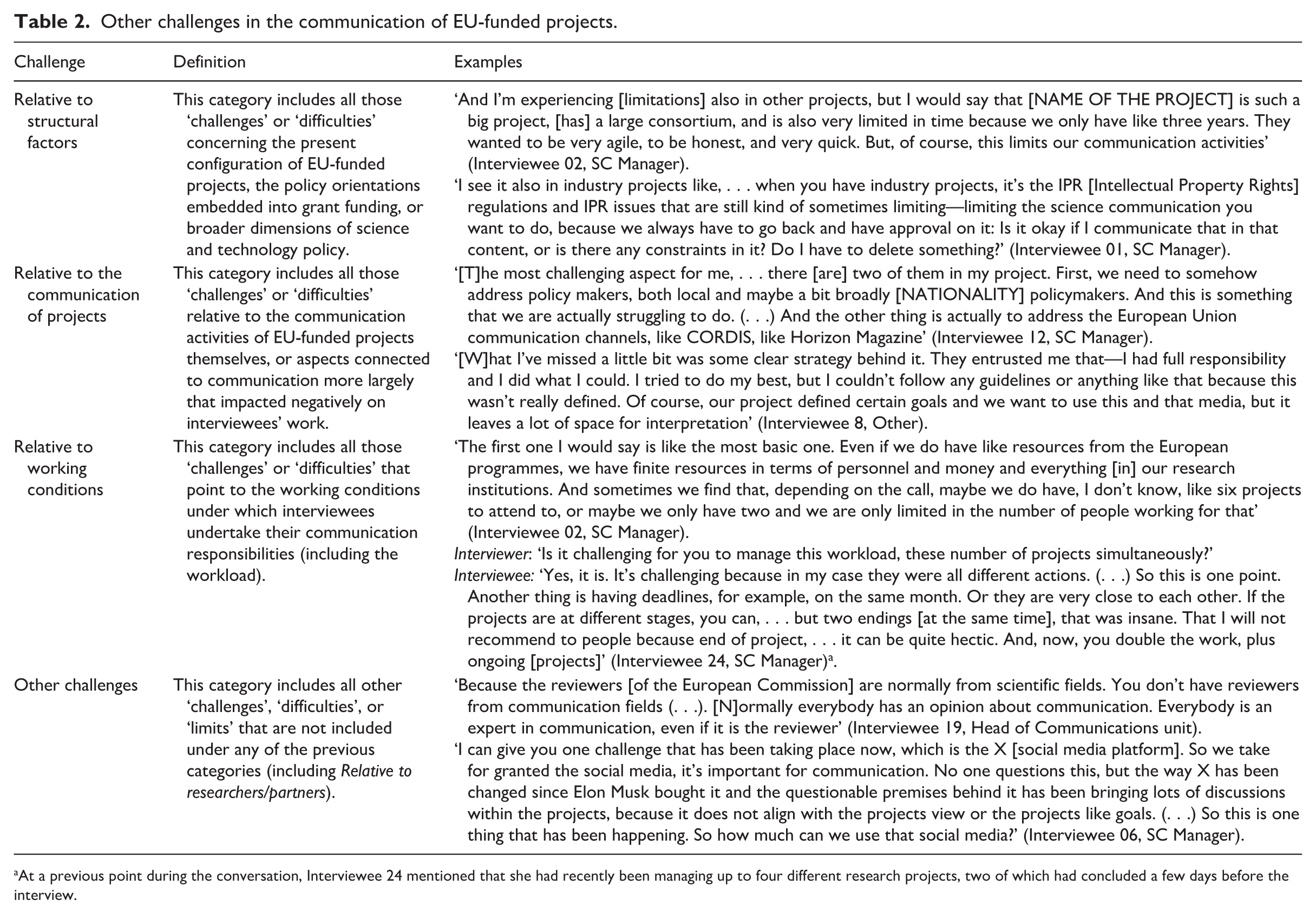
At a previous point during the conversation, Interviewee 24 mentioned that she had recently been managing up to four different research projects, two of which had concluded a few days before the interview.
Funding for the communication of EU-funded projects
Interviewees were divided on whether funding, or the available budget for C&D WPs in EU-funded projects, represents an issue. There was nevertheless a prevalence of the view that funding is not problematic, and that the budget allocated to communication activities is generally satisfactory: I always found the budget to be quite accurate, yes. If there was a big project where you were expected, . . . it was agreed to reach out to a large audience, set up many stakeholder engagement activities, like workshops, events—I feel the budget was there. (Interviewee 16, SC Manager)
However, inductive coding also uncovered several dimensions pertaining to funding that are not reducible to the available budget as such. Crucially, several interviewees noted that allocated funding is merely sufficient to do the ‘standard thing’, while more impactful or experimental forms of science communication may be beyond reach owing to funding constraints. For instance, elaborating on his views on funding—which he does not regard as an issue—Interviewee 10 commented, It would be nice to do more hands-on stuff. We do get to go conferences and that sort of things. But that’s mostly within a certain academic bubble. So, it would be nice to have the budget to do slightly more experimental things, or something a bit more, . . . perhaps engaging to [the] general public than just conference events, perhaps. (Interviewee 10, SC Manager)
These considerations underscore that the prevailing approach to communication activities in EU-funded projects—mainly social media activities and websites, along with public events with selected stakeholders—is partially shaped by the available budget. Funding thus poses a structural limitation on the development of potentially more impactful or engaging forms of science communication and the degree of innovation possible within PBSC (see Biermann et al., 2025).
Two interrelated secondary themes relative to funding that were also identified are the importance of the project proposal and the grant agreement for the subsequent development of the C&D WP, alongside the oftentimes cumbersome process of budget negotiation that communication partners must engage in in order to secure a level of funding consonant with the objectives being sought. The following excerpts capture each of these two dimensions: It depends on who wrote the proposal, how the proposal was written. (. . .) But that budget has never been an issue for us when it comes to communication [and] dissemination. We’ve had enough personal. But that’s because good thought went into the beginning of the project when they were writing the proposal. (Interviewee 17, Other) [W]hat I see from consortia that have asked [NAME OF THE ORGANISATION] to contribute to a proposal is that it is always a bit of a struggle. On the one hand, they see only the research as the main work to be done, and then they kind of try to . . . when you hand in your estimated budget, what you need in the proposal—it’s a lot of time, like a discussion. (. . .) Always in a discussion. (Interviewee 01, SC Manager)
A final theme pertaining to funding is underbudgeting. By this term, I mean the practice of planning, at the proposal stage, a series of communication activities whose viability may be compromised due to the allocation of insufficient budget. While this may result from inadequate planning in some instances, the interviewees who noted this problem also pointed to more structural factors—primarily, the need to keep costs low in order to increase the chances of being awarded funds. When discussing funding, Interviewee 17 (Other) provides a short but exemplary account of the practice of underbudgeting and its main driver, referring to a project whose C&D WP was led by an organisation different from hers: [A]t that point, they’re promising stars, and with the least amount of budget. It’s not also their fault because they want to make sure that they get the budget. But now with feedback, the organisation knows better that: ‘Please, you can promise the world, but please make sure you have enough budget for that, and don’t promise things that you can’t deliver’. (Interviewee 17, Other)
Interviewee 19 (Head of communications department) personally experienced the issue of underbudgeting on more than one occasion. He and the communications team he supervises were involved—without prior notification—in projects whose C&D WP had no dedicated funding: Scientists ask sometime companies (. . .) to write or to support the writing of proposals. So, you got a very well written work package. And then at a certain point, you were involved in the project—without you knowing it. Sometimes they were writing that the science communication office of the institution will support this with no resources. In the beginning, it was a kind of confusing situation, but I started to say ‘No’. (Interviewee 19, Head of communications unit)
It must be stressed that the companies providing professional services in grant proposal writing and related activities to which Interviewee 19 is referring assess their success (on which future profitability prospects hinge) in terms of the number of grants awarded to their clients—thereby creating an extra incentive for underbudgeting. That said, Interviewee 19 does not place the blame on competitive grant funding per se, but rather on the insufficient importance afforded to communication within EU-funded projects and on the subordinate position of communication professionals within research consortia.
Interviewee 21 (Project manager) is also engaged in the C&D WP of a project that she also oversees in her capacity as project manager. According to her testimony, communication activities were not allocated any funding at the proposal stage, and the communications unit of her institution was not involved in the planning process. This may represent the most extreme case of underbudgeting owing to poor planning, which is also how Interviewee 21 frames it. However, the project nevertheless succeeded in all evaluation stages and was awarded the grant, a fact which suggests that either the underbudgeting was not noted by reviewers or, if noted, it may have had a positive effect on the project’s chances of securing funds. It is therefore not far-fetched to state that the C&D WP was not assigned funds, probably because the perceived benefits of proceeding thus outweighed the risks.
Broader views on PBSC
Many interviewees hold negative opinions about current communication practices in EU-funded projects. When assessing communication activities in projects in which they are not involved, the most frequent characterisation was that they tend to be ‘homogeneous’—with projects being ‘indistinguishable’ from one another—representing the ‘standard’ approach or a ‘bare minimum’. Other problems identified include that the choice of communication partners may be guided more by inertia and personal relations than by a proper assessment of all the available options, that communication teams or professionals often lack enough training or experience and that communication activities are generally poorly adapted either to specific publics or to newer trends in social communication more broadly (e.g. the limited uptake of social media platforms such as TikTok).
Notably, only a minority of interviewees frame their negative perceptions of the communication of research projects by other PBSC experts in relation to more general or structural factors—that is, the factors that they themselves acknowledge as constraints on their own work. I identified a tension between these broader structural factors, on the one hand, and the attribution of responsibilities for pitfalls in PBSC to individual communicators, C&D WP leaders or research consortia, on the other. This tension is particularly salient in the following excerpt. Interviewee 20 (SC Manager) indicated that the Key Performance Indicators (KPIs) for communication expected by the European Commission (i.e. number of visits to the website, blog posts, articles produced, etc.) may potentially derail efforts towards more public engagement-oriented initiatives. When invited to further elaborate on her views on this issue, she contends: You just make campaigns that you know they will reach as many followers as possible, . . . for example, [if] you should target local groups and try to make an impact in a local group, you just try to make it as general and as widespread as possible to get as many followers as possible. (. . .) So, if you don’t have enough time to do the work, you just do what gives . . . so that you can fulfil the requirements. (. . .) And only if you have the time for it, then you go beyond that, and actually create impact on the websites, which we then do as soon as we have time. But I think if you’re not a very dedicated science communicator, you’re just going to try to fulfil the KPIs. (Interviewee 20, SC Manager)
In other words, Interviewee 20 acknowledges that there are factors beyond PBSC experts’ purview limiting the degree of creativity and impact feasible in communication campaigns for EU-funded projects. These constraints notwithstanding, she also believes that the ultimate responsibility remains with communicators themselves, who must be passionate and dedicated in order to go beyond the constraints posed by KPIs and explore novel ways of making an impact.
Probing further into the interviewees’ perceptions of PBSC and the communication of EU-funded projects, and drawing on Koivumäki and Wilkinson (2020), PBSC experts were asked whether they perceive downsides or unintended effects arising from the multiplication of EU-funded projects with attached C&D WPs. A minority of them did not report viewing any particular problem in this regard. Interviewee 17 is possibly expressing the prevailing opinion within this group in the clearest manner: [T]here’s no downside. I mean, I don’t see any downside in communicating science at all. I think the more, the better. (Interviewee 17, Other)
Others, by contrast, were much more critical of how the European Commission and other funding agencies leverage competitive grant funding to foster science communication. Various downsides are identified as arising from the proliferation of projects aiming to communicate their results and their underlying science, including competition between projects for limited attention; 6 an excess of information which may, in turn, result in a lack of impact; the misallocation or misuse of resources; and the presence of misaligned objectives. The latter is often addressed in connection with the fact that the communication is currently mandatory in all projects funded under Horizon 2020 and Horizon Europe, on the one hand, and with the kind of KPIs that are expected, or otherwise favoured, by the European Commission, on the other.
One Interviewee was particularly critical of the present configuration of science communication within the framework of EU-funded projects and raised concerns regarding the usefulness of the current approach by the European Commission: Most of the scientific projects that you have in the European commission nowadays—by my point of view, don’t benefit at all from user packages of science communication. Because they don’t do science communication, they do formal communication. And most of time nobody cares about that communication. (. . .) So, I think there is a mess on this producing garbage, lots of garbage, and it takes a lot of resources. (Interviewee 19, Head of Communication office)
By way of synthesis, Interviewee 14 threads together several themes emerging from the discussion of the interviewees’ perceptions of PBSC and the potential downsides arising from the particular manner in which the European Commission seeks to foster science communication: I mean, Europe is so oversaturated with projects—every day more. I don’t mean oversaturated in a bad sense, it’s just, . . . it’s a crowded pond. And human attention, . . . you’re competing in a sense for human attention, for people’s views, for people’s clicks and likes and whatever. And attention spans are getting shorter and shorter. So, making your voice heard can be really difficult. It takes a lot. It takes having the experience of having done it before, being able to pivot when something is not working, just not giving up and saying: ‘Yes, this newsletter is only reaching 15 people, but at least it’s reaching 15 people’. (Interviewee 14, Other)
According to this participant, the present configuration of PBSC results in a multiplication of projects (‘oversaturation’), which in turn leads to competition among projects. This proliferation has a negative impact on communicators’ work (‘So, making your voice heard can be really difficult’), while these professionals are constrained by the commitments set out in advance and reflected in KPIs (‘clicks, and likes and whatever’) —leading to frustration when they cannot be met (‘at least, [this newsletter] is reaching 15 people’).
Further considerations
This section briefly explores two topics that emerged during some of the interviews, and which have been selected given the paucity of research and/or theorisation concerning them in the extant science communication literature. It is argued that both dimensions represent promising avenues for future investigation on the intricate realities of PBSC and the funding mechanism undergirding this distinct setting for science communication. At the same time, I caution readers that the following remarks are exploratory and tentative, and that more research along these lines is needed.
Enforcing the communication of science among researchers
The first theme elaborates upon, as well as illustrates, Koivumäki and Wilkinson’s (2020) contention that grant funding and PBSC lay the groundwork for science communication to be coerced upon researchers. Through the interviews, I gained insight into the concrete mechanisms that compel researchers to collaborate with communication partners or professionals. Project size may be a key factor here, even when the differences are only in degree: in smaller projects with fewer communication-related tasks, the involvement in communication activities is directly included as a duty to be fulfilled in contracts of researchers hired through the project—an increasingly established mechanism (Franssen and de Rijcke, 2019). In larger projects, researchers are bound by the ‘person-months’ assigned within the C&D WP to their institution, department or research centre.
Interviewee 06 (SC Manager) elaborates on the first of these mechanisms in her observations about the ERC project in which she participated as communication officer: The PI [Principal Investigator] of the project, (. . .) she wanted to give a special attention to communication. This meant that, even the application calls for researchers, it was written in the job description that will be required to help on communication. This is [there] since the beginning: they were hired, and when they applied, they knew that this should be part of their jobs. So, starting from this, no one was caught by surprise. (Interviewee 06, SC Manager)
In the following quote, Interviewee 20 (SC Manager) provides insights into the second mechanism (i.e. ‘person-months’) and pinpoints how the ‘person-months’ agreed upon in the grant agreement may serve as a device of last resort to elicit collaboration in communication activities from recalcitrant partners: So then if they really don’t respond, my kind of last barrier is that then I sent them an email and be like, ‘Hey, just as a reminder, you do have six person-months for communication. So, this task that I have been asking you in the last three emails—please, complete it’. For example, making the subtitles for the video. Or, ‘Hey, you are going to this conference, please, do take the pictures. This is part of your obligation for the six person months that you have for this communication work package’. (Interviewee 20, SC Manager)
Similar perceptions are developed by Interviewee 24, who underlines the importance of the grant agreement as a device backed by the authority and power of the European Commission when arguing that funding agencies across the world should follow the lead of the EC and make the communication of projects mandatory: [B]y having this written down in the legal document [that communication is obligatory], you have a basis to ask partners for their contribution. (. . .) By having this line written down that everyone must contribute and participate, you have a basis, (. . .) the legal thing to just bring someone and say, ‘We have to do it together and we cannot do it alone’. (Interviewee 24, SC Manager)
The relevance of the foregoing quotes should be assessed in light of my preliminary remarks (see ‘The distinctness of PBSC’) concerning the distinctness of PBSC as an institutional setting for science communication and the complexities deriving from the extensive division of labour, as well as the dependence of PBSC experts upon researchers and research partners. These excerpts vividly illustrate that the ‘institutional mandate’ characteristic of PBSC takes the form, at least as far as EU-funded projects are concerned, of a specific assignation of person-months in C&D WPs (or, less frequently, through contractual clauses that hired researchers must comply with). PBSC experts can thus leverage the grant agreement to overcome roadblocks caused by the extensive division of labour within projects and their reliance on researchers’ willingness and active support to fulfil communication tasks.
Future research reconstructing the ‘institutional mandate’ in PBSC should consider the perspectives of the other party, that is, the researchers who are bound by the legal obligation.
The political economy of communicating science in EU-funded projects
The context of EU-funded projects is particularly suitable for beginning to explore what remains uncharted territory in science communication studies, namely, the economic dimension of science communication. By this, I concretely mean the burgeoning business of specialised science communication services for EU-funded projects and beyond.
It was seen in section 2 that PBSC evolves out of a competitive funding mechanism, and the empirical findings (especially, ‘Broader views on PBSC’) have shed light on how that competition reaches the C&D WPs—in particular, when the proliferation of projects obliges PBSC experts to compete with one another for public visibility and attention. However, the political economy of science communication promoted through grant funding entails that the competitive process permeating C&D WPs begins much earlier than at the review stage. Companies providing specialised communication services must compete among themselves to be selected as partners in consortia applying for funding. Being invited to consortia may be critical to them, insofar as communicating externally funded projects may have become their primary business line. Naturally, competition in this context is not qualitatively different from that found in any other sector of the capitalist economy: it is based on quality and cost. When quality is held constant, the competitive advantage of any one company lies in its capacity to keep costs low. Interviewee 14 reflects on this dimension in the following quotation, pointing to her company’s relative cost advantage owing to its location in a Southern European territory.
In our case, what helps us a little bit [i.e., in funding acquisition], only a little bit though, is that, as [COUNTRY] organisation, we’re not as expensive in terms of our rates as, say, an organisation in Finland or the Netherlands would be. But we’re still more expensive than an organisation in Turkey or Bulgaria. So, it helps a little bit depending on where we are. (Interviewee 14, Other)
Generally speaking, partnerships between communication specialists and the consortium as a whole are not built upon personal commitments or otherwise unique skills that the former may bring to the team (as the term ‘partnership’ would imply), but rather upon the competitive advantage that some companies may have over others—either in terms of quality or cost, or both. In the quotation above, the competitive advantage consisted primarily of geographical location and the relatively lower costs of labour there.
Moreover, while in larger projects the organisation tasked with the C&D WP is a partner in the consortium and is involved from the early stages of the project, it also occurs that the concrete embedding of C&D WPs into research projects as a whole—that is, as a bundle of tasks only tangentially related to research and with minimum influence upon the project’s scientific achievements—may favour the externalisation or outsourcing of these communication activities when costs can be thereby lowered without substantially compromising the quality of the end product(s). For instance, Interviewee 07 commented on the procurement process for the C&D WP of an ERC project overseen by her project management office. The company that won offered, according to her, ‘the best value for money’—that is, the lowest costs when holding quality of service constant. Big or small, whether as partners or as external providers, business companies are required to offer their communication services in EU-funded projects on a competitive basis.
5. Discussion and conclusion
This article has explored the realities of the communication of EU-funded projects through the experiences, opinions, and beliefs of their main protagonists—namely, the PBSC experts directly or indirectly involved in these communication activities. I have investigated these professionals’ views on the benefits of PBSC both for them personally and for society at large; the challenges (including funding-related ones) they confront in their daily working practices; and their perceptions of PBSC more broadly, including the potential (detrimental) impacts of the promotion of science communication through grant funding.
Regarding Research Question 1 (personal benefits and societal impacts of PBSC), interviewees report several personal benefits deriving from their own involvement in C&D WPs, including learning opportunities, the establishment of personal relations and partnerships, and the possibility of acquiring, applying and refining (communication) skills. Consonant with prior findings, they regard their communication work as a positive contribution to society (Davies, 2020; Wilkinson et al., 2023). At the same time, these societal benefits of PBSC are primarily framed in instrumental terms, that is, as the transmission of useful knowledge or information that enables citizens to keep up with developments in scientific and technological fields. Rather than holding science ‘accountable’ as such, interviewees view the communication of EU-funded projects as indispensable to showcase how taxpayers’ money is spent in research.
In relation to Research Question 2 (challenges faced in the communication of EU-funded projects), several challenges have been identified. Again, in alignment with prior findings (Biermann et al., 2025; Koivumäki and Wilkinson, 2020), the relationship with partners/scientists appears as a key concern. At the same time, the analysis has disclosed that these problematic relations possess a more objective basis, as it were, in the division of labour within projects and the concrete form by which C&D WPs are embedded into research projects—namely, as a separate bundle of tasks with little bearing upon research activities, but dependent on researchers’ input and collaboration. These preliminary insights into the structural dimensions shaping the relations between scientists and communication professionals should inform future research on the particular dynamics of collaboration between these two groups, since the division of labour obtaining in each context may represent a key factor mediating these concrete interactions.
Also in connection with Research Question 2, it has been ascertained that interviewees do not generally regard funding as an issue. Nevertheless, they acknowledge that funding for C&D WPs may be insufficient when costlier and more impactful initiatives (i.e. public engagement) are pursued. Funding strictures may explain, at least partially, why the communication of EU-funded projects tends to be perceived as ‘standard’ or ‘homogeneous’. Therefore, funding is revealed as a factor that necessarily impinges on PBSC experts’ latitude when informing different stakeholders about the project and its outcomes. The analysis has also uncovered other, secondary yet equally relevant aspects pertaining to funding. We now possess a better understanding of how the ‘cost-cutting approach’ favoured by competitive project-based funding (Arboledas-Lérida, 2024; Geuna, 2001) impacts science communication activities conducted within the framework of externally funded research initiatives. Nevertheless, more research along these lines is still needed. Future studies should strive to gain access to the negotiations between communication partners and project coordinators in order to identify how the ‘cost-cutting approach’ unfolds at the microlevel.
Concerning Research Question 3 (perceptions regarding communication practices in EU-funded projects, as well as the broader configuration of science communication via grant funding), the majority—though certainly not all—of PBSC experts are critical. Interviewees celebrate the proliferation of projects and their communication, but also acknowledge their negative side. The interview data provides additional insights into the potentially detrimental effects on PBSC experts’ own communication duties stemming from the proliferation or multiplication of research projects required to communicate. It enables us to advance the enquiry beyond the point reached by Koivumäki and Wilkinson (2020). Proliferation is perceived to lead to competition, and competition, in turn, may hinder potential communication impacts. It is also questioned whether having a dedicated C&D WP within projects creates the right incentives or promotes a more impactful approach to communication. The tension between individual responsibility and structural factors concerning the pitfalls of PBSC as currently practised suggests that, for the PBSC experts surveyed, there is both room for improvement within the present configuration of PBSC in EU-funded projects and a need to create a new institutional setting. This observation is particularly timely, as the next FP for Research and Innovation of the European Commission is in the making. It suggests that PBSC experts’ views and recommendations must be listened to in any potential reshuffling of the approach adopted by the European Commission to the promotion of science communication through grant funding.
Finally, two emergent themes have been identified in the dataset as avenues for future research. The first one refers to the concrete mechanisms through which science communication is coerced or imposed as an obligation upon researchers through grant funding. The second is connected with the undertheorised political economy of science communication. In this latter case, I suggest that future studies could begin by interrogating PBSC as a productive activity and, consequently, as a labour process.
Despite the insights gained into the realities of PBSC through the experiences and opinions of its primary incumbents, this study presents some limitations. Drawing on 26 semi-structured interviews, the degree of generalisability is circumscribed. A different sampling procedure might have yielded different results for some of the topics. However, the author is confident that many of the experiences and opinions reported here are widely shared by PBSC experts across Europe. More research is also needed to understand in what particular manner the structural factors raised during these interviews concretely affect the communication practices being carried out within the framework of EU-funded projects, including the mechanisms and social agents through which these influences are specifically articulated. Project officers tasked with the monitoring and evaluation of projects (including their C&D WPs) should receive greater scholarly attention, given their critical role in supporting and assessing the work of PBSC experts.
The ultimate purpose of this work is to foster research on PBSC as a particular form of science communication. If predictions are accurate, competitive grant funding is set to grow as a funding instrument in the coming years (Reale, 2017)—and, with it, communication work packages embedded in externally funded research projects. The field of science communication studies is therefore bound to gain greater acquaintance with PBSC as a distinct institutional setting for science communication and the ongoing ‘social conversation around science’.
Supplemental Material
sj-docx-1-pus-10.1177_09636625261433895 – Supplemental material for The communication of science within the framework of European Union-funded research projects: Exploring practitioners’ experiences and perceptions
Supplemental material, sj-docx-1-pus-10.1177_09636625261433895 for The communication of science within the framework of European Union-funded research projects: Exploring practitioners’ experiences and perceptions by Luis Arboledas-Lérida in Public Understanding of Science
Footnotes
Acknowledgements
The author is deeply thankful to all the interview participants who dedicated part of their time to share their experiences and perceptions on the communication of EU-funded projects. He also wants to express his gratitude to the two anonymous reviewers for their useful advice and suggestions for improvement. The author is solely responsible for all the remaining shortcomings.

Ethical considerations
In accordance with institutional and national guidelines, this study did not require formal ethical approval, as it involved non-vulnerable adult participants, did not address sensitive topics, and posed minimal risk. Stringent measures were implemented during data collection, processing, and storage to ensure anonymity and data protection.
Informed consent
Informed Consent in written form—based on WHO’s guidelines for qualitative inquiry—was obtained from the participants prior to the beginning of the interviews
Funding
The author disclosed receipt of the following financial support for the research, authorship and/or publication of this article: This work has been supported by the NAWA Agency with a fellowship granted under its 6th Ulam NAWA Program (agreement no. BNI/ULM/2024/1/00032).
Declaration of conflicting interests
The author declared no potential conflicts of interest with respect to the research, authorship and/or publication of this article.
Data availability statement
In order to ensure the confidentiality of research participants, and in line with the commitments made to participants in the Informed Consent Form, interview transcripts will not be made publicly available or shared privately.
Supplemental material
Supplemental material for this article is available online.
Notes
Author biography
References
Supplementary Material
Please find the following supplemental material available below.
For Open Access articles published under a Creative Commons License, all supplemental material carries the same license as the article it is associated with.
For non-Open Access articles published, all supplemental material carries a non-exclusive license, and permission requests for re-use of supplemental material or any part of supplemental material shall be sent directly to the copyright owner as specified in the copyright notice associated with the article.
