




Abstract
Research involving animal experimentation is a contentious issue at the intersection of science and society, making science communication about it especially challenging. Yet, we lack a systematic account of the barriers researchers and communicators face in this context. Our systematic review used a peer-reviewed search strategy and screening by independent reviewers. The resulting 65 documents (e.g. research articles, editorials, comments) underwent full-text qualitative content analysis. Seven barrier themes emerged from the dataset, most prominently: The Research Is Not Well Suited for Science Communication, The Public Is Difficult, and The Discourse Environment Is Complicated and Dysfunctional (occurred in 86%, 85% and 83% of the 65 documents). Each theme contains multiple barrier categories with varying prevalence across the analysed documents. We elaborate on the most prevalent categories and present examples. This offers researchers and communicators an overview of what they might face so they can prepare accordingly, ultimately strengthening public debate.
1. Introduction
Science communication is essential to a society that is increasingly dependent on scientific output. Communication barriers that impair ‘the social conversation around science’ (Bucchi and Trench, 2021: 6) can be detrimental to society – as the COVID-19 pandemic has shown. This literature review systematically identifies barriers in science communication about an issue that is highly relevant to the life sciences but similarly faces diverse viewpoints and controversy: research involving animal experimentation.
Animal experimentation is widely discussed, but it is not well researched as a subject of science communication (Crettaz von Roten, 2020). As a socioscientific issue (Garrecht et al., 2021), animal experimentation is positioned at the intersection of science and society: it is controversial in nature and requires ‘moral reasoning or the evaluation of ethical concerns’ (Zeidler and Nichols, 2009: 49) to be resolved. In the most extreme cases, the controversy around animal experimentation can even become violent (Beversdorf et al., 2015). Accordingly, science communication about research involving animal experimentation likely faces special barriers, or at least faces them to a different degree than science communication about less contentious research.
A literature search reveals the lack of a well established definition and typology of communication barriers – even outside the field of science communication research. The definitions that do exist are very context-specific and only partially translatable to science communication (e.g. Nijkamp et al., 1990; Russ, 2009). The prototypical communication barrier of noise is a variable that negatively affects the fidelity of transmission (i.e. the probability of the message being decoded by the recipient as intended by the sender). Noise can be, for example, spurious information accompanying the signal (Shannon and Weaver, 1964). Shannon’s model has been widely adopted in human communication research (e.g. Schramm, 1970), where communication fidelity is typically defined as the degree of ‘mutual understanding or shared cognition’ (Powers and Witt, 2008: 250) between a sender and a receiver. But what constitutes a barrier in this context is not as clear as what Shannon offers with noise. In human communication, a variable (e.g. the complexity of a message) may both improve and lower communication fidelity simultaneously via different mechanisms and depending on the circumstances. A message’s complexity naturally makes communication (and achieving high fidelity) more difficult, but it may also trigger curiosity and motivate the recipient to seek out more information until high fidelity is achieved (i.e. the knowledge gap is closed; Hidi and Renninger, 2020). So, we take a variable affecting communication (e.g. the complexity of a message) to be a communication barrier if, on average across all (conceivable) communication scenarios, it can be expected to reduce or prevent communication fidelity.
Empirical studies on communication barriers to science communication are often questionnaire-based, asking different actors to evaluate specific barriers to their science communication efforts (e.g. Hamlyn et al., 2015; The Royal Society, 2006; Wilkinson et al., 2023). As these studies denote the barriers explicitly, preliminary barrier categories were easily extracted: (1) the scientific culture surrounding science communication, (2) the science communication efforts themselves, (3) the researchers, (4) the research, and (5) the public.
Scientific culture, that is, ‘the integrated societal value system that appreciates and promotes science’ (Burns et al., 2003: 189), neglects science communication in multiple ways. A common barrier is a lack of resources like time (The Royal Society, 2006; Wilkinson et al., 2023). Science communication competes with other research-related tasks, such as applying for grants (Andrews et al., 2005). In addition, a lack of support, for example, in the form of specialised personnel, is noted (The Royal Society, 2006; Wilkinson et al., 2023). The studies also address how the public is perceived to be difficult to work with: their inability to contribute to research (Hamlyn et al., 2015) or their low interest (The Royal Society, 2006). Such low interest may be related to the low accessibility of research (Hamlyn et al., 2015). After all, comprehensibility is a predictor of lay audiences’ interest in research (Johnson et al., 2019). The questionnaires also identify characteristics of researchers as barriers: a self-reported lack of confidence, skills and/or motivation to communicate (Hamlyn et al., 2015; The Royal Society, 2006; Wilkinson et al., 2023).
These findings are independent of the kind of research that is being communicated. Few studies specifically investigate science communication about research involving animal experimentation, and they are rarely explicitly concerned with barriers to such communication. Instead, barriers naturally emerge. Surveys with students and faculty members indicate that the justifiability of animal experimentation depends both on the taxa employed and the research purpose (Ormandy and Schuppli, 2014; Sandgren et al., 2020). In addition, acceptance of animal research decreases with the amount of pain or distress the animal is subjected to (Hagelin et al., 2003; Sandgren et al., 2022). Low perceived justifiability and also low acceptance of research involving animal experimentation (see also Crettaz von Roten, 2012) among the public can be communication barriers. But the fact that such barriers (can) impair science communication is rarely explicitly discussed.
Although these attitude studies are thorough, they also reveal blind spots in the current state of research: attitudes are just one characteristic of the public that may impair communication, and recipients are not the only actors relevant to science communication. Among researchers, fear and shame can result in a lack of transparency (Arluke, 1991; Holmberg and Ideland, 2010), but such ethnographic approaches are not exhaustive either. Of the papers specifically concerned with science communication about research involving animal experimentation, Crettaz von Roten (2020) addresses barriers most explicitly. But even her questionnaire only encompasses five barriers: the opportunity cost of wasted research time, the risk of being misquoted, the fear of critical reactions from peers or senior staff, and the incompatibility of science communication activities with scientific culture. Finally, media coverage may also negatively impact communication fidelity, although Link et al. (2024) only found a negative impact for their most extreme experimental conditions (multiple negative framing elements). But like Arluke (1991) and Holmberg and Ideland (2010), the approach of Link et al. (2024) focuses on a very specific part of science communication, in this case, the representation of the research in the media.
In summary, many highly specific communication barriers are scattered throughout the literature on science communication about research involving animal experimentation, but comprehensive accounts are lacking. We address this research gap with a systematic literature review, a method suited to reliably uncover international evidence, while minimising bias (Munn et al., 2018). This approach avoids the restrictions associated with the specific research goals and samples of the presented attitude and ethnographic studies. Instead, we broadly present communication barriers that impair science communication about research involving animal experimentation, many of which are also relevant to science communication about other (controversial) research topics. In addition, we hierarchically categorise these barriers and report their prevalence in the data.
2. Methods
A search strategy was developed (i.e. search string construction, database selection, formulation of screening criteria; see supplemental material) to systematically identify literature that specifically addresses science communication about research involving animal experimentation. To ensure transparency and thus improve reproducibility of the review, we adhered to the Preferred Reporting Items for Systematic reviews and Meta-Analysis (PRISMA) where applicable (see Figure 1).
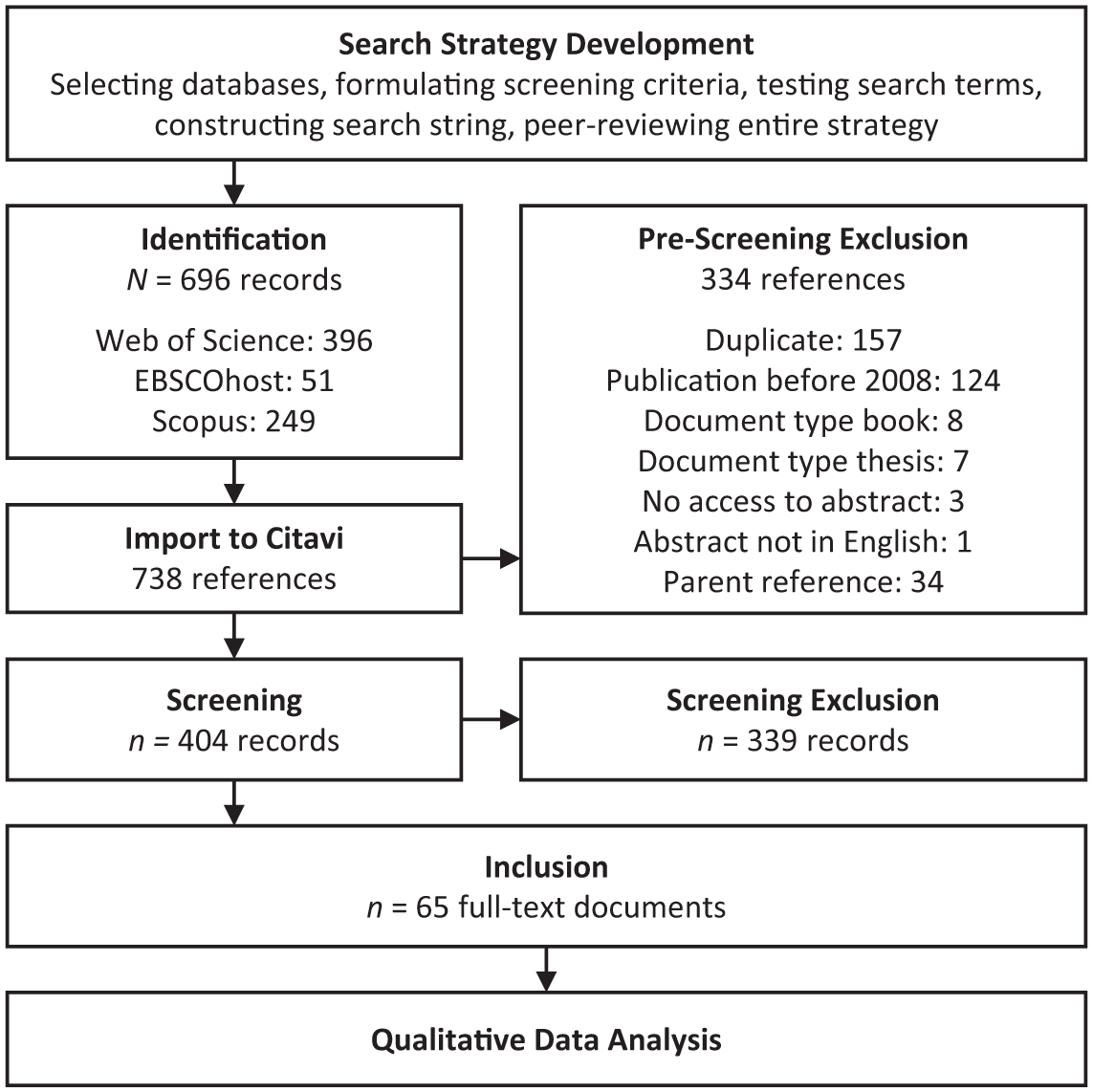
PRISMA flow diagram.
Although designed for clinical trials (Page et al., 2021), PRISMA is often appropriated for reviews in educational sciences (e.g. Garrecht et al., 2018; Hahn and Klein, 2022; Kranz et al., 2022). In addition, recommendations from the Cochrane Handbook for Systematic Reviews of Interventions, like peer reviewing the search strategy and screening with multiple independent raters (Lefebvre et al., 2024), informed our methodological approach (Higgins et al., 2024).
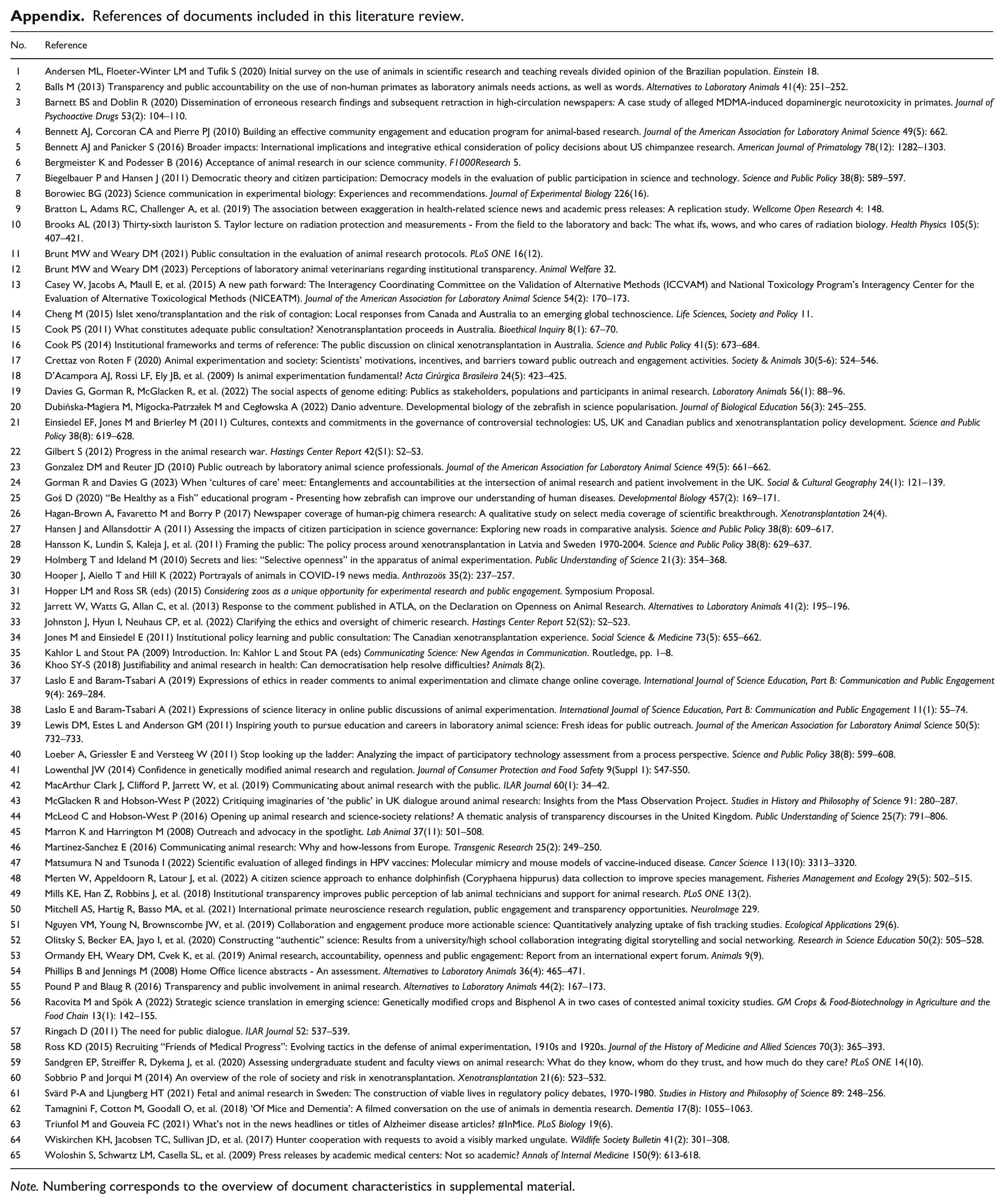
Sixty-five documents resulted from the literature search and screening (see references in appendix; the analysed documents will not be referenced here) and underwent full-text qualitative content analysis (Mayring, 2019). This included axial coding of the barriers into a hierarchical structure of seven barrier themes with multiple barrier categories each (Saldaña, 2013; see supplemental material for more details).
3. Results and Discussion
Seven barrier themes, each containing three to seven barrier categories, emerged from the qualitative analysis (see Table 1). The media theme and the discourse environment theme did not occur in the empirical studies on barriers to science communication in general by Hamlyn et al. (2015), The Royal and Society (2006), or Wilkinson et al. (2023). They were formed inductively based on the dataset of 65 documents. In particular, the discourse environment theme was highly prevalent there (see Figure 2). The other themes were also expanded with inductively derived barrier categories. We will focus our presentation on the most prevalent barrier categories, specifically those mentioned in at least seven documents (>10% prevalence; see highlighted categories in Table 1).
Barriers in science communication (SC) about research involving animal experimentation (AE) sorted by prevalence.
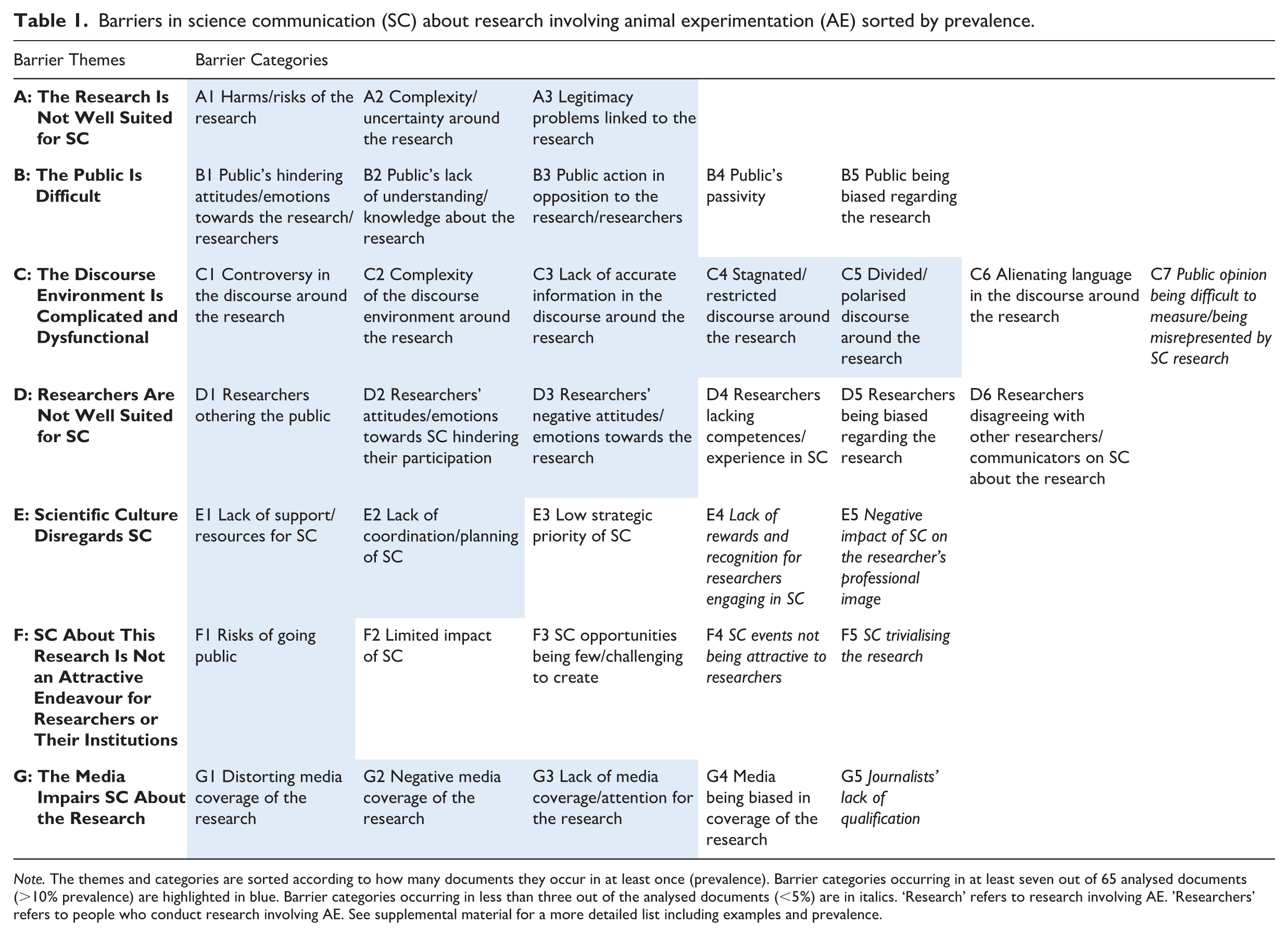
Note. The themes and categories are sorted according to how many documents they occur in at least once (prevalence). Barrier categories occurring in at least seven out of 65 analysed documents (>10% prevalence) are highlighted in blue. Barrier categories occurring in less than three out of the analysed documents (<5%) are in italics. ‘Research’ refers to research involving AE. ’Researchers’ refers to people who conduct research involving AE. See supplemental material for a more detailed list including examples and prevalence.
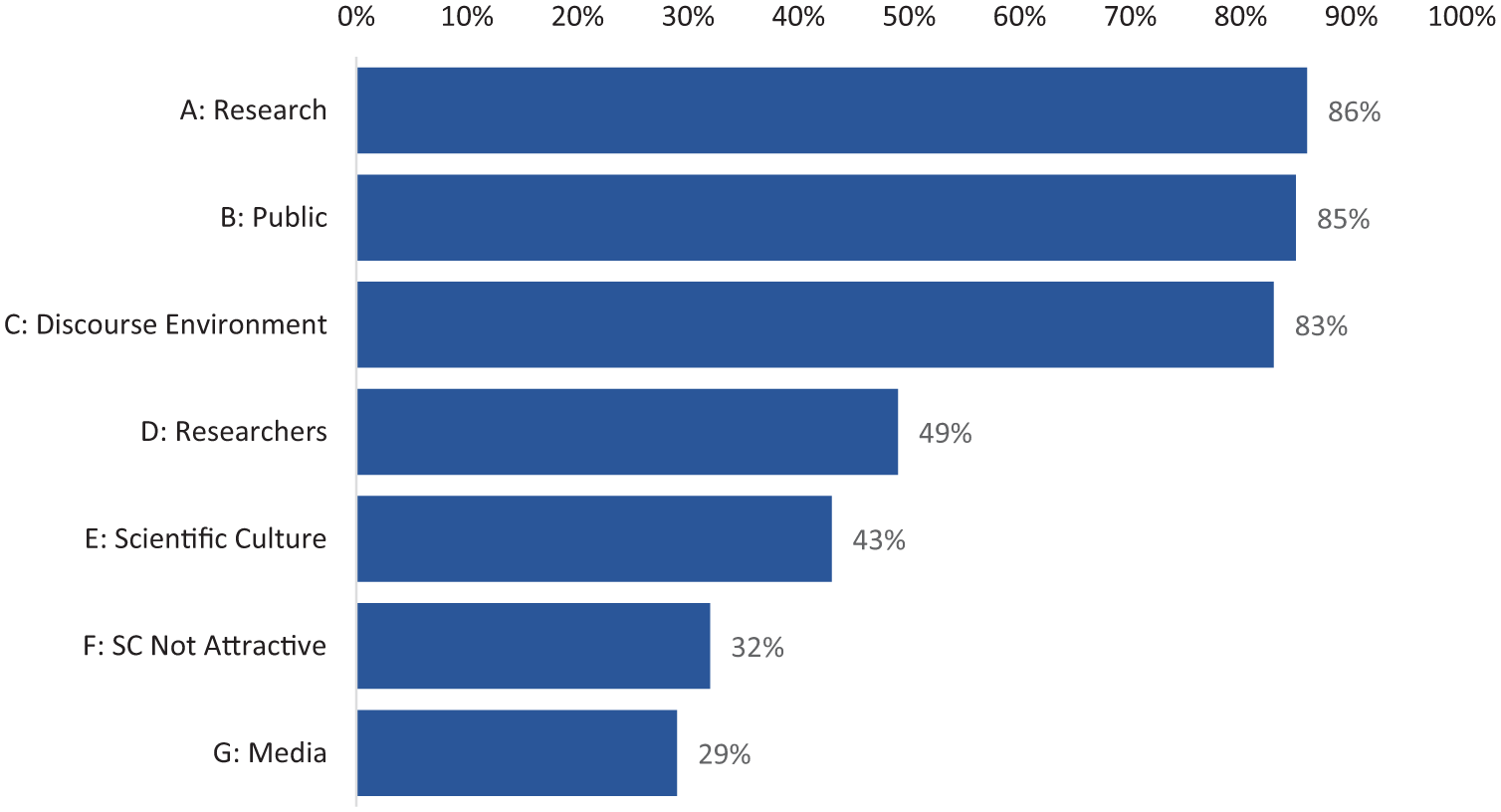
Prevalence of barrier themes in science communication (SC) about research involving animal experimentation.
Theme A: The research is not well suited for science communication
The most prevalent theme in our dataset covers barriers that can be attributed to the research itself. In total, 56 out of 65 documents (86%) address how research is not well suited for science communication because it poses risks and causes harm to test animals (71%), is highly complex and involves uncertainties (63%), or may have legitimacy problems (54%).
A1 Harms/risks of the research
A central reason for opposition towards animal experimentation is the harm done to the test animals. Harm from experiments comes up in many contexts: descriptions of harms (Barnett and Doblin, 2020) including harms from new methods (e.g. in chimeric research; Johnston et al., 2022), assessing harm (Brunt and Weary, 2021), severity levels of experiments (Balls, 2013), mitigating or minimising harm (Brunt and Weary, 2021; Ormandy et al., 2019), and misinformation on (Lewis et al., 2011) or accusations of animal mistreatment (Borowiec, 2023).
In addition, harms and risks are discussed by multiple authors in the context of weighing them against potential benefits of the research (Davies et al., 2022; Khoo, 2018; Laslo and Baram-Tsabari, 2019). Such calculations are especially relevant for philosophical arguments and policy decisions regarding the research (Gilbert, 2012) as well as the justifiability (Bennett and Panicker, 2016; Khoo, 2018) or necessity of the research (Hagan-Brown et al., 2017). As public sensitivities towards animals increase (Crettaz von Roten, 2020), the harms involved in animal experimentation naturally make science communication about such research more difficult.
Risks of the research are addressed in the context of requiring assessment (e.g. genetic modification; Lowenthal, 2014) but also when animal experimentation is itself used for risk assessment (e.g. toxicity studies; Racovita and Spök, 2022). With risk communication being notoriously difficult (Sobbrio and Jorqui, 2014) – not least due to the uncertainties addressed above – risks represent barriers inherent to the communicated research.
A2 Complexity/uncertainty around the research
Research involving animal experimentation is described as a complicated and complex science (Barnett and Doblin, 2020; Laslo and Baram-Tsabari, 2019; Pound and Blaug, 2016) involving technical concepts and details (Khoo, 2018; Ormandy et al., 2019). It also covers multiple disciplines and levels of abstractions (Laslo and Baram-Tsabari, 2019) and yields complex, difficult-to-interpret results (Martinez-Sanchez, 2016).
Such barriers are generic across different research areas, but research involving animal experimentation has additional, unique complexities like choosing the appropriate animal (McGlacken and Hobson-West, 2022) and assessing animal suffering (Phillips and Jennings, 2008). This makes such research ethically complex: the unpredictability of risks and benefits (Bennett and Panicker, 2016; Cook, 2014; Khoo, 2018) complicates consequentialist calculations. Other ethical frameworks, such as deontological ethics and virtue ethics, can also be involved (Laslo and Baram-Tsabari, 2019), leading to highly demanding discussions. In general, the issue of animal experimentation is described as dilemmatic (Pound and Blaug, 2016) with conflicting values (Laslo and Baram-Tsabari, 2019) being relevant to its evaluation. On top of that, specific contexts such as research involving non-human primates pose additional challenges. Primates warrant special ethical consideration due to their high cognitive abilities (Balls, 2013; Bennett and Panicker, 2016; Mitchell et al., 2021), which further complicates the choice of the test animal. Finally, the regulatory frameworks and guidelines for animal experimentation are themselves complicated, for example, guidelines on research with non-human primates differ across countries (Mitchell et al., 2021). As this regulatory complexity gets entangled with the already complicated practice (McGlacken and Hobson-West, 2022), animal experimentation becomes an especially challenging topic for science communication.
A3 Legitimacy problems linked to the research
Across the data, multiple negative aspects of the research are addressed that relate to questions of legitimacy. Research that is (perceived to be) illegitimate because it lacks usefulness, value, necessity, or validity is difficult to communicate. Similarly, insufficient governance procedures, methodological errors, researcher misconduct, or scandals associated with the research may contribute to a lack of legitimacy.
A central legitimacy issue is that the research might not be expected to yield sufficient benefits, especially in xenotransplantation (Cheng, 2015; Cook, 2014). Such limited usefulness of the research is also framed as a perception among the public (Tamagnini et al., 2018), and a possible lack of necessity is even exclusively presented as perceived by the public (Phillips and Jennings, 2008; Tamagnini et al., 2018). On the other hand, doubts about the value of research involving animal experimentation are attributed to both the public (Ringach, 2011) and the scientific sphere (Pound and Blaug, 2016). There is even some evidence of validity issues, specifically in the context of Alzheimer’s disease research in mice (Triunfol and Gouveia, 2021). But generally, a lack of validity is framed as a problem perceived by the public (e.g. questionable translatability; Brunt and Weary, 2021).
More concrete legitimacy problems can taint the image of the research or even the broarder research area. Not only is spurious research in itself a bad subject for science communication (Barnett and Doblin, 2020; Cheng, 2015; Racovita and Spök, 2022), it may hurt the legitimacy of related research and make science communication about those topics more difficult too. Likewise, inadequate (Khoo, 2018) or failing governance procedures (Sandgren et al., 2020) may undermine public trust in the research. However, the biggest threats to legitimacy are likely cases of misconduct and scandals. Historical misconduct is mentioned in chimeric research (Johnston et al., 2022) and xenotransplantation (Hansson et al., 2011). However, much more often, researchers’ misconduct is framed in the data as allegations (Borowiec, 2023; Laslo and Baram-Tsabari, 2019; MacArthur Clark et al., 2019) or as a broad narrative surrounding the research (Holmberg and Ideland, 2010; Lewis et al., 2011). Whether the alleged misconduct is true or not is likely of little significance to science communication about the research. The reputational damage to the research impairs science communication regardless.
Theme B: The public is difficult
In 85% of the documents, the public is described as being difficult to communicate with regarding research involving animal experimentation. The public’s attitudes/emotions (82%), lack of understanding/knowledge (46%), or opposing actions (37%) can interfere with and inhibit communication efforts.
B1 Public’s hindering attitudes/emotions towards the research/researchers
On the side of the receiver, multiple factors can represent a barrier to communication. Among them are attitudes towards research and researchers working with animal experimentation. Opposition, concerns, and mistrust among the audience are barriers to science communication efforts. In addition, a disregard for the research’s contributions can be observed in part of the data. If the audience does not acknowledge the efficacy of the research (Khoo, 2018), the communicative strategy of highlighting past successes to justify the research fails.
By far the most prevalent attitude that makes the public a difficult audience is general opposition towards the research. Besides direct references to opposition (Johnston, 2022; Lowenthal, 2014; MacArthur Clark et al., 2019), this barrier principally occurs as mentions of anti-animal experimentation activists, organisations, and movements (Crettaz von Roten, 2020; Holmberg and Ideland, 2010; Martinez-Sanchez, 2016). Studies showing rising opposition or low or declining public support for the research are also often presented (Crettaz von Roten, 2020; Khoo, 2018; MacArthur Clark et al., 2019; Sandgren et al., 2020). This contributes to a separation of the public into those who support and those who oppose animal research (Holmberg and Ideland, 2010; Ringach, 2011). Opponents are then diagnosed as misunderstanding the research (Ringach, 2011) or being emotional in their communication and mistrustful of researchers (Laslo and Baram-Tsabari, 2019).
Opposition can be rooted in concern about the research (Brunt and Weary, 2021; Johnston et al., 2022), which is a straightforward barrier, often addressed verbatim (Borowiec, 2023; Brunt and Weary, 2021; Gorman and Davies, 2023; Johnston et al., 2022). The public is reported to be concerned about different aspects of the research, like risks to public health (Cheng, 2015; Hansson et al., 2011), appropriate regulations (Cheng, 2015), and most often animal welfare (Davies et al., 2022; MacArthur Clark et al., 2019; Phillips and Jennings, 2008; Ringach, 2011). In that regard, Balls (2013) specifically highlights concerns about non-human primates due to their cognitive abilities. Concerns are voiced in the public sphere, on the Internet (Laslo and Baram-Tsabari, 2019), in public consultations, and in the media (Einsiedel et al., 2011), which increases their potency as a barrier.
Mistrust towards the researchers, communicators, their institutions, or science in general is also a barrier to communication. A lack of transparency and secrecy is often cited as a cause for the erosion of trust in science (Laslo and Baram-Tsabari, 2021; MacArthur Clark et al., 2019; Mitchell et al., 2021). Such a lack of transparency from the side of the researchers leaves the stage to opponents of the research, leading to a one-sided information landscape (Borowiec, 2023). For example, horror images framed by animal rights activists and spread by the media can lead audiences to lose trust in the research, regardless of how accurate or representative those images are. Regulations and standards of animal welfare in research cannot appease an audience that does not believe that researchers adhere to those standards (MacArthur Clark et al., 2019). Past failures of governing bodies are also discussed to have a lingering impact on trust among the public (Cook, 2014). Evidence of mistrust backs up these prevalent assumptions: the public is reported to lack trust in scientific results (Bratton et al., 2019), researchers (MacArthur Clark et al., 2019), and governance (McGlacken and Hobson-West, 2022).
Negative emotions like fear, false hope, irrationality, or even general emotionality also impair science communication. In the context of research involving animal experimentation, the public’s fear of the research in general (Gorman and Davies, 2023) or specifically its application (Hagan-Brown et al., 2017) can be a powerful, negative emotion. False hope can represent another pitfall. Stemming from, for example, misrepresentation in the media, the audience may interpret research results to be more promising than they really are. This barrier occurs specifically in medical research, where results from trials in mice may generate false hope for a cure (Triunfol and Gouveia, 2021).
Irrationality and general emotionality are barriers framed in contrast to the rational and objective scientific sphere (Cook, 2014). This framing is criticised (Holmberg and Ideland, 2010) but also supported by qualitative analysis (Laslo and Baram-Tsabari, 2019). Among a public that already regularly displays outrage about the research (Einsiedel et al., 2011; MacArthur Clark et al., 2019), animal rights activists are especially difficult to reason with (McGlacken and Hobson-West, 2022). They are reported to react emotionally to animal experimentation and exhibit an incoherent ideology (Holmberg and Ideland, 2010). Bias can aggravate this, and it is not only present among opponents (Khoo, 2018) but also the general public (Laslo and Baram-Tsabari, 2021; Mills et al., 2018). Such bias influences how the public evaluates the research (Khoo, 2018) and leads to avoidance behaviour (Davies et al., 2022; Pound and Blaug, 2016). However, these descriptions of the public inevitably contain some degree of stereotyping. It is not clear to what degree these stereotypes – even more than factual emotionality and irrationality of the public – are the actual barriers.
B2 Public’s lack of understanding/knowledge about the research
The public’s lack of understanding is a prevalent barrier in the data. The public is often perceived as ignorant (Holmberg and Ideland, 2010), limited in understanding (Andersen et al., 2020), prone to misunderstanding (Brunt and Weary, 2023), or having distorted knowledge of the research (Barnett and Doblin, 2020). This barrier occurs principally in two forms. One: the barrier is presented as a genuine diagnosis of how the public lacks understanding regarding animal experimentation (Martinez-Sanchez, 2016), including citations of surveys (Kahlor and Stout, 2009; Lewis et al., 2011; MacArthur Clark et al., 2019) and original, empirical research (Sandgren et al., 2020). And two: the barrier is framed as a stigmatisation of the public, a perceived or alleged lack of understanding typical of Deficit model thinking (Holmberg and Ideland, 2010; Laslo and Baram-Tsabari, 2021). McGlacken and Hobson-West (2022) even highlight how experts benefit from constructing an uninformed public: it prioritises their authority. Being un- or misinformed, the public’s input during science communication efforts is devalued: they cannot meaningfully contribute to the research or decisions surrounding it (Brunt and Weary, 2021) and assume a passive, receiving role (Cook, 2014; Crettaz von Roten, 2020) if any role at all. Thus, the lack of knowledge also works as a mechanism of exclusion (Hansson et al., 2011). It remains unclear whether the perception of an uninformed public or objective ignorance among the public hinders science communication more.
B3 Public action in opposition to the research/researchers
In some cases, attitudes and emotions motivate people to take legal and even criminal action against research involving animal experimentation. Multiple sources address legal initiatives by opponents of animal experimentation, such as attempts to grant non-human primates personhood (Bennett and Panicker, 2016) or place bans on animal experimentation (Crettaz von Roten, 2020). Lawsuits against researchers or institutions occur regularly (Cheng, 2015). Such legal action increases controversy surrounding the research and can popularise (false) claims of researcher misconduct (MacArthur Clark et al., 2019).
Public action also impairs science communication by scaring potential communicators. Researchers may be deterred from communicating about the research by activists targeting them (MacArthur Clark et al., 2019; Ormandy et al., 2019). Examples include ‘shock and shaming tactics’ (Einsiedel et al., 2011: 625), insults (Crettaz von Roten, 2020), and even violent actions against researchers or their institutions (Crettaz von Roten, 2020; MacArthur Clark et al., 2019).
Reports of public action stand in contrast to the public being (constructed as) passive (Cook, 2014). This conception is challenged (McGlacken and Hobson-West, 2022), but reports of avoidance behaviour towards the topic of animal experimentation (Davies et al., 2022; Pound and Blaug, 2016) support the diagnosis of a disengaged public. Whether actively opposing research involving animal experimentation or hardly paying attention to it, both extremes are challenges to science communication in their own way.
Theme C: The discourse environment is complicated and dysfunctional
With occurrences in 83% of the documents, the complicated and dysfunctional discourse environment is the third most prevalent theme. It is also the broadest one, both conceptually and in the number of barrier categories. The theme comprises seven categories of which we present here the five most prevalent: controversy surrounding the research (55%), complexity of the discourse environment (46%), the lack of accurate information in the discourse (46%), stagnation and restrictions of the discourse (43%) and the divided and polarised nature of the discourse (32%).
C1 Controversy in the discourse around the research
Controversy is certainly a symptom and catalyst of a polarised discourse, but it is so frequently addressed in the data that it stands out as its own category. Controversial is used as a descriptor of the research in general (McLeod and Hobson-West, 2016; Ormandy et al., 2019; Sandgren et al., 2020) and the specific practice of animal experimentation (Crettaz von Roten, 2020; Gilbert, 2012; Holmberg and Ideland, 2010; Laslo and Baram-Tsabari, 2019). Authors present controversies as events in reaction to the research (Andersen et al., 2020; Biegelbauer and Hansen, 2011; Davies et al., 2022; Holmberg and Ideland, 2010) or intense debates in public (Biegelbauer and Hansen, 2011) and even within the scientific community (Barnett and Doblin, 2020). Controversy is framed as a problem that has to be circumvented (Hansson et al., 2011), avoided (Holmberg and Ideland, 2010), or as legitimising secrecy (Mills et al., 2018). On a more positive note: controversy is also described as motivating researchers to proactively address it with clear communication (Johnston et al., 2022). This illustrates how barriers do not exclusively impair science communication.
C2 Complexity of the discourse environment around the research
The discourse environment that researchers and communicators have to navigate is complex. Sometimes, information on the research is plainly described as complex (Laslo and Baram-Tsabari, 2019) while other documents vaguely refer to a range of contextual factors and complex settings surrounding science communication efforts (Einsiedel et al., 2011; Racovita and Spök, 2022). This barrier category also manifests in the data as an immense diversity of discourse participants: multiple or diverse stakeholders and interest holders (Bennett and Panicker, 2016; Laslo and Baram-Tsabari, 2019), diverse or multidimensional publics and audiences (Brunt and Weary, 2021; Davies et al., 2022; Kahlor and Stout, 2009; Laslo and Baram-Tsabari, 2019), as well as heterogeneous researchers are addressed (Crettaz von Roten, 2020). The complexity arising from this diversity is aggravated by competing or conflicting interests (Cheng, 2015; Khoo, 2018; Racovita and Spök, 2022).
Discourse participants are reported to be diverse in multiple ways, like ‘life experiences, religion, values, culture, age, education’ (Sobbrio and Jorqui, 2014: 530). But the diversity of viewpoints was especially prevalent in the data (Cheng, 2015; Sandgren et al., 2020). Views can differ based on the particular nature of the research (Andersen et al., 2020), like the species involved (Brunt and Weary, 2021). Interestingly, Davies et al. (2022) stress how public views cannot be easily aggregated into one opinion – especially with polls that rely on biased samples and flawed methodologies – which further complicates the discourse environment.
C3 Lack of accurate information in the discourse around the research
With such diverse viewpoints, the discourse runs the risk of having a poor signal-to-noise ratio. Misinformation in the discourse is noted in multiple sources (Brunt and Weary, 2023; Dubińska-Magiera et al., 2022). It can come from faulty science (Cheng, 2015; Racovita and Spök, 2022) or in the form of exaggerations in media releases (Bratton et al., 2019). But most often it is blamed on the activity of opponents of animal experimentation (McLeod and Hobson-West, 2016; Martinez-Sanchez, 2016) who fill the communication vacuum left by a lack of accurate science communication (Martinez-Sanchez, 2016). For example, public abstracts and project reports of research involving animal experimentation are criticised to lack or be vague about the species of test animals and severity levels (Balls, 2013; Phillips and Jennings, 2008). With science communication efforts and even academic sources (Triunfol and Gouveia, 2021) struggling to provide accurate information, it is no surprise that the discourse is dominated by those opposing the research (Borowiec, 2023; Holmberg and Ideland, 2010).
C4 Stagnated/restricted discourse around the research
Possibly the biggest reason for the above-mentioned information vacuum is a stagnated discourse on research involving animal experimentation. In attempts to avoid controversy, institutions employ a strategy of ‘selective openness’ coined by Holmberg and Ideland (2010) and broadly recognised (Brunt and Weary, 2023; Crettaz von Roten, 2020; Gilbert, 2012). Selective openness means that researchers or institutions place specific restrictions on how the research is communicated. Such restrictions can take the form of self-censorship (Holmberg and Ideland, 2010) and even go as far as keeping research activities involving animal experimentation secret (Holmberg and Ideland, 2010; MacArthur Clark et al., 2019; McGlacken and Hobson-West, 2022; Mills et al., 2018). Research with non-human primates is mentioned specifically in this context (Brunt and Weary, 2023). Although the way selective openness restricts discourse does not apply to all countries to the same degree (McLeod and Hobson-West, 2016), it still represents a major barrier to science communication about research involving animal experimentation.
Restrictions on science communication are a defining feature of strategic and agenda-driven science communication. Such science communication has the goal of positively influencing public attitudes (Brunt and Weary, 2023), but restrictions are reported to have multiple additional motives. Restriction helps to minimise reputational risks to the institutions conducting animal experimentation (Brunt and Weary, 2023), and selective openness and secrecy are ways of dealing with negative emotions, for example, preventing shame (Holmberg and Ideland, 2010). However, these restrictions impair science communication beyond the stagnation effects. Ultimately, perceptions of secrecy can reduce public trust and even undermine research legitimacy (Pound and Blaug, 2016).
However, public debate is not only limited by the scientific sphere preventing transparency. The literature also references the exclusion of the public from research-related decision-making (Einsiedel et al., 2011; Hansson et al., 2011) and marginalisation (Cook, 2011). Holmberg and Ideland (2010) criticise how citizens are often outnumbered in committees that evaluate animal experimentation. That way, a scientific – and supposedly objective – interpretation is privileged over the social and emotional interests of the public (Cook, 2014; Einsiedel et al., 2011). Also, some science communication efforts involve only pre-selected audiences (Sobbrio and Jorqui, 2014), are restricted by top-down, Deficit model approaches (Cook, 2014), or even a few predetermined outcomes (Einsiedel et al., 2011).
Finally, discourse around research involving animal experimentation is stifled by unclear standards of transparency (Brunt and Weary, 2023; McLeod and Hobson-West, 2016). Without a clear definition of what constitutes transparency, researchers and their institutions cannot be sure what exactly should or should not be communicated. Transparency may then be interpreted as absolute, meaning all scientific and societal uncertainties, as well as ethical questions, are to be communicated (Crettaz von Roten, 2020). However, such impossible standards are bound to deter people from engaging in science communication.
C5 Divided/polarised discourse around the research
In contrast to the diversity of viewpoints addressed above, some documents mention just two sides to the debate about research involving animal experimentation (e.g. xenotransplantation; Biegelbauer and Hansen, 2011). A division is diagnosed between science and society (Andersen et al., 2020; Cook, 2011), researchers and opponents (Gilbert, 2012), or among the public (Khoo, 2018). Causes for these divisions include othering (Cook, 2014) and failed communication attempts, for example, ‘some students may feel blocked from science’ (Olitsky et al., 2020: 507) due to the way it is presented in science communication efforts.
More problematic than division is polarisation. Polarisation is described as a general characteristic of the discourse surrounding animal experimentation (McLeod and Hobson-West, 2016). A polarised discourse leaves little room for nuance (Crettaz von Roten, 2020; Gilbert, 2012) and can even silence researchers in fear of violent reactions (Crettaz von Roten, 2020). Instrumentalisation of science by opposed interest groups also relates to polarisation, both as a symptom (Racovita and Spök, 2022) and a catalyst (Cheng, 2015). In addition, experts’ ‘patronising, hierarchical attitude’ (Tamagnini et al., 2018: 1056) is reported as contributing to polarisation. From this perspective, polarisation may be constructed by a prejudiced approach to science communication – a self-inflicted problem of scientific culture.
Theme D: Researchers are not well suited for science communication
Forty-nine percentage of the documents point out multiple barriers that – if valid – would make a researcher less well suited to do science communication than one might expect. Science communication research in general highlights the lack of skills or confidence for science communication among researchers (Wilkinson et al., 2023). But in the context of animal experimentation, other barriers are more prevalent: researchers othering the public (23%), researchers’ attitudes or emotions towards science communication (20%) or towards the research (18%).
D1 Researchers othering the public
Othering – the process of demarcating an ‘us’ from a ‘them’ – is frequently addressed in the data. Most strikingly, this leads to the isolation of so-called ‘publics in particular’ from the general public (Holmberg and Ideland, 2010; McGlacken and Hobson-West, 2022). These particular publics are seen as undebatable (Holmberg and Ideland, 2010) or unruly (McGlacken and Hobson-West, 2022), and are sometimes excluded from surveys (Hansson et al., 2011) and policy decisions on issues involving animal experimentation (Einsiedel et al., 2011).
Multiple stereotypes fuel this exclusion: researchers are documented to assume that (part of) the public lacks interest (McGlacken and Hobson-West, 2022), mistrusts the research (McGlacken and Hobson-West, 2022; Sobbrio and Jorqui, 2014), is over-emotional (Holmberg and Ideland, 2010), and uninformed or misinformed about the research (Crettaz von Roten, 2020; Dubińska-Magiera et al., 2022; McGlacken and Hobson-West, 2022). Thus, public opinion and specifically concerns are sometimes dismissed (Cook, 2014), and public input to the research is not seen as necessary (Hansson et al., 2011) or even valuable (Brunt and Weary, 2021; Hansson et al., 2011).
D2 Researchers’ attitudes/emotions towards science communication hindering their participation
Science communication is still seen as not relevant by some researchers (Borowiec, 2023). Researchers may be reticent to talk to the public about research involving animal experimentation (Crettaz von Roten, 2020; MacArthur Clark et al., 2019; Ringach, 2011), feeling ‘that it is not their job to convert a sceptical public’ (Holmberg and Ideland, 2010: 362). Such attitudes may come from activists’ hostilities instilling fear in researchers (Gilbert, 2012; Holmberg and Ideland, 2010; Phillips and Jennings, 2008) or even critical reactions from peers or the hierarchy for engaging in science communication (Crettaz von Roten, 2020).
D3 Researchers’ negative attitudes/emotions towards the research
Some documents note how researchers may view research with animals (at least partly) in a negative light and doubt how successful it will be (Cook, 2014) or how ethical it is (Crettaz von Roten, 2020). Holmberg and Ideland (2010) even read a ‘collective, culturally shared, shame’ (p. 366) into researchers’ accounts of their work. In the context of xenotransplantation, multiple documents also note safety concerns regarding the application of the research (Cheng, 2015; Hansson et al., 2011). But ethical concerns (including about animal welfare) are also addressed (Crettaz von Roten, 2020; Hagan-Brown et al., 2017; Johnston et al., 2022). In addition, Johnston et al. (2022) report validity concerns, specifically about the robustness of animal models for human biology and the ability of animal experimentation to generate the quality results it claims. Here, researchers echo some of the concerns of the public, though it is less pronounced in the data.
Theme E: Scientific culture disregards science communication
In the context of research involving animal experimentation, scientific culture disregards science communication in multiple ways. The theme occurs in 43% of the documents, with the most prevalent category being a lack of support and resources (35%), followed by a lack of coordination or planning (14%).
E1 Lack of resources/support for science communication
The lack of time for science communication is addressed by multiple authors (Borowiec, 2023; Phillips and Jennings, 2008; Ringach, 2011). However, a lack of time is partially a priority problem: scientific culture reportedly does not view science communication as a priority (Brunt and Weary, 2023; Cook, 2014; Johnston et al., 2022). This can be construed as the root cause of most of the other barriers in this theme. Especially in the context of animal experimentation, the low priority of science communication can be attributed to institutions being cautious (McLeod and Hobson-West, 2016) and even fearful of being transparent (Brunt and Weary, 2023). In this cultural climate, science communication efforts have difficulty being funded (Ringach, 2011), and educational material is lacking (Marron and Harrington, 2008).
In addition to the lack of resources, a lack of support structures is reported. Some documents mention that researchers are not trained in science communication (Crettaz von Roten, 2020; Gorman and Davies, 2023), or that their institutions (Crettaz von Roten, 2020) or supervisors (Brunt and Weary, 2023) do not encourage or support science communication. Institutional support could take the form of specialised science communication staff, but that is also reported to be lacking (Brunt and Weary, 2023).
E2 Lack of coordination/planning of science communication
Science communication efforts can require a lot of coordination between actors such as publics, researchers, dedicated communication personnel, administrators, and even between institutions. In line with the low priority of science communication, such coordination is reportedly lacking in the scientific culture surrounding research involving animal experimentation (MacArthur Clark et al., 2019). But science communication efforts not only require coordination, they also need to be planned and designed. Cook (2014) criticises how a framework for public consultations on xenotransplantation did not clarify ‘what active community participation and consultation should look like’ (p. 679) or how the results of such science communication efforts should be used. And in the context of patient involvement, Brunt and Weary (2023) note the lack of a ‘plan to increase transparency’ (p. 6). Ultimately, the lack of such plans and coordination limits researchers’ opportunities to present their research, which itself is another barrier (Dubińska-Magiera et al., 2022; MacArthur Clark et al., 2019; Tamagnini et al., 2018).
Theme F: Science communication about the research is not an attractive endeavour for researchers and their institutions
Thirty-two percentage of documents address how participating in science communication can be unattractive for researchers, and usually institutions have reasons for not encouraging science communication: the risks of going public make up the most prevalent category in this theme (26%).
F1 Risks of going public
Risks of going public are expected outcomes that researchers or their institutions evaluate negatively. The hostilities that individuals may experience in the controversial climate surrounding research involving animal experimentation are most important here (Borowiec, 2023; Johnston et al., 2022). They are perpetuated by animal rights activists (Holmberg and Ideland, 2010; McLeod and Hobson-West, 2016; Ormandy et al., 2019) with at times violent tactics (Crettaz von Roten, 2020; MacArthur Clark et al., 2019).
Violent tactics are severe risks that cause fear among researchers and other research personnel (Holmberg and Ideland, 2010) and deter them from science communication. Opposition among the public and the controversy surrounding animal experimentation (Crettaz von Roten, 2020; Davies et al., 2022) also mean that institutions may face a reputational risk (Brunt and Weary, 2023) or even compromise their personnel’s security when they are transparent about animal experimentation (Ormandy et al., 2019). If this is widespread, it is no surprise that science communication is not supported or coordinated by institutions (Brunt and Weary, 2023). Another risk of going public is misquotation, highlighting researchers’ sceptical attitude towards the media (Crettaz von Roten, 2020).
Theme G: The media impairs science communication about the research
Twenty-nine percentage of documents mentioned the media, be that newspapers or online comments, as a barrier. This is the least prevalent of the themes, yet it distinctly emerged from the data, with authors reporting distorting (18%), negative (14%), and even a lack of media coverage (11%).
G1 Distorting media coverage of the research
Incorrect coverage involving misinformation and errors (Barnett and Doblin, 2020), misquotation of researchers (Crettaz von Roten, 2020), and omissions of critical information (Triunfol and Gouveia, 2021) can mislead the public. The same is true for oversimplifications (Bratton et al., 2019) and exaggerations (Barnett and Doblin, 2020; Bratton et al., 2019; D’Acampora et al., 2009). Exaggerations are tightly linked to accounts of the media being biased because they are driven by profit incentives (Barnett and Doblin, 2020) or pushing an anti-research agenda (MacArthur Clark et al., 2019).
G2 Negative media coverage of the research
Though negative coverage can be distorting, it can also be legitimate. It can take the form of horrific images and stories from laboratories (MacArthur Clark et al., 2019) or simply concerns about the research. Hagan-Brown et al. (2017) specifically report how newspaper articles covering chimeric research raise ‘ethical, social, and health and safety concerns’ (p. 5). Such coverage – whether legitimate or not – influences public opinion on research involving animal experimentation (Crettaz von Roten, 2020) and thus makes science communication about it more difficult.
G3 Lack of media coverage/attention for the research
Not covering the research can also distort public perception. For example, newspapers are noted to not cover retractions of faulty research (Barnett and Doblin, 2020) or disregard the use of animals in research (Hooper et al., 2022). The preferential coverage of studies that are not transparent about their use of animals (Triunfol and Gouveia, 2021) incentivises researchers in that direction, and thus aggravates the lack of accurate information in the discourse.
Limitations
A central limitation of this literature review is the data set of analysed documents. During sampling, we limited ourselves to academic sources. This likely hid barriers that are primarily perceived by (and relevant to) the audience. In addition, screening was guided by the content of the documents, not their methods or scientific rigour. We can only be agnostic as to whether the circumstances in the documents are accurately described. Authors of the analysed documents may be wrong in their opinions on and descriptions of science communication. Similarly, our analysis of the circumstances described in the documents – namely, their evaluation as barriers and their categorisation – is potentially subjectively biased. Even though we took measures to limit the influence of subjective interpretations (training the coders, intercoder agreement tests, and consensus discussions), most documents (n = 48) were coded by a single coder. A final, independent review by two authors corrected false positives in a broad sample of codes, but false negatives (i.e. passages mistakenly not coded) were not accounted for. Finally, in abstracting the potential barriers from the documents, we did not account for their applicability across different contexts like countries, research areas, and types of communication. For some barriers, we highlighted the specific context in which the barrier is mentioned (e.g. concerns about non-human primates as test animals due to their cognitive abilities). However, in most cases, the authors are not as clear about which context the barrier they address applies to. The blind spot resulting from the exclusion of non-English documents exacerbates this, as culturally specific barriers are likely reported more frequently in the languages of those cultures. Finally, prevalence is a poor proxy for a barrier’s importance. Authors may address a barrier simply because it is obvious, not because it is particularly impairing. In this respect, the identified barriers should be regarded with caution and further context-sensitive research is needed.
4. Conclusion
The number of potential barriers mentioned in the literature makes science communication on research involving animal experimentation sound like an impossible challenge. The academic literature diagnoses the most prominent actors in science communication with mutiple impairing characteristics: the public is broadly accused of being uninformed, too emotional, or simply too opposed to the research for rational discussions. Researchers harbouring such stereotypes might not want to engage in science communication, or they may even be concerned about the research themselves. On top of that, due to its socioscientific character, research involving animal experimentation is per se not well suited for science communication. While its scientific complexity is not unique, the additional ethical and regulatory complexities make it much harder to communicate than other kinds of research. The harm to animals from this research and the numerous legitimacy issues surrounding it also make it a highly emotional topic in comparison with other topics.
Few other forms of research face such vehement and even violent opposition from parts of the public, to the point of making science communication risky for communicators. In response, some institutions and researchers have (historically) decided not to communicate or do so only selectively. The resulting scientific culture does not support or even actively discourages science communication. This not only restricts the discourse on the research, it also leaves a vacuum for oppositional opinions and (mis)information. In a landscape that is already complex with multiple different stakeholders, this one-sided communication contributes to division – and ultimately polarisation. Media coverage that distorts their audience’s perception of the research with exaggerations or (non-representative) horror stories makes earnest dialogue about the topic seem almost impossible. Not only does each of these barriers impair science communication in its own right, they are also likely to aggravate each other in feedback loops that are beyond the scope of this study.
Nevertheless, science communication about research involving animal experimentation is done by dedicated organisations (e.g. Understanding Animal Research in the United Kingdom; Tierversuche verstehen in Germany), social media accounts (e.g. @justsaysinmice), and individual researchers (e.g. Courtney Bannerman; TEDx Talks, 2020). Despite survivorship bias skewing this observation, these examples show that the presented barriers do not entirely prevent science communication on this topic. In fact, many circumstances we labelled as barriers do not exclusively impair science communication: controversy can motivate proactive communication (Johnston et al., 2022), and mistrust may be answered with transparency (MacArthur Clark et al., 2019) or be a driver for consultation between science and society (Einsiedel et al., 2011). In this regard, the identified barriers can serve as a starting point for solutions. There are plenty of general recommendations for good science communication (e.g. transparency and accuracy; Fähnrich et al., 2023) and even some recommendations for science communication about research involving animal experimentation (Link et al., 2024; Sandgren, 2024). However, the presented barriers lend themselves to more targeted research. They can be easily adapted into questionnaires to investigate their relevance in specific contexts and what compensatory strategies stakeholders in those contexts employ. Even beyond the topic of animal experimentation, most of the barriers are promising for such research approaches.
Supplemental Material
sj-docx-1-pus-10.1177_09636625261424852 – Supplemental material for Barriers to science communication about research involving animal experimentation: A systematic literature review
Supplemental material, sj-docx-1-pus-10.1177_09636625261424852 for Barriers to science communication about research involving animal experimentation: A systematic literature review by Sebastian Löser, Emma Weitkamp, Lena M. Schiefelbein, Claudia N. Haertel and Susanne Bögeholz in Public Understanding of Science
Footnotes
Appendix
References of documents included in this literature review.
| No. | Reference |
|---|---|
| 1 | Andersen ML, Floeter-Winter LM and Tufik S (2020) Initial survey on the use of animals in scientific research and teaching reveals divided opinion of the Brazilian population. Einstein 18. |
| 2 | Balls M (2013) Transparency and public accountability on the use of non-human primates as laboratory animals needs actions, as well as words. Alternatives to Laboratory Animals 41(4): 251–252. |
| 3 | Barnett BS and Doblin R (2020) Dissemination of erroneous research findings and subsequent retraction in high-circulation newspapers: A case study of alleged MDMA-induced dopaminergic neurotoxicity in primates. Journal of Psychoactive Drugs 53(2): 104–110. |
| 4 | Bennett AJ, Corcoran CA and Pierre PJ (2010) Building an effective community engagement and education program for animal-based research. Journal of the American Association for Laboratory Animal Science 49(5): 662. |
| 5 | Bennett AJ and Panicker S (2016) Broader impacts: International implications and integrative ethical consideration of policy decisions about US chimpanzee research. American Journal of Primatology 78(12): 1282–1303. |
| 6 | Bergmeister K and Podesser B (2016) Acceptance of animal research in our science community. F1000Research 5. |
| 7 | Biegelbauer P and Hansen J (2011) Democratic theory and citizen participation: Democracy models in the evaluation of public participation in science and technology. Science and Public Policy 38(8): 589–597. |
| 8 | Borowiec BG (2023) Science communication in experimental biology: Experiences and recommendations. Journal of Experimental Biology 226(16). |
| 9 | Bratton L, Adams RC, Challenger A, et al. (2019) The association between exaggeration in health-related science news and academic press releases: A replication study. Wellcome Open Research 4: 148. |
| 10 | Brooks AL (2013) Thirty-sixth lauriston S. Taylor lecture on radiation protection and measurements - From the field to the laboratory and back: The what ifs, wows, and who cares of radiation biology. Health Physics 105(5): 407–421. |
| 11 | Brunt MW and Weary DM (2021) Public consultation in the evaluation of animal research protocols. PLoS ONE 16(12). |
| 12 | Brunt MW and Weary DM (2023) Perceptions of laboratory animal veterinarians regarding institutional transparency. Animal Welfare 32. |
| 13 | Casey W, Jacobs A, Maull E, et al. (2015) A new path forward: The Interagency Coordinating Committee on the Validation of Alternative Methods (ICCVAM) and National Toxicology Program’s Interagency Center for the Evaluation of Alternative Toxicological Methods (NICEATM). Journal of the American Association for Laboratory Animal Science 54(2): 170–173. |
| 14 | Cheng M (2015) Islet xeno/transplantation and the risk of contagion: Local responses from Canada and Australia to an emerging global technoscience. Life Sciences, Society and Policy 11. |
| 15 | Cook PS (2011) What constitutes adequate public consultation? Xenotransplantation proceeds in Australia. Bioethical Inquiry 8(1): 67–70. |
| 16 | Cook PS (2014) Institutional frameworks and terms of reference: The public discussion on clinical xenotransplantation in Australia. Science and Public Policy 41(5): 673–684. |
| 17 | Crettaz von Roten F (2020) Animal experimentation and society: Scientists’ motivations, incentives, and barriers toward public outreach and engagement activities. Society & Animals 30(5-6): 524–546. |
| 18 | D’Acampora AJ, Rossi LF, Ely JB, et al. (2009) Is animal experimentation fundamental? Acta Cirúrgica Brasileira 24(5): 423–425. |
| 19 | Davies G, Gorman R, McGlacken R, et al. (2022) The social aspects of genome editing: Publics as stakeholders, populations and participants in animal research. Laboratory Animals 56(1): 88–96. |
| 20 | Dubińska-Magiera M, Migocka-Patrzałek M and Cegłowska A (2022) Danio adventure. Developmental biology of the zebrafish in science popularisation. Journal of Biological Education 56(3): 245–255. |
| 21 | Einsiedel EF, Jones M and Brierley M (2011) Cultures, contexts and commitments in the governance of controversial technologies: US, UK and Canadian publics and xenotransplantation policy development. Science and Public Policy 38(8): 619–628. |
| 22 | Gilbert S (2012) Progress in the animal research war. Hastings Center Report 42(S1): S2–S3. |
| 23 | Gonzalez DM and Reuter JD (2010) Public outreach by laboratory animal science professionals. Journal of the American Association for Laboratory Animal Science 49(5): 661–662. |
| 24 | Gorman R and Davies G (2023) When ‘cultures of care’ meet: Entanglements and accountabilities at the intersection of animal research and patient involvement in the UK. Social & Cultural Geography 24(1): 121–139. |
| 25 | Goś D (2020) “Be Healthy as a Fish” educational program - Presenting how zebrafish can improve our understanding of human diseases. Developmental Biology 457(2): 169–171. |
| 26 | Hagan-Brown A, Favaretto M and Borry P (2017) Newspaper coverage of human-pig chimera research: A qualitative study on select media coverage of scientific breakthrough. Xenotransplantation 24(4). |
| 27 | Hansen J and Allansdottir A (2011) Assessing the impacts of citizen participation in science governance: Exploring new roads in comparative analysis. Science and Public Policy 38(8): 609–617. |
| 28 | Hansson K, Lundin S, Kaleja J, et al. (2011) Framing the public: The policy process around xenotransplantation in Latvia and Sweden 1970-2004. Science and Public Policy 38(8): 629–637. |
| 29 | Holmberg T and Ideland M (2010) Secrets and lies: “Selective openness” in the apparatus of animal experimentation. Public Understanding of Science 21(3): 354–368. |
| 30 | Hooper J, Aiello T and Hill K (2022) Portrayals of animals in COVID-19 news media. Anthrozoös 35(2): 237–257. |
| 31 | Hopper LM and Ross SR (eds) (2015) Considering zoos as a unique opportunity for experimental research and public engagement. Symposium Proposal. |
| 32 | Jarrett W, Watts G, Allan C, et al. (2013) Response to the comment published in ATLA, on the Declaration on Openness on Animal Research. Alternatives to Laboratory Animals 41(2): 195–196. |
| 33 | Johnston J, Hyun I, Neuhaus CP, et al. (2022) Clarifying the ethics and oversight of chimeric research. Hastings Center Report 52(S2): S2–S23. |
| 34 | Jones M and Einsiedel E (2011) Institutional policy learning and public consultation: The Canadian xenotransplantation experience. Social Science & Medicine 73(5): 655–662. |
| 35 | Kahlor L and Stout PA (2009) Introduction. In: Kahlor L and Stout PA (eds) Communicating Science: New Agendas in Communication. Routledge, pp. 1–8. |
| 36 | Khoo SY-S (2018) Justifiability and animal research in health: Can democratisation help resolve difficulties? Animals 8(2). |
| 37 | Laslo E and Baram-Tsabari A (2019) Expressions of ethics in reader comments to animal experimentation and climate change online coverage. International Journal of Science Education, Part B: Communication and Public Engagement 9(4): 269–284. |
| 38 | Laslo E and Baram-Tsabari A (2021) Expressions of science literacy in online public discussions of animal experimentation. International Journal of Science Education, Part B: Communication and Public Engagement 11(1): 55–74. |
| 39 | Lewis DM, Estes L and Anderson GM (2011) Inspiring youth to pursue education and careers in laboratory animal science: Fresh ideas for public outreach. Journal of the American Association for Laboratory Animal Science 50(5): 732–733. |
| 40 | Loeber A, Griessler E and Versteeg W (2011) Stop looking up the ladder: Analyzing the impact of participatory technology assessment from a process perspective. Science and Public Policy 38(8): 599–608. |
| 41 | Lowenthal JW (2014) Confidence in genetically modified animal research and regulation. Journal of Consumer Protection and Food Safety 9(Suppl 1): S47-S50. |
| 42 | MacArthur Clark J, Clifford P, Jarrett W, et al. (2019) Communicating about animal research with the public. ILAR Journal 60(1): 34–42. |
| 43 | McGlacken R and Hobson-West P (2022) Critiquing imaginaries of ‘the public’ in UK dialogue around animal research: Insights from the Mass Observation Project. Studies in History and Philosophy of Science 91: 280–287. |
| 44 | McLeod C and Hobson-West P (2016) Opening up animal research and science-society relations? A thematic analysis of transparency discourses in the United Kingdom. Public Understanding of Science 25(7): 791–806. |
| 45 | Marron K and Harrington M (2008) Outreach and advocacy in the spotlight. Lab Animal 37(11): 501–508. |
| 46 | Martinez-Sanchez E (2016) Communicating animal research: Why and how-lessons from Europe. Transgenic Research 25(2): 249–250. |
| 47 | Matsumura N and Tsunoda I (2022) Scientific evaluation of alleged findings in HPV vaccines: Molecular mimicry and mouse models of vaccine-induced disease. Cancer Science 113(10): 3313–3320. |
| 48 | Merten W, Appeldoorn R, Latour J, et al. (2022) A citizen science approach to enhance dolphinfish (Coryphaena hippurus) data collection to improve species management. Fisheries Management and Ecology 29(5): 502–515. |
| 49 | Mills KE, Han Z, Robbins J, et al. (2018) Institutional transparency improves public perception of lab animal technicians and support for animal research. PLoS ONE 13(2). |
| 50 | Mitchell AS, Hartig R, Basso MA, et al. (2021) International primate neuroscience research regulation, public engagement and transparency opportunities. NeuroImage 229. |
| 51 | Nguyen VM, Young N, Brownscombe JW, et al. (2019) Collaboration and engagement produce more actionable science: Quantitatively analyzing uptake of fish tracking studies. Ecological Applications 29(6). |
| 52 | Olitsky S, Becker EA, Jayo I, et al. (2020) Constructing “authentic” science: Results from a university/high school collaboration integrating digital storytelling and social networking. Research in Science Education 50(2): 505–528. |
| 53 | Ormandy EH, Weary DM, Cvek K, et al. (2019) Animal research, accountability, openness and public engagement: Report from an international expert forum. Animals 9(9). |
| 54 | Phillips B and Jennings M (2008) Home Office licence abstracts - An assessment. Alternatives to Laboratory Animals 36(4): 465–471. |
| 55 | Pound P and Blaug R (2016) Transparency and public involvement in animal research. Alternatives to Laboratory Animals 44(2): 167–173. |
| 56 | Racovita M and Spök A (2022) Strategic science translation in emerging science: Genetically modified crops and Bisphenol A in two cases of contested animal toxicity studies. GM Crops & Food-Biotechnology in Agriculture and the Food Chain 13(1): 142–155. |
| 57 | Ringach D (2011) The need for public dialogue. ILAR Journal 52: 537–539. |
| 58 | Ross KD (2015) Recruiting “Friends of Medical Progress”: Evolving tactics in the defense of animal experimentation, 1910s and 1920s. Journal of the History of Medicine and Allied Sciences 70(3): 365–393. |
| 59 | Sandgren EP, Streiffer R, Dykema J, et al. (2020) Assessing undergraduate student and faculty views on animal research: What do they know, whom do they trust, and how much do they care? PLoS ONE 14(10). |
| 60 | Sobbrio P and Jorqui M (2014) An overview of the role of society and risk in xenotransplantation. Xenotransplantation 21(6): 523–532. |
| 61 | Svärd P-A and Ljungberg HT (2021) Fetal and animal research in Sweden: The construction of viable lives in regulatory policy debates, 1970-1980. Studies in History and Philosophy of Science 89: 248–256. |
| 62 | Tamagnini F, Cotton M, Goodall O, et al. (2018) ‘Of Mice and Dementia’: A filmed conversation on the use of animals in dementia research. Dementia 17(8): 1055–1063. |
| 63 | Triunfol M and Gouveia FC (2021) What’s not in the news headlines or titles of Alzheimer disease articles? #InMice. PLoS Biology 19(6). |
| 64 | Wiskirchen KH, Jacobsen TC, Sullivan JD, et al. (2017) Hunter cooperation with requests to avoid a visibly marked ungulate. Wildlife Society Bulletin 41(2): 301–308. |
| 65 | Woloshin S, Schwartz LM, Casella SL, et al. (2009) Press releases by academic medical centers: Not so academic? Annals of Internal Medicine 150(9): 613-618. |
Note. Numbering corresponds to the overview of document characteristics in supplemental material.
Acknowledgements
The authors wish to express their gratitude to the members of the SFB1528 Ö01 Professional Learning Community (PLC) Laura Behm, Susanne Diedrich, Jacqueline Dischereit, Carola Garrecht, Carolin Schuon, Valeska Stephan, Roman Stilling, Nadine Tramowsky, and Mechthild Wiegard, the PLC guest Wendy Jarrett, and University of Göttingen librarian Margo Bargheer for their feedback on the search strategy, and also research assistants Sophie Schuster for testing search terms and Luisa Hütter for screening retrievals.

Ethical Considerations
Not applicable: no ethical approval was required.
Informed Consent
Not applicable: no participants were involved in this study.
Author Contributions
Sebastian Löser: Data curation, Formal analysis, Investigation, Methodology, Visualisation, Writing – original draft, Writing – review & editing
Emma Weitkamp: Conceptualisation, Formal analysis, Supervision, Writing – review & editing
Lena M. Schiefelbein: Formal analysis, Investigation, Writing – review & editing
Claudia N. Haertel: Data curation, Formal analysis, Investigation, Visualisation, Writing – review & editing
Susanne Bögeholz: Conceptualisation, Formal analysis, Funding acquisition, Methodology, Project administration, Resources, Supervision, Visualisation, Writing – review & editing
Funding
The authors disclosed receipt of the following financial support for the research, authorship, and/or publication of this article: This publication was funded by the Deutsche Forschungsgemeinschaft (DFG, German Research Foundation) – Project-ID 454648639 – SFB 1528 ‘Cognition of Interaction’ Ö01
Declaration of Conflicting Interests
The authors declared no potential conflicts of interest with respect to the research, authorship, and/or publication of this article.
Data availability statement
Data will be made available within 1 year of publication via Göttingen Research Online DATA.
Supplemental Material
Supplemental material for this article is available online.