




Abstract
Recent research examines how the transformational experience of the COVID-19 pandemic reshapes trust in science, expertise and public institutions in its aftermath. This article extends this scholarship by asking how the transformation of societal norms about expertise induced by the pandemic experience shapes social movements that contest state expertise. Using interview data with participants from an ongoing environmental health mobilization in Rouyn-Noranda (Quebec, Canada), this article highlights how participants negotiate their precarious status as challengers of expertise in a post-COVID world. First, I examine the direct and indirect evidence of politicized expertise that participants draw on to motivate their distrust. Second, I show how participants negotiate the boundary between claims of COVID-related groups labeled as conspiracist and their own. Overall, this article contributes to better understanding how mobilized citizens navigate changing norms around trust in science.
1. Introduction
Polarization of attitudes toward science and scientists has recently increased, notably along partisan lines (Gauchat, 2012; Mann and Schleifer, 2020; Perry, 2022) and the urban-rural divide (Krause, 2023). This polarization of trust in science, and more specifically scientific expertise, reached a new peak during the COVID-19 pandemic. As the pandemic unfolded, trust in scientific expertise indeed arose in the general population (Wellcome Global Monitor, 2021) while it decreased among selected social groups (Evans and Hargittai, 2020). This dual movement reflects conflicting underlying processes: an overall increase in deference to experts in light of our collective experience with a global pandemic, which however takes place amid significant growth in anti-science sentiments (Zapp, 2022) and a broader crisis of expertise (Eyal, 2019).
Recent research examines how the transformational experience of the pandemic reshaped attitudes toward science, expertise and public institutions (Seyd et al., 2025). This is notably guided by the fact that, during COVID, polarization of views regarding expertise led to considerable social conflict. For instance, people who voiced opposition to or skepticism toward expert agencies and other scientific institutions were sharply discredited by elites (Chu et al., 2021) and stigmatized by the general population (Capurro et al., 2022; Kasper et al., 2022).
Scholars grappling with how the pandemic experience reshapes distrust in science have largely focused on shifting individuals views, most often through survey research. In this article, I extend this scholarship by asking how the transformation of societal norms about expertise induced by the experience of COVID-19 shapes social movements that seek to contest state expertise in its aftermath. How are lay challenges to expertise-producing institutions understood by social movement participants in a context where discursive repertoires now associated with anti-science or conspiracist views are less politically desirable? How do social movements participants negotiate their status as challengers of state expertise in a post-COVID landscape? How do they situate their own discourse vis-à-vis rhetoric that is labeled as conspiracist? Using data from interviews conducted with an environmental health mobilization that contests state expertise in Rouyn-Noranda, a remote region of the Canadian province of Quebec, I describe how participants motivate their distrust in state expertise and contextualize their use of competing knowledge claims in this changing context.
This article proceeds as follows. I first discuss recent developments in the literature on distrust in science and challenges to state expertise. Following this, I review the study’s methods. I then present the results in two parts. First, I lay out the main sources of distrust toward state expertise as described by participants. Building on these findings, I then address how participants contrasted and compared their movement to COVID-related movements that were labeled as conspiracist. I end by discussing what these results mean for trust in state expertise in a post-COVID world.
2. Distrust and challenges to state expertise
The COVID pandemic remodeled the relationship the general public entertains with state expertise, that is, the knowledge claims that are promoted and used by state institutions for monitoring and regulatory purposes. This includes claims that are independently developed in-house by expert bureaucracies (Benamouzig and Besançon, 2005) as well external claims—those made by university researchers, for example—that are promoted or reused by state institutions to inform decision-making. The pandemic also reshaped the relationship between publics with diverging views of that expertise. Trust in institutionalized expertise arose in the general population (Wellcome Global Monitor, 2021), but decreased in selected segments of the population, including political conservatives (Cole et al., 2023; Hamilton and Safford, 2021), religious individuals (Tippins et al., 2023) and racialized minorities (Evans and Hargittai, 2020). Recent social psychological research finds a wide range of characteristics negatively associated with trust in science and facts disseminated by authoritative institutions during COVID, from desire for control (Morin et al., 2024), to informational need to construct one’s own opinion (Post et al., 2021), to limited intellectual humility (Preston and Khan, 2024) or feelings of powerlessness (Biddlestone et al., 2020). In many cases, distrust is also bred out of major biographical disruptions (Klinenberg, 2024). Institutional factors, such as differential exposure to the media during the pandemic, is also shown to have influenced levels of trust in experts (Alinejad and Honari, 2024; Arrese, 2024). Moreover, the very management of the pandemic by state experts and governments impacted trust. The degree of independence of experts from political concerns in decision-making process had a sizable impact (Seyd et al., 2025), as distrust was in some instances motivated by perceived politicization of expert agencies (Purvis et al., 2021), by perceived proximity of experts with elected officials (Lavazza and Farina, 2020), or by perceived inconsistency of the claims made by state experts (SteelFisher et al., 2023).
The rise of distrust during the pandemic contributes to consolidating a crisis of expertise some had already diagnosed prior to it (Eyal, 2019). The contemporary crisis of expertise reflects its secularization, “in the sense that it is critically interrogated by a general public that no longer is in awe of, and no longer blindly submits to, [its] authority” (Arnoldi, 2023: 519). In this era of secularized expertise, the appeal of movements that contest its institutional forms and promote alternative knowledge is greater (Epstein, 2008: 501; Jauho, 2017). Although they may act upon different understandings of knowledge and politics, this appeal is similar to that which allows for conspiracy milieux to flourish (Harambam and Aupers, 2015).
The secularization of expertise is also tied to the emergence of (dis)trust in experts as a political identity. Machado et al. (2024) show that individuals performed membership to certain types of scientific publics during COVID. In doing so, they negotiated their status as more or less trustful toward science, experts, and governments. Scoville et al. (2022) argue that attitudes on masks became dissociated early on from the politicization of mask-wearing behavior itself and rather became a response to affective polarization. Urkens and Houtman (2023) find that expert figures were criticized either (a) for being too authoritative and performing unwarranted superiority over the general public, (b) for manipulating the public to cater to special interests, either their own or that of other powerful actors, or (c) for being ignorant or incompetent. These performative elements suggest that one’s relationship to expertise during the pandemic was shaped by one’s identity and shaped it in return. This insight ties to the social movements literature, where movement frames and narratives are viewed as key tools for identity-building. Contemporary social movements scholarship emphasizes the importance of a common identity to create and reinforce bonds within movements. These bonds in turn act as a resource for continued mobilization of their members (Benford and Snow, 2000; Polletta, 1998).
The discursive repertoire of individuals and groups that questioned state expertise on COVID generally mirrors the claims of other movements that seek to contest state expertise, such as the environmental health movement. These two types of challenges are undoubtedly different. However, their main contrast lies not necessarily in their relationship to expertise, but in their politics. In the North American context, COVID-related mobilizations were generally associated with right-wing views, as they were often implicitly or explicitly affiliated with far-right or libertarian parties, and often suggested that state policies (e.g. mask mandates, vaccination campaigns, and social distancing regulations) were not developed with population health in mind but rather for social control purposes. 1 Meanwhile, environmental health mobilizations are generally left-leaning, and often indeed advocate for more—not less—state intervention to solve the problems they care about.
Extant social movement scholarship generally uses differentiated tools to explain left-wing and right-wing mobilizations. For instance, research on left-wing movements tend to focus on political opportunities while research on right-wing movements focus on perceived threats and grievances. Recent scholarship however argues that this boundary may be unproductive and limit analytic possibilities on both ends (Blee, 2017; Drago, 2024: Ch. 2). Following this, I pay close attention to the parallels between the types of epistemic claims put forward by these movements and the reception of those claims by both state institutions and the broader public, regardless of political leanings.
Similarly to COVID-related movements, environmental health mobilizations often frontally take on state expertise because of a perceived flaw in the knowledge production process. They contest the types of questions asked by experts, the data used to produce knowledge claims, or the process by which these claims are translated into regulations that seek to alleviate environmental health risks. Groups and communities that are disproportionally exposed to environmental risks are generally distrustful of state expertise, especially that upon which they have little or no control (Hart, 2023; Lerner, 2012). Distrust is likely to arise out of instances where undue political or corporate influences are shown to corrupt independent knowledge production processes (Pauli, 2019).
Environmental health mobilizations focus on voids in science that misrepresent or invisibilize their risk burden—that is, areas of “undone science” (Frickel et al., 2010; Hess, 2016)—and fight against attempts by states or corporations to produce ignorance about their realities (Frickel and Edwards, 2014). To do so, they may conduct participatory science to challenge established facts and arrive at “knowledge justice” (Allen, 2018), promote alternative ways of knowing to challenge established scientific practices (Brown, 1992), emphasize local or situated knowledge as sometimes superior to institutionalized expertise, or challenge established top-down scientific processes (Kalb, 2009). In some cases, they tackle “contested” illnesses, or illnesses that are unrecognized or misdiagnosed by institutionalized experts (Cable et al., 2008). Finally, environmental health mobilizations often challenge the dominant epidemiological paradigm, which tends to obscure risks when multiple (or “cocktail”) exposures are co-occurring or when small populations sizes make it unlikely that study models would achieve statistical significance (Brown, 2007).
Knowledge claims of environmental health mobilizations are invariably discredited as less rigorous or scientific by incumbent experts and authorities (Auyero and Swistun, 2008; Cable et al., 2008; Suryanarayanan and Kleinman, 2013). Yet, in a post-COVID world, these mobilizations need to reckon with a new, even less favorable context. Negative attitudes toward experts have been declining in the past few decades (Mede and Schäfer, 2022) and the experience of the pandemic positively spilled over attitudes toward expertise in its aftermath (Motta and Benegal, 2023). In addition, those who were skeptical or opposed to experts during the pandemic faced important social challenges. Opposition to expert agencies and other scientific institutions, whether it be reflected in refusal to wear a mask, breaking of social distancing, isolation and other mandates, vaccine hesitancy or spread of conspiracy theories, was met with elite and popular resistance (Chu et al., 2021). The full range of skeptical views on COVID-19 policies, from mere vaccine hesitancy to outright conspiracism, were dismissed and stigmatized (Capurro et al., 2022; Kasper et al., 2022). This reflects the potential weaponizing of the conspiracist label by political elites (see Pelkmans and Machold, 2011). Opposition to state mandates during the pandemic was sometimes even met with hostility and violence (Klinenberg and Sherman, 2021).
In a post-COVID world, common meanings associated with contesting state expertise have changed, and mobilizations that engage in such activities need to adjust accordingly. Stigmatization of alternative COVID-related views is likely to impact the attitudes and discourse of those who contest state expertise in its aftermath. In an effort to negotiate a narrowing perceived line between distrust of state expertise and conspiracism as well as greater social sanction of those views by political elites, the discourse of participants in expertise-challenging movements may be altered to reflect the current environment in which expertise claims are now debated.
3. Methods
Case
This article draws on data from a qualitative case study of an environmental health mobilization in Rouyn-Noranda, a town of around 40,000 situated in the Abitibi-Témiscamingue region of Quebec, Canada. Although it is not considered to be economically dependent on the Foundry anymore (Institut national de santé publique du Québec, 2022), its historical legacy as a mono-industrial town still weights heavy on regulatory debates in the region (Céré, 2023).
The movement’s objective is to challenge regulations of the Horne Foundry, a copper and recycling smelter situated in downtown Rouyn-Noranda. This mobilization brings several organizations together, including Mères au front Rouyn-Noranda (MF), Comité ARET des rejets et émissions toxiques de Rouyn-Noranda (ARET), Regroupement Vigilance Mines Abitibi-Témiscangue (REVIMAT), and a few other smaller groups (Other). These organizations advance different secondary goals and employ slightly different frames, but are nonetheless highly integrated, have a high degree of co-membership, and work together on large-scale actions.
The mobilization began in 2019 and had its biggest surge in activities and membership from 2022. Two major scandals fueled this mobilization. First, media reports in the Summer of 2019 highlighted that an exceptional authorization from the Ministry for Environment allowed the Horne Foundry to emit up to 67 times the 3 ng/m3 provincial standard for airborne arsenic exposure. That same year, a biomonitoring study from the Regional Public Health Agency showed that children from the bordering Notre-Dame neighborhood were exposed at high rates to arsenic, lead and cadmium, and that many were poisoned. The following year, a second wave of biomonitoring showed that adult residents of the Notre-Dame neighborhood were also subject to arsenic contamination. These two reports heightened perceptions of the environmental risks associated with the smelter and problematized the exceptional authorization in the eye of many residents. Second, in 2022, the media reported that then-national director of public health Dr Horacio Arruda had ordered the removal of an Appendix from the 2020 biomonitoring study which showed that lung cancer and chronic obstructive pulmonary disease were found in excess of the general Quebec population in Rouyn-Noranda. These successive surges in public attention led to a strong mobilization against the practices of the Glencore corporation, the parent company of the Horne Foundry, as well as against the regulatory practices of the Quebec provincial government.
In Fall 2022, the government held a consultation process as part of the renewal of the Foundry’s exceptional authorization. Members of mobilized groups played a major role in that process. The Ministry report from this consultation underlined that a majority of surveyed residents disapproved of previous arsenic emission standard and instead wanted it to meet the standard of 3 ng/m3 that applies elsewhere in the province. The renewed authorization, issued in March 2023, required the smelter to lower its arsenic emissions from 200 to 15 ng/m3 within 5 years, with transitory targets set each year. This fell short of mobilized groups’ expectations but undoubtedly would not have happened without a strong mobilization. In addition, the government ordered the creation of a buffer zone between the Foundry and the municipality that would eradicate a part of the bordering Notre-Dame neighborhood and force the relocation of residents of that area. Members of mobilized groups generally disapproved of the government’s new plan, as they questioned its scientific rationale and social acceptability.
Importantly, at the height of the controversy, the provincial government dismissed the mobilization using similar language to that used to describe groups challenging the state during the COVID-19 pandemic. For instance, in response to a question by the leader of the left-wing opposition party Québec solidaire in Parliament, the Ministry for Environment once insinuated that the claims of opponents to governmental action on the issue were “conspiracies.” 2 Altogether, the outcomes of the regulatory process as well as the overall inclination of state officials during the crisis brought about unrest and social conflict in the Rouyn-Noranda community, prospects for more radical actions by mobilized groups and, most of all, a deepening of distrust toward state expertise.
Data and analysis
From September 2023 to February 2024, I conducted 43 interviews with participants in the movement. I first purposively contacted around 10 participants through the Facebook pages of mobilized social movement organizations. I then sampled new participants through snowballing until theoretical saturation. I sampled interviewees with varying degree of involvement, from a few hours a year to over 10 hours a week. Based on estimations I gathered from interviewees themselves, I reached the majority of active participants in the movement, and almost all of core movement participants. Table 1 summarizes sample characteristics on a few meaningful variables.
Overview of the sample.
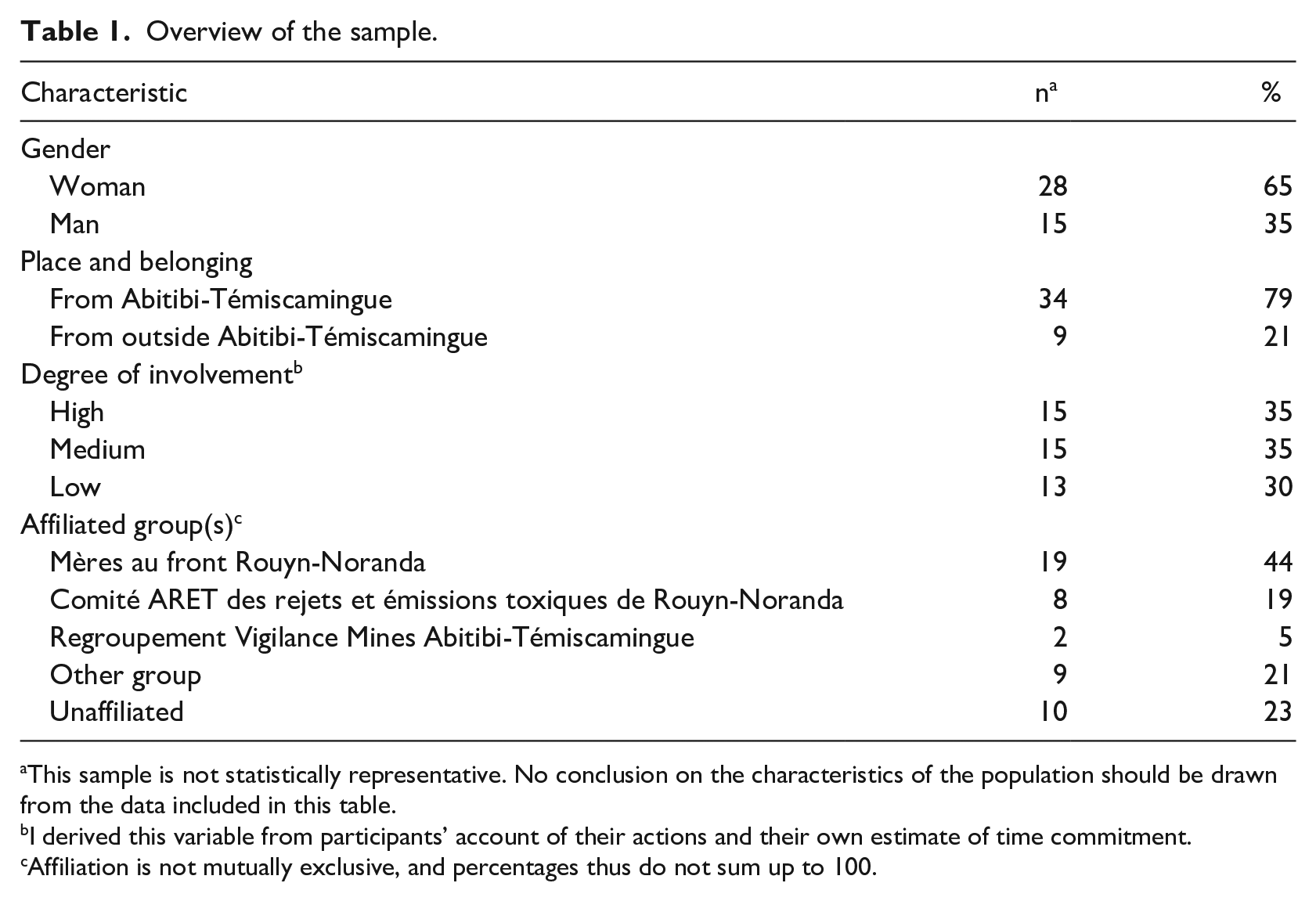
This sample is not statistically representative. No conclusion on the characteristics of the population should be drawn from the data included in this table.
I derived this variable from participants’ account of their actions and their own estimate of time commitment.
Affiliation is not mutually exclusive, and percentages thus do not sum up to 100.
I conducted interviews over video call on Microsoft Teams. They were automatically recorded and transcribed by the software, and I revised them as needed. They each lasted between 60 and 150 minutes with an average of around 90 minutes. I analyzed the transcripts in NVivo 14 using a flexible coding approach, where I deductively determined larger codes and added subcodes inductively (Deterding and Waters, 2021). One of the key themes discussed with participants was their trust in other actors, like the provincial government, the city council, the Foundry and public health authorities. By discussing issues of trust, I was able to collect data on how participants opposed their knowledge claims to those produced and disseminated by the state, as well as explained why they challenged institutional expertise. The interview guide and qualitative coding structure for this study are available in Supplemental materials.
4. Sources of distrust
Participants delineated various ways in which state expertise had become politicized on the Horne Foundry issue to motivate their distrust. I broadly define politicization of expertise as the perversion of the process, style or substance of expertise for contentious or partisan purposes (see Bolsen and Druckman, 2015; Chinn et al., 2020). Participants generally pointed to the National Public Health Agency as the primary state institution where this problem had taken place. Sources of distrust described by participants included direct or “smoking gun” evidence that showed the independence of expertise had been undermined. Just as importantly, sources of distrust also included indirect or circumstantial evidence from which participants inferred politicization. In this section, I review how both types of evidence were substantiated.
Smoking gun evidence
Local resistance took off as a reaction to media reports that then-Public Health director Dr Arruda had ordered the removal of an Appendix from a 2020 biomonitoring report that showed lung cancer and chronic obstructive pulmonary disease to be found in excess of the general Quebec population in Rouyn-Noranda. Some referred to this event as proof that the National Public Health Agency was subject to political interference: This hide-and-seek game, and the lying that’s going in the backstage, we saw it for instance with the biomonitoring study. We saw that Arruda removed the [Report’s] Appendix that mentioned cancer, occurrences of pulmonary cancer notably. We saw a company that summoned the government to quieten the [National Public Health Agency] (Christian, Other).
3
Some identified this event as the key cause of undermined trust toward the state among movement members, but nonetheless wanted to believe that this was an isolated event:
Obviously, there was the incident with the Appendix that was hidden. Do you think this is a recurrent problem or was it just an isolated event?
Well, I hope it was just an isolated event. I hope it was, because you know I still want to have some trust in them. [. . .] In general, I feel like they are quite rigorous, at least from my point of view.
Others argued that this was not an isolated incident. For example, Emmanuelle (MF) heard from an ex-administrator in the Regional Public Health Authority that encompasses Rouyn-Noranda that the National Public Health Agency had ordered that the number of occurrences of the word “carcinogenic” should be reduced from reports on environmental contamination in relation to the Horne Foundry. Viviane (MF) maintained that documents obtained through a freedom of information request suggested that the Agency knew about the gravity of environmental contamination problems well before biomonitoring studies were conducted. Florence (MF) argued that local physicians that had been speaking out against the government’s handling of the situation had been threatened to be reported to their Medical Association for malpractice by officials from National Public Health.
Others noted that National Public Health officials were quite dismissive of activists’ concerns. One way in which this showed was in a perceived lack of preparedness of top officials when meeting with the movement. Movement members expected productive meetings that centered on data and that paid attention to details. For Louise (ARET), the foremost state experts did not deliver on that expectation: We had a meeting with Dr. Arruda that was, I’ll say troubling. He was just being nice and friendly; he was making jokes—sometimes on the verge of inappropriateness. Anyway, I won’t cite the details here, but it was quite disappointing. He was treating us like . . . [dismissive gesture]. [. . .] With Arruda, we wanted to center our efforts on reaching agreement for the 3ng/m3 to be recommended, and he made clear he was not going to hear it. With the ARET committee, we saw that he was completely unaware of the health impacts [of arsenic exposure]. Denis, who was with us, who is also part of the committee, was explaining the risks for children to Arruda, and it became clear that he had no knowledge on the topic. That’s not a big deal in itself, because his specialty is prevention [. . .]. That’s something we can understand. However, the fact that he did not seem to listen or be interested . . . that was more concerning.
These types of events served as a further proof that the highest instances of public health were politicized. Most participants distinguished starkly between the Regional Public Health Authority and its national counterpart: the former was generally trusted by participants, while it was believed that political interference in the latter prevented it from delivering neutral expert opinions. Many stressed for instance that despite being a nonpartisan appointment, the National Director of Public Health is selected by the Premier’s office and by default assumes the role of Deputy Minister of Health. Pascal (Other) noted that this results in an expectation of loyalty from the nominee. In January 2022, National Director of Public Health Dr Arruda resigned and was replaced in the interim by Dr Luc Boileau. In June of that year, Dr Boileau was then permanently appointed. Some saw Arruda’s resignation and the transition to Boileau as evidence that these appointments are indeed political. They viewed Boileau as unqualified for the position and, most importantly, as sympathetic to the Coalition Avenir Québec party that forms the government. For some, this blurred even further the boundary between elected government officials and appointed state experts: Look, I think public health officials are puppets of the government. Literally. We saw Arruda [order the hiding of the Report’s Appendix]. Did he really make that decision on his own? You know, I don’t know if he has that power to do that without [asking the government first]. I can’t tell you. I would like to believe this is his own decision, but I am not sure. Now they traded him for Boileau . . . Boileau is but an empty shell. You know, he came to some meetings here, and he really did not impress anyone. (Henri, MF)
Some like Pascal (Other) noted that these kinds of political appointments attract certain types of candidates who are willing to be loyal regardless of their own view: Boileau, for him, the lines are quite blurry. In his mind, he’s part of the government, and acts as such. [. . .] And you know, It was always my understanding that he’s happy to do the government’s dirty work.
Others in contrast interpreted the Director’s behavior not as a result of personal motivations but of externally imposed constraints from the government and even potentially the Foundry: After the authorization renewal being published, Mr. Boileau’s hands are now tied. We have to understand that from a political standpoint these people are tied to their job. They have to follow the government’s directives, and we’ve heard that the government negotiates behind closed doors with the Foundry. (Carole, REVIMAT)
In any case, participants noted that public interventions of the new Director of Public Health showcases the delineable impacts that this loyalty expectation has in practice. For example, Florence (MF) found uncanny that the head of a public health agency would put so much emphasis on economic concerns in his messaging: In the interpretation of reports, I find it very displeasing that the Director of Public Health, you know, gets out of his way to argue that this industry is important, that there are lots of jobs associated with it. That’s not your area of expertise! And you know, he starts saying that the Foundry can’t change its practices in a heartbeat, that they can’t sufficiently reduce their emissions. I’m like: ok, have you suddenly become an industrial engineer or something?
By resorting to direct evidence of political interference in expertise, participants were able to justify their distrust in state institutions. This in turn allowed them to underline the role of their movement in addressing areas of knowledge and regulation neglected by the state.
Circumstantial evidence
Indirect evidence of politicization was also key in participants’ understanding of the problem. Many argued for instance that inconsistencies in the discourse of state experts throughout the controversy was to be interpreted as a sign of politicization. Penelope (Other) noted that some of the decisions made by National Public Health contravened their own earlier recommendations: In fact, they contradict themselves. There’s a difference between Boileau’s messaging and public health reports upon which it is based. There are many public health reports out there and they don’t follow their own reports. Having said that, I think there is a clear political orientation in their discourse, but does that mean public health as a whole is incorrect? I don’t think so, but they don’t follow their own recommendations. You know, just the way in which they manage the buffer zone contradicts a bunch of principles that were initially outlined by public health.
Inconsistencies were further noted between the reports published by state experts and how they were then framed for a broad audience in the media: A [public radio journalist] saw the brief that was tabled by the Regional Public Health Agency of Rouyn-Noranda [. . .] and that was cosigned by the interim director who is a physician that’s specialized in public health. So, the [journalist] invited him on his show after having read the report and I think he was convinced that he would have someone that would tell him on air that the Foundry is a huge problem in Rouyn-Noranda, that [the Foundry] poisons residents, that we have problems such as underweight newborns, pulmonary cancers, cardiopulmonary diseases, etc., and the Foundry is the cause of that. But that’s not at all what the interview looked like in the end! Having listened to it, I am under the impression that Stéphane Trépanier, the interim director, was disciplined for agreeing to the interview or had been advised prior to it to watch his mouth during the interview. He seemed to backpedal over the language of the report the entire time. Throughout the interview he was saying “no, we’re not entirely sure about that,” “it’s not as clear as it might seem,” etc. (Josiane, ARET)
This in turn led to skepticism toward organizations whose trust in public health remained unwavering despite these inconsistencies. For example, Martine (Other) criticized the municipality’s use of recommendations from the National Public Health Agency as an argument to promote its own position: This municipal council member was saying that Public Health says [current regulations] are ok. Can you please not take us for a bunch of fools? You really are taking us for fools. I am sure you don’t believe that Public Health agrees with [current regulations]. You know, Public Health, they say something one day and then change their mind the very next day.
Beyond inconsistencies over time, some noted contention points between different sources of state expertise. Viviane (MF) explained that Public Health did not only backpedal on its own recommendations but also interpreted data from the Ministry of Environment in tangential ways: The Ministry of Environment took samplings from [contaminated] snow in the Notre-Dame elementary school backyard and when news of that got out through freedom of information access requests from journalists [they found] that they contained 137 times the maximum allowable arsenic standard for soils. And then we ask questions to Public Health about it, and they say “well, we can’t compare this dust to regular soil dust because that’s a sample from snow and there’s no standard for snow; there’s not a risk of a severe poisoning in that case and it’s ok to let the children play outside; we can’t always leave them inside. [. . .] I feel it’s inconceivable to make this argument. You’re Public Health, you know that leads to increased risk of cancer later on in life, you know what impacts it has on the development of a child’s brain.”
Since this interpretation advanced governmental interests, she argued, this was evidence that the National Public Health Agency was politicized. In addition to direct evidence of politicization of expertise; thus, participants resorted to some indirect sources of evidence to sustain this argument. These inferences allowed them to find the missing links in parts of the story that remained unknown or uncertain.
5. Relationship with COVID-related challenges
I sometimes directly interrogated participants on the relationship they saw between the types of claims their movement builds on and those of COVID-related movements that were labeled as conspiracist. 4 Other participants evoked that parallel on their own. This parallel is especially relevant because the National Public Health Agency, the main institution which generated distrust from participants, was also the main source of governmental expertise during the pandemic. Why would participants trust the Agency on matters related to COVID, but not at all when it comes to the Horne Foundry issue? On one hand, participants distinguished between their way of contesting state expertise and that of COVID-related movements. On the other hand, participants noted gray areas in this distinction. In this section, I detail how these two themes transpired in participant discourse.
Drawing boundaries
Participants generally saw a stark contrast between their movement and COVID-related conspiracism. On the topic of expert knowledge, Xavier (Other) argued that, in contrast to COVID-related movement, the scientific consensus was actually on their side, not on the side of the government: Conspiracist discourse tends to deny scientific consensus and to view the scientific consensus in and out of itself as a conspiracy [. . . In our case] the more cynical discourse that sees a relationship between politics and public health bases its arguments precisely on scientific discourse. In the discussion we just had, I said “we know, there were groups of physicians from here that published very serious studies, that tabled very extensive briefs during the public consultation process that are filled with facts, with the scientific consensus, with research, with data. Despite this, the renewal of authorization that was enacted doesn’t take that into account.” [. . .] So, it’s on the basis of known scientific facts that [our] discourse holds up, I believe.
Raymond (REVIMAT) also noted that the degree of scientific certainty is much greater in the Horne Foundry case, making it less plausible that bad decisions are simply mistakes: [In the case of COVID] they did their best, they didn’t know, we were all ignorant, so [we said] let them do what they are doing. In the case of the Foundry, we know what’s going on. That’s something we’ve known since, I mean, the best studies started in the 1970s! [. . .] It’s documented, it’s well done, we’re able to go back. These studies mean that for that conspiracist parallel, that idea that we fear our own shadow, that we’re creating an imaginary world for ourselves, that there is no danger . . . One of the things we have done is to gather evidence in a highly professional manner, we went and obtained documents produced by the World Health Organization, by Europe, by the United States, by unions, by health scientists, and we all put it together. We didn’t have to fight [to obtain those]. That’s where the difference lies: the evidence exists. [. . .] That’s why we didn’t fall in that [conspiracist] dynamic that went on during COVID.
Several participants, like Daphné (MF), underlined that the COVID pandemic contrasts with their problem because it was a global phenomenon: The pandemic was global, it affected everyone, whereas the Foundry is so far, it’s in the middle of nowhere, nobody knows what’s going on. COVID affected everyone, all countries were making efforts to find a vaccine. [. . .] Since it was global, we did not have a choice but to trust the government on our health.
For her and others, the global aspect of the COVID crisis made it less plausible that state experts had been captured by political interests. Also making it less likely is the fact there was no identifiable corporate advantage in having COVID-related restrictions: What would be the advantage of mandating us to wear a mask, I mean? You know, there’s no conspiracy of mask producers. In general, I am not too drawn into conspiracies even though I try to stay skeptical of big corporations, big pharma, etc. You know, I understood this type of skepticism. But when you analyze it, you think “how would that benefit them”? (Marie-Pierre, MF)
In contrast, Louise (ARET) argued that clear corporate interests existed in the Horne Foundry case, that the corporation had acted upon those interests, and that the government had been responsive to those interests. Altogether, this made it a different issue: The issue is simply not the same from a financial and economic standpoint. [. . .] In our case, we are faced with important lobbying efforts from a large multinational corporation; we are faced with governments—especially this government—for which economic concerns supersedes anything else, is the first priority. The actual power of Public Health in that case is in my opinion even less important. [The economy] is always put first. You know, the common good is equated with the economic state of the province and to well-paying jobs.
Finally, Ariane (MF) argued that the line is to be drawn where credible independent sources like the mainstream media come to the same conclusions as the movement does: The longest I could trust [state institutions], I did. Until I saw it on paper, from [the media outlet] Radio-Canada, that actually, no, they had been hiding information from us. That evidence was published by a source that I believe is reliable. Radio-Canada is a state-owned media company, too. It’s not, you know, usually . . . And there was quality investigative journalism that was done by Thomas Gerbet to shed light onto [the problem]. That journalism allowed to produce facts, so that it isn’t mere interpretation from citizen groups that don’t trust [institutions] and never do. We have journalistic work that has been done to get these facts out. I think that’s where the distinction lies.
Overall, participants highlighted that political interference in state expertise was more plausible in their case than on pandemic issues, making it more plausible that their claims were accurate. They also pointed to external sources of validation for their claims (the media, Regional Public Health Agency) to draw a boundary with COVID-related challenges to state expertise.
Blurring boundaries
Some participants reported having doubts at times about whether or not their views were to be defined as conspiracist. As Florence (MF) put it, she sometimes felt she had fallen into the conspiracist trap, after all: Sometimes you say to yourself “oh, in the end, it’s me who’s out of line, and I’ve become a conspiracist, and I’ve gone off the rails, and I take my information where I want to take it” Anyways, I don’t think so [laughs and sighs], but it becomes confusing, because the institutions that are supposed to protect us . . . I’m starting to lose trust in them.
In addition, she acknowledged that there is an element of faith in how she distinguishes between true and false statements in making sense of this controversy: I feel like I’m at a point where I don’t necessarily have all the required time to do my research to validate that I am right in fighting against it. It’s more of an act of faith, I think, until I can read more, and convince myself again in a more logical way.
Furthermore, Nadine (ARET) noted that it might be hard to evaluate whether a discourse is conspiracist when it is your own:
You’ve said a few times that your discourse might resemble that of conspiracist discourse. You’ve drawn that parallel a few times. How would you differentiate [the two]?
That’s the question I ask myself, and I keep coming back to it. You know, I think I have a good ability for discernment, but they must believe the same thing about themselves [laughs]!
In parallel, David (MF) acknowledged he does not possess all the necessary scientific knowledge to ground his desire for stricter arsenic standards: And so, you know, I don’t have the expertise to evaluate all this. Take the specific amount of 3ng/m3. I have no scientific clue of what that represents concretely, but generally I believe standards are relatively weak in the sense that—let’s not lie about it—they are already a compromise with industry.
For some, this uncertainty about knowledge extended beyond the content of expertise onto the political process in which it is embedded. Camille (MF) conceded that the movement does not have all the necessary information to make definitive claims about what went on during the regulatory process. She thus advocated for a more prudent view of dynamics that are going on behind closed doors to avoid a slippery slope that edges on conspiracist views: I don’t want to make any assumptions about why [health professionals] don’t speak out more. I don’t have a clue about that. What I mean is, my feeling is that I don’t believe everyone feels free in that context to truly act according to their convictions. Now, to say why and what hinders them to do so is tricky. [Others] could tell you about questionable things that are going on behind closed doors.
In the end, even though participants generally established boundaries between their movement and COVID-related critiques that were labeled as conspiracist, some acknowledged that the lines are blurrier than they might appear at first glance. Some recognized their own limits in assessing whether their movement had conspiracist “tendencies” as active participants in that movement.
6. Discussion and conclusion
This study examined how movements that seek to contest state expertise navigate the post-COVID landscape. First, I described the use of both direct and indirect evidence by participants to motivate their distrust in state expertise. Most of their claims were attempts at interpreting the outcomes of the regulatory process by trying to narrow the gap between their expectations of how state experts should behave and their perception of how they behaved in reality. In this sense-making activity, participants highlighted inconsistencies as a sign that state expert institutions like the National Public Health Agency had been subject to interference. Second, I delineated how participants situated the nature of their knowledge claims and their relationship with other political actors in light of an implicit or explicit comparison with COVID-related movements.
The COVID experience shaped participants’ understanding of which types of contesting claims are socially sanctioned and which are not. It also promoted boundary-setting. Attempts by participants to identify allies in mainstream sources of epistemic authority (university researchers, Regional Public Health, the media) while distancing themselves from others (National Public Health) promotes a discourse where institutional sources of expertise are not rejected altogether but are rather selected. In line with Mann and Schleifer’s (2020) findings, differences in political allegiances between right-wing COVID challenges and left-wing environmental health mobilizations did not necessarily result in contrasting relationships with science as a whole. Participants however felt that their movement did entertain a different relationship with expert organizations, one that was constructive rather than merely oppositional. This stated difference was important in drawing boundaries with COVID-related conspiracist groups. In parallel, I found that many participants recognized gray areas that blurred those boundaries between their own views and views they categorized as conspiracist.
Participants relied on a shared set of arguments to justify their distrust. These arguments map well onto sources of distrust in state expertise identified in recent literature: they focused mainly on perceived independence (or lack thereof) of experts from politics (Lavazza and Farina, 2020; Purvis et al., 2021; Seyd et al., 2025) and on perceived inconsistency between expert claims (SteelFisher et al., 2023). Moreover, in line with recent scholarship on distrust and political identity (Machado et al., 2024; Urkens and Houtman, 2023), the repeated use of similar cognitive tools by participants suggests that these have become a salient part of the movement’s narrative. Interestingly, comparisons with COVID-related movements did not seem to promote insecurity among participants about how other citizens might view them or their movement. Is it because they do not believe the parallels to be convincing enough? Is it because they believe that accusations of conspiracism aimed at their movement are ineffective with public opinion? Reasons for this are worth investigating in future work.
A key difference that many established between their experience in contesting state expertise and that of COVID-related groups is their ability to rely on multiple sources of facts and arguments that are promoted independently from the movement. To them, this made it less plausible that they could be conspiracists. If anything, the rise of challenges to state expertise that draw on conspiracist theories has led to a stronger reflexive attitude among participants, and the internal examination of knowledge claims has become an essential task of the mobilization. More broadly, this narrow focus on evidence-based claims is perhaps an imperative response to the needs of increasingly scientized politics (Cardon and Prete, 2018; Morello-Frosch et al., 2006).
Limitations and future research
This article has several limitations, two of which I should note here. First, its conclusions rest on after-the-fact data. A natural experiment design would have allowed to assess changes in attitudes within the same movement and among the same participants. This would have yielded more reliable results. Like many social movements, however, mobilization on the Horne Foundry issue was severely limited during the pandemic. This exceptional context was not conducive to this study design. Another major limitation is that the movement studied here emerged out of verifiable instances of abuse of power on the part of state authorities. The sources of distrust outlined in this case echo those of similar environmental health mobilizations in recent scholarship (e.g. Hart, 2023; Sony et al., 2023). Nonetheless, in a sense, these verifiable breaches of trust made it more likely that participants would engage critically with the conspiracism parallel because they may never have felt threatened by this line of questioning. This may lead to overestimating the external validity of the findings. Future studies that investigate similar questions should broaden the empirical base for the claims made here by investigating cases that contrast in that regard.
This study’s findings open up interesting new research avenues. One distinction between the movement studied here and how scientific and media accounts generally depict COVID-related contests to state expertise is that participants did not view the politicization of expertise on the Horne Foundry issue as a sign of a broader national or global elite conspiracy. This difference induces promising questions for future inquiry. What inferences do individuals or groups make about expert authorities in general from individual instances of perceived politicization? How does that in turn guide their interactions with these authorities? How does trust in institutions vary across political scales—from the local, to the national and to the international? Moreover, extant scholarship has mostly asked how conspiracist claims are sustained in both mainstream and alternative discourse. The findings presented here suggest that the reverse pattern, in which the authority of claims that are verifiable through traditional means is challenged by the proliferation of similar claims that aren’t, is worth investigating.
Rebuilding trust?
Facing complex issues that involve a corresponding high degree of uncertainty, experts and the public alike come to realize the limits of simplistic slogans like “follow the science” (Koch and Durodié, 2022). This is especially true when expertise-producing institutions behave in ways that actively promote distrust. As Paul (Other) noted, institutions like public health agencies are the “last bastion of defense” against popular distrust in the state. If he is right, we ought to believe distrust has come to run deep among this study’s participants. One important theme that emerged in our discussions around trust was its affective dimension. Participants time and time again referred to their disappointment and sorrow. They felt lied to and neglected by the state, felt their trust was taken for granted, and that their knowledge was not taken seriously. Some compared it to an unhealthy or abusive intimate relationship. Nadine (MF) clearly articulated this parallel:
It’s really not easy. You know, from the moment—it’s like someone who was in a relationship with someone who cheated on them. Once that trust bond is ruptured, whatever you do in the aftermath, that bond remains broken, you know?
There’s always a doubt, isn’t it?
There’s always doubt, and that doubt will remain because there are things that were known that were voluntarily hidden. That will always stand out.
Can this trust be rebuilt? Raymond (REVIMAT) thought that it could, but that time was not an appropriate remedy: A guy like Mr. Proulx from [Regional] Public Health, who conducted the biomonitoring studies and asked for [arsenic] to be added to [list that] that mandates declaration and action for products that are recognized as dangerous to health. That’s why they conducted biomonitoring studies for arsenic: they were required to conduct studies for cadmium and lead, and [Regional] Public Health decided to add arsenic. Arsenic was not originally in [the list]. But they added it anyways. So, you know, that sends us a signal that we can trust them. They went beyond what they were tasked to do. [. . .] So these are ways for us to grant trust slowly but surely—when we see concrete gestures (emphasis added).
His view is that trust becomes possible when state institutions put themselves in positions that allow them to anticipate rather than simply react to regulatory problems. In this regard, participants often opposed National and Regional Public Health. For them, the National Public Health Agency had participated in hiding data from the public, was subject to political interference, and was one of the main culprits in the crisis. In contrast, the Regional Public Health Agency for Abitibi-Témiscamingue was perceived as resisting politicization and as an ally within the state. This held true even though regional instances are overseen by their national counterpart and act within nationally defined constraints and priorities. The reason for noting such as a sharp distinction was at least in part affective: whether or not they were right in their expert assessments and whether or not they had made mistakes during the controversy, Regional Public Health officials were perceived as proactive in their search for truth and as responsive to the movement within the limits of their mandate. Trust had sure been earned through their actions, but it was maintained through their manifest commitment to solving the problem. Crucially, for participants, it was about seeing state experts move toward their preoccupations, not the other way around.
Supplemental Material
sj-pdf-1-pus-10.1177_09636625251347063 – Supplemental material for Contesting state expertise after COVID-19
Supplemental material, sj-pdf-1-pus-10.1177_09636625251347063 for Contesting state expertise after COVID-19 by Gabriel V. Lévesque in Public Understanding of Science
Footnotes
Acknowledgements
The author thanks all participants for their time and dedication to this study. The author also thanks members of the Laboratory on Culture, Knowledge and Social Structures (LOCKSS) at McGill University for their thoughtful comments on a previous version of this manuscript.
Declaration of conflicting interests
The author(s) declared no potential conflicts of interest with respect to the research, authorship, and/or publication of this article.
Funding
The author(s) received no financial support for the research, authorship, and/or publication of this article.
Ethics approval and informed consent statements
This study received approval from the Research Ethics Board Office at McGill University (REB # 23-07-036). Written consent was obtained from participants.

Supplemental material
Supplemental material for this article is available online.
Notes
Author biography
References
Supplementary Material
Please find the following supplemental material available below.
For Open Access articles published under a Creative Commons License, all supplemental material carries the same license as the article it is associated with.
For non-Open Access articles published, all supplemental material carries a non-exclusive license, and permission requests for re-use of supplemental material or any part of supplemental material shall be sent directly to the copyright owner as specified in the copyright notice associated with the article.
