




Abstract
While surveys on public understandings of science are common, little is known about how science and its processes are perceived and reported by journalists. However, knowledge about processual aspects of science is crucial when estimating the trustworthiness of experts and levels of evidence. Science journalists function not only as translators but also as critical observers of science, shaping the overall picture of science and ideally strengthening the public’s judgment. To unfold the shape of such process-oriented science journalism, we investigate the understanding of science in the German science journalism community in the aftermath of COVID-19. We find an advanced understanding of scientific processes among participants of five focus group discussions and a preceding survey. The science journalists show a high level of general trust in scientific institutions and see informing and contextualizing as their main professional tasks. Some emphasis on quantitative studies and some reservations about politicized science and certain disciplines become visible.
Keywords
1. Introduction
Do journalists need to know what a “preprint” is? And are they obliged to flag evidence from preprint publications as preliminary in their reporting? They are, according to the German Press Council (2020): in September 2020, the Council published a reprimand criticizing Germany’s leading tabloid BILD for its coverage of a medical study on the SARS-CoV-2 viral load in children compared to adults (Deutscher Presserat, 2020; Piatov, 2020). The Press Council deemed the respective article to be “a serious violation of journalistic due diligence obligations”, because it had failed to disclose the preprint status of the study at issue. This case somehow affirms a general principle of (science) journalism. When covering science and technologies, processual and contextual knowledge such as the publication status or levels of evidence should be an integral part of reputable science journalism. At present, however, “science journalists agree that too few people are reporting on the process of science—there is too much focus on the results of scientific research” (Massarani et al., 2021a: 8; see also: Schipani, 2024).
Traditionally, science journalism has been “episodic in nature” and “readers encounter few descriptions of the research methods employed” (Dunwoody, 2021: 19). This tendency mirrors the historical exclusion of the public from the “house of science” itself (Shapin, 1992: 28). Moreover, medialization encourages both researchers and journalists to first and foremost “make science news” (Franzen, 2011) and the “straitened conditions” of the digital age increase the “need for quick and accurate science content” (Brumfiel, 2009: 275). The factors contributing to this specific character of science journalism are various and reach from persisting “deficit model” conceptualizations (Simis et al., 2016) to news value orientations equally affecting selection processes in science journalism (Badenschier and Wormer, 2012).
At the same time digital and social media infrastructures have weakened traditional media gatekeeping paradigms and produced “new confusion” in the digital sphere affecting media as a whole and science journalism in particular (e.g. Peters et al., 2014; Weingart et al., 2017). Confronted with scientific claims, media recipients cannot make decisions of “informed trust” (Bromme, 2020) without considering the underlying professional rules and processes of science. Studies have indeed shown that “higher-order knowledge about science does relate to acceptance of specific scientific claims” (Weisberg et al., 2021: 134).
By investigating the manifestations and potentials of process-oriented instead of outcome-oriented science communication (Shapin, 1992), we go beyond the existing research on professional self-perceptions and understandings of science among science journalists. For example, European science journalists have been found to stress the need for balancing roles of translation and critique (Davies et al., 2021), while in non-Western regions educational and watchdog functions are more strongly pronounced (Bauer et al., 2013; Massarani et al., 2021a). However, regardless of whether they consider themselves translators or critics of science (e.g. Fisher, 2022; Kohring, 2005), science journalists likely transfer their attitudes and understandings of science to a broader public through their editorial decisions (e.g. Badenschier and Wormer, 2012) and framings (e.g. Tewksbury and Scheufele, 2019).
Building on qualitative insights from five focus group discussions with selected science journalists, this paper therefore aims to answer the following research questions:
Which understandings of science dominate among science journalists in Germany and how familiar are they with certain processes of scientific knowledge production and with the characteristics of science as a social system?
How do these understandings shape science journalists’ professional self-perceptions?
Throughout the text, we refer to ‘meta’-aspects of science as a shorthand for those processual and institutional aspects of science we deem relevant for an enhanced understanding of science among professional science communication communities and beyond. Moreover, the term “science” as used in the following is to be understood in the sense of the German ”Wissenschaft”—as an umbrella term generally referring to the entire spectrum of scientific research, spanning the whole spectrum from the natural sciences to the humanities.
2. Science journalism in Germany: Structures and actors
Based on the first full survey targeting science journalists in Germany, Hömberg famously described the science section as a “delayed department,” developed much later than other traditional journalistic departments such as politics, culture or sports (Hömberg, 1989). This diagnosis was followed by a period often considered the first peak of modern science journalism—at least in the Anglo-American world (e.g. Rensberger, 2009). Elmer et al. found a science journalism boom in German media in the 2000s (Elmer et al., 2008). Since then, the Internet’s disruptive impact on journalism has been discussed at length—with some observers being rather skeptical about the assertiveness of scientific content in social media environments (e.g. Trench, 2007; Weingart et al., 2017). In any case, science journalism and its core functions remain essential in the digital age of science communication (Esser and Neuberger, 2019) facing complex multiple crises (e.g. Massarani et al., 2021b; Nguyen and Catalan, 2020). However, comprehensive studies surveying profiles and attitudes of science journalists are scarce. The relevant studies for Germany, Austria, and Switzerland date back more than ten years (Blöbaum, 2008; Bonfadelli et al., 2011; Kaltenbrunner et al., 2008; Weischenberg et al., 2006). According to Blöbaum (2008) and Weischenberg et al. (2006), science journalists in Germany have high academic qualifications (Blöbaum, 2008: 249), are likely to have a background in the natural sciences (Blöbaum, 2008: 250), and consider themselves as “neutral mediators” of complex scientific information (Blöbaum, 2008: 255).
3. Scientific meta-vocabulary in the media
Influential concepts in journalism studies (such as news value and framing theory) represent the belief that news selection and depiction are shaped by individuals with existing previous knowledge, values, and preferences. The public image of science transported by such intermediaries is closely related to the understandings of science dominant in these groups. A review of the existing literature on science representations in mass media shows that most of the available research deals with the products and results rather than the processes and contexts of scientific knowledge production. Researchers have exhaustively targeted similarities and differences in mass media coverage of different scientific disciplines. However, “the scientific system” or “scientific institutions” are not discussed as advanced content categories. One meta-analysis concludes that most research conducted on science in the media is focused on natural sciences and print media (Schäfer, 2012). Pertinent works such as Bucchi’s and Mazzolini’s long-term analysis of Italian daily press are in line with Schäfer’s observations (Bucchi and Mazzolini, 2008). The bias toward natural science topics has been prominently problematized in science communication research, with observers pointing out the “specific challenges” of communicating the social sciences (Cassidy, 2014). However, Summ and Volpers have shown that the social sciences and humanities may indeed account for a significant part of science coverage, at least in German media—with most of this coverage happening outside of “science” departments (Summ and Volpers, 2016).
If at all, most of these studies treat meta-aspects of science peripherally. For example, Cassidy points out popular stereotypes connected to methodologies associated with the social sciences and humanities (Cassidy, 2014). By doubting the “hard” scientific qualities of the social sciences, journalists seem to at least subliminally engage with the peculiarities of scientific methodologies. However, as Pellechia observed in an early analysis of science news reporting in three major daily U.S. newspapers, an explicit thematization of such aspects is often missing: “articles frequently omitted methodological and contextual information” (Pellechia, 1997: 49). In Germany, Volpers and Summ equally found that “ongoing scientific work (except from the engineering sciences) does not seem to be that newsworthy” (Summ and Volpers, 2016: 783).
There is, however, one notable context in which meta-aspects of science regularly draw attention: Science communication research has developed a permanent interest in how journalists deal with scientific uncertainty (e.g. Guenther et al., 2019; Heidmann and Milde, 2013), with Public Understanding of Science even dedicating a special issue to the topic in 2016 (Peters and Dunwoody, 2016). According to Dunwoody, core aspects of science as “organized skepticism” (Merton, 1968) are at least latently addressed within (science) journalism (Dunwoody et al., 2018). However, a structured in-depth exploration of media representations of the science system and its processes is missing so far. We argue that analyzing discourses around and uses of scientific meta-vocabulary among journalists can provide us with a more nuanced picture of understandings of science in science journalism—with possible implications for broader audiences and their mediated engagement with science, as described above.
4. Method
Approach
Our research approach combines the analysis of journalists’ understandings of scientific meta-aspects through focus group discussions with selected science journalists with a preceding supplementary survey targeting their journalistic understandings of science through standardized items. This combination of methods allowed us to trace continuities as well as possible inconsistencies between the often implicit suggestions made throughout the group discussions and the explicit answers provided in the preceding survey. Both the surveys and the group discussion guidelines asked about understandings of science as well as journalistic self-conceptions to also reveal subliminal understandings contained in professional attitudes.
The research reported in this article was part of a project that combined research goals and practical goals. Such endeavors have been advocated (e.g. Fischer et al., 2024) and promoted by special funding programs (e.g. VolkswagenStiftung, 2020) to integrate science communication research and training. Our focus groups were embedded in workshops that brought together science journalism practitioners, instructors and social science and science communication researchers.
Preliminary survey
To provide insights into the participants’ beliefs about science and journalism prior to the workshops and for further inquiry about their academic and professional profiles, self-perceptions and understandings of science and its functions, 1 the group discussions were preceded by a preliminary survey digitally sent to the workshop participants some weeks before the workshops. For this, we used the survey tool LimeSurvey, which allows a broad spectrum of standardized and semi-open question formats fitting our research interests. The participants received one general email reminder asking to complete the survey prior to the planned workshop. The results from the preliminary survey were then first assessed before the workshops to help optimize the focus group discussion settings further. In-depth analyses were conducted later. The preliminary survey was completed by 27 out of 28 group discussion participants.
Focus group discussions
Conducted in the context of three expert workshops, our focus group discussions with selected journalists provided us with the main body of the qualitative data presented here. The focus group discussion is an established method for surveying individual attitudes as well as dominant beliefs in a casual group atmosphere (Lunt and Livingstone, 1996; Vogl, 2019; Wimmer and Dominick, 2013). The method goes beyond synchronized single interviews and integrates the exchange of arguments and the in-group establishment of consensus and dissent into the process of knowledge production.
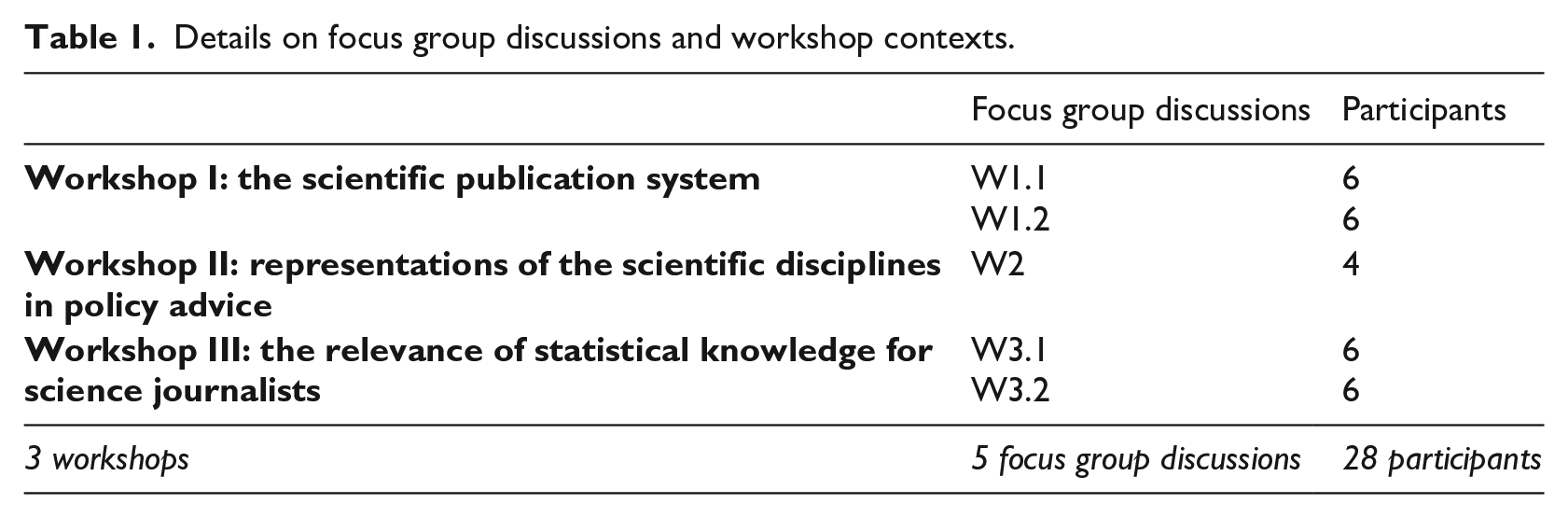
To qualitatively analyze the dominant understandings of science among science journalists in Germany we conducted five focus group discussions with a total of 28 participants. The discussions were loosely tied in with three superordinate topics stressing selected areas of the scientific system with relevance to journalism practice. These topics were: the scientific publication system, representations of the scientific disciplines in policy advice, and the relevance of statistical knowledge for science journalists. 2 To start off the discussions, the participants received a short discussion impulse introducing the respective topics. Each impulse established a topical connection to the COVID-19 pandemic as the predominant subject of science journalism practice during that time. The focus group discussions themselves were structured by pre-developed guidelines connecting a set of general perspectives to the discussion impulses and the more specific superordinate topics. 3
The focus group discussions were embedded into an interactive workshop setting. In each workshop, the group discussions were the first item on the agenda to keep the academic content input provided later from distorting the qualitative data collection. The workshop participants were invited via online platforms and mailing lists relevant to professionally organized science journalists in Germany, such as the German science journalism association Wissenschaftspressekonferenz (WPK). They decided to participate based on short content descriptions of the workshops. A general interest in scientific meta-topics and an increased motivation can therefore be assumed. Table 1 provides details about the links between workshops, focus group discussions and participants.
Details on focus group discussions and workshop contexts.
The focus group discussions were transcribed and analyzed using standard methods of qualitative interview research (Kruse, 2015; Ritchie et al., 2013). The group discussion transcripts were coded by two researchers. To limit any pre-structuring operations to a minimum, the researchers worked separately on separate transcripts and compared their inductively identified codes afterwards. Codes were more or less strong depending on the frequency and intensity of their appearance throughout different group discussion contexts. By comparing these codes with the results from the pre-survey, we were able to identify consistencies between the journalistic self-declarations given beforehand and the underlying understandings of science visible in the group discussions. Only the illustrative quotes from the results section were translated from the German transcripts.
5. Results and discussion
Sociodemographic features of the focus group participants
The sociodemographic items from our preliminary survey revealed a diverse group of science journalists quite similar to the overall professional field in Germany (e.g. Blöbaum, 2008). Most of the focus group journalists (14) were aged between 41 and 50 years and held master’s degrees and equivalent diplomas (18) or even doctoral degrees (5). Just like average German science journalists, they had a higher formal education than average journalists in Germany (Blöbaum, 2008: 249). About one-third of the focus group journalists dealt primarily with the natural sciences in their professional practice. Freelance journalists made up the biggest part of the focus groups and more women than men participated.
In the following, the insights from our qualitative exploration of the journalistic understandings of science predominant in our focus groups are presented along three focus areas, providing answers to our research questions:
Self-perception and understanding of professional roles
The journalistic understanding of science I: attributes and functions
The journalistic understanding of science II: disciplinary differences, roles, and values
Preliminary survey
Self-perception and understanding of professional roles
Surveying self-perceptions and understandings of roles among science journalists can provide insights into prevalent understandings of science. For example, whether science journalists see themselves as science translators or critics (e.g. Secko et al., 2013) may partly depend on their level of trust in science and its processes. Our pre-survey therefore not only asked directly about perceived attributes of science but also investigated self-perceptions of the participants as an intermediate step before closing in on prevalent understandings of science.
Our results from a four-point Likert-type scale show that a clear majority of the focus group participants partly or fully agrees on informing a broader public about scientific findings and developments as the main function of science journalism (26), closely followed by contextualizing scientific findings regarding current societal challenges (24). The journalists also consider themselves critics of scientific institutions, actors, and practices (24). Stimulating and entertaining (23) as well as providing practical orientation and advice for recipients (22) are less but still mostly approved as functions of science journalism. These results are largely in line with Hömberg’s early survey of 200 science journalists in Germany (Hömberg, 1989). However, the self-perception of science journalists as critics seems to be more pronounced within our focus group than in Hömberg’s survey.
The informative function, perceived as first duty of science journalism by the focus group participants, is also present in the full-text answers given to the question: “What can scientists learn from science journalists?”: At least trying to explain the research in simple terms, so that people without scientific background understand. (W1) Communicating results comprehensibly and vividly [. . .]. (W3)
The journalistic understanding of science I: attributes and functions
Asked to freely associate keywords describing the main attributes of science in the pre-survey, journalists from all three workshops frequently mentioned “independence” and “objectivity.” Claims to scientific methodologies were prominently expressed through terms such as “(empirically) verifiable” and “plausible.” In addition, various aspects of public orientation and transfer as key feature of science became visible in open keyword answers such as: “social relevance,” “add scientific perspectives to everyday topics” or “provide a basis for political decisions.”
Among the “main functions of science” most frequently selected by the journalists 4 from a list of pre-defined options were “conducting basic research” (23 selections), “developing solutions for social problems” (19) and “providing scientific results to the public” (18). In contrast, the options “supporting technology development for the economy” (6), “giving advice based on scientific results” (3) and “actively formulating policy recommendations” (2) were perceived as less relevant by the participants.
The high priority assigned to the ideal of scientific independence and objectivity matches the participants’ perception of basic research as the main function of science. This high level of trust in freedom of research comes with a strong belief in scientific methods and critical thinking. The participants are, however, aware of the social embeddedness of scientific research and its results: knowledge production, public transfer, and application were strongly associated with science and its functions both in the open and in the prioritizing query.
The journalistic understanding of science II: disciplinary differences, roles and values
To avoid limiting the participants’ statements to a narrow understanding of science as natural science, the preliminary survey specifically asked about the journalists’ attitudes toward diverse scientific disciplines. The results show that they indeed differentiate between scientific cultures and methods when evaluating the “soundness” of scientific findings: more than 80% (22) of the respondents at least partly agreed with the statement that “some disciplines bring about more objective knowledge than others.” However, as will be shown in the following subchapter, in the focus group discussions the journalists justified their different evaluations of diverse scientific disciplines methodically. Positivist prejudices or a disregard of certain “soft” disciplines could not be determined.
Finally, when asked which social actors or groups are responsible for explaining the impacts of science on society to a broader public, the journalists ranked their own profession highest (26 selections), followed by scientists at public institutions (18), international organizations (9), scientists at private or industrial research facilities (6), and NGOs (5). Not a single journalist voted for the option “politicians,” possibly also due to a professional mistrust toward politicians instrumentalizing science, a phenomenon described by Bogner as “the epistemization of the political” (Bogner, 2021).
Focus group discussions
By coding the focus group discussion transcripts as described in the methods section, we identified five superordinate themes structuring the focus group talks: scrutinize & contextualize (the main tasks of science journalism); science vs politics (a clear differentiation between the two spheres); disciplinary perspectives (results evaluated depending on disciplinary context); trust the process (a generally high level of trust in scientific checks and balances); reflexive learning (conscious and self-critical evaluations of own journalistic work). The insights presented below along the three focus areas were derived from these themes.
Self-perception and understanding of professional roles
The guidelines used in the focus group discussions picked up the strategy of inquiring about professional self-perceptions of the journalists to uncover implicit understandings of science among them. The results match the answers from the preliminary survey: participants from all three workshops talked extensively about the necessity to question and explicate the status of scientific knowledge, the integrity of scientific experts and the informative value of scientific data
5
, as for example visible from the following quotes: If I report on a preprint, I have to point out that it is a preprint. That should be self-evident because it is science which has not been peer-reviewed yet. (W1.1-SJ1) Of course, it has to get clear I am talking to someone who is also an activist. (W2-SJ1) But one has to do some investigations: Who conducted the study? Who financed it? (W3.2-SJ1)
Such statements, subsumed in the theme scrutinize & contextualize, seem to confirm the self-declarations given in the pre-survey regarding contextualization and critique as important functions of science journalism. In combination, the pre-survey and focus group content analysis provide a differentiated but coherent picture of a self-perception as a professional group informing about, but also critically and context-sensitively engaging with science. In any case, the journalists are convinced that their professional group is the one most suitable for explaining the scientific impact on society to a broader public.
The journalistic understanding of science I: attributes and functions
The journalistic understanding of attributes and functions of science became most visible in the three themes trust the process, disciplinary perspectives and science vs politics. Quotes such as the following illustrate a general trust in scientific institutional principles such as peer review. At the same time, the necessity to consult science and transfer scientific results into society as well as possible pitfalls in that process are acknowledged: It is my impression that the COVID-19 pandemic showed us in fast motion that one can trust the process behind a peer-reviewed study. [. . .] But all involved actors learned that it is always only a cutout from one research area. (W1.1-SJ2) They [the media recipients] also have to get an idea of the interrelations between the sciences. Only this way they can see from which field they can get help and where they find approaches [. . .]. (W1.2-SJ1)
Overall, the results of the qualitative analysis of the focus group discussions match the journalistic understandings of science made explicit in the pre-survey. The science journalists show a high level of trust in scientific and institutional processes, checks and balances, and are willing to grant a certain autonomy to the system. However, they are very aware of the social embeddedness of science and the challenges accompanying informed transfer and application of research results.
The journalistic understanding of science II: disciplinary differences, roles and values
Based on existing research diagnosing a marginalization of the social sciences and humanities in the media—or at least a perception of their disciplines as less scientific (e.g. Cassidy, 2014; Gattone, 2012; Summ and Volpers, 2016)—some of the focus group questions specifically addressed the role of values and scientific attributions by disciplines.
In accordance with the pre-survey results, the qualitative interpretation of the group discussions confirms that the participants indeed differentiate between disciplinary cultures and methods when evaluating the “soundness” of scientific findings. The following quotes were assigned to the superordinate theme disciplinary perspectives. Two participants from two different focus groups explain and justify how they deal with research results from selected disciplines in their daily work: I am rather skeptical about some disciplines, nutritional medicine for example, because they cannot carry out double blind studies [. . .]. (W3.1-SJ4) When I look at studies [from the social sciences and humanities] I usually look for a counter study immediately. Especially when I cannot find such a study in the literature review. Preferably even a meta-study. Because they work qualitatively a lot [. . .]. (W3.2-SJ1)
However, the distinction between the disciplines made in these statements is being justified methodically. Summarizing the material of all five group discussions, there are no indications of a general, unfounded disregard of certain disciplines characterized as “soft” sciences. What’s more, several group discussion participants were rather critical of “fetishizing numbers” and emphasized the special value of individual cases and contextualization. Participants from the third workshop, which was centered around the journalistic handling of scientific data, interestingly not only stressed the importance of social data but also made a case for “small-scale” data in localized and individualized contexts.
Another finding from the focus group discussions is encapsulated in the theme science vs politics. The following quotes reinforce the idea of a clear separation between science (communication) and politics already visible in the pre-survey. The way the participants talked about how during the COVID-19 pandemic science was used to support political decisions indicates a certain reflection of professional roles: I believe this to be a general shortcoming of science journalism in Germany: it is not political enough. So that a lot of colleagues explain and work investigatively and process scandals and problems, but the whole science policy part falls short. (W2-SJ1) The numbers developed enormous power. One had the impression that, of course, decision makers hid behind these numbers although some of them came about in problematic ways. (W3.1-SJ4)
The science journalists seem to be aware of the potential tensions between science and politics, and how scientific results can be instrumentalized politically. Again, their general trust in science and its institutions was emphasized at this point of the discussion. In the participants’ perceptions the political side would be the one to illegitimately cross borders and bring about role ambiguity, not the scientific one. In contrast, science studies frequently observe mutual trespasses. The unambiguous journalistic perception might hint at a professional blind spot and an idealizing view on the scientific system. In addition, some especially “wicked problems,” namely COVID-19 and climate change, seemed to trigger scientocratic impulses: “listen[ing] to science” was deemed important in climate politics (W1.1-SJ4), “climate” and “corona” were described as topics carrying an obligation to engage (W2-SJ1).
6. Conclusion, limitations, and outlook
Science journalism shapes the intersections between science, general journalism, and broader publics. The COVID-19 pandemic illustrated this key role to audiences across the globe, and the accelerating climate crisis keeps doing so. However, more communication of isolated scientific results would not solve such problems (Sarewitz, 2004). Instead, transparency regarding scientific, political, and public processes of checks and balances as well as underlying values in science becomes more and more crucial. In this vein, Oreskes has advocated for “informed trust in the consensual conclusions of scientific communities, but not necessarily in the views or opinions of individual scientists” (Oreskes, 2019: 60). Such meta-knowledge about science could help to better inform lay attributions of expertise (Bromme, 2020; Kienhues et al., 2020) and value the broader system of checks and balances (Mede et al., 2021).
Our study sheds a light on the manifestations of such meta-perceptions of science in the German science journalism community. By interviewing 28 science journalists through a combination of survey questions and guided focus group discussions, we were able to extract and cross-check explicit as well as implicit understandings of science. The focus group participants see themselves mainly as informants about and contextualizers of science. Their self-perception indicates a high degree of general trust in science and its processes, without naivety regarding the social and institutional premises and the inevitably temporary nature of scientific knowledge. In any case, the science journalists consider themselves the professional group with the main responsibility for transferring and discussing science in public. This self-perception goes hand in hand with the journalists’ descriptions of general scientific qualities and functions in the survey: science is seen as independent, oriented toward objective methods, and yet embedded in societal values and processes. Researchers therefore should prioritize basic research, but in a second step communicate insights publicly, and hint at solutions for social problems. The hierarchy between the journalistic self-perception as primarily public informers and secondarily contextualizers and critics of science matches the hierarchy in the image of science as primarily an independent institution responsible for basic research and secondarily a socially embedded endeavor with public obligations. In addition, our results show that science journalists approach various scientific disciplines differently, although not (explicitly) based on general prejudices but justified through inevitable methodological insecurities. One example given here was the limited replicability of psychological studies. A similar level of reflection is mirrored in the way the journalists differentiate between political and scientific spheres and their operating principles—although COVID-19 and the climate crisis seemed to facilitate some scientocratic temptations.
Apart from the rather exceptional attention to preprints and the general status of scientific research during the COVID-19 pandemic (Fleerackers et al., 2022; Berger and Kaldewey, 2024), the limited perceptions and prioritizations of only some scientific meta-aspects identified in our study are in line with the few other studies that examined meta-aspects of science in the media (Guenther et al., 2019: 40; McComas and Simone, 2003). Despite the advanced general level of reflexivity and differentiation regarding scientific contexts and processes found among the focus group discussion participants, some statements hinted at certain methodical prioritizations and more narrow scientific perceptions. For example, the science journalists’ associations with science, its nature and main functions often focused on quantitative methods and scientific studies.
Our approach surely has its limits when it comes to generalizing some of our findings. Focus groups can be used to explore a range of views circulating within a certain group. Their in-depth qualitative scope can prove valuable for initial mappings of mainly uncharted territories, as has been the case here. However, they cannot give a sound estimate of the general prevalence of these views in the observed group. We are also aware that our focus groups were composed of highly motivated journalists with a certain pre-existing interest in scientific meta-aspects as well as in data and statistics not necessarily representing the whole science journalism community. As beneficial as the knowledge transfer and exchange between research and practice is, it should be noted the applied workshop settings may have contributed to certain sample biases influencing the resulting data.
Further research should therefore put our explorative findings on the journalistic understanding of science among science journalists in Germany to the test. More qualitative data could add to an even clearer picture of how science journalists envision science; quantitative data and international studies could help to increase the comparability and possibly approach a certain generalizability of our findings. Furthermore, media content analyses should supplement the actor-centric approach presented here with a new perspective, extracting journalistic understandings of science contained in media products and help answer follow-up research questions such as: to what extent do different media cover or neglect certain meta-aspects in actual science coverage? Do science journalists (as some insinuations in the focus group discussions suggested) frequently face internal opposition against the description of the “too complex” scientific system from other editorial departments with a less nuanced understanding of science and its processes? Or do science journalists themselves give in to an “in-group orientation” (Donsbach, 2008) not trusting their audience’s interest in scientific processes beyond simple results? And finally, is there a general journalistic distrust of politics and “politicized” science, which shapes science journalists’ attitudes toward certain disciplines? Such questions and approaches have the potential to further understand and improve science journalism as a key profession forming public understandings and opinions of science.
Supplemental Material
sj-pdf-1-pus-10.1177_09636625251326508 – Supplemental material for The journalistic understanding of science as process and social system: A qualitative exploration in the German science journalism community
Supplemental material, sj-pdf-1-pus-10.1177_09636625251326508 for The journalistic understanding of science as process and social system: A qualitative exploration in the German science journalism community by Tobias Kreutzer, Frauke Domgörgen, David Kaldewey, Pascal Berger and Holger Wormer in Public Understanding of Science
Footnotes
Funding
The author(s) disclosed receipt of the following financial support for the research, authorship, and/or publication of this article: The research presented in this article was financially supported by the Volkswagen Foundation, which funds the Rhine Ruhr Center for Science Communication Research. The funding was used for organizing the workshops during which the qualitative interview data was collected.

Supplemental material
Supplemental material for this article is available online.
Notes
Author biographies
References
Supplementary Material
Please find the following supplemental material available below.
For Open Access articles published under a Creative Commons License, all supplemental material carries the same license as the article it is associated with.
For non-Open Access articles published, all supplemental material carries a non-exclusive license, and permission requests for re-use of supplemental material or any part of supplemental material shall be sent directly to the copyright owner as specified in the copyright notice associated with the article.
