



Abstract
The first edition of the New York Times published after the Apollo 11 astronauts walked on the moon (21 July 1969) is an extraordinary artefact of creative experimentation in reporting on a major scientific event. The Times published poems and artworks critical of the moon landing, and showcased first-person perspectives from public figures who expressed misgivings about space exploration, yet the 50th anniversary commemorations of Apollo 11 (in 2019) overlooked this unusual example of science reporting. This article is a case study and close reading of that Times issue, aiming to bring those alternate responses – long buried in the archives – back into view as instances of resistance to spacefaring. It also serves as an inspirational reminder that the New York Times opened up the form and style of its science reporting in 1969 to include diverse voices and opinions, thus deepening and enriching public understanding of a significant scientific event.
1. Introduction
On Monday, 21 July 1969, the New York Times published a poem on its front page. 1 Something so momentous had occurred that the editors believed that the language of news reporting alone was not up to the task of communicating to the Times’ readership the scientific significance of the fact that humans had set foot upon the moon (Rosenthal, 1989: para 9). The front page’s enormous headline proclaimed ‘MEN WALK ON MOON’, and the middle column showed photographs of Neil Armstrong and Buzz Aldrin climbing out the Eagle lander to plant the American flag (see Image 1). Yet at the bottom-left corner of the front page, surrounded by a thick border, was something very unusual: a poem by Archibald MacLeish, titled ‘Voyage to the Moon’. 2
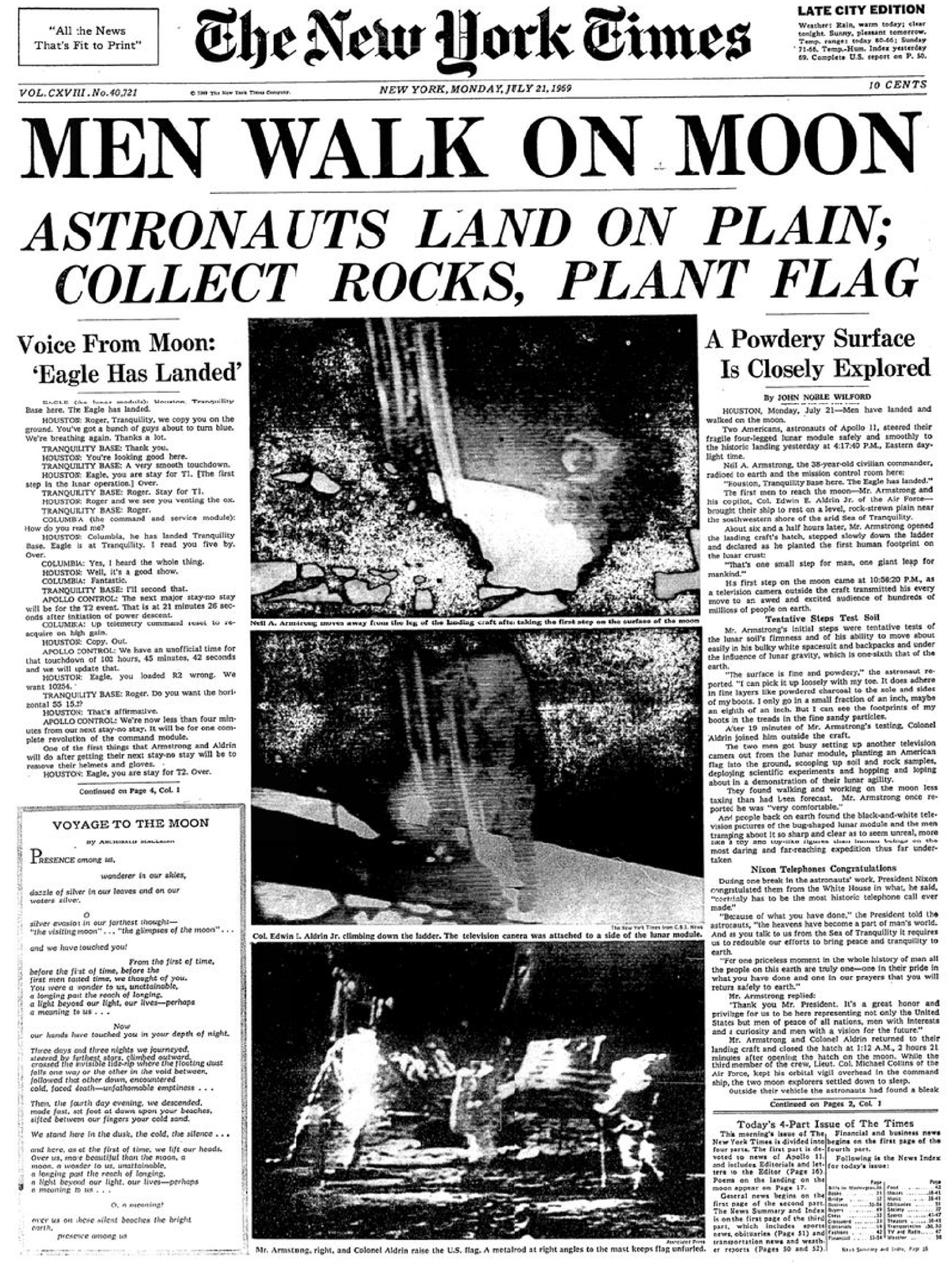
Screenshot of the front page of the New York Times, Monday, 21 July 1969.
This essay is a case study and close reading of parts of that iconic Times issue. I use interdisciplinary methods (including desktop research, archival research, close readings and textual/image analysis) to examine how a hugely significant scientific event – the moon landing – was communicated to the public by the Times using a variety of modes, styles and voices, encoding a widespread ambivalence about human encroachment on outer space. As a fiction writer, filmmaker and practising science writer (with a focus on space ethics), 3 I am particularly interested in how the creative experimentation evident in that 1969 issue of the Times can serve as inspiration to contemporary science writers who often operate within strict limitations imposed by media publications as to how we do our reporting (Lief, 2019; Robbins, 2010). As esteemed science writer Martin Robbins (2010) has noted, ‘Science is all about process, context and community, but reporting concentrates on single people, projects and events’ (para 19) and is often formulaic and ‘unimaginative’ (para 43). To improve the quality of science journalism, one of Robbins’ (2010) top recommendations is that editors allow their writers ‘to experiment with the form’ (para 39). This echoes other high-level recommendations to stimulate public engagement with science through incorporating innovative and novel ideas, forms and styles into science journalism (Lief, 2019; Mbao and Iqani, 2024; Inspiring Australia Expert Working Group on Science and the Media, 2011).
This case study traces how the coverage by the New York Times of the Apollo 11 landing included a diverse range of forms and registers – including poetry, visual art and first-person perspectives – to acknowledge the uncertainty felt by many Americans about the meaning and consequences of the first moon landing. Pages 6 and 7 of the issue showcase dozens of different opinions on the moon landing (half of them negative) from poets, philosophers, politicians, scientists, sculptors, activists and theologians. Page 17 of the same issue includes four poems and two artworks about the moon (and/or the moon landing). Unlike the effusive MacLeish poem on the front page, these poems – two by women, two by men – were subversively critical of the project of landing humans on the moon. The two artworks were reproduced without any editorial explanation. The first is ‘L’Acte de Foi’ by surrealist painter René Magritte (1960), which shows an irregular shape cut into a door, through which shines a crescent moon. The second is an ominously dark untitled (and undated) painting of the moon by American painter Albert Pinkham Ryder (1847–1917). These poems, artworks and critical first-person perspectives collectively give expression to a powerful lament that by landing humans on the moon, humanity has perhaps lost more than it has gained. Some respondents decry the insanity of spending so much money on a moonshot when there are pressing humanitarian issues on Earth. Others wish that the moon had remained a zone of the imagination and poetry, instead of becoming a pawn in a game of Cold War one-upmanship.
These interventions by artists and activists in 1969 were made openly in the New York Times, yet the story of their inclusion in that iconic issue has not been amplified over time. By bringing that story back into view, this case study aims to strengthen links between past and present critiques of who gets to go to space, why they claim the right to go there and whose interests they represent – and to rethink how narratives about current-day space activity are being communicated to the public by the mainstream media. This is highly relevant now as governments and private space companies share their concrete plans to mine the moon for economic profit (Osburg and Lee, 2022), to plant flags on Mars (Lambert, 2025) and to encircle our planet with satellite mega-constellations used by civilians and militaries (Albon, 2024). The editorial choices made by the Times in 1969 can serve as an impetus to reflect on how journalistic media today might more creatively cover (and contextualise) these new developments in space, for as anthropologist and space activist Juan Francisco Salazar (2023a) has noted, ‘[I]t matters immensely from where one thinks of space, when, and why (and with whom)’ (xiii).
2. Background: ‘We knew the newspaper would need help’ – editorial decision-making and creative risks
The Times editor who made these striking decisions about form and style, A.M. Rosenthal (1989), described what had prompted him to do things differently that day in 1969 in an Op-Ed for the New York Times published on 18 July 1989 (for the 20th anniversary of the first moon landing): The moment Apollo 11 went up, we knew the newspaper would need help four days later, when the astronauts landed on the moon, to tell the joy that was in us. (para 1)
Rosenthal had asked for a special headline type to be cast for the 1969 issue, one inch higher than usual, ‘[b]igger than ever used in the history of the paper!’ he recalled in 1989. ‘Shouting is one way to express joy’, he wrote, ‘but what else?’ He had decided that only a poem would do: What the poet wrote would count most, but we also wanted to say to our readers, look, this paper does not know how to express how it feels this day and perhaps you don’t either, so here is a fellow, a poet, who will try for all of us. (Rosenthal, 1989: para 9)
Rosenthal (1989) remembered first reaching out to an esteemed poet ‘who just did not think much of moons or us’ and turned down the invitation (para 10). He did not name this poet in his 1989 Op-Ed, but elsewhere it has been claimed it was an open secret this poet was W.H. Auden (Mendelson, 2019). 4 Rosenthal (1989) had next called up Archibald MacLeish, a three-time Pulitzer Prize winner, who said yes to the unusual commission (para 10). MacLeish had agreed to write a poem quickly to make the deadline, and to assume while writing it that the Apollo men had indeed safely walked on the moon – since the actual moonwalk would be happening right as the newspaper needed him to turn in his poem (Rosenthal, 1989: para 11). Once MacLeish had filed, the director of science news, Henry R. Lieberman, kept him on standby in case he needed to update the poem in the event the moonwalk failed (Rosenthal, 1989: para 12). It did not: the Apollo 11 astronauts walked on the moon, and MacLeish’s poem was run in all Times editions.
In his 1989 Op-Ed, however, Rosenthal misremembers the contents of the full issue from that day in 1969, writing that it was only a ‘couple of weeks later’ that the Times ‘ran a whole batch of moon poems’ (para 13). In fact, those other moon poems are present in that same day’s issue, grouped together on page 17. Rosenthal (1989) shows no recollection that these other poems – unlike the MacLeish poem – were not at all an expression of unalloyed ‘joy’ (para 1) but quite the opposite. They were bitter critiques of the dirty underbelly of American expansion into space, filled with the poets’ grief at how a geopolitical quest for scientific prestige had forever altered their beloved moon of poetry.
After two decades, even Rosenthal himself did not accurately recall the unusual coverage of the moonwalk that he had presided over as editor of the Times, nor just how much ambivalence about the event is evident in that 21 July 1969 issue due to his own editorial experiments in style, voice and form. Just as he had forgotten how sharply the page 17 poets had felt the symbolic loss of the moon as a realm previously only accessible to humans through the poetic imagination, so too was any reference to these poems excluded from the New York Times’ (2019) extensive coverage of the 50th anniversary of the moon landing. It is thus worth taking a close look at the poems and artworks here, to rescue them from historical oversight – and to glean insights that might inform contemporary science writing about major space events. What follows in the next section is a detailed description of the contents of page 17 of the 1969 Times issue, and a brief close reading of each poem to begin to understand the critique the poets were collectively making.
3. Close readings – reconsidering the ‘whole batch of moon poems’ on page 17
On page 17 of the 21 July 1969 issue of the New York Times, beneath a headline banner ‘Some Reflections on Man and the Moon at Their First Closeup Encounter’, are four poems, two artworks and a satirical essay by Times columnist Russell Baker (see Image 2). 5 At the top left is American poet Babette Deutsch’s poem ‘To the Moon, 1969’. Beneath it is an untitled poem by British author Anthony Burgess. To the right is a one-line palindrome poem (with short editorial explanation) by Soviet poet Andrei Voznesensky. At the bottom right is American poet Anne Sexton’s poem ‘Moon Song, Woman Song’.
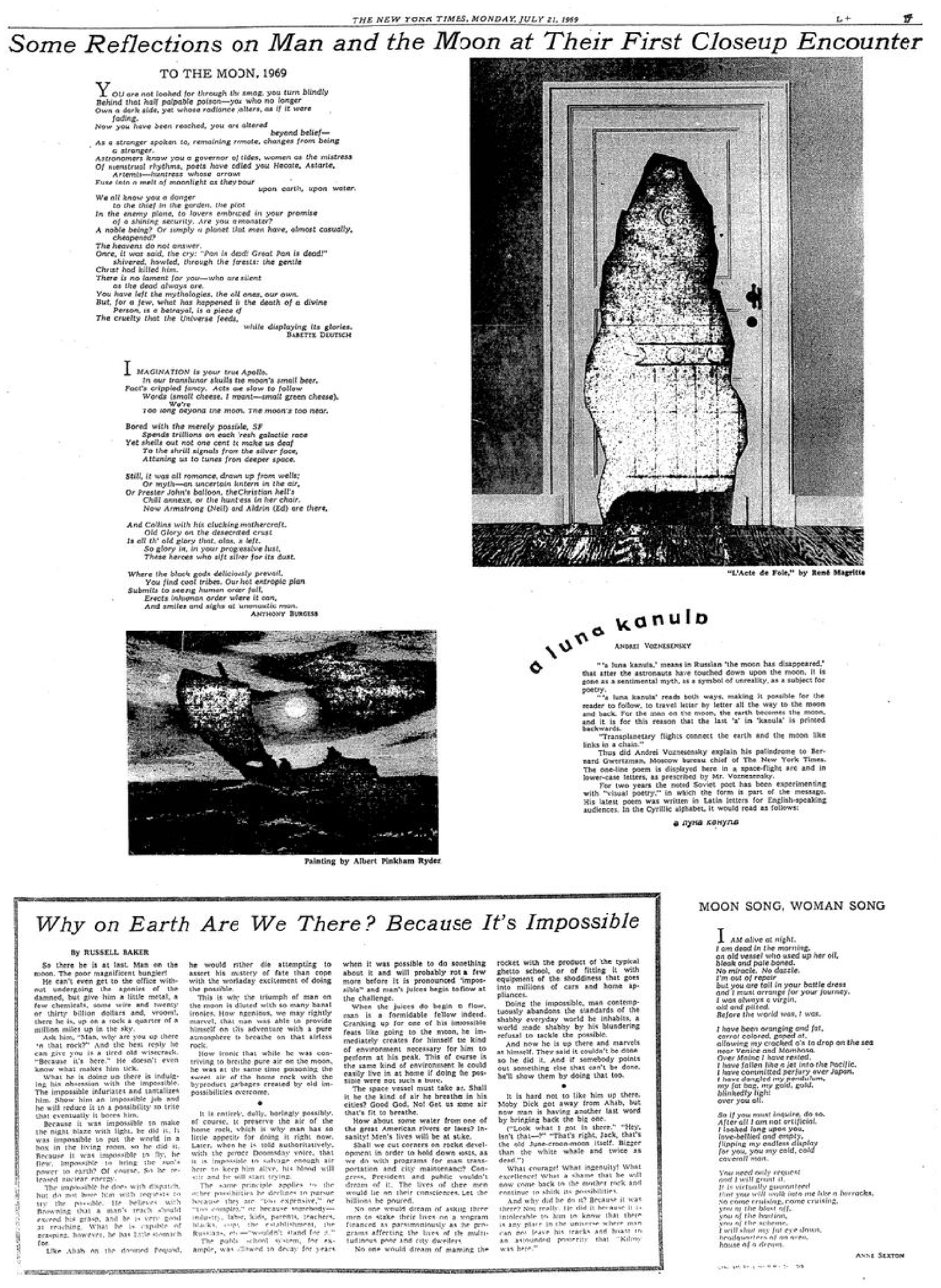
Screenshot of page 17 of the New York Times, Monday, 21 July 1969.
These four poems are united in their argument that after the moonwalk, the moon will no longer be what it has been throughout human history: an unsolved mystery, a symbol of longing, and a way for humans to experience poetic, romantic or spiritual transcendence. By setting foot on the moon, and making it into a ‘real’ place governed by science and politics, the poets believe that the Apollo astronauts have changed its meaning forever – and in ways that will have far-reaching consequences the poets insist will be dire.
Babette Deutsch’s poem (see Image 3) is addressed to the moon itself, and early on the speaker declares: Now you have been reached, you are altered beyond belief
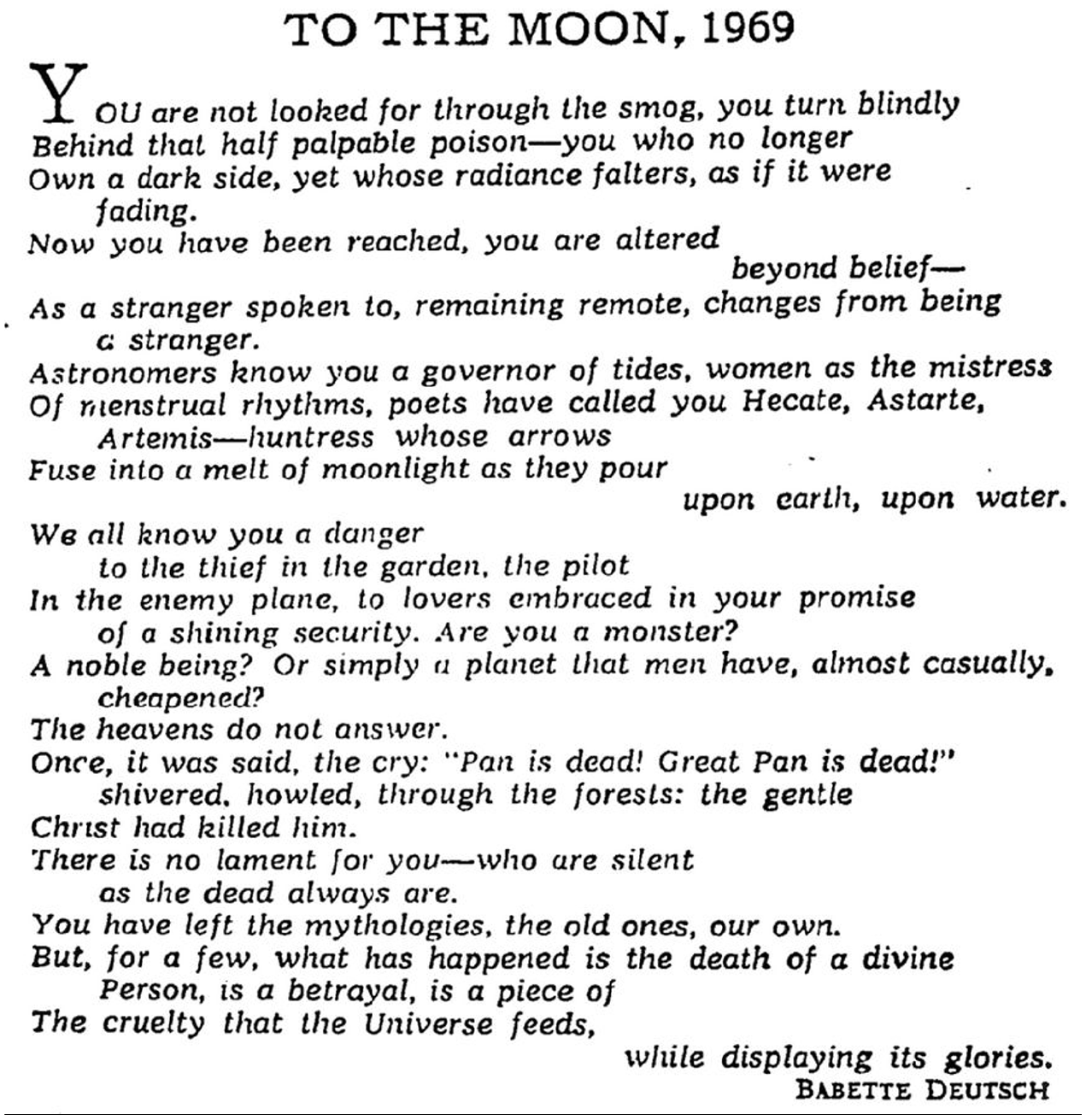
Screenshot of Babette Deutsch’s poem on page 17 of the 21 July 1969 issue of the New York Times.
The moon is no longer a stranger, ‘remaining remote’, and in the speaker’s view, familiarity breeds contempt. The speaker lists the many other ways of knowing the moon that humans have always had, whether as ‘governor of tides’, ‘mistress/Of menstrual rhythms’ or ‘a danger’ to ‘the thief in the garden’. Yet now, instead of being a ‘monster’ or a ‘noble being’, the speaker asks if the moon has become ‘simply a planet that men have, almost casually,/cheapened?’ As organised religion has killed off earlier pagan forms of worship and ritual, so the speaker laments that ‘what has happened is the death of a divine/Person, is a betrayal, is a piece of/The cruelty that the Universe feeds’.
The untitled poem on page 17 by British writer Anthony Burgess (1962) (best-known as author of the dystopian novella A Clockwork Orange) expresses similar themes.
6
The first two lines are a statement of poetic superiority in the wake of the moon landing: Imagination is your true Apollo. In our translunar skulls the moon’s small beer.
The speaker boasts that poets and artists have been going to the moon in their hearts and minds forever – and much further out into space, for that matter: We’re Too long beyond the moon. The moon’s too near.
Clearly, this poem was written in direct response to the moonwalk, for the speaker regrets that after ‘romance’, after ‘myth’ and religion, ‘Now Armstrong (Neil) and Aldrin (Ed) are there,/And Collins with his clucking mothercraft’. Their ‘progressive lust’ has turned the moon into ‘desecrated crust’, yet it is a fool’s errand – they ‘sift silver for its dust’. The final line depicts the astronauts not as ‘heroes’ but as lunatics, or ‘lunonautic man’.
The one-line poem on page 17 by Soviet poet Andrei Voznesensky (see Image 4), as the editorial explanation beneath it notes, is part of the poet’s two-year experimentation with ‘‘visual poetry’, in which the form is part of the message’. It is laid out in a ‘space-flight arc and in lower-case letters’ and is a palindrome that reads both forwards and backwards (when translated from the Russian) to mean ‘the moon has disappeared’. The final ‘a’ in the phrase is printed backwards to signify that ‘[f]or the man on the moon, the earth becomes the moon’.
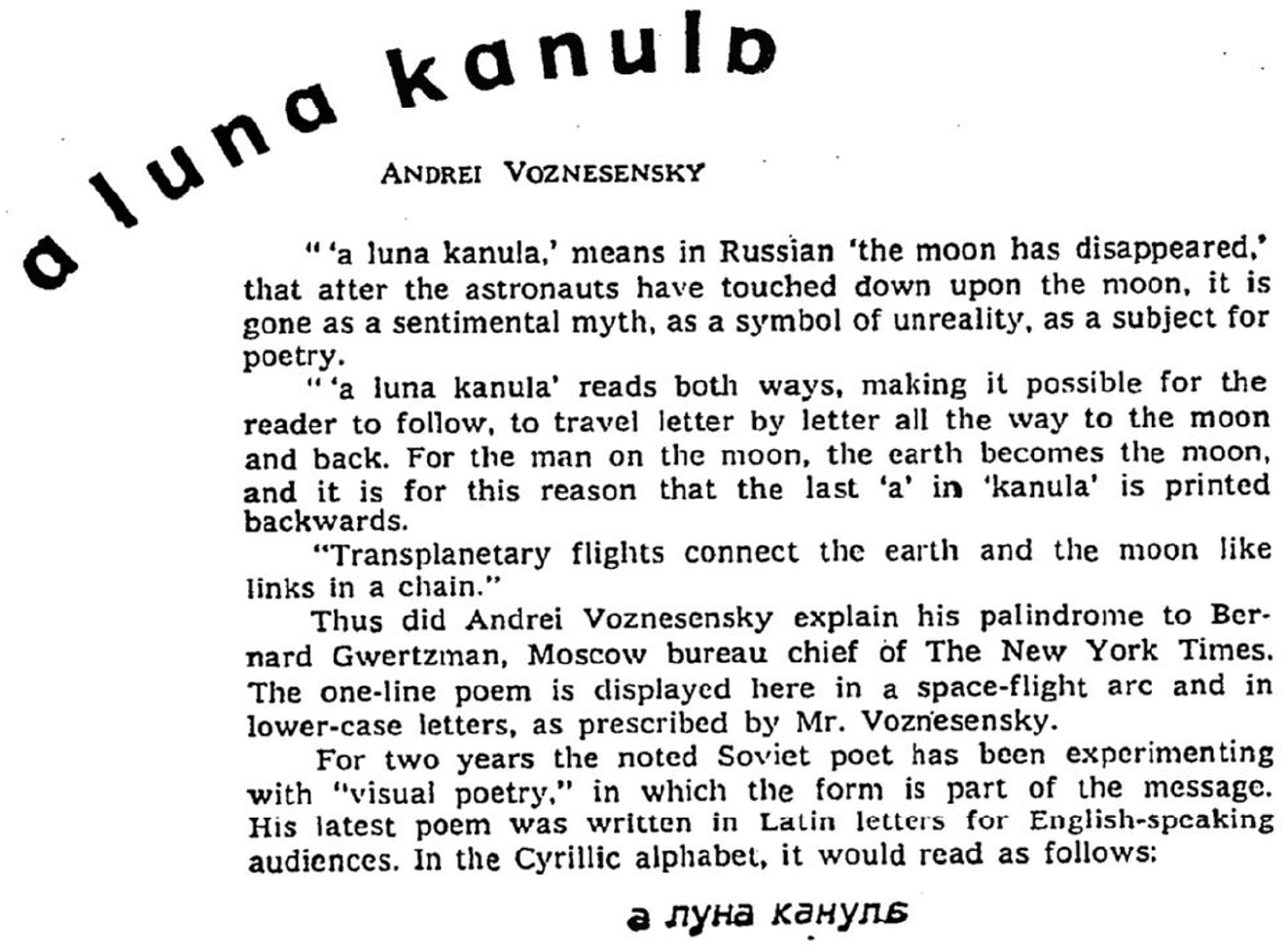
Screenshot of Andrei Voznesensky’s poem on page 17 of the 21 July 1969 issue of the New York Times.
The editorial notes that Voznesensky
7
explained the meaning of his poem to Bernard Gwertzman (Moscow bureau chief of the New York Times) as follows: . . . that after the astronauts have touched down upon the moon, it is gone as a sentimental myth, as a symbol of unreality, as a subject for poetry.
The editorial decision to include this poem by a Soviet poet is quite remarkable, given that the primary motivation for the American Apollo program was to put a human on the moon before the Soviets. On page 15 of the same issue of the Times, for instance, there is coverage of the Soviet Union’s spacecraft Luna 15, which had altered its orbit to bring it closer to the moon’s surface, provoking fears the Soviets were going to land it on the moon to collect rocks and prove that ‘unmanned craft were the equal of manned ships, if not more valuable’ (Gwertzman, 1969: para 4).
Finally, in American feminist icon Anne Sexton’s poem ‘Moon Song, Woman Song’,
8
the speaker of the poem is the moon: I am alive at night. I am dead in the morning,
The speaker addresses a ‘you’ implied at first to be the men who are getting ready to ‘journey’ towards the moon, ‘tall in your battle dress’. Later in the poem, this ‘you’ expands to address the human collective, above whom the moon has ‘dangled’ its ‘gold, gold./blinkedly light/over you all’. The speaking moon – after proudly asserting itself as ancient (‘Before the world was, I was’) – changes halfway through the poem to a different mode of address, defeatist and almost grovelling, hinting at a love that has been unrequited and a base willingness to be degraded through scientific inquiry and conquest: So if you must inquire, do so. After all I am not artificial. I looked long upon you, love-bellied and empty, flipping my endless display for you, my cold, cold coverall man.
In the last stanza, however, the moon-as-speaker – while still promising ‘You need only request/and I will grant it’ – switches to rage in its register, prepared to accommodate anything that the men in coveralls might want only because ‘It is virtually guaranteed/that you will walk into me like a barracks’. Knowing there will be no choice in the matter, the invitation the moon makes in the final lines is spiked with a twisted warning – that the ‘you’ will come anyway, but in revenge the moon will shut itself (and everything else it has ever meant) down: I will shut my fat eye down, headquarters of an area, house of a dream.
4. Discussion – losing the poetic moon to science
These four poets whose critiques of the moon landing were published on page 17 of the Times formed part of a much wider, global movement of poets (and segments of the general public) who were genuinely concerned about the re-coding of the moon’s meaning and value in the wake of the first moonwalk. Australian space archaeologist Alice Gorman has written about a similar shift in the style and content of poems about the moon published in the Australian Women’s Weekly: The Australian Women’s Weekly, for example, published numerous stories, columns, and poetry about the Moon. In the 1930s, poems celebrating the Moon as mysterious and feminine were common. By 1946, after the Second World War, science (and satire) started to creep into the poems. In this excerpt from Australian poet and war correspondent Dorothy Drain, the Man in the Moon laments that he’s had to neglect the lovers, poets, and songwriters because of increased scientific interest: Kindly tell the scientists I am overworked And wish They would leave me alone with my craters.
As Gorman (2019) writes, during the 1950s and 1960s, when ‘the U.S., the USSR, France, and the U.K. were developing rockets for space launch’ (p. 157), the moon was increasingly understood as the site of a future showdown between ‘science and culture’ (p. 158). In 1957, an unnamed writer published these lines in the Women’s Weekly: ‘Goodbye, romantic moon. Poor lovers: it’s black, hot and full of dust’ (quoted in the work of Gorman, 2019: 158). In Gorman’s (2019) view, ‘Lunar science was tarnishing the perfect pearly light, which bestowed ethereal beauty and inspired contemplations of the ineffable’ (p. 158).
One of the only in-depth published discussions of the page 17 poems in the Times is academic Edward Lense’s (1994) essay ‘Poetry & the Moon, 1969’ (itself behind a paywall that is unusually difficult to get through). Like Gorman, Lense (1994) describes how it was ‘the public consensus of both poets and non-poets during the summer of 1969’ that the moonwalk had set about ‘ruining the moon as an image for poetry’, transforming it from a place of metaphor into something more ‘prosaic’ once humans had reached it (p. 21). He continues: This blow to poetry was a side issue compared to serious matters like the United States’ propaganda victory and the worry that the moon might somehow become a missile base, but the nearly universal perception that technology had subtly altered the limits of poetic language is important too, at least to poets, because it demonstrates the power of the cultural concept that poetry deals in unreality and loses its force when touched by something real . . . Armstrong and Aldrin, by landing on the real moon, removed the unreal moon from the collective symbolic consciousness on which poetry depends. (Lense, 1994: 21)
Yet Lense, it turns out, does not agree with the poets. He reads their poems as proof of the intransigence of poets when faced with the need to ‘accommodate any kind of discourse other than traditional “poetic” language dependent on conventions irrelevant to experience’, and he is frustrated by the way these poets ‘retreat to contrarian grumbling about how the moon will just never be the same again’ (Lense, 1994: 21). For Lense, the battle of Poets versus Scientists is nothing new; it goes back to the poet William Blake’s attacks in verse of scientists of his own time (Newton, Locke, Bacon) and his skewering of science as ‘single vision & Newton’s sleep’ (quoted in the work of Lense, 1994: 21). 9 Lense (1994) traces this strained relationship between two different ways of knowing to the Romantic poets who felt sidelined by the rise of modern science and its threat ‘to eliminate all mystery from the physical world’ (p. 22). He writes that Deutsch’s ‘charge of lunacide against NASA’ in her poem is a way of taking the ‘anti-science attitude of Romanticism about as far as it can go’ and sees in her approach an ‘elitism by which only a few are sensitive enough’ to feel this way about the loss of the poetic moon (Lense, 1994: 22).
As for Burgess’ poem, Lense reads it as an expression of ‘the irritation that science-fiction writers felt all through the 1960s when every event in space provoked journalists to declare that science fiction had become “obsolete”’. To Lense (1994), this is more promising than Deutsch’s approach, ‘in that it still holds out hope for science fiction as a successor to traditional poetry’, and slyly suggests that ‘science can be a language of the imagination’ (p. 22). Overall, Lense argues against seeing poetry as a ‘privileged language’ that is ‘inherently different’ from any other kind of language. Poets, he thinks, have lost touch with other ways of naming things and experience – so that, in the wake of the first moonwalk in 1969, all they could see was ‘poetry under siege by rockets’ (Lense, 1994: 23). Yet he believes that ‘poetry is a dynamic art, and has never been more so than now as it continues to adjust to a world dominated by technology’ (Lense, 1994: 24).
A second, briefer discussion of the page 17 poems can be found in American poet Mary Ruefle’s (2012) essay ‘Poetry and the Moon’. This essay was published online and in a collected book of Ruefle’s (2012) essays but was originally written in 1995, soon after Edward Lense had published his own essay (para 4). Ruefle uses a gently tongue-in-cheek tone throughout, a hallmark of her writing in prose. She judges the batch of moon poems on page 17 to be ‘really dreadful moon-verse’, and describes MacLeish’s front-page poem as ‘thoroughly mediocre’ and ‘vague’. However, in spite of all this, she (like me) still thinks a ‘full-page spread of poetry in the New York Times’ in commemoration of a major scientific event represents a courageous and creative editorial choice, and she finds ‘the whole of that day’s newspaper’ to be ‘rather wonderful’ (Ruefle, 2012: para 4 10 ). Her takeaway is that there is no need for post-Apollo poets to panic. No lunacide was committed that day of the first moonwalk, and poetry did not die in its wake. Great poems about the moon are still possible, Ruefle (2012) believes, because the moon has not ‘lost any of her presence’ (para 4).
These mid-1990s interpretations of the original page 17 poems also help to shine a slightly different light on the MacLeish poem published on the 1969 issue’s front page. Beneath MacLeish’s attempt to express boundless wonder and joy about the moon landing (‘and we have touched you!’) is something else, a muted agreement with his more critical poet peers: that the right to make meaning from the moon has been stolen from the poets. ‘O, a meaning!’ is one of the final lines in MacLeish’s poem and can be interpreted as a lament for the loss of the moon as an ‘unattainable’ place of ‘longing’ that the poets have been visiting in their minds ‘[f]rom the first of time’. Now that astronauts have ‘set foot’ on the moon’s ‘cold sand’, they find only ‘unfathomable emptiness’. The moon delivered by science is a disappointment, MacLeish suggests, and the communal ‘We’ speaking the poem instead looks up from the moon’s surface to see the Earth as ‘a/moon’, now invested with all the longing and light and meaning that had once been invested in the moon.
This turn back to Earth, in MacLeish’s view, becomes the only consolation of going to the moon and finding it to be a wasteland. This is, in fact, quite similar to the other poets’ assertions on page 17: that something irreparable has happened now that the moon has entered the zone of the real, an animating concern for many poets at the time of the Apollo 11 landing: Dare we land upon a dream and sully it with our flaws? Or dare we land upon a dream and thus see its enchanted light turn into ordinary soil beneath our feet? (Allen, 2019: para 5)
In MacLeish’s poem, the return of the speaker’s gaze towards Earth was likely influenced by the famous ‘Earthrise’ photograph taken by an astronaut on the Apollo 8 mission the previous year, in 1968 (Oliver, 2015). Instead of finding the moon to be a magical place, this photograph shows the Earth’s uncanny living beauty in the face of the frightening nothingness of the moon. As Lense (1994: 24) wrote, ‘the real moon has turned out not to be a very interesting object, even to planetary geologists’. Rene Dubos, a microbiologist who was given a first-person perspective on page 7 of the 1969 Times issue, described the ‘drabness of the moon’, and a Protestant theologian, Reinhold Niebuhr, quoted on the same page said that ‘the moon is dead and barren’.
It is true that some of the Apollo astronauts who spent time near (or on) the moon found themselves unimpressed by it as a landscape. Bill Anders, the same astronaut who took the ‘Earthrise’ photograph, described the moon as ‘one beat-up, sand-blasted ball with hole upon hole’ (quoted in the work of Allen, 2019: para 6). Jim Lovell said it was ‘essentially gray, no color; looks like plaster of Paris or sort of a grayish beach sand’ (quoted in the work of PBS, n.d.: para 8), while Frank Borman called it ‘a vast, lonely, forbidding type of existence or expanse of nothing’ (quoted in the work of PBS, n.d.: para 12). Michael Collins saw the moon as ‘a hostile place, a scary place’ (quoted in The Independent, 2007: para 7). Only very occasionally did the astronauts acknowledge how inadequately prepared they were for the task of finding the right language to describe the moon (‘How to describe it, how to describe it’, muttered James Irwin of Apollo 18, as quoted in the work of Ruefle, 2012: para 8). While these astronauts’ descriptions of the moon as desolate may have helped to anticipate the shift to gazing back at Earth as a precious ball of blue beside its grey sister satellite (Oliver, 2015), this language they used also enacted exactly what the poets had feared all along. Through this scientific language, authoritatively communicated to the public as the ‘truth’ of the moon as a place, the moon was indeed transformed from a place of boundless imagination, meaning and beauty into just one place, seen firsthand by a few men and declared by some of them to be monotone, stark, barren, even boring.
The two paintings reproduced in miniature beside the poetry spread on page 17 of the 1969 Times issue also speak to this underlying astronaut anxiety about the instability of human (and lunar) legacies, and how those who claim to be making history never really know what history they are making, or how it will be remade or reinterpreted in the future. These artworks (see Image 2) express something of the horror of the moonwalk, right as it was happening. They shade the real into the surreal.
The title of Belgian surrealist painter René Magritte’s ‘L’acte de foi’ (see Image 2) translates as leap of faith. 11 The image in the painting suggests that somebody has broken violently through the door and leapt off the balcony into what looks like the ocean far below. It seems to represent an almost wanton self-annihilation, not a joyful leap into the unknown. Magritte had died only 2 years earlier (in 1967), and this fact heightens the unease created by the inclusion of this painting on this particular page (as does the knowledge that his own mother had died of suicide when he was 14 by throwing herself into a river). This painting is not, in Times editor Rosenthal’s (1989) words, an expression of ‘the joy that was in us’ (para 1). It feels much closer to what the New York Times (1967) obituary for Magritte had described as his visual call to do a ‘double-take’ (para 6) and ‘poke’ at ‘the strange world’ (para 32).
The second, untitled painting on page 17 is by American painter Albert Pinkham Ryder (1847–1917) (see Image 2). Ryder’s artworks were enormously popular at the start of the twentieth century, but by the 1960s he was no longer as well-known, and his work had fallen out of critical favour (Broun, n.d.). In his attempts to give his paintings an unusual translucency, Ryder tried different techniques, including painting over gold leaf. The method that he used most often was to mix vast quantities of oil into his paints, and to paint in many colours, layer after layer, without the underlayers drying properly. This resulted in layers of paint so thick they would later crack, destroying the paintings themselves. Many of the pigments have also deteriorated and darkened over time.
It is difficult to clearly make out the image of his painting on page 17 other than to know it involves the moon, clouds and a seascape below (moonlight on the ocean was his recurrent subject). Due to the way his paintings have darkened, the moon is now often the only object still visible in his paintings. This feels like it is in keeping with his original intentions, for just as poets have dreaded myth and imagination being killed off by fact, so too have painters often feared atmosphere being replaced forever by accuracy, as Maria Popova (n.d.) writes: And yet, although what remains of them today is but a mere ghost of the radiance that so enchanted his contemporaries, something about Ryder’s moody moonscapes still makes them more luminous and alive than any photograph of the Moon, for they were not a mere record of beauty but a portrait of a consciousness wonder-smitten by beauty – a living testament to William Blake’s koan of a pronouncement that ‘the Eye altering alters all’. (para 6)
5. Focusing on ‘Earth’s affairs’ – first-person perspectives and resistance to moon landings in 1969 and today
As the Apollo 11 astronauts walked on the moon, and the poets worried about the loss of the poetic moon, the attention of many Americans was instead focused on the Vietnam war, widespread protests by students on campuses around the country, the civil rights movement, political assassinations (Martin Luther King Jr. and Bobby Kennedy had both been assassinated in 1968), and poverty and hunger in communities throughout the country. Beneath the banner headlines ‘Reactions to Man’s Landing on the Moon Show Broad Variations in Opinions’ (page 6) and ‘Some Would Forge Ahead in Space, Others Would Turn to Earth’s Affairs’ (page 7), the Times presented in that same issue a snapshot of diverse first-person responses to the moonwalk, some accompanied by photographs of the speaker.
These perspectives on pages 6 and 7 of the 21 July 1969 issue of the Times (see Image 5) 12 serve as an important reminder to today’s public of just how controversial and disputed America’s space program was at the time. Taken together, they add up to a kaleidoscope of strongly expressed, differing opinions on the moonwalk’s significance and consequences. These first-person perspectives also highlight the different critical approaches taken by the poets on page 17, whose response was less about fighting for social justice on Earth and more about resisting having the moon’s symbolic value and meaning altered right before their eyes.
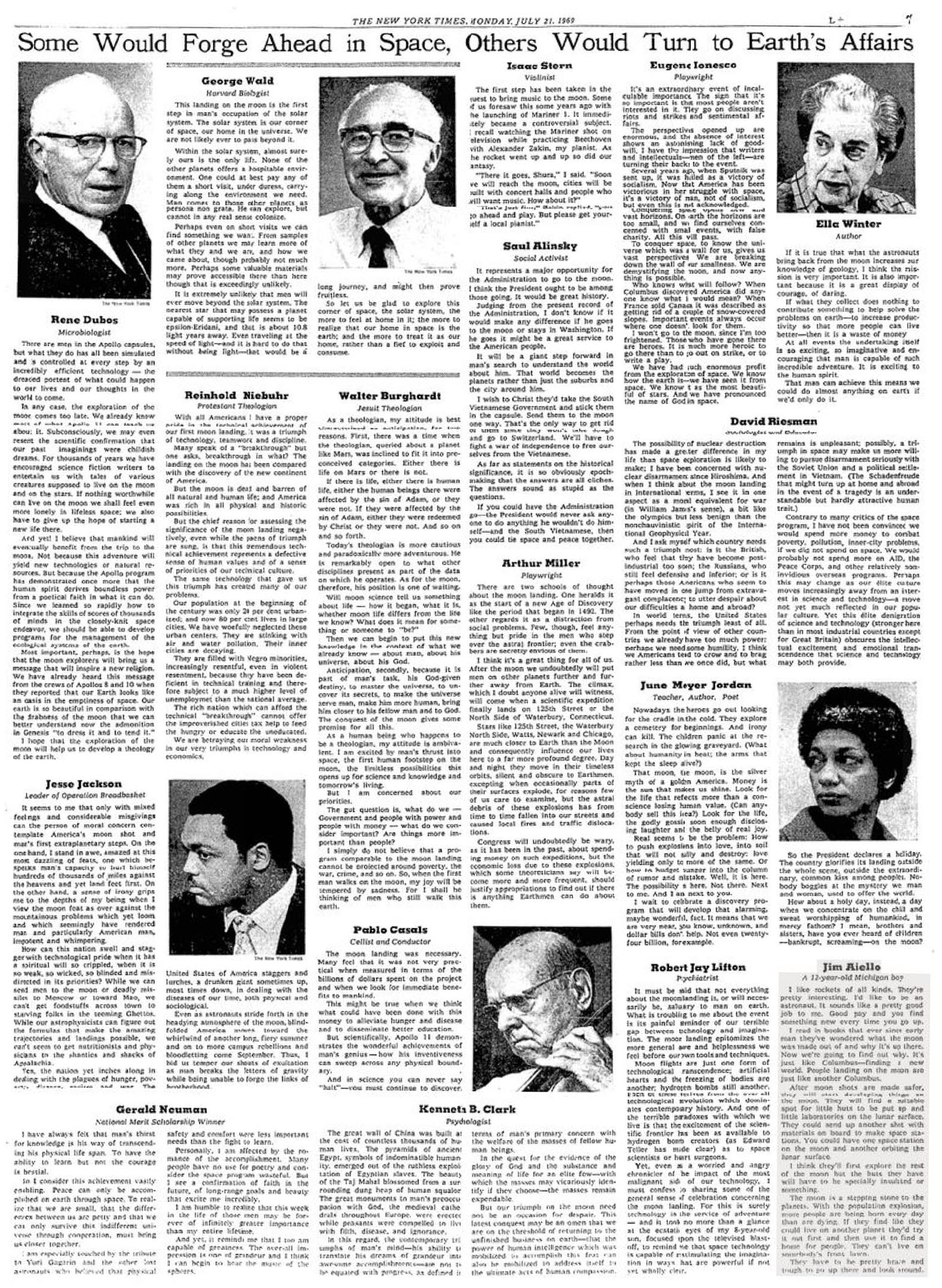
Screenshot of page 7 of the 21 July 1969 issue of the New York Times.
About half the first-person respondents on these two pages were ‘for’ the moon landing (and the wider American space program) for reasons linked to scientific ingenuity and prowess, and national pride. The other half were ‘against’, expressing concerns that the fight for social justice on Earth was being undermined by the American government’s extravagant spending in space, that the nationalistic fervour of the landing risked world peace, and that the prestige of the landings accrued only to certain kinds of (white, male, wealthy) Americans. Several short excerpts from just a few of the first-person perspectives expressing these criticisms follow: How can this nation swell and stagger with technological pride when it has a spiritual will so crippled, when it is so weak, so wicked, so blinded and misdirected in its priorities? While we can send men to the moon . . . we can’t get foodstuffs across town to starving folks in the teeming Ghettos . . . What is troubling to me about the event is its painful reminder of our terrible gap between technology and imagination. The moon landing epitomizes the more general awe and helplessness we feel before our own tools and techniques . . . How about a holy day, instead, a day when we concentrate on the chill and sweat worshipping of humankind, in mercy fathom? I mean, brothers and sisters, have you ever heard of children – bankrupt, screaming – on the moon? . . . the promoters of space exploration have made the credulous and the scientifically uninformed believe that a better future may await mankind on the sterile moon, or on an even more life-hostile Mars – as if such a change of scene would bring our sick rulers and their still acquiescent victims back to health.
Just as these respondents questioned the narratives used to justify space exploration in 1969, contemporary activists who work on social justice issues related to space activities are today critiquing the privatisation of space in what is being touted as a new ‘Space Race’ (Lawrence et al., 2022; Noon and De Napoli, 2022; Walkowicz, 2018, 2022), but they are not often given such a prominent platform as the New York Times in which to make their informed critiques. In a relatively short time span, space has gone from being the domain of national governments to becoming a mixed realm for profit-seeking commercial space ventures servicing many government and military clients (Munro, 2024; Whitman Cobb, 2023). Lucianne Walkowicz (2022) (co-founder of the JustSpace Alliance) believes that it is essential to understand the ‘intentional imagination capture’ of the contemporary global public and mainstream media by the well-resourced marketing teams of commercial space companies (n.p.). By bending the public’s imagination of what is possible in space towards their own purposes and projects – such as human settlement and resource extraction off-Earth – these companies have already managed to convince a large portion of the public (and the media) that ‘private companies will replace government programs’, Walkowicz (2022) says, or that it is of the utmost necessity ‘that we leave [Earth] in the first place’ (n.p.).
One of the most significant contemporary contributions to thinking about what social justice might look like in outer space is the Decolonise Mars movement. 13 This movement became politically relevant during the Black Lives Matter movement’s protesting of the police killing of George Floyd in the United States, right around the time that SpaceX sent the first commercial astronauts to the International Space Station (McKinson, 2020). Space activities carried out by rich spacefaring countries have often been linked to wider state projects of colonial dispossession and racial oppression (Gorman, 2009; Maher, 2017; Redfield, 2000; Smith, 2019; Walkowicz, 2022), but this is not often a line of reporting explored by the mainstream science media. As Nikki Giovanni’s (2002) poem ‘Quilting the black-eye pea (We’re going to Mars)’ states, ‘The trip to Mars can only be understood through Black Americans’, connecting the history of slavery with white supremacist forays into space (stanza 9).
Other hidden histories of the Apollo space era have only recently been uncovered and gradually shared, such as the unacknowledged role of Black women mathematicians who did essential calculations for the space program (a story told in Hidden Figures (Shetterly, 2016)), and protests by African American activists at Cape Canaveral before the Apollo launches, who decried the enormous amounts of government spending on a trip to the moon instead of providing basic social services to their communities (Maher, 2017; Smith, 2019). A year after the Apollo 11 landing, the poem ‘Whitey on the Moon’ was released on the debut album of spoken-word poet Gil Scott-Heron (1970). It has since become emblematic of those protests: A rat done bit my sister Nell With Whitey on the moon Her face and arms began to swell And Whitey’s on the moon I can’t pay no doctor bills But Whitey’s on the moon Ten years from now I’ll be payin’ still While Whitey’s on the moon
After Scott-Heron’s death in 2011, his poem was heralded as bringing space travel out of the ‘abstract, universal realm in which we like to place our technical achievements’, and raising uncomfortable questions about ‘which America’ benefitted from all the ‘glory of the moon landing’ (Madrigal, 2011: para 2). For Scott-Heron, the loss of the poetic moon was not front of mind as it was for the page 17 poets in the Times; instead, his poem points to everything the moon landing (and space program) was stealing from Black Americans and others struggling to make it through day by day back on planet Earth. This case study of the 1969 Times coverage of the moonwalk can thus serve as a timely reminder to present-day science writers (and science section editors) to move beyond the awestruck headlines celebrating technological prowess in space and seek out new voices and perspectives – as well as new forms and modes of science communication – to properly investigate and creatively contextualise for the public the changes that are taking place so rapidly in outer space.
6. Conclusion: Poetic moon, scientific moon . . . economic moon?
The New York Times coverage of the first moonwalk in 1969 was experimental and creative, encouraging a turn away from reportorial authority to welcome different voices and perspectives shared in unconventional forms. Yet the full story behind that approach, and the depth and breadth of this experiment by the Times, has been lost over time. The sharp edges of dissent and resistance to human activities in space that were openly expressed in a major American newspaper in 1969 have also been sanded down as the decades have passed: recent research by the Pew Research Centre shows 70% of Americans now support America being a world leader in space (Kennedy and Tyson, 2023).
This historical amnesia about how the moon landing was reported on in 1969 became even more apparent as I tracked the mainstream press coverage of the 50th anniversary of the first moonwalk, in 2019. The New York Times (and many American and international English-language newspapers) commemorated the anniversary with celebratory coverage infused with nostalgia for what is now roundly viewed as a bold, brave, heroic past (AAP, 2019; BBC, 2019; Douthat, 2019; The New York Times, 2019; Associated Press in Washington, 2019). If the nostalgia was counterbalanced at all, it was by the widespread optimism expressed in mainstream science reporting about the new hope represented by the private space industry, as space companies vie with one another to make space a realm of profit-making (McKie, 2019; The Washington Post, 2019). There was little acknowledgement in the 50th anniversary commemorations that public resistance – and poets’ pushback – to the 1969 moonwalk (and American space program) were not marginal sideshows but were taken very seriously at the time, and given significant column inches in the pages of the New York Times right as the first moon landing was taking place.
If, as the page 17 poets feared, the spell cast by a romantic and poetic moon has been broken, and it has now been demystified as a scientific moon, the next goal of space agencies working in partnership with private space companies is to re-define the moon as a natural place for settlement and profit-making through resource extraction. The moon’s value is increasingly being framed in economic terms (Dominguez, 2023; Guenot, 2023) as the moon is strategically re-zoned by the space industry and prospective moon-miners as Earth’s ‘eighth continent’: a rhetorical tactic to downgrade the moon into just another bit of land holding valuable resources that can be dug up and sold (Álvarez, 2020). Every planned lunar mission now makes mining the moon one of its future priorities – whether to use the regolith to 3D-print human habitats; to mine the water-ice at the lunar south pole to make fuel and oxygen for missions to Mars; or to extract rare Earth minerals that may exist in large quantities on the moon (Staedter, 2022). The United Nations Committee on the Peaceful Uses of Outer Space (COPUOS) Working Group on Legal Aspects of Space Resource Activities is working hard to establish a governance framework to ensure any future space resource extraction is sustainable and equitable, and to remind space actors of their responsibilities under existing international space law like the 1967 Outer Space Treaty (which forbids sovereign claims being made in space) (UNOOSA, 2024). Yet this initiative will depend on the major space powers being in the geopolitical mood to cooperate (O’Brien, 2024; UNOOSA, 2024).
If America’s long-planned Artemis mission is successful, and humans land again on the moon in years to come (this time with economic goals firmly in mind), will the editors of the New York Times be prepared to take creative risks in their coverage of this significant scientific event in terms of their decisions around form, structure, voice and style? Will that future issue of the Times be allowed to be as experimental and filled with ambivalence as the 21 July 1969 issue once was – and will critics of the Artemis mission (and the new Space Race) be given equally vivid and valid coverage through first-person perspectives? At the very least, perhaps a brave Times science editor might see fit to publish a few bitter, grief-laden poems and reproductions of artworks lamenting the advent of an ‘economic’ moon, even if they are buried deep within that future issue’s pages.
Footnotes
Acknowledgements
This article includes screenshots from the New York Times issue of 21 July 1969 as sourced via TimesMachine. This material is used under s41 of the Copyright Act 1968 Fair Dealing for Criticism or Review.
Funding
The author disclosed receipt of the following financial support for the research, authorship, and/or publication of this article: This work was supported by Macquarie University through their Macquarie University Research Fellowship scheme.
