



Abstract
Drawing from science capital research and applying current practice theory, this study sheds light on people’s perceptions of science and science-related practices in their everyday lives. The study develops a practice theoretical approach to examine understandings and engagements embedded in socially shared everyday science-related practices. The analysis of 51 interviews with Finnish people aged 20 to 88 with varied educational and socio-economic backgrounds brings participants’ voices into a discussion. The findings suggest that science is understood as a generally valuable all-compassing phenomenon offering a means to explain the world and address complex issues. Participants commonly reported engaging with science in their professional lives, regardless of their educational background or employment status. However, most interviewees implied a lack of confidence to engage in science due to the perceived norms of institutionalised science. This study reveals the need for more critical reflection on the approaches of science-promoting practitioners to advance science engagement.
1. Introduction
This study contributes to the strategic research of the multidisciplinary Fostering Finnish Science Capital (FINSCI) consortium, which aims to explore and foster Finnish science capital (i.e. science-related forms of Bourdieusian cultural and social capital), as well as to develop new kinds of inclusive practices for science centres and museums. By exploring the distribution of science capital in Finnish society, the project aims to pave the way for more equitable opportunities to engage with and participate in science, as a precondition for citizens’ science literacy and the ability to acquire and use scientific knowledge in everyday decision-making (FINSCI Research, 2024). However, the aspects and elements constituting science literacy, especially as a political and educational goal, are a matter of debate and a question that cannot be resolved solely with research knowledge, or within the frame of the FINSCI project, for that matter (see, for example, DeBoer, 2000; Hodson, 2008). While our research aligns with the strategic objectives of FINSCI and draws from the studies on science capital (e.g. Archer et al., 2015, 2021; Kaakinen et al., 2023), our perspective is more intertwined with the concepts of public understanding of science (PUS), and especially, public engagement with science (PES) or science engagement (e.g. Davies, 2013; Smallman, 2016; Stilgoe et al., 2014). We will not delve into the conceptual differences or alleged transition between PUS and PES here but instead focus on the variety of participation to respond to the need for holistic analyses of science engagement across wider systems (e.g. Braun and Könninger, 2018; Chilvers and Kearnes 2020).
Typologies of science engagement do exist, but theoretical frameworks have not yet been empirically studied and discussed ‘against the concrete engagement practices of the general population’ (Losi, 2023: 799). The few qualitative studies conducted on the variation of engagements (e.g. Davies, 2013) imply that people’s actual engagement and participation in science can have multiple forms depending on, for example, personal and professional background or national contexts (see also Einsiedel, 2021; Irwin, 2014). Many groups are also marginalised from participation in institutionally organised science-related activities, and their contributions to or interactions with science in daily life may thus be either unrecognised or unexplored (e.g. Dawson, 2019). For instance, according to the analysis of Eurobarometer 2021 data, 45% of the European population that ‘does not engage at all with science’ mostly has low social status (Losi, 2023: 812). Similarly, the Finnish Science Barometer (Finnish Society for Scientific Information, 2022) survey on public opinion and attitudes towards science and technology shows ‘high public interest’ (nearly 70% respondents said they were very or fairly interested) and ‘strong public trust’ (85% of respondents had very high or fairly high trust) in science and research. However, education is a major distinguishing factor between the ‘at least fairly interested’ majority (83%) of tertiary education graduates and the one-third of all respondents expressing ‘no interest in science’ at all. Scholarly literature has also addressed the unequal distribution of science capital (Archer et al., 2015, 2021; Suortti et al., 2024), reflecting, for example, people’s socio-economic, socio-demographic and educational backgrounds. Do these results convey actual disengagement with and disinterest in science? Or do they convey rather asymmetrical power positions and a limited – Western, middle-class, educated and non-inclusive – view on science engagement and participation embedded in science barometers and quantitative surveys?
Therefore, instead of taking any definitions of understanding or engagement with science as starting points – such as normative and premeditated sets of scientific facts, skills, (appreciative) attitudes, or participation in institutionally managed engagement activities – our qualitative analysis of semi-structured interviews with 51 Finnish people aims to explore how they define, construct and perform connections with science and science-related issues in their everyday lives. Resonating with the practice theoretical approach to ‘mundane science use’, suggested by Halkier (2017), our perspective is based on the family of practice theories and ‘practices’ as shared and repeatedly enacted ‘structures of action’ (Reckwitz, 2002: 244). As culturally recognised and routine ways of doing and saying, practices consist of intersecting ‘forms of bodily activities, forms of mental activities, things and their use, a background knowledge in the form of understanding, know-how, states of emotion and motivational knowledge’ (Reckwitz, 2002: 249; Schatzki, 2002). To close ‘the gap between theory and practice’ on science engagement (Delgado et al., 2011), we thus address understandings of and engagements in science, asking the following research questions:
As an analytical frame, the practice theoretical approach unifies the embodied and discursive elements of science-related activities to comprise a cultural condition and societal context (Halkier, 2017: 19). In our study, one notable contextual feature is the Finnish language, in which the term ‘science’ (tiede) encompasses all fields of academic research including natural sciences, social sciences, humanities and arts. The practice theoretical perspective enables us to explore not only people’s perceptions of science as an abstract entity but also the uses of research-based knowledge representing various disciplines. This approach is crucial as people engage in different ways with science and its outcomes in specific fields (e.g. Achterberg et al., 2017). Next, we elaborate on the study’s theoretical background – the science capital approach and our turn to current practice theory, which is used as an analytical framework.
2. Science capital and practice theories
The concept of science capital (Archer et al., 2014, 2015, 2021), inspired by Pierre Bourdieu (1986) was primarily developed and applied in the United Kingdom to understand children’s and adolescents’ educational outcomes and career aspirations in STEM, especially in underrepresented groups. For that purpose, science capital encompasses ‘science-related qualifications, knowledge/understanding, interest, literacy and social contacts’ (Archer et al., 2014: 19). In contrast, the Finnish science capital research began with the study of adults who had already presumably passed formal education. The aim was to highlight the potentially transformative role of lifelong learning and the interpretation of science capital as a dynamic rather than a deterministic concept, covering a variety of academic fields, and not only STEM. A recent population study of Finnish adults revealed four dimensions of the emergence of science capital (science identity, dispositions towards science, support from parents and teachers in childhood, and science-related activities) to develop recommendations for fostering science capital in society (Kaakinen et al., 2023).
The underlying Bourdieusian concepts of social and cultural capital define capital as accumulated and embodied within the boundaries of social class, transmitted via socialisation and social reproduction, and generating power for its holder (Bourdieu, 1986). Capital is often unevenly distributed, leaving the higher social classes with a clear advantage in many fields of society. According to critics of capital theory, Bourdieu sheds light on the social reproduction of the middle class, yet he does not ‘account for the nuanced practices of those who do not operate from a dominant position’ (Skeggs, 2004). Archer et al. (2021: 169) counterargue for the wider use of the capital approach in understanding ‘the production and nature of practice’ by emphasising ‘structural inequalities and relations of power’. However, their research has been criticised for pushing for science participation as a ‘gateway’ out of science non-participation, without delving into why some groups are not engaged with science in the first place (Nicolaisen et al., 2023). Indeed, more recent research within the science capital framework built on Bourdieusian concepts emphasises emancipatory interests in equity and social justice by examining structural inequalities and disrupting exclusive science-related practices (Dawson, 2019).
Bourdieu represents the first generation of practice theorists, although he primarily used social practices to develop concepts of habitus, capital and field (Schatzki, 2018). From the perspective of second-generation practice theorists, however, social life is envisioned as a nexus of practices (e.g. Nicolini, 2012; Schatzki, 2002). Accordingly, the social phenomenon called science can be approached as an open-ended bundle of (science-related) practices carried out consciously or unconsciously by multiple people (Schatzki, 2002). Moreover, any social practice, such as various practices related to research, has a dual nature: practice-as-entity and practice-as-performance (e.g. Shove et al., 2012). The practice-as-entity means that we can discuss a particular practice and recognise the performance of practice that someone is carrying out, even if we have never carried out the practice in question. It is enough that a wide range of people has performed it repeatedly in sufficiently similar ways, and as a result, the practice becomes shared, persistent, and recognisable within a particular social and cultural sphere. For instance, academic scholars can recognise and discuss numerous research practices as social entities (e.g. writing a study report and collecting data). As for practices-as-performances, this means that practices must also be carried out repeatedly so that those survive or be ‘alive’. Embodied and material performances reproduce but unavoidably also change social practices according to situational and cultural environments. Thus, practice theory emphasises social, material, and embodied practices steering or even governing our everyday activities instead of the individual’s free will or cognition. Therefore, people could be described as ‘carriers of practices’ (Reckwitz, 2002: 250) who more or less consciously acknowledge the normativity embedded in practices (Schatzki, 2012).
A few studies focusing especially on PES apply practice theory to highlight everyday performances of science-related practices (Halkier, 2017; Meckin and Balmer, 2019), or knowledge shared across social practices (Goisauf and Durnová, 2019). Accordingly, our study contributes to the approaches based on practice theory to examine understandings of and engagements in science by applying practice theoretical concepts of constituting elements of practices. Simplified, practices consist of doings and sayings (Schatzki, 2002) that can be organised, for example, into elements of understandings, procedures and engagements (Warde, 2005). Understandings compose knowledge, notions, beliefs and opinions about practices. Procedures refer to competencies and principles emerging in the performance of practices. Engagements comprise what is worth doing in our lives – meanings, emotions and normative aims towards which practices are oriented. Noteworthy, understandings and engagements can be analysed as sayings of practices, but an analysis of procedures may demand an observation of doings (Torkkeli et al., 2020; Warde, 2005). The most effective way to conduct a practice-theoretical empirical study would be to apply ethnographical interaction-observation methods (e.g. Schatzki, 2012). Nonetheless, ‘sayings are a subclass of doings, namely, all doings that say something about something’ (Schatzki, 2012: 15). Thus, the focus of this study is especially on verbalisations of (1) understandings as socially shared conceptions, beliefs and aspirations related to science and (2) engagements as appropriate and meaningful science-related performances in everyday lives.
3. Methods and data
We collected people’s sayings and verbalised doings of science-related practices by conducting semi-structured interviews.
Participants
The participants (n = 51) were recruited in March and May 2023, from four communities (n = 23) in Vantaa, and in October 2022, from three Finnish science centres or museums (n = 28) participating in the FINSCI research project: Heureka the Finnish Science Centre (n = 20) in Vantaa, the Museum of Technology (n = 7) in Helsinki, and the Muisti Center of War and Peace (n = 1) in Mikkeli. Community participants were recruited mostly from three residential activity facilities (n = 18) providing free-of-charge meals, information, training and recreational events for the residents. To even the gender distribution, we recruited additional participants through a male-dominated recreational club (n = 5). All participants had visited a science centre at least once in their lives.
Upon recruitment, participants were approached to respond to a short science capital survey based on a larger population survey conducted in Finland in 2021 (Kaakinen et al., 2023). This study does not include the survey responses as they did not offer further information regarding our research questions. However, the demographic questions were consulted in cases where certain details about participants (e.g. age or education) did not come up during the interviews. Participants were recruited using convenience sampling: they could leave their contact details at the end of the survey. All interviewees were rewarded with a free pass to a science centre or museum.
The 51 research participants were aged 20 to 88 (mean 59), and the gender distribution was almost equal. With five exceptions, the participants were mostly Finnish-speaking. Interviews were conducted in Finnish and Russian (n = 3). The majority of participants were quite highly educated (especially participants recruited from science centres), with at least a bachelor’s or equivalent. We also asked about the educational level of their parents or guardians. Table 1 shows the highest parental level of education in the family.
Participants by gender, age group, home language, education and parental education.
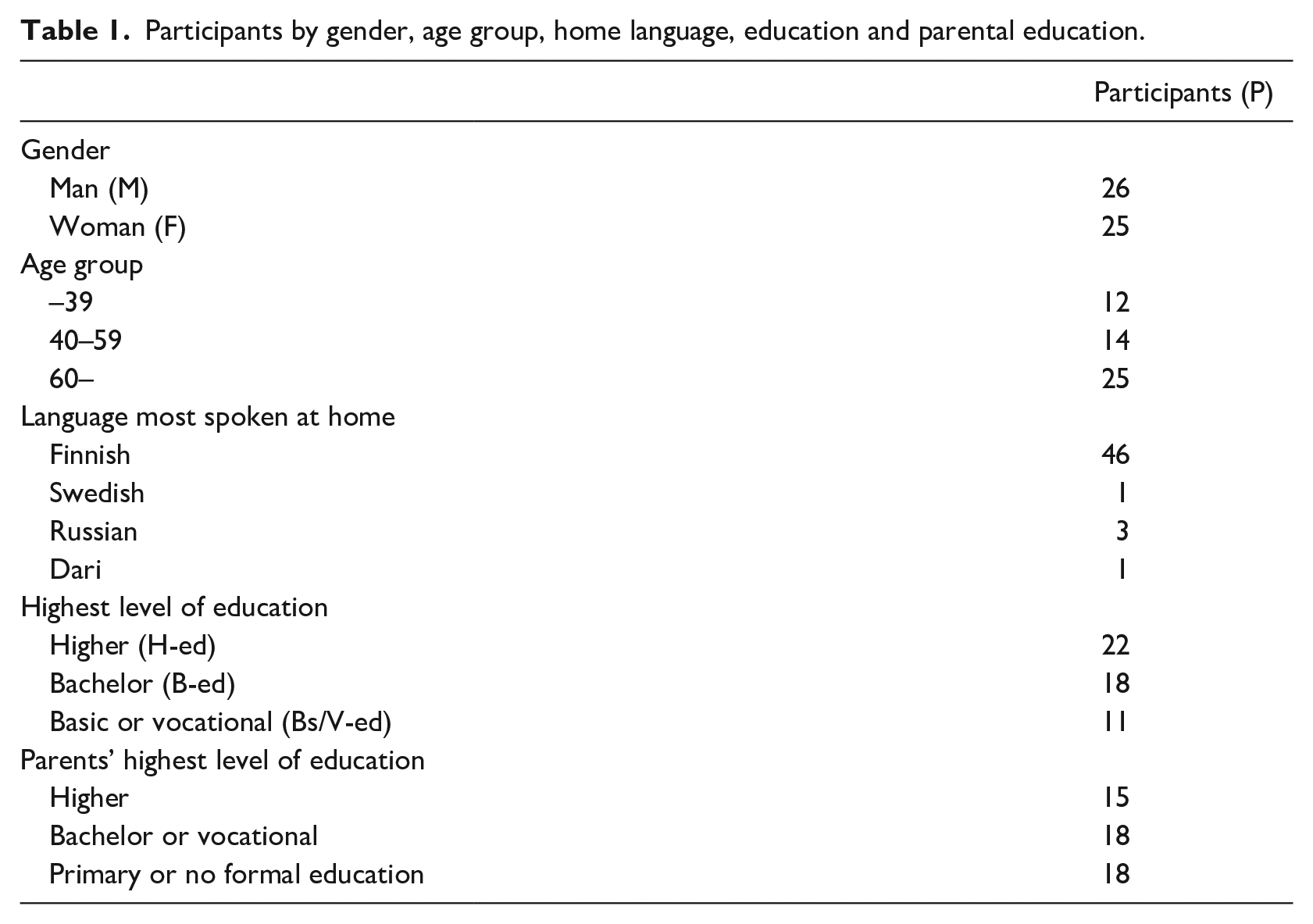
We aimed to recruit participants from diverse social contexts as one in four residents of Vantaa are registered as speakers of other than Finland’s three official languages (Finnish, Swedish and Sami) (Parviainen, 2022). However, several speakers of English, Arabic and Swedish were contacted for an interview without result; two Arabic speakers declined to participate after reading the information letter professionally translated into Arabic; and an Easy Finnish interview with a native Dari speaker proved to be difficult as a common science-related language was missing. In addition, the age distribution of community participants is quite high, because recruitment took place during office hours. We acknowledge the discrepancy between our aim to understand engagement in science while interviewing mostly highly educated and Finnish-speaking participants. Nonetheless, the participant pool reflects a change within the Finnish education system and society, where younger generations are more educated than older ones (Statistics Finland, 2007).
Interview data
Our thirteen semi-structured interview questions represented the four dimensions of science capital distinguished by Kaakinen et al. (2023): (1) science attitudes, (2) science identity, (3) early encouragement towards science and (4) science-related activities. The last wildcard question, ‘What is science?’, was more abstract and participants often had difficulties verbalising their answers. The participants were encouraged to express themselves freely, and it was stressed that there are no ‘right’ or ‘wrong’ answers and that all viewpoints are valuable.
Three of the authors conducted interviews mainly over the phone or over Teams/Zoom, except 15 conducted in person. Participants received a study information letter and a data privacy statement beforehand and gave verbal permission for the data collection and reporting at the beginning of the interviews. Interviews were audio recorded and transcribed by professional agencies, who were also employed to remove directly identifying information and to pseudonymize data. Interviewers revised and Supplemented transcriptions from recordings when needed. The full data set consists of 1481 minutes of interviews and transcriptions of 983,550 characters, including spaces. The average length of an interview was 29 minutes (ranging between 14 and 50 minutes). The interview transcripts were analysed in their original language, but the anonymized citations in this study were translated into English by the authors and with the help of ChatGPT. The study was approved by the Ethics Committee for Human Sciences of the University of Turku and followed the declaration of Helsinki.
Data analysis
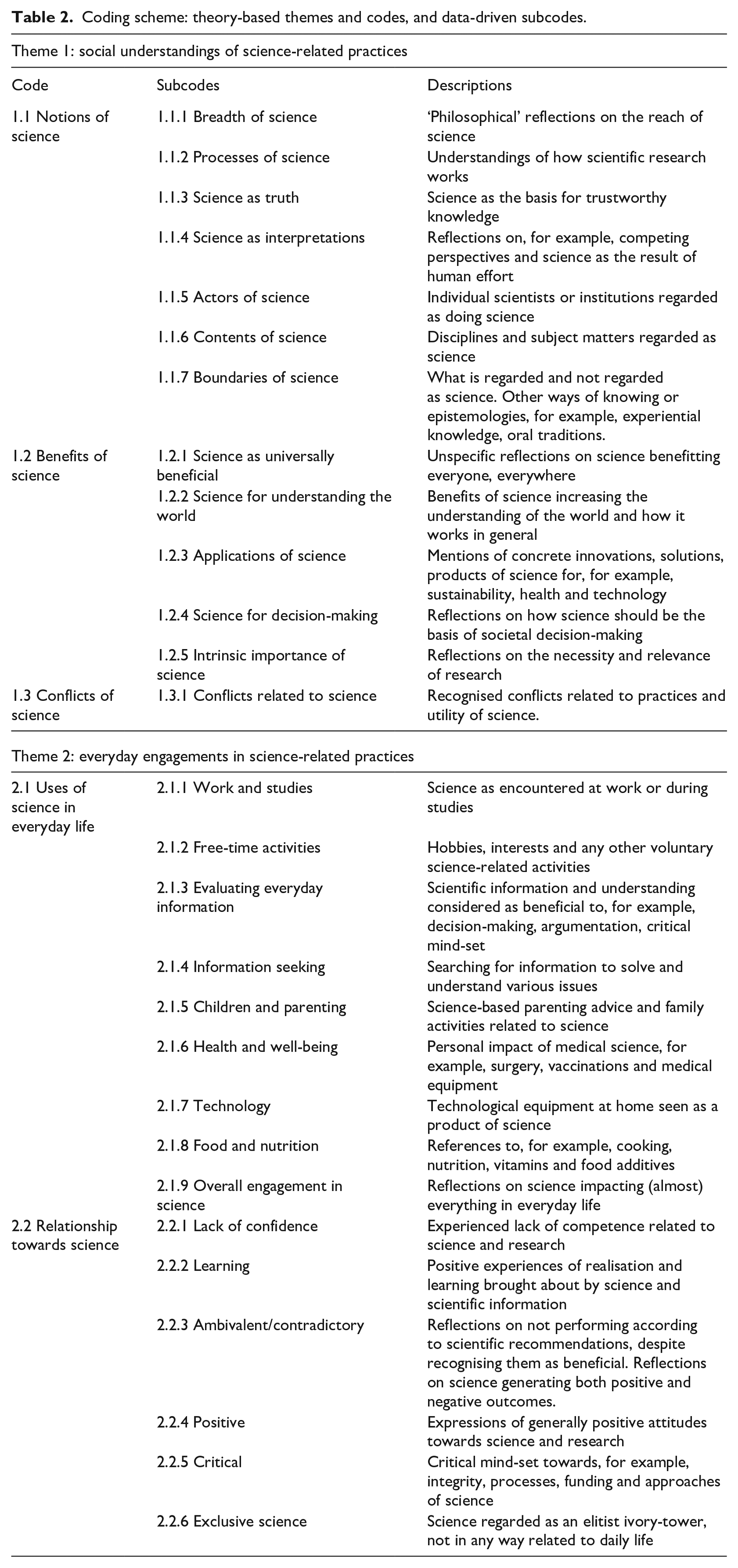
The study applied a theory-based and data-driven content analysis consisting of four phases. The data analysis produced a coding scheme for condensing results supported by the theoretical approaches. The first phase produced an initial coding scheme based on the four dimensions of Finnish science capital (attitudes, identity, early encouragement and science-related activities; Kaakinen et al., 2023). However, nuances in the data prompted adjustments to the coding that initiated the second phase while interviews were still being conducted and some transcripts had been read. The elaborate content analysis produced eight codes divided into 53 subcodes. The coding units varied from expressive words (e.g. the subcode ‘actors of science’) to sentences or descriptions with essential meaning (e.g. the subcode ‘processes of science’). The data were chiefly organised with the help of Atlas.ti by the second author without the aid of automated insights. The coding was informed by regular discussions with the research group. In the third phase, due to the expressiveness and richness of the data, the research group applied the perspective and concepts of practice theory. This led to the selection of codes and their organisation into two primary themes, as showcased in Table 2. The first theme refers to understandings, and the second to engagements as conceptual elements of practices. Finally, in the fourth phase, the coding scheme was re-evaluated and condensed to ensure that codes and their descriptions were distinctive and comprehensive, while the alignment with practice theory was sound. The fourth phase was conducted in negotiations by the whole research group, producing the final coding scheme in Table 2. The scheme includes two primary themes, five codes and descriptions of 28 subcodes.
Coding scheme: theory-based themes and codes, and data-driven subcodes.
4. Results
The results of the data analysis are presented in two themes. The first theme, social understandings of science-related practices, responds to the first research question of how people understand science and science-related practices. The second theme, everyday engagements in science-related practices, responds to the second research question of how people are engaged in science-related practices in their everyday lives. Figures 1 and 2 show the number of participants (also represented by the size of each rectangle), who mentioned the subcoded topics in their interviews.
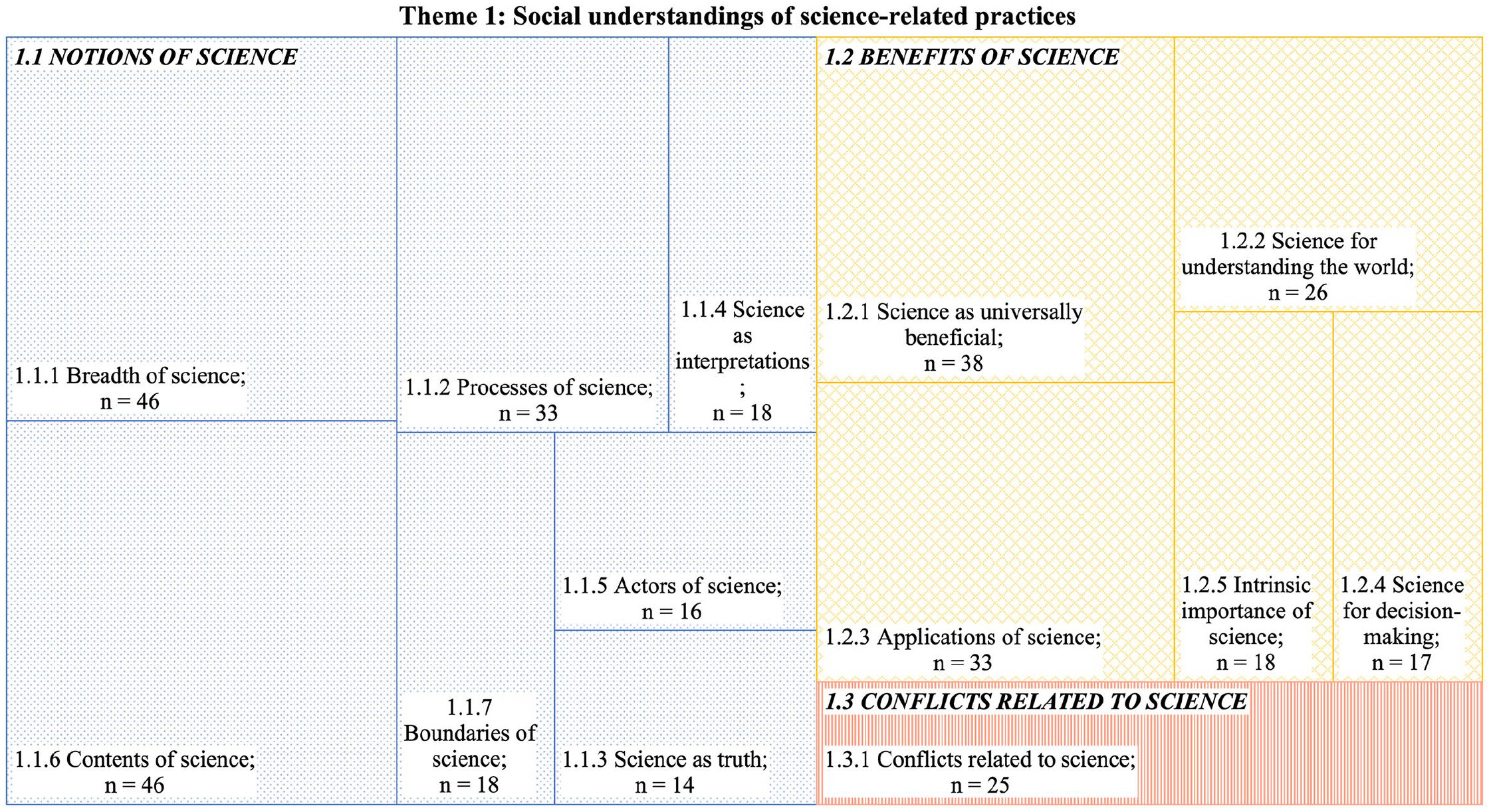
Division of subcodes under theme 1.
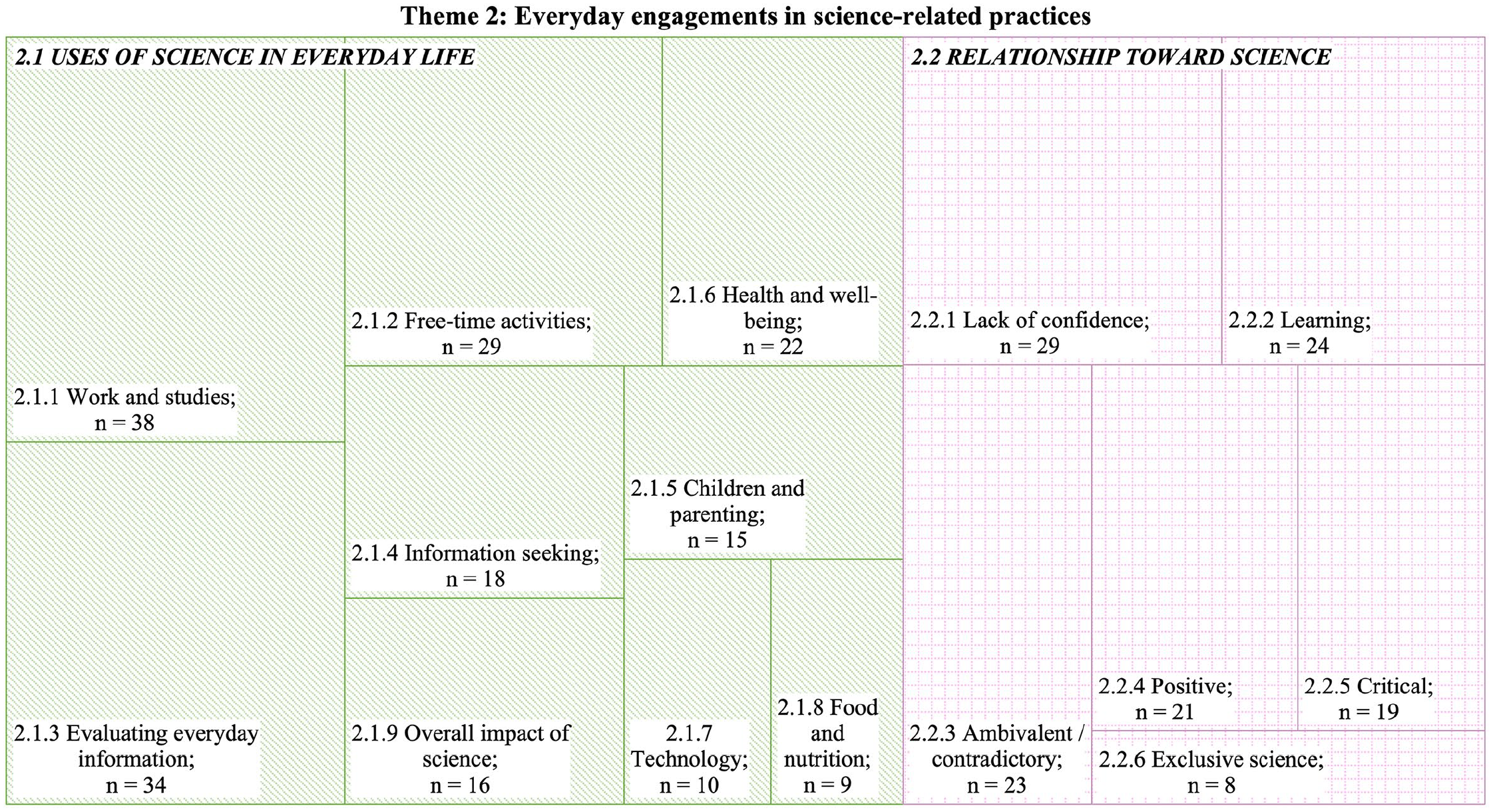
Division of subcodes in the theme 2.
Social understandings of science-related practices
The code ‘notions of science’ encompasses people’s perceptions, knowledge, beliefs and assumptions of what science is: what might be included in the definitions of science, research-based knowledge, and science-related practices, and what might not; what is science good for and who performs science or participates in its development.
Most participants perceived science as a pervasive phenomenon (subcode 1.1.1). ‘It helps us to understand why we exist, what we do, and how this world operates’ (M37/B-ed/P4), and ‘everything related to life, such as food, housing, and transportation, develops based on science’ (F77/V-ed/P34). Some participants described science as a source of universal value and hope for our future: ‘Science is about [. . .] why we are here, and what, in a way, the purpose of life is and what we are striving for’ (F79/H-ed/P10). It was also equated to a quest for information, a way to figure out and organise things or events, and put them into words, or even viewed as a symbol of (human) progress, bringing wealth and happiness to humankind.
Many participants identified the processual nature of science (subcode 1.1.2) rather similarly regardless of their educational background. However, participants with H-ed/B-ed parents seemed to describe scientific processes more frequently. Science was depicted as ‘human curiosity’ organised into ‘a process with common rules and global guidelines, and processes and channels and everything’ (M39/H-ed/P7), and a cumulative, advancing pool of knowledge, which aimed to be measurable, testable, repeatable, objective, critical and self-correcting.
Scientific information was described as the basis of truth or reliable knowledge (subcode 1.1.3) by a third of interviewees, and juxtaposed with, for example, opinions: ‘It must be the truth, not distorted truth or opinion, but specifically so that it stands up to criticism or critical examination’ (M53/V-ed/P46). Yet many also recognised that science to some extent involves different viewpoints, interpretations and subjectivity (subcode 1.1.4) and is susceptible to biases or pressure: ‘Science is not always entirely unbiased, as people, being the ones who conduct science, inevitably bring their perspectives into it’ (F33/H-ed/P18). Participants also recognised that interpretations may change over time when new data and factors come into play.
Disciplines or subjects regarded as scientific (subcode 1.1.6) were mentioned by almost all participants, yet only one-third spontaneously mentioned actors of science (subcode 1.1.5). Named scientists spanned from Albert Einstein and Carl Sagan to their contemporary, domestic equivalents, but a few participants also referenced groups like professors, ‘scientists, those old men with tousled hair’ (M58/V-ed/P44) and healthcare professionals, or institutions connected with science. Many participants mentioned specific applications of science and technology (e.g. genetic testing and telescopes). Participants with higher education more often mentioned entire disciplines (technology, astronomy, archaeology, etc.), including a greater number of disciplines, and with more variance within one interview.
Participants contemplated where to draw the boundaries between scientific or unscientific disciplines, or research-based knowledge and other ways of knowing (subcode 1.1.7). They recognised existing debates related to, for example, feminist theory, technology and finance. Other ways of knowing included folk and oral traditions, religious knowledge, experiential or practical knowledge, and these knowledges were considered useful in domains like agriculture, parenting, nursing, machine repair or renovating old buildings. ‘Upbringing is kind of based on tradition, but also on researched knowledge’, said a secondary school teacher (F42/H-ed/P8). Some also contemplated the boundaries of science in relation to their hobbies, such as painting and writing poetry.
The code ‘benefits of science’ contains participants’ notions of what science is for, that is, the purposes and significance attributed to science and science-related practices in society: why science and its practices are necessary or important, or whether they are relevant at all.
Science was observed as being universally beneficial (subcode 1.2.1) by the majority of participants: ‘This researched information really permeates almost everything’ (F73/B-ed/P39). The question ‘Who benefits from science and research?’ even felt ‘a bit silly’ to some, as their benefit for society and individuals seemed quite evident: ‘It benefits every moment. I’ve probably been an engineer in my past life, because it feels to me, like, when wouldn’t it be beneficial?’ (M39/H-ed/P7). A secondary school teacher also noted that ‘everyone, in some way or another, ends up enjoying the results of science and research’, whether willingly and knowingly or not. However, the extent of the benefit might depend on the person or even on ‘how much one understands it to be beneficial’ (F42/H-ed/P8).
The benefit of science and research for explaining the world (subcode 1.2.2) was mentioned by half of our interviewees, but this interpretation was accentuated among higher educational levels. Participants explained how science helps us understand how things have come about, or how people, societies, or biological processes work. Science helps us comprehend, conceptualise and ‘get to the bottom’ of things, giving us in-depth understanding as well as facts over speculation: It’s not just about taking everything at face value; perhaps with common sense, you can get by with some things, but if you want to understand it deeply, you do need science’ (M66/V-ed/P15).
Various scientific applications and innovations (subcode 1.2.3), from vaccinations and curing cancer to energy efficiency, LED lights and induction stoves, were mentioned as beneficial outcomes of science and research. Men raised sustainability-related issues more often than women. Older informants more frequently saw the benefits of science to health issues, while no Bs- or V-ed participants mentioned health in this context. Applications of science often included hope for science to solve problems such as climate change and wars, as a Russian-speaking participant (F37/H-ed/P48) expressed: ‘Maybe science will save us from global warming and teach us to live in peace with each other’. Though innovation may not always be directly exploitable, ‘everywhere you look, science and research are the basis for the direction it [the world] takes and how it evolves. Hopefully for the better’ (F77/V-ed/P34).
Science was often related to social decision-making and argumentation (subcode 1.2.4), although frequently combined with expressions such as ‘should be’, ‘hopefully’ or ‘unfortunately not usually’. More commonly among H-ed participants, science was described as bringing valid and dependable justification for ‘political decision-makers who hopefully base their decisions on scientific knowledge rather than making assessments on a gut feeling or emotions’ (M67/H-ed/P9). Science and research were thus seen as an ideal to strive for, though perhaps not always achieved.
More than a third of participants, more often older rather than younger ones, highlighted the intrinsic importance of science and research (subcode 1.2.5): ‘I don’t see any other way for humanity to navigate through things except with the help of knowledge’ (M75/H-ed/P20). Even basic research was seen as important, even though only a fraction of its results yielded practical applications. However, some interviewees pointed out that those applications would never have come about without research, and that ‘hopefully it [research] will persist and evolve so that more investigation into life-related matters can be conducted’ (M82/V-ed/P27).
The code ‘conflicts of science’ (subcode 1.3.1) describes the acknowledged conflicts within scientific processes, such as contradicting results or scientific misconduct (malpractice, silencing nonconforming results). Some interviewees also expressed doubts about the utility and usefulness of scientific results, worries about the intelligibility of scientific information, or whether scientific results reflect real-life situations and can be put into practice. Some identified conflicts between research-based information and society’s requirements, in which case following research-based information ‘may not necessarily lead to the absolute best outcome’ (M51/H-ed/P25). Many informants also voiced their concern about inequalities in benefitting from research-based knowledge: ‘So, it feels like it might benefit them [those with higher education] more. Not everyone may have the same access or pathway to that research-based information’ (F37/B-ed/P36).
Everyday engagements in science-related practices
The way informants described uses of science in everyday life depended on their life situations. Science was recognised as entangled in parenting, free-time activities, eating, health and well-being, technology, work life or studies as well as in evaluating and seeking information.
Science was mostly encountered at work or during studies (subcode 2.1.1) with about three-quarters of the participants accounting for how adaptations of new technologies, equipment, and procedures at work were carried out by applying science, research-based knowledge, or current statistics. They reported following publications and seeking new knowledge related to their work, which included nursing, agriculture, managerial work, theology, hiking, historical archiving, logistics, nuclear fuel industry, industrial design, education, chemical industry, translation services and so on. Some informants considered how their education was also based on science and research-based knowledge. Science formed a kind of background or cornerstone for daily work practices or helped to perform certain tasks. Utilising ‘the results of research in everyday working life was used ‘unconsciously, but consciously you rarely seek the information that research has provided for a particular issue’ (M59/B-ed/P47).
We inquired about customs or hobbies related to science, research-based knowledge or research, and over half of the participants mentioned a free-time activity (subcode 2.1.2), such as genetic testing, construction, breeding dogs, educating animals, (discovering) animal species, fishing, detergents, history, (world) politics and economy, (food) additives, forestry, traditional renovation, lubricating skis, scholarly knowledge of sport, photography, stargazing, chaos theory, educational sciences, psychology, gardening, playing the saw, Finnish language, nature documentaries and reading scientific articles. The question also confused some informants, and some doubted whether charity community activities, using mathematic formulas, or reading non-fiction related to science: ‘I also follow quite a lot of discussions, especially those related to non-fiction books. Is that researched information or just something like peer recommendations?’ (F75/H-ed/P13).
Almost three-quarters of participants of all educational backgrounds said they were aware of and/or tried to lean on research-based knowledge in decision-making and argumentation (subcode 2.1.3). Participants contrasted research-based knowledge to irrationality, opinions, or solving questions on their own. Science added certainty in evaluating opinions and enabled participation in conversation and debate, while also sparking self-reflection in ‘thinking about things in a different way than you used to’ (F73/B-ed/P26), and caution in ‘not claiming anything’ (F37/B-ed/P36) they did not know enough about. Almost half of the participants recounted searching for research-based information (subcode 2.1.4) to solve mundane problems or make decisions – this seemed to be a social norm for many. However, for some participants research-based knowledge was only one factor in decision-making (if hardly playing a role): ‘When I was looking for a flat, there were some energy certificates, but I don’t know if they had much influence on any decision-making after all’ (M52/B-ed/P43).
Children and parenting (subcode 2.1.5) were described as significant meaning-makers for (grand)parents to engage in science. Research-based knowledge was interlinked with parenting practices at least in theory: ‘It’s a different thing how it really translates into practice, but I have tried to read researched information, for example, about child development’ (F33/H-ed/P18). Many participants recounted how they engaged children or grandchildren in science by finding answers to their questions or through different activities, such as going to the forest: ‘So I can actually tell things, like facts, you know, so she knows a bit more about some things, so it’s been, it has been a benefit’ (M43/B-ed/P14).
Many participants recognised the everyday uses of science in relation to their health and well-being (subcode 2.1.6), that is, medical examinations, surgeries, vaccinations and medicines. They described how research-based knowledge in the medical sciences provided information for personal, familial, or global (such as COVID-19) health-related issues. Health and well-being were also embodied experiences and, as such, examples of tangible, everyday science: ‘I can’t think about things like the Big Bang. [. . .] But, if you consider, for example, medicine or biology or something else, they are interesting in their own way. [. . .] If it closely applies to me, then it is interesting’ (F57/V-ed/P30).
In addition, informants identified technology (subcode 2.1.7) and food and nutrition (subcode 2.1.8) as everyday uses of science. Technological equipment and inventions utilised at home and work (such as LED lights, AIV-silage, housing and construction technology, fuels, solar energy, and the Internet) were considered products of science. One-fifth of women and none of the men expressed engagement with food and nutrition, whereas both mentioned engagement with technology. The overall engagement in science (subcode 2.1.9) was described as sometimes an unconscious factor affecting participants’ everyday life practices and decision-making. An executive director pondered: ‘It’s [science] not something I constantly think about, but when I start to consider it, it’s definitely there in the background’ (M28/H-ed/P5). People described how they were continuously engaged in science and research-based knowledge and how it might be a nonmaterially enriching and enjoyable part of everyday life: ‘You can observe nature with slightly different eyes when you think that there is an ecosystem and laws and a long evolutionary history and (this just) enriches life. It’s not as if it materializes into a number in a bank account, but it’s a benefit nonetheless’ (M51/H-ed/P25).
Relationships towards science became apparent in participants’ experiences of the competencies they possessed and their engagements to perform according to recognised science-related norms. In other words, they reflected on themselves as agents or ‘carriers’ of science-related practices (cf. Reckwitz, 2002: 250). The data conveyed a lack of confidence, critical, positive, and ambivalent approaches to science and a feeling of subjection/subordination in the face of the ‘great science’.
Over half of the participants, regardless of educational background, expressed a lack of confidence (subcode 2.2.1) related to science-related practices. Younger and higher-educated participants (H-ed/B-ed) expressed low confidence in science engagement more than lower-educated (Bs/V-ed) ones. Some informants did not feel ‘clever’ enough to engage in science-related conversations or were uncertain about their capability to express themselves and use ‘correct’ concepts while talking about science. Some recounted intimidating experiences in normative science-related contexts, such as a popular science lecture: ‘I’m easily afraid to ask. It feels like there is so much knowledge there [in the lecture], and my question seems somehow so basic that it immediately reveals that I don’t really know even the fundamentals of it’ (F42/H-ed/P8).
Almost half of the participants, especially younger ones, mentioned learning (subcode 2.2.2) and positive experiences of realisation as a reason to engage in science-related practices. Science reading, information-seeking and being involved in conversations about science produced a sense of conscious and unconscious learning. Many described the feeling of success while solving something or finding new connections based on previous knowledge. Performing science-related practices and ‘civilizing yourself’ (M69/V-ed/P1) was also seen as a value as such. A few participants described learning as a state of flow or a fundamental curiosity which, however, required time: ‘I set myself difficult tasks. Doable. Often. When I have time. Because right now I’m working 16 hours a day and I don’t have time’ (F38/H-ed/P49).
The relationship towards science was sometimes also ambivalent or contradictory (subcode 2.2.3), revealed mostly in reflections of not always adhering to public, science-based recommendations or advice despite recognising them as beneficial. Participants of all educational backgrounds tended to express understanding towards recommendations (such as those relating to the COVID-19 pandemic) as social norms, while simultaneously performing against them because of their embodied histories or everyday life conditions. As an art teacher said, ‘I don’t see them [experts] as very strong authorities, but I don’t publicly question them either. So, I’m in solidarity with that world [of experts], but I hardly follow them [recommendations] myself’ (F74/B-ed/P29). The ambivalent relationship was also exemplified in the evaluation of the consequences of research by an economist: ‘Research data can be used for good and for evil’ (M66/H-ed/P16).
The critical (subcode 2.2.5) relationship or mind-set towards science was revealed in participants’ considerations of scientific integrity, processes, funding and approaches. ‘Another question is how accessible it [science] is, what language it is expressed in’, highlighted an art teacher. ‘You can speak in muddy words, which are understood only in scientific circles’ (F38/H-ed/P49). Also, the rules of scientific argumentation caused frustrations for one elementary school teacher, especially when faced with demands to cite sources to support claims on social media: ‘It would be nice if I could always remember to check the source, but that’s not possible’ (F41/H-ed/P51).
While participants articulated critical or ambivalent perspectives, they equally conveyed positive (subcode 2.2.4) science attitudes. They used words like ‘gratitude’ and ‘esteem’ to describe, for example, their relief at not needing to ‘know everything’ or ‘dive too deep into things’, but to be able to simply ‘choose the source of information to believe’ (F70/B-ed/P12). Simultaneously, participants unveiled interpretations of science as ‘exclusive’ (subcode 2.2.6), that is, they sometimes understood science as a ‘utopia’ (M58/V-ed/P44) or an ivory tower with no direct relationship to people’s everyday lives.
5. Discussion
This study aimed to explore, first, how Finnish people understand science and science-related practices and, second, how people perform and enact science-related practices within their daily activities. Regarding the first question, our analysis suggests that science is perceived as a means of explaining the world and addressing global and complex issues. In most contexts, participants recognised a normative, epistemic authority of science, while simultaneously acknowledging conflicts concerning scientific processes, science’s utility, or its accessibility in society. Participants employed strategies of boundary work (Gieryn, 1983), demarcating what science is – a means to a systematic hunt for ‘truth’ – in contrast with what it is not – other types of knowing, such as traditions and practical knowledge. Thus, they actively participated in considering and (re)drawing the borders of the ‘cultural cartography’ (Gieryn, 1999) of science. Irrespective of their educational background, most participants recognised long-standing ontological and epistemological debates within the scientific community – participants with higher education simply had access to a wider academic vocabulary. These findings showcase the participants’ science literacy, specifically in terms of understanding socially shared scientific principles and processes, pointing to scientific thinking as a means for ‘socio-scientific decision-making’ (Holbrook and Rannikmae, 2007: 1358–1359).
Many participants described science as an all-encompassing phenomenon positively affecting human lives, a source of meaning, or a symbol of human progress. They painted a picture of science as universally valuable, explaining our existence and providing hope for the future. On the one hand, these findings reflect the normative and socially shared understandings of science in Finnish society, where trust in science and institutions is relatively high (Finnish Society for Scientific Information, 2022). Alternatively, results address the need for further research within the fields of PUS and sociology of religion/nonreligion, delving into ‘belief, identity, and practice’ (Catto et al., 2023) regarding science or the shared ‘civilisational’ and ‘existential’ (Jones et al., 2020) narratives that shape its perceived significance in society. This approach falls outside the scope of this article, but we anticipate it might be fruitful for further discussion.
Focusing on the second research question, participants commonly reported engaging with science in their professional lives, regardless of their educational background or current employment status. Given the significant amount of time that adults spend at work during their lifetime, this finding is not surprising. Participants discussed the impact of scientific advancements and the necessity of incorporating scientific knowledge into their decision-making processes at work. It is worth considering whether employers, policymakers, or academia have fully acknowledged the significance of contextualising science engagement within professional settings. Overall, everyday science engagement was linked to reflections on personally relevant practices (e.g. laundry detergents, rat poison, camping tents, comparing household appliances or renovation). Participants described information-seeking in a way that can be interpreted as a significant everyday research-making – though, in some cases, it led to conclusions that were not scientifically sound. Interviews also revealed that people recognised and appreciated many sources of knowledge beyond the research-based (such as common or folk knowledge) in different contexts and domains of everyday life. Concerns regarding (science) literacy levels or lack of interest in science are often tackled by interventions in formal education (DeBoer, 2000). However, people’s learning continues well after graduation, and it is thus important to consider the role of science in domains such as work, family, hobbies and everyday tasks.
As carriers of socially shared science-related practices, participants employed science-related vocabulary and concepts, considered the nature of science-based knowledge, and pondered the boundaries of knowing and science. The interview, as such, represented engagement in a scientific practice where the interviewer performed procedures of academic research (e.g. presented the study information letter and data privacy statement), and interviewees carried out and negotiated the appropriate performances with the interviewers. Despite participating in the interview practice, the majority expressed uncertainty and a ‘lack of confidence’ in engaging in science-related practices (for instance, in science-related discussions), regardless of their educational background. The tension of self-efficacy in relation to science is also reflected in previous research on science capital (Archer et al., 2015; Kaakinen et al., 2023), and the recognition of science-related norms may thus further hinder engagement in science. Practices aiming at dissolving hierarchies (e.g. dialogic discussions or co-research) could affect the tensions by supporting participants’ agency and mutual appreciation between participants and practitioners.
By applying the Bourdieusian lens to analyse our own practices, we recognise the study’s limitations in researcher-participant dynamics and researchers’ positionality within the field of science, where science capital is generally valued. We question whether we, as interviewers, implicitly defined what constitutes science through our inquiries or omissions, or whether our interactions with the participants reproduced normative science understandings and engagements. From the practice-theoretical perspective, data interpretations are partially limited by capturing only participants’ sayings, not the situational everyday doings embedded in places and based on embodied knowledge (e.g. Schatzki, 2002). In other words, we did not have access to what people do, except through verbal accounts that were at times ambiguous in terms of whether interviewees described their performances or considered broader public understandings. Future research could employ ethnographic methods to provide a more comprehensive view of science-related practices in action.
Data interpretations are also limited by the rather small sample (n = 51) of quite highly educated and older participants, with an underrepresentation of minority groups. Therefore, generalisations need to be cautiously approached, especially considering that participation in this study already required a certain level of interest in the topic. Linguistic and cultural barriers to participant recruitment could be mitigated in the future through alternative recruitment strategies and research methods (e.g. focus groups and co-researching). Also, as the research conducted in Finland reflects certain culture-specific perceptions of science (tiede), further studies across diverse cultural and societal backgrounds are necessary for broader applicability.
This study examined the multiple ways science is related to diverse practices of people’s everyday lives and negotiations concerning proper ways of knowing. Opening new perspectives to examine science literacy and science capital, it shows that people’s diverse and continuous everyday engagements need to be acknowledged and valued. Moreover, this study’s results suggest that offering possibilities to engage in scientific practices, such as co-research and citizen science, can diversify perspectives, transform power structures and enhance public science engagement for equal dialogues and encounters.
Supplemental Material
sj-pdf-1-pus-10.1177_09636625241309055 – Supplemental material for ‘It benefits every moment’: Understandings of and engagements in science-related practices in everyday life
Supplemental material, sj-pdf-1-pus-10.1177_09636625241309055 for ‘It benefits every moment’: Understandings of and engagements in science-related practices in everyday life by Kaisa Torkkeli, Milla Karvonen, Daria Pritup and Johanna Enqvist in Public Understanding of Science
Footnotes
Acknowledgements
The authors thank the participating residential activity facilities in Vantaa and their coordinators as well as our research participants, without whom this study would not have been possible.
Funding
The author(s) disclosed receipt of the following financial support for the research, authorship and/or publication of this article: This study was conducted as part of the Fostering Finnish Science Capital (FINSCI) project supported by the Strategic Research Council/Academy of Finland grant numbers 335233 and 336636.

Supplemental material
Supplemental material for this article is available online.
Author biographies
References
Supplementary Material
Please find the following supplemental material available below.
For Open Access articles published under a Creative Commons License, all supplemental material carries the same license as the article it is associated with.
For non-Open Access articles published, all supplemental material carries a non-exclusive license, and permission requests for re-use of supplemental material or any part of supplemental material shall be sent directly to the copyright owner as specified in the copyright notice associated with the article.
