



Abstract
A recent wave of studies has diversified science communication by emphasizing gender, race, and disability. In this article, we focus on the understudied lens of religion. Based on an analysis of ultra-Orthodox (Haredi) science journalism and its readership, we identify four main strategies for tailoring science, which we call the four “R”s—removing, reclaiming, remodeling, and rubricating science. By analyzing how science communication is produced by and for a particular religious group, we reveal the diverse ways a religious-sensitive science communication is shaped by community gatekeepers, while also exploring the ethical and epistemological tensions this tailoring entails.
1. Gatekeeping or religious-sensitive science communication?
A recent wave of studies has been devoted to diversifying science communication (Canfield et al., 2020; Dawson, 2020), which continues to benefit specific (e.g. affluent, college-educated, and able-bodied) audiences. A variety of models of science communication have been developed, especially shaped to take into account gender, race, and disability. In our work, we focus on the understudied lens of religion while highlighting the challenges science communication poses for Haredi Jews (often called ultra-Orthodox) in Israel. While most research on diversifying science communication focuses on the ways science is tailored for particular communities (Canfield et al., 2020; Seethaler et al., 2019), we look at the ways science is tailored by particular community members. Shifting this object of inquiry, we study the ways Haredim tailor science to fit inner-communal cultural and epistemological stances. In particular, one of the biggest challenges Haredi reporters must overcome is science–religion tensions which are perceived as risk-laden knowledge by rabbinic and other authoritative figures.
In this article, we analyze the ways Haredi reporters communicate science in culturally specific ways; the ways these strategies are manifested in the texts they produce; and in the ways Haredi audiences negotiate these texts. Based on a collaborative study including content analysis and interviews with Haredi reporters and audiences, we show four primary strategies for tailoring science. While examining these processes of tailoring can (potentially) be used as a model for religious-sensitive science communication, our analysis also highlights their prices. We found that information about the process of making science is omitted, female scientists are pushed to the margins, and scientific epistemologies are framed as second place to religious knowledge. Exposing the prices of this tailoring, we question the limits of culturally specific science communication when it seems to justify the exclusion of important factual information about the world.
2. Beyond the science–religion conflict
While the study of science and religion has flourished over the past two decades, it has mainly focused on the perceived “conflict” and boundary-making between religious teachings and science (Ecklund, 2010; Falade and Bauer, 2018). Drawing mainly on studies of white protestants (typically in the United States), both public discourse and literature tend to amplify theological tensions while endorsing a “conflict narrative” (Hedley-Brooke, 1991; also see: Evans, 2011; Evans and Evans, 2008) that primarily characterizes people of faith in stark opposition to science (Carlisle et al., 2019; Chan, 2018). For example, researchers have argued that some religious groups do not seek out scientific knowledge because they are opposed to the all-encompassing veracity of science especially related to heated debates on topics such as evolution, geology, values, and ethics, particularly regarding stem cell research and brain death (Allum et al., 2014; Evans, 2018; Holland et al., 2001). Others suggest that Americans operate either religious or scientific epistemologies (O’Brien and Noy, 2015), reflecting the perceived conflict between science and religion in US society (Ecklund, 2010).
Several models accounting for the relationship between science and religion have been put forward (Falade and Bauer, 2018; Scheitle and Ecklund, 2017). The first posits that there is an inherent conflict or hierarchy clashing over competing truth claims and epistemology of knowledge (Parsons, 1951). The second puts forward a model of parallelism in which religion exists to provide answers to questions of meaning and morality, while science exists to provide answers to questions about the natural world (Gottlieb and Wineburg, 2012). The third is a model of collaboration in which both science and religion influence and guide each other, and neither has a monopoly on “truth.”
While previous scholarship has focused on theological negotiations of science and religion, recent studies have paid attention to everyday perceptions of science while investigating lay religious believers’ attitudes, views, identifications, and behaviors regarding science in real life (Elsdon-Baker and Lightman, 2020; Evans, 2018; Jones and Catto, 2019; Jones et al., 2020; Pear, 2022; Taragin-Zeller et al., 2020, 2023). This growing scholarship demonstrates how science-related decision-making is negotiated within and through many actors and systems of local knowledge since both scientific knowledge and socio-religious frameworks serve as cultural and epistemological tunnels (Canfield et al., 2020) of science and medicine 1 interpretations, attitudes, and behavior (Goldberg et al., 2019; Kasstan, 2021; Raucher, 2020; Rock-Singer, 2019; Taragin-Zeller, 2023).
While science is constantly negotiated in the everyday lives of people of faith (O’Malley et al., 2021; Perry et al., 2021), we still know very little about how this knowledge is constructed and disseminated by religious mediators. How do religious mediators share science-related knowledge in their home communities? What types of strategies do they employ to offer culturally sensitive science-related knowledge to members of their communities? How are science/religion tensions interpreted, represented, and created? And, finally, how is this mediated knowledge consumed and negotiated by members of their home community?
To answer these questions, we draw on an extensive study of Haredi science journalism to understand how religion–science relationality is constructed and negotiated in everyday life. Based on an analysis of Haredi journalism, the writing strategies of Haredi journalists, and the ways Haredi audiences make sense of this content, we offer four main strategies for tailoring science in Haredi media—removing, reclaiming, remodeling, and rubricating science. Whereas most scholarship on religion and science focuses on theological, institutional, and epistemic tensions between science and religion, these strategies reveal how these tensions are negotiated and mediated in culturally accepted ways, offering insights into the processes and prices of tailoring science for religious publics.
3. Haredim and science communication: A brief history
Haredim (Ultra-Orthodox Jews) account for roughly 13.6% of Israel’s population (Cahaner and Malach, 2023). Haredi men and women live according to the Hebrew Bible, which has been continuously interpreted through a large (and ever-growing) body of rabbinic literature and Jewish law. Haredim are typically divided into three different sub-groups: Lithuanian yeshiva-based (Torah learning) communities, Hasidim, and Sephardi Haredim (who trace their origins to the Iberian peninsula, North Africa, and the Middle East). All Haredi sub-groups are often referred to as an enclave culture (Stadler, 2009) with strict social and cultural boundaries and distinguished from other streams of Judaism: Progressive, Conservative, and religious-Zionist, by their avoidance of secular education and professional training, especially for men. Haredim have developed their own education system while acquiring varying levels of autonomy from the national curriculum (Golan and Fehl, 2020; Perry-Hazan, 2015). Haredi education prepares young ones for gender-specific roles—men are to become religious scholars and women are prepared to support them as main breadwinners and domestic caregivers. As Haredi women are expected to navigate the non-Haredi world, female pupils usually study math and some science up to the age of 15 years. However, for boys who are meant to become Torah scholars who need little formal science or math education, most male students do not learn any science beyond fifth or sixth grade (ages 11–12 years).
Haredim manage their own sectorial press where news are “censored” by rabbinic representatives who tailor daily news to Haredi culture and comply with religious values, such as modesty standards which prohibit the public display of female images. Haredi dailies publish a variety of content that is meticulously edited and supervised to present only information that fits Haredi worldviews, corresponding with what Carey (2009: 15) termed as a “communal” view of communication: “This projection of community ideals and their embodiment in material . . . creates a . . . symbolic order that operates to provide not information but confirmation, not to alter attitudes or change minds but to represent.” In spite of much resistance from rabbinic leadership, there has been a sharp increase in Internet use in Israel (and the United States) which has also produced a large audience in Haredi news websites alongside traditional print newspapers (Cohen, 2012; Golan and Stadler, 2016; Shahar, 2024; Shomron and David, 2022). While news websites tend to be more critical than printed dailies, online Haredi journalists are also careful not to offend spiritual leaders, and duly vet readers’ comments before publishing (Golan and Mishol-Shauli, 2018). Today, Haredi news websites, such as Kikar Hashabbat and B’Hadrei Haredim, report news with higher degrees of free expression, and one such website also shows pictures of women, which is still uncommon in both print and online media. In terms of science communication, there is no designated science section in any major outlet of mass Haredi press. When reported, science-related information will typically be included in the technology or health sections, which is consistent with mainstream science reporting strategies in Israel (Baram-Tsabari et al., 2020; David et al., 2015).
4. Method
To understand the ways science is tailored by and for Haredim, we used a multifaceted research method fusing content analysis, often used in communication studies (Krippendorff, 2018) with open-ended interviews with Haredi journalists and readers (Seidman, 2006), creating a safe, non-judgmental and flexible environment to reflect on Haredi science journalism. As detailed below, each team worked both separately and collectively to collect data and analyze findings in a two-staged research design. The first stage included a process of grounded theory (Charmaz and Thornberg, 2021; Glaser and Strauss, 1967; Saldana, 2021) (team 1 and team 3) and content analysis (team 2), aimed at identifying journalist strategies for tailored science; the main themes that emerge in Haredi science-related media compared with non-Haredi outlets; and the ways Haredi audiences make sense of science-related news. Stage 2 included an additional round of analysis (detailed below). To protect the anonymity of our interlocutors, all interviewee names are pseudonyms. Ethical approval was obtained from the ethics committee at the Technion Institute of Technology.
Data collection
Team 1: Journalist perspectives
To uncover the ways science is tailored by Haredi journalists, several steps were taken. Initially, a comprehensive list of online/offline Haredi news outlets was composed. Additional outlets were identified through online search, and key informants were consulted in the process (e.g. journalists and community leaders). Snowballing techniques were employed to contact and enable in-depth interviews with editors as well as radio and print/online journalists. Between August 2019 and November 2020, 20 interviews were conducted in Hebrew by Oren Golan and Nakhi Mishol-Shauli, averaging between 30 and 90 minutes. The open-ended questions focused on three primary topics: (1) ethos and perception of professional role (value-based/instrumental, ethics); (2) source selection and authority; (3) taboos and reporting boundaries. All interviews were recorded, anonymized, and transcribed manually. Only the passages cited in this article were translated into English by Oren Golan and Nakhi Mishol-Shauli.
Team 2: Haredi and non-Haredi science media
To analyze the ways Haredi science media differs from non-Haredi science media in Israel, the following steps were taken. Print and online news media articles were obtained from Yifat Media Information—Israel’s largest and most reputable media clipping service. The search query included: “scientific research” or “new research” or (“research” and (“mathematics” or “biology” or “physics” or “chemistry” or “life science” or “natural science” or “social science”)) for all items that appeared in Yifat Media Information archives for the period between November 2018 and September 2019 (N for the Haredi media was 695 and for the general media was 709). The Haredi outlets were Yated Neeman, Behadrei Haredim, Hamodia, Hapeles, Mishpaha, Bakehila, Kikar Hashabat, and Hamvaser. The non-Haredi outlets were Yediot, Maariv, Haaretz, Calcalist, YNET, Reshet, Mako, and Walla! The search query led to a variety of reports on science and research but also included irrelevant data about historical and current events in universities, for example, tuition costs. We included only media that referred to science and scientific research and deleted irrelevant articles, yielding a final sample size of 401 (200 from the Haredi media and 201 from the general media).
Team 3: Audience perspectives
Between September 2020 and February 2021, 20 open-ended interviews were conducted by Lea Taragin-Zeller and Yael Rozenblum. Snowballing techniques were employed to contact 10 Haredi men and 10 Haredi women, who were affiliated with one of the three main Haredi sub-groups: Sephardi, Lithuanian, and Hasidic. All participants attended Haredi schooling and their education patterns reflected gendered Haredi norms: seven women attended non-Haredi higher education and worked outside of their homes in a variety of white-collar positions, whereas most men did not have any higher secular education and combined Torah learning with low-income positions, primarily as teachers and third sector charity workers. While this may appear as a biased sample, this gendered educational gap reflects communal norms where men aim to devote their life to the study of Torah in contrast to Haredi women, who attend various types of higher education as part of their vocational development. For example, women were 67.5% of all Haredi undergraduate students in Israel (14,700 in total) between 2020 and 2021 (Malach and Cahaner, 2021).
Before COVID-19, eight interviews were conducted face-to-face. After providing background information, each participant was asked about the ways they consume science-related information. Interviews were stopped at the first stages of the pandemic (December 2020) and then tailored to follow COVID-19 social distancing guidelines. As many Haredi Jews are selective about Internet use, the additional 12 interviews were conducted on the phone. Interviews lasted between 30 and 60 minutes. They were recorded, anonymized, and transcribed manually in Hebrew. Only the passages cited in this article were translated into English by Lea Taragin-Zeller.
Data analysis
Stage 1
Team 1: Journalist perspectives
Data analysis included interview transcripts that were imported to Dedoose’s mixed-method software. The researchers employed categorization techniques via a coding process that drew on Glaser and Strauss’ principles (1967). This included initial line-by-line labeling interview content which was constantly reflected upon (in memos) and used as feedback to highlight key themes, codes, and analytic categories that pertained to subjects’ approach to the tailoring of science (cf. Charmaz and Thornberg, 2021). Scouring through the transcripts, we implemented several cycles of coding which tightened the conceptual categories (see Saldana, 2021). Initially, 35 subtopics were identified. The following coding cycle clustered the subtopics into 10 themes (“parent codes”): legitimate science, Haredi education, lay sources of science information, different positions regarding science, journalist motivation, journalist ethic, science definition, Haredi media, science and religion, and COVID-19. These themes drove us to the parsimonious categories of the study (the four Rs): Rubricating, Removing, Remodeling, and Reclaiming science.
Team 2: Haredi media content analysis
As our resources were not sufficient to code the entire sample of 401 articles, a random quarter was sampled (Krippendorff, 2018). The coding book was adapted from Barel Ben David et al. (2015) and conducted between April 2020 and October 2021. Two coders analyzed the data based on the coding book. Reliabilities were calculated for each variable separately (10%, N = 42). Items were coded for the topic of the report (intercoder reliability κ = .81): health/medicine (e.g. “Is bottled water really more healthy?”), environment (e.g. “Do planes create more rain when flying through clouds?”), army/security (e.g. “Security industries will work together with technology companies”), food and agriculture (e.g. “How soy is made”), social-economic (e.g. “Recession is on its way”), history and culture (e.g. “New study: South Africa is the origin of mankind”), industry (“A new company has began producing . . .”), the universe (“NASA has made a new deal with Israel’s Science and Technology Department”), human sciences (“This surgery won’t hurt”), animals (“Skyscrapers are killing a billion birds a year”), religion (“Medical care on the Sabbath”), computers (“Haredi data scientist shares his experiences”), and other; the number of sources and whether they were religious or scientific authorities (intercoder reliability κ = .84). The frame through which the report was presented (defined as the interpretation that accompanied the story, the way the story was presented) was also coded (between 1 and 6), with separate variables measuring: (1) risk (intercoder reliability κ = .6); (2) development (intercoder reliability κ = .86); (3) policy or regulation (intercoder reliability κ = .89); (4) educating the public (intercoder reliability κ = .69); (5) uncertainty (intercoder reliability κ = .71); (6) ethics or morality (intercoder reliability κ = .77); (7) futuristic orientation; and (8) scientific importance (intercoder reliability κ = .88). Several frames could have been selected for the same item. We also coded for the number of women who appear in each report (intercoder reliability κ = .78) as well as the presence or absence of a conflict between science and religion mentioned or implied by the text (intercoder reliability κ = .68).
Team 3: Audience perspectives
Interviews were analyzed on both a separate and comparative basis. Thematic analysis was used in order to analyze each interview. This method is intended to develop understandings about what is common among a set of data, “from the bottom up” (Taylor and Bogdan, 1984). The first step entails classifying the data into different themes and then combining and cataloging related patterns into the following 10 sub-themes: science and religion, state-religion tensions regarding secular curricula, attitudes toward Internet use, science news consumption, literacy and skills, science-related decision-making, source evaluation, science experiences in childhood, religious authority, and science in everyday life. To ensure reliability, three researchers examined the data independently and discussed the themes that were generated from thematic analysis.
Stage 2
After the first stage of analysis, each research team presented their findings to the two other groups. After team one presented the strategies journalists utilized to actively shape science content (what we now call the 4Rs), we instigated another round of analysis. Team 2 compared the Haredi and non-Haredi database, scouring through the database for manifestations of the four strategies, while searching for the ways these journalist strategies manifested in the articles themselves. To examine whether these four strategies appeared in the narratives of Haredi audiences, three researchers from team three conducted a further analysis of the theme of science and religion, further dividing this category into four sub-categories—removing, reclaiming, remodeling, and rubricating. While the strategy of “removing” was unique to the journalists (who actively removed materials that were deemed problematic), all other three strategies were prevalent in the narratives of the readers, which we now turn to describe.
5. Analysis
Four strategies of tailoring science
In what follows, we detail four strategies of tailoring science—removing, reclaiming, remodeling, and rubricating science—while drawing on particular examples from our research data. While the literature offers three different typologies for mediating science–religion tensions (conflict, parallelism, and collaboration), in this section, we show how these strategies overlap. To offer a holistic presentation of the findings, we do not present each unit of analysis individually but rather integrate the journalists, the content analysis, and their audiences.
Removing challenging science
In this study, we found that Haredi reporters intentionally keep any potentially controversial science-related data out of Haredi newspapers and media. We call this strategy—removing—omitting or avoiding references to (what is perceived as) challenging scientific knowledge. Removal is implemented to avoid transgressing religious or communal mores or to mitigate potential tensions between religious-based values and scientific epistemology. Within a sectorial press that provides Haredi-filtered news to protect their right “not to know” (Fader, 2017; Shahar, 2024), reporters “censor” the general news to make sure the information complies with religious standards. Hence, on top of Haredi guidelines that keep descriptions of sexuality, suicides, violence, and pictures of women out of Haredi media so as not to “contaminate” the Haredi home, any scientific information that might be linked to evolution and archeological time dating is never published to keep any challenges to emunah (faith) at bay (cf. Fader, 2020). As Meir, the chief editor of a digital news outlet in his late 20s explained: First of all, the whole idea is to avoid considering something that displays (tension between religion and science), unless it is something critical, but overall you just shake it off. That means you eschew it.
A more vivid account was offered by Shimon, a Haredi journalist in his 40s, demonstrating the strict guidelines implemented in Haredi dailies: My friend wrote in Yated Ne’man for many years . . . One day, in honor of Tisha Be’Av,
2
he wrote a column full of yearning about the two olive trees in front of the Temple Mount, on Mount of Olives, that date back to 3-4 thousand years according to radiocarbon dating, which means that these trees witnessed the building and destruction of the first and second temple. This excited him, but the editor deleted this column. Why? Because it is forbidden [in this newspaper] to credit science for accurate dating technologies.
These accounts reflect a clear agenda to include science-related news in Haredi media, but only in ways that do not include any potential threat (as outlined by community gatekeepers). Implementing their ethical concerns on science/religion and avoiding potential tension with their readers, journalists’ vetting process and daily practice demonstrate their active address of the convergence of these cultural tenets in their science reportage. Hence, removing potentially threatening information is one of the main strategies utilized to minimize conflictual encounters in Haredi news.
While removing was a strategy, that, by definition, was only part of the journalists’ strategies as they actively omitted or avoided what was perceived as “problematic information,” ripples of this strategy manifested in the narratives of Haredi consumers and in the texts themselves. For example, Libby, a 26-year-old Haredi woman with a bachelor’s degree, shared how whenever she comes across anything science-related, it always seemed to fit with her faith: Most of what I came across, I always found things that are in line with each other. In fact, the scientific studies that I have come across show that religion and science support each other. What would I do if I ever came across something that didn’t? I don’t know, because
Libby’s narrative reflects a common theme that came up in most of the interviews we conducted. We found that when we asked individuals to explicitly state what type of relationship exists between science and their religious beliefs and practices, men and women typically responded that there is no real conflict between religion and science. Sometimes they backed their argument with examples, and sometimes this relationality was just presented as an overarching and basic principle, as Libby did.
When examining the news articles, we also found the ripple effects of the journalists’ removal of conflictual information. While 4.5% of science-related information in non-Haredi media outlets related to the universe (e.g. space and astronomy), there were no stories at all about the universe in Haredi media. While 5% of the science stories in the general media referred to history, the parallel rate in the Haredi press was only 1.5%. Similar findings were found regarding animals (5% in general media, compared with 0.5% in Haredi media) and the environment (7% in the general media compared with 3% in Haredi media). Interestingly, we also found that there were a few topics with similar coverage rates. These included: agriculture (2.5% of the stories in both the Haredi and general media) and computer science (2.0% in the general media and 1.9% in the general media), which, as we will show later, is considered a “safe” topic. In addition, several topics were slightly overrepresented in Haredi media: health (Haredi—53.0%, general—49.3%), security (2.0% compared with 0.5%), social and economic issues (Haredi—17.0%, general—14.4%); human or social sciences (Haredi—5.0%, general—4%; and religion: Haredi—5.5%, general—1.0%). Importantly, although these differences between the Haredi and general media were not dramatic, and much smaller than expected, they were statistically significant (χ2 = 38.85, df = 15, p < .001) (Table 1).
Relative frequency of science stories, by topic, in the general and Haredi media (n = 401).
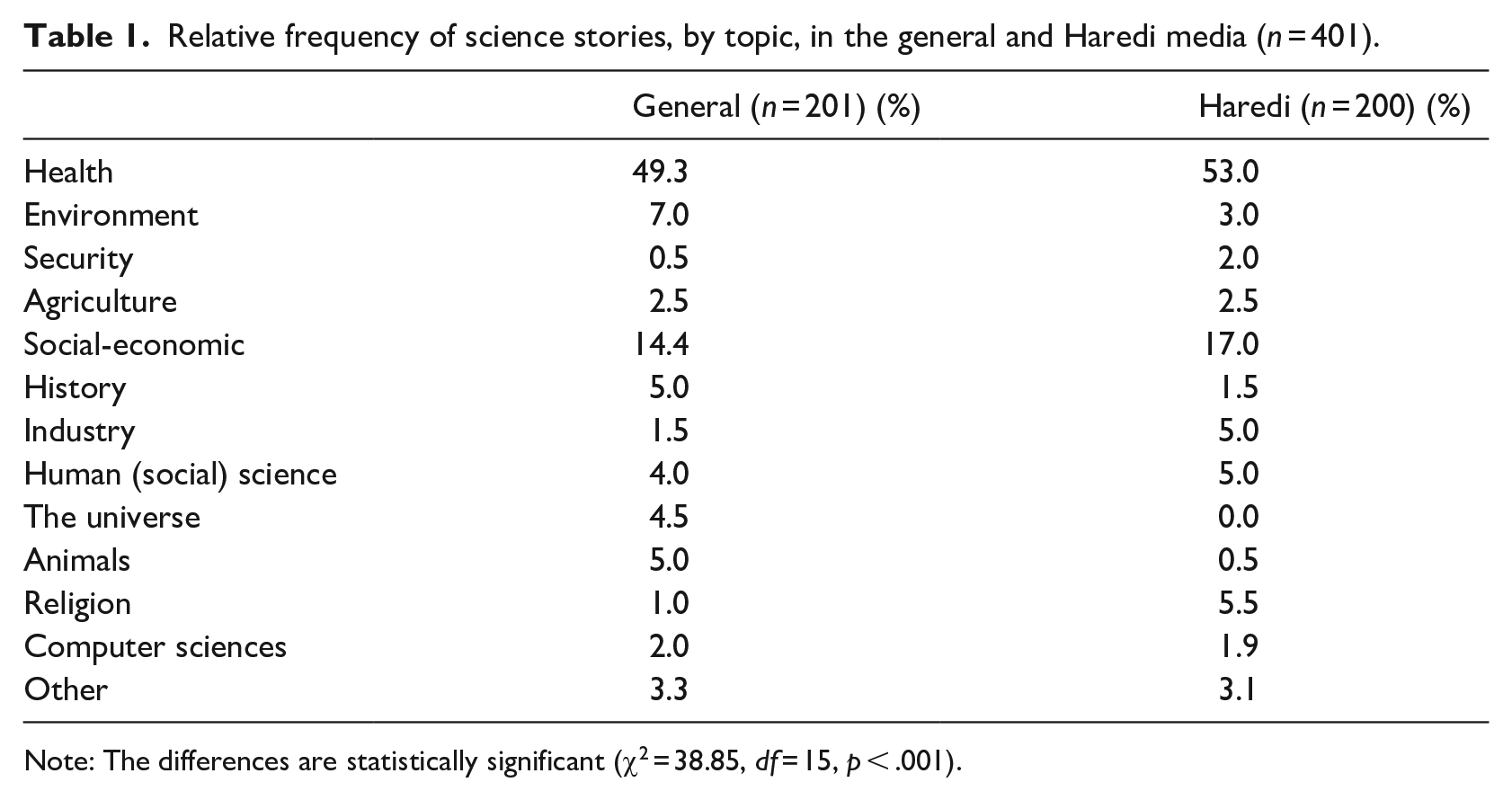
Note: The differences are statistically significant (χ2 = 38.85, df = 15, p < .001).
We also found that “removing” not only focused on knowledge but included active removal of people whose mere presence is challenging for Haredi publics. For example, we found that female scientists were much less likely to be referred to in Haredi press compared with the general press in Israel. On average, each story contained only 0.17 females (less than 1 female in every 5 stories), compared with 0.36 in the general press t(348.79) = 3.87 (p < .001). This alarming finding will be further addressed in the discussion and conclusion.
Reclaiming science
Reclaiming science refers to the identification of science as rooted in religious lore. This assumes an a priori condition of which nature is bound to the transcendental and that believers’ mission is to uncover its nexus. Reclaiming science includes an implicit or overt negation of a common perspective that identifies science with modernity, secularism, and moral profligacy. Yossi lamented the rejection of science by the Haredi mainstream and applied the following strategy to explain his motivation to make science acceptable: The (Sage) Vilna Gaon, for example, was a mathematical genius, and he wrote a book called Ayil Meshulash [literally, a triangular deer], in which he explains the Pythagoras’ Theorem and its connection to Judaism in different aspects.
The main idea here is that there is a connection between Pythagoras’ Theorem and Judaism. The wisdom of mathematics is not foreign to Judaism—it is integrally intertwined in it. Instead of compartmentalizing different wisdoms and perspectives that interpret physical reality, reclaiming is a strategy that frames science as part of the great wisdom of Judaism, similar to the work of the highly esteemed Vilna Gaon (eighteenth-century Jewish scholar Rabbi Elijah Ben Solomon Zalman). This relationship is deemed hierarchical, as described by the following interviewee. When asked whether science can coexist with Jewish ultra-Orthodox faith, Arale, a publisher of an online news outlet, proudly cited a physics professor who wrote: Science is like a mountain. Many climb this mountain. They climb and climb. When they reach the summit, they will see Haredim walking with Tefillin and Tallit (ritual objects) on the other side.
Similarly to Yossi, Arale alludes to a covert aspect of science which contains Jewish wisdom. He uses the metaphor of a mountain to describe the quest for scientific knowledge. According to his interpretation, the quest for knowledge will end with an acceptance or acknowledgment of Jewish wisdom, which he hints at by putting religious Jews at the summit. This metaphor reflects a perception that there is a religious truth that stands beyond scientific principles. Furthermore, voicing this opinion by a physics professor hints that true scientists will reveal the true wisdom of the Torah.
This type of meta-understanding was also part of the meaning-making process for Haredi readers. For example, Ruchi, a 32-year-old women, shared how: There are a lot of modern studies that found that you aren’t supposed to get out of bed immediately in the morning. It is better to wait at least twelve seconds. And, you know the morning prayer ‘Modeh Ani” is exactly 12 words. And we have been doing that way before they found that out!
Similarly to Arale, Ruchi reclaims science positing that scientific discoveries reflect traditional Jewish practices. In Orthodox Judaism, it is customary to recite a short morning prayer in bed, called “Modeh Ani” (I give thanks). As Ruchi comes across scientific discoveries she interprets them in ways that position Jewish wisdom and practice as a superordinate authority. This strategy entails a paradox: on one hand, Jewish wisdom seems to trump scientific knowledge. Yet, on the other hand, scientific discoveries offer support and evidence to long-standing Jewish customs. A classic example of how this metaphysical framework translates into science communication can be seen in an article 3 reporting on research which linked between milk consumption and cancer, infections, and diabetes, the reporter mentioned that “the first one who was wary of the consumption of milk and dairy products was Maimonides.” (See: Kikar Hashabat, 2019)
We also found that while reclaiming science, Haredi journalists often offered religious language to reshape scientific terminology. As Shulamit, a Haredi reporter explained: The term evolution is not used in our community. It is unacceptable, and rightfully so. But when I write about the “wonders of creation,” there are enough Haredi scientists, well, at least religious scientists who have seen the hand of god in nature. There are a lot of explanations. So, when I wrote in our magazine about the tactics that desert plants adopt to reach water, I write how generation after generation they adopt particular characteristics, this is the wonders of the world. It is not heresy, and this is not evolution, at least not in Darwin’s heretical meaning.
Shulamit’s strategy reveals how translating terms for Haredi publics entails a process of renaming. As there are terms that are deemed unacceptable (such as evolution), she finds ways to describe a classic case of evolutionary adaptation through religious vocabularies—“wonders of creation.” Renaming these processes allows her to describe the process as “the hand of god in nature,” while removing the perceived “heretical” context of Darwin’s theory.
Remodeling Science
Remodeling encompasses cases where there is an elevation of science, and its affiliated epistemic values, through the social construction and legitimation of an exemplar, whose conduct draws on scientific work and knowledge. Whereas reclaiming science refers to the wisdom of science per se, remodeling is about making science “kosher” through reference to particular exemplars, primarily Torah scholars who are particularly knowledgeable about science. Akin to the construction of religious veneration, modeling offers a strategy toward the reverence of a persona, and implicitly the values he or she draws their legitimacy from.
Our content analysis showed that the average number of religious figures in the Haredi press was 0.14 (SD = 0.72) meaning that on average, one in seven stories referenced a religious figure as part of science-related reports. The parallel sample of coverage of science in the general media did not contain even a single story referencing a religious figure, a statistically significant difference, t(199) = 2.82, p < .001. Whereas the general public in Israel consumes science as an area that has nothing to do with religion, Haredi publics often consume science in ways that are linked to religious figures and history, a point we return to in the discussion.
Journalists often referenced Maimonides (Rabbi Moses ben Maimon), the influential Jewish scholar of the Middle Ages, to simultaneously showcase piety and scientific expertise, but they also looked for more contemporary examples. In an interview with Yitzhak, a young journalist working in both print and online Haredi press, he told us of a special issue he edited on astronomy. He remembered this special issue with much excitement, signaling that this was not an ordinary task for him. In this issue, the main article celebrated the life, family, and discoveries of a Haredi astronomer—Dr. Vidal. He explains his work as follows: Once I did something truly scientific. I created a supplement section, for the New Year holiday, dedicated to astronomy . . . Dr. Vidal was an astronomer . . . One of the most renowned astronomers in the world, a Haredi Jew, his son is a well-known Jerusalem-based, Dayan (religious judge). The former is really old and has authored books on the “army of heaven” (celestial constellations) . . . we wrote a beautiful article with him.
In his account, Yitzhak highlights the centrality of a Jewish scientist and frames his scientific work with a religious metaphor (“army of heaven”) coupled with a reference to his learned son, who is a judge in Jerusalem’s Jewish court. Thus, modeling includes both historical (Maimonides) and contemporary (Vidal) examples of individuals who have mastered both scientific and religious knowledge. By referring to these historical or contemporary figures, modeling offers a way for journalists to display modes in which science and religion can live together.
Rubricating science
Rubricating is a strategy allowing conflicting ideas to coexist by creating separate (compartmentalized) forms of knowledge. Presented in this fashion, science and religion are not in competition but rather describe different spheres of knowledge and expertise (reflecting the concept of parallelism, see Gottlieb and Wineburg, 2012). For example, Chaim, a print journalist, offered an account of the acceptable forms of scientific knowledge.
Question: So from your point of view, you do not think there is any problem with speaking with the Haredi public on scientific matters?
Answer: Outside of the topics that create a religious conflict. As long as you engage in topics that are not connected to religion. With computer-related subjects for example . . . there is no issue.
Chaim’s description creates a clear division between scientific topics that can or cannot be discussed in Haredi media. According to his distinction, anything that does not have the potential to create conflict—such as computer-related subjects—may be circulated. Chaim’s description regarding computers resonates with previous research which found that computers and technology are highly reported in Haredi media as science as a technology is deemed less risky than science as an epistemology (Taragin-Zeller et al., 2022). This was further established in this study which found that computer sciences received almost the same scant attention in the general and Haredi media (2.0% in the general media and 1.9% in the Haredi media).
One of the articles offers an explicit rationale to steer away from conflict. In a Haredi newspaper, the author discusses astronomy’s status with a Rabbi
4
: What would the Rabbi recommend to a Haredi Jew asking whether he should get informed in this field? “The answer is not simple. For those whose faith in Judaism is not firm, I would not recommend it, so that they will not fail in (compliance with) the foundations of Judaism. Only those who accept that the world has existed for 6000 years as the final word, while all the rest is not worth addressing, can enter this field . . . there are scientists that deal with these things and are not singed from all these theories. Hence, the journalist suggests issues which are acceptable, versus fields which may contain contentious hotspots and hence, should be avoided. This boundary-work was also vivid in the meaning-making process of the men and women we spoke to. Chava, a 32 year old woman from Petah Tikva illustrated this as follows: Torah never talks about science. It is not a book of science. It is not trying to say what is right or wrong from a scientific perspective. It is a book that is trying to tell us how to live.
Chava’s narrative reflects a process of re-compartmentalizing that not only distinguishes different forms of science (“good”/“bad”) but altogether separates science from religion, in a complementary and meaning-seeking effort of understanding the world. Her narrative showcases a particular understanding that science tells us how to live. While this may not be typical in other contexts, Chava’s understanding resonates with research that links opposition to science as part of a dispute about values (see Evans, 2018). Nevertheless, it is this distinction that makes epistemic order and allows both to live side by side. Similarly, a young journalist in a Haredi weekly summarized this commonly applied categorization methodology: It is possible to claim that, for the Haredi sector, there is no real opposition to scientific knowledge, professional knowledge. Sometimes there is resistance to their symptoms, to the clashes with the Jewish law, to clashes with the knowledge of the Torah. Creation of the universe, evolution.
The journalist divides science into two different systems: professional and belief systems. The professional parts are acceptable and worthy for publication. In contrast, segments that present science as a competing belief system are illegitimate and should be avoided. Thus, these journalists account for their classification practices, which guide their decisions on selecting relevant narratives to include in their reportage, while dismissing others that they deem as unfitting for the moral economy of the outlet and its imagined public. Similarly, Haredi audiences accepted science as a provider of practical solutions, medicines, and technology but did not accept its claim to be a way of knowing the world.
6. Discussion
This article reveals how Haredi reporters tailor science for their publics; how these strategies are reflected in the texts they produce; and how these manifest in the ways Haredi readers negotiate science and religion. Our analysis identified four main strategies, which we call the four “R”s—removing, reclaiming, remodeling, and rubricating science. These strategies reveal a constant paradox: On one hand, there is much curiosity and even admiration of science among the reporters and readers we spoke to. Yet, this admiration is fused with anxiety, creating a constant need to tailor scientific knowledge. In contrast to earlier research on religion and science that highlighted the ways some religious communities steer away from science, this article showcased the concerted efforts to tailor scientific knowledge for and by Haredi Jews. Based on these findings, this article calls for more attention to the particular ways science communication can be more religious-sensitive in diverse contexts. Tailoring for different religious groups likely requires situated methods to negotiate particular theological, cultural, and social forms of “protection” (Kasstan, 2019). As Priest et al. (2018) remind us: “Science communicators come from many backgrounds and work toward different—sometimes competing—objectives” (p. 2).
While we strive to develop a model for science communication that takes religion into account, this study also highlights the limits of religious-sensitive science communication. Our findings show that tailoring comes with a price, raising important questions about the ethics and the politics that accompany this particular set of tailoring tools (the four Rs). First, we found that “remodeling” entails a constant motivation to highlight the aspects of science that coalesce with religious knowledge and language. Second, part of “rubricating” science included minimizing the importance of competing scientific epistemologies while merely highlighting the more technical and applicable aspects of science. This distinction makes epistemic order and allows both to live side by side. When “reclaiming” was utilized, science was incorporated in the “Truth of Judaism,” as everything is already “known” in religious texts, thus the quest for science can be tolerated as (un) intendedly leading to this ultimate truth.
While all strategies have ramifications, “removing” comes with a particularly heavy toll for attempts to embed gender equity in science communication. As mentioned above, “removing” entailed leaving complete topics and people under-reported. In most Haredi news outlets, pictures of women are not allowed. In addition, while names of women are not prohibited, there is less incentive to give voice to female scientists, as this is not a “traditional” vocation for Haredi women. We found that each story contained only 0.17 females (less than 1 female in every 5 stories), compared with 0.36 in the secular press, t(348.79) = 3.87 (p < .001). Namely, while consuming general media, non-Haredi readers will have double the chance of reading about female scientists than in Haredi media. Haredi readers, however, will continue to gain a limited and restricted picture of female scientists. Hence, Haredi publications are failing to portray scientists fairly, even in comparison with non-religious media where female scientists are already under-represented (Steinke, 2012). While there is “critique from within” (Kravel-Tovi, 2020; Zion-Waldoks, 2023) advancing calls for gender equality and female representation, our dataset reveals that “removing” is utilized by both female and male reporters, who align their writing with authoritative communal structures. Thus, inclusion, in this case, entails the exclusion of important factual information about the world, producing (and their audiences are consuming) content that diverges significantly from reality while taking away the credit that female scientists deserve.
Some might view this case study as a story of successful (or at the least necessary) tailoring. Tailoring entails significant agency for journalists as they forge a distinct form of knowledge that converges scientific information with the audience’s perceived values. However, these findings also raise questions regarding the prices of cultural adaptation and the ethics of science communication. A more critical look at Haredi science journalism reveals that these strategies are not merely tailoring but also entail a process of gatekeeping, excluding various types of knowledge and egalitarian models of knowledge-making.
Before we conclude, a word of positionality seems necessary. While all authors of this article are not Haredi, our work is part of a research group which includes a variety of activists and researchers, including Haredim. Even though we all have a diverse range of opinions and positionalities vis-a-vis science and/or religion, we all came together to better our understanding about how science and religion are operationalized in real life. Our findings offer fresh tools to rethink assumptions about science and religion and their real-life entanglements. We also argue that these findings are relevant to scholars in other contexts who are, like us, interested in diversifying science. As we have shown in this article, diversifying science requires us, like our interlocutors, to confront and negotiate the ethical challenges introduced by epistemological pluralism.
Footnotes
Funding
The author(s) disclosed receipt of the following financial support for the research, authorship, and/or publication of this article: This research was funded by Israel’s Ministry of Science, Grant 3-15724, and The TCSS Center of Excellence, supported by the Israel Science Foundation, Grant 2678/17.
