



Abstract
Organizations involved with gene editing may engage with the public to share information and address concerns about the technology. It is unclear, however, if the information shared aligns with what people want to know. We aimed to understand what members of the public want to know about gene editing in animals by soliciting their questions through an open-ended survey question and comparing them with questions posed in Frequently Asked Question (FAQ) webpages developed by gene editing stakeholder organizations. Participants (338 USA residents) asked the most questions about gene editing in general and animal welfare. In contrast, FAQ webpages focused on regulations. The questions survey participants asked demonstrate a range of knowledge and interests. The discrepancy between survey participant questions and the information provided in the FAQ webpages suggests that gene editing stakeholders might engage in more meaningful public engagement by soliciting actual questions from the public and opening up opportunities for real dialogue.
1. Introduction
Gene editing (GE) is the targeted removal, addition, or replacement of specific genes to produce desired traits (Wenfang et al., 2016). In animal agriculture, applications have been framed in terms of potential benefits for disease resistance, production, and reproductive performance (Perisse et al., 2021) as well as reducing the environmental footprint of animal agriculture (Lamas-Toranzo et al., 2017). Some applications have purported animal welfare benefits (de Graeff et al., 2019), including polled cattle (removing the need for painful removal of horns after birth; Carlson et al., 2016) and identifying the sex of chicks before hatching by placing a marker gene on a male chromosome (allowing for the removal of male eggs before they hatch, thereby eliminating the need for culling male chicks after hatching; Tizard et al., 2019). However, these technologies can create environmental (Kohl et al., 2019) and ethical concerns, including interfering with nature, disproportionately serving agricultural corporations, and potentially harming the animal’s welfare and dignity (Eriksson et al., 2018; de Graeff et al., 2019). For example, GE may be used to improve livestock productivity, but this has raised the concern that the creation of GE livestock would then further promote the industrialization of animal agriculture and heighten the negative environmental impacts associated with farming (Benz-Schwarzburg and Ferrari, 2016).
A large body of research seeks to understand public perceptions of agricultural applications of genetic technologies (including GE). Much of this work uses surveys to examine acceptance (e.g. Beghin and Gustafson, 2021; Frewer et al., 2013), willingness to pay (e.g. Costa-Font et al., 2008; Kilders and Caputo, 2021), and attitudes (Frewer et al., 2011). Findings include, for example, that American participants were more likely to support uses of genetic technologies that purport to benefit animals, such as polled cattle (McConnachie et al., 2019), and Brazilian participants were more hesitant to support technologies they believe would harm animals (Yunes et al., 2021). Potential benefits to animal welfare also appear to have a larger impact on United Kingdom participant attitudes than potential environmental or human health benefits (Martin-Collado et al., 2022). Perceived risk also affects public perceptions. McFadden and Lusk (2016) reported that equal proportions of American participants believed genetically modified food was unsafe, were unsure about genetically modified food, or believed it was safe. Finally, Rose et al. (2020) reported that most American participants felt genetically modified organisms were highly risky and rejected the resulting food products.
Given these concerns and the early development stage of GE in animals, there are calls for meaningful engagement with the public (Reincke et al., 2020; Scheufele et al., 2021; Sykes and Macnaghten, 2013). Meaningful engagement brings forward value-based concerns that can guide responsible innovation (Scheufele et al., 2021) and includes a range of public voices (Davies et al., 2021). Although some claim that public engagement can create conflict between stakeholders and incite polarization, thereby lengthening decision-making timelines (PytlikZillig et al., 2018), public engagement can aid in the creation of acceptable, fair policies that account for the perspectives of multiple stakeholders and can facilitate the development of rigorous risk assessments of novel technologies (Kuzma, 2021).
We define public engagement as “a subset of democratic activity that focuses specifically on the inclusion of nontechnical publics in the development and governance of new technologies” (Rempel et al., 2018: 170). Public engagement may take a variety of forms, including educational exhibits and fairs, webpages, workshops, focus groups, and surveys (Reed et al., 2017) and provides opportunities for the public to access information, discuss concerns, ask questions, and, if done at an early stage, can be an integral part of decision-making processes (PytlikZillig and Tomkins, 2011; Sykes and Macnaghten, 2013).
However, some public engagement efforts adopt a knowledge-deficit approach (Simis et al., 2016), which utilizes top-down efforts by experts to provide information intended to bolster public support for the technology (Davies, 2008). This model is driven by a conception of the public as ignorant and thus in need of education (Rempel et al., 2018). While some studies have found a positive relationship between objective knowledge (i.e. knowledge of genetic technologies) and attitudes toward genetic technologies (Costa-Font et al., 2008), objective knowledge is not always linked to support of novel technologies (Rempel et al., 2018). Subjective knowledge (i.e. how much the participant feels they know about genetic technologies) seems to have a larger impact on attitudes than objective knowledge, perhaps because the former relates to values (Costa-Font et al., 2008). Despite this, public engagement efforts often focus on scientific knowledge over other factors affecting technology acceptance, such as societal values (Reincke et al., 2020), which are sometimes dismissed as irrational by experts (Marris, 2014). For example, public consultation on Norway’s Gene Technology Act prioritized technological discussions despite participants raising social, cultural, and ethical questions (Kjeldaas et al., 2021). Gene editing in animals is a novel technology in its early stages of development so there are opportunities to meaningfully engage with the public to understand the concerns they have, especially given that these technologies can impact different facets of human society including food and health (Burall, 2018).
One engagement tool used by stakeholder organizations including government, industry, and institutional groups, is a list of “Frequently Asked Questions” (FAQs). Typically, FAQ webpages address public questions on a range of topics, and have also been used as a communication tool, for example, to provide information about COVID-19 vaccines (Sajjadi et al., 2021) and climate change (Connors et al., 2022). Gene editing stakeholders have developed FAQ webpages about GE in animals, but it is unclear whether the questions in FAQ webpages correspond to actual questions asked by members of the public.
The aim of the current study was to use an open-ended engagement approach to investigate what people want to know about GE in animals. To do this, we solicited questions people have about GE in animals through an open-ended survey question: “What questions come to mind about gene editing animals?” A secondary aim was to compare the questions people asked with those on FAQ webpages about GE in animals. Documenting actual questions and describing how they correspond to publicly available FAQ webpages about GE in animals can reveal gaps between the information provided to the public and what people want to know. This approach could provide insight into how FAQ webpages could be better designed as a meaningful public engagement tool, potentially allowing stakeholders to refine their engagement efforts.
2. Materials and methods
Survey design
United States of America residents at least 18 years of age were recruited in May 2022 using Amazon Mechanical Turk, which is a method of high-quality, reliable data collection (Saunders et al., 2013) that is quick and easy-to-use and has been shown to yield a diverse (Buhrmester et al., 2011) and attentive (Hauser and Schwarz, 2016) pool of participants.
The survey was hosted online using Qualtrics (Provo, UT, USA; full text available online at https://doi.org/10.5683/SP3/LIF1PZ). Participants provided their age and gender identity and then responded to the open-ended question: “What questions come to mind about gene editing animals?” Participants were invited to write at least one question and could add up to 15. Finally, participants answered a question about dietary preferences.
Participant quotas were based on the US Census data for gender identity (United States Census Bureau, 2021) and age (United States Census Bureau, 2019). Before beginning the survey, participants were told the survey would solicit their views about agricultural practices; no definition of GE was provided. Participants provided written consent before starting the survey and received 1 USD as renumeration at completion. All procedures were approved by The University of British Columbia’s Behavioural Research Ethics Board (Ethics ID: H22-00873).
Survey data preparation
Participants were automatically removed from the survey if they failed the instructed attention check (Oppenheimer et al., 2009). Excluding these participants, we collected responses (i.e. questions) from 861 participants who submitted a total of 1572 open-ended questions. Of these, 321 participants were removed because their question(s) were unrelated to GE in animals or could not be reasonably interpreted as a question, leaving 540 participants and 1133 open-ended questions.
We then used Turnitin™ to determine whether questions were copied from the Internet. Turnitin™ is an online writing tool that assesses the originality of text through comparisons to website content in their database (Turnitin, n.d.). Participants and their questions were removed if their questions were flagged by Turnitin™ as more than 50% copied from online sources, leaving 340 participants and 747 open-ended questions. Of these remaining participants, two were removed because they were flagged by Qualtrics as duplicates based on IP address; this was corroborated by duplicate demographic characteristics. This left 743 open-ended questions from 338 participants for qualitative analysis (all data are available online at https://doi.org/10.5683/SP3/LIF1PZ). Demographics of the final sample are shown in Table 1.
Demographics of the survey participants (n = 338) in relation to the US Census data (for those variables reported in the Census).
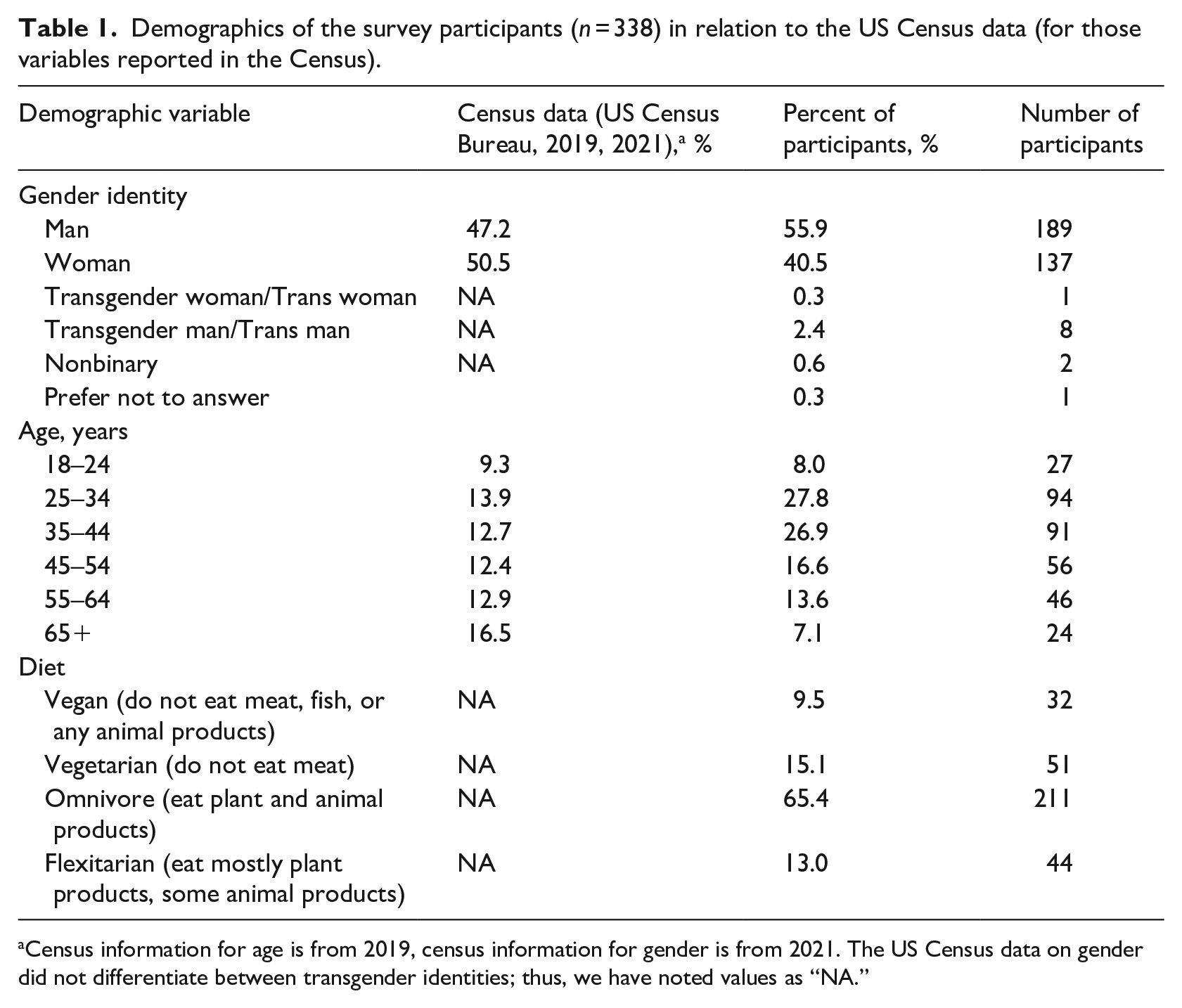
Census information for age is from 2019, census information for gender is from 2021. The US Census data on gender did not differentiate between transgender identities; thus, we have noted values as “NA.”
Survey analysis
We used descriptive coding (Saldaña, 2015) to categorize questions into themes based on the topic of the question. Initially, we used a priori (i.e. pre-existing) themes which were developed based on a review by de Graeff et al. (2019) that summarized themes in the broader literature about GE in animals. These themes included human health, efficiency, risks and uncertainty, animal welfare, animal dignity, environmental considerations, and public acceptability.
Intercoder reliability was used to ensure the consistency of coding (Guest et al., 2012). In the first round of coding, a trained researcher categorized questions into the a priori themes. Two coders (the first author and the same trained researcher) then met to discuss themes that were not applicable to the data. The first author then recoded all the data and inductively developed new codes and subthemes as needed. Once themes and corresponding descriptive codes were organized by the first author in a codebook, a trained researcher recoded the entire dataset using the updated codebook. The overall unweighted Cohen’s kappa coefficient between coders was .75, which indicates moderate agreement according to the guideline by McHugh (2012). The first author then made final adjustments to the codebook to clarify themes with lower agreement. During the coding process, some questions were coded with two themes or subthemes. The final themes were animal welfare, economics and trade, ethical concerns, general information, purpose of gene editing, regulations, and risks and safety.
FAQ webpage data collection and analysis
The secondary aim of this article was to compare survey participant questions to questions presented in FAQ webpages (Koralesky et al., 2024). To identify FAQ webpages, we developed a systematic search strategy based on Godin et al. (2015), which included an advanced Google search using the “intitle” function and pairing of search terms (e.g. gene AND animal AND edit AND FAQ). We included webpages that were intended for a public audience, free, about GE in farm animals, and in a question-and-answer format. Our search yielded 10 FAQ webpages (Supplemental materials; https://doi.org/10.5683/SP3/LIF1PZ). Two were published by industry stakeholders: Acceligen (a precision breeding company), and the Biotechnology Innovation Organization (a biotechnology advocacy group). Two were published by biotechnology research groups: the Roslin Institute at the University of Edinburgh, and the Yourgenome educational website, published by the Wellcome Genome Campus. Two were published by food and environment advocacy organizations: the Center for Science in the Public Interest (advocates for safe and healthy foods for consumers), and the Global Justice Ecology Project (advocates for environmental and social justice). Finally, four were published by government bodies responsible for food and agriculture: the Department for Environment, Food and Rural Affairs in the United Kingdom; the European Food Safety Authority; the Food and Drug Administration in the United States; and Health Canada.
For the purposes of comparing the survey responses and the online FAQs, we coded the online FAQ questions using the same codebook that was developed for the survey response analysis (based on themes in de Graeff et al., 2019). Although the online FAQs included both questions and answers, only the questions were coded.
3. Survey results
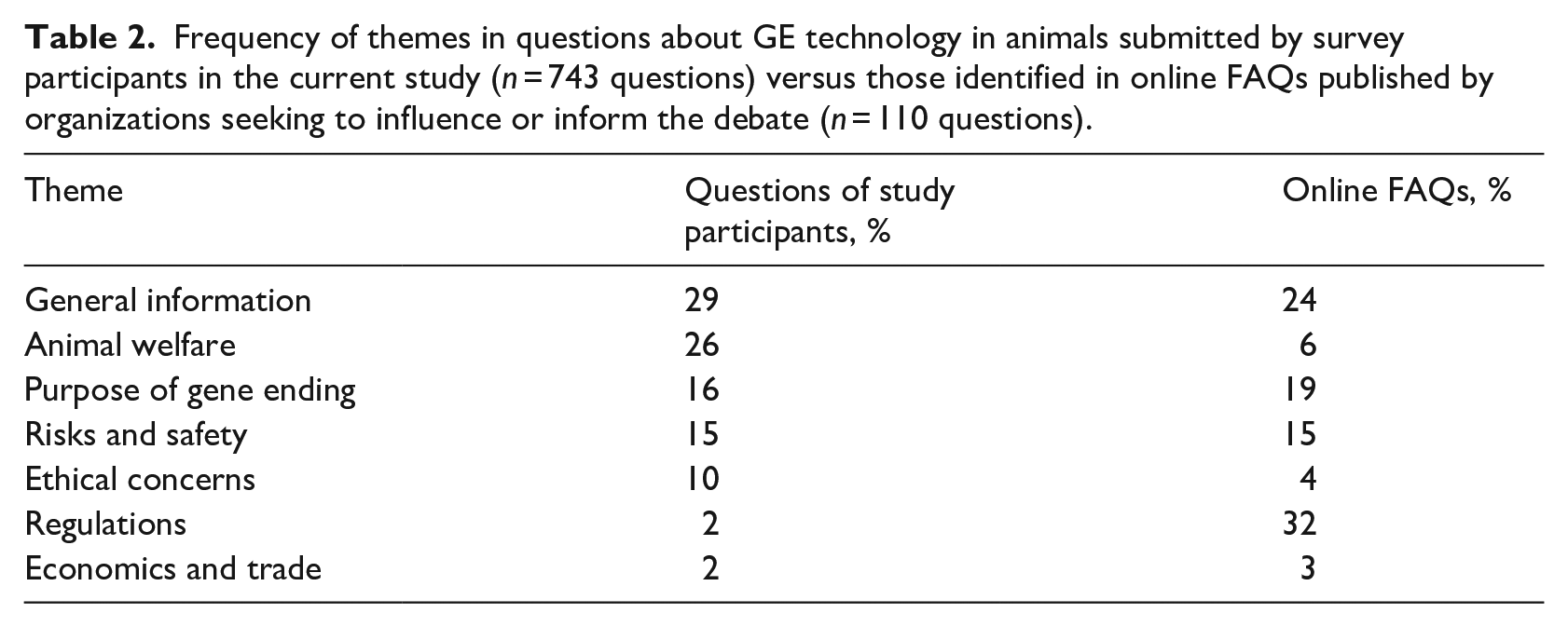
Participants submitted a mean of two questions, but the number of submitted questions ranged from one to nine. Questions from a single participant sometimes addressed multiple themes (25% of participants addressed two themes, 15% addressed three themes, and 6% addressed four or five themes). Although we specifically solicited questions about GE in animals, participants were free to provide other questions about the technology, and indeed participants raised a variety of questions. Participants asked about general information about GE (29% of questions), animal welfare (26% of questions), the purpose of GE (16% of questions), risks and safety (15% of questions), ethical concerns (10% of questions), regulations (2% of questions), and economics and trade (2% of questions) (Table 2). Later, we describe each theme using participant quotes to illustrate the theme. Participants are identified by the letter P followed by a randomly generated number (e.g. P125). Edits to improve clarity (spelling or grammar) are indicated by square brackets.
Frequency of themes in questions about GE technology in animals submitted by survey participants in the current study (n = 743 questions) versus those identified in online FAQs published by organizations seeking to influence or inform the debate (n = 110 questions).
General questions about gene editing
The most common theme was general questions about GE. Most questions centered around defining terms related to GE such as “What is gene editing in livestock?” (P76) and “What does ‘gene editing animals’ actually mean?” (P71). Some participants asked for definitions of related terms such as cloning (“What is gene cloning?” P293) and genes (“What is [a] gene?” P148). Respondents also asked for examples of GE, with questions such as “Which animal [was] first used for gene editing?” (P326) and “What examples of actual gene edited animals are there?” (P93). Some participants also asked about the history of GE in animals with questions such as “Which country [. . .] first introduced gene editing technology?” (P65) and “When has this been done in history?” (P78).
Participants also asked about how GE technology works. Questions encompassed the general process, such as “How are they [GE animals] produced?” (P112) and “How does the process work?” (P69), as well as more specific questions, such as “Can we splice different species together to get certain traits?” (P68), “How is the gene identified and altered?” (P95), and “Can any animal gene be edited or is it just certain animals?” (P90). Some respondents also questioned if GE was possible or complicated, with questions such as “Is it real?” (P20) and “How difficult is it?” (P34). Finally, some participants asked questions aimed at seeking information or opinions from others, such as, “How do I find more information about gene editing animals?” (P90) and “What [are] your thoughts about gene editing animals?” (P320). In this theme, the questions submitted by participants ranged from general questions about the gene editing process to specific questions about how the technology works.
Animal welfare
Within the animal welfare theme, some participants asked about potential benefits to animals. Questions ranged from general benefits such as “Is gene editing good for animals?” (P106, P162, and P258) and “How can gene editing benefit animals?” (P36 and P217), to specific benefits regarding lifespan, “Will this make animals live longer?” (P52), and disease “What diseases does this target?” (P141). Participants also asked neutrally-worded questions about the general effect of GE on animals, with questions like “How does it affect animals?” (P42 and P129).
We received more questions about potential negative impacts on animals and if GE could harm animals. Specifically, participants raised concerns about disease (e.g. “Will this raise the incidence of disease in these animals?” P39), experimental harms (“Will a lot of animals die during testing?” P53), and lifespan (“Do their lifespans get reduced?” P207). Participants were also concerned about how the animals would be changed as a result of GE, asking if it would create animals that are “malformed, uncomfortable, or suffering” (P53), “feel pain” (P35), or “decrease the animal’s quality of life” (P80). Others wondered if GE was “safe” (P88, P119) or “humane” (P40, P120) for animals or specifically asked “Have the humane factors of this editing been discussed?” (P45). As well, a few participants expressed concerns that GE may create long-term impacts for a species, asking questions such as “What ramifications does a gene-altered animal have [for the] genetic pool of that species?” (P321) and “How does it [GE] affect future generations?” (P100). Some questions specifically compared GE animals to “normal” or “real” animals and questioned how GE made them different. For example, participants asked if GE animals “behave like real animals” (P12), “look bigger than others” (P65), or if GE “alter[s] the animal’s personalities” (P70). Thus, people wanted to know about potential negative impacts of the technology and were curious about how GE would change animals on an individual level.
Purpose of gene editing
Some participants asked about the purpose of GE in terms of potential benefits (i.e. “What are the potential benefits?” P126), including potential benefits for humans (i.e. “How does gene editing in animals benefit human beings?” P243). Specific questions centered around the human food supply, with questions like “Would this be done so that animals could get a “fat” gene and then grow fatter so that there will be more meat on the animal for humans to eat?” (P57) and “Is gene editing done to improve flavor or quality?” (P60).
Others asked more neutrally worded questions, focusing on why GE is being performed, like “What are the reasons for doing this?” (P181) and “What is the point?” (P51). Furthermore, some participants asked about potential alternatives to GE and wondered why GE was being done if alternatives were available. For example, participants asked, “Would promoting vegetarianism, instead, be an option?” (P35) and “Why not grow lab meat, instead?” (P80). Overall regarding the purpose of GE, survey participants wanted to know about benefits and alternatives.
Risks and safety
Participants asked questions about the risks of GE, for example, “What are the risk[s] of making such creatures?” (P38) and “Is this safe?” (P52) or expressed concerns about side effects, with questions like, “What is the percentage of mutations or other unintended consequences?” (P67) and “What unforeseen side effects have occurred that were bad?” (P32). Some participants expressed concerns about long-term consequences with questions like “Will there be any long-term repercussions?” (P204) and “What are [the] long term side effects?” (P117).
Participants asked about food safety, wondering if consuming products from GE animals was “healthy” (P263), “safe” (P64), or if such products were even “edible” (P85). Some participants wondered about how safety would be ensured for these products, with questions like, “If it is bred for food or food byproducts, will studies be made as to the safety of the food it produces?” (P64) and “Have there been studies on how people of different ages and states of health react to genetically modified food?” (P95).
Finally, participants questioned the environmental safety of GE, asking questions like, “Will this have an impact on nature in the long run?” (P83), “Would gene editing animals negatively impact the [ecosystem]?” (P30), and “Are gene edited animals safe for the environment?” (P58). Thus, across the sub-themes of general, food and environmental risks and safety, participants were united in their concern about the long-term consequences of GE.
Ethical concerns
Participants expressed ethical concerns about the technology, asking if GE was “moral” (P43, P254, and P264) or “ethical” (P46, P54, and P89). Others asked if gene editing was natural, with questions such as “Isn’t gene editing animals against nature and artificial?” (P173) and “Is it violating nature?” (P110). Participants also held concerns that GE may be used in humans, with questions like “Could this lead to gene editing in humans?” (P42) and “Is it okay to gene edit humans like we do animals?” (P46).
Participants also expressed ethical concerns about who benefits from gene editing, asking questions such as “Who owns the gene edits?” (P136) and “What industry would have access to this?” (P56). Participants also asked about the ethical principles that apply to those developing and using the technology, asking “Is there a code of ethics in use by the researchers?” (P98).
Regulations and economics and trade
Questions that fell under the regulations theme centered on whether gene editing was “legal” (P48, P86, and P114) or “illegal” (P3, P41, and P75). However, some participants asked about specific regulations, such as “What are the regulations and laws for how much “editing” can be done?” (P33) and “Is it FDA-approved?” (P31). Finally, questions in the economics and trade theme were primarily about the cost of GE. Some participants wondered if it would be “expensive” (P62) or “costly” (P164). Others questioned if it would be used to produce food that was “more affordable than [traditional] food” (P108) or if it was “economically friendly” (P2).
Online FAQ webpage results and comparison
We compared survey participant questions to the questions on the FAQ webpages. The FAQs collectively had 110 questions. Questions included those about regulations (32%), general information about GE (24%), the purpose of GE (19%), risks and safety (15%), animal welfare (6%), ethical concerns (4%), and economics and trade (3%) (Table 2). Survey participants proportionally had more questions about animal welfare (26% of all survey participant questions vs 6% of all FAQ webpage questions) and ethics (10% of survey participant questions, 4% of FAQ webpages questions), and the FAQ webpages proportionally had more questions about regulations (32% of all FAQ webpage questions vs 2% of all survey participant questions). Other themes were addressed somewhat equally.
4. Discussion
This study described questions asked by members of the public about GE in animals and compared these questions with those in FAQ webpages published by GE stakeholder organizations. Our open-ended approach allowed us to understand what people want to know about GE in animals, and the range of responses highlights the diversity of knowledge and interests among participants. We found that participants asked more questions about animal welfare, while GE stakeholders focused on regulations through their online FAQs, highlighting a gap between the information provided by stakeholders and the interests of the public.
Survey participants asked questions that demonstrated varying levels of knowledge of GE. Knowledge of genetic technologies is typically assessed using objective and subjective measures (McFadden and Lusk, 2016). Surveys might, for example, ask whether participants have heard about the technology (Hallman et al., 2004) or how much they think they know about the technology (i.e. subjective knowledge, Costa-Font et al., 2008). Research has also assessed objective knowledge, typically by asking participants knowledge-based questions about genetic technologies that have a correct answer (i.e. “Is it possible to transfer plant genes into animals?”) (e.g. Hallman et al., 2004; McFadden and Lusk, 2016). Some of this research has reported that both subjective (McFadden and Lusk, 2016; Vasquez et al., 2022) and objective (McFadden and Lusk, 2016) knowledge of genetic technologies is generally low among North American participants. However, objective measures typically use questions predetermined by researchers which may exclude or fail to consider the different types of knowledge that participants have.
Knowledge of novel technologies can take different forms that are difficult to assess using the format of an objective knowledge question. The questions asked by participants within this survey can be used as a way of understanding public knowledge about GE in animals, showing both how much they know about the technology, and the breadth of issues that they find relevant. For example, more sophisticated questions about GE (i.e. how it works, rather than what it is) suggest a certain base level of GE knowledge, given that one needs to have some knowledge about a topic to formulate a question about it (Flammer, 1981). In other cases, people construct narratives about novel technologies that relate to their understanding of the technology (Macnaghten et al., 2019). Understanding the varying levels of knowledge and the diversity of topics that interest the public highlights the importance of acknowledging a heterogeneous public when conducting public engagement efforts. Public engagement efforts for genetic technologies typically treat public perspectives as static and homogeneous, likely limiting the relevance of engagement efforts (Burall, 2018). Acknowledging the public as diverse, with diverse questions, concerns, and levels of knowledge, may facilitate meaningful public engagement.
The most prevalent theme among survey participants was general questions about GE. These questions showed that participants have a range of knowledge, asking for definitions of “genes” or descriptions of the process of GE, as well as how GE has been developed and used over time. This result highlights the diversity of knowledge participants have, and that some seemed to have a more sophisticated understanding of the technology. Under the knowledge-deficit model, some authorities contend that the public does not want to know the details of how complex technologies work because this will be perceived as uninteresting or unrelatable (Davies, 2008); our open-ended approach allows a broader view of what people know and want to know about gene editing.
Many participants also asked questions about animal welfare and focused on potential negative impacts of the technology. It is not surprising that participants were more concerned about negative impacts of GE, as these are known to influence the acceptance of GE (Kilders and Caputo, 2021). Concerns about animal welfare may be related to concerns about naturalness (McConnachie et al., 2019) and animal dignity, relating to the idea that GE exploits animals for human purposes or alters their essence such that they will no longer be the same (de Graeff et al., 2019).
The questions submitted by participants about the purpose of GE were primarily neutral, although some asked about benefits. This may be because we did not provide specific information or a particular application of GE in animals so as to gather a wide range of questions. Although some members of the public may have strong opinions about genetic technologies (Fernbach et al., 2019), research has shown that the purported purpose can influence how the technology is perceived. For example, Busch et al. (2022) found that acceptance was higher for GE applications like disease resistance in pigs, and lower for increased muscle mass. McConnachie et al. (2019) and Kilders and Caputo (2021) found acceptance of GE was higher when using GE to create polled cattle to prevent the use of painful procedures to manually dehorn cattle. Beghin and Gustafson (2021) concluded that the public may be more accepting of genetic technologies that benefit the environment, human health, and animals, and less accepting of technologies that increase production and save costs.
Participants also raised questions about public safety related to food and human health, and wondered about risk mitigation, side effects, and testing. Concerns about risks and safety for food and the environment are known to affect perceptions of GE in animals (de Graeff et al., 2019). Food safety is a known concern for the public across different regions and agricultural applications, including in plants and animals (Frewer et al., 2013), and may stem from a concern that GE food may cause unintended consequences (McConnachie et al., 2019) or be of lower quality (Martin-Collado et al., 2022). Environmental concerns have been documented in the case of gene drives (where a specific genetic element is promoted to spread rapidly within a population), where risks were perceived to be higher than benefits (Kohl et al., 2019). In addition, as summarized in a review by Ishii and Araki (2016), risk perceptions may be impacted by public trust in the developers of the technology and trust in regulatory structures. Stakeholder attitudes toward GE may be driven by whether, for instance, people perceive the risks or benefits of the technology to be higher or lower than each other (Hall and Moran, 2006).
It was unsurprising that participants asked questions centered around the ethics of GE. Participants questioned the naturalness of GE and questioned who stands to benefit from the technology. Ethical and value-based concerns are well documented in the literature and likely play a large role in overall attitudes toward GE (see review by Scott et al., 2018). Ethical concerns documented in the literature include that GE is being used simply as a technological fix to problems rooted in industrial agriculture (Devolder, 2021) or related to animal welfare (Shriver and McConnachie, 2018). Research has also shown that people prefer more “natural” foods (although what “natural” means in this context lacks consensus; Scott et al., 2018), and are concerned that technology will tamper with nature, which is a strong predictor of perceptions of risk and attitudes toward novel technologies (Hoogendoorn et al., 2021). In addition, questions about who stands to benefit from GE may reflect a distrust in the developers of GE, which is known to influence risk perceptions (Ishii and Araki, 2016). In a study on crops, Pixley et al. (2019) cautioned that equitable distribution of the benefits from GE will require intentional policies and investments, and that care must be taken to ensure that research and resources are allocated to applications that offer social benefits, such as improving disease resistance of important crops in resource-poor regions.
The regulation and economics and trade themes occurred at the lowest frequency in our dataset. The regulation theme covered regulatory processes, which can be used to assure the safety of GE; however, this theme may have occurred infrequently because participants may not have wondered about the regulatory process itself, but rather safety, which fell under the risks and safety theme. Some previous research has investigated public willingness to pay for GE products (Costa-Font et al., 2008). One recent study (Martin-Collado et al., 2022) reported that price is not a significant factor in the acceptance of GE products; only 18% of participants would choose GE meat over traditionally produced meat if there was a price discount, although willingness to pay for GE meat increased if it was associated with additional benefits (e.g. improved animal welfare). The lack of questions on economics and trade highlights the importance of other factors (i.e. general information about GE and animal welfare) to our participants.
Comparing our survey participants’ questions with online FAQ webpages published by GE stakeholders revealed differences in how frequently themes were represented. Specifically, the online FAQ webpages focused on regulations about GE, but few survey participants appeared interested in this theme. In contrast, survey participants were interested in animal welfare, but few online FAQ webpages addressed this theme. If FAQ webpages are intended to be a meaningful form of online public engagement, then we might expect that the information provided in FAQ webpages would align with actual questions posed by the public, creating an exchange between the public (who provides the questions) and stakeholder organizations (who acknowledge the questions and provide answers). However, if the goal of the organization is to encourage support of their perspective (Marris, 2014), then information is likely to be framed in ways that advance this perspective (Wirz et al., 2020) and may not be aligned with the actual questions of the public. The discrepancy between the participants’ questions and the online FAQ webpages suggests that FAQ publishing organizations were more interested in framing the debate.
Regulations may have featured prominently in some online FAQ webpages because proponents of the technology may believe that public confidence in the adequacy of regulatory oversight will lead to enhanced trust and reduced perceptions of risk. Expert communication about GE has often provided curated information to encourage public support, perhaps reflecting the fear that openly discussing risks and safety would lead to rejection (Davies, 2008). While some survey participants were indeed interested in regulations and may value information about the regulation of GE, the discrepancy between the questions posed by our survey participants and those addressed in the online FAQs suggests that the online FAQs would be more meaningful public engagement tools if they addressed the public’s actual questions, including those about animal welfare.
Sykes and Macnaghten (2013) warn against forms of engagement with the public where the issue is framed without public input; these authors suggest that members of the public should be involved with defining and framing the issue according to their terms and should be provided with resources to develop their own opinions. Similarly, Rempel et al. (2018) advise that public engagement on novel technologies should embrace discussions about risks and safety, as avoiding communication on these topics is likely to diminish public trust in science (Gauchat, 2012). Rather, to improve public engagement, science communication should be a two-way dialogue, instead of treating public engagement as an opportunity to provide one-way information aimed at promoting one point of view (Radstake et al., 2009; Reincke et al., 2020). Following the “dialogue model” of science communication (Reincke et al., 2020), experts can share knowledge while also listening to and learning from others, building relationships with the public as valued participants in discussions. Although engaging on these topics may involve uncomfortable conversations about potential downsides of GE, this process may be valuable in building relationships and in giving people the knowledge they need to be informed and involved in the debate. Our research suggests that GE stakeholders might better contribute to meaningful public engagement efforts and facilitate a dialogue with the public by engaging with the actual questions asked about GE in animals.
5. Limitations
Participants were recruited according to quotas based on the US Census data for gender identity (United States Census Bureau, 2021) and age (United States Census Bureau, 2019), but our sample should not be considered representative for a number of reasons, including that these participants were recruited online and chose to participate in this specific study. Moreover, our final sample diverged somewhat from intended census values, in part because some participants were removed for failing the attention check or providing unrelated or uninterpretable text responses to our open-ended questions. Although we believe that these exclusions improved data quality (Shamon and Berning, 2020), we acknowledge that our exclusion criteria may disproportionately affect those of certain racial groups, ages, and education levels (Berinsky et al., 2014), biasing our sample. The online FAQs focused on farm animals and survey participants could ask questions about any type of animal. However, most survey participant questions were about farm animals or animals in general, so the two data sources can be viewed as comparable.
6. Conclusion
In this study, we asked participants to provide their questions about GE in animals. We found that participants most often sought general information about the technology, or asked how it might affect animal welfare, or why the technology was used. In contrast, online FAQs compiled by interested organizations focused heavily on questions related to regulations. The gap between the questions that members of the public posed and the questions that GE stakeholder organizations answered is consistent with the deficit model of communication, where organizations seek to frame the issue and provide information consistent with this framing. By considering the actual questions of the public, organizations may design more meaningful forms of public engagement.
Footnotes
Acknowledgements
We thank Anjali Parthasarathy for her assistance with analysis. We are also grateful to our colleagues at UBC and the University of Guelph, including Dr Mike von Massow and Jennifer Leslie for their help and support with this project.
Author contributions
Declaration of conflicting interests
The author(s) declared no potential conflicts of interest with respect to the research, authorship, and/or publication of this article.
Funding
The author(s) disclosed receipt of the following financial support for the research, authorship, and/or publication of this article: This work was funded by the Government of Canada through Genome Canada and the Ontario Genomics Institute (OGI-191).
