




Abstract
Despite widespread trust in scientists, efforts to curtail their influence suggest some Americans distrust scientists and may even perceive them to be a social threat. Using panel survey data, we examine who holds this viewpoint and potential implications of threat perceptions. Results suggest Republicans and Evangelical identifying individuals perceived more social threat from scientists. News media uses were associated with threat perceptions in divergent ways. Threat perceptions were strongly associated with inaccurate science beliefs, support for excluding scientists from policy-making, and retributive actions toward scientists. Findings highlight the importance of social identity considerations amid concerns about partisan social sorting and politicization of science.
COVID-19 put science at the forefront of partisan conflict in the United States, which had polarizing implications for partisans’ perceptions of scientists (Pew Research Center, 2020). This conflict was primed by increasing politicization of science by strategic actors both opposed to evidence-backed policies (McCright and Dunlap, 2011) and supporting the role of science in policy-making (Motta, 2018b). Given politicizing rhetoric and strategy from both sides, it is unsurprising that COVID-19 was immediately framed as a partisan issue (Hart et al., 2020). There are concerns that political divisions around science reflect broader trends of partisan social sorting, in which partisans increasingly see themselves as reflecting separate social groups (Mason, 2018; Törnberg, 2022). As science becomes politicized, scientific knowledge and those who produce it may become associated with competing social groups, and a consequence of this is that scientists themselves may be painted as a group either sympathetic to or in conflict with other social identities. Indeed, we see some rhetoric suggesting that science is “owned” by one partisan group over another in depictions of scientists as elites in ivory towers and yard signs allying belief that “science is real” with social values (Mak, 2021). By associating science with not only political positions but partisan social identities, scientists may come to be seen as a political or social ally to some and a threat to others, a view that has downstream implications for policy-making and the ability for experts to respond to future crises.
In this context, we explore whether segments of the public have begun to view scientists as a social out-group that poses a threat to their well-being and way of life, how this perception might correlate with news media use, and potential consequences of this perception on the accuracy of science beliefs, support for expert-informed policies, and retributive actions against scientists. In doing so, this study builds on emerging research documenting evidence of a perceived social conflict between scientists and some social groups (Mede and Schäfer, 2020; Prot, 2015) and recent work on affective polarization and social sorting in the United States (Mason, 2016, 2018). We highlight the implications of presenting science as aligned with or against social groups and the importance of intergroup theories to better understand contemporary attitudes toward science and experts in the United States.
1. Politicization of science and partisan social sorting
The American electorate is generally trusting of science and supportive of scientific research (Krause et al., 2021). That said, there are specific issues that have become politicized in the United States, leading partisans to interpret scientific evidence through the lens of their political identity (Lewandowsky and Oberauer, 2016; Nisbet et al., 2015). Some politicization is strategic; interested stakeholders have exploited uncertainty in scientific research to foster doubt and discredit evidence for political purposes (McCright and Dunlap, 2011). However, some politicization results from scientific research being swept up in partisan identity politics and social sorting. Americans increasingly sort themselves into social groups aligned with partisan identities, meaning that political divisions are not only driven by policy differences, but also by the social groups to which individuals belong (Mason, 2016, 2018). Partisan social sorting results in Republicans and Democrats sharing fewer social and cultural beliefs (DellaPosta et al., 2015; Mason, 2018); partisans increasingly align with in-group preferences and behaviors and disdain those of the out-group (Iyengar et al., 2012; Mason, 2018).
There is evidence that both Republicans and Democrats may perceive scientific issues as aligning with their political in- or out-groups. For example, Merkley and Stecula (2018) argue that the abundance of early supportive messages from Democrats about climate change signaled an in-group position that Republicans, as out-group members, should oppose. Other work has found that Democrats also become more distrusting of science when scientific information on hydraulic fracking or nuclear power counters their world view (Nisbet et al., 2015). Beyond single issues, the March for Science in 2017, intended as a non-partisan movement to celebrate science, furthered perceptions of conflict between scientists and Republicans (Motta, 2018b; Newman, 2020). Symbolic expressions such as yard signs proclaiming the belief that “science is real” alongside support for social values supported by Democrats may contribute to perceptions that science aligns with a Democratic or liberal political identity (Chen et al., 2021; Rothschild, 2020). In these ways, we have seen divisions over science that reflect broader patterns of affective polarization and partisan social sorting, even prior to the COVID-19 pandemic, which brought partisan conflicts over the role of experts in policy-making to the front page (Motta et al., 2020).
While most of the American public holds positive attitudes toward scientists, even throughout crises such as the COVID-19 pandemic (Pew Research Center, 2020), segments of the population have become vocal in their hostility toward scientific and academic experts. State legislatures in Wisconsin, Missouri, Iowa, and Texas have sought to curtail or eliminate tenure for university professors over concerns they “get away with literally anything” on the taxpayer’s dime (Flaherty, 2017; McGee, 2021). Political actors in Florida are seeking to eliminate funding for diversity, equity, and inclusion (DEI) initiatives at universities, which have been instrumental in supporting women and marginalized communities in STEM (Science, Technology, Engineering, and Mathematics), and recently succeeded in dismantling a DEI office at one university (Anderson and Gecker, 2023; Waxman, 2023). Public health officials responding to measles outbreaks and the COVID-19 pandemic have been doxed, harassed, and threatened with bodily harm (Mello et al., 2020). These examples suggest that politicization of science and partisan social sorting has implications beyond rejection of scientific positions—some segments of the public may perceive scientists as part of a social group by which they feel threatened. Although scientists are diverse and public perceptions of doctors, climate scientists, social science PhDs, and nuclear engineers vary (Suldovsky et al., 2019), messaging amplifying social divisions around science may imply that scientists are a homogeneous social group whose interests and values are in conflict with other groups.
2. Social identity and intergroup threat theories
Identifying sources and outcomes of anti-science attitudes is a growing area of interest. Extant work has explored the prevalence of anti-intellectualism, mistrust in experts, and science populist beliefs, as well as factors predicting such attitudes (Mede and Schäfer, 2020; Motta, 2018a). However, an underexplored explanation for skepticism and hostility toward experts is that certain groups have come to view scientists as a social threat. People tend to see each other not as individuals but as members of salient social categories and identify with social in-groups that aim to be distinct from out-groups to retain positive self-concept (Tajfel and Turner, 1979). When resources, such as wealth or social power, are unequally distributed between social groups, or there is a history of suspicion between groups, it can trigger intergroup comparisons and conflict. One may believe that their social in-group is at risk of being harmed by other social out-groups (Stephan et al., 2016). Groups with less power may be more likely to experience threats, but powerful groups tend to react more strongly to threats since they have the resources to maintain their positions (Schaller and Abeysinghe, 2006). Perceptions of threat from other social groups may concern physical well-being and political or economic power, called realistic threats, or people may perceive that their group’s morals, worldview, and values are under attack from other groups, called a symbolic threat. Both realistic and symbolic threats to the in-group lead to prejudice against members of out-groups and can motivate punitive actions to remove perceived threats (Stephan et al., 2016).
While extensively used to explain discrimination and social conflicts (e.g. prejudice against Muslims; Saleem et al., 2017), social identity theories have not been frequently explored in science communication research. However, limited research employing these frameworks in such contexts has found that conservatives viewed environmentalists as a symbolic out-group threat to their ways of life, and that these perceptions of threat reduced support for climate action (Hoffarth and Hodson, 2016). Furthermore, Prot (2015) found that video game players who read about scientists researching effects of violent video games on aggressive behavior perceived scientists as a threatening out-group and supported retributive actions against those scientists. Christians who believed more scientists were atheists perceived greater social threat, and subsequently mistrusted science more (Simpson and Rios, 2019). At this time, we expect that the prevalence of perceptions of scientists as a social out-group is limited; however, there is evidence that social sorting and messaging may be fostering these perceptions among some.
3. Groups who may perceive scientists as a social threat
Groups who believe that scientists are challenging their power or worldviews are likely to see scientists as a threat. This includes people who are highly religious, particularly Evangelical Protestants, who may perceive symbolic threats to their knowledge systems from science (Evans, 2018). Evangelicals, for instance, tend to be morally opposed to scientists’ influence in public affairs for issues such as stem cell research because they believe scientists’ research agendas go against their values (Evans, 2011). Simpson and Rios (2019) found that perceptions that scientists were predominantly atheists increased threat perceptions among Christians, leading them to mistrust science. Recent work has also shown that adherents to Christian nationalism—“the desire to see exclusivist versions of Christian symbols, values, and policies enshrined as the established religion of the United States” (Baker et al., 2020)—perceive science as a challenge to Biblicist epistemic and political authority, which drives rejection of scientific claims and expert recommendations (Perry et al., 2021; Whitehead and Perry, 2020). In sum, there is evidence that certain religious groups in the United States, particularly Evangelical Protestants, may already perceive scientists as an opposing social out-group that makes symbolic and potentially realistic threats against their political power and worldview.
There are also prevalent narratives of conflict between scientists and those who identify as Republican and conservative. Generally, Republicans in the United States promote ideals of limited government and individual freedom, which may conflict with science-based policies on issues such as climate change calling for government interventions, international treaties, or industry regulation (McCright and Dunlap, 2011). Conservatives and the Republican party in the United States also tend to be associated with anti-expert attittues (Motta, 2018a) and are skeptical of climate and environmental science (McCright and Dunlap, 2011). There are other recent notable issues, such as the development and use of COVID-19 vaccines, where Republicans tend to percieve science as opposed to their values (Motta et al., 2020) or when scientists inadvertently drew divisions between the scientific community and the Republican party with the March for Science (Motta, 2018b). Such value conflicts are not necessarily threat inducing; however, because of the recent, notable conflicts with scientists, we hypothesize that individuals affiliated with the Republican party may also perceive scientists as a group that threatens their political power.
Hypothesis 1a (H1a): Individuals who identify as Evangelical Protestants are more likely to perceive scientists as a threat.
H1b: Individuals who identify as Republican are more likely to perceive scientists as a threat.
4. How media shape perceptions of science and scientists
When individuals are personally unfamiliar with scientists, they may form impressions from what they hear or see in media, thus representation in news coverage is likely to impact how audiences perceive scientists. Conservative outlets such as Fox News have often advanced views contrary to scientific consensuses on issues such as climate change and COVID-19 (Feldman et al., 2012; Motta et al., 2020), as well as presenting experts with a more negative tone (Stecula and Motta, 2019), compared to news outlets such as CNN or MSNBC. These depictions contribute to differences in audiences’ science attitudes. Consumers of right-leaning news outlets are more likely to deny the urgency of climate change and to endorse COVID-19 misinformation (Feldman et al., 2012; Motta et al., 2020). Republicans who consume Fox News reported less trust in scientific research centers and leaders such as Dr. Fauci compared to Republicans who do not consume this content (Jones et al., 2020). Differing representations across news sources may affect perceptions of threat from scientists. However, while comparisons between Fox News and other TV news outlets have been frequently investigated, there is limited research on the ways other news sources present scientists and experts (e.g. mobile news apps, online news websites, local newspapers, and so on) and no study to date that has explicitly measured effects on threat perceptions. We therefore pose the following research question (RQ):
RQ1: How is exposure to different news media sources associated with perceiving scientists as a threat?
Audiences are also exposed to science information on social media, where scientific messages can vary wildly. How people use social media affects the content to which they are exposed and different uses of social media are often associated with important differences in attitudes and behaviors (Gil de Zúñiga et al., 2014). Indeed, recent work has shown that those dependent on social media for news and information were more likely to see and share misinformation about the COVID-19 vaccine; in contrast, those who consumed news from a range of different sources held the most accurate and scientifically supported views about COVID-19 vaccination (Chadwick et al., 2021). Individuals who seek information about science in social media are likely exposed to diverse political discourses and may rely on partisan group cues to evaluate and form attitudes toward scientists (Törnberg, 2022).
However, many people do not use social media to seek news and information, but for entertainment and to connect with others (Alhabash and Ma, 2017). Individuals who rely on social media to connect with others are attentive to social cues online (Margetts et al., 2015) to monitor and conform to in-group norms. Influence from our social groups can affect science attitudes in ways that promote desirable behaviors (e.g. supporting COVID-19 vaccination; Chinn and Hasell, 2023) or foster negative attitudes toward experts (Belluz, 2019). It is evident from past work that social media can inform science attitudes and that patterns of social media use can lead to systematically different beliefs and perceptions of expertise (Chadwick et al., 2021). This is in part because social media draw on different types of social relationships, including political identities, close ties with friends and family, and influential opinion leaders. Messages about how scientific experts are or are not in alignment with these groups may inform perceptions of whether scientists are a helpful in-group or a threatening out-group. However, given limited empirical investigation, we ask:
RQ2: How are different social media uses associated with perceiving scientists as a threat?
5. Implications of viewing scientists as a social threat
Although at present few people may perceive scientists as a social threat, it is important to understand the implications of these views should identity-based science messaging persist. First, negative perceptions of experts are associated with misperceptions about scientific topics (Motta, 2018a). Perceiving threat from scientists was shown to be associated with denial of scientific views about video game aggression and climate change (Prot, 2015). The causal pathway for this association is plausible in either direction. People may perceive threat from scientists and, as a result, be skeptical of their positions. Conversely, people may learn that scientists hold a different view than they do and then perceive scientists as a threat to their values, freedoms, or resources (Lewandowsky and Oberauer, 2016). By either pathway, we expect a negative association between perceiving threat and holding accurate beliefs about science.
Second, perceiving scientists as a threat may reduce support for expert voices in policy-making. When a group is viewed as a threat to another’s resources or values, those who see themselves as vulnerable often attempt to limit the opposing group’s political power. For example, White Americans reminded of demographic shifts see people of color as a threat to their racial status and oppose policies such as affirmative action and healthcare reform to limit the power and resources of racial and ethnic minorities (Craig and Richeson, 2014). The same rationale exists for threatening high-powered groups; Democrats and Republicans see some opposing policies as threats to their ways of life (Osborne et al., 2008), which motivates politicians and political groups to raise billions of dollars for campaigns to obstruct each other’s political agendas. Thus, those who view scientists as a social threat are likely to want to limit scientists’ political influence.
Finally, when an out-group is perceived as threatening, in-group members may support actions that reduce the out-group’s power or access to resources (Lickel, 2012). Perceptions that an out-group is threatening or aggressive can motivate actions to harm members of that group, either with a punitive motivation or more often to restore the relative power of the in-group (Brewer, 2001; Stephan et al., 2016). This relationship well documented in extant work; for example, exposure to media coverage depicting Muslims as terrorists was associated with support for retributive policies against Muslims (Fischer et al., 2010; Saleem et al., 2017). Concerning scientists, those who perceived threat were more supportive of cutting research funding and more willing to write negative online comments about scientific research (Prot, 2015). In some US states, conservative politicians have sought to curtail instruction and initiatives about gender and racial issues at universities by eliminating funding and tenure (Anderson and Gecker, 2023; Waxman, 2023). These kinds of retributive actions seek to limit the resources and power of the out-group because they are perceived to pose a symbolic or realistic threat to the in-group.
H2: Perceptions of threat from scientists will be negatively associated with holding accurate beliefs about controversial science.
H3: Perceptions of threat from scientists will be positively associated with support for excluding scientists from policy-making.
H4: Perceptions of threat from scientists will be positively associated with support for retributive actions against scientists.
6. Perceiving scientists as threat versus distrust of science
It is important to determine whether perceived threat from scientists captures anything above and beyond mistrust. The degree of trust in science affects a wide range of science attitudes (Roberts et al., 2013). While dimensions of trust in science are debated, many refer to four: competence, integrity, openness, and benevolence (Besley et al., 2021). Reasons one may trust or distrust scientists vary across social context and domain. Concerning COVID-19 vaccine recommendations, white men expressed concerns about experts’ competence, while Black people frequently voiced mistrust about the beneficence of those recommending vaccination (Bunch, 2021). There are several pathways leading to mistrust or skepticism of experts, including lack of knowledge or issue familiarity, lack of broader social trust, exposure to messages about scientific disagreements (Chinn and Hart, 2021), or historical and contemporary mistreatment (Bunch, 2021).
We argue that perceptions of scientists as a social threat and distrust of science are related constructs but have important differences. First, threat is plausibly linked to reduced perceptions of beneficence and openness, but not necessarily with greater perceptions of incompetence. In fact, a highly competent social group that lacks warmth poses a greater threat than an incompetent one (Awale et al., 2019). Next, some level of distrust provides an important check on scientific research, compels engagement with the public and stakeholders, and can lead to more productive societal outcomes (Krause et al., 2021). Perceptions of threat, on the contrary, can lead people to avoid interactions with out-group members (Saleem and Ramasubramanian, 2019), suppressing discussion in a way that inhibits social progress. Finally, threat perception is likely a more potent attitude than mere distrust and may be particularly useful for explaining political challenges to science institutions (Anderson and Gecker, 2023). Threat perception is associated with anger and related action tendencies to mitigate the perceived threat (Shepherd et al., 2018), whereas distrust or skepticism does not necessarily demand action. For example, a recent meta-analysis found no relationship between political trust and participation such as protesting, suggesting that a mistrust might lead instead to an exit from politics altogether (Devine, 2022). In contrast, perceptions of threat can motivate actions to protect the in-group and remove power from the out-group (Stephan et al., 2016). We expect that those who perceive scientists as a threat would also be distrusting of science; indeed, some research conceptualizes perceptions of threat as motivating distrust of scientists (Simpson and Rios, 2019). But we do not assume that those who are distrusting of science necessarily perceive scientists as a threat. When considered together, threat perception should be a much stronger predictor of support for actions to limit the power of scientists.
H5a: Perceptions of threat from scientists will have stronger associations with support for excluding scientists from policy-making than distrust of science.
H5b: Perceptions of threat from scientists will have stronger associations with support for retributive actions than distrust of science.
7. Methods
Data
We conducted a two-wave panel survey of US participants using YouGov, an online survey research company, in December 2020 and March 2021. Respondents were recruited by YouGov through online advertising. A total of 2680 invitations were sent, which resulted in 1760 respondents completing the first wave of the survey between 16 and 23 December 2020. After matching participants to a sampling frame on gender, age, race, and education, 1500 participants comprised our final data set for Wave 1. The sampling frame was constructed by stratified sampling from the full 2018 American Community Survey (ACS) 1 year sample with selection within strata by weighted sampling with replacements (using the person weights on the public use file). All respondents who completed Wave 1 were invited to complete the second wave of the survey between 2 and 8 March 2021. A total of 1015 respondents completed Wave 2 (retention rate 67.66%). After removing participants who failed an attention check, we had a final sample of 1421 people in Wave 1 and 975 in Wave 2.
Overall, 54% of the Wave 1 sample were women, and the average age was 49 years old (SDW1 = 17.96); in Wave 2, 55% were women and the average age 52.6 years old (SDW2 = 17.12). In terms of racial and ethnic identification, 65.5% of the Wave 1 sample identified as White, 11.9% as Black, 14.8% as Hispanic, 2.7% as Asian, and the remaining 5% identified as mixed race or as something else. In Wave 2, 68.7% identified as White, 11.3% as Black, 12.9 as Hispanic, 2.7 as Asian, and the remaining 4% identified as mixed race or as something else. Regarding to education, 30.7% of the Wave 1 sample had at least a 4-year college degree, and the median income was between US$50,000 and US$59,000; in Wave 2, 33.8% had at least a 4-year college degree, and the median income was between US$50,000 and US$59,000. Party affiliation was measured on a 7-point scale from “Strong Democrat” to “Strong Republican” (MW1 = 3.57, SDW1 = 2.14; MW2 = 3.61, SDW2 = 2.17). Evangelical Protestantism was measured with a binary variable, with 29.6% of the sample in Wave 1 and 30.1% of the sample in Wave 2 identifying as Evangelical or born again Christian. Finally, political interest was measured by taking the average of two items asking about how closely participants’ follow news and current events and how interested they are in politics, both on a 5-point scale with higher values indicating more attention and interest (MW1 = 3.50, SDW1 = 1.01; MW2 = 3.58, SDW2 = 1.02).
Measures
Perceived threat from scientists
Perceptions of threat were measured in Wave 1 with items adapted from past work concerning perceived social threats from scientists (Hoffarth and Hodson, 2016; Prot, 2015), out-group threat from other social groups (Kteily et al., 2016), and from the realistic and symbolic threat scales by Stephan et al. (2002). One item measured general perceptions of threat (“Scientists are a threat to other Americans”), three items measured realistic threats (“Scientists do research that harms other Americans,” “Too much money is spent on research grants that benefit scientists,” “Scientists have more political power than they deserve in this country”) and two items measure symbolic threats (“Scientists hold values that are morally inferior to other Americans,” “Scientists try to limit Americans’ personal freedoms”). All items were measured on a 7-point scale from 1 (Strongly Disagree) to 7 (Strongly Agree). A factor analysis suggests that all items load onto a single factor (see Supplemental information). Measures were averaged to create a measure of perceived threat from scientists (M = 3.02, SD = 1.60, a = .95).
Traditional news media exposure
In Wave 1, participants responded to how often they used different sources to get news or information about current events in the past 14 days. Response options ranged from “Never” (1) to “Several times a day” (7). Participants reported their use of national nightly TV news (M = 3.13, SD = 2.06), local TV news (M = 3.74, SD = 2.12), Fox News (M = 2.58, SD = 2.01), CNN (M = 2.74, SD = 2.04), MSNBC (M = 2.40, SD = 1.96), local or regional newspapers (M = 2.91, SD = 1.97), national newspapers (M = 2.71, SD = 1.98), online news sites (M = 3.81, SD = 2.10), mobile apps (M = 3.14, SD = 2.17), and search engines (M = 4.12, SD = 2.06).
Social media uses
We focus on three different uses of social media that engage differing social relationships, including those based on political identities (information), personal strong and weak ties (connection), and parasocial relationships with influencers and opinion leaders (aspirational). These measures were derived from previous research (Gil de Zúñiga et al., 2014), though we added measures of aspirational use, which includes using social media to seek advice and inspiration from influencers, bloggers, and other opinion leaders. In Wave 1, participants responded to how often they used social media for different reasons in the past 14 days. Response options ranged from “Never” (1) to “Several times a day” (7). Three items about seeking information about news, health, and science were averaged into informational use of social media (M = 3.29, SD = 1.79, a = .86). Two items about connecting with friends and family or online communities were averaged into connection uses of social media (M = 4.26, SD = 1.80, r = .58). Finally, two items about getting inspiration and advice from influencers and opinion leaders were averaged to create aspirational uses of social media (M = 2.72, SD = 1.62, r = .48). Full-item wording is available in Supplemental information.
Controversial scientific beliefs
Participants’ beliefs about controversial science were measured in both waves by asking participants about whether they believed the five statements were likely true or false. The topics of the statements included anthropogenic climate change, evolution, the safety of genetically modified (GM) food, vaccine safety, and mask wearing. This scale drew on items from Chinn and Pasek (2021). All items were measured on a 5-point scale from 1 (Definitely true) to 5 (Definitely false) with a scale midpoint of 3 (Unsure). Items were reverse coded and averaged to create a measure of controversial science beliefs (MW1 = 3.67, SDW1 = 0.86, aW1 = .71; MW2 = 3.69, SDW2 = 0.87, aW2 = .74).
Support for excluding scientists in policy-making
In Wave 2, participants responded to three, 5-point bipolar scales with opposing statements about the role of science in policy-making and were asked to place a mark closer to the statement that describes their beliefs (e.g. “Scientists should take an active role in policy debates” (1) vs “Scientists should have no role in policy debates” (5)). These three items were averaged in a measure of support for scientists in policy-making, with higher values indicating more support for excluding scientists (M = 2.72, SD = 1.05, a = .82).
Support for retributive actions
In both waves of the survey, support for retributive actions was measured with four items, adapted from Prot (2015) (e.g. “I would sign a petition to cut scientists’ funding”). All items were measured on a 7-point scale from 1 (Strongly Disagree) to 7 (Strongly Agree). Items were averaged to create a measure of support for retributive actions (MW1 = 2.67, SDW1 = 1.55, aW1 = .89; MW2 = 2.71, SDW2 = 1.55, aW2 = .87).
Distrust of science
In Wave 1, we measured distrust of science by asking participants how trustworthy the following groups are when it comes to acting in the best interests of the American people: scientists, colleges and universities, doctors and medical scientists, and the Centers for Disease Control. All items were measured on a 7-point scale from 1 (Extremely Untrustworthy) to 7 (Extremely Trustworthy). Items were reverse coded and the averaged to create a measure of distrust of science (M = 3.13, SD = 1.45, a = .86)
8. Results
Our first hypothesis and research questions examined predictors of perceiving scientists as a threat. We used an ordinary least squares (OLS) regression to test associations of demographic information (H1), news exposure (RQ1), and social media uses (RQ2) with threat perception, using cross-sectional data from the first survey wave. Both political affiliation and Evangelical identification were significantly associated with threat perception, such that those who identified as more Republican (b = 0.18 (.02), p < .001) and Evangelical (b = 0.58 (.08), p < .001) had higher levels of perceived threat; Hypotheses 1a and 1b were both supported.
Looking next at associations with news media exposure (RQ1), results showed that use of national television news (b = –0.07 (.03), p < .01) and CNN (b = –0.07 (.03), p < .01) were significantly associated with less threat perception, while use of FOX News was significantly associated with more threat perception (b = 0.24 (.02), p < .001). Other forms of news media exposure had no associations with threat perception. As for social media use (RQ2), the results showed that using social media to connect with friends and family was significantly associated with less threat perception (b = –0.05 (.02), p < .05), while aspirational use of social media was significantly associated with more threat perception (b = 0.11 (.03), p < .001). However, using social media to seek news and information had no association with threat perception (–0.04 (.03), p = .16). See Table 1 for full results.
The associations of demographics, news media use, and social media use with the perception of scientists as threats.
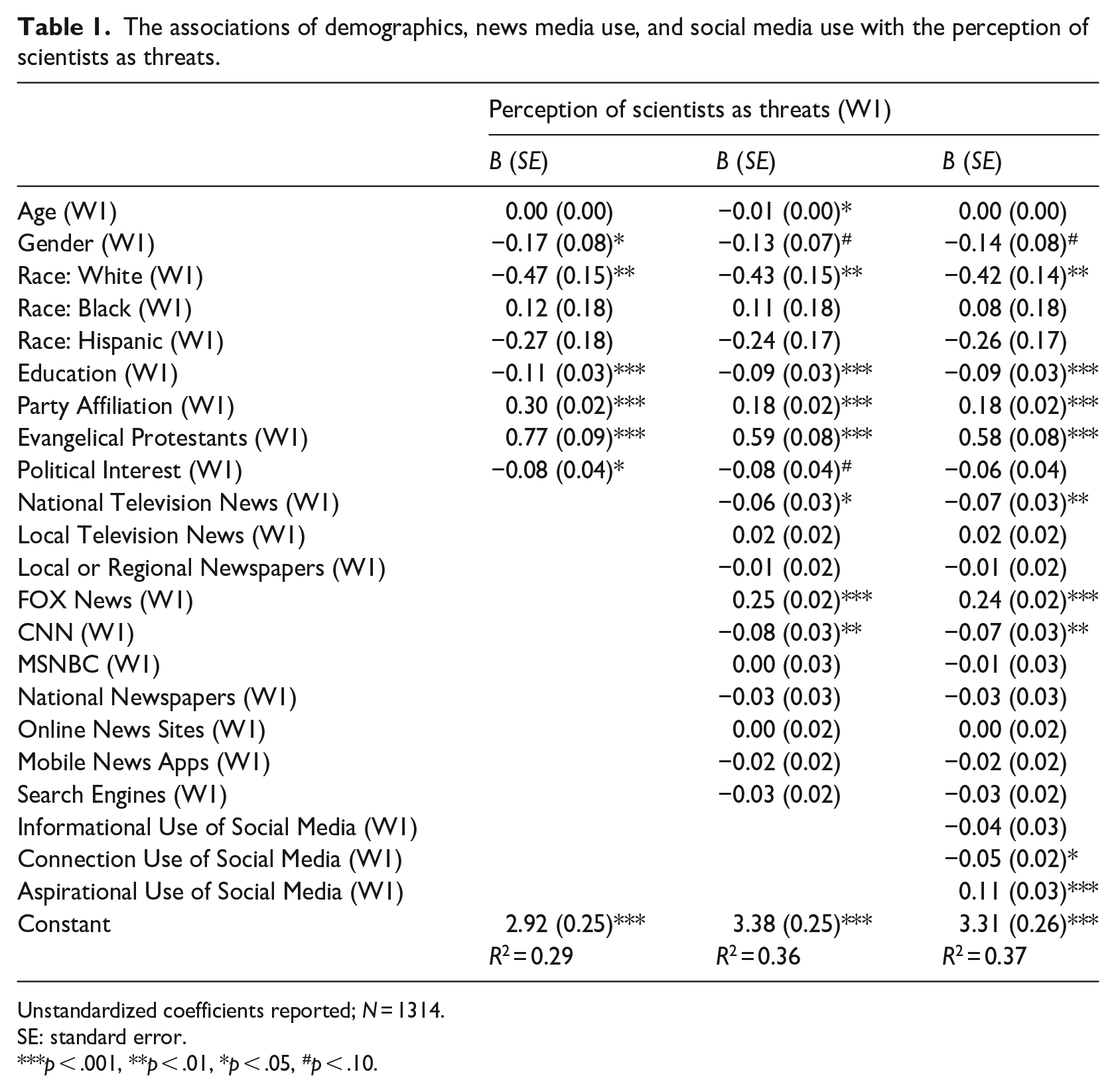
Unstandardized coefficients reported; N = 1314.
SE: standard error.
p < .001, **p < .01, *p < .05, #p < .10.
To examine how perceiving threats from scientists might associate with controversial scientific beliefs (H2), beliefs about the role scientists should play in policy-making (H3), and support for retributive actions against scientists (H4), we conducted three OLS regressions. Each model used threat perception, W1, as the main independent variable, and controlled for age, gender, race, education, party affiliation, Evangelical identity, and political interest. The first model included controversial science beliefs, W2, as the main dependent variable, while additionally controlling for prior consensus beliefs, W1. Results showed that perceiving scientists as a threat, W1, was significantly associated with holding fewer beliefs that are consistent with scientific consensus, W2, (b = –0.08 (.01), p < .001), supporting H2 (see Table 2, column 1). The second model used support for excluding scientists in policy-making, W2, as the dependent variable and supported H3; threat perception, W1, was associated with more support for excluding scientists from policy-making, W2 (b = 0.37 (.02), p < .001) (see Table 2, column 3). The third model included support for retributive actions, W2, as the main dependent variable, while additionally controlling for prior levels of support for retributive actions, W1. Results showed that threat perception, W1, was associated with increased support for retributive actions against scientists, W2 (b = 0.26 (.04), p < .001), supporting H4 (see Table 2, column 2). See Table 2 for complete results.
The association of perception of scientists as threats with consensus beliefs, support for excluding scientists from policy-making, and support for retributive actions against scientists.
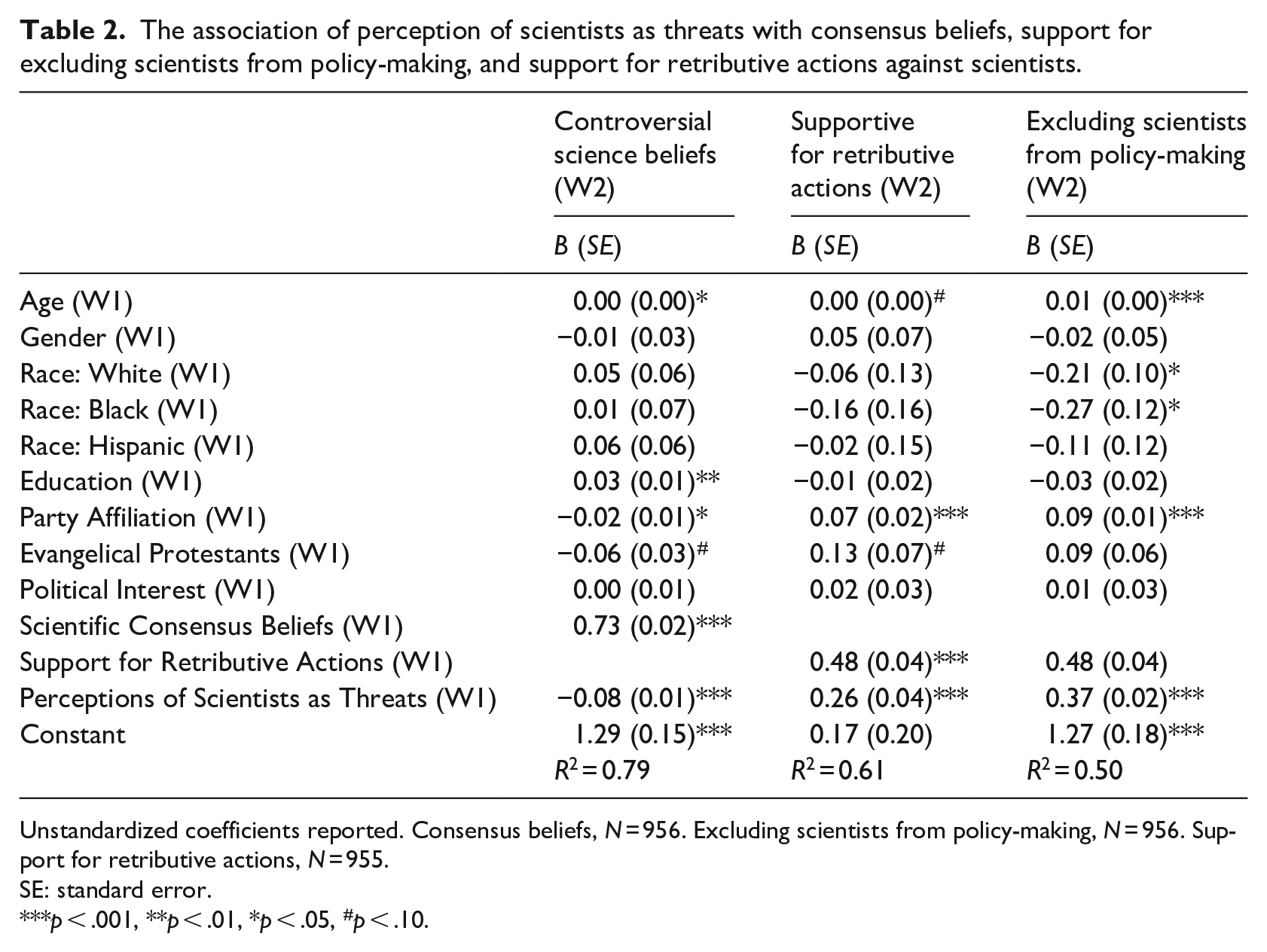
Unstandardized coefficients reported. Consensus beliefs, N = 956. Excluding scientists from policy-making, N = 956. Support for retributive actions, N = 955.
SE: standard error.
p < .001, **p < .01, *p < .05, #p < .10.
Our final hypothesis posited that perceiving scientists as a threat would be a stronger predictor of support for excluding scientists from policy-making and retributive actions compared to distrust of science (H5). To examine this, we ran similar regressions to those described above but included distrust of science, W1, as an additional independent variable. We also standardized all included variables to facilitate comparison between threat perception and distrust of science. Results showed both threat perception, W1, (B = 0.43 (.03), p < .001) and distrust of science, W1 (B = 0.21 (.03), p < .001) were both associated with more support for excluding scientists from policy-making, W2, but the standardized coefficient for threat perception was double that of distrust in science (see Table 3, column 3). However, only threat perception, W1, was associated with increased support for retributive actions against scientists, W2 (B = 0.25 (.04), p < .001), while distrust of science, W1, had no association with retributive actions, W2 (B = 0.03 (.03), p = .30; see Table 3, column 2). See Table 3 for complete results.
The standardized associations of perception of scientists as threats and distrust of science with consensus beliefs, support for excluding scientists from policy-making, and support for retributive actions against scientists.
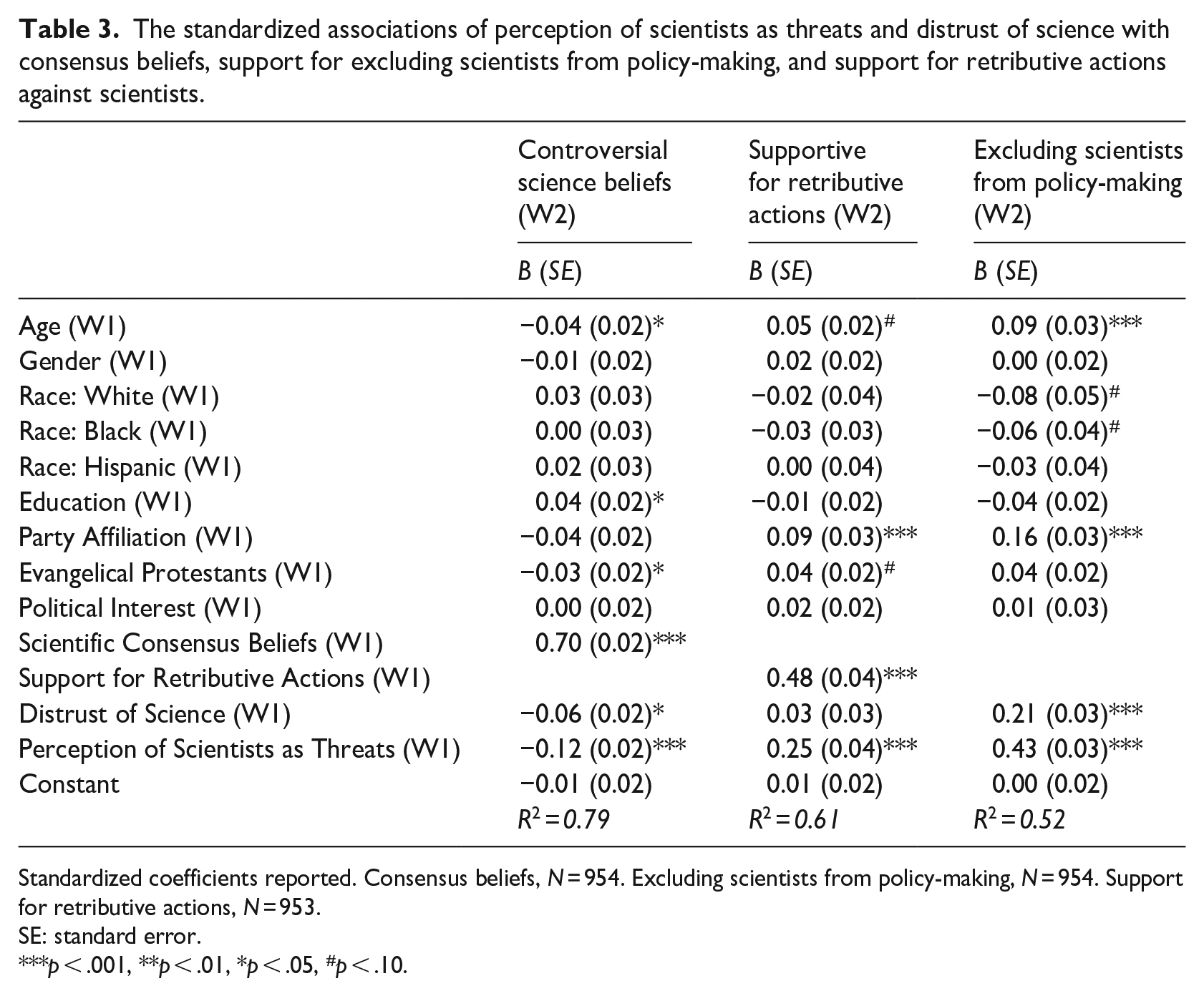
Standardized coefficients reported. Consensus beliefs, N = 954. Excluding scientists from policy-making, N = 954. Support for retributive actions, N = 953.
SE: standard error.
p < .001, **p < .01, *p < .05, #p < .10.
9. Discussion
Amid politicization of science and partisan social sorting, there are concerns that some people may come to see scientists as a social group that is either allied with or in opposition to their own (Motta, 2018b; Newman, 2020; Rothschild, 2020). A result of perceiving scientists as part of an out-group in conflict with one’s in-group is that people may feel as though scientists as a group pose threats to their well-being or worldview. These views have implications for the accuracy of people’s science beliefs, support for expert voices in policy-making, and support for retributive actions against scientists.
Our study finds that overall perceptions of threat from scientists were low in our sample, but were associated with demographic characteristics in expected ways. Republicans and Evangelical individuals were more likely to perceive scientists as a social threat. Of interest, groups perceiving social threat from scientists were markedly different from those who tend to have higher risk perceptions about science and technology. It is well documented that, in the United States, White women and non-White persons systematically perceive greater risks from science and technology than White men, a pattern attributed to social vulnerability (Finucane et al., 2000). However, we did not observe this pattern for threat perceptions. While White individuals were generally less likely to perceive scientists as threats, no minority group was specifically more likely to perceive threat and there was no significant effect for gender after controlling for media uses. Social identity processes may be driving perceptions of threat in a different way than risk perceptions are formed.
In addition, while threat perceptions and mistrust were correlated, perceived threat had a stronger association with support for excluding scientists from policy-making and was associated with support for retributive actions though mistrust was not. These findings reinforce that perceptions of threat are associated with taking actions to harm the out-group or improve the position of the in-group, above and beyond the effects of mistrust. This is consistent with arguments that problematizing distrust of science can be unproductive and polarizing (Krause et al., 2021). Distrust of science may be concerning, but messaging that demands deference to science may foster perceptions that science is aligned with a political party or social group. Such “trust fallacies” may contribute to social sorting in ways that ultimately pit scientists against social groups, inhibiting political discussion, compromise, and understanding (Mason, 2018), in addition to inhibiting scientific progress (Krause et al., 2021). Already there is evidence that politically motivated COVID-19 vaccine opposition has eroded support for other childhood vaccine mandates, which previously saw little partisan polarization (Motta, 2023). There are important reasons why groups may be wary of scientific claims and emergent technologies (Bunch, 2021), so communication efforts should avoid messaging that demonizes distrust as it could contribute to perceptions that scientists and research are aligned with a political party or other social group and are hostile to other views.
Importantly, different media uses were associated with threat perceptions in different ways. National TV news and CNN viewing were negatively associated with threat perceptions, as was using social media to connect with friends and family. However, two uses of media stood out as having positive associations with threat perceptions: Fox News viewing and aspirational social media. This is consistent with research describing differences in the treatment of experts by Fox News compared to other news outlets (Stecula and Motta, 2019). Regarding aspirational social media use, journalists have documented the ways in which social media influencers often promote “alternative” modes of thinking in lifestyle content that may conflict with expert recommendations, a dynamic most recently seen during the amplification of conspiracies surrounding the COVID-19 vaccine in wellness communities online (Hume, 2020). Future research should consider to what extent this type of content on social media cultivates negative perceptions of experts or whether those who are inclined to be threatened by expertise are more likely to consume this type of content.
Limitations
This study is among the first to explicitly investigate who in the United States is likely to see scientists as a social threat, how this perception differs from both risk perceptions and mistrust, and the potential consequences of perceiving threats from scientists using a large panel survey that is reflective of the US population. However, there are also important limitations. First, these data do not allow us to make definitive claims about causal order, particularly concerning perceptions of threat and media uses. Second, though our hypotheses about threat perceptions were derived from intergroup threat theories, we did not identify or make salient an in-group identification. We do not expect that “scientist” and “non-scientist” are social groups inherently in conflict, but that depicting science as in alignment with, or in conflict with, existing social groups may lead some to view scientists as a social out-group. Thus, a motivation of this study was to identify who perceived scientists as a social out-group in the context of politicization, partisan social sorting, and identity-based messaging about science. Finally, it is important to note that these data were collected during the COVID-19 pandemic. During this time, there was a great deal of public attention on politicized science (Hart et al., 2020). It is conceivable that these conditions influenced our survey respondents to report different attitudes toward scientists than they would when politicized science was not dominating the news. That said, aspects of science have long been politicized and are likely to remain so once pandemic conditions abate.
10. Conclusion
This study highlights the consequences of messaging that depicts scientists as a group in cooperation and competition with existing social groups and is important for understanding why certain segments of the US population have strongly supported actions to curb the political influence of experts amid widespread trust in scientists. As certain groups come to perceive scientists as a social threat to their safety, resources, and values, they may become motivated to reject evidence-based positions, restrict political access, and support punitive actions against scientists. Although such attitudes were held by a minority of our sample, these manifestations of hostility toward scientists and experts may present challenges to democratic processes and the implementation of policies based on scientific evidence. While a healthy degree of skepticism or mistrust is beneficial (Krause et al., 2021), the belief that scientists pose threats to certain social or political groups is likely to hinder scientists’ ability to conduct research and work with the public to address pressing problems. Given that dynamics surrounding politicization of science in the United States, in which people are increasingly sorting themselves into social identities that align with political parties (Mason, 2016), scientists may come to be perceived as a social group that is either in alignment or in opposition to other social groups. Future work should explore whether threat perceptions are increasing and to what extent media messages are driving these perceptions of social threat. Strategies that aid in rebuilding social relations and reducing perceptions of threat are vital to build support for evidence-based policy amid political polarization.
Supplemental Material
sj-docx-1-pus-10.1177_09636625231183115 – Supplemental material for Threatening experts: Correlates of viewing scientists as a social threat
Supplemental material, sj-docx-1-pus-10.1177_09636625231183115 for Threatening experts: Correlates of viewing scientists as a social threat by Sedona Chinn, Ariel Hasell, Jessica Roden and Brianna Zichettella in Public Understanding of Science
Footnotes
Funding
The author(s) received no financial support for the research, authorship, and/or publication of this article.

Supplemental material
Supplemental material for this article is available online.
Author biographies
References
Supplementary Material
Please find the following supplemental material available below.
For Open Access articles published under a Creative Commons License, all supplemental material carries the same license as the article it is associated with.
For non-Open Access articles published, all supplemental material carries a non-exclusive license, and permission requests for re-use of supplemental material or any part of supplemental material shall be sent directly to the copyright owner as specified in the copyright notice associated with the article.
