




Abstract
Climate scientists face many challenges when it comes to communicating their work to the public, yet it is largely unknown how junior climate scientists give meaning to their role as science communicators. Therefore, the current research conducted five focus group discussions with Dutch junior climate scientists, which were structured around the following themes: (a) common barriers; (b) climate advocacy; (c) message content; and (d) climate skepticism, misinformation, and incivility. The results reveal the motivations and barriers for junior climate scientists to do science communication. New barriers were identified relating to participants’ lack of seniority, meaning a self-attributed lack of expertise and not having established their scientific credentials yet, providing evidence for the imposter syndrome. Furthermore, many participants alluded to the information-deficit model and indicated they do not know where to start with science communication. Overall, the findings show uncertainty, which could be mitigated by media training and institutionalized incentives.
1. Introduction
The majority of the public perceives climate change as a serious problem. Even in countries with skepticism about the issue, the belief that climate change is happening and harming is at “all-time highs” (European Commission, 2021; Leiserowitz et al., 2021: 3). Yet, the world is nonetheless experiencing the dangerous impacts of climate change. The latest Working Group I contribution to the Sixth Assessment Report of the Intergovernmental Panel on Climate Change (IPCC) (2021: 10) states how “climate change is already affecting every inhabited region across the globe, with human influence contributing to many observed changes in weather and climate extremes.”
Across the globe, political and public debates are taking place about whether and how to address the adverse effects of climate change. Climate scientists are valuable communicators in these debates, as the public’s trust in scientists is strongly associated with public climate-friendly behaviors (Cologna and Siegrist, 2020). Moreover, in light of polarization dynamics in the climate change debate, climate scientists can rebuild trust and understanding across society (Corner et al., 2018). Climate scientists hold a sense of duty to participate in the climate debate (Sharman and Howarth, 2016). However, many of them have chosen to self-silence (Boykoff and Oonk, 2018), which might be unsurprising considering that these experts need to overcome a wide range of challenges.
Besides the common barriers for scientists to engage in science communication, such as a lack of time and fear of failure (Lubchenco, 2017), climate scientists face challenges pertaining to climate advocacy. They question to what extent they can get involved in climate advocacy, as many assume it might hurt their credibility (Kotcher et al., 2017). In addition, climate scientists face challenges related to the content of their message. Climate science is complex and the issue often does not resonate with people’s lifeworld, in part due to its invisible causes and often distant impacts (Corner and Clarke, 2017; Moser, 2010). Therefore, climate scientists are challenged in how to get their message across in an understandable manner that resonates with their audience. An issue that exemplifies this challenge is the kind of language and frames one uses to communicate about the uncertainties inherent to climate science (Corner et al., 2015; Ho and Budescu, 2019; Post, 2016). Finally, climate change has become a polarized issue, which is characterized by climate skepticism, misinformation, and incivility (see, for example, Anderson and Huntington, 2017; McCright and Dunlap, 2011; Sharman and Howarth, 2016; Treen et al., 2020). Climate scientists who participate in public debates about climate change are often confronted with individuals who question their integrity and legitimacy. The challenge here is how one communicates with climate skeptics, counters misinformation, and relates to incivility directed toward oneself.
In sum, while climate scientists’ role in public debates is of great importance (Cologna and Siegrist, 2020; Corner et al., 2018), climate scientists face challenges in communicating their science to the public, which can roughly be categorized into challenges pertaining to (a) common barriers; (b) climate advocacy; (c) message content; and (d) climate skepticism, misinformation, and incivility. These challenges are serious, as many climate scientists are hesitant to become science communicators. Boykoff and Oonk (2018: 37) noted that “this hesitancy effectively contributes detrimentally through inaction to impaired public understanding and engagement.”
Some research has focused on the considerations of climate scientists to engage in science communication (Boykoff and Oonk, 2018; Entradas et al., 2019; Ivanova et al., 2013; Post, 2016; Sharman and Howarth, 2016; Tøsse, 2012). Yet, less is known about the considerations of “junior” climate scientists, in the current research defined as PhDs and postdocs. Boykoff and Oonk’s (2018) study showed that young US climate scientists support the idea that climate advocacy by climate scientists with a known low carbon footprint is more persuasive and inspiring. They also showed that these young scientists are more concerned with engagement than their senior colleagues. Ivanova et al. (2013) found that German junior researchers consider potential new media interest in their scientific endeavors. Finally, Entradas et al. (2019) showed how a lack of rewards could form a potential barrier to engaging in public communication for younger climate researchers.
Yet, to date, a study that comprehensively evaluates the considerations of junior climate scientists regarding science communication is lacking. However, a part of this younger generation will pursue an academic career and pick up the baton from their more senior colleagues. Thus, learning about the opportunities and challenges for junior climate scientists regarding science communication at an early stage of their careers is important. Bankston and McDowell (2018: 1) argue that due to the potential for science communication to produce better scientists, facilitate scientific progress, and influence decision-making at multiple levels, training junior scientists in both effective and ethical science communication practices is imperative, and can benefit scientists regardless of their chosen career paths.
Since the dangerous impacts of climate change are anticipated to worsen (IPCC, 2021) and collective action is, therefore, more critical than ever, it is crucial to understand how these junior scholars want to give meaning to their role as science communicators. Therefore, the main research question of the current research is “How do junior climate scientists give meaning to their role as climate science communicators?”
2. Literature review
This section reviews literature that addresses the challenges climate scientists are facing when they engage in science communication, which is roughly categorized into challenges pertaining to (a) common barriers; (b) climate advocacy; (c) message content; and (d) climate skepticism, misinformation, and incivility.
Common barriers
Survey research has been conducted at the university and country levels to understand scientists’ motivations and barriers to public communication. These studies showed that many barriers to science communication are persistent across academic disciplines and over time (see, for example, Poliakoff and Webb, 2007; Rose et al., 2020; Willems, 2003). Lubchenco (2017) outlined seven of these barriers: (a) fear of failure, (b) lack of skills, (c) uncomfortable with popular modes of science communication, (d) fear of criticizing colleagues, (e) too little time, (f) science not valued as important in promotion and tenure decisions, and (g) fear of (aggressive) criticism by activists. Many climate scientists have voiced similar considerations to refrain from science communication in the past. For example, Sharman and Howarth’s (2016) interview study showed how for many climate scientists, science communication is “not second nature.” They also found that many climate scientists felt that universities do not value public engagement.
Climate advocacy
There has long been academic debate about scientists’ role in public policy (Kotcher et al., 2017) and how science demarcates itself from non-science to justify claims to scientific authority (Gieryn, 1983), for example, in natural resource debates (Yamamoto, 2012), human genome research (Gerhards and Schäfer, 2009), and more recently Covid-19 (Martin et al., 2020). Many academics assume that advocacy will hurt scientists’ credibility as advocacy is inherently value-driven (Kotcher et al., 2017), hence disregarding the value-free ideal of science (Douglas, 2009).
Climate scientist Schmidt (2015) discussed how the term “advocate” is regularly used pejoratively in scientific circles and is frequently associated with the cherry-picking of science to support a preconceived idea. To avoid these connotations, scientists often go to great lengths to deny being advocates for specific policies. (p. 71)
Therefore, Schmidt proposed that scientists should be open about the values and scientific views that inform their advocacy. Kotcher et al. (2017) put to the test this assumption circulating in academia that issue advocacy will compromise scientists’ credibility. Their results showed, however, that the perceived credibility of scientists advocating for specific climate policies was uniformly high (except for advocacy for building more nuclear plants). Thus, the idea that advocacy will hurt climate scientists’ credibility and that scientists should therefore avoid it is arguably unfounded.
Yet, Donner (2017: 431) discussed how “public audiences are arguably more comfortable with advocacy by scientists than scientists are with advocacy by scientists.” Consequently, many junior scientists get advice from their superiors to “stick to the science” (Donner, 2017). Indeed, previous research showed that climate scientists are reluctant about climate advocacy. For example, UK-based climate scientists are wary of not being overtly political, since they need to be impartial (Sharman and Howarth, 2016). Congruently, surveyed climate scientists in the United States had mixed feelings on whether advocacy for specific policies should be criticized (Boykoff and Oonk, 2018). Finally, of the surveyed UK environmental scientists, male researchers rated female scientists as more biased and dramatic than their female counterparts (Armstrong and Adamson, 2021).
Climate scientists’ public statements are not the only form of climate advocacy, as their behaviors matter too. Previous research showed that climate scientists’ credibility is compromised if they have alleged large carbon footprints (Attari et al., 2016). Similarly, US climate scientists support the idea that science communication is more persuasive and inspiring if their known carbon footprint is smaller (Boykoff and Oonk, 2018). While there is no consensus on a singular definition of what climate advocacy comprises (Kotcher et al., 2017), in the context of this research, climate advocacy is understood as policy-prescriptive climate communication in whatever form (i.e. public statements and behaviors).
Message content
Some scientific issues lend themselves to public communication better than others, especially ones that are less contentious. For example, issues that are experienced as psychologically distant are often more challenging to communicate (e.g. Covid-19) (Blauza et al., 2021; Skotnes et al., 2021). The latter also proves true for climate change, a phenomenon that is inherently characterized by its invisible causes, often distant impacts, and complexity. Communication scholars have been grappling with the question of how climate change could be most effectively communicated for quite some time, by focusing on various elements of the communication process (Moser, 2010). Previous research focused on what kind of messages are most effective to persuade the audience. By incorporating psychological, political, and cultural insights, communication scholars tend to agree that there is no “one-size-fits-all approach” to effective climate change communication (Moser, 2010; Pearce et al., 2019). Boykoff and Oonk’s (2018) study showed how some climate scientists also believe that effective public engagement requires thinking about target audiences and communication goals. Yet, this notion makes communicating about the phenomenon by definition more challenging, as climate scientists need to think about how they want to craft their message.
How one communicates about the uncertainties inherent in climate science is a communication challenge that has received considerable attention over the years. One can communicate about the uncertainties too precisely, or on the other hand, too vaguely. Moreover, diverse audiences interpret uncertainties in different ways, leading to misrepresentation of climate science (Ho and Budescu, 2019; Painter, 2013). Climate scientists also anticipate the effect of news values, and this can lead to self-censoring (Sharman & Howarth, 2016) found that climate scientists fear that the media misrepresents or exaggerates their statements. Post (2016) found that German climate scientists believe that uncertainties should be clearly communicated, but when they are highly involved with the media, they are less inclined to highlight uncertainties.
Previous research suggested shifting from the language of uncertainties to the language of risk (Corner et al., 2015; Painter, 2013). Others have suggested that communicating the scientific consensus on climate change could be an important gateway to increasing climate change belief (The Consensus Project, n.d.; Van der Linden et al., 2015). However, a new direction that moves away from the public understanding of science model (or information-deficit model) is offered by Pearce et al. (2015): to focus not only on consensus but to seek to celebrate the disagreements which necessarily flow from such a complex multilevel issue as climate change. Such an overtly political approach to climate change communication accepts both that hard-to-overcome cultural barriers exist in talking about many aspects of climate change (including climate science), and that dialogue that is inclusive of human values provides greater promise than top-down efforts at science education. (p. 619)
Climate skepticism, misinformation, and incivility
Multiple instances are documented where debates about contentious issues have engendered harassment of scientists, for example, about topics such as vaccination, Covid-19, and gun control (Nogrady, 2021). Climate scientists also reported they have been bitterly attacked, for example, with death threats (Milman, 2017). Interview studies showed how climate scientists shared that they feel negatively labeled in the debate (Sharman and Howarth, 2016) and that climate skeptics are “a source of pressure and a cause of anxiety” (Head and Harada, 2017: 37). When it comes to communicating about uncertainties to climate skeptics, it is according to Nerlich (2015) a “lose-lose situation.” When climate scientists say they are certain, climate skeptics will accuse them of “religious dogmatism” or fraud, whereas if climate scientists are open about the uncertainties, they will be accused of unsound science. Climate skeptics have, for example, a strong presence in the climate change blogosphere, spreading misinformation online, which climate scientists in turn ought to counter (Harvey et al., 2018; Treen et al., 2020). Overall, climate scientists need to navigate a polarized issue debate that is characterized by climate skepticism, misinformation, and incivility.
3. Methodology
The current research conducted five focus group discussions and employed a thematic analysis, to identify, analyze, and report patterns (themes) within the data (Braun and Clarke, 2006). To understand how junior climate scientists give meaning to their role as climate science communicators, of main interest were the communication challenges that were identified in the literature review. These challenges informed both the data collection and data analysis procedures. The research was approved by the Ethics Review Board of the Faculty of Social and Behavioral Sciences of the University of Amsterdam.
Data collection
In October 2021, five focus groups were held with 25 PhDs and postdocs who are all affiliated with the Netherlands Earth System Science Centre (NESSC). NESSC is a Dutch virtual research center consisting of scientists with a background in physics, earth sciences, ecology, and mathematics (NESSC, 2022). Their goal is “to better understand the processes behind climate change and to improve future climate projections and predictions.” The participants were approached via an email from an NESSC professor with the question of whether they wanted to participate in a focus group with the author of the current research to gain input for a workshop they would later participate in. All focus groups were conducted face-to-face and facilitated by the author of the current research. The facilitator did not know the participants before the focus groups, except one participant with whom they collaborated for a seminar. During one focus group discussion, the facilitator joined the focus group via Microsoft Teams, while all the participants were together in the same room. The focus groups lasted approximately 1.5 hours and were recorded with the permission of the participants.
A topic guide was developed based on the literature, which consisted of the following themes: (a) barriers and motivations to engage in science communication; (b) climate advocacy; (c) message content; (d) misinformation, skepticism, and incivility. The guide was carefully constructed, considering the wording, length, and order of questions to reduce social desirability and other participant biases (see Supplemental Materials) (Bispo Júnior, 2022). In addition, the guide was validated by the NESSC professor, who confirmed the themes and questions were relevant science communication challenges in their field. Informed consent was obtained before conducting the research.
The focus group discussions started with an explanation of the ground rules. Subsequently, participants were invited to introduce themselves and their experiences with science communication. After that, the question “what are your general feelings about science communication” was posed. Subsequently, a conversation between the participants emerged organically. Every once in a while, the facilitator introduced questions to ensure that in the end, all the topics of the topic guide were covered. The input from the focus groups was used to design a workshop tailored to the needs of the participants. Therefore, the focus groups ended with questions about which topics the participants felt that they had not yet covered, what they would like to learn about science communication, and what they would like to practice in the workshop.
Data analysis
Braun and Clarke’s (2006) six phases of thematic analysis were followed to analyze the focus group data. In the first phase, the collected recordings were verbatim transcribed and the transcripts were read and reread to immerse the researcher in the data. This immersion was also facilitated by noting down initial ideas for coding when reviewing the transcripts. In the next phase, each part of the transcripts was systematically coded line-by-line in ATLAS.ti (version 22). Important to note is that the coding was theory-driven, focusing on the communication challenges identified in the literature review. Hence, codes were flagged with a number if they pertained to one of the four challenges.
In the third phase, 11 themes were identified across all codes, for which code groups were created. Examples of themes were “experience with science communication,” “barriers to science communication,” and “climate advocacy.” In the subsequent phase, these themes were refined into eight themes about participants’ backgrounds, their experiences with science communication, their skills, motivations, and the four communication challenges. In this process, the theme “responsibility” became part of the theme “motivations.” In addition, the themes “other challenges” and “workshop” were removed as there was not enough data to support this theme or the data did not answer the main research question.
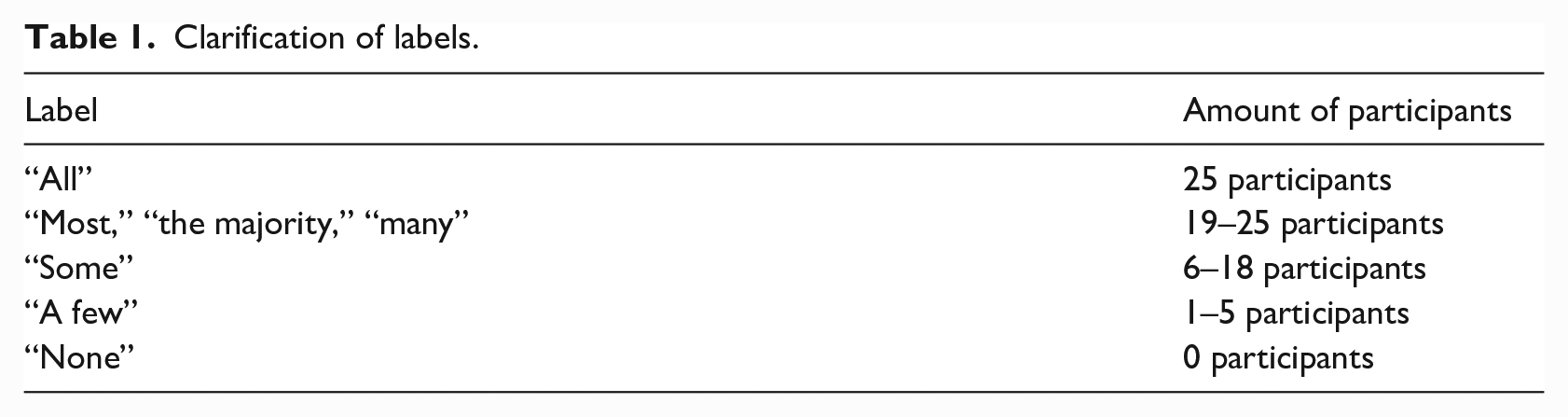
In phase 5, the theme names were finalized and a detailed interpretative analysis of the codes was conducted for each theme (see Supplemental Materials). In the last phase, the analysis was reported in the following Results section, structured according to the eight themes. Table 1 clarifies the labels that were used to indicate how many participants supported particular statements (Van Eck, Mulder and Dewulf, 2019).
Clarification of labels.
4. Results
Overall, the majority of participants discussed how they have no or limited experience with science communication. A few of them have some experience in either giving talks (e.g. in education), writing a piece, doing interviews, and communicating via social media (Twitter, Facebook, and Instagram). Yet, nearly everyone talks about their work with friends and family. Frequently, these conversations head in two directions. The participants either get asked whether climate change is as bad as everyone says, or they need to defend the science in debates with climate skeptical family members. One participant discussed, Obviously there’s a lot of personal communication going on with friends, family, and strangers you meet at a bar. The moment someone asks “What do you do?,” you say you basically reconstruct the climate. Then it either goes two ways: either they’re very excited about it or they’re the opposite way, then you have to explain. Then you have to listen to them, talk about why my view is wrong, even though you’re there like, “Okay, fair. I studied this for the past seven years, but I’m pretty sure I’m wrong. Sure, convince me of my wrongness.”
The majority agreed on two motivations to engage in science communication. First, participants want to do science communication, because it is fun to share interesting insights about their research and their passion for the job. One participant discussed, “Sharing climate research with others is fascinating. Many aspects of it are really cool. Many people do not know about these things, which makes it a lot of fun.” Second, the participants find it important to inform the public about their research. A few discussed how they are not so much interested in appearing in mainstream media but are excited to share research in educational settings. Finally, a few participants explained that they want to do science communication to either get acknowledgment for their work, restore trust in science, or warn the public about the dangerous impacts of climate change.
Most of the participants believe that science communication is a responsibility of scientists. One participant explained, I think there should be more effort from scientists, us, people who are in senior positions in science to actually try to speak with others (. . .), because it’s also on our part. We can sit here all day complaining about how they don’t understand us, and journalists do this and that. That’s all true. I’m not saying it’s not. It’s just we also need to try something.
However, while a few firmly argued that it is everyone’s responsibility to communicate their science, about half of the participants also shared that they do not believe it is everyone’s individual responsibility. Some of these junior scientists argued that it only becomes their responsibility once they are more senior. One participant discussed, Especially during your Ph.D., it’s less part of your responsibility. I feel it’s a pretty short time. Most of us are insecure about what we know. So, I feel that it’s also part of my responsibility to use these years to become a better scientist, a real scientist, and to first be a bit more selfish or focused on my research and get that knowledge.
Besides the more senior climate scientists, the university’s communication department and journalists are held responsible. Somewhat contradictory, two participants discussed how the general public has a responsibility to educate and warn themselves about climate change: You feel like you have to dive in something else that’s not related to your [PhD] topic, just because you are in the perfect surrounding to know because this knowledge is more accessible to us. But it feels like, I can also just look on the internet. So, these people I want to warn can then just do it themselves. They also have this responsibility. (. . .) It’s really frustrating.
Common barriers
While the participants discussed their motivations to do science communication, they also identified a variety of barriers that withhold them from public engagement activities. Many said that science communication takes too much time and effort, and it is not one of their priorities. A few shared that the universities do not provide any incentives to communicate their work. Some participants discussed that they do not know where to start. For example, they wonder when their research would be interesting enough to communicate, why would it be relevant to communicate, and which platforms are out there.
A few discussed that they simply do not enjoy science communication. One participant explained, I do not feel comfortable [to do science communication]. I often do not find myself an expert. I also often think that it is not fun. I do this Ph.D. because I like to work with models and data and not because these climate models are close to my heart. Thus, I do not feel motivated.
Many other participants also shared that they do not feel comfortable and have a fear of failure. The following conversation arose between three participants:
If you do not know your numbers by heart, I am afraid to fail. It does not feel professional.
I understand what you mean. But I think it is perfectly fine, even though it is frustrating, to say that you do not know. (. . .) I believe it is to your credit if you do that. But it’s not easy.
It just does not feel right.
You mean it is not a nice feeling or a sense of failure?
It just does not feel good.
Congruently, many participants do not feel that they are an expert (yet). One participant discussed: “I think that’s a very specific scientist problem, that we constantly think, ‘Well, we need a bit more knowledge. We need a bit more . . .’ (. . .) I think what is holding us back, is our knowledge.”
Climate advocacy
The participants were mixed about whether scientists could do climate advocacy. On one hand, the majority of participants argued that it is very important that scientists remain objective and therefore should refrain from climate advocacy in their role as a scientist. Scientists may not advocate for certain climate policies and be moralistic. One participant argued, “I believe it is important to keep it separate [science and personal opinion]. My role is delivering objective information, that’s my job as a scientist.” Another participant said, “We’re all: ‘Obviously this needs to happen’. But it’s not like we can do anything about it because we’re the wrong people for this.” Another participant said, The moment climate scientists under each other start talking politics and what should be done, it’s a lot of fun. There’s a lot of ideas, but none of us would ever dare to go outside of that specific group with those ideas and be like, “Hey, do something about it.”
These participants are mostly concerned that climate advocacy could hurt their credibility. They hear negative stories from, for example, colleagues about other climate scientists who do climate advocacy. A few voiced how climate advocacy might potentially jeopardize their future career. One participant said, “I do not want my credibility to be affected before I have built my career and put myself out there too soon.” Hence, before possibly engaging in climate advocacy, they want to build a strong reputation.
Moreover, these participants who highly value their objectivity use phrases distinguishing between being a scientist and being themselves. One participant said, “I have my opinion and my results are actually evidence for that. But when you communicate, you are not just yourself, you are the researcher.” Another participant explained, “Sometimes I feel like I have two caps; I have my citizen cap and the scientist one.” However, these participants also discussed how they struggle with where they draw the line between these different roles in different circumstances. One participant argued, When you are communicating your science, how do you separate yourself as a researcher and you as a private person? Sometimes it is easier to just put your research out there for someone else to communicate it, and then you kind of hide behind the lines.
On the other hand, there were a few participants who argued that it is impossible to separate the two. They discussed how scientists are also humans with values. One participant explained, My values are a driving force for me to choose this scientific career. I believe I can separate when I speak as an expert and when not. However, I feel like I cannot take it apart when I’m <name participant> and when I am a scientist. Even at night, I am a scientist.
Another participant argued, I tend to think that for me, there is not a line at all. We are all part of this society. So why can’t we influence and go if you know something? Why does there need to be this line? (. . .) For me, when in science they say “No, we cannot be part of this because we are neutral,” it’s like you are claiming that you are above. I don’t think we are above at all. I think we are part of it.
This mixed sentiment about climate advocacy, in general, was also reflected in how the participants feel about participating in climate activism on the streets. Some participants do not participate in climate protests, because they are afraid it hurts their credibility. While others believe it is possible to join protests, they also argued it must be done on a personal title, whereas a few also argued that it is powerful if someone is there as a scientist. The same reasoning was provided to the question of whether the participants feel that they can openly support specific climate policies and political parties. Finally, the majority believe that they can and may show their emotions and live an non-sustainable lifestyle.
Message content
According to the participants, an effective science communicator is someone who has charisma, is passionate, has a deep understanding of the research, and is often extroverted. In addition, an effective science communicator can use easy language to explain complex issues (i.e. avoid jargon and use metaphors), understand the audience, and recognize the relevance of the work.
Most participants find it difficult to translate complex science into laymen’s terms. One participant discussed, I struggle with exactly how much into details do I go? How much do I leave out? Where is the line between, “Oh, now I left out too much,” to the point where it’s no longer scientifically correct what I’m saying.
Some discussed how this alleged simplicity of science communication is a barrier for them to do public engagement.
The majority of participants discussed how they are becoming a specialist in their Ph.D or postdoc topic and not the broader field of climate change. The following conversation arose between two participants:
You need to really understand the problem you’re talking about. If you want to explain it in clear language, then it takes more than just knowing what the problem is. You need to really master the problems. And I don’t think that’s always the case.
But that’s also the problem, right?
Yeah.
You think that’s not the case, I’ll not go. But we’re probably better at it than other people.
Yeah.
Similarly, another participant shared the following: (. . .) scientists doing super precise things, and then being asked to talk about climate change. I think it’s something we all experience, right? We all are doing a postdoc, we’re doing a Ph.D. (. . .) Sometimes it’s not our expertise to talk about warming or acidification or very broad things. But I think we may be way better placed than others to talk about these things. It’s okay when journalists ask us to answer questions that are not directly related to our field because they think that we learn about these topics in our Ph.D. or our studies (. . .). Every day when you read papers, you learn new information about climate change, about concepts in general. And because we are taught to always look for more information and to never just be happy with what we have, always go a bit further. I think it’s our role to at some point to be courageous enough to talk about things we don’t really know and just accept that from what we know, we can’t take the risk of talking about something slightly bigger. Because if we don’t do that, then you have plenty of people online who are just experts in anything. They have no credentials and they can tell you everything about that climate change is not happening, or the oceans are not acidifying.
The fact that they are often asked to speak about climate change in general leads to both frustration and insecurity. Also, not all participants identify themselves as climate scientists, while others do regard them as such.
Next to the fear that the participants are being asked to say something that is not related to their specific research, many are also concerned that their statements are being misrepresented in the media. One participant explained: “Every time I share something, I’m very careful about what I share (. . .) because I know the backlash you could get and what tedious conversation you’re going to have with certain people.” The majority finds it therefore really important to communicate about the uncertainties in an open, honest, and transparent manner. One participant commented, When I saw people linking the floods and other individual events to climate change, I was thinking by myself; “Is this the honest story? Are we certain that this is happening because of climate change?” You cannot communicate that, that is not honest.
However, most of the participants have no specific strategy for communicating about the uncertainties, except for some. A few mentioned how the language of “projections, scenarios, and expectations” is useful. One other participant suggested always communicating the numbers of the lower bound. Finally and contrastingly, one participant discussed how one should not be afraid to be bold in expressing certainty.
Overall, in their discussions, many participants alluded to the information-deficit model, assuming that the general public needs more or better information about climate change. Multiple participants discussed how making their research available to the general public is sufficient (e.g. open access publishing). For example, one participant discussed, “It’s good to be informative and bombard a lot of information.” However, there were also a few participants who alluded to the dialogical model of science communication, for example: “I would like to see that it’s not two groups, the scientists and the public, but one group. So, that we don’t think, ‘oh, we’re the scientists, and you’re the public’. (. . .) to realize we are not different people.”
Climate skepticism, misinformation, and incivility
Very few have been in a professional situation where their work was challenged by a climate skeptic, but many have had such discussions with either a skeptical family member or friend. Some discussed how they are reluctant to do science communication because climate change is such a controversial topic. A few discussed how they try to avoid climate skeptics, for example, because they get overwhelmed with emotions in discussions with skeptics.
The strategies for communicating with climate skeptics differ per participant. Most discussed how they would want to teach skeptics to think critically and spot false logic. A few discussed that it is important not to let emotions take over. Instead, it is important to calmly, humanly, and genuinely respond to the skeptic’s concern. One participant discussed, “If you are a climate sceptic, it is either because you are misinformed, you support other facts, and you have different values. I do not think you should write people off right away.” However, some also discussed how it is a waste of time to communicate with climate skeptics and that it is better to ignore them. Another participant explained, I have a very extreme standpoint. I believe that when people believe that climate change is not happening, there’s no need to do anything about this. Then I think let’s ignore them, let’s not waste any more time on trying to make them understand, trying to convince them, trying to talk to them.
Yet, a few also mentioned that ignoring skeptics is dangerous, as they discussed how these people can become more extreme in their convictions.
The majority of participants have had no experiences with incivility directed toward them. Although, they also discuss that extreme incivility would be a barrier to public engagement. Whereas a few avoid social media because of incivility, others contrastingly discuss how incivility motivates them to communicate their work.
5. Discussion
For many reasons, climate scientists are valuable communicators in the climate change debate (Cologna and Siegrist, 2020; Corner et al., 2018). Yet, climate scientists face communication challenges pertaining to (a) common barriers, for example, a lack of time or fear of failure; (b) climate advocacy; (c) message content; and (d) climate skepticism, misinformation, and incivility. Based on focus group discussions, the current study comprehensively evaluated how junior climate scientists give meaning to their role as a science communicator. This discussion highlights findings that add to academic scholarship on science communication by climate scientists (Boykoff and Oonk, 2018; Entradas et al., 2019; Ivanova et al., 2013; Post, 2016; Sharman and Howarth, 2016; Tøsse, 2012), as these findings are distinctive for junior climate scientists.
The interviews revealed how these scientists’ self-attributed lack of expertise forms a barrier to science communication. First, they want to become “better” and more senior scientists. Most likely, young academics will indeed get a better overview of their field over time. However, the risk is that they miss practice in science communication to develop skills and confidence (Hoffman, 2016). Moreover, arguably junior climate scientists have more knowledge about their field than they judge. This newly identified barrier contributes to earlier studies about climate scientists’ motivations and barriers to doing public communication (Boykoff and Oonk, 2018; Lubchenco, 2017; Sharman and Howarth, 2016) and provides empirical evidence for Bothello and Roulet’s (2019) essay on how “the imposter syndrome” is a growing problem among junior researchers.
Extreme forms of the imposter syndrome involve one’s fear of losing all of their credibility at once (Bothello and Roulet, 2019). The current research showed how many junior climate scientists are especially fearful of losing their credibility if they do climate advocacy on an “academic title,” as it compromises their academic objectivity. First, they want to solidify their academic reputation and future career. This finding contradicts the findings of Boykoff and Oonk (2018) and Hoffman (2016) who found that young scholars seek more impact from their work than their senior colleagues. This discrepancy might be explained by differing academic cultures across countries, but the role of academic culture in scientists’ considerations about climate advocacy is an area that needs more research. Also, more research is needed on (junior) climate scientists’ role in climate advocacy, as the evidence is still quite limited (Cologna et al., 2021; Kotcher et al., 2017). For example, the current research raised the question of whether senior climate scientists have more latitude to do climate advocacy than junior climate scientists. Finally, future research could address how climate scientists construct identities of “academics” and “self” in climate advocacy, as the current research showed how these scientists struggle with their profession’s boundary-arrangements regarding climate advocacy (Gieryn, 1983).
In line with previous research that investigated the reflections of climate scientists to engage in science communication (Sharman and Howarth, 2016), the findings indicated that many junior climate scientists hold a sense of responsibility to communicate their science to the public. Yet, the current research also revealed that many of them do not know where to start and how to communicate their work. While this finding could be attributed to the fact that the participants are juniors in general, it is nevertheless a finding that warrants attention. Beyond the notion that a part of this younger generation will pursue an academic career and pick up the baton from their more senior colleagues, junior climate scientists can already be valuable communicators in the early stages of their careers. Therefore, it is recommended to provide junior scientists with training on how to effectively communicate their work to other audiences (Bankston and McDowell, 2018). More specifically, the current research showed that such training could focus on introducing the possible formats of science communication, learning how to communicate the complexity of their work to different audiences, and practicing how to deal with climate skeptics. Finally, the results suggest that universities need to provide incentives for those junior climate scientists with less “altruistic” goals to practice science communication, for example, by increasing recognition and institutional support (Rose et al., 2020).
Finally, junior climate scientists who participated in the current research alluded to the information-deficit model. Yet, the discourse among social scientists is that this model of science communication is outdated and insufficient (McDivitt, 2016). Therefore, this finding calls attention to the need for extra efforts from communication scientists to close, what Moser (2016) has called, “the communication science-practice gap,” a view that is not often mentioned in the science communication discipline. Thus, rather than expecting climate scientists to do excellent public engagement (Yuan et al., 2019), the expectation could also be directed toward communication scientists to share their work with practitioners, in this case, climate scientists. Ironically, communication scientists could potentially face the same communication challenges that were identified in the literature review of the current research (Moser, 2016). In any event, the current research attempted to bridge the communication science–practice gap through its research design. Participants reported that they found the focus group discussions insightful, and the data were used to design a workshop tailored to their needs afterward.
Overall, the current research provided insight into reflections of junior climate scientists to engage in science communication. Yet, when interpreting these findings, one should bear in mind the limitations. For example, the research was conducted with PhDs and postdocs of Dutch universities. Future research should therefore investigate to what extent the findings are transferable from the Dutch academic context to other national contexts. Moreover, the author of the current research is also in the first stages of her career, which might have influenced the analysis of results in unpredictable ways. Although, the data collection and analysis were mainly theory-driven, which limits how a potential lack of seniority in science communication affects the results. Presumably, the participants might have felt safer sharing their views as there was not a big difference in the level of seniority, reducing social desirability bias (Bispo Júnior, 2022). In addition, it would be interesting to investigate to what extent these results are transferable to other scientific fields where the topic has become politicized, such as Covid-19.
Finally, this article concludes with a quote from environmental scientist Lubchenco (2017: 108): As a senior scientist, I don’t believe that my students should follow the path that I took: establish your scientific credentials first and then begin to be more public. Those choices were informed and framed at different times. Engaging with society was not even on the radar screen of most academics when I began my career. Only as the environment began to change radically and neither the public nor policymakers were paying much attention did I begin to engage. When I did so, I felt I had to break away from academic conventions. Doing so was difficult, but it was the right thing to do. The world continues to change and to need scientists and scholars to help chart the future. I continue to feel compelled to both engage actively with society—on the public and on the policy fronts –and to create pathways for others to do so. I feel strongly about the need for my generation to also champion the right of younger academics to chart their own path along the continuum of engagement, and to do so with their seniors’ full support.
Supplemental Material
sj-docx-1-pus-10.1177_09636625231176382 – Supplemental material for The next generation of climate scientists as science communicators
Supplemental material, sj-docx-1-pus-10.1177_09636625231176382 for The next generation of climate scientists as science communicators by Christel W. van Eck in Public Understanding of Science
Footnotes
Acknowledgements
I thank all the researchers who participated in the current research for their invaluable contributions.
Funding
The author(s) disclosed receipt of the following financial support for the research, authorship, and/or publication of this article: This work was supported by the Amsterdam School of Communication Research.

Supplemental material
Supplemental material for this article is available online.
Author biography
References
Supplementary Material
Please find the following supplemental material available below.
For Open Access articles published under a Creative Commons License, all supplemental material carries the same license as the article it is associated with.
For non-Open Access articles published, all supplemental material carries a non-exclusive license, and permission requests for re-use of supplemental material or any part of supplemental material shall be sent directly to the copyright owner as specified in the copyright notice associated with the article.
