



Abstract
Science-related crowdfunding enables public engagement with science. However, we know little about citizens engaging with science this way: Who are the people engaging with and donating to science through crowdfunding – and how do they decide how much to give? This study analyses behavioural and survey data from the Swiss crowdfunding platform wemakeit (N = 576). Results illustrate that a small, non-representative segment of the public engages with science through crowdfunding. Compared to the general public in Switzerland, these backers have an above-average education and income. Science-related crowdfunding mainly reaches citizens with an existing interest in science, personal ties to project initiators or the scientific community. The size of backers’ donations correlates with perceived personal appeals in campaigns or connections to initiators rather than projects’ scientific merit. While science-related crowdfunding thus opens up new avenues for public outreach by the scientific community, its potential for broader public engagement with science seems limited.
1. Introduction
The rise of digital media (Brossard, 2013) has changed perceptions of, and processes within, science. It also brought about new opportunities for public engagement: Researchers can use social media to engage with non-experts (Besley et al., 2020). Citizens, in turn, rely on Reddit to ask scientists questions (Edwards and Ziegler, 2022), participate in research as citizen scientists (Füchslin et al., 2019) or fund science via crowdfunding (Vachelard et al., 2016).
Crowdfunding describes ‘fundraising, typically via the Internet, whereby groups of people pool money, usually (very) small individual contributions, to support a particular goal’ (Ahlers et al., 2015: 955). It brings together two groups: ‘initiators’, that is, individuals or teams aiming to raise money through campaigns, and ‘backers’, that is, individuals supporting projects through donations. For science, reward- or donation-based crowdfunding is typical (Schäfer et al., 2018b). Here, backers donate money in exchange for a reward or without receiving any return (Belleflamme et al., 2015). Discussions about including citizens in funding decisions as a form of public engagement are not new (Calyx, 2022; Rowe et al., 2010). With the rise of crowdfunding platforms, however, they have remerged both in science (Vachelard et al., 2016) and politics (European Commission et al., 2017).
Despite different connotations connected to the term public engagement (Rowe and Frewer, 2005), scholars argue that it encompasses both scientists’ engagement with the public and citizens’ engagement with science (Weingart et al., 2021). As such, it includes different conceptualizations of the public (Stilgoe et al., 2014) – from citizens receiving communication about science in a more passive manner to their active participation in decision-making (Rowe and Frewer, 2005). As a form of public engagement, crowdfunding can be of interest for scientists and citizens: Researchers may rely on crowdfunding to make their research visible, interact with the public, and increase the transparency of the scientific process (Hui and Gerber, 2015; Vachelard et al., 2016) as key aspects of public engagement (Weingart et al., 2021). Citizens, in turn, may learn about science and interact with scientists by asking for research material (Hui and Gerber, 2015) or meeting scientists as a reward for donations (Vachelard et al., 2016). Crowdfunding may also enable citizen science – the involvement of non-scientists in research as another form of public engagement (Füchslin et al., 2019) – by funding it (Mehlenbacher, 2017). As one of the strongest forms of engagement involving citizens’ financial resources (Schäfer et al., 2018b), crowdfunding includes the public in deciding upon scientific funding.
Existing studies on science-related crowdfunding mostly focus on how the scientific community kindles public engagement, for instance, which scientists initiate campaigns or which projects get funded (Davidson and Tsfati, 2019; Sauermann et al., 2019; Schäfer et al., 2018b). In contrast, as Davidson and Tsfati (2019) criticize, we know little about which citizens are willing to engage with science through crowdfunding and why.
This study takes an initial step to address this gap in research. We analyse backers of science-related crowdfunding projects, in particular, their sociodemographic/personal characteristics and their relationship to/perception of projects as antecedents of funding motivations and, by extension, funding decisions. Taking an exploratory approach, we focus on wemakeit as the biggest general-interest crowdfunding platform in Switzerland and one of the largest platforms in Europe. The study combines a survey of N = 576 backers and platform data on backers’ donation behaviour to answer two questions: Who are the people willing to engage with science through crowdfunding? And are their sociodemographic/personal characteristics and their relationship to/perception of projects associated with the size of their donations to science?
Our study advances research in three ways: From a theoretical perspective, we deliver a contribution to discussions about the nature and sources of public engagement with science, here related to crowdfunding. From an empirical perspective, this study is the first to deliver primary data on individuals engaging with science through crowdfunding. From a policy perspective, our findings inform efforts to foster public support for science, including how scientists may engage broader segments of the public by increasing identification with the scientific community.
2. Reviewing prior scholarship on science-related crowdfunding
To better understand science-related crowdfunding and its potential for public engagement, we focus on its five key elements (Shneor and Vik, 2020): platforms, projects, initiators, campaigns, and backers.
Platforms
Platforms are digital infrastructures used to host crowdfunding projects. For science-related crowdfunding, these include general-interest platforms by commercial enterprises (e.g. Kickstarter.com) as well as science-specific platforms by universities (e.g. Spark.ucla.edu) or commercial enterprises (e.g. Experiment.com) (Sauermann et al., 2019; Schäfer et al., 2018b). Existing research indicates that projects on science-related platforms enjoy more funding success than those on general-interest platforms (Schäfer et al., 2018b). However, other social media platforms like Twitter and Facebook also play a role since initiators use them to promote projects to broader audiences (Cai et al., 2021; Shneor and Vik, 2020).
Projects
Projects are the specific endeavours scientists aim to fund. While an early study by Schäfer et al. (2018b) identified around 370 science-related projects across 11 platforms until mid-2014, more recent numbers indicate the launch of more than thousand projects until 2022 (Experiment.com, 2022). While crowdfunding projects are affiliated with a variety of disciplines, many stem from fields such as medicine or biology. However, there is no consistent evidence that citizens prefer to fund projects from specific disciplines (Schäfer et al., 2018b, but see Davidson and Tsfati, 2019). Projects mostly aim to fund data acquisition, research material or travelling – not, as common in traditional grant proposals, salaries (Davidson and Tsfati, 2019; Sauermann et al., 2019; Schäfer et al., 2018b). Citizens engaging in crowdfunding therefore encounter science across different disciplines and types of projects.
Initiators
Initiators are the individuals or teams setting up projects. Most projects are initiated by individuals affiliated with universities (Davidson and Tsfati, 2019). Projects initiators are predominantly male; many of them are young scholars, for instance, PhD students (Sauermann et al., 2019; Schäfer et al., 2018b). Their motives for engaging in crowdfunding include gathering funds in a less bureaucratic way as well as bringing democracy to funding decisions (Hui and Gerber, 2015). Since female or younger scholars enjoy more crowdfunding success, Sauermann et al. (2019) argue that crowdfunding enables ‘access to resources for groups that have been excluded or disadvantaged in traditional funding systems’ (p. 20). Viewing crowdfunding as an avenue for citizens’ engagement with science, this could include citizen science. Via crowdfunding platforms, citizens may help to conceptualize research designs or initiate research projects on their own. However, existing research indicates that citizens are seldom included in initializing projects, seeing that most crowdfunding projects are set up by university-affiliated researchers (Davidson and Tsfati, 2019; Sauermann et al., 2019). Overall, citizens’ engagement with science through crowdfunding is thus limited to financing science, not conceptualizing and conducting it.
Campaigns
Initiators host campaigns informing about their crowdfunding projects to convince the crowd of their project’s value. Campaigns include information on targeted funds, how these will be used, and who project initiators are. Here, the size of targeted funding represents the biggest difference to traditional grant proposals: Most crowdfunding campaigns collect less than US$6000 (Davidson and Tsfati, 2019; Sauermann et al., 2019; Schäfer et al., 2018b) – a considerable difference to, for instance, National Science Foundation (NSF, 2021a) grants averaging more than US$200,000. Correspondingly, crowdfunding only makes up for a fraction of scientific funding. For instance, the largest science-specific crowdfunding platform in the United States, Experiment.com, secured 10 Mio. USD until 2022 – compared to an annual budget of more than US$650 billion for research and development in the United States. As such, especially businesses and the federal government provide far more financial support for science (NSF, 2021b). Another difference is that crowdfunding campaigns need to appeal to the public, not the scientific community. They therefore rely less on scientific jargon and more on engaging features like multimedia content, personal information on initiators or interesting rewards (Sauermann et al., 2019; Schäfer et al., 2018b). Studies conducting content analyses of successful projects conclude that backers are convinced by these engaging features rather than projects’ scientific merit (Sauermann et al., 2019; Schäfer et al., 2018b). Despite the lack of primary data on backers, this tentatively suggests that citizens’ engagement through crowdfunding may be shaped by non-scientific motivations.
Backers
In contrast to existing research on who and what is being funded, we know almost nothing about the individuals funding science-related crowdfunding projects (Davidson and Tsfati, 2019; Sauermann et al., 2019). This gap in research extends to non-scientific crowdfunding and is due to the inaccessibility of data on those providing financial support (Ryu and Kim, 2016; Shneor and Vik, 2020): To understand backers, researchers need to collect primary data, for instance, via surveys. This requires the consent of platform owners and project initiators. Consequently, studies instead rely on content analyses to collect publicly accessible information on projects, initiators and their crowdfunding success. Using this information, they then draw indirect conclusions about criteria citizens may use to decide upon the financing of science (Davidson and Tsfati, 2019; Sauermann et al., 2019; Schäfer et al., 2018b). Given this lack of primary data, Shneor and Vik (2020) urge researchers to explore new directions, including ‘individual perceptions, attitudes, beliefs and behaviors from primary data sources of actual [. . .] funders’ (p. 154)– something we focus on in this study.
3. Backers of science-related crowdfunding projects
While we know little about individual motivations for engaging with science via crowdfunding, previous studies on non-scientific crowdfunding have identified distinct motivations that may extend to this context. While conceptualizations differ across studies, these include ‘interest in a project’, ‘be part of a community’, ‘help others’, ‘relationship to initiators’ or ‘interest in rewards’ (Bretschneider and Leimeister, 2017; Cecere et al., 2017; Gerber and Hui, 2013; Jian and Shin, 2015; Ryu and Kim, 2016). ‘Interest in a project’ indicates that funding support is motivated by backers’ personal interest in and identification with a project (Bretschneider and Leimeister, 2017; Ryu and Kim, 2016). ‘Be part of a community’ as a related motivation shaped by backers’ identification with projects suggests that people provide support ‘to feel part of a community of like-minded people’ (Gerber and Hui, 2013: 15). Connected to altruistic behaviour, ‘help others’ indicates that people fund projects to be ‘supporting a good cause, or the common good’ (Aitamurto, 2011: 440, see further Gerber and Hui, 2013; Jian and Shin, 2015; Ryu and Kim, 2016). Moreover, donations are often motivated by backers’ ‘relationship to initiators’ (Jian and Shin, 2015): Friends and family feel motivated to support people they know (Cai et al., 2021). Another motivation is individual ‘interest in rewards’ offered against donations (Bretschneider and Leimeister, 2017; Gerber and Hui, 2013). Importantly, these motivations are activated by specific antecedents (Moritz and Block, 2016; Ryu and Kim, 2016; Shneor and Munim, 2019; Shneor and Vik, 2020). Ryu and Kim (2016) argue that antecedents include backers’ sociodemographic background, their personal characteristics and characteristics of the specific project under scrutiny. For instance, socioeconomic characteristics may shape one’s interest in and identification with a project as a motivation for supporting it: People working as journalists, for example, often support crowdfunding projects by other journalists to give back to their community (Aitamurto, 2011). Personal characteristics of backers play a role as well. For instance, individuals with prior crowdfunding experience re-engage by supporting new projects (Bretschneider and Leimeister, 2017; Efrat et al., 2020; Liu et al., 2018), potentially because they want to feel part of and support the crowdfunding community. Finally, backers’ relationship to and perception of projects matters. If individuals, for instance, know project initiators, this fosters their interest in and identification with projects, oftentimes motivating them to provide support (Cai et al., 2021; Cecere et al., 2017; Gerber and Hui, 2013).
In this study, we take an initial, exploratory step towards understanding individuals engaging with science via crowdfunding. To do so, we focus on backers’ sociodemographic/personal characteristics and their relationship to/perception of projects as antecedents of crowdfunding motivations and, in turn, funding decisions. Doing so allows us to describe backers: Who are the individuals willing to engage with science through crowdfunding? Moreover, we can assess the degree of backers’ engagement by exploring how these antecedents correlate with the size of individual donations, an effect assumed to be shaped by underlying motivations: Are backers’ sociodemographic/personal characteristics and their relationship to/perception of projects associated with the size of their donations to science?
Backers’ sociodemographic characteristics
Concerning the first antecedent, Sauermann et al. (2019) argue that we need to know ‘whether backers tend to come from particular parts of the general population’ (p. 22). Understanding backers’ socioeconomic background – their age, gender, education, income and occupation – not only sheds light on who participates in science-related crowdfunding, it also indicates whether crowdfunding engages a representative part of the public (Hui and Gerber, 2015). Research illustrates that crowdfunding projects attract different strata of society: Campaigns for financial start-ups, for example, appeal to educated men with a background in finance (Bretschneider and Leimeister, 2017). Projects concerned with local journalism attract female, younger citizens (Jian and Shin, 2015). Given that interest in a project is a key motivation for support, backers may stem from sociodemographic segments of the population most interested in science. Citizens from such segments often have an above-average education (Schäfer et al., 2018a; Schäfer and Metag, 2019). Citizens who attended university may be more experienced with and interested in science and thus feel inclined to support it. However, higher education may also be a proxy for income (Jian and Shin, 2015) which seemingly shapes citizens’ willingness and capacities to financially contribute to crowdfunding (Cecere et al., 2017; Harms, 2020). Next to education and income, occupation may also be associated with crowdfunding motivations and, in turn, funding support: For science-related crowdfunding, Vachelard et al. (2016) argue that backers are often scientists themselves. Scientists are interested in research; they may also support projects to give back to their community, a known effect in crowdfunding (Aitamurto, 2011). We ask,
RQ1a. What are the sociodemographic characteristics (age, gender, education, income, occupation) of individuals who participate in science-related crowdfunding?
RQ1b. Are backers’ sociodemographic characteristics associated with the size of their donation to science?
Backers’ personal characteristics
Thus far, the role of backers’ personal characteristics has largely been ignored: A systematic review by Neuhaus et al. (2022) identified no more than nine studies on the topic which, in addition, focus on very different characteristics. Given that we cannot deduce important antecedents from existing research, we focus on two personal characteristics presumably most closely related to motivations for crowdfunding: backers’ attitudes towards science and their experience with charitable giving and crowdfunding.
Personal interest in a project’s topic is a key motivation for crowdfunding engagement (Bretschneider and Leimeister, 2017; Gerber and Hui, 2013). Individuals interested in science often have positive attitudes towards science (Füchslin et al., 2019; Schäfer et al., 2018a), indicating that backers’ general attitudes towards science may play a role for whether and how much they engage in science-related crowdfunding. We ask,
RQ2a. Which attitudes towards science do individuals who participate in science-related crowdfunding hold?
RQ2b. Are backers’ attitudes towards science associated with the size of their donation to science?
Moreover, backers’ experience with charitable giving and crowdfunding may prove important. Liu et al. (2018) illustrate that individuals who frequently donate money to causes are more likely to also participate in crowdfunding, presumably because they generally feel inclined to help others. Moreover, individuals’ experience with crowdfunding plays a role: Studies indicate that between one-third and two-thirds of individuals supporting crowdfunding projects are recurring backers (Bretschneider and Leimeister, 2017; Cecere et al., 2017; Efrat et al., 2020; Jian and Shin, 2015). Many backers thus support projects to feel part of the crowdfunding community, which is why previous experience with crowdfunding may serve as an important antecedent. We ask,
RQ3a. Which experience with charitable giving and crowdfunding do individuals who participate in science-related crowdfunding hold?
RQ3b. Is backers’ experience with charitable giving and crowdfunding associated with the size of their donation to science?
Backers’ relationship to/perception of projects
On the one hand, individuals often participate in crowdfunding because they know the people behind the project. This makes the social capital of initiators – that is, the size of initiators’ personal and professional networks – indispensable for their crowdfunding success (Cai et al., 2021; Shneor and Vik, 2020). While studies on science-related crowdfunding are scarce, Sauermann et al. (2019) estimate that more than 50% of backers are friends or family members of initiators. If backers predominantly stem from initiators’ networks, this may again undermine crowdfunding’s potential for engaging the broader public. We ask,
RQ4a. What proportion of individuals participating in science-related crowdfunding knows the initiators?
RQ4b. Do backers who know initiators donate more money to science?
On the other hand, the presentation of projects plays an important role for convincing backers to support them (Sauermann et al., 2019; Schäfer et al., 2018b). In their systematic review of studies on crowdfunding, Shneor and Vik (2020) identify five features related to the content of reward-based campaigns that shape funding success: The quality and understandability of campaigns as well as their visual appeal, the use of prosocial cues and interesting rewards. 1 These features may activate distinct motivations: If backers, for instance, feel that a project offers not only scientific, but also societal qualities – for example, because initiators aim to develop a specific medicine – this may shape their impression that by supporting it, they provide help to others. Moreover, prosocial cues in the form of personal narratives in campaigns may strengthen backers’ identification with a project and therefore foster crowdfunding success (Parhankangas and Renko, 2017). Similarly, a project’s visual appeal – for instance, campaigns including images and videos showing initiators – may help backers to identify with projects. Given that ‘interest in rewards’ is a key motivation for crowdfunding engagement (Gerber and Hui, 2013), it is not surprising that perceptions of rewards as being interesting are associated with funding success. Thus far, studies on science-related crowdfunding have predominantly focused on initiators’ use of audio-visual material and rewards, both of which foster crowdfunding success (Sauermann et al., 2019; Schäfer et al., 2018b). Here, we instead aim to directly capture backers’ perceptions of projects and include additional characteristics identified by Shneor and Vik (2020). We ask,
RQ5a. How do individuals who participate in science-related crowdfunding perceive projects (in terms of their quality, understandability, visual appeal, prosocial cues and rewards)?
RQ5b. Do backers donate more money to science the more positive their perception of projects?
4. Method
The Swiss crowdfunding platform wemakeit
This study focuses on a specific case: the Swiss general-interest crowdfunding platform wemakeit (wemakeit.com). Among the around 40 crowdfunding platforms in Switzerland (Dietrich and Amrein, 2021), wemakeit is among the biggest. The platform was founded in 2012 and has supported around 5800 projects with more than 85 million CHF. Its backers mostly stem from the German-speaking part of Switzerland (Dietrich and Amrein, 2016). The platform also hosts a science-specific channel called Science Booster (wemakeit.com/channels/science) which was launched in January 2017 and is administered by two co-authors of this study. Here, scientists from Switzerland, Germany and Austria can apply for funding. In our study, more than 80% of projects were initiated by Swiss scientists. To participate, initiators apply with a short project description which is subsequently reviewed by administrators of Science Booster. As such, the platform has the final decision on which projects to include. Initiators do not have to be affiliated with institutions of higher education. In our study, around 20% of projects were initiated by citizens not affiliated with any institution, indicating that citizen science is, to some extent, funded as well. As of May 2021, the Science Booster channel supported 95 projects (of which 75% were successful) with over 1.7 Mio CHF. As such, it is still smaller than other platforms, for instance, the US-based platform Experiment.com (2022) which by 2022 had collected 10 Mio. USD.
Our focus on Switzerland as a country and wemakeit as a platform was due to three reasons: First, previous studies have almost exclusively analysed science-related crowdfunding in the United States (Davidson and Tsfati, 2019; Sauermann et al., 2019). Here, the crowdfunding market is larger and public engagement with the issue is higher than in Europe (Dietrich and Amrein, 2021; Lamprecht et al., 2020; Ziegler and Shneor, 2020). By focusing on a country where citizens may be less aware of crowdfunding, we can therefore get a fuller picture of its potential for public engagement beyond the US context. Switzerland is an important case in this respect as it includes the third-largest reward-based crowdfunding market in Europe (Ziegler and Shneor, 2020). Second, most studies have focused on science-specific platforms, especially Experiment.com (Davidson and Tsfati, 2019; Sauermann et al., 2019). However, general-interest platforms also play an important role for science-related crowdfunding (Schäfer et al., 2018b). Moreover, general-interest platforms may attract a more diverse community of backers, making them particularly interesting for assessing crowdfunding’s potential to foster broader engagement. Third, our choice was informed by data availability: As the inaccessibility of data is the largest barrier to studying backers (Shneor and Vik, 2020), wemakeit’s willingness to collaborate enabled this study in the first place.
Accessing behavioural and survey data
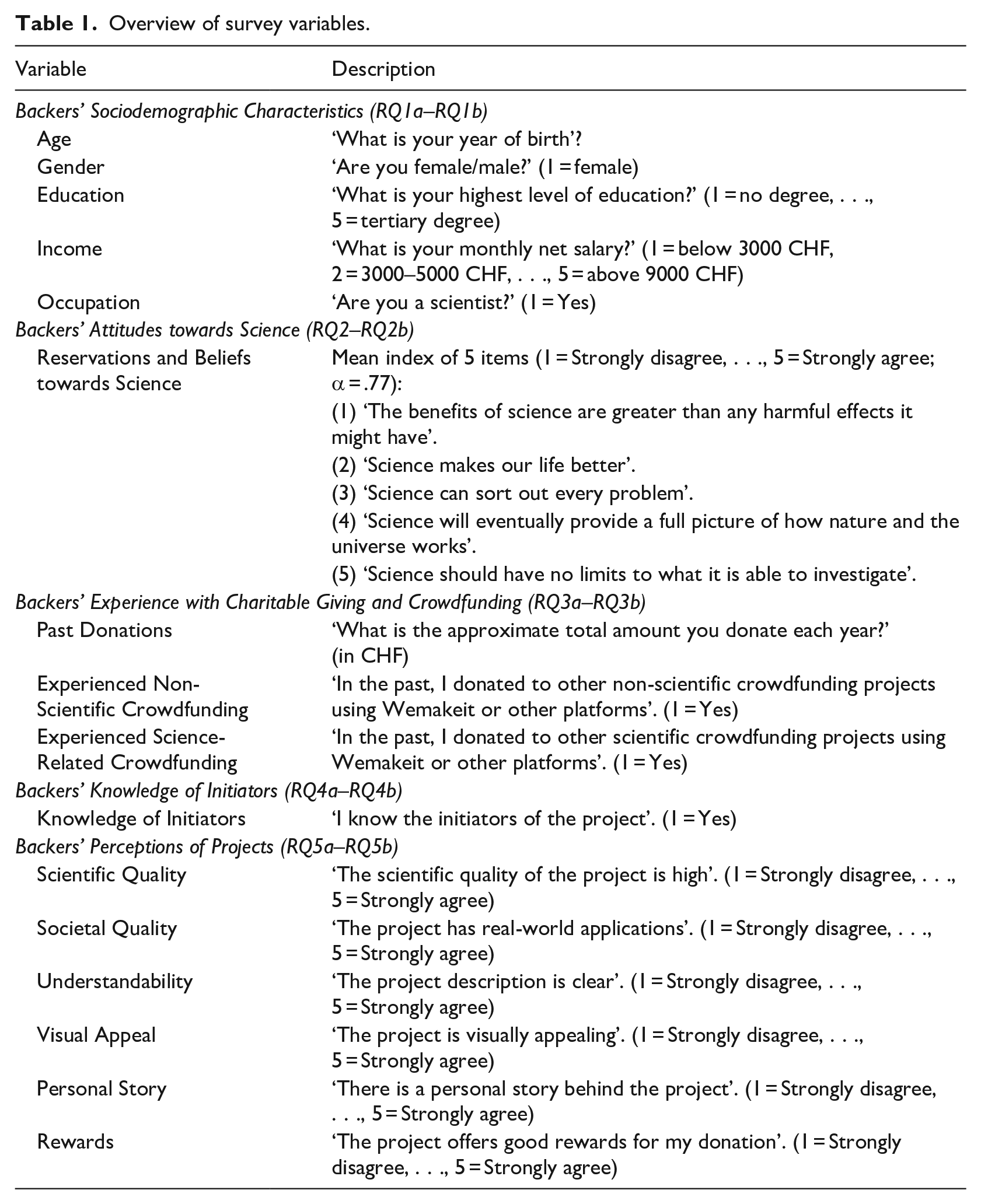
On the one hand, we used behavioural data on backers’ donations which was provided by wemakeit. The variable Donation (in CHF) describes the amount of money an individual donated to a science-related crowdfunding project via the Science Booster channel on wemakeit. On the other hand, we fielded a survey of backers supporting science-related projects on the Science Booster channel (March 2018–July 2020). Backers were contacted via email after crowdfunding campaigns had ended. This yielded survey responses from N = 576 backers for 34 projects (response rate: 13.2%). 2 For an overview of survey variables, see Table 1.
Overview of survey variables.
Backers’ sociodemographic characteristics (RQ1a–RQ1b)
Our survey captured backers’ Age (in years), Gender (1 = Female), Education (five categories, see Table 1), monthly net Income (five categories, see Table 1), and Occupation (1 = Scientist).
Backers’ attitudes towards science (RQ2a–RQ2b)
Concerning backers’ personal characteristics, we measured backers’ Reservations and Beliefs towards Science (five items, see Table 1) from established surveys (European Commission, 2014) similar to previous studies (Füchslin et al., 2019; Schäfer et al., 2018a). Participants, for instance, indicated whether they perceive science makes their lives better (1 = Strongly disagree, . . ., 5 = Strongly agree). We then created a mean index (Cronbach’s α = .77).
Backers’ experience with charitable giving and crowdfunding (RQ3a–RQ3b)
We also captured backers’ experience with charitable giving and crowdfunding via three variables. Similar to other studies, we measured backers’ general donation behaviour (Liu et al., 2018), in particular, how much CHF they donated to causes each year (Past Donations). We also measured whether backers had ever participated in non-scientific crowdfunding (Experienced Non-Scientific Crowdfunding, 1 = Yes) or science-related crowdfunding (Experienced Science-Related Crowdfunding, 1 = Yes).
Backers’ knowledge of initiators (RQ4a–RQ4b)
Related to backers’ relationship to/perception of projects, we captured whether they personally knew initiators (Knowledge of Initiators, 1 = Yes).
Backers’ perceptions of projects (RQ5a–RQ5b)
In addition, we measured backers’ perceptions of campaign features following Shneor and Vik (2020): The quality and understandability of campaigns as well as their visual appeal, prosocial cues and interesting rewards. We developed six items measuring backers’ perceptions related to these features (1 = Strongly disagree, . . ., 5 = Strongly agree). We differentiated between a project’s Scientific Quality (‘The scientific quality of the project is high’) and its Societal Quality (‘The project has real-world applications’), seeing that citizens often consider societal benefits for scientific funding decisions (Rowe et al., 2010). We also measured backers’ perceptions of the Understandability (‘The project description is clear’) and Visual Appeal (‘The project is visually appealing’) of projects. Similar to previous studies (Parhankangas and Renko, 2017; Schäfer et al., 2018b), we operationalized prosocial cues as perceptions of a Personal Story (‘There is a personal story behind the project’). Finally, we measured the appeal of Rewards (‘The project offers good rewards for my donation’).
Analysis
We used descriptive statistics to understand which citizens participate in crowdfunding (RQ1a–RQ5a). Where possible, we relied on chi-square and t tests to compare backers to benchmarks: Individuals supporting any project on wemakeit (Benchmark ‘all backers’) and the general population in Switzerland (Benchmark ‘general public’). The first benchmark – ‘all backers’ – includes sociodemographic characteristics (Age, Gender) of backers supporting any project on wemakeit. This data was provided by wemakeit. The second benchmark – ‘general public’ – includes sociodemographic (Age, Gender, Education, Income, Occupation) and personal characteristics (Reservations and Beliefs towards Science, Past Donations, Experienced Non-Scientific Crowdfunding) of the Swiss population. Sociodemographic characteristics were drawn from the Federal Statistical Office (2021a, 2021b, 2021c). Attitudes towards science were provided by the Swiss Science Barometer (Schäfer and Metag, 2019). Variables related to experience with charitable giving were drawn from the Volunteering Monitor in Switzerland (Lamprecht et al., 2020).
To understand whether backers’ sociodemographic/personal characteristics and their relationship to/perception of projects correlate with the size of their donations (RQ1b–RQ5b), we used multilevel regression. We matched backers’ survey responses to their donations using anonymized IDs. This reassured that data stayed fully anonymized throughout the study. We then regressed Donation on our theoretically derived antecedents. Please note that we took the logarithm of the dependent variable Donation and the independent variable Past Donations to account for their skewedness. Our data have a nested structure as it contains information on different backers (level 1) supporting different projects (level 2). Using the package lme4 (Bates et al., 2015) in R (R Core Team, 2022), we thus relied on a random intercept model. Research indicates that other project characteristics – that is, targeted funds (Schäfer et al., 2018b) or a project’s scientific discipline (Davidson and Tsfati, 2019) – may further shape funding success. As we are interested in backers’ subjective perceptions of projects, our main analysis does not include these characteristics. For robustness tests including these as controls, refer to the Supplemental Material (Appendix B, Table B1). Main results stayed robust across robustness checks.
5. Results
Descriptive statistics on backers’ sociodemographic/personal characteristics and their relationship to/perception of projects are depicted in Table 2 (RQ1a–RQ5a). The table also includes comparisons to benchmarks. Figure 1 illustrates how antecedents correlate with the size of backers’ donations to science-related projects (RQ1b–RQ5b). The full regression table for Figure 1 is included in the Supplemental Material (see Appendix A, Table A1, Model 3).
Descriptive statistics and comparison to benchmarks.
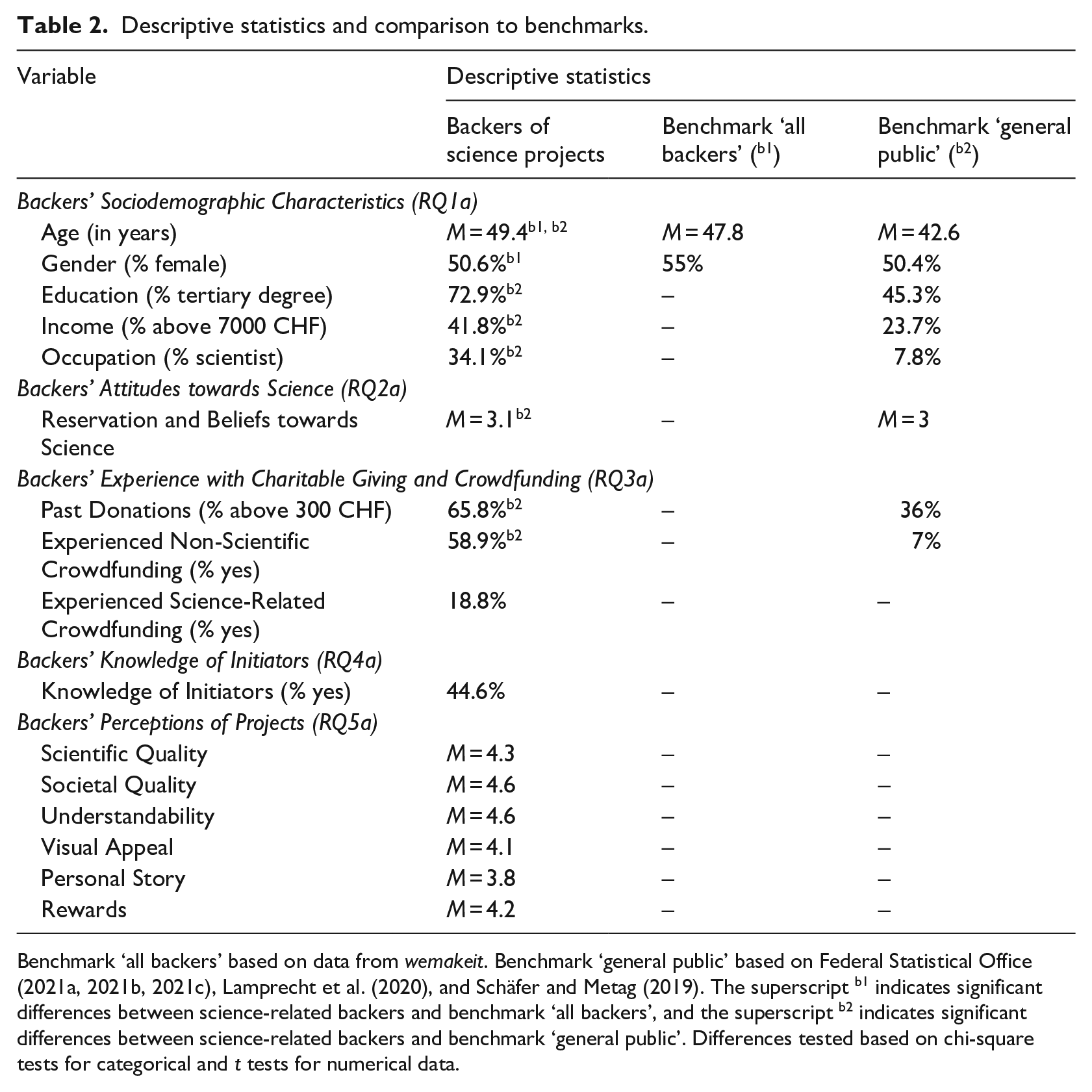
Benchmark ‘all backers’ based on data from wemakeit. Benchmark ‘general public’ based on Federal Statistical Office (2021a, 2021b, 2021c), Lamprecht et al. (2020), and Schäfer and Metag (2019). The superscript b1 indicates significant differences between science-related backers and benchmark ‘all backers’, and the superscript b2 indicates significant differences between science-related backers and benchmark ‘general public’. Differences tested based on chi-square tests for categorical and t tests for numerical data.
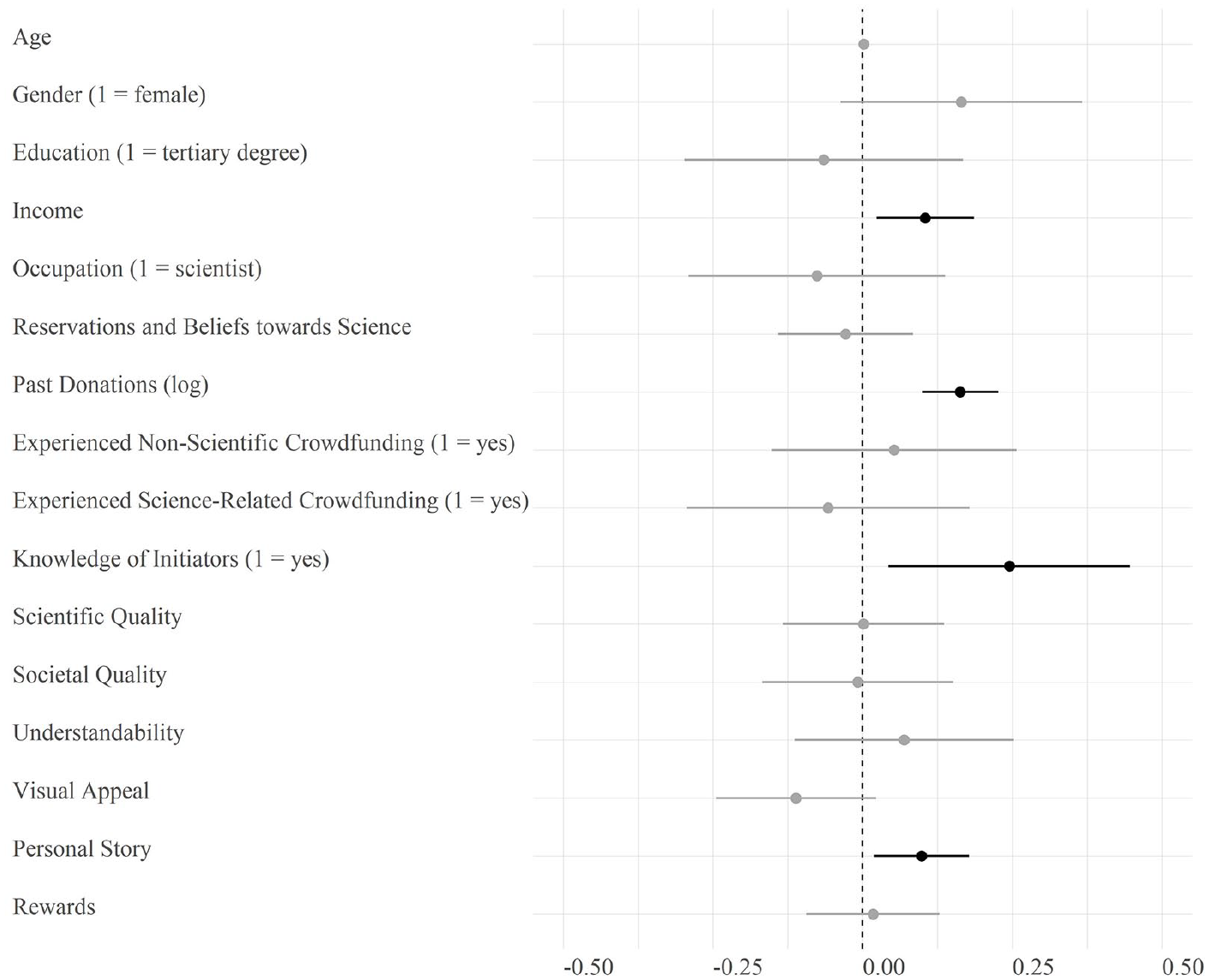
Regressing Donation (log) on independent variables.
Backers’ sociodemographic characteristics (RQ1a–RQ1b)
First, we are interested in sociodemographic characteristics of individuals engaging in science via crowdfunding (RQ1a). Individuals donating for science-related projects are, on average, 49.4 years old (M = 49.4, SD = 13.5). They are therefore significantly older than the average backer on wemakeit (M = 47.8, t(573) = 2.85, p < .01) and the average Swiss citizen (M = 42.6, t(573) = 12.02, p < .001; Federal Statistical Office, 2021a). Results suggest that women (50.6%) and men (49.4%) are similarly likely to participate in science-related crowdfunding. While the distribution of women among backers is similar to the Swiss population (50.4% female, χ2(1, 567) = 0.01, p = .918; Federal Statistical Office, 2021a), scientific backers are more likely male than the average backer on wemakeit (55% female, χ2(1, 567) = 4.31, p < .05). Concerning education, we find that individuals engaging in crowdfunding have a far higher education (72.9% tertiary degree) than is typical for the Swiss population (45.3% tertiary degree, χ2(1, 572) = 175.87, p < .001; Federal Statistical Office, 2021b). Moreover, 41.8% of backers have a net income of 7000 CHF or more, which is far above the national average (23.7% income of 7000 CHF or more, χ2(1, 514) = 93.42, p < .001; Federal Statistical Office, 2021c). In terms of occupation, we find that backers are often scientists themselves (34.1%) und thus, again, dissimilar from the Swiss population (7.8% scientists, χ2(1, 575) = 547.32, p < .001; Schäfer and Metag, 2019). Next, we analysed whether sociodemographic characteristics are associated with how much individuals donate to science-related projects (RQ1b). As indicated by Figure 1, only backers’ income has a consistent positive association with the size of donations (B = 0.1, p < .05). In contrast, neither backers’ age (B = 0, p = .698), nor gender (B = 0.16, p = .11), education (B = –0.07, p = .583), or occupation in terms of whether backers are scientists themselves (B = –0.08, p = .486) have consistent effects.
Backers’ personal characteristics (RQ2a–RQ3b)
Backers’ attitudes towards science (RQ2a–RQ2b)
Turning to RQ2a, we find that backers’ reservations and beliefs towards science are relatively positive (M = 3.1, SD = 0.9), significantly more so than those held by the Swiss population (M = 3, t(573) = 2.72, p < .01; Schäfer and Metag, 2019). However related to RQ2b, we find no consistent correlation between the size of donations and backers’ general reservations and beliefs towards science (B = –0.03, p = .62).
Backers’ experience with charitable giving and crowdfunding (RQ3a–RQ3b)
Turning to RQ3a, individuals participating in science-related crowdfunding have more experience with charitable giving than the average Swiss citizen: 65.8% of backers donated more than 300 CHF in the last year, a value far above the Swiss average (36%, χ2(6, 559) = 391.86, p < .001; Lamprecht et al., 2020). In addition, individuals supporting science-related crowdfunding often already participated in non-scientific crowdfunding (58.9%). They are thus dissimilar from the Swiss population (7%, χ2(1, 576) = 2379.1, p < .001; Lamprecht et al., 2020). Moreover, 18.8% of backers had experience with science-related crowdfunding. Related to RQ3b, evidence suggests that higher donations to charitable causes in the past correlate with higher donations to science-related crowdfunding: With every CHF individuals donated to causes in the last year, we expect their donations to science-related crowdfunding to increase by 18% (B = 0.16, p < .001). However, neither backers’ experience with non-scientific (B = 0.05, p = .615) nor science-related crowdfunding (B = –0.06, p = .633) had a consistent effect.
Backers’ relationship to/perception of projects (RQ4a–RQ5b)
Backers’ knowledge of initiators (RQ4a–RQ4b)
Related to RQ4a, results illustrate that 44.6% of backers know the project initiators. Turning to RQ4b, we find that these ties are associated with how much people donate: Donations by backers who know the initiators are expected to increase by 28% (B = 0.24, p < .05) compared to those that do not.
Backers’ perceptions of projects (RQ5a–RQ5b)
Related to RQ5a, backers mostly perceive projects to be of high scientific (M = 4.3, SD = 0.8) and societal quality (M = 4.6, SD = 0.7). They also think projects are presented in an understandable way (M = 4.6, SD = 0.6), visually appealing (M = 4.1, SD = 0.9), based on a personal story (M = 3.8, SD = 1.3), and include interesting rewards (M = 4.2, SD = 1). Related to RQ5b, we tested whether these perceptions correlate with how much money backers donate. With every one-unit increase in Personal Story, that is, backers agreeing that projects are based on personal stories, donations are expected to increase by 10% (B = 0.1, p < .05). In contrast, neither a project’s scientific quality (B = 0, p = .988) nor its societal quality (B = –0.01, p = .921), understandability (B = 0.07, p = .469), visual appeal (B = –0.11, p = .105), or rewards (B = 0.02, p = .764) have consistent effects.
6. Discussion
Combining a survey of backers and behavioural data on their donations to science-related crowdfunding projects on the crowdfunding platform wemakeit, we set out to answer two questions: Who are the people willing to participate in science through crowdfunding? And how do they decide how much to give?
Understanding science-related crowdfunding
Overall, individuals engaging with science through crowdfunding are not representative of the Swiss population: They are older, have an above-average education and a higher income. A third are scientists themselves (RQ1a). Most have above-average positive attitudes towards science (RQ2a). In contrast to most citizens in Switzerland, backers often have prior crowdfunding experience (RQ3a). Forty-five per cent of backers know project initiators (RQ4a) and most of them have positive perceptions of projects (RQ5a). While we can only shed light on antecedents of motivations for participating in science-related crowdfunding, our results tentatively suggest that these may be similar to those identified for non-scientific crowdfunding (Bretschneider and Leimeister, 2017; Gerber and Hui, 2013; Jian and Shin, 2015; Ryu and Kim, 2016): It seems that citizens engage with science via crowdfunding because they have positive attitudes towards science, identify with the scientific community or because of their ties with initiators. However, backers’ antecedents were only partly associated with how much money they donated. Apart from individual income and past donation behaviour, neither sociodemographic nor personal characteristics consistently explained variance in the size of individual donations (RQ1b, RQ2b, RQ3b). However, backers’ perception of and relationship to projects proved important: Individuals who knew initiators (RQ4b) or perceived projects as being based on a personal story (RQ5a) donated more money.
Overall, we conclude with three main findings. First, our study suggests that crowdfunding does not (yet) engage broader segments of the public. It mainly reaches citizens with an existing interest in science and friends/family members of initiators, underlining why crowdfunding has also been called ‘friendfunding’ (Lee and Lehdonvirta, 2020). Its potential for citizens’ engagement with science is thus limited to specific segments of the public. Similar to other forms of public engagement with science (Füchslin et al., 2019; Rowe et al., 2010), a small, non-representative part of the public is interested in participating via crowdfunding. Second, backers’ personal ties to initiators and the (perceived) personal background of projects are more strongly associated with the size of donations than projects’ (perceived) scientific or societal merit. In line with existing research, this indicates that citizens may rely on non-scientific criteria to decide upon the funding of science (Rowe et al., 2010; Sauermann et al., 2019; Schäfer et al., 2018b). Third, and last, findings indicate that different mechanisms may explain whether individuals engage with science via crowdfunding and how much they engage: While proximity to and attitudes towards science play a role for citizens’ decisions to engage with science via crowdfunding, these aspects do not necessarily explain how much they engage, here in terms of the amount of money they are willing to donate.
Theoretical and practical implications
Overall, our study suggests that far-reaching hopes about crowdfunding’s role in fostering public engagement with science seem somewhat premature. Initiators of science-related projects often claim to engage in crowdfunding to ‘bring democracy to the world of fundraising’ (Hui and Gerber, 2015: 38), underlining why public engagement with science more generally is associated with a potential democratization of science (Weingart et al., 2021). Our results suggest that such hopes may be unrealistic: Individuals engaging with science via crowdfunding are not representative of the population. Presumably, most citizens are either not aware of crowdfunding or not interested in participating, a known issue in science communication (Scheufele, 2018). A more problematic aspect in this regard is that how much money people donate is, to some extent, based on personal perceptions of or ties with initiators. Scientists with larger networks, for example, may enjoy more crowdfunding success simply because they know more people inside and outside the scientific community, casting doubt on a democratization of science via crowdfunding. While crowdfunding thus comes with key advantages as it opens up new avenues for scientists to engage with the public – and vice versa – it is still subject to limitations often similarly connected to other forms of public engagement with science (for an overview, see Weingart et al., 2021). Scholars have repeatedly raised critical questions in terms of who ‘the public’ engaging with science is and whether such individuals are qualified to participate in a more active manner (see critically Kleinman, 1998; Rowe et al., 2010; Rowe and Frewer, 2005; Stilgoe et al., 2014; Wynne, 2006). Not only may citizens not have the capacity for getting involved in this domain (Rowe et al., 2010,) public engagement efforts may, to some extent, also exploit the free labour of volunteers (Resnik et al., 2015) – in the specific case of crowdfunding, this includes citizens’ financial resources. While we understand the benefits of crowdfunding to outweigh potential detrimental effects, keeping the latter in mind does seem important when discussing how and when to implement any form of public engagement with science. Overall, we therefore agree with Rowe et al. (2010) that involving citizens in funding decisions may be more useful for bringing ‘concepts to the public’s attention (i.e. communication), but not as a method for consultation [. . .] or for enabling actual participation in decisions’ (emphasis in original) (p. 236).
The representativeness of citizens engaging with science through crowdfunding may change in the future, and our results merit some hope in this respect: From research on non-scientific crowdfunding, we know that a core of the crowdfunding community repeatedly backs different projects (Bretschneider and Leimeister, 2017; Efrat et al., 2020). In our study, we find a similar effect for science-related crowdfunding given that many backers have experience in non-scientific crowdfunding. General-interest platforms including different types of projects such as wemakeit may foster spillover effects: Individuals supporting non-scientific projects may become aware of science-related projects via the platform and support them, which could increase engagement by individuals otherwise disconnected from science. If broader engagement is the goal, increased communication efforts would, however, be needed to reach out to citizens less attuned towards science or crowdfunding (Calyx, 2020). These should include reliance on non-digital channels, for instance, promoting campaigns in zoos or aquariums where less science-attuned segments of the public are more likely to be reached (Schäfer et al., 2018a). Moreover, our findings provide scientists with recommendations on how to effectively promote their research to the public: It seems that identification with science and the scientific community are key for fostering public engagement with scientific issues. Correspondingly, scientists could include personal information in science-related outreach activities, for example, by explaining why they are personally interested in the topic of their research or what first made them interested in science. Platforms, on the other hand, could promote community-building, for instance, by more often including interactive features enabling communication between initiators and backers to engage individuals without existing connections to the scientific enterprise.
Limitations and the road ahead
As any study, ours has several limitations. First, selection bias may influence results. Not only is our response rate low, findings are also only representative for backers who participated in the survey, not all for those who donated. Such responses often represent those most heavily engaged (Jian and Shin, 2015). Second, we had to wait for initiators’ approval after a campaign finished to contact backers. This induced a time lag between the end of a campaign and backers being surveyed (mostly no more than 2–3 months). While the email inviting backers to the survey reminded them of the specific project they donated for, allowing backers to revisit campaign websites and refresh their memory, this sometimes led to missing answers concerning project perceptions. Third, associations cannot be interpreted in a causal manner. In fact, reciprocal effects may emerge if backers evaluate projects more positively after their donation due to sunk-cost fallacies. Fourth, results should not be generalized beyond their context, given that we focused on a single general-interest platform in a specific country. Fifth and last, we only included a distinct set of antecedents to shed light on backers, thereby discussing potential crowdfunding motivations and, by extension, funding decisions. Altogether, fixed effects explained no more than 16% of the variance in individual donations (see Supplemental Material Appendix A, Table A1, Model 3), indicating that there is clearly much more to know about individual determinants of science-related crowdfunding. Future studies should extend the context of our findings by including further platforms and countries. They should also analyse additional antecedents, for instance, how backers perceive not only projects and campaigns but also initiators. Moreover, they could focus on how antecedents may interact to parse out further and more distinct motivations for public engagement with science.
Supplemental Material
sj-docx-1-pus-10.1177_09636625221113134 – Supplemental material for Engaging the public or asking your friends? Analysing science-related crowdfunding using behavioural and survey data
Supplemental material, sj-docx-1-pus-10.1177_09636625221113134 for Engaging the public or asking your friends? Analysing science-related crowdfunding using behavioural and survey data by Valerie Hase, Mike S. Schäfer, Julia Metag, Mirko Bischofberger and Luc Henry in Public Understanding of Science
Footnotes
Acknowledgements
We would like to thank Céline Fallet and the wemakeit team for providing support in collecting data for this project, Salome Bosshard for supporting us throughout the manual content analysis and all the crowdfunding backers who participated in the survey. Moreover, we would like to thank the reviewers whose comments tremendously improved the paper.
Declaration of conflicting interests
The author(s) declared the following potential conflicts of interest with respect to the research, authorship and/or publication of this article: Mirko Bischofberger and Luc Henry are administrators of the Science Booster channel and receive financial compensation from wemakeit.
Funding
The author(s) disclosed receipt of the following financial support for the research, authorship and/or publication of this article: Initiation of the Science Booster platform was supported by the Gebert Ruef Stiftung (grants number GRS-040/15 and GRS–015/18).

Supplemental material
Supplemental material for this article is available online.
Notes
Author biographies
References
Supplementary Material
Please find the following supplemental material available below.
For Open Access articles published under a Creative Commons License, all supplemental material carries the same license as the article it is associated with.
For non-Open Access articles published, all supplemental material carries a non-exclusive license, and permission requests for re-use of supplemental material or any part of supplemental material shall be sent directly to the copyright owner as specified in the copyright notice associated with the article.
