



Abstract
Social networks are becoming powerful agents mediating between science and the public. Considering the public tendency to associate science with men makes investigating representations of female scientists in social media important. Here we set out to find whether the commenting patterns to text-based science communication are similar. To examine these, we collected and analyzed posts (165) and their comments (10,006) published between 2016 and 2018 on an Israeli popular science Facebook page. We examined post characteristics as well as the relevance and sentiment of comments. Several gendered differences in commenting patterns emerged. Posts published by female scientists received more irrelevant and fewer relevant comments. Female scientists received more hostile and positive comments. These findings are consistent with results of previous research, but also demonstrate a more nuanced understanding that when female scientists write using scientific jargon (usually an unwanted feature of popular science writing), they received less hostile comments and were given less advice.
Keywords
1. Introduction
In an opinion piece published in the Wall Street Journal on 11 December 2020 (Epstein, 2020), Joseph Epstein insisted that Dr. Jill Biden, the wife of the then newly elected US president, should stop using her Dr. title. He wrote, “Any chance you might drop the ‘Dr.’ before your name? ‘Dr. Jill Biden’ sounds and feels fraudulent, not to say a touch comic.” He argued that Dr. Jill Biden should be content as just being First Lady Jill Biden. This piece instigated a flood of reactions, especially on Twitter (Treisman, 2020) involving intensive backlash against the patronizing tone of the op-ed, with claims that this would have never been written about a man. A new hashtag was created #mytitleisdr and many female academics decided to add Dr. to their Twitter name. This op-ed appeared to have struck a chord—reminding us that despite progress in gender equality, belittling women in academia is still alive and well. Moreover, Epstein’s attitude is also illustrative of a commonplace approach to women in social media (and mainstream media) known as “mansplaining” which is defined as “a certain patronizing form of communication directed at women by men” (Koc-Michalska et al., 2021: 2). In a very patronizing tone, Epstein explained to Dr. Biden how to better continue with her professional life. Mansplaining is even more pronounced in fields that are predominantly male, such as in the technology industry. A recent study on the hashtag “mansplaining” on Twitter found the combination of “mansplaining” and “tech” to be very popular (Lutzky and Lawson, 2019).
Despite the dramatic rise in the number of women studying and working in STEM (science, technology, engineering, and math) fields in recent years, progress has been slow and uneven (Blackburn, 2017; Holman et al., 2018). Although PISA (Programme for International Student Assessment) test results predict that one out of three girls could successfully complete a STEM degree, in most countries the percentage of women graduating in these fields is much lower than that of men (Mostafa, 2019).
Recent data on tertiary education show that in Finland, Norway, and Sweden, all of which are countries where gender equality is considered to be very high (The United Nation Gender Inequality Index of these countries is 0.05 or lower), fewer than 25% of STEM graduates are women (Stoet and Geary, 2018). In the United States, women received only 23.6% of engineering doctoral degrees (Roy, 2018). A similar trend has been found in Israel and many other countries (Kertcher-Tzameret et al., 2017).
The underrepresentation of female scientists is also noticeable in popular culture. In most television programs, newspapers, films, and commercials, there are more male than female scientists (Hubner and Bond, 2021; Steinke, 2017). A recent analysis of survey data from a large national sample of Italian academics identified that female scholars are actively involved in public engagement activities, but not in the most visible ones (Anzivino, 2021).
This situation is also apparent on social media. On Instagram, for example, female scientists have fewer followers on average than male scientists (Jarreau et al., 2019), and of the 50 most followed scientists on Twitter only four are women (You, 2014). This low representation contributes to the public tendency to associate science with men much more than with women (Amarasekara and Grant, 2019).
Amarasekara and Grant (2019) explored the influence of gender on the popularity of YouTube science videos and viewers’ comments about them. They reported that despite the fact that female scientists’ videos received a higher percentage of positive reactions (compared with male scientists’ videos), these videos also received a higher percentage of comments about the presenter’s appearance and sexuality, as well as outright hostile comments. The current study aimed to explore these trends to determine whether the same trend would be apparent in a social media platform where scientists engage with the public through text rather than video. This medium may make scientists’ gender less visible and apparent. In addition, Facebook is the leading global social network, and in Israel, where we conducted the study, 70% of Internet users have a Facebook account (Statista, 2022). To do so, retrospective data of posts (n = 165) and comments to these posts (n = 10,006) published from 2016 to 2018 on a popular science Facebook page were analyzed.
Women in STEM fields
The relative scarcity of women in STEM careers in academia takes many shapes and forms: women are invited less often to deliver lectures at conferences, receive fewer awards and research grants, publish fewer scientific articles and their articles are cited less, especially by men (Amarasekara and Grant, 2019; King et al., 2017; Lincoln et al., 2012; Maliniak et al., 2013; Pohlhaus et al., 2011). Data from around the world suggest that although there are disparities within STEM fields and between countries, overall, women are still not equally represented in “math intensive” STEM fields (Bonham and Stefan, 2017; Ceci et al., 2014; Rosen, 2017).
Numerous studies have explored possible alternate explanations only to find that these differences are largely gender related (Magua et al., 2017; Moss-Racusin et al., 2012; Oliveira et al., 2019; Royal Society of Chemistry, 2019). For example, Caplar et al. (2017) demonstrated that astronomy papers authored by women receive fewer citations than would be expected if the same papers had been written by men. Another example comes from analysis of National Institutes of Health (NIH) grant renewal applications where Magua et al. (2017) analyzed approval rates and comments written by reviewers. They found that gender biases, demonstrated also by the written reviews, account for gaps in approval rates. Although outwards discrimination has decreased, it has sometimes been replaced with a subtler form of discrimination: “women face more insidious challenges, such as subtle, unconscious bias held by people of both genders and built-in barriers to success” (Rosen, 2017: 1). The resulting relative smaller number of women in public scientific arenas feeds a cycle that perpetuates their overall absence from a number of STEM fields.
Gender stereotypes and STEM
Gender stereotypes and gender schemes about the meaning of being a man or woman are shaped and reshaped from childhood. These in turn contribute to public perceptions about women in science (Eccles et al., 1990; Steegh et al., 2021). In addition, gender stereotypes about science-related careers tend to “influence female self-beliefs and values” (Steegh et al., 2021: 3). Gender stereotypes prescribe how women should behave including what academic careers they should pursue (Krefting, 2003). These schemes affect how people interact with others and what they expect from others based on their gender. In the context of STEM, gender schemes encourage men to enter the field, while women are more likely to say that these are not suitable areas for them (Valian, 2006). This is manifested in the early stages of young girls’ academic careers. Studies spanning three decades have demonstrated that young girls feel less secure about their math and science abilities even though their achievements are often equal to those of boys (Huber and Burton, 1995; National Science Foundation, 2007). According to PISA data, boys show greater confidence when learning science than girls, although this difference is not borne out by actual differences on test scores (Mostafa, 2019).
These differences in confidence levels also contribute to a self-perpetuating cycle of gender stereotypes in society (van der Vleuten et al., 2016). Gender stereotypes about women’s roles and traits orient girls to be supportive, loving, and sensitive. They also lead women to avoid math-related disciplines, to focus on children and the family and to choose a profession that is people-oriented (Konrad et al., 2000; Verniers et al., 2015). On the other hand, gender stereotypes about male qualities include assertiveness, independence, and competitiveness (Carli et al., 2016).
Science in social media
Social media are fast becoming the main source of many types of information and news, especially when it comes to health and science (Hitlin and Olmstead, 2018). In the United States, 72% of adults use at least one social network (Silver, 2019) and global data indicate that in 2020, over 3.6 billion people were using social media, of which Facebook is the leading network (Tankovska, 2021). Facebook in particular has become an important arena for engagement with science (Mueller-Herbst et al., 2020).
Social media are used by scientists to reach out to a variety of audiences in addition to their peers. Different social media platforms attract different audiences and are characterized by different levels of public engagement (Orr et al., 2016). In North America, “Twitter is emerging as a medium of choice for scientists . . . although it is still used by a minority (< 40%) of academic faculty” (Côté and Darling, 2018: 682). When analyzing the profiles of followers of these scientists on Twitter, Côté and Darling (42) found that they were mostly composed of other scientists. However, when scientists attract very large audiences (over 1000 followers), these followers tend to be much more diverse in terms of their backgrounds and interests. Scientists have reported that they use social networks to share journal articles, make their scientific opinions public, post updates from conferences and meetings, share upcoming events and correct misrepresentations of science (Collins et al., 2016; Jünger and Fähnrich, 2020; Nature Cell Biology, 2018).
In addition to changing where and how the public obtains information, social media enable non-scientists to comment and express their opinions by posting comments and original science-related content (Hilverda et al., 2018). This interactive feature may facilitate science-related dialogue with the public (Laslo et al., 2011; Orr et al., 2016), but it also enables audiences to draw attention to a different focus and engage with the themes and ideas that are important to them, and not necessarily to scientists (Dalyot et al., 2021; Laslo et al., 2011).
In recent years, several studies have analyzed reader perceptions, feelings, and behavior on social networks (Kalogeropoulos et al., 2017; Laslo et al., 2011; Smith et al., 2013; Vermeulen and Seegers, 2009; Witteman et al., 2016). They have focused on topics related primarily to health such as organic food, vaccinations, smoking and diets (Shi et al., 2014; Walther et al., 2010) as well as consumer reviews of various products and services (such as hotels and restaurants) (Witteman et al., 2016). The findings indicate that comments on social media have an impact on the public’s opinions and behavior (Hilverda et al., 2018; Shi et al., 2014; Walther et al., 2010; Witteman et al., 2016).
Women scientists in the media and social media
Gender stereotypes permeate many social spheres, and the framing of science as male in the media has played an important role in shaping the image of scientists and the extent to which the public appreciates the ability of female scientists. For example, a UK study that investigated gender representations of scientists featured in the national press found that 84% of these scientists were male. In addition, for half of the women (50%) featured in these stories, their clothing, body shape and hairstyle were mentioned (as compared with 21% of the men) (Chimba and Kitzinger, 2010).
Studies on science writers in the media present a more complex picture. In 2016, the Science Byline Counting Project (a nonacademic endeavor) monitored 10 magazines (and The New York Times’ Tuesday science section) for a total of 8 months and recorded the byline credits on science-related stories. While there was no overall disparity between female and male writers, male writers wrote longer articles as well as more magazine-style science articles (Graber and Gammon, 2016).
These trends are present on social media platforms as well. Several studies that have monitored the presence of female scientists on various social networks, especially Twitter and Facebook (Amarasekara and Grant, 2019; Demailly et al., 2020; Hubner and Bond, 2021; Ke et al., 2017; Klar et al., 2020; Mueller-Herbst et al., 2020), have reported mixed results. For example, a review by Ke et al. (2017) identified that the ratio of female to male scientists on Twitter is actually better than the ratio of female to male scientists in academic publications. By contrast, Demailly et al. (2020) found that for anesthesia researchers, male scientists were more visible on several professional social networks (Twitter, LinkedIn, and ResearchGate).
Even if present on media or social media, reader assessments of female scholars’ statements might be less favorable than their assessment of male scholars’. This was demonstrated with UK-based environmental scientists who were provided with media statements by a fictitious male or female scientist.
Where the statements were attributed to a female scientist, male environmental scientists rated the fictitious scientist as significantly more “dramatic” and “biased” than their female counterparts did. These gendered attributes are typically held as contrary to the norms of science, suggesting an implicit bias among male scientists when reviewing their female peers’ media statements. (Armstrong and Adamson, 2021: 841)
To better understand the gendered messages researchers receive in a popular science social media platform, the current study explored whether there are differences between comments submitted to posts authored by male and female scientists on a popular science Facebook page.
2. The social context of the study
This study analyzed a Hebrew popular science Facebook page. In Israel, the status of women in academia and science is similar to the situation in other OECD countries. Although most undergraduate and graduate students in Israeli universities are women, fewer than 33% of the senior faculty are women, and only 21% of all professors are women (Kertcher-Tzameret et al., 2017). Specifically, as of 2017, women made up 11% or less of the full professors in Engineering, Computer Science, and Physics faculties (Academic Committee of the Council for Advancement of Women in Science Technology, 2019).
Data on social media in Israel demonstrate that Facebook is the main social media network, in terms of the average amount of time users spend and the percentage of users in the entire population (Statcounter Global Stats, 2020). Alongside other new media, it has been a major force in science communication in Israel over the last decade (Baram-Tsabari et al., 2020). These data make Israel a valid arena for research on public engagement with science on Facebook.
3. Methodology
The study was designed to examine differences between comments submitted to posts authored and published by female versus male scientists on a popular science Facebook page. We characterized these differences based on sentiment and relevance analysis adapted from Amarasekara and Grant’s study on YouTube videos (2019) and Tsou et al. (2014) study on Ted talks.
Research field
Little, Big Science (LBS) is a non-profit organization for science outreach that operates the largest independent popular science Facebook page in Hebrew (Baram-Tsabari et al., 2020) and had nearly 140,000 followers as of September 2020 (https://www.facebook.com/MadaGB/). LBS publishes posts in the form of either short (300–500 words) or long (600–800 words) articles on various STEM subjects. These posts can be divided into three types: explanations of a well-known term or phenomenon, descriptions, and clarifications of a recently published peer-reviewed scientific paper, and rebuttals dealing with a recent media publication.
At the time of data collection, the contributors to the LBS website broke down into 30 male and 17 female writers all holding or currently earning an advanced degree (e.g. PhD, MD) or who are involved in or have experience in academic research. Topics for articles are suggested by individual writers or chosen from suggestions shared in a private writers’ group. Each article goes through three steps before publication, as a form of quality control. All manuscripts are read by peers from that particular discipline to detect errors. The text is then also read by a team member outside of the discipline, to make sure the text is readable and understandable. Finally, the text is edited by a designated editor, who does the final grammatical corrections and uploads the text to the LBS Facebook page and the LBS website. The posts vary widely in terms of topic and relevance to daily life and range from posts dealing with hot water boilers to posts about quantum physics.
Data collection and data analysis
Data collection was conducted in two phases. The first involved selecting and extracting posts, and the second involved extracting the comments to these posts. Codebooks were used to analyze the posts (Table 1) and the comments (Table 2) by the same 2 coders (a research assistant and the second author).
Codebook for post characteristics.
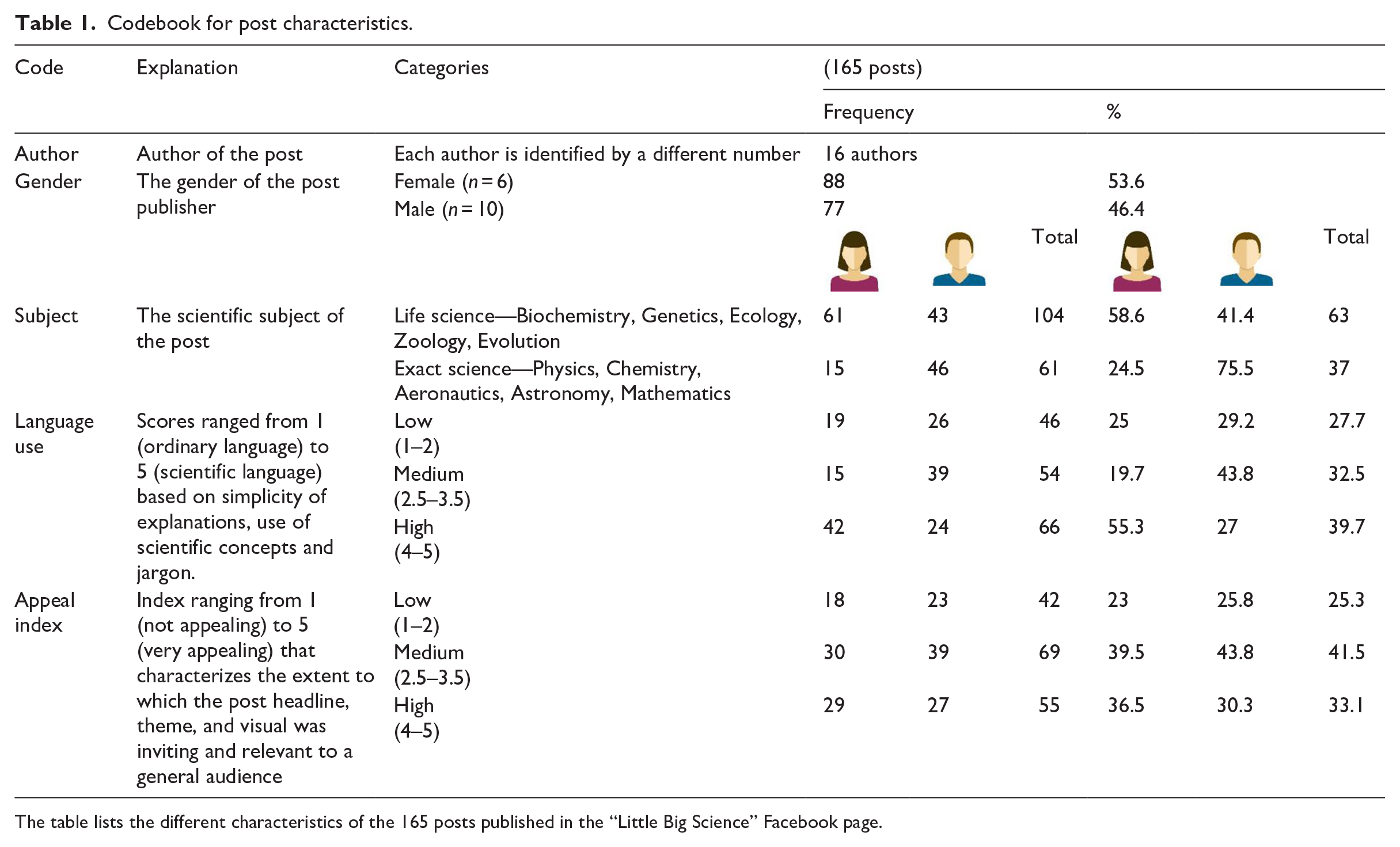
The table lists the different characteristics of the 165 posts published in the “Little Big Science” Facebook page.
Codebook for comments to posts.
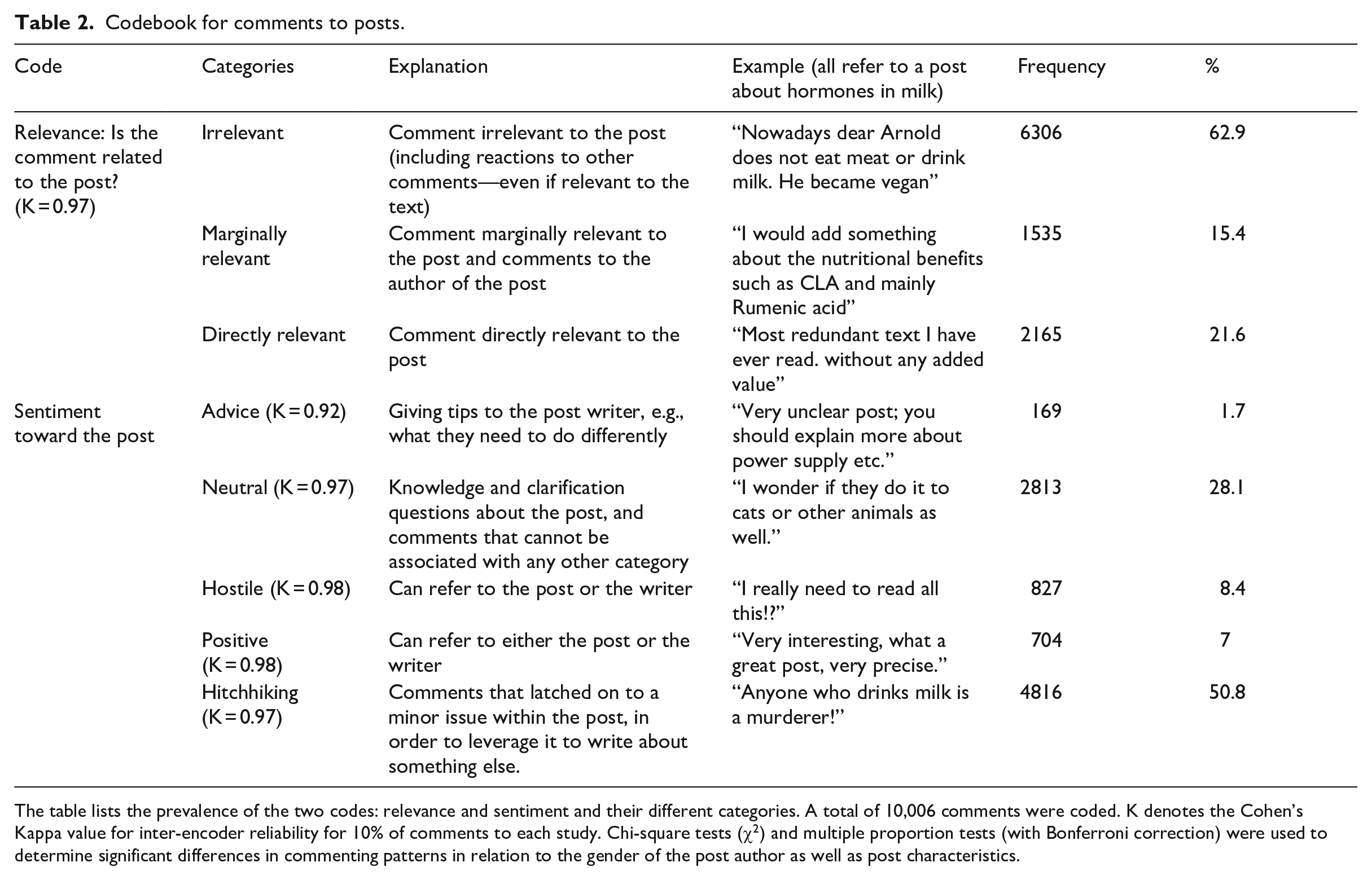
The table lists the prevalence of the two codes: relevance and sentiment and their different categories. A total of 10,006 comments were coded. K denotes the Cohen’s Kappa value for inter-encoder reliability for 10% of comments to each study. Chi-square tests (χ2) and multiple proportion tests (with Bonferroni correction) were used to determine significant differences in commenting patterns in relation to the gender of the post author as well as post characteristics.
The posts analyzed in this study were all published between 2016 and 2018. A total of 165 posts were collected, which fulfilled the following criteria: (1) a visible and gender identifiable author’s name, and (2) being a member of the LBS team (not a guest author). While the selection process aimed to maintain a balance between the number of posts published by both genders, and because there were more female scientists in the life sciences, the selection criteria constrained the overall number of posts for analysis. The final number of posts consisted of 88 posts authored and published by 6 female scientists and 77 posts authored and published by 10 male scientists, as listed in Table 1.
The codebook was developed by the research team, and its content validity was established non-statistically by submitting it to the expert professional judgment of a gender specialist as well as 10 science communication experts. The purpose of coding the posts (and not only the comments) was to ensure that the sample was varied in terms of post characteristics, and to contribute to a more nuanced understanding of the differences in reader comments. Posts were coded for subject, gender, the level of scientific language, and their overall appeal (appeal index Table 1). Mean comments to posts authored by female scientists was 65, and mean comments to posts authored by male scientists was 95. This difference is mainly attributed to the fact that two of the male writers are also LBS directors and always received much more comments than other writers. The mean number of comments to male scientists excluding their posts is 70.
Ethics
Our data were collected from a public page, in collaboration with its editors, writers, and administrators. Commentators’ names and any identifiable information were not extracted from Facebook at any stage and hence do not appear in our analysis or article. After extracting the comments, name tags were immediately deleted from our files. In addition, since comments were written originally in Hebrew, the process of translating preserves the spirit of the comment without using the exact identifiable words (Townsend and Wallace, n.d.).
Comment extraction and coding
A total of 13,405 comments that were submitted in response to the 165 posts were extracted using Facebook for Developers API (average number of comments to a post: 81.2, SD = 111.1 range: 3–930). Of these, 3399 comments containing only name tags or emojis, or comments that included links to additional references related to the post theme were excluded, resulting in a sample of 10,006 comments. A codebook was developed based on previous work by Amarasekara and Grant (2019), and Tsou et al. (2014). Each comment was coded with respect to two categories:
Relevance. The relevance of the comment to the post’s main subject. The categories in this code were irrelevant, marginally relevant, or directly relevant.
Sentiment. The sentiment of the comment toward the post. The categories in this code were advice, neutral, hostile, positive, or hitchhiking.
The definitions and examples for all codes appear in Table 2. Coding was carried out by the second author and a research assistant and yielded satisfactory inter-coder reliability (Table 2).
4. Findings
Relevance
An analysis of comments submitted to posts by female and male scientists found a total of 63% comments that were not relevant to the post itself (comments that replied to other comments and not the post itself were also coded as irrelevant). Women scientists received significantly more irrelevant comments and fewer directly relevant comments compared with men (Table 2, Figure 1, χ2(1) = 93.53; p < .001). When looking at the differences as mediated by the post subject (Table A in Supplemental Material) the differences are more significant between comments to women and men in the life sciences (χ2(2) = 61.008; p < .001), than in the exact sciences (χ2(2) = 10.577; p < .005). In the exact sciences, women and men received a similar percent of irrelevant comments (55.6% and 54.2%), but women received significantly fewer relevant comments (25.9% and 31%). In addition, women received more marginally relevant comments (18.6% and 14.8%).
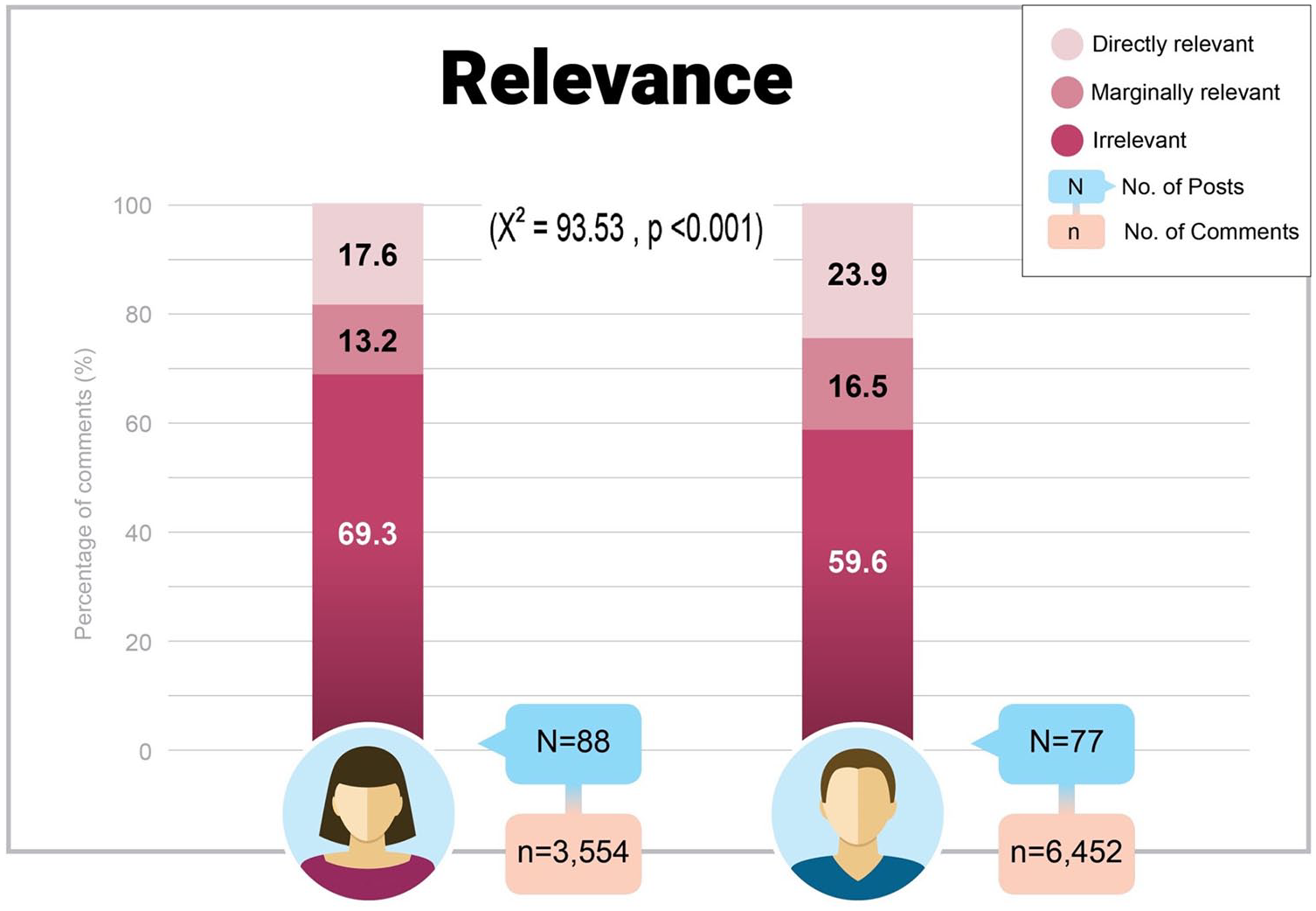
Distribution of the different categories of the Relevance code: directly relevant, marginally relevant, and irrelevant comparing posts authored by male or female scientists on the Little Big Science Facebook page.
Next, we examined how the appealingness index of the post mediates the gender influence (Table B in Supplemental Material). In the lowest category (posts that are not very relevant to daily life, or are less appealing), there were no significant differences between comments to women and men scientists. However, posts in the medium and high categories received significantly more irrelevant comments when the author was a woman (Medium category: χ2(2) = 9.421; p < .05, High Category: χ2(2) = 127.130; p < .001). Moreover, the most relevant and appealing posts received significantly fewer relevant or marginally relevant comments when the author was a woman.
Finally, analysis of the 3 levels of language (daily vs scientific jargon) revealed that for posts coded as containing a high proportion of scientific language women received more irrelevant comments (women 67.1% and men 50%) and fewer relevant and marginally relevant comments (χ2(2) = 70.608; p < .001). This trend is maintained in the two additional language levels, but is less significant (Table C in Supplemental Material).
Sentiment
The analysis of the comments demonstrated that their sentiments were mainly hitchhiking (50.8%, comments whose relationship to the post was unclear) or neutral (28.1%, as in clarification and knowledge questions). The positive (7%) and hostile (8.4%) comments were rarer, as were comments offering advice to the author (1.7%) (Table 2).
Women received a significantly higher percentage of comments offering advice to the author compared with men (χ2(1) =170.68, p < .001, Figure 2a), and significantly fewer neutral comments than men (χ2(1) = 40.61, p < .001, Figure 2b). Women received more hostile comments (χ2(1) =4.28, p < .05, Figure 2c), but also more positive comments than men (χ2(1) = 170.7, p < .0001, Figure 2d). No significant gendered differences were found in the “hitchhiking” category.
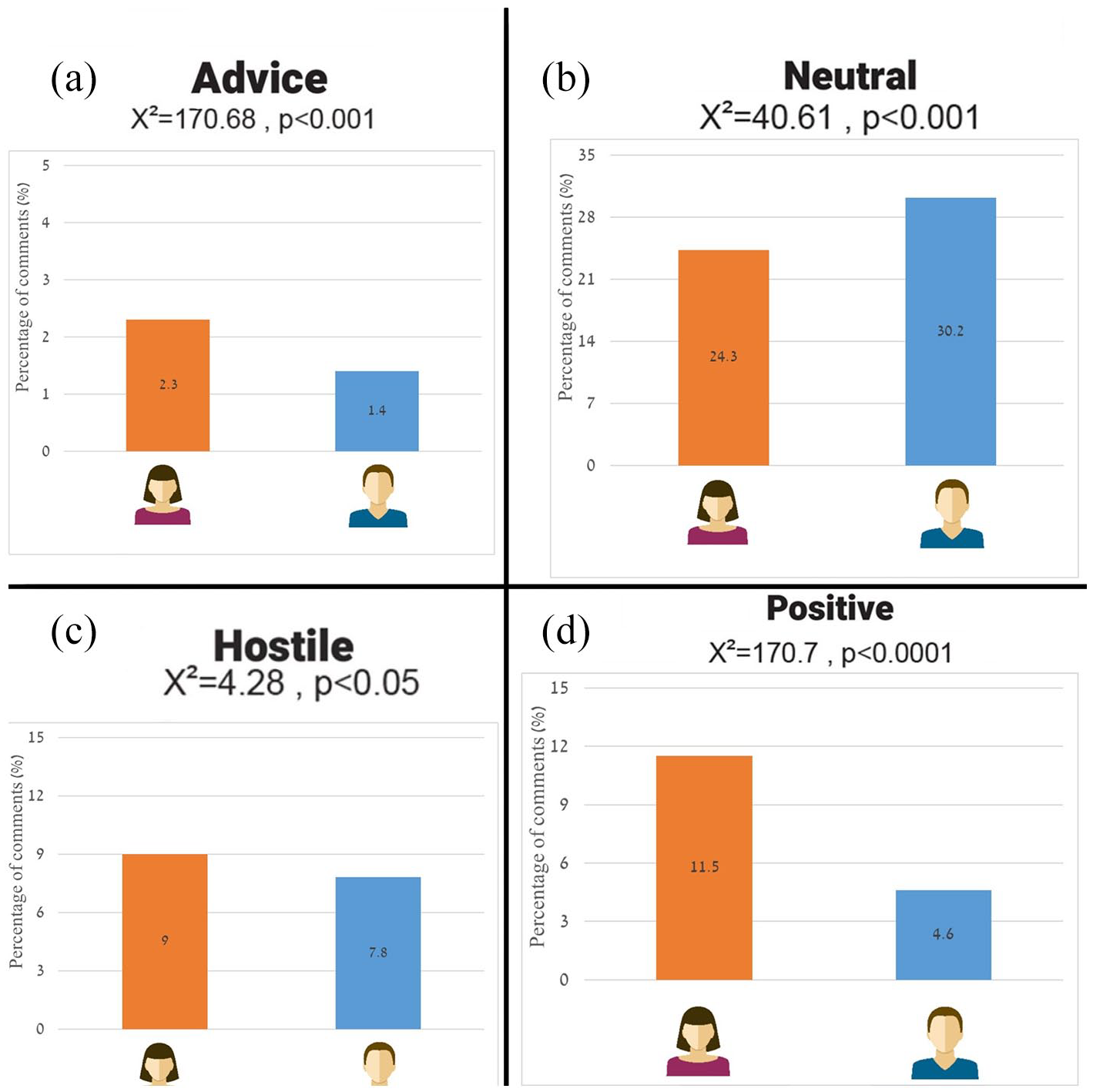
Distribution of the different categories of the Sentiment code: Advice (a), Neutral (b), Hostile (c), and Positive (d). The analysis compared posts authored by male or female scientists on the Little Big Science Facebook page.
Testing for gender differences within the two post subjects (Table D in Supplemental Material) revealed that women received significantly more positive comments to life science posts, but not to exact science posts (χ2(1) = 421.393, p < .001). This trend persisted with hostile comments (χ2(1) = 20.939, p < .001). However, for the neutral comments, the differences are significant in both subjects (still slightly more for the life sciences). Most interestingly, significant differences in giving advice comments were only found in the exact sciences (χ2(1) = 16.087, p < .001).
Examining the gender differences within the three levels of the appeal index (Table F Supplemental Material) reveals that women receive significantly more hostile comments when the appeal index is high (χ2(1) = 8.845, p < .05 (but differences were not significant for the two additional levels. For giving advice comments, significant differences were found only in the lowest category of the index.
When examining the interaction with the level of language used in the post (Table E Supplemental Material), women received significantly fewer hostile comments when posts were categorized as having a high level of scientific jargon (χ²(1) = 55.698, p < .001), but significantly more hostile comments in the medium and low language categories (medium: χ²(1) =31.591, p < .001; low: χ²(1) = 28.657, p < .001). Another important finding is that a difference in giving advice comments was only significant in the lowest level of language category (χ²(1) = 6.912, p < .01). Still women received significantly fewer neutral comments when they write in daily language.
5. Limitations
Several limitations to this study should be noted. At the time of data collection, the contributors to the LBS website included 30 male and 17 female writers, many of whom have unisex names. This resulted in a male-dominant sample for our study. Furthermore, despite advances in women’s representation in many STEM fields, they are still largely excluded from many other fields (Rainey et al., 2018). For example, at the time of the studies only two female authors in the exact sciences volunteered at LBS, which is why the posts had to include more articles from the life sciences to achieve a relative author gender balance. Many of the comments were composed solely of emojis which were difficult to interpret in terms of positive or hostile sentiment and thus were not included in the analysis.
Finally, while “Little, Big Science” Facebook page is by no means representative of all popular science Facebook pages, we argue that due its high visibility and popularity and to the primacy of Facebook in general within adult audiences in Israel, it is an important field to study.
6. Discussion
When juxtaposing our findings with other social media studies, most of them are consistent. For example, posts published by female scientists received more irrelevant comments and fewer directly relevant comments (Figure 1), which is consistent with results reported by Tsou et al. (2014) indicating that female scientists received less relevant comments when appearing on Ted Talks. In addition, in our study female scientists received more hostile comments; similarly, Amarasekara and Grant (2019) found that female presenters in YouTube videos received a higher proportion of negative/critical, hostile, and sexist/sexual comments. Also consistent with previous studies is that women scientists received fewer neutral comments that asked for clarification and information about the post (Amarasekara and Grant, 2019; Tsou et al., 2014).
However, our study offers an additional perspective that takes a deeper look at the differences in commenting patterns. Analyzing how the commenting patterns are mediated by post characteristics enables a more nuanced understanding of the gendered differences. First of all, our findings point to an interesting fact that when women write using scientific jargon, they receive less hostile and giving advice comments. This is important because common science communication guidelines usually recommend using less jargon and more daily language as a strategy to reach wider audiences (National Academies of Sciences, Engineering, 2017). Moreover, our findings echo Barel-Ben David (2020) that identified the unique struggles of female science communicators with keeping a professional public persona. This is also consistent when looking at the differences as mediated by the appeal level of the post. Although female scientists received fewer neutral comments in the higher and medium appeal categories (more relevant to daily life and appealing to larger audiences), in the lowest category they received more neutral comments. This demonstrates that again when female scientists are communicating more popular science, they receive more biased responses.
We also observe a unique pattern for female scientists within the exact sciences, which are generally more male dominated (Kanny et al., 2014). When looking at the comments to female scientists in the life sciences and in the exact sciences, female scientists received significantly more giving advice comments only in the exact sciences, but also more neutral comments.
We conclude that commenting patterns earlier described in video format are replicated to some degree in a textual format, where only one’s first name reveals their gender.
In interpreting our findings, we find useful the notion that sexism (discrimination and prejudice based on sex/gender) is expressed in many ways and is often characterized as “blatant, covert, and subtle” (Swim et al., 2004). Studies on discrimination distinguish between “hostile sexism” and “benevolent” forms of sexism, which is sometimes described as “subtle” or “friendly” sexism. The commenting patterns on Facebook can be considered to take a both hostile sexism and a covert approach to sexism, as manifested in the higher levels of advice-giving as well as in the fewer neutral comments. These results are best cast within the context of gender stereotypes in today’s social landscape.
In the last 10 years, one of the expressions of sexism that has received significant attention in social media is “mansplaining.” This term usually refers to a situation in which a man explains a concept to a woman whom he considers is less knowledgeable about the subject (Koc-Michalska et al., 2021). The comments offering advice may be an expression of mansplaining (although the gender of the authors of the comments was not available for analysis). Benevolent sexism such as this is often ignored because the public does not perceive it as harmful or problematic (Glick and Fiske, 1997; Swim and Cohen, 1997; Swim et al., 2005). The irrelevant and advice comments are thus illustrative of an approach based on the conception that women are less competent and require a gentle and sensitive “corrective” approach more “appropriate” to their “character.”
7. Conclusions
It is important to acknowledge that biases differ between cultures. A recent study that compared physics- and mathematics-related stereotypes between Japan and the United Kingdom found that in Japan (but not in the United Kingdom) a person’s attitude to intellectual women was related to viewing mathematics as “masculine,” but “the experience of being told or having heard that the choice of a particular course of studies would make someone less attractive to the opposite sex was evident only in England” (Ikkatai et al., 2021: 810). However, the results we describe here, that suggest that female scientists receive more negative feedback when writing in a more popular language, seem to hold true across English-speaking and Hebrew-speaking popular science.
Comments on social networks affect the opinions and behavior of the public in general and teenagers in particular (Williams and Gulati, 2012). Research has shown that gender science stereotypes (which view science as male) and gender stereotypes in general inhibit young women from envisioning scientific careers and their ability to identify with science (Cotner et al., 2020; Steegh et al., 2021). Correll (2001) found that high school students’ perceptions of their own abilities and competencies influenced their decisions to pursue a specific career choice. These social and psychological mechanisms are reinforced by social media messaging.
The widespread differences in comments toward female scientists compared with male scientists on Facebook, along with the low representation of female scientists, may have dire consequences for the ways in which young women and girls perceive themselves. Cognitive Social Theory, as developed by Lent et al. (Lent Robert et al., 1994), suggests how personal variables such as gender along with environmental variables such as support shape career development. Thus, it is important to investigate and uncover gendered interactions on different social media platforms, especially those targeting young adults, so that we can better shape the engagement of future female scientists on social media. But more importantly, to better understand the message sent to the next generations of female scientist and science communicators.
Supplemental Material
sj-docx-1-pus-10.1177_09636625221092696 – Supplemental material for Engagement patterns with female and male scientists on Facebook
Supplemental material, sj-docx-1-pus-10.1177_09636625221092696 for Engagement patterns with female and male scientists on Facebook by Keren Dalyot, Yael Rozenblum and Ayelet Baram-Tsabari in Public Understanding of Science
Footnotes
Acknowledgements
The authors acknowledge the important work of Nadia Bordo in the statistical analysis, and Yomiran Nissan and Ella Lachman from “Little, Big Science” for helpful comments during the development of this study and manuscript. We also thank Ayala Goldstein for her coding work in the study. Finally, we owe a great deal to the scientist authors volunteering for Little, Big Science for their invaluable contribution to our research.
Author contributions
All authors contributed to the design of the research. K.D. and Y.R. analyzed the data. K.D., Y.R., and A.B.-T. interpreted the findings. All authors read and approved the final manuscript.
Data availability statement
The data sets generated and/or analyzed in the current studies are not publicly available because the Facebook page of “Little Big Science” (NPO) only agreed to disclose the confidential data for the purposes of this research project. However, they may be made available from the corresponding author upon reasonable request.
Declaration of conflicting interests
The author(s) declared no potential conflicts of interest with respect to the research, authorship, and/or publication of this article.
Funding
The author(s) disclosed receipt of the following financial support for the research, authorship, and/or publication of this article: The authors acknowledge partial support for this study received from the TCSS (Taking Citizen Science to School) center grant.

Supplemental material
Supplemental material for this article is available online.
Author biographies
References
Supplementary Material
Please find the following supplemental material available below.
For Open Access articles published under a Creative Commons License, all supplemental material carries the same license as the article it is associated with.
For non-Open Access articles published, all supplemental material carries a non-exclusive license, and permission requests for re-use of supplemental material or any part of supplemental material shall be sent directly to the copyright owner as specified in the copyright notice associated with the article.
