



Abstract
As the demand for science communication proficiency is growing and post-secondary science communication courses and programs are launched or redesigned, it is paramount to understand who takes these courses and why. Based on a convergent mixed methods approach, this article explores the characteristics and self-reported motivations of students enrolled in an online science communication course at Université Laval, Canada, from 2009 to 2018. Results show that the typical science communication student is a woman with a career-orientated motivation pattern, mostly seeing science communication skills as an asset for a career in communication, science, or health. Be it career-driven, interest-driven, or online education-driven, motivation pattern differences emerge depending on the students’ gender or field of study. Those patterns offer new paths of research, such as exploring the impact of science communication program design or of advertising strategies on enrollment.
1. Introduction
As science journalism was recognized as a legitimate beat during the 1970s and the 1980s (Dunwoody, 2014), Université Laval in Canada created its first science communication course in 1976. In 2009, it took a digital turn with the creation of the first francophone, online university-level science communication course in Canada. Simply titled “Science Communication 1 ,” it is a three-credit, 135-hour fully asynchronous online course spread over 15 weeks. It is available to undergraduate- and graduate-level students regardless of faculty or program and aims at the practice of science communication, with a focus on popularization in the news media. The initial science communication course became mandatory within a fully online nine-credit graduate-level microprogram in 2017 but remained opened to students from any program for the whole period of this study.
Since the onset of the pioneer science communication program “The Science Circus” at the Australian National University in 1985 (McKinnon and Bryant, 2017), a growing number of people are being fully trained as science communicators or working as such, and more universities are engaging in science communication instruction (Trench, 2012, 2017). The evolution of university-level science communication or science journalism programs available worldwide, however, lacks reliable documentation. Most published peer-reviewed studies are case studies about a particular program (Hong and Wehrmann, 2010; McKinnon and Bryant, 2017; Mellor, 2013; Scalice et al., 2019). In 2008, an international survey aimed at filling this gap was sent to the Public Communication of Science and Technology (PCST) mailing list: only 19 universities in 10 countries replied, providing details about their own programs. The authors called for the formation of a register of science communication programs (Mulder et al., 2008), but their wish has not yet been realized (H.A.J. Mulder, personal communication, 27 May 2021). In Canada, universities, mainly in Ontario, Québec, and British Columbia, offer some courses, and with very few complete programs leading to a degree in this field (Schiele and Landry, 2012).
While many universities might plan to launch such courses or programs, or to revamp existing ones, we have a unique opportunity to look back at a 10-year dataset. For whom are universities designing these courses and programs? Where are these students coming from? What are their characteristics and objectives? The following analysis offers insights to science communication instructors around the world and aims to fuel discussion about the future of science communication and science journalism post-secondary training.
Using a convergent mixed methods approach, this article addresses a decade of online, college-level science communication teaching at Université Laval. It aims to improve our understanding of who studies science communication at college level, and why. The intent is to support the decision process of university faculty members and managers who design new science communication programs and courses, or redesign existing ones. To our knowledge, this study is the first to evaluate students’ motives for engaging in science communication courses or degree, and therefore addresses a clear gap in the literature. We use quantitative data to describe the enrolled students, and explore their self-reported motivations using a qualitative approach, highlighting the different motivation patterns arising from men and women, as well as people coming from “soft” (as opposed to “hard”) sciences programs. Analyzing those cohorts from quantitative and qualitative perspectives helps develop a more complete understanding of the characteristics and motivations of the students for whom science communication courses and programs are intended.
2. Methodology
Quantitative analysis
Names, years, and semesters of enrollment, as well as program and faculty affiliations, were retrieved from students’ enrollment lists for each student who completed the online science communication course at Université Laval from 2009 to 2018 (429 in total), with an average of 57 students per year when the course was available—there was a pause in 2015 and 2016. Each student’s gender was determined by using first name and personal presentation (use of pronouns and male or female references to themselves in the activities related to the course). It was possible to assume the probable gender identity of all students. However, the author recognizes this method has limits, as it does not consider non-binary and trans identities, and could be subject to errors. In accordance to ethics of research guidelines, data were fully anonymized after gender determination.
Statistical analysis was performed using the software R. Gender distribution in the dataset was compared to the post-secondary enrollments by gender data from Statistics Canada (Table 37-10-0018-01) from 2009 to 2018. Faculty distribution in the dataset was compared to the number of students per faculty, a dataset provided by Université Laval. Statistical analysis was done using a Test of Equal or Given Proportions with a two-sided hypothesis. Results with a p value <.05 with a 95% confidence interval were considered significant.
Qualitative analysis
Qualitative data were retrieved from the course’s online forum. At the start of each new semester, the students described, in a forum post, their expectations for the course, the reasons they enrolled, their previous experience with science communication or science journalism, and their career goals.
The qualitative sample included 99 forum posts written by as many unique students (2009: n = 13; 2014: n = 42; 2018: n = 44), accounting for 23% of the complete dataset of students. The forum posts were coded using a thematic analysis inspired by a grounded theory approach in NVivo 12. All posts were anonymized and linked to the quantitative data available for each student. Years 2009, 2014, and 2018 were chosen as a fair sample covering the 10-year span of the study. Coding was performed by a unique coder, but categories were reviewed by an independent researcher and submitted to discussion with this independent peer in order to avoid coder bias. A student was coded positive for a category if one occurrence was encountered. A student’s response could show more than one code. The coding categories and subcategories were crossed with the available quantitative characteristics of the subjects. Statistics provided regarding the qualitative dataset are purely descriptive. Those trends therefore need to be interpreted with caution and should be used as qualitative insights to guide future inquiries.
Concordia University Human Research Ethics Committee granted ethical approval for this study under the certification number 30 011 888.
3. Findings: Portrait of a science communication student
The analysis draws the typical portrait of a science communication student as a woman completing an undergraduate degree in communication, biology, nutrition, journalism, agronomy, or physics. She is looking to gain science communication skills, mostly because she believes it is an asset on the job market. Beyond this average portrait, the results reveal that the motivation patterns of the students fall within three categories: career-driven, interest-driven, and online education-driven.
Analysis shows that 51% of students were enrolled in a program in a “hard science” faculty and 41% in a “soft science” faculty (see Supplemental Material for faculty classification and full titles). For 8% of the students, faculty of origin was classified as “other or unknown.” For example, students in this category were enrolled in free studies, multidisciplinary individualized programs, or visiting from another university.
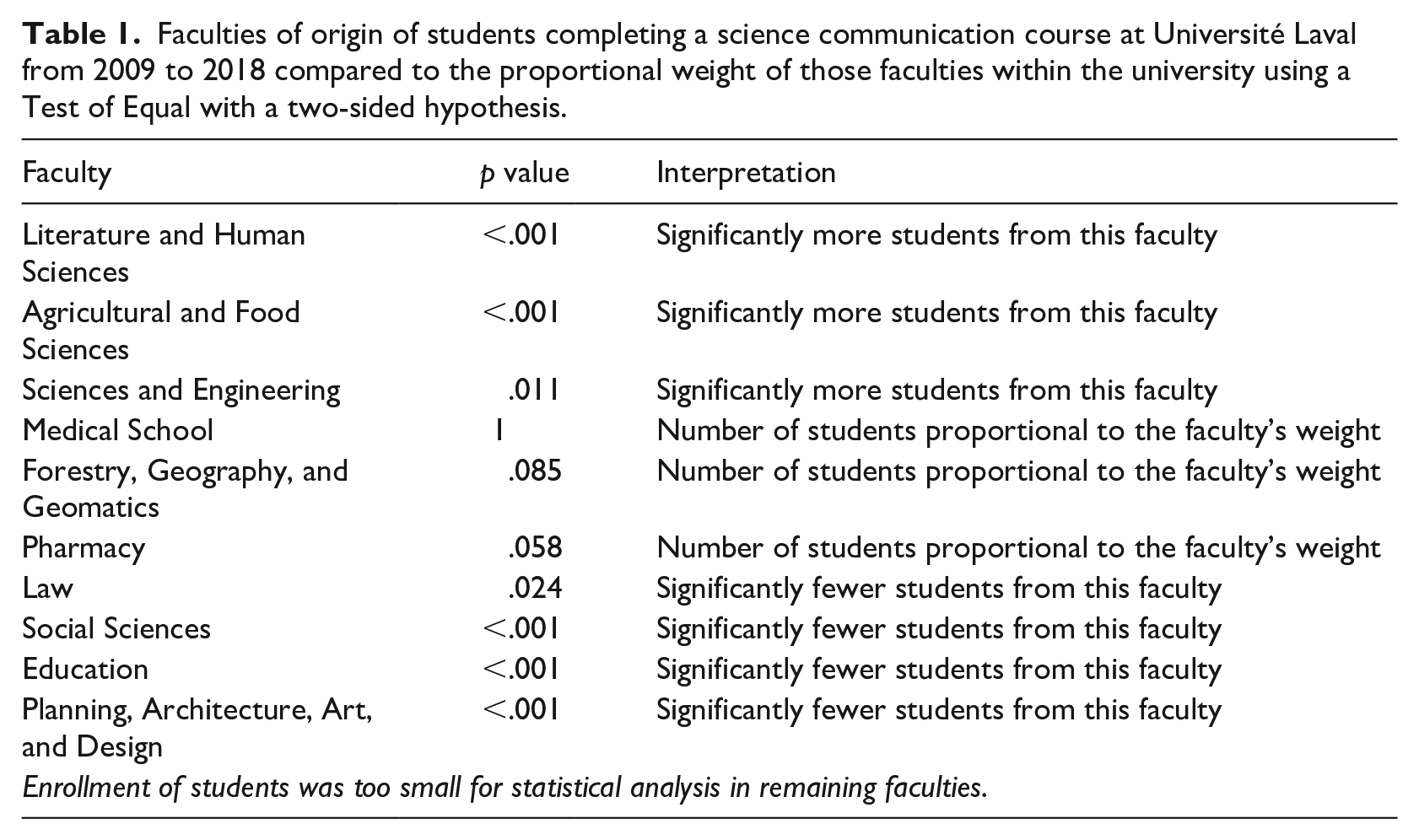
Results as well as the p values from a Test of Equal or Given Proportions with a two-sided hypothesis used to compare student enrollment to their faculty of origin weight in terms of student population are shown in Table 1. Faculties of Literature and Human Sciences (34.5%, or n = 148, of students completing the course), Agricultural and Food Sciences (22.1%, or n = 95, of students completing the course) as well as Sciences and Engineering (18.2%, or n = 78, of students completing the course) show a significantly higher proportion of students enrolled when compared to those faculties’ student population weight within the university, on average, over the same 10-year period. No students from the faculties of International Studies, Music, or Nursing ever completed the course.
Faculties of origin of students completing a science communication course at Université Laval from 2009 to 2018 compared to the proportional weight of those faculties within the university using a Test of Equal with a two-sided hypothesis.
The students came from 67 different programs. The most represented were communication (17.0%, or n = 73), journalism and the microprogram in science communication and journalism (11.6%, or n = 50), nutrition (13.8%, or n = 59), physics (5.8%, or n = 25), agronomy (5.6%, or n = 24), and biology (5.6%, or n = 24). Other programs brought less than 5% of the student body. A proportion of 61.8% were undergraduates. Year-to-year variation was overall low, with some small clusters of students forming occasionally—for example, all three Dental School students were enrolled in the same year, showing that a word-of-mouth phenomenon was probably at play.
Finally, over the 10-year analysis, 65.7% of students were women (Figure 1). This proportion of women enrolled in the course is significantly higher (p = .001) when compared to the proportion of women enrolled in post-secondary education in Québec from 2009–2010 to 2017–2018, which is 57.9%. 2 The predominant programs of origin—communication, biology, nutrition, and journalism—present a high proportion of female enrollment. In Canada, women represent the majority of students in post-secondary programs in biological sciences (60%), health care (80.7%), and arts and humanities (66.2%). Women’s representation is lower in other dominant programs in the present study, such as agronomy and physics (Wall, 2019).
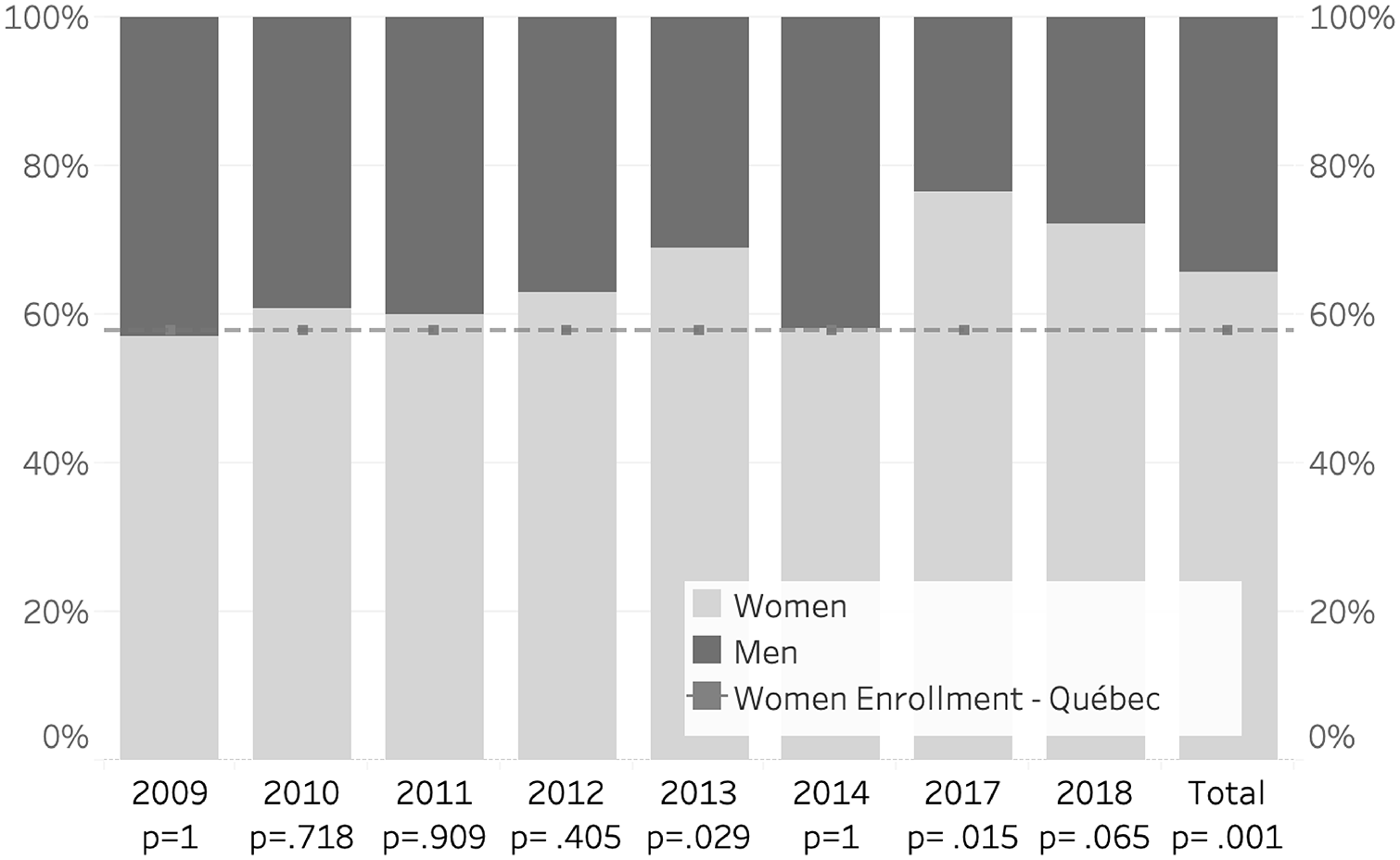
Gender distribution of students completing a science communication course at Université Laval from 2009 to 2018 compared to the gender distribution of students in post-secondary enrollment in Québec using a Test of Equal with a two-sided hypothesis.
Science communication: Coming for the skills
The qualitative analysis of the forum posts shows that the motivation patterns of the students are threefold: career-driven, interest-driven, and online education-driven. All coding category and subcategory proportions per year are shown in Table 2.
Proportion of students coding positive once or more for the different categories and subcategories in a qualitative set of forum posts written by students in 2009, 2014, and 2018 in a science communication course.
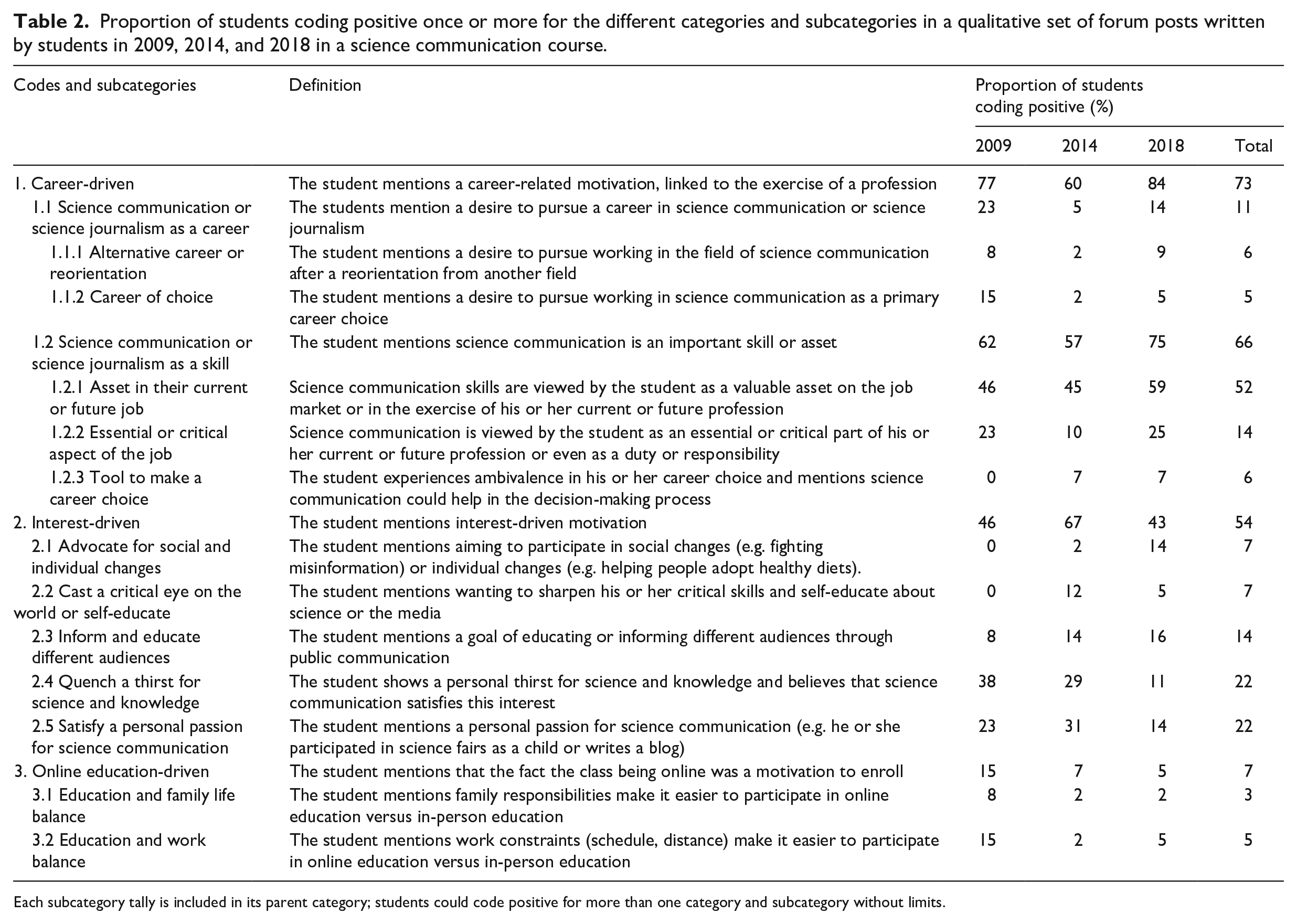
Each subcategory tally is included in its parent category; students could code positive for more than one category and subcategory without limits.
A majority of students’ motivation is career-driven, and more precisely, science communication and science journalism are viewed as skills providing an asset for a current or future profession. As shown in Tables 3 and 4, students from “hard science” faculties, and woman students generally, tend to present that type of career-driven motivation. Many subjects explain that, in their field of expertise, they need good communication skills, and some note that those skills were not taught in their regular program curriculum:
Motivation analysis comparison between “soft sciences” (social sciences, art and education) and “hard sciences” (natural sciences, health and engineering) students in a science communication course in 2009, 2014, and 2018.
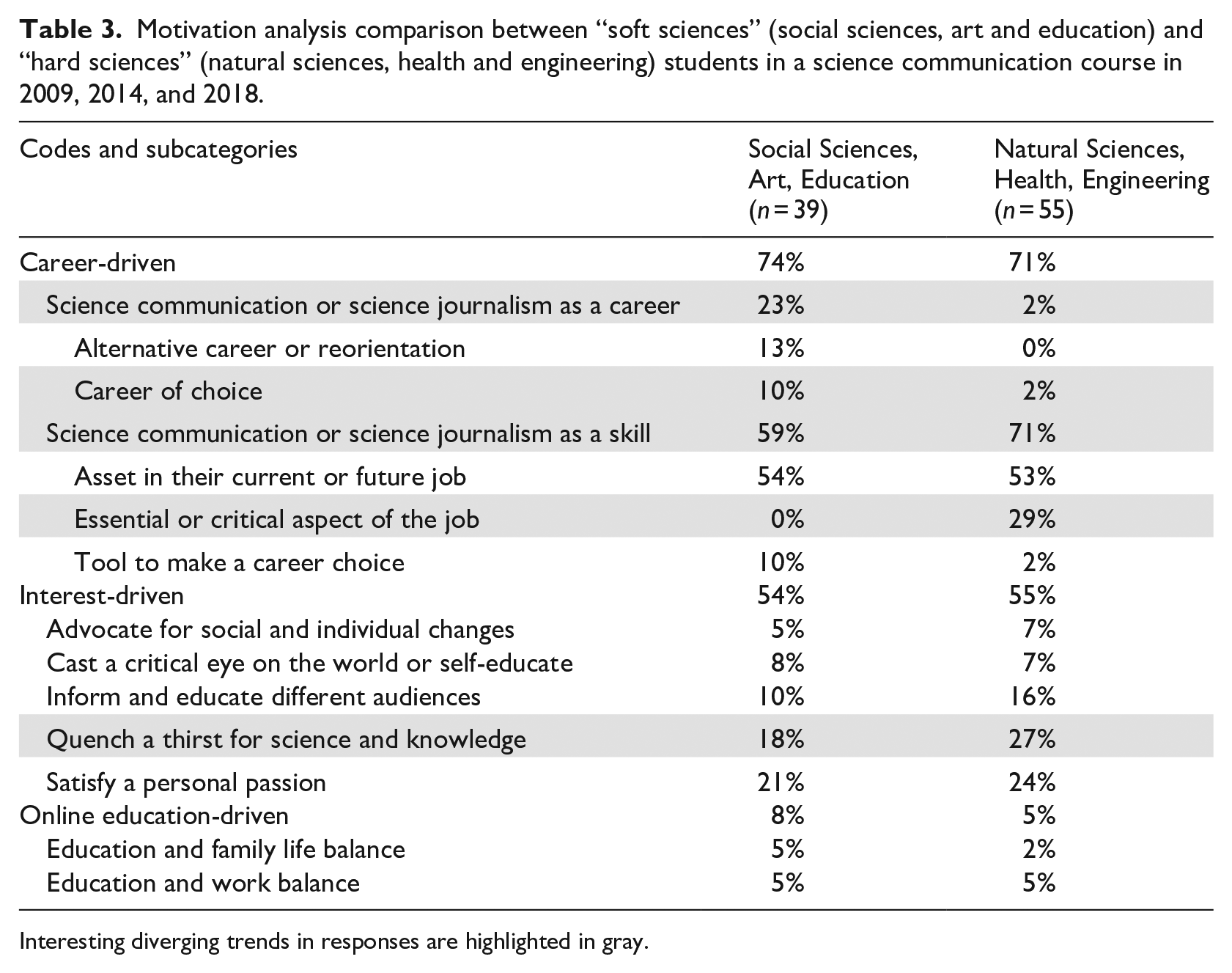
Interesting diverging trends in responses are highlighted in gray.
Gender-based motivation analysis of students in a science communication course in 2009, 2014, and 2018.
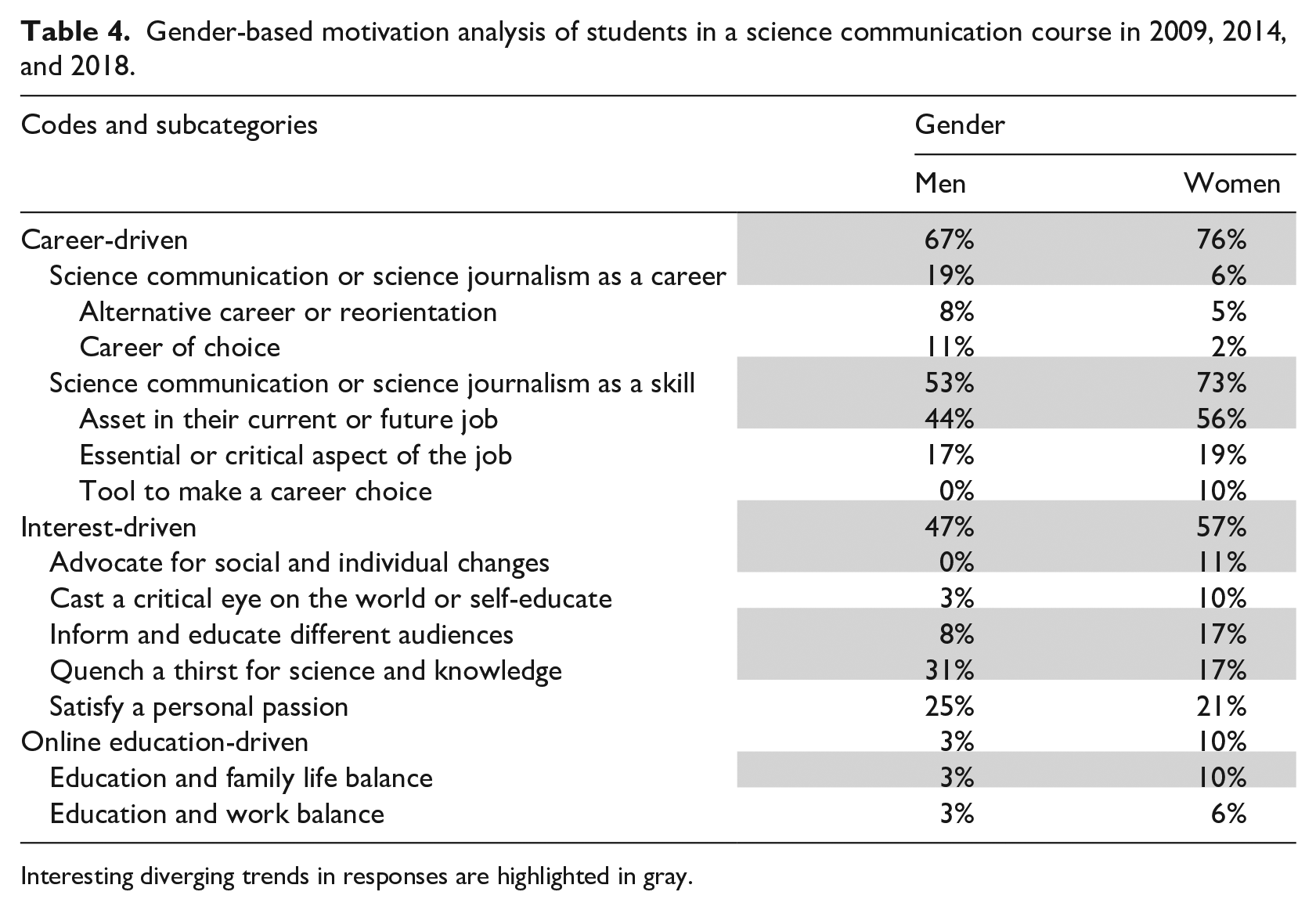
Interesting diverging trends in responses are highlighted in gray.
Nutrition evolves rapidly as a field and we are confronted with a massive amount of information. I chose this course to acquire the ability to communicate that information effectively in my professional practice. (Subject 405, 2018) Unfortunately, no course prepares us to express and communicate our science in simple terms. This course is a tool to help me remedy this shortfall. (Subject 9, 2019)
The students from “soft sciences” faculties, especially those enrolled in a communication or journalism program, also perceive science communication as a skill needed to fulfill their professional role and, more importantly, to distinguish themselves from other journalists.
I have some experience as a generalist reporter, and I would like to improve my ability to explain scientific information of public interest using simple language. I am committed to my work, and I believe journalism still has a place in a world where social issues sometimes collide with financial interests. I want, in a near future, to contribute to public affairs related to the environment. (Subject 413, 2018) I think I could become a better journalist if I could better explain complex issues. (Subject 332, 2014)
For other students showing career-driven motivation, science communication is viewed as a critical aspect of their current or future work, or even as a scientist’s duty. Their motivation is more philosophical (e.g. scientists have the responsibility to communicate with the public) than practical (e.g. communication is part of a scientist’s job).
Career in science communication as a marginal trend
A minority of students are motivated by the aim to make a career in science communication or science journalism. As seen in Table 3, the students from “soft” science fields are more prompt to perceive science communication as a possible career. Only one (2%) student in the “hard” science programs expressed the motivation to pursue a career in science communication (Subject 7 is a woman studying in sciences): I would like to continue working in a zoo or an aquarium. I like working with animals on a daily basis. But those jobs also require interaction with the public. That’s why I think it’s instrumental to have science popularization skills. (Subject 7, 2009)
Two women from the 2009 and 2018 cohorts give some insights about a hidden factor in the finding: some of the “soft sciences” students were first enrolled in an “hard science” field. Both Subjects 11 and 426 were enrolled in a journalism program after dropping out of a previous health or science career: I studied medicine for five years [details omitted for confidentiality] and I finally decided to pursue another path. I started a certificate in journalism to learn the basics of this job with the aim of doing science communication. (Subject 11, 2009) As years went by, I realized academia wasn’t for me. I always thought I would continue my education at the postdoctoral level, and I ended up not starting grad school. After a year off to think about it, I now work for an organization doing youth science outreach. Being passionate about science and its popularization, I wanted to dive into this universe and exploit another facet of my creativity that was left untouched during my studies. (Subject 426, 2018)
It is possible that students in the “hard sciences” programs were not considering a science communication career “yet,” and that taking the class could eventually bring a certain number to do so. Moreover, a majority (60%) of students with a science communication career goal are men. This is how one explains it: I enrolled in this course because I am passionate about science, especially everything concerning animal wildlife. I would like to work for a scientific publication like Québec Science, L’Actualité or, why not, National Geographic. (Subject 393, 2018)
It is possible some of those male social sciences students see the possibility of writing for certain science magazines as more “prestigious,” or science journalism and communication as a way to “harden” their original discipline: this line of inquiry could be pursued in future scholarships. Even in 2018, when 34% (n = 16) of the 47 students in the course were enrolled in the newly launched nine-credit graduate microprogram, only 14% (n = 6) formulate the goal to pursue a career in science communication or journalism. For four out of six students, including Subject 419, this choice is a change of career/alternative: I decided to make a career change toward science writing, a field that fascinates me but that I always deemed out of reach (I don’t have a science degree). By completing this microprogram, I hope to get closer to sciences while doing what I enjoy the most, writing. (Subject 419, 2018)
When passion speaks
Many students also show interest-driven motivation patterns. More precisely, wanting to quench a personal thirst for science and being passionate about science communication explain most of the interest-driven motivation expressed by students.
At the college level, a teacher asked us to write scientific articles of our choice. As soon as the first article was written, I was bitten by the science communication bug and reoriented my career goals. (Subject 3, 2009) I chose physics enthusiastically. But, after one and a half semesters, it was clear something was missing. And that something was, of course, communication. (Subject 12, 2009)
Others were driven by a desire to educate and to make a difference in the world, mainly in a public health perspective. Only women subjects (Table 4) said to be driven by the motivation to advocate for such social and individual changes. For example, I want to promote a healthy diet. I want to make of nutrition an accessible science and urge people to take a critical view of information about nutrition. I would like to review my own critical thinking skills. (Subject 397, 2018)
Distance education matters, sometimes
Finally, the fact the course was entirely delivered at a distance and online is raised as a motivation by seven students. Six of them are women. For four students, balance between work and education is the main reason they choose distance education: Since I work outside of Québec City, without distance learning, it would have been impossible to complete three credits this semester. (Subject 7, 2009)
For the others, both family and work issues are involved in their decision to enroll in distance learning: After a year-long maternity leave, I will be back on-air next Monday. As a full-time journalist and mom, I chose to complete my master’s degree part-time. (Subject 320, 2014)
4. Discussion
To our knowledge, no previous study evaluated the students’ motivation for engaging in science communication courses or to pursue a related degree. A handful of studies evaluated the effectiveness of different science communication trainings (Cirino et al., 2017; Ponzio et al., 2018), but not the student’s own willingness to engage. Others observed the high demand for science communication resources, but did not explore what fueled it (Andrade Oliveira et al., 2019). The studies exploring scientists’ and researchers’ motivation to engage in outreach are the closest literature we can rely on for comparison. Studies found that scientists who participate in outreach wish to stimulate the public’s interest, enthusiasm, level of culture, and appreciation of science, or they feel a sense of duty doing so as well as, sometimes, a personal passion for it (Martín-Sempere et al., 2008).
The fact the students in the present study were fairly divided between hard sciences faculties, with a slight advantage for the hard sciences, is in line with previous findings showing that the science communication field is divided between the two trends (Krieghbaum, 2016; Riedlinger et al., 2019; Ryan and Dunwoody, 1975).
The gender patterns we observe are also consistent with the literature, with women being predominant in the field (Riedlinger et al., 2019). A feminization trend became visible in the 1980s (Lewenstein, 2019; Pérez-Bustos, 2019). This proved true in Québec, too (Fleury et al., 2012). Mellor (2013) makes the hypothesis that women science graduates are looking for an alternative career and therefore engage in science communication. This trend was not clearly observed in the present study. Studies showed women scientists also tend to participate more in outreach than men (Fuchslin et al., 2019).
Also, anecdotal observations from colleges providing online education in Canada and insights from scholarly studies from various countries indicate that there is a greater proportion of women taking courses online than in a conventional, in-person setting (Kramarae, 2007; Lewington, 2018; Lokken, 2019).
One can ask whether gender influences the desire to engage in science communication or whether the marketing of science communication targets women. AbiGhannam (2016) argues that labeling science communication as a gendered activity could participate in the alienation of women from science careers and positions. Or perhaps some women engage in science communication because they are unable to secure a position within their field, or seek a better work and family balance.
The skill-oriented motivation patterns of students enrolled in science communication might also reflect the competitive environment of many science fields, where one needs to stand out to secure a position either in academia or the private sector.
5. Conclusion
The understanding of the motivation patterns of science communication university students is paramount to the design or revamping of science communication programs and courses. University administrators, faculty deans, department chairs as well as professors and instructors will benefit from this portrait. While, as educators, we might believe the objective of our courses is to train science communicators and journalists, we might be partly wrong. This study shows the breadth and diversity of students’ motivations. But we need to acknowledge as a limit that the course attracted a wide range of students precisely because it was tagged as an elective that anyone could benefit from. The portrait and motivations of science communication students at Université Laval could differ from other universities and locations. Since this study might be one of the first explorations of the question of students’ motivation to engage in such courses and programs, it cannot be generalized, and we call for more research to explore this important issue.
In regions where the job market for science communicators is relatively small, mixing the training of future professional science communicators/journalists, scientists, and other professionals looking to enhance their communication skills might be a way to avoid financial shortfalls and to maintain programs through time. Future research should also address the influence course design and advertising have over enrollment profile for science communication courses and programs.
Supplemental Material
sj-docx-1-pus-10.1177_09636625211051970 – Supplemental material for Science communication skills as an asset across disciplines: A 10-year case study of students’ motivation patterns at Université Laval
Supplemental material, sj-docx-1-pus-10.1177_09636625211051970 for Science communication skills as an asset across disciplines: A 10-year case study of students’ motivation patterns at Université Laval by Amélie Daoust-Boisvert in Public Understanding of Science
Footnotes
Acknowledgements
The author thanks Lucie Laumonier (Concordia University), who contributed to the data analysis and literature review; Yara Abu Awad (Concordia University) for her advice with statistical analysis; and Jean-Marc Fleury (Laval University), who contributed to the creation of the science communication course and microprogram at Laval University.
Funding
The authors disclosed receipt of the following financial support for the research, authorship and/or publication of this article: The authors received financial support from Concordia University for this study.

Supplemental material
Supplemental material for this article is available online.
Notes
Author biography
References
Supplementary Material
Please find the following supplemental material available below.
For Open Access articles published under a Creative Commons License, all supplemental material carries the same license as the article it is associated with.
For non-Open Access articles published, all supplemental material carries a non-exclusive license, and permission requests for re-use of supplemental material or any part of supplemental material shall be sent directly to the copyright owner as specified in the copyright notice associated with the article.
