




Abstract
The article describes how the idea of “naturalness” was used by three different groups in arguments over the risk of livestock vaccines developed in synthetic biology. Based on interviews with two groups of scientific experts and focus groups with lay people in five European countries, and using Toulmin’s argument analysis as the analytical tool, the article maps and compares the different ways in which “naturalness” was used as a warrant. Several notions of “naturalness” are involved in lay people’s reasoning and several lay people’s understandings of risk relied on their perceptions of the “unnaturalness” of the synthetic vaccines. The notion of “naturalness” was used less by synthetic biology experts and not at all by vaccine experts. Lay people see the vaccine as less natural than other vaccines and therefore as a greater risk. In contrast, synthetic biology experts understand synthetic biology as natural, and relate naturalness, unpredictability and risk.
Keywords
1. Introduction
New biotechnologies and their use have often been the subject of controversies between the public, scientific experts, government, and industry. This has happened with genetically modified (GM) crops, where European citizens have been reluctant to accept or buy food products based on genetically modified organisms (GMOs) (Hudson et al., 2015; Lassen and Sandøe, 2009; Shaw, 2002). Scientists often consider the lay public as misinformed about, and excessively suspicious of, biotechnologies (Horst, 2013; Wynne, 2006). They, as well as politicians and government officials, tend to limit their concerns to questions about the risks and benefits of the use of biotechnologies (Boëte et al., 2015; Lassen, 2018). At the same time, it has been suggested that “scientists” are not as uniform a group as some social scientists have hitherto thought, and that expert perceptions vary greatly (e.g. Besley and Nisbet, 2013; Boëte, 2011; Boëte et al., 2015). A growing body of studies has identified recurrent themes and concerns among lay people in relation to new technologies (Giordano et al., 2018; Irwin and Wynne, 1996; Kronberger et al., 2013; Lassen, 2018). An important finding is that the public do not only assess new technologies in terms of their perceived risk to human health and the environment but also consider questions about usefulness, together with moral questions, including questions about naturalness and justice. The specific content of public concerns appears to vary depending on the context and the specific application being considered (Lassen and Jamison, 2006).
Recent developments in genetic technologies have introduced synthetic biology as a new area of research and development within the agricultural food sector. Synthetic biology is a scientific field in which organisms are modified (or “re-designed”) for useful purposes. While no empirical studies directly address expert views on synthetic biology, we do have some information about lay perceptions from recent scientific studies, which seem to confirm that public concerns about synthetic biology are similar to concerns over GM foods. Research suggests that public attitudes depend on the perceived benefits and risks of synthetic biology: that is, lay people tend to accept applications of synthetic biology if they are seen to bring advances for a large group of people and if the risks are low (Akin et al., 2017; Pauwels, 2009, 2013; Starkbaum et al., 2015). Linked to the lay requirement that biotech applications should be useful to be acceptable, has been a concern whether in reality corporate interests prevail (Lassen et al., 2002). Research has also found that lay people worry about synthetic biology because they regard it as a form of human interference with nature (“playing god”), and that people’s attitudes to applications of synthetic biology depend on the degree to which the applications are seen as “natural” (Avellaneda & Hagen, 2016; Dragojlovic and Einsiedel, 2013; Kahan et al., 2009).
Unnaturalness has often been found to be a decisive concern in studies of lay perceptions of biotechnologies used in the production of foods (Mielby et al., 2013; Román et al., 2017; Scott et al., 2018). Where foods are concerned, the label “natural” is typically associated with positive characteristics and seen as the opposite of toxic, processed, artificial, risky and dangerous (Ditlevsen et al., 2019; Douglas, 2002; Rozin et al., 2012). Although, at times, naturalness is used as a proxy for ordinary positive qualities, it is often linked to broader moral judgments implying that whatever is “natural” is inherently good (Rozin et al., 2004; Scott et al., 2018). The term “natural” has many meanings and can be used both in absolute terms and, relationally, to express the idea that one thing is more, or less, natural than another (Chambers et al., 2018). In a study of public perceptions of cisgenic crops, Mielby et al., 2013 identified no fewer than five distinct aspects of “unnaturalness” in the reasoning used by lay people: (a) a history-based argument, which builds on the idea that natural entities are independent of human inference; (b) a substance-based argument, where natural entities are free of foreign materials (e.g. genes) and thus kept within the borders known in nature; (c) a feature-based argument in which the physical properties of natural entities are not modified; (d) a harmony-based argument based on the idea that natural entities are in harmony with nature; and (e) an acquaintance-based argument, where what is natural is what is well-known. The underlying categorization of notions of unnaturalness originates from a review paper by Siipi (2008).
While ethical concerns about unnaturalness are widely recognized as an important driver of lay perceptions, little is known about how experts understand naturalness in relation to emerging biotechnologies. The study reported in this article adds to our understanding of the differences between lay and expert perceptions of synthetic biology. Using the development of a livestock vaccine obtained by synthetic biology as a case, our aim was to investigate how lay people and two groups of experts (synthetic biology scientists and vaccine scientists) use the concept of naturalness to support their views.
The role of naturalness is particularly interesting because it plays a significant role in public perceptions of biotechnologies in general. Synthetic livestock vaccines combine two areas of concern where experts and lay people may, or may not, differ in their understandings and assessments: (a) synthetic biology and (b) the use of vaccines in the food sector. The development of livestock vaccines has occurred without much public attention or scholarly interest from the social sciences. The few studies that do exist suggest that experts have a higher level of acceptance of animal vaccines than farmers and the population as a whole (Zingg and Siegrist, 2012a) and that consumers are reluctant to eat meat from vaccinated animals (Scudamore, 2007; Zingg and Siegrist, 2012b).
This article will answer the following research question: How is the notion of “naturalness” used by lay people, vaccine experts, and synthetic biology experts in arguments about the possible risks associated with synthetic biology vaccines for livestock?
2. Methodology
The study reported here is part of a larger in-depth study addressing lay and expert perceptions of livestock vaccines produced using synthetic biology. 1 In this study, the aim was to sociologically explore considerations among lay people and experts in relation to the development of a serum-free, universal vaccine chassis against Mycoplasma for livestock, which was under way while research was being conducted (MycoSynVac, 2019). This vaccine is synthetically engineered by means of artificially constructed genes, which resemble the microorganism, which causes the disease.
In the following, data production within the larger study is described, while the description of the analysis is limited to aspects with relevance to the present research question. Since there is limited scientific knowledge of lay and expert attitudes to synthetic biology and vaccines, a qualitative approach allowing these attitudes to be explored was chosen. It was designed to capture the diversity of perceptions among lay people and experts working as researchers on animal vaccines and experts doing research within synthetic biology. The study focus was not restricted to the specific MycoSynVac livestock vaccine, but included considerations on use of different kind of vaccines and other strategies to prevent and treat animal infections in agriculture more broadly in order to capture the complex set of values, observations, anxieties, opinions and interest that influence specific perceptions of an issue.
Individual interviews with experts and focus group interviews with lay people were carried out in five European countries: Denmark, the United Kingdom, Poland, Austria, and Spain. These countries were chosen to ensure that a diversity of factors known to influence perceptions of new technologies in the area of food and food production were represented. One dimension of that diversity is the degree (high/low) and nature (formal/informal) of public involvement in science governance. Following the typology of Mejlgaard et al. (2012), Denmark and the United Kingdom are countries in which there is both formalized, and a high degree of, public involvement in science governance. In Poland, there is formalized, but a low degree of, public involvement. In Austria, there is limited formal, but a high degree of, public involvement, and in Spain, there is limited formal involvement and a low degree of participation. A second dimension of diversity is economic—specifically, variation in the country’s economic situation and the relative importance of the agricultural sector for the country. In United Kingdom, the importance of agriculture is categorized as “low,” in Denmark and Austria, it is “Middle,” and in Poland and Spain, it is “high” (EU, 2013). Third, based on findings in European surveys (Gaskell et al., 2010), the countries were chosen to reflect differences in public attitudes to new technologies. Denmark is the country with the highest share of generalized technological optimism among the five, followed by Spain, the United Kingdom, Poland, and Austria. Austria is also the country where most disapprove of synthetic biology, followed by Poland. Denmark approve slightly along with the United Kingdom, whereas Spain is more approving of the biotechnology. Yet, in all five countries, many people do not have an opinion on synthetic biology.
Recruitment
The recruitment of the lay participants ensured a wide diversity, since lay publics should not be seen as a uniform entity unaffected by social factors (Irwin and Wynne, 1996). Sampling was based on the factors: gender, age, place of residence (city or countryside), income, and education in order to secure variation in perspectives. The recruitment criteria were designed by the research group and a professional company managed the recruitment itself. Lay participants were defined as citizens aged 18–69, with no specific knowledge on biotech science, agriculture, or consumer responses to biotechnology. People who (or had household members, who) worked with marketing; market research; journalism/public relations (PR)/consumer research; biotech science or industry; manufacturing of meat or dairy products were excluded. Four focus groups were conducted in each country, each had between 5 and 10 participants. In total, 154 lay people participated.
The two groups of experts were recruited for individual interviews. Sampling was done with reference to disciplinary affiliations, seniority, and area of work (basic or applied science). Key persons working at universities or public research institutions within the two scientific fields were identified in the five countries, and they recommended junior colleagues and peers for the interviews. Five interviews with experts were conducted in each of the case countries, except Poland, where only three experts were recruited. Ultimately, interviews were held with nine vaccine experts 2 with a background in veterinary science or immunology, and 13 experts in synthetic biology with backgrounds in chemistry, biochemistry, physics, or computer engineering.
Interview guides
Interview guides were developed for each of the three populations using a deductive approach. The themes reflected issues known from the literature to be central: risk, trust, usefulness, justice, regulation, and animal welfare. The guides also allowed the interviewees to suggest and develop additional themes. The theme “naturalness” was spontaneously, and repeatedly, raised by participants in the focus groups with lay persons, but rarely in the expert interviews. Where appropriate, the interviewer prompted the experts to talk about “naturalness.” (Interview guides available in UCPH, 2017).
Focus groups with lay participants
Synthetic biology has hardly entered public awareness (Gaskell et al., 2010; Kronberger et al., 2011), and the interview guide was designed so that participants were provided with the relevant information before debating specific issues related to the synthetic vaccine. Before information was provided, the different interview themes were opened with an open discussion allowing the participant to bring initial reflections and considerations to the table.
The focus groups started with two exercises on Consumption of animal farm products. Second, the discussion moved on to Animal welfare, aiming to move from a consumer context toward an agricultural production context. Third, the discussion dealt with Maintenance of healthy livestock. Participants were asked to brainstorm on methods to prevent diseases among animals, and then to discuss which were preferred. This was followed by a structured ranking exercise of the six strategies “vaccines,” “change of feed,” “antibiotics,” “not do anything,” “strict indoor containment,” and “kill infected livestock.” Then, the participants were informed about three different kinds of vaccines (dead vaccines, GM vaccines, synthetically engineered vaccines) and were asked to rank them, but were not given a principle or scale to rank from. This section concluded with an open debate on consumption of meat from vaccinated animals. During the abovementioned exercises and discussions, the moderator structured the debate to touch upon the themes – risk (related to animal diseases and vaccines), usefulness (synthetic biology as potential helpful technology), justice (perceptions of fairness and unfairness related to the production and use of the vaccine), trust and regulation (in relation to control over production and use of vaccine).
Interview with experts
Individual interviews with both groups of experts started with questions on their professional expertise. Synthetic biology experts were then asked to assess different synthetic biology applications and to describe their own field of work. This was followed by questions on their perception of risks related to their own and others use of synthetic biology. Vaccine experts were asked to reflect on the importance of animal welfare from a professional and personal point of view, and then to assess different kinds of animal vaccines (including synthetic vaccines). Then, they were asked to reflect on who would potentially benefit from a serum-free, universal vaccine chassis against Mycoplasma for livestock, and how it should be regulated.
Interviews and analysis
All expert interviews and all Danish and UK focus groups were conducted by the second author. Lay interviews in Spain, Austria, and Poland were carried out by native-speaking moderators with the second author present. Interviews were recorded and transcribed, and those in Austria, Poland, and Spain were also translated into English.
The transcribed and translated interviews were analyzed in a two-step procedure. First, they were coded using NVivo11 (Daly et al., 1997). Codes were developed to cover sections where participants referred to naturalness when discussing risks related to the synthetic vaccine. In this study, we looked at risks to human health, animal health, and the environment. Coding included sections where interviewees explicitly used the terms “natural,” “unnatural,” “nature,” “unnaturalness,” and “naturalness,” as well as sections where alternative terms such as “artificial,” “modified,” and “biologically” were used or it appeared from the context that the participants were talking naturalness. In the second part of the analysis, the codes were further scrutinized using a simplified version of Toulmin’s argument analysis (Hitchcock and Verheij, 2006; Simon, 2008; Toulmin, 2003). The arguments were analyzed into three elements: a claim about the issue, the data supporting the claim, and the warrant logically linking the claim and data. Warrants express the political or cultural values which make the argument plausible and legitimate in the eyes of the person endorsing it (Toulmin, 2003).
The goal was to make a comparative study of lay and expert perceptions of naturalness in the context of synthetically modified livestock vaccines, and the analysis therefore did not assess the significance of countries of origin. The aim was to illuminate lines of argument, not individuals, or individual’s in-depth understandings of the issues. It should be noted that the analysis presented below is limited to common perceptions—that is, perceptions that appeared with some emphasis and frequency across the interviews.
3. Results
In this section, the way in which “naturalness” is invoked in reasoning (claim, data, warrant: Toulmin, 2003) about the risks associated with synthetic livestock vaccines is analyzed.
Lay persons
The lay participants from Denmark, Austria, the United Kingdom, Spain, and Poland judge synthetic vaccines for livestock to be useful in improving animal welfare and as a replacement for antibiotics in agriculture; the vaccine was assessed positively by the majority (the risk of agricultural use of antibiotics and the risk of antibiotic resistance were discussed unprompted in most focus groups). While the majority of interviewed lay participants see possibilities in, and accepted, the vaccine, some also express concerns about potential risks created by the use of a new technology in meat production. It should be noted that some participants consider “naturalness” very important, while others feel the question on naturalness of the vaccine is insignificant.
The “unnaturalness” of synthetic biology and vaccines
“Biology should never be synthetic [. . .] it’s an oxymoron, because biology can never be artificial,” a participant states in a British focus group. This fundamental assumption about synthetic biology is important, as the lay understanding of the risk of synthetic livestock vaccines rely heavily on it. In half of the focus groups, participants spontaneously associate synthetic biology with “unnaturalness” (using the phrases “artificial,” “not natural,” “against the laws of nature,” “interfere with nature,” “manipulation of nature”). Consider this extract, for example, in which participants are given a definition on “synthetic biology” and then reflect on it:
Then it has nothing to do with biology. To me, biology is something biologically produced, it is growing in the great outdoors—otherwise it is not biology anymore.
It’s not biology for me either.
These two words [synthetic and biology] contradict in my opinion.
What does not exist in a natural way, in nature, does not exist biologically.
(Focus group 4, Austria)
It is clearly claimed that synthetic biology is unnatural. The claim is supported with data: because it does not exist in nature. This understanding is based on an underlying idea of “natural,” in which natural entities come to exist without interference. Here, this understanding is the warrant linking claim and data.
A minority of participants suggests that the maintenance of good health depends on an active immune system, not a system made redundant by vaccines: “If you over-vaccine you’re not allowing them to build up a natural resistance to your disease,” as one participant expresses it. The assumption is that animals need a “real” illness to strengthen their immune system, and the body’s “natural” defense mechanisms are preferable to artificial aids. Interestingly, this idea of the natural workings of the body was also used when participants ranked different kinds of vaccine. One participant states, “I would rank them according to the principle of naturalness,” with the most “natural” (i.e. inactivated or live attenuated) as the most favored, and the “unnatural” (i.e. GM or synthetically obtained) as the least. This differentiation between “natural” vaccines, as opposed to unnatural imitations, is often remarked on by the participants. In the following sections, it will be shown how the distinction functions as a line of demarcation between risky and safe.
Unnatural technologies as risk
While some participants are unconcerned about the risks of synthetic vaccines, others had little faith in the ability of the authorities to protect consumers and lay people from risks related to the vaccine. Three lines of argument which motivate worries about risks associated with the “unnaturalness” of the synthetic technology will now be described.
Naturalness: Artificial substances are risky
In the first argument, concerns about the synthetic vaccine relate to the artificial nature of the biotechnology it is based on. Thus, in one of the focus groups, D expresses concern over the synthetic vaccine, which he contrasts with “traditional vaccines made with real viruses”:
I don’t trust them [synthetic vaccines]. Somehow, I’m worried because I don’t know what the synthetic is . . . You know that traditional vaccines are made with real viruses, but these others . . . they make me doubt. (Focus group 18, Spain)
Participants consider synthetic vaccines to be “unnatural,” and therein lay a risk. “Natural” is considered safer, because something defined as “natural” is assumed to be more predictable than synthetic products where you ‘don’t know.’ While the participants do not reject the use of synthetic biology altogether, they do in general agree that “the artificial” should be last resort:
The artificial [synthetic] vaccine would be the one that I would least like—but I would still try what helps the best. But the artificial would always be my last thought, because it is artificial. The others are better, because it is better when we treat animals in—“quotation marks”—a natural way, so that the body can react itself and can handle it. (Focus Group 13, Austria)
“Natural” vaccines activate the body, causing it to do what it has always had the capacity to do—which is to begin a process that is the same whether the activating virus is injected through a vaccine or contracted by accident. In contrast, there is a perception that GM and synthetically created biological materials would cause the body to react to something that does not occur in nature. The body’s response itself would then become less natural, and this is considered risky. Very few of the participants are opposed to vaccines in general, but many exhibit concerns about risks connected with vaccines containing synthetic or GM material. Here, we see the argument that “artificial” synthetic vaccines are risky (claim), because it is unpredictable how organisms will react to artificial substances (data), since unnatural vaccines do not activate a process which is already latent in the organism (warrant).
Naturalness: Tampering with natural harmony is risky
“I am not a vet, but anything that changes the natural food chain can be potentially dangerous,” one participant states. In the second line of argument, the interpretation of “unnatural” is related, not to what the vaccine is made of, but rather to the idea that the vaccine changes the way in which foods are produced. The idea is that there is a well-established method of food production, and that modifications of this will introduce changes to the “natural” food chain. Here, G explains,
Well, for me it is the same as an artificial heart or those 3D organs [. . .] It is a risk factor, it is playing god. The question is: how far does it get out of control? What else can come without us knowing whether we can stop it, and so on . . . It’s a risk. (Focus group 4, Austria)
G claims that to put something “artificial” into an organism is to “play god,” which is a potentially risky interference with the natural state of things. Underlying this claim is the notion that if humans tamper with the natural order (“play god”), the development may run wild and be impossible to control. Several participants warn against synthetic vaccines by making a comparison with additives in food products. In this perspective, synthetic vaccines for livestock are an unwanted additive in meat. In the following remarks, a participant compares her doubts about synthetic vaccines with her distaste for “unnatural” additives of a different sort:
I make my own skin care products of natural ingredients, for instance [. . .] when I make it myself, I know exactly what’s in it, and I don’t put all sorts of weird things in it, which in not healthy for my body. Anything artificial, I am against. (Focus group 5, Denmark)
Additives (“weird things”) are considered unnatural and therefore present a risk to human health. In this line of argument, the claim is that synthetic vaccines are risky because they introduce unnatural changes in a product (data), whereas by contrast, natural products are in harmony with the natural order (warrant).
Naturalness: Dangerous because it is new
Some participants explain their concerns about synthetic vaccines by referring to the need to be particularly cautious with emergent technologies. Consider, for instance, the following exchange, where M states that new, “unnatural” technologies per se are dangerous:
Yes, the safest are the inactivated and the attenuated vaccines . . .
The genetically modified and the synthetic ones are dangerous.
We don’t know if they are dangerous.
It’s dangerous because it’s new, according to me.
Because it is genetically modified, yes.
And this is the danger. Because [the synthetic vaccine] is new and [. . .] was not launched yet,
right? So in fact it’s not known what kind of results and effect it can have.
(Focus Group 11, Poland)
Some of the participants do not distinguish between GM and synthetic vaccines, and considering them both to be “dangerous.” But for M, the main reason for calling the synthetic vaccine “dangerous” is that it is a “new” way of affecting the body of the animals. It is the combination of “new” and “unnatural” (“modified”) that makes the vaccine risky in this line of argument. This is underscored in the comments below:
I prefer the natural vaccine, because those [synthetic] are not tested and there might be side-effects. Perhaps they are still unknown.
Exactly . . . they don’t talk about them.
Maybe the synthetically engineered vaccine can modify some part of the animal or something weird. Who knows!
(Focus group 17, Spain)
Most participants believed that, in general, the vaccines used today have been thoroughly tested, but some stressed that tests cannot be assumed to cover effects that you “don’t think about” or “long-term side-effects.” Anxiety about these unknown unknowns is serious enough to make some participants agree that they would not buy products from vaccinated animals because they would “rather not take the risk.” The claim in this line of argument is that the synthetic vaccine is dangerous. This is backed by the data: because it is new and unnatural. The warrant implicitly linking the claim and the data is: whereas only well-known or natural vaccines can be considered safe.
Wrong rather than risky
One line of argument stands out from those examined above: in this, the synthetic vaccine is considered unnatural and “wrong,” but not necessarily risky. In the following extract, the claim that what is “unnatural” is wrong is used in a discussion of the benefits of synthetic vaccines. The group discussion appears to have reached a general consensus that the synthetic vaccine is good because with it the animals will be healthier. Then one participant objects:
Do you become a healthier version of you, if the vaccine is artificial?
If the cow is healthy, then I shouldn’t become unhealthy.
It’s not necessarily the same . . . you can get cured for an illness with something artificial, which makes you healthy . . . but inside you there is something . . . err . . . wrong. (Focus group 5, Denmark)
L suggests that a living creature cannot be considered “healthy” if there is some kind of unnatural (“artificial”) entity in its body. She justifies this belief by saying that even if cows are cured, something artificial inside them will still be “wrong.” This argument does not treat unnaturalness as a proxy for risks. Instead being “natural” becomes a value in itself, something that is inherently better than being “unnatural.” The argument against the synthetic vaccines is therefore that the vaccine is “wrong” (claim), because it interferes with the natural workings of the organism (data), whereas natural entities are in harmony with the natural order (warrant). The argument does not challenge the consensus that the vaccine is useful and safe: L is arguing that artificial vaccines remain wrong no matter how “healthy” the cows might be.
The equation of “unnatural” with “wrong” is recurrent across the focus groups, but it is rarely elaborated explicitly in arguments. It appears to be rather difficult for participants to articulate the argument, as can be seen in the following comments, made by a participant who is justifying her preference for “natural vaccines”:
I mean, I would just say natural, just because . . . the more natural something can be, the better. Other than that, I wouldn’t be able to make the call between [the vaccines]. (Focus group 19, the United Kingdom)
The same difficulty is visible in the following extract from a discussion in which E counters a general consensus on the synthetic vaccine being risky:
In the case of the synthetic vaccine, there is a chance that it would not mutate like bacteria do now. The synthetic vaccine remains as it is.
But biology is biology. Nature is . . . Natural processes take place in our organisms, and once we start something artificial . . .
Yes.
Exactly.
Natural bacteria multiply, while this synthetic . . . [further interruption]
(Focus group 11, Poland)
While arguing that the synthetic vaccine may not mutate (i.e. be risky), E is interrupted by other participants, who protest without saying very much at all in justification of their opinion. They simply deem the synthetic vaccine to be wrong because it is unnatural, period.
Synthetic biology experts
Generally speaking, the synthetic biology experts considered the synthetic vaccine to be useful because it could decrease the use of antibiotics and the risk of antibiotic resistance, and help in the fight against infectious diseases. These experts also consider it useful in terms of the scientific advances that may follow from the development of applications. When talking about risks, a few of the scientists mention the spread of disease as a serious risk in work with the applications of synthetic biology. Some refer to unintended risks; others articulate concerns about deliberately harmful activities such as bioterrorism. A third category of risk, mentioned by a few of the scientists, center on mutation, and the development of resistance when the potential vaccine is actually used.
The naturalness of synthetic biology
The term “naturalness” is used much less in the interviews with synthetic biology experts than it is in the lay focus groups. In fact, naturalness is seldom brought up spontaneously by the interviewees. The scientists who use the term “natural” do so mostly to distinguish between chemical methods for extracting substances and methods where synthetically constructed organisms produce the desired substance. “Natural” is used to describe objects and processes that belong to the biological world, while the use of chemicals is considered “unnatural.” In the interview extract below, a scientist is explaining her understanding of the term “natural” by comparing it to lay people’s understanding. She suggests that her understanding of “natural” is more accurate:
Speaking to someone, I am trying to be very careful with my words, because I have noticed that they [lay people] get it mixed up. They can actually not tell what’s natural and what’s not. So, if I change plants in order to produce vanillin, and it’s done by the plant, to me that’s more natural than if I do it in a chemical lab. [Lay people] can’t understand that. They just cannot wrap their heads around it. For me “natural” means that you have not done any intervention. (Scientist 12)
For this scientist, it is less “natural” to use chemicals to synthetize substances than it is to manipulate a plant to produce it: “an intervention” in the “natural” order occurs when chemicals are used. In this interpretation, “natural” and “chemical” are opposites, and when substances are produced using “biological” methods they are “natural.” Another scientist explains her sympathy for synthetic biology methods by referring to their “naturalness”:
But I like that, because we work with this biosynthesis [. . .] I kind of like that it’s easier to work with in some way, because we have simplified things, but it’s still natural. It’s still something that goes on in nature. (Scientist 13)
In C’s perception, what she and her team do in the laboratory is “natural” because it does not differ from the biological processes that take place without human interference. Organisms are “natural” as long as they stay within the biological realm. The claim: synthetic biology is natural, is thus backed by the data: because the development follows the laws of nature, and the warrant: whereas unnatural substances are created by intervening by chemical means in biological processes.
Naturalness: Natural technologies are risky
The synthetic biology experts did not express concerns about livestock vaccines obtained by synthetic biology which they did not have about other kinds of vaccine:
Some of the citizens I’ve talked to are a bit worried about eating meat from cows which have been vaccinated with synthetic vaccines.
Erm. . . I don’t think that is necessarily a worry. Why would they be more worried about that than an animal serum vaccine? (Scientist 7)
When talking about risks of a synthetic vaccine, the synthetic biology experts tend to refer to risks associated with synthetic biology in general, and when they did share these anxieties. Some experts are concerned about the unpredictability of what will happen when a biological organism interacts in a larger system. One scientist says,
In order to engineer something, you have to understand the component. And we don’t [. . .] In Lego or in a computer, your pieces don’t depend on the context, whereas in biology they do. All the time. (Scientist 2)
For this expert, biological components are unpredictable and dependent on the biological context. The same concern emerges in the interview excerpt below, where another scientist is talking about general risks involved in the manufacture of synthetic organisms:
Plants or bacteria, it is something that you release and then the thing escapes from your control. And why? Because in synthetic biology, we try to design things, we try to build a device that does something. We decide on this from a rational point of view and then forget about the evolution [. . .] Ah, evolution is the enemy—we don’t like it, but it’s there. And if we build a thing that works—for instance, bacteria that can be used to clean the sea—we release it and it will probably work, but when the sea is cleared, what will happen to the bacteria? [. . .] I’m sure the bacteria will evolve and transform into another thing. (Scientist 9)
Some experts expressed concern over the long-term risks of synthetic biology, even though they tended to talk about general risks and concerns about method, rather than focus on the particular vaccine. According to J above, there is always a risk when releasing a synthetically engineered substance or organism into a living system, or ecosystem, because it can “evolve” and “transform into another thing.” This risk is inherent, because the technology is “natural”: nature is not in the scientist’s control, because evolutionary processes are unpredictable. In short, using synthetic biology is risky (claim), because the technology follows the unpredictable laws of nature and is therefore beyond our control (data), whereas unnatural substances are “dead” and within our control (warrant).
Vaccine experts
Generally speaking, the vaccine experts gave the impression that they do not distinguish strongly between different vaccine types such as live attenuated, GM and synthetic vaccines. Very often they are content to talk about vaccines in general. Overall, the participating experts see the synthetic vaccine as useful for improving animal welfare and as an alternative to antibiotics, but they also expressed some concerns about it. Some had doubts about the effectiveness of the vaccine. The main concern—which, again, was only voiced by a few of the vaccine experts—revolved around the risk of unknown consequences of using a modified organism on livestock. This aside, the experts seem to agree that, as a rule, livestock vaccines are a reasonably safe way of protecting animals, and they are unconcerned about risks to humans consuming food products from vaccinated animals. Unlike the other groups in the study, the vaccine experts appeared not to see a link between naturalness and risk or absence of risk.
4. Discussion
The findings summarized above show that concerns about “naturalness” often play a part in lay people’s reasoning when they consider the safety of synthetic biology livestock vaccines. In general, lay people consider synthetic vaccines unnatural because they involve human interference. Two overall kinds of lay argument drawing on this notion of unnaturalness seemed to be prevalent: in one, unnaturalness was linked to risk, and in the other, naturalness was seen as a value in its own right. When risks and (un)naturalness were being linked, three types of arguments supporting the claim that synthetic vaccines are risky for human health appeared. The first referred to the natural as more predictable; the second referred to harmony with natural order, and the third took what is natural to be familiar, or well-known. In explaining and supporting their views about synthetic biology vaccines, the synthetic biology experts referred to naturalness much less often—and the vaccine experts did not refer to naturalness at all. When synthetic biologists did refer to “naturalness,” they equated it with working in accordance with the “laws of nature.” And it was striking that, unlike the lay participants, they regarded naturalness as a basis on which to praise synthetic biology, but also as a risk factor making synthetic applications risky, because for them, nature was unpredictable.
Different aspects of naturalness
The four aspects of naturalness identified in this study are largely in line with the classification used by Mielby et al. (2013) in their analysis of perceptions of the naturalness and acceptability of another emerging technology: transgenic, as opposed to cisgenic, crops. Despite studying perceptions of different technologies, both studies identified four similar interpretations of the natural. Both this study and Mielby et al. (2013) found arguments using four aspects of naturalness to justify claims (see Table 1):
A history-based argument, where naturalness depends on the degree of human interference. For example, the view that synthetic biology is unnatural because it represents a high level of technological intervention in nature (lay people); or the view that synthetic biology vaccines are more natural because they follow the laws of nature rather than being product of human interference (experts).
A substance-based argument, where naturalness depends on whether substances have been introduced where they cannot be found in nature. For example, the view that synthetic biology vaccines are unnatural because they introduce artificial substances into organisms.
A harmony-based argument, where unnatural entities are seen as upsetting natural balances. For example, the view that synthetic biology vaccines are wrong, or risky, because they interfere with the delicate balances in nature.
An acquaintance-based argument, where naturalness depends on how well-known a phenomenon is. For example, the view that synthetic biology vaccines are risky because they are not well-known.
Aspects of naturalness in arguments about synthetic livestock vaccines * .
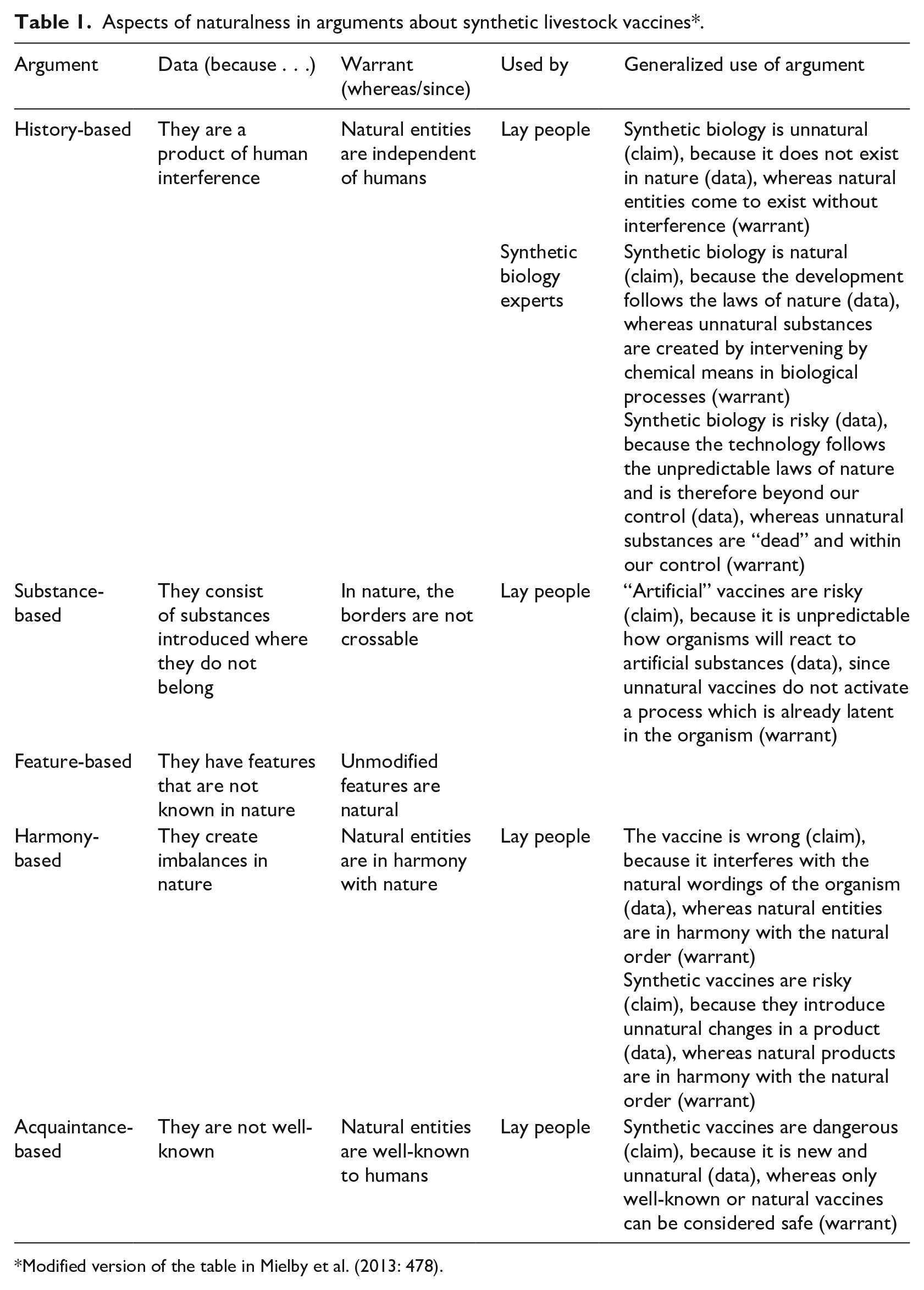
Modified version of the table in Mielby et al. (2013: 478).
In one respect, however, the results of the analysis in this article differ from those reported by Mielby and colleagues: we found no references to feature-based argumentation, where unnatural entities are seen as problematic because they contain features not found in nature. This could be due to differences between the technologies examined in the two studies.
We found a significant difference between the ways in which experts and lay people used the history-based argument. While the experts used it to claim that synthetic biology is “natural,” lay people used it to make the opposite claim. For the synthetic biology experts, a vaccine obtained by synthetic biology was natural because it is produced by processes following the laws of nature. For lay people, the same vaccine was unnatural, because it is produced by human interference and does not follow the laws of nature when used (e.g. the normal processes in the animal’s own immune system). It should be noted that vaccines in general can be seen as human interference and thus invite the history-based argument, as vaccines per se do not exist in nature. But although some lay participants defined all vaccines as unnatural, the argument was used mainly as a relative measure defining something as more or less natural, with some vaccines deemed to be more natural than others.
Lay people used the harmony-based argument in two ways: in understandings of risk, and when making moral judgments. In the latter case, the argument was used to support the claim that the vaccine was wrong because it was unnatural. This argument was conspicuously un-articulated in focus group discussions. This may have been because the claim seemed self-evident to the participants, and as such needed no explanation or justification (Boltanski and Thévenot, 1999, 2006).
The vaccine experts stand out in that they did not relate risk to “naturalness” when considering the vaccine in question. It is possible that vaccine experts consider and accept that all vaccines are unnatural, and hence think of “naturalness” as an aspect that it is irrelevant to discuss.
The general preference for “naturalness” may be explained by the understanding of natural objects as having an underlying “essence” independently from human existence (Kronberger et al., 2013), which is expressed in four of the abovementioned interpretations (the acquaintance-based being the exception). Interfering with this “natural essence” represents, according to a famous analysis by Mary Douglas (2002), a threat toward the perception of the world as a well-structured and stable place. Naturalness represents symbolic order, while unnaturalness represents disorder and creates a diffuse sense of danger among people. Unnaturalness is therefore often met with moral aversion (Douglas, 2002; Kronberger et al., 2013).
Contribution and limitations
This study contributes to the existing literature on ethical concerns about emerging biotechnologies. It provides further evidence that “naturalness” is a decisive concept in lay people’s understandings of the risks associated with the use of synthetic biology (cf. Dragojlovic and Einsiedel, 2013; Kahan et al., 2009). For some, an application’s unnaturalness is more important than whether it is useful. The study also supports the notion that “experts” do not form a uniform group, and therefore that “expert opinion” is not necessarily a meaningful entity to refer to in research into perceptions of technologies or understandings of naturalness (cf. Besley and Nisbet, 2013; Boëte et al., 2015). Differences between experts need more investigation.
It is a limitation of this study that naturalness was not the only study object. Since naturalness was rarely brought up spontaneously in the expert interviews, but was raised very often in the lay focus groups, the study generated more material on lay understandings of naturalness than it did on expert understandings of naturalness. Hence, it is necessary to be cautious in summarizing, and especially in generalizing from, the results presented here.
Implications for public debate
This study showed that lay people consider synthetic livestock vaccines to be unnatural and risky. Given that earlier studies have shown that the unnaturalness of emerging technologies is likely to worry the lay person and create public controversies, this finding points toward potential conflicts over the use of synthetic vaccines. So far, the use of animal vaccines has not been prominent in public debate, but this may change if and when it becomes common knowledge that vaccines are being used in animal production, and that contested technologies such as synthetic biology are being employed. Since lay and expert understandings of what is “natural” differed, there is a real potential for misunderstandings in public debates.
There was some evidence in this study that lay people and experts are not always in opposition. The synthetic biology experts and lay people involved in the study shared one concern over the risk of using synthetic biology applications: the unknown side-effects of releasing an application into a larger system. Despite using different language to explain this risk, and although they also used contrasting definitions of naturalness in presenting their arguments, members from these groups, at least, could potentially all endorse a call for caution.
Footnotes
Acknowledgements
The authors would like to thank the lay and expert participants for taking time to share their opinions with us, and the larger MycoSynVac project group for feedback and support. We would also like to thank Paul Robinson for his assistance in improving our English.
Author Contributions
In October 2019, our friend and colleague Professor Jesper Lassen died from cancer. Jesper was a leading scholar in the study of how modern forms of biotechnology are perceived by the public and by various professional stakeholders. He was a driving force in setting up the study on which this paper is based and he took a leading role in developing the story line of this paper. We are deeply grateful for his contribution.
Funding
The author(s) disclosed receipt of the following financial support for the research, authorship, and/or publication of this article: This paper analyses some of the findings of the sociological study carried out within the Horizon 2020 project MycoSynVac (grant agreement No 634942).
