




Abstract
Guided by neo-institutional theory, this study compares how researchers from science, technology, engineering, and math disciplines differ from researchers from the arts, humanities, and social sciences fields in terms of how macro- and meso-level concerns shaped their willingness to conduct public engagement. Focus group discussions conducted among researchers based in Singapore revealed that science, technology, engineering, and math and arts, humanities, and social sciences researchers held different macro-level concerns. Particularly, science, technology, engineering, and math researchers raised more concerns about media misrepresentation, while arts, humanities, and social sciences researchers were more concerned about receiving political repercussions and public backlash. With regard to meso-level considerations, researchers from all disciplines cited similar institutional constraints for public engagement; however they possessed varying public engagement competencies and held differing perceptions of their social duty to engage the public. Hence, researchers of different disciplines desired different kinds of media training. Policy and managerial implications as well as directions for future research were provided.
Keywords
Research in science, technology, engineering, and math (STEM) has boosted economic progress (Archibugi and Pianta, 1992) and enhanced living standards (United Nations Educational, Scientific, and Cultural Organization, 1999). Meanwhile, research in arts, humanities, and social sciences (AHSS) has influenced governance approaches (Stilgoe et al., 2014), assisted individuals in problem-solving, enhanced their understanding of life, and improved their social interactions (Boulton and Lucas, 2011). However, the public remains uninformed about how STEM and AHSS research have offered solutions for many prominent issues (Twardowski and Małyska, 2015). Hence, the public may have misgivings about the advancements in STEM and AHSS, thereby impeding the extent to which society can leverage on research to progress (Aldrich, 2014). Public engagement is thus vital to cultivate public interest, enhance public knowledge, and help the public make better-informed choices (Besley et al., 2018a; Ho et al., 2015).
Noting the importance of public engagement, numerous studies have examined the motivations and barriers of conducting public engagement among STEM researchers. Yet, few studies have examined these considerations among AHSS researchers (Cassidy, 2014). Even fewer have explored how differences in academic disciplines may manifest in varying considerations among STEM and AHSS researchers about conducting public engagement. Furthermore, most studies were conducted in nations where civil discourse is commonplace (e.g. North America, Europe, and India). Therefore, this study turns to a nation with a nascent public deliberation environment.
To address these research gaps, this study draws upon neo-institutional theory (Meyer and Rowan, 1977) to identify the macro- and meso-level concerns of public engagement faced by STEM and AHSS researchers. This study further teased out the similarities and differences between STEM and AHSS researchers. The study was conducted in Singapore—a country with a nascent public deliberation culture—to explore if researchers face additional societal and political concerns when partaking in public engagement.
1. Study context: Singapore
This study was conducted in Singapore—a globally recognized knowledge-based economy and a hotbed for academic research. Notably, the Singapore government recognizes the importance of STEM research and has provided extensive support (Sidhu et al., 2011) by investing S$19 billion to establish Singapore as a dynamic hub for STEM research (National Research Foundation Prime Minister’s Office Singapore, 2016). The Singapore government has also increasingly supported initiatives to develop a robust AHSS research ecosystem by substantially increasing funding for AHSS research and designating $350 million to develop local talents while fostering global networks of policymakers and scholars (Teng, 2016). This, coupled with private funding from multinational corporations, creates an environment in which Singapore-based researchers have to take into consideration both the national agenda and the interests of corporate funders in their research (Ong, 2016). Corporate interests and interventions may have a connection with how researchers engage with the public (Ong, 2016). For instance, researchers may be inclined to conduct public engagement in a bid to attract more research funds from the private corporations. However, bound by non-disclosure agreements with their corporate funders, researchers may also be restricted in what they can communicate to the public.
At the same time, although Singapore has produced noteworthy academic contributions in STEM and AHSS disciplines, the local public deliberation culture is nascent. The Singapore government has limited the range of topics for media publication and public deliberation to preserve social stability (Tham, 2015). Specifically, topics related to race and religion are forbidden as they are deemed to be sensitive (Singapore Statutes Online, 2018). In the 2018 World Press Freedom Index, Reporters Without Borders (2018) ranked Singapore 151 out of 180, due to the prevalence of self-censorship among journalists as well as the tight regulations for public deliberation, public speaking, and assembly (Government of Singapore, 2018). These moves have stymied free press and outright public contestations of the political system (Tey, 2008).
While Singapore’s emphasis on research could spur public deliberation, its limited press freedom and stifled public deliberation climate may serve as unexplored macro-level concerns that could discourage researchers from conducting public engagement. This study therefore explores how these contradictory conditions may shape Singapore-based researchers’ willingness to conduct public engagement.
2. STEM versus AHSS research
STEM research focuses on solving complex social issues by designing tangible technological solutions. As a result, the intellectual outputs from STEM research could often be monetized (Benneworth and Jongbloed, 2010). Meanwhile, AHSS research seeks to understand human behaviors and resolve social uncertainties, thereby shaping knowledge on human conditions and social welfare (Benneworth and Jongbloed, 2010). Although non-academic actors expect AHSS scholars to produce research that is highly relevant to policies, many AHSS researchers perceive their scholarly work as independent pursuits that offer critical descriptions and reflections of social phenomenon that may not necessarily generate instrumental outcomes (Burchell, 2009). The general public often have wide-ranging views about the roles of AHSS researchers, with some acknowledging the importance of AHSS expertise for society, while others questioning the independence of funded AHSS research (Huber et al., 2019). The public often do not ascribe the same amount of scientific rigor to AHSS research as they do to STEM research (Huber et al., 2019). Moreover, STEM research outputs are more quantifiable than those of AHSS (Benneworth, 2015). Due to these differences, public engagement for STEM research is more commonplace.
However, social issues are complex and multi-faceted. Since these issues require the expertise of multiple academic disciplines, STEM and AHSS researchers have increasingly collaborated on interdisciplinary research projects. For instance, STEM and AHSS scholars have collaborated to provide data-driven recommendations and in-depth critiques on science-related issues (Bastow et al., 2014), such as climate change (Hulme, 2011). Many research institutions provide formal and informal social settings to facilitate cross-disciplinary communication, while multidisciplinary journals such as Nature and Science provide an ideal platform for researchers to be exposed to works beyond their own discipline by emphasizing important research across all disciplines (Schummer, 2008).
3. Neo-institutional theory
This study draws upon neo-institutional theory to organize and present ideas pertaining to public engagement at the three levels. Neo-institutional theory accounts for how organizations adapt to their environment at the three levels (Tolbert and Zucker, 2013), focusing on institutes’ interactions with stakeholders, organizational behavior, and its societal impact (DiMaggio and Powell, 1983; Schultz and Wehmeier, 2010).
Resting upon Weber’s assumption about the utility of formal structures of bureaucracy, organizations face pressures from higher-order institutional systems to adopt rationalized structures and gain legitimacy (Meyer and Rowan, 1977). The adoption of production processes recommended by the International Organization for Standardization (ISO) is a prime example (Tolbert and Zucker, 2013). Therefore, individuals are important to organizational change to the extent that they link the psychological and perceptual processes involved in organizational decision-making to demands imposed at the societal level.
However, Hasselbladh and Kallinikos (2000) criticized neo-institutional theory’s failure in delineating the specific organization–environment interactions that result in organizational change. Despite this theoretical limitation, the theory traces how the interplay among external environment, organization, and employees defines the states of organizations. It emphasizes how examining employees’ behaviors is instrumental in understanding how organizations function (DiMaggio and Powell, 1991; Schultz and Wehmeier, 2010). It also accounts for macro-, meso-, and micro-level triggers that motivate or dissuade employees’ behaviors (DiMaggio and Powell, 1991).
Most public engagement studies have utilized the theory of planned behavior (TPB; Ajzen, 1985) or the integrated behavioral model (Yzer, 2012) to examine how micro-level motivators and barriers influence researchers’ willingness to conduct public engagement. However, neo-institutional theory is better-suited to address the study’s objectives as it holistically examines researchers’ considerations at the macro-, meso-, and micro-levels. Applying neo-institutional theory allowed this study to consider STEM and AHSS researchers in various capacities: contributors to their academic disciplines, employees of their universities and research institutes, and residents in Singapore.
In reviewing the considerations pertaining to public engagement, most literature has focused on STEM researchers. Comparatively few studies have examined the considerations of AHSS researchers. Therefore, this literature review will rely heavily on the findings of public engagement studies on STEM researchers.
Macro-level considerations
Macro-level considerations refer to external triggers from global issues, national legislations, public pressure, and industry-wide practices (Schultz and Wehmeier, 2010; Scott, 2001). In public engagement, macro-level considerations refer to researchers’ relationships with stakeholders (e.g, policymakers, media practitioners, and the public). While certain studies have identified some broad-based philosophical, economic, cultural, and political arguments for science communication (e.g. Bultitude, 2011), limited research has analyzed the specific societal and political conditions that shape researchers’ willingness to conduct public engagement.
A country’s political climate and governance could serve as macro-level concerns that impede researchers from conducting public engagement. Some researchers may perceive public engagement as an opportunity to influence policymaking by providing media comments on contentious issues (Ho et al., 2015). However, researchers’ academic freedom and freedom of expression could be curtailed by the country’s legislative restrictions and media censorship (Cerrato et al., 2018). Despite this, limited studies have explored how political considerations may impact researchers’ public engagement involvement.
As the mass media becomes increasingly integrated with individuals’ daily lives, researchers typically collaborate with media practitioners for public engagement to leverage on the mass media’s extensive audience reach. This phenomenon, known as the medialization of science, highlights the mass media’s crucial role in selecting and broadcasting science content based on news values (Franzen et al., 2012). This implies that researchers’ knowledge and acceptance of the mass media’s operations would impact their considerations for conducting public engagement. According to Dudo et al. (2014), prevailing media policies and researchers’ perceptions of journalists and communication professionals affected STEM researchers’ considerations for public engagement. Many STEM researchers have also expressed disdain and distrusted the media due to past experiences of journalists’ distorting and sensationalizing research findings (Gascoigne and Metcalfe, 1997; Gunter et al., 1999; Hunter, 2016). Some researchers also felt that journalists’ personal beliefs interfered with objective reporting about the research (Gunter et al., 1999). Due to these negative perceptions, researchers may be deterred from collaborating with media practitioners for public engagement.
Researchers’ perceptions of the public may also shape their willingness to conduct public engagement. Researchers who perceived the public to have low interest and literacy in their academic disciplines were discouraged from conducting public engagement (Winter, 2004). Researchers may also be reluctant to conduct public engagement if they perceive the public to lack readiness to discuss controversial STEM and AHSS topics. Therefore, researchers based in a country with nascent public deliberation culture, such as Singapore, may possess additional macro-level considerations for conducting public engagement.
Meso-level considerations
Meso-level considerations typically occur at the group level, thereby connecting broader macro-level considerations with personal micro-level considerations. Specifically, meso-level considerations refer to individuals’ responses to concerns at the community or organizational level, and how they adapt to organizational culture, structures, and policies (Schultz and Wehmeier, 2010). In public engagement, meso-level considerations refer to the motivations and barriers presented by researchers’ institutional affiliations or their academic disciplines. Studies revealed that researchers were motivated to conduct public engagement when institutions emphasized how public engagement could attract funding (Kreimer et al., 2011; Marcinkowski et al., 2014), research collaborations, and students (Bultitude, 2011). Contrastingly, the absence of workplace policies to support public engagement coupled with the lack of institutional recognition dissuaded researchers from conducting public engagement (Bentley and Skyvik, 2011; Ho et al., 2015). Unlike the establishment of codes of ethics that delineate the sanctions for laboratory work (Sharp, 2019), research institutes seldom mandate public engagement. Past studies have also found that the research fraternity stigmatized researchers who actively conducted public engagement, commonly known as the “Carl Sagan effect,” deterring many researchers from conducting public engagement (Bauer and Jensen, 2011; Bentley and Skyvik, 2011; Besley et al., 2018a, 2018b; Dudo et al., 2018; Ecklund et al., 2012).
Micro-level considerations
Micro-level considerations are defined as individuals’ sense-making process (Weber and Glynn, 2006) as well as their perceptions of the organization’s policies and norms (Schultz and Wehmeier, 2010). Researchers’ micro-level triggers for public engagement refer to their personal motivations and barriers, which have been extensively examined in the existing literature. Internal motivations for public engagement included attitudes toward public engagement (Dudo, 2012; Kreimer et al., 2011; Peters, 2013; Torres-Albero et al., 2011; von Roten, 2011), passion for research (Sharman and Howarth, 2016), and passion for inspiring future generations (Gascoigne and Metcalfe, 1997). As laboratory work prompts scientists to delve deep into questions of morality and defines the moral being of scientists (Sharp, 2019), this heightens their sense of social study and opens up the desire for researchers to contribute to public welfare through public engagement (Dunwoody et al., 2009; von Roten, 2011). External motivations for public engagement included increased visibility, career progression, potential research collaboration, and funding for research projects (Dudo et al., 2014). Contrastingly, researchers have cited the lack of time as a key impediment to conduct public engagement (Besley, 2015; Dudo et al., 2014; Poliakoff and Webb, 2007).
While most public engagement studies focused on researchers’ micro-level concerns of public engagement, limited studies have analyzed researchers’ macro- and meso-level concerns. As such, this study seeks to address the research gap by focusing specifically on researchers’ macro- and meso-level concerns and how it shapes their willingness to conduct public engagement. Hence, we pose the following research questions:
RQ1. What are the similarities and differences in macro-level concerns for conducting public engagement between STEM and AHSS researchers?
RQ2. What are the similarities and differences in meso-level concerns for conducting public engagement between STEM and AHSS researchers?
4. Method
This study utilized focus group discussions (FGDs) to uncover macro- and meso-level considerations among STEM and AHSS researchers that are unaccounted for in the extant literature. Considering the limited literature in this area, this qualitative approach provided the flexibility to ask a set of predetermined questions and follow-up questions to gather rich insights. FGDs are also instrumental in facilitating information exchange, issue deliberation, and collective ideation among the participants (Smithson, 2000), enabling the researchers to obtain in-depth responses.
Participant recruitment and sampling
The research team conducted five FGDs (N = 38) with STEM researchers and three FGDs (N = 25) with AHSS researchers. We collated lists of STEM and AHSS researchers and sent out recruitment emails. To ensure that the responses are not biased toward a particular institution, participants were recruited from all the local public universities and public research institutions listed in Singapore. Data collection ended upon achieving data saturation. The sample comprised participants aged from 31 to 77 years (M = 42.4, SD = 9.4). As the academic fraternities are male dominated (Richman et al., 2011), there were 43 male and 20 female researchers. The sample constituted 35 Singaporeans, 13 permanent residents, and 15 foreigners. Foreigners were included in the sample to reflect the diverse nationalities in Singapore’s research scene. In order to capture the views of researchers across varying seniority, the sample included 35 junior researchers and 28 senior researchers. The FGDs also included participants across a large variety of disciplines: STEM participants included those from biology, biotechnology, chemical engineering, chemistry, earth science, information technology, marine biology, materials science, mechanical engineering, medicine, nanotechnology, and pharmacy. AHSS participants included those from communication and media studies, economics, English, geography, international relations, psychology, and sociology.
Study procedure
Prior to each FGD, the participants provided informed consent and filled in a demographic questionnaire. All FGDs were conducted in English and moderated by a researcher with a doctoral degree in Communication and extensive FGD moderation experience. The moderator utilized a semi-structured moderator’s guide to facilitate all the FGDs. Each FGD lasted for approximately 90 minutes. Upon completion, each respondent received S$80.
Analysis
The FGDs were recorded digitally, and the data were transcribed verbatim. All identifiers were removed and replaced with an alphanumeric code to safeguard the participants’ confidentiality. Using NVivo 10, the coders adhered to the coding process suggested by Berdahl et al. (2016) and Lock et al. (2014). First, the coders established a codebook with points identified in the extant literature. Second, the coders independently analyzed the transcripts, generated codes, and identified emergent themes. The research team obtained a good average inter-coder reliability (Cohen’s kappaSTEM = .77, Cohen’s kappaAHSS = .82).
5. Results
Through the analysis, five key themes emerged. Three major themes pertained to researchers’ macro-level concerns: political, societal, and media considerations. Two major themes related to researchers’ meso-level concerns: discipline-level and institute-level considerations. On both macro- and meso-levels, STEM researchers possessed greater differences than similarities as compared to AHSS researchers (Tables 1 and 2).
Overview of participants’ responses in RQ1.
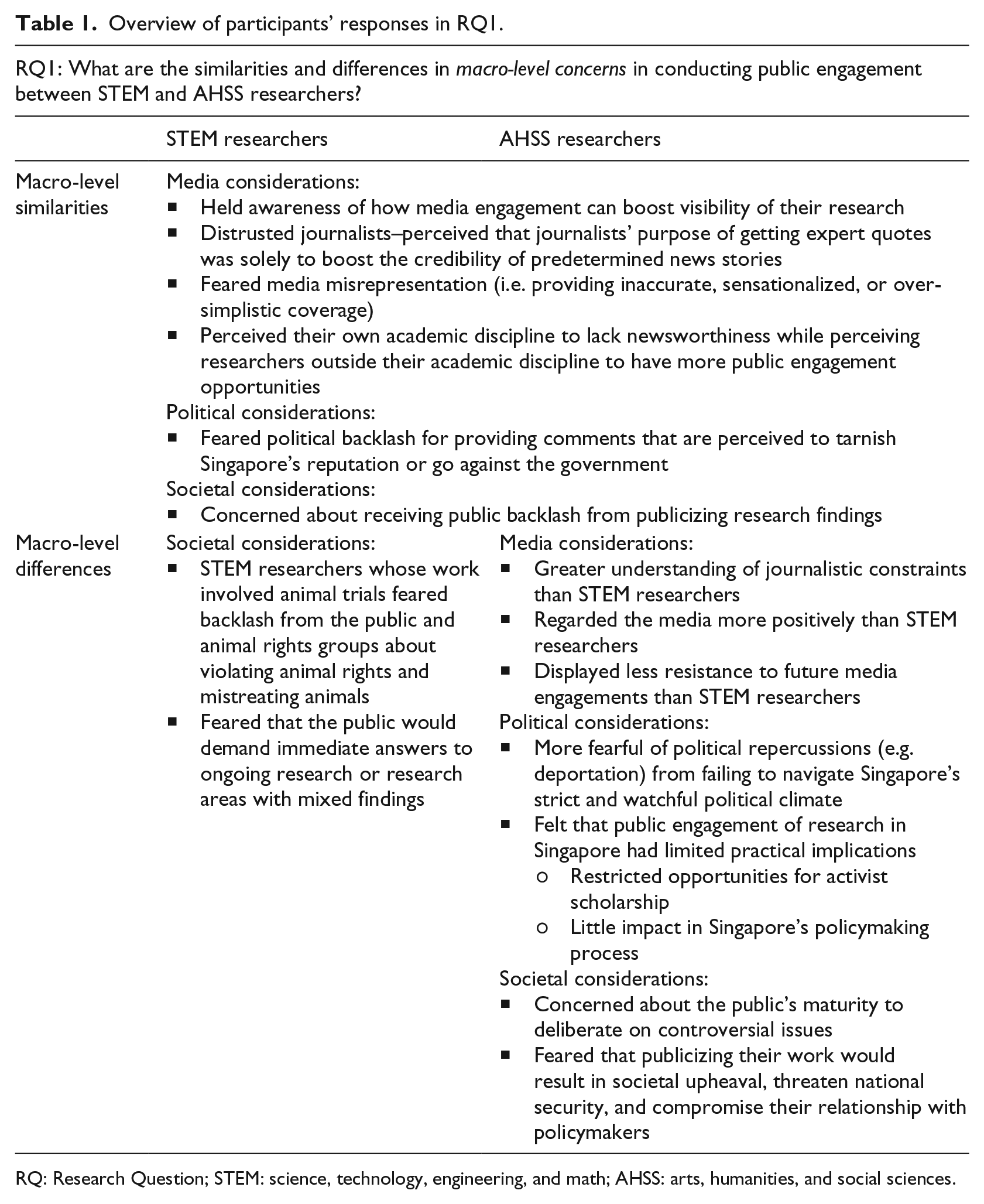
RQ: Research Question; STEM: science, technology, engineering, and math; AHSS: arts, humanities, and social sciences.
Overview of participants’ responses in RQ2.
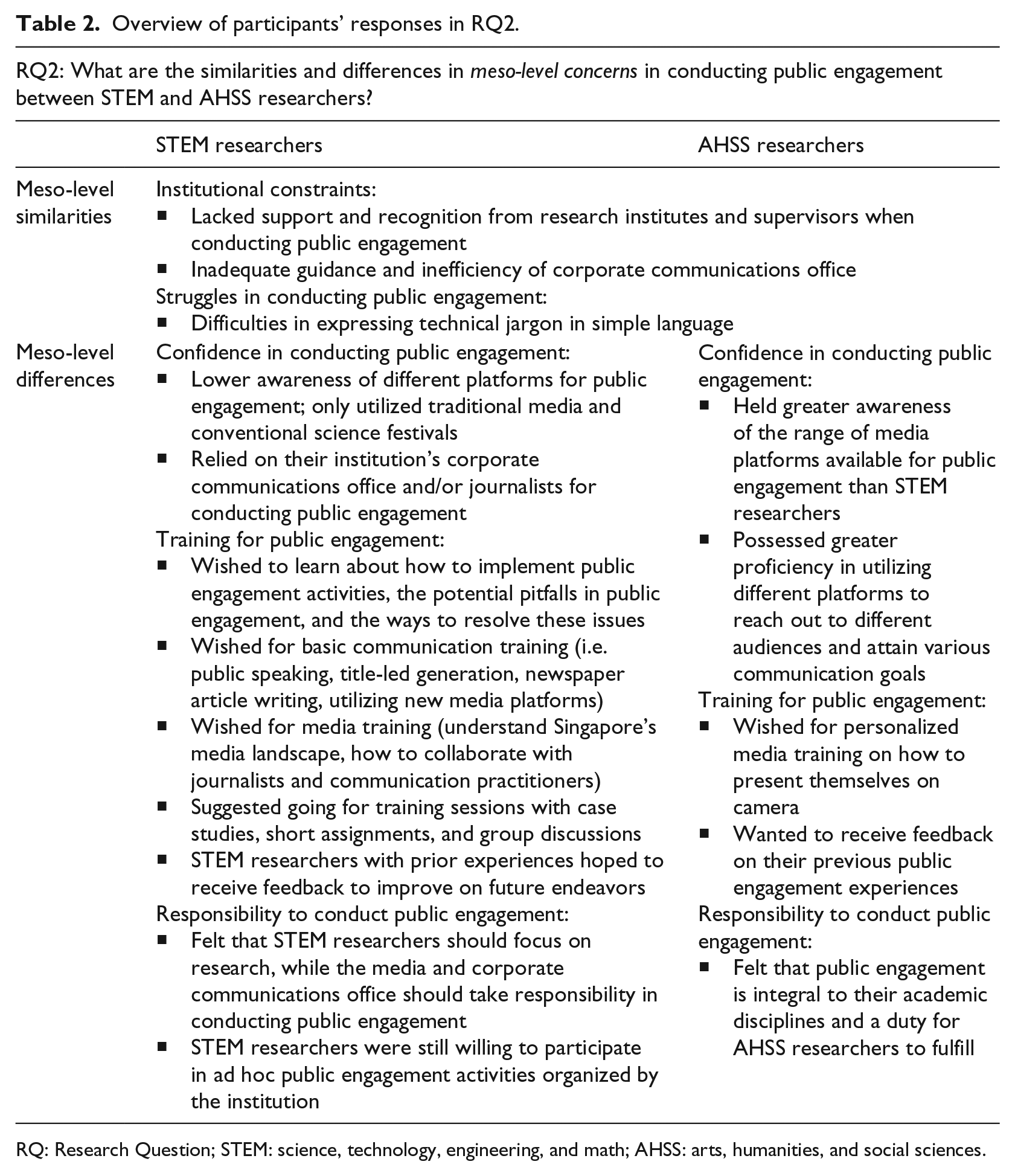
RQ: Research Question; STEM: science, technology, engineering, and math; AHSS: arts, humanities, and social sciences.
Macro-level similarities
Media considerations
STEM and AHSS researchers were aware of how media engagement can boost visibility of their research. Quoting P8G4, “Nature may have the highest global impact factor, but the Straits Times [newspaper] has the highest [impact factor] in Singapore.” Despite the mainstream media’s extensive reach in Singapore, the participants expressed disdain toward how research findings were reported. P7G3, an English literature researcher, commented that she had “never seen a newspaper story about medieval topics that struck me as anything other than nonsense.” The researchers also distrusted journalists and perceived journalists to be unaware of the research process. As a result, journalists would misrepresent research findings by providing inaccurate and reductionist coverage. Participants also noted instances whereby the media frequently sensationalized research by selecting soundbites and creating clickbait-type headlines (P5G5). P3G6 also shared his experience in which, “essentially every paragraph had. . . a quote just totally taken out of context, or completely misrepresented, or was factually incorrect.” P4G4 further commented that media reports of most scientific research are “a bit oversimplified. . . to the level of absurdity.” These experiences caused the researchers to be wary of journalists and dissuaded them from collaborating with the media for public engagement.
The STEM and AHSS researchers mutually felt that researchers from other disciplines were more newsworthy and would have more public engagement opportunities. The STEM researchers perceived that science research would be “too distant” for the public (P5G6) and found it difficult to spur public interest about their research (P3G6). STEM researchers perceived greater public and media interest in AHSS topics as it had greater personal relevance to their daily lives. Contrastingly, AHSS researchers argued that journalists and research institutes were more interested in promoting the novel advancements in STEM research. P7G3 felt that STEM advancements with tangible and direct implications on laypeople’s lives, as “a robot that made an IKEA chair. . . [or capable of providing a] massage” would garner more media and public attention, whereas AHSS topics were harder to communicate. Evidently, both STEM and AHSS researchers perceived their research area to lack public and media interest as compared to other academic disciplines.
Macro-level differences
Media considerations
While the STEM and AHSS researchers were concerned about media misrepresentation, some AHSS researchers were more understanding of journalistic constraints. P11G1, an ex-journalist and current AHSS researcher, commented that “a lot of what we see as misrepresentation, is simplification.” AHSS researchers, such as P3G1, understood that simplification was necessary for the public to understand the research. P8G1 justified that the methodology and study limitations were often omitted, as traditional media’s space constraints inhibited journalists from “packag[ing] the entire research in a newspaper article.” Overall, while most participants were apprehensive about collaborating with the media for public engagement, AHSS researchers with greater understanding of journalistic practices regarded the media more favorably and were less resistant to media engagement.
Political considerations
Both STEM and AHSS researchers feared receiving political backlash from providing comments that are perceived to tarnish Singapore’s reputation or oppose the government. However, AHSS researchers working on controversial research areas also feared receiving political repercussions from conducting public engagement. AHSS researchers concurred that Singapore is “not the freest space to speak up” (P4G3). Participants, such as P11G1, heard unverified rumors of colleagues “who had been summoned. . . [by government authorities] with files on the desk and names on the files.” These concerns were exacerbated among researchers who researched about public policy and politically sensitive topics such as national security. Researchers working on such topics were also concerned that misunderstandings arising from a wrong word choice in politically sensitive topics may result in public uproar or threaten national security (P3G2). P3G2 emphasized the importance of cautiously selecting terminologies and considering the possible political repercussions for conducting public engagement. P8G2, a political scientist, also refrained from commenting too much during Singapore’s general elections. AHSS researchers even mentioned that they only work with trusted journalists when discussing politically sensitive topics.
AHSS researchers of foreign nationalities were also hesitant to comment on local affairs as they were concerned about navigating Singapore’s strict and watchful political climate. A participant mentioned that “as an outsider, if I make a mistake, they may reallocate me to Antarctica, or for me to suddenly move, because I’ve gotten something wrong” (P11G1). These concerns were also voiced by AHSS researchers who are permanent residents (P1G3) or Singapore citizens who recently returned from abroad (P4G3).
AHSS researchers also perceived the Singapore government to be indifferent about the researchers’ comments on local politics and national policies, especially if the AHSS researchers were foreigners. As such, foreign AHSS researchers felt that they had limited opportunities for activist scholarship and little impact in Singapore’s policymaking process. As foreign AHSS researchers felt that the practical implications of their research were limited by Singapore’s political climate and strict governance, they expressed reluctance to conduct public engagement. Nonetheless, AHSS researchers were also aware that they could directly reach out to policymakers when conducting public engagement, while STEM researchers were less aware of such avenues.
Societal considerations
All participants expressed concerns that publicizing their research would invite various forms of public backlash. The STEM researchers were concerned about receiving public backlash from publicizing their research on contentious research areas. Specifically, STEM researchers working on fields involving animal trials felt that they could receive backlash for violating animal rights and mistreating animals in spite of the theoretical and practical advancements that these research projects could bring about. Although there have been no notable cases of a researcher receiving backlash for doing animal trials in Singapore, P7G5 witnessed that “the animal rights people [in the United Kingdom] have actually gone right up to [the STEM researchers’] door and held them accountable for torturing or killing animals.” As such, STEM researchers based in the United Kingdom will refrain from “publiciz[ing] their research [even if] they get fantastic results.” This incident also resulted in P7G5’s avoidance from partaking in public engagement.
STEM researchers, such as P2G4, also cited the “ignorance” of the public as a deterrent to public engagement. STEM researchers perceived the public to assume that all research promoted during public engagement would have been completed. They also felt that the public would demand STEM researchers to provide immediate answers to complex scientific or technological phenomena.
In comparison, AHSS researchers were concerned about damaging Singapore’s social harmony and national cohesion. AHSS researchers working on controversial topics were also concerned about the public’s maturity to engage in civil discourse. As racial equality is a highly sensitive topic in Singapore, P6G1 was hesitant to publicize his research even though he felt the need to inform the public about racial divides in Singapore. Some AHSS researchers also lamented, “when you are trying to add to the discourse it can be immediately taken as anti-this or anti-that” (P4G3). AHSS researchers also recounted their experiences with online trolls when discussing contentious issues or rectifying common misperceptions during public engagement (P4G1, P5G1, and P9G1).
Furthermore, the STEM and AHSS researchers held vastly different considerations about funding for carrying out public engagement. Overall, funding was generally not a consideration for AHSS researchers to conduct public engagement (P7G1). Rather, AHSS researchers were more motivated by their desire to make a significant impact on pertinent social issues (e.g. aging population, preserving national security, etc.). In spite of their fear of receiving public backlash, a few participants (P4G3) would be willing to conduct public outreach if they perceived their research could “change the world or has some things that the world should hear about.”
Although some STEM researchers were motivated to conduct public engagement as it could improve public welfare and reduce misconceptions about science (P3G5 and P5G5), STEM researchers did not cite public interest as frequently as the AHSS researchers. Rather, STEM researchers were more concerned about gaining attention from potential public and commercial funders. Some STEM participants noted that conducting public engagement could help to attract more research grants from public and commercial organizations (P3G5, P4G5, P3G6, P3G8, and P4G8). Some participants even noted that certain commercial organizations expected their scientists to help to push the company’s agenda and boost sales. For instance, P6G8 cited how a scientist he knew had to publicly make health claims about a certain product that came out of a research that was funded by a company. Conversely, P6G5 noted that their funders wanted the researchers to maintain strict confidentiality about the research. Therefore, his team could not conduct public engagement even if they wanted to. Overall, it appeared that AHSS researchers were more concerned about whether their public engagement would have significant societal benefits, while STEM researchers were more concerned about their relationship with funding agencies.
Meso-level similarities
Institutional constraints
Most participants received insufficient support from their research institutes and supervisors when conducting public engagement. All the participants’ performance appraisals emphasized publishing journal articles rather than newspaper articles. Participants working in universities also had additional teaching responsibilities to fulfill. Hence, participants concurred that their organizations’ prioritization of research output and teaching commitments dissuaded them from conducting more public engagement. Furthermore, most participants shared that the corporate communication departments failed to support them. Some participants recounted that the public engagement activity ended before the corporate communication departments replied the participant’s email. Other participants shared that their supervisors or corporate communication departments denied their requests to publicize certain research for fear that the public engagement might go awry.
However, some STEM and AHSS researchers reported that public engagement was recently included in their performance appraisals, albeit as a minor component. This inclusion therefore encouraged researchers to conduct public engagement as it indicated that these institutions valued public engagement. Departments with such requirements also provided resources to facilitate the public engagement process. For instance, P3G2 shared that his department had an ex-newspaper editor on staff to provide writing support. However, the participants were still aware that research remained their main focus and would only conduct public engagement activities after fulfilling their institutes’ research priorities.
Struggles in conducting public engagement
Both STEM and AHSS researchers struggled to simplify technical jargon for public engagement. STEM researchers were concerned that their terms will be too esoteric for public engagement, while AHSS researchers were concerned that their terms will be misunderstood by the public.
Meso-level differences
Confidence in conducting public engagement
AHSS researchers were more confident in their public engagement abilities than STEM researchers. Many AHSS researchers had greater awareness of the various media platforms for public engagement than STEM researchers. The AHSS researchers also generally possessed greater proficiencies in utilizing different platforms to reach different target audiences and attain various communication objectives. This awareness of different communication tools allowed AHSS researchers to have greater flexibility in their public engagement. Many AHSS researchers cited past experiences in providing opinion editorials, commentaries, talks, forums, live interviews, and even reached out to interest groups and policymakers. However, STEM researchers only utilized traditional media and conventional science festivals (e.g. one-north Festival, university open house days) for public engagement.
Compared to STEM researchers, AHSS researchers were also more confident about communicating their research findings directly with their target audience instead of depending on third parties (e.g. journalists, corporate communications department). P1G3 remarked that she would rather rely on herself for “tell[ing] a good story” during public engagement as she received “more training than the average person in the communications office.” Similarly, P5G3 preferred to control the content that is being published, rather than relying on a third party. AHSS researchers also spontaneously participated in media engagement by voluntarily submitting opinion editorials or commentary pieces. Contrastingly, STEM researchers relied heavily on their institutions’ corporate communications department to serve as the liaison between the STEM researchers and the mass media. Several STEM researchers also felt reassured by the corporate communications department’s supervision, such that the corporate communications department could assist in safeguarding the researchers’ and the organizations’ reputations. Some STEM participants, such as P4G4, also warned that “it might bring a lot of issues for the professor if you go to the public directly.”
Training for public engagement
Since the STEM and AHSS researchers possessed different levels of confidence in conducting public engagement, they also wished to undergo different types of training. STEM researchers wanted to learn about how to implement public engagement activities, the potential pitfalls in conducting public engagement, and the ways to resolve these issues. A participant also suggested learning about the aforementioned aspects through case studies, short assessments, and group discussions. The STEM researchers wished to receive training in public speaking, science communication writing (e.g. title-led generation, newspaper article writing), and utilizing new media platforms. Moreover, they wished to understand Singapore’s media landscape and learn how to collaborate with media practitioners for public engagement. The STEM participants with prior public engagement experiences hoped to receive feedback on how they could improve for future endeavors. AHSS researchers, being more adept at communicating, requested personalized media training, rather than basic media training, for instance, feedback on their public engagement experiences, and one-to-one training on how to present themselves on camera.
Public engagement as a form of ethical responsibility
STEM and AHSS participants differed drastically when discussing who should be responsible for conducting public engagement. AHSS researchers agreed that public engagement was integral to their disciplines and “[saw] it as part of [their] work” (P2G1). P7G3, a sociology researcher, articulated that sociologists “have [the] responsibility to be intellectuals and to be speaking in the public.” Since the AHSS research is highly pertinent to society, their research can potentially help stakeholders to better understand societal issues or resolve certain issues. P1G3 stated that “even though the university doesn’t quite recognize [public engagement],” it is a duty that “almost have to be done (sic).” P1G3 also felt that it would be “odd” if he did not provide expert comments, especially if it concerned his research areas. Overall, AHSS researchers viewed themselves as a “conveyor of knowledge” and saw a greater ethical responsibility to allow the community to understand their research (P9G1). Nonetheless, AHSS researchers noted that there is a “professional disdain for people who focus too much on communicating,” rather than research. Hence, even though AHSS researchers believe that they should communicate, they struggle to find a balance between their academic fraternity’s expectations with their perceived moral and ethical responsibility to society.
Contrastingly, STEM researchers were not as ardent in conducting public engagement. They felt that STEM researchers should focus solely on research, while the media and corporate communications officer (CCO) should take responsibility in conducting public engagement. An exasperated P2G4 questioned, “Why you want to be on TV? I’m a researcher, I need to be in the lab! [I] don’t want to be on TV all the time (sic)!” Although these sentiments were observed among most STEM researchers in the FGDs, they were still willing to conduct ad hoc public engagement activities organized by their institution. Unlike AHSS researchers who predominantly perceived themselves as contributors to society, STEM researchers typically viewed themselves as contributors to their research field.
6. Discussion
Guided by neo-institutional theory, this study examined researchers’ macro- and meso-level concerns about conducting public engagement in Singapore. Even though STEM and AHSS researchers shared several macro- and meso-level similarities, they held more differences about public engagement.
RQ1 compared STEM and AHSS researchers’ macro-level concerns pertaining to public engagement. In doing so, this study found prominent differences in researchers’ views of the political, societal, and media landscapes in supporting public engagement. Specifically, the findings of this study suggest that STEM and AHSS researchers in Singapore prioritize their motivations for conducting public engagement differently. While STEM researchers were concerned about their relationships with funding agencies, AHSS researchers were more concerned about how their public engagement might benefit the public. To investigate this relationship between funding agencies and researchers in greater depth, we propose future studies to examine the discrepancies between frequency of public outreach and funding for each discipline. While past studies have analyzed how science researchers’ perceptions of the media and journalists influenced their public engagement decisions (e.g. Nisbet and Lewenstein, 2002; Peters et al., 2008; Peterson et al., 2009), research can also look into the role of political and societal considerations.
RQ2 focused on STEM and AHSS researchers’ meso-level concerns. Overall, the STEM and AHSS researchers experienced similar struggles and institutional constraints about conducting public engagement. Although some STEM and AHSS researchers received disciplinary calls for public engagement as a minor component of their work appraisals, most participants received inadequate support and recognition. STEM and AHSS researchers also displayed meso-level differences in terms of their confidence for conducting public engagement, the types of training they require, and their perceptions on who should be responsible for conducting public engagement. While STEM researchers did not cite their sense of social duty as a major motivation for conducting public engagement, AHSS researchers were keenly motivated to conduct public engagement to benefit the society. That is, AHSS researchers’ desire for conducting public engagement did not arise from their employers’ expectations, but from their ethical responsibility and wishes to serve as knowledge producers to benefit society. This is akin to Ong and Chen’s (2010) notion of situated ethics, in which researchers are propelled to take into consideration how their actions (i.e. conducting public engagement) would affect the community and society at large. This sense of ethical responsibility appears to pan out more strongly among the AHSS researchers than the STEM researchers in this study, possibly because scholarly work in AHSS has a strong social focus.
The pivotal shift of science toward the mass media, or medialization of science (Weingart, 2012), is also evidenced in the various types of training requested by STEM and AHSS researchers. While the STEM and AHSS researchers acknowledged the necessity of attending training, they cited different types of training that they wanted to attend. This study noted that researchers wish to be trained in audience engagement and be informed on the operations of the mass media, therefore, revealing that Singapore-based researchers are working toward gaining attention for their work through the mass media. However, looking inwards, all researchers yearned for more institutional support for public engagement. Taken together, the findings revealed that researchers hoped to receive more institutional support for conducting public engagement, but they require different types of support.
In answering RQ2, STEM researchers relied on conventional science outreach festivals, while AHSS researchers utilized a myriad of media platforms as public engagement outlets. This meso-level difference could be attributed to the higher number of STEM outreach events in Singapore than AHSS outreach events. For example, the biggest public research institution (Agency for Science, Technology, and Research) in Singapore and Science Centre Singapore hold an annual public outreach event, the “one-north Festival” where they select researchers to publicize their research (Seriously Science, 2019). This large-scale national event brings the latest scientific innovations relatable and relevant to the lives of the general public, by featuring a variety of shows, workshops, media broadcast, STAR lectures by STEM researchers, and exhibitions (Science Centre Singapore, 2019). In contrast, AHSS researchers do not have such a routine and large-scale organized public engagement outlet. Therefore, AHSS researchers might need to more actively seek out appropriate public outreach opportunities on their own.
Theoretical implications
Using neo-institutional theory as a guiding framework allowed this study to systematically analyze researchers in varying capacities—citizens, employees, and unique individuals. This novel approach uncovered the important role of macro-level concerns pertaining to public engagement, an angle that past studies frequently neglected. Congruent with the central tenets of neo-institutional theory, the findings therefore attest to the importance of examining macro- and meso-level concerns in conjunction with micro-level concerns in shaping researchers’ willingness to conduct public engagement.
Practical implications
The unique macro- and meso-level concerns unveiled in this study can inform policymakers and research institutes in implementing policies to boost public engagement among researchers based in nations with nascent public deliberation environments like Singapore. Generally, providing a safer space for discussing controversial issues can help researchers to be more involved in public engagement.
Macro-level implications
Researchers may shun public engagement if they perceive that providing an alternative voice to controversial issues may detrimentally affect their reputation and career. As such, clear rules and guidelines should be provided for researchers. Authorities should also provide avenues for researchers to seek advice, while reducing potential political backlash for researchers if they comment on controversial issues. Instead of dismissing researchers’ comments, policymakers could also benefit from incorporating researchers’ opinions.
To promote public engagement, the media can also dedicate regular columns for STEM and AHSS researchers to share abstracts of their research. To ameliorate researchers’ fear of media misrepresentation, the media may collaborate with researchers to ensure that their write-ups are accurate and easily understood by the public. Researchers’ close collaboration with media practitioners could also help researchers gain awareness of different media outlets and enhance their proficiency in conducting public engagement.
Meso-level interventions
The findings provide managerial implications in incentivizing researchers to conduct public engagement and organizing targeted training programs based on the researcher’s discipline. Universities and research institutions can motivate researchers by recognizing their public engagement efforts during performance appraisals and research grant application. Besides this, organizations could provide training opportunities to enhance researchers’ willingness to conduct public engagement. For STEM researchers, institutions could help them understand media routines and improve on their competencies to conduct public engagement (e.g. public speaking, media interviews). In comparison, AHSS researchers preferred to receive feedback on their past public engagement endeavors and undergo personalized training programs.
Limitations and directions for future research
The responses yielded from the FGDs lack generalizability to all the Singapore-based researchers. However, we mitigated this limitation by recruiting participants from all the public universities and research institutions in Singapore. We also attained a saturation of ideas as ideas and themes were repeated by the FGD participants (Mason, 2010; Morse, 2000). Future research could also address this limitation by conducting a survey of STEM and AHSS researchers from Singapore’s public universities and research institutions using probability sampling.
Furthermore, while this study compares how considerations for public engagement differ between STEM and AHSS researchers, it does not make detailed distinctions within STEM researchers (e.g. theoretical physicists versus biotechnologists) and within AHSS researchers (e.g. economists versus philosophers). Hence, future studies could compare how theorists and practitioners within STEM and AHSS fields differ. Considering the nascent public deliberation environment and the limited press freedom in Singapore, future studies could also compare how researchers’ macro- and meso-level would vary across countries with different degrees of press freedom and readiness to engage in public deliberation.
Footnotes
Funding
The author(s) disclosed receipt of the following financial support for the research, authorship, and/or publication of this article: This work was supported by the Singapore Ministry of Education Tier 1 Grant (Grant Number M4011686).
