




Abstract
We propose the use of discussion structures as tools for analyzing policy debates in a way that enables the increased participation of lay stakeholders. Discussion structures are argumentation-theoretical tools that can be employed to tackle three barriers that separate lay stakeholders from policy debates: difficulty, magnitude, and complexity. We exemplify the use of these tools on a debate in research policy on the question of responsibility. By making use of discussion structures, we focus on the argumentative moves performed by the parties involved in this debate. We conclude by discussing advantages and limitations of discussion structures and we trace several opportunities for further research on these instruments.
Keywords
1. Introduction
A wide variety of methods have been developed for engaging the public in science and policy (Fishkin, 2011; Rowe and Frewer, 2005; Ryfe, 2002; Selin et al., 2017). These methods share the challenge of finding ways to translate the knowledge that each group brings to the proverbial round table. Famously difficult is the translation of scientific discourse to lay stakeholders (Irwin and Wynne, 2003). Indeed, the question of how science should interact with its publics has been one of the central themes in the field of public engagement since its early days (Bohman, 1996; Burgess, 2014; Eden, 1996; Irwin, 1995).
Yet scientific discourse is to an important extent argumentative discourse. Classic Science and Technology studies (STS) have shown that argumentative discourse lies at the very core of both science making (Latour and Woolgar, 2013) and science writing (Gross, 1990; Myers, 1991). As rhetoricians of science have put it, “science rests on facts and theories that have been argued into place” (Gross, 2006: 43, italics added). Yet this argumentation is not easily accessible to laypersons. First, because of a linguistic barrier. It is well known that academics develop their own language (Bazerman, 1988), rhetorical genres (Swales, 2004), and, more abstractly, “thought styles” (Fleck, 1979: 39–42). Second, scientific debates need translation because of their sheer magnitude. Especially when a topic becomes popular in academic circles and attracts a large number of contributions, even scratching the surface of a complex problem becomes impossible for laymen. A third reason is that there is a lot of “noise” around the debate proper. Academics might be highly trained in particular fields, but are not always the most orderly of arguers (Popa, 2016; Rehg, 2011). During a debate scientists digress, miss points, talk past each other, elaborate, overkill, brag, use humor, use figures of speech, and so on. Extracting the arguments from such complexity is not straightforward, as past studies of scientific debates have shown (Ceccarelli, 2001; Gross, 1990; McCloskey, 1998).
It is plausible, then, that the field of public engagement has a lot to gain from insights stemming from argumentation theory (see van Eemeren et al., 2014). Public engagement in science and policy can be enriched by employing tools that are designed to make sense of complex argumentative discourse of the kind we often find in science. Conversely, argumentation theory can benefit from closer inquiry into the use of their main product—analyses of argumentation—in real-life. In this article, we want to help trigger the cross-fertilization between these two fields by illustrating the utility of such an effort within a contemporary debate. Employing insights from argumentation theory, particularly the pragma-dialectical approach of van Eemeren and Snoeck Henkemans (2016), we will show how discussion structures can be used to translate complex scientific debates for an increased participation of lay stakeholders.
As a case in point, we analyze a policy discussion recently gaining much attention in Europe: responsible research and innovation (RRI). Since the early 2000s, researchers, policy makers, and other stakeholders have been interested in the question of scientists’ responsibility. RRI has been proposed as a framework to achieve this responsibility and the development of RRI has taken place between related fields such as technology assessment, public understanding of science, responsible innovation and science studies. But why do we need responsibility in research and development? Is it a universal, undebatable truth that scientists must put responsibility first? Scholars have answered this question in academic literature. To find out what their answers are, an analysis of the argumentation for and against RRI is needed. In this article, we illustrate how this can be done using discussion structures.
Our plan is as follows: In Argumentative discussions, their reconstruction and visualization section, we explain what discussion structures are and how they can be used to open up scientific debates. In Case in point: Reconstructing the RRI discussion section, we illustrate the use of these tools as analytical methods and propose an associated engagement exercise. In Using structures as participation tools section, we discuss the advantages and limitations of this instrument. In the Discussion section, we sketch some directions for further research.
2. Argumentative discussions, their reconstruction and visualization
Argumentative discussions
Since we are focusing on the reconstruction of debates and debates are argumentative exchanges, we will start by taking a closer look at argumentative exchanges. An argumentative exchange is a form of communicative interaction that is triggered by an explicit or implicit difference of opinion (van Eemeren and Grootendorst, 2004). A difference of opinion is a relationship between two discussants in which one discussant holds a positive standpoint with regard to a statement p and the other one holds the negative standpoint, for example, “p is the case” and “p is not the case.”
Having discovered that they are not in agreement regarding the acceptability of p, the participants engage in an exchange whose aim is to clarify the source of their difference of opinion. 1
Among the many types of speech acts that are performed during such an exchange, one is particularly important: that of explicitizing the reasons one holds in support of, or against, p. Such speech acts, typically referred to as an argument (Jacobs, 1989), are generally regarded as the “core” of the argumentative discussion. The main moves in a debate are typically the argumentative moves. Such a definition of argumentation as an exchange of arguments in a context of a difference of opinion is highly compatible with the definition of deliberation as given.
Let us make all this more concrete by giving an example of an argumentative exchange:
Can we go to restaurant A tonight?
Why not B?
A is cheaper
But B is closer!
The example above illustrates a difference of opinion on the “policy issue” of going to a restaurant. The speech acts performed by Maria and John are directed toward clarifying their difference of opinion, that is, understanding what reasons each party has to support their standpoint. Pre-theoretically, we can also intuit that those discussion moves are linked in a structured way—2 is some form of attack on 1, 3 is some form of defense of 1, and 4 is some form of attack on 3. In order to make these intuitions more precise and to represent the structure in question, we can employ tools from argumentation theory.
Reconstructing argumentative discussions
In the example above, John and Maria carried out their argumentative discussion without being explicit about the argumentative function of their moves (i.e. whether a contribution is an argument, counter-argument, standpoint, concession etc.). For example, John’s reaction to Maria’s proposal is a counter-argument, which is a type of assertive, but it is formulated as a question, which is a type of directive (Searle, 1975). In order to extract this argumentative function and understand what kind of moves are performed, an argumentative reconstruction is needed (van Eemeren and Garssen, 2016). The fields of argumentation theory, informal logic and (critical) discourse analysis are dedicated inter alia to understanding this reconstruction process and providing tools for increasing the accuracy of reconstructions (van Eemeren et al., 2014).
The process of reconstructing argumentative discussions is an iterative one: the analyst goes back and forth between the text under analysis and context in which the text was produced (Popa, 2016). Since this process is dependent on the particularities of the data under analysis, it is very difficult, if not impossible, to write down “reconstruction procedures” (van Eemeren and Garssen, 2016; van Eemeren and Snoeck Henkemans, 2016). Beyond establishing the text as a point of departure, we can also list the kind of insights that can be employed during the reconstruction as follows: (1) syntax, semantics, and pragmatics of the language; (2) institutional context in which the exchange takes place (legal, political, commercial etc.); (3) previous interactions between the actors within the same context; (4) the distinct event in which the interaction took place (convention, meeting, anniversary etc.); (5) goals that can be ascribed to the discussants; (6) argumentative strategies we can ascribe to discussants.
Policy discussions of the kind we will be addressing are thus more complex than the imaginary Maria–John exchange we introduced. As pieces of scientific and political discourse, they are institutionally embedded in highly conventionalized practices (academic writing, legal writing, political commentary etc.). By deploying the aforementioned resources (1–6), the analyst can extract these policy discussions from their context and present them in a way that is accessible to the general public. This presentation is further discussed in the next section.
Visualizing a reconstruction
Traditionally, reconstruction of argumentative texts leads to a tree-like structure underneath the main standpoint. Such representations are called “argument schemes” (Walton, 2013), “argument diagrams” (Peldszus and Stede, 2013), “argumentation structures” (Snoeck Henkemans, 2000). Other visualizations seek to represent not just one party’s viewpoint but both sides of the discussion using “discussion structures” (Popa, 2016). Each tool has its advantages and disadvantages, and it is not the purpose of this article to rank them. We choose discussion structures for the present purposes because they are more appropriate for understanding the totality of a debate around complex issues as opposed to delving into one party’s argumentation.
In our approach, a discussion structure is built out of three simple types of moves: arguments, counter-arguments, and rebuttals, illustrated in Figure 1 above in the three segments respectively. We use the restaurant example to illustrate:
An argument is the defense of a claim. An argument can be accepted, ending the discussion, or rejected, bringing the parties back to a stalemate position. An argument is typically marked by the use of “because” and “since.”
A counter-argument is an attack on the other’s argument. It can be thought of as “the attack of the defense” and is marked by the same linguistic indicators as an argument.
A rebuttal is a combination of moves. It consists of a concession of an argument followed by a counter-argument. A rebuttal can be thought of as a “defense despite an attack” and is typically marked textually by words such as “however” or “nevertheless.”
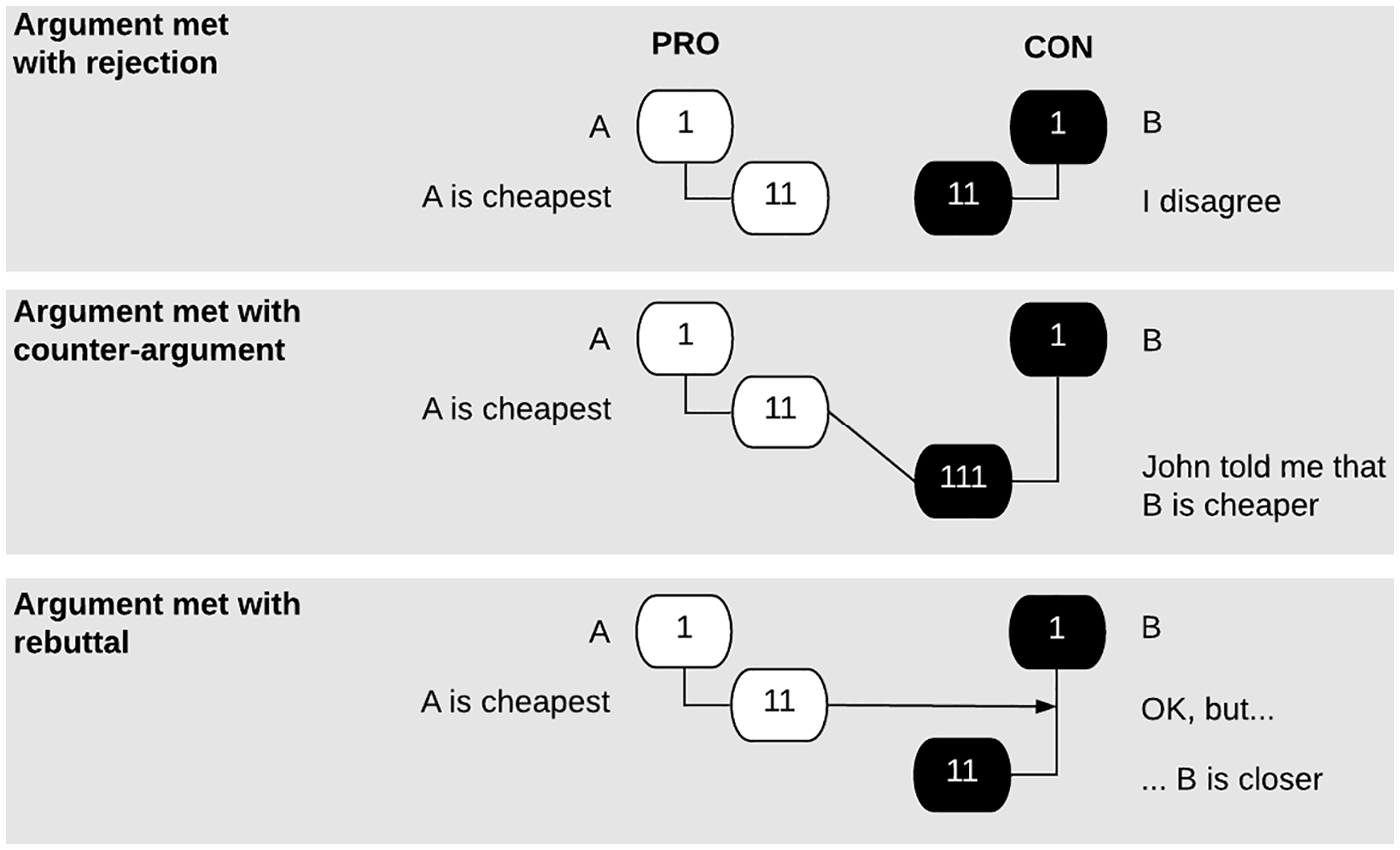
Basic combinations and associated labels.
In argumentation analysis, labeling contributions with numbers once they have been reconstructed is a standard practice undertaken in most approaches (Snoeck Henkemans, 2000). The advantage of labeling statements is twofold. First, it removes the need to mention the content of the statements in referring to statements. Participants can refer to “11-white” and “111-black” as opposed to “the argument about x being the case” or “when A said that B is wrong because such and such.” Second, the numbering is an indication of argumentative function (van Eemeren and Snoeck Henkemans, 2016: 56). The argumentative function is indicated through the following rules for adding the three types of statements introduced above:
An argument receives one extra digit relative to the statement it supports (e.g. the argument for 1-white is 11-white). Arguments added on the same level increase the digit in question (e.g. the second argument for 1-white is 12-white, the third is 13-white etc.)
A counter-argument receives one extra digit relative to the statement it attacks and it changes color (e.g. the counter-argument for 11-white is 111-black)
A rebuttal receives one extra digit, since it is in fact an argument, but we also mark the concession (e.g. a rebuttal of 11-white is conceding 11-white and adding 11-black). The placement of boxes and lines is carried out as follows: we use a black-white distinction between standpoints (suggesting opposition); every argument is placed underneath its standpoint (suggesting support) and closer toward the other party (suggesting that through argumentation parties get closer to one another at least in that they discover what’s behind their opponents’ views).
Next, we will exemplify the use of these tools by looking at a real-life example of a policy debate—specifically, the debate in the field of research policy on the responsibility of stakeholders engaged in R&D.
3. Case in point: Reconstructing the RRI discussion
The RRI discussion
In this section, we will reconstruct the (research-)policy discussion around the idea of responsibility. The discussion can best be captured by the following question: How can research and innovation be made more responsible toward society? Since the early 2000s, a framework known as “Responsible Research and Innovation” (RRI) has been proposed as an answer to the aforementioned question. This proposed answer has been increasingly discussed in academic circles (Asveld, 2017; Grunwald, 2011; Koops et al., 2015; Nielsen, 2016; Owen et al., 2012; Rip, 2014). The phrase RRI “has become increasingly fashionable” (Owen et al., 2013b: 39) and “catapulted from an obscure phrase to an issue in the European Commission’s Horizon 2020 Program” (Rip, 2014: 2).
The central claim in this movement is that research and innovation need to be more responsible, that is, more inclusive and more responsive to societal challenges (Owen et al., 2013b). While this claim is acceptable, it does seem to be immunized against critique, for who would hold irresponsible research and innovation in high regard? Critical positions can even backfire financially because RRI has “gained momentum in both national and supranational funding agencies and institutions” (Delgado and Åm, 2018).
Nevertheless citizens, policy makers, businesses, associations, and the media might stubbornly ask: why should research and innovation be stirred in this direction (Timmermans and Blok, 2018)? What are the reasons for and against such a policy? Delving into the body of academic literature, lay stakeholders will encounter the three barriers mentioned in the introduction (difficulty, magnitude, and complexity).
First, regarding the difficulty of the task, RRI remains a fairly abstract ideal of responsibility. Arguments for pursuing this ideal in research and development have been advanced primarily by academics in academic outputs. Assuming lay stakeholders know where to look (but see barrier 3 below), the academic language will act as a barrier.
Second, regarding the magnitude of the task, finding answers to the “Why so responsible?” question would involve plowing through a sizable literature. The RRI story started before the term “RRI” with the beginnings of STS and technology assessment; additionally, the movement has grown exponentially since RRI’s adoption at a European policy level (Burget et al., 2017). To give only one example, the paper Developing a framework for responsible innovation (Stilgoe et al., 2013) is one of the top three papers in the journal Research Policy with more than 400 citations worldwide (according to the Publisher’s own citation count). Sifting through these citations for relevance would prove a formidable task.
Third, the discussion on RRI has not proceeded in an orderly fashion and as many as four different conceptions can be distinguished behind the label, each with its own paradigmatic assumptions (Timmermans and Blok, 2018).
In what follows, we illustrate how discussion structures can be employed to reconstruct the RRI discussion so as to address the three issues mentioned above. To this end, we analyze the following academic works on the subject:
Jonas’ (1984) The imperative of responsibility
Douglas’ (2003) The moral responsibility of scientists
Fiorino’s (1990) Citizen participation and environmental risks
Blok and Lemmens’ (2015) The emerging concept of responsible innovation
These texts have been chosen because of their involvement in the debate around RRI. They tackle the question we formulated above: “Why so responsible?.” We are not claiming that the arguments advanced in these works are advanced frequently or that they are the most acceptable (or the most accepted nowadays). Our selection was made based on these criteria: the four works are often employed in the RRI literature, they have been advanced at different junctures in the RRI history, and they are diverse enough to serve our illustrative goals. We should note that we are already outside the realm of what lay stakeholders can be expected to do by themselves. In making this selection, the analyst is already engaged in reconstructing the discussion by reducing it to four (more or less representative) focal points. This point will be discussed further in the section Further developments.
Hans Jonas
Hans Jonas’ 1984 book The Imperative of Responsibility: In search of an Ethics for the Technological Age is often cited when justifying the RRI call. For the present purposes, we will set aside Jonas’ theory of responsibility because here we are not interested in what responsibility is but in why R&D should be (more) responsible. The first reason that Jonas advances in favor of responsible science is the negative consequences associated with irresponsibility. If we do not engage in a more responsible science, our actions will have catastrophic consequences. This is then a pragmatic argument from negative consequences, the “apocalyptic possibility inherent in modern technology” (p. 200). One might reply that Jonas is unnecessarily pessimistic. In reply to such a move, Jonas further defends his argument by giving the example of nuclear weapons.
It is well known that the “argument from apocalypse” is not Jonas’ strongest line of defense (Cosans, 2016; Groves and Adam, 2011). 2 He therefore opens a second line by an appeal to our moral duty. This line of defense is more appropriate for an ethicist, he claims, and indeed is referred to in the subtitle of his book: “In Search of an Ethics for the Technological Age” (italics added). Let us thus formulate the next argument as “It is your duty to be (more) responsible.” What happens if this duty is called into question? According to Jonas (1984), this argument follows from a more general duty: “Never must the existence or essence of mankind be made a stake in the hazards of action” (p. 37). 3
At this point in The Imperative, Jonas concedes a point, that is, we cannot really know, in the present, whether we are indeed wagering the fate of mankind in the (especially distant) future. His reply is that such calculations do not matter. When it comes to things of great importance, such as the fate of mankind, we are subject to another rule according to which, in calculations of great importance, one must assign a bigger probability to disaster rather to progress (Jonas, 1984: 31). Put differently, the little improvement on our lives that science might bring cannot justify the threat to the “essence or existence” of mankind.
The discussion as summarized here is represented in Figure 2. In selecting these arguments, we have left aside some of the deeper philosophical discussions opened by Jonas, but these can, if needed, be added to complete the discussion structure. 4
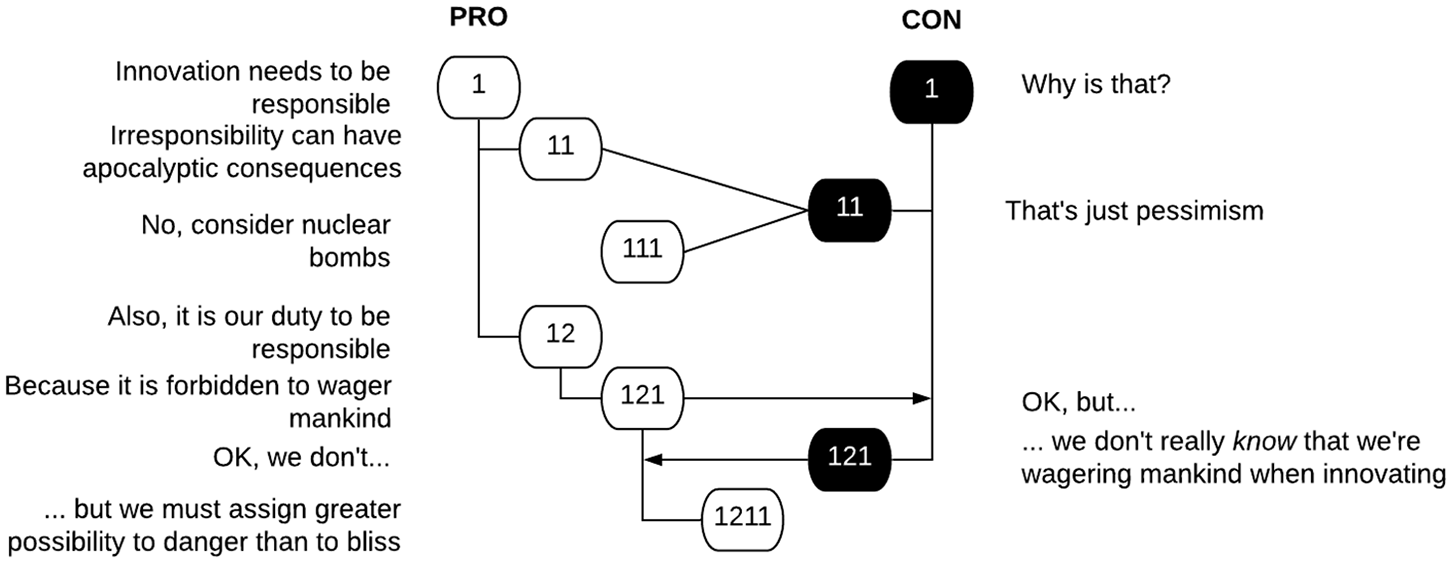
Jonas’ discussion on responsibility.
Heather Douglas
Heather Douglas is a philosopher of science best known for her works on the interplay between science, values, and policymaking (Douglas, 2000, 2009). For the present purposes, we will focus on a paper that is often cited as a philosophical contribution to the RRI literature: her 2003 paper entitled The Moral Responsibilities of Scientists (Tensions Between Autonomy and Responsibility). This article has been employed in justifying RRI ideal (Stilgoe et al., 2013) and is interesting from the present perspective because it voices some clear criticisms against RRI. In this article, Douglas (2003) investigates whether it is indeed the case, as some have argued, that science “is so valuable to society [. . .] that we must relinquish other claims of social or moral responsibility on scientists so that they can produce this valuable end” (p. 60); however, according to Douglas, this view “is mistaken” (p. 63).
Let us start with the defense of scientists’ autonomy (i.e. the moves made by Douglas’ opponents). According to some arguments originating in the 1940s, scientists need considerable autonomy to develop their creativity and sustain the innovation process (Douglas, 2003: 60). Proponents claim that external restrictions such as those imposed by the call for responsibility are a handicap to innovation.
Douglas’ response runs as follows:
First, she points out that scientists already accept the hampering of science by moral values. In defense of this claim she brings the example of experimentation on living subjects. Concretely, although it would greatly improve the speed of the discovery trajectory to be able to subject, for example, new born babies to toxicity tests, it is unanimously accepted that such improvements are not worth its risk (p. 64).
Second, Douglas discusses the claim that the consideration of societal consequences falls outside the scope of science proper. Douglas concedes this claim (“. . . it may be possible that those outside of science can control the uses of applied science”), but goes on to specify her claim to tackle only the consequences of data and theory selection. When it comes to data and theory selection, Douglas claims, only scientists can do the work of foreseeing undesirable consequences.
Third, in refusing to subject their work to social norms of responsibility, scientists are in fact running the risk of losing their responsibility. The apparent paradox in this statement—for, remember, responsibility was supposed to hamper freedom—is clarified by Douglas as follows: If scientists do not take responsibility (either individually or in collaboration with other stakeholders) then outsiders will eventually take over and control those parts of the research environment that seems (to outsiders) to breed irresponsibility. This “either do it yourself or you will see others do it” is a variant of Jonas’ consequentialist argumentation except this time Douglas appeals precisely to the autonomy scientists supposedly wish to maintain. As she puts it: “The more scientists relinquish their responsibility, the more they must relinquish their autonomy” (p. 65).
Douglas’ arguments for responsibility are represented in Figure 3.
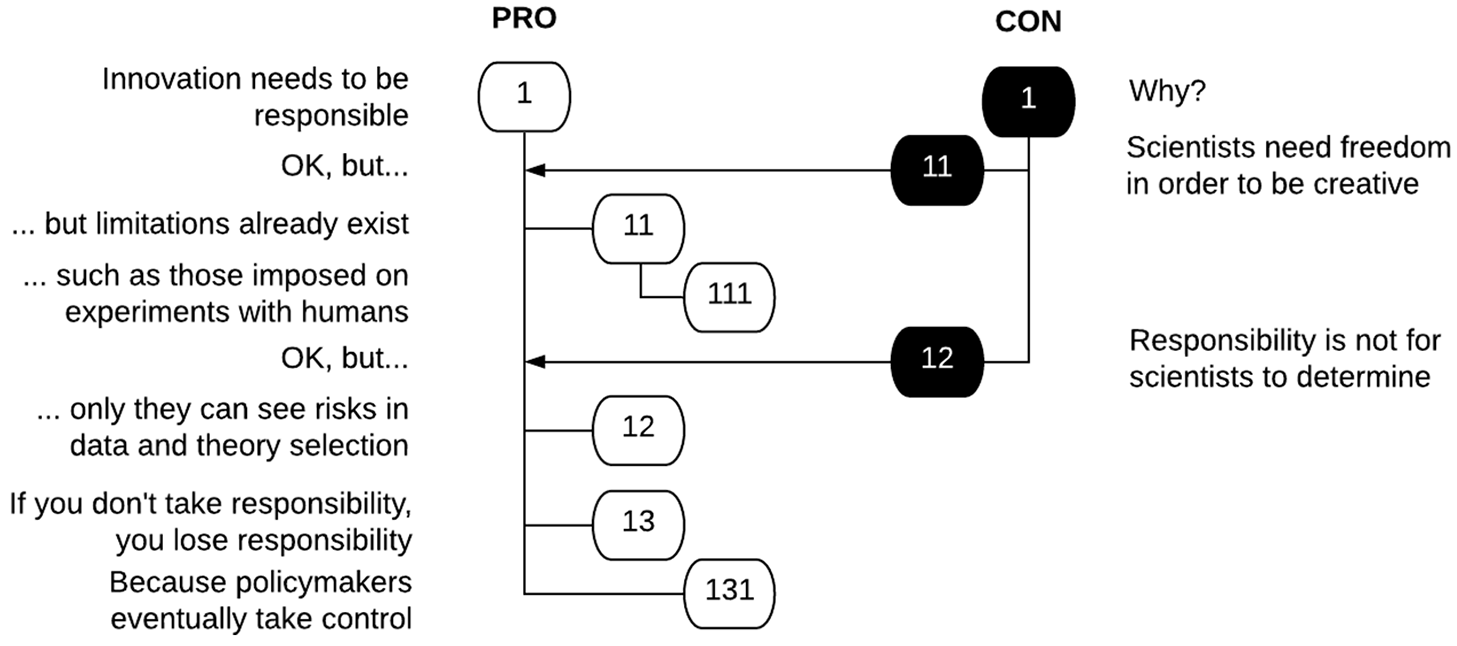
Douglas’ arguments for responsibility.
Integrating two accounts into one structure
In this last example, we want to show how contributions to the discussions from different works can be combined. For this purpose, we will focus on a specific aspect of RRI, namely stakeholder inclusion (Owen et al., 2013b: 1571). Although stakeholder inclusion is but one aspect of RRI, this aspect has been referred to as “the conceptual dimension that characterizes RRI the most” (Burget et al., 2017: 10). Furthermore, a much-employed definition of responsible science describes it as a process in which “societal actors and innovators become mutually responsive to each other” (Owen et al., 2013a), meaning that these actors are thereby included in the process of research and development.
The call for inclusion is typically defended with three arguments, dubbed the substantive, normative, and instrumental argument. This threefold typology of arguments for inclusion was first presented by Fiorino (1990) and subsequently quoted by various studies of stakeholder participation in scientific and governmental policy. Fiorino will defend responsibility. Then we will integrate this with the more critical stance taken by Blok and Lemmens (2015) in their paper The emerging concept of responsible innovation. Although these two do not engage in the discussion explicitly, it is because of their tackling of the same issue that their works can be seen as entering a reconstructible policy discussion.
Starting with Fiorino (1990), we notice that his account is built as a defense against the freedom argument, according to which experts need not be checked by society since experts “will make more rational decisions” while other stakeholders lack “the time, information and inclination to take part in technically based problems” (p. 227). Fiorino advances the three arguments as follows:
The substantive argument consists of the claim that the views of other stakeholders are often relevant for the decision-making process regarding even the most complex, technical issues. So-called “laypersons” can exploit their real-world experience to bring the entire stakeholder group closer to a solution. The substantive argument thus claims, roughly, that other stakeholders might know more about a certain (complex) problem than the experts assigned to tackle that problem. 5
The normative argument brings forth the principle that “a technocratic orientation is incompatible with democratic ideals” (Fiorino, 1990: 228). Unlike the substantive argument, which moves “backwards” from the predicted benefits of engaging stakeholders, the normative argument moves “forward” from the principle that citizens ought to be able to participate in decisions that influence their lives. Fiorino does not detail the origin of this principle, so we are to treat it as something of an axiom of democratic governance.
The instrumental argument consists of the claim that stakeholder participation makes policies more legitimate (i.e. they are better supported) and thereby to better implementation of those policies. Notice that this argument also moves backwards from predicted benefits of participation (like the substantive argument). In this case, it is not the quality of the policy itself or the knowledge that goes into it but rather the policy’s acceptance and implementation.
Turning to the contribution of Blok and Lemmens (2015), we first notice that the authors construct their defense without using Fiorino’s threefold distinction between substantive, normative, and instrumental. Rather, they organize their attack as follows: they divide their critique according to the stage of the R&D process to which the call for responsibility pertains, namely the input, throughput, and output of an R&D process.
When the input of the R&D process is a complex problem (a “grand challenge”), it is questionable whether RRI is even possible because “there is no consensus about the scope of the grand challenges and the goal of the innovation process among stakeholder” (Blok and Lemmens, 2015: 23). 6 Specifically, the responsiveness toward stakeholders and their inclusion in the R&D process is impossible because fundamental differences and conflicts that are associated with grand challenges. Given these fundamental differences, then, the authors ask whether the stakeholder involvement urged by the RRI literature is even possible.
Concerning the throughput of the R&D process, it is questionable whether RRI is desirable to stakeholders. This is because, through collaboration, stakeholders minimize their advantage of information asymmetry, that is, the advantage of knowing more than your competitors or other stakeholders. Another reason why stakeholder participation can be undesirable for stakeholders is the prospect of sharing responsibility over risks: should the innovation turn out to have negative consequences, all stakeholders share responsibility for these consequences. In contrast, if everybody keeps to their own game, there is no risk of being associated with the “traditional enemy” (Blok and Lemmens, 2015: 25).
Concerning the output of the R&D process, it is questionable whether “stakeholder involvement may result in more desirable outcomes, the involvement of stakeholders doesn’t necessarily guarantee a more responsible output of the innovation process” (Blok and Lemmens, 2015: 26). The authors give the example of biofuels which had negative effects (increased food prices) even though stakeholders from many sectors participated in their development. Thus, since the outcome of innovation is essentially unpredictable, stakeholder involvement may, against all predictions, result in less responsible output.
If we seek to elucidate the interaction between the two accounts, we need to find arguments that are advanced by one party and addressed by the other. Taking Fiorino’s arguments, we notice that Blok and Lemmens say nothing about Fiorino’s normative argument, so we will assume that they concede that one. However, the substantive argument (laymen have useful knowledge) is addressed by the objection regarding output (knowledge that seems useful may in fact be beneficial). Similarly, the instrumental argument is conceded but it is addressed by pointing out that the “stakeholder support” mentioned by Fiorino might not come from all sides, especially not those who lose competitive advantages in the process (see Figure 4).
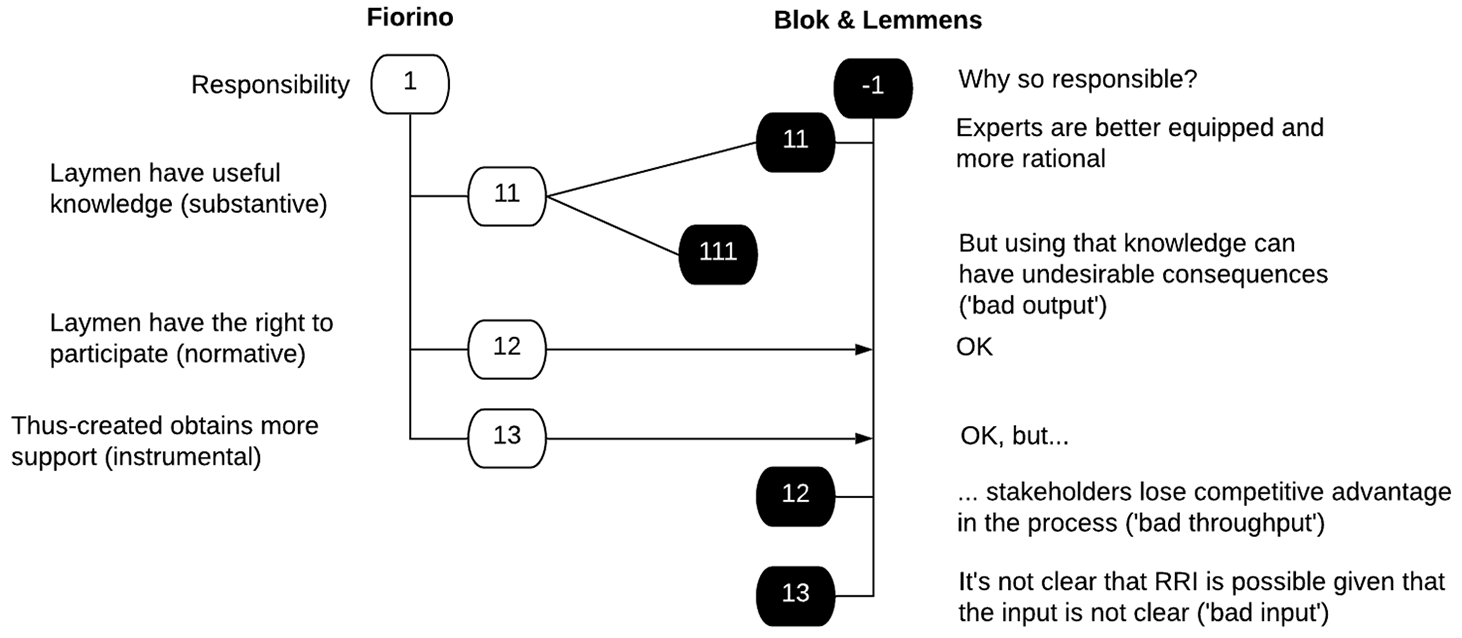
Fiorino versus Blok & Lemmens.
4. Using structures as participation tools
In this section, we exemplify the use of reconstructed discussions for engagement exercises. We do not wish to suggest that this is the only way to use reconstructed discussions. Rather, we follow Ryfe (2002) in observing that, in the world of deliberative methods “there is no such thing as one form or format of good discourse” and that “deliberation is inherently rooted in context, and different kinds of contexts demand different kinds of conversations” (p. 369). In offering the following example method, we take inspiration from a diverse literature on stakeholder interaction methods (Booher, 2004; Burgess and Chilvers, 2006; Hassan, 2014; Muff, 2014; North and Aspling, 2014).
Step 1: Using the structure for a walking exercise
In this exercise, the discussion structure is placed at the center of the group and employed as a point of departure for various types of interventions. Before the dialogue, the discussion structure is created based on available literature and inter-subjectively checked by stakeholders for accuracy and fair representation of arguments. The resulting structure is placed on a poster around which a small group (7–12 people) takes a seat. This constitutes the stating position.
When signaled, participants begin to switch sides by walking from one side of the discussion to the other. Walking from one side to the other for several minutes, stakeholders make sure they understand the text given on the poster and prepare 1–2 questions. Participants are asked to prepare both descriptive questions and normative questions. Descriptive questions pertain to assumed matters of fact (What is the case? Who does what? How many?); normative questions pertain to matters of value (What is best? Who should do what? Which principle is more important? What rights are relevant?). These questions are not meant to be answered right away. Rather, they are placed on a common surface as a preparatory step to moving forward. Throughout this time, the participants are allowed to keep walking. After all the questions have been marked, participants sit down to answer the informative questions.
The objective of such an exercise is to give participants the chance to express off-the-bat thoughts on the represented discussion. Moreover, walking is a cooperative activity but at the same time it creates a disruptive dynamics in which the environment is, more or less literally, not yet set. The walking exercise can be employed as a preliminary exercise to various forms of subsequent dialogues. Two such continuations are given in what follows.
Step 2: Co-constructing the discussion
Having elicited reactions to a discussion structure via the walking exercises, stakeholders can now participate in the discussion by co-constructing it: they can add new arguments, counter-arguments, and rebuttals. The co-construction of the discussion runs in cycles and each new cycle starts with the person who spoke last in the previous cycle (so that the advantage of seeing what others are adding/deleting is balanced out). Notice that stakeholders cannot flat-out erase a discussion moves. The reason for not allowing this discussion move is that a rejection is a discussion stopper. In this exercise, the only way to position oneself against a claim is to either argue for the opposite or concede it but produce a stronger argument for the opposite standpoint.
Step 3: Co-constructing the meta-discussion
Having engaged with the discussion, we can expect participants to be better equipped to engage with the meta-discussion, that is, the discussion about the rules, rights, and obligations that govern the discussion (Finocchiaro, 2007). In the meta-discussion, we can ask questions that refer to these elements: Who has power to settle this discussion? What code of conduct is needed for making reasonable discussion moves? What are the uncertain/implicit risks concerning the result of this discussion. The literature on rhetorical citizenship (Kock and Villadsen, 2012) can provide insights into the kind of topics that might be relevant for the meta-discussion. Also, given that these meta-discussions would touch upon the system embedding of the policy/issue in question, system-analytical perspective such as the multi-level system perspective (Geels, 2006) can be employed to “zoom out” after the discussion, and tackle more abstract or general issues. For example, in the case of RRI, stakeholders can stop and discuss why discussing RRI is needed in the first place—is it not better to leave it as it is? Does opening up the Pandora box of arguments for and against RRI produce more assent or more dissent? This subject (suggested by a reviewer) fits beautifully in a meta-discussion on responsible innovation. It is of course difficult to specify in advance the meta-discussion topics that will be relevant for each context. In fact, we suggest conceptualizing the “meta-discussion” broadly enough to encompass most every topic that the participants feel is activated by the discussion itself.
5. Discussion
The RRI discussion reopened: The three barriers
The present endeavor started with the identification of three barriers for public participation in science and policy: difficulty, magnitude, and complexity. RRI functioned as a case in point. Although discussion structures do not solve every aspect arising from these barriers, they constitute an important step in the right direction.
Discussion structures address the problem of difficulty because the text in the source is translated in a non-technical language before it is inserted in the structure. Thus, if Jonas’ book is virtually intangible given its complex language, the discussion structure that summarizes its main arguments is comprehensible within minutes. It goes without saying that some nuance is lost in this translation process, but we would argue that nuance is not always relevant, at least not from the very beginning. More subtle distinctions can always be introduced later in the participation process (see Further developments below). For example, nuance does seem to be needed in the case of the “argument from apocalypse”: hazards come in various shapes and sizes and thus the appeal to apocalypse (roughly, “If irresponsibility, then apocalypse”) might need some hedging. These are issues that can be brought in later in the participation process and do not interfere with the gist of Jonas’ pragmatic argumentation from risks: we need to be more responsible because otherwise we will destroy the planet and ourselves. Our intuition tells us that, in the trade-off between participation in a somewhat simplified discussion, on the one hand, and lack of participation, on the other hand, the former can be preferred since nuance can be introduced during the participation process if it becomes relevant.
Discussion structures address the problem of magnitude because the analyst is forced to compress the discussion and focus on the loci where distinct arguments have been advanced. Our examples showed how this can be done with several works. These works have been reduced to a structure that can be printed and shown to a group of people and thus constitute the starting point of a discussion. The understanding of the structure might not be immediate (as understandings of discussions go) but it will take significantly less time to go through a structure than to go through the works employed as sources.
Finally, discussion structures solve the problem of complexity because they leave aside deviations, side-tracks, tangents, repetitions, and all other “anomalies” that are normal in scientific discourse and yet irrelevant for capturing the gist of the argumentative exchange. Going through a discussion structure, the reader follows the discussion from the highest level (main difference of opinion white1 vs black1) to the lowest levels and can do so using the text accompanying the structures. Also, in working with discussion structure, one can pick up a discussion from where others have left it, avoiding talking past each other and adding to the problem of complexity.
What have we gained from looking at the “why-so-responsible” debate through argumentation-theoretical lenses?
First, we have re-focused analytical attention on the argumentation around the issue of responsibility. The question “Why RRI?” has received surprisingly little attention in the RRI literature. Consider the opening paragraph of the following oft-quoted paper on RRI: Few would disagree that science and innovation should be undertaken responsibly. “Responsible innovation” intuitively feels right in sentiment, as an ideal or aspiration. It has positive, constructive overtones, where science and innovation are directed at, and undertaken towards, socially desirable and socially acceptable ends, with connotations of trust and integrity. However, in reality, it lacks definition and clarity, both in concept and practice: What might it involve? Who might it involve? When might it be applied? (Owen et al., 2013a: 27)
Phrases such as “few would disagree,” “intuitively feels right,” “positive,” “constructive”, and “socially desirable” are discussion stoppers. They bypass the why question and move directly to the question of “clarity.”
Second, we have reconstructed a complex discussion in research policy in such a way that laypersons can understand and participate it. Each main argument divides the discussion into what might be called issue: for Jonas there is the practical issue of responsibility (being irresponsible brings about unwanted effects), and the moral issue of responsibility (being responsible is a moral imperative); for Douglas, there is the issue of responsibility versus freedom (how do we maintain inventiveness if responsibility curbs innovation); and in the Fiorino versus Blok & Lemmens interaction we see a repetition of the practical and moral issues but with more “push back” from the negative side (is extra responsibility really practical?). Much needs to be said on these issues, and many sub-arguments can be discussed, but what is said here can be more systematically “placed” within the respective areas of the discussion represented by the aforementioned issues. In this way, we can organize the discussion more clearly by identifying, for example, unvisited issues, issues on which there is too much repetition of known arguments, issues on which the discussion is too shallow or too deep and so on. In short, the systematization of the debate up to a certain point allows for a more systematic continuation of that debate.
Further developments
In this section, we want to address several aspects of discussion structure that can be developed in further research.
First, the risk of framing needs to be addressed. Since discussion structures are created by experts who have a bird’s-eye view of the topic under analysis, they might engender a framing of the discussion in a way that is more advantageous for some stakeholder groups. The issue of framing-by-experts is a known theme in the literature on public participation (Andy, 2008; Goven, 2006) and since experts are needed in our case to analyze the existing policy issue and extract the discussion moves from the source, a significant degree of framing and agenda setting conceivably could occur. The risk of framing cannot be fully avoided, but it can be minimized by employing different types of input in preparing the structure for stakeholder participation. For the purpose of this article, we focused on scientific argumentation as input, but this input can be combined with input from other sectors of society and other types of discourse. Perhaps one should strive for what might be called “quadruple helix” discussion structures, alluding to the Quadruple Helix Innovation theory in which innovation is seen as the contribution of academia, policy, public, and industry (Carayannis and Campbell, 2010, 2014). A quadruple helix reconstruction would contain input from all these sectors and thus minimize the risk of undue framing. In addition, during the co-construction exercise (Step 2 described in Using structures as participation tools section), undue framing can be exposed when stakeholders do not see their intuitions represented in the structure. If points have been avoided, oversimplified, or given too much emphasis, the co-construction process as discussed in the previous section should offer a platform for “repairing” the structure so that the quadruple helix perspective is achieved.
Second, steps to avoid stakeholder self-selection can be developed. Working with discussion requires a set of skills (understanding the structure, co-constructing the structure) and might therefore lead to a self-selection of those A-type members of society that are proficient with those skills. It has been claimed, along these lines, that “the emphasis within the theory of participation and deliberation on discourse, reasoned argument and consensus-building can itself be undemocratic” (Davies, 2016: 167). Would discussion structures, with their emphasis on argumentation (“reasoned argument”) open the way exclusively for those at ease in this practice? Prophylactic steps can be taken. Discussion structures can be deployed in a variety of interactions and need not monopolize the discussion or turn it invariably into a debate. After all, we can discuss a debate without debating. In this sense, the third step in the proposed discussion procedure is not even directly about the discussion moves themselves but rather seeks to access the meta-themes that are made relevant by those moves (power, fairness, ideology, fears etc.) We can imagine an implementation of the proposed discussion procedure in which, during Step 3, one is deterred from pressing the issue further and asked to merely bring about themes for reflection. This part need not be argumentative at all.
Third, the use of discussion structures in public deliberation methods needs empirical validation. Here we have undertaken the task of explaining the tool and illustrating its use, but the proof of the pudding is in the eating. A more systematic empirical investigation of the advantages and pitfalls of using discussion structures is needed in order to understand how the instrument can further be developed and improved.
6. Conclusion
The translation of scientific discourse for lay stakeholders has been a constant theme in the field of public understanding of science. Since scientific discourse has predominantly an argumentative function, we see benefits from cross-fertilization between the fields of public understanding of science and argumentation theory. Public engagement in science and policy can be further enriched by considering public engagement with/in scientific argumentation. Employing insights from argumentation theory, particularly the pragma-dialectical approach of van Eemeren and Snoeck Henkemans (2016), we have illustrated how discussion structures can be used to translate complex scientific debates for lay stakeholders. As a case in point, we discussed the policy question of whether research and innovation should be stirred (more) toward responsibility. This required an analysis of the argumentation for and against RRI in such a way that it increasingly allows non-academic stakeholders to understand and participate in the debate. For these purposes, we have selected four illustrative texts and shown how the original discourse can be transformed into relatively easy-to-understand figures that represent the discussants argumentative behavior. Once these figures have been created, they can be used as a point of departure in a variety of deliberation methods. We have proposed one such use in which participants co-construct not only the discussion itself (by adding or modifying moves) but also tackle the meta-discussion (by approaching socio-ethical themes outside the discussion itself). In this way, the deliberation between stakeholders is fostered by opening up a debate that had been previously shielded by technical language, magnitude, and complexity.
Footnotes
Funding
The author(s) received no financial support for the research, authorship, and/or publication of this article.
