




Abstract
The growing importance of social media for getting science news has raised questions about whether these online platforms foster or hinder public trust in science. Employing multilevel modeling, this study leverages a 20-country survey to examine the relationship between social media news use and trust in science. Results show a positive relationship between these variables across countries. Moreover, the between-country variation in this relationship is related to two cultural characteristics of a country, individualism/collectivism and power distance.
Keywords
Nowadays, the public increasingly gets science news online, particularly via social media such as Twitter, Facebook, or YouTube (Brossard, 2013). For example, people in the United States cite the Internet as their primary science and technology information source (National Science Board, 2016). Some scholars have expressed concerns regarding social media’s growing impact on science news by asking whether a lack of quality control online threatens public trust in science (Weingart and Guenther, 2016). Social media are not only used to share new scientific insights but also to spread scientific misinformation (Allgaier, 2016; Liang et al., 2014). Social media have been used by individuals or groups to negatively influence public opinion about science-related topics such as vaccination (Dunn et al., 2015) or climate change (Jang and Hart, 2015).
However, there also are good theoretical reasons to expect a positive relationship between social media news use and trust in science. Not only do social media have the potential to correct misinformation (Vraga and Bode, 2017), they also expand information networks (Bakshy et al., 2015; Barnidge, 2015; Kim et al., 2013) and promote user engagement with content posted by trusted social contacts (Bonchi et al., 2013; Media Insight Project, 2017; Wang and Mark, 2013).
Scholars have only just begun to explore the wide range of online formats and platforms used for science communication (Davies and Hara, 2017), and few studies to date have examined social media from a cross-national perspective. Our study fills this gap in the literature by testing the relationship between social media news use and public trust in science in 20 countries worldwide. As Schäfer (2017) points out, findings from the United States are only partially translatable to other regions due to differences regarding the relevance of online science communication and the ways in which scientific topics are debated. Hence, scholars and science communicators around the world will benefit from the insights provided by cross-cultural research by gaining a better understanding of whether key relationships are consistent across national contexts.
1. Trust in science
The trustworthiness of science is often debated in public, and the narrative that science is not trustworthy has taken hold. For instance, headlines such as “Americans’ increasing distrust of science” (Blake, 2015) or “The challenge of fighting mistrust in science” (Beck, 2017) create an image of a public that trusts science less and less. While some of the public debates about science arise from specific scientific misconduct cases, others are driven by a generalized lack of belief in science, particularly science related to climate change or health. But why is trust so important? First, scientific knowledge is a critical resource that enables political actors to inform and legitimate political decisions (Bogner and Torgersen, 2005), and it is also important for laypeople in terms of forming public opinion about important political issues. Therefore, distrust in science can be problematic for society as a whole. For example, people who do not believe in anthropogenic climate change will see no need to take political action to slow its progress. Second, science depends on people’s willingness to participate in research projects (Medical Research Council, 2016), and declining trust in science could diminish that willingness. Much research would simply not be possible without survey respondents, experimental participants, focus group discussants, and so on. Third, science also depends on public funding. Specific types of scientific research could be limited if people think that money invested in it is unnecessary or wasteful (Huber et al., 2019).
Definition and dimensions of trust
Trust is essential to democratic societies (Barber, 1987) because it helps reduce social complexity (Luhmann, 1989). Trust can be defined as “the probability that [someone] will perform an action that is beneficial or at least not detrimental to us is high enough for us to consider engaging in some form of cooperation with [them]” (Gambetta, 1988: 217). Prior literature suggests that trust in science is a multidimensional concept (Achterberg et al., 2017; Miller, 2004). More specifically, people assess scientific institutions differently from scientific principles and methods. Some people trust principles and methods but distrust institutions (Achterberg et al., 2017). While support for principles and methods is generally high (Miller, 2004), there is a growing distrust in scientific authorities (Aupers, 2012). Because the current study focuses on the question of fostering trust in science, we examine trust in scientific institutions and scientists rather than trust in principles and methods, which is relatively stable.
Predictors of trust in science
Since the 1980s, the concept of trust in science has increasingly attracted scholarly attention (see, for example, Evans and Durant, 1989; Ziman, 1991), and it remains a popular research subject today (e.g. Achterberg et al., 2017; Brewer and Ley, 2013; Liu and Priest, 2009; Myers et al., 2017). Research has identified a wide range of factors predicting trust in science, including age (Anderson et al., 2012), gender (Von Roten, 2004), political ideology (Gauchat, 2012), and religiosity (Brewer and Ley, 2013; Liu and Priest, 2009), and results show that younger, liberal, non-religious men trust science more. Moreover, research shows that education (Bak, 2001; Hayes and Tariq, 2000), income (Anderson et al., 2012), and science knowledge (Evans and Durant, 1995; Nisbet et al., 2002) positively predict trust in science. Moreover, media use was found to be an important predictor: Heavy TV viewing (Gerbner, 1987; Nisbet et al., 2002) and conservative news media use (Hmielowski et al., 2014) negatively correlate with trust in science. The opposite is true for non-conservative news media use (Hmielowski et al., 2014), as well as newspaper use and Internet use (Dudo et al., 2011).
2. Social media news use and trust in science
While there is a large body of literature investigating the relationship between traditional media use and attitudes toward science (e.g. Anderson et al., 2012; Dudo et al., 2011; Gerbner, 1987; Hmielowski et al., 2014; Nisbet et al., 2002; Scheufele and Lewenstein, 2005; Taddicken, 2013) or online media use and attitudes toward science (Dudo et al., 2011; Su et al., 2015), less research has been conducted on social media. Still, this prior research on traditional news use and online news use provides an important baseline for theorizing about the relationship between social media news use and public trust in science. For example, research has shown that online media use increases science knowledge (Cacciatore et al., 2014; Su et al., 2015) and positive attitudes toward science (Dudo et al., 2011). Other studies show that science news framing influences science information processing (Scheufele and Lewenstein, 2005) and that habitual media use cultivates perceptions about science and the scientific process (Gerbner, 1987; Nisbet et al., 2002). Thus, traditional news has relatively strong effects on trust in science.
There are several reasons why social media news use may have a stronger relationship with trust in science than traditional or online news use. First, social media diversify and expand information networks (Bakshy et al., 2015; Barnidge, 2015; Kim et al., 2013). Social media users have a greater chance of encountering science news than non-users because they are exposed through incidental exposure in addition to active news seeking; both forms of news use are positively related to engagement with news content (Oeldorf-Hirsch, 2018). Accordingly, social media news users may be exposed to and engage with a greater volume and a broader range of science news, and this heightened exposure fosters trust in science (Nisbet et al., 2002). Second, social media news is supplemented by social recommendations (Bode, 2016; Thorson and Wells, 2015), which affect news engagement (Messing and Westwood, 2012). People engage with news posted by people they trust (Media Insight Project, 2017), people with whom they perceive similarity (Bonchi et al., 2013), or people to whom they feel closer (Ganley and Lampe, 2009; Wang and Mark, 2013). Therefore, people are more likely to trust the science news on social media because it was likely posted by a social contact they trust. Finally, scientists and universities increasingly rely on social media to interact with users (Collins et al., 2016; Darling et al., 2013; Liang et al., 2014; Peters et al., 2014). Rather than receiving science news from journalists, social media users also get science news directly from experts. If people have the choice, they prefer scientists to present scientific information rather than journalists because it is perceived as more trustworthy, more precise, and more objective (Special Eurobarometer, 2007). Moreover, the author’s authority has a positive effect on trust in information (Sbaffi and Rowley, 2017). 1 For these reasons, it is hypothesized that social media news use will be positively related to trust in science across all 20 countries. Thus, the first hypothesis reads as follows:
International comparison
(Science) news use worldwide
While in some countries, nearly three-quarters of the population access news via social media (e.g. Argentina: 72%; Brazil: 66%), in other countries, less than half of the population does so (UK: 39%; US: 45%; see Newman et al., 2018). Hence, online news consumption is not the same worldwide. These same claims can be made about science news use, specifically. One can observe “significant shifts among audiences away from traditional news [. . .] as primary source for scientific information and towards news diets that are heavily supplemented by or rely exclusively on online sources” (Scheufele, 2013: 14041). This trend is also evolving differently around the globe. In the United States, for example, more people used the Internet than TV to learn about science and technology by 2010 (National Science Board, 2016). However, the shift from traditional media to online sources has not progressed as far in Europe (Special Eurobarometer 468; see European Union, 2017). When looking at implications of traditional science news use, one can expect to find differences between countries based on the amount of news available, the framing of stories, and so on. When it comes to social media news, one also has to consider differential social media use, differential emphasis on user comments and social opinion formation, and different attitudes toward authorities.
Cross-cultural indicators
The Hofstede model is widely used in comparative cultural research (Hofstede, 1980, 2001; Hofstede et al., 2010). The model offers a six-dimensional typology of indicators that characterize national cultures: power distance, individualism/collectivism, uncertainty avoidance, masculinity/femininity, long-/short-term orientation, and indulgence/restraints. The model has been subjected to criticism: besides the countries included, the age of the data, and the number of dimensions the model should contain, 2 scholars have criticized the model for attempting cultural quantification and using national culture as a causal factor of individual behavior (Baskerville, 2003; McSweeney, 2002). Hofstede (2002), as well as other scholars, have provided arguments and empirical research to address these points of criticism. For example, Hofstede (2002) increased the numbers of dimensions, and the updated model has been validated through replication studies. Taras (2017) concluded, “His model may not be perfect, but it remains the most popular and nothing revolutionary or remarkably better has been offered in the decades since it was introduced” (p. 4). When it comes to social media, prior research has shown that the power distance and individualism/collectivism dimensions are particularly important in terms of explaining cross-cultural differences in a range of outcomes (e.g. Goodrich and De Mooij, 2014; Yang and Kang, 2015). Therefore, the current study focuses on these two dimensions.
Power distance index (PDI)
Power distance is the extent to which less powerful members in society accept that power is distributed unequally (Hofstede, 2001). In countries with low PDI scores, people see inequality as a negative aspect of society that should be minimized, and they believe that the use of power should be legitimate. In countries with high PDI scores, people see inequality as a fact of life, and they believe power dynamics are basic aspects of the social order that do not require legitimacy. PDI scores tend to be higher in Eastern Europe, Latin Europe and Latin America, Asia, and Africa. German-speaking and English-speaking countries tend to score lower.
Individualism (IDV)
Individualism is the degree to which people are integrated into social groups and networks (Hofstede, 2001). In more individualistic societies, the ties between individuals are looser and less dense, and individuals prioritize the needs of themselves and their immediate families. In more collectivistic societies, individuals are integrated into dense, cohesive groups and networks, and the needs of the collective are a relatively stronger priority than in individualistic societies. IDV scores are higher in developed and/or Western countries and lower in less developed and Eastern countries.
Social media news use and culture
Prior research shows that Hofstede’s (2001) cross-cultural indicators influence how people use social media. Cross-cultural indicators not only affect users’ motivations for using social media (e.g. Kim et al., 2011; Vasalou et al., 2010) but also the importance they place on using it (Jackson and Wang, 2013; Shneor and Efrat, 2014) and the composition of their social networks (e.g. Choi et al., 2011). Because scholars have only just begun to connect Hofstede’s cross-cultural indicators to country-level differences in news use (Wei et al., 2012), we draw instead from research that focuses on cross-cultural indicators and various forms of social media use. These findings on general social media use are helpful when theorizing about social media news use because people tend to stumble upon the news in the natural course of communicating and connecting with others on social media.
Wei et al. (2012) tested how IDV is related to online news use and social media use in China and the United States. Interestingly, while it less helpful in explaining online news use, it is related to social media use. IDV could therefore influence how people use social media for news, as well. In the United States, which is relatively more individualistic, social media users are motivated more by entertainment than by social relationships; meanwhile students in Korea, which is relatively more collectivistic, are motivated more by social relationships than by entertainment (Kim et al., 2011). Similarly, social media users in individualistic countries like the United Kingdom, the United States, or Australia are less likely to use social media for purchasing decisions than collectivistic countries like China and Thailand, where social media are more central for opinion formation (Goodrich and De Mooij, 2014).
IDV could therefore affect the relationship between social media news use and trust in science. Specifically, the relationship should be stronger in collectivistic cultures because social media users in these cultures place higher importance on the recommendations of others, which should theoretically increase the trust they have in the science news they encounter. Accordingly, we formulated the following hypothesis:
Likewise, prior research shows that PDI plays a key role in explaining cross-cultural differences in human behavior. People in high-PDI countries tend to be more accepting of authority and prefer more guidance from superiors, than people in low-PDI countries (Bochner and Hesketh, 1994). For example, corporate employees in low-PDI countries respond more unfavorably when left out of decision-making processes than employees in high-PDI countries (Brockner et al., 2001). Similarly, employees in low-PDI countries are more likely to take initiative without supervision than people in high-PDI countries (Van der Vegt et al., 2005). Variation in PDI could lead to variation in trust in authority figures including scientists and universities. For example, one study found that White Americans, who come from a low-PDI culture, were less likely to believe the US Surgeon General’s anti-alcohol messaging than Mexican Americans, who come from a cultural background with higher PDI (Perea and Slater, 1999). Thus, when it comes to science news on social media, direct access to science news and information from scientists and universities should have a stronger relationship with trust in science in high-PDI countries than in countries with low PDI. Accordingly, our third hypothesis reads as follows:
These two cultural dimensions, IDV and PDI, represent different but interrelated dimensions of how people interact with messages: IDV focuses on the importance people place on the opinions of others, while PDI represents the degree to which people are willing to accept the opinions of authority figures. But while these dimensions may be distinct, they may also interact. For example, one study found that in collectivistic countries with high PDI, people are less active information seekers and place higher importance on the opinions of others (Goodrich and De Mooij, 2014). Meanwhile, the opposite is true for people in individualistic countries with low PDI, where people place more importance on individualistic information seeking than they do on the opinions of others. Therefore, when it comes to science news on social media, where people get science information both from trusted others and from authority figures, there are good reasons to expect the IDV and PDI will interact to shape the relationship between social media news use and trust in science. In high-IDV/low-PDI countries, people will be less likely to place importance on the opinions of others and more likely to seek non-authoritarian information. Meanwhile, the opposite should be true in low-IDV/high-PDI countries, where people will be more likely to place importance on others’ opinions and to seek authoritarian information. Therefore, we hypothesize that the relationship between social media news use and trust in science will be the strongest in countries with low IDV and high PDI, and it will be the weakest in countries with high IDV and low PDI. Thus, our last hypothesis reads as follows:
3. Method
Sample and data
This study relies on survey data collected in 20 countries (for the list of countries, see Table 1). The data stem from the project Digital Influence, a collaboration between researchers at the University of Vienna (Austria) and Massey University (New Zealand). One main challenge in conducting this international research project was to achieve the most comparable and reliable data set among different countries with different languages. For this purpose, researchers relied on a large group of participating scholars from each country involved to perform the translation of all items. Researchers at University of Vienna performed the survey administration by using the online poll survey platform Qualtrics. The study was fielded online between September 14 and 24, 2015. The research group partnered with Nielsen. Nielsen used stratified quota sampling technique to create samples whose demographics closely match those reported by official census agencies in each country (see Callegaro et al., 2014). The total sample size is N = 21,321, and individual country sample sizes range from 943 at the lowest (Korea) and 1223 (Ukraine) at the highest. Overall cooperation rate was relatively high, averaging 77% across the panel (American Association for Public Opinion Research, 2011; CR3). For more information on the sample and a demographic breakdown by country, see (Gil de Zúñiga et al., 2017).
Tests of mean differences between each country mean and the grand mean for trust in science.
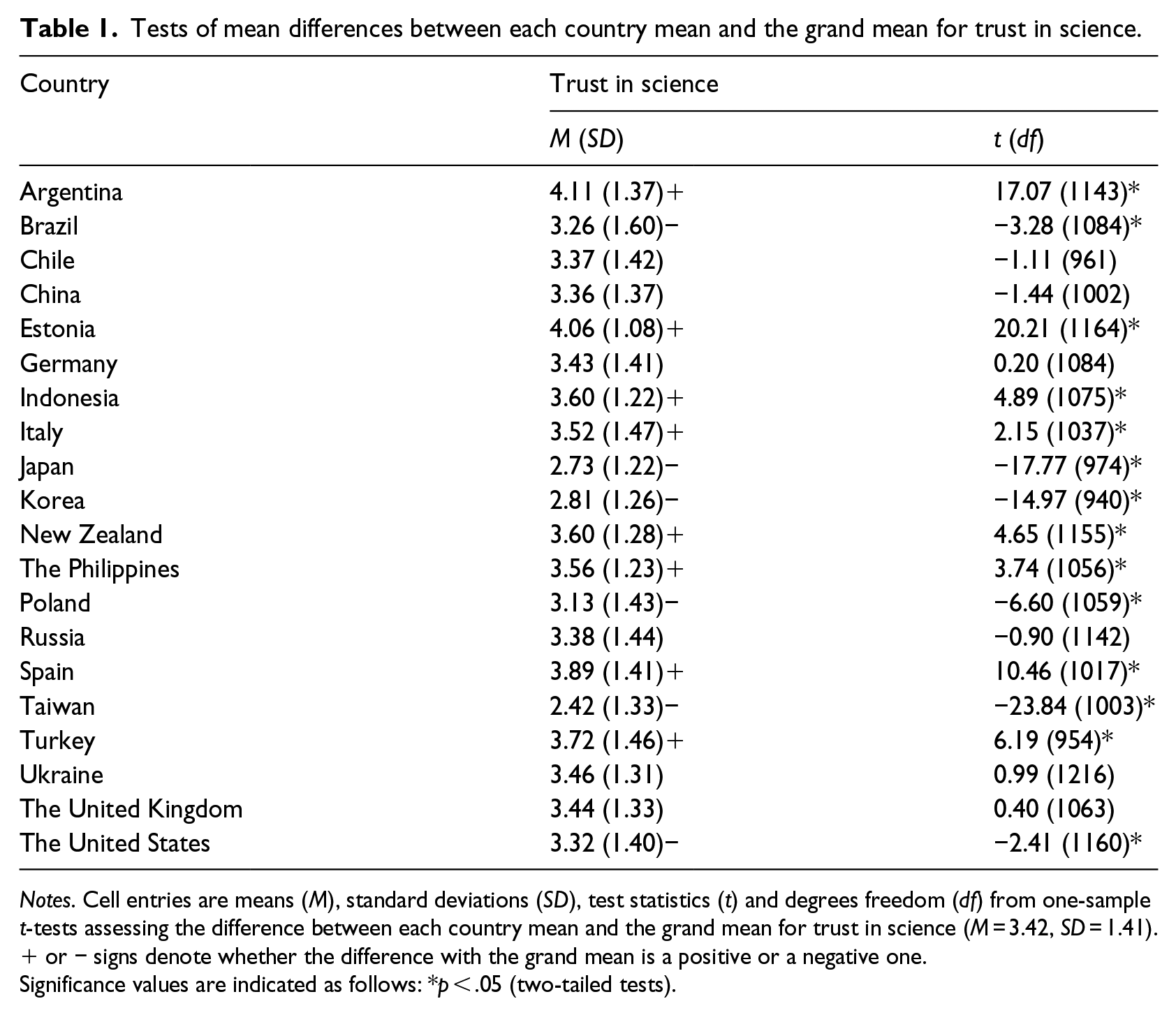
Notes. Cell entries are means (M), standard deviations (SD), test statistics (t) and degrees freedom (df) from one-sample t-tests assessing the difference between each country mean and the grand mean for trust in science (M = 3.42, SD = 1.41). + or − signs denote whether the difference with the grand mean is a positive or a negative one.
Significance values are indicated as follows: *p < .05 (two-tailed tests).
Individual-level measures
Trust in science
The dependent variable in the analysis is trust in science. Based on prior research (Brewer and Ley, 2013; Nisbet and Goidel, 2007), this variable relies on two questionnaire items 3 that ask respondents to rate their feelings of trust toward particular actors or institutions (0 = “No Trust,” 6 = “A Great Deal of Trust”) toward (a) scientists and (b) universities. These two items are highly correlated (r = .77), and therefore the final variable took the average of the two scores (M = 3.42, SD = 1.41).
Social media news use
Based on prior research (Gil de Zúñiga et al., 2012; Valenzuela et al., 2012), we asked respondents how often they use social media to (a) get news, (b) stay informed about current events and public affairs, (c) get news about their local communities, and (d) get news about current events from mainstream media. These four items, which were measured on 7-point scales (0 = “Never,” 6 = “All the Time”), form a reliable scale (Cronbach’s α = .865, M = 3.33, SD = 1.51).
Control variables
The study controlled for an array of variables that prior studies have identified as having an influence (demographics, political ideology, science knowledge, religiosity, traditional news use; for details, see Supplementary Appendix Table A1).
Country-level measures
We included PDI and Individualism (IDV) as macro variables in our analysis (for details, see Supplementary Appendix Table A1).
Analysis
First, one-sample t-tests were used to test whether each country’s mean for trust in science is statistically different from the overall (grand) mean across the 20 countries. 4 Next, a series of log-likelihood model comparisons were used to establish the most appropriate multi-level model for the data. A fixed intercept null model was compared to a random intercept model. This comparison is useful for establishing whether, without accounting for control variables, the mean of trust in science significantly varies across countries. A full model with a random intercept was then compared to a full model with random slopes, which establishes that, accounting for the controls, the effect of social media news use varies randomly across countries. Once the appropriate model was determined, multi-level modeling was conducted. The between-country variance was first assessed with a random slope model, before moving on to test the cross-level interactions between social media news use and PDI and IDV.
4. Results
One-sample t-tests were first conducted to assess each country’s difference with the overall sample in terms of mean levels of trust in science (M = 3.42, SD = 1.41). Results are summarized in Table 1, and means are illustrated in Figure A1 in the Supplementary Appendix. The highest test statistics (indicating country means greater than the grand mean) are seen in Estonia (20.21), Argentina (17.07), and Spain (10.46). Meanwhile, the lowest test statistics are seen in Taiwan (−23.84), Japan (−17.77), and Korea (−14.97). Finally, non-significant test statistics (indicating a country mean close to the grand mean) are observed in Germany (.20), the United Kingdom (.40), Russia (−.90), Ukraine (.99), Chile (−1.11), and China (−1.44).
Figure 1 plots the PDI and individualism (IDV) index scores by country. Because these scales have been standardized for the purposes of this visualization, the specific scores for each country are not as meaningful as the relative distance to other scores. The highest scoring countries on PDI (indicating more inequality, or less equality) include the Philippines, Russia, and Ukraine. The lowest scoring countries are New Zealand, the United Kingdom, Germany, the United States, and Estonia. Countries with average PDI include Taiwan, Spain, and Chile. For IDV, the United States, the United Kingdom, New Zealand, and Italy score the highest while Indonesia, Taiwan, Korea, and China score the lowest. Meanwhile, Argentina and Japan score close to the mean.
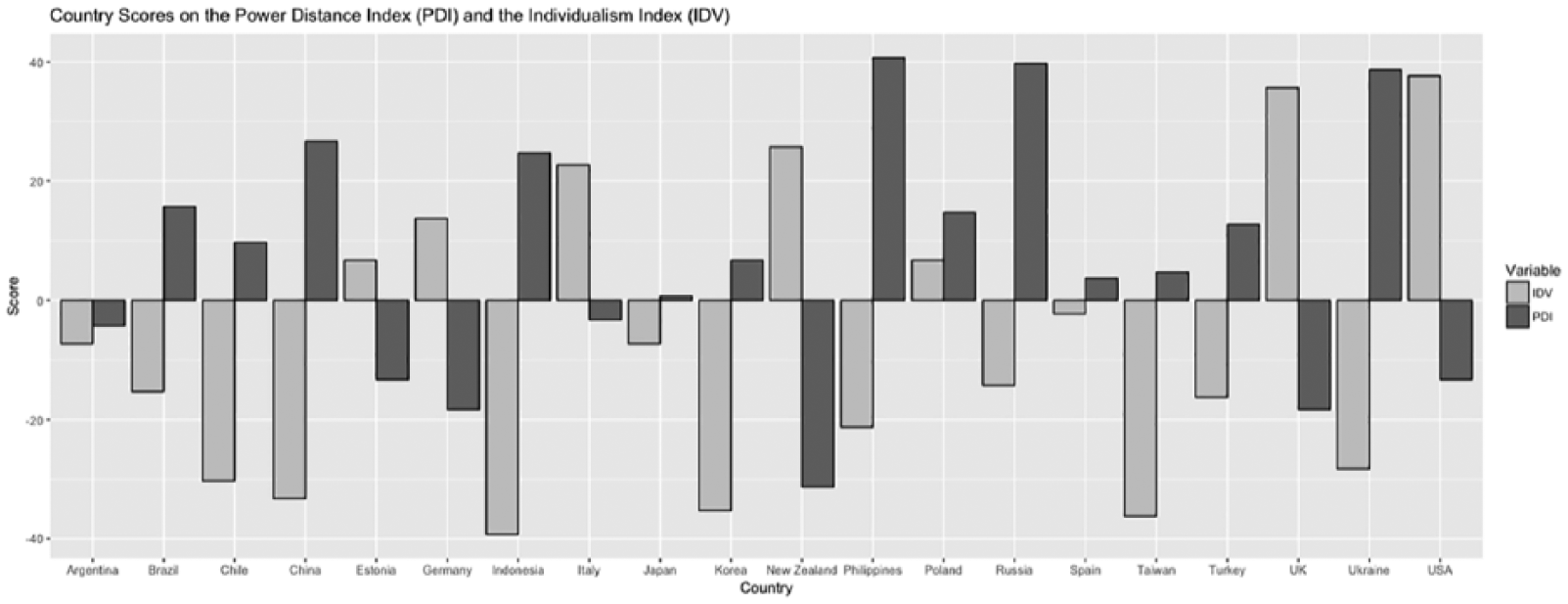
Country scores on the power distance index (PDI) and the individualism index (IDV).
A series of model comparisons was conducted to establish the most suitable model for the data. Results are summarized in Table A2 in the Supplementary Appendix. First, a null model with a random intercept (i.e. a model with no predictors and a random intercept) is a better fit (log likelihood = −36,708.31) than a null model with a fixed intercept (log likelihood = −37,538.22), which indicates that, without accounting for the predictors, mean levels of trust in science vary from country to country. Next, results show that a full model with a random slope (i.e. a model including predictors and a random slope for social media news use) is a better fit to the data (log likelihood = −33,534.29) than a similar model with a fixed effect for social media news use (log likelihood = −33,563.17). This result indicates that the effect for social media news use significantly varies from country to country.
Having established that a random slope model is the best fit to the data, we proceeded to test H1, which predicts an overall positive relationship between social media news use on trust in science. Results, which are shown in the first column of Table 2, support this prediction, showing a statistically significant and positive coefficient (B = .13, SE = 0.02, p < .001). Moreover, this relationship varies in magnitude across countries with a standard deviation of .08, indicating that the result is strongly positive (+2 SD = 0.29) in some countries and non-significant in others (−2 SD = −0.03).
The relationship between social media news use and trust in science with and without cross-level interactions.
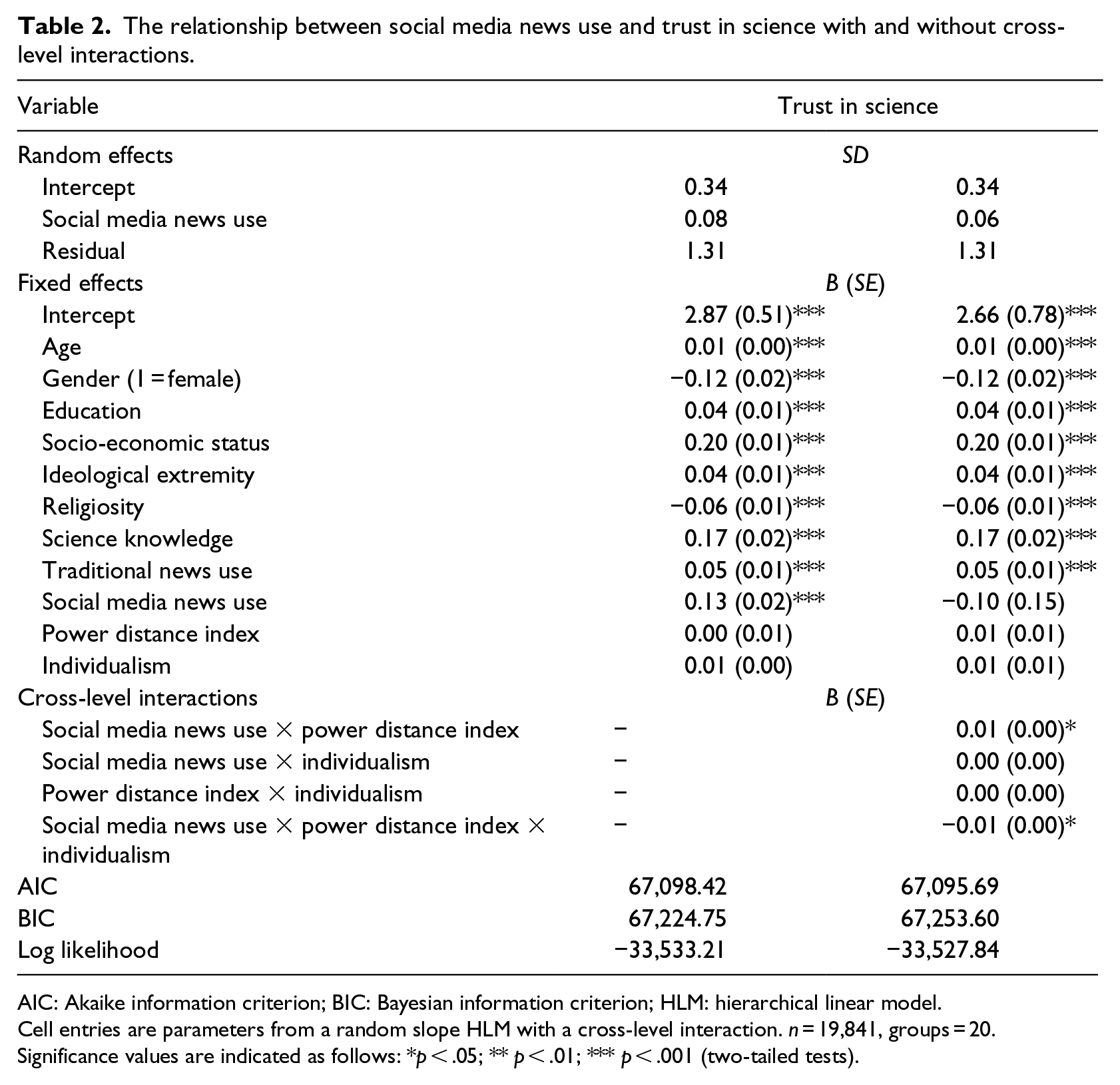
AIC: Akaike information criterion; BIC: Bayesian information criterion; HLM: hierarchical linear model.
Cell entries are parameters from a random slope HLM with a cross-level interaction. n = 19,841, groups = 20.
Significance values are indicated as follows: *p < .05; ** p < .01; *** p < .001 (two-tailed tests).
The second model in Table 2 models this between-country variation in the relationship between social media news use and trust in science. The model estimates a fixed intercept—which can be interpreted as the grand mean of trust in science adjusted at the mean of all predictors—of 2.66 (SE = 0.78). This mean varies between countries with a standard deviation of 0.34, which indicates that in 96% of countries (approximately 19 of 20), the adjusted mean for trust in science falls between 1.98 and 3.34 (Minimum = 0, Maximum = 6). The fixed coefficient for social media news use is non-significant, owing to the presence of the cross-level interaction terms. Neither second-level predictor is independently statistically significant in this model.
The first interaction between social media news use and PDI is significant with B = .01 (SE = 0.00), but the second and third interactions are not statistically significant (for social media news use by PDI: B = .00, SE = 0.00, n.s. and for PDI by IDV: B = .00, SE = 0.00, n.s.). However, the three-way interaction (social media news use by PDI by IDV) is statistically significant (B = −.01, SE = 0.00, p < .001). This three-way interaction is illustrated in Figure 2, which shows that the relationship between social media news use and trust in science is strongest where PDI is also high—but only in collectivistic countries (i.e. where IDV is low). These results support H3 and H4, but not H2.
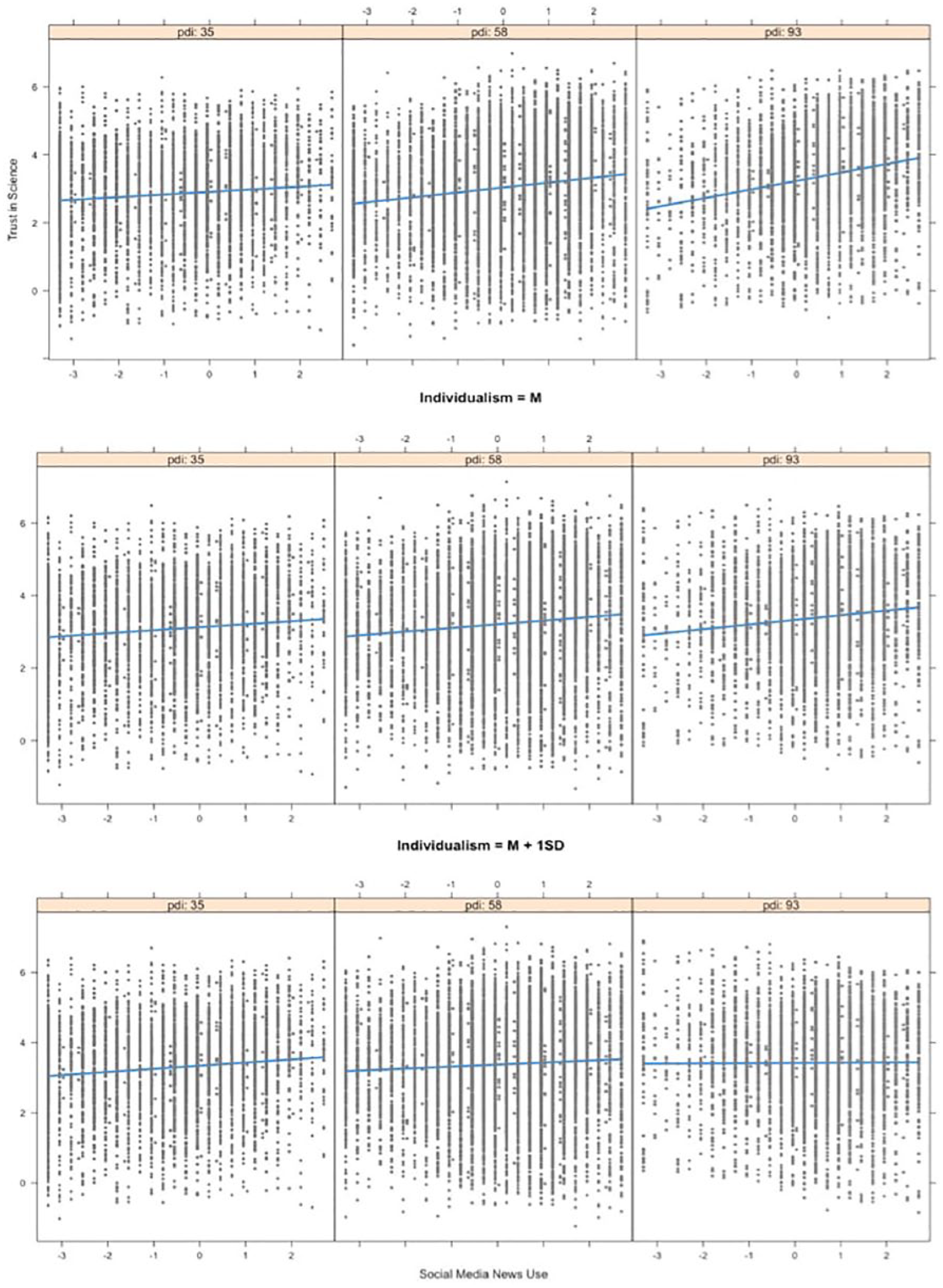
The relationship between social media news use and trust in science at three levels of the Power Distance Index (left = low, right = high) and Individualism (top = low, bottom = high).
5. Discussion
This study tested the relationship between social media news use and trust in science in 20 countries worldwide. Results show a positive relationship between social media news use and trust in science across different societies. Social media news use is more strongly related to trust in science than traditional news use (the difference in betas strength based on z-score test is significant at p < .001). Social media expand and diversity information networks (e.g. Bakshy et al., 2015), promote engagement with news posted by trusted social contacts (e.g. Media Insight Project, 2017), and provide direct access to science news posted by scientists and universities (e.g. Collins et al., 2016; Darling et al., 2013). It is unclear which of these three mechanisms is at play (an important limitation to our study); it could be that all three mechanisms work together.
First, social media make it more likely that people will encounter science news in the first place, whether through active news seeking or incidental exposure, both of which are positively related to engagement with news (Oeldorf-Hirsch, 2018). Second, the social recommendations that accompany science news in social media environments could increase the credibility of the story or counteract mistrust based on ideological tendencies (Bode, 2016; Messing and Westwood, 2012). Finally, social media give users the opportunity to receive science news directly from scientists and institutions engaged in science research, which are inherently more trustworthy than news organizations (Sbaffi and Rowley, 2017).
However, this conclusion comes with an important caveat. This study has examined trust in science based on exposure to social media news regardless of the quality of the information. Misinformation and fake news have become increasingly prevalent on social media (Allcott and Gentzkow, 2017), including misinformation about scientific findings (Allgaier, 2016; Liang et al., 2014). Hence, important questions for future research are how to deal with scientific misinformation on social media (Vraga and Bode, 2017) and how to deal with incivility in social media discussions about science (Anderson and Huntington, 2017). Circulating science news on social media and interacting with the public is a challenging task which entails risks, and not all researchers and their institutions are prepared to take on those risks (Bucchi, 2017). Moreover, recent research suggests that researchers and their institutions do not fully utilize the dialogic potential of social media (e.g. Jia et al., 2017; Lee et al., 2018), and science communicators have only just started to integrate two-way communication strategies into training programs (Yuan et al., 2017). Hence, future research should focus on two-way communication between scientists and the public and investigate its association with trust in science.
Second, the results of the current study indicate that the relationship between social media news use and trust in science is the strongest in collectivistic countries with high power distance. These differences may be explained by how these cultural indicators affect the ways in which people engage with information posted on social media. People in collectivistic countries are more likely to place high importance on the opinions of others (Goodrich and De Mooij, 2014), and people in high-PDI countries are more likely to trust information obtained directly from authority figures (Perea and Slater, 1999). Because social media afford the opportunity for users to engage with science news posted by trusted others and by scientists and universities, these tendencies interact to make people in low-IDV/high-PDI countries more likely to trust the science news they encounter in social media environments.
These insights are important for science communicators, especially for those who are engaged in transnational communication. Culture plays a significant role in shaping the dialogue between organizations and publics in online environment in different countries (Men and Tsai, 2012). Specifically, social media could have a stronger positive impact on scientific information campaigns in collectivistic countries with high PDI, including, for example China or Indonesia. These countries tend to be more accepting of social and institutional hierarchies, and they tend to have more of a collectivistic mind-set. As such, science messages may be more effective in these contexts if they play to the authoritativeness of scientists or scientific institution. Appeals to collective benefits to the society may also be particularly effective in these contexts. However, these strategies may be less effective in individualistic countries with low PDI, including, for example, Germany or the United States. Future research should focus on uncovering which components of science communication on social media may be effective in different contexts. For example, a message effective in some countries might irritate people in other countries due to violation of cultural norms. Hence, future studies should also test how emotions while reading science news on social media relate to trust in the information and trust in science, and contribute to the emerging research on emotions, humor, and entertainment in science communication (e.g. Bore and Reid, 2014; Simis-Wilkinson et al., 2018).
These conclusions are limited in several ways. Social media news use was measured by using generic wording (“social media”), rather than wording about specific social media platforms. In addition, we measured general social media news use and not science news, specifically. Nonetheless, there is good reason to assume that our respondents encountered science news. First, science coverage is not limited to science sections; rather, scientific findings and scientists’ statements are an integral part of general news (e.g. Brantner and Huber, 2013; Elmer et al., 2008). Second, survey data indicate that around half of social media news users regularly see posts about science (Pew Research Center, 2015). Third, recent research shows that it is quite common to share links to science and research on Facebook (Hargittai et al., 2018): 44% of young adults do so. Hence, it is quite likely that social media news users encounter science news. However, future studies could focus specifically on social media use for science news and differentiate between getting science news from mainstream media accounts via social media and getting news directly from scientists on social media.
Moreover, cross-level interactions in multi-level regression are notoriously difficult to detect (see, for example, Mathieu et al., 2012), because doing so requires at least 15 second-level groups to have enough statistical power. Given this understanding of multi-level analysis, we would argue that detecting any cross-level interaction is a noteworthy finding. That said, the readers should interpret these small effect sizes with caution. Finally, our study is based on cross-sectional data and, therefore, do not allow for causal inferences.
Despite these limitations, our study shows relatively strong evidence across 20 countries about the positive relationship between social media news use and trust in science. In addition, it points out the role of Hofstede’s (2001) cultural dimensions individualism/collectivism and power distance in shaping this relationship: The potential of social media to foster public trust in science seems to be especially high in collectivistic countries with a large power distance.
Supplemental Material
Supplemental_Material – Supplemental material for Fostering public trust in science: The role of social media
Supplemental material, Supplemental_Material for Fostering public trust in science: The role of social media by Brigitte Huber, Matthew Barnidge, Homero Gil de Zúñiga and James Liu in Public Understanding of Science
Footnotes
Declaration of conflicting interests
The author(s) declared no potential conflicts of interest with respect to the research, authorship and/or publication of this article.
Funding
The author(s) disclosed receipt of the following financial support for the research, authorship, and/or publication of this article: This research was supported by Grant FA2386-15-1-0003 from the Asian Office of Aerospace Research and Development. Responsibility for the information and views set out in this study lies entirely with the authors.

Supplemental material
Supplemental material for this article is available online.
Notes
Author biographies
References
Supplementary Material
Please find the following supplemental material available below.
For Open Access articles published under a Creative Commons License, all supplemental material carries the same license as the article it is associated with.
For non-Open Access articles published, all supplemental material carries a non-exclusive license, and permission requests for re-use of supplemental material or any part of supplemental material shall be sent directly to the copyright owner as specified in the copyright notice associated with the article.
