




Abstract
Crowdfunding has emerged as an additional source for financing research in recent years. The study at hand identifies and tests explanatory factors influencing the success of scientific crowdfunding projects by drawing on news value theory, the “reputation signaling” approach, and economic theories of online payment. A standardized content analysis of 371 projects on English- and German-language platforms reveals that each theory provides factors influencing crowdfunding success. It shows that projects presented on science-only crowdfunding platforms have a higher success rate. At the same time, projects are more likely to be successful if their presentation includes visualizations and humor, the lower their targeted funding is, the less personal data potential donors have to relinquish and the more interaction between researchers and donors is possible. This suggests that after donors decide to visit a scientific crowdfunding platform, factors unrelated to science matter more for subsequent funding decisions, raising questions about the potential and implications of crowdfunding science.
1. Introduction
The relationship between science and society is changing. This change has many facets (e.g. Nowotny et al., 2001; Weingart, 2001), two of which are particularly relevant for this study: First, research funding is changing. Funding levels have stagnated or been cut in many countries (e.g. Byrnes et al., 2014; Wheat et al., 2013). In addition, third-party funding from agencies like the US National Science Foundation (NSF), private foundations, enterprises, and so on has become more important in relation to public funding in many Organisation for Economic Cooperation and Development (OECD) countries (e.g. Eurostat, 2015; Jahnke, 2015).
Second, online and social media—enabling interactive, many-to-many communication in which user-generated content is exchanged and the distinction between senders and receivers is blurred (cf. Kaplan and Haenlein, 2010)—have created new interfaces between science and the broader public (e.g. Brossard, 2013; Dickel and Franzen, 2016). Non-scientists can observe “science in the making” in live-streams from scientific conferences (cf. Peterson, 2001), engage in scientific debates online (e.g. Trench, 2011), check scientific publications for plagiarism or fraud in online fora (e.g. Fähnrich et al., 2015), or participate in research through citizen science (e.g. Bonney et al., 2009). Nowadays, they can even—and this will be the focus of this article—fund science by donating money for scientific projects via crowdfunding (e.g. Vachelard et al., 2016; Wheat et al., 2013). Crowdfunding is an internet-based method of fundraising in which individuals solicit contributions for projects on specialized crowdfunding websites. The focus […] is gathering many small donations (the “crowd” in crowdfunding) rather than requesting a single large sum from a funding agency. Crowdfunding drives run over a limited timeframe[,] and attempt to meet a funding goal before the end of the campaign. (Wheat et al., 2013: 71)
Four crowdfunding variants have been identified (cf. Hollow, 2013: 71; Schwarz, 2013: 12): In equity-based crowdfunding, donors invest in business projects and receive dividends or shares in case of success. In lending-based crowdfunding, donors lend money to applicants and get interest in return. Reward-based crowdfunding rewards donor contributions in non-monetary ways, for example by providing services or products. In donation-based crowdfunding, donors do not receive a material return. This is by far the most common variant with regard to scientific projects (Wheat et al., 2013: 72), and we will focus on it in our study.
Crowdfunding has become increasingly important in recent years, with a global volume estimated at more than US$5 billion in 2014 (Broderick, 2014). Crowdfunding projects have been used to finance businesses, music albums and movies, novel forms of journalism, and more (for overviews, see Bennett et al., 2015; Lambert and Schwienbacher, 2010). It also seems to be increasingly used as a source to fund science. Several high-profile scientific projects have already been crowdfunded, including an orbital space telescope which received US$1.5 million (Sich, 2015). General-interest crowdfunding platforms like Indiegogo, Kickstarter, or RocketHub have hosted numerous scientific projects, and platforms like experiment.com, petridish.org, or sciencestarter.de focus exclusively on crowdfunding science. On these platforms, hundreds of scientists ask donors to fund field trips, data analysis, publications, or entire projects. The total amount of money raised as well as the number of funded projects have increased considerably in recent years (Vachelard et al., 2016: 1f.).
The way scientists seek funding on these platforms is an interesting object for scholars of science communication because it has novel features: On crowdfunding platforms, scientists have to engage in external communication at a very early stage in the research process. “Instead of disseminating results to a broader community upon completion of the research, crowdfunding garners public support before research is initiated” (Wheat et al., 2013: 71). In addition, this communication has to appeal to potential donors beyond the circle of immediate scientific peers and the scientific community, in a way that convinces the audience to make a financial contribution. Scientists approach this challenge differently: Some use scientific jargon, explaining their research with disciplinary nomenclature. Others employ colloquial language, trying to be easily understandable to the broader public. Many use images or audiovisual material, from personal statements to computer animations (cf. Vachelard et al., 2016).
As of yet, however, an empirical assessment of these different communicative strategies is lacking. There have been almost no peer-reviewed studies on this topic (cf. Mollick, 2014: 4). While studies on crowdfunding in other fields have described the characteristics of donors (e.g. Belleflamme et al., 2014), the nature of donor–applicant interactions (e.g. Sargeant et al., 2007), or the use of website elements (e.g. Ingenhoff and Koelling, 2009), a mapping of the presentations of scientific projects on crowdfunding platforms as well as an assessment of the factors making these projects successful is lacking.
The study at hand tackles this question, asking, What factors influence the financial success of scientific projects on crowdfunding platforms? It assesses which project presentations make people more likely to engage with scientific projects—and it does so using people’s funding decisions as an indicator, that is, a form of “strong” public engagement in science as it involves people’s financial resources.
In doing so, the analysis presented here also offers an assessment of hopes and concerns that have been voiced with regard to the crowdfunding of science. Its proponents have argued that scientists should explore new avenues to acquire research money, as science is getting more elaborate and costly and as funding is harder to come by (e.g. Byrnes et al., 2014; Wheat et al., 2013). And although crowdfunding cannot be the solution to the current funding crisis, it can be a viable alternative for certain types of research projects [, as] scientists (especially in their early careers), students, and researchers in developing countries (where research funding is scarcer), have started to seek funding through “crowdfunding.” (Vachelard et al., 2016: 1)
In addition, crowdfunding has been described as a way to alleviate alleged problems in the traditional grant system, which has been characterized as tending to fund “lower-risk, longer term projects, given to older scientists” and as “inefficient, risk-averse, and often times political” (Frood, 2015), whereas crowdfunding is portrayed as reaching a broader audience, as being more “democratic” and as allowing the public to decide directly what kind of science should get financed (e.g. Davidson and Poor, 2016: 127; Sciencestarter, 2016; Wheat et al., 2013: 71).
In contrast, a number of concerns have been voiced about crowdfunding science, mainly with regard to quality control and the importance of peer evaluation (cf. Agrawal et al., 2013: 8f.). If research funding is decided by non-experts, it is argued, quality control is lacking and certain kinds of necessary, but complex or seemingly less appealing projects might not receive enough funds (cf. Bennett et al., 2015; Patel, 2015). The result might be that only “panda bear science” gets funded, that is, research that is “super sexy or [has] to do with cuddly animals” (Siva, 2014: 1086), but may lack scientific substance.
2. Theoretical framework
These hopes and concerns have not yet been met by empirical studies (cf. Mollick, 2014), and no conceptual model exists to explain the crowdfunding success of scientific projects. There are, however, a number of related theoretical strands which can be utilized here: news value theory, the “reputation signaling” approach (Agrawal et al., 2013), economic theories explaining the willingness of people to make online payments, and assumptions about the effects of crowd size and crowd interest.
News value theory
News value theory aims to explain which issues or events journalists select for coverage in news media and how they present them (e.g. Shoemaker and Reese, 1995: 105ff.). It posits that journalists look for “news factors” in these issues and events, such as novelty, personalization, or the participation of elite persons, and that issues and events are more likely to be covered, and more prominently so, if they embody these news factors to a large degree, that is, if they have strong “news value” (for classical accounts, see Galtung and Ruge, 1965; Östgaard, 1965).
News value theory can inform our study because it represents journalists’ operationalizations of audience interest. News factors “embody assumptions about […] the composition, wants or tastes of those who are being addressed” (Schlesinger, 1987: 115f.) and what they “find interesting and important to know about” (Shoemaker and Reese, 1995: 106). Research has also shown that audiences of news media tend to select news items that have high news value, that they study them longer and more thoroughly (Eilders, 1997: 264ff., 2006), and that this seems to hold true for online environments as well (Engelmann and Wendelin, 2015).
As news factors operationalize audience interest, they should also be relevant for the study of crowdfunding science: A prerequisite for an online user spending money on a crowdfunding project is that the respective project catches his or her attention.
It has to be taken into account, however, that scientific issues have specific news factors, which do partly, but not fully, mirror the general news factors that have been established for other issues. Badenschier and Wormer (2011) found that several general news factors such as actuality and personalization apply to scientific issues as well, but that some news factors exist which are specific for science issues, such as scientific relevance or the question whether a scientific finding was arrived at intentionally or not (“intention”). These findings will inform our study—with some adjustments, as crowdfunding projects differ from media content in that they do not present daily or weekly news from various fields of society, but specific scientific projects which are often not finished at the time of presentation and unable to present results (cf. Wheat et al., 2013).
In general, we assume that news factors influence the success of scientific projects on crowdfunding platforms. We hypothesize that the stronger relevant news factors are presented in project proposals on crowdfunding websites, the more successful these projects will be (H1).
Reputation signaling
If a scientific project on a crowdfunding site has caught their attention, potential donors have to assess whether the project merits a donation. This assessment is difficult because of “the particularly high degree of information asymmetry” (Agrawal et al., 2013: 18; cf. Herzenstein et al., 2011; Lin et al., 2013) inherent in crowdfunding. Donors have less information about the projects and their chances of realization available than applicants. Crowdfunding scholars have, therefore, argued that the best solution for applicants is to “signal” their reputation, which may serve as an incentive for donors to trust applicants, and, subsequently, finance their projects (Ahlers et al., 2015; Cabral, 2012; Metzger and Flanagin, 2013: 214f.; Mollick, 2013).
In online settings, three mechanisms of “reputation signaling” have been distinguished (Agrawal et al., 2013: 22ff.): First, “quality signals” (Agrawal et al., 2013: 22f.; Mollick, 2014: 7) address the problem that for potential donors, the quality of proposed products or projects is hard to assess. This particularly applies to scientific projects. In comparison with “low-touch” products such as CDs, which are available from various providers at the same quality (cf. Kim et al., 2012), scientific products are complex, often presented with a certain nomenclature, need an understanding of certain concepts or methodologies, and do not usually produce immediate, tangible results (Wheat et al., 2013: 72). This is why they are traditionally evaluated by peers—and even they have difficulties doing so consistently (see the meta-analyses of Mutz et al., 2012; Siler et al., 2015). Under these circumstances, it is likely that potential donors base their quality assessments at least partly on “quality signals” instead of robust judgments. Quality signals that have been demonstrated to be effective in other areas are the brands to which a product belongs (e.g. Rademacher and Siegert, 2007: 489ff.; Waldfogel and Chen, 2006), the education level of the applicant (Ahlers et al., 2015), or his or her earlier achievements such as patents or successful sales (Häussler et al., 2012; Hsu and Ziedonis, 2013). For scientific projects, equivalent quality signals might be the academic titles or honors of an applicant, or the length and complexity of the project presentation itself, that is, its “scientific-ness” (Wheat et al., 2013). In addition, the promise of “perks”—donor gratifications like mentions on a research paper or visits to a research facility—has been shown to function as quality signals (Davidson and Poor, 2016: 129; Varian, 2012). We hypothesize that the more quality signals a project proposal displays, the more successful the respective project will be (H2).
Second, “feedback systems” (Agrawal et al., 2013: 23f.; Metzger et al., 2010: 420) are seen as effective signals for improving reputation. This has been shown in research on online auctions (Cabral, 2012; Tucker and Zhang, 2011), where elaborate feedback mechanisms such as buyer/seller rating systems are available. These are usually not available on crowdfunding platforms and would apply less to them anyway, as interactions there are less frequent (cf. Agrawal et al., 2013: 23). Crowdfunding scholars have argued, however, that feedback mechanisms should still be relevant (cf. Davidson and Poor, 2016: 129). Even a basic, one-way feedback mechanism from the applicants to potential donors has been assumed to signal transparency (Flanagin and Metzger, 2007), to demonstrate the applicants’ commitment to the project (Vachelard et al., 2016: 5) and their “accountability to funders” (Bennett et al., 2015: 145). Two-way, dialogical feedback mechanisms, where users can question applicants, are seen as even stronger signals, as they make evaluative comments of the project possible (cf. Metzger et al., 2010: 420). Therefore, we hypothesize that the existence of one-way or two-way feedback mechanisms will increase the success of the respective projects (H3).
Third, “trustworthy intermediaries” (Agrawal et al., 2013: 24), “endorsements” (Metzger and Flanagin, 2013: 215), or “social recommendations” (Metzger et al., 2010: 420ff.) have been shown to be effective reputation signals (cf. Jin and Kato, 2007). Applicants and project descriptions can profit from the “conferred credibility” of peer or media testimonials, as donors are more “inclined to perceive information and sources as credible if others do so also” (Metzger et al., 2010: 427). Accordingly, we hypothesize that positive endorsements of the applicant or his or her project increase the success of the project (H4).
Theories of online payment
The willingness of Internet users to make payments online has been mainly analyzed with regard to crowdfunding in fields other than science (e.g. Kuppuswamy and Bayus, 2015; Mollick, 2014; Schwienbacher and Larralde, 2010), to commercial products in economics and marketing (e.g. Kim et al., 2012; Wang et al., 2005), and to news content in journalism studies (e.g. Burtch et al., 2013; Lischka and Rademacher, 2012; Rademacher and Siegert, 2007).
The respective studies show that apart from the perceived product quality, two additional factors influence users’ willingness to make online payments: The first are the characteristics of the payment process (cf. Burtch et al., 2015; Rademacher and Siegert, 2007; Wang et al., 2005). Online payments differ from those offline: They can be tedious, and users may be forced to relinquish sensitive information (such as e-mail addresses or credit card numbers) in contexts they may not know well and which may be insecure. Since the convenience and security of the payment process influence payment decisions online (e.g. Burtch et al., 2015; Dou, 2004; Lischka and Rademacher, 2012; Wang et al., 2005), we assume that they will also influence people’s willingness to donate money on crowdfunding platforms: The more information an individual has to relinquish to make a donation, the less successful the respective project will be (H5).
Another factor that influences users’ willingness to make online payments is the price of a pro-duct. This has been demonstrated for consumer decisions (e.g. Kim et al., 2012; Meer, 2014) and for users paying for news content (e.g. Chyi, 2012; Lischka and Rademacher, 2012)—with lower prices in each case increasing the likelihood of payment. It is also in line with crowdfunding studies showing that “increasing goal size is negatively associated with success” (Mollick, 2014: 8) and with scholars assuming that crowdfunding may be particularly suitable for small- to medium-sized projects (Patel, 2015; Schmiedgen, 2014: 136ff.; Vachelard et al., 2016). Therefore, we hypothesize that the lower the total price of a scientific project is, the more successful it will be on crowdfunding platforms (H6). We do not expect a strong effect here, however, as donors—different from other online merchandises—are able to individually determine the amount of money they would like to donate for a project. 1
Social factors: Size and topical interest of the “crowd”
In addition, a number of studies have emphasized that characteristics of the “crowd” itself, that is, of the social communities and networks around platforms and projects, play an important role for crowdfunding success (e.g. Agrawal et al., 2013; Davidson and Poor, 2016: 129; Lin et al., 2013). Two characteristics have been described as influential: The first is the size of the crowd. That a “larger crowd [is] translating into more money raised” (Wheat et al., 2013: 72) has been shown repeatedly in crowdfunding studies apart from scientific projects (Byrnes et al., 2014: 12; Fisk et al., 2011: 444; Mollick, 2014; cf. Vachelard et al., 2016): The more users see a project, the more likely it is going to be successful. Therefore, we hypothesize that the more user traffic a crowdfunding platform has, the more successful the respective projects will be (H7).
The second factor is whether a particular crowd is likely to be interested in a project (cf. Byrnes et al., 2014: 12). If the respective crowd has a general interest in science, it may be more likely to donate for scientific projects. As the interest of users on crowdfunding platforms which only offer scientific projects is likely to be higher than elsewhere, we assume that scientific projects will be more successful on crowdfunding platforms that focus on scientific projects only (H8).
3. Data and methods
Data
Our analysis included crowdfunding platforms specifically focusing on scientific projects as well as general-interest platforms, in English and German, as long as they had also been presenting scientific projects by 1 July 2014 (when our selection process ended). We included all projects that were deemed as “scientific” according to our search criteria in the analysis. Whether or not a project was deemed as “scientific” was determined in several steps. First, we searched platforms for projects containing a number of keywords which were developed in an iterative process: “academic,” “analysis,” “department,” “dissertation,” “doctoral,” “examination,” “exploration,” “graduate,” “investigation,” “research,” “scholarly,” “science,” “scientific,” “study,” “survey,” and “university” (as well as their German translations). In a second step, all projects containing at least one of these terms were manually screened by four coders and excluded if they did not constitute scientific projects. Both successfully funded and unsuccessful projects were included if they were finished by 1 July 2014. On this date, a total of 371 scientific projects were chosen for analysis among the thousands of non-scientific projects looking for crowdfunding.
The 371 scientific projects we selected stem from 11 crowdfunding platforms (see Table 1). Nine of them are English-speaking platforms; six of them are general-interest sites offering crowdfunding projects from different fields such as music, movies, art, games, business, media, and so on. One of them—medstartr.com—focuses on medicine and health-related projects. Four are platforms for scientific projects only.
Overview of the crowdfunding platforms included in our analysis and the scientific projects found there.
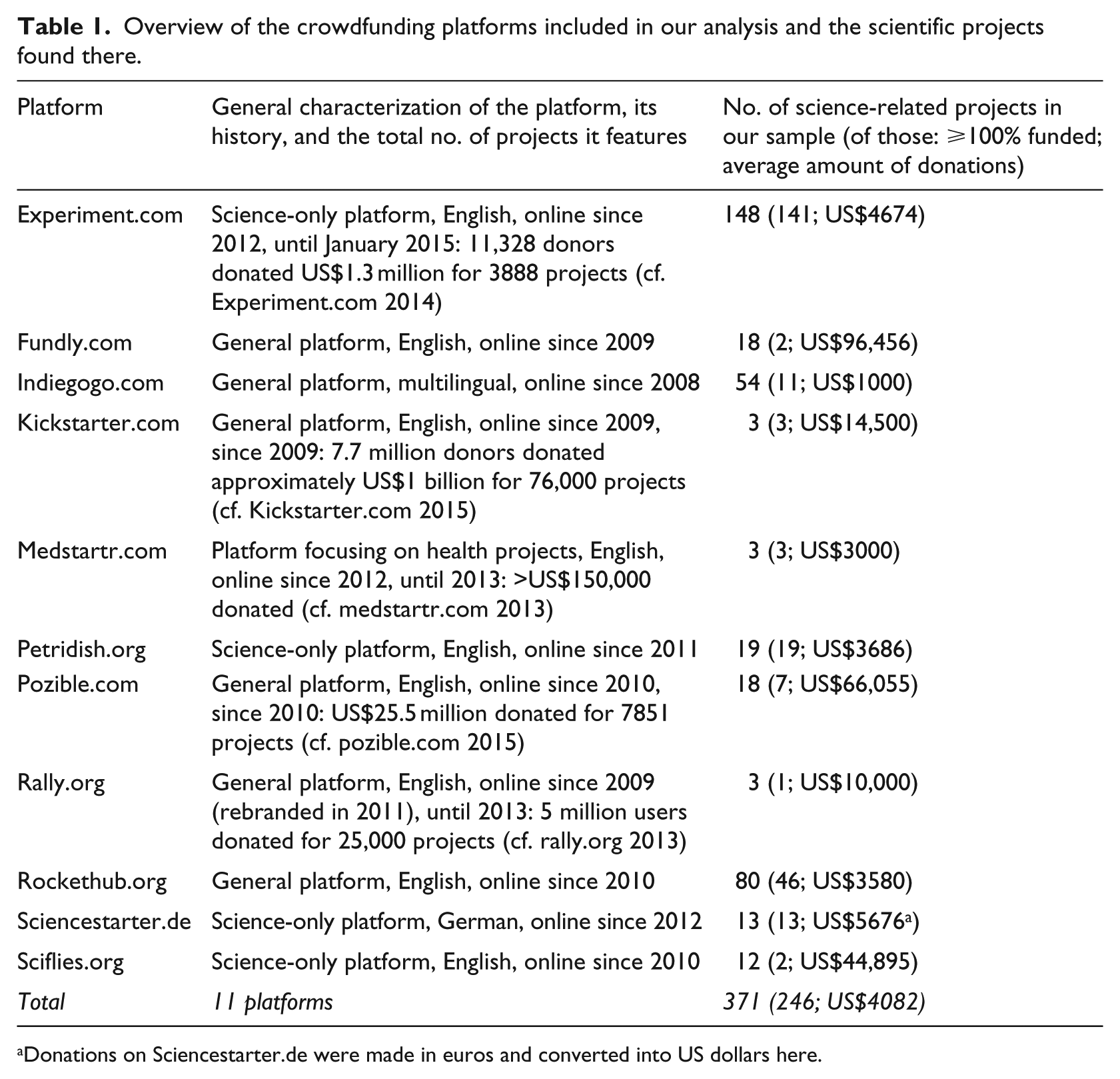
Donations on Sciencestarter.de were made in euros and converted into US dollars here.
Methods and operationalization
The 371 projects were analyzed using standardized content analysis. The codebook contained 54 variables, e.g. formal and general characteristics of platform (name, URL, etc.) and project (name, URL, and research location). The dependent and independent variables were operationalized as follows (see Table 2 for more detail):
Dependent variable. The success of a crowdfunding project can be measured in various ways, for example, by the total amount of money that was raised or by the number of donors. The most relevant measure of success from the perspective of the applicants is whether they acquire the requested funding. 2 While this would indicate a dichotomous-dependent (yes/no) variable, the extent to which applicants reach their self-defined goal can be measured in more detail. Mollick has proposed to use the “funding level” as a measure of crowdfunding success, that is, the “percentage of a project’s goal that is actually raised by founders” (Mollick, 2014: 5). The advantage of this measure—which we decided to use here—is that it is highly relevant for applicants themselves, equally applicable to successful and unsuccessful projects, and available on all coded platforms (while, for example, the number of donors was not available on all platforms).
Overview of the coded variables, their operationalization, and descriptive statistics.

In addition, the codebook contained independent variables operationalizing the theoretical strands outlined above.
Several variables pertaining to news value theory were taken from the “adapted science news value theory” (Badenschier and Wormer, 2011: 61ff.): the “astonishment” of the envisaged project, measured by the amount of superlatives and hyperboles used in its description; its “presentation in graphical form” or visualization, measured as the number of images and videos in the project description; the “personalization” of the project, that is, the extent to which personal information about the researchers such as hobbies, family members, or marital status was provided; the question whether or not “references to elite persons” such as decisions makers, heads of state, or celebrities were made; and the project’s “scientific scope,” that is, the question whether it was presented as being relevant for a sub-disciplinary field only, for an entire discipline, or for several disciplines. Moreover, we added one factor which seems to occur more often in science communication recently (Bore and Reid, 2014; Riesch, 2014), frequently appeared in our sample, and is often recommended for creating successful crowdfunding projects (Mollick, 2014; Vachelard et al., 2016; Wheat et al., 2013): the extent to which humor was used to present the proposed project.
In addition, “reputation signaling” factors were coded. Five variables were included as “quality signals”: the highest academic title of the applicant(s) as an ordinal variable, scientific awards or honors he or she received and mentions in the project description, and the length of the project description (in words) and the complexity of the project presentation itself. In addition, it was coded whether or not “perks” were offered to donors. A variable assessing “feedback mechanisms” was included, coding whether a one-way, a two-way, or both mechanisms existed. Furthermore, the existence of “trustworthy intermediaries” and endorsements was coded, that is, whether the crowdfunding platform has a scientific sponsor such as a renowned scientific journal, whether the project description displayed media features about or testimonials for applicant or project, and whether the platform displayed media features about or testimonials for itself.
From theories explaining online payments we derived two explanatory factors: the total price of the project, measured as the targeted amount in US dollars, and the security of the payment process, operationalized as the amount of personal information individuals have to lay open before being able to make a donation. 3
Two variables operationalizing the size and interest of the crowd were added: the number of monthly users of the crowdfunding platform, based on alexa.com measurements, and the information whether it is a general-interest or science-only crowdfunding platform.
We included the discipline of the project as a control variable since not all disciplines may be equally likely to attract donors (cf. Wheat et al., 2013: 72). Numerous studies have shown, for example, that the news media take up scientific topics to different degrees, likely due to the different audience appeal of these disciplines. The disciplines that have been represented most extensively in recent decades are medicine and biology, with other natural sciences and engineering science following (e.g. Bauer, 2011; Elmer et al., 2008).
A team of four coders coded these variables for all projects. Coding was pretested using 20 project descriptions. Intercoder reliability across all variables was 0.901 (Holsti coefficient), and no single variable had a coefficient below 0.7.
4. Results
Description of scientific crowdfunding projects
Of the 371 scientific projects included in our analysis, 66% (n = 246) were successful, that is, reached or exceeded their self-defined funding goal (see Table 3). This is in line with the 70% average success rate of scientific projects reported by the SciFund Challenge (Vachelard et al., 2016: 1f.), and it clearly exceeds the funding rates of most funding agencies or foundations which are significantly lower (e.g. NSF, 2015b: 5).
Project characteristics: overview (N = 371).
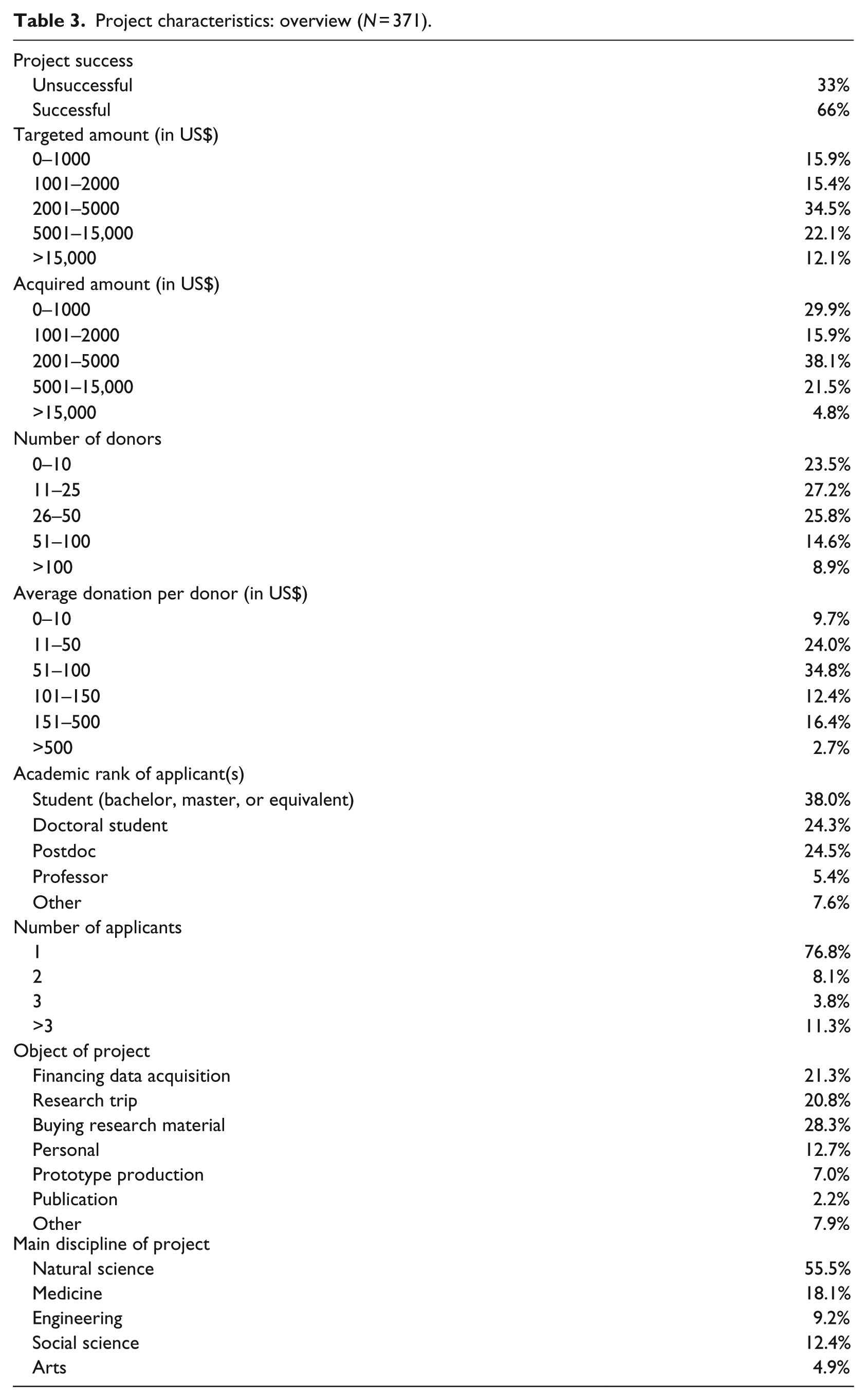
In turn, however, the targeted and received sums on crowdfunding platforms are considerably lower than, for example, the US$170,000 which are awarded for an average NSF proposal (NSF, 2015a). Almost two-thirds of all analyzed crowdfunding projects (64.8%) target amounts of up to US$5000, and only 12.1% aim for more than US$15,000. The funding they actually acquire is even lower: The average sum of donations the projects received was approximately US$4000; 29.9% of all projects received less than US$1000, with only 4.8% acquiring more than US$15,000.
Linear regression, method: stepwise (N = 370).
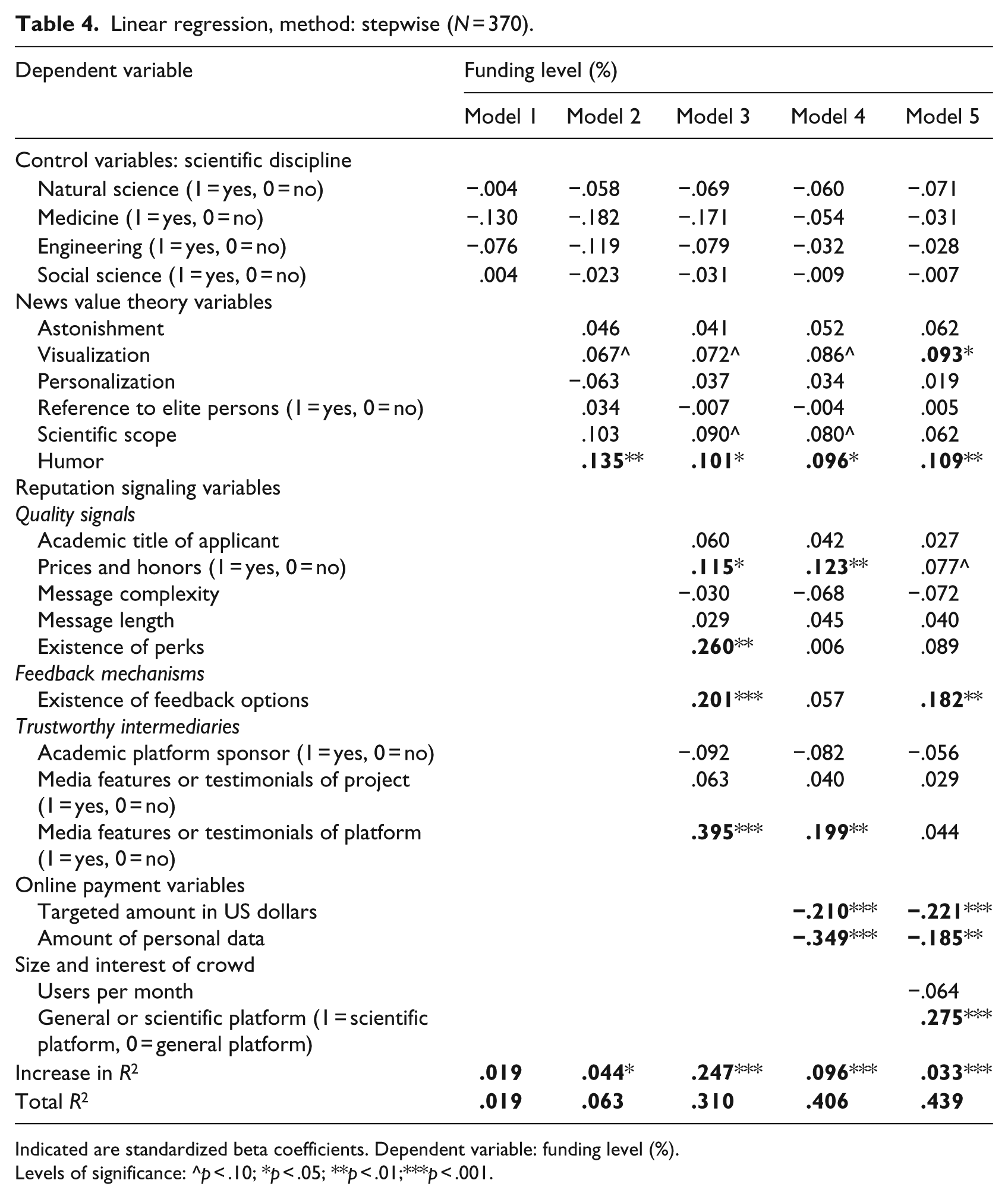
Indicated are standardized beta coefficients. Dependent variable: funding level (%).
Levels of significance: ^p < .10; *p < .05; **p < .01;***p < .001.
These comparatively small amounts are the aggregate of many donations. On average, projects have 39 donors, with about one-quarter of all projects having up to 10, between 11 and 15, between 26 and 50, or more than 50 donors. Accordingly, most donations lie between US$11 and US$100.
Typically, applicants of scientific projects on crowdfunding platforms are early-career, individual scholars from Science, Technology, Engineering, and Mathematics (STEM) disciplines (82.8% of all applicants come from the natural sciences, medicine, or engineering). The large majority of all projects come from single applicants. They mostly apply for crowdfunding to finance data acquisition, to buy research materials, or to finance research trips, that is, for early stages of their research. Research outcomes such as prototypes or publications feature in less than 10% of all applications.
What factors influence the financial success of these projects?
We used linear regression analysis to test the influence of the various independent variables on the projects’ funding levels. Independent variables were entered stepwise into the analysis, resulting in five models. 4
In model 1, the control variables were introduced, that is, dummy variables indicating the scientific disciplines the projects belong to. Belonging to any one of these disciplines, however, does not significantly influence the level of funding a project receives. No disciplinary field receives significantly more, or less, funding when compared to projects from the arts, which served as reference variable. Accordingly, model 1 does not explain a large amount of the dependent variable’s variance (.019).
Model 2 adds the variables derived from news value theory. They improve the model’s explained variance to a significant, but moderate degree (.044*). This is mainly due to one significant news factor: The use of humor in project descriptions clearly increases funding levels. While the visualization of the project, i.e. the use of graphical materials such as pictures and videos, points in the expected direction without exhibiting a significant effect, no other news factors—including the scientific range of the project or an extensive personalization—influence the funding level.
Model 3 introduces the variables taken from “reputation signaling” approaches. In comparison with all other (groups of) variables, they improve the model strongly (.247***). Among these nine variables, four show significant effects: Awards or honors which the applicant or his or her project has received and mention, the promise of perks, and the existence of media features and testimonials that underline the reputation of the crowdfunding platform all positively impact funding levels. These effects, however, dissolve later as other variables are included in subsequent models. The fourth influential factor, which remains significant later on, is the existence of feedback mechanisms between applicants and donors: One-way and, particularly, two-way feedback mechanisms clearly increase the funding a project receives.
Adding the online payment variables in model 4 again improves the explained variance (.096***). Both variables included here show the expected effects: The amount of personal information potential donors have to relinquish, in particular, is strongly and negatively correlated with funding levels: When donors are forced to provide a lot of personal information, they are less likely to make a donation. Additionally, the targeted sum also negatively influences funding levels: Projects which apply for large sums have systematically lower funding levels.
The final model 5, including the size and interest of the crowd and, thus, containing all factors that were conceptually identified as potentially relevant, further improves the explanatory power of the regression (.033***). It shows that projects presented on crowdfunding platforms which only focus on scientific projects, such as experiment.com or petridish.org, receive significantly more funding than projects on general-interest platforms and that this factor is stronger than all other variables which were included in our analysis. In turn, the number of users a project’s platform has per month does not influence funding levels.
Overall, the regression model explains a comparatively high 44% of the dependent variable’s variance. In the final model, the news factors visualization and humor, the existence of feedback mechanisms between applicants and donors, the targeted sum, the amount of personal data a donor has to relinquish, and whether the project is hosted on a science-only or general-interest platform significantly influence funding levels.
5. Discussion
The study at hand attempts to explain the success of scientific projects on crowdfunding platforms by integrating news value theory, “reputation signaling,” and economic theories of online payment. A standardized content analysis of scientific projects revealed that each theory contributes relevant explanatory factors. Overall, with accounting for 44% of explained variance, they explain the crowdfunding success of scientific projects quite well.
Projects which are presented on science-only crowdfunding platforms have a much higher chance of success (H8, see Table 5). At the same time, projects are more likely to be successful if they are presented humorously and include visualizations (H1), the lower their targeted funding is (H6), and the less personal data potential donors have to relinquish when they donate money (H5). In addition, if projects allow for interactivity between the researchers and potential donors, this increases crowdfunding success (H3).
Assessment of the formulated hypotheses.
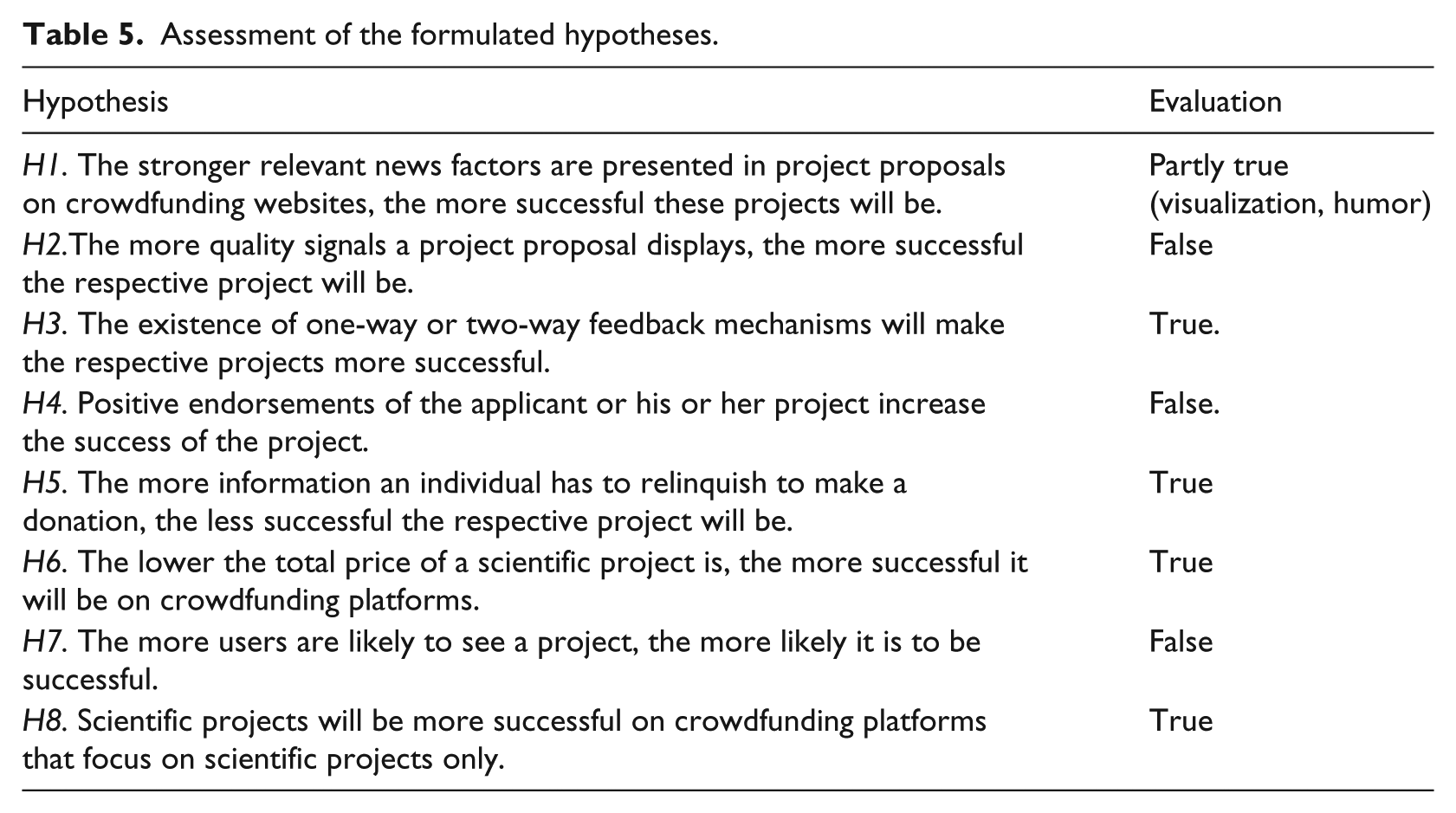
These results suggest that potential donors may choose the crowdfunding platform they visit based on a scientific criterion—that is, whether it is a crowdfunding platform specifically focused on scientific projects or not. But this initial focus on scientific characteristics does not seem to last once the respective platform has been selected. Detailed scientific indicators and credentials of the platform (such as the question whether it is sponsored by scientific institutions; H4), the applicants (such as their scientific titles, prices, or honors; H2), or the project itself (such as its scientific range or the discipline it comes from) do not significantly influence crowdfunding success and neither does the site traffic of the platform (H7). Once donors have decided on a platform, factors unrelated to science seem to matter more for funding decisions: Whether proposals are presented in an easily approachable way, through adding humor, visuals, or an interactive presentation, is more important for receiving donations than a proposal’s scientific content, relevance, or discipline. Furthermore, the security of the payment process has a strong influence on crowdfunding success. These findings underline some of the problematic aspects of the crowdfunding of scientific projects. It has been feared that crowdfunding might favor “sexy” but insubstantial “panda bear science” (Siva, 2014), and our results suggest that factors related to the scientific quality of the proposed projects are indeed less important for crowdfunding success.
These findings could be indicative of the current changes in the relation between science and society, particularly for an increasingly “contextualized” (Nowotny et al., 2001) or “societalized” (Weingart, 2001) science. For science crowdfunding, they suggest that non-scientific factors not only play an important role, but that they are more important than scientific criteria.
Our study also shows that crowdfunding is still a marginal phenomenon within science funding. It is mainly used to acquire smaller amounts of money for specific parts of research projects, and the donated amounts are minor in comparison with public or foundation-based research funding. All 371 crowdfunding projects analyzed here, in sum, received approximately US$1.5 million—an amount equivalent to nine average projects funded by the NSF (2015a). But we could show that crowdfunding is mainly employed by early-career researchers, for whom it may represent their first avenue into research funding. Via crowdfunding, (some) young scholars may be socialized into project applications in a way where problematic criteria apply.
These results need to be substantiated further. Our study represents a first foray into the explanation of crowdfunding success, which has not yet been analyzed empirically with regard to scientific projects. Although we conducted an analysis of all scientific projects that were presented on crowdfunding platforms at the given date, future studies should expand this database. In cooperation with crowdfunding platforms, for example, it would be possible to employ larger n analyses of crowdfunding characteristics and successes (e.g. Herzenstein et al., 2011). Future studies should also take additional explanatory factors into account. They could include additional information about the researchers which is publicly available, such as their Facebook or Twitter profiles or networks (Byrnes et al., 2014; Lin et al., 2013), the concrete payment mechanisms of crowdfunding platforms (Cumming et al., 2015), or the “herding behavior” that has been shown among donors, making donations more likely if others have donated before (Agrawal et al., 2013: 4f.; Herzenstein et al., 2011). As STEM projects are dominant on crowdfunding platforms, it would also be interesting to analyze for each discipline seperately if different factors are influential for the success of a project. Analyses of the crowdfunding of scientific projects would also benefit from connecting content analysis to experimental or survey research testing assumptions about crowdfunding successes among potential donors (similar to Burtch et al., 2015). In general, future studies should develop an integrated explanatory model not only identifying the relevant factors but also modeling the interrelations between them in more detail.
Footnotes
Acknowledgements
The article title refers to Dorothy Nelkins’ seminal book Selling Science ( ). The authors wish to thank Angela Landolt and Sabine Lorencez, who coded part of the data; Tobias Füchslin, who provided assistance with the data analysis; and Christiane Eilders, Ulrike Klinger, Juliane Lischka, and the two anonymous reviewers for helpful comments. Earlier versions of this study were presented at the International Communication Association’s Annual Conference in Fukuoka and at the Annual Conference of the German Communication Association’s Science Communication Division.
Funding
The author(s) received no financial support for the research, authorship, and/or publication of this article.