




Abstract
In contrast to increasing debates on China’s rising status as a global scientific power, issues of China’s science communication remain under-explored. Based on 21 in-depth interviews in three cities, this article examines Chinese scientists’ accounts of the entangled web of influence which conditions the process of how scientific knowledge achieves (or fails to achieve) its civic authority. A main finding of this study is a ‘credibility paradox’ as a result of the over-politicisation of science and science communication in China. Respondents report that an absence of visible institutional endorsements renders them more public credibility and better communication outcomes. Thus, instead of exploiting formal channels of science communication, scientists interviewed were more keen to act as ‘informal risk communicators’ in grassroots and private events. Chinese scientists’ perspectives on how to earn public support of their research sheds light on the nature and impact of a ‘civic epistemology’ in an authoritarian state.
1. Introduction
In contrast to increasing interest in China’s rising status as global scientific power, China’s public engagement efforts remain under-explored. Among the limited empirical studies on science communication in China, the focus has mainly been on evaluating the outcome of related national campaigns, such as public science literacy, rather than the process of how such efforts are carried out (see Chen et al., 2009; Lü, 2009). This empirical inattentiveness to the actual practice of scientific communication may be partially due to three widely shared characterisations of Chinese science communication: (1) science communication in China is dominated by the government, which acts both as the main sponsor and organiser; (2) such a top-down approach is often seen as resembling a ‘deficit model’ of public engagement; and (3) similarly, apart from top-down initiatives, other civil actors, in particular Chinese scientists, seem to be much less enthusiastic in engaging with the public (Chen et al., 2009; Jia and Liu, 2014). In other words, the landscape of China’s science communication seems rather bare and straightforward; thus, there seems not much to be investigated. Both academic studies and media analysis have attributed the perceived reluctance of Chinese scientists to engage with publics to a conventional academic culture which does not value public engagement, and to scientists’ lack of awareness of their social responsibilities (Hu, 2010; Wu and Qui, 2012; Zhao, 2014).
To be sure, the public engagement with science, aiming to involve diversified stakeholders to establish a ‘hybrid forum’ and to strengthen ‘societal regulation’ of science is still in its infancy in China (Callon et al., 2009; Jelsøe et al., 2006: 45–49; Zhang, 2012). This is reflected in existing studies on public communication in the field of nanotechnology, genetic modification (GM) technologies, vaccination and the promotion of scientific literacy in general (Jia and Liu, 2014; Leong et al., 2011; Ren et al., 2014). The nascent state of science communication in China can also be seen from official government documents which lack the vocabulary to describe various interactions between science and the public. Currently, the term ‘kexue puji’, or kepu for short, is used as a catch-all terminology to incorporate a range of science communication activities (Ministry of Science and Technology China (MOST), 2012; State Council, 2006). Literally translated as ‘science popularisation’, kepu incorporates a spectrum of activities, ranging from one-way science education to interactive public dialogue, from one-off media events to sustained community engagements (MOST, 2012; State Council, 2006; Zhao, 2014).
Based on recent fieldwork, this article argues that this ‘neat’ depiction of Chinese science communication as a top-down ‘deficit’ approach with unenthusiastic scientists may be misleading. As rightly pointed out by previous comparative studies of alternative public engagement in Asia, science communication in authoritarian societies, such as China, cannot be simply equated to a ‘deficit model’ (Leong et al., 2011). Reducing the perceived communicative attitudes of the Chinese state and Chinese scientists to a ‘deficit model’ framework obscures crucial differences in the power-relations among the state, the scientific community and the public. It also blinds us from identifying actual governing challenges these differences entail. Thus, to fully comprehend the myths and realities of public engagement in China, a closer examination of how stakeholders interpret, accommodate, question, subvert and transform science communication strategies is required.
To fill this gap of knowledge, this article sets out a preliminary empirical investigation on the entangled web of influences underlying China’s science communication, with a focus on the views of Chinese scientists. Data used in this article are based on 21 interviews conducted by a collaborative UK–China research project in three Chinese cities.
By employing Sheila Jasanoff’s (2005a, 2012) ‘civic epistemology’ thesis and Brian Wynne’s (1980, 2001) ‘public alienation’ thesis, this article illuminates the process of how scientific knowledge achieves its civic authority through negotiating with and adapting to social and political expectations.
The importance of examining China’s public science communication is not limited to the fact that China is a ‘leading influence’ in the global organisation and delivery of scientific innovation (Foreign & Commonwealth Office (FCO) and Department for Business Innovation & Skills (BIS), 2013). Effective public communication is essential for maximising the uptake and application of scientific research carried out in, and with, China (Moreno, 2010). More importantly, as rightly pointed out by policy scholars Leong et al. (2011), the theorisation of public acceptance of science has hitherto been based mainly on Western liberal-democratic states; how contentious technologies acquire their social support in societies where ‘states play much more active and central roles’ necessitates empirical examination (p. 135). By investigating Chinese scientists’ account of the entangled web of influence which conditions how scientific knowledge achieves (or fails to achieve) its civic authority, this article furthers the civic epistemology thesis by extending its discussion to an authoritarian state.
2. Credibility of science and civic epistemology
With the recognition of the ambiguity and contingency of contemporary science, there is an increasing consensus that the credibility of scientific knowledge is not a given but is socially validated (Callon et al., 2009; Irwin and Wynne, 1996; Jasanoff, 2004; Jelsøe et al., 2006; Miller, 2005). In her seminal work, Designs on Nature, Sheila Jasanoff (2005a) powerfully argued that scientific knowledge can only establish its authority when it is articulated, deliberated and valourised in a way that meets entrenched cultural expectations and conforms to public reasoning. These socio-politically grounded ‘knowledge-ways’ through which citizens ‘assess the rationality and robustness of claims that seek to order their lives’ are what she defined as civic epistemology (Jasanoff, 2004, 2005a: 249).
Jasanoff’s ‘civic epistemology’ thesis has value beyond simply highlighting the importance of social validation and mapping out key indicators to categorise public knowledge-ways into comparable ideal-types. To be sure, Jasanoff (2005a) herself has cautioned that simple characterisation alone is ‘at enormous risk of reductionism’ (p. 259). Rather, the most significant contribution of the ‘civic epistemology’ thesis is that it offers an alternative paradigm to think about the public understanding of science and in the process, makes social research more instrumental in improving our political life (Jasanoff, 2005a: 250–255). In relation to this article, there are two illuminating points in Jasanoff’s civic epistemology theorisation.
First, from a civic epistemology perspective, the diagnostic capacity of social research in promoting the public understanding of science does not come from deducing what the public should be informed. Rather, it comes from questioning why certain patterns of behaviours are deployed for science to gain broad-base support in a given society (Jasanoff, 2004, 2012; Miller, 2008). More specifically, through her comparative research in the United States, the United Kingdom and Germany, Jasanoff (2005) underlines the need to examine the entrenched social-political relations between the state, the scientific community and the public – for these relations form the basis of how scientific knowledge is produced and validated.
Second, by recognising the relational leverages different social actors have in legitimising scientific knowledge, the civic epistemology framework highlights that questions of ‘who communicates’ and ‘how’ become just as important as ‘what’ is being communicated. On this point, Jasanoff drew on Brian Wynne’s research on the public understanding of science. She argued that the rifts of attitudes towards certain scientific practice may not be a result of some social actors being better informed than others, but because they may be differently informed (Irwin and Wynne, 1996; Jasanoff, 2005a: 253–255). Communicative efforts insensitive to existing social-political expectations may preemptively ‘engender alienation and suspicion on the part of the public’ (Wynne, 2001: 457).
This article follows this line of inquiry. Rather than simply rallying for more scientists’ involvement in open public dialogue as a corrective to China’s current science communication, this article questions patterns of behaviour and the underlying power-relations that give rise to the ‘credibility paradox’ phenomenon. Analysis of how scientists interpret and contrast their capacity to meet social expectations as formal and informal risk communicators sheds light on how social validation of scientific agendas is conditioned in an authoritarian state.
3. Methodology and structure
The data used in this article contribute to a larger collaborative UK–China project on improving public accountability of science in China. This study was jointly funded by the China Association for Science and Technology and the Economic and Social Research Council in the United Kingdom. The author interviewed 21 Chinese scientists in 2014 and 2015 in three research-intensive cities: Beijing, Wuhan and Hangzhou (Nature Publishing Group, 2013: 16). Participants’ information is summarised in Table 1.
Participants’ information.
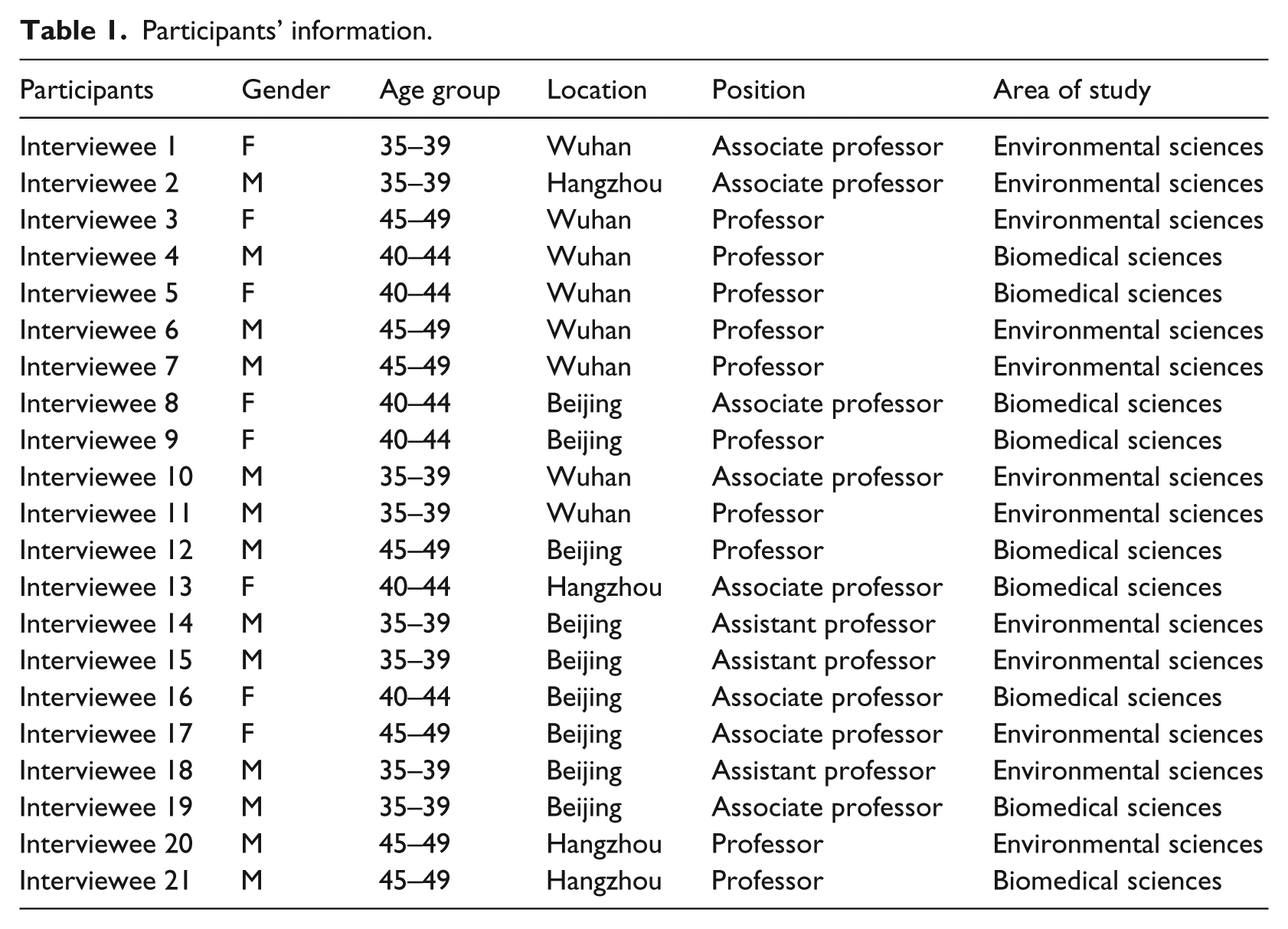
This study took a combination of purposeful and snowballing sampling techniques. The research team primarily contacted universities’ research offices for recommendations of staff with at least 5 years of working experience after completing their PhDs, and who are currently working in the areas of either environmental or biomedical sciences. We then relied on a few interviewees to recruit further contacts. This study chose to focus on practitioners from environmental and biomedical sciences for they are two leading investment areas in China’s science and technology (S&T) strategies. They are also arguably the two most controversial areas in the public domain. Incidences such as the 2012 Golden Rice controversy and unproven stem cell therapies have generated much public criticism and distrust, and highlighted the urgency for effective public engagement in China (Cryanoski, 2012; Qiu, 2012). Among the recommendations, we selected scientists who have either been a principle investigator or a co-investigator on publicly funded projects. Compared to their colleagues, this cohort of scientists normally has more exposure to media interviews and other forms of public dialogue. In the end, our sample consists of 8 female and 13 male scientists, aged between 35 and 48. While none of the interviewees have integrated public engagement as part of their scientific project, all of the participants recognised the importance of good science communication. They shared with us their perception of science communication events they contributed to or had access to. Although disciplinary comparison is not of primary concern to this article, it is useful to note that of the 21 interviewees, 12 were from environmental sciences and 9 from the biomedical sciences. There was no evident divergence of views on the state of China’s science communication from the two disciplines. Similarly, there was also no visible difference from a gender perspective. It must be noted that given the sample size, this article does not aim to be representative or definitive. Rather, it should be read as similar to other small scale studies of science communities which are often seen as particularly valuable in under-researched areas (see Cao and Suttmeier, 2001; Parry, 2006; Zhang, 2010). It allows us to identify important themes that may benefit from future study.
Each interview lasted for approximately an hour. The recordings were transcribed, coded and analysed with the use of NVivo 10 (Charmaz, 2006). Coding was established through two phases. Initial coding mainly consisted of descriptive typologies that helped to sort the range of communication scenarios into categories of ‘Institutional’ (with sub-categories of ‘government’ and ‘media’) and ‘Non-institutional’ (with sub-categorises of ‘personal’ and ‘civil society’). Then ‘axial coding’, such as ‘incentive’, ‘communicative relation’ and ‘interpretation of outcome’, was developed to further ‘dimensionalise’ the data and establish analytical links between categories (Charmaz, 2006: 60–63; Strauss and Corbin, 1998: 123–142).
This article’s discussion is structured as follows: section ‘Introduction’ contextualises China’s government-led science communication initiatives by critically reviewing the evolving role of science in the contemporary Chinese polity. This section points out that, similar to other socialist states, there seems to be an over-politicisation of science and of science communication in China (Linkova and Stockelova, 2012). When scientific accountability is often seen as subordinate to Communist Party accountability, it engenders alienation and distrust on the part of the civil actors (Wynne, 2001). Further to this discussion, this article has two twin sections on how Chinese scientists articulate the ‘dos’ and ‘don’ts’ of science communication. The section ‘Credibility of science and civic epistemology’ discusses a shared uneasiness expressed by scientists interviewed. That is, when they interacted with the public as an institutional scientist, they felt impelled to constantly check and adapt what they communicate so as to balance their professional accountability to the public and their obligation to adhering Party rhetoric. This makes public communication a burdensome and precarious business which many interviewees prefer to avoid or simply felt as beyond their expertise. However, this does not mean that Chinese scientists are public-averse. In fact, as section ‘Methodology and structure’ illustrates, a number of scientists interviewed were quite keen to explore alternative ways to gain public understanding and support of their research. In the eyes of the interviewees, the public perception of scientists’ credibility was often inversely proportional to the level of institutional backing. This ‘credibility paradox’ in China’s science communication shed insights on the pluralistic and contending nature of social validation of scientific knowledge (Callon et al., 2009; Jasanoff, 2012).
An over-politicisation of science communication
Science has always been a ‘politicum’, in which political and scientific communities lead public deliberation on collective actions (Linkova and Stockelova, 2012). China is not unique in tying science to its modernisation project. But as pointed out by Shiela Jasanoff (2005b: 214), what is of analytical interest is not so much the ‘“fact” of science’s embeddedness in politics’, but the evolving ‘nature’ of how science functions in political rhetoric.
Since China’s political reform in 1978, science has been seen as a ‘production force’ expected to lead to tangible improvement of living standards (MOST, 2005). In 1995, then President Jiang Zemin (1995) formally proposed ‘rejuvenating the nation through science and technology’ (kejiao xingguo) as a national strategy. Jiang’s proposal was further upgraded to the status of ‘foundational national policy’ (jiben guoce) by the State Council (1996) the following year. The political value of science in rejuvenating national productivity was reflected in popular science publications and was to ‘serve’ both industrial and agricultural production and ‘the communist ideology’ (Wu and Qiu, 2012: 526).
In practice, China’s S&T system is highly centralised. Almost all regulatory decisions and funding can be traced back to a handful of ministerial-level organisations that are under the direct leadership of the State Council. Despite China’s recent efforts to reorient its innovation system to a market-based approach, comparing to most developed countries, government sponsorship remains crucial for scientific research. For example, currently, private investment only accounts for 11% of academic research, as compared to 70% in the United States (Organisation for Economic Co-operation and Development (OECD), 2012).
In parallel to its fast S&T development, the Chinese government has also recognised that the public understanding of science is important for its knowledge economy to forge ahead (Chen et al., 2009). In June 2002, the Standing Committee of China’s Ninth National People’s Congress promulgated the world’s first national legislation on scientific engagement, The People’s Republic of China Science and Technology Popularisation of Law. The second chapter of this law formally recognises the government’s leadership in scientific communication. It demands governments at county level and higher incorporate science communication into its ‘national economy and society development plans’. The role of scientific communities, as stated in this legislation, is to ‘assist’ the government’s agenda setting (National People’s Congress, 2002). The political importance of science communication was re-emphasised through two high profile documents: the State Council’s (2006) Outline of National Action Scheme of Scientific Literacy for All Chinese Citizens and the Ministry of Science and Technology’s China (2012) National Special Planning of Science Popularisation in the Twelfth Five Year Plan. In this 2012 document, while diversified social contributions are mentioned, it further consolidates the commanding role of the government in planning, organising and delivering science communication (MOST, 2012: 5, 17).
In short, science communication in China follows a top-down approach with an acute sensitivity towards serving economic and political objectives. This state dominance is exhibited in the development of both traditional scientific disciplines as well as emerging science, such as biomedicine and nanotechnologies (Jia and Liu, 2014; Leong et al., 2011; Ren, 2014). It is true that China is not unique in politicising science. But when science and science communication are deeply entrenched with state directives, government sponsorship and centralised control, the supposed mutual relation between a politicisation of science and a scientification of politics seems to be one-sided.
This over-politicisation of science communication is further exhibited when examining an often neglected question of ‘how states recognise who is an expert’ (Jasanoff, 2012: 11). Previous comparative research on China’s and United Kingdom’s’ public communication of biomedical practices pointed out that while experts in the British media acted as independent professionals who ‘speak for themselves’, experts in the Chinese media were often selected by the authorities for their ‘policy compatibility’ (Ren et al., 2014: 372). To some extent, one could argue that science communication in China is an alternative form of policy engagement. The aim to justify political agendas is just as important as popularising scientific knowledge.
One immediate consequence of overshadowing science communication with political directives seemed to be a ‘public alienation’ problem identified by Brian Wynne. As one lecturer at the University of Science and Technology Beijing commented, ‘sometimes the case is if it [science communication] is government-led, the public will refuse to trust it’ (Interviewee 15). Given the Chinese government’s poor record of accountable governance, such as on issues of food safety, environment degradation and clinical trials, this public scepticism towards government communication may not be surprising (Cryanoski, 2012; Qiu, 2012; Zhang and Barr, 2013). As was indicated by Wynne (1980, 2001), public scepticism is less a response to the risk and benefits of the specific technology, and more a response to the trustworthiness and value-orientations of the institutional science and policy. Questions such as how Chinese scientists situate themselves within the web of contentious relations between the state and society and where they see their contribution and responsibilities become important. This is the analytical focus of the next two sections.
‘Willing but inactive’ – concession and protest of Chinese scientists
With intensified transnational scientific exchange and an increasing number of overseas-return scientists, Chinese research culture has undergone rapid transformation in recent decades (Zhang, 2012). One environmental scientist in Beijing, who was in his mid-30s, pointed out that the conventional portrayal of Chinese scientists as a socio-politically dispassionate group who pursue their professional interests within well-walled ivory towers may have become an outdated cliché. This old characterisation ignored a ‘generation gap’ between Chinese scientists:
It is without doubt that we [scientists] want to do more for the ordinary citizens (lao baixing) … we have social responsibilities … For previous generations of Chinese scientists – those who were born in the 50s or 60s – they may think that they only need to answer to the Communist Party, or the government … But I think many for my generation and younger ones, we have realised that our funding comes from the tax payers, and our research should be accountable to them. (Interviewee 15)
Interviewee 15’s view on being accountable to the tax payers was echoed by almost all of the scientists we talked to. A number of scientists explicitly pointed out explaining and discussing research findings with the public as an important part of conducting ‘accountable’ science and being a responsible scientist (Interviewees 1, 4, 7, 10, 11, 16). However, across the three cities, our interviews invariably fell into one same pattern: while scientists recognised their social responsibilities, and were (in theory) willing to engage with the public, they were all, in fact, reluctant or inactive in participating in public discussions of their own research areas. One typical response was from a professor in Wuhan: ‘I usually follow relevant public debates online, but I rarely contribute anything to the discussion (Interviewee 11)’.
This ‘willing but inactive’ phenomenon is consistent with a 2011 quantitative study on Chinese scientists’ involvement in science communication. In the survey, 94% of the scientists questioned recognised public engagement as a social responsibility. But only 20% had made any contribution, such as writing popular science articles, participating in media or public events (Jia and Liu, 2011).
In our study, we further explored the reasons behind this lack of action and identified three main factors. We first speculated if this was due to busy work schedules. One associate professor at Peking Union Medical College corrected us and explained that, given the over-politicisation of science in China, who communicates to the public was not just a matter of professional ability, but was a matter of one’s ‘political qualification’:
It is not so much that my colleagues and I don’t want to contribute [to public communication]. We do. But most of the time, these public occasions seem to be more appropriate for the ‘Big Experts’ (da zhuanjia). Scientists like us are not at the liberty to say much. (Interviewee 8)
An associate professor at Hubei University of Technology put it more bluntly:
I don’t think these public occasions are something we front-line (yixian) scientists can handle. It is a shame though that the voice from the front-line is diminishing. (Interviewee 1)
It is interesting to note that, similar to the two professors above, a majority of scientists we interviewed made a distinction between two types of Chinese scientists: (1) The ‘front-line’ scientists, who are the backbone of institutional research but have not yet acquired high administrative status, and (2) the ‘Big Experts’, who have secured elite positions in the science-political establishment. These Big Experts may be reaching retirement age and may no longer be research active, but they still act as ‘legitimate’ spokespersons for their respective fields as they are seen to be more proficient in adapting to political rhetoric.
Similar to Interviewees 8 and 1, as science communication is closely tied to the vindication of development agendas, a number of scientists interviewed felt public engagement had slipped outside their professional ‘expertise’ and can be potentially ‘troublesome’. A professor at Wuhan University half-jokingly told us that, ‘I do my best to avoid the media … as I do not want to inflict trouble (re-shi)’ (Interviewee 4). A professor in Beijing also shared a personal anecdote:
Last year the newspaper, Science and Technology Daily, invited me to write an article for them. The editor specifically asked me to make my views clear – that request immediately gave me a headache, I told him to forget it, it was too troublesome. (Interviewee 12)
It may appear puzzling that a university professor was daunted by the request of writing a popular science article with a ‘clear view’. But it should be remembered that, as pointed out in section 1, the Chinese government remains the primary, and sometimes only, funding source for research. Individual scientists as well as research institutions need to be seen as non-offensive and not ‘trouble-inflicting’ by the government in exchange for patronage (Zhang, 2012: 33, 89–92). The primary concern of science communication for scientists and scientific institutions then is to avoid provoking public concerns or stirring up social debates. In contentious areas, such as pollution control and experimental therapies, this can be a tricky business. An undesirable public interpretation of a scientist’s ‘clear view’ may endanger one’s career. The apprehension attached to science communication was not only experienced at the individual level, but was also a pressure felt by universities and research academies. Previous studies have indicated that, without clear instructions from the government, local institutions often feel that ‘organising or being involved in public debates could bring political risk’ (Jia and Liu, 2014: 35).
To some extent, the scientific community seems to be troubled by a ‘double clientelism’ identified by communication scholar Yu Hailing (2009a: 91–94). Yu (2009a) considered ‘clientelism’ as a ‘defining characteristic of Chinese society’ in which social actors need to act for their patrons in return for support and sponsorship (p. 182). In the case of science communication, as in other forms of mediation, scientists are stretched to meet the demands of two patrons (Yu, 2009b). That is, they need to cater to the interests of the public while at the same time attending to the political expectations of the state. This may not necessarily be unique to China, as the influence of government patronage can be observed in many countries. However, when the financial and administrative leverages are heavily tilted towards the state, scientists’ bargaining power in the patron–client relationship with the government seems to be limited. The business of safeguarding this one-sided relationship can be a ‘headache’ (Interviewees 4, 12), and many scientists may feel that they are not up to the task (Interviewees 1, 8).
A related second factor that persuaded most scientists to remain silent was a commonly shared frustration of being kept ‘out of the loop’ in science-based policy making. One example was from a senior environmental science professor:
Whenever the municipal government have launched new guidelines or promulgated new industrial standards, I receive requests to comment on them. But this is a weird logic: I was never consulted in the policy making process, I do not understand how they [the officials] arrived at these figures and based on what data, from where, how would I know [what to make of the new rules]? (Interviewee 3)
To some extent, the perceived non-participatory attitude of Chinese scientists can also be interpreted as a form of scientists’ ‘protest’ to being excluded from science-based policy making. Previous research works have indicated that in contemporary China, given the overpowering priority of economic development, ‘expert advice’ often remains an obscure role in the final decision-making process (Qiu, 2004; Zhang, 2012). An example was from Interviewee 1. She told us that when she was invited to policy consultation meetings, initially she took it quite seriously and made a number of suggestions. But to her dismay, she never heard any response. Interviewee 1 then concluded, ‘after a few times, you just gave up trying!’ Such frustration was expressed by another professor in Hangzhou:
The underlying tension is that the government wants to monopolise administrative decisions and control of resources, but let scientists assume associated public accountabilities. (Interviewee 21)
A third practical concern that discouraged scientific practitioners from contributing to public discussions of science was, as mentioned in section ‘Introduction’, public scepticisms as a result of the over-politicisation of science communication. Given this contention, despite elaborate government efforts in this field, one lecturer at the University of Science and Technology in Beijing still believed a ‘platform for communication’ was yet to be built:
What Chinese science doesn’t have is a platform for communication. Having Big Experts as the public face is counter-productive, they conversely generate distrust among the public. Because the public would say that this was manipulated by the government, or there is some political cover-up. Voices from front-line scientific practitioners, like us, have increasingly been turned down. But if we can think differently for once and have a platform, on which ordinary scientists can demonstrate what they do, why they do it, and to what extent their output can solve certain problems, the public may be more accepting. (Interviewee 14)
This perceived general scepticism towards institutional science was further described by the above interviewee’s colleague:
There are two separate issues [in science communication]: ‘would you want to trust me’ is one thing, and ‘can I sustain my trustworthiness’ is quite another … I can vouch for my findings, but if you [the public] are determined to be cynical, then I see no basis for a dialogue. (Interviewee 15)
As suggested by scientists interviewed, when the independence of scientific institutions is overshadowed by heavy political manoeuvres, it leads to a ‘credibility paradox’. The appearance of Big Experts only reinforced a public image of ‘organised irresponsibility’ (Beck, 1995: 58; Ren et al., 2014). As one water pollution specialist described, when scientific accountability was perceived as subordinate to political directives, the public became ‘very impatient’: the public ‘now only hear half of what you are about to say and then go on developing their own interpretation’ (Interviewee 10).
To some extent, it seemed that science communication in China has set off on the wrong foot. An over-politicisation of science communication has significantly constrained Chinese scientists’ interpretation of their capacity as well as responsibilities in interacting with the public (points 1 and 2 above). Its public alienation effect creates a ‘credibility paradox’ which further discourages scientific practitioners from contributing to formal channels of public dialogue (point 3). The seemingly voluntary withdrawal of Chinese scientists from public discussion is both a pragmatic concession to an asymmetry of power and an act of protest. This point is further supported from a different angle in the next section.
The ‘informal communicators’: (re)-directing professional credibility
The previous section examined the ‘credibility paradox’ as the inversely correlated public credentials attached to institutional endorsement. This section further illuminates this paradox from the other side of the story. That is, in contrast to their inactiveness in formal communication events, scientists interviewed showed more involvement with grassroots and private events. Given the limited space, I focus on two examples.
One of the most intriguing interviews of our fieldwork was with a genetically modified crop specialist at the Beijing Academy of Agriculture and Forestry Sciences. Similar to other interviewees, she saw formal channels of science communication as a terrain for the Big Experts or as she put it, ‘specialised government personnels’. She was unenthusiastic about media interviews, writing opinion pieces or participating in online debates. In fact, this professor believed that ‘the lack of desire for conversation [between the public and the scientific community] was mutual’ and she considered scientific outreach a ‘waste of time’. Yet interestingly, this professor emphasised scientists’ social responsibilities to explain and discuss their work with the public, and she saw her fulfilling of that responsibility in scenarios as follows:
There are a number of times when I was traveling on the train, passengers sitting next to me was chatting about GM foods with their friends. Some of them may make comments such as ‘we never cook with soybean oil at home. We only cook with peanut oil, because I think peanut oil may not be from GM crops’. This is when as a GM scientist, I feel a need to join the discussion. I would tell them they don’t need to be afraid of GM technique, maybe because I am a GM scientist so that I am not worried … People usually get really interested when they learnt that you are a GM scientist and ask me all kinds of questions … I would explain to them how [GM] proteins are digested in our body, and the fact that GM actually reduces the use of herbicide. Anyway, I see everyone has a right to express one’s view, so here is what I think, and fellow passengers may or may not accept my view … But every now and then, they see good reasoning in my argument and they may be convinced. (Interviewee 18)
Interviewee 18 was not alone in taking an interest in these informal conversations (Interviewees 5, 17, 20, 21). One biomedical scientist, who works on metabolic therapies, also highlighted to us the value of engaging with grassroots events and sharing professional knowledge within personal networks:
A while ago, a local residential community invited me to take part a community [public health] activity. Unfortunately I didn’t go for I was busy on that day, but I am quite happy to contribute to this kind of events … The incentive? Quite simple: all scientists want to see their findings can make some difference and be put to some ‘use’ … I am not instructing people what they should not do, I’m just telling them what should be moderated … I feel most people are quite willing to take in your findings, but of course in practice, it is quite hard to make people adapt their life habit accordingly … I have experienced difficulties even with my own family … But you got to promote your ideas with them [the public] and wait for gradual change. (Interviewee 5)
This expressed interest in interacting with the public through grassroots channels is consistent with the authors’ previous qualitative studies on environmental science. A number of environmental scientists have been regular contributors to non-governmental organisation (NGO)-organised public seminars or field trips on weekends (Zhang and Barr, 2013).
There are three points worth highlighting in scientists’ expressed interests in being a communicator of science in ‘informal’ (i.e. non-institutionally organised) events. First, it is important to note scientists’ framing of their social identities in participating in the above described public encounters. In Interviewee 18’s scenario, she was ‘a fellow passenger who happens to be specialised in GM techniques’, rather than an institutionally endorsed expert. Similarly, in Interviewee 5’s case, she was to share her knowledge with the neighbourhood over an informal gathering. She would be seen more as a ‘fellow citizen with particular knowledge’ rather than an expert dispatched by the research institution. While both scientists still see their actions as part of their ‘professional’ responsibilities, they have, in their narrative, distinguished these communications from their employment duties as institutional scientists. Being a fellow passenger on the train, or a visitor of the neighbourhood have, to a large extent, de-politicised the communication process.
Second and relatedly, it is interesting to contrast scientists’ perception of the ‘public’ in formal and informal communication scenarios. It is useful to recall that, when discussing formal channels of science communication, the public was described by interviewees as a ‘very impatient’ and unreasonably ‘cynical’ audience (Interviewees 10, 15). Interviewee 18 explicitly noted a ‘mutual’ apathy of dialogue between the scientists and the public. But when the communication scenarios are de-politicised, the public attitude towards scientists seemed to be more receptive and welcoming. Interviewee 18 felt the public ‘usually [got] really interested’ when knowing about her job, and Interviewee 16 experienced similar affirmations as the public appeared to be ‘quite willing to take in’ her view. One Hangzhou professor working on agricultural pollution also observed that the public can be ‘janus-faced’: ‘Peasants in general are willing to hear scientists’ advice … but if it [scientific advice] is imposed as blanket administrative decisions, peasants will also not hesitate to curse you’ (Interviewee 20).
Among these two conflicting images of the ‘public’, the ‘supportive public’ in informal settings may be a more accurate representation of the Chinese public’s attitude towards science itself. In a 2003 public opinion survey adapted from the Eurobarometer exercise, the result indicated a ‘very positive attitude’ and high support among the Chinese public across different scientific applications, so long as they could see the ‘usefulness’ of these new technologies (Lü, 2009: 490–491). This survey data, in addition to the qualitative findings of the research presented here, further reinforced the article’s argument that the perceived public suspicion and rejection in science communications may not be a reaction to science itself, but to the perceived intention and to the ‘behaviour, track-record, and trustworthiness of the institutions in charge’ (Wynne, 1980, 2001: 454). When scientists’ de-formalised their politically charged institutional affiliations and redirected their professional identity as fellow citizens, they seemed to (re)gain their credentials from the public.
Third, despite a more receptive audience, scientists interviewed exhibited a sensible and pragmatic expectation of science communication. They recognised that the public is far from ‘uncritical’ or submissive (Lü, 2009). Take the above demonstrated cases for example. Interviewee 5 recognised the ‘difficulties’ in asking people to adopt her health-care suggestions. She saw the point of participating in community activities not as to pass on ‘instructions’ but to anticipate ‘gradual change’. On more contentious topics, such as GM foods, Interviewee 18 felt the urge to offer her advice when she encountered misconceptions in public. But Interviewee 18 was also at ease with the fact that some people ‘may or may not’ agree with her. The point of her engagement, then, was not to battle for consensus, but to offer ‘good reasoning’ and to exercise her rights both as a scientist and as a citizen ‘to express one’s view’. This seems to rebuke a conventional assumed ‘naivety’ of Chinese scientists embedded in a ‘deficit mode’ depiction (Hu, 2010; Zhao, 2014). In fact, the majority of scientists interviewed indicated that, if opportunity allowed, they preferred conversational interactions with the public, rather than simply giving lectures (Interviewees 1, 14).
In short, the Chinese scientists we talked to believed that they could be more convincing to the public with their institutional hat off. As Wynne (2001) argued, public suspicion of science ‘goes much deeper than simply “disagreeing with” or “rejecting” experts views’ (p. 445). Rather, it is a rational response to the perceived institutional culture and associated political agenda. Chinese scientists’ redirection of their professional credibility as “informal” communicators is to address the public alienation problem exhibited in government-led communications. To some extent, it could be argued that it is an effort towards restoring ‘civic epistemology’ back to the public discourse of science. That is, it effectively re-tunes the government rhetoric of science development to a social conversation, and re-orients the political enterprise of science to a collective civil project. The observed constraints in China’s government-led science communication and the perceived value in informal engagements demonstrate the impact of a ‘civic epistemology’ and how the social validation of knowledge is necessarily a deliberation among multiple actors (Jasanoff, 2005a). The interview data suggest that even in an authoritarian state such as China, political directives cannot fully replace a multi-perspective ‘civic’ epistemology in insuring public support of science.
4. A reflection on science communication in China
While Chinese science is racing ahead with generous investment on cutting-edge projects, its science communication is often characterised as lagging behind with a twentieth-century top-down model, with seemingly unenthusiastic scientists. However, at a closer examination, for Chinese scientists interviewed, public engagement involves a calculative balance of observing and subverting institutional constraints so as to overcome the asymmetry of relations between science and politics.
Contrary to a common assumption that Chinese scientists are indifferent to public engagement (Hu, 2010; Wu and Qui, 2012), almost all of the scientists we interviewed explicitly acknowledged public communication as part of their social responsibilities and were willing to take part. However, one key, yet seemingly perplexing finding was a ‘credibility paradox’ in Chinese scientists’ narrative of how effective public communication can be achieved. This is to say, the majority of them expressed scepticism, reluctance and even resistance towards participating in formal channels of science communication, such as responding to public queries through online or paper media. Rather, many scientists were more keen to act as ‘informal risk communicators’ (Richard, 2011) on private occasions or grassroots events. This is because they believed speaking as an ‘institutional scientist’ would invite additional public scepticism and contention. An absence of visible institutional and official endorsements, conversely, would render them with more public credibility and lead to better conversations. This shared preference of being perceived as ‘unofficial carriers’ of information is revealing.
It is true, as many have suggested, that China needs to replace its current ‘one-direction’ scientific communication with ‘more engagement practices that feature open and equal public dialogues and debates’ (Jia and Liu, 2014: 32). But this article argues that for such dialogue to happen and to pull Chinese science communication out of the credibility paradox, one needs to first understand the culturally and politically embedded power dynamics that conditions effective communication. There are at least two useful insights that can be drawn from scientists’ view on science communication in China.
First, Chinese scientists’ actions in and perception of science communication suggests that even in authoritarian societies, ‘civic’ epistemology plays a tacit yet significant role in validating scientific knowledge. This is to say, without justifying and adapting its value-orientation according to wider cultural and social expectations, political directives alone fall short in mitigating a multiplicity of public interpretations and cannot guarantee public uptake of a given scientific agenda (Jasanoff, 2005a). Arguably, the ‘credibility paradox’ in China’s science communication exhibits a reactive impact of civic epistemology. That is, the overshadowing of a civic epistemology of science with political resolutions has not only made scientists feel ‘unqualified’ to contribute, but also has led them to redirect their professional credibility as ‘informal communicators’. Scientists’ reorientation of their position as risk communicators, despite financial and administrative monopoly by the government, is an involuntary restoration of a public reasoning of science (Wynne, 1980, 2001).
Second, China may represent an extreme case of asymmetrical power-relations between the state, scientific community and society. However, China is hardly unique in having the national government as the dominant and most powerful apparatus to direct public opinion and shape the conditions in which societies embrace or reject a new technology (Bell and Hindmoor, 2009: 77–78, 86; Leong et al., 2011). It is not the presence of government per se, but an over-politicisation of science that alienated the public (and the scientists) and paralysed effective communication in China. When government is selective in inviting ‘policy-compatible’ scientists as their spokespersons, then institutional science communication loses its capacity to ‘speaking truth to power’, and becomes instead ‘power orchestrated truth’. Rather, the credibility paradox urges a change of mindset among Chinese policy-makers in conceptualising the relation between science and politics, which conditions the delivery and reception of scientific research. Thus, a useful lesson for both regulators and social scientists that can be drawn from China’s experience is that to promote a social uptake of emerging science, attentiveness to culturally entrenched knowledge-ways is crucial, but what is equally important is that it involves an intricate balancing act to maintain a level of reciprocity between a politicisation of science and a scientification of politics (Jasanoff, 2005b).
When looking through an analytical lens of civic epistemology, the landscape of China’s science communication may not seem as ‘straightforward’ as commonly assumed. This article presents a small sample pilot study on this important yet under-explored area. Further empirical inquiries into the production and validation of knowledge in China’s other scientific disciplines and in other non-Western states would add valuable insights on the role of science in public life.
Footnotes
Acknowledgements
I thank Professor Zhang Wenxia, Dr Liao Miao and Feng Danyang at the Chinese Academy of Science and Technology for Development (CASTED) for their help in Beijing and Wuhan. I also wish to thank the anonymous reviewers for their helpful comments on an earlier draft of this article.
Funding
The author gratefully acknowledges the financial support of the Economic and Social Research Council in the United Kingdom (Research Council Grant reference: ES/L009803/1).