Valid instrumental variables (IVs) must not directly impact the outcome variable and must also be uncorrelated with nonmeasured variables. However, in practice, IVs are likely to be invalid. The existing methods can lead to large bias relative to standard errors in situations with many weak and invalid instruments. In this paper, we derive a LASSO procedure for the k-class IV estimation methods in the linear IV model. In addition, we propose the jackknife IV method by using LASSO to address the problem of many weak invalid instruments in the case of heteroscedastic data. The proposed methods are robust for estimating causal effects in the presence of many invalid and valid instruments, with theoretical assurances of their execution. In addition, two-step numerical algorithms are developed for the estimation of causal effects. The performance of the proposed estimators is demonstrated via Monte Carlo simulations as well as an empirical application. We use Mendelian randomization as an application, wherein we estimate the causal effect of body mass index on the health-related quality of life index using single nucleotide polymorphisms as instruments for body mass index.
The instrumental variable (IV) technique is one of the most commonly used causal inference methods for analyzing observational and experimental studies with unmeasured confounders. This technique is based on three important assumptions.1 The first assumption is relevance, which requires that the exposure not be independent of the instrument. The second assumption is exclusion, which requires the instrument's impact on the outcome to be completely mediated by the exposure. The final assumption is the independence of confounding factors (unmeasured variables). An example of IV analysis in medical statistics is Mendelian randomization (MR), wherein genetic data are used as instruments to distinguish causation from correlation while analyzing the effects of adjustable risk factors (e.g. body mass index, blood pressure, and alcohol intake) on health, social and economic outcomes. However, a difficult task in MR is identifying IVs that fulfill the above-stated assumptions.2
One challenge regarding the relevance assumption is when instruments (e.g. genetic markers) are only weakly associated with the outcome variable. Staiger and Stock3 derived the effects of weak instruments on the linear IV model, which led to the development of a simple F-test for weak instruments introduced by Stock and Yogo.4 Seng and Li5 proposed a model averaging method to address the issue of high-dimensional and weak instruments. Qasim et al.6 suggested weighted average K-class IV methods to address the issue of many weak instruments. However, these methods are developed under the assumption that all the instruments are valid. A second challenge is potential heteroscedasticity, which can bias the classical two-stage least squares (TSLS) estimator, as demonstrated by Angrist et al.7 A third challenge arises when some available instruments are invalid, as they may directly affect the outcome of interest. If IVs are uncorrelated, this issue can be addressed via methods from the meta-analysis literature. When all instruments are valid, the inverse-variance weighted method can be employed, and if a majority of the instruments are valid, then the median estimator, as suggested by Bowden et al.,8 can be used. Further enhancements to these estimators are described in Burgess et al.9 In recent work, Seng et al.10 used model averaging in the linear IV model to address the challenge of high dimensionality. This model averaging approach uses different subsets of single nucleotide polymorphisms (SNPs) as instruments to predict exposure, followed by weighting the submodel predictions via penalization methods.
With potentially correlated instruments and if no prior knowledge exists regarding the validity of the instruments, this problem can instead be treated as a model selection problem. This approach is more informative since it also shows which instruments are in fact invalid and have a direct effect on the outcome variable. Andrews11 introduced the moment selection criterion (MSC) for the IV model, which is estimated via the generalized method of moments. However, this method becomes computationally infeasible when the number of instruments is large. For this reason, Kang et al.12 proposed a LASSO-type procedure for TSLS, which is as computationally fast as ordinary least squares (OLS). Even without prior knowledge of the instrument's validity, this method can identify valid instruments and estimate the causal effect under the weak condition that the proportion of invalid instruments is strictly less than 50% of the total instruments. Windmeijer et al.13 further developed this method and introduced the adaptive LASSO (ALASSO) approach, which can be used when invalid instruments are relatively strong. Lin et al.14 introduced a robust IV estimation method to overcome the issue of many weak and invalid instruments via a surrogate sparsest penalty. Moreover, accurate causal inference without selecting instruments, especially in the context of Mendelian randomization methods from the meta-analysis literature, has been considered. Notable examples are the median8 and mode15 estimators. Using the flexible variable selection approach that allows for correlated instruments, we show that one can find robust estimators for both weak instruments and heteroscedasticity.
The first contribution of this paper is that it adds to this growing research field by addressing the issue of invalid instruments under many weak instruments. According to Hernan and Robins16 and Davies et al.,2 in the presence of weak instruments, even minor deviations from the exclusion assumption cause large bias in the estimated causal effect. Therefore, this is a particularly important empirical situation to examine. By following Kang et al.,12 we derive a LASSO procedure for the limited information maximum likelihood (LIML) estimator and FUL17 estimator. We primarily consider situations with a single outcome and a single risk factor. Burgess et al.18 stated that the methods do not significantly differ in this situation; the main difference is that LIML estimates parameters only from a single equation, whereas FUL uses a three-stage least squares approach and estimates the model simultaneously as a system of equations. When LIML is used, not all moments are defined, but FUL does not suffer from this, as mentioned by Hahn et al.19 A significant advantage of LIML and FUL over TSLS is that the median of the distribution of the LIML estimator is close to being unbiased in the presence of many weak instruments.18
The second contribution of the paper is the use of the jackknife technique to derive heteroskedasticity-robust versions of the LASSO type of estimators for TSLS, LIML and FUL. Angrist et al.7 showed that the TSLS is biased in both situations and suggested a jackknife approach that performs better. Furthermore, Hausman et al.20 showed that the LIML estimator is biased and presented some conditions under which it is even inconsistent in the presence of many instruments and heteroscedasticity. These authors then derived heteroskedasticity-robust versions of the LIML and FUL estimators (denoted as HLIML and HFUL, respectively). In this paper, we derive the jackknife version of the sisVIVE12 estimator in the presence of many invalid instruments; this estimator is robust to heteroscedasticity. We also derive jackknife versions of the LIML and FUL estimators, which provide comparatively easy solutions to the problem of many invalid and valid instruments in the case of heteroscedastic data. Additionally, for convenience, we created an R package for implementing the proposed methods.1
We show in the Monte Carlo simulation study that the LIML and FUL estimators yield substantial improvements in high-dimensional instrumental variable studies. These improvements are especially pronounced for many weak instruments. Our simulation results also reveal substantial improvements in the bias and median square error (MSE) when the jackknife approach is used for both heteroscedastic and homoscedastic data. Therefore, we recommend that researchers and practitioners use the jackknife technique, especially in the presence of heteroscedasticity. In real-life applications, we use all of the suggested estimators in an MR study in which we estimate the causal effect of body mass index (BMI) on the health-related quality of life index (HRQLI) via SNPs as instruments for BMI. Owing to the presence of heteroscedasticity and weak instruments, the jackknife IV method performs the best in this case and yields quite reasonable results.
The remainder of this paper is organized as follows. In Section 2, the model construction and notations used are discussed, and the valid and invalid instruments in the linear IV model are defined. The LASSO-type robust estimation method is introduced, and its properties and theoretical performance are then discussed in Section 3. The simulation study and empirical application are detailed in Sections 4 and 5, respectively. Finally, some concluding remarks are provided in Section 6. All mathematical proofs are provided in Appendix Sections A–C of the supplementary materials.
Model construction
We define the causal model by following the lines of Kang et al.12 and Small.21 Suppose we have n observations that are independently and identically distributed, where and represent the observed outcome and the exposure (endogenous) variable, respectively, and the variables are the IVs. The model for the random sample is given by
where and are the true parameters, is an error term and is the causal parameter of interest. We further assume that and let , where represents the direct effect of the IVs on the outcome and where represents the association between the IVs and the confounders. By defining such that with the ith element of being , we define
where and where is an error term; therefore, . Both and are random errors and let . The mean is , and the variance–covariance matrix is . In addition, the assumption of the error terms under the setting of homoscedasticity and heteroscedasticity is discussed in Assumption 1.3. Kang et al.12 emphasized the uniqueness of the solutions for parameters and and discussed necessary and sufficient conditions for identifying and . If , then there is no direct effect of instruments on the outcome, and similarly, if , then there are no confounders because . The value of encompasses the concept of valid and invalid instruments. Therefore, the definition of valid and invalid instruments states that the instruments are valid when and that the instruments are invalid when . Assume that is the set of invalid instruments, where and is the coefficient vector of invalid instruments. The definition of valid instruments corresponds to the formal definition of Holland22 and a special case of the valid instrument's definition of Angrist et al.23 when . The theory of valid IVs can be perceived as a simplification of Holland's22 model when . Let denote the number of invalid instruments that are below the upper bound, , i.e. . For any full-rank matrix , is the residual-forming matrix, where is the projection matrix onto the column space of and where is an identity matrix of . The lp-norm is denoted by so that the corresponds to , which yields the number of nonzero components of a vector, and the is denoted by , which yields the maximum element of a vector. We have, for example, , which represents the number of nonzero components in . The vector is known as r -sparse if it contains nonzero elements. Let be any set and let denote the complement of set S. Furthermore, let denote the support of . If and are two matrices, their inner product is defined as .
The basic definitions of the restricted isometry (RI) property and restricted orthogonality constant (ROC) are given by Khosravy et al.,24 Cai and Zhang25 and Cai et al.26 We use Definitions 2.1 and 2.2 below to analyze the performance of the l1-penalized k-class IV method. The RI property and ROC determine what subsets of cardinality q of columns of matrix are in an orthonormal structure. These conditions are common in the high-dimensional setting of the linear model.
A matrix has the RI property of order q if for all q -sparse vectors , where . To simplify the notation, we define
where and are the upper and lower RI property constants of order q.
If , then is the smallest nonnegative number such that
for all and , where and are q-sparse and q′-sparse vectors, respectively, and have nonoverlapping support.
l1-Penalized instrumental variables estimation
It is important to first state the conditions on which the l1-penalized IV estimation methods are based.
are independently and identically distributed;
is of full rank and positive definite;
and ;
with elements of being nonzero, i.e.
Assumption 1.1 is a basic assumption that states that the observations are i.i.d. Assumption 1.2 requires the usual identification assumption to be satisfied and the matrix to be full rank. In assumption 1.3, we first make a conditional homoscedasticity assumption on the errors given the instruments, and we assume that the elements of are finite.27 We relax assumption 1.3 and propose the robust methods in Section 3.4 by following Hausman et al.20 if the errors are heteroscedastic, which is more common in practical applications. Assumption 1.4 indicates that the matrix is associated with the exposure variable .
The oracle class of IV estimators is found when the invalid instrumental variables are known, and we then set . Specifically, we consider estimators of the form
with different methods of estimating k. Eq. (3.1) encompasses all of the well-known k-class estimators. For example, the OLS and TSLS estimators are special cases of these estimators when and , respectively. In addition, Eq. (3.1) corresponds to the LIML estimator when , where is the smallest eigenvalue of the matrix , with , and therefore depends only on observable data and not on unknown parameters.28 The modification of the LIML method known as FUL17 is also classified as a k-class estimator where with a constant value of . Note that since and cannot be smaller than when the number of invalid instruments is known. The FUL estimator was developed because the LIML estimator does not have moments since its distribution has heavy tails, leading to high dispersion in finite samples.19 The FUL estimator addresses this problem. This modification of LIML further leads to an FUL estimator with the existence of moments. LIML and FUL were developed as alternatives to the TSLS estimator since they are capable of handling weak instruments, many instruments and misspecification of the model.
Penalized k-class estimators
Here, we introduce the equivalent Lagrangian structure as an estimator of the causal effect, called the penalized k-class IV (PKCIV) estimation method, as follows:
for . The class of estimators in (3.2) is a modification of the popular LASSO29 method, wherein we consider Model (2.1) and use -penalization to parameter with many valid and invalid instruments. The PKCIV method does not penalize because it is the main parameter of interest, and we do not wish to bias the estimation of the causal effect. The proposed estimator in (3.2) is a k-class invalid and valid IV estimator and can be seen as a generalization of Kang et al.'s12 estimator if , (3.2) is the penalized TSLS (PTSLS) estimator. Similarly, (3.2) corresponds to the penalized LIML (PLIML) and penalized FUL (PFUL) estimators when and , respectively.
The choice of the tuning parameter affects the performance of the PKCIV estimator and affects the intensity of the sparsity of the solution. Figure 1 shows the LASSO regularization path using the IV method to illustrate how the coefficient estimates of decrease to zero as increases. Each curve corresponds to a variable. The axis above indicates the number of instruments at the current value of . For , few elements of will be zero, indicating that most instruments are estimated to be invalid instruments. On the other hand, for large values of , the penalty function, , surpasses the sum of squares, which strongly penalizes parameter , and most instruments are estimated as valid instruments. Intermediate tuning parameter values yield a balance between these two extremes. An important aspect of the PKCIV estimator is choosing the tuning parameter .
LASSO instrumental variable regularization path.
Several different methods for selecting have been discussed in the literature. Selecting through cross-validation is a very common data-driven approach that aims for optimal prediction accuracy. Various types of cross-validation exist, such as K-fold and leave-out cross-validation. In this paper, we use 10-fold cross-validation, which is frequently used in practice. We minimize the predictive error while using 10-fold cross-validation, and the parameter of interest is .
Estimating the causal effect
We introduce a numerical optimization algorithm for estimating parameters and . The solution of the numerical algorithm is equivalent to the PKCIV estimator in (3.2). First, we rewrite (3.2) as
Step-I: Then, we obtain the estimator for a given as
where , and are estimated through cross-validation.
Step-II: Given the estimator , we obtain an estimator for as
where and . Note that in the selection stage, we use the LASSO procedure with a k-class estimator-based objective function. The tuning parameter, λ, is chosen through cross-validation, wherein we minimize the predictive error for the PTSLS, PLIML and PFULL estimators. This algorithm uses 10-fold cross-validation to determine the optimal value of , selecting it on the basis of the cross-validation results. Each method in PKCIV provides both the estimated causal effect of exposure on the outcome and the set of invalid instruments for a specific . Finally, the algorithm gives a list of estimated results, which contains the estimations of , , and the set of invalid instruments for the best . This numerical algorithm is thus simple and easy to calculate as least squares. The theoretical properties of this two-step algorithm are discussed in Appendix A. The PLIML estimator can be computed by finding and then using this in the estimation of the causal effect of exposure on the outcome for . Let 17 and . Then, the value of in step II is substituted for to compute the PFUL estimator for the causal parameter.
Theoretical performance of the PKCIV estimator
To minimize the structure of the PKCIV method, Eq. (3.2) might have different minimizers, particularly for estimating the causal effect of parameter , because is not strictly convex. In this case, the value of the parameter may need to be carefully tuned to ensure that the algorithm is able to converge to the global minimum. The estimated difference between all the minimizers of (3.2) and , that is , is analyzed in this section. Through the RI property and ROC, we illustrate the performance of the PKCIV estimator in finite samples. Let be the predicted value of given and the residual-forming matrix be . The solution of (3.2) is unique when the elements of the matrix are taken from a continuous distribution.30 The following theorem is a generalization of the theorem based on PTSLS provided by Kang et al.,12 wherein we consider the general estimator that includes the k-class IV methods.
Consider model (2.1) with under assumptions 1.1–1.4. Let and be the minimizers of (3.2) with for . Then:
The estimator can be expressed as
Suppose that the condition holds by definition of the RI constants. Then, is such that
The first part of the theorem can be easily established by utilizing the algorithm primarily for estimating the causal effect. However, to guarantee the performance of the proposed method, the final part of the theorem must be proven. The proof of this theorem is presented in the Appendix.
The assumption in part (ii) of Theorem 3.1 involves the RI property constants, which are difficult to estimate. In addition to the RI property, the mutual incoherence property (MIP) is a commonly used condition in the sparse recovery literature. The MIP conditions are defined as
which establishes the maximum pairwise correlation of the columns of the instrument's matrix , and the maximum strength of the individual instruments is measured as
The performance of the PKCIV is analyzed in terms of the MIP conditions in (3.5) and (3.6). We modify the bounds in (3.4) by following Corollary 2 in Kang et al.,12 wherein the number of invalid instruments is r such that . In addition, by rewriting the assumption in terms of two MIP constants and , under the conditions and and , the constraint from Lemma 3.1 can be modified and stated as
where due to the upper and lower bounds of the RI property constants in terms of MIP conditions such as , , , and .
The LASSO procedure for IV estimation for some valid and invalid instruments was proposed by Kang et al.12 It is known as the PTSLS estimator, which is a special form of the PKCIV estimator when . The PTSLS estimators of and can be computed in two parts. The PTSLS estimator of , for a given , from (3.2) is defined as
The matrix in (3.8) depends on , which is estimated from the first-stage regression; thus, the bias of TSLS depends on . For observation i,
where measures the degree of endogeneity. arises from the correlation of for observation i with . In addition, this bias continues even if all the valid instruments are uncorrelated with . This becomes a more serious problem in the presence of many or weak instruments, which increases the bias of the PTSLS estimator.7 Another issue with the TSLS, as shown by Hausman et al.20 and Bekker,31 is that with many (weak) instruments, the TSLS is not consistent, even under homoscedasticity. The LIML and FUL estimators are efficient with many weak instruments and under homoscedasticity. However, these k-class IV methods are not robust when the data are heteroscedastic. This prompts us to introduce a new class of LASSO-type jackknife IV estimator (LJIVE) that is robust to heteroscedasticity and many instruments by following Hausman et al.20 The leave-one-out procedure in IVs regression can reduce bias by systematically excluding each observation, performing the estimation, and then aggregating the results. The penalized jackknife TSLS (PJTSLS), penalized jackknife LIML (PJLIML), and penalized jackknife FUL (PJFUL) are all members of a class of LJIVE.
7 Let be an vector given by with the ith row removed and, similarly, be an matrix. The ith row removes the dependence of the composing instrument on the exposure variable so that
Proof of Lemma 3.3 is provided in the appendix. We estimate the fitted value of exposure via Lemma 3.3 such that is the vector with the ith row of , where is well defined in the proof of Lemma 3.3 in Appendix C. Formally, the LJIVE for is obtained for a given as
where , . The LJIVE for using in (3.9) is defined as
where and . PJTSLS occurs with , PJLIML uses , and PJFUL arises with . can also be viewed as another estimator by setting . For PJLIML, is estimated, where is the smallest eigenvalue20 of the matrix , with , and, for PJFUL, . The tuning parameter, λ, is chosen through 10-fold cross-validation, wherein we minimize the predictive error for the PJTSLS, PJLIML and PJFULL estimators. We display the solution path of the LASSO-based jackknife IV method in Figure 2 to visualize the impact of the penalty parameter on the estimated . Tibshirani29 proposed the LASSO estimator for classical linear regression. The LASSO estimates are nonlinear and nondifferentiable functions of the outcome values, making accurate estimation of their standard errors difficult. As an alternative, Tibshirani29 suggested the use of bootstrapping to calculate the standard error. Bootstrap methods are commonly used in statistics and econometrics, as well as in Mendelian randomization (see, e.g. Refs.32,33). Therefore, the standard error and confidence intervals of the proposed methods and PTSLS can be estimated by bootstrapping.
The theoretical performance of the LJIVE can be generalized on the basis of Theorem 3.1 via the estimator . When we remove the dependence of the constructed instruments on the exposure variable for observation i, we use instead of . This implies that . We then replace with in (3.7) to obtain the estimation error bounds for the LJIVE, , as
under , where .
Empirical study
We consider two experimental designs to examine the finite-sample behavior of the proposed estimators through Monte Carlo simulations. The objective of Model-I design is to assess the performance of the PLIML and PFUL estimators in the presence of numerous weak instruments and, subsequently, their performances with those of PTSLS. The objective of Model-II design is to evaluate the performance of all estimators in the presence of heteroscedastic errors.
Model I: We begin with a model in which the first-stage regression model is linear, and the errors are homoscedastic in the form:
where
with , and instrumental variables are drawn from the multivariate normal distribution, i.e. , with by setting all the diagonal elements as one and the off-diagonal elements as , which is a pairwise correlation between instruments. Three different values of and are set to consider weak, moderate and strong correlations between instruments. We set parameters , , and , where we change r by increasing the number of instruments in , and the causal parameter is the quantity of interest. The degree of endogeneity is measured by , wherein we set the values of from 0.30 to 0.90, while represents no endogeneity. We set the sample sizes to , 500 and 1000. We consider cases with different numbers of instruments to assess the performance of the proposed estimators with many weak and invalid instruments. The total number of instruments is selected by varying 10% to 70% of the sample size in a 10% interval; for example, L ranges from 20 to 140 when the sample size . Increasing L from 50% to 70% corresponds to the high-dimensional setting case.
Model II: The data generation process of the second model is given by and , where the true parameter values remain the same as those in Model (4.1) and , where and r represent the invalid instruments by setting 30% of L rounded to the nearest whole number. We set , where is intimately related to the concentration parameter (CP). We consider and to vary the strength of the instruments.34 Both values of CP represent weak instruments and the lower the value of the CP parameter the weaker the instruments are. The value of is selected on the basis of the parameter .2 The CP measures the strength of the instruments, and it is also the first-stage F statistic when all the instruments are valid.35 The parameter increases at the same level as the sample size , i.e. approaches for some . We set n to 200, 500, 1000 and 5000. For Model-II we included 5000 observations to reflect the larger sample sizes usually available in modern MR analysis. Due to the high computational cost, we used only sample sizes of 200 to 1000 for Model-I. The second model is similar to the first model, but the errors are not homoscedastic. The errors are allowed to be heteroscedastic by following the design of Matsushita and Otsu.36 However, the disturbance terms and are generated as , where and are drawn from the normal distribution and where , and are drawn for the homoscedastic and heteroscedastic error cases, respectively36 and.37 We consider the errors to be heteroscedastic and homoscedastic to gain a broader view of the performances of the estimators. A total of 1000 Monte Carlo replications are used for each experiment.
Model I: We examine the PTSLS, PLIML and PFUL estimators for the first model in (4.1). We replicate the simulation study of Kang et al.12 and propose robust estimators (PLIML and PFUL) to overcome the large bias relative to standard errors when many weak valid and invalid instruments are present. The mean squared error is not a standard comparison in this situation because LIML endures the moment problem, and high dispersion relates to the lack of moments in LIML; as a result, we instead report the median squared error (MSE). Figures 3–5 depict the estimated results of the PKCIV estimators (PTSLS, PLIML and PFUL) of in terms of the relative median squared error2 and number of instruments for sample sizes of , and . In each figure, we fix the sample size and increase the number of instruments to observe the performances of the proposed estimators (PLIML and PFUL) and the PTSLS12 estimator with many weak and invalid IVs. In addition, the numbers of invalid instruments and valid instruments increase with the total number of instruments. This is true from low- to high-dimensional settings, where to , respectively. The PLIML and PFUL estimators perform better as the number of valid and invalid weak instruments increases. The performances of the PLIML and FUL estimators are almost equivalent for many instruments; these results align with those of Hahn et al.19 However, neither FUL nor LIML dominate each other in practice. Figures 3–5 (b) show that the median squared errors of the PLIML and PFUL estimators are slightly greater than those of the PTSLS estimator when the number of instruments is 10% of the sample size. Table 1 indicates the results of the rate of decrease (%) to examine the relative decrease in median squared error due to sample size. As the sample size increases, the rate of decrease increases, and the performance of the proposed estimators improves. Overall, these simulation results demonstrate that the proposed PLIML and PFUL estimators perform better than PTSLS in the case of many instruments in terms of median squared errors.
Relative median squared errors of PTSLS, PLIML and PFUL vs. when the sample size is 200 and (a) low endogeneity and low correlation exist between instruments, (b) low endogeneity and high correlation exist between instruments, (c) high endogeneity and low correlation exist between instruments, and (d) high endogeneity and high correlation exist between instruments.
Relative median squared errors of PTSLS, PLIML and PFUL vs. when the sample size is 500 and (a) low endogeneity and low correlation exist between instruments, (b) low endogeneity and high correlation exist between instruments, (c) high endogeneity and low correlation exist between instruments, and (d) high endogeneity and high correlation exist between instruments.
Relative median squared errors of PTSLS, PLIML and PFUL vs. when the sample size is 1000 and (a) low endogeneity and low correlation exist between instruments, (b) low endogeneity and high correlation exist between instruments, (c) high endogeneity and low correlation exist between instruments, and (d) high endogeneity and high correlation exist between instruments.
Rate of decrease (%) for sample size using the relative median squared error.
L (%)
PTSLS
PLIML
PFUL
PTSLS
PLIML
PFUL
PTSLS
PLIML
PFUL
PTSLS
PLIML
PFUL
and
and
and
and
Sample size 200 to 500
10
9.00
8.23
6.34
12.31
14.1
12.50
−3.54
−5.68
−4.01
5.95
5.67
5.04
20
12.85
9.97
9.29
17.76
16.28
16.39
2.17
0.18
0.73
7.41
8.98
7.71
30
16.14
14.03
13.92
13.49
16.47
14.50
6.02
3.52
4.24
6.99
5.98
5.39
40
17.96
14.33
14.11
18.83
16.67
14.38
6.47
5.50
4.94
5.94
6.18
5.62
50
16.66
13.04
13.07
13.83
14.1
11.57
8.61
4.66
4.52
6.91
5.33
5.01
60
17.32
9.54
13.68
17.83
11.86
14.67
6.80
4.11
5.00
7.91
6.24
7.87
70
15.73
9.30
11.22
16.25
11.57
13.83
6.94
3.74
4.11
8.46
4.68
4.97
Sample size 200 to 1000
10
20.15
17.99
17.24
24.78
25.40
24.32
1.17
−0.70
0.27
11.32
10.82
9.00
20
24.28
21.08
20.50
28.48
28.26
26.63
8.72
6.23
6.22
14.28
14.91
14.09
30
27.52
24.38
25.89
25.22
26.30
24.81
11.82
9.82
10.56
13.09
11.59
10.68
40
26.46
21.45
21.17
28.69
24.56
24.07
11.85
9.54
8.57
12.31
11.84
11.48
50
27.87
22.98
23.09
26.17
23.74
21.67
14.25
9.66
10.06
13.86
11.48
10.95
60
28.49
18.27
20.12
27.76
20.48
22.68
13.39
8.46
8.87
14.15
12.32
13.06
70
26.06
16.99
19.03
25.32
20.88
21.93
12.46
7.21
7.53
14.04
12.97
14.01
Note: PTSLS = “Penalized two-stage least square”12; proposed estimators: PLIML = “Penalized limited information maximum likelihood”; PFUL = “Penalized FUL.”17
Model II:Tables 2a, 2b, 2c, 3a, 3b, and 3c present the simulation results in terms of median bias, MSE and average standard errors for oracle-LIML (OLIML),3 naive-LIML (NLIML),4 oracle-FUL (OFUL), naive-LIML (NFUL), penalized k-class IV estimators (PTSLS, PLIML, PFUL) and LASSO-type jackknife IV estimators (PJTSLS, PJLIML, PJFUL) for a range of numbers of instruments L, the degree of endogeneity , the sample size n, and the strength of the instruments . The standard errors for the penalized methods are calculated by bootstrapping with 500 resamples. The average standard error performance criterion has been widely used in previous MR simulation studies, such as those by Burgess et al.38Tables 2a, 2b, 2c, 3a, 3b, and 3c present the results when the errors are heteroscedastic and homoscedastic, respectively. We estimate the causal effect for each experiment and the penalization parameter in the LASSO procedures selected by 10-fold cross-validation. The results of the OLIML and OFUL estimators are based on knowing which instruments are invalid with , and the results of the NLIML and NFUL estimators are based on not knowing which instruments are invalid. We expect NLIML and NFUL to perform poorly in the presence of invalid instruments.39 The PTSLS estimator is taken from the sisVIVE routine in the literature.12 As discussed earlier, the PLIML and PFUL estimators are robust and viable alternatives to PTSLS (sisVIVE) when there are many weak instruments. However, PLIML and PFUL can be inconsistent in terms of many instruments and heteroskedasticity. Therefore, we present the results of PJTSLS, PJLIML and PJFUL proposed for reducing the bias caused by the endogeneity, weak instruments and heteroscedastic errors in the IV model with invalid instruments.
The results in Table 2a when and show some interesting patterns. The PJTSLS estimator outperforms the other LASSO procedures (PTSLS, PLIML, PFUL, PJLIML and PJFUL) in terms of bias and MSE. However, the PJLIML and PJFUL estimators are more efficient, with estimates having lower mean standard errors than those of the other methods. The performance of the estimators improves when the sample size is increased, excluding the NLIML and NFUL estimators, because of the number of invalid instruments. In the presence of heteroscedasticity, the MSE of the estimators is greater than that in the homoscedastic scenario. The bias, MSE and mean standard error values of the estimators decrease when the parameter is changed from 8 to 64. represents the case in which the instruments are very weak, and the proposed estimators are more robust in this situation. Note that the OLIML and OFUL methods do not perform well in the presence of weak instruments and heteroscedasticity. This might be because the LIML and FUL methods are not consistent in handling this situation.20 The PJLIML and PJFUL methods exhibit greater bias and MSE than PTSLS when and . This is the case when the instruments are slightly strong; however, in this situation, the alternative choice is PJTSLS, which is efficient. When L increases from 15 to 30 (Table 2b), PJLIM and PJFUL outperform in a certain case, such as when , and . Table 2b and 2c present the estimation results for and , respectively. The bias, MSE and mean standard error increase for all IV methods when the number of instruments is 30 or greater. However, in these situations, the use of LASSO-type jackknife IV estimators improves the estimation of the causal effect in the MR. In addition, we observe that the PJTSLS outperforms all other estimators where the LASSO procedure is used for the estimation of IVs when the errors are heteroscedastic.
Estimation results of the estimators for L = 15 and r = 5 with heteroscedastic errors.
n = 200
n = 500
n = 1000
n = 5000
Estimators
Bias
MSE
SE
Bias
MSE
SE
Bias
MSE
SE
Bias
MSE
SE
OLIML
0.7340
0.5388
28.908
0.7405
0.5483
20.033
0.6888
0.4745
5.1437
0.8116
0.6587
58.142
NLIML
20.611
424.81
420.72
31.456
989.46
962.48
44.306
1963.0
1511.7
101.65
10332
4629.0
OFUL
0.5688
0.3236
0.6942
0.5985
0.3582
0.7159
0.5590
0.3125
0.7127
0.6198
0.3841
0.9412
NFUL
12.756
162.73
7.2819
20.095
403.79
10.919
28.273
799.35
15.620
65.525
4293.5
29.454
PTSLS
0.8313
0.6910
0.6360
0.7855
0.6170
0.8328
0.7478
0.5592
1.0125
0.7797
0.6079
3.6787
PLIML
0.4367
0.1907
0.1634
0.4012
0.1609
0.0913
0.3754
0.1410
0.0604
0.3687
0.1359
0.0251
PFUL
0.4366
0.1907
0.1625
0.4012
0.1610
0.0913
0.3743
0.1401
0.0603
0.3687
0.1360
0.0255
PJTSLS
0.3967
0.1573
0.4436
0.3868
0.1496
0.4483
0.3742
0.1400
0.4556
0.3240
0.1050
0.6356
PJLIML
0.4056
0.1646
0.1195
0.3925
0.1540
0.0709
0.3704
0.1372
0.0478
0.3682
0.1356
0.0215
PJFUL
0.4059
0.1648
0.1191
0.3911
0.1529
0.0708
0.3709
0.1375
0.0477
0.3681
0.1355
0.0215
OLIML
0.2136
0.0456
0.2315
0.2124
0.0451
0.2297
0.2115
0.0447
0.2351
0.2155
0.0465
0.3251
NLIML
7.1232
50.740
2.6997
11.334
128.45
3.5642
15.984
255.50
4.2924
34.666
1201.7
10.402
OFUL
0.2106
0.0443
0.2268
0.2079
0.0432
0.2250
0.2085
0.0435
0.2300
0.2097
0.0440
0.3119
NFUL
6.7773
45.932
2.1058
10.783
116.28
3.0155
15.162
229.90
3.7798
33.002
1089.1
7.8571
PTSLS
0.5964
0.3557
0.3906
0.5810
0.3376
0.4541
0.5693
0.3241
0.6262
0.5242
0.2748
1.1634
PLIML
0.4669
0.2180
0.1930
0.4176
0.1744
0.1014
0.3850
0.1482
0.0734
0.3704
0.1372
0.0264
PFUL
0.4683
0.2193
0.1916
0.4171
0.1739
0.1012
0.3867
0.1496
0.0733
0.3706
0.1374
0.0263
PJTSLS
0.3682
0.1355
0.2318
0.3652
0.1333
0.2396
0.3590
0.1289
0.2476
0.3026
0.0916
0.2298
PJLIML
0.4126
0.1702
0.1312
0.4036
0.1629
0.0738
0.3808
0.1450
0.0496
0.3699
0.1369
0.0221
PJFUL
0.4178
0.1746
0.1309
0.4040
0.1632
0.0736
0.3801
0.1445
0.0495
0.3698
0.1368
0.0221
OLIML
0.6836
0.4673
15.864
0.6761
0.4572
17.651
0.6360
0.4045
10.821
0.6391
0.4085
12.112
NLIML
20.282
411.36
693.37
31.322
981.08
428.43
45.221
2045.0
921.29
91.826
8432.1
1456.8
OFUL
0.4786
0.2291
0.5509
0.4757
0.2263
0.5939
0.4871
0.2372
0.5424
0.4926
0.2426
0.6636
NFUL
12.025
144.61
6.7822
18.742
351.27
10.349
26.360
694.84
14.310
57.545
3311.5
29.625
PTSLS
0.9737
0.9481
0.4810
0.9451
0.8932
0.6228
0.9519
0.9061
0.7168
0.9769
0.9544
2.8269
PLIML
0.8076
0.6523
0.1221
0.7891
0.6226
0.0703
0.8636
0.7457
0.0455
0.8620
0.7430
0.0204
PFUL
0.8071
0.6514
0.1215
0.7887
0.6221
0.0702
0.8626
0.7441
0.0454
0.8618
0.7428
0.0203
PJTSLS
0.5242
0.2748
0.4399
0.5105
0.2606
0.4547
0.5132
0.2634
0.4467
0.4641
0.2154
0.7887
PJLIML
0.7806
0.6093
0.0888
0.7801
0.6085
0.0549
0.8612
0.7416
0.0379
0.8614
0.7420
0.0168
PJFUL
0.7825
0.6123
0.0886
0.7795
0.6077
0.0548
0.8611
0.7416
0.0379
0.8613
0.7418
0.0169
OLIML
0.2073
0.0430
0.2538
0.2020
0.0408
0.2464
0.1843
0.0340
0.2773
0.2086
0.0435
0.4208
NLIML
8.7991
77.423
50.054
12.303
151.37
5.4473
16.880
284.92
7.5591
36.068
1300.9
240.52
OFUL
0.2004
0.0401
0.2374
0.1983
0.0393
0.2296
0.1824
0.0333
0.2541
0.2038
0.0415
0.3585
NFUL
7.9965
63.944
3.4328
11.525
132.82
3.9451
15.7973
249.55
5.0733
33.817
1143.6
8.7772
PTSLS
0.6690
0.4476
0.3561
0.6541
0.4279
0.4717
0.6672
0.4452
0.7024
0.6319
0.3993
2.1266
PLIML
0.7147
0.5108
0.1601
0.7503
0.5629
0.0896
0.8447
0.7136
0.0634
0.8584
0.7369
0.0252
PFUL
0.7144
0.5103
0.1597
0.7520
0.5655
0.0894
0.8458
0.7154
0.0633
0.8585
0.7370
0.0254
PJTSLS
0.4722
0.2229
0.2134
0.4612
0.2127
0.2042
0.4784
0.2289
0.2287
0.4286
0.1837
0.2421
PJLIML
0.6746
0.4551
0.0958
0.7393
0.5465
0.0559
0.8420
0.7089
0.0393
0.8572
0.7348
0.0172
PJFUL
0.6771
0.4585
0.0955
0.7406
0.5486
0.0559
0.8415
0.7082
0.0393
0.8572
0.7347
0.0172
Note: OLIML = “oracle-limited information maximum likelihood (LIML)”; NLIML = “naive-LIML”; OFUL = “oracle-FUL17”; NFUL = “naive-FUL”; PTSLS = “Penalized two-stage least square”12; proposed estimators: PLIML = “Penalized LIML”; PFUL = “Penalized FUL”; PJTSLS = “Penalized jackknife two-stage least square”; PJLIML = “Penalized jackknife-LIML”; PJFUL = “Penalized jackknife-FUL.” We report the median bias, median squared error (MSE) and average standard error (SE). The SEs of PTSLS, PLIML, PFUL, PJTSLS, PJLIML, and PJFUL are obtained by bootstrapping.
Estimation results of the estimators for L = 30 and r = 9 with heteroscedastic errors.
n = 200
n = 500
n = 1000
n = 5000
Estimators
Bias
MSE
SE
Bias
MSE
SE
Bias
MSE
SE
Bias
MSE
SE
OLIML
1.0657
1.1357
29.378
1.0373
1.0760
5.5995
1.1804
1.3940
102.12
1.0134
1.0269
21.336
NLIML
26.932
725.32
1313.2
45.216
2044.5
1023.7
59.681
3561.8
1483.5
134.10
17982
2562.8
OFUL
0.8484
0.7198
0.8153
0.7933
0.6293
0.9186
0.9289
0.8629
0.9093
0.7950
0.6320
1.3244
NFUL
16.807
282.46
10.038
27.524
757.57
14.813
37.084
1375.2
22.314
84.658
7166.9
43.856
PTSLS
0.9382
0.8803
0.4073
0.9293
0.8637
0.4410
0.9573
0.9164
0.4322
0.9165
0.8401
0.5669
PLIML
0.6432
0.4137
0.2081
0.5735
0.3289
0.1044
0.5559
0.3090
0.0656
0.5401
0.2917
0.0262
PFUL
0.6462
0.4176
0.2072
0.5752
0.3308
0.1041
0.5560
0.3092
0.0655
0.5402
0.2918
0.0262
PJTSLS
0.3902
0.1523
0.3749
0.3595
0.1292
0.3971
0.3926
0.1541
0.3948
0.3825
0.1463
0.6438
PJLIML
0.5801
0.3365
0.1553
0.5611
0.3149
0.0930
0.5518
0.3044
0.0624
0.5399
0.2915
0.0261
PJFUL
0.5805
0.3370
0.1550
0.5607
0.3144
0.0931
0.5518
0.3045
0.0624
0.5399
0.2915
0.0261
OLIML
0.2971
0.0882
0.3000
0.2711
0.0735
0.2860
0.2590
0.0671
0.2908
0.2714
0.0737
0.4922
NLIML
10.296
106.00
4.8698
16.099
259.17
6.2305
22.444
503.74
7.0819
49.915
2491.5
16.011
OFUL
0.2898
0.0840
0.2903
0.2686
0.0721
0.2780
0.2499
0.0624
0.2837
0.2702
0.0730
0.4608
NFUL
9.6628
93.370
3.2726
15.185
230.58
4.7904
21.185
448.82
6.0105
47.083
2216.8
11.782
PTSLS
0.7797
0.6080
0.3264
0.7809
0.6099
0.3256
0.7821
0.6117
0.3637
0.7355
0.5409
0.5350
PLIML
0.6633
0.4400
0.2250
0.5874
0.3450
0.1130
0.5679
0.3225
0.0726
0.5403
0.2919
0.0277
PFUL
0.6659
0.4434
0.2246
0.5895
0.3475
0.1127
0.5671
0.3216
0.0725
0.5400
0.2916
0.0277
PJTSLS
0.3208
0.1029
0.2489
0.4256
0.1811
0.2456
0.4104
0.1684
0.2568
0.3484
0.1214
0.2595
PJLIML
0.5414
0.2932
0.1585
0.5614
0.3152
0.0944
0.5610
0.3147
0.0644
0.5397
0.2913
0.0277
PJFUL
0.5450
0.2970
0.1577
0.5595
0.3130
0.0943
0.5607
0.3144
0.0644
0.5396
0.2911
0.0276
OLIML
0.9229
0.8517
21.410
0.9494
0.9014
21.932
0.9962
0.9924
21.205
0.8760
0.7674
32.850
NLIML
29.745
884.77
328.80
47.804
2285.3
949.75
61.985
3842.1
1059.8
137.6
18921
2771.1
OFUL
0.6827
0.4661
0.5818
0.7156
0.5120
0.9403
0.7115
0.5062
0.8807
0.6242
0.3896
0.8332
NFUL
14.940
223.22
8.0492
23.498
552.17
14.429
30.905
955.13
17.739
71.287
5081.8
39.091
PTSLS
1.1169
1.2474
0.2376
1.1229
1.2610
0.3670
1.1413
1.3027
0.3904
1.1228
1.2608
0.2941
PLIML
1.0147
1.0297
0.1204
0.9931
0.9862
0.0727
1.0341
1.0694
0.0418
1.0328
1.0666
0.0183
PFUL
1.0132
1.0267
0.1201
0.9923
0.9847
0.0727
1.0340
1.0692
0.0420
1.0328
1.0666
0.0183
PJTSLS
0.4644
0.2156
0.3619
0.5384
0.2899
0.7924
0.5649
0.3191
0.7927
0.4526
0.2048
0.7395
PJLIML
0.9693
0.9396
0.0981
0.9806
0.9616
0.0713
1.0304
1.0618
0.0411
1.0327
1.0665
0.0182
PJFUL
0.9754
0.9514
0.0981
0.9818
0.9638
0.0711
1.0312
1.0634
0.0411
1.0327
1.0664
0.0182
OLIML
0.2583
0.0667
0.3674
0.2760
0.0762
0.6012
0.2830
0.0801
0.7474
0.2437
0.0594
0.7249
NLIML
12.715
161.67
40.977
18.000
324.01
16.607
24.471
598.83
49.728
49.801
2480.1
24.572
OFUL
0.2590
0.0671
0.3213
0.2702
0.0730
0.4851
0.2612
0.0682
0.4400
0.2348
0.0552
0.4709
NFUL
11.086
122.91
5.0926
16.323
266.46
4.2491
22.053
486.32
5.5862
45.612
2080.5
11.663
PTSLS
0.8463
0.7162
0.2453
0.8767
0.7686
0.3353
0.8692
0.7555
0.3076
0.8604
0.7403
0.3339
PLIML
0.9084
0.8252
0.1519
0.9571
0.9160
0.0746
1.0128
1.0257
0.0412
1.0285
1.0577
0.0162
PFUL
0.9068
0.8223
0.1508
0.9576
0.9170
0.0756
1.0125
1.0251
0.0415
1.0284
1.0576
0.0162
PJTSLS
0.3469
0.1203
0.2283
0.5366
0.2879
0.2844
0.5294
0.2803
0.2832
0.4685
0.2195
0.2366
PJLIML
0.8288
0.6868
0.1013
0.9415
0.8865
0.0685
1.0085
1.0172
0.0379
1.0281
1.0569
0.0161
PJFUL
0.8323
0.6927
0.1014
0.9425
0.8884
0.0682
1.0089
1.0179
0.0380
1.0280
1.0568
0.0161
Note: OLIML = “oracle-limited information maximum likelihood (LIML)”; NLIML = “naive-LIML”; OFUL = “oracle-FUL17”; NFUL = “naive-FUL”; PTSLS = “Penalized two-stage least square”12; proposed estimators: PLIML = “Penalized LIML”; PFUL = “Penalized FUL”; PJTSLS = “Penalized jackknife two-stage least square”; PJLIML = “Penalized jackknife-LIML”; PJFUL = “Penalized jackknife-FUL”. We report the median bias, median squared error (MSE) and average standard error (SE). The SEs of PTSLS, PLIML, PFUL, PJTSLS, PJLIML, and PJFUL are obtained by bootstrapping.
Estimation results of the estimators for L = 60 and r = 18 with heteroscedastic errors.
n = 200
n = 500
n = 1000
n = 5000
Estimators
Bias
MSE
SE
Bias
MSE
SE
Bias
MSE
SE
Bias
MSE
SE
OLIML
1.6016
2.5650
33.191
1.5904
2.5293
56.544
1.6537
2.7349
30.563
1.5317
2.3462
86.343
NLIML
40.025
1602.0
7483.1
60.407
3649.0
905.24
94.479
8926.3
15105
204.53
41831
8865.1
OFUL
1.3027
1.6971
1.1471
1.2720
1.6181
1.8644
1.2709
1.6152
1.8996
1.2555
1.5763
1.9022
NFUL
23.481
551.36
13.090
36.699
1346.8
17.491
53.874
2902.4
28.263
119.60
14303
60.579
PTSLS
1.1421
1.3043
0.3571
1.2088
1.4612
0.4339
1.1716
1.3727
0.4248
1.1980
1.4352
0.4407
PLIML
0.9762
0.9530
0.2991
0.8969
0.8044
0.1304
0.8613
0.7419
0.0836
0.8338
0.6952
0.0359
PFUL
0.9752
0.9511
0.2989
0.8972
0.8050
0.1305
0.8612
0.7417
0.0836
0.8339
0.6953
0.0359
PJTSLS
0.7287
0.5311
0.3083
0.4104
0.1684
0.5862
0.3954
0.1563
0.6243
0.3938
0.1551
0.6229
PJLIML
0.7982
0.6371
0.2007
0.8564
0.7334
0.1214
0.8513
0.7247
0.0816
0.8331
0.6941
0.0358
PJFUL
0.8045
0.6472
0.2004
0.8582
0.7365
0.1217
0.8520
0.7258
0.0817
0.8330
0.6939
0.0358
OLIML
0.4873
0.2374
0.3910
0.4340
0.1883
0.8118
0.4319
0.1866
1.8343
0.4221
0.1782
0.9424
NLIML
15.229
231.91
16.446
22.927
525.64
11.967
32.974
1087.3
11.663
69.909
4887.3
28.533
OFUL
0.4769
0.2275
0.3748
0.4177
0.1745
0.6988
0.4179
0.1746
0.7342
0.4059
0.1648
0.7547
NFUL
14.138
199.89
5.1201
21.502
462.35
5.5510
30.875
953.27
7.3416
65.820
4332.3
17.888
PTSLS
1.1797
1.3916
0.3259
1.1765
1.3842
0.3187
1.1285
1.2735
0.3048
1.1331
1.2839
0.3169
PLIML
1.0752
1.1561
0.2953
0.9354
0.8749
0.1408
0.8774
0.7698
0.0877
0.8359
0.6987
0.0353
PFUL
1.0792
1.1647
0.2955
0.9359
0.8760
0.1413
0.8770
0.7691
0.0874
0.8361
0.6991
0.0353
PJTSLS
0.2135
0.0456
0.2530
0.4401
0.1937
0.3000
0.5047
0.2547
0.2808
0.4451
0.1981
0.3079
PJLIML
0.7295
0.5322
0.1900
0.8569
0.7343
0.1238
0.8577
0.7357
0.0828
0.8348
0.6969
0.0352
PJFUL
0.7394
0.5467
0.1900
0.8588
0.7375
0.1234
0.8608
0.7410
0.0833
0.8352
0.6975
0.0352
OLIML
1.3394
1.7940
100.59
1.0993
1.2084
24.999
1.2648
1.5998
20.176
1.1392
1.2978
20.851
NLIML
41.294
1705.2
2334.6
61.263
3753.1
6260.8
87.847
7717.3
883.76
185.07
34251
3615.1
OFUL
0.9649
0.9311
0.5840
0.8645
0.7473
0.8525
0.8870
0.7867
0.9652
0.8842
0.7819
0.9004
NFUL
18.724
350.60
10.043
26.328
693.16
17.553
36.237
1313.2
25.606
84.375
7119.1
59.068
PTSLS
1.3352
1.7827
0.1456
1.2760
1.6283
0.1819
1.2794
1.6368
0.1924
1.2817
1.6428
0.1737
PLIML
1.2824
1.6445
0.1210
1.2236
1.4973
0.0532
1.2208
1.4903
0.0372
1.2157
1.4780
0.0142
PFUL
1.2802
1.6388
0.1210
1.2229
1.4954
0.0529
1.2212
1.4914
0.0372
1.2157
1.4780
0.0142
PJTSLS
0.8560
0.7328
0.2903
0.5758
0.3315
0.6479
0.5809
0.3375
0.7322
0.4955
0.2456
0.7128
PJLIML
1.1412
1.3023
0.1325
1.2011
1.4426
0.0526
1.2153
1.4770
0.0363
1.2155
1.4773
0.0142
PJFUL
1.1495
1.3214
0.1328
1.2022
1.4452
0.0527
1.2149
1.4760
0.0362
1.2155
1.4774
0.0142
OLIML
0.4232
0.1791
3.7552
0.4018
0.1615
8.2432
0.3717
0.1382
2.1096
0.3776
0.1425
3.5872
NLIML
17.365
301.54
569.79
24.832
616.65
482.16
33.854
1146.1
39.008
74.350
5528.1
444.66
OFUL
0.3933
0.1547
0.4937
0.3811
0.1453
0.6661
0.3592
0.1290
0.6280
0.3473
0.1206
0.6036
NFUL
14.500
210.26
6.5774
21.169
448.13
6.6786
29.408
864.85
8.1396
64.119
4111.2
17.025
PTSLS
1.1870
1.4089
0.1608
1.1306
1.2782
0.2104
1.1304
1.2779
0.2018
1.1229
1.2608
0.1732
PLIML
1.1965
1.4316
0.1406
1.1926
1.4224
0.0653
1.2012
1.4429
0.0399
1.2124
1.4699
0.0152
PFUL
1.1952
1.4286
0.1403
1.1931
1.4234
0.0649
1.2006
1.4414
0.0400
1.2123
1.4697
0.0152
PJTSLS
0.2970
0.0882
0.2344
0.3406
0.1160
0.4128
0.4662
0.2174
0.3854
0.4458
0.1987
0.3836
PJLIML
1.0031
1.0062
0.1201
1.1597
1.3448
0.0596
1.1902
1.4165
0.0375
1.2118
1.4684
0.0151
PJFUL
1.0109
1.0219
0.1199
1.1616
1.3493
0.0597
1.1901
1.4163
0.0377
1.2121
1.4693
0.0151
Note: OLIML = “oracle-limited information maximum likelihood (LIML)”; NLIML = “naive-LIML”; OFUL = “oracle-FUL17”; NFUL = “naive-FUL”; PTSLS = “Penalized two-stage least square”12; proposed estimators: PLIML = “Penalized LIML”; PFUL = “Penalized FUL”; PJTSLS = “Penalized jackknife two-stage least square”; PJLIML = “Penalized jackknife-LIML”; PJFUL = “Penalized jackknife-FUL”. We report the median bias, median squared error (MSE) and average standard error (SE). The SEs of PTSLS, PLIML, PFUL, PJTSLS, PJLIML, and PJFUL are obtained by bootstrapping.
In Tables 3a–3c, the values of bias, MSE and mean standard errors are lower than those in the heteroscedastic case. Tables 3a–3c provide interesting findings for different cases. For example, when and , the causal effect estimates of PJLIML and PJFUL perform efficiently and have substantially lower bias, MSE and standard errors than those of the other methods do. This is the benefit of the PJLIML and PJFUL methods under many (weak) instruments. On the other hand, when the instruments are not very weak and , PJTSLS seems to perform better than the other methods do. When and , OLIML and OFUL have higher MSEs. This is because both the LIML and FUL estimators are inconsistent and exhibit greater dispersion, particularly for LIML, due to the “moments problem” under conditions of many (weak) instruments and heteroskedasticity. However, even under homoscedasticity, the issue of many weak instruments remains. With many (weak) instruments, does not shrink to zero, causing inconsistency. When , the OLIML and OFUL estimators perform better than the other methods do, as expected. The performance of PTSLS and PJTSLS is superior to that of other penalized methods when the instruments are slightly strong and the degree of endogeneity is high (Tables 3a and 3b); when (Table 3c), the bias, MSE and mean standard error of PJLIML and PJFUL are lower than those of PTSLS. The median bias, MSE, and mean standard error values generally decrease as n increases, but this is not the case for all estimators, and the pattern is not consistent. The parameter varies with the sample size and number of instruments and is not constant, as shown in Tables 2 and 3. However, in Model I, we fix the value of , and it can be seen in Table 1 that the MSE decreases when the sample size increases, and the performance of the estimators improves.
Estimation results of the estimators for L = 15 and r = 5 with homoscedastic errors.
n = 200
n = 500
n = 1000
n = 5000
Estimators
Bias
MSE
SE
Bias
MSE
SE
Bias
MSE
SE
Bias
MSE
SE
OLIML
0.4436
0.1968
5.8441
0.4509
0.2033
69.011
0.4449
0.1979
4.7034
0.4007
0.1605
4.3224
NLIML
20.316
412.74
144.41
30.738
944.83
950.67
44.039
1939.5
781.57
96.750
9360.7
901.99
OFUL
0.3634
0.1320
0.4829
0.3766
0.1418
0.5064
0.3589
0.1288
0.5807
0.3375
0.1139
0.6042
NFUL
13.202
174.29
6.8089
20.268
410.80
11.210
28.916
836.16
13.273
64.967
4220.7
24.550
PTSLS
0.5113
0.2615
0.5526
0.5278
0.2786
0.6827
0.5114
0.2616
1.6302
0.4876
0.2378
3.5702
PLIML
0.2469
0.0610
0.1292
0.2202
0.0485
0.0683
0.2083
0.0434
0.0478
0.2027
0.0411
0.0191
PFUL
0.2471
0.0611
0.1281
0.2197
0.0483
0.0681
0.2081
0.0433
0.0465
0.2027
0.0411
0.0192
PJTSLS
0.2289
0.0524
0.3156
0.2317
0.0537
0.3303
0.2086
0.0435
0.4501
0.2360
0.0557
0.4323
PJLIML
0.2228
0.0497
0.0808
0.2145
0.0460
0.0475
0.2044
0.0418
0.0318
0.2020
0.0408
0.0132
PJFUL
0.2225
0.0495
0.0802
0.2141
0.0458
0.0474
0.2045
0.0418
0.0317
0.2020
0.0408
0.0131
OLIML
0.1141
0.0130
0.1661
0.1086
0.0118
0.1877
0.1134
0.0128
0.1811
0.1179
0.0139
0.1840
NLIML
7.0139
49.194
2.3171
11.161
124.56
4.3601
15.532
241.25
5.0710
33.885
1148.2
8.4775
OFUL
0.1112
0.0124
0.1622
0.1062
0.0113
0.1778
0.1081
0.0117
0.1755
0.1146
0.0131
0.1776
NFUL
6.6533
44.266
1.9543
10.634
113.08
2.7209
14.827
219.85
3.7154
32.410
1050.41
6.8950
PTSLS
0.3778
0.1427
0.3073
0.3764
0.1417
0.2946
0.3711
0.1377
0.2710
0.3749
0.1405
0.3400
PLIML
0.2853
0.0814
0.1473
0.2341
0.0548
0.0589
0.2158
0.0466
0.0348
0.2020
0.0408
0.0142
PFUL
0.2849
0.0812
0.1459
0.2340
0.0547
0.0608
0.2158
0.0466
0.0345
0.2019
0.0408
0.0149
PJTSLS
0.1762
0.0311
0.1526
0.1820
0.0331
0.1481
0.1738
0.0302
0.1500
0.1768
0.0313
0.1578
PJLIML
0.2351
0.0553
0.0844
0.2220
0.0493
0.0462
0.2119
0.0449
0.0327
0.2019
0.0408
0.0139
PJFUL
0.2359
0.0556
0.0840
0.2229
0.0497
0.0458
0.2108
0.0444
0.0328
0.2016
0.0406
0.0138
OLIML
0.4194
0.1759
8.5442
0.4270
0.1824
3.8392
0.4117
0.1695
4.2641
0.4384
0.1922
40.637
NLIML
20.191
407.67
952.88
33.076
1094.0
283.59
45.079
2032.1
41204
100.78
10156
2500.5
OFUL
0.3196
0.1021
0.5376
0.3263
0.1065
0.4605
0.3065
0.0939
0.4999
0.3483
0.1213
0.5414
NFUL
13.132
172.46
5.5014
20.791
432.27
11.057
29.647
878.97
12.308
65.035
4229.5
30.933
PTSLS
0.7291
0.5316
0.8992
0.7091
0.5029
0.6572
0.7127
0.5079
1.3109
0.7258
0.5268
3.8978
PLIML
0.6237
0.3890
0.1149
0.6099
0.3719
0.0595
0.6038
0.3645
0.0378
0.6020
0.3625
0.0188
PFUL
0.6221
0.3870
0.1132
0.6104
0.3726
0.0590
0.6036
0.3643
0.0378
0.6020
0.3624
0.0178
PJTSLS
0.3963
0.1570
0.6033
0.3662
0.1341
0.3480
0.3194
0.1020
0.5168
0.2878
0.0828
0.5566
PJLIML
0.6056
0.3668
0.0636
0.6043
0.3652
0.0388
0.6018
0.3622
0.0255
0.6010
0.3612
0.0116
PJFUL
0.6053
0.3664
0.0635
0.6045
0.3654
0.0387
0.6019
0.3623
0.0256
0.6008
0.3610
0.0116
OLIML
0.1128
0.0127
0.1696
0.1075
0.0116
0.1797
0.1111
0.0124
0.1677
0.1095
0.0120
0.1728
NLIML
8.3114
69.080
3.7003
12.204
148.94
5.0255
16.219
263.05
7.0103
35.218
1240.3
10.481
OFUL
0.1078
0.0116
0.1643
0.1044
0.0109
0.1697
0.1088
0.0118
0.1591
0.1058
0.0112
0.1635
NFUL
7.7859
60.620
2.6061
11.555
133.53
2.8426
15.422
237.85
3.5974
33.635
1131.3
7.8079
PTSLS
0.4535
0.2057
0.2926
0.4595
0.2111
0.3092
0.4599
0.2115
0.4923
0.4363
0.1904
0.5521
PLIML
0.5259
0.2766
0.1423
0.5708
0.3258
0.0551
0.5881
0.3458
0.0432
0.5972
0.3566
0.0163
PFUL
0.5303
0.2812
0.1412
0.5709
0.3260
0.0554
0.5874
0.3450
0.0453
0.5971
0.3566
0.0162
PJTSLS
0.2961
0.0877
0.1514
0.2994
0.0896
0.1350
0.2849
0.0812
0.1262
0.2475
0.0613
0.1420
PJLIML
0.4935
0.2435
0.0766
0.5638
0.3179
0.0388
0.5864
0.3439
0.0262
0.5969
0.3562
0.0118
PJFUL
0.4960
0.2460
0.0764
0.5639
0.3180
0.0388
0.5853
0.3426
0.0264
0.5970
0.3564
0.0118
Note: OLIML = “oracle-limited information maximum likelihood (LIML)”; NLIML = “naive-LIML”; OFUL = “oracle-FUL17”; NFUL = “naive-FUL”; PTSLS = “Penalized two-stage least square”12; proposed estimators: PLIML = “Penalized LIML”; PFUL = “Penalized FUL”; PJTSLS = “Penalized jackknife two-stage least square”; PJLIML = “Penalized jackknife-LIML”; PJFUL = “Penalized jackknife-FUL”. We report the median bias, median squared error (MSE) and average standard error (SE). The SEs of PTSLS, PLIML, PFUL, PJTSLS, PJLIML, and PJFUL are obtained by bootstrapping.
Estimation results of the estimators for L = 30 and r = 9 with homoscedastic errors.
n = 200
n = 500
n = 1000
n = 5000
Estimators
Bias
MSE
SE
Bias
MSE
SE
Bias
MSE
SE
Bias
MSE
SE
OLIML
0.5471
0.2994
21.549
0.4703
0.2211
42.657
0.5558
0.3089
9.8970
0.5340
0.2852
152.65
NLIML
25.830
667.21
13907
42.400
1797.7
366.75
61.821
3821.9
1791.4
136.54
18642
3532.7
OFUL
0.4401
0.1937
0.7109
0.3925
0.1541
0.5172
0.4612
0.2127
0.7620
0.4316
0.1863
0.7321
NFUL
17.238
297.14
8.8823
27.841
775.10
15.164
39.229
1538.9
18.265
85.414
7295.6
43.086
PTSLS
0.4392
0.1929
0.3451
0.4551
0.2071
0.2727
0.4400
0.1936
0.3315
0.4472
0.2000
0.9151
PLIML
0.2664
0.0710
0.1032
0.2242
0.0503
0.0581
0.2101
0.0441
0.0344
0.2035
0.0414
0.0151
PFUL
0.2643
0.0698
0.1024
0.2237
0.0501
0.0581
0.2100
0.0441
0.0344
0.2036
0.0414
0.0154
PJTSLS
0.3820
0.1459
0.3949
0.2533
0.0641
0.2463
0.2735
0.0748
0.4134
0.2993
0.0896
0.4104
PJLIML
0.2209
0.0488
0.0813
0.2137
0.0457
0.0497
0.2068
0.0428
0.0332
0.2032
0.0413
0.0136
PJFUL
0.2211
0.0489
0.0812
0.2146
0.0460
0.0497
0.2070
0.0428
0.0332
0.2033
0.0413
0.0136
OLIML
0.1233
0.0152
0.1733
0.1274
0.0162
0.1597
0.1164
0.0135
0.2028
0.1242
0.0154
0.2245
NLIML
9.9734
99.469
5.2307
15.963
254.83
4.5340
21.762
473.58
6.8518
48.991
2400.1
15.711
OFUL
0.1212
0.0147
0.1670
0.1250
0.0156
0.1569
0.1123
0.0126
0.1927
0.1178
0.0139
0.2052
NFUL
9.4271
88.871
3.0074
15.119
228.58
4.0042
20.697
428.37
5.0801
46.527
2164.8
10.885
PTSLS
0.3997
0.1597
0.2007
0.3874
0.1501
0.2013
0.4029
0.1623
0.2462
0.3909
0.1528
0.1774
PLIML
0.3128
0.0978
0.1345
0.2440
0.0595
0.0661
0.2227
0.0496
0.0330
0.2043
0.0417
0.0136
PFUL
0.3127
0.0978
0.1334
0.2432
0.0591
0.0661
0.2226
0.0496
0.0333
0.2042
0.0417
0.0136
PJTSLS
0.0975
0.0095
0.1397
0.1104
0.0122
0.1392
0.1144
0.0131
0.1382
0.1147
0.0132
0.1576
PJLIML
0.2099
0.0441
0.0849
0.2214
0.0490
0.0508
0.2166
0.0469
0.0315
0.2040
0.0416
0.0136
PJFUL
0.2112
0.0446
0.0846
0.2234
0.0499
0.0507
0.2168
0.0470
0.0313
0.2039
0.0416
0.0136
OLIML
0.5054
0.2554
13.595
0.4778
0.2283
6.8080
0.4441
0.1973
41.860
0.4429
0.1962
4.0026
NLIML
30.265
915.95
258.86
42.381
1796.2
553.95
61.359
3764.9
1967.5
127.46
16247
861.31
OFUL
0.3960
0.1568
0.6276
0.3826
0.1464
0.4761
0.3591
0.1290
0.6304
0.3540
0.1253
0.6028
NFUL
17.565
308.53
8.7924
27.788
772.17
15.538
39.767
1581.4
18.695
85.616
7330.1
39.838
PTSLS
0.7063
0.4989
0.3245
0.7283
0.5304
0.2200
0.7177
0.5151
0.2609
0.7190
0.5170
0.2651
PLIML
0.6290
0.3957
0.0794
0.6105
0.3727
0.0466
0.6054
0.3665
0.0263
0.6008
0.3610
0.0119
PFUL
0.6301
0.3970
0.0794
0.6104
0.3726
0.0465
0.6054
0.3666
0.0264
0.6010
0.3612
0.0119
PJTSLS
0.3523
0.1241
0.4747
0.3077
0.0947
0.2607
0.2928
0.0858
0.4905
0.2780
0.0773
0.5198
PJLIML
0.5906
0.3488
0.0679
0.6024
0.3629
0.0403
0.6034
0.3641
0.0258
0.6007
0.3608
0.0119
PJFUL
0.5933
0.3519
0.0679
0.6030
0.3636
0.0402
0.6034
0.3641
0.0258
0.6006
0.3607
0.0119
OLIML
0.1227
0.0151
0.1715
0.1236
0.0153
0.1413
0.1070
0.0114
0.1804
0.1061
0.0113
0.1886
NLIML
11.490
132.01
9.4369
17.348
300.94
6.0294
23.708
562.05
8.0123
50.220
2522.1
16.159
OFUL
0.1201
0.0144
0.1650
0.1201
0.0144
0.1337
0.1049
0.0110
0.1709
0.0999
0.0100
0.1742
NFUL
10.669
113.83
3.3918
16.262
264.46
3.7447
22.359
499.91
5.5266
47.644
2270.0
11.591
PTSLS
0.5005
0.2505
0.1701
0.5087
0.2588
0.1712
0.5064
0.2564
0.1109
0.5046
0.2546
0.1183
PLIML
0.5440
0.2959
0.1169
0.5764
0.3323
0.0509
0.5901
0.3483
0.0259
0.5975
0.3570
0.0110
PFUL
0.5455
0.2976
0.1165
0.5748
0.3304
0.0508
0.5900
0.3481
0.0260
0.5975
0.3570
0.0110
PJTSLS
0.1591
0.0253
0.1419
0.2473
0.0612
0.1299
0.2417
0.0584
0.1426
0.2064
0.0426
0.1590
PJLIML
0.4621
0.2136
0.0781
0.5593
0.3128
0.0461
0.5849
0.3421
0.0257
0.5973
0.3568
0.0110
PJFUL
0.4663
0.2174
0.0777
0.5605
0.3142
0.0461
0.5860
0.3434
0.0257
0.5974
0.3569
0.0110
Note: OLIML = “oracle-limited information maximum likelihood (LIML)”; NLIML = “naive-LIML”; OFUL = “oracle-FUL17”; NFUL = “naive-FUL”; PTSLS = “Penalized two-stage least square”12; proposed estimators: PLIML = “Penalized LIML”; PFUL = “Penalized FUL”; PJTSLS = “Penalized jackknife two-stage least square”; PJLIML = “Penalized jackknife-LIML”; PJFUL = “Penalized jackknife-FUL”. We report the median bias, median squared error (MSE) and average standard error (SE). The SEs of PTSLS, PLIML, PFUL, PJTSLS, PJLIML, and PJFUL are obtained by bootstrapping.
Estimation results of the estimators for L = 60 and r = 18 with homoscedastic errors.
n = 200
n = 500
n = 1000
n = 5000
Estimators
Bias
MSE
SE
Bias
MSE
SE
Bias
MSE
SE
Bias
MSE
SE
OLIML
0.6319
0.3993
28.18
0.6951
0.4832
34.688
0.5969
0.3563
53.133
0.6515
0.4245
4.1784
NLIML
40.163
1613.0
1250.5
62.666
3927.1
6285.9
85.420
7296.7
1573.3
201.00
40403
4200.7
OFUL
0.5311
0.2820
0.5342
0.5365
0.2878
0.9070
0.5135
0.2637
0.8943
0.5622
0.3161
0.8724
NFUL
24.533
601.88
13.192
38.753
1501.8
19.718
55.412
3070.5
23.418
125.53
15758
61.155
PTSLS
0.3828
0.1465
0.1833
0.3866
0.1495
0.2255
0.4128
0.1704
0.2115
0.3904
0.1524
0.2196
PLIML
0.3001
0.0901
0.1508
0.2332
0.0544
0.0562
0.2176
0.0474
0.0335
0.2025
0.0410
0.0132
PFUL
0.2981
0.0889
0.1504
0.2325
0.0541
0.0562
0.2176
0.0474
0.0334
0.2025
0.0410
0.0132
PJTSLS
0.8082
0.6532
0.1713
0.5515
0.3042
0.3493
0.4562
0.2081
0.3339
0.4811
0.2314
0.3373
PJLIML
0.1768
0.0313
0.1021
0.2105
0.0443
0.0496
0.2098
0.0440
0.0320
0.2021
0.0409
0.0132
PJFUL
0.1817
0.0330
0.1022
0.2115
0.0448
0.0498
0.2107
0.0444
0.0318
0.2021
0.0409
0.0132
OLIML
0.1679
0.0282
0.1949
0.1609
0.0259
0.8578
0.1369
0.0188
0.2990
0.1539
0.0237
0.2949
NLIML
14.157
200.41
7.8704
21.546
464.24
6.1868
30.964
958.77
11.220
69.339
4807.9
18.756
OFUL
0.1656
0.0274
0.1805
0.1556
0.0242
0.2692
0.1352
0.0183
0.2536
0.1483
0.0220
0.2394
NFUL
13.395
179.43
4.1468
20.486
419.69
4.7906
29.357
861.81
7.6277
65.819
4332.2
14.654
PTSLS
0.4573
0.2091
0.1622
0.4589
0.2106
0.1626
0.4382
0.1920
0.1560
0.4426
0.1959
0.1566
PLIML
0.3898
0.1519
0.1457
0.2814
0.0792
0.0603
0.2381
0.0567
0.0343
0.2068
0.0428
0.0140
PFUL
0.3886
0.1510
0.1458
0.2826
0.0799
0.0603
0.2377
0.0565
0.0344
0.2067
0.0427
0.0140
PJTSLS
0.3102
0.0962
0.1306
0.1050
0.0110
0.1436
0.0909
0.0083
0.1430
0.0946
0.0090
0.1441
PJLIML
0.1473
0.0217
0.0912
0.2254
0.0508
0.0484
0.2214
0.0490
0.0314
0.2060
0.0424
0.0139
PJFUL
0.1507
0.0227
0.0908
0.2270
0.0515
0.0476
0.2211
0.0489
0.0315
0.2060
0.0424
0.0139
OLIML
0.6402
0.4099
6.7102
0.6392
0.4086
3.9629
0.5901
0.3482
44.322
0.5362
0.2875
18.216
NLIML
41.121
1690.9
718.78
61.199
3745.3
1228.4
84.972
7220.3
2471.9
193.66
37504
7640.6
OFUL
0.5035
0.2536
0.5007
0.5216
0.2721
0.7583
0.4657
0.2169
0.7513
0.4348
0.1891
0.7327
NFUL
24.840
617.05
14.087
40.036
1602.9
17.955
55.410
3070.3
25.020
124.36
15466
52.479
PTSLS
0.7009
0.4913
0.1480
0.7297
0.5324
0.1628
0.7250
0.5256
0.1838
0.7155
0.5119
0.1740
PLIML
0.6542
0.4280
0.1223
0.6238
0.3891
0.0440
0.6118
0.3744
0.0284
0.6025
0.3630
0.0115
PFUL
0.6523
0.4255
0.1221
0.6227
0.3878
0.0440
0.6128
0.3755
0.0283
0.6025
0.3630
0.0116
PJTSLS
0.8082
0.6531
0.1969
0.4472
0.2000
0.3772
0.3281
0.1077
0.4369
0.3393
0.1151
0.4227
PJLIML
0.5395
0.2911
0.1045
0.6007
0.3608
0.0412
0.6053
0.3664
0.0275
0.6023
0.3628
0.0115
PJFUL
0.5488
0.3012
0.1045
0.6016
0.3619
0.0411
0.6057
0.3669
0.0275
0.6022
0.3627
0.0115
OLIML
0.1449
0.0210
0.2657
0.1272
0.0162
0.2634
0.1436
0.0206
0.2292
0.1358
0.0184
0.2270
NLIML
14.864
220.95
7.2045
22.758
517.90
9.6079
32.531
1058.3
10.686
70.598
4984.1
20.710
OFUL
0.1401
0.0196
0.2385
0.1194
0.0143
0.2277
0.1453
0.0211
0.2131
0.1304
0.0170
0.2126
NFUL
14.007
196.21
4.1371
21.569
465.21
5.3666
30.715
943.41
7.5753
66.835
4466.9
15.559
PTSLS
0.6098
0.3718
0.1415
0.5981
0.3577
0.1344
0.6034
0.3641
0.1216
0.5933
0.3520
0.1158
PLIML
0.6078
0.3694
0.1047
0.6020
0.3624
0.0503
0.6002
0.3603
0.0288
0.5987
0.3584
0.0119
PFUL
0.6069
0.3684
0.1041
0.6021
0.3625
0.0500
0.6002
0.3603
0.0290
0.5987
0.3584
0.0119
PJTSLS
0.2468
0.0609
0.1886
0.1439
0.0207
0.1755
0.1893
0.0359
0.1738
0.1800
0.0324
0.1763
PJLIML
0.4010
0.1608
0.0870
0.5552
0.3082
0.0438
0.5854
0.3427
0.0272
0.5982
0.3579
0.0118
PJFUL
0.4061
0.1649
0.0873
0.5574
0.3107
0.0437
0.5859
0.3433
0.0273
0.5983
0.3580
0.0118
Note: OLIML = “oracle-limited information maximum likelihood (LIML)”; NLIML = “naive-LIML”; OFUL = “oracle-FUL17”; NFUL = “naive-FUL”; PTSLS = “Penalized two-stage least square”12; proposed estimators: PLIML = “Penalized LIML”; PFUL = “Penalized FUL”; PJTSLS = “Penalized jackknife two-stage least square”; PJLIML = “Penalized jackknife-LIML”; PJFUL = “Penalized jackknife-FUL”. We report the median bias, median squared error (MSE) and average standard error (SE). The SEs of PTSLS, PLIML, PFUL, PJTSLS, PJLIML, and PJFUL are obtained by bootstrapping.
The results of OLIML and OFUL achieve better performances than the naive estimators because the oracle estimators accurately identify which instruments are valid and invalid. However, the naive estimators (NLIML and NFUL) assume that all the instruments are valid, and consequently, they have higher bias, MSE and mean standard error values than the other estimators do. Note that the proposed estimators do not use the information that one knows accurately which instruments are valid, whereas the TSLS, LIML and FUL estimators do. Examining the FUL- and LIML-type estimators reveals that FUL is less dispersed than LIML. The proposed estimators perform similar to the oracle estimators and sometimes perform even better. The LASSO-type jackknife IV estimators outperform the PTSLS estimator. In summary, these simulation results indicate that the PTSLS performs worse when the instruments are weak and the errors are heteroscedastic, so PJLIML and PJFUL may be helpful methods when many instruments are used. Moreover, PJTSLS performs well relative to all other estimators.
Analysis of body mass index, health-related quality of life and genetic markers
This analysis was conducted to perform an MR study in which we estimated the causal effect of BMI on the HRQLI using SNPs as instruments for BMI. The HRQLI is estimated via the health utility index mark 3 developed by Horsman et al.,40 which is a summary measure of several health attributes, such as vision, hearing and cognitive skills. A health utility score of 1 indicates “perfect health,” and a value of 0 represents a “dead” state. The health utility score can be negative, which represents a state “worse than death.”41,42 We use data from the Wisconsin Longitudinal Study (WLS),5 which includes American high school graduates from Wisconsin who have been tracked since 1957. According to the information provided by the WLS, genetic variants can explain different dimensions of the HRQLI (e.g. cognitive skills). Our analysis is limited to 1816 individuals who were genotyped in 2004. We remove individuals with more than 10% missing genotype data. We use 10 genetic variants (SNPs) as potential IVs that have been used in previous research either to explain various dimensions of HRQLI or as instruments explaining BMI. The SNPs used as potential instruments (APOE, CHRM2, GABBR2,5-HTR2A, ADIPOQ, DISCI, CYP11A1, BDNF, HFE and DRD2), along with the respective references for each SNP, are summarized in Table 4. In addition, the diseases/behavior associated with them as identified by WLS are also presented in Table 4. IVs may be invalid for various reasons, such as linkage disequilibrium, population stratification, and horizontal pleiotropy.13,53 The R code for the analysis of BMI, HRQLI and genetic variants is provided in the supplementary material.6
Note: †APOE = “apolipoprotein E”; CHRM2 = “cholinergic muscarinic receptor 2”; GABAB2= “gamma-aminobutyric acid type B receptor subunit 2 gene”; HTR2A = “5-hydroxytryptamine (serotonin) receptor 2A”; ADIPOQ = “adiponectin”; DISC1= “disrupted-in-schizophrenia 1”; CYP11A1= “cholesterol side chain cleavage enzyme that catalyzes the initial and rate-limiting step of steroidogenesis”; BDNF = “brain-derived neurotrophic factor”; HFE = “human homeostatic iron regulator protein”; DRD2= “dopamine receptor D2 gene”. *“rsID” is a unique label used to identify a specific single nucleotide polymorphism (SNP).
The parameter of interest for estimating the causal effect of BMI on the HRQLI is in Model (2.1). The results of the estimated causal effect (), standard errors, 95% confidence intervals and number of invalid IVs from the causal regression model using SNPs are given in Table 5. If we treat all instruments as valid, then the causal effects for the TSLS (0.006769 ± 0.020022), LIML (1.041803 ± 4.260779), and FUL (0.052532 ± 0.069872) estimators are positive, which is not expected. This is because these methods are not robust in the presence of invalid instruments. LIML has a higher standard error than other methods because it suffers from a “moments problem,” as noted by Hahn et al.19 MR analysis assumes homoscedasticity. In practice, this assumption is often not fulfilled, leading to heteroscedasticity. Additionally, the association between SNPs and the exposure variable is often weak. Therefore, we need to address the issues of many weak instruments and heteroscedasticity. The Sargan test rejects the hypothesis that all the IVs (SNPs) are valid (p-value < 0.001). We use the studentized Breusch–Pagan (BP) test to detect heteroscedasticity in the MR analysis. The results of the BP test show that there is strong evidence of heteroscedasticity (p-value < 0.01). The result of F-test = 0.4489 indicates that the SNPs are weakly associated3 and Burgess et al.18 with exposure variable.
Estimation results of the causal model with SNPs as Instruments for BMI.
Note: TSLS = “two-stage least square”; LIML = “limited information maximum likelihood”; FUL = “FUL17”; PTSLS = “Penalized TSLS”12; proposed estimators: PLIML = “Penalized LIML”; PFUL = “Penalized FUL”; PJTSLS = “Penalized jackknife TSLS”; PJLIML = “Penalized jackknife-LIML”; PJFUL = “Penalized jackknife-FUL”. is the estimated coefficient. †Standard error (SE) and confidence interval (CI) for PTSLS, PLIML, PFUL, PJTSLS, PJLIML, and PJFUL are obtained by bootstrapping. SNP = “single nucleotide polymorphism” (IVs)). “–” means that the TSLS, LIML, and FUL methods do not have the ability to identify any instruments as invalid. These methods are performed under the assumption that all the instruments are valid.
All of the regression coefficients for LJIVE and PKCIV estimation methods are negative, as expected, since these methods are robust with invalid instruments compared to naive k-class IV methods. When we use the PKCIV methods, certain instruments are identified as invalid and possibly have direct impacts on HRQLI. In particular, PTSLS (−0.008288 ± 0.02150) identified many instruments as invalid, aligning with the findings of Windmeijer et al.13 Furthermore, PLIML (−0.007377 ± 0.00108) and PFUL (−0.007375 ± 0.00107) select the rs1435252, rs6314, rs2241766 and rs8039957 instruments as invalid, all of which could be related to HRQLI. In addition, PJTSLS (−0.007369 ± 0.01214) and PJLIML (−0.007373 ± 0.00108) selects three instruments as invalid while PJFUL (−0.007358 ± 0.00106) selects two instruments as invalid.
We have signs of heteroscedasticity and weak instruments as shown by the BP test and F-test. In this situation, the jackknife-based methods are superior according to the simulation results, particularly the PJLIML and PJFUL methods. These methods yield a lower standard error than the naive methods and the PTSLS method proposed by Kang et al.12 Further, in contrast to the naive methods, BMI has a negative effect on HRQLI which is the expected sign. One limitation of this analysis is the distribution of the outcome variable. The value of HRQLI ranges from −0.13 to 1.00. A negative HRQLI value represents states that are considered worse than death.41 When the data is skewed, one can use the generalized linear model, and if most of the observations are zero, zero-inflated models can be used. HRQLI is unlikely to be normally distributed. If it is constrained to lie between 0 and 1, beta regression can be used. If most of the observations are within the closed unit interval [0, 1], zero/one inflated beta regression could be employed to estimate the causal effects. This approach can extend MR analysis within the generalized linear model framework.
Concluding remarks
In this paper, a causal model with many weak instruments is examined, where some instruments may directly impact the response variable. We also consider a scenario that includes many instruments with heteroscedastic data. In both of these situations, classic estimators such as NTSLS, NLIML, and NFUL are found to be inconsistent. While the PTSLS estimator is a robust alternative to TSLS in the presence of potentially invalid instruments, its performance may be inadequate when facing many weak instruments, as TSLS estimates are biased toward the probability limit of least square estimates. This bias increases as the degree of overidentification increases.7 In this paper, five new methods, PLIML, PFUL, JPTSLS, JPLIML, and JPFUL, are proposed as alternatives to PTSLS for estimating causal effects. The first two estimators, PLIML and PFUL, are extensions of the PTSLS framework. The other three estimators are proposed by using a “leave-one-unit” jackknife-type fitted value in place of the typical first-stage equation. Our empirical findings show that in the presence of weak instruments and heteroscedastic data, both PJLIML and PJFUL outperform PTSLS. When the instruments are not weak, PJTSLS outperforms all the other estimators. Both the simulation results and real-life application results demonstrate that the proposed estimators are robust in estimating IV models with potentially invalid instruments.
The inconsistency of PTSLS, as discussed by Windmeijer et al.,13 is that PTSLS may not consistently select invalid instruments if they are relatively strong. This is one of the limitations of the PKCIV methodology. A possible extension of the PKCIV methods is to use the ALASSO procedure and derive the oracle properties. It is a common assumption in IV methods that the instruments are not linearly correlated. However, in practice, genetic variables can be highly correlated, causing the matrix to be ill-conditioned, a problem known as multicollinearity. One solution is to use Burgess et al.38 methods with principal component analysis to address the issue of correlated variants. Another potential solution could be the application of Tikhonov regularization techniques. Future works could also focus on generalizing the model explored in this paper. Specifically, this led to the consideration of binary exposure variables and nonlinear outcome models, which can be direct extensions of this study. Burgess et al.54 introduced an averaging estimator that provides consistent estimates. Furthermore, it would be important to derive the asymptotic distribution and establish the statistical properties for testing hypotheses of the K-class and jackknife IVs via the LASSO procedure. Chao et al.55 developed the asymptotic distribution of jackknife IV estimators for the classical linear IV model, which could serve as a basis for such extensions.
Supplemental Material
sj-pdf-1-smm-10.1177_09622802241281035 - Supplemental material for LASSO-type instrumental variable selection methods with an application to Mendelian randomization
Supplemental material, sj-pdf-1-smm-10.1177_09622802241281035 for LASSO-type instrumental variable selection methods with an application to Mendelian randomization by Muhammad Qasim, Kristofer Månsson and Narayanaswamy Balakrishnan in Statistical Methods in Medical Research
Footnotes
Acknowledgment
This research uses data from the Wisconsin Longitudinal Study, funded by the National Institute on Aging (R01 AG009775; R01 AG033285; R01 AG060737; R01 AG041868). The authors are grateful for the opportunity to access this valuable dataset for this study. We would also like to express our gratitude to the anonymous referees for their very valuable comments and suggestions, which certainly improved the quality and presentation of the paper.
Declaration of conflicting interests
The authors declared no potential conflicts of interest with respect to the research, authorship, and/or publication of this article.
Funding
The authors received no financial support for the research, authorship, and/or publication of this article.
ORCID iD
Kristofer Månsson
Supplementary material
Additional results from Section 3, along with the proofs for Theorem 3.1 and Lemma 3.3, are included in Appendix Sections A–C of the supplementary materials. Additionally, the supplementary material include guidelines and R code for implementing instrumental variable methods using R software in practice. Our R package, pive, is available at .
Notes
References
1.
HartfordJSVeitchVSridharD,et al.Valid causal inference with (some) invalid instruments. In: International Conference on Machine Learning. PMLR. 2021, July, pp. 4096–4106.
2.
DaviesNMvon Hinke Kessler ScholderSFarbmacherH, et al.The many weak instruments problem and Mendelian randomization. Stat Med2015; 34: 454–468.
3.
StaigerDStockJ. Instrumental variables regression with weak instruments. Econometrica1997; 65: 557–586.
4.
StockJYogoM. Asymptotic distributions of instrumental variables statistics with many instruments. In: Identification and inference for econometric models: essays in honor of Thomas Rothenberg, vol. 6. Rochester, NY: Social Science Research Network (SSRN), 2005, pp.109–120.
5.
SengLLiJ. Structural equation model averaging: methodology and application. J Bus Econ Stat2022; 40: 815–828.
6.
QasimM. A weighted average limited information maximum likelihood estimator. Statistical Papers2023; 65: 1–26.
BowdenJDavey SmithGHaycockPC, et al. Consistent estimation in Mendelian randomization with some invalid instruments using a weighted median estimator. Genet Epidemiol2016; 40: 304–314.
9.
BurgessSSmithGDDaviesNM, et al.Guidelines for performing Mendelian randomization investigations: update for summer 2023. Wellcome Open Res2019; 4: 1–34.
10.
SengLLLiuCTWangJ,et al.Instrumental variable model average with applications in Mendelian randomization. Stat Med2023; 42: 3547–3567.
11.
AndrewsDW. Consistent moment selection procedures for generalized method of moments estimation. Econometrica1999; 67: 543–563.
12.
KangHZhangACaiTT,et al.Instrumental variables estimation with some invalid instruments and its application to Mendelian randomization. J Am Stat Assoc2016; 111: 132–144.
13.
WindmeijerFFarbmacherHDaviesN,et al.On the use of the lasso for instrumental variables estimation with some invalid instruments. J Am Stat Assoc2019; 114: 1339–1350.
14.
LinYWindmeijerFSongX,et al.On the instrumental variable estimation with many weak and invalid instruments. J R Stat Soc Ser B: Stat Methodol2024; 86: 1068–1088.
15.
HartwigFPDavey SmithGBowdenJ. Robust inference in summary data Mendelian randomization via the zero modal pleiotropy assumption. Int J Epidemiol2017; 46: 1985–1998.
16.
HernánMARobinsJM. Instruments for causal inference: an epidemiologist's dream?Epidemiology2006; 17: 360–372.
17.
FullerWA. Some properties of a modification of the limited information estimator. Econometrica1977; 45: 939–953.
18.
BurgessSSmallDSThompsonSG. A review of instrumental variable estimators for Mendelian randomization. Stat Methods Med Res2017a; 26: 2333–2355.
19.
HahnJHausmanJKuersteinerG. Estimation with weak instruments: accuracy of higher-order bias and MSE approximations. Econom J2004; 7: 272–306.
20.
HausmanJANeweyWKWoutersenT, et al.Instrumental variable estimation with heteroskedasticity and many instruments. Quant Econom2012; 3: 211–255.
21.
SmallDS. Sensitivity analysis for instrumental variables regression with overidentifying restrictions. J Am Stat Assoc2007; 102: 1049–1058.
22.
HollandPW. Causal inference, path analysis and recursive structural equations models. ETS Res Report Series1988; 1988: 1–50.
23.
AngristJDImbensGWRubinDB. Identification of causal effects using instrumental variables. J Am Stat Assoc1996; 91: 444–455.
24.
KhosravyMGuptaNPatelN, et al. Recovery in compressive sensing: a review. In: Compressive Sensing in Healthcare. Amsterdam, The Netherlands: Elsevier, 2020, pp. 25–42.
25.
CaiTTZhangA. Compressed sensing and affine rank minimization under restricted isometry. IEEE Trans Signal Process2013; 61: 3279–3290.
26.
CaiTTWangLXuG. Shifting inequality and recovery of sparse signals. IEEE Trans Signal Process2010; 58: 1300–1308.
27.
GuoZKangHTony CaiT,et al.Confidence intervals for causal effects with invalid instruments by using two-stage hard thresholding with voting. J R Stat Soc: Ser B (Stat Methodol)2018; 80: 793–815.
28.
DavidsonRMacKinnonJG. Econometric Theory and Methods, vol. 5. New York: Oxford University Press, 2004.
29.
TibshiraniR. Regression shrinkage and selection via the lasso. J R Stat Soc: Ser B (Stat Methodol)1996; 58: 267–288.
30.
TibshiraniRJ. The lasso problem and uniqueness. Electron J Stat2013; 7: 1456–1490.
31.
BekkerPA. Alternative approximations to the distributions of instrumental variable estimators. Econometrica1994; 64: 657–681.
32.
AikensRCZhaoWSaleheenD, et al.Systolic blood pressure and risk of type 2 diabetes: a Mendelian randomization study. Diabetes2017; 66: 543–550.
33.
BurgessSDanielRMButterworthAS, et al. and EPIC-InterAct Consortium. Network Mendelian randomization: using genetic variants as instrumental variables to investigate mediation in causal pathways. Int J Epidemiol2015; 44: 484–495.
34.
HansenCHausmanJNeweyW. Estimation with many instrumental variables. J Bus Econ Stat2008; 26: 398–422.
35.
StockJHWrightJHYogoM. A survey of weak instruments and weak identification in generalized method of moments. J Bus Econ Stat2002; 20: 518–529.
36.
MatsushitaYOtsuT. A jackknife Lagrange multiplier test with many weak instruments. Econ Theory2024; 40: 447–470.
37.
AdkinsLCCampbellRCChmelarovaV,et al.The Hausman test, and some alternatives, with heteroskedastic data. In: Essays in honor of Jerry Hausman. Leeds, UK: Emerald Group Publishing Limited, 2012, pp.515–546.
38.
BurgessSZuberVValdes-MarquezE, et al.Mendelian randomization with fine-mapped genetic data: choosing from many correlated instrumental variables. Genet Epidemiol2017b; 41: 714–725.
39.
FanQWuY. Endogenous treatment effect estimation with some invalid and irrelevant instruments. arXiv preprint arXiv:2006.149982020: 1–36.
40.
HorsmanJFurlongWFeenyD,et al.The Health Utilities Index (HUI®): concepts, measurement properties and applications. Health Qual Life Outcomes2003; 1: 1–13.
41.
FurlongWJFeenyDHTorranceGW,et al.The Health Utilities Index (HUI®) system for assessing health-related quality of life in clinical studies. Ann Med2001; 33: 375–384.
42.
MolinaMHumphriesBGuertinJR, et al.Health Utilities Index Mark 3 scores for children and youth: population norms for Canada based on cycles 5 (2016 and 2017) and 6 (2018 and 2019) of the Canadian Health Measures Survey. Health Rep2023; 34: 29–39.
43.
LongJRLiuPYLiuYJ, et al.APOE and TGF-β1 genes are associated with obesity phenotypes. J Med Genet2003; 40: 918–924.
44.
LichensteinSDJonesBLO’BrienJW, et al.Familial risk for alcohol dependence and developmental changes in BMI: the moderating influence of addiction and obesity genes. Pharmacogenomics2014; 15: 1311–1321.
45.
WehbyGLJugessurAMurrayJC, et al.Genes as instruments for studying risk behavior effects: an application to maternal smoking and orofacial clefts. Health Serv Outc Res Methodol2011; 11: 54–78.
46.
LaneHYLiuYCHuangCL, et al.Risperidone-related weight gain: genetic and nongenetic predictors. J Clin Psychopharmacol2006; 26: 128–134.
47.
LuoCLiuJWangX, et al.Pharmacogenetic correlates of antipsychotic-induced weight gain in the Chinese population. Neurosci Bull2019; 35: 561–580.
48.
KrollCFariasDRCarrilhoTRB, et al.Association of ADIPOQ-rs2241766 and FTO-rs9939609 genetic variants with body mass index trajectory in women of reproductive age over 6 years of follow-up: the PREDI study. Eur J Clin Nutr2022; 76: 159–172.
49.
BischofGNParkDC. Obesity and aging: consequences for cognition, brain structure, and brain function. Psychosom Med2015; 77: 697–709.
50.
AkbarianSASalehi-AbargoueiAPourmasoumiM, et al.Association of brain-derived neurotrophic factor gene polymorphisms with body mass index: a systematic review and meta-analysis. Adv Med Sci2018; 63: 43–56.
51.
MäättäKMNikkariSTKunnasTA. Genetic variant coding for iron regulatory protein HFE contributes to hypertension, the TAMRISK study. Medicine (Baltimore)2015; 94: e464.
52.
CardelMILemasDJLeeAM, et al.Taq1a polymorphism (rs1800497) is associated with obesity-related outcomes and dietary intake in a multi-ethnic sample of children. Pediatr Obes2019; 14: e12470.
53.
Von HinkeSSmithGDLawlorDA, et al.Genetic markers as instrumental variables. J Health Econ2016; 45: 131–148.
54.
BurgessSZuberVGkatzionisA,et al.Modal-based estimation via heterogeneity-penalized weighting: model averaging for consistent and efficient estimation in Mendelian randomization when a plurality of candidate instruments are valid. Int J Epidemiol2018; 47: 1242–1254.
55.
ChaoJCSwansonNRHausmanJA, et al.Asymptotic distribution of JIVE in a heteroskedastic IV regression with many instruments. Econ Theory2012; 28: 42–86.
Supplementary Material
Please find the following supplemental material available below.
For Open Access articles published under a Creative Commons License, all supplemental material carries the same license as the article it is associated with.
For non-Open Access articles published, all supplemental material carries a non-exclusive license, and permission requests for re-use of supplemental material or any part of supplemental material shall be sent directly to the copyright owner as specified in the copyright notice associated with the article.











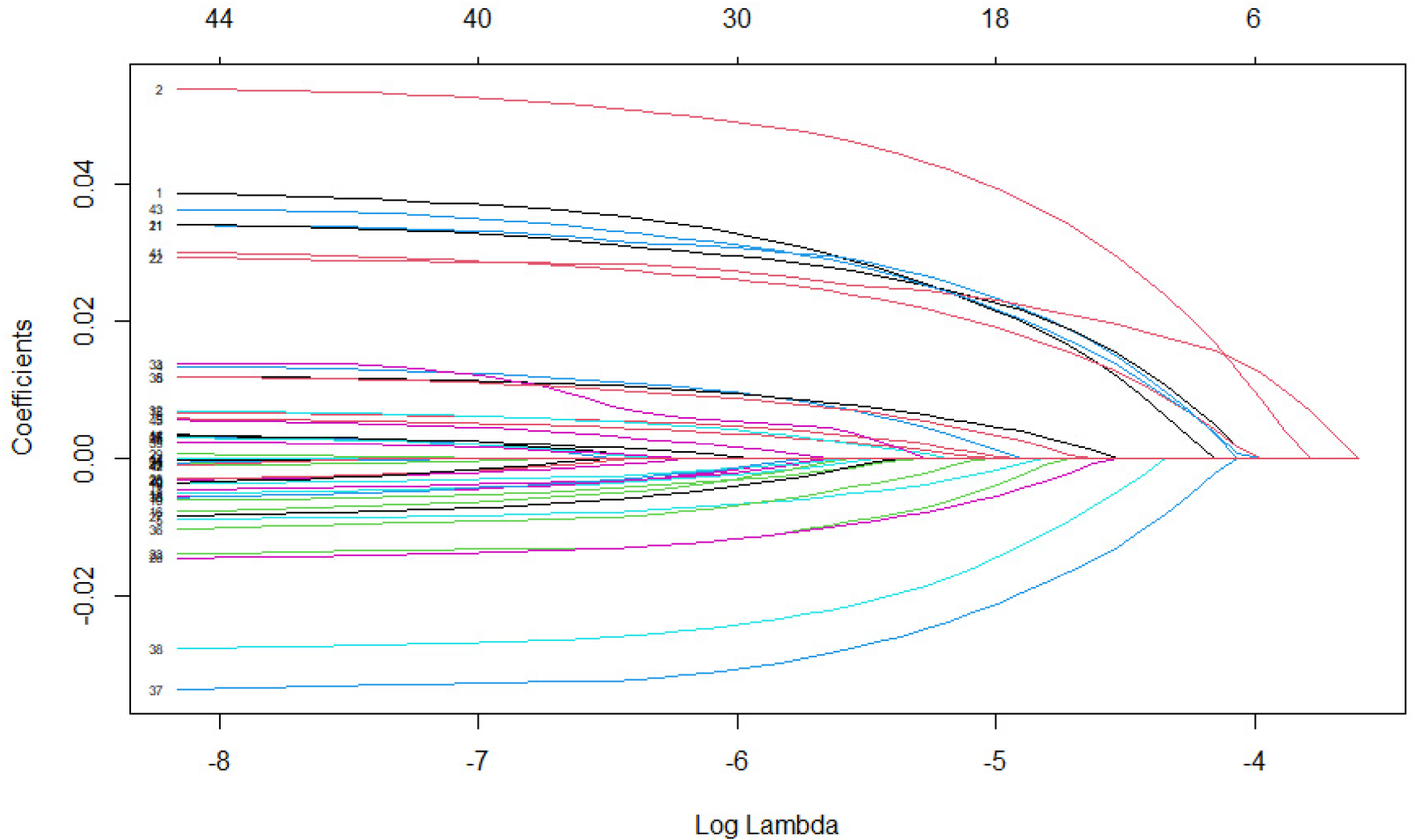


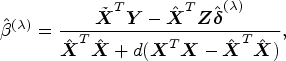













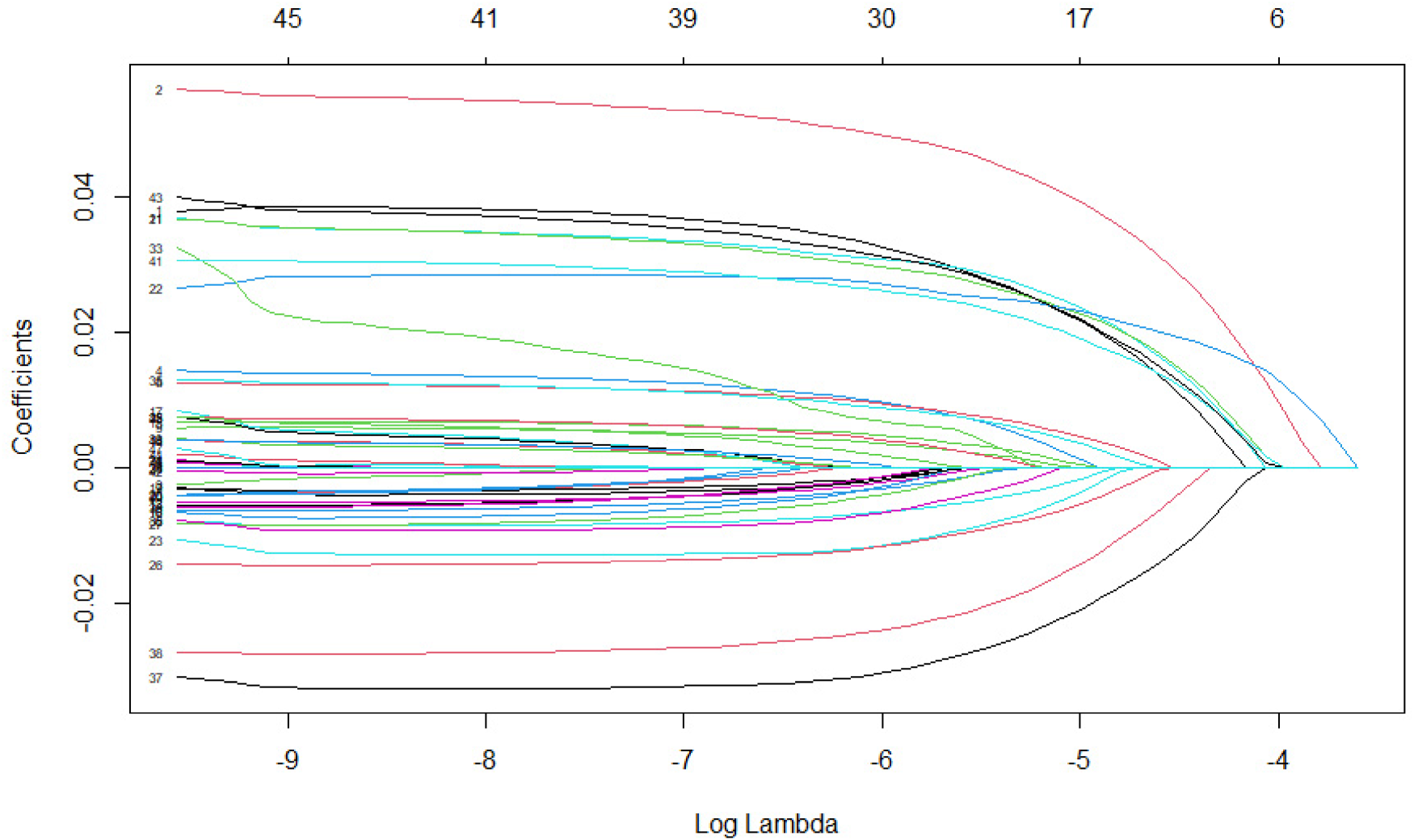
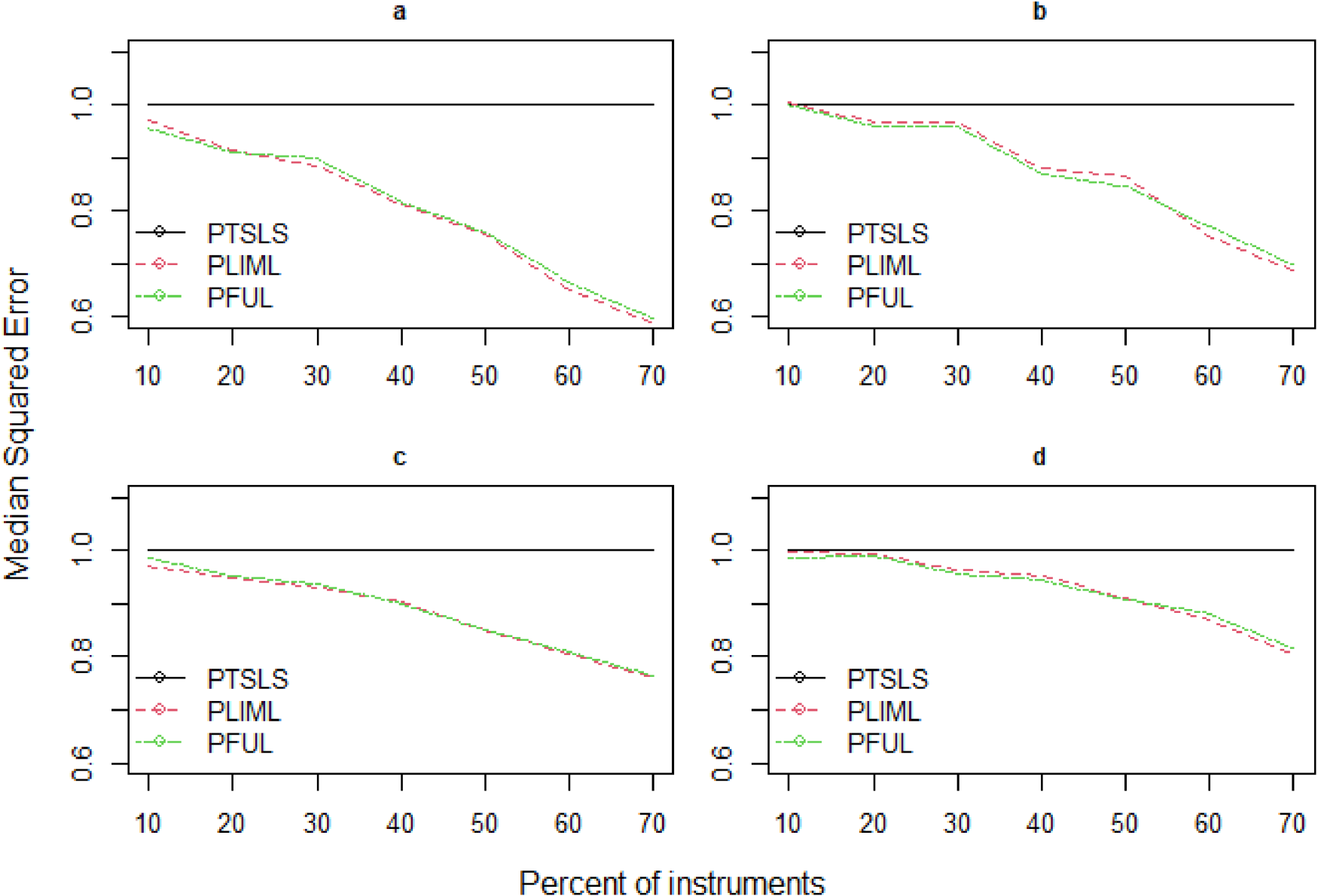
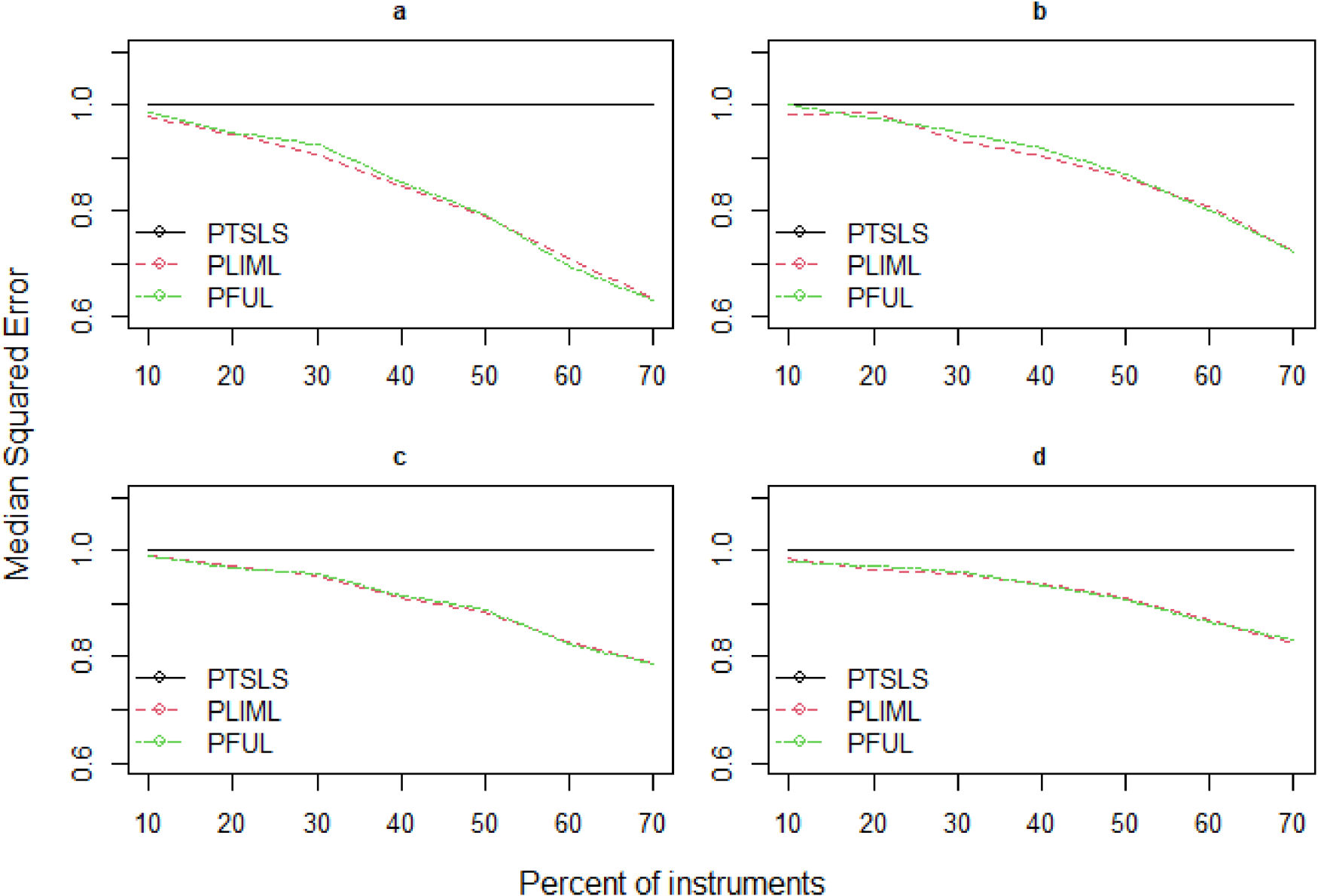
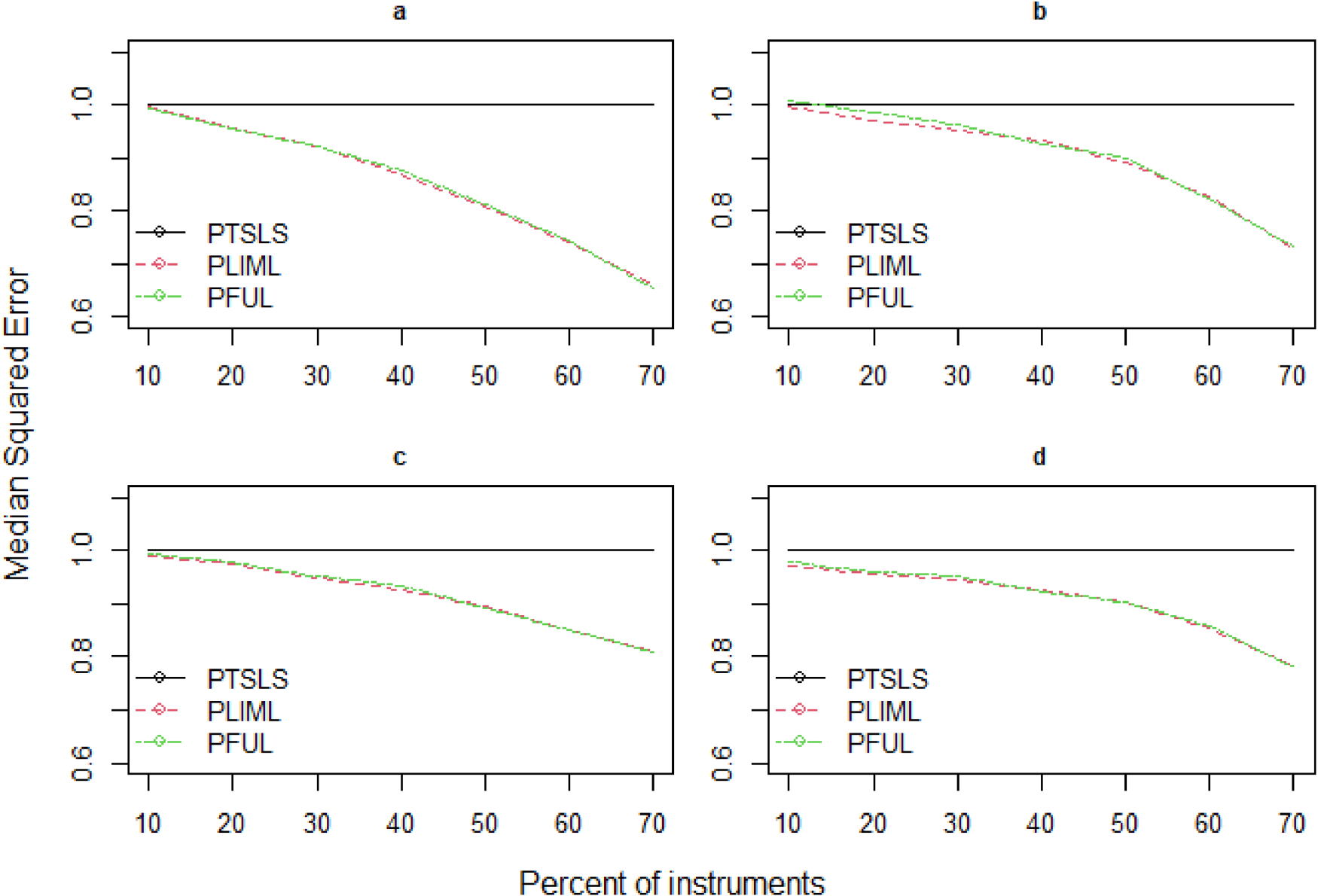
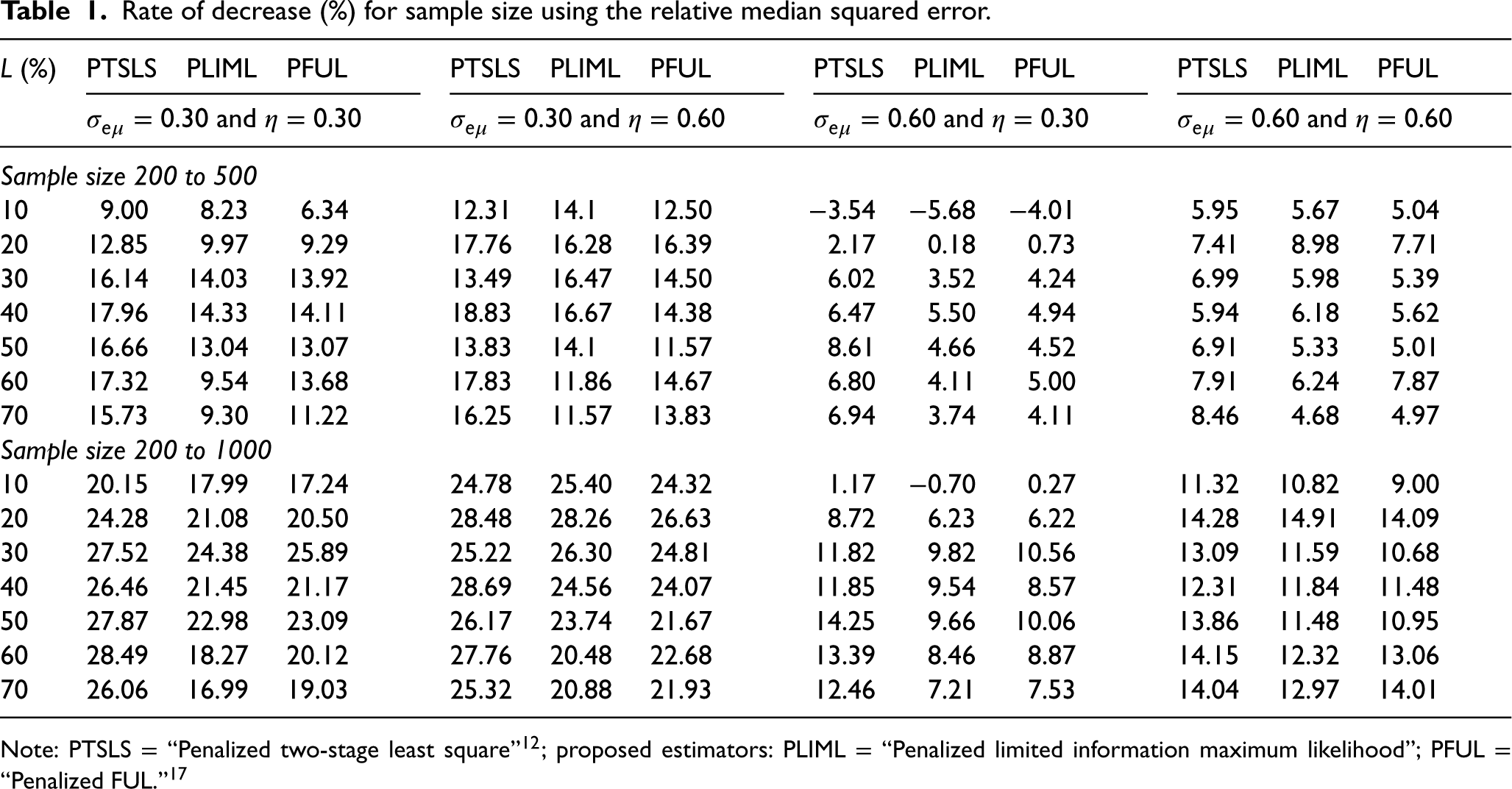
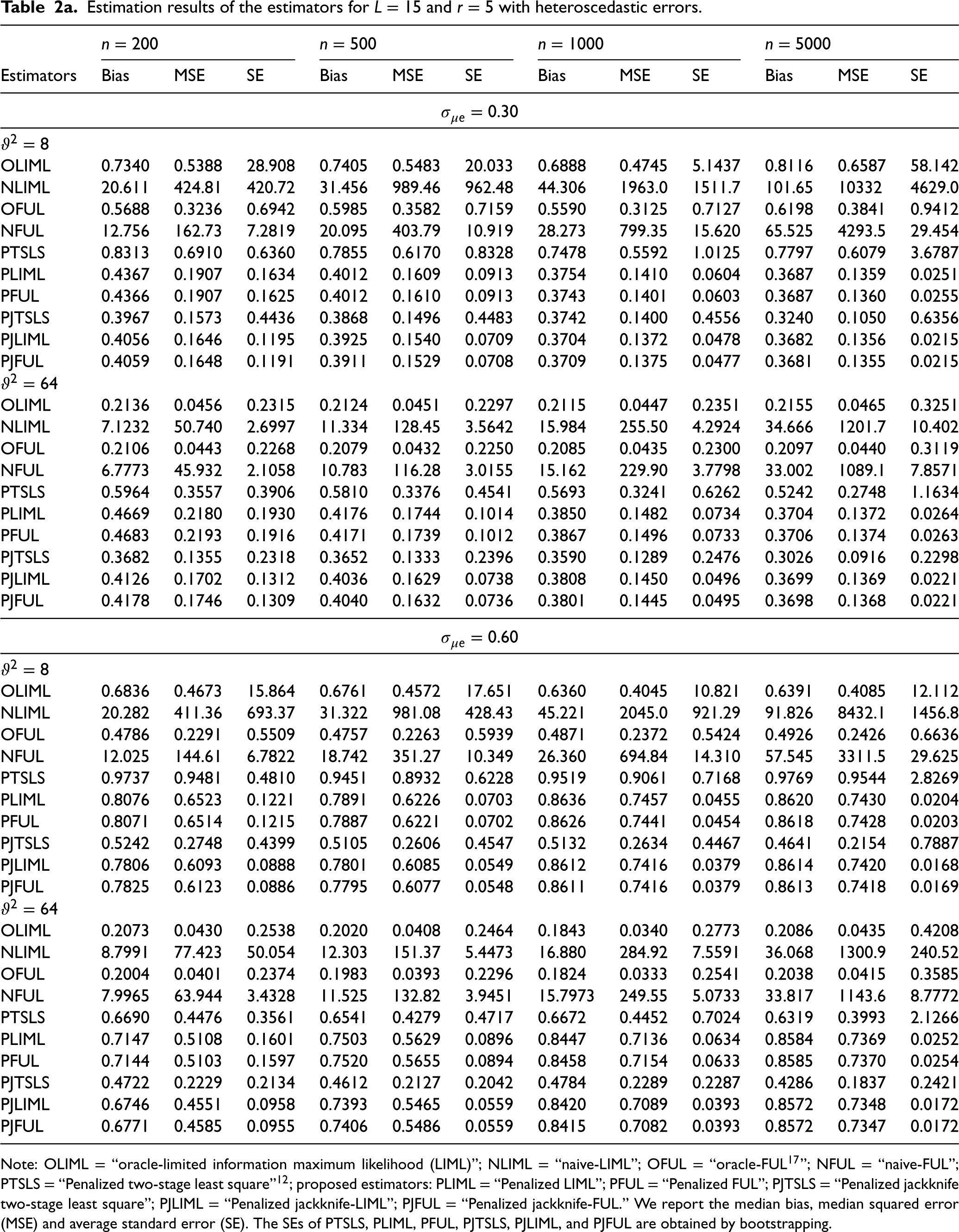
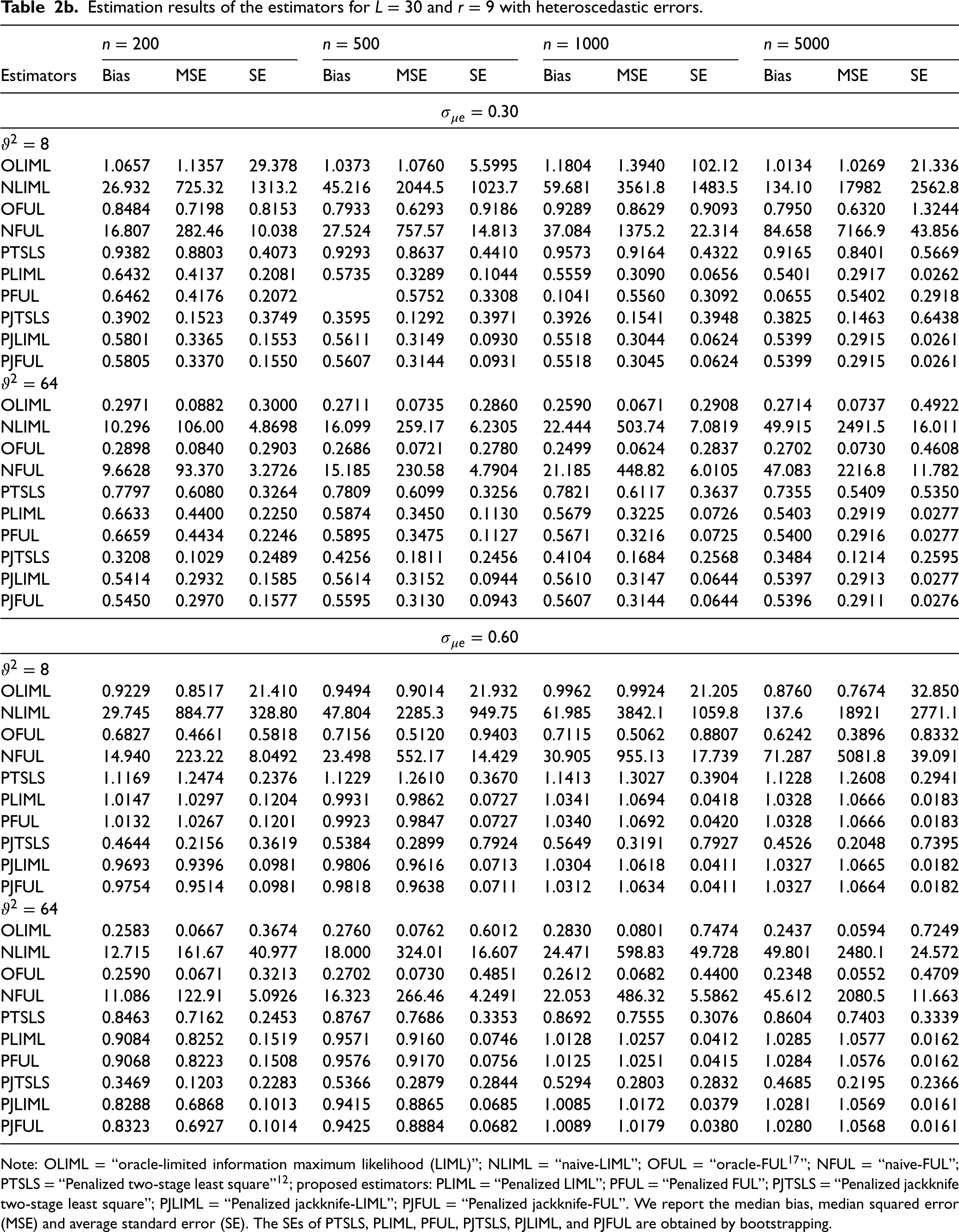
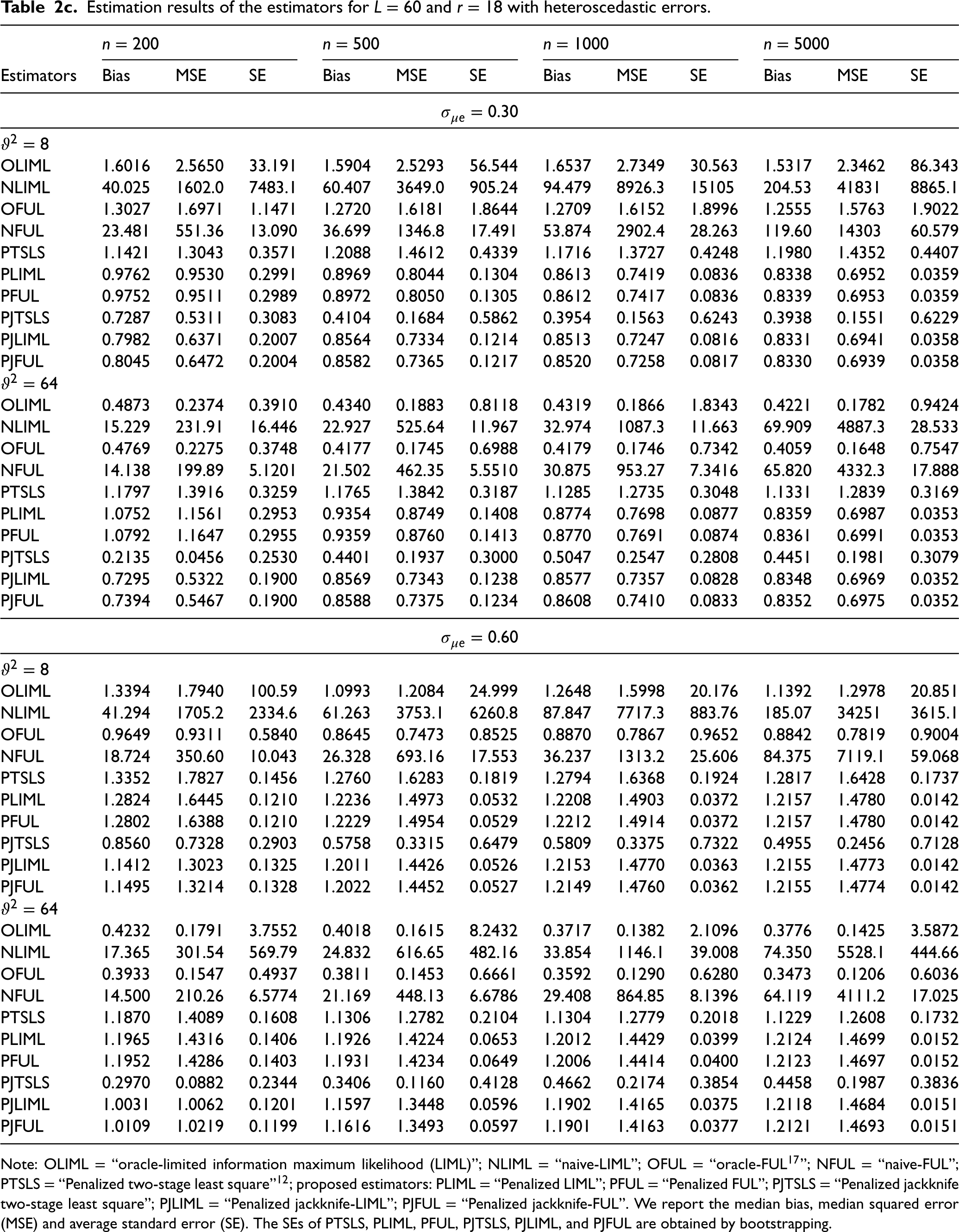
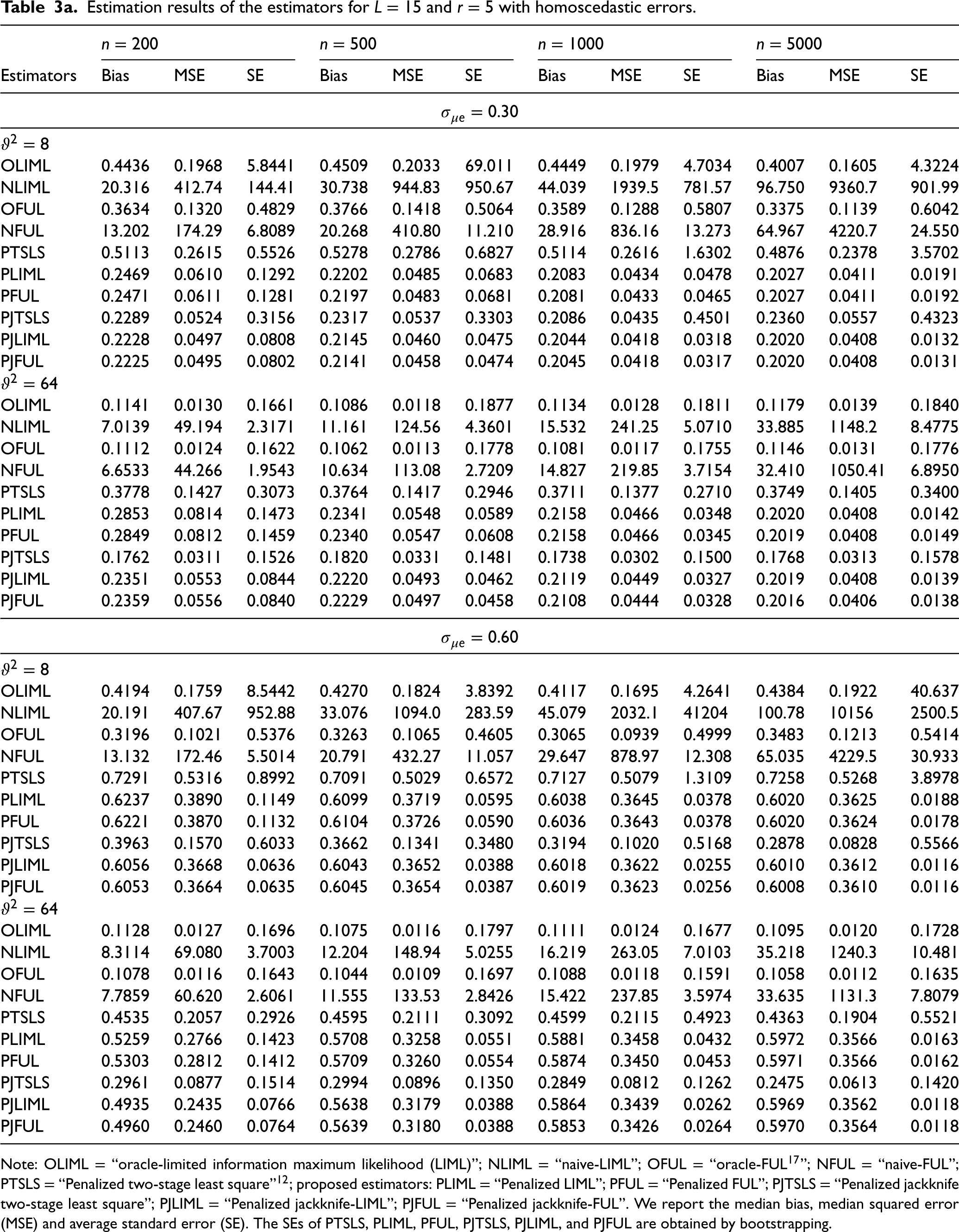
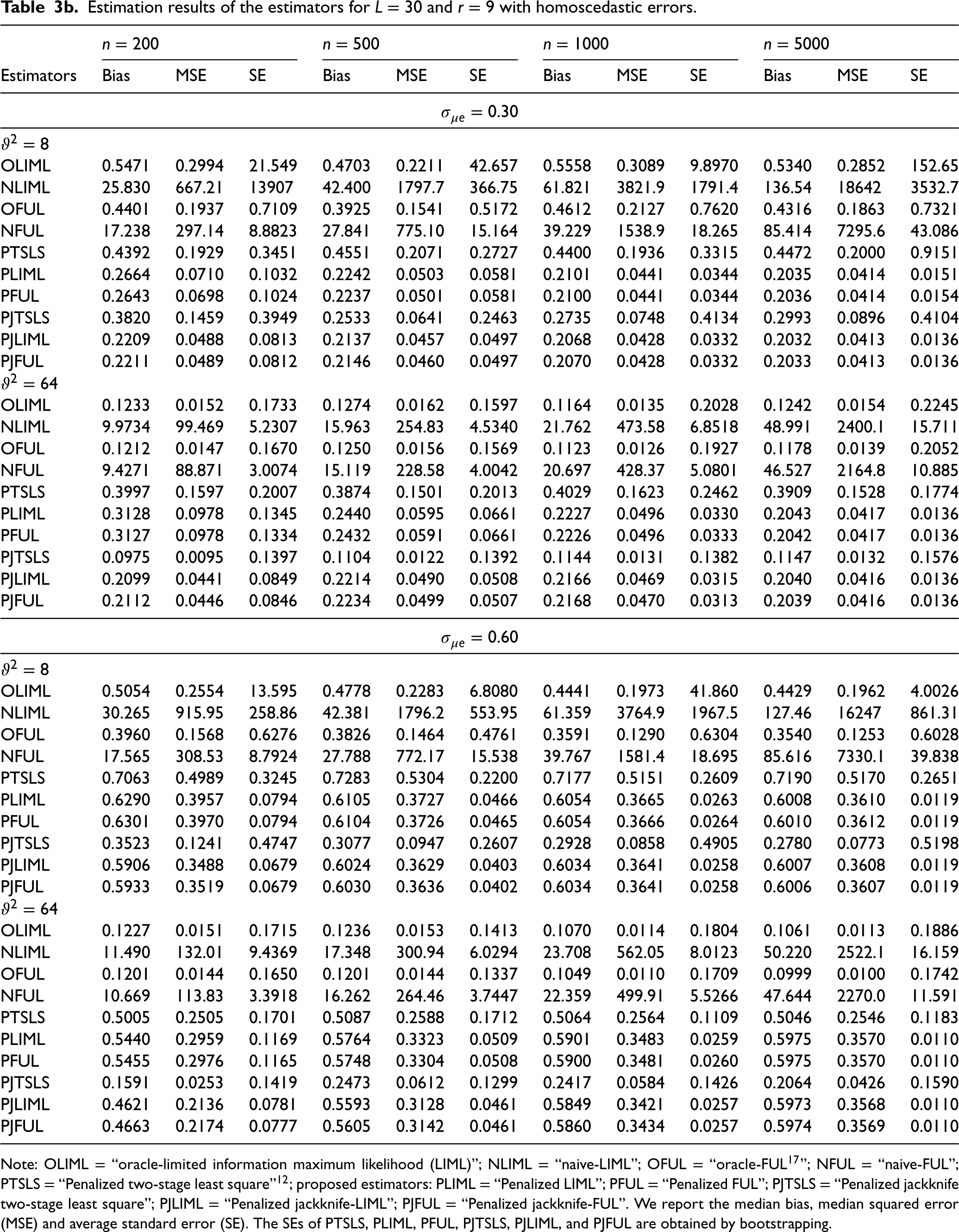
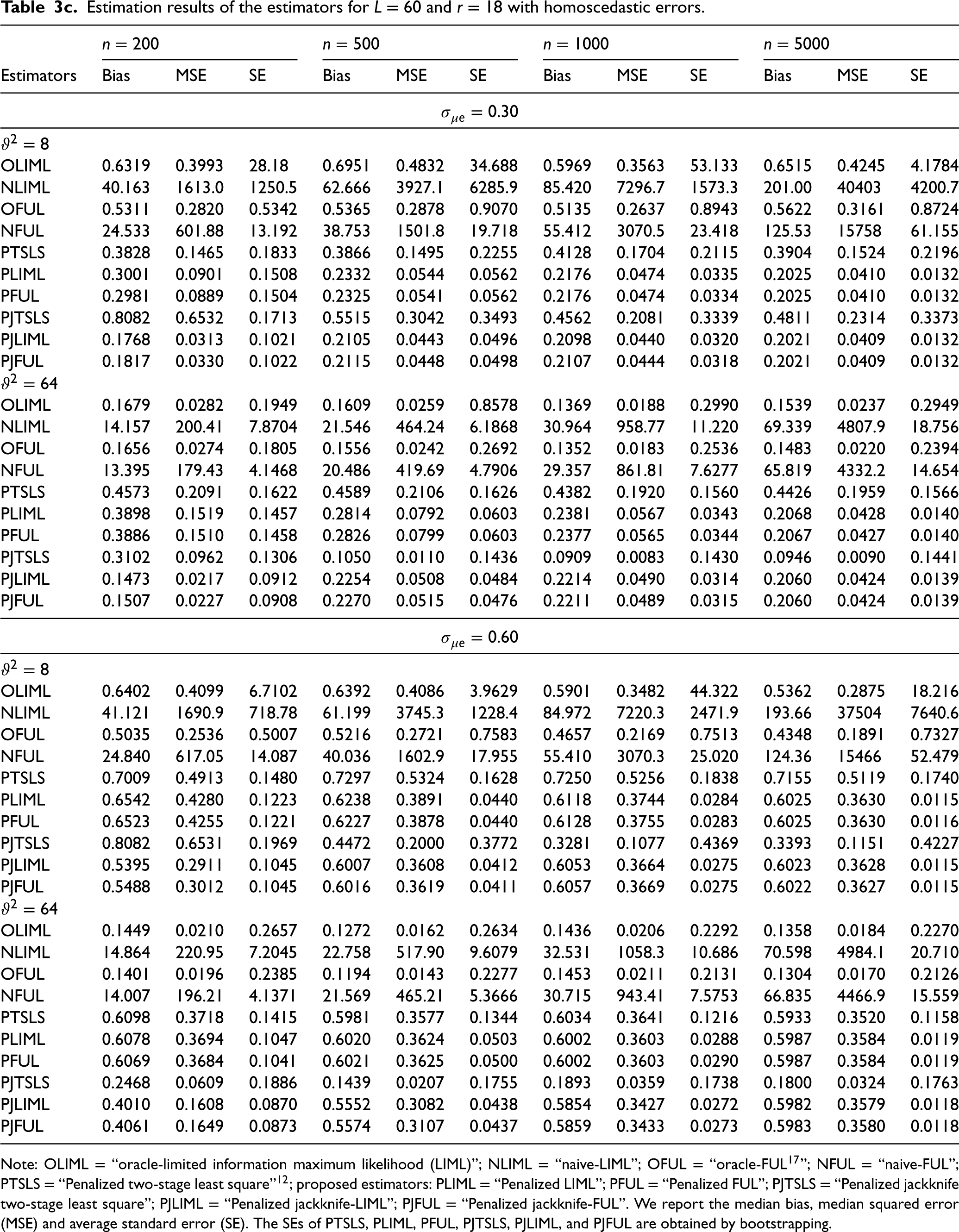
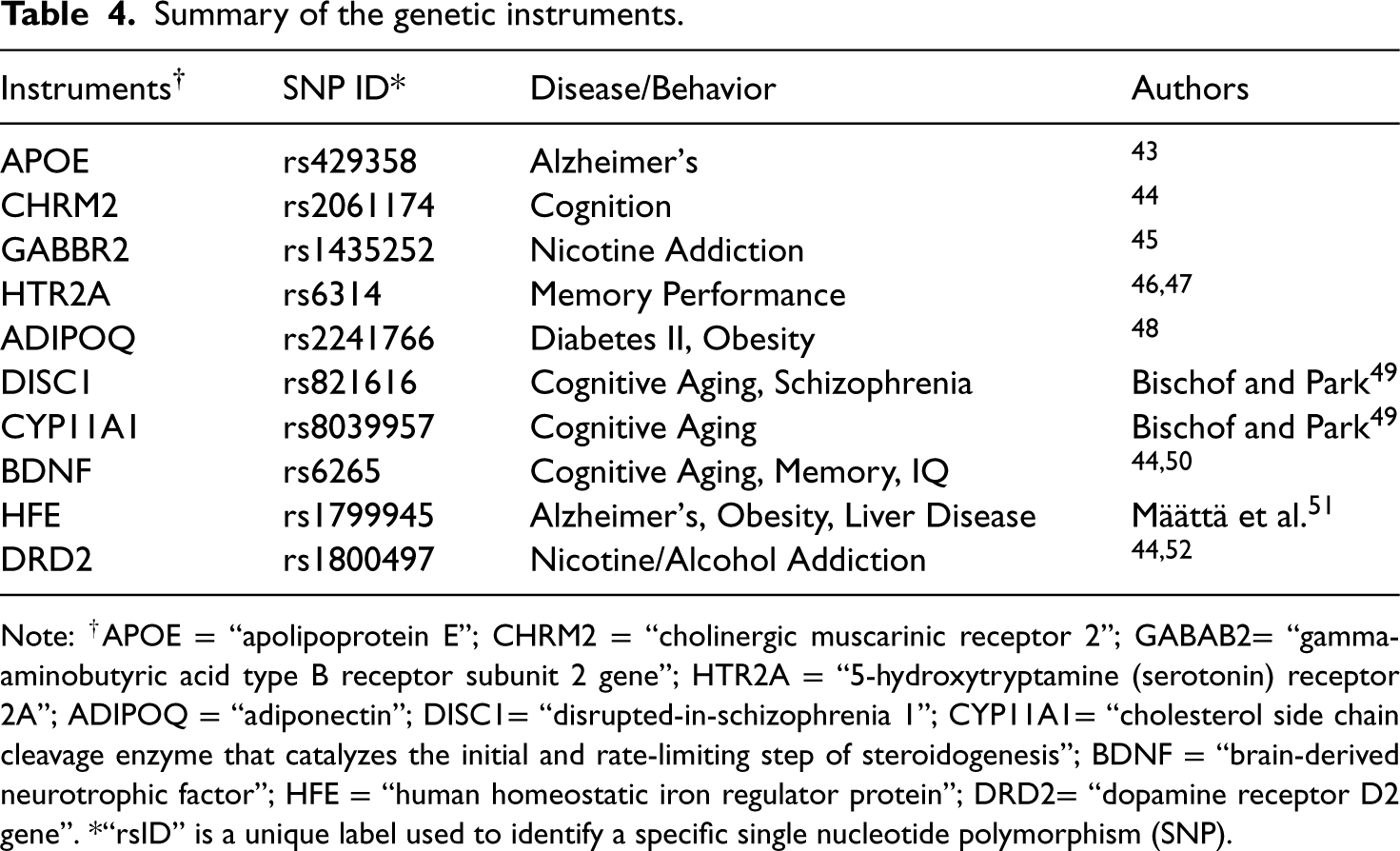
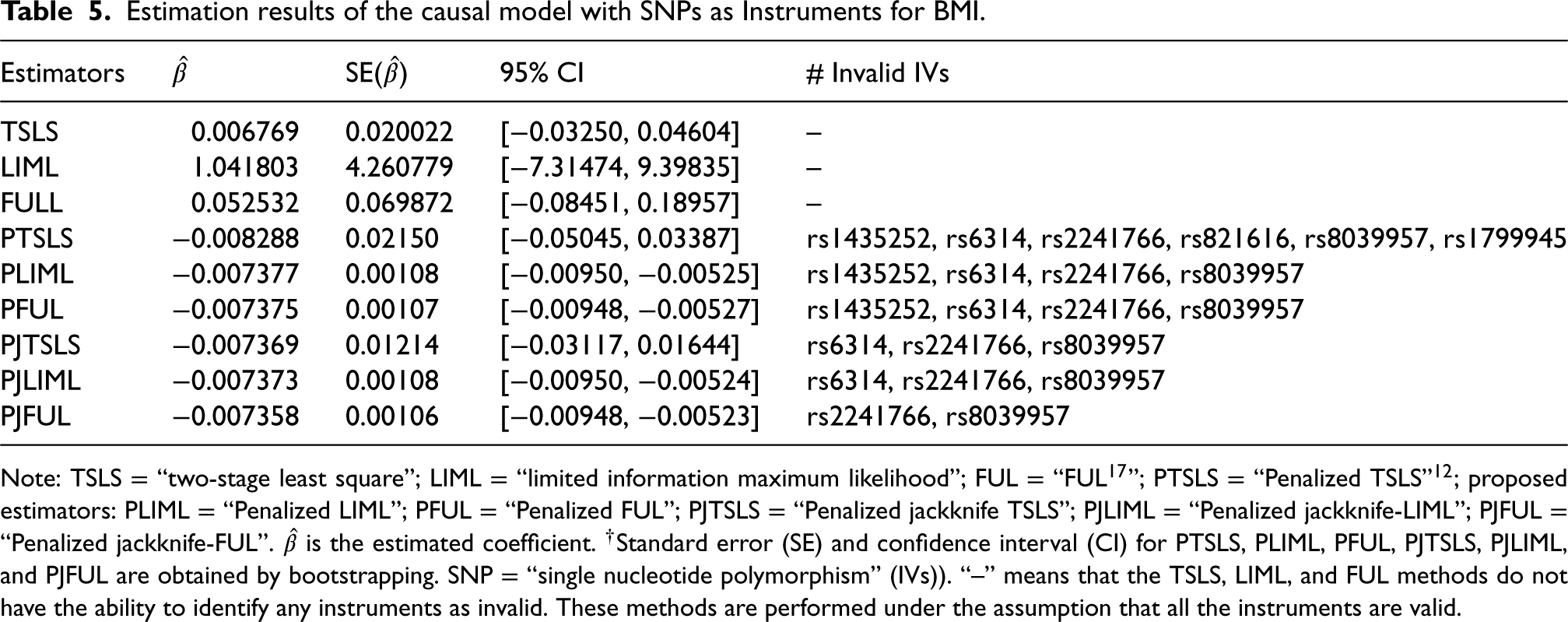
 .
.