




Abstract
Bivariate binary response data appear in many applications. Interest goes most often to a parameterization of the joint probabilities in terms of the marginal success probabilities in combination with a measure for association, most often being the odds ratio. Using, for example, the bivariate Dale model, these parameters can be modelled as function of covariates. But the odds ratio and other measures for association are not always measuring the (joint) characteristic of interest. Agreement, concordance, and synchrony are in general facets of the joint distribution distinct from association, and the odds ratio as in the bivariate Dale model can be replaced by such an alternative measure. Here, we focus on the so-called conditional synchrony measure. But, as indicated by several authors, such a switch of parameter might lead to a parameterization that does not always lead to a permissible joint bivariate distribution. In this contribution, we propose a new parameterization in which the marginal success probabilities are replaced by other conditional probabilities as well. The new parameters, one homogeneity parameter and two synchrony/discordance parameters, guarantee that the joint distribution is always permissible. Moreover, having a very natural interpretation, they are of interest on their own. The applicability and interpretation of the new parameterization is shown for three interesting settings: quantifying HIV serodiscordance among couples in Mozambique, concordance in the infection status of two related viruses, and the diagnostic performance of an index test in the field of major depression disorders.
Keywords
1 Introduction
In medical applications as well as in other fields, it is often of interest to examine the “resemblance” between two or more observations from paired or matched outcomes. Here the focus is on two binary paired or matched outcomes. Examples considered in this paper are the HIV status among couples; the infection statuses for the same individual for both the Varicella-Zoster Virus and the Parvo B19-virus, viruses that are similar in their transmission being close contact; and the diagnostic performance of the Whooley questions as a screening tool for depression amongst older adults in primary care. Resemblance can be measured in different ways, depending on the characteristic of interest. It could be represented by an association parameter, such as the Pearson product-moment correlation or, for binary data, by the cross-product ratio or odds ratio. However, often association is not of interest but rather agreement. Agreement and association are in general distinct facets of the joint distribution. Strong agreement requires strong association, but strong association can exist without strong agreement. 1 A well-known measure for agreement is Cohen’s kappa, see Agresti 1 for extensions and ways to model agreement.
Measures for association and agreement are typically symmetric and can be misleading if one of the agreeing outcomes is very dominant, such as the (negative, negative) combination in our first example of the HIV status among couples. Indeed, as the majority of pairs agree in being negative, symmetric measures of association or agreement might be high even if there is only a small number of agreeing positive pairs. In the context of measuring synchrony in neuronal firing, Faes et al. 2 proposed a new measure of synchrony, the conditional synchrony measure (CSM), which is the probability of two neurons firing together, given that at least one of the two is active. Faes et al. state that, although the odds ratio is an attractive association measure with nice mathematical properties (such as the absence of range restrictions, regardless of the marginal probabilities), it is less suitable for quantifying synchrony, due to its symmetry treating 0–0 matches of equal importance as 1–1 matches. Similar to the CSM but being rather interested in discordance, Juga et al. 3 defined the HIV conditional (sero)discordance measure (CDM) as the conditional probability that the couple is HIV discordant, given that at least one of them, man or woman, is HIV positive.
As noted by Faes et al. and Juga et al., a reparameterization of the joint bivariate binary distribution in terms of the marginal “success” probabilities and with the OR parameter replaced by the CSM (or the CDM) does not lead to a permissible joint distribution for the full ranges of all parameters, as the Fréchet bounds can be violated. 4 This puts constraints on the parameters of the joint bivariate distribution which are difficult to translate to the regression parameters when introducing dependency of the parameters on risk factors and other covariates. Moreover, the constraints hinder fitting the models, leading to computational issues such as convergence problems. The objective of this paper is to solve this non-permissibility problem, and to introduce an alternative parameterization guaranteeing a permissible distribution for all combination of values. The alternative parameterization, no longer including the marginal success probabilities, is shown to be of interest on its own, and offers additional insights for particular applications.
In the next section, three settings with illustrative datasets are introduced. Then the new measures and the new parameterization are presented and covariate models for the different parameters and maximum likelihood inference is briefly described. The illustrative datasets are analyzed using the new parameterization and the paper ends with final conclusions, considerations and ideas about further research.
2 Applications and datasets
In the following sections, three different settings and specific data examples are introduced in the field of disease control and prevention.
2.1 HIV serodiscordance among couples in Mozambique
We consider the same setting as in Juga et al., 3 based on data from the 2009 National Survey of Prevalence, Risk Behavioural and Information about HIV and AIDS (INSIDA 5 ). This survey was a cross-sectional two-stage survey, carried out by the National Institute of Health in collaboration with the National Bureau of Statistics of Mozambique. The objective is to model HIV serodiscordance among couples as a function of different risk factors and other covariates.
Let


As will be discussed in Section 3, the parameterization with both HIV marginal probabilities and the conditional discordance measure CDM does not satisfy the Fréchet inequalities, 4 causing computational difficulties with some of the models. In Section 5.1 we will reanalyze these data with the same type of models, but based on our new parameterization as introduced in Section 3.2.
2.2 Varicella Zoster Virus and Parvo B19 concordance
The Varicella-Zoster Virus (VZV) and the Parvo B19-virus (B19) are similar in that transmission occurs during close contacts. The contact rate and the infectiousness of the pathogen determine the spread of the infection in a population. It has been shown that the contact rate depends on age through heterogeneity in mixing of individuals from different age-classes. Several approaches have been proposed to model multi-sera data. Hens et al. 6 used a marginal model (bivariate Dale model 7 with odds ratio as association parameter) and conditional models (modelling one infection status conditional on the other) to model the multi-sera VZV-B19 data from Belgium. Hens et al. 8 studied the behaviour of the bivariate-correlated gamma frailty model for cross-sectionally collected serological data on Hepatitis A and B.
Here we reanalyze the Belgian VZV-B19 serological data. In a period from November 2001 until March 2003, 2381 serum samples in Belgium were collected and consecutively tested for VZV and B19. 9 Together with the test result for VZV and B19, gender and age of the individuals were recorded. Samples from children under 6 months were omitted, as test results are driven by maternal antibodies in this early stage of life. The maximum age of 40 was fixed by design; it was considered not important to test for older ages given that it concerns childhood infections.
Figure 1 depicts the bivarate distribution of VZV and B19 as a function of age. In Section 5.2, we will propose and discuss new measures to provide other and new insights in the joint occurrence of both infections, as function of age and gender.
VZV and B19 data, as function of age. Proportion of samples that tested positive on both VZV and B19 (top left panel), that tested positive on B19 only (top right panel), that tested positive on VZV only (lower left panel), and that tested negative on both viruses (lower right panel), based on a cross-sectional survey in Belgium anno 2001–2003. The size of the dots is proportional to the number of serum samples collected in the corresponding age category.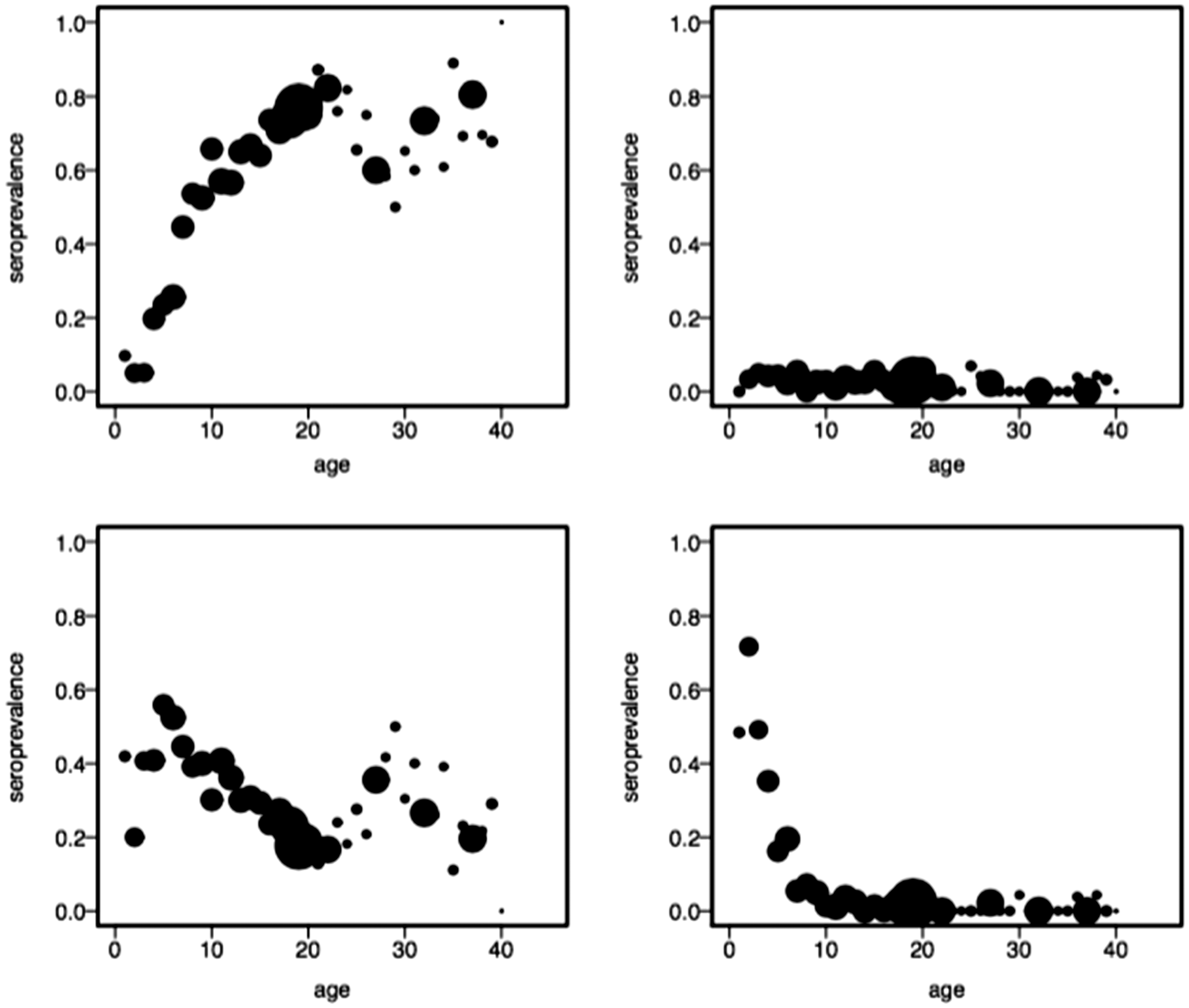
2.3 Diagnostic performance and concordance of the Whooley questions
Based on a cross-sectional validation study, conducted with 766 patients aged ≥75 from UK primary care and recruited via 17 general practices based in the North of England during the pilot phase of a randomized controlled trial, Bosanquet et al. 10 assessed the diagnostic performance of the Whooley questions (Whooley et al. 11 ) as a screening tool for major depression disorder (MDD) amongst older adults in UK primary care. Sensitivity, specificity, and likelihood ratios comparing the index test (two Whooley questions) for an MDD-diagnosis were ascertained by the reference standard Mini International Neuropsychiatric Interview (MINI 12 ). Participants completed a self-reported, written version of the index test, the Whooley questions: (WQ1) During the past month, have you often been bothered by feeling down, depressed, or hopeless? (yes = 1/no = 0); (WQ2) During the past month, have you often been bothered by little interest or pleasure in doing things? (yes = 1/no = 0). In the standard method of scoring the Whooley questions, participants who respond yes to at least one of the two questions were classified as screening positive for depression.
Whooley questions data.
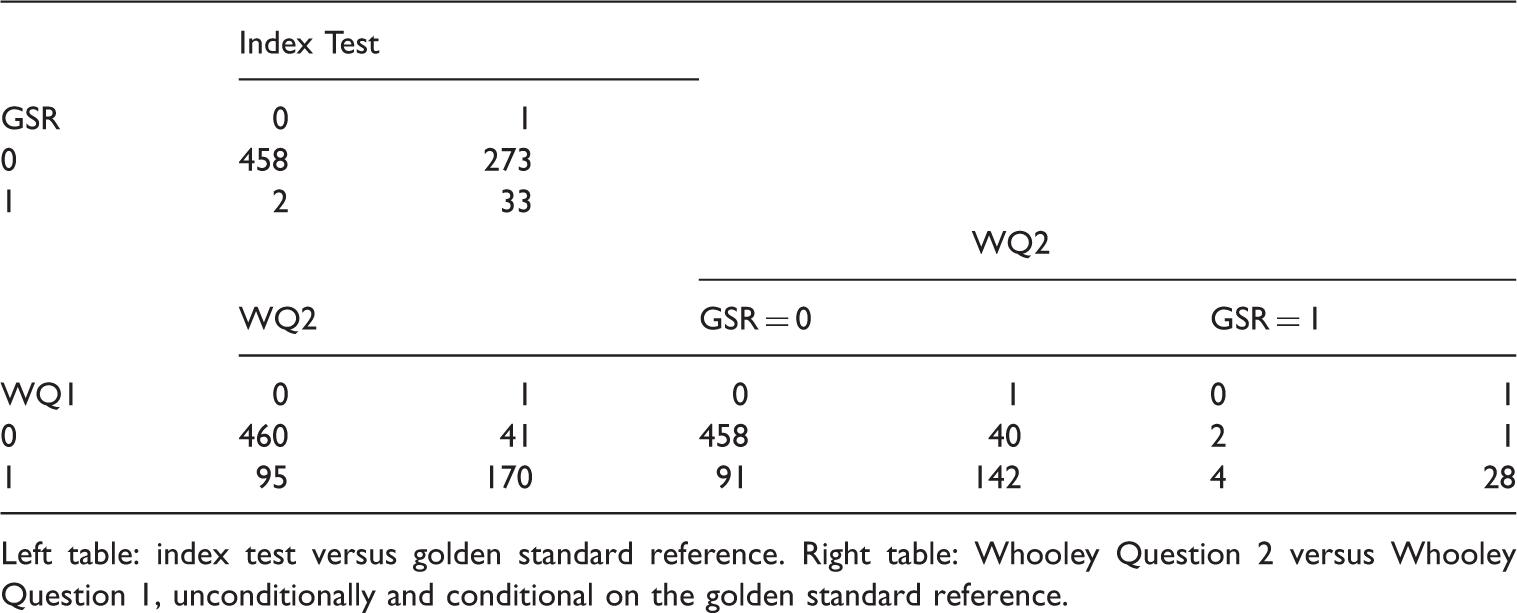
Left table: index test versus golden standard reference. Right table: Whooley Question 2 versus Whooley Question 1, unconditionally and conditional on the golden standard reference.
3 Measuring con(dis)cordance and (a)synchrony
First, we briefly review existing measures, including the conditional synchrony measure. Next the new parameterization is introduced, discussed and relations with other parameters are examined. A final section focuses on the estimation of the new parameters by maximum likelihood.
3.1 Existing measures
Consider a bivariate binary outcome 
But such association measures are not the target parameter of interest in case interest goes to con(dis)cordance or (a)synchrony. In the context of measuring synchrony in neuronal firing, Faes et al.
2
stated that the odds ratio is less suitable to quantify synchrony due to its symmetry, treating 0–0 matches of equal importance as 1–1 matches, and proposed a new measure of synchrony, the conditional synchrony measure CSM, defined as

A limitation of this parameterization, with the marginal probabilities combined with 
When modelling the dependency on x and possibly including additional random effect structures on all three parameters (
3.2 New measures and new parameterization
While it is common to include the two marginal probabilities as part of a model parameterization, particular alternative parameters might be of interest too and might shed more light on the research questions at hand. In the three applications of interest, the focus is not on the marginal probabilities. The new parameterization proposed here abandons the common starting point of adding the parameter of interest to the marginal probabilities, but takes an opposite approach: next to the CSM or CDM measure, which other parameters of interest can be introduced to obtain a complete parameterization of the joint distribution?
As a first parameter, define the conditional probability that y1 is positive, given that both disagree

Note that 
In the sequel, we will use definition (6) and refer to it as the (marginal) homogeneity parameter.
As a second parameter, define (as before) the “positive” conditional synchrony measure CSM, being the probability that both are agreeing (both positive) given that at least one is positive

Finally, define the third parameter as the “negative” conditional synchrony measure, being the probability that both are agreeing (both negative), given that at most one is positive

Again, the third parameter can also be defined as (negative) CDM, being
The homogeneity parameter π determines the relative ratio of the off-diagonal probabilities of disagreement, independently of the values of 
The measure 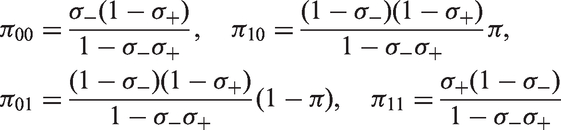
It can also readily be shown that, for any combination of values for the three conditional probabilities
The marginal success probabilities can be written as


Identity (9) shows that the odds ratio φ decomposes in three factors, each related to one of the three new parameters. The association in terms of the odds ratio increases multiplicatively with the odds of both synchrony measures
The relation with Cohen’s kappa measure of agreement takes the form

A bit different and more “asymmetric setting” is that of measuring the accuracy of diagnostic tests. Assume y1 represents the true disease status, and y2 another alternative test. Sensitivity 

First of all, note that Se and PPV do not depend on
The diagnostic odds ratio

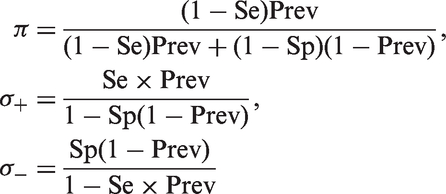
Although our application as introduced in Section 2.3 is based on a cross-sectional study, allowing to estimate the disease prevalence by the case study prevalence, this might be not the case for other study designs. Consider for instance the case-control design, with data about a screening test result for the diseased and non-diseased subpopulation (as defined by a golden standard or reference test). Such a design allows the estimation of the sensitivity and specificity, but not the prevalence of the disease. The formulas
4 Estimation and inference
Consider quadrinomial observations 
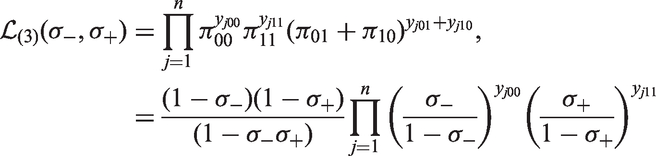
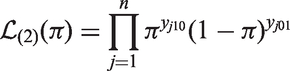
In case no parameters are common to the models for
The dependency of the three conditional probabilities 
Note that, when using the relative difference parameter 
5 Applications
In this section we revisit the three applications introduced in Section 2 and show how in each example model (11) can be formulated and we illustrate the use and interpretation of the three conditional probabilities
5.1 Modelling HIV serodiscordance among couples in Mozambique
We reanalyse the HIV data introduced in Section 2.1 based on model components for i) the (homogeneity) probability πij that the female partner of couple j in EA i is HIV positive, given that both partners differ in their HIV status; ii) the probability 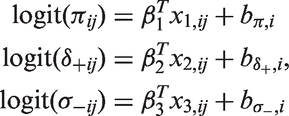

Most of the sample designs for household surveys such as INSIDA are complex and involve stratification, multistage sampling, and unequal sampling rates, and it is necessary to account for the particular survey design in the statistical analyses using appropriate weights. We followed the same approach as Juga et al. 3 For more details on the calculation of the weights as used in our analyses, we refer to Juga et al. 3
After following the same model building procedure as in Juga et al., the best fitting final model had no random EA-effect
HIV serodiscordance example.
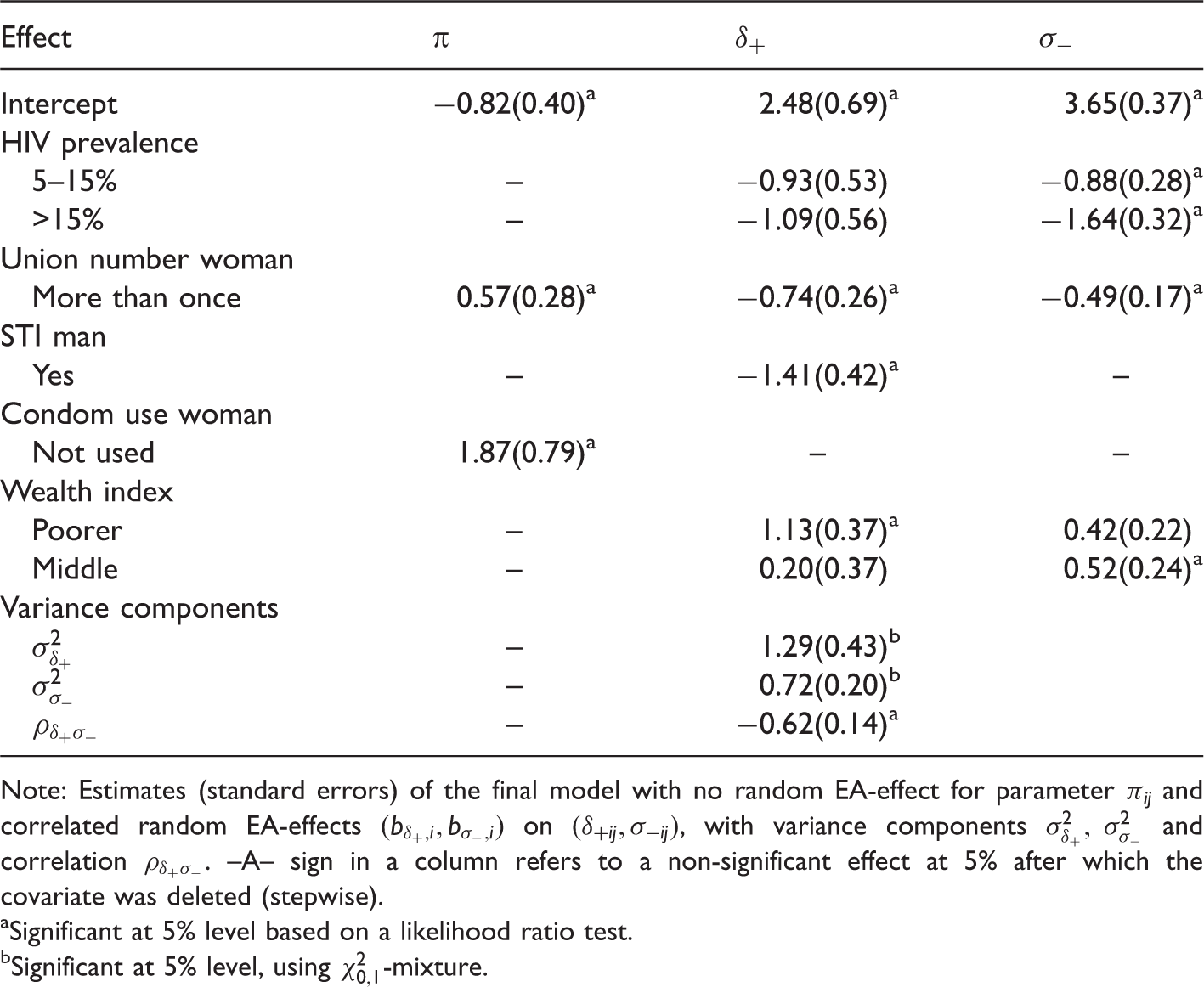
Note: Estimates (standard errors) of the final model with no random EA-effect for parameter πij and correlated random EA-effects
Significant at 5% level based on a likelihood ratio test.
Significant at 5% level, using
Comparing our results with those of Juga et al.
3
and focusing on the common conditional serodiscordance parameter CDM =
The negative synchrony depends on the ‘HIV prevalence’ (the higher the prevalence the lower the synchrony), the ‘Union number woman’ (lower synchrony in case the woman has been married or lived with a man more than once) and the ‘Wealth index’ (higher synchrony for the middle category).
Finally for the homogeneity parameter π, it can be observed that marginal homogeneity (both partners having the same probability to be HIV positive) does not hold in case the woman has been married or lived with a man only once and the man has indicated to have no STI symptoms (95% CI [0.166, 0.491] for π, implying the probability to be HIV positive is lower for the woman) and in case the woman has been married or lived with a man more than once and the man has indicated to have STI symptoms (95% CI [0.517, 0.960] for π, implying the probability to be HIV positive is higher for the woman).
5.2 Varicella Zoster Virus and Parvo B19 concordance
VZV and B19 data.
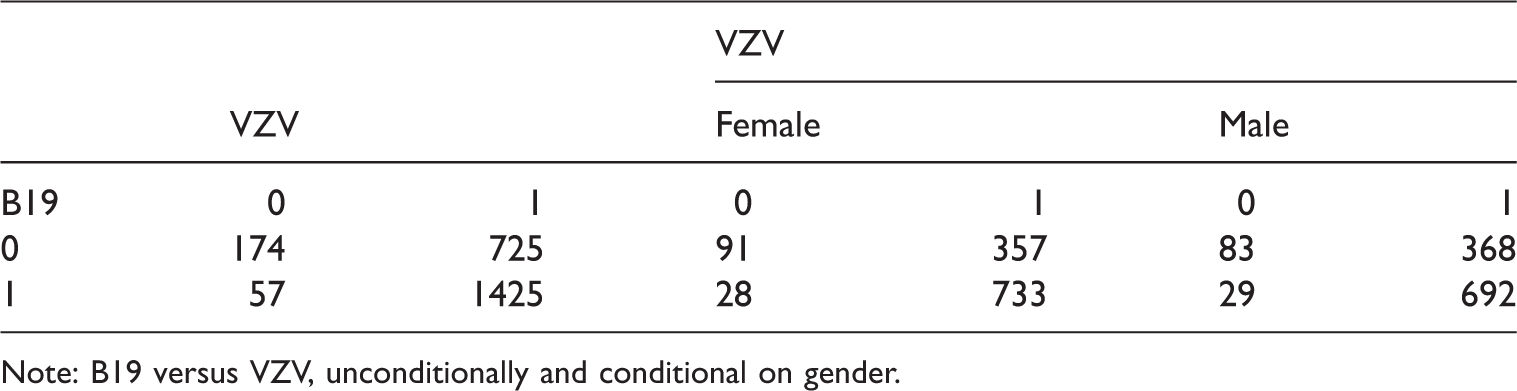
Note: B19 versus VZV, unconditionally and conditional on gender.
Figure 2 visualizes the dependencies on age. For an individual who is positive for one and negative for the other virus, the probability is lowest that he/she is positive for B19 (about 0.10) across all ages. Marginal homogeneity clearly does not hold, for any age (p < 0.00001). If an individual is positive for at least one virus, the probability VZV and B19 example. Plot of the fitted π (solid line), 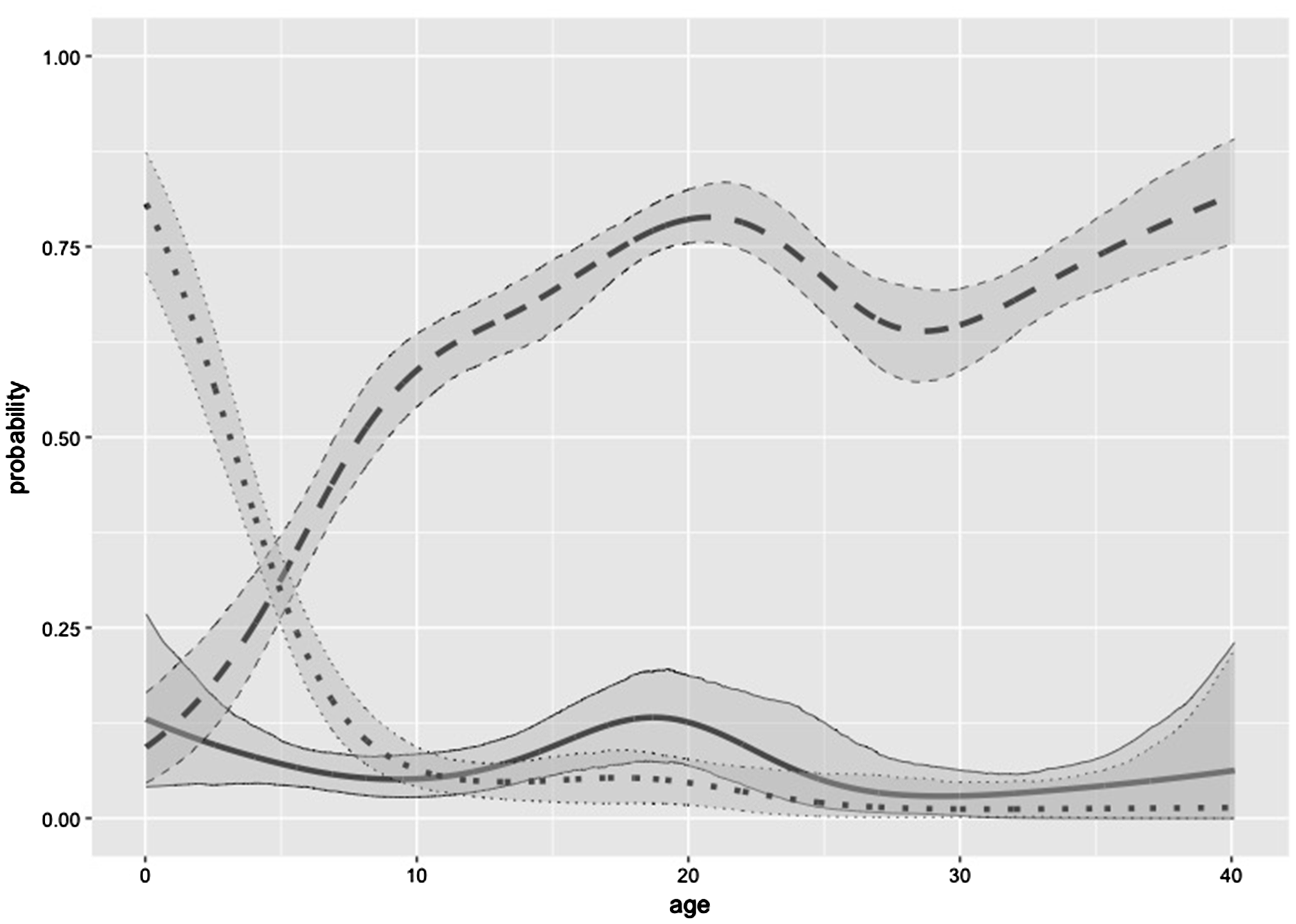
Using a bivariate Dale model and splines for the effect of age, Hens et al. 6 could not reject the null hypothesis of a constant OR (p = 0.37). The estimated age and gender independent OR equaled 2.11 with 95% confidence interval (1.45, 3.23). This is another example showing that measures for agreement and for dependency can behave quite differently.
5.3 Diagnostic performance and concordance of the Whooley questions
Whooley questions example.
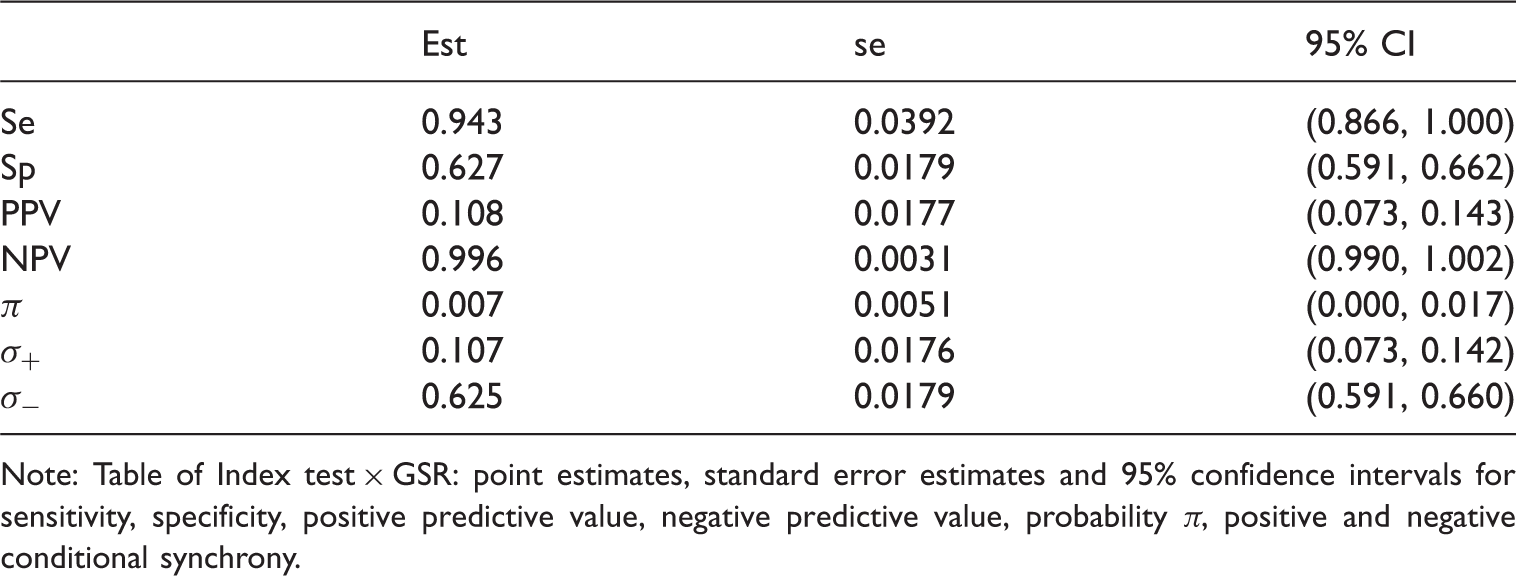
Note: Table of Index test × GSR: point estimates, standard error estimates and 95% confidence intervals for sensitivity, specificity, positive predictive value, negative predictive value, probability π, positive and negative conditional synchrony.
Whooley questions example.
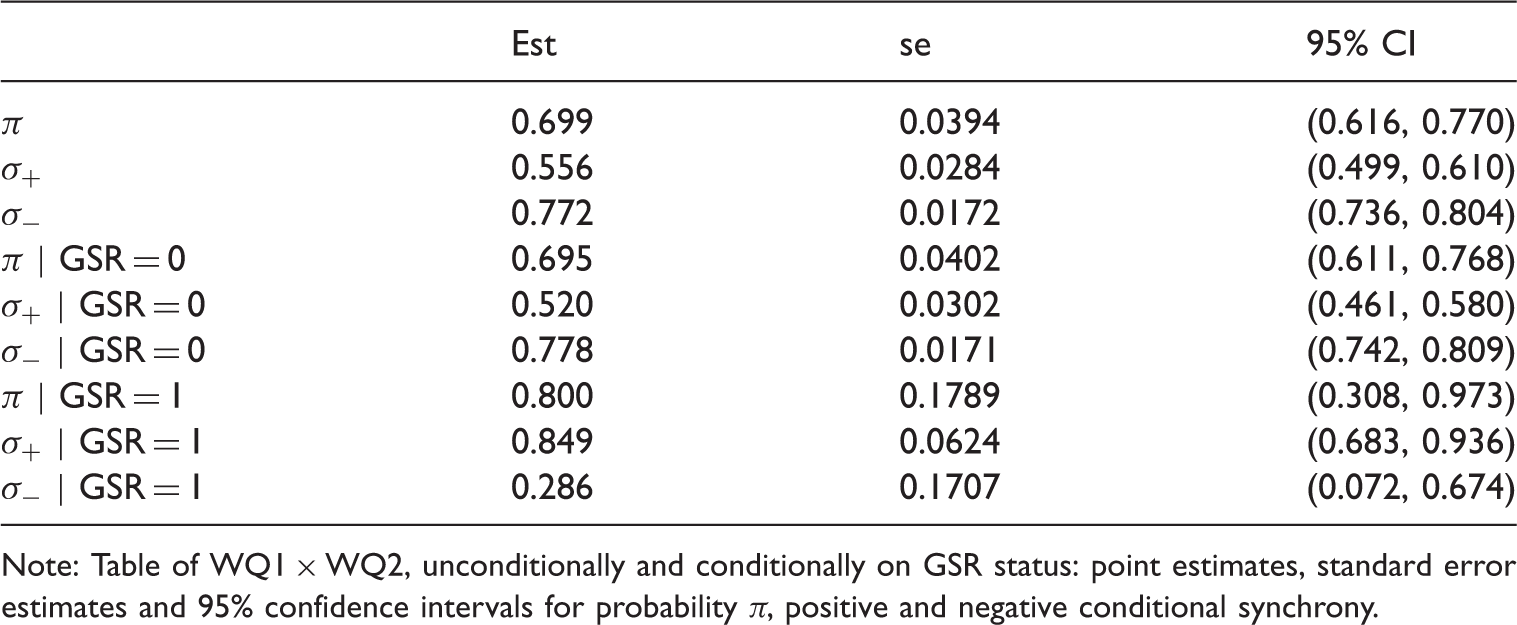
Note: Table of WQ1 × WQ2, unconditionally and conditionally on GSR status: point estimates, standard error estimates and 95% confidence intervals for probability π, positive and negative conditional synchrony.
The homogeneity probability π does not depend on the GSR status (p = 0.6189). As
But
Bosanquet et al. 10 mentioned in the discussion that the use of the two-item version of the Whooley questions, rather than a three-item version, in which the respondent is asked to state whether they would like help for any difficulties reported, is a potential limitation of their study. However, evidence from recent studies using a third help question, does not provide a conclusive answer whether to include or not the third question. It would be interesting to study in more depth the con- and discordance between all three questions in order to come up with an improved index test.
6 Conclusions and discussion
As interest goes to modelling a genuine synchrony/concordance measure rather than a typical association measure such as the odds ratio, the joint distribution of matched pairs of binary data need to reparametrized accordingly. In this contribution, a new parameterization solved the existing permissibility issue with the conditional synchrony measure and related limitations of fitting appropriate models. This new parameterization is based on two synchrony measures, a positive and negative synchrony (or alternatively discordance) parameter, combined with a marginal homogeneity parameter, leading without any restrictions on any of these parameters to a permissible joint distribution for the matched binary pairs, thus facilitating the fitting of more flexible and appropriate models.
The usefulness of the new approach has been illustrated in three different areas of application in disease control and prevention. In the first application, the positive serodiscordance was the main parameter of interest, but also the additional negative seroconcordance provides alternative new insights in this field. While the same characteristic (HIV status) is measured for both partners of a couple in the first application, two different characteristics (VZV and B19 infection status) on one and the same individual are available in the second application. The negative and positive synchrony measures provide new information and insights in the joint process of acquiring both diseases having similar transmission routes. In a third, more distinct application, the accuracy of a screening test is to be assessed in relation to the true disease status (or a gold standard). The new synchrony measures allow to investigate the performance of the diagnostic test from another angle, different from but closely related to well-known accuracy measures such as sensitivity, specificity, predictive values, DOR, etc. and future use of these new measures will shed more light on their ultimate value in this particular field of application.
An advantage of the new approach is that, in case interest only goes to both synchrony measures and their models do not share any parameter in common with the model for the marginal homogeneity parameter, the disagreeing observations can be collapsed and the synchrony measures can be modelled by means of a simplified trinomial likelihood. It may be perceived as a disadvantage that the marginal success probabilities (such as the prevalence of one or both diseases) are not directly estimated or modelled as a function of covariates, as in the currently applied parameterizations. On the other hand, the homogeneity parameter still allows to investigate structural differences in both marginal parameters. Moreover, models for the new parameters
A first interesting methodological topic for further research is the modification and application of the HIV model of the first example to same-sex couples, as already mentioned by Juga et al. 3 They suggested two approaches to deal with the exchangeability of both partners of a couple. But the parameterization proposed here offers an interesting third option. Indeed only the marginal homogeneity parameter depends on the order of the partners in a couple and would not be interpretable when using a random order (actually one would expect homogeneity in case of a random order). Being orthogonal to the other parameters, it would not affect the estimation of the synchrony measures.
Another interesting extension is to examine synchrony between three or more outcomes, as for instance three related infections in our second example. As the number of parameters grows exponentially with the outcome-dimension, defining a full set of appropriate homogeneity and synchrony parameters needs careful considerations in view of the application of interest. For the last example, one often includes an inconclusive category, introducing one or both as a trinomial outcome. An extension in that direction poses interesting challenges. Also in the latter setting, one might like to account for an imperfect GSR by correcting for misclassifications.
Supplemental Material
Supplemental material for Measures for concordance and discordance with applications in disease control and prevention
Supplemental material for Measures for concordance and discordance with applications in disease control and prevention by Marc Aerts, Adelino JC Juga and Niel Hens in Statistical Methods in Medical Research
Footnotes
Acknowledgements
The authors would also like to acknowledge the support given by the Mozambican Health Ministry (MISAU) and Demography Health Survey (DHS) Program for providing the INSIDA survey data. The VZV-B19 example was based on a serum sample collected for the European Commission’s ESEN2-project.
Declaration of conflicting interests
The author(s) declared no potential conflicts of interest with respect to the research, authorship, and/or publication of this article.
Funding
The author(s) disclosed receipt of the following financial support for the research, authorship, and/or publication of this article: This study was only possible, thanks to the financial support of the Flemish Interuniversity Council (VLIR-UOS) in collaboration with Eduardo Mondlane University (UEM) through the DESAFIO Program. NH acknowledges funding from the European Research Council (ERC) under the European Unions Horizon 2020 research and innovation programme (grant no. 682540 TransMID) and the Special Research Fund of Hasselt University.
References
Supplementary Material
Please find the following supplemental material available below.
For Open Access articles published under a Creative Commons License, all supplemental material carries the same license as the article it is associated with.
For non-Open Access articles published, all supplemental material carries a non-exclusive license, and permission requests for re-use of supplemental material or any part of supplemental material shall be sent directly to the copyright owner as specified in the copyright notice associated with the article.
