




Abstract
Taking inspiration from literary studies, this article examines how the seasonal mode has been taken up in video games by exploring, first, how seasonality impacts gameplay practices which are sensitive to spikes in temperature, and second, by analyzing an emergent trend in popular game design that points to a growing engagement with climate change. This trend, which this article dubs “dark seasonality,” describes the increased thematization of unseasonal and dangerous weather in popular media, reflecting anxieties and concerns about the climate crisis. Rather than engage with extreme weather as a singular, spectacular occurrence, dark seasonality portrays extreme weather events to fall within new seasonal norms, dictating different styles of gameplay that are more cautious, more focused on the long term, and more attentive to environmental uncertainties. In this way, dark seasonality offers players a space to familiarize themselves with tumultuous weather-worlds, whose disturbed seasonal rhythms echo the more protracted ones felt around the globe.
For ecocritical literary scholars, it has long become clear that in novels time and place—or setting—do not merely serve as containers for a plot but perform crucial structural and symbolic functions. The Victorian regional novel, for example, depends on the regularity of British seasonal change for pacing and plot, which becomes clear when juxtaposed to Victorian novels set in locales with different climates, like Australia (Steer, 2021). Scholar of English literature Tess Somervell also points out, seasonality allows for a “flexibility in the perception of time” in literature by making it easy to skip back and forth between past and present through association and memory (Somervell, 2019). In video games too, seasonality performs important structural and symbolic functions that are often overlooked in game analysis, and which require a different kind of analytical lens to bring to the foreground. In this article, I demonstrate how to read for seasonality in video games and argue that doing so can illuminate emergent trends in popular game design that point to a growing engagement with climate change. Specifically, I introduce a trend that I call “dark seasonality,” which describes the increased thematization of unseasonal and dangerous weather in popular media, reflecting anxieties and concerns about the climate crisis.
The climate crisis is a catastrophe without an event (Horn, 2018). While stories of environmental collapse due to nuclear fallout tackle many of the same themes as climate fiction, they are temporally quite different. The same is true for stories about asteroid strikes. Disaster narratives like these depend on a clear apocalyptic incident that changes everything, creating a distinct before and after. In contrast, climate change is characterized by the “slow violence” of gradual environmental degradation (Nixon, 2011), as well as a treacherous lag, or delay, between cause and effect. These protracted temporalities are difficult to experience, often registering conceptually rather than phenomenologically; when they do register in the body it is often through “slow observations and corporeal reasoning,” sensed (and not to be discounted) by those most immediately affected (Davies, 2022: 419). What is more universally experienced, however, is weather. Consequently, in climate fiction, extreme weather events like blizzards, typhoons, floods, and hurricanes are often used to drive home the consequences of the climate crisis. Seasonality as a theme resists this vocabulary of spectacular weather. By definition, it is more interested in general patterns and subtle deviations rather than “freak” weather events and singular occurrences. Dark seasonality, however, understands extreme weather events to fall within new seasonal norms, depicting tumultuous weather-worlds, which, though fictional and often fantastical, are clearly inspired by our need to reckon with Earth's changing climate.
Dark seasonality emerges in response to what in phenology, or the study of the timing of biological events and cycles, is called “season creep.” Season creep refers to the subtle change noticeable in the timing of the seasons, as in the gradually earlier arrival of springtime weather. On rare occasions, season creep shows up directly in game culture. Take for example Animal Crossing: New Horizons (Nintendo, 2020). In this game, players tend to a little community that they check up on every day: weeding, gardening, and socializing with the other villagers. The game boasts a unique temporal design, being synced up to a localized real-time seasonal clock and calendar. Each season has its prospects in terms of fishing, gathering, and social events, as well as special gameplay opportunities. For instance, in the first week of April, Animal Crossing celebrates the Japanese cherry blossom festival by releasing special collectables. However, these days cherry blossom festivals in Japan are held earlier every year because due to warmer temperatures cherry trees start blooming as early as March. In other words, there is a growing gap between planned seasonal events in video games and their actual timing.
This gap is all the more pronounced in Animal Crossing because it is a pastoral game—simulating rural village life—and seasonality in pastoral games is generally characterized by regularity and properness, referencing weather patterns and phenomena that are meant to be deeply familiar (at least to those living in the temperate regions of the Northern hemisphere, where many pastoral games are set). As I have argued elsewhere, such predictable rhythms intersect neatly with the temporalities of progress and resource accumulation present in farm games, because predictability allows players to maximize their productivity, leaving no stone unturned, and no opportunity wasted (Op de Beke, 2021). In seasonal literature, which includes a lot of nature writing, seasonal regularity and predictability are sometimes appreciated as a source of serenity. Such a move becomes increasingly difficult to make. Sarah Dimick, scholar of ecocritical literature, writes “For [Rachel] Carson, the observation of seasonal processions was a method of retaining equanimity in the face of drastic environmental uncertainty. But for readers returning to Carson's oeuvre in the face of anthropogenic climate change, that reassurance becomes difficult to access: these patterns of seasonality are now subjects of uncertainty in their own right” (Dimick, 2022: 33). As a result, “The seasonal mode itself is creeping into new territory and affects,” like dark comedy, the uncanny, horror, science fiction, fantasy (37), and certainly not least, elegy (Smith, 2014). The following paragraphs set out to examine how the seasonal mode has been taken up in video games, chiefly through visual and textual analysis, although in the next section I also adopt a slightly broader view in order to anchor this article in existing studies on seasonal play.
Seasonality in situated play
For example, Steam, the biggest online platform for playing and purchasing PC games, hosts regular seasonal sales, as well as holiday sales during Christmas, Easter, and Lunar New Year. Additionally, more and more game developers offer so-called season passes, which you pay for on top of the price of a game in order to gain (discounted) access to current and future downloadable content (DLC). Some of these DLCs may include season or holiday-specific additions, for example new outfits or “skins” for playable characters. Exploratory studies on gaming habits and their fluctuations according to the time of year also do not report any strong correlation between seasonality and gameplay, which does spike somewhat during the summer holiday, but more so with the release of new, highly anticipated titles, and not, as expected, in response to seasonal affective disorder (Palomba, 2019).
When looked at a little more closely, however, there is a long history of seasonal play that may surface in digital games. Digital design researcher Hugh Davie'’s (2020) pre-history of the popular mobile game PokémonGo demonstrates as much. He clearly exposes its roots in Japanese seasonal traditions of insect collecting and stamp rallies. Such traditions play such an important role in Japanese society that Yoshida Mitsukuni suggests expanding Roger Caillois's canonical typology of play (agon, alea, mimicry, and ilinx) with a fifth category: seasonal play (Mitsukuni cited in Davies, 2020). Such a category would comprise activities like Easter egg hunts, or games associated with the harvest, like bobbing for apples. Digital examples would include farm-themed games like Stardew Valley (Eric Barone, 2016), and many popular franchises like the above-mentioned Animal Crossing and Story of Seasons (Marvelous Inc.). The cozy, sometimes nostalgic appeal of these games is deeply tied up with their seasonality, which introduces just the right amount of change (in color palette, in gameplay) to keep things interesting, while playing on memories and associations seeded in childhood. As Dimick mentioned above, however, in a warming world, seasonal play may cease to provide an uncomplicated source of pleasure, imbued as it will be with climate change-related affects like uncertainty, guilt, and dread.
More concretely, gameplay and game culture are also sensitive to seasonal shifts in temperature. For starters, gaming consoles and PCs produce heat. When I lived in frosty Norway, during winter, I often warmed my hands on the keypad of my ancient, blazing laptop. This same outpouring of heat poses a challenge for players in warmer climates who have to resort to many creative means to cool down their rigs, from high-tech liquid cooling systems to bags of frozen biryani (Chang, 2019: 151). In a warming world, increasingly, there will come times when such measures may fail. In his book about digital games and climate change, game scholar Benjamin Abraham recalls that, growing up in Australia, choosing to play “during summer holidays meant periods of grueling physical endurance punctuated by retreats to cooler parts of the house” (2022: 1). This choice, to play or not to play, can also be scaled up. Given the video game industry's sizeable carbon footprint, perhaps the most sustainable way to play games is not to play them at all. Adopting a “thermal approach,” ecogame scholar Alenda Chang ruminates on the interplay between the global climate, and the micro-climates generated by games: in living rooms, gaming cafés, as well as in high-tech, electricity-intensive, air-conditioned sports venues; “Games, whether played on plastic and metal or grassy or snowy fields, handily demonstrate the lengths to which we will go to sustain an illusion—of fairness, fun, and climate normalcy” (Chang, 2023: 146).
Insights into the impact of temperature on gaming habits emerge from what Apperley would call a situated approach, which draws on ethnography and audience reception studies, in addition to Henri Lefebvre's method of rhythmanalysis. This approach serves to re-embed gameplay in the temporality of everyday life, and to make visible the gaming body in its interactions with the global medium of video games, marked by its commercial rhythms like the hotly anticipated launch of new consoles, annual conventions and expos, and the release of new titles. As Apperley demonstrates in his study of two different gaming cafés in disparate corners of the globe (Melbourne and Caracas), these rhythms of global game culture often clash with those upheld locally, creating arrhythmias. This might be the case for individual players, as well as larger communities. For instance, some games might not leave enough time for people to eat or use the restroom, particularly if they require people to come together (online) in tight windows of opportunity. Add to this the difficulty of organizing play across different time zones. Besides such scheduling challenges, gaming communities in the economic and cultural margins often work with different hardware, making it difficult to keep up with what is becoming an increasingly resource-intensive hobby. Internet speed and the chance of brownouts also limit the accessibility of certain competitive online games. Finally, the speed at which video games are expected to be developed, and the soaring technological standards to which they are judged each year—by studio bosses as well as consumers—take their toll on the social and, indeed, environmental sustainability of the industry. In short, a situated approach to gaming makes it possible to key into what Sarah Sharma, a scholar of time and technology, calls “power-chronography” (2014: 9–11), or the way in which temporalities are differentiated along lines of power. Oftentimes the desired tempo of those on top is acquired through the laborious recalibrations and synchronizations of those on the bottom. In the case of the game development industry, rapid production-cycles that benefit CEOs and consumers are bought for with many exhausting hours of crunch time put in by coders and artists. Players too may feel forced into awkward synchronizations in order to play with online communities on foreign servers that are better serviced by digital networks and game platforms.
The cultural hegemony of the kind of seasonality endemic to the temperate regions of the Northern hemisphere, and the subsequent marginalization of other kinds of seasons and their attendant traditions, can also be understood in terms of power-chronography. In popular culture, there is very little recognition of the way seasonality is expressed closer to the equator (or indeed in the Southern hemisphere). And when it does pop up, it is often burdened by a long history of environmental “othering,” baked into, for example, the discourse of tropicality (Collet et al., 2017: 11). Consequently, seasonal arrhythmias might emerge when players are presumed to know about, or relate intimately to seasons that are unfamiliar to them. The ability of such games to find audiences in non-temperate regions rests on the willingness of these players to experience such arrhythmias. Games engaging more non-hegemonic seasonalities could offer players the opportunity to learn about different kinds of seasonal traditions. The popularity of Japanese pastoral games has introduced global audiences to rituals like the cherry blossom festival; and in My Time at Sandrock (Pathea, 2022) players learn about the impact of seasonal dust storms and the techniques used to fight them, which are based on real efforts in Northern China (Zhang et al. 2018).
One way to understand seasonality in pastoral games is through the lens of what anthropologists and geographers call seasonal rounds, or “patterns of human activities associated with cyclical changes in their ecosystem” (Kassam et al., 2021: 510). As professor of Indigenous and environmental studies Karim-Aly Kassam et al. explain, “Seasonal rounds lend themselves to a wide aesthetic, and therefore may be described through texts, tables, graphs, and circular figures illustrating a calendar of events expressing human ecological relations” (2021: 510). So why not video games? For example, 24 Solar Terms (Free Men Free Time, 2023) is a hidden object game like Where's Waldo that introduces you to the traditional religious, social, and agricultural activities associated with each of the 24 periods, or micro-seasons, of the traditional Chinese calendar. By clicking around and perusing an illustrated map you collect items, solve little puzzles, and trigger small events that illustrate seasonal folk narratives and rituals (see figure 1). In doing so, you get a real sense of the climate of the North China Plain where the 24 solar terms originate. Crucially, this happens not by relying on dates (there are none in the game) but by learning about phenological indicators. You are taught that you can tell that it is early fall, for example, by the blooming of the chrysanthemums, the ripening of melons and pears, the activity of the cicada's, and the migration of geese.
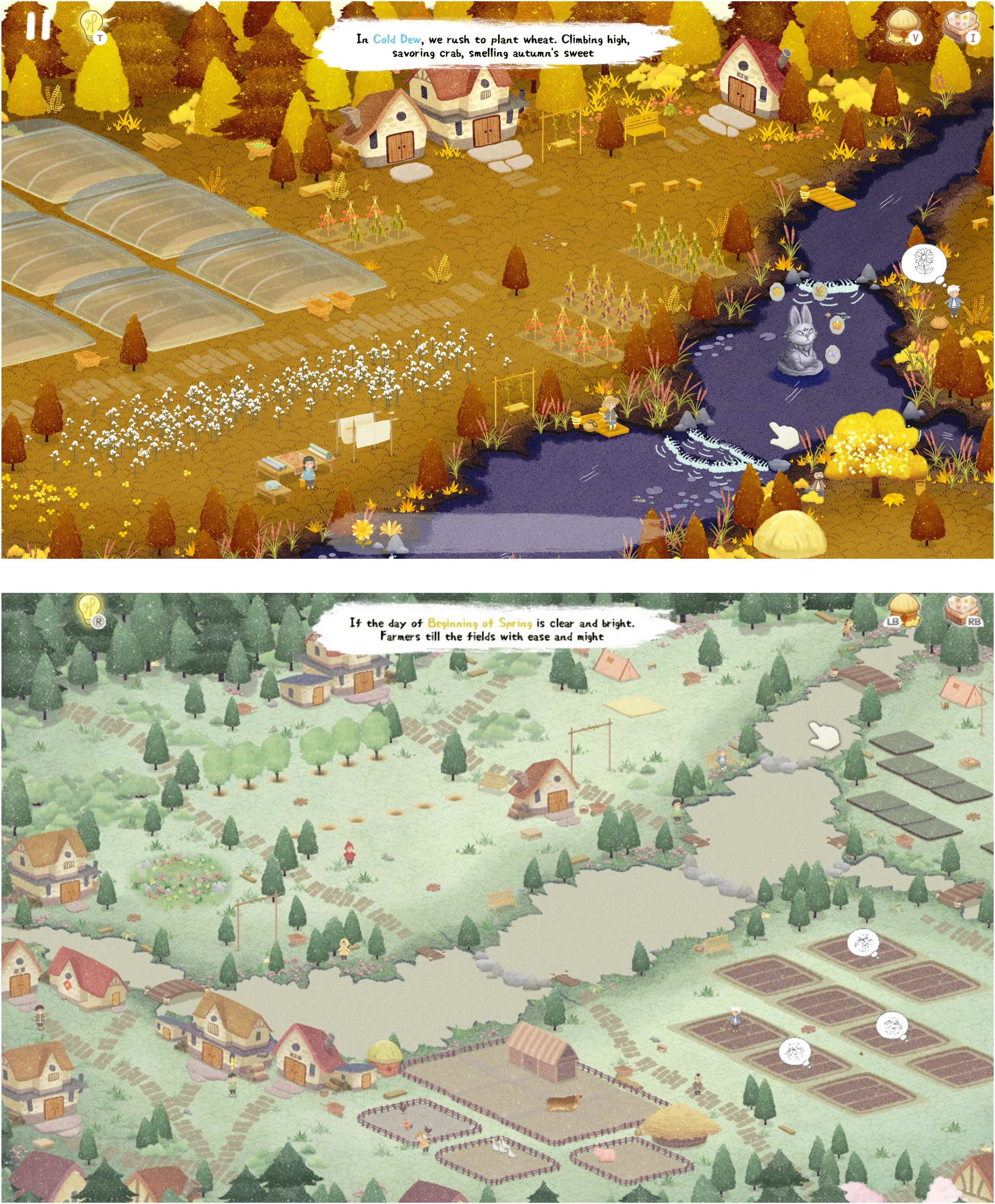
A screenshots from 24 solar terms made by the author.
With urbanization growing worldwide, and opportunities for people to engage with traditional agricultural practices decreasing, there is a real danger for this kind of knowledge to be lost, or worse, become outdated. Climate change puts pressure on traditional seasonal rounds by disrupting ecological rhythms. Unseasonal, early frosts or thaws can cause pollinators and flowers, predators and prey, to miss each other. 24 Solar Terms acknowledges such seasonal creep, if only casually, in one of its loading screen messages: “summer seems to become hotter year by year.” The ostensible nonchalance with which 24 Solar Terms gestures at climate change is, I think, typical for many pastoral games, whose characteristic coziness depends on cute aesthetics, low stakes, and low-stress gameplay. There are exceptions to the rule that dwell melancholically on the passage of time, on death, and dissolution (Op de Beke, 2021). It is in exceptions like these that I previously located some of the most critically interesting engagement with ecology in games. These days, however, the growing prevalence of tumultuous weather-worlds in games points in another direction. More and more, popular video games are evoking sophisticated, dynamic, and unpredictable environments, where what Chang called “climate normalcy” is out of the window, and dark seasonality is in.
Dark seasonality in video games
In their introduction to a special issue on the literature of the “New Weird,” sci-fi scholars Gerry Canavan and Andrew Hageman identify it as a source of climate fiction, specifically, a type of climate fiction that draws on tropes of gothic romance, sci-fi, and fantasy (2016). These novels of “global weirding” drive home the realization that we are living in “postnormal times: we can no longer depend on the climatological patterns that up till now have more or less reliably structured our behaviors” (Canavan and Hageman, 2016: 8). Instead, they explore new ways to dwell in crisis. For example, NK Jemisin's Broken Earth trilogy (2015–2017) is about a world that has been geologically destabilized as a result of environmental exploitation. Its people now experience an unpredictable, but recurring “fifth season” in which volcanic eruptions, tsunamis, droughts, pandemics, and all manner of natural disasters threaten the longevity of human civilization. In the world of The Fifth Season everybody has “runny sacks” prepared with emergency rations and tools, ready to snatch up at a moment's notice; it is expected for communities and even governments to reconfigure themselves during times of crisis so as to increase their odds of survival. In similar fashion, Karen Thompson Walker's The Age of Miracles (2012) explores what would happen if the globe suddenly slowed spinning on its axis, creating much longer days and nights. How would people cope, and how long until the rhythms of normal life are stretched to their limit? Novels of global weirding are deeply invested in imagining the mundane, everyday consequences of environmental change.
Stories of global weirding, which include series as popular as George RR Martin's Game of Thrones—set in a world of decade-long seasons, threatened by a lethal winter—might not immediately read as climate fictions since they might not engage with global warming explicitly. Nor do they always speak in the serious, unimaginative tones and registers we have come to expect from climate fictions. But they do register, even if only obliquely, metaphorically, or subtextually, what anxieties, concerns, and desires are melted together in the cultural crucible of the climate crisis. Many scholars of popular media have developed various techniques and frameworks for attending to such implied, or “unconscious” engagement (Bould, 2021; Leyda, 2023). To notice it in video games you don’t even have to squint; dark seasonality is trending.
The strategy game Endless Legend (Amplitude Studios, 2014) features alternating summer and winter cycles, where the winter lasts for an unpredictable number of turns, drastically limiting the moves you can make; in the postapocalyptic game Rain World (Videocult, 2017), lethal torrential showers punctuate play, driving you underground to find shelter; Death Stranding (Kojima Productions, 2019) also features a dangerous kind of rain shower called “timefall” that speeds up decay and degradation; in the city-building survival game Frostpunk (11 Bit Studios, 2018) players have to weather a dramatic blizzard without knowing exactly how long it will last, or if their stores will be sufficient; the post-apocalyptic beaver-town simulator Timberborn (Mechanistry, 2021) hinges on a recurring dry season that lasts longer each time it occurs; the game Season: A Letter to the Future (Scavengers Studio, 2023) tells the story of a girl on a quest to record the sights and sounds of the last season before a mysterious cataclysm will wash away everything; Against the Storm (Eremite Games, 2021) is a brooding city-building survival game featuring not one but three different rainy seasons; and Diluvian Winds (Alambik Studio, 2024) involves preparing for and rebuilding after a recurring flood.
More than just a theme, dark seasonality is generating innovation in game design. That is because, as literary scholar Adam Trexler writes, “climate change is not just a ‘theme’ in fiction. It remakes basic narrative operations. It undermines the passivity of place, elevating it to an actor that is itself shaped by world systems. It alters the interactions between characters and introduces entirely new things to fiction” (2015: 233). In games, the new reality of climate change is putting pressure on traditional gameplay conventions, pushing developers to reconsider established gameplay conventions, chiefly by questioning the availability of time and space in games. For instance, the city-builder is a video game genre that challenges players to puzzle around with configurations of buildings, roads, and methods of economic production. The genre generally encourages geographical expansion and economic growth, allowing cities to sprawl to the edges of the map. But recent games like Terra Nil (Free Lives, 2023) and Flooded (Artificial Disasters, 2023) present themselves as reverse city-builders. In Terra Nil players are tasked to rewild areas by constructing but also eventually removing infrastructures, until only a pristine wilderness is left; in Flooded the challenge is to build up an economy of increasingly more dense and more compact design as rising sea levels gradually eat away at the coastline of your little island.
The titles mentioned above, like Endless Legend, Frostpunk, Timberborn, and Against the Storm, all complicate the linearity of expansion. They introduce rhythms—often unpredictable ones—that dictate a more cautious approach that involves biding one's time and considering space efficiently. Strategically, they challenge players to be more flexible and more fixated on the long term. This is exactly the kind of gameplay that Shawna Kelly and Bonnie Nardi, both scholars of digital culture, called for in their 2014 article on the use of video games to simulate futures of scarcity. They too suggested “new game metrics and mechanics that are not predicated on simple linear growth” but which rather model “slow growth,” “stasis,” or “cyclical patterns” (Kelly and Nardi, 2014).
While they are important to note, such spatio-temporal subversions to established game-genres do not exhaust the ways in which dark seasonality manifests in video games. Seasonality is not just a matter of simulation. That is why it helps to look beyond the dimension of rules and systems, to the essential audio-visuality of video games. Seasonal change effects changes in vegetation, temperature, weather, and species activity. We generally register these changes visually, as well as through sound (e.g. bird song), smell (e.g. flowers, decaying leaves), and sensation. But because video games have yet to allow players to sense smell or temperature, seasonality is generally evoked in video games through audio-visual means. Unfortunately, because of that reason, it has long gone overlooked in game studies due to the field's disciplinary history. For years, video games’ audio-visual aspects were dismissed in scholarship in favor of the expressive potential of game-rules and systems. This means that unless they directly supported player interactions or influenced game-states, visual markers of seasonality embedded in landscapes never pulled much focus, and were often disregarded as mere background assets. Currently, video game landscapes are garnering more academic interest than they used to, thanks in part to impassioned arguments like Soraya Murray's, about their ideological assumptions (Murray, 2017), and Brendan Keogh's more general defense of video games’ meaningful audio-visuality (Keogh, 2018).
In contrast to game studies scholarship, video game journalism is often quite interested in visuality, as it is considered a selling point for games to have realistic, detailed, or unique graphical styles. Rob Dwiar's series of articles on the representations of spring, summer, fall, and winter in video games provides a case in point. With a painterly eye, Dwiar describes how popular games evoke different seasons using carefully planted vegetation, simulated weather events, and other landscape elements (Dwiar, 2017, 2018b, 2018c, 2018a). Moreover, he identifies the seasons’ “world-finishing, narrative-helping” functions (Dwiar, 2017), which help cement “landscape fidelity and authenticity,” as well as their symbolic effects. For example, it is no coincidence that post-apocalyptic games like Horizon Zero Dawn (Guerilla Games, 2017) and Everybody's Gone to the Rapture (The Chinese Room, 2015) make use of springtime markers, with their associations of rebirth and regeneration. And plenty of other games, like Metroid Exodus (4A Games, 2019) and The Last of the Us (Naughty Dog, 2013), use seasonal change to pace the plot, and to impart a sense of duration.
Paying attention to game audio can also attune players to the ways in which seasonality is incorporated in games. Musicologist Kate Galloway's (2020) experimental practice of soundwalking in Stardew Valley brings to the fore the way in which seasonal atmosphere can be evoked through sound using both recorded ambient soundscapes, as well as electronic composition. Galloway notes the sheer number of sounds used to give texture and life to Stardew Valley's pixelated world, and she remarks on the mimetic stylistics of the seasonal tracks, that imbue players with anticipation in the spring, energy in the summer, melancholy in the fall, and solitude in the winter.
In other games like Frostpunk, the soundtrack has been just as powerfully employed to evoke climate and weather. Frostpunk is a city-builder set in an alternative Victorian England that has frozen over by a catastrophic, never-ending winter. While ostensibly the game is about global cooling as a result of solar activity, as game scholar Cameron Kunzelman points out in his reading, the game is a pretty clear allegory of climate change, one that engages with a host of relevant themes—extreme weather and the social cost of climate adaptation among others (Kunzelman, 2020: 115). The game plays out over a tense 3–4 h during which players are challenged to prepare for a looming blizzard that will bring plummeting temperatures and put to the test stores of food, fuel, and medicine. The game's laudatory reception owes much to its incredible orchestral musical score, which is punctuated by the ambient cracking of ice and the bells and whistles of industry. The final track that plays as the storm hits your city, called “The City Must Survive,” is especially memorable. It features high-pitched, nervous strings that evoke flurries of snow and ice, as well as ominous lower notes, carving out an epic, melancholy melody. “This is boss music isn’t it,” writes a commenter on Youtube, referencing the use of epic scores during video game boss-fights.
Piotr Musiał, who composed the soundtrack for Frostpunk, drew on classical music like Vivaldi's Four Seasons for inspiration. It is a clearly recognizable intertext. Building on such familiarity can effectively drive home the consequences of climate change. A case in point: The Uncertain Four Seasons (Gameau, 2021) is an artistic project that remixed Vivaldi's Four Seasons according to climate projections for 2050, yielding a number of remarkably changed musical pieces that were performed all over the world from Amsterdam to the Marshall Islands and adapted to those places. According to regional projections regarding temperature and rainfall, parts of the score have been sped up or slowed down generating a sense of urgency and unpredictability, and sometimes notes are dropped to reflect rates of species extinction, resulting in prolonged, uncanny silences. The result is a number of haunting renditions of the familiar concerto's that illustrate in a deeply effective manner how climate change stands to impact the world we know.
Seasons can also figure allegorically in video games, standing in for larger changes in history. For example, Season: A Letter to the Future (Scavengers Studio, 2023) tells the story of a girl, Estelle, on a quest to record the sounds and sights of the last “season,” or epoch, before it draws to a mysterious close. In this way, the notion of a season is used rather like the term “Anthropocene,” to denote an era in human history. Season is a meditative, exploration game, not a simulationist challenge like the examples mentioned above. And yet using narrative and visual design the game gives the impression of world in transition: assemblages of ruins, old-timey technology, and more speculative details establish a world different from, but not unlike our own. For instance, the Tieng Valley, where you spend the bulk of the game cycling around, is days away from being flooded because the Grey Hands—the local authority—plan to demolish a dam that is proving too hard and too expensive to maintain. The obsolescence of ecomodernist projects like hydroelectric dams evokes a world, like ours, that has known decades of industrial development and which is now having to evolve into something else.
Concurrent with the flooding of the Tieng Valley, the Grey Hands will draw the season to a close by washing away everyone's memory in order to put an end to all the resentment, grief, and discontent that has built up over the years. Estelle's task is to record local stories in a scrapbook, to be stored in a vault, so that when enough time has passed, presumably, they can be read again with fresh eyes. The game is not incredibly interested in developing the dubious politics of such planned forgetfulness; it lands on a more shallow note, emphasizing the importance of taking your time, being present, and attentive to the beauty of the world, especially given its transience. Nevertheless, the game does raise the important subject of seasonality and its correlations with political renewal and historical change.
David Wengrow and David Graeber, archaeologist and anthropologist respectively, tackle this subject in an argument most elaborately set out in their book The Dawn of Everything (2021). In earlier work (Wengrow and Graeber, 2015), they already argued that “regular oscillations between egalitarian and hierarchical modes—were an emergent property of human societies in the highly seasonal environments of the last Ice Age” (1). Rejecting assumptions about the simple nature of hunter-gatherers, who are often characterized as either hierarchical or egalitarian, they point to anthropological studies detailing the politically flexible, self-conscious organization of many Amazonian indigenous societies, whose socio-political structure changed completely depending on the season. During the dry seasons, they formed roaming bands hunting and foraging, whereas during the rainy season they gathered in hilltop villages of several hundred people, practicing horticulture. What is more, each season made different demands of its political leaders. Wengrow and Graeber emphasize the political awareness such reconfigurations would have instilled in people belonging to those societies, and they remark on the lack of it in today's climate, in which we struggle to even think of other ways to live than we do now, as underestimated, disempowered citizens, subject to the profit-driven designs of powerful corporations. How did we lose that political self-consciousness, once so typical of our species? How did we come to treat eminence and subservience not as temporary expedients, or even the pomp and circumstance of some kind of grand seasonal theatre, but as inescapable elements of the human condition? If we started out just playing games, at what point did we forget that we were playing? (2021: 115)
In short, the choice posited in Season: A Letter to the Future, to remember or to forget the previous seasons of our lives, is a deeply political one. Only by remembering that things once were and could again be otherwise, which means engaging in the playful, subjunctive mode of “what-if,” do we open up the present to let alternative futures in. This is why periods of ritual intensity, such as those that mark the solstices, equinoxes, and other seasonal celebrations, are of such importance. The self-consciousness that inheres in what Wengrow and Graeber call “seasonal theater,” or the proclamation of a (temporary) change in routine, creates opportunities for us to reflect on that change of behavior and to allow it to provoke a more enduring, profound, and provocative transformation. Games, like rituals, construct a space outside of the ordinary, where different rules apply, even though they often lack the atmosphere of sacrality and the grounding in a shared community or culture that amplifies any impact ritual experimentation might have. That does not mean that when games stage rituals of change (even fictional ones), they are not able to inspire critical reflection, especially when the game is imbued with sincerity and gravitas as in the case of Season: A Letter to the Future. What this means for the role video games have to play in the climate crisis is a question I save for the conclusion.
Conclusion: A season of change
In the The Guardian's weekly video game newsletter, “Pushing Buttons,” Keith Stuart welcomed the arrival of the fall, “the best season of the gaming year” (Stuart, 2023). He wrote “This is the season of withdrawing, and that is what games are about too in a way.” If video games do indeed provide spaces for withdrawal, where climate normalcy still reigns, this article has sought to demonstrate that these spaces are being gradually infected by seasonal creep. One can only hope, therefore, that what Stuart describes as a withdrawal will lead to a kind of regrouping, a mustering in the face of the climate crisis; let the change of seasons kick off a season of change.
This hope is not entirely unfounded though the role video games have to play in confronting the climate crisis, and becoming more attuned to seasonal change, is far from straightforward. As one study has shown, stereotypes about gamers as disengaged loners are far from true, and “many players are ready and willing to take collective action to combat climate change” (Carman et al., 2024: 85). For this demographic, playing with dark seasonality in games may spark welcome engagement with the challenge of adapting to new seasonal norms. What is more, it may inspire feelings of climate resilience; a survey by Perraeult et al. (2017) indicates players of immersive videogames report more confidence knowing what to do in the case of a natural disaster because they have “rehearsed” it in virtual contexts. In a more general sense, studies on the impact of (literary) climate fiction corroborate that it has the potential to encourage audiences to take climate change more seriously by vividly imagining its consequences, even though it will not convince skeptics or people who already have a negative bias towards environmentalism (Schneider-Mayerson, 2018). Moreover, Matthew Schneider-Mayerson, who surveyed American readers of climate fiction, concludes that while exposure to climate fiction does raise awareness of the issue, “awareness is only as valuable as the cultural messages about efficacious action that are in circulation” (2018, 473). For this reason, he argues for the importance of media to delineate “novel and plausibly effective forms of cultural and political action” (495). In light of this, it is especially worth noting the way in which the game genre of the so-called “colony simulator”—which includes the above-mentioned Frostpunk as well as, for example, the climate-game Floodland (Vile Monarch, 2022)—are deemphasizing climate measures based on technological innovation in favor socio-cultural policies. By allowing players to experiment with laws that govern, for example, the distribution of resources, the rights of individuals, the availability of services and facilities, as well as crisis protocols, these games are showcasing forms of cultural and political action (executed at a community level) that may help inspire sustainable transition.
While it would be nice to end on this note of optimism, I would like to underline that the politics of dark seasonality (like the politics of climate fiction) are hard to generalize. For example, games about hostile climates can support stories of collectivism, as well as narratives of individualistic and competitive survival. What is safe to say is that video games featuring dark seasonality familiarize players with scenarios characterized by unpredictable or extreme seasonality. Moreover, as interactive media, video games allow for players to consider more actively what new seasonal circumstances could demand of people in terms of adaptation and survival. That is not to say these scenarios are always persuasive of a “green agenda,” or that the assumptions players take from them are always progressive. More focused analyses of individual case-studies would offer more specific conclusions. My intent here has been more general than that.
What this article has argued, is that seasonality performs important practical, structural, and symbolic functions in video games. As I have demonstrated, making these functions legible requires attending to multiple dimensions; a situated approach makes explicit the warming (micro)climates that gameplay is contextualized by, as well as the rhythms entraining players in seasonal play. What has emerged from my research is that this kind of seasonal play often functions—or rather functioned—as a refuge for climate normalcy and that as such it rarely acknowledges seasonal abnormality. However, this is subject to change. Using the term dark seasonality I have described the increased thematization of unseasonal and dangerous weather in popular media, reflecting anxieties and concerns about the climate crisis. I believe dark seasonality provides a space for players to become acquainted with tumultuous weather-worlds, whose disturbed seasonal rhythms echo the more protracted ones that are felt around the globe. Like global weirding in fiction, dark seasonality is interested in extreme weather and environmental change not as a singular incident, but as an enduring development that requires us to adapt on all fronts. This is clear from the way it pushes game developers to reconsider established scripts, innovating on tired old rules and conventions.
Footnotes
Declaration of conflicting interests
The author declared no potential conflicts of interest with respect to the research, authorship, and/or publication of this article.
Funding
The author received no financial support for the research, authorship, and/or publication of this article.
