




Abstract
This article focuses on analogue postcards as a communicative and artistic tool for potentially engaging nostalgically with the past, present, and future. It poses questions about the experience of time and place in a specific setting (the city of Montreal, Canada), as well as in a specific project that looks at cultural mediation in public spaces. During the summer of 2017, Comptoir public, an organization that works with artists and cultural mediators, launched the project “Postes du futur” (Mail from the Future). The organizers asked Montrealers to write a postcard to a recipient of the sender's choosing, so that it will be mailed in 2042 during the celebration of Montreal's 400th anniversary (i.e., 25 years later). One of our main findings is that most of these postcards will be sent to the current addresses of future recipients. Choosing one's home as one of the settings to write to and to write about finally made it possible to connect to the historical and medical meaning of nostalgia: the homesickness, the yearning for a place of one's own, for a space we now miss prospectively on in the future. Home, where people live their lives, is not yet “lost” or “left behind.” But anticipating its loss and transfer to others becomes one of the primordial factors shaping instantaneous nostalgia and its expression—a future in which postcard senders are no longer present or even alive. The issue of the finiteness and the irreversibility of time is usually an indicator of past-oriented nostalgia. In our case, it is projected toward the future. The printed, analogue postcard becomes the writing space that leaves room for anticipated and anticipatory nostalgia and for imagining future communication technologies.
Introduction
On the occasion of the festivities honoring the 375th anniversary of Montreal (Canada), Comptoir public, an organization that works with artists and cultural mediators, launched the project “Postes du futur” (Mail from the Future). During the summer of 2017, in a truck decked out as a post office, the Comptoir public team traveled through all nineteen of Montreal's boroughs. There they collected messages written by residents on printed postcards, to be mailed 25 years later to addressees of the residents’ choosing—in time for the 400th anniversary of Montreal's founding (Figure 1).
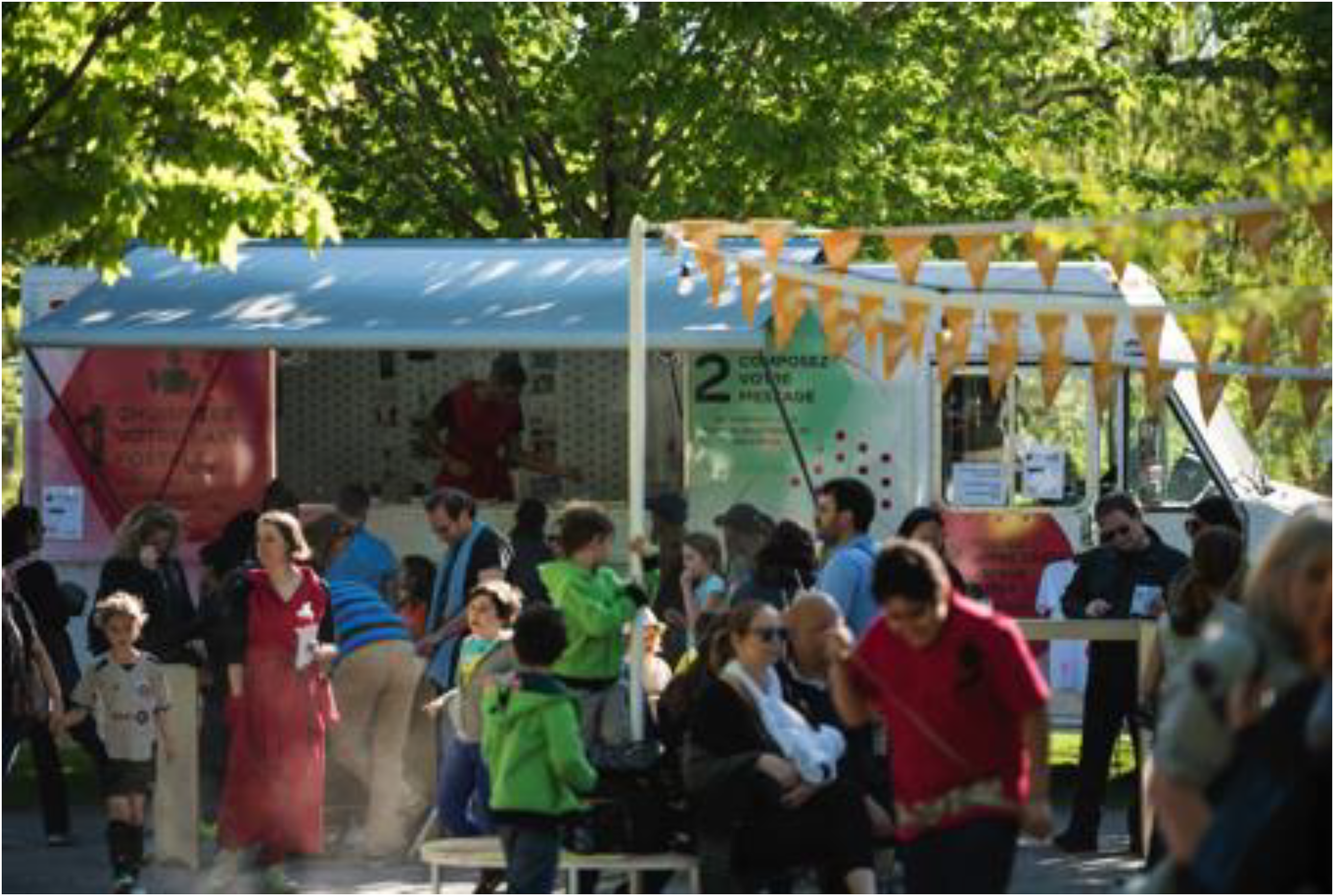
Photography credit: Ulysse, Brut.
This comprehensive story-collecting and mediation project, which took place in urban public parks (as had been the case for materials projects), opened up a number of avenues. As a research duo specializing in media studies and sociology for the occasion, we compare in this article thematic analyses, conducted both on selected archived postcards and on the project website, with the results of a focus group we led with two of the project creators, two artists, and a cultural mediator.
This article, however, focuses on the communicative and artistic experience of nostalgia and its articulation with the future. It poses questions about time and place in a specific setting (the city of Montreal), as well as in a specific project that looks at cultural mediation in public spaces. Indeed, what makes Mail from the Future fascinating is, of course, the artistic perspective out of which the project emerged. But it also offers opportunities to delve into nostalgia among people who live in or pass through Montreal via an analogue, printed communication tool: the postcard. Our aim is therefore to examine various aspects of imagination and potential nostalgia for the future contained in and expressed by this body of work.
Framing instanteneous nostalgia
Before going deeper into the analysis of the postcards, it is important to present the conceptual framework of our study, and to explain what we mean by instantaneous nostalgia. As a bitter-sweet feeling, expressing homesickness or the experience of loss, nostalgia has been theorized in many scholarly disciplines over the years, and it has for too long been understood as a regressive, old-fashioned, and Westernized phenomenon as the geographer Alastair Bonnett (2015) underpins. With her concept of reflective nostalgia being a way to use the yearning for the lost past constructively, Svetlana Boym (2001) has prepared the path for understanding nostalgia as a complex emotion but also and foremost as a (creative) social and cultural practice; be it in anthropology (Angé and Berliner, 2015), media and cultural studies (Niemeyer, 2014; Schrey, 2014), literature (Ladino, 2012; Ahad-Legardy, 2021), psychology (Arndt et al., 2006; Routledge et al., 2013) or sociology (Keightley and Pickering, 2006; May, 2016) and history (Becker, 2018; Dodman, 2018). These renewed approaches cross all disciplines and they do not ignore the negative potentials of nostalgia as commercial (West, 2000; Niemeyer and Keightley, 2020) or political tools of manipulation (Duyvendak, 2011; Menke and Wulf, 2021), but what all these theoretical and empirical studies of the last 20 years have in common is a more open and critical understanding of nostalgia on an individual and collective level; not only in the Western world. Nostalgia is experienced in multiple cultures and languages (Bonnett, 2015; Ahad-Legardy, 2021) and nostalgia is not only a bitter-sweet desire to go back or to restore the past; it is also an experience of the present and an anticipation of the future; an experience that is often shared via media content or communicative tools (Boym, 2001; Niemeyer, 2014; Ahad-Legardy, 2021). Additionally, media and communication tools can also function as a coping tool for nostalgia; a coping tool that leads far back in the history of nostalgia. The coining of the neologism “nostalgia”—meaning homesickness—first appeared in a medical thesis written by Johannes Hofer in 1688 in Switzerland. The Greek etymology of the concept comes from nostos (to return home) and algia (longing/yearning or pain). The homesick, especially homesick soldiers were cured when they went physically home or with the promise of return, or when they heard the same accent spoken by another soldier, or when they listened to music that evoked images and memories of their homeland (Bolzinger, 2007). Thus, historically, the power of narratives, images and sounds acting as remedy made it possible to alleviate the symptoms of nostalgia; and this is still valid today. Ranging from various media content to material and immaterial memory culture, they can provoke nostalgia but also function as coping tools (Niemeyer, 2014; Menke, 2017).
It is therefore interesting to bring together postcards and nostalgia, but not without introducing one important epistemological concern. Postcards can become a media to express or trigger nostalgia, but nostalgia is not always present where one might think it is. For example, an old black and white postcard from the 1960s might stand for a nostalgic mood (Grainge, 2002), but it does not necessarily induce nostalgic feelings in those who gaze at it. Comparatively, a song released in the last year can trigger nostalgic feelings in a person who connects to a bygone moment while listening to it (Pickering and Keightley, 2015). Moreover, a media devices or contents can be a source of nostalgic feelings for a period which the yearning person had never experienced. All these aspects show that nostalgia cannot be an a priori in terms of analysis and it is also important for our study to underpin that nostalgia has its place in the future. Nostalgia can be connected to an imagination of the future (Niemeyer and Siebert, 2023) in different ways. It can be positively anticipated nostalgia as a potential future experience in the form of mental or mediated travel (Cheung, 2023) and it can also be anticipatory (Batcho and Simran, 2016), a form of nostalgia that contains fear and concern for the future.
This framework in mind, the concept of instantaneous in relation to nostalgia coins the idea of spontaneous written feelings and imaginations that are sent to the future on a fix and analogue media: the printed postcard. Be it anticipatory or anticipated, our analysis shows that most of the postcards had a nostalgic tone and mood; similar to what Bartholeyns calls an instant past (2014).
Accordingly, three kinds of questions have guided our inquiry.
After scanning postcard contents, website text, and speeches delivered by the project creators, do the nostalgic expressions identified at the outset really focus on the future, as implied by Mail from the Future? Or are these expressions instead responding to present-day crises (Boym, 2001)? Might they, in fact, be even more anchored in the past? Do they follow a probabilistic logic (inscribed in the register of the expected) or a prospectivist logic (calling on imagination and fiction to shape feasible, if still uncertain, futures)? As de Certeau has pointed out, “A sharper awareness of the qualitative breaks between present and future gives increasing importance to the imagination, while stripping language of the power to describe the future in order to allocate to it the poetic function of stating options that now are rationally possible” (1993, 197). Between foresight and futurology, linking to a future imagined midway beyond the present may well prove an option worth considering.
What is the role of the postcard as medium for temporal projection? Does it act as an entertaining relic from the past, a material manifestation that eschews the digital, or a means of damping communications that, by reactive metastasis, inundates us with devicesMoreover, do links exist among postcards as “medium,” their artistic nature (the postcards are professionally illustrated), and the messages that the residents of Montreal's boroughs wrote? In that case, do nostalgic mood and nostalgic mode (Grainge, 2002) 1 both emanate from the postcards? What indicators might suggest so?
Finally, is it feasible for a “common narrative,” one that registers social and political climates, to weave the postcards into a sturdy fabric? Or is it rather a question of adopting a more singular, personal tone in 2042? What do these dimensions tell us about the aspirations, projections, desires, and fears of the Montreal borough residents who took part? What future and what society are portrayed in the self-directed writings and the narratives that issue from them (Butler, 2007; Cauquelin, 2003; Uhl, 2015)?
These three orders of inquiry—having to do with (future) temporality, the medium (the postcard), and narrative (about self and others)—have guided our research and the analysis.
From open-forum mediation to inquiries about a sidelined archive
The Mail from the Future project is a cultural mediation activity made possible by the interdisciplinary collective Comptoir public. It comprises four young entrepreneurs/artists from the arts and entertainment world: Antoine Beaudoin Gentes, Gabriel Léger Savard, Cloé St-Cyr, and Guillaume Duval. The activity took place in 2017 during the Grand Tour organized by the City of Montreal. Organizers of the Mail from the Future project asked Montrealers to write and mail a postcard to a recipient of the sender's choosing, so that it will arrive in 2042 during the celebration of Montreal's 400th anniversary (i.e., 25 years later). Aboard a futuristic-looking mail truck, the collective visited parks and met residents in Montreal's boroughs. Members wore fashion creations by famed designer Rad Hourani. The truck housed a collection of 38 postcards (Figure 2), each illustrated by contemporary Quebec artists (both emerging and established). In each park residents were offered two or three postcards at no charge, which often led to follow-up exchanges such as “What piece of history will you be sending to the future?”
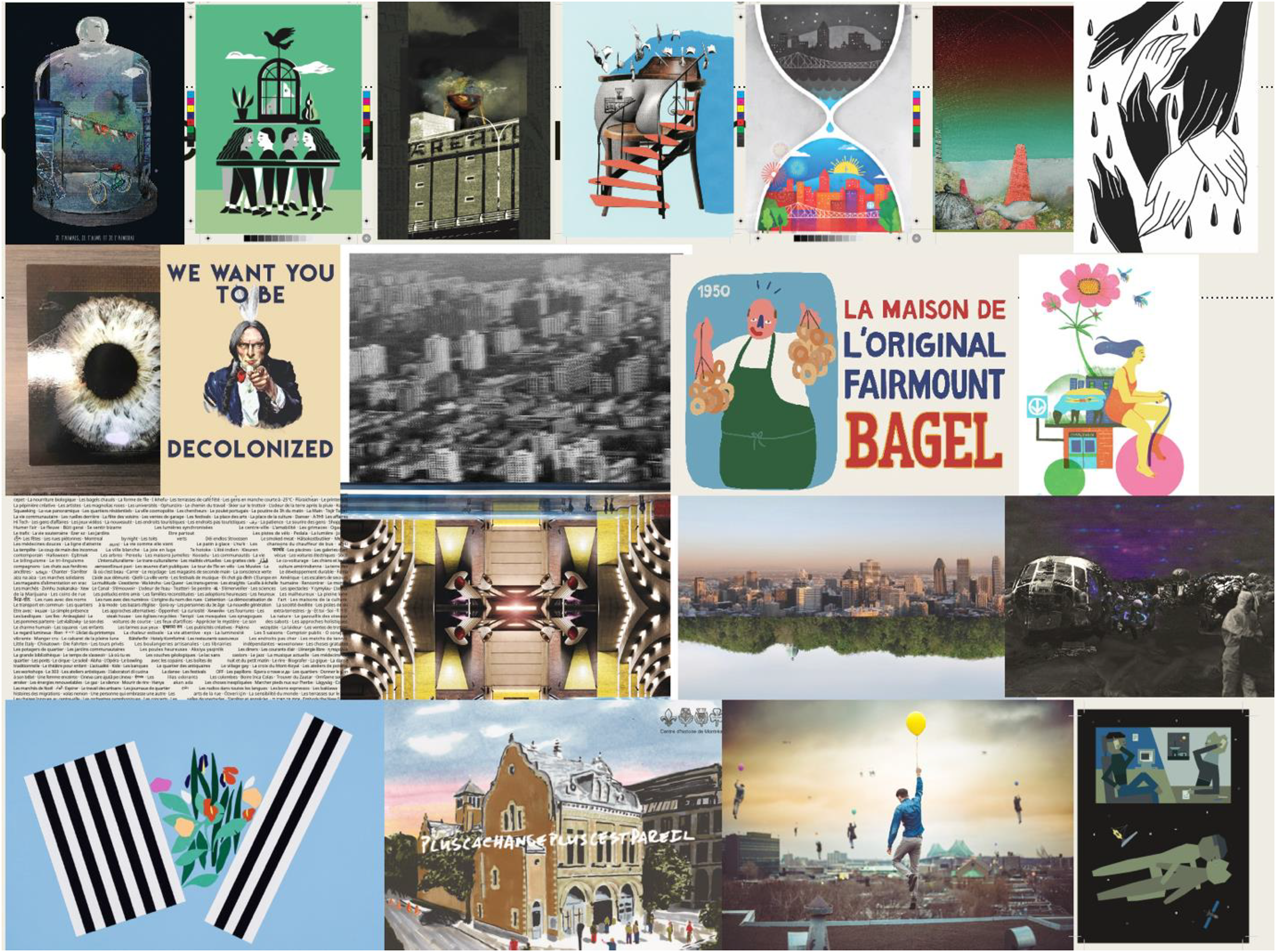
Some of the created postcards of the project.
A short manifesto offered guidance to mail carriers in the field. It concluded with: “Because a better tomorrow can only come about from consequences unforeseeable today, we have brought together thousands of people from all over the Island of Montreal so that they might imagine the future of a city that lives up to Montrealers’ expectations.” Postal directories of Montreal, pens, colored pencils, tables, benches, and ottomans were put at the disposal of residents, affording them time to relax and recollect. Nearly 10,000 postcards had been gathered during the four months spent visiting the 19 parks that the collective toured from May 13 to September 17, 2017.
Circumscribed by its postcard medium—in a vernacular esthetic that allows a form of daily life, now past, to persist—the proposed Mail from the Future event actually transposes evidence of a past and a present bygone into a planned future: 2042. Postcards written in the present and destined for a distant future thus become, and are understood to be, signs of a future projected from the past. Yet is this mechanism for projecting into the future—devised during public writing sessions in Montreal parks—a resurgence of the past, a component of the present, or an imaginary projection into the future? In other words, do the postcard (as device) and the mediation protocol aid us in imagining what might be possible when relying on the imaginary and the fictional to characterize the future (De Certeau, 1993; Heurgon, 2008)? Or do they, with their utopian and “retrotopian” features (Bauman, 2017), depend more on a nostalgia for the future?
After conducting pre-analyses of the postcards, the multiple aspects of nostalgia emerged quickly. They refer to the postcard as a place for expressing intimacy and everyday life (De Lemos Martins, 2011) in a present perceived as a past in the making and a future represented as an amplified and scripted version of the present (Bérard and Uhl, 2012; Davis, 2010). If these postcards are about the future, they also have more to do with a vision and a technological-communicative, even “futuristic,” approach linked to fantasies and fears about the present, which ultimately find expression, as we shall see.
We have thus restructured our initial questions as a nostalgia-oriented, three-part hypothesis that subsumes: (1) initiators of the project (the collective), who are undergoing a “rite of passage” that will take them into the 30- to-40-year-old age group; (2) project participants, who express, through the postcards, an instanteneous nostalgia for the future; (3) nostalgia focusing on the postcard as medium itself.
In light of this three-facetted nostalgia hypothesis, we have adopted a combined methodology.
Methodology
Our perspective draws on several techniques and approaches.
On different occasions, starting in the summer of 2017, we met with Guillaume Duval, one of the Mail from the Future managers. Those meetings led us to initiate a research collaboration.
We examined the project’s Facebook 2 and Twitter 3 sites, 4 focusing primarily on their visual presentation, their proposed content, and, in the case of online social networks, numbers of followers. We also analyzed the main tools used for paper communication: press kits (e.g., devoting fifteen of nineteen pages to the artists, thus emphasizing the scope of the project) and supporting documentation aimed particularly at schools (the collective visited several primary- and secondary-school classrooms to prime intergenerational communication).
Guillaume Duval developed with us an initial analytical thematic framework based on a digitized sample of approximately a hundred postcards. They were selected by the project managers, to which a second randomly selected group of similar size was added, at our request.
To these first two samples we added a final selection of about 150 postcards. We selected the postcards while spending a day in the archives of the Montreal Archaeology and History Complex, where the postcards will be curated until they are mailed in 2042.
Next we devised two types of mapping criteria. The first was based on themes that emerged naturally; the second was arranged by main addressee.
The final phase involved preparing, moderating, transcribing, and analyzing the results of a focus group held on March 21, 2018. Those taking part included two of the project promoters, Guillaume Duval (31 years old, theater studies) and Antoine Beaudoin Gentes (29, theater studies); a post-mediator, Audrey Leblanc (31, theater studies); Hugo Bergeron (emerging artist, 36, Victoriaville); and Dominique Blain (established artist, 60, Montreal).
The methodology has thus focused as much on the project and its promoters, and their motivations, perceptions, and projections, as on the postcards themselves and their role as tangible, esthetic, and textual media. The focus group allowed both plunging deeper into the ambience, preparation, and realization of the project and more thoroughly understanding the threefold nostalgia hypothesis we are proposing.
What the postcards tell us?
The majority of the postcards have an upbeat tone and are intended for inner family circles. Rarely do they portray disastrous futures or desires for a world that is more diverse, united, ecologically conscious, peaceful, etc. We could cite a few rare examples, although they do not predominate: “Who knows what the world will look like 25 years from now. I hope it will be a better one” 5 (7158), 6 and “I hope homophobia, racism, and sexism will be only technical terms and will have lost their usefulness. I also hope that French is still our language. . . . From a teenager who dares to hope” (1744).
Yet one wish the project promoters shared was to learn more about the role that imagination would play in the future. They did not want to replicate the 375th Anniversary commemorations that had permeated most projects, as focus group participant Guillaume Duval explained: “Look toward Montreal's future rather than [favoring] heritage celebrations per se.”
Devising a preliminary typology for the postcards—comprising both recipients and thematic contents—makes portraying the work as a whole possible 7 .
Everyday intimacy: Relationships, family, friends
Most of the postcards reflect private, everyday, family-centered aspects of life and become an intimate mise en scene (Uhl, 2015) or an ironic encounter with oneself and the future recipients. Many women write as mothers would to their children: “My dear boys, I am writing you from a not-so-distant past. . . .” (1737). Or as people addressing children not yet born (CM −1) or, if they have children, emphasizing parental pride: “Mail from the Future is my son Guillaume [sic] and his accomplices. I’m proud of you!” (2301) They visualize their children's futures and wish them happy lives.
Postcards sent to lovers also occupy a prominent place in the collection: “Dear Sarah, Meeting you has changed my life. . . . 25 years later I cannot wait to see the woman who reads these lines. I love you, Sabrina” (6151); “I hope these words will always make your heart beat faster” (2557); “We’re going through a rough patch right now, do you remember? A lot of bickering and tension. . . . I’m confident that we’ll have gotten past this period by 2042. . . . P.S. If we finally split up, go to hell! lol” (6813). Many romantic postcards profess love for an idol. Justin Bieber, for example, received a long missive beginning with “I’ve loved you so much” (6082). Nor are friendship postcards left out: “Never forget that you are wonderful. Pay no attention to criticism” (1600).
Along these same lines, children wrote postcards to their parents or grandparents or to their brothers and sisters. “If you are not Judith, then keep this message for yourself. But above all look for my daughter. . . . I want to say one more time I LOVE YOU” (6908). People rarely write postcards about the future of society; in contrast to what might have been intended by the project itself. Rather, they express feelings that bring them closer to loved ones and describe their surroundings, the summer, the mood, the weather, or simply how their day went: “Today we are at the park in front of my house in Anjou. . . .” (5232) or “Here I am under the summer sun. . . .” (3657). Postcards thus fill quite classic snapshot functions for their senders: like saying hello from a holiday destination, sharing impressions, recounting moments lived. Postcard senders also pose direct questions to their intended recipients: “We’re going through a rough patch right now, do you remember?” (6813) or “Will we always be together? Will we still be in love?” (4011) At the heart of many missives recipients read “What has become of you?,” “What are you doing right now?,” “I’m thinking of you.”
Less common, but no less significant, are the postcards one writes to oneself, which can convey self-absorption. The “Hello you,” “Hi you,” “Dear you,” suggest that people can see themselves in future circumstances, but think mainly of themselves: “Dear Valentina, This postcard, if you don’t remember it, was written by you a few years ago. . . . By now I’d like to be a veterinarian” (1744); “I wish myself a good life” (1840). Self-affirming postcards (sometimes ironic ones) follow a similar pattern: “I adore myself. I consider myself funny and also very beautiful” (6905) or “I am beautiful, athletic, and generous” (1600). Often viewed as typical of childhood, comments on such postcards also act to reinforce identity by emphasizing sexual orientation or gender. For example, a teenager declares “I’m a lesbian” (6573) to friends and relatives.
Finally, one cannot forget the place pets occupy in day-to-day life: “I lived in this house with Yoda (super Chihuahua) and Pablo Escobar (evil cat)” (1503); “Monsieur is fat. He meows less at mealtime, but he's fat just the same” (6460). Yet here again, if four-legged companions are well represented in the postcard collection, they are firmly rooted in the present rather than considering what their lives might be like in 2042.
The home: where living takes place
Since many people did not know where to send their postcards, mail carriers suggested that people write instead to future or hypothetical occupants of the homes they now occupy. This is of course a bias as it implies a preframing; and one of our findings is that most of these postcards will really be sent to the current addresses of future recipients “Dear [Street Name] occupants/Dear [generic designator]” is the most common salutation in the sample. Caroline, for example, writes: “Dear Stranger. Today I find myself writing to you without knowing anything about you” (6474).
Many postcards describe an emotional attachment to a particular place and could create enduring bonds, often described as happy, with specific addresses. For example, postcard writers may list home renovations they have made. “Some things leave Bruno wondering: Now we’re busy renovating the upstairs bathroom. By 2042 how many rooms will we have renovated?” (2514). Postcard messages may also recount brief anecdotes and humorous incidents. Sometimes they described the almost spiritual energies of a place, which in turn elicited tender thoughts about the residents who would succeed them: “Greetings from the mists of time. I hope you’ll be as happy in this house as we were when we lived here” (4510).
The postcards offered examples of amusing incidents, as well as scary ones, that stand out from the rest. “Ghost” postcards and haunted premises figured among them: “The basement is haunted” (1861), along with “Dear future residents of the house, If you still living [sic] in this household, GET OUT IMMEDIATELY!” (2533, Figure 3), which elaborated on a dark tale of murder in the basement. This is not only a imagined domestic scene of femincide (currently increasing in Montreal after the pandemic), but also a sarcastic anticipation of creating a haunted feeling via the image of a ghost. As Avery Gordon states, “haunting is not the same as being exploited, traumatized, or oppressed, although it usually involves these experiences or is produced by them. Haunting is quintessentially an animated state in which a repressed or unresolved social violence is making itself known, sometimes very directly, sometimes more obliquely (…). Ghosts appear when the trouble they represent and symptomize is no longer being contained or repressed or blocked from view. Ghosts arise or haunting occurs when repression or blockage is not working” (Gordon, 2016:43). In other words, these type of fictional or non-fictional postcards (be they of funny, sad or violent order) transport a potential trauma or at least new event into the home narrative of the future occupants.
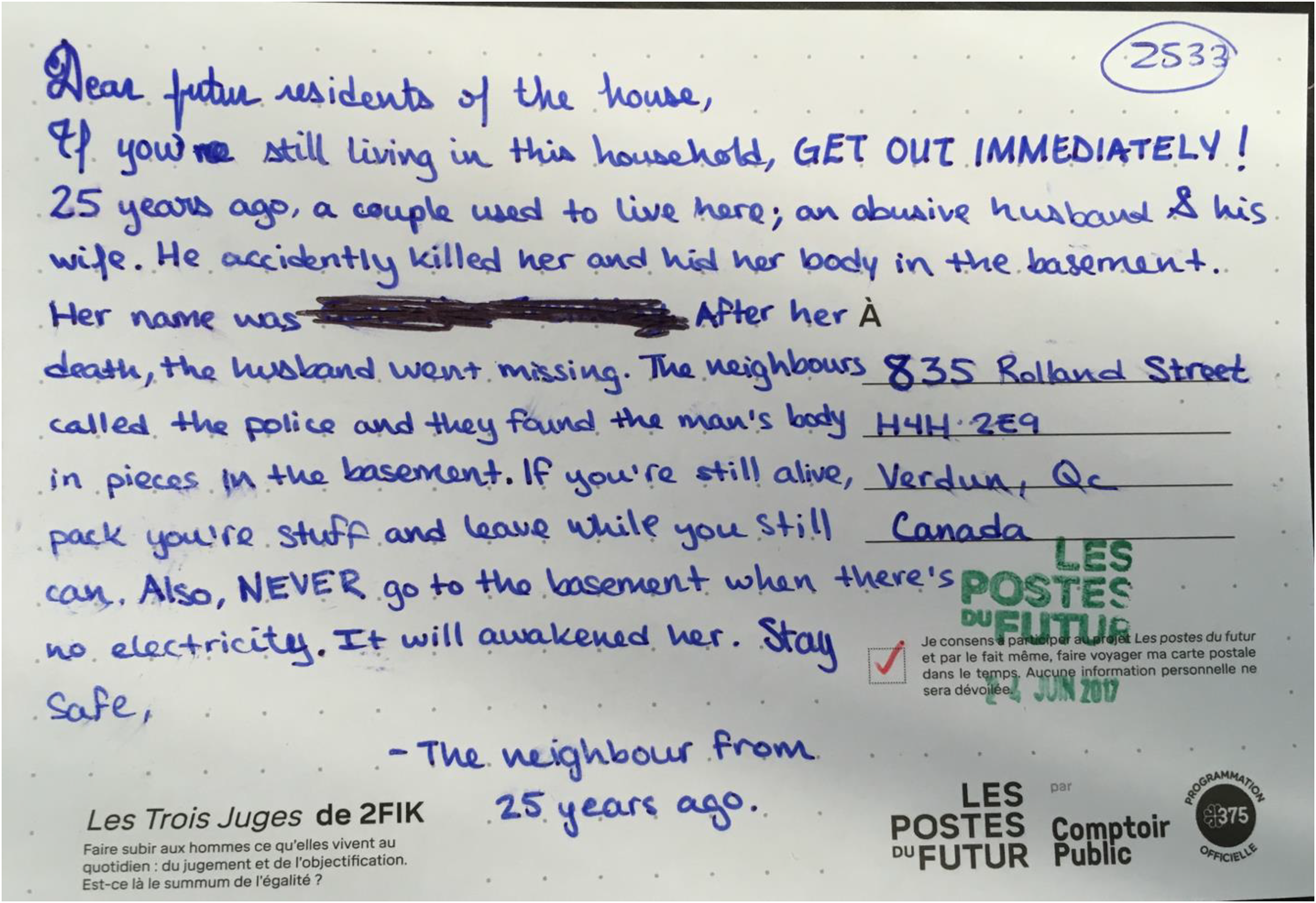
Postcard 2533 (the green stamp tells that publication is authorized by the author).
Where senders imagine the future residents, the latter are confronted to the material (imagined) memory and traces of the former occupants and cannot escape the narrative bond.
Choosing or offering a home as one of the main settings to write about finally made it possible to recreate and explain the historical and medical meaning of nostalgia (cf. Bolzinger, 2007): the homesickness, the yearning for a place of one's own, for a space we now miss. Home, where people live their lives, is not yet “lost” or “left behind.” But anticipating its loss and transfer to others becomes one of the primordial factors shaping instantaneous nostalgia and its expression—a future in which postcard senders are no longer present or alive.
Institutions, social and political spaces
Postcards have been sent to many places: the City of Montreal; public institutions (e.g., hospitals); hospices; museums (e.g., contemporary and fine arts); universities (including UQAM). Some postcards were also sent to recognized associations, such as the Friends of the Mountain. For example, to the City of Montreal: “Dear Future Montreal, I think you should make more bike lanes” (5185); “I am writing to you in 2017. You are an extraordinary city” (2833). And to UQAM: “We would like the Native Studies curriculum to continue” (3211); to the Olympic House: “I hope that when Aliens invade Earth people will still appreciate gymnastics” (3135); and to the SPVM (the Montreal police force): “I think you do bad work, SPVM—you turn your flashers on just so you can run a red light” (644).
Other postcards were addressed directly to politicians: “Madam Mayor (sorry if you are a man, I’m assuming that in 2042, women will outnumber men!)” (6213); and to the Minister of Education: “Why isn’t Halloween a holiday?” (4508). Some postcards made audacious demands or reported on major controversies like “Save Montreal from the squirrels!” (644), as well as “Let's save the squirrels!” (444-1).
Other missives closely resemble “thank-you postcards.” Many immigrants appreciate the way Immigration, Refugees and Citizenship Canada welcomed them: “Thanks to your help . . . we have good jobs, we can swim in the Olympic Park, we eat poutine (often too much of it), and we speak only French” (2799). Or the way the City embraced them: “Dear Montreal, as an immigrant, I have spent the best years of my life here, and I will raise my children in ways that develop the country” (5174). Sometimes homeless people have gratefully acknowledged the welcome Bonneau (6226) and Exeko (6861) gave them. Most of the time, people see the City of Montreal as a female entity that embodies the greeting “Hello there, place where . . . .” In most cases, the postcards assume a more solemn tone, often taking the form of a tribute. What makes them interesting is how much they resemble “reader mail”: they establish connections with institutions that, as a general rule, do not seek informal exchanges of this nature. The postcard thus becomes a novel channel of communication for expressing thanks, offering suggestions, even registering complaints. They are like prospective Tweets (now X) but without being shared online.
From the state of today's world toward an uncertain future
Finally, there is one last salient category: postcards that portray the state of the world today, both as it is and as the writers remember it. Like the vacation report found in the first category, this portrait responds to societal concerns, from debates on the Anthropocene to trending social-media networks. For example: “Here are some quick pointers about the current state of affairs,” which was followed by mentions of Canada's trade agreements, the controversial President of the United States, ambient xenophobia, terrorism, and ISIS, concluding with artificial intelligence (6160). And this comment: “At this time, smart cellphones are popular and people are using the iPhone made by Apple” (2207). Although some writers wondered about the future (“Where is the world heading? In 2042 how much control will technology have over our lives?”) (CM-2), it was quite unusual to hypothesize, for example, a post-internet or post-gender world. Yet judging by the way the artists designed their postcards, a considerable number of them ventured onto that very terrain. This indicates that a gap exists between the postcard creation process and the way addressees reacted to the postcards—one of the issues that emerged from our analysis. In other words, the esthetic characteristics of the postcards and their narrative content showed little congruence.
Nevertheless, in this postcard category, which deals with an imagined future, some examples stand out. In contrast to postcards written in future past tense, these are written in the future present. People imagined their city as it might be by 2042. Their tone is often lighter than perspectives taking stock of the present, to the point that they at times assume a humorous air: “In retrospect, the future turns out to be highly overrated. One thing, though, must be acknowledged: the invention of cyber-trans-phyto-calin!” (2926). They were most often written in present tense or, more daringly, made ample use of the present participle: “Not knowing how to swim before and, with my spirit now decolonized, learning to fly . . ., guiding us all the way to the 6400th” (3667). Whatever the tone and style, these postcards militate for a different society.
The message the postcards carry is, on occasion, unrelated to the present, as in this case: “Dear Captain of the Captainship of Montreal, Thank you! Thank you for transforming Montreal into a water city, a city that turns towards the river and its happy whirlpools” (6134). Sometimes, by contrast, imagining things differently meant recurring to the present. One postcard, for example, was addressed to the House of Sustainable Development: “Your are to be congratulated for your leadership and avant-garde spirit. . . . Montreal has been declared the greenest city worldwide. What a feat!” (1456). Or, according to Radio Canada: “This is 2042, time has passed . . ., but the urge to tell a story, or many stories, about the people of Montreal—this urge remains unabated” (2958). Finally, some messages, straight out of the future, fervently hope 2042 will feature a different present, as expressed on one postcard addressed to the Mayor of Montreal: “Enough! Montreal has now been hit by a second hurricane! It's time to tackle climate change!” (6213).
The categories mentioned above vivify a nostalgic future by conjuring the past, the familiar, and the everyday to express future-directed desires and fears; such as eco-anxiety or even solastalgia, meaning the distress caused by the transformation and degradation of one's home environment (Albrecht, 2005; Uhl and Niemeyer, 2023). This new class of postcards assumes a futuristic dimension, since moving from the present to the future is clearly the focus, as is the appeal to imagination and fiction to structure a society yet to come. Before an uncertain and sometimes disturbing present, the postcards tell us more about what could happen than would a golden age or a lost paradise. They are, moreover, political because future scenarios are expressly formulated to exert an influence on the present. 8 These future-driven postcards often examine issues related to communication technologies and media that have not yet assumed final form.
Our triple hypothesis covered the nostalgia experienced by project promoters and participants, as well as postcard-transmitted nostalgia. The typology we proposed thus partially validated our approach, although the results show greater contrast.
The printed postcard as nostalgic aid from the future
Three types of inquiry have guided our study: the temporal aspect of nostalgia, the postcard as signifying medium, and discourses whose narratives contrast with the present. These enabled us to identify elements for analysis bearing on the Mail from the Future project.
Instantaneous anticipated and anticipatory nostalgia
The postcards that participants sent to future occupants are oriented more towards the past or locate the present in a past future, as these two missives suggest: “Twenty-five years ago, I am at the 375th anniversary [of the founding of Montreal]. . . . I’m thinking of you, my two lifelong loves” (1722). And: “I’m writing this from the past to arrive in the future. A moment captured in time. I wonder what my 40-year-old self will think about my silly, weird 15-year-old self” (2722).
A “nostalgic mood” (Grainge, 2002) emerges from many of the postcards. It is not always explicit, but the vocabulary trails it leaves lean toward a nostalgia centered on attachment to place, people, and days bygone, which grammatical tense also reveals. In the present tense postcard writers use, one sees imaginings of a future that puts the moment in a past that will come later: “I write to you from a past . . .” (1737); “I am writing this from the past . . .” (2722); “I write to you from the past . . .” (1812); “It has already been 25 years since this letter was written . . .” (1883). At issue is an anticipated past, are anticipated feelings of nostalgia—both expressed instantaneously—and not a nostalgia for the future as place and time unknown that we might wish to know, but rather as a nostalgic a priori that extends into the future where the present is no more.
Here the question of irreversibility arises, as well as how it confronts its own finiteness, in addition to the notion of leaving a trace or a memory. Creating “testament postcards” as a tangible legacy could make sense here. Moreover, the postcard written by Guillaume Duval, one of the initiators of the project, reflects these characteristics: “My name is Guillaume Duval, Claude's son. In 2017, I created a postcard-based project that takes place in the future . . . . This house will always remain a cherished memory . . . . I hope this house brings you as much enjoyment and as many precious memories as it did me. P.S. There is a tree in the woods where I engraved my initials and my first girlfriend's” (7014).
Nostalgia, then, worms its way into postcard writing. It is also tied to prospects for 2042 and how participants see the future unfolding a quarter-century from now. Mail from the Future establishes a space–time suspension spanning 25 years. For some, this hiatus is brief enough that many will probably experience 2042 themselves, as will likely be the case for the project promoters. Others understand that they will not be around to celebrate Montreal's 400th anniversary. Focus group dynamics led us to conclude that, over the collective's lifetime, the 25 years fusing with the postcard project were forging an event that people wanted to experience, colored as it is by quite explicit nostalgia about what was to come. It was also due to this project that organizers and promoters mustered so much commitment and energy. Conversely, Dominique Blain, one of the artists, told us that his octogenarian father, fully aware that he would not live much longer, also completed a postcard. Among the postcards analyzed were those of others equally cognizant of their imminent departures: “This postcard was written in 2017. . . . I write to you from afar, I am no longer of this world, but I am there in your heart. Grandma” (6969).
The issue of the finiteness and the irreversibility of time is usually an indicator of past-oriented nostalgia. In our case, it is a past projected toward the future, sometimes involving the person who wrote the postcard but who has since passed on. Conversely, nostalgia for the future, which has its origins in both past and present, is itself the object of the postcard. In other words, the postcard—an analogue and less used medium than digital communication tools—becomes the writing space that leaves framed room for nostalgia and for imagining communication technologies of the (past) future.
The postcard: A question addressed to the future?
Apart from some notable exceptions in written messages (“Enjoy the nice graphic art on the front of this postcard” [562]) or in certain more subtle correspondences between text and images, the link established between postcards that the artists illustrated and messages that residents penned is rare. “The visual inventiveness” (Chéroux and Eskildsen, 2008) of the medium has guided the writing much less than has the medium itself. If the esthetic quality of the postcards has indeed had an impact on the project and its success, it has drawn just as much on the conceptual versatility undergirding the Mail from the Future collective. Their indisputable appreciation for scenic composition and artistic sophistication ranged from costume selection to postal truck design, further enhanced by a vigorous recruitment of accomplished artists.
As artist Hugo Bergeron pointed out during the focus group, the postcard is both a “genre” and a “code” (systematically compiled laws, rules, or regulations). As such, it can be an object of nostalgia as well as a medium for imagining future or present communication technologies. It is therefore the object around which nostalgia crystallizes. The message the postcard conveys is rooted more in the forms that a future nostalgia takes, which concern the past, and not in nostalgic imaginings of an utopia.
The dual role of the postcard is interesting because it is, first of all, the nostalgia repository of the project initiators, Antoine and Chloé, who are, like Dominique Blain, collectors of postcards. As Antoine put it.
If we think of the future, we think of technology as something technological. We always imagine a future as something greatly magnified, with flying cars, and we looked at futuristic visions from 50 years ago, and compared to today they’re completely exaggerated. Then we said to each other, in 25 years that’s going to be how we live, only just slightly different, so . . . . Yeah, that's what it was, we didn’t want to be part of some clichéd image of the future, so we thought, the postcard looks interesting, and we thought in 25 years, screens will be taking up even more space than they do now, and having a postcard, that’ll be a really nostalgic artifact. In 25 years, you just know we’ll be finding papers from the past . . . as we get older, the thing is, there is always some kind of nostalgia, some emotion or other, and we say ah . . . in terms of turning experience into something theatrical, seeing it on paper, that's much more powerful emotionally.
A question of materiality thus arises, a nostalgia for analog media and its gestures, for handwriting (Schrey, 2014). But Antoine goes further. For him it is also a question of thwarting technological progress.
One of our first ideas was the hallmark of being technologically alienated from how we live today. . . . Then we thought, we could create some 2.0 project, with iPads and everybody being a business geek, we really wanted to go back to things made of paper, things that could be handwritten. . . . People were clueless about using pencils, it was very difficult for them not to type. . . . The postcard was also the idea of moving away from technology toward things made out of paper, small-scale things done the old-fashioned way.
Postcards are compact analog media; they are ephemeral and fascinating objects of material memory culture. In this special project they remind the idea of travelling memory, less in a traumatic, transnational sense than Erll (2016), but in the sense of an instant (nostalgic) temporality (the postcards written in 2017) that becomes a future memory for the unknown . At first glance, the postcards seem more substantial than other forms of communication. One could employ more recent communication technologies to imagine the future,, but the humble postcard lends itself well both to objectification and to projection and screening. It also symbolizes and embodies an earlier zeitgeist that has not always embraced sweeping innovations and high-speed communications. The postcard integrates this first feature while embedding itself in a continually evolving medium, showing once more that older media can coexist with the new (Natale 2016). In addition, the Pointe-à-Callière Museum archive in Montreal (where the postcards are being curated) has continued to develop relationships with patrons, promoters, institutions, and users. It has pledged to preserve these present-day artifacts for future use while cultivating trust and confidence in Canada Post, the institution charged with delivering the postcards in 19 years (we are in 2023 now). If not, the project might become a short-time capsule project (less than 100 years) in the sense of Jarvis (2015:2) who defines time capsules as “deliberately sealed desposits of cultural relics and recorded knowledge that are intended for retrieval at given future target date.” “Will there be post offices in the future?” asked an internet user on the Comptoir public Facebook page. Similar questions also appeared on postcards: “Dear Post Offices, will you still be there in 2042?” (2129). Whether written personally and individually, or collectively, postcards also ask questions of the future: one's own future, one's entourage, one's city, one's society, one's planet. In this sense, too, postcard participants wonder how writing will change and how today's communication technologies and media will evolve. They acknowledge how attached they have become to SMS. Taking postcards as their starting point, they even imagine the new forms that future communications will assume.
Conclusion: “We write nostalgic messages to make people cry” 9
Anticipated and anticipatory nostalgia running through the analyzed postcard collection lead us back to the notion of legacy: people want their writing to be read later on and thus want to leave behind a tangible, palpable trace. But they also deposit memory trails that are more diffuse than the written word, stretching from style to content, trails that recreate and restore. It is not just about communicating, but also transmitting, at the leisurely pace of a postcard making its way towards its addressee. Mail from the Future is concerned more with personal transmissions that center on family and relationships. Its messages of hope go out to institutions that are admired and respected. Very few postcards, however, depict futures founded on foresight or based on imagined, unknown worlds. The postcard medium actually yields writing that is vernacular, commonplace, intimate, and even “banal” (De Lemos Martins et al., 2011). It is, regarding the common touristic and commercial use of postcards, not intended in any “natural” sense to imagine uncertain futures or the future at all. Its purpose here is to project portrayals of an immediate present, replete with its fears and aspirations, into the future . . . in a form derived from the past—an anticipated and anticipatory nostalgia for the future expressing itself instantaneously by contracting the past, present, and future within it. As the postcards will be sent out to the chosen addresses in 2042, the imaginary time capsule (Jarvis, 2015) will be opened up and torn apart: the now collective messages in the archival boxes will meet their new receivers and continue the narrative of those who wrote them in 2017.
Footnotes
Acknowledgements
We thank the Comptoir Public for their cooperation and especially Guillaume Duval who initiated the postcard project. We thank Robert Sullivan for his thoughtful and brilliant English translation skills. We also thank our research Center, the CELAT (Cultures-Arts-Sociétés) that financially supported the translation from the French into the English of our text.
Declaration of conflicting interests
The author(s) declared no potential conflicts of interest with respect to the research, authorship, and/or publication of this article.
Funding
The author(s) received no financial support for the research, authorship, and/or publication of this article.
