




Abstract
The Anthropocene term invokes the multiple temporalities through which organisms, ecologies, and environments unfold – from the immediacy of the present moment to the sedimentary timescales of the geological record. Viewed from the perspective of anthropogenic climate change and environmental degradation, these organisms, ecologies, and environments, including the planet's human occupants, may well benefit if we took a view of time that was more-than-human in scope and scale. This paper demonstrates how design, creative practice, and technology can be used to make legible human and more-than-human timescales through local, planetary, and celestial imaginaries that are congruent with the Anthropocene term. It first considers various anthropogenic and non-anthropogenic phenomena that are used for time keeping, both human and non-human. It then discusses the design and development of a timepiece that uses observations of environmental light to imaginatively situate daily life within various temporal scales, from embodied, diurnal, circalunar, and annual to the sedimentary timescales of the geological record. Through the timepiece, the paper argues that a hybrid form of timekeeping that brings together human time standards and environmental observation could help align the temporal imaginaries of urban societies with biological, ecological, and planetary processes, while highlighting the presence of potentially damaging anthropogenic processes, such as artificial light at night. Such hybrid forms of timekeeping may help foster meaningful relationships between people and the environment, facilitate day-to-day awareness of the presence and extent of disruptive anthropogenic processes in our environments and provide an imaginative framework for thinking about urban time and life in an Anthropocene context.
Keywords
Introduction
As we witness the transition from the Holocene to what has been termed the Anthropocene (Crutzen and Stoermer, 2021), it has become increasingly clear that there is a mismatch between the social and economic cycles of human societies and those of the wider ecologies in which they are held. The time scales of hours, minutes, seconds, and fractions thereof that are used to organise contemporary societies at both local and global scales are being augmented by a general awareness of the sheer multiplicity of time scales through which the environment and our place within it emerges. Environmental change at a planetary scale exposes a view of time whereby the often-short-term concerns of human societies are extending to the generational, evolutionary, and geological time scales of sea level rises, mass human and multispecies migrations, and the widespread loss of biodiversity and extinctions.
These pressing issues require a view of time that is more-than-human in scope and scale; meanwhile, anthropogenic measures of time continue to be taken as the drumbeat for societies across the globe. Responding to this, this paper will first introduce several important forms of time keeping – diurnal variations in light, seasonal variations in light and temperature, and the anthropogenic time standard Universal Coordinated Time (UTC). It argues that a hybrid form of timekeeping that brings together human time standards and environmental observation could help align the temporal imaginaries of urban societies with ecological and planetary temporal imaginaries, while also revealing the presence of anthropogenic processes, such as artificial light at night (ALAN), that disrupt chronobiological and behavioural timekeeping for both humans and non-humans. It goes on to describe the development and function of a timepiece (Light Clock, Griffiths, 2021) that responds to this, with reference to various creative and scientific practices that share similar concerns or methods. It then discusses the challenges that this hybrid form of timekeeping attempts to address, followed by a description of the various timescales that the Light Clock brings to the viewer that are sympathetic with chronobiological and phenological rhythms and the Anthropocene term. The paper ends by considering what critical work the timepiece contributes to discourse regarding the relationship between society and the environment and the role that our conception of time plays in that. It also briefly considers its position in the lineage of scientific and aesthetic timekeeping experiments.
Timekeeping
Timekeeping is vitally important for both ecologies and societies. To coordinate behaviours and activities in each case requires measures that are periodic, predictable, and shared. For most life on earth, such measures have their basis in observable periodic events, such as the diurnal variations in light and temperature related to sunlight. Circadian biological rhythms (Bünning, 1967) and diurnal meteorological and oceanic rhythms are bound to the earth's rotation. Circadian rhythms are found in almost all lifeforms, including plants, mammals, birds, insects, fungi, and cyanobacteria. They allow organisms to anticipate patterns of change in the environment and regulate physiological and behavioural processes accordingly, such as ‘sleep/wake cycles, sexual behaviour and reproduction, thermoregulation, and metabolic control such as energy intake/expenditure, glucose metabolism, lipid metabolism, and food and water intake’ (Foster and Kreitzman, 2017: 36). Such patterns include dusk and dawn, and the changes in light, temperature, and humidity associated with the earth's rotation and its movement around the sun. Over the 3.8 billion years since life began, these planetary rhythms have become so engrained in organisms as to be endrogenous, persisting when environmental cues are removed. In the absence of external cues, circadian rhythms will nevertheless gradually drift. To ensure their synchronicity with the solar day, several cues, known as zeitgebers (time givers), entrain circadian rhythms. Of these, light is the most stable and important.
It is not only the earth's rotational period that affects the physiology and behaviour of life. Because the rotational axis of the earth is tilted in relation to its orbital plane, the relative lengths of night and day change throughout the year, and the timing and magnitude of this change differs according to latitude. It is important for organisms to be able to predict and prepare for these seasonal variations to time behaviours such as reproduction and migration. Variations in the length of the day and night (photoperiod) are perhaps the most important means by which organisms synchronise with seasonal change (Foster and Kreitzman, 2017). Without artificial light, heating, and air conditioning, human survival would be equally reliant upon this capacity to synchronise with the environment. Indeed, prior to the advent of industrialisation, many forms of timekeeping were based solely upon observations of the environment. The observation of the life-cycle events of plants and animals throughout the year – a practice known as descriptive phenology – has been crucial for farming practices in particular, which rely on the ability to anticipate seasonal variations in the environment. Such practices have been recorded for many thousands of years, with the earliest documented evidence coming from China (Puppi, 2007) – indeed, the Chinese geographer and meteorologist Zhu Kezhen was able to document recorded descriptive phenological knowledge in China going back some 3000 years (Zhu, 1931). In the eighteenth century, the development of systematic methodologies and methods of observation gave rise to scientific phenology in Europe, with naturalists such as Carl Linnaeus making meticulous extended observations of the life cycle calendars of various plants and their relationship to geography and climate (see Linné, 2005 [1751]). Linnaeus also developed a clock, the Horologium florae, that was made of various plant species. The hours of the day were marked by the opening and closing of carefully chosen flowers whose timings are unaffected by climate or latitude (i.e. length of day) (Puppi, 2007).
In contrast, rather than relying on observations of the environment to measure the passage of time, contemporary humans use a measure that relies on the observation of the very precise and consistent periodic oscillations created by atomic clocks. This is the source of Temps Atomique Internationale (TAI), which is the basis for UTC, the civil time standard used in daily life. Through the use of anthropogenic time standards and the extensive use of nighttime lighting in homes and the built environment, humans have challenged the synchronising force of the Earth's rotation and orbit around our star. This has facilitated the complex choreography of people and processes that contemporary societies rely on. It also brings with it imaginaries of nature and society as parallel realms that touch lightly rather than being deeply interwoven. Members of urban societies in particular are able to experience a place in time without reference to wider environments, ecologies, and planetary phenomena and indeed may never experience the firmament of a truly dark sky (see Dunnett, 2015).
While Anthropogenic time standards and ALAN do not work in sympathy with those chronobiological and phenological cues – such as variations in light and temperature – that have driven life for billions of years, the effects of anthropogenic time standards and ALAN do not sit parallel to those cues. The temporalities of the material practices of human societies, of which ALAN is but one proxy, are wholly co-present, disturbing the rhythms and cycles that underpin the biologies and behaviours of organisms and ecosystems, human and non-human alike.
While human time standards and artificial light facilitate temporal imaginaries of nature and society as parallel, their effects do not respect this distinction. This paper is concerned with bringing together human and environmental temporalities and associated imaginaries through the development, design, and use of the Light Clock, which employs an anthropogenic time standard (Linux Time) and environmental light observations (the combined presence of natural light and artificial light). These are sedimented into a database, and this ever-expanding archive is made accessible through the Light Clock, which was conceived as both an artwork and a practical device. The clock aims to facilitate temporal imaginaries that are congruent with the multiple timescales that the Anthropocene term brings to our attention and the ubiquitous presence of ALAN. Doing so may provide those living in urban societies in particular with a way of thinking about daily life in an ecological and planetary context, while revealing the presence and extent of disruptive Anthropogenic processes, such as artificial light.
The Light Clock
The Light Clock was conceived as an artefact that engages the viewer with a multiplicity of interwoven temporal imaginaries. It does so by visually describing observations of light over time in such a way as to situate the viewer within urban, environmental, and planetary phenomena as they change over various timescales, many of which cannot be directly experienced or perceived. Its basic principle is to augment Linux Time, which will be described in more detail later, with environmental observations made by a light sensor placed at the glazed threshold between interior dwelling and the urban outdoors. It then uses these indexed observations to create a visual representation of time, describing changes in both natural and artificial light as the earth rotates on its axis and orbits the sun. As such, it could be conceived as a processual collaboration between the planet, technology, and the viewer that unfolds specifically in daily life while pointing to the many timescales within which daily life sits (see White, 1989; Magrane, 2015).
The Light Clock, photography, and painting
Before describing the Light Clock in more detail, it will be helpful to explain the process through which it emerged and its relationship to various creative and scientific practices. Several years ago, I was developing new methods for a body of artworks that responded to natural and ALAN, with plans to contrast a dense urban area with purposefully high levels of nighttime lighting (Xi’an in China) with a remote high-altitude area with very dark skies (Ngari Prefecture in Tibet), both of which are at a similar latitude. I was interested in how images that of the sky and nighttime light over cities and dark sky areas might be captured and compared. An example of this is photographer Ori Gersht's Rear Window series (1997–1999; see Griffiths, 2017: 66–92). These large format photographs, shot above the London skyline from his 14th floor flat in south London, appear almost abstract in nature – colour fields that powerfully communicate London's urban scale rendered through a twentieth-century palette of urban skyglow diffused and reflected by airborne pollutants, while reducing visual reference to the built environment to a thin sliver that barely scratches the bottom of each image. This emphasis on accurately representing the sky and its endless variation is also seen in Joseph Mallord William Turner's studies of the sky (Turner, 1816–1818), fusing ‘empirical studies with the coeval scientific knowledge and an aesthetic dimension’ (Bosko, 2019: 148). Like Gersht's work, these watercolours capture the effects of atmospheric particulate matter, documenting over several years the changing meteorological effects of the powerful eruption of Tambora in 1815. Olafur Eliasson's series Turner colour experiments (2014) reveal the variation in several of Turner's oil paintings. These large oil paintings accurately present the colour palette of Turner paintings as a continuous colour wheel on circular canvases without a centre. These paintings remove the descriptive detail of Turner's work, to ‘deter the viewer's eye from resting on a single line or spot’ (Eliasson, 2014), offering a reading that fully foregrounds Turner's interest in the qualities of light and the sky. The circular shape of the canvas with its missing centre, also ‘generates a feeling of endlessness and allows the viewer to take in the artwork in a decentralised, meandering way’ (Eliasson, 2014). Eliasson's paintings also have a clear correspondence with the Cyanometer, a simple visual device invented by the meteorologist Horace-Bénédict de Saussure's (1789). This early example of quantitative meteorology consisted of a colour wheel that was used to measure the blueness of the sky. It consisted of 53 squares of dyed paper, starting white and moving through shades of Prussian blue to the darkest Royal Blue. He used these to compare the blueness of the sky at various altitudes, times of day, and weather conditions while undertaking climbing expeditions around Chamonix and the Mont Blanc massif, concluding that the blueness of the sky was correlated to altitude, all other parameters, such as weather, particulates, water vapour, and ice crystals suspended in the air, being equal (Hentschel, 2014: 353–354). Like Gersht, Turner, and Elliasson's work, this encourages a gaze that relies upon close observation, while situating the observer within a diffuse field of atmospheric experience rather than a specific point of view.
Like the above practices, I had been developing methods to capture the changing light of the urban sky through close observation, approaching this as a collaborative process that emerges between observer and atmosphere as it reflects, refracts, and diffuses light. I wanted to employ photographic processes to document atmospheric light without invoking a gazing Cartesian subject that is separated from an out-there landscape – a distinction that lens-based media and camera obscura can create. I began by experimenting with lensless photographic techniques, initially using a modified lens housing that retained the aperture but removed the optics, replacing them with an optical diffuser. When attached to a digital camera, this produced high-resolution colour-field images of the environment (Figure 1), capturing the average colour of the sky at the time of exposure. Importantly, by removing the optics from the picture-making process, these images occupy a diffuse understanding of both photographer and observer. Such non-perspectival images cannot be mapped directly to a Cartesian gaze (whether photographer or audience) fixed to a specific perceiving body located at a specific point in time and place. Instead, they suggest a body that does not adopt a ‘point of view’ but instead is spatially ambiguous and situated within an atmosphere or field of experience – an effect that has duration. This blurring of both the captured image and perceiving subject when making and viewing the photographic image was an important concern when developing this technique; this was an attempt to capture and communicate environmental observations in a way that was not wholly determined by the capacities of human perception and interpretation but also acknowledged how light might affect or be experienced by other organisms.

Colour-field photograph of the sky taken with a lensless digital camera. Author, Xisi, Beijing, 2018.
I also considered how photography can be made to move between temporal and spatial registers, particularly in relation to recording changes in sunlight over periods of days, weeks, and years. This had been influenced by work I had been doing with sound visualisations (spectrograms) and their use in soundscape ecology (Pijanowski et al., 2011). Sound spectrograms move audio recordings from an aural experience to a visual image that shows at once the changing presence of various sound frequencies over time. Such images effectively translate the temporal dimension of sound from one that unfolds for the listener as a recording plays to one that is already unfolded in its entirety in a visual register, allowing the viewer to survey the whole temporal landscape (soundscape) of a recording. I wanted to perform a similar translation with photography, moving from an image that records a moment in time to one that describes change over a long period in a single image. Various approaches to long-exposure photography were of interest, although not all would normally be described as photography. One such approach is the Campbell–Stokes sunshine recorder used by meteorologists (see Curtis, 1898) to continuously record insolation without intermission. This device consists of a glass sphere that focuses the sun to a point on a strip of thermo- or photosensitive paper or other material, tracing its intensity and movement over the day. A similar technique was used by the land artist Charles Ross to create Sunlight Convergence / Solar Burn: The Year Shape (1971–1972; see Ross, 1976; Lippard, 1983: 105), a work that used a large lens mounted on his New York studio rooftop to burn the movement of the sun into wooden panels each day over the period of a year. After one year, he arranged these pieces end to end, finding that due to the changing radius of the arc of the sun's daily movement across the sky over the year, they traced a double spiral, reversing direction at the winter and summer equinoxes.
Related to such works, but without the use of a lens, are long-exposure photographs using pinhole cameras. Rather than use photographic negative film, I experimented with solargraphs – images produced by the action of sunlight directly on photographic paper (see Calvín, n.d.). I made simple cylindrical pinhole cameras with a piece of photographic paper nestled into their curved interiors and placed them facing out of hotel windows for the duration of my stay at each location as I moved between various Chinese cities. These created images that traced the movement of the sun across the sky from one day to the next, creating arcs of light between points on the horizon, similar to works in Al Bydon's Solargraphs (2019). Another example is Michael Wesely, who developed and refined a pinhole camera technique for making high-quality photographic images with exposures of up to 3 years. These often depict large building projects, such as the development of Potzdamer Platz, Berlin (Wesely, 5.4.1997–3.6.1999), showing the cumulative daily arcs of the sun across the sky behind architectural forms that appear not as solid edifices but ghostly and evolving presences that will similarly one day disappear. Meanwhile, Jonathon Keats addresses a timescale of a different order of magnitude with Millennium Cameras (2018), which were installed in locations around Lake Tahoe, straddling the state line between Nevada and California in the United States. These pinhole cameras are intended to make 1000-year exposures, which he hopes ‘will help our descendants understand climate dynamics and help people envision their long-term impact on the environment today’ (Oberhaus, 2018). To ensure longevity, the cameras are made from copper, while the pinhole pierces a 24-carat gold sheet, and the photosensitive medium is rose madder oil paint applied to copper according to a technique borrowed from Renaissance painting. According to the conservationists that Keats worked with, the paint will slowly fade but remain stable over the centuries, gradually precipitating an image of the landscape. In long-exposure images such as these, only those features that are fixed in the landscape persist – buildings, hills, mountains – with the transient presence of people, animals, and cars far too fleeting to be captured. In projects such as Millennium Camera, it is likely that the landscape itself may change, leaving ghostly traces of the deep past if and when the images they produced are finally seen.
Time-lapse photography has also been used to capture duration and change. A prototypical example is Eadward Muybridge, who created composite time–motion study photographs (see Prodger et al., 2003), opening a window onto previously unseen details of human and animal locomotion, the galloping gait of a horse being but one example. A related technique for capturing time and motion in a single image is the slit-scan camera (see Kinsman, 2017); such cameras expose the film or digital medium through a vertical slit, either by moving the photographic medium beneath it or moving the slit relative to the medium, building the image as it does so. Such cameras have typically been used to create panoramic photographs or the photo-finish images in horseracing. Slit-scan images can also be made by digitally processing a series of still images – for example, a large number of time-lapse photographs or frames from a video.
I experimented with a combination of time-lapse and slit-scan photography, taking one lensless photograph every three seconds over periods of 24 h and later cutting a single-pixel column from each photograph and piecing them together in chronological order to form a single image that showed change over the day and night. Figure 2 shows an example of this – a 24-hour recording of the light above Beijing taken from a hutong courtyard on the spring equinox of 2018. The variations in hue and tone throughout the night are related to anthropogenic skyglow and the light from my dwelling spilling out into the courtyard. 1 The final image was constructed from tens of thousands of photographs.

Twenty-four hours of ambient environmental light constructed from many thousands of colour-field photographs taken on the vernal equinox. Author, Xisi, Beijing, 2018.
I wished to extend this photographic technique to cover periods of a year or more, but this process was too labour intensive for such periods. Furthermore, I wanted the image to be produced and updated in real time. To resolve these issues, I replaced the camera with a light sensor – essentially, a lensless single-pixel camera – connected to a microcontroller.
To detect the colour and luminosity of ambient environmental light, the light sensor was placed in a window facing the sky (Figure 3). The microcontroller captures a one-pixel photograph from the sensor every three seconds and sends it to a server via the Internet. Processing, a programming language particularly suitable for visual work, was used to collect and store these one-pixel photographs and construct an image from the many hundreds of thousands that accumulate over extended periods. Figure 4 shows an example of such a recording made in 2020. Here, several days are arranged in a helical pattern. Together, Figures 1–4 summarise the main processes employed by the Light Clock.
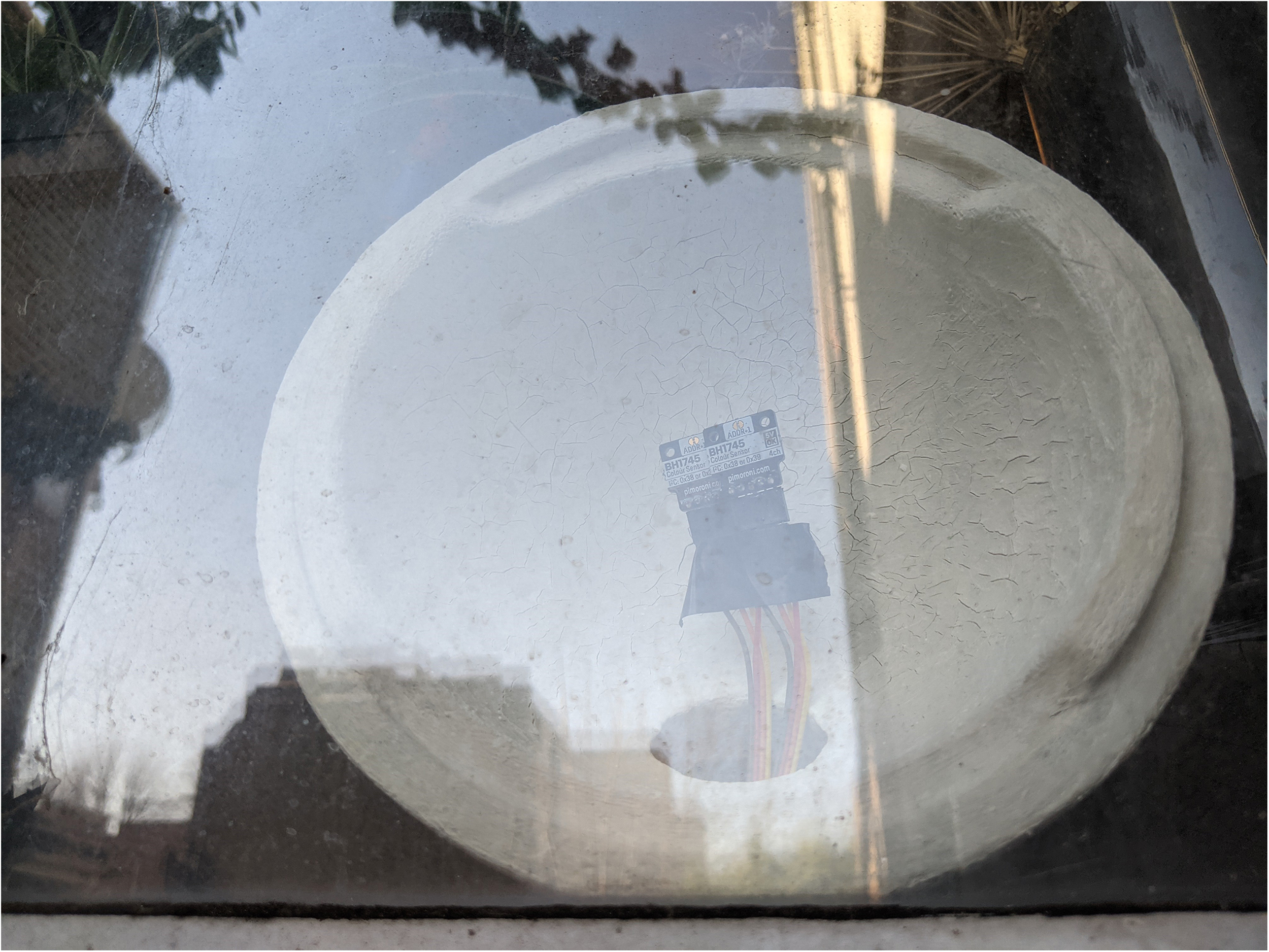
Light sensors facing the sky. Author, 2021.
Changing ambient environmental light over three days. Light was collected using a light sensor and the image constructed in real time using the Processing programming language. Author, Lancaster, UK, February 2020.
Further refinements were made, displaying the information as dabs of colour (Figure 5) using Linux Time as an index to position them on the screen. Linux Time, also referred to as Unix Time, Epoch Time, and seconds since the Epoch, is an important if not generally familiar time standard that is based upon the measure of the second produced by TAI. It is expressed as the number of seconds that have elapsed since a specific datum (the Epoch), which is defined as 00:00 on 01 January 1970 (IEEE, 2018: A.4.16). It differs from UTC and TAI in that it describes time in terms of duration (since the Epoch) rather than time of day as with UTC. It was designed for 32-bit computers and embedded systems to simplify and standardise the specification of dates and times by reducing them to a single incremental number with a precision of one second. Linux Time does not adjust for leap seconds, as this can introduce errors or inconsistencies into time-sensitive systems and is thus well suited to critical systems, such as nuclear power stations.
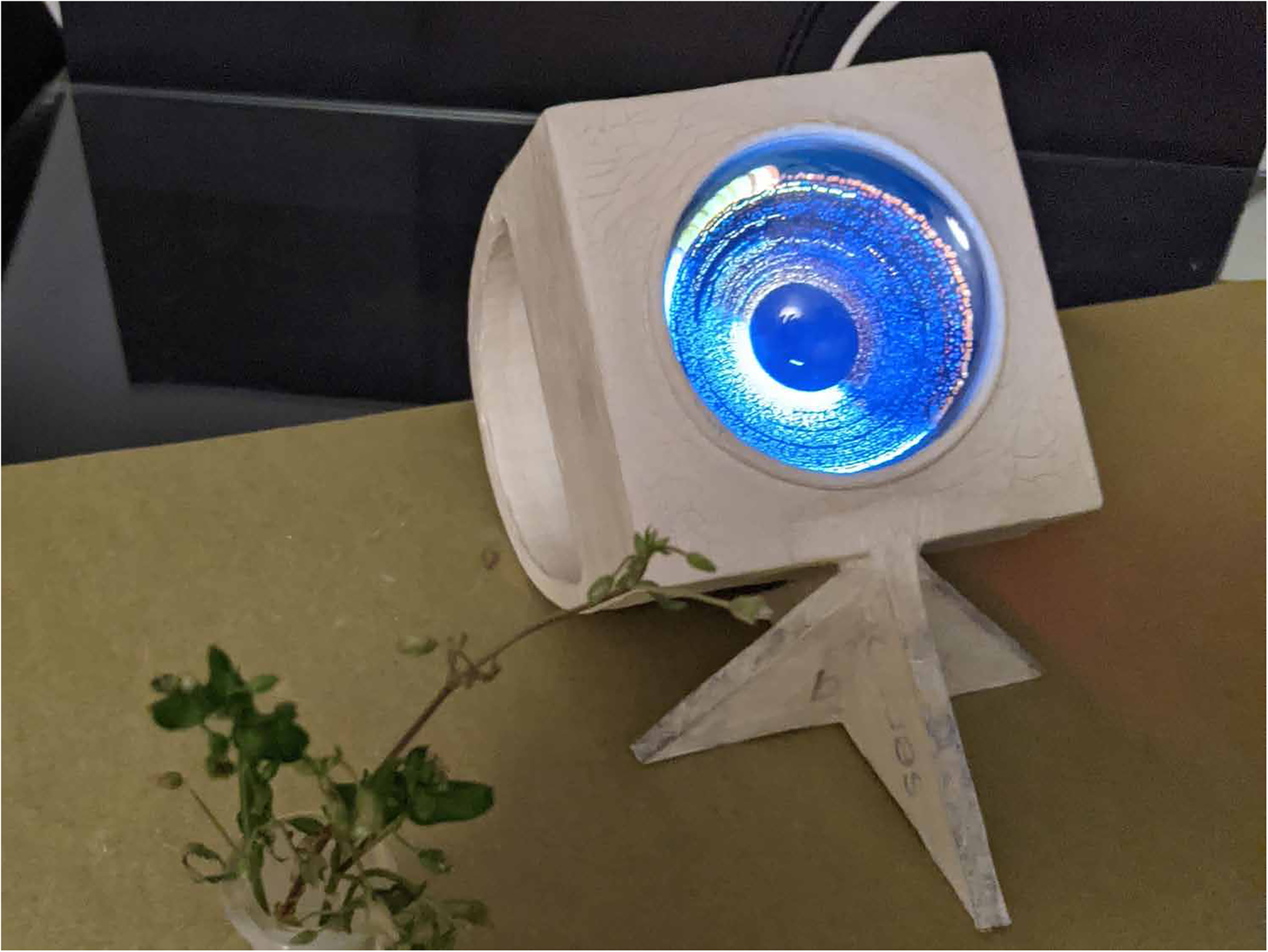
The physical form of the timepiece. Author, 2021.
The decision to use dabs of colour rather than a technique similar to the blended-line images of Figure 4 was influenced by impressionistic painting of the nineteenth century. This plein air technique emphasises the painter's presence in the landscape over time and their close attention to light and its changing qualities. A parallel could be drawn with the clock's light sensor – indeed, when impressionism emerged, it suffered from critiques regarding its similarity with the ‘love of absolute truth and the textual…a mechanical technique of imitation’ ascribed to photography, a practice likened to ‘the modernity of Manet and the impressionists’ (Callen, Havell and Gallimore, 2000: 89). Despite this comparison with mechanistic imitation, impressionist painting often employed loose brush strokes of single colours to portray an overall visual effect rather than describing detail through lines, contours, and blended colour. This is mirrored in the design of the Light Clock, which aimed to situate the viewer within a field of effect rather than a point of view.
The first time that the Light Clock is turned on, there will be very little to see – each clock stores the photographs it receives locally in a database, which is initially empty. After a few tens of seconds, dabs of colour will begin to appear, dancing around the north-most position of the screen. This most northerly position on the display always shows the present ambient light, and earlier recordings are slowly shifted anticlockwise to accommodate this. In this way, the Light Clock always roots the viewer in the same place and time – the present moment – while the past accumulates behind this point, and the future has not yet happened, indeed does not yet exist.
It should be noted that the ‘present moment’ is not presented as a specific time of day but rather to a durational moment of experience. Each measurement appears as a flickering dab of colour rather than a precisely located point in time and space. As time goes on, more dabs of light appear. The colour and luminosity of these flecks correspond to the cumulative colour field in the landscape beyond the window. An anticlockwise arc of flecks begins to emerge, dancing along the trajectory. If the Light Clock was instantiated before dusk, then after a while one will see an arc that fades from bright daylight hues to deep blues – what photographers refer to as the blue hour – and into the dark umber hues of the urban night. After one full rotation of the earth, a complete circle of light can be seen. The transitions from day to night are visible. The northerly position on the outer ring always shows the present, with the entire arc slowly moving in an anticlockwise direction as the earth rotates. The head of the circle does not quite join its own tail – it appears as a spiral, each turn curling around the day before. The spiral builds over weeks and months, and the changing length of the day becomes visible as the length of the sun's arc above the horizon undulates with the earth's tilted journey around the sun. Figure 5 shows the days that are slightly longer than nights as we leave the vernal equinox and head towards the summer solstice. The Light Clock uses light not only to place one in the moment but also to continuously remind one of the context of that moment – the seasonal variation of light and where in the year we are.
The Light Clock and land art
Although the Light Clock is small in scale, its development has much in common with concerns of the land art movement of the 1960s and 1970s, in particular regarding the creation of non-gallery-based art that intersects astronomy, architectonic forms, and brings vast spatial and temporal scales into embodied experience. Works of particular relevance are Nancy Holt's Sun Tunnels (constructed between 1973 and 1976; Holt, 1977; Holt/Smithson Foundation, n.d.) and Charles Ross's Star Axis (conceived in 1971 and constructed between 1976 and the present day; Ross, n.d.). Sun Tunnels consists of four concrete drainage pipes arranged along two axes in the Great Basin Desert in Utah. The axes are aligned such that the tunnels frame the rising and setting sun on the vernal and winter solstices, marking the most easterly and westerly positions of the sun's arc as it intersects the horizon during the year. In this way, they act as parentheses to the extent of the sun's arc, similar to the solargrams mentioned earlier. The Light Clock similarly marks these extremes of night and day, albeit in a different way, by showing the gentle change of the day's length along its receding helix. Each of the four Sun Tunnels has holes core drilled into it, arranged such that they project constellations (Columba, Capricorn, Draco, and Perseus) into the interior as the sun or moon passes overhead. These constellations were chosen as they encompass the globe: ‘Columba is a Southern Hemisphere constellation which slips over the edge of the horizon for a short time each year, but can’t be seen because of the dense atmosphere near the earth. Capricorn is visible in the fall and early winter, and is entered by the sun at the winter solstice. Draco and Perseus are always visible in the sky’ (Holt, 1977: 37). Through the carefully considered location, position, and framing of the landscape, sun, sky, and viewer created by Sun Tunnels, ‘Holt brings the cosmos down to the earth and into the realm of human experience’ (Holt/Smithson Foundation, n.d.). Time is central to how she considers this work, describing it thus: Day is transformed into night, and an inversion of the sky takes place: stars are cast down to Earth, spots of warmth in cool tunnels […], “time” is not just a mental concept or a mathematical abstraction in the desert. The rocks in the distance are ageless; they have been deposited in layers over hundreds of thousands of years. “Time” takes on a physical presence. Only 10 miles south of Sun Tunnels are the Bonneville Salt Flats, one of the few areas in the world where you can actually see the curvature of the earth. Being part of that kind of landscape, and walking on earth that has surely never been walked on before, evokes a sense of being on this planet, rotating in space, in universal time. (Tiberghien, 1993: 146)
While Nancy Holt's Sun Tunnels are aligned to the movement of our own star, Charles Ross's Star Axis – originally conceived in 1971 and now a complex of architectonic forms under construction in New Mexico – is built according to a geometry based on star alignments over various timescales. These alignments are ‘built into the sculpture so that we can experience them in human scale’, offering ‘an intimate experience of how the earth's environment extends into the space of the stars’ (Ross, n.d.). One construction, Star Tunnel, is aligned with the pole star Polaris, which coincides with the earth's current axis of rotation. As the viewer ascends the steps in a slowly widening tunnel, the circle of light at the end of the tunnel describes the path that will be traced by Polaris over the day and night at a future point in time. This refers the viewer to the gradual undulating wobble of the earth's axis, a process known as precession, which happens over a period of 26,000 years. When at the bottom of the tunnel, only a small dot of light is visible, centred on Polaris as it is seen today. At the top of the tunnel, the extent of the circular field of vision describes the diurnal movement of Polaris 26,000 years from now, when it is no longer aligned with the earth's axis. Other constructions include the Solar Pyramid, which, marks the daily and seasonal movements of the sun through a form carved out of its shadow. The Hour Chamber gives a view of one hour of Earth's rotation, while from within the Equatorial Chamber, the stars that travel directly above the equator can be viewed (Ross, n.d.).
The Light Clock, like Holt's Sun Tunnels and Ross's Star Axis, intends to bring spatial and temporal scales that are far beyond human experience into an intimate proximity. The decision to develop this work as a timepiece – something so familiar as to be verging on the mundane – was driven by a desire to bring planetary and celestial processes into the same frame of reference as the rhythms and processes of everyday life. Like these works, the physical form of the Light Clock (Figure 6) was thus designed to immediately situate the viewer's body in local, planetary, and celestial contexts. When the forward pointing foot of the base is aligned with magnetic north and the viewer looks directly into the glass, Polaris is directly behind the viewer's head – the viewer's line of sight is parallel to the earth's axis of rotation, and the heavens slowly rotate around them. To achieve this, the base props the clockface at an angle equal to the viewer's latitude – in this case Hackney, East London, with a latitude of approximately 51.5 degrees. The clock's curved back allows the latitude to be changed according to one's location.
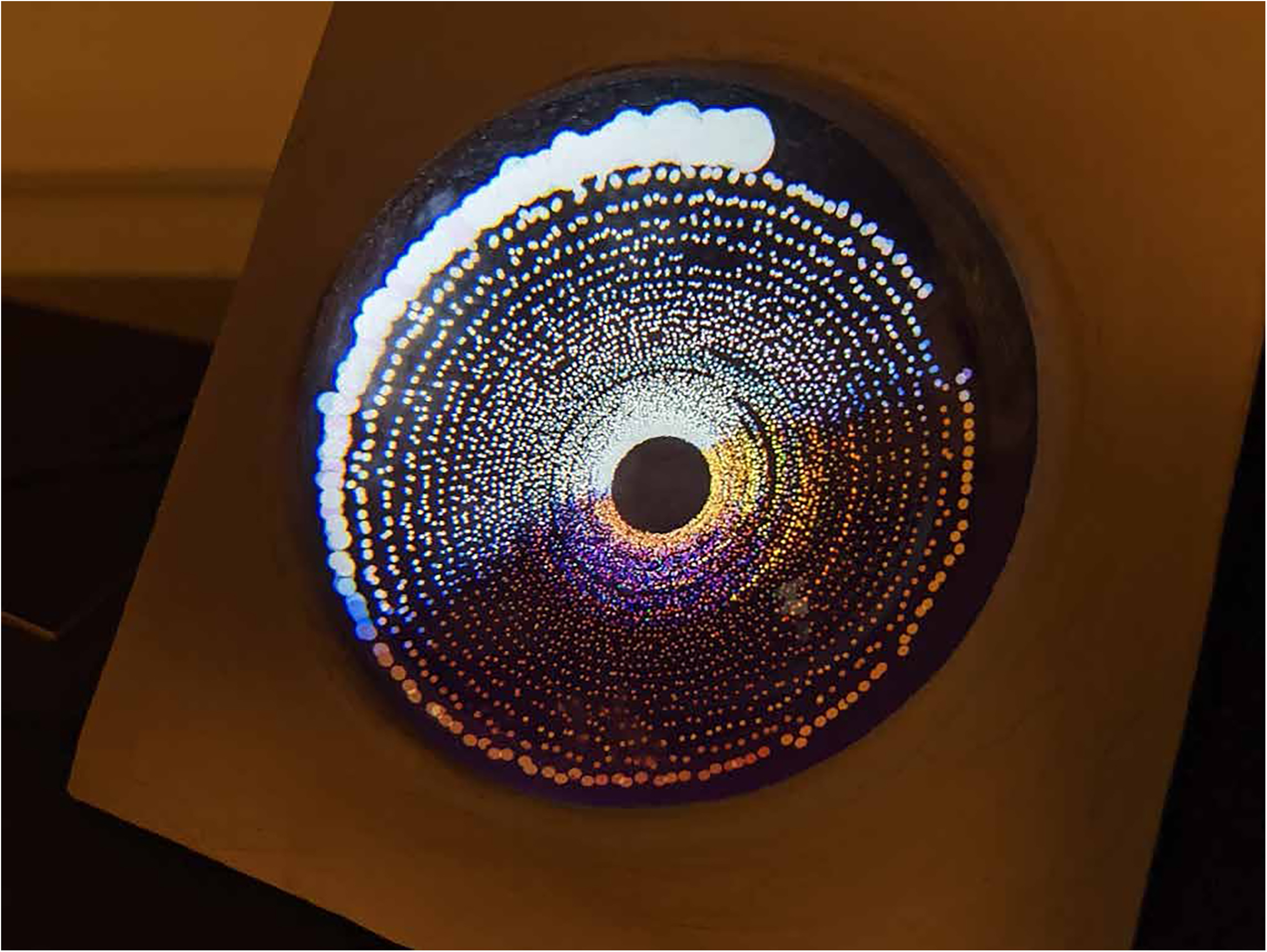
Approximately 40 days of environmental light recordings. The hue and lux of light are shown as dabs of colour, with the top of the screen always showing the present moment. Author, Hackney, London, spring 2021.
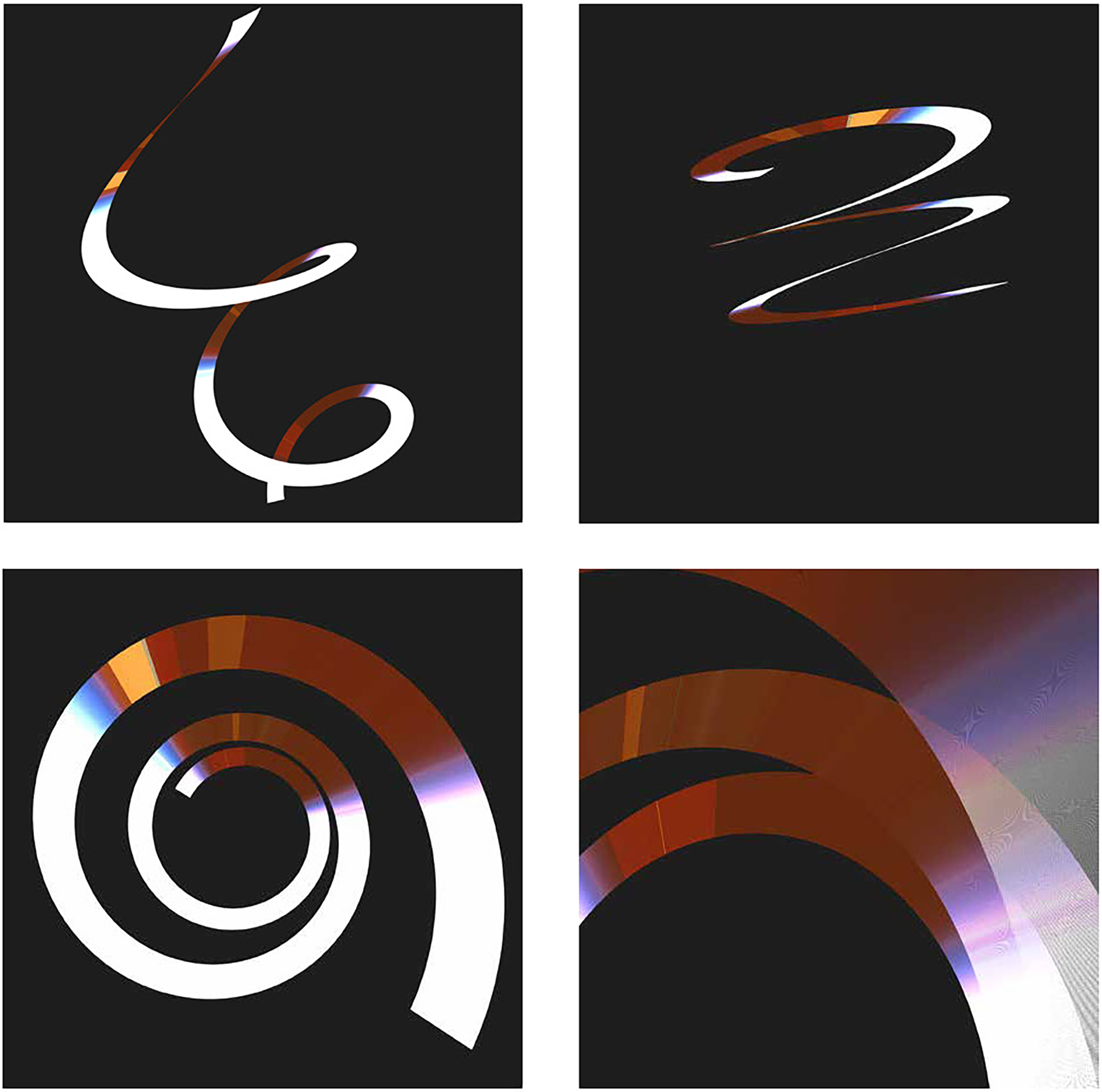
Finally, the viewer can interact with the Light Clock by moving it from its north-facing axis. This changes the clocks position in relation to the sky, and the viewpoint taken on the display changes to accommodate this. This reveals the spiral to be a perspectival view of a helix (Figure 7). This corresponds to the earth moving through space around the sun with one's position on the rotating earth tracing out a helix. A future iteration will wind this helix along the helix created by the earth's orbit around the sun as the sun itself moves on its trajectory through space (Figure 8).
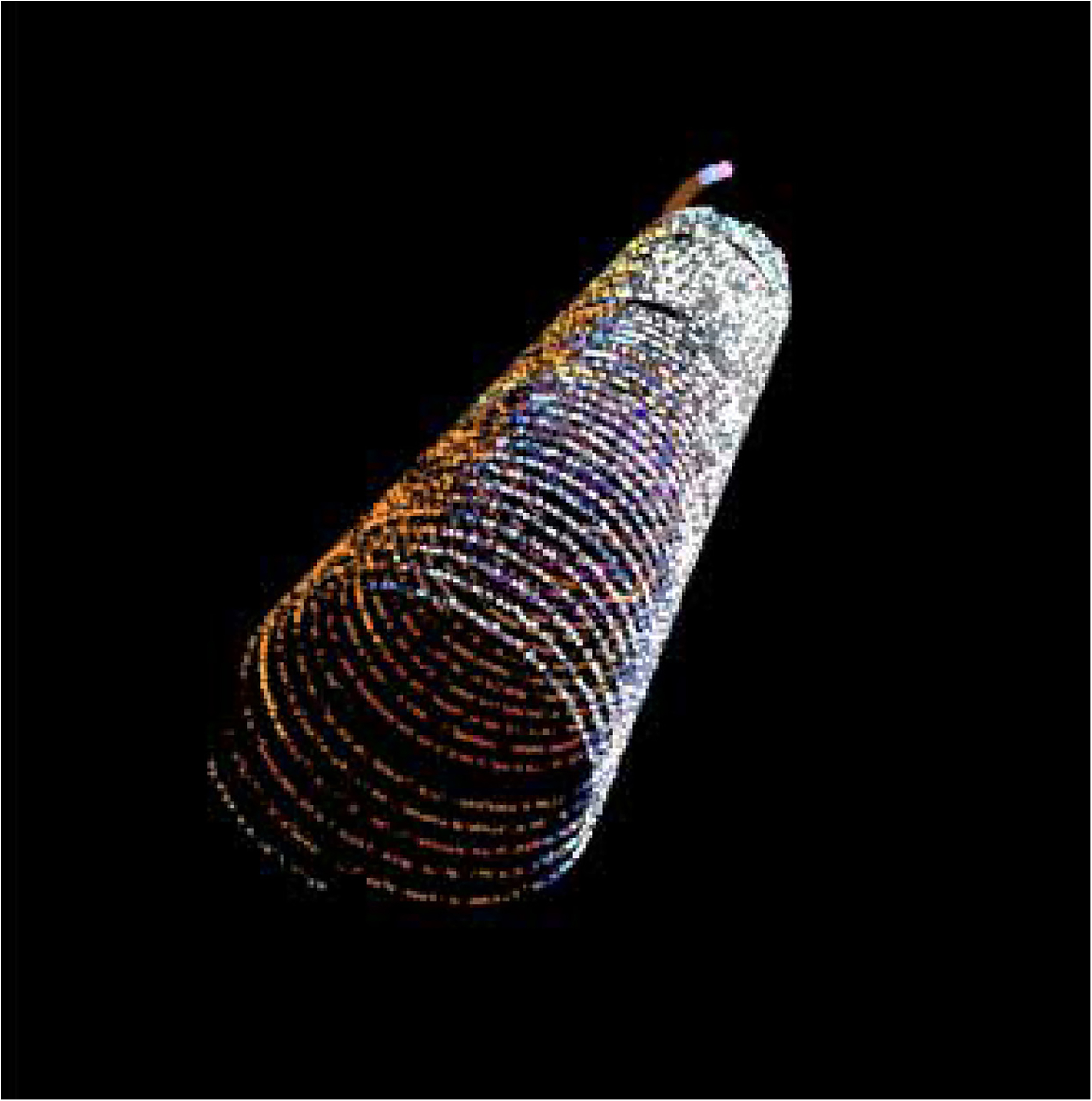
Hue and lux of environmental light over approximately 40 days displayed as a three-dimensional helix. Author, Hackney, London, spring 2021.
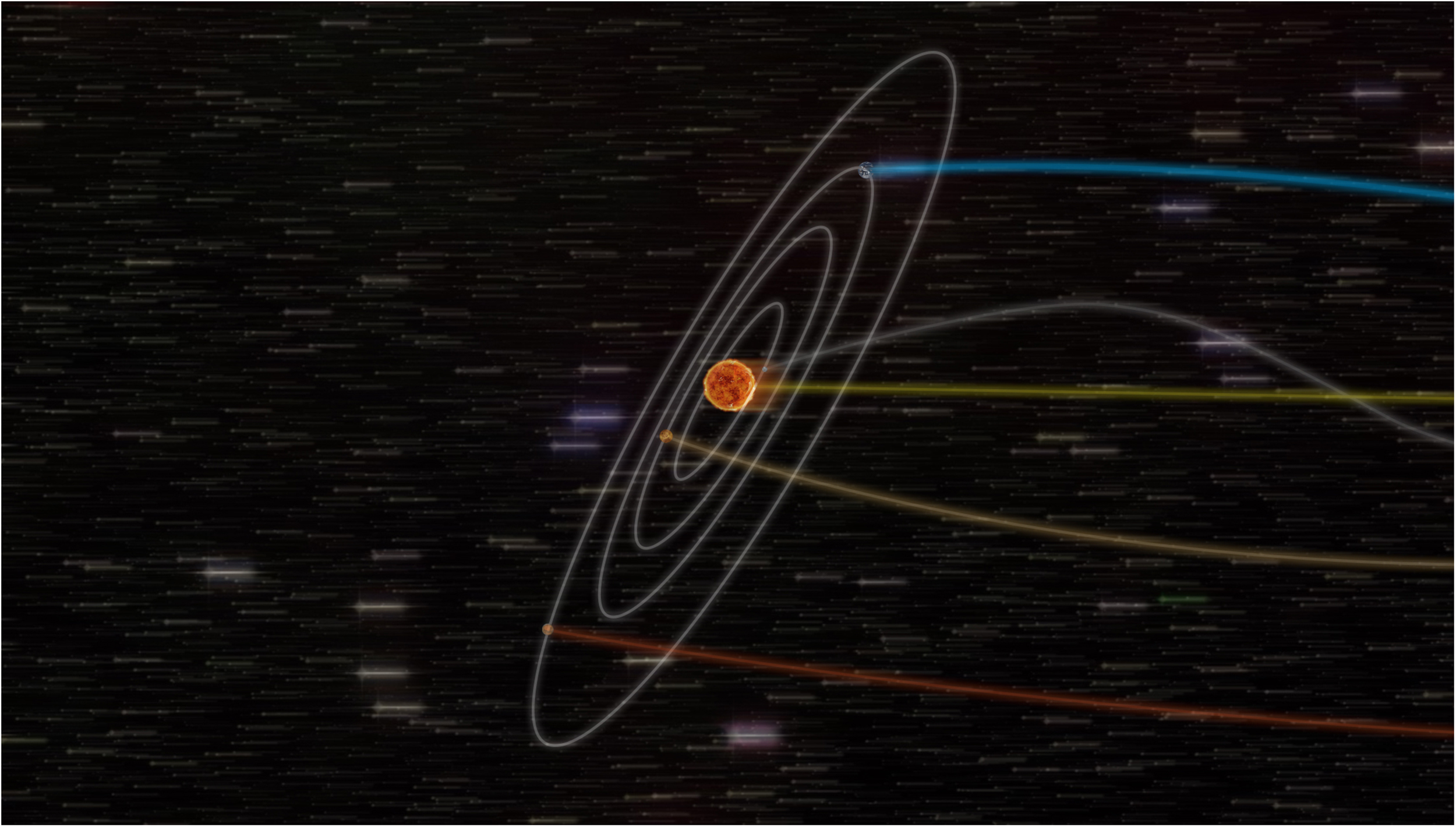
The helical movement of Mercury, Venus, Earth, and Mars around the sun as they move through space. Author, 2021 with reference to an animation by Rhys Taylor (2015).
Multiple temporalities
While UTC has advantages for coordinating the systems of communication and movement that facilitate the complex functioning of societies, it hides the multiple temporalities of the more-than-human world that supports them and the observations that situate individuals ontologically within local and planetary ecologies. Rather than reject UTC, a hybrid approach to time keeping might be an appropriate response. This follows Bastian's call for a critical horology, where ‘clocks do not need to be produced in only one form, but could be remade to respond to temporal challenges in new ways’ (2017: 11).
The temporal challenges that the development of the Light Clock responds to are twofold. First, UTC and other time-of-day forms of time keeping reinforce imaginaries of nature and society as somewhat parallel. UTC presents a global system of timekeeping that is shared ubiquitously among humans but is not of utility to other life forms. This situates the human at the centre of spatiotemporal experience, marking the human subject's precise time in place, much like lens-based media can place a viewer at a precise place in time. This can create imaginaries of a human subject that stands apart from the durational planetary processes through which the environment and the viewer are simultaneously unfolding. Meanwhile, it is precisely this unfolding of biological and physical processes over a vast range of timescales that human timekeeping should pay attention to when considering the effects of anthropogenic activity on the environment. Such an approach foregrounds the planetary over the global – an important distinction when situating human activity within the context of the Anthropocene term; as Spivak writes, ‘The “global” notion allows us to think that we can aim to control globality. The planet is in the species of alterity, belonging to another system; and yet we inhabit it, on loan.’ (2012, 291).
Second, ALAN is an increasingly pressing problem that is evident not only in urban societies but increasingly across rural and wilderness areas (e.g. Falchi et al., 2016). ALAN is a widely experienced and intuitively understood proxy for human activity at both individual and societal levels. It affects the visual quality of the night and our capacity to experience it as ‘a time and place in its own right’ (Dunn and Edensor, 2020; Edensor, 2013; Melbin, 1978). It has deleterious effects on the health, well-being, and ecologies of humans and non-humans (Chepesiuk, 2009; Fonken and Nelson, 2014; Rich and Longcore, 2013). From a cultural perspective, it deprives people of a view of the night sky, with the number of stars visible in the night falling each year as the skies see an average yearly increase in brightness of almost 10 percent (Kyba et al., 2023). This ‘loss of the night’ (Bogard, 2013) has implications for ecologies, human health and well-being, as well as astronomy and access to dark skies (see Gallaway, 2010; Hölker et al., 2010; International Dark-sky Association, n.d.).
The Light Clock makes legible various rhythms and temporalities related to the copresence of natural and artificial light. The superstition of natural and artificial light has a clear and accessible narrative that puts the temporality of urban, rural, and wilderness landscapes at its core, bringing together the social, cultural, biological, behavioural, and environmental effects of human activity on both humans and non-humans. From this perspective, ALAN might be considered to be a temporal pollutant, adding noise to the cycles of environmental light and dark that regulate social and cultural rhythms on one hand and biological and behavioural rhythms on the other. However, as artificial light can be easily mitigated (unlike many other pollutants, its presence does not linger once the source is removed), the damaging effects of anthropogenic activity on our environments might be foregrounded in daily life in a manner that is hopeful rather than overwhelming.
Furthermore, as a tool for facilitating discourse regarding the presence and extent of disruptive Anthropogenic processes, in particular ALAN, artefacts such as the Light Clock may be an excellent means of engaging with public perceptions of the night, ALAN, and exploring the values attached to darkness (Stone, 2017) – for example, through participatory methods, such as the design probes discussed by Pschetz et al. (2022). Devices such as the Light Clock collect and represent data about the night sky in ways that may also be able to contribute to urban design and corresponding policy that considers the temporality of both day and night – for example, ‘dark design’ (Dunn, 2020) and ‘nocturnal urbanism’ (Narboni, 2017) – and human and non-human needs for light and darkness. This could support interventions and imaginaries that recognise the importance of cycles of light and darkness for the health and well-being of human and non-human societies and ecologies. Bringing together multiple temporalities with the temporal noise introduced by ALAN could provide those living in urban societies (and increasingly those living outside of urban areas) with an imaginative framework for thinking about urban time and life in an Anthropocene context.
Although the Light Clock in its current iteration is likely to be encountered only by readers of this journal or by those interested in environmental arts, work is underway in various locations (currently Leighton Moss RSPB Nature Reserve, Cumbria, UK and Bonn Botanical Gardens, Bonn, Germany) that will extend this to a wider public. By foregrounding the role that creative practice can play in facilitating nature–society imaginaries (Hawkins, 2020), this work proposes sensor-based environmental data collection and dissemination as a social and cultural activity, and suggests that creative time-based interpretations of environmental observations, such as those of the Light Clock, can help foster meaningful relationships between people and the environment.
Before concluding, this final section will describe the specific temporal scales that the Light Clock engages with. The clock observes, records, and displays the changing brightness and hue of the sky over the day and night and the accumulation of these observations over months and years, using Linux Time as an index. Through this process, the Light Clock emphasises time as duration, alluding to several temporal scales in particular: Linux Time, the embodied present, diurnal and circadian rhythms, circalunar rhythms, phenological rhythms, and time as a process of sedimentation.
Using Linux Time as an index frames time as duration (seconds since the Epoch). This contrasts with UTC, which is a time-of-day representation and cyclical. Employing a database that begins to populate when the Light Clock is initially turned on further emphasises this durational approach by adding a visible ‘epoch’ – i.e. the unfolding of days from the moment it was first instantiated. 2
Embodied present
The Light Clock creates a new record approximately every three seconds, recording information from the light sensors against the nearest Linux Time second. This three-second period was chosen to accord with ‘the length of the human present moment’ (Turner and Pöppel, 1983: 70) – the cognitive and sensory frame that humans experience as ‘now’. The dab of light corresponding to the most recent observation is displayed at the top outermost position of the screen, showing the ambiant hue and lux of local environmental light shared by humans and non-humans alike, while situating the viewer in an embodied present. Displaying the present in one position changes the perspective of the observer from one who is abstractly mobile in time to one who is always situated in the present as it sediments into the past through the unfolding of the processes that we experience – a process that may be material, as in the slow accumulation of dust upon a bookcase, or it may be apparently immaterial, as with the accumulation of memory. Each dab of colour displayed has a small random jitter added to its position, creating a dappled, shimmering effect. As mentioned earlier, the intention was to encourage a reading of each dab as an affective experience that fills time rather than describing a discrete point marked in time as with time-of-day representations. The Light Clock also locates the viewer in the present spatially, showing time as specific to both latitude and the luminous particularities of the immediate environment, while not tying it to an explicit point of view. Each Light Clock thus inhabits a local time, similar to the local solar time alluded to in David Horvitz's installation and performance Let Us Keep Our Own Noon (2013), which is equally situated in planetary movement.
Diurnal and circadian
Meanwhile, the referent itself – observations of ambient environmental light – locates the viewer in the changing environmental light as it unfolds and leaves its trace. In a city, this shows not only as the changing rhythm of night and day in accordance with latitude but also the rhythms of skyglow caused by ALAN. If overlooked by buildings, the sensor may also sediment the rhythms and syncopations of their lights, as seen if one looks closely at the night in Figure 2. By visually tracing changes over the day and night, the work situates the viewer within the diurnal changes in light and dark that entrain the circadian clocks of flora and fauna and the artificial sources of light that disrupt them, showing society and nature as unfolding together, inseparable.
Circalunar
In large European cities such as London or the cities and megacities of China, where this work was developed, the night sky is very bright. Although the clock is capable of picking up variations in moonlight as the moon waxes and wanes, this variation is barely perceptible on the Hackney-based clock. Artificial light obscures the circalunar rhythms of moonlight at night (see Attlee, 2011), and the loss of this signal demonstrates how dramatically artificial light is obscuring the night sky. This is indicative of a general trend of a year-on-year increase in nighttime brightness due to artificial light (Kyba et al., 2023).
Phenological time
By showing traces of light as a helix of diurnal variations in daylight and darkness throughout the year, the Light Clock locates the viewer in the circannual rhythms of light that drive the phenological calendar – the life-cycle events that animate organisms and ecologies. The length of the following day and the time of year can be clearly anticipated by looking to the inner spirals of light, which show change over periods of days to months. This is aligned with the function of the circadian clocks and phenological cycles used by organisms to anticipate and prepare for future events according to the patterns of processual intensities in the environment over time.
Sedimentary time
The clock operates through a process of sedimentation – the sedimentation of present environmental light observations into a time visualisation and growing database. Rather than locating the viewer in a present that is persistently hurried by an eye to an impatient future, this sedimentary approach situates the viewer at the exposed surface of the past. This has corollaries with the process of formation of tree rings and the stratification seen in coral, ice, sediment, and rock core samples, referencing timescales and their attendant imaginaries that span periods ranging from decades to millions of years.
This is in contrast to reacting to unfolding events or approaching the future as a tabula rasa awaiting the inscription of planned events. Such a sedimentary conception is sympathetic to Bergson's understanding of time as ‘a present which endures’ (1946: 179). Speaking of a hypothetical mind capable of holding all its past in the present moment, he writes: An attention to life, sufficiently powerful and sufficiently separated from all practical interest, would thus include in an undivided present the entire past history of the conscious person,—not as instantaneity, not like a cluster of simultaneous parts, but as something continually present which would also be something continually moving. (Bergson, 1946: 179)
Axial precession
The physical body of the clock is designed to align the viewer's line of sight with the earth's axis of rotation, locating the viewer's body in the diurnal rotation of the earth and the seasonal changes related to its orbit around the sun. By aligning the viewer with Polaris, the clock also brings the 26,000-year period of axial precession (see Beardsley, 1977: 71–75; Ross, n.d.) into the frame of reference, rendering time ‘less anthropocentric, less automatic, as we see ourselves relative to the cycles of a far greater duration and permanence than our own’ (ibid, p. 74).
End times
Finally, Linux Time also brings two further periods of duration into view. The original implementation of Linux Time was only able to index time up to the year 2038. Its initial design stored time as a 32-bit binary integer. The first bit is used to indicate time as past or future (1 or 0), leaving 31 bits for storing the time value. The highest value that can thus be stored is 2,147,483,647, which translates to Tuesday, 19 January 2038 03:14:07, after which it will overflow – a date informally referred to as the Epochalypse. However, modern systems use a 64-bit version of Epoch time, which allows time since the Epoch to be measured in microseconds while extending its range beyond the beginning and end of the universe.
Concluding remarks
The Light Clock demonstrates how design, creative practice, and technology can foreground the planetary over the global by making legible human and more-than-human timescales through local, planetary, and celestial imaginaries that are congruent with the Anthropocene term.
The clock is situated within a constellation of observational practices. These are tensioned between scientific practices – such as phenology, astronomy, and meteorology – and creative practices – such as land art, photography, and painting. The work adopts empirical approaches to observation that produce objective environmental knowledge. Meanwhile, it uses these observations to produce time-based environmental imaginaries. Each of these practices has a historical relationship to ways of knowing that have moved between scientific observation and poetic interpretation. For example, following early photographic discourse, the clock blurs the boundary between scientific observation and artwork, while further proposing data collection as a social and cultural activity – as an artistic means of making the multiple temporalities that drive our environments meaningfully legible in daily life. In doing so, it acknowledges and attempts to deploy the aesthetic concept of beauty as an important dimension regarding how we value and create meaning in our relationship with environments; discussing ethical approaches to how environments are valued, Leopold writes, ‘a thing is right when it tends to preserve the integrity, stability, and beauty of the biotic community. It is wrong when it tends to do otherwise’ (1989: 224–225). Although this statement leaves many questions, and a discussion of the concept of beauty is outside of the scope of this paper, in bringing ethics and aesthetics together, it marks a position that this paper is aligned to – that value should not be based exclusively on approaches that quantitate environments.
Meanwhile, by using what is effectively a single-pixel camera, the clock eschews Cartesian optics, choosing instead a more diffuse understanding of the subject's position in time and space – one that is equally applicable to individual cells, to humans, to other lifeforms, and to earth systems (i.e. via the changes in light levels that drive these processes). Underpinning this approach is the proposition that empathy is not an adequate basis for value regarding the environment. Empathy is prone to bias, blind to microbes and single-celled organisms, for example, which are nonetheless central to the functioning of organisms, ecologies, and environments. This is further compounded by the view that humans cannot truly empathise with other species (Nagel, 1974).
Similar to land art, the clock rejects the gallery as its primary site. However, rather than siting the work in remote and inaccessible sites, it proposes domestic urban environments as the site for the work. This emphasises how the contemporary experience of great spatial and temporal scales does not require pilgrimage to remote sites and artworks that situate one in sublime or mythic conceptions of landscape (see Beardsely, 1982) – rather, the Anthropocene term sees scale as a central and giddying frame for the unfolding of everyday life. Furthermore, while land art often tensions embodied human experience with cosmological processes and notions of deep time, the clock additionally acknowledges the biological and ecological frames of reference that sit between.
The timepiece was conceived as a technological artefact and artwork that could easily be incorporated into daily life, while gesturing towards questions of how individuals might situate themselves in relation to the environment through the lens of the various time scales discussed earlier. The clock aims to use technology as a means of bringing human sensibilities closer to the environment by encouraging observation and an understanding of what such observations might mean in terms of value and meaning over various timescales, including those that are beyond our capacity for direct observation. Viewed from the perspective of environmental ethics, these time scales place different emphases on how humans value the environment. Linux time proposes an Anthropocentric position regarding the environment, which the clock augments with time-based environmental observations that are pertinent to biological, ecological, planetary, and cosmological processes. This creates a bridge between dominant Anthropocentric views on environmental value – for example, economic and instrumental approaches based solely on nature's contribution to human well-being (Dempsey, 2010) – and bio-, eco-, and cosmocentric views that see varying degrees of intrinsic value in natural processes (Bosworth et al., 2011: 11–15). The timepiece also shows the anthropogenic noise (ALAN) added to environmental light, creating continued awareness of the effect of human activity on the environment with regards these biological, ecological, and cosmological processes.
The Light Clock does not prioritise any specific one of these positions, but rather presents them as an incremental expansion of how value can be understood regarding the environment, moving from Anthropocentric to bio-, eco-, and cosmocentric positions; it does not suggest that we replace human concerns with environmental concerns (see Leopold, 1989; Callicott, 1999), but rather to build upon existing human ethical frameworks and extend them.
Footnotes
Acknowledgements
The author would like to extend his sincere gratitude to the editor and anonymous peer reviewers for their invaluable guidance, insights, and constructive feedback throughout the review process.
Declaration of conflicting interests
The author declared no potential conflicts of interest with respect to the research, authorship, and/or publication of this article.
Funding
The author disclosed receipt of the following financial support for the research, authorship, and/or publication of this article: This work was supported by Research England Expanding Excellence in England (E3) funding through the Beyond Imagination project at LICA, Lancaster University, and the Joy Welch Post-Doctoral Fund.
