



Abstract
Climate changes in every social sector, every web of life, radical change is occurring, and we all have to find ways to relate to such fundamental transformation. In this paper, we explore how museums can engage with environmental changes and concerns in new ways. By understanding how the power of time operates, one can make visible temporal connections between human and more-than-human agencies, control and negligence and its consequences. The paper explores the huge potential of museum exhibitions to open up various temporal relations, crucial both for witnessing, learning and un-learning the human impact on the world. Time is one of the museum's most important dimensions and the effects of recognizing other temporalities rather than the prevailing anthropocentric ones – become profound. We have selected one particular exhibition to work with: ‘500 years of Monarchical Power’ at the Royal Armory in Stockholm to explore how temporal relations are produced and maintained in this exhibition. The starting point is that time is not only something measured but also made, which opens up for analyzing museum temporalities in new ways. As will be shown under common museum narratives lies temporal complexities that weaves through human-animal relations, care time and those of planetary change. How, then, can we lay the ground for developing what could be called a more affirmative and ecologically inclusive alter-museum by curating time differently?
Museums and museology beyond dominant narratives of time
The museums of today are well-known and popular social institutions. They are mediums and a channel for information, a filter through which material and intangible phenomena pass and take communicable forms in exhibitions and other public activities. Furthermore, there are hardly any other public places where narratives are as connected to temporal aspects as those in museums. Museums work as temporal laboratories or time-transformers, where agency and power related to time can be studied and illustrated in new ways.
Emergent ecological museology is beginning to take shape. It moves museology beyond what is called ‘new museology’ that focus on transforming the relationship between museums and society (see Vergo 1989; McCall and Gray 2014). However, new museology, as it has been formulated, does not particularly question anthropocentrism, nor focus on the ecologies that form in museum contexts. Our version of ecological museology adds this to the new museology (see also the outline method of how to follow museum ecologies from artefacts in Fredengren and Karlsson 2019, and several works of human-animal studies and museums in Jørgensen 2020 and in Owman 2021). It traces what ecological relationships can be found in museums, with non-human animals, plants, soil, water, climate, and all that which has been othered as ‘nature’, it works with extinction and other topics. Such ecological museology is inspired by developments in the field of the environmental humanities (Rose et al., 2012). There are several inspiring ways for museums to work in the climate crisis (see Bergsdóttir 2016; Fredengren and Karlsson 2019; McGhie 2019; Newell et al., 2017; Harrison and Sterling 2021; Owman 2021). What we add further to the development of the emerging ecological museology is an expanded version of heritage things as composed of material-discursive relations and processes (see Fredengren 2015), and could be, if approached through ecological lenses. Heritage can be described as a verb (DeSilvey 2017: 9). Heritage can be understood as relational phenomenon in the making (Fredengren 2015), that arises through the co-ordination of several human and more-than-human agencies. Also, museum things can be described as such phenomena, that come about through several different environmental and temporal relations. Similarly, by recognizing museums as material processes, Bergsdóttir (2016) suggests, we could establish space for alternative museum practices and thus enable a transition from today's traditional cultural heritage museums with their ‘hierarchical divisions of agencies’ (Bergsdóttir 2016: 127).
It has been argued that museums need to be ecologized if they are to step up to the challenges of climate and environmental change (Cameron and Neilson, 2015: 3) and this can be done by reviewing their underlying assumptions and organizations. In the book Curating the Future Newell et al. (2017) argue that these institutions need to change their organizational, material, and conceptual arrangements as museums both work with the past and shape the future. Wehner (2017: 87) draw on Plumwood (2009) and propose an ecological museology that ‘produce ways of being, thinking and acting in the world that position people as integrally part of ecological communities’.
This paper will take these museum ecological ideas further and investigate how museum time can be curated differently. We work with an exhibition ‘500 years of Monarchical Power’ at the Royal Armory in Stockholm. It provides us with a good classical example of a narrative that focuses on humans and that outlines time in a linear way. However, it also has the potential for a time-sensitive ecological curation. The paper outlines some of the methods for doing so as it traces the ecological temporal relations that co-produce museum objects on display. The aim is to open up for an acknowledgement of several human and more-than-human relations, sometimes hidden from sight in classically curated exhibitions.
The work pays particular attention to the temporal complexities that are braided through the collections and throughout the curated space of exhibitions, for example, those that highlight particular human-animal relations, care time and relations that stretch into matters of climatic and planetary change. Through this work we wish to produce an affirmative provocation to the field of museology and also contribute to enlarging the ongoing engagement with heritage and museums studies within the environmental humanities. Also, we will work with the more-than-human as a concept and methodological tool, connected to both human-animal studies and critical feminist posthumanism (see for example Haraway 2008: 101; Rose and van Dooren 2017), useful for investigating temporal relationalities between humans, animals, and the environment in the museum context.
It's about time and ecology
Margaret Atwood (2015) writes ‘It is not climate change; it is everything change'. Importantly, the environmental crisis is closely linked to our relationship with and through time (Bastian 2009, 2012; Huebener 2020). This urges us to take a closer look at the temporal assumptions in museums, and to work with temporal relations, literacy of time as well as care time (Adam 1998; Bastian 2009, 2012; Hölling 2017; Huebener 2020; Metcalf and van Dooren 2012; Pschetz and Bastian 2018; Puig de la Bellacasa 2017).
McGhie et al. (2020) propose that a re-working of the concepts of time in museum exhibitions may raise engagement in climate change matters. Walklate (2013) notes in her studies of museums that many of them often don’t problematize the time references and often communicate tempo-linear narratives. There are several theories and tools that assists in our re-working of museum time. For example, we will make use of Freemańs (2010) important observations around the normative rules that frames lives with regard to time and temporality and that such normalized temporal practices could be captured by the term chrononormativity. Pschetz and Bastian (2018: 173–175) work with temporal design to notice and experiment with how dominant temporal narratives might be shifted into an understanding of how everyday activities are composed of several different temporal relations that sometimes clash and which chrononormativity easily overlooks.
One aspect of chrononormativity that we will investigate further is that of temporal anthropocentrism, i.e., practices and narratives that focus on human timekeeping and synchronizing. We argue that chrononormativity is at play when a museum thing is set primarily within one period of human use, while its effects, in fact spread out and entangle with other phenomena over time in more temporally queer ways. Particularly important in these environmentally challenged times are relationships forming beyond those conceptualized through anthropocentric lenses. As suggested by Fredengren and Karlsson (2019) museum things can then be analyzed as bundles of ecological relations (see also Alberti 2005 and Jørgensen 2022). For example, their production can have relations with extractive shadow places (see Plumwood 2008), they may come about through the use and abuse of animals, and they may project out and bind their relations into several futures. Furthermore, Bastian (2017, n. 736) points to the need to create ‘counter-clocks’ or ‘collaborative clocks’ if we are to live ethically and environmentally consciously. This paper deals with museum things as ‘counter-clocks’ – as devices that heightens our awareness and ability to observe and alter and re-tie networks of ecological temporal relations.
Amitav Ghosh (2016: 11) writes on the climate crisis that: In a substantially altered world, when sea-level rise has swallowed the Sundarbans and made cities like Kolkata, New York, and Bangkok uninhabitable, when readers and museumgoers turn to the art and literature of our time, will they not look, first and most urgently, for traces and portents of the altered world of their inheritance.
There are several temporal relations that lie undercurrent in the materiality of the collections and in the displays, that can be used as counter-clocks to heighten the awareness of ecological relationships and to trace such portents. In this paper we will, based on the work of these critical time theorists, and our theories of heritage and museum things as ecological relations, explore how to acknowledge museum things as relational clocks, not only to create counter-clocks in museums – but also to start the inquiry of how to make alter-museums through counter-curated exhibitions for more environmentally friendly lifestyles. If museums want to take an active role as agents of change, in an environmental situation that each day keeps driving the planet closer to the very extreme edge of the climate crisis, it is about time that we release the museum's timelines and temporal relations, and welcome in the more-than-human. Museums are heavily involved in temporal design and hence have the potential to be sites where other temporalities could be encountered, which we will address here.
Walk the timeline
The exhibition ‘500 years of Monarchical Power’ was selected for analysis as it is a rather classic case of a temporal linear curation, often found in museums exhibition. It will be used to show the potentials for working with environmental challenges and temporalities in a museum exhibition, that at the surface level focus on humans and linear time. Hence, our research shows how it can be developed and reveals complex temporal and material relations in a different articulation of museum space and narratives. Furthermore, the selection is one where none of us has any closer relation to the cultural historical materials (one of us is an archaeologist, the other a museologist and conservator). When approaching the curated space, we have done a selection of the temporalities communicated in the exhibition to give a wide variation and representation. We will first describe the exhibition and how time is communicated, then we will make use of our theoretical armoury and try to lift other aspects that could be highlighted in an ecologically based counter-curation.
The exhibition is laid out in a tempo linear way through the exhibition rooms. The first room holds a white-box for giving an overview to the visitor – where the rooms and their temporal content are lined up (Figure 1). One room is for the 1500s, followed by two for the 1600s, then one for each of the centuries up until 1900. As visitors we almost inevitably walk the timeline as bodies move from room to room. Furthermore, each of the rooms has a timeline that is projected onto the museum walls that facilitates the visitor with timekeeping and underlines the linear ordering of the exhibition and the linear ordering of time. The history narrative is also ordered along this timeline, presenting the highlighted events one after the other. In addition to the exhibitions time-space-enclosed rooms, the neat one-century-at-the time- boxes, each and every room have a headline either introducing us to a specific era, or the title of the room refer to events that emerge from sociopolitical human activities: the expansion of Sweden, nationalism, or democracy. A short overview follows here.
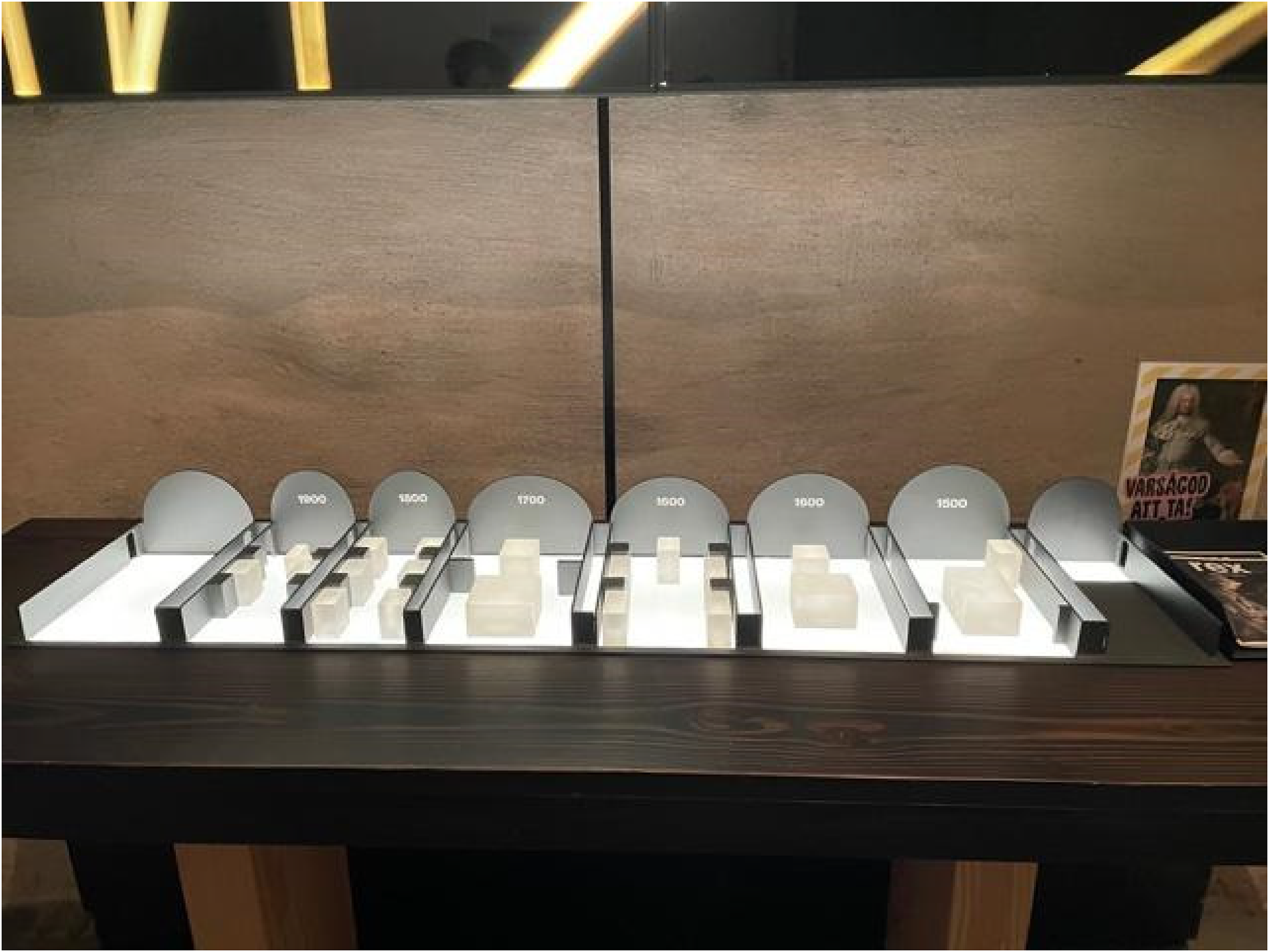
White box showing different rooms and their layout in time (Fredengren and Owman).
The first room of the exhibition, The Vasa era – Independence and power struggle, presents armour and artefacts from this epoch. Room two of the exhibition, Sweden Expands, features clothing and the king's warhorse Streiff, among other things. In room three, The age of the Great Wars, we find Karl XI's Roman armour and a masquerade jacket from the late 17th century. Room four, The age of liberty and revolutions, shows artefacts such as a royal wedding dress. In room five, Nationalism and New Ideals, we enter the 20th century. The last room of the exhibition, Monarchy in the age of democracy, contains more contemporary royal artefacts.
The focus of the exhibition is to tell the story of how humans contributed to the making of monarchy and society and how this has manifested through time. The temporalities communicated directly in the museum displays are time of the making of the objects and their acquisition. Furthermore, the exhibition deals with the birth, marriages, lives, and deaths of royalty. In every showcase the narrative is anthropocentric. However, the museum cases have numerous non-human animal related artefacts, such as the horse and human armour display, or the several remains of animals that have gone into the production of clothes and equipment. Furthermore, time in the exhibition is more complex than this.
The 1500s room is dominated by a large horse-and-human display, where the horse is clad in headgear with two horns, as well as encased in metal body armour (Figure 2). It is described as a gift from Poland that was sent to Sweden 1574 – the piece was made in 1550. Another display in the same room focuses on King Gustav Vasa who died after a reign of 40 years. This is exemplified by a crowned helmet of a medieval type. This is interpreted in the display text as the king had one foot in the medieval world and modern times. It also lets us know that the king was buried on the darkest day of the year 21st of December. By then he had been dead since the 29th of September. The King is Dead: Long Live the King is written on the information panel that alludes to the continuation of royal power between generations. King-time transgress generational division.
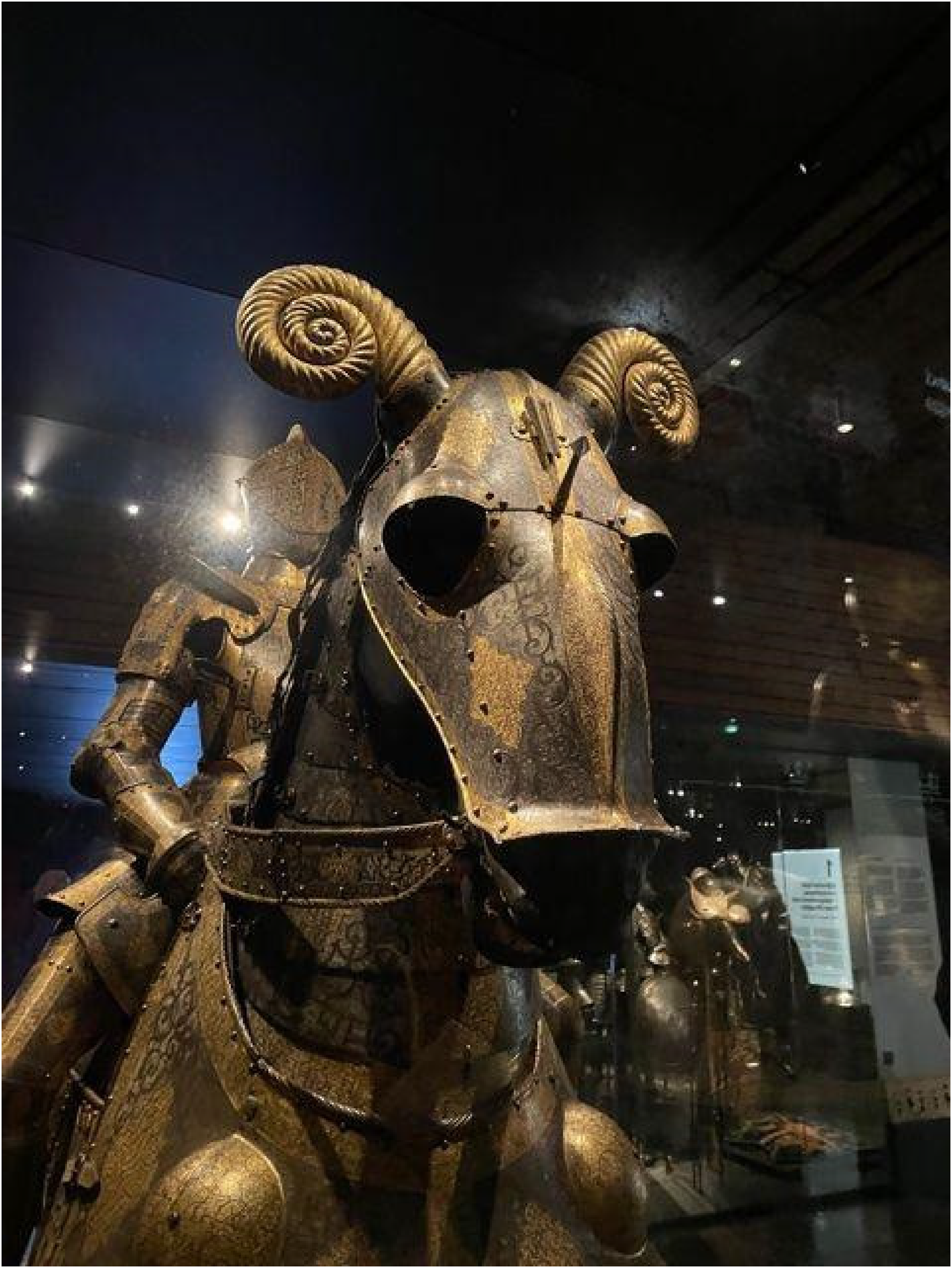
Horse-and-human display (Fredengren and Owman).
There is a variety of temporalities also in the linear time narratives, for example dealing with the human life-death-cycles. There is the wrapping of the king's heart that is on display. The exhibition also holds the crib of a newborn prince or princess. There are furthermore several clothes for children (Figure 3). During earlier periods children are dressed as miniature adults, and in later periods they get demarcated by specialized clothes. Hence the time of childhood could vary and be much shorter than today. Through the rooms one can follow the temporal cycles of human lives, with the demarcation of birth and death events.
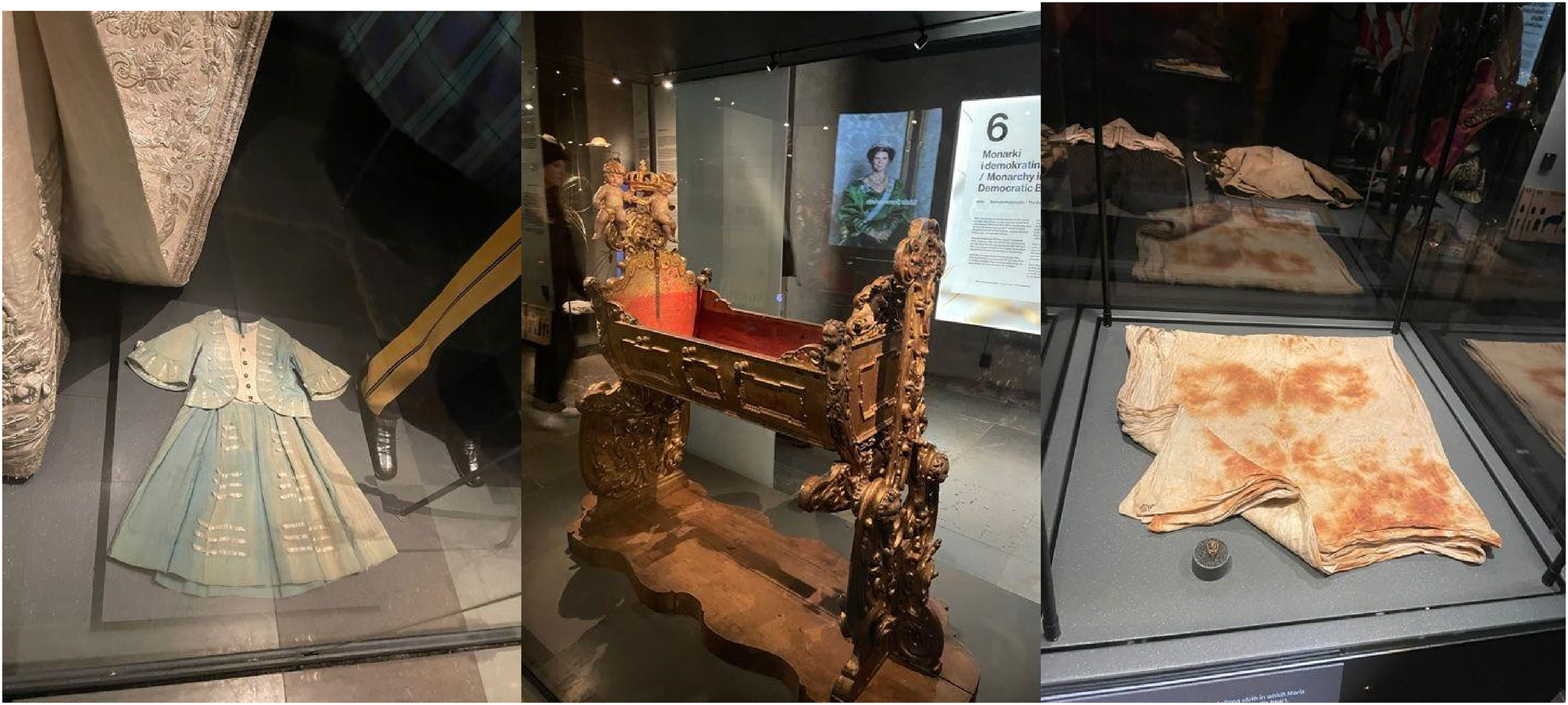
Human life-cycles – the hearth of a king and birth of a princess (Fredengren and Owman).
The exhibition also holds items connected to travels to other places. The rooms of the periods from 1700s to 1900s has exotic goods. There are items that show connections to the East and China and there are increasing materials of display with colonial connections. The amount of exotic goods in the exhibition increases over time. In the 1900s room – the museum case holds a board game with a topic that relates to travels in exotic continents by steamboat and by train, but that also indicates that there was spare time to spend on playing games. Among several animal remains present in the exhibition, beside the horses, the display hosts the classical fir-gear for the crowning of kings and queens, with ermine trimmings and velvet that was coloured by using purpura shells. The royal dress silk with thread produced by silkworms and ostrich feathers was a part of a fan. However, the animal narratives are not communicated to a great extent.
With the thinking tools of Freeman (2010) and Pschetz and Bastian (2018) this exhibition could be understood as chrononormatively curated. It clearly subscribes to a linear ordering of time and describes norm-adherent lives with births, baptisms, weddings, and deaths. In the linear chronologically ordered exhibition visitors move physically through a history ‘that appears to have no “roads not taken”’ (Rabinowitz 1991: 38) i.e., people will inevitably walk the timeline, hence embodying and internalizing the aforementioned chrononormativity, giving an impression of a complete historical narrative. Temporality is composed by the punctuated time of artefact production, or the use date of the same in a rather narrow sense. Furthermore, the exhibition showcases museum things that illustrate normative versions of temporal rites from birth and marriages to death, and while animals are there, the story is centered on particular human life cycles. The exhibition has a temporal design – that both guides the visitoŕs bodies into a linear time order, but also underpin a particular understanding of time. On the one hand, it allows for identifying both stability and change over time, but that does not touch on how relational time-hierarchies between human and more-than-human are built up and maintained. Furthermore, the narratives around the artefacts deal with either the temporalities of their users or with when they were produced and used. Hence, they are treated as temporal singularities only at work within one major, bound time period. Here we can only note that these museum things are still with us. They are still at work outside period bounds and they are the nexuses and producers of several temporal relations.
Museum things as counter-clocks
This exhibition and the artefacts however have the potential to chisel out a rich variety of temporal relations and temporal tensions as in between fantastic times, the time produced in human-animal relations, care-time and decay time, relations to weather and climates. The temporal focus in the exhibition narrative around the 1500s horse gear is focused on the time of the production of the armour (1550) and the time when it was gifted (1574). However, around this armoury there are several other temporal relations in the exhibition. The horse-and-human armoury artefacts in one of the showcases may be interpreted as if they produce fantastic or saga time where animals are redressed as fantasy creatures: One with curled-up horns and one with a unicorn-horn in the forehead (Figure 2 and 4). It is as if the royal lives, through the use of materiality, might have created and staged a saga world, a privileged dreamtime floating above the lives of ordinary people and animals. This makes us aware of how some peoples experiences of time would have been paid for by otheŕs care, time, and effort that went into the production and maintenance of these things. This means that one can ask questions about what time and effort it took to make this gear in metal. What relations had to be in place for this product to come about? Who carried out the task and where? What was the work environment from a temporal perspective? What ergonomic conditions were in place to facilitate and how long did the workers body manage to carry on, that in turn limited how long the working day was? What power relations and organization were in place in order to demand that the crafts person's time was spent on this production instead of other activities?
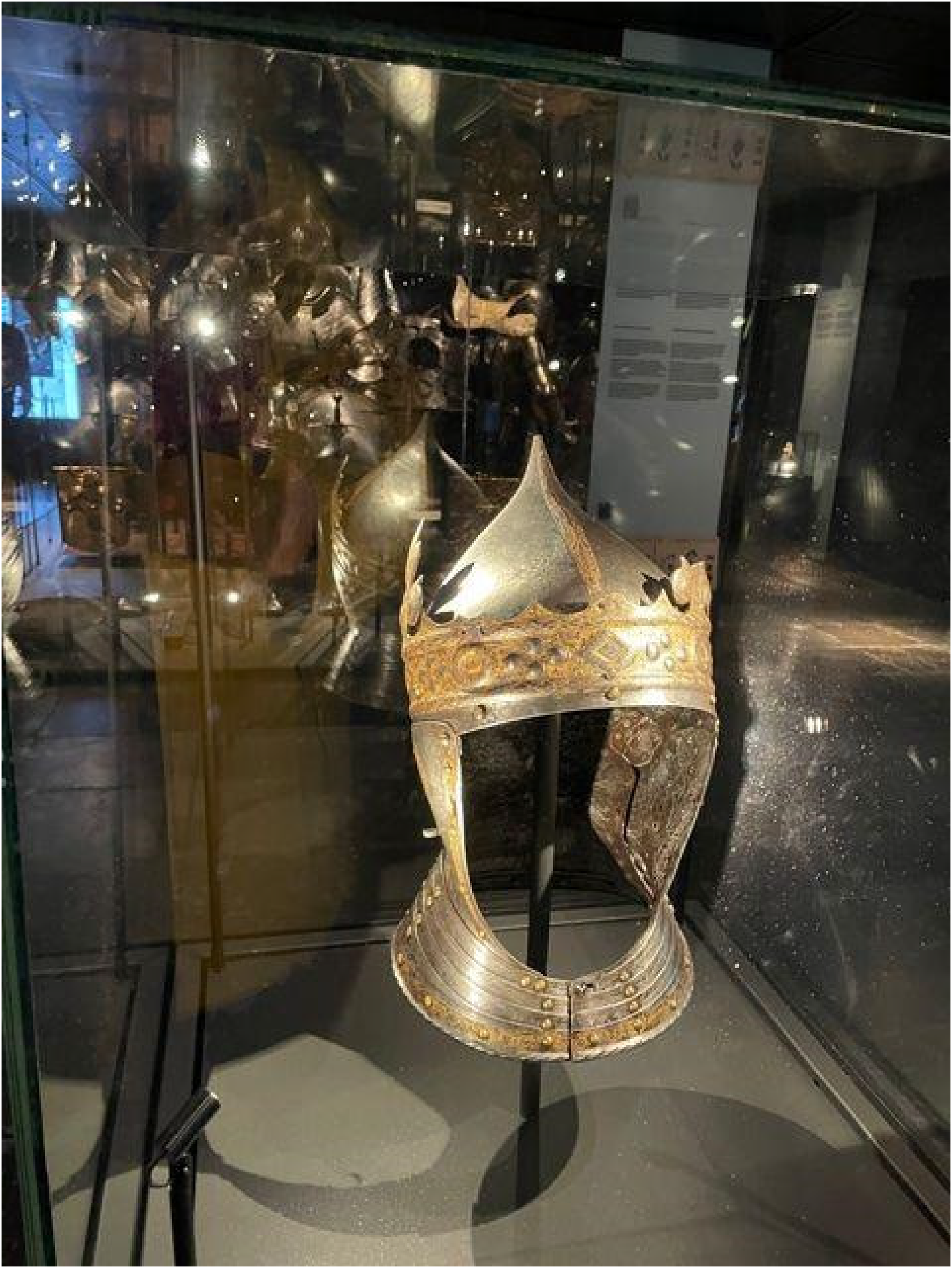
Crowned helmet (Fredengren and Owman).
Furthermore, one might take an interest in what extractive places the artefacts were related to – how long would it take for to renew the resources in the landscape – and heal environmental wounds. As Metcalf and van Dooren (2012: v-xiv) alerts us to; human action has created several temporal ruptures in the life of other beings, and in several ecological relations cast over into wounded futures. Mieke Bal (2021: 104) argues for shocks to be produced more often in museums, that is ‘ways of going against the grain of expectations’. Since ‘chronology makes lazy’ her advice is to invite ‘temporal turbulence’ in order to activate the museum visitors (Bal 2021). In this exhibition, time flows without interruption from the 1500s to the 2000s. There are no museum things that keep interfering in later periods. However, there is a potential for showing how the production and consumption of royal goods would have contributed to and speeded up ecological disasters in other places, distorting time in this sense. Worth noting is that the exhibition covers a period ruptured by climate change, for example: the harsh years of starvation during the little ice age.
When environmental time runs smoothly through the exhibition, this tends to silence catastrophes (compare Ghosh 2016: 22).
Counter-clocks and the known unknown
Bastian emphasizes that we need to challenge ‘the conception of time as linear, externalized and absolute’ if we are to be able to become more aware of a broader range of temporal agencies than the human-centered ones (Bastian 2009: 99). This linearly curated exhibition is anthropocentric, but still has more potentialities to open up for communicating counter-clocks that challenge the chrononormativity of the museum. This could be point of origin for an altered narration of the exhibition, more connected to matters of power and agency of the more-than-human and brought in place by asking questions of ‘who have been important enough to travel through time and what temporalities fit into the temporal frames?’.
The exhibition makes use of a spiral-art-object in the museum cages to represent the known unknown (Figure 5). The presence of these objects are ways of showing that the collection misses content related to different people significant to monarchical history. This is an interesting curatorial take to signal present absence. This innovation provides an opportunity to continue the discussion on the temporal relations of museum things. There are a variety of people, places, animals, and temporal relations of environmental change that could be acknowledged for their contribution to both museum things in the collection and in the exhibition. There are several truly absent more-than-human producers of monarchical history, such as animals, environments, technologies, and activities. The iron necessary for producing armoury, for instance, stem from extractive activities in the wider landscape. It is also linked to forests that need to be cut down to produce charcoal and heat. It would have produced CO2 that was fed into the atmosphere and that would last and form future relations for several thousands of years to come. Hence, some of the artefacts in the museum display stretch well outside their bracketed off time in the displays, through their long-lasting climate legacy into deep futures.
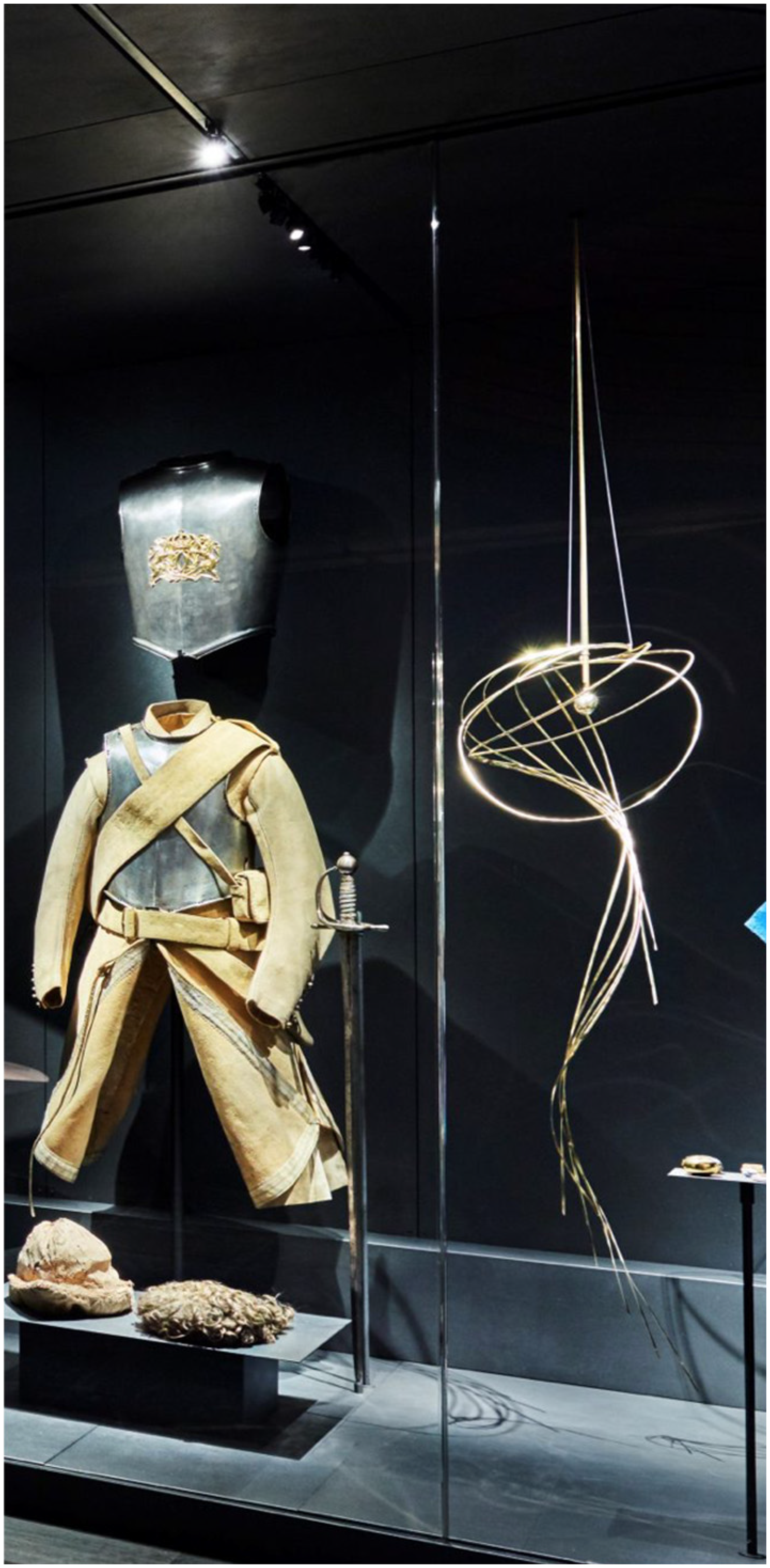
Spiral art to represent the known unknown (Fredengren and Owman).
Different animals are implied in the exhibition, from horses, to ermine, ostriches, and silkworms (Figure 6). The horse body under armour as well as the armoured human form into a cyborg state – both tied together and working apart – co-produced into a more-than-human assemblage. These could be analyzed as counter-clocks that are produced through several relationalities that synchronize in the museum thing. Furthermore, the use of horse armour would imply a disciplining of both the human and non-human body, and the temporal relations implied between humans and animals under training. The other animal bodies were harvested and transferred into goods, such as clothes and fans. The silkworm (Bombyx mori) has been in human service for thousands of years (Chen et al., 2012). They have been domesticated and co-evolved with humans and carry out labour weaving their cocoons. These larvae and cocoons are tended to and cared for by humans that had to pay close attention to and care for their life cycles and metamorphosis. They play a role in several temporal relating's that need to be in place for a silkworm to spin a cocoon. One has to pay attention to when the mulberry leaves are ripe for eating, and how they interlink with the digestive process of these critters. Furthermore, the silkworms die in the process of extracting the silk thread. Their caretakers had to decide on the exact time and date for the death of the particular silkworms that contributed to a particular object in the exhibition, as it was boiled to prevent it from turning into a moth. These silkworms, just as the purpura shells, ostriches and ermines are workers that are woven into the products of display, that also paid for royal garments by their death. Looking at the exhibition from our curious more-than-human perspective we can identify clean cuts between lives worth saving and killable, non-grievable lives, but also instances of violent care. The heart of the king is treasured but no heart of horse, ostrich or rat are to be found. To be handled-with-care is a privilege that is formed around the killing of others. These exotic goods came to the northern locations through temporally coordinated networks of trade and transport. Some of these, like the silk road, had been around for a long time, and the development of steam-engines for transports by boats and trains came later. This is only implied in the exhibition by a board-game but reminds us of the different temporalities implied for those that can pay for smooth journeys through the colonies, contra the time of those that have to go through troubles and remove obstacles for others to move from one point to another.
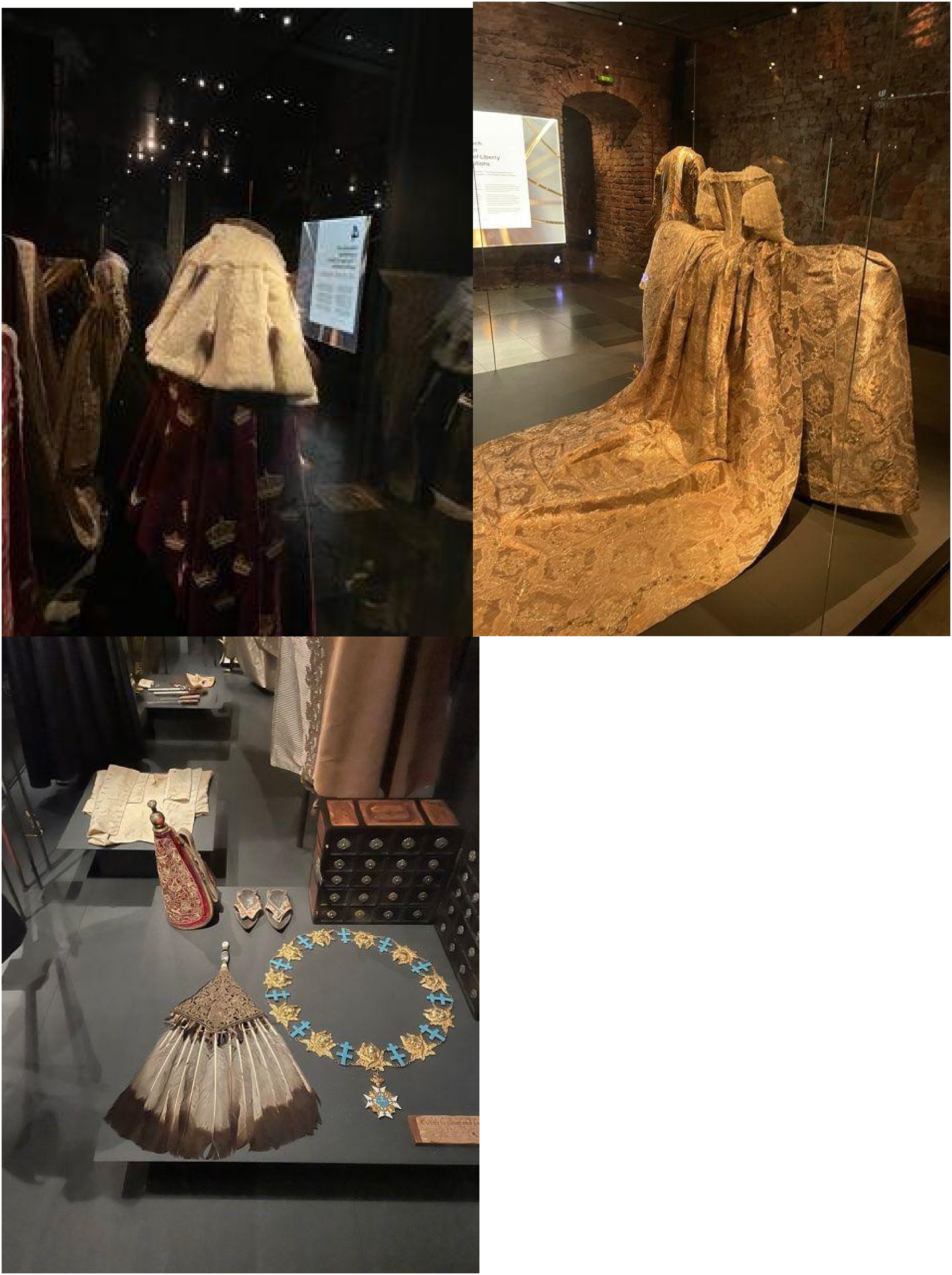
Fur, Feathers and Silk (Fredengren and Owman).
The animals in the exhibition could be ordered in line with how they are perceived by humans: As producers of fabric that are killed as soon as they have supplied their services, as a companion in war that was probably mourned over, or as simple invasive creatures, the most killable of them all. By unleashing the animals from the anthropocentric paradigm their time and agency begin to form new, and maybe more useful, cognitive frames (Owman 2021). From our more-than-human perspective the aforementioned spiraled designs could be almost infinitely multiplied to show and announce the existence of everything and everyone at first glance not visible there in the showcase and that has a relation to the things on display. The spiral design could be portals to extraction landscapes and more-than-human agents. Obviously, they can be found in the museum things on display, and this is what we realize when we begin to unravel or rewind the rhizomatic (invisible) showcased mesh that shows several temporal belongings for museum things. Hence, we must, so to speak, mirror or inverse the visualized story/narrative; instead of with one spiral or another accentuating that a few human figures have been excluded throughout history, we need to show that what actually remains is the true anomaly. In fact, the exhibited objects can be unfolded to show synchronizations with a crowded more-than-human past. Thus, the object loses its given and taken-for-granted function as story-bearing hubs for select periods of human action. Instead, they can be understood as evidence/witness from some shadow places of history, that diffract through the present and into the future. As we have shown, the exhibition ‘500 years of Monarchical Power’ reveals a temporally diverse cacophony of entangled more-than-human temporal relations.
Counter-clocks of care and decay time
Our visit to the museum on a rainy November afternoon, moist in hair and clothing, most certainly catalyzes a specific humidity-related temporal-dance-activity among the objects on display. The visiting bodies and the weather they bring with them interrelates with the museum things. Climate change and weather run through the exhibitions in several ways, and heath, water, and moist stretches through and form relations with the contents of the museum. Not only are the museum cages climate controlled and where moist balancing gadgets being at work to keep the materials stable – but the collections are also co-produced by several weather events. These all play a role in emerging museum ecologies that link up what goes on within the museum box to relationships several environments outside of it and the climatological and temporal agencies of change.
Furthermore, there is a lot of care time that has gone into the production, as in all the hands that have gone into crafting metalwork, textile, cloaks, and items. At the same time, a lot of care work of the collections takes place and is needed to prevent them from degradation through conservation, so they can be there for future generations. Taking care of things, both human and non-human, requires a certain amount of time around which ethical negotiations are woven, most obviously when for various reasons efficiency is sought for. Ethics are also tightly connected to the making of the things that eventually end up in the care and conservation of museum objects. Care, time, and ethics are intertwined and undercurrent at all levels in society and Puig de la Bellacasa reflects on ‘how care time entails ‘making time’ to get involved with a diversity of timelines (…) that make the web of more than human agencies’ (Puig de la Bellacasa 2017: 171). Hence, as soon as we focus on different so-called agents of deterioration the neat order of things, times, and human narratives, even the museum building itself starts to dissolve and tilt.
Were we to arrange the exhibition according to some possible alternative (for example material) temporalities, first of all we would have to divide the objects into groups following their relational tendencies, their movement, and rates of decay. Such arrangements would challenge a chrononormative ordering and highlight the lasting of different museum things. Their lasting is dependent on which other agents they form relations with. The collections ‘are permanently impermanent; they are characterized by relative duration, rather than by snapshots of a reality punctuated by the illusion of material authenticity’ (Hölling 2017: 7).
The museum things are engaged in a slow, temporal, and environmental, relational dance that inevitably changes the object as a whole. Hence these museum things are not at all dead and gone. They are in fact more alive than dead: existing at different rates of decay, and on their way to becoming something else. Precautions would differ if we were to handle them due to what chemicals they were treated with and which chemicals we ourselves secrete. And at what speed does the silk of the fabric deteriorate given the interaction dust from the concrete walls, the humidity, the light, the way it is handled and so forth? If one cares to tune in with these ongoing processes, there are several more-than-human counter-clocks in the museum collections. Their pace of decay tells the time of climate change. The parameters multiply from each and every object, which in turn can be traced to other objects, matters, individuals, temporalities. They correlate and synchronize their dance behind the back of the humanly imposed timelines.
A sun-bleached little shirt in the exhibition catches our attention both rolling out the interaction between sunlight, heath, and textile deterioration and an unexpressed narrative of a child outdoors in the sun. Or was the wardrobe of this child for some reason being exposed to the sunlight, by accident, of neglect or why? The simple fact that it is the same sun that touched us earlier today, before the rain came, that shone upon this shirt, this child, this life, is almost uncanny, and evokes a feeling of a tightening timeframe. We are all in it – climate change run through the museums and entangle with museum things, increasing the need for indoors climate control. Furthermore, recent flooding and weather events make themselves known in the collections, as portents of futures to come. They require action with a view on several future generations of care (and possibly also the decommissioning of some artefacts) that an environmentally conscious museum can communicate: these omens of ongoing change.
Undercurrent temporal relations and counter-curation of museum things
Our relational temporal analysis of the exhibition ‘500 years of Monarchy’ has identified how museum things can be read as counter-clocks. It also shows various ways it can be counter-curated to welcome the several eco-temporally situated, more-than-human agencies that are at work in the exhibition and in the collections. As suggested above there are many ways in which the politics of temporal design in museums can be discussed, and how a standard exhibition of human history and linear time-telling can be re-curated to unfold undercurrent temporal relations. In the exhibition, there are several living things that entangle in numerous ecologies that bring their own forms of time, rhythms of decay and synchronize with other agents of change (compare Rose 2012: 128). As shown, there are a number of temporal environmental relations that lie undercurrent in the materiality, in the displays and the collections. While the exhibition has the spiral art that represents important gaps in the collection with regards to royal history – it could potentially also serve to highlight the masses of human and more-than-human others that co-relate in the production of these remains, or the unruly temporalities moist or dryness of climate change as discussed in this paper. The museum things we have investigated here can be acknowledged as counter-clocks that tie relations with several past-present-futures. Like Pschetz and Bastian (2018) underlines there is an urgency in our environmentally challenged time to start tuning in to counter-clocks and to acknowledge more-than-human agencies as well as non-anthropocentric temporalities. One of the museum's counter-clocks shows for example the tensions between fantasy-time of royalty that must be underpinned by several other subdued temporal arrangements. Other museum counter-clocks in this exhibition reveal the labour of non-human animals that have gone into the production of royalty. Furthermore, the collections form temporal relations with several agencies of environmental change.
It is clear in our unfolding of the ‘500 years of Monarchical Power’ exhibition that there are several queer temporalities under the surface of the chrononormative displays. There is a vast potential in exhibitions and in the museum at large when the order of objects is expanded upon. The move beyond understanding museum objects as permanent, single-period things, as witnesses of the past during a particular period and foremost as evidence of human activities open up for other histories that are environmentally entangled. The original linear ‘snapshots’ in the exhibition, we insist, are the anomalies in the museum, as they are illusions of temporal design that are kept in place through extensive measures of curatorship and conservation. Such illusions can be found in numerous museums around the world.
It must be emphasized that museum exhibits are facilitated by a considerable apparatus of care work carried out by conservators, where time is devoted to preventing decay. Just as Rubio (2016) points out it takes a lot of work to keep fragile museum things stable over time.
At the surface level the museum objects’ clocks of decay may seem to have stopped, but their materials keep synchronizing at deeper levels with other agents, events, and actions in their surroundings (moist, microbes, heath etc). The objects, just like all the worlds outside of the museum, are instead ‘permanently impermanent’, and this is one of the many challenges we face today: how to accept, understand and relate to change that is enforced not only by human agency. As the museum objects constantly bind new temporal relations – these clocks do not stand still. The museum things form relations with moist, light, and other agents of decay. Furthermore, museum conservators and others that handles museum things are all immersed in, as Puig de la Bellacasa (2017) frames it, a ‘diversity of timelines’ stretching through past-present-futures. They are also entangled in a variety of temporal care relations when the objects are tended to, both when on display in exhibitions, and when in storage.
A variety of portents of climate change, from shadow places and ecologies, but also moist, weather and climate change, run through the museum things and can be brought in from the shadows of human history and linear time. This would connect us to aspects of times that we urgently need: to understand ‘our time’ and to make us more aware and prepared for times to come. If museum things are used as ‘counter-clocks’ they can, as shown in our encounter with the exhibition, assist in drawing attention to several issues of equality, ethics, and power. As evidenced in our case study ‘500 years of Monarchical Power’ there are numerous such power relations at play. They may open up to discussion and actions where temporal webs of relations could be tied differently. This is important for museums that want to take an active role in dismantling and retelling stories of the past/present/future. This enhanced timely awareness of other living things, as well as other aspects of the environment, plants, bacteria, fluctuations of light and temperature, as well as this openness to our interconnectedness, makes way for new perspectives and practices in the museum. We can in fact, as it already is, never forget about weather, climate, animals, bacteria, because if we turn our backs on them, the museum will inevitably turn into something far from our intention.
The museum things are temporally queer knottings of a myriad of co-relations of human- and more-than-human agents that make them come into place and gape out for forming other relations, be they so with different conservator substances and/or climate and future generations. The objects we encountered in the exhibition do this through synchronizing and co-becoming with visitors, changes in climate, moisture or temperature that run through their physical bodies, or in the ways they will be subject to care from future generations. This resonates with Fiona Cameron's (2015) observations that relics from modernist thinking, such as the anthropocentric and dualistic worldview, are still active in museum contexts. However, there are ways in which museum exhibition could be curated differently. To move into a curatorship of time that acknowledge museum things as material, ethical, ecological temporal, material and relational phenomena, there is also a need to make sense of all the impressions that overflow and pass through us at every instant of our lives. By arranging, naming, categorizing, generalizing, and staging delimited pieces of ‘reality’, a world can be made comprehensible, but at the same time it is narrow (-minded) and locked into definitions. This is how the museum-medium works, but in all the museum's expressions there are also several possibilities that lie resting in its shadowy sides, the pushbacks, the excluded, and the indefinable. There are emerging realities that come to surface for the curator, in occurrences that no longer match the map, such potentialities of alternative temporal designs emerge, or messy agents show up as omens of climate change and unfavourable human-animal relations, that can be picked up and welcomed in. What if we were to exorcise what resides in the shadows, call forth the museum's non-natural culture and non-cultural nature; that which we lack words for, only vaguely can perceive, that which we do not yet know and will never be able to master?
Conclusion
There are numerous potentialities of counter-curation also within classical tempo-linear exhibitions, as the one analyzed here, for a more environmentally conscious way to curate time. Our affirmative provocation suggests a curatorship that acknowledges the range of more-than-human material and immaterial actors and relations in the formation of new types of museum ecologies. This is however hinged on different understandings of museum things, where they are acknowledged as bundles of temporal ecological relations, constantly in the making. By making alternative ecological temporalities visible, analyzing these things as counter-clocks, more-than-human agents emerge in the museum exhibitions. Hence, through such an intervention a livelier museum appears, which allows the visitor to connect to the more-than-human worlds of the Anthropocene and beyond. And what better is, it is right there in front of us, ready to be articulated. Hence, the museum that might be helpful in society's much-needed climate change transitions is not about inventing new stuff, but rather about a shift in perspective, or mindset.
We have shown how more-than-human temporalities, and with them alternative agencies, are reduced or even muted in the museum leaving vast realms of vibrant life under articulated or invisible, and in this way creating a false illusion of a world where only humans act and react, live, and die and where museum things exist forever, outside the passing of time. Here, in our case study several human-animal temporal relations are so to say hidden I plain sight. Furthermore, these remnants are obstacles if we are to understand the world, through the museum, as entangled, relational and in constant transition. Moreover, modernist remains in museum practices, may impinge, and hinder us at a deeper, cognitive level; in trying to make sense of a complex world by organizing time. When time is placed in neat boxes and separate rooms, we might have created an even more incomprehensible picture of it. Here we will conclude by returning to the question of why it is of importance to explore time in the museum, and how this connects with wider ecologies and environmental questions.
As many of our critical time allies (Bastian 2012: 25; Huebener 2018) argue it is important to clarify how particular social arrangements work and synchronize and to highlight how temporal relations with several other things or beings work. This is of importance also in museum settings, particularly as such institutions are major social institutions that work with time and temporal design. Furthermore, a more time-conscious curatorship could be an inspiration for other ways of both imagining time and for acting on environmental change in time. For museums, it is also important to clarify how they operate in temporal politics and to work out both what temporal relations are in place, but also open for other ways that temporal relations can be tied and witnessed.
In order to be able to reflect upon and promote alternative future perspectives the prevailing and very thin timeline in museums in general has to be broadened so that it encompasses a wider range of temporal diversities. To highlight that there are several alternatives for how to curate time our study has tried to show such portents that are telling the time of futures to come and histories in the making. Notably, when it comes to curated exhibitions and educational programmes, human time scales are in focus, but behind the scenes or under the surface of these civilized time frames, large and complex, living, and pulsating networks of ethical temporal relations are woven into the museum. The building itself, the collections, the stands and the scenography, the air, the light and the humidity, tremble and vibrate. In time or out of time, synchronized or as anachronisms, the visitors and those who work in the museum – whether they are employed or not, human, or non-human, examine or digest the museum's materialities – everything and everyone oscillates. This paper has examined the queer relational temporalities of materiality in museum collections.
We have revealed networks of relational correlation across human-animal-nature boundaries that form the complexities and power formations under which for example the exhibition of the monarchs has come about and how it projects into a variety of futures. Such a move may counteract the wedges driven between a number of human and non-human others, nature, and culture, where otherwise such binaries may also be transplanted into museum collections, curatorship, and exhibition-making. This, in order to aspire towards a more affirmative curatorship that enfolds life, death and decay in better ways that consider more-than-human intragenerational justice and care. Curating alternative temporalities within the museum is connected to presenting alternative agents that in different ways manifest and make temporal relations, that also inform on counter-times as compared to industrialized times. In doing this the museum's connection between time and space is problematic (as can be seen clearly in the exhibition): That time is understood as delimited units/ rooms, which locks our gaze to other manifestations (or in other words) of time. Curating time differently may expand outside of the museum where it now is more obvious that not only humans but multiple agents act in and through the Anthropocene: a new awareness that time-agents consist of infinite more-than-human entanglements that we can/should no longer try to hold together and delimit as ‘space’ or ‘human intention/action’. It is about time we uncover the museum's alternative timelines and show how museum things synchronize with the environment.
