




Abstract
Individuals commonly report feeling rushed in industrial societies such as the United States. However, social and economic upheavals such as disasters, recessions, and pandemics complicate perceptions of time by disrupting routines and creating experiences of trauma. In existing research, time perceptions usually are studied separately, leaving unclear how individuals in the United States might experience time in multifaceted ways while working, caring, and grieving. Moreover, previous research has not established whether multifaceted time perceptions each carry independent influences on mental wellbeing, or how they are shaped by sociodemographic background or pandemic-related stressors. Drawing on national Gallup data collected during the COVID-19 pandemic (Spring 2021), we find that Americans generally report some degree of feeling rushed, and also perceive multiple types of time disorientation involving slowness, quickness, and days and weeks blending together. Perceptions that time is moving too quickly or too slowly show an inverse relationship, as expected. Feeling rushed and that days or weeks are blending together also show relationships with both of these perceptions over a 3-month recall period. Importantly, we find that each of these time perceptions is shaped uniquely by income, work hours, age, or having children at home, and that each matters for understanding levels of depressive and anxiety symptoms and overall sense of mastery or control in life. Pandemic-related stressors, including economic strain, working from home, homeschooling a child, and severe household conflict, also show considerable relationships with these multifaceted time perceptions.
Introduction
The rapid pace of life in postindustrial society often is accompanied by the experience of feeling rushed (Agger, 2011; Rosa, 2013; Giddens, 1991; Harvey, 1999). Feeling rushed is itself a complex experience, involving the perception of different tempos attached to activities, days, and seasons (Bo, 2020; Flaherty, 2022; Zerubavel, 1982; Thompson, 1967). In the United States and other high-income nations, the COVID-19 pandemic introduced time-related stressors of working from home, homeschooling, caring for others, and all the potential household conflict this entails against a backdrop of increased social isolation (Wessels et al., 2022). These stressors amplified the situational demands of an already intensified work culture marked by long hours across the socioeconomic spectrum (Lamont, 2019) and schedule inflexibility especially within the working class (Schneider and Harknett, 2019).
While researchers of time perceptions have long noted that public health emergencies and other social upheavals alter how we experience the passage and availability of time (Restubog et al., 2020; Roeser, 2012; Taylor, 2020; Zimbardo and Boyd, 2008), the COVID-19 pandemic represents a vital opportunity to revisit a fundamental, longstanding question in the literature: how common are different time perceptions, and how are these different time perceptions related to each other? In particular, while the perceptions of time moving slowly or quickly are commonly studied, it is less common to place these into the context of feeling rushed or that days blend together, which are other important components of temporal disorientation (Chaumon et al., 2022; Kosak et al., 2022; Velasco et al., 2022a, 2022b). Here, we analyze these time perceptions not only in terms of their frequency, but also in terms of how they relate to each other and vary across individual backgrounds and experiences of pandemic-related stress.
In addition to offering a detailed characterization of multifaceted time perceptions during the COVID-19 pandemic, we revisit another question in the literature: how do time perceptions relate to mental wellbeing? Although it is well-established that perceptions of slowed time relate to depression and various forms of stress including social isolation (e.g. Kosak et al., 2022; Wessels et al., 2022; Velasco et al., 2022a), relationships to sociodemographic background and to specific forms of pandemic stress in a US context remain less clear. Also, this research has not unraveled how these disorientations relate to mental wellbeing net of each other. This is important due to the fact that individuals often experience varying degrees of disorientation across a given time span, leading to complex overall associations with mental wellbeing. Public health emergencies such as epidemics or natural disasters typically are mental health crises as well, where deteriorating mental health can be observed in terms of distress, anxiety, or feelings of hopelessness (e.g. Benevolenza and DeRigne, 2019; Cai et al., 2021; Howell and Elliott, 2019). We investigate whether and to what extent these mental health inequalities can be traced to diverse time perceptions that vary within and across sociodemographic backgrounds in the United States during the COVID-19 pandemic.
Background
Perhaps one of the most common subjective experiences in modernity is the feeling of being rushed or pressed for time. Modern, “digital capitalist” societies are particularly vulnerable to work and family norms influencing feelings of time scarcity (Wajcman, 2015). Objective clock time differs from perceptions of time's passage, such as feeling rushed.
Time perceptions are shaped by routines, work hours, and family and social life within industrial society, making them patterned by demographic background. For instance, feeling rushed is related to age, gender, race, socioeconomic status (SES), social support, familial and neighborhood characteristics and physical health status (Adam, 2006; Bo, 2022; Hunt et al., 2008; May and Thrift, 2003). The aged, marginalized, and those lower on socioeconomic, gendered, and racial hierarchies tend to have less access to potentially time-saving resources, technological devices, and to efficient transportation (Tranter, 2010). These factors influence their time availability, thus framing their sense that time is rushed (Bo and Dukhovnov, 2022; Mullainathan and Shafir, 2013). In turn, perceptions that one lacks time can be detrimental to both individual and social wellbeing (WHO, 2020; Hamermesh, 2019; George, 2014; Clawson and Gerstel, 2014; OECD, 2013).
Yet, how time seems to pass also can be a matter of social circumstance (Flaherty et al., 2005). During times of sadness or trauma, we are more likely to perceive time as passing slowly due to a compromised outlook of the future that influences how we view the present as saturated (Buonomano, 2017; Holman and Grisham, 2020). Indeed, early research into time perceptions during COVID-19 suggests a slowed sense of time, which itself has been linked to boredom and depressive symptoms (Frederiksen, 2013; Droit-Valet et al., 2021). Both perceptions of time moving “too quickly” and “too slowly” qualify as subjective time disorientations because the individual is indicating that their experience of the passage of time is not meeting their expectations concerning how time should be “normally” felt (i.e. a deviation from felt synchronicity between objective and perceived time; Flaherty et al., 2005). That is, while feeling rushed is a typical measure of time perception, we explicitly focus on time disorientations of slowness, quickness, and blending of days as ways of capturing a disoriented sense of time.
Particularly during times of social upheaval, such as the COVID-19 pandemic, we expect that days and weeks may contain complex and varied activities that are disparate in their social natures. For instance, time can seem to pass relatively quickly during periods of rapid social or political change, due to being busy or anxious about social unrest (Flaherty et al., 2005). Likewise, implementation of new work or social routines is expected to lead to different subjective experiences of time (Ekerdt and Koss, 2016). Recent, small-sample evidence from Uruguay suggests that the blurring of time and the slowing of time are experienced together, at least during the COVID-19 pandemic (Loose et al., 2021). In addition to shaping time perceptions, the particular changes that individuals face determine their objective time availability for different activities. Consequently, we turn to objective measures of time to see how they relate to time disorientation.
Objective time scarcity: The central importance of work and family commitments
While time perceptions vary with social circumstances, hours of the day induce constraints on activity regardless. Given the typical occurrence of work hours during the daytime, many researchers have operated on the premise that allocation of time across work and nonwork commitments such as family is zero-sum (Strazdins et al., 2011; Williams et al., 2016). By extension, number of hours spent at work—especially abnormally long hours—can itself be considered a measure of time scarcity or time poverty when it comes to remaining time left for nonwork commitments over the span of a day. Building relationships with and providing support for children, partners, and friends requires considerable hours (Strazdins et al., 2011). This is before considering any restorative time spent alone. In summary, time researchers often consider how time perceptions relate to but also differ from objective time scarcity.
This body of literature also highlights that SES (measured by income, education, and occupation) shapes time scarcity. In particular, SES influences both how much time different individuals have and how much discretion they have with how they spend their time (Hamermesh, 2019; Clawson and Gerstel, 2014). Relative to lower SES individuals, higher SES individuals can afford time-saving resources and partake in a wider variety of activities, which supports their greater happiness and wellbeing levels (Hamermesh, 2019; Mullainathan and Shafir, 2013). We know that workers’ ability to control their schedules enhances wellbeing, and schedule control and stability is far more common among salaried jobs relative to hourly wage jobs (Moen et al., 2013; Schneider and Harknett, 2019). A “stress of higher status” perspective counterargues that schedule flexibility within higher-paying jobs is associated with increased performance expectations, which serve to dampen some of the mental health benefits of schedule control (Badawy and Schieman, 2021). Family commitments in the United States are shaped by how work–family balance can be influenced profoundly by employers in the United States, since the federal government does not provide for widespread work flexibility or paid leave mandates for parents, except in states such as California and Massachusetts (Andersson et al., 2021; Lee et al., 2020).
To summarize, both socioeconomic status and number of work hours are key considerations in structuring time perceptions as well as overall mental wellbeing. While outside the context of a global pandemic we might expect that long work hours would lead to a sense of feeling rushed due to the compression of nonwork activities, changes in work routines during the pandemic have been related to upending hourly work schedules, homeschooling children, and working from home, leaving unclear whether total work hours would hold the same relationship to feeling rushed. Moreover, while SES would typically provide flexible resources mitigating against time pressure, these same pandemic-related changes may have muted the power of SES for many if not most workers.
Even outside a pandemic, working parents report “felt deficits” in time spent with family (Berghammer and Milkie, 2021; Milkie et al., 2019). Parents often report feeling rushed and that time is moving quickly rather than slowly, relative to nonparents (Musick et al., 2016). Meanwhile, the varying demographic backgrounds of parents shape their work–family conflict and relative availability of spousal or workplace support (Bianchi et al., 2006; Bittman et al., 2003; Chen et al., 2021; Craig, 2006; Flood et al., 2020; Greenstein, 2000; Milkie et al., 2010; Sanchez and Thompson, 1997).
Hypotheses
In this study, we draw on national Gallup survey data collected in the United States in early 2021. These data provide four different measures of subjective time experience amid the COVID-19 pandemic. They are (1) feeling rushed and pressed for time, (2) feeling that time passes too quickly, (3) feeling that time passes too slowly, and (4) feeling that days and weeks blend together. We hypothesize these time disorientations will logically be related in the following ways: Hypothesis 1: Increases in feeling rushed will be positively associated with increases in feeling that time moves too quickly.
Hypothesis 2: Increases in feeling rushed and feeling time moves too quickly will be negatively associated with increases in feeling that time moves too slowly.
Because the feeling that days and weeks are blending together indicates a general sense of disorientation, we expect that it may be related to all forms of time disorientation. Therefore, Hypothesis 3: Increases in feeling rushed and feeling time moves too quickly as well as increases in feeling that time moves too slowly will all be positively associated with increases in feeling that days and weeks are blending together.
Also, given well-established associations between subjective time perceptions and mental health, we hypothesize: Hypothesis 4: Increases in feeling rushed, feeling time moves too quickly, feeling time moves too slowly, and feeling that days and weeks blend together will all be negatively related to mental well-being.
Finally, we are interested in how time disparities and COVID-19 stressors are related to time disorientations. First, we test the extent to which work hours and caring for children at home—both measures of objective time scarcity—relate to time disorientations. Hypothesis 5: Increases in feeling rushed and feeling time moves too quickly will be positively associated with time scarcity, while increases in feeling that time moves too slowly will be negatively associated with time scarcity and increases in feeling that days and weeks blend together will not be associated with time scarcity.
Then, we test whether certain stressors brought about by the COVID-19 pandemic, such as working from home, homeschooling children, caring for a relative, and financial setbacks, increased time disorientations. We expect the following: Hypothesis 6: Increases in feeling rushed, feeling time moves too quickly, feeling time moves too slowly, and feeling that days and weeks blend together will all be positively associated with COVID-19 stressors.
These expectations indicate that time scarcity might only be related to feeling rushed but that general stress brought about by the pandemic will be associated with every kind of time disorientation. In this way, life changes brought about by the pandemic may distort time perceptions generally and not necessarily in one direction.
Methods
In this study, we draw on a recent, national US dataset collected in spring 2021. The Values and Beliefs of the American Public Survey was conducted from January 27 to March 21, 2021 by the Gallup Organization. This survey offers a random sample of adults in the United States aged 18 or older. Gallup randomly selected individuals to participate using an address-based sample frame. Gallup mailed a self-administered questionnaire to 11,000 randomly selected households living in all 50 states and the District of Columbia. The paper survey instrument was a 16-page booklet, printed in black and white. Respondents were allowed to respond to the survey on paper or via a web link. The web survey was accessed via the survey URL and by entering the unique respondent ID. Sixty-three percent of surveys were completed via paper and 37% were completed via web. Surveys were conducted in English and Spanish. The final response rate, using the AAPOR1 calculation, was 11.3% (n = 1,248). This final sample is analyzed in multivariable analyses using Gallup-provided post-stratification weighting to help correct for unequal selection probability and nonresponse biases.
Wellbeing measures
Mastery
We assess a sense of mastery or control by taking into account four related items: “I have little control over the things that happen to me,” “There is really no way I can solve some of the problems I have,” “I often feel helpless in dealing with problems of life,” and “I can do just about anything I really set my mind to” (1= “strongly disagree” to 5 = “strongly agree”; similar to Mirowsky and Ross, 2007). All items except the latter are reverse-scored (alpha = .72; items averaged).
Depressive symptoms
We constructed a depressive symptom index based on items from the Center for Epidemiologic Studies—Depression Scale (Radloff, 1977), asking respondents how often (1 = “Never “; 4 = “Most or all of the time”) each of the following was true during the past week: “I felt depressed” and “I felt sad” (alpha = .85; items averaged).
Anxiety symptoms
Finally, we considered anxiety symptoms, in terms of “I worried a lot about little things,” “I felt tense and anxious,” and “I felt restless” (similar to Cockerham, 1990, Kessler et al., 2002; alpha = .83; items averaged).
Subjective and objective time measures
Subjective time perceptions or disorientations
The Gallup survey asked respondents about four distinct ways of perceiving time. For these items, respondents were asked to consider “In the past three months, how often did you feel that”: “You were rushed or pressed for time,” “Time seemed to pass too quickly,” “Time seemed to pass too slowly,” and “Days and weeks seemed to blend together” (1= “never,” 2= “rarely,” 3= “sometimes,” 4= “often,” 5= “always”; e.g. Loose et al., 2021; Martinelli et al., 2021). In our analysis, we take an item-specific approach due to differing conceptual and psychological relationships to time suggested by these items.
Objective time scarcity
We calculate the potential for objective time scarcity using two items, one which asks “How many hours did you work last week?” and “How many children under the age of 18 currently live in your household?” We create hour-based categories to distinguish nonlinear effects of overtime work hours in terms of their relation to probable time shortage or scarcity (Strazdins et al., 2011; Williams et al., 2016). The work hours variable is therefore sorted into the following categories: 0–9, 10–29, 30–49, 50–59, and 60 h or more. The child at home variable indicates whether one or more children aged under 18 live in the household. We also adjust for the overall number of children that a respondent has, to additionally capture nonresidential or nondependent children.
Pandemic-related stressor measures
Financial hardship during the pandemic is assessed by a series of questions. Respondents were asked, “As a result of the COVID-19 pandemic, have you lost your job, missed house or rent payment(s), been evicted, or received a pay cut?” Those who answered “yes” to any of these were coded as experiencing financial strain during the COVID-19 pandemic. In addition, responses to the question, “Which of the following best describes your ability to get along on your income? (1) always have money left over, (2) have enough with a little extra sometimes, (3) have just enough, no more, and (4) can’t make ends meet” were used to identify additional respondents experiencing financial strain. Those who said they had just enough money or could not make ends meet also were coded experiencing financial strain during COVID-19.
Other stressors during the pandemic included “worked from home,” “homeschooled a child,” “cared for an elderly or sick relative,” and “had a serious conflict between the people living in your home” (0 = never, 0.25 = rarely, 0.5 = some of the time, 0.75 = much of the time, or 1 = all of the time). Loneliness is captured by whether the respondent felt lonely during the COVID-19 pandemic, “compared to your life before” (0 = less often, 0.33 = about the same, 0.67 = a little more, 1 = much more often). Finally, respondents were asked whether they had “been infected by COVID-19” (1 = yes) or “lost a close relative or friend to COVID-19” (1 = yes).
Background variables: Socioeconomic status, work hours, parenthood, and demographic characteristics
Socioeconomic status is measured in terms of level of education, which is specified as highest degree attained, and last year's household income, which is midpoint-imputed within broad survey question brackets capped at $150,000 or higher (top-coded at $175,000). Respondents reported how many hours they worked last week, which we categorize into <10 (less than part-time), 10–29 (part-time), 30–49 (full-time), 50–59 (full-time, overwork), and 60+ (full-time, overwork). Parenthood is assessed in terms of how many children a respondent has as well as whether they have any children under the age of 18 living in their household.
To assess demographic background characteristics, age is measured in years; current marital status is indicated, as is living with a partner (yes or no). Race is treated as self-identification as white, black, Hispanic, Asian, or American Indian/Alaska native. Urbanity is queried on a four-point self-reported scale ranging from “a large city” or “a suburb near a large city” (classified as urban) to “a small city or town” (used as reference category) or “a rural area” (classified as rural). Finally, any physical limitation is based on having “a physical health problem that limits the kind or amount of activity you can do” (yes or no).
Analytic strategy
We begin our analysis by examining the correlations among multifaceted time perceptions or disorientations. Tests of significance for these correlations are used to evaluate hypotheses 1–3 concerning how perceptions of slowness, quickness, feeling rushed, and days/weeks blending together are related to each other. Negative correlations are consistent with perceptions being less likely to co-occur, while positive correlations denote more likely co-occurrence, and insignificant correlations point to no relationship either way.
Next, we examine subjective time disorientations as they relate to mental wellbeing. To do so, we implement multivariable regression analyses. We take a multivariable approach in order to characterize the independent or net relationships of each time disorientation to mental wellbeing, controlling for socioeconomic status, work hours, parenthood, and demographic characteristics. Doing so allows us to isolate time perception processes from objective processes of time scarcity related to work and family commitments and the socioeconomic resources available for navigating them. The coefficients of time perceptions within these regression models are used to evaluate hypothesis 4, concerning whether time perceptions and disorientations are related to diminished mental wellbeing.
Hypothesis 5 is evaluated by a separate set of regression model results. In particular, the associations of work hours with time perceptions or disorientations are tested using regression coefficients, where each subjective time measure is given a separate model to understand the particular scarcity and demographic patterns related to that given perception or disorientation.
Finally, hypothesis 6 is evaluated using bivariate regression analysis, where each time perception is associated with individual pandemic-related stressors. Tests of significance for these coefficients are used to evaluate hypothesis 6, where a positive coefficient indicates that a perception or disorientation becomes more likely given exposure to a particular stressor.
Regression parameters are estimated in Stata 17.0 by full-information maximum likelihood (FIML), which is an optimal procedure for dealing with missing data that is asymptomatically equivalent to multiple imputation. FIML uses all available data from each case to estimate model parameters. Use of unstandardized coefficients enables results to be interpreted in terms of unit changes in predictor or independent variables.
Results
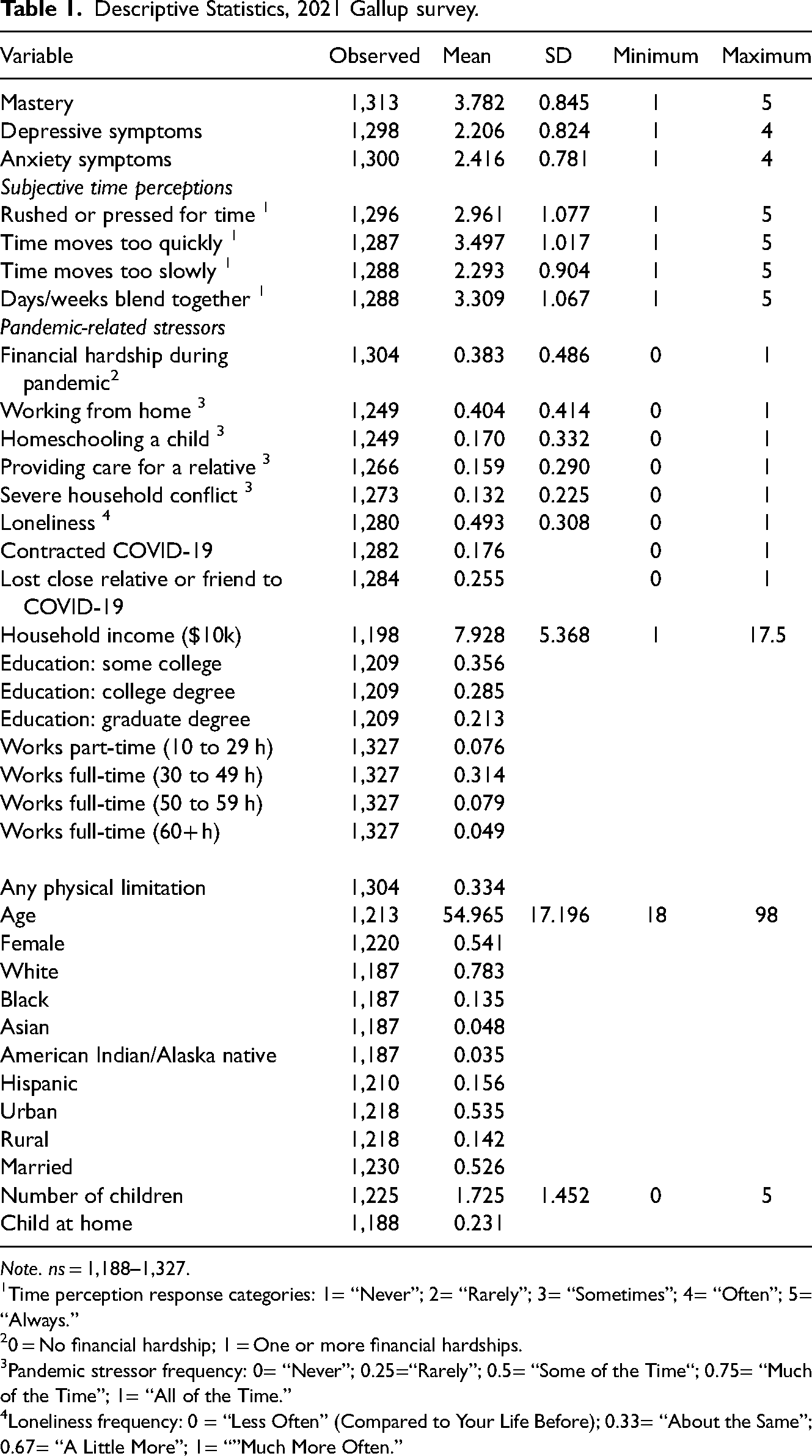
Table 1 gives a descriptive overview of the national Gallup data that we use for our analysis. Perceptions of feeling rushed or pressed for time, of time moving too quickly, or days and weeks blending together over the past 3 months are common across the entire sample, averaging around “sometimes” (i.e. 3 on a 5-point scale), while feeling that time was moving too slowly was a bit less common over the past 3 months, averaging around between “rarely” and “sometimes.” Pandemic-related stressors were fairly common, ranging from 13.2% (serious household conflict) to 25.5% (lost close relative or friend to COVID-19) to around 40% (financial hardship or working from home). In terms of time scarcity, 31.4% worked 30 to 49 h per week, while over 10% worked at least 50 h (50–59 h = 7.9%, 60 + h = 4.9%). The obtained sample is somewhat higher on education and income than the American population more generally (average household income is about $79,280 [SD=$53,680], and about two-thirds of the sample possesses at least some postsecondary education). Below, in our multiple regression analyses, we enhance the representativeness of our conclusions by implementing the Gallup provided post-stratification survey weight, which reweights the sample to bring it closer to being nationally representative.
Descriptive Statistics, 2021 Gallup survey.
Note. ns = 1,188–1,327.
Time perception response categories: 1= “Never”; 2= “Rarely”; 3= “Sometimes”; 4= “Often”; 5= “Always.”
0 = No financial hardship; 1 = One or more financial hardships.
Pandemic stressor frequency: 0= “Never”; 0.25=“Rarely”; 0.5= “Some of the Time“; 0.75= “Much of the Time”; 1= “All of the Time.”
Loneliness frequency: 0 = “Less Often” (Compared to Your Life Before); 0.33= “About the Same”; 0.67= “A Little More”; 1= “”Much More Often.”
Correlations among time perceptions and disorientations (hypotheses 1, 2, and 3)
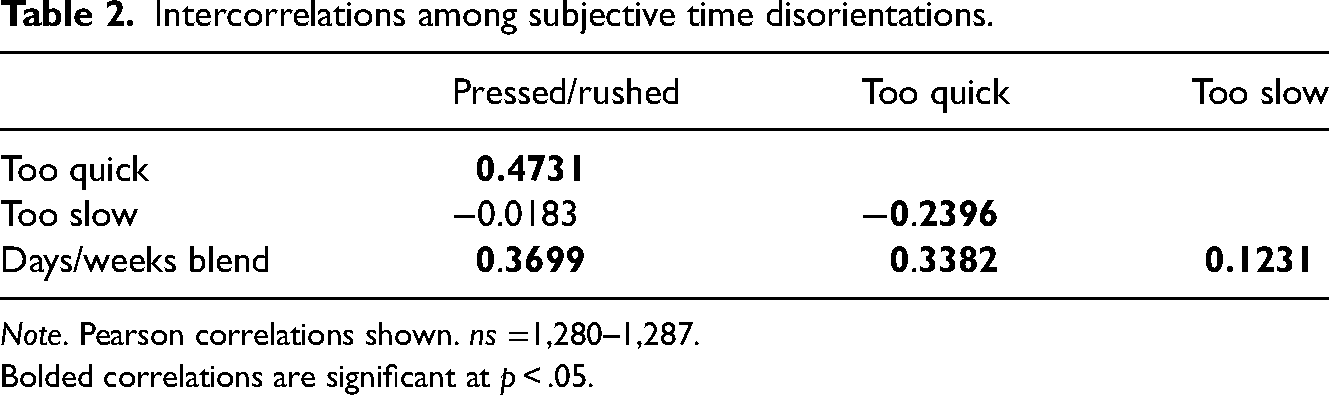
Table 2 displays correlations among subjective time perceptions. Unsurprisingly, feeling rushed and feeling that time moves too quickly are positively correlated (r = 0.4731, p < .05), providing support for hypothesis 1. Time moving slowly shows varying relationships with the other items (r = −0.0183 with feeling pressed/rushed, ns; −0.2386 with time moving too quickly, p < .05; 0.1231 with days/weeks blending together, p < .05). Hypothesis 2 is supported by the finding that feeling that time moves too slowly is negatively correlated with time moving too quickly; however, as reported above, no significant relationship is found between time moving slowly and feeling rushed. Speaking to contradictory, simultaneous experiences of time, feeling that days and weeks blend together is positively related to feeling time is moving both too quickly (r = 0.3382, p < .05) and too slowly (r = 0.1231, p < .05). Together, these correlations attest that both fast and slow time disorientations may result in a loss of clear demarcations between days and weeks, supporting hypothesis 3. These findings also suggest that logically contradictory time disorientations may or may not actually overlap in subjective experience, in that a person could feel time moving too quickly during certain days or weeks and then moving too slowly in other days or weeks, for example.
Intercorrelations among subjective time disorientations.
Note. Pearson correlations shown. ns =1,280–1,287.
Bolded correlations are significant at p < .05.
Mental wellbeing and time perceptions/disorientations (hypothesis 4)
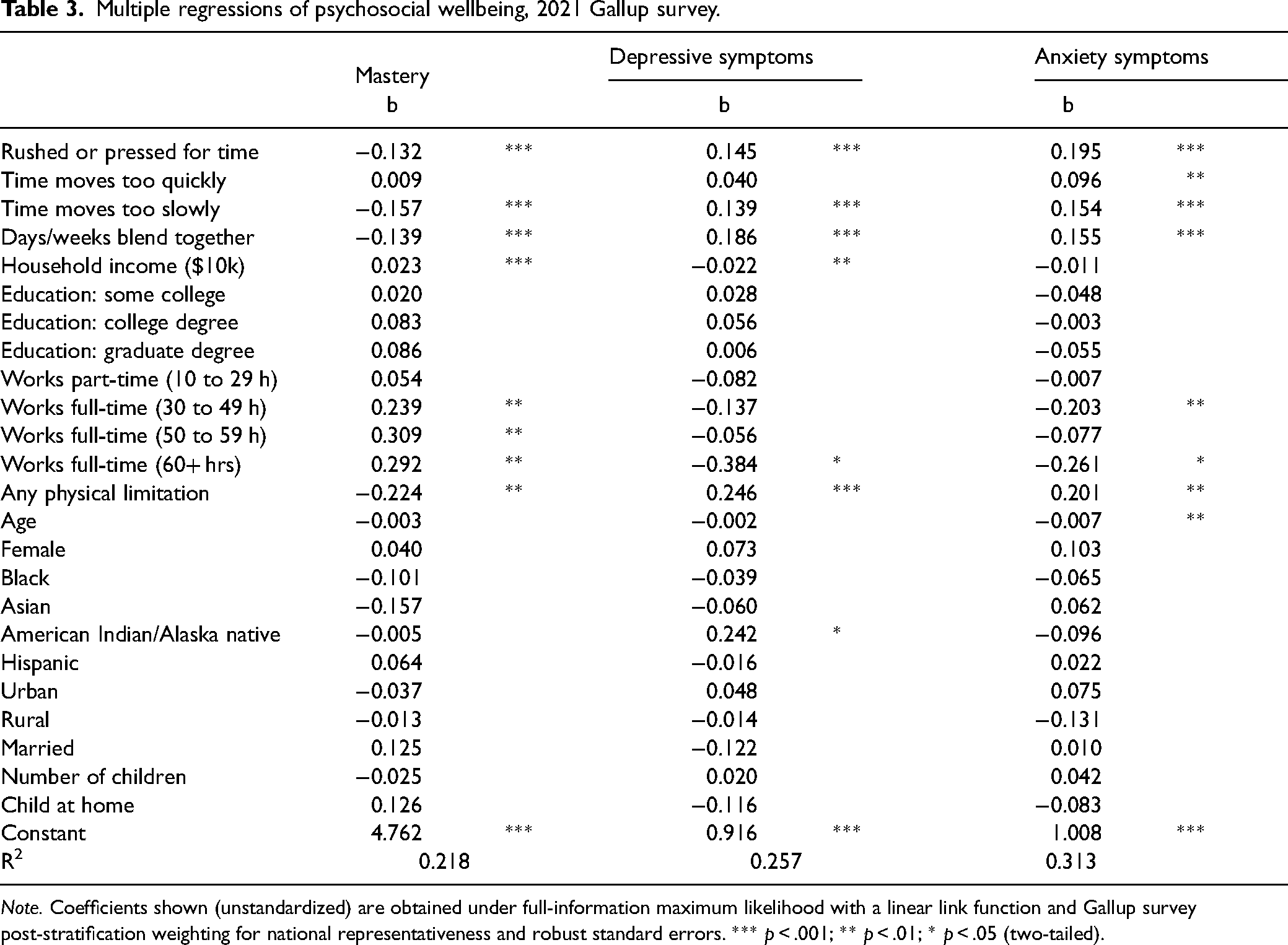
Table 3 turns to regression analysis of mental wellbeing outcomes. Rushed or pressed for time, time moves too slowly, and days/weeks blend together all associate with a lessened sense of mastery over life (b = −0.132 to −0.157, p < .001). However, time moving too quickly shows no significant relationship, net of other time perceptions and demographic background (b = 0.009, ns). All of these time coefficients are sizable, as they rival income and any physical limitation in terms of their magnitudes (income, in $10k units; b = 0.023, p < .001; any physical limitation, b = −.224, p < .01). Working part-time shows no relationship to mastery (b = 0.054, ns), but working full-time shows considerable associations (b = 0.239 for 30–49 h/week; 0.309 for 50–59 h; 0.292 for 60 + h). Crucially, in the presence of subjective time disorientation, such as feeling rushed or pressed, the beneficial association between work hours and mastery could be negated.
Multiple regressions of psychosocial wellbeing, 2021 Gallup survey.
Note. Coefficients shown (unstandardized) are obtained under full-information maximum likelihood with a linear link function and Gallup survey post-stratification weighting for national representativeness and robust standard errors. *** p < .001; ** p < .01; * p < .05 (two-tailed).
Turning to the regression model for depressive symptoms, all perceptions except for time moving too quickly show independent, net associations with heightened frequency of depressive symptoms, ranging from b = .139 for time moving too slowly to b = .186 for days/weeks blending together (p < .001). Models for anxiety symptoms yield results that are substantively similar, with time perceptions significantly related to heightened frequency of anxiety symptoms, ranging from b = .195 for rushed or pressed for time to b = .096–.155 for all other perceptions (p < .01).
In sum, hypothesis 4 concerning mental wellbeing is largely supported. Specifically, feeling rushed or pressed for time or that time moves too slowly or days/weeks blend together is related to heightened depressive or anxiety symptoms. However, feeling that time moves too quickly is unrelated to mastery or depressive symptoms when the other time perceptions are controlled, which suggests that the other time perceptions may be more potent predictors of mental wellbeing.
Time perceptions/disorientations and their relationships to time scarcity (hypothesis 5)
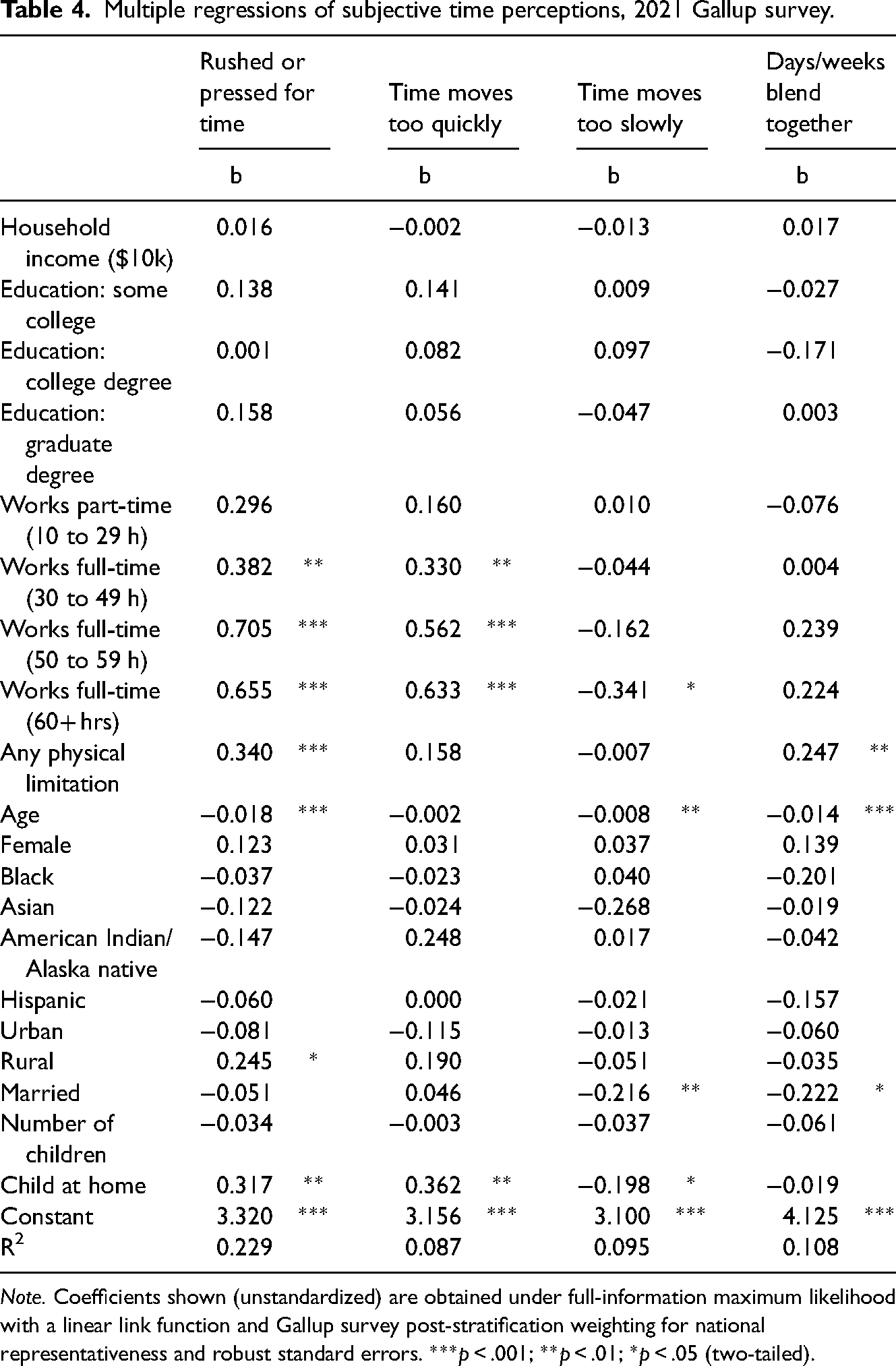
Table 4 shows results from linear regressions of subjective time perceptions, pertinent to hypothesis 5. These results are interpreted in terms of increases or decreases in time perceptions linked to one-unit changes in specific predictors. Although education and income show expected positive relationships with feeling rushed, these variables are not significant within the multivariable regression model, pointing to the greater importance of work hours in particular. For instance, respondents who work 50 to 59 h per week show a net expected increase of .705 in reporting that they are rushed/pressed for time, relative to the omitted reference category of those who work fewer than 10 h per week (p < .001; 30–49 h b = .382, p < .01; 60+ h; b = .655, p < .001). Those with children at home are considerably more likely to report feeling rushed (b = .317, p < .05).
Multiple regressions of subjective time perceptions, 2021 Gallup survey.
Note. Coefficients shown (unstandardized) are obtained under full-information maximum likelihood with a linear link function and Gallup survey post-stratification weighting for national representativeness and robust standard errors. ***p < .001; **p < .01; *p < .05 (two-tailed).
In terms of demographic background, older individuals are less likely to report feeling rushed or pressed, net of their other demographic characteristics (b = −0.018, p < .001). Additionally, respondents living with a physical health limitation feel rushed (b = .340, p < .001). No gender differences in feeling rushed emerge. Interestingly, rural respondents report a greater sense of feeling rushed (b = .245, p < .05) compared to those who live in a small city or town (omitted reference category).
Moving to the next column in Table 4, feeling that time has moved too quickly in the past 3 months shows similar predictors. As before, no significant relationships with socioeconomic status emerge, but longer work hours and having a child at home show similar unit increases for this particular time disorientation. However, physical limitations are not predictive of this disorientation, and there are no net age or geography differences.
Feeling that time has moved too slowly yields results that in some ways opposite to those obtained for the first two perceptions. While socioeconomic status continues to be statistically insignificant, long work hours relate to a decreased probability of perceiving time passing too slowly (60 + h, b = −.341, p < .05), as does and having a child at home (b = −.198, p < .05). Being married is negatively associated with a perceived slow passage of time (b = −.216, p < .01). Age remains a negative predictor (b = −.008, p < .01), pointing to the fact that greater age is linked to neither feeling rushed nor feeling that time moves too slowly.
Days or weeks seeming to blend together has a relatively unique set of demographic predictors. Neither socioeconomic status, nor work hours, nor having a child at home is significantly predictive of this perception. However, age is negatively related (b = −.014, p < .001), as is being married (b = −.222, p < .05), while any physical limitation is positively related (b = 0.247, p < .01).
Overall, hypothesis 5 is supported, as higher work hours bring with them a greater likelihood of feeling rushed and that time moves too quickly, and a lessened likelihood of viewing the passage of time as too slow, while showing no relationship to perceptions of days/weeks blending together. While work hours are the key consideration in understanding objective time scarcity, parenthood as a secondary measure of time scarcity mirrors the relationship between work hours and these multifaceted time perceptions.
Pandemic-related stressors and time perceptions/disorientations (hypothesis 6)
Table 5 overviews estimated relationships between pandemic-related stressors and multifaceted time perceptions. With the exception of losing a close relative or friend to COVID-19, all other pandemic stressors we examine show positive, significant relationships with feeling rushed (bivariate b = 0.223–1.276, p < .05). These associations are quite considerable, as increases in the frequency of working from home, homeschooling a child, providing care, or severe household conflict all could amount to categorical shifts in feeling rushed (e.g. the difference from feeling rushed “sometimes” versus “often”). This also is the case for loneliness, which is a stressor related to social isolation. The remaining time perceptions (time moves too quickly, too slowly, or days/weeks blend together) each show significant, positive relationships with pandemic stress as well, at magnitudes resembling those observed for feeling rushed or pressed for time. However, for these perceptions, relationships are not as consistently significant. Overall, across eight distinct pandemic-related stressors and all of the time perceptions or disorientations we examine, there is a clear abundance of positive, significant associations, and no associations are significant in the negative direction, thus lending general support to hypothesis 6.
Relationships of pandemic-related stressors and subjective time perceptions.
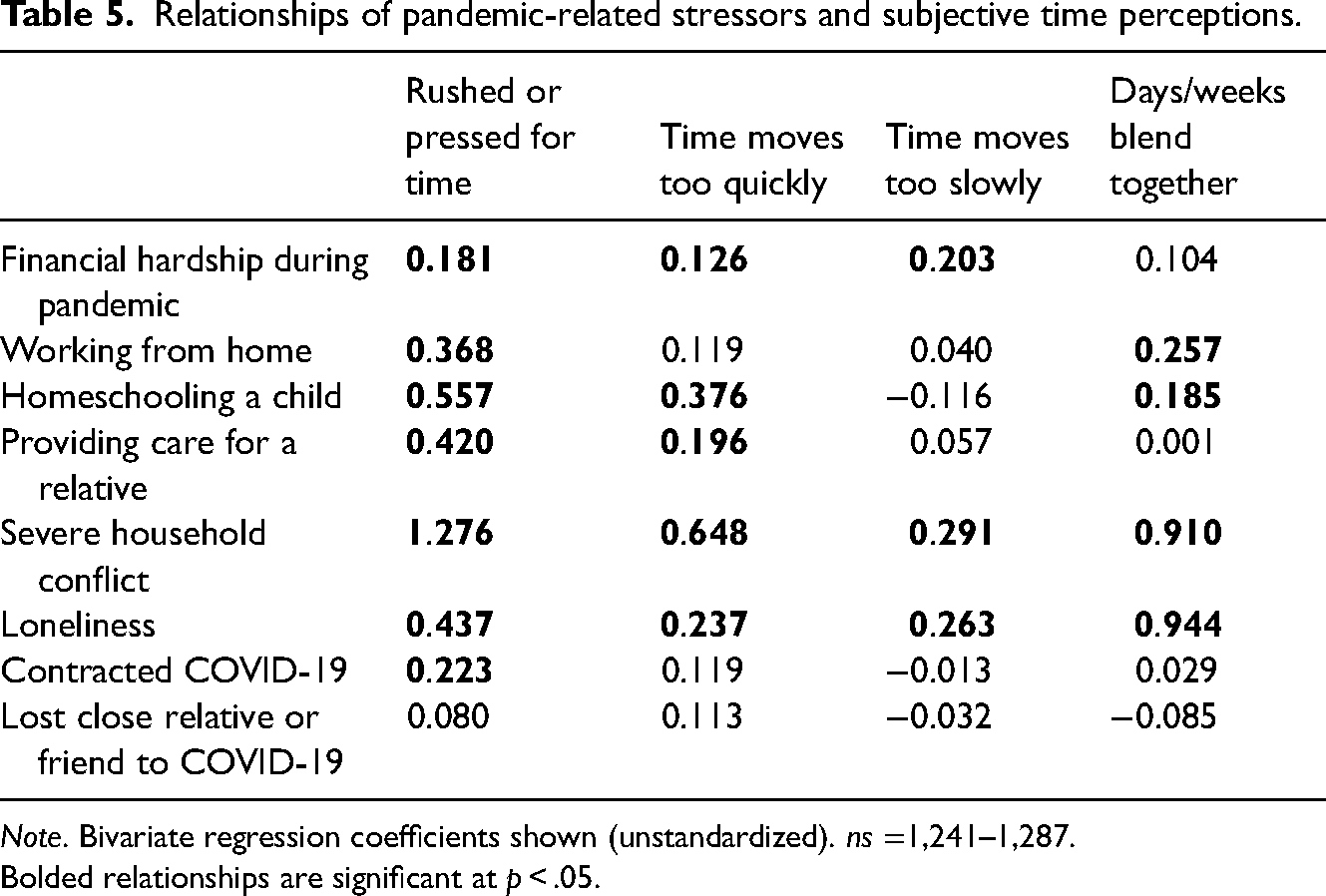
Note. Bivariate regression coefficients shown (unstandardized). ns =1,241–1,287.
Bolded relationships are significant at p < .05.
Discussion
Industrialization has brought with it a hastening of daily life. Against this backdrop, the pandemic has upended routines and generated profound stress, trauma, and loss, changing how individuals navigate and perceive their enduring, time-intensive work and family commitments. Before and especially during the pandemic, the subjective experience of time is a complex or multifaceted phenomenon, encompassing experiences of being rushed or days blending together, along with perceptions of time moving both too quickly and too slowly. While a sense of being rushed constitutes a classic measurement of time perception, experiences of time moving at an unnatural pace or days blending together constitute additional perceptions which we label as disorientations (i.e. disorientations relative to a sense of synchronicity between felt time and objective time).
Drawing on existing research into time perceptions, we reinforce and extend the literature in three important ways. Existing research on multifaceted time disorientations during the pandemic has focused on diverse countries but has not documented associations within the United States in particular. Also, this research has not unraveled how these disorientations relate to mental wellbeing net of each other. This is important due to the fact that individuals often experience varying degrees of disorientation across a given time span, leading to complex overall associations with mental wellbeing. Finally, we examine how different time perceptions associate with sociodemographic backgrounds, while also revealing how these perceptions link to specific experiences of stress (e.g. financial hardship, homeschooling, and household conflict) commonly endured during the COVID-19 pandemic.
Our analysis was guided by six hypotheses, which mark our theoretical contributions. We found that Americans experience multiple types or degrees of time disorientation over a 3-month time span, warranting a multifaceted approach. For instance, many Americans perceive time moving both too quickly and too slowly, even though these perceptions tend to be inversely related on the whole. These felt time disorientations, in turn, each show sizable negative associations with mental wellbeing. Vitally, this suggests that when individuals feel multiple types of time disorientation, the impact to mental health is larger than it is when the disturbance of time feels more contained or less complex. In additional analyses (available on request), we found that the contributions of time disorientation to predicting depressive and anxiety symptoms could not be fully accounted for by perceptions of mastery or control over life. Thus, the case is strengthened for examining specific forms of time disorientation even when examining generalized control beliefs about the world.
Regarding time scarcity, we find that Americans working longer hours during the pandemic generally are in better mental health, but also that these longer hours indirectly undermine mental health by instigating time perceptions and disorientations involving feeling rushed and time moving too quickly. Parenthood had a similar effect. However, we also found that work and family commitments both lessened a sense of time moving too slowly, thereby helping to protect mental health. Meanwhile, socioeconomic status showed insignificant relationships to time perceptions with work and family commitments controlled, highlighting how these commitments may have limited schedule flexibility during the global pandemic. Overall, all time disorientations are related to diminished mental health, and time scarcity created by work and family commitments show significant links to subjective time. Finally, pandemic-related stressors are linked to sensations of feeling rushed and to all types of time disorientation, helping to further our knowledge about how stress relates to mental health.
Our work contributes to several well-established streams of research. First, this study systematically links the public health emergency of the COVID-19 pandemic to the social experience of time, thus adding to prior work investigating disasters and emergencies as they relate to subjective time (e.g. Buonomano, 2017; Holman and Grisham, 2020). Although research in other countries has found that loneliness or social isolation during the pandemic is related to a perceived slowness of time or longer perceived duration between events (e.g. Wessels et al., 2022; Velasco et al., 2022a), we find here that other stressors during the pandemic such as household conflict and financial hardship also bear associations with multifaceted time perceptions. Especially as recall period lengthens, individuals become more likely to experience conflicting time disorientations (e.g. slowness as well as quickness), consistent with a sense of vertigo (Velasco et al., 2022a, 2022b). In France, perceived slowness in particular is linked to a psychological sense of traumatization (Velasco et al. 2022a). Similarly, we find in the United States that perceived slowness is more commonly linked to lowered mental wellbeing as compared to quickness.
We add to prior work linking subjective time to mental health, by broadening the set of perceptions and disorientations examined (e.g. Adam, 2006; Bauman et al., 2019; Bo, 2022; Hunt et al., 2008; May and Thrift, 2003). We extend the literature on the relationship between subjective time and time scarcity (e.g. Strazdins et al., 2011; Williams et al., 2016) by re-examining these links during the exigencies of the COVID-19 pandemic and doing so using multiple approaches to time. Moreover, our study contributes to interdisciplinary efforts to understand mental health and coping during the COVID-19 pandemic (e.g. Loose et al., 2021; Restubog et al., 2020), by characterizing time-related experiences of stress as a novel pathway for understanding compounding influences of social or traumatic stress on mental health. Working from home, homeschooling a child, and severe household conflict were three key pandemic-related stressors that not only were relatively common but also showed quite strong links to multiple types of time disorientation.
While data limitations prevent us from comparing our results to prepandemic temporal experiences across class, these Gallup data still provide baseline information about associations between diverse time disorientations and aspects of mental wellbeing during the pandemic, including relationships to pandemic-specific stressors. Several directions await future research. First, with a more explicit measurement of daily work schedules and job autonomy, as well as a separate analysis of how retired individuals navigate time by social class, we would have deeper insight into other avenues by which SES undergirds the social experience of time (Bo, 2022). Relatedly, measurement of role commitment or intensity would be helpful, as individuals fit into distinct social roles, social circumstances and locations that then shape the levels of stress or engagement they experience and thus their mental health (George, 2014). Similarly, type and duration of activity can both matter to how individuals experience time, stress, and themselves (George, 2014). These role configurations are likely to differ profoundly by gender and race/ethnicity, which presents a valuable direction for future research into how structural marginalization would structure the experience of time. Third, although we cannot firmly establish a directional relationship between time disorientations and wellbeing, other research could find mental wellbeing exerts its own effects on time perception (Thönes and Oberfeld, 2015). Finally, each of us engages in different types of agentic “time work” (Flaherty, 2003) as a way of managing these perceptions—these individual strategies also depend on the affordances of social interaction (Flaherty, 2018). Any strategies for navigating one's work and family obligations are bound to differ by gender, due to prevailing understandings of how devotion looks different for mothers and fathers (Rao 2020; Young and Schieman, 2018). With this, child's age is likely to matter fundamentally to time scarcity and mental wellbeing (e.g. Berghammer and Milkie, 2021; Milkie et al., 2019; Negraia and Augustine, 2020). Unfortunately, the Gallup data leave us unable to differentiate young children from adolescents.
Conclusion
While the COVID-19 pandemic has fundamentally restructured how we spend time at work and with family, much remains the same about the rushed pace of life so typical to industrialized societies including the United States. Our approach to capturing experiences of time rests on the assumption that individuals relate to time in complex ways, especially as weeks and months unfold. We found original evidence to suggest that experiences of quickness, being rushed, slowness, and indistinct boundaries of days all coincide, and that these multiple disorientations each relate to diminished mental wellbeing, to objective work and family demands, and to widespread exposures to pandemic-related stressors. By taking a multifaceted approach, we allow for the possibility that experiences of time differ and accumulate, speaking to the diverse objective and subjective demands of working and living during an unprecedented time of profound stress and loss.
