




Abstract
Proposing a measure of synchrony, the level of accordance between individual and collective schedules, we examined the effects of synchrony on the two indicators of subjective wellbeing, daily mood, and life satisfaction. We argue that temporal norms underlying collective schedules are a part of social norms, the deviation from which influences an individual's wellbeing via external and internal sanctions. Analyses of time-use data showed that synchrony was effective in improving evaluative wellbeing (life satisfaction) but not affective wellbeing (daily mood). More specifically, synchrony did not predict well who was satisfied with life but did fairly well predict who was not, which implies that compliance with temporal norms is a necessary but not sufficient condition of life satisfaction.
“After I had been there about ten or twelve days, it came to my thoughts that I should lose my reckoning of time … and should even forget the Sabbath days. … [A]nd thus I kept my calendar, or weekly, monthly, and yearly reckoning of time.” Daniel Defoe, Robinson Crusoe
Introduction
Keeping a calendar and reckoning time are probably far down the to-do list if one is wrecked on a distant island alone. Time on the island may be an undifferentiated flow of duration that one feels passing subjectively (Durkheim, 1995 [1912]; Munn, 1992). Robinson Crusoe, a castaway, began to keep a calendar, not for any practical reasons on the island but to stay synchronized with the society that he had left. The synchrony helped him maintain his identity and a sense of being connected. As Zerubavel (1981) pointed out, sharing a common schedule establishes intergroup boundaries and helps solidify in-group sentiments.
Synchrony, the state of individuals’ behaviors synchronized in both time and form (Lakin et al., 2003), is unique to humans, and not found in other apes and monkeys (Dunbar, 2008). A nearly universal practice found in tribal societies is ecstatic group rituals, which involve synchrony, such as drumming and dancing together. These synchronous activities produce exaltation and camaraderie among the participants (Durkheim, 1995 [1912]; Lakin et al., 2003; McNeill, 1995). McNeill (1995: 4) went further and claimed, “keeping together in time became important for human evolution, allowing early human groups to increase their size, enhance their cohesion, and assure survival by improving their success in guarding territory, securing food, and nurturing the young.”
Time is a fundamental element for synchronizing activity. For individuals to synchronize their activities they must share, among others, a common time reference (minutes, hours, days, weeks, etc.). According to Durkheim (1995 [1912]), the concept of time was developed out of the social need for temporal coordination and synchronization. For society to be felt, Durkheim (1995 [1912]) argued, “the individuals that comprise it are assembled and acting in common” (p. 421), and time was invented to assure “the recurrence of rites, festivals, and public ceremonies at regular intervals” (p. 11). This explains why time, an intersubjective social reality, is a major parameter of the social world. It is so fundamental that “not knowing the day, the date, or the year, despite their arbitrariness, is even regarded as indicative of some mental problem” (Zerubavel, 1982a: 4).
For individuals to synchronize they must also be able to anticipate what other participant(s) will do and factor that into the scheduling of their own movements. It is quite reasonable that mutual attention and physical co-presence (e.g. playing in an orchestra) produce exaltation and camaraderie among those in synchrony. However, synchrony with anonymous others, not even present in the same space, may have similar effects. Every society develops rules on when, how long, how frequent, and in what order activities are performed on a given day, and these yield collective temporal rhythms (Zerubavel, 1981). When individuals conform to the rules, their attention is not directed to specific others but diffused to the entire group. In this sense, temporal norms are a subset of social norms, the conformity to which affects individual SWB (Durkheim, 1966; McAdams, 1997).
In this study, we examined the effects of temporal synchrony on SWB, as indicated by daily mood and life satisfaction. We argue that the mismatch between individual and collective schedules harms individual wellbeing. Specifically, it focuses on synchrony at the societal level. Dyadic synchrony, that is, time spent together with familiar and well-defined participants, has received much research interest. Research on social capital, social relations, and social support explores, from our perspective, dyadic synchrony. However, we do not yet adequately understand what we call community synchrony, which involves a large aggregate of impersonal participants acting in time without explicit coordination with one another.
Synchrony and spontaneity
Scheduling is setting aside specific times for activities. It may be purely self-imposed but is more likely to involve temporal coordination with other individuals. The latter scheduling yields synchrony—doing things when others do them. Synchrony is often intended; participants sharing a common goal deliberately coordinate their schedules (e.g. Sunday family dinner). Following Haidt et al. (2008), this is what we are calling “dyadic” synchrony. However, synchrony can be much less intentional for each individual but still achieved at the collective level, which we call “community” synchrony, the subject of this study. Community synchrony is based on temporal norms. When to carry out which activity is often a part of values and norms that prevail in a society, and many activities in daily life have standardized temporal locations (Zerubavel, 1981). For example, drinking at eight in the morning is much less synchronous than drinking at eight in the evening.
Spontaneity, on the other hand, indicates a lack of scheduling, time used with few constraints, either self-imposed or external. It is a state of doing things when one desires. Just as social norms constrain personal freedom, temporal norms suspend the temporal freedom of individuals. Keeping up with a collective rhythm is adjusting one's personal schedule and preference to accommodate that of others. For this reason, spontaneity, like synchrony, is often experienced as delightful, the feeling of not having to do things or escaping obligations and burdens (Gingerich, 2018). Contrary to synchrony, however, such an experience comes only from solitude, requiring detachment from connections to other people (Gingerich, 2018).
Our time is filled with various activities, all of which are probably important for our survival and wellbeing. It is also true that strain often arises in coping with the cross-cutting temporal demands that the activities exert on us at single points in time (Lewis and Weigert, 1981). Societies develop a set of rules that guides individuals in managing the complex tasks, and that yield collective temporal regularities. These rules are necessary since society is based on the coordination and synchronization of individual activities.
One such rule is what Lewis and Weigert (1981) call temporal stratification. They presented a typology of social times, “self time” at the individual level, “interaction time” at the group level for informal interactions, “institutional time” for bureaucracies and other formal organizations, and “cyclic time” (day, week, and seasons) at the broad, societal-cultural level. Lewis and Weigert (1981: 444) proposed a definite stratification among the times: “Generally speaking, organizational [institutional] time demands precedence over interaction time, and interaction time, in turn, demands precedence over self time.”
This observation reveals a rule of temporal scheduling, the priority of synchrony over spontaneity. It is synchrony that prevails when synchrony and spontaneity compete against each other. The typology of social times is, in fact, ordered by the degree of spontaneity available. It is the most available in self time and least in cyclic time. This explains why spontaneity is hard to achieve or can be achieved only temporarily—individuals live in a society with social commitments. The topology is also in the order of the increasing number of participants. Interaction time, for example, involves fewer participants and schedules than institutional time. To sum up, the rigidity of time is determined by the scope of the synchrony it requires.
Community synchrony is a reified and abstracted schedule, relying heavily on clock time. Thus, it may appear to be “an impersonal set of indispensable guidelines for daily life that transcend the individual” (Van Tienoven, 2019: 976). Some authors, however, view individuals as competent agents who (re)produce community synchrony (Nowotny, 1992; Van Tienoven, 2019). Empirical research showed that individual schedules were heterogeneous and often in conflict with one another, and that community synchrony emerged, as they were interpreted, negotiated, adjusted, and subjugated (Calkins, 1970; Reinecke and Ansari, 2015; Schwartz, 1974; Zerubavel, 1982a). That is, multiple temporalities that arise from different life cycles, social roles, images of the future, social statuses, and cultural backgrounds coexist in and constitute a collective rhythm (Adam, 1995; Jordheim, 2014; Lewis and Weigert, 1981).
Research that demonstrates a multiplicity of times includes a study by Reinecke and Ansari (2015). They examined the tension that the two opposing temporal orientations—clock time versus process time—created in an organization, and the process by which they were negotiated and modified. For Forman (1989), time reflects male consciousness, and women are often exempt from the collective rhythms that men create. She argues, “the exclusion [of Jewish women] from timebound commandments was a profound reflection of the reality that only free men can undertake to give their time while women (and slaves) don’t have it to give” (Forman, 1989: 5). Calkins (1970) showed how the images of the future held by patients in a rehabilitation institution influenced the ways they conceptualized, marked, and used time. Also interesting is the observation that these styles of time usage not only reflected the social relationship one had within the institution, but were also evaluated by staff members and other patients as positive or negative reference points.
Synchrony and social integration
The standardization of temporal references involves setting common units of duration so that different individuals measure the passage of time in an identical manner. Zerubavel (1982a) asserted that standardization is both a means to consolidate the boundary of a group and a consequence of increasing interdependence among the constituents. A common temporal reference is needed to enable individuals to coordinate and synchronize their activities.
Zerubavel (1982b) showed how social groups used sociotemporal patterns to express their distinctiveness vis-a-vis other groups. His examples included the calendrical dissociation of Easter from Passover and Stalin's introduction of 5-day and 6-day weeks. These calendrical reforms were intended to promote the social segregation of the Church from Judaism and society from the church, respectively. Vihalemm and Harro-Loit (2019) measured how many people in Estonia recognized and celebrated various holidays and other days of importance. Some of the days were national, whereas others were local, in the sense that only certain social groups (e.g. ethnic Estonians and the Russian-speaking community) recognized and celebrated them. That is, these days differed in the width of synchronization, producing different degrees of social cohesion.
To summarize, temporal similitude is an integrating force, closely related to group formation (Zerubavel, 1982b). Collective schedules are a part of social norms, which define average or desirable behavior. Just as conformity to social norms is associated with how one identifies with the group, synchronizing one's schedule to a collective rhythm improves a sense of attachment.
Prior studies showed that moving in time with others encouraged the participants to trust, cooperate, and affiliate themselves with other participants (Hove and Risen, 2009; Lakens and Stel, 2011; Valdesolo and DeSteno, 2011; Wiltermuth and Heath, 2009). In Hove and Risen (2009), for example, the participants were asked to tap their index finger, keeping in time with a moving target while seated next to the experimenter, who (1) did not tap, (2) tapped in synchrony with the participants, or (3) tapped in asynchrony. The degree of interpersonal synchrony predicted how much participants liked the experimenter. Wiltermuth and Heath (2009) also showed that those acting in synchrony felt more similitude and belongingness than did people without synchronous activity.
Other nonexperimental studies also reported that a common schedule was an integrating force. The temporal similitude in monastic life, according to Zerubavel (1981: 65), provides individuals with a sense of togetherness and helps “to form a strong basis for what Durkheim called ‘mechanical solidarity’.” Cohen et al. (2010) provided a biological explanation for the above observations. They found that group training significantly increased the pain threshold more than training alone among college rowing athletes. That is, synchronized exercise stimulated the release of endorphins more than individual exercise did. Given that endorphins are thought to underpin social bonding in primates, this finding may explain how synchronized activities promote affiliation, trust, altruism, cooperation, and exaltation among participants.
Synchrony in the studies above involved specific partner(s), with whom an actor tried to coordinate behavior. It may be the personal relationships formed before or during the coordination that produce a sense of integration. We argue, however, that synchrony with anonymous others without deliberate coordination may bring similar effects. Keeping up with a collective tempo reflects the extent to which an individual participates in daily rounds of social life and interaction, which in turn, solidifies in-group sentiments.
Haidt et al. (2008) made a similar distinction with regard to social relatedness. One was a dyadic relatedness referring to the state in which an individual is tied to another, whether as friends, lovers, or other individuals, who are responsive to one's needs. It promoted a concrete sense of mutual understanding and support. This corresponds to dyadic synchrony, since relatedness includes synchronizing activities. The other aspect of relatedness is less direct, adjacent, and personal but equally important. Haidt et al. (2008) called it moral community relatedness, a sense of being tied to a community that shares values and norms. This corresponds to community synchrony. Unlike dyadic synchrony, this produces an abstract feeling of similitude and belonging, even though the participants “may have nothing more in common than their collective bondage to clock time” (Lewis and Weigert, 1981: 439) and are not even aware that their activities are synchronized.
Synchrony and subjective wellbeing
Conformity with (or deviance from) social norms presents rewards (or penalties) to individuals and thus can affect their wellbeing (Etzioni, 2000; McAdams, 1997). Prior studies identified two possible mechanisms through which this happens, since the rewards (or penalties) can originate from two different sources. As McAdams (1997) argued, individuals follow norms because of external informal sanctions, an internalized sense of duty, or both.
According to the esteem theory of norms by McAdams (1997), social norms can arise and be maintained by external sanctions, especially esteem or respect from others. When a (general) consensus is reached within a group regarding the desirable quality of an act, one way to enforce the consensus with minimal cost is to allocate esteem according to conformity. Those who comply with the consensus, despite some costs incurred, are thought of highly. In contrast, behavior against it is accorded disesteem and shame in the form of gossip, ridicule, and social exclusion.
The above argument can be applied to temporal norms. After discussing the stratification of social times, Lewis and Weigert (1981: 451) added, “properly meeting the expectations of timing … warrants a person's moral character and displays his or her normalcy. To fail to time one's life according to the stratification of social times elicits labels of laziness, shiftlessness, untrustworthiness, and clearly inferior selfhood.” Moreover, desynchronization can be imposed to penalize individuals. As Zerubavel (1981: 65) observed in the Benedictine monasteries, “a most common method of punishing monks was to segregate their activities temporally from those of the rest of their community.”
Possibly as a consequence of external sanctions, social norms are often internalized deeply enough to shape one's own preference (Etzioni, 2000; McAdams, 1997). Once this happens, conformity becomes what individuals want. “[S]ocial norms help form (and re-form) the self, by profoundly influencing people's identities, their world views, their views of themselves, the projects they undertake, and thus the people they seek to become” (Etzioni, 2000: 161). Individuals then follow social norms not because they fear external sanctions but because they find that such following expresses their inner self (Etzioni, 2000). When they fail to live up to social norms, they suffer from internal sanctions. They blame themselves and feel guilty, whether or not the violation is known to others.
When one is socially disapproved and loses esteem, and when one suffers from psychological discomfort and feelings such as unworthiness and guilt, one is not likely to feel much wellbeing. If temporal norms are held within a society strongly enough, then living up to temporal expectations helps improve the sense of belonging. Those who schedule activities contrary to most others are less esteemed when that is known to others, or they may suffer from internal sanctions, even when it is not known to others.
For some individuals, deviation from temporal norms may not be voluntary but mandatory. For example, those working night shift schedules have asynchronous time use because of their institutional obligation. Since their schedules are governed by a social time operating in an institutional sphere (Lewis and Weigert, 1981), they may be exempt from or less subject to the social sanctions discussed above. However, research showed that they still suffered from other consequences, such as limited opportunities for social contact and spare-time activities. These experiences often lead to feeling different and isolated from others (Torquati et al., 2019).
Affective wellbeing and life satisfaction are related but separable dimensions of SWB (Sørensen, 2014). They are influenced by distinct factors or differently by the same factors (Vladisavljević and Mentus, 2019). The former refers to emotional responses to ongoing or daily experiences, whereas the latter is a conscious, cognitive, and overall evaluation of one's life, encompassing past, present, and future quality (Miret et al., 2017; Sørensen, 2014; Vladisavljević and Mentus, 2019). For this reason, life satisfaction remains relatively stable across days, as opposed to affect.
Of the two components of SWB, the positive effects of synchrony are more likely to be captured in evaluative wellbeing (life satisfaction) than in experienced wellbeing (daily mood). As discussed above, synchrony is associated with dyadic contacts, which improve both daily mood and life satisfaction. Suppose, however, that dyadic synchrony is controlled for, so that the measure mostly reflects community synchrony, a sense of being tied to a moral community that shares values and norms. This sense of belonging becomes an evaluative criterion that increases life satisfaction. However, synchrony as an ongoing experience may be felt as a constraint to temporal freedom and lower daily mood. It may also mean confronting the unbearable congestion during rush hours and mealtimes (Zerubavel, 1981). To sum up, synchrony is both an ongoing experience that lowers daily mood and an evaluative criterion that increases life satisfaction.
Data and measurement
We analyzed the data from the Korean Time Use Survey (KTUS), collected by the Korean National Statistical Office in 2019. The respondents in this survey, who were aged 10 or above and nationally representative, recorded their time diaries over the most recent 24 hours on two different days during the year. The diary consisted of 144 10-minute time slots, on each of which the respondents recorded one or more of their activities, and where and with whom they were. When multiple activities were reported, we analyzed the main activity only. The 26,091 respondents recorded 52,182 diaries during the year.
We selected the time diaries, recorded by those aged 20 to 64 during the weekdays, because we believe that these diaries better reflected the collective temporal rhythm that we focused on. These criteria left 21,021 diaries by 14,022 respondents. As mentioned, each respondent recorded a time diary on two different days. Of the 14,022 respondents selected, 6,999 recorded both of their diaries on weekdays, thus constituting a two-wave panel. The rest (7,023 respondents) recorded the other diary on a weekend day. We found little difference between the entire weekday sample (14,022 respondents) and the panel sample (6,999 respondents) in terms of age, gender, and synchrony.
The synchrony of an individual is the degree to which his daily schedule corresponds to the collective schedule. The collective schedule is not a priori but rather an empirical concept. To measure it, we first calculated the participation rate (# respondents doing an activity / total respondents) for each activity reported in a given time slot. For example, a total of 85 different activities were reported in the slot 12:00 am to 12:10 am, including sleeping, watching TV, and watching videos, at the rates of 0.83, 0.03, and 0.02, respectively.
A respondent reported 144 (main) activities, each of which was assigned a participation rate (or, synchronization score). If, for example, a respondent slept during the 12:00 to 12:10 slot, the person's score was 0.83. The measure of synchrony for an individual was the mean of the 144 scores during the diary day. The lower the index, the more asynchronous one's daily schedule. This measure theoretically varies from 1.0 to 1/N. The maximum (1.0) is probably not reached except for such places as total institutions, where everyone performs the same activities with everyone else. Compare this to the practical maximum, the score obtained when one performs the most frequent activity in each time slot throughout the day. The minimum (1/N) is achieved when an individual performs activities throughout the day that none of others do.
The time spent with others (in minutes) was used as a proxy for dyadic synchrony. The KTUS contains information on the person(s) accompanying each activity. Note that accompanying person(s) in the KTUS requires more than spatial co-presence. It is defined as the one(s) who actively participated in the activity. This variable has seven categories: (1) alone, (2) spouse, (3) child aged under 10, (4) child aged 10 or above, (5) parent, (6) siblings or other relatives, and (7) nonfamily members. Family time in this study was the time spent with family members (2∼6). Social time was defined as the time with nonfamily members (7). The rest was considered solitary time (1).
The predicted variables of daily mood and life satisfaction were measured on a seven-point and a five-point scale, respectively. Some control variables were measured in a similar way, including education (4 ordinal categories), health status (5), and personal income (9). We also introduced the time (in minutes) spent on paid work and being awake (1,440—the minutes of sleep) as controls. Last, occupations (6 categories), marital status (2), and gender (2) were measured as nominal variables.
Results
The mean level of synchrony was 0.299 (the median was 0.306), meaning that when an individual carried out an activity in a time slot, about 30% of the others, on average, performed the same activity. The highest value observed in the sample was 0.423 for a 48-year-old married man with a full-time clerical job. Compare this value with the practical (not theoretical) maximum of 0.436. The lowest value observed was 0.016 for a 21-year-old single male college student with a part-time job in service. The interquartile range (0.275–0.338) was much smaller than the entire range (0.016–0.423), indicating that the middle half of the values showed much less variability.
Table 1 shows the levels of synchrony across various social groups and weekdays. Synchrony was slightly higher among men, full-time workers, and those in their 30s and 40s than among women, the unemployed or part-time workers, and those in their 20s and the 60s. While synchrony showed little difference from Monday through Thursday, it became somewhat lower on Friday, indicating that collective rhythm was less rigid on that day.
Temporal synchrony by social groups (N = 21,021).
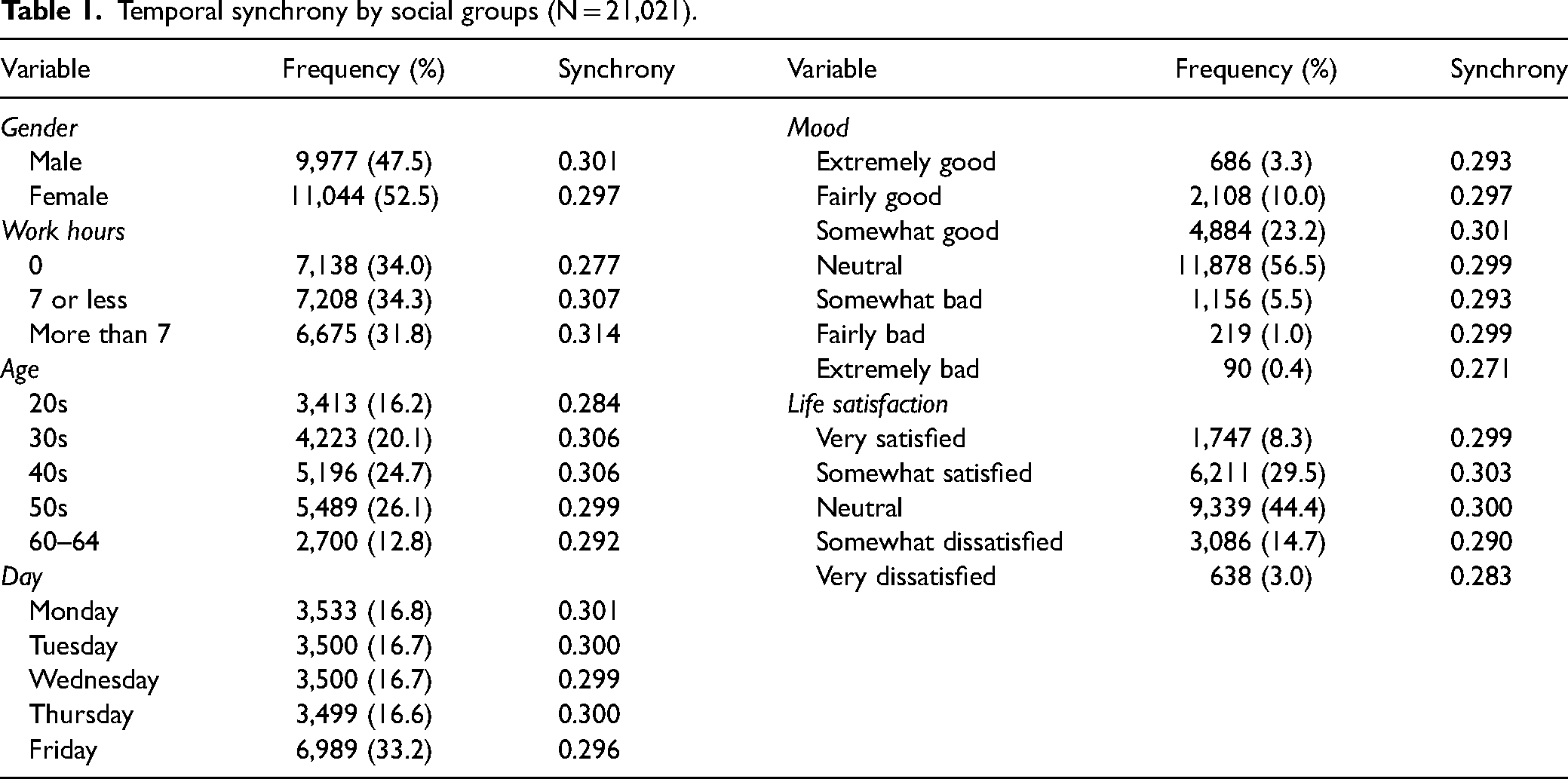
The relationship between synchrony and daily mood appeared weak and curvilinear, if any. Whereas those in an extremely bad mood had noticeably lower synchrony scores (0.271), those in an extremely good mood were as synchronous (0.293) as those in a somewhat bad mood (0.293). Overall, the individuals in the upper-middle categories on the mood scale were the most synchronous. In contrast, life satisfaction showed a clear pattern: the more synchronous, the more satisfied with life. The only exception was those who are very satisfied. They were less synchronous (0.299) than those who were somewhat satisfied (0.303). Overall, the levels of synchrony could tell how dissatisfied one was with life, but it did not tell very well how satisfied one was.
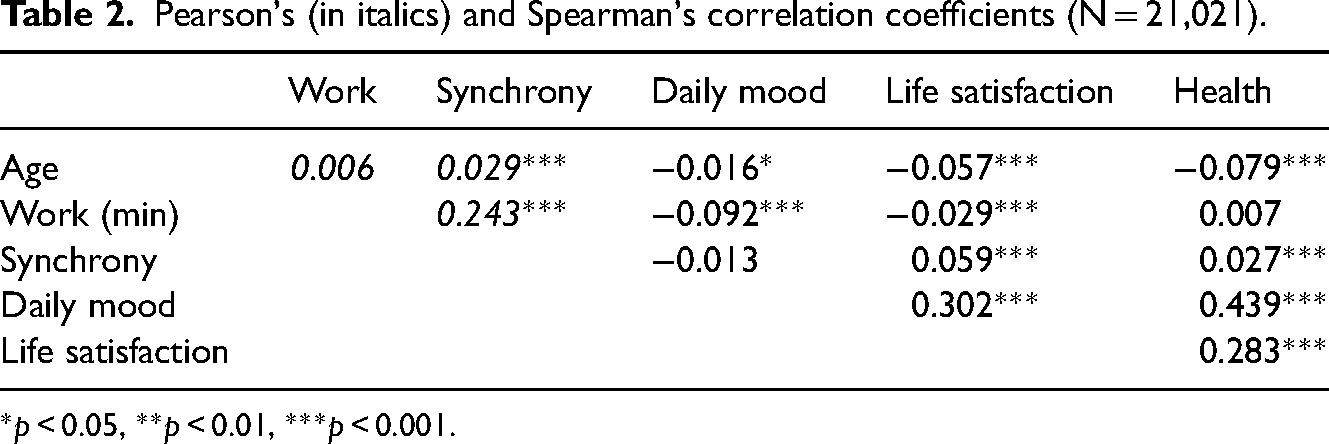
Table 2 presents Pearson's or Spearman's correlation coefficients. Although weak, synchrony was significantly and positively associated with life satisfaction, but not with daily mood. The coefficient between daily mood and life satisfaction (0.302) was somewhat lower than the corresponding coefficients from the World Values Survey (0.44) or the European Values Survey (0.55) (Sørensen, 2014). Also, health was more strongly associated with daily mood (0.439) than it was with life satisfaction (0.283).
Pearson's (in italics) and Spearman's correlation coefficients (N = 21,021).
*p < 0.05, **p < 0.01, ***p < 0.001.
We used the two-wave panel data (6,999 respondents) and ran a fixed-effect regression, which has the advantage of controlling for time-invariant variables. We first tested the validity of the synchrony measure, in which the focus was on how family, social, and work time affected it. The more time one spends with family members or friends, the more synchronous one's schedule is expected to be. Each individual has a unique schedule and preference, and dyadic synchrony requires coordinating such schedules. The intersecting schedule that emerges is likely to converge toward a collective temporal rhythm. Work time, on the other hand, corresponds to institutional time, an important element of collective rhythm, although most respondents reported being solitary. We thus expect that the longer one works, the more synchronous one's schedule becomes.
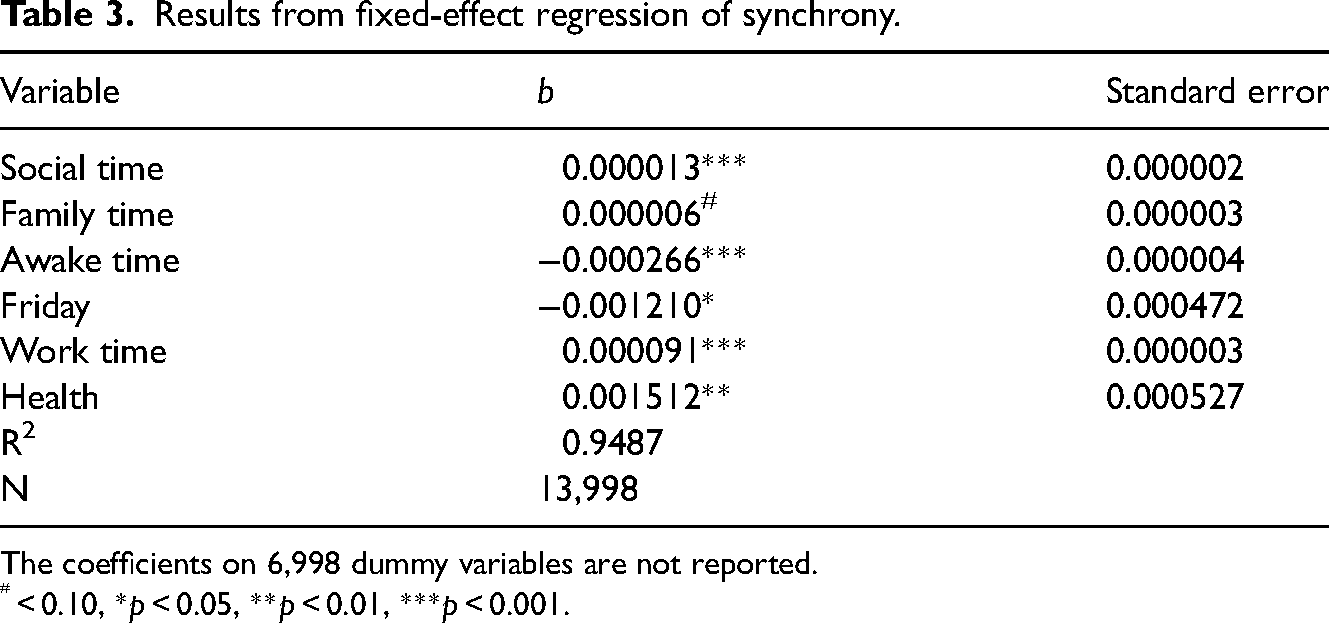
As shown in Table 3, all the time-use variables were significant with the expected signs. The activities that required temporal coordination with (either personal or impersonal) others increased temporal synchrony, whereas solitary activities reduced it. For example, as one spent an additional 100 minute on social gatherings between the two survey days, one's synchrony increased by 0.0013. In contrast, an increase in awake time, after controlling for family and social time, considerably reduced temporal synchrony. Moreover, as one's survey day changed to Friday, their synchrony declined by 0.0012, which also supported the finding at the bivariate level.
Results from fixed-effect regression of synchrony.
The coefficients on 6,998 dummy variables are not reported.
< 0.10, *p < 0.05, **p < 0.01, ***p < 0.001.
Note that we used the original metric (minute) for the time-use variables. When the minutes were log-transformed by adding the minimum value (1 minute), the results were almost the same. The only difference was that family time became nonsignificant (p = 0.403). We preferred the original metric, because it fitted the data better in terms of the F value and R2, and it did not require adding a constant to handle zero minutes.
Before turning to the effects of synchrony on the SWB measures, we noted that life satisfaction appeared to be measured only once between the two diary days: the values were exactly the same between the days for all respondents. This is understandable in the sense that one's evaluation of life is stable, not changing over a short period of time. It is unfortunate, however, that the advantages of fixed-effect regression are not available for life satisfaction. Thus, we used fixed-effect regression only to examine the effect on daily mood, which was treated as a numerical variable. We then pooled and analyzed all of the weekday diaries as cross-sectional data, using the ordinal logistic regression suitable for an ordinal dependent variable.
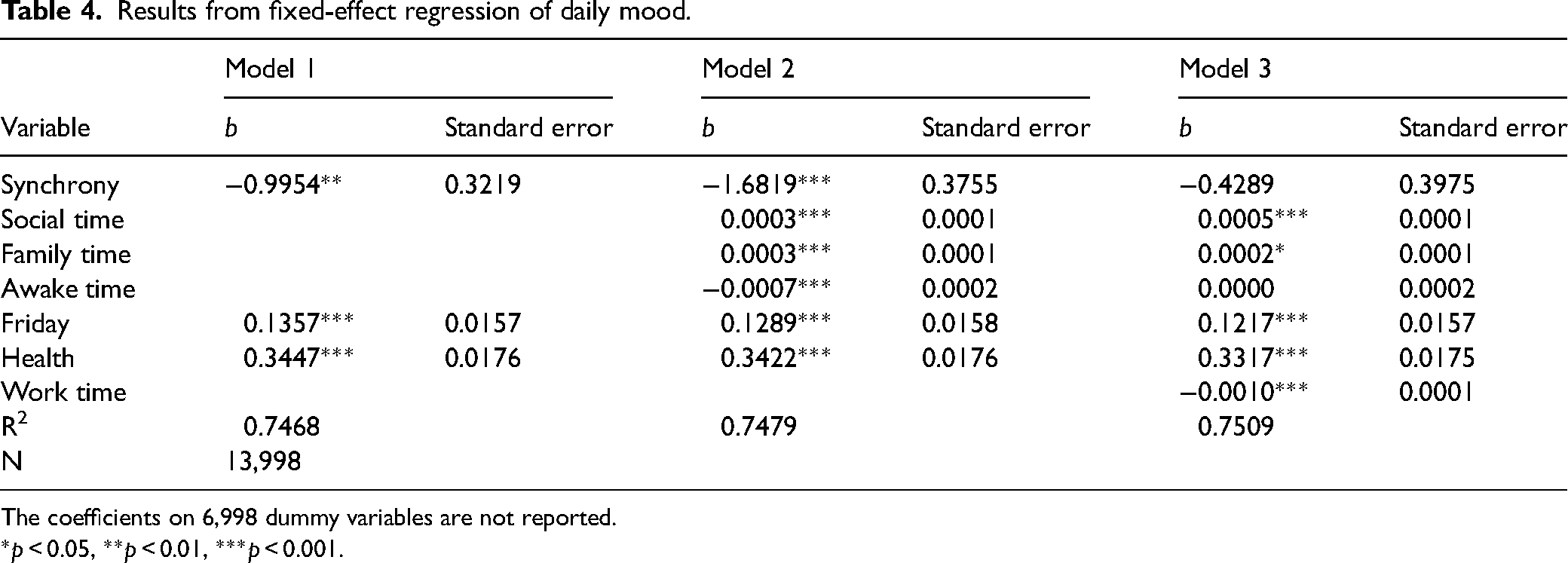
The results from fixed-effect regression of daily mood are presented in Table 4. Model 1 shows the overall effect of synchrony on daily mood, which was negative (p = 0.002). Turning to Friday and improvements in health status, on the other hand, boosted the mood. We noted earlier the positive and negative effects that synchrony as an ongoing experience may have on daily mood (see Synchrony and Subjective Wellbeing). Model 2 adds the variables of dyadic synchrony, which we expected to increase the negative effect of synchrony on daily mood. The results supported the expectation. Whereas dyadic synchrony elevated mood, synchrony worsened mood considerably more than it did in model 1.
Results from fixed-effect regression of daily mood.
The coefficients on 6,998 dummy variables are not reported.
*p < 0.05, **p < 0.01, ***p < 0.001.
The negative effect of synchrony above may be confounded by the effect of paid work, an external constraint to temporal freedom that increased synchrony but lowered daily mood (Table 2). When work time was included (model 3), synchrony became nonsignificant (p = 0.281). We also ran model 2 for only those who spent zero minutes working on both survey days (a total of 2,058 respondents). Although not reported in the table, the results were basically identical. Changes in synchrony did not produce significant differences in daily mood (p = 0.215).
Using ordinal logistic regression, we examined the effects that synchrony had on life satisfaction. The effects on daily mood were also examined and compared to the results above. Note that the respondents were very unevenly distributed across the seven mood categories. Only 1.0% and 0.4% were “fairly bad” and “extremely bad,” respectively (Table 1). This yielded cells with extremely small values. To alleviate this issue, we collapsed the categories of “extremely” and “fairly” together, so that daily mood consisted of five categories, as did life satisfaction. Also note that, unlike the case of the panel data above, the analyses of the pooled data required a set of control variables holding constant both time-variant and time-invariant attributes of the respondents.
Table 5 presents the results from the ordinal logistic regressions of daily mood. Note that models 1 and 2 in the table correspond to models 2 and 3 in Table 4, respectively. The results were highly comparable. (1) Synchrony had a negative effect on daily mood (b = –0.5702, p = 0.030) when the measures of dyadic synchrony were added, and (2) it became nonsignificant (b = 0.0889, p = 0.748) when also controlled for work time.
Results from ordinal logistic regression of daily mood.
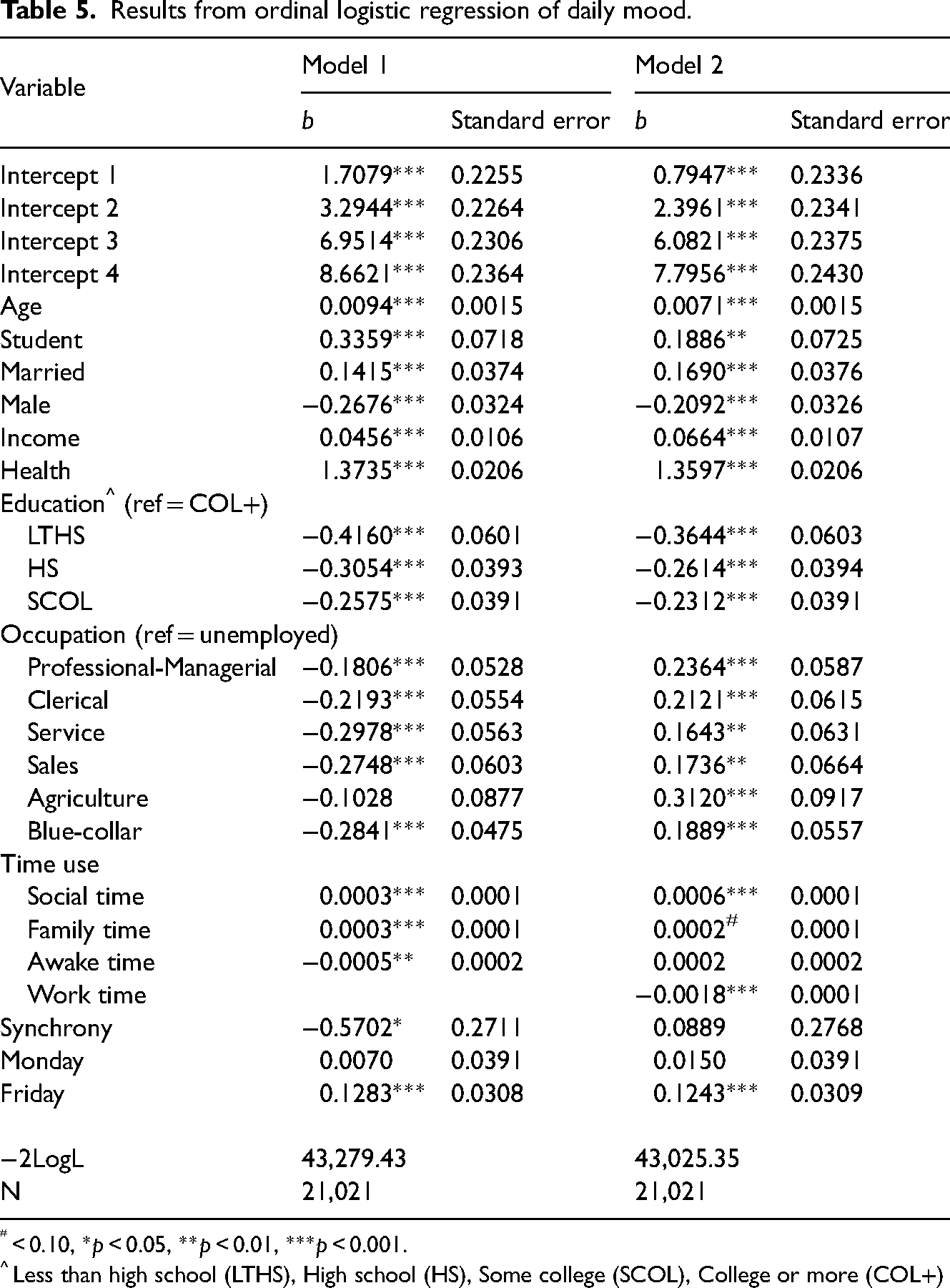
< 0.10, *p < 0.05, **p < 0.01, ***p < 0.001.
Less than high school (LTHS), High school (HS), Some college (SCOL), College or more (COL+)
Table 6 presents the results from the ordinal logistic regression of life satisfaction. First, the cognitive evaluation of life, unlike daily mood, was not contingent upon the day when the survey was conducted. This is understandable given the differences between daily mood and life satisfaction noted above. Regarding the effects of occupation, those engaged in sales and blue-collar occupations were less satisfied with their lives than those who were unemployed. In contrast, agricultural and professional-managerial occupations were associated with more positive evaluations of life. The positive effects of agricultural occupation may reflect not the attributes of the job per se but those of the rural way of life (Sørensen, 2014). Other control variables, such as education, income, and health status, also showed the expected effects. Finally, synchrony had a positive and significant effect on life satisfaction, whether or not work time was controlled for, in contrast to daily mood.
Results from ordinal logistic regression of life satisfaction.
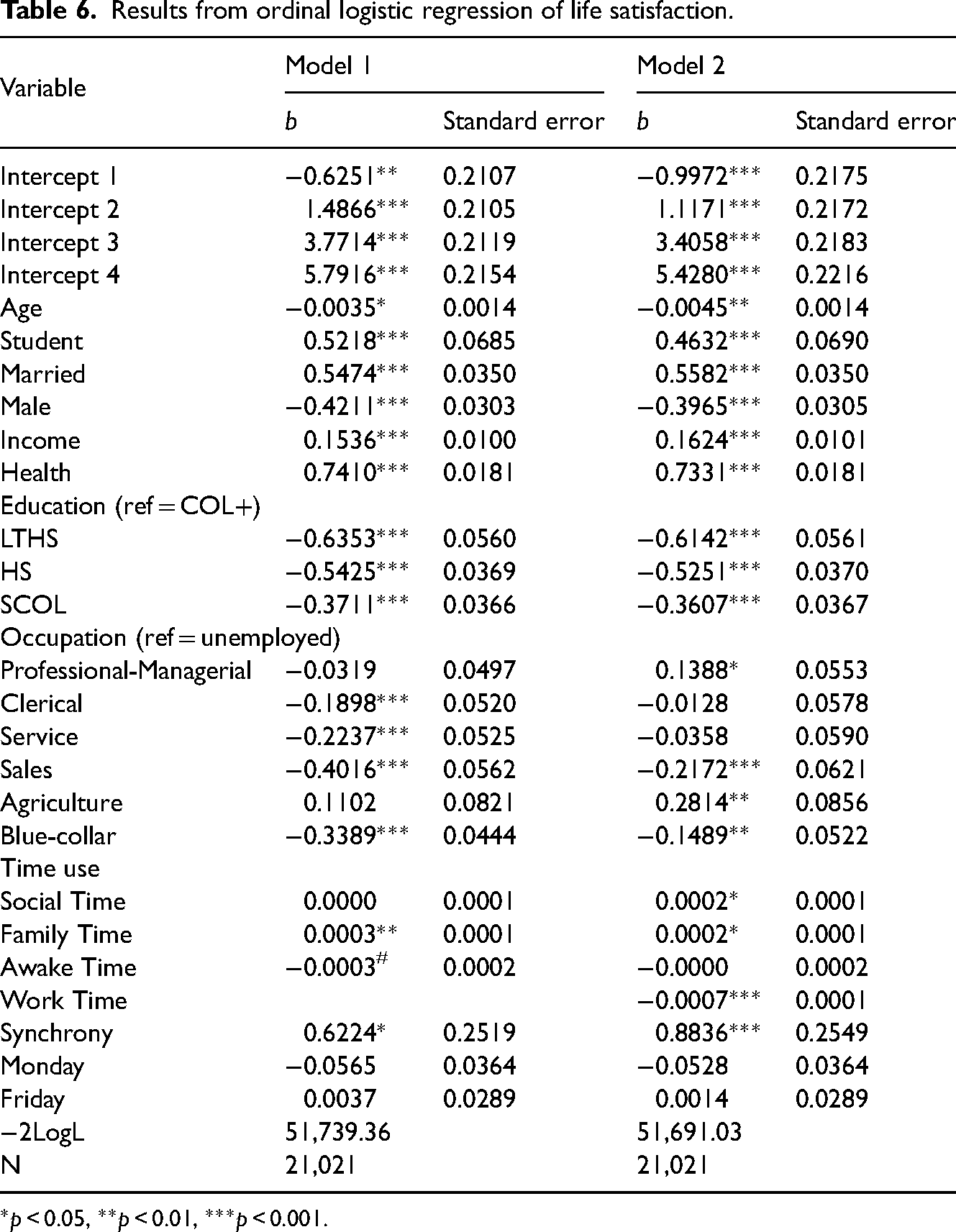
*p < 0.05, **p < 0.01, ***p < 0.001.
Ordinal logistic regression is based on the proportional odds assumption that each predictor variable has an identical effect across the cumulative splits of an ordinal dependent variable. When this holds, a single coefficient can describe the effect of a predictor variable. However, the assumption is hardly met, as was true for the models in Tables 5 and 6. Running four sets of binary logistic regression with the same set of control variables as in Tables 5 and 6, we found that the focal predictor variable (synchrony) was one of those that do not have an identical effect. Table 7 presents the coefficients for synchrony across the cumulative splits (to save space, the coefficients of the other control variables are not reported).
Coefficients on synchrony across cumulative splits (standard error).
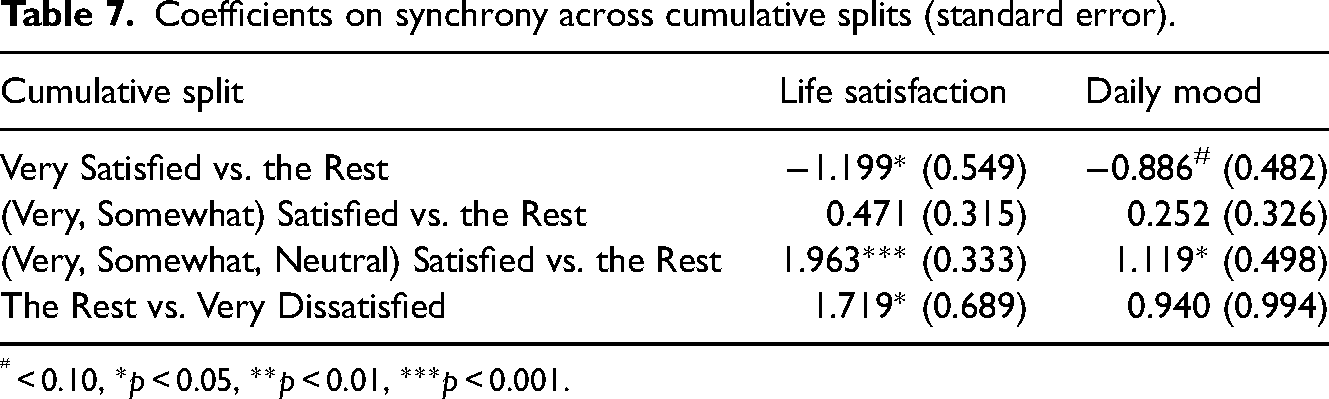
< 0.10, *p < 0.05, **p < 0.01, ***p < 0.001.
The pattern that emerges is what was seen in Table 1. Synchrony did not predict well who was satisfied with life, but it did fairly well predict who was not. For example, the coefficient on synchrony was not significant (b = 0.471, p = 0.136) in the model estimating who was (very and somewhat) satisfied with life. It was even negative and significant (b = −1.199, p = 0.029) for the first split. The coefficient, on the other hand, was positive and highly significant (b = 1.963, p < 0.001) in estimating who was (somewhat and very) dissatisfied. A similar pattern, in a less dramatic form, was found for daily mood.
Discussion
Proposing a measure of synchrony, the level of accordance between individual and collective schedules, we examined its effects on the indicators of SWB. We argued that temporal norms underlying collective schedules are a part of social norms, the deviation from which influences SWB via external and internal sanctions. This approach contrasts with prior research that mostly focused on synchrony on a small group level. We analyzed large-scale, nationally representative, and real-life data, a part of which constitutes a panel. This provides advantages for generalizability and the ability to control for the stable characteristics of individuals.
Analyses of time-use data showed that synchrony was effective in improving evaluative wellbeing but not affective wellbeing. The first part of the finding was consistent with previous research. Kim (2020) showed that the negative effects of solitary meals on life satisfaction were contingent upon their timing. Negative effects were present only when the meal was desynchronized from the collective eating schedule, indicating that it may not be eating alone but desynchronization that lowered life satisfaction. The second part of the finding, synchrony not being effective for affective wellbeing, implies that synchronizing with anonymous others without explicit coordination does not yield collective effervescence. This echoes Wiltermuth and Heath (2009), which found that acting in synchrony did not instill exaltation but still strengthened social attachment among the participants.
We also found that synchronizing one's daily activities with a collective schedule did not influence a positive evaluation of life but did affect a negative evaluation, perhaps because temporal norms are widely accepted and considered ordinary. Conformity to norms, in this case, may not help earn esteem and respect. Disconformity, on the other hand, becomes more visible, which increases the intensity of the disesteem it merits. Synchronizing in this respect appears to be a necessary but not a sufficient condition for life satisfaction.
Examining Danish diaries written during the coronavirus lockdown in March 2020, Damsholt (2020: 141) found a recurrent theme, the experience that “all activities seemed to coalesce into an indistinguishable mash.” Coronavirus restrictions provided structural opportunities for acting against temporal norms as individuals carried out all daily activities at home, or tried to avoid crowds and close contact in scheduling activities. This means that a violation of the temporal norms became less detectable and more tolerated. Spontaneity then was likely to dominate everyday life. The resulting temporal anomie may explain some of the deterioration in mental health and wellbeing that took place after the COVID-19 outbreak (WHO, 2022). Singing in synchrony from balconies and rooftops, online Friday beers, and stay-at-home parties may have been attempts at synchronizing during coronavirus restrictions.
The synchrony measure proposed here can be useful in addressing various issues at the social group level. For example, time structure has been pointed out as one of the latent functions of employment that protects individuals against psychological distress (Jahoda, 1981). Time structure has usually been measured as the extent to which the unemployed “perceived” their use of time to be purposeful. Our measure enables the measurement of how they “spend” time. As another example, the thesis of a 24-hour society claims the diversification of temporal rhythms and the desynchronization of social time, driven mainly by flexible working hours (Glorieux et al., 2008). The practical maximum value of synchrony we proposed above may be used to test the changes in temporal norms.
Footnotes
Declaration of conflicting interests
The author(s) declared no potential conflicts of interest with respect to the research, authorship, and/or publication of this article.
Funding
The author(s) disclosed receipt of the following financial support for the research, authorship, and/or publication of this article: This research was supported by the Ministry of Education of the Republic of Korea and the National Research Foundation of Korea (NRF-S-2022-A0434-00105). The dataset analyzed during the current study is available either from MDIS - Microdata Integrated Service (kostat.go.kr) or from the corresponding author on reasonable request.
