




Abstract
In the period 2014–2019, the Dutch authorities governed the duration of asylum procedures in order to control the influx of asylum seekers. They prioritised and accelerated cases with poor chances of success, while they deprioritised cases with good chances of success. This resulted in long asylum procedures for asylum seekers with a likelihood of success and short asylum procedures for those with a poor chance of success. This article contends that this Dutch policy is an illustration of ‘temporal governance’: a governmental strategy to control and discipline migrants by means of time. This form of governance is based on a detailed knowledge of processes of asylum procedures, which enables qualification, categorisation and differentiation between different groups of asylum seekers. The focus of this research is on how such temporal governance functions and how it relates to law. A traditional understanding of law and sovereign power entails that law legitimates and restricts power. Strikingly, temporal governance regulating the asylum procedure seems to have a different relationship to law. This article demonstrates that legal standards, in this case the standards of European Union legislation, provide Member States a large amount of room (temporal discretion) to apply temporal governance. Moreover, only a few limited legal remedies remain available, if the duration of the asylum procedure appears unlawful. Instead of limiting temporal governance, law provides ample opportunity for the acceleration and deceleration of asylum cases in order to delay due process of asylum seekers and deter others from arriving. We cannot prove that the Dutch government aimed at deprioritising and decelerating complex asylum cases and cases with good chances of success – which would have been unlawful. However, this was the net result of their chosen policy. We illustrate that instead of a legitimation and restriction of sovereign power to govern the asylum influx by means of time, law can function as a set of tactics to pursue policy aims by employing ‘temporal governance’.
Keywords
Introduction
On the 5th of May 2016, two asylum seekers arrive in the Netherlands. One asylum seeker is Moroccan, the other Iraqi nationality. Several days after arrival, the Moroccan asylum seeker is interviewed by the Dutch Immigration Service (hereafter: IND) about his motivation for requesting asylum. On the 15th of May 2016, he receives a negative asylum decision. At the same time, the asylum seeker from Iraq is placed in a reception centre, where he has to wait 7 months, before he is first interviewed by the IND. His case turns out to be complicated, and the IND needs to perform an extra interview. In December 2017, the Iraqi asylum seeker receives an asylum permit. Why did the Iraqi asylum seeker have to wait so much longer for the asylum decision than the Moroccan asylum seeker?
In this article, we show that this difference in treatment of the Moroccan and the Iraqi asylum seeker is caused by ‘temporal governance’, to use anthropologist Griffiths (2017) term, a governmental strategy to discipline and control migrants by means of time. We show that the Dutch government prioritised cases of asylum seekers with low chances of success, which resulted in the simultaneous ‘deprioritisation’ of cases with high chances of success. This policy was one of the factors which caused the dramatic increase in the average duration of asylum procedures during the period of high influx in 2015–2016 and during the period from 2018 to 2019, when the numbers of asylum applications had decreased to normal proportions again.
Our analysis adds to the academic discussion about the use of time in governance by focussing on the relationship between temporal governance and law. We hold that such an analysis is pressing because temporal governance turns the traditional relationship between law and sovereignty on its head. A traditional understanding of the relationship between sovereign power and law would entail that law legitimises and sets clear limits to the governance of migration by means of time. On the face of it, one would think that this also applies to the rules regulating the duration of asylum procedures. After all, European Union law (hereafter EU law) sets clear time limits for decision-making to protect asylum seekers from endless asylum procedures. Yet, as philosopher Michel Foucault has pointed out, ‘governmentality’ regards law not so much as legitimating and limiting governmental action but rather as a set of tactics to obtain goals that are extralegal, without being illegal. In this article, we take this understanding of the relationship between law and governmentality as the starting point for an analysis of the (de)prioritisation, acceleration and deceleration of asylum procedures by the Dutch government.
We demonstrate that the rules regulating the asylum procedure allow for what we call ‘temporal discretion’, fed by lack of conceptual clarity and discretionary room for exceptions to time limits in asylum procedures. On the basis of a close scrutiny of the Dutch situation during and after the high influx of asylum seekers in 2015, we reveal that this temporal discretion gives governments ample room for letting asylum seekers wait within the boundaries of law. The time limits for decision-making can be extended under certain circumstances, and some cases may be prioritised over others. Temporal governance serves not only to deprioritise or decelerate procedures, but it can also entail prioritising specific cases and accelerating the pace of their procedure. For such prioritisation and acceleration, the legal situation is even more ill-defined. EU law allows prioritisation of any asylum case. Moreover, the concept of an accelerated procedure is basically undefined in EU law, and EU law does not require the asylum procedure to last a minimum amount of time. It is only stipulated that there should be an adequate and complete examination of the asylum application.
Furthermore, we discern unlawful forms of waiting. We show that governments can simply let asylum seekers wait, even though such waiting is technically speaking unlawful. Challenging the lawfulness of the waiting itself takes more time and often does not lead to quicker decision-making. We expose that not living up to its legal obligations has been a clear element of Dutch temporal governance since 2015.
In this article, we first discuss temporal governance and its use in migration law (Section 2). Subsequently, a legal case study of the response of the Dutch government to the high influx of asylum seekers and its aftermath in the period between April 2014 and August 2019 sets the stage for the analysis of the relationship between temporal governance and migration law (Section 3). We illustrate how the Dutch government used temporal discretion to let asylum seekers with high(er) chances of success wait for a long time, while the cases of asylum seekers with low chances of success were prioritised and accelerated. This was aimed to deter others from coming. We highlight ‘processing time’, that is, the time between the first application for asylum and the first administrative decision on the asylum application. This is the time that asylum seekers actually have to wait in the procedure, no matter whether this is lawful or not. Within processing time, we endeavour to distinguish lawful from unlawful processing time. In order to pinpoint how this practice relates to law, we discuss the EU legal framework concerning asylum procedures (Section 4). This inquiry is guided by the simple question ‘How long does the law allow the authorities to make asylum seekers wait before they take a decision on the asylum claim?’ In Section 5, we argue that the Dutch case shows that there is ample temporal discretion. Governments may simply exceed time limits in the asylum procedure, while individual asylum seekers lack legal avenues to remedy this injustice. Also, within the legal time limits, governments have ample room to apply temporal governance measures, which are barely subjected to judicial control. This is also due to the fact that it is near impossible to establish the proportionality and effectiveness of such measures by a court or the public.
Temporal governance
We live in what sociologist Robert Hassan (2009) has called ‘clock time modernity’, in which life is dominated by an unambiguous and dominating conception of clock time, which is the time of money and of industry and technology. Hassan shows in his book Empires of Speed how the clock has created its own temporal reality since the Industrial Revolution. Disguising as the measurement of time, the clock transforms what it supposedly measures. In fact, the clock slices diverse understanding and meanings of time of different cultures, societies and the natural environment into precise and predictable pieces that can be counted and measured. As such, the clock functions as a powerful tool to regulate and coordinate actions of individuals and groups in society. Yet, as political scientist Kathrin Braun has lucidly argued in this journal, modern forms of governance focus less on the control of bodies by targeting processes (2007: 11). Philosophers such as Arendt and Foucault point out that modern forms of power and politics should be conceived as control by means of the administration, categorisation and calculation of human life. In his lectures at the Collège de France, Foucault famously dubs this governmental power ‘governmentalité, a form of power that aims at managing the life of a population. Whereas traditional forms of power controlled its subjects by means of the threat of death, or the direct control over the physical body, the modern subject is controlled by taking charge of the life of the population. This entails the control and study of processes, which occur over a period of time, and not so much the mere control of individual bodies. ‘[Power] targets collective phenomena such as the birth rate or the average life expectancy. While on the individual level these phenomena seem ungovernable, they are not necessarily so when taken as collective phenomena’ (Braun, 2007: 11). An important element of the operation of such power is knowledge about these processes, by means of statistics and data that classify and organise subjects. This knowledge enables differentiation between differently categorised and positioned subjects.
Indeed, power operates as much through temporal devices as it does through spatial control (Edelstein et al., 2020; Eule et al., 2019: 149; Griffiths, 2013: 30). This politics of time, in some fields called chronopolitics (Klinke, 2012), also plays an important role in the governance of migration and borders (Cwerner, 2001; Jacobsen et al., 2020; Stronks, forthcoming 2021). There is a growing body of anthropological literature on the different and contradictory forms of time at work in migrant experiences. Time can be stagnated, such as is clearly the case in waiting times in asylum centres or camps (Anderson, 2014; Griffiths, 2013, 2014; Khosravi, 2014), but it can also be ‘frenzied’ (Griffiths, 2013; 2017) with sudden ruptures and accelerations. Another manifestation of such politics of time can be found in ‘timing’, the moment in which certain policies are installed. As Brux et al. argue, the timing of construction of fences in Norway after the ‘refugee crisis' in 2015 can be understood as a clear example of a temporal element in the ‘spectacle of enforcement of the border’ to use an expression of anthropologist Nicholas de Genova (Brux et al., 2019). Anthropologist Ruben Andersson argues that in such politics, waiting should not be perceived so much as a by-product of state institutions and bureaucratic regulations, but rather as a tactic, a management technique to control the inclusion and exclusion of migrants in a territory (2014). This aligns with what political scientist Martina Tazzioli (2018) has called the ‘temporal border’, arguing that the border itself is one of the objects of temporal management. Based on her research on the hotspot approach of the European Union, she shows that mobility is disciplined by means of dates, deadlines and, importantly, the differentiation in speed between different categories of migrants. The rapid identification and registration and selection of asylum seekers upon landing are meant to differentiate the speed of the procedure, and it functions as a ‘practice that ends up in slowing down the speed of some migrants’ movements – generating protracted situations of legal limbo or preventively illegalising asylum seekers – while hastening some others, as in the case of deportations from Greece to Turkey and channels of expulsions’ (Tazzioli, 2018: 18).
Griffiths has coined the term ‘temporal governance’ for these diverse manifestations of the role of time in governing migration. Temporal governance can be seen as a governmental strategy to discipline and control migrants by means of time. Griffiths' analysis aligns with the observations of Braun that this form of governance focuses on processes, such as the asylum procedure. As Griffiths shows, migration is not an exception to the central use of time in the operationalisation of state power. And indeed, if one looks closely at the role of time in migration law, one can draw up a long list of examples of how time is used to differentiate and control the presence of migrants. Qualification periods; age criteria; limits to the length of detention; terms for long-term residence or naturalisation but also the difference between temporary or permanent residence. Upon close scrutiny, it turns out that time is never a straightforward category in law; there is a multitude of different forms of time in law: lawful and unlawful time; interrupted or continuous time; calendar time or temporality; the relevant legal moment in a decision or temporal restrictions to rights. The rules regarding time are complex, and even if a criterion seems straightforward (5 years), this can lead to multiple forms of differentiation (Stronks, 2017). 1 Griffiths shows that in the United Kingdom, immigration rules operate in large part through temporal governance because time is used as a technique that ‘delays, punishes and trips people up, as well as providing temporal safeguards, incentives and gifts such as periods of lawful access to British space’ (2017: 56–57). Concerns that unwelcome migrants, such as migrants who were convicted for a criminal offence or unlawfully residing migrants, would be able to remain on the territory and gain stronger rights over time, have led to speeding up deportation procedures and devaluing the worth of long-term presence.
Taking our cue from Griffith’s conceptualisation, we map the exact relationship between temporal governance and migration law regarding asylum seekers waiting in asylum procedures since the exact role of law remains unclear in the operation and limitation of temporal governance. Waiting is central to the question of sovereignty and contemporary forms of governance of migration prove this. ‘The all-powerful is he who does not wait but who makes others wait’, as sociologist Pierre Bourdieu writes (2000: 288). Indeed, the prerogative to let others wait seems the ultimate form of power. Yet, this begs the question how such power can be limited by means of law. In a traditional conception of sovereignty and law, law is a legitimating ground for sovereign action. Law not only legitimises sovereign action but also delimits its possibilities declaring unlawful what is not allowed under the law. Foucault, however, has argued that in ‘governmentality’, the relationship between law and sovereignty has changed. It is this ‘art of government’, which aims to manage populations, goods and economic matters. [W]hat enabled sovereignty to achieve its aim of obedience to the laws, was the law itself; law and sovereignty were absolutely united. Here, on the contrary, it is not a matter of imposing a law on men, but of the disposition of things, that is to say, of employing tactics rather than laws, or, of as far as possible employing laws as tactics; arranging things so that this or that end may be achieved through a certain number of means’ (Foucault 2009, 137).
In governmentality, the management of populations has become central, and tactics are deployed to achieve certain policy aims. The usage of law is justified through an aim that is external to law, ‘but not through recourse to any set of prior principles or legitimating functions’, as philosopher Judith Butler lucidly explains (2004: 94). Those legitimating functions may still be in place, but they are not central to the field of governmentality. ‘Understood in this way, the operations of governmentality are for the most part extralegal without being illegal. When law becomes a tactic of governmentality, it ceases to function as a legitimating ground: governmentality makes concrete the understanding of power as irreducible to law’ (Butler, 2004: 94, emphasis in original).
Building on Foucault’s understanding of power, Butler argues that in using law as tactics for extralegal means, sovereignty again reanimates itself in a new form. While Butler uses the indefinite detention in Guantanamo to make this argument, we want to test this hypothesis in the case of asylum seekers who are kept waiting. We argue that temporal governance should be understood as a form of governmentality that seeks to use law as tactics. 2 Controlling the speed or length of the asylum procedure clearly qualifies as a form of temporal governance. We show that the legitimating functions and procedures of law are still in place, yet they do not delimit nor justify governmental power. We show that the different conceptions of time that are at work in the laws regulating asylum applications leave room for rather unrestricted forms of temporal governance. The next section will demonstrate that, in the case of the Netherlands, these measures aim to deter asylum seekers with low chances of success by applying very speedy asylum procedures which have the knock-on effect of generating long periods of waiting for other categories of asylum seekers.
Temporal governance in asylum procedures in the Netherlands
The starting point for our analysis of the relationship between temporal governance and law is a case study of the response of the Dutch government to the high influx of asylum seekers and its aftermath in the period between April 2014 and August 2019. Our aim in this analysis is twofold: firstly, we focus on the aim and effect of the Dutch approach, by bringing to the fore, the choices that were made concerning (de)prioritisation and acceleration by the Dutch Secretary of Justice and Security, who is responsible for migration policy, and the IND, the Dutch Immigration Service. This is done on the basis of parliamentary documents, letters and internal documents of the Ministry of Justice and Security together with public reports issued in the period January 2014–August 2019. 3 Moreover, processing time of asylum cases (the time from the application until the asylum decision made by the IND) was examined on the basis of statistics specifically gathered for and provided to the authors of this article by the IND. These concern the processing time of cases of asylum seekers from Syria, Eritrea, Iraq (countries with high(er) chances of success), Morocco, Algeria and Albania (safe countries of origin) and the cases of asylum seekers with other nationalities in the period January 2014–July 2019.
The second aim of this section is to show the exact functioning of temporal governance in the Dutch case, which consisted of a sophisticated interplay between acceleration, deceleration, prioritisation and deprioritisation of different sets of asylum applications. From the outset, it is important to observe that the Netherlands has a very fast asylum procedure compared to other EU Member States (ECRE, 2017: 10). Most asylum seekers start the asylum procedure in the ‘general asylum procedure’. This asylum procedure lasts eight working days, and all its steps are strictly regulated. 4 The asylum procedure always starts with a first interview, after which there are strict deadlines for every subsequent step in the procedure. Only when it is not possible to take a judicious (positive or negative) decision in the general asylum procedure, will an asylum case be referred to the extended asylum procedure. In this extended procedure, the IND must make a decision within 6 months. This time limit can be extended on individual grounds (e.g. the complexity of the case) or general grounds (high influx or the insecure situation in the country of origin) to a maximum of 21 months.
Extent and nature of the asylum influx
Number of first asylum applications submitted in the Netherlands. 8

Secondly, the nature of the influx of asylum applications changed. Before 2013, the top three countries of origin consisted of Afghanistan, Iraq and Somalia. 9 After 2013, many asylum seekers from Syria and Eritrea arrived in the Netherlands. 10 They had a good chance of having their asylum application granted. 11 At the same time, many applicants originating from relatively safe countries, such as Albania, Algeria and Morocco, entered the Netherlands. 12 These countries have been considered safe countries of origin since 2015 (Albania) and 2016 (Algeria and Morocco). 13 Cases of asylum seekers from safe countries of origin have almost no chance of success. 14 Applications from countries with very good chances of success (Syria and Eritrea) and poor chances of success (safe countries of origin) may both be considered relatively simple and not very time-consuming. After 2015, the nature of the asylum applications in the Netherlands changed again. The number of applications submitted by Syrians decreased, 15 while the number of more complicated cases increased. 16 More complicated cases take more time to process. 17
Prioritisation and acceleration of asylum cases with low chances of success
During the period of high influx, the Dutch government made clear that it wanted to limit the number of asylum seekers coming to the Netherlands. In 2014, the Secretary of State indicated that the high influx was ‘disastrous’ for the Netherlands and announced several measures to limit it. 18 According to a prognosis in the autumn of 2015, approximately 93,600 asylum seekers were due to arrive in the Netherlands in 2016, if asylum policies remained the same. The Dutch government stated that it considered that such an influx would be undesirable because it would place a heavy burden on Dutch society. 19
In November 2015, the Secretary of State announced the introduction of different tracks (special asylum procedures) within the Dutch asylum procedure for asylum cases with poor chance of success. It concerned cases in which it was assumed that asylum seekers are safe in their country of origin 20 or in another EU Member State where they had been granted asylum. It also concerned asylum cases, for which another EU Member State was responsible (so-called Dublin cases). Since the first of March 2016, cases with low chances of success have both been prioritised and accelerated (see also DSP Group, 2018: 50): prioritised because they were put at the top of the stack of applications; accelerated because the procedure consisted of less steps and therefore took less time. Within the category of Dublin cases, cases of asylum seekers from safe countries of origin (notably the Maghreb countries) were prioritised (DSP Group, 2018: 41). This prioritisation and acceleration of the three mentioned categories of asylum cases with low chances of success was of a permanent nature. The Secretary of State was of the opinion that also in times of a lower amount of influx, it would remain necessary to quickly decide on such cases. Indeed, recently, she has reiterated that such cases have priority and are to be processed within the legal time limit. 21
Consequences for the processing time
After the first of March 2016, cases of asylum seekers with low chances of success have indeed been processed within a very short period. Almost all asylum seekers from safe countries of origin (99%) received a decision within the legal time limit of six months.
22
On average, they had to wait between 10 days (2016) and 4 weeks (2019) for their decision. Dublin cases took a lot longer (13–14 weeks).
23
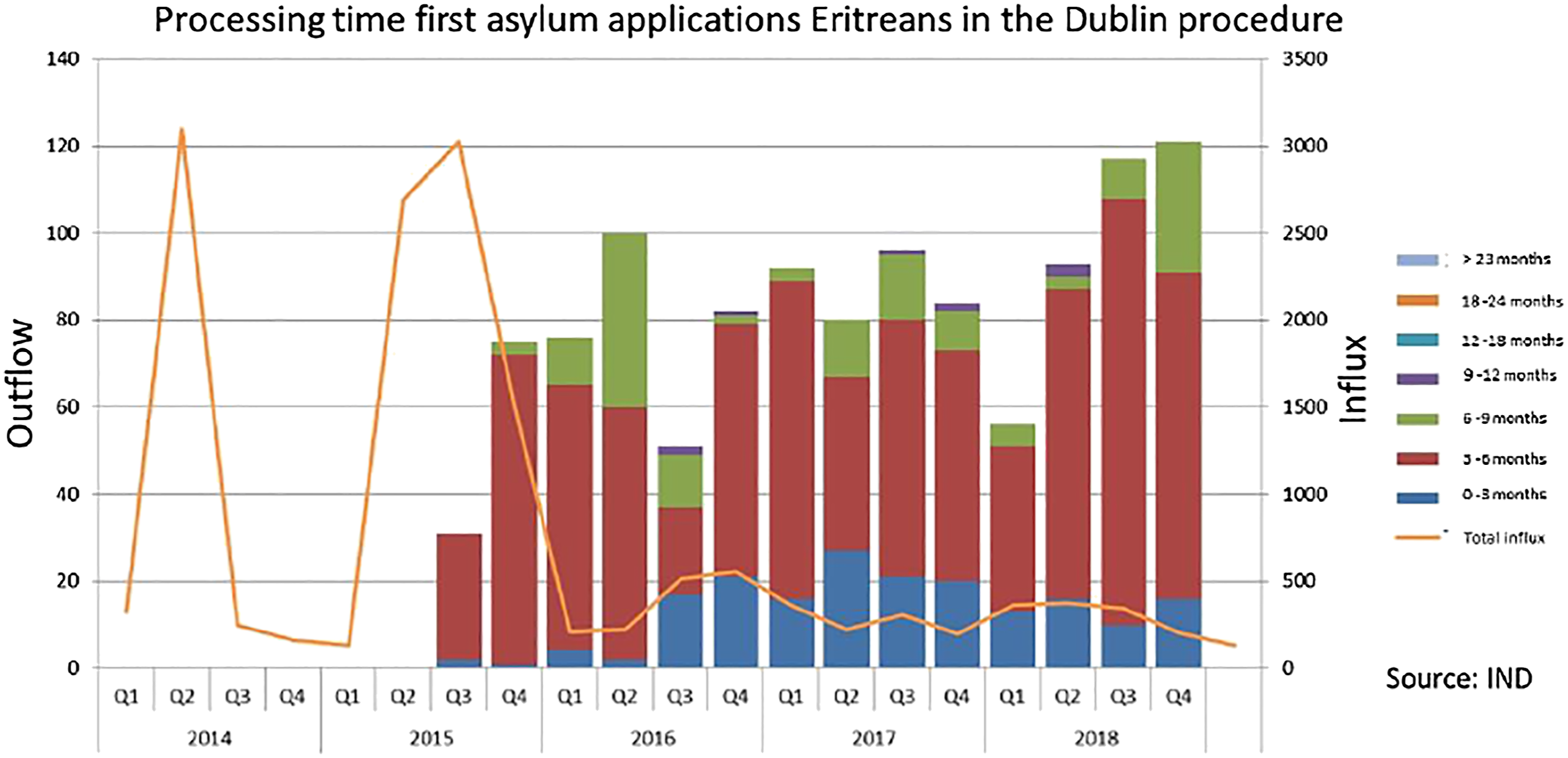
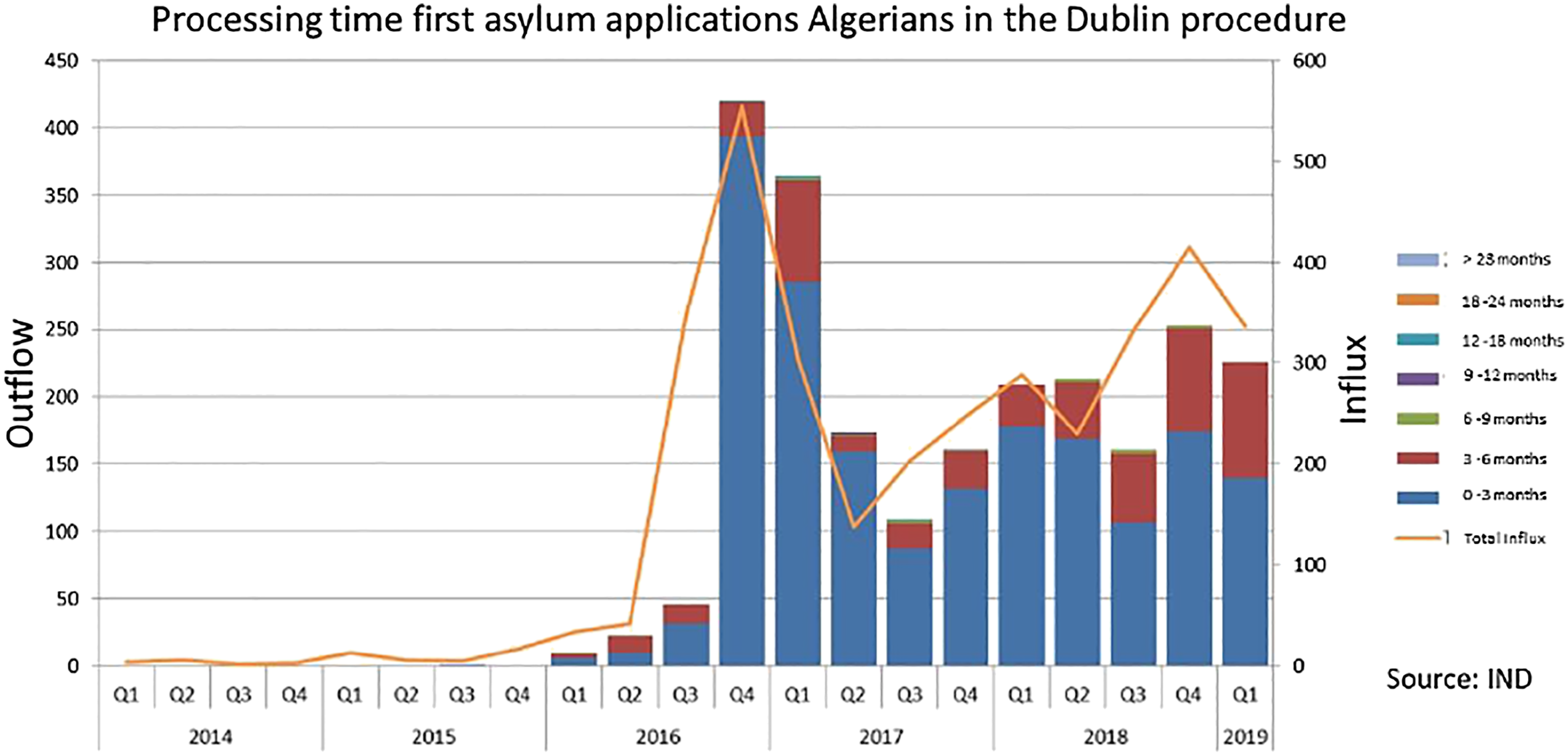
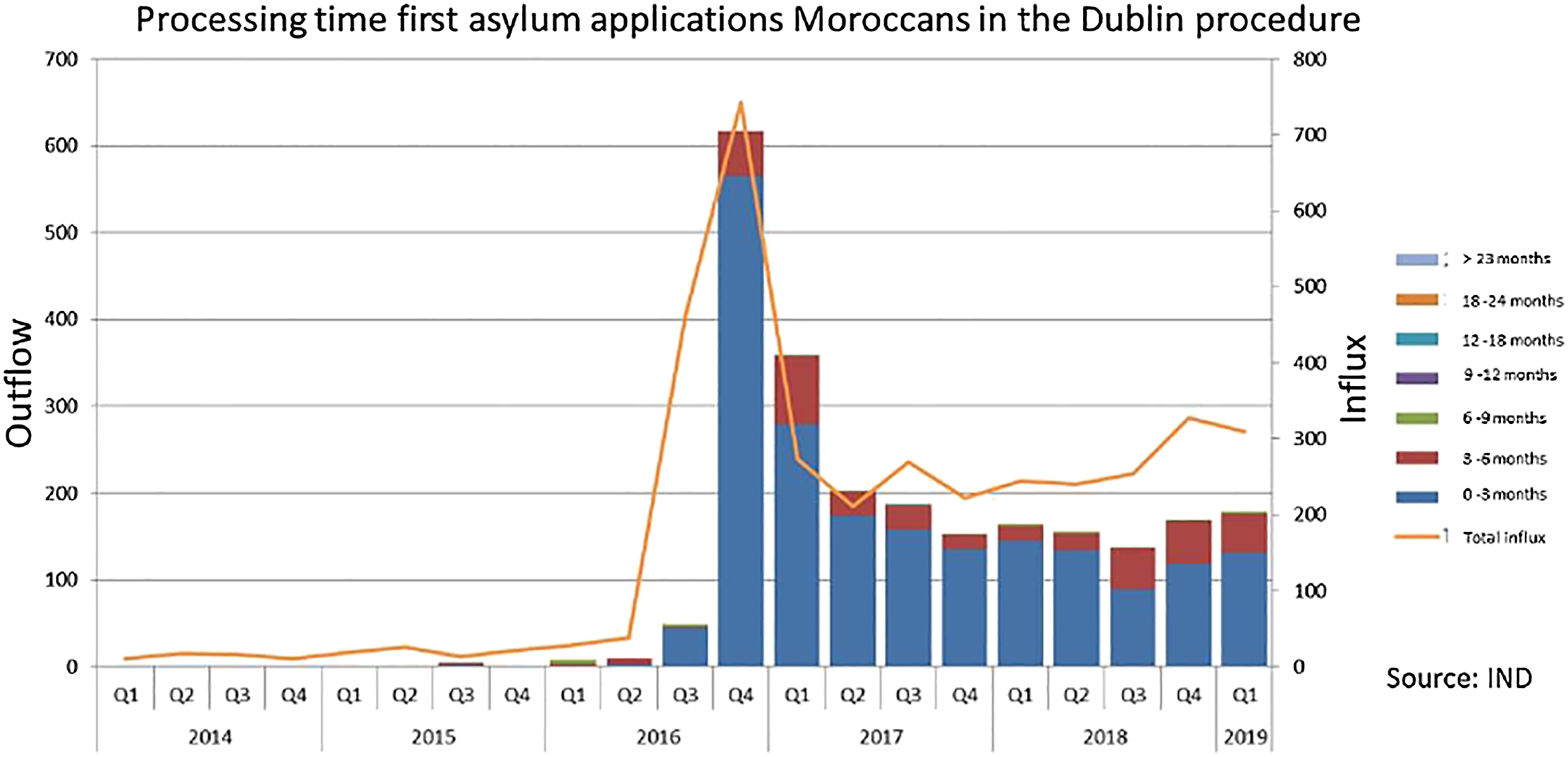
It is striking that also within the group of Dublin cases, asylum seekers with high chances of success (Syria, Eritrea and Iraq) had to wait longer than asylum seekers with low chances of success (Albania, Algeria and Morocco).
24
Figures 1–4 below show that by far most Dublin cases of Algerian (Figure 3) and Moroccan (Figure 4) asylum seekers were processed within 3 months, while by far, most Syrian (Figure 1) and Eritrean (Figure 2) asylum cases were decided within three to 6 months. Processing time first asylum applications Syrians in the Dublin procedure. Processing time first asylum applications Eritreans in the Dublin procedure. Processing time first asylum applications Algerians in the Dublin procedure. Processing time first asylum applications Moroccans in the Dublin procedure.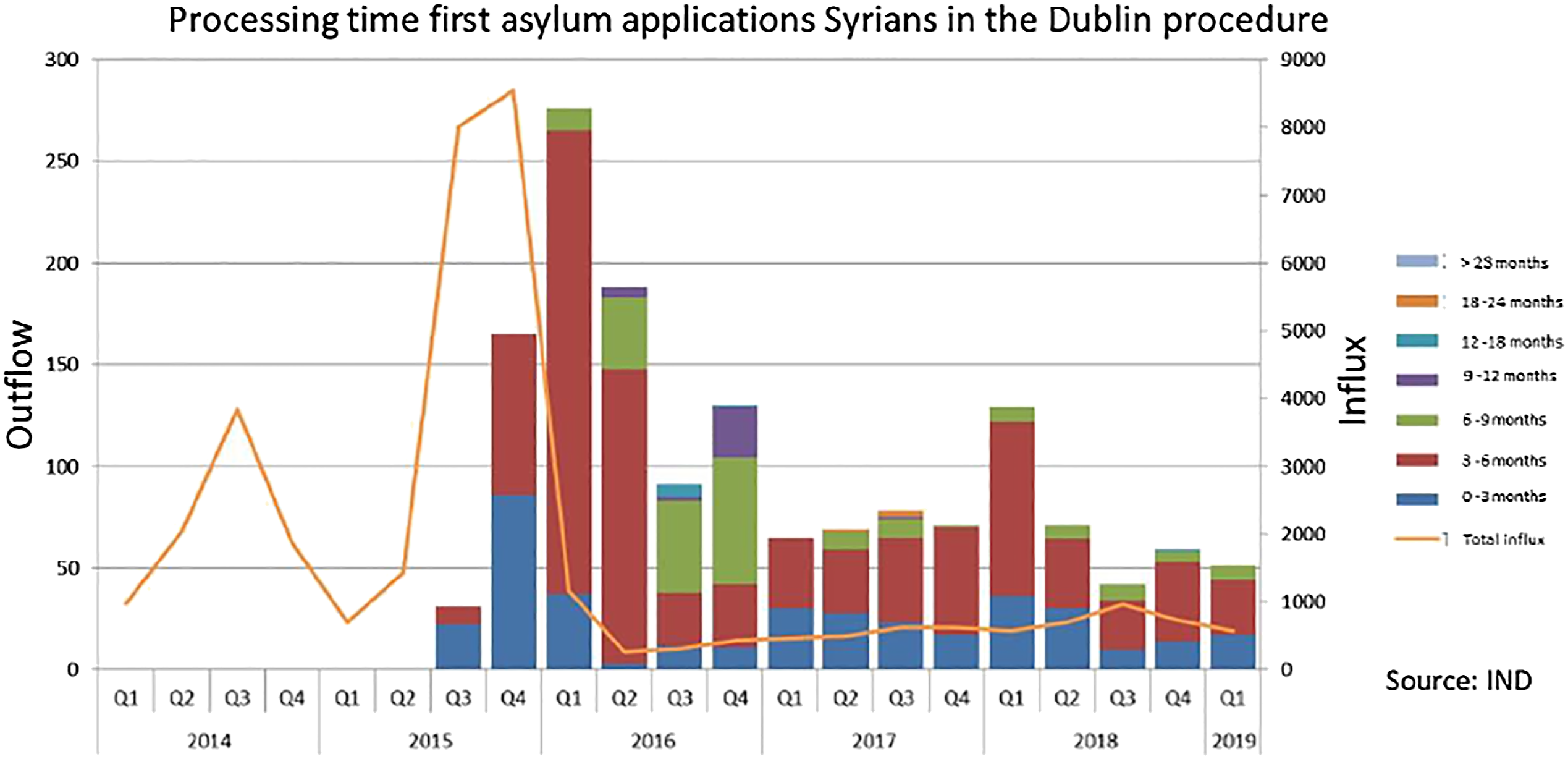
Deprioritising and decelerating cases with high(er) chances of success
While the IND has processed cases with low chances of success very quickly, it took much longer to decide on cases with high(er) chances of success and complex cases. The State Secretary has acknowledged that this was partly a result of the prioritisation and acceleration of cases with low chances of success. 25 The capacity of the IND was used to ensure that such cases were rejected within a short period of time, which meant that this capacity could not be used to process cases with high(er) chances of success. Apart from this, several decisions were made by the Secretary of State, which led to deprioritisation or deceleration of cases with high(er) chances of success. In this section, we discuss three of such crucial decisions.
First, the Secretary of State decided to actively decelerate cases of Eritrean asylum seekers in Spring 2014. In April and May 2014, the Netherlands received almost 1100 asylum applications from Eritreans per month. 26 Politicians called the situation concerning or even alarming. 27 In response, the Secretary of State took the ‘strategic decision’ 28 ‘to slow down’ processing of Eritrean cases in the general asylum procedure. 29 The State Secretary explained that the IND would take more time to examine the travel routes of Eritrean asylum seekers and human smuggling because the travel route seemed to have shifted from Germany and Sweden to the Netherlands. 30 The IND received the instruction to send 80% of all Eritrean cases to the extended asylum procedure. 31 After May 2014, the number of asylum applications from Eritreans decreased again, and the deceleration was stopped. 32
The second crucial decision was the refusal of the Secretary of State to apply a special track for cases of asylum seekers with high chances of success. This special track was implemented in Dutch law at the same time as the special tracks for cases with low chances of success, discussed in the previous section. It entailed that cases of asylum seekers, with a specific nationality or belonging to a specific group, of which it was foreseeable that they would be granted an asylum permit, would be accelerated (but not prioritised). 33 The application of this track would enable the IND to process more asylum cases on a weekly basis. As a result, processing time and therefore the period of uncertainty in which asylum seekers would find themselves would be shortened. 34
In February 2016, the Secretary of State specified that ‘the current situation renders the introduction of (the track for cases with high chances of success) indispensable’. 35 However, the Secretary of State never activated such a track. Instead, it was decided in February 2016 to extend the maximum time limit for taking a decision from six to fifteen months because there was a situation of high immigrant influx. This extension did not apply to cases with low chances of success. In February 2017, he announced that there was no need to apply the track for cases with high chances of success anymore because the number of pending cases and processing time had been reduced to manageable proportions. 36 In February 2017, the time limit for taking an asylum decision was again reduced to the standard 6 months.
The third crucial decision was made in 2016. After the influx and processing times had decreased, the IND sacked 300 employees. 37 It also received less budget for the following years on the basis of a prognosis of the influx of asylum applications, and in 2017 and 2018, more employees were dismissed (Commissie Van Zwol, 2019: 46). At that point, however, the time limit for decision-making remained extended to 15 months, and many asylum seekers were still waiting for their decision. The influx for 2018 turned out to be 5500 cases higher than the prognosis for that year. As a result of the large amount of dismissal of employees, the processing time of asylum cases in the general and extended asylum procedure increased dramatically in 2018 and 2019 (Commissie Van Zwol, 2019: 46). From the end of 2018 onwards, the IND started to recruit hundreds of new employees to reduce processing time. 38 However, these employees first needed to be trained and it took time before they would be able to work on cases independently. 39 The State Secretary expected it to take until 2021 before the IND would be able to decide on most cases in the general and extended asylum procedure within the legal time limit. 40
Consequences for the processing time
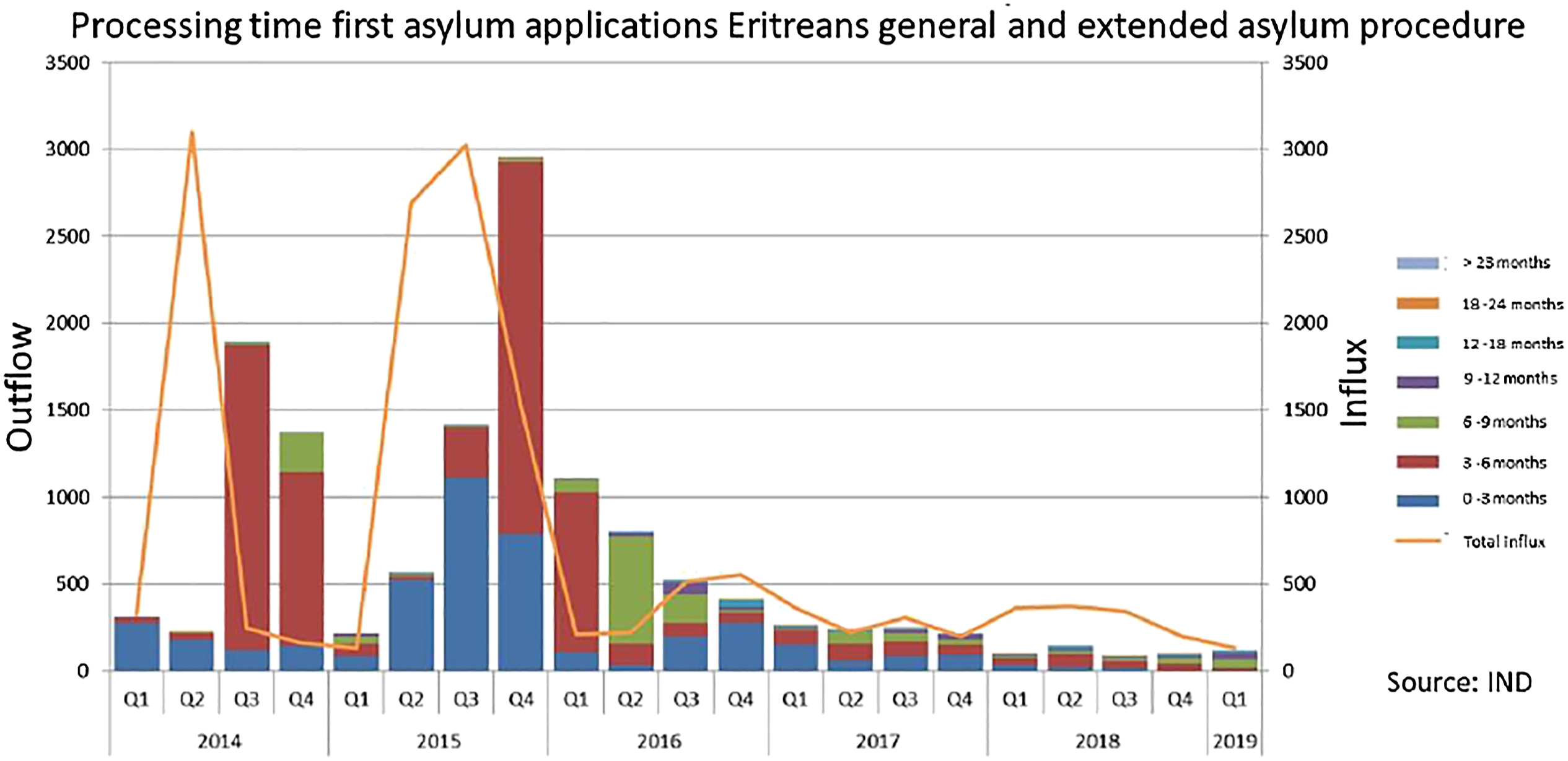
The duration of cases which were processed in the general and extended asylum procedure fluctuated after 2014. Syrian and Eritrean cases were delayed in particular in the first half of 2016. From the last quarter of 2016 until the beginning of 2019, by far, most cases of Syrians and Eritreans were decided within the legal time limit of 6 months (see Figures 5 and 6). Processing time first asylum applications Syrians general and extended asylum procedure. Processing time first asylum applications Eritreans general and extended asylum procedure.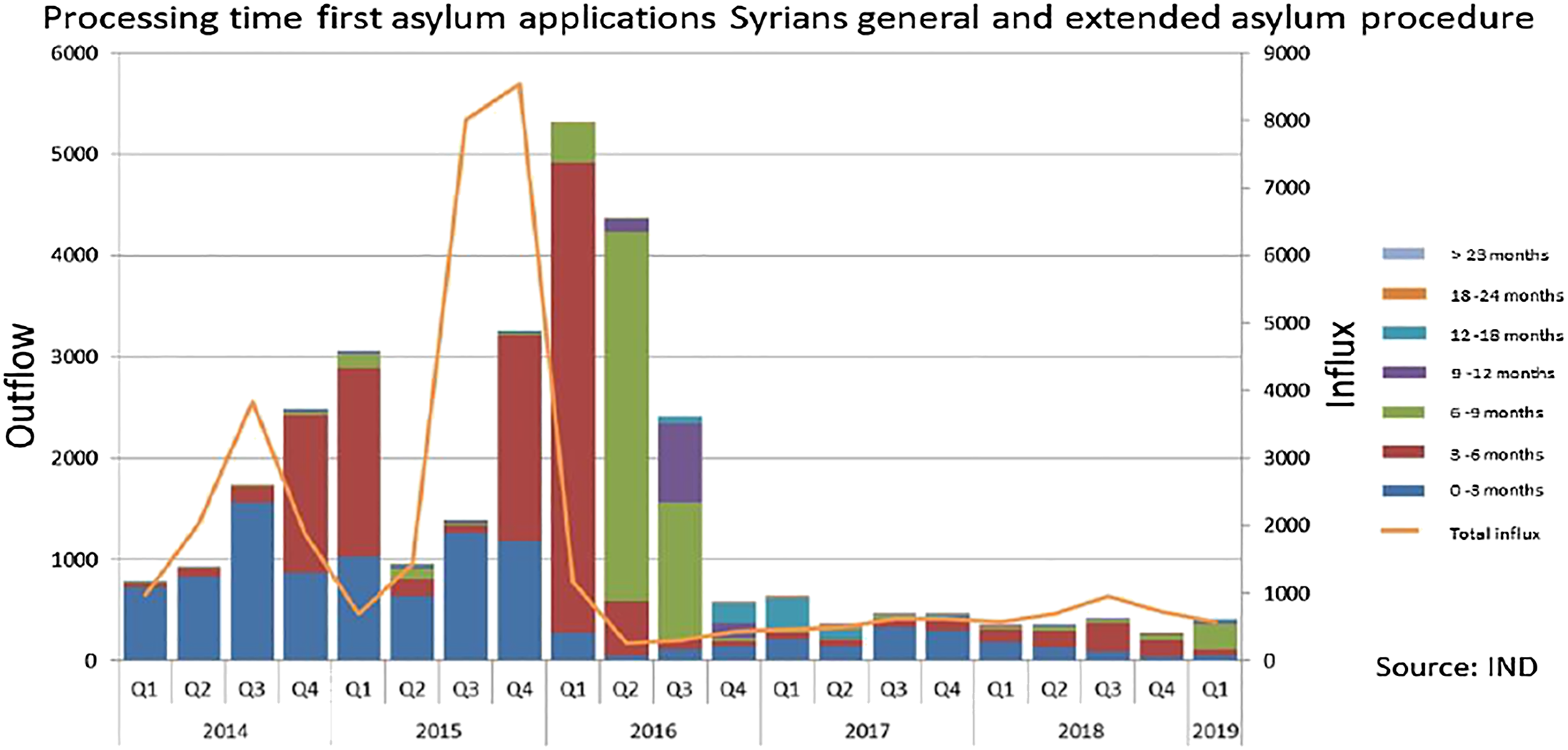
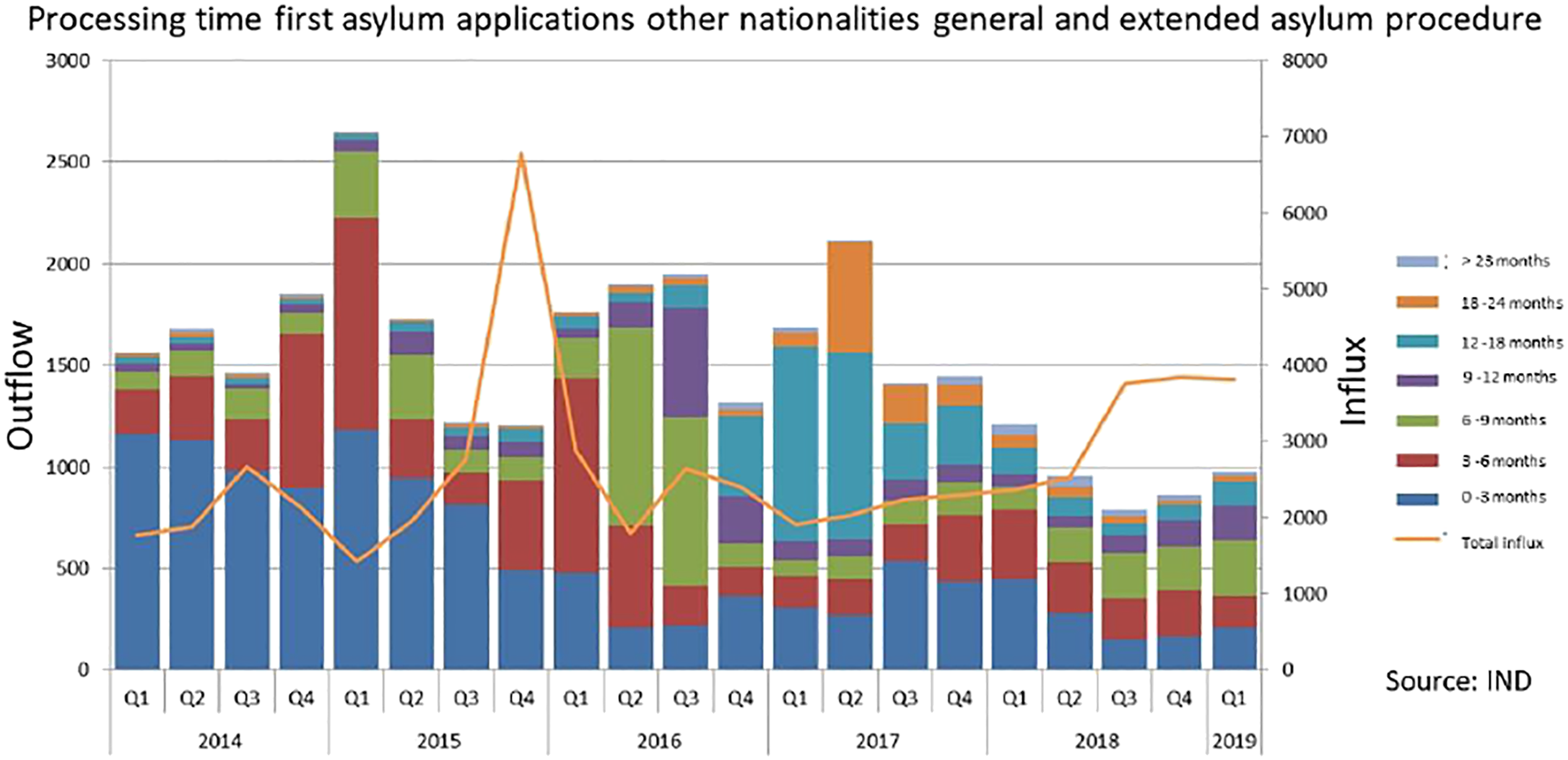
However, Figures 5–8 below show that asylum procedures in cases of asylum seekers with other nationalities took much longer. For example, most Iraqi asylum seekers, who received their decision in the period from the second quarter of 2016 until the last quarter of 2017, had waited between one and 2 years (see Figure 7). The same applies to many asylum seekers originating from other countries than Syria, Eritrea and Iraq (see Figure 8). With the exception of the last quarter of 2017 and first quarter of 2018, more than 50% of all asylum seekers who received their decision had waited more than 6 months. Processing time first asylum applications Iraqis general and extended asylum procedure. Processing time first asylum applications other nationalities general and extended asylum procedure.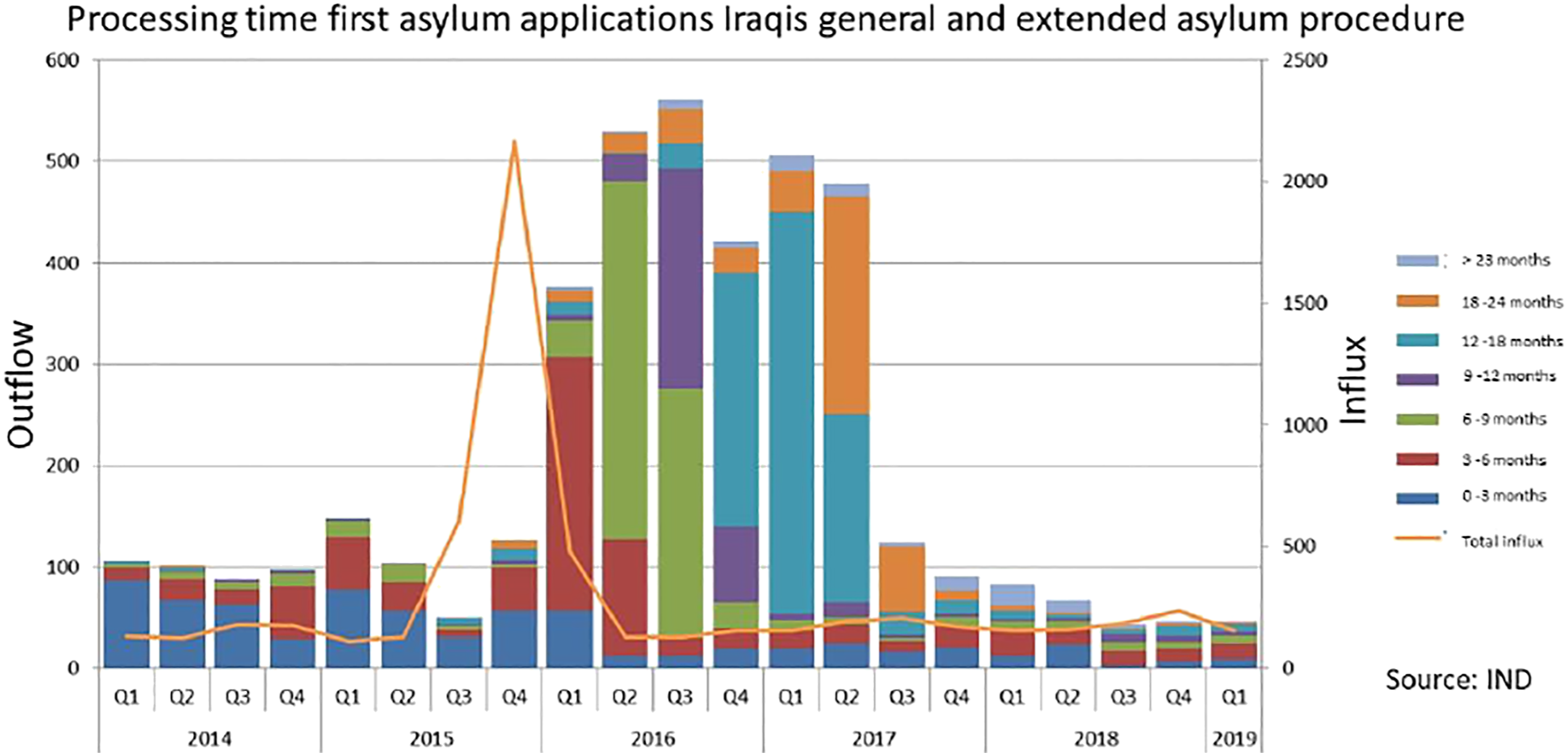
There seem to be long periods in individual cases processed in the general and extended asylum procedure, where the IND was inactive. A lot of time was lost before asylum seekers had their first interview with the IND. In March 2016, this period took an average of seven months. 41 In the beginning of 2018, an average of 75 days, and in March 2019, an average of 140 days passed before an asylum seeker had their first interview (Commissie Van Zwol, 2019: 43–44). 42 Moreover, once a case had been referred to the extended asylum procedure, this also led to long delays. Some cases waited for the planning for an additional interview (Commissie Van Zwol, 2019: 45). Other cases had to wait even though they were ready for decision-making because the IND lacked capacity (Commissie Van Zwol, 2019: 45).
European migration law and temporal governance
Endless procedures in which the asylum seeker has to wait for a final decision seem to benefit no one. Waiting is often perceived as a waste of time (Eule et al., 2019: 152; Schwartz, 1974), and for asylum seekers, it constitutes an ‘in-between’ situation after which life ‘could then move forward’ (Rotter, 2016: 88). While this does not serve to say that the waiting time of asylum seekers necessarily equates lost or empty time (Rotter, 2016), it often consists of long periods of ennui and inactivity (Kobelinski, 2010: 147; Griffiths, 2014). And such waiting time, the experience of being stuck in seemingly endless waiting periods, combined with the unpredictability of the outcomes, can have detrimental effects on well-being of these migrants (Wyss, 2019). The temporal border adds a sense of existential immobility to the physical border, which anthropologist Ghassan Hage has called ‘stuckedness’. Existential immobility is not limited to physical immobility – the impossibility to move from one location to another – rather it is temporal; it is about whether one can move forward to a viable future (2005; 2009). Stuckedness involves waiting, yet it is a hopeless sort of waiting. It is, as political scientist Anne McNevin succinctly captures it, ‘the combination of aspiration and the feeling of going nowhere, geographically, socially or economically, in a world in which others are perceived as being unfairly and disproportionately mobile’ (2020: 547). Given the effects of waiting on the asylum seeker, this begs the question how precisely these waiting periods, resulting from Dutch temporal governance, relate to law.
The Procedures Directive 43 (henceforth also RAPD) provides EU law standards for asylum procedures in the Member States. Basically, it balances two equally demanding principles that dictate the length of the procedure: the need for a fast and simple procedure and the necessity of a fair and effective procedure. 44 So, legally speaking, asylum procedures should not take too long, nor should they be too quick.
Indeed, lengthy asylum procedures seem, at first sight, to violate EU law. According to EU law, it is in the interest of both asylum seekers and the EU Member States to decide as soon as possible on asylum applications. 45 After all, the refugee is in immediate need of protection, while the host country wants to return the rejected asylum seeker to their country of origin as soon as possible. Quick asylum procedures prevent asylum seekers from being ‘kept in suspense for an unduly long period of time’. 46 They are also in the interest of persons in need of international protection since they ‘would enjoy quicker access to entitlements’. 47 Additionally, speedy procedures foster ‘employability, as their skills would suffer less from a long period without full access to labour market’. 48 For this reason, the Procedures Directive mentions explicitly that Member States may prioritise asylum cases, which are likely to be well founded. 49 A high speed of asylum procedures can also be in the interest of the Member States. 50 The reason for this is that it reduces reception costs and promotes the return of failed asylum seekers. 51 The European Commission thinks that it is reasonable that Member States deal with manifestly unfounded asylum cases in shorter procedures than in normal cases because they are less complex. Short procedures for such cases prevent abuse of the asylum procedure. 52 Asylum procedures may also be accelerated in the interest of national security or public order. 53
Notwithstanding, a procedure that is purely based on the principle ‘the sooner the better’ would clearly lead to unjust results (Hambly and Gill, 2020). Therefore, the Procedures Directive and case law also stress that time limits may not undermine the fairness of the asylum procedure. 54 It takes time to examine the applicant’s statements and documents, to reveal whether the asylum seeker is legally a refugee or an irregular migrant. Some cases simply need much time to investigate facts and evidence or are legally, highly complex. The European Commission recognises that speedy asylum procedures may not undermine the quality of asylum decisions, amongst other reasons because this may lead to more appeals and therefore longer procedures. 55 Short time limits should be accompanied by procedural safeguards for the asylum seeker, such as free legal aid. 56 Even though Member States may accelerate and prioritise the procedure in certain situations, the asylum seeker must enjoy a sufficient period of time within which to gather and present the necessary material in support of their application, thus allowing the determining authority to carry out a fair and comprehensive examination of those applications and to ensure that the applicants are not exposed to any dangers in their country of origin. 57
These underlying principles – fast and simple versus fair and effective – can be retraced to a sophisticated framework of rules regulating the asylum procedure. The Procedures Directive stipulates that the examination procedure should be concluded ‘as soon as possible’ and, as mentioned earlier, within 6 months of the lodging of the application. 58 This means that, generally speaking, the duration of the procedure is considered lawful, if it remains within the period of 6 months. However, Member States may extend the time limit of the procedure up to a further 9 months where a case is very complex; there is a situation of high influx or the applicant fails to satisfy certain obligations to cooperate in the procedure. Moreover, the time limit may be extended due to uncertainty about safety in the country of origin. In any case, the maximum time limit is 21 months. Based on these rules, certain cases can be deprioritised or decelerated as long as they remain within these time limits. If one wants to establish the legal time limit for decision-making, one therefore has to establish whether such an exception to the general six-month rule applies in the individual case.
The Procedures Directive mentions a limited number of grounds for acceleration of asylum procedures. One of these grounds is that the asylum seeker originates from a safe country of origin. The Directive does not define the term ‘accelerated procedure’. Moreover, it does not require the asylum procedure to last a minimum amount of time. It is only stipulated that there should be an ‘adequate and complete examination’. As a result, the duration of accelerated procedures varies widely among Member States (ECRE, 2017: 10).
The Procedures Directive allows Member States to prioritise any asylum case. The Preamble states that ‘in order to shorten the overall duration of the procedure in certain cases, Member States should have the flexibility, in accordance with their national needs, to prioritise the examination of any application by examining it before other, previously made applications’. It mentions two types of cases, which Member States may particularly prioritise: cases with high chances of success and cases of vulnerable asylum seekers.
Due to the underlying contradictory principles, the Procedures Directive consequently provides Member States plenty of room for manoeuvre (‘temporal discretion’) to take measures affecting the duration of the asylum procedure, instead of providing a clear and monolithic framework establishing clear boundaries to the sovereign power. The next section will demonstrate on the basis of the Dutch case how governments can, in practice, apply temporal governance measures within and outside the legal time limits, while asylum seekers lack the legal avenues to effectively challenge such measures.
Temporal governance and European migration law: The Dutch case
Temporal governance measures may be lawful or unlawful. Measures, which lead to (systematic) breach of time limits, are clearly unlawful. However, we reveal below that this does not mean that the law will necessarily prevent such unlawful use of temporal governance measures since legal remedies to enforce timely decision-making are often lacking. In case of temporal governance measures, which fall within the legal time limits, legal control is also almost completely absent. Even if an individual asylum seeker is able to challenge the lawfulness of such measures before a judge, their chances of success are minimal. Consequently, law is not able to limit or legitimise the government’s power to apply temporal governance measures.
Temporal discretion: Exceeding legal time limits
At the end of 2018 and 2019, the IND in many cases, including those of Syrians, Eritreans and Iraqis, needed longer than 6 months to take a decision, which was clearly unlawful. Parliamentary documents and reports show that the IND systematically failed to meet the legal time limits 59 and that the main cause of the delay was a lack of capacity (Commissie Van Zwol, 2019: 45–46). As a result, a considerable amount of time passed between the moment of the asylum application and the first interview with the IND and after referral of a case to the extended asylum procedure. These delays were not justified by a high influx of asylum seekers. In 2018, the number of asylum applications was only 5500 higher than expected and did not come close to the influx in 2015. The Secretary of State (probably for that reason) did not extend the time limit with 9 months on the basis of high influx as he had previously done in 2016.
Still, it is one thing for processing time to be unlawful on paper, it is quite another to have an effective legal remedy, which prevents the government from simply remaining inactive. If the time limit for decision-making has been exceeded, an individual asylum seeker may start proceedings in order to force the authorities to take a decision. In the Netherlands, the asylum seeker can register their objection by writing a notice of default to the IND. If the IND has not decided within 2 weeks after the notice has been given, it automatically has to pay a penalty fee of 23–45€ per day, until it finally takes the decision. 60 Moreover, the asylum seeker can ask the court to set a new time limit for decision-making after which the IND has to pay a penalty fee of 100€ a day with a maximum of 15,000€. 61
In theory, this should be an effective remedy to limit unlawful prolongation of processing time. However, in practice, the IND did not manage to decide within the 2 weeks after the notice was sent by the relevant asylum seekers or the time limits set by the court. As a result, many asylum seekers received a high amount of IND fines but still had to wait for their decision on their asylum application. The amount of money paid by the IND increased from 700,000€ in 2017, to 1.5 million euros in 2018 and 6,6 million euros in 2019. 62 The State Secretary expected this amount to increase to 17 million euros in 2020 and 16 million in 2021. 63 This indicates that the IND did not anticipate a reduction in processing time in the coming years. The high number of penalty payments led to political outrage. As a result, the penalty procedure for exceeding time limits has been withdrawn, with the effect that asylum seekers can no longer contest the unlawful prolongation of processing time. 64
Temporal discretion: Within legal time limits
In Dutch practice, there seemed to be long periods of IND inactivity before a first interview with an asylum seeker occurred and even after the referral to the extended procedure in many asylum cases. An asylum seeker could claim that the decision on their asylum application was not taken ‘as soon as possible’, as is required by European law. However, what precisely does ‘as soon as possible’ mean? This term seems to indicate that processing time should be used for the right purposes: the examination of the individual asylum application in a fast, simple, fair and effective manner. In a specific legal context, the aims of temporal governance measures should be legitimate, and the measures should be appropriate and necessary to achieve these aims. Moreover, they should not cause disproportionate harm to asylum seekers. Did the temporal governance of the Dutch Government fulfil these standards?
There are several factors, which make it difficult to answer this question. First, it is often unclear what the individual asylum seeker is waiting for: availability of an interpreter, further research into the application or an IND officer who can do the interview or take a decision? The aim and necessity of the asylum seeker’s waiting can thus not be established.
Second, temporal governance measures may have explicit aims, which are communicated in policy documents, as well as implicit aims which remain hidden. According to Dutch policy documents, the prioritisation and acceleration of cases with low chances of success aimed to prevent further delay of cases with high(er) chances of success and to increase physical space in the reception centres. 65 This is in line with EU legislation, which promotes quick decision-making, in particular in cases with low chances of success. Moreover, these measures were to deter poor-chance asylum seekers coming to the Netherlands while ensuring an effective return policy for migrants without a right to stay. 66 This aligns with the general objective of the European Union to effectively return migrants without a right to stay. 67 Finally, the measures had to prevent nuisance caused by asylum seekers with low chances of success, which may be justified in the light of public order. 68 The explicit aims of the temporal governance measures may thus be considered legitimate.
However, one could suspect that the deprioritisation and deceleration of the cases of asylum seekers with high(er) chances of success also aimed to deter asylum seekers from coming to the Netherlands. This aim would not be legitimate because such an interest is not mentioned in EU asylum legislation. Rather, the EU legislation seeks to guarantee the full and inclusive application of the Refugee Convention. Deterring (potential) refugees from coming to the Netherlands does not sit well with this aim. However, it cannot be derived from publicly accessible documents that such a covert aim existed. The State Secretary has denied on several occasions that this was his government’s intention. 69 Indeed, the Secretary of State took measures in 2015 to cope with the high number of asylum applications and speeding up all procedures, such as recruiting more IND personnel, opening more asylum application centres and extending IND working hours to the weekends. 70 From the perspective of political justice, it is perfectly understandable that society does not spend all of its resources on one of its branches: the authority deciding on asylum applications. The amount of resources which are made available to the determining authority is thus a political choice. As a result, procedures may last longer because of a lack of available resources and staff to speed up the procedure. High influx and capacity problems may also mask an implicit illegal aim to make asylum seekers wait in order to deter others from coming.
The third factor which renders the assessment of the lawfulness of temporal governance measures problematic is that it is impossible to establish whether such measures are suitable and necessary and proportionate for achieving the envisaged aim. As to suitability, the Dutch government and politicians often mention that measures should be taken to deter asylum seekers from coming to the Netherlands or to prevent the Netherlands from becoming too attractive to asylum seekers. However, it has not been systematically researched whether these measures actually work. Moreover, even in hindsight, it is impossible to establish whether the temporal governance measures of the Dutch government have reached their aims. For example, did accelerated asylum procedures indeed deter poor-chance asylum seekers with? Statistics only show how many of such asylum seekers have applied to the Netherlands, not how many have chosen for another Member State as a result of temporal governance.
It is also difficult to establish whether poor-chance asylum seekers have indeed left the Netherlands in greater numbers than previously or sooner than before. The return of an asylum seeker depends on many factors, such as the cooperation of the asylum seekers and the country of origin (DSP Group, 2018: 55). Moreover, the Dutch authorities often do not know whether an asylum seeker has left the country or continues to illegally reside in the Netherlands. 71
IND employees and the Secretary of State have recognised that the prioritisation and acceleration of asylum cases with low chances of success has actually contributed to delays in asylum cases with high(er) chances of success. 72 Therefore, in hindsight, we can conclude that the twin aims of streamlining high-chance asylum cases and creating space in reception centres have failed. . Nevertheless, it could also be argued that processing times would have further increased anyway, if the IND had not prioritised and accelerated cases of asylum seekers with low chances of success. Moreover, there were other factors at play, such as a (slightly) increased influx and a lack of capacity at the IND.
In the context of the proportionality test in an individual case, the interests served with the temporal governance measures should be weighed against the interests of an individual asylum seeker. In this exercise, a judge would pay deference to the decision-making of the government, thus (again) granting temporal discretion. It was mentioned in section 4.1 that long procedures cause harm to asylum seekers. However, how should this harm be best measured? Reports on the situation of high asylum influx in the Netherlands mention that many asylum seekers suffered from stress because they had left family members behind in unsafe areas and could not arrange for their reunification until they had received an asylum status (Reneman, 2018: 177). Moreover, medical and psychological treatment of asylum seekers was often postponed until they had started the interviews with the IND or had even received an asylum status (Reneman, 2018: 171). Finally, during the period of high influx and its aftermath in 2015–2016, there was a lack of recreational activities in the reception centres, which led to passivity and isolation (Commissie voor De Rechten Van de Mens, 2015: 4–5, 2016: 8). Yet, is this sufficient to evidence that in relation to high-chance asylum cases, the periods of IND inactivity within the legal time limits constituted unlawful processing time? This should be assessed on a case-by-case basis and is difficult to establish in general. Similarly, it is not an easy task for an asylum seeker to show how the acceleration of the asylum procedure negatively affected the asylum decision.
Besides, there is yet a second problem to overcome, which has already been touched upon. Even if it could be established that processing time in individual asylum cases is unlawful, asylum seekers lack a mechanism for legal redress with which to force the IND to take a decision, as long as the time limit for decision-making has not been exceeded. For example, they cannot challenge the decision to extend the time limit for decision-making. 73 Moreover, they cannot ask a judge to order the IND to prioritise their case. They may try other legal pathways, such as a claim before the civil court but even if such a claim were to be open in theory, it is closed in practice because – aside from being legally intricate – it requires considerable time and money. Therefore, it does not provide a solution for asylum seekers who are waiting for their decision. As far as we know, this remedy has not ever been attempted by asylum seekers’ lawyers.
Conclusion
We have demonstrated that in the period 2014–2019, the Dutch government used the (de)prioritisation, acceleration and deceleration of asylum procedures to differentiate between cases with good and poor chance of success. Even though we have not found any explicit intention to prolong procedures of precisely those good-chance asylum seekers or those who have complex cases, their long waiting time was the undisputed result of the Dutch policy. Dutch policy gave priority to the acceleration of cases of poor-chance asylum seekers, in order to deter such asylum seekers from coming to the Netherlands and effectuate their prompt return. This should have resulted in more time and space for good-chance asylum seekers. This policy stayed in place, even after it had become clear that it did not achieve these aims. Moreover, the Dutch government made a political choice to cut the budget of the IND, even though many asylum seekers were still waiting for their decisions.
This Dutch policy should be understood as a form of what Griffiths calls temporal governance; a form of governmentality, which focuses not so much on the control of bodies but rather on the control of processes. This operation of power targets temporal phenomena, which occur over a period of time, and is directed to the whole group of asylum seekers. Since the high influx of asylum seekers in 2015 was received as ‘disastrous’ by the Dutch government, it took several measures to lower the number of asylum applications. In 2015, different tracks were put into place, to differentiate between cases with high and those with low chances of success. Such tracks are classic examples of what Foucault means with ‘governmentality’, by means of detailed knowledge about the ‘influx of asylum seekers’ differentiations can be made within the total ‘population’ of asylum seekers. This form of knowledge is based on classifying, qualifying, categorising and ranking the data about the population at hand, as Braun has pointed out (2007; 10). This knowledge, therefore, is an important element of the operation of this form of power. Since the influx of asylum seekers is ungovernable on the individual level, it necessitates a collective approach targeting asylum applications as processes that stretch out in time. Based on the statistics of these processes, it is the time and pace of these procedures that can be managed, calculated and controlled with the effect that asylum seekers with low chances of success quickly receive a negative decision, while those more likely to receive a residence status are stalled.
It is this temporal operation of power that begs the question what the precise relationship is between temporal governance and law, especially in the light of the lack of an explicit, official aim to prolong the waiting time for complex cases and asylum seekers with high chances of success. Instead of asking the question what exactly the legal limits are to such waiting policy, in this article, we flipped from a legal perspective to a temporal perspective that emphasises the long-term effect Dutch policy had in practice. The legal story is one of the official aims, exceptions, intended prioritisations and accelerations, unintended deprioritisations and decelerations and discretionary room to make policy choices. Instead of focussing on the question whether this form of governance was legitimate, we examine how law was operationalised in this form of governance and how it enabled this particular durable effect. What would the legal status of such a policy be if the policy covertly aimed at making highly complex and/or high-chance asylum seekers wait?
We argue that the crux of it all is the central role of time: both in the functioning of this form of governance by means of the knowledge of processes, as well as in the limited possibilities to restrict this by means of legal criteria and remedies. Crucial in the latter aspect is what we have called ‘temporal discretion’ within the legal framework. Such temporal discretion is available in law in two forms. Firstly, there is conceptual ambiguity and discretionary room for exceptions to the duration of asylum procedures. This room for manoeuvre is based on the indeterminacy that exists between two underlying principles of EU law. The point of departure is that asylum procedures have to be concluded ‘as soon as possible’ but not be too quick in order to ensure an ‘adequate and complete examination’ of the asylum case. EU law provides for a time limit of 6 months for decision-making in the asylum procedure. However, Member States have plenty opportunities to extend this time limit on the basis of individual or general circumstances (including high influx). Exceeding of the legal time limit for decision-making is clearly unlawful. However, we have disclosed that within the time limits, the lawfulness of temporal governance measures is a very complex issue to assess; their covert aims have to be uncovered, and their eventual effects on asylum seekers need to be measured and weighed. In such an exercise, a judge will pay deference to the government’s decisions.
Secondly, even if it is clear that certain processing time is unlawful, asylum seekers often have no effective legal remedies at their disposal to enforce that a decision is taken in their case. Tellingly, the Dutch State Secretary recently decided to cancel one of the few legal remedies the asylum seeker had to challenge the long processing time (the imposition of penalty fees on the State) because it cost the state too much money and capacity. This will make it practically impossible in the future to effectively challenge governmental inactivity. At the same time, it should be noted that fines for delay in processing did not necessarily lead to a quicker asylum decision. Often, asylum seekers simply had to wait longer, even though this resulted in the maximum amount of penalty fees.
Two features of temporal discretion – the indeterminacy of legal criteria for the duration of the procedure and lack of effective remedies – ensure that temporal governance resulting in long waiting for asylum seekers remains, legally speaking, quite unrestricted. Firstly, simply by hiding behind the competing interests that determine the length of the procedure, subsequently, by invoking exceptions that allow for extensions of the maximum duration, and finally, by simply remaining inactive even after that period of time. Here, Butler’s (and Foucault’s) argument that in governmentality, law does not have a legitimating and restricting function but rather operates as a tactic for extralegal operations is enlightening. Of course, law can still have such a classic function, and obviously, it still operates as such in many migration cases. However, when a government endeavours to explicitly make asylum seekers wait – such as seems to be the case in the Dutch practice – the law does not restrict this operation of power, to the contrary, it provides an opportunity to buy time. Moreover, law provides asylum seekers little protection against temporal governance measures. After all, governmental inaction leads to more waiting, just as procedures to challenge these operations cost more time, time in which the applicant has to wait longer. In other words, certain policies might be unjust, but it takes time to get justice done, to accomplish certain rules in practice. It is in this sense that power can be extralegal without being illegal. Law then enables, or at least does not prevent, the sophisticated operation of power that is based on detailed knowledge of temporal processes on the basis of which some categories of asylum seekers have to wait, while others are rushed. And because some must stand and wait, the influx of asylum seekers appears to be still subject to (some) governmental control.
Footnotes
Acknowledgements
The authors would like to express their gratitude to Pieter Boeles, Frances Gilligan, Betty de Hart, two anonymous reviewers and Michelle Bastian from T&S for their thoughtful comments on draft versions of this article. Thanks goes also to the department of the Dutch IND, which provided the statistics for this article and also critically read earlier versions of the paper and to participants of the Bergen aan Zee seminar 2018 organised by the Amsterdam Centre for Migration and Refugee Law of the Vrije Universiteit Amsterdam, where we presented our first ideas for this article.
Declaration of Conflicting Interests
The author(s) declared no potential conflicts of interest with respect to the research, authorship and/or publication of this article.
Funding
The author(s) received no financial support for the research, authorship and/or publication of this article.
