




Abstract
Existing research and policy on international students’ study-to-work transition fall short of a temporal theoretical perspective that is sensitive to the fluid and class-stratified nature of their career imagination. Career imagination refers to how international students conceive of, enact and reconfigure their careers as they encounter novel circumstances along their life courses. Drawing on in-depth interview data with 21 Chinese international students and graduates at UK higher education institutions, this article adopts a primarily Bourdieusian framework that centres around how time, class and privilege intersect to shape these students’ career imagination. In this framework, time is conceptualised both as a form of coveted cultural capital and as an underlining mechanism that constitutes these students’ habitus. This theoretical orientation facilitates exposition of the complex rationale behind the two observed temporal career strategies, ‘deferred gratification’ and ‘temporal destructuring’ and accentuates nuanced inequalities pertaining to fine-grained familial class backgrounds and places of origin of these students. This article furnishes empirical cases that challenge extant policy and empirical literature’s tendency to consider international students and their career imagination as homogeneous, individualised and present-focused. Instead, the empirical findings reveal how these Chinese international students’ career imagination is class-differentiated, embedded within and influenced by broader temporal structures and constantly evolving. This article thus advances understanding about how temporally sensitive and better differentiated career supports should be and could be tailored for international students at policy and practice levels.
Introduction
This article contributes to understanding the career imagination of international students from a temporal perspective. Career imagination is defined as ‘[p]eople’s understandings of what careers can look like [as] informed by what is collectively perceived as appropriate in particular social locations’ (Cohen, 2014: 169). Such social locations can denote discourses about what is a desirable career (Geddie, 2013) or gendered perceptions about what jobs are best for women (Cohen, 2014). However, this does not mean that career imagination is static. Instead, as social agents experience novel events in life, their career imagination can be recalibrated and reconfigured. This aspect highlights the importance of a temporal perspective, which was underdeveloped in Cohen’s work, that accentuates the evolving nature of an individual’s career understanding as furnished by their shifting living circumstances over time.
Such a temporal perspective, however, is lacking in policy accounts of, and empirical literature on, international students’ study-to-work transition. Current policy discourse in destination countries such as the United Kingdom, Canada, Denmark and Singapore has often statisticised international students as lifeless figures that constitute graduate employment indicators (Collins et al., 2017; Ge and Ho, 2019; Geddie, 2013; Higher Education Statistics Agency, 2018; Mosneaga and Winther, 2013). These instrumental approaches betray policymakers’ lack of intention to harbour international students’ subjective career wishes, plans and imaginations. Instead, there are prevalent focuses on the present, the Now of the international students’ employability and much oblivion of the ‘unpredictable’ future and impact of ‘the passage of time’ on these students’ post-study career enactment (Collins and Shubin, 2017: 19). Such policies also tend to consider career deliberation of international students as a linear process that could be compartmentalised in a specific period,1 for example pre-employment stages.
Within such policy accounts, international students are often individualised and homogenised. They are individualised because they are frequently assumed to be ‘individual free agents, able to respond to [migration policies] in line with their individual career or lifestyle preferences’ (Geddie, 2013: 204); this assumption ignores the ‘embedded’ nature of international students’ career decision-making, as shaped by their complex transnational relationship and citizenship strategies (Geddie, 2013). They are homogenised because they are typically portrayed to fit this persona: … are financially secure; have the support (emotional and material) of family and friends (i.e. ‘social capital’); have been raised in an environment that places great value on formal education and credentials; have highly educated parents; and have experienced overseas travel as a child. (Waters, 2012: 128)
This stereotype is counterproductive as it may falsely lead policymakers and institutions to believe that a one-size-fits-all approach is sufficient for supporting all international students’ study-to-work transition. In fact, research has revealed that international students can be highly diversified and socioeconomically stratified. Phan (2016), Yang (2018) and Xu (2020), for instance, have researched international students who are from working class, rural and impoverished backgrounds of China, India and other Asian societies. Compared with their privileged peers who often enjoy abundant familial support and exude confidence in the future (Waters, 2012), this latter group may display more practical education pursuits and career imagination. Collins et al. (2017), for example examine the post-study trajectories of international alumni at three major Asian universities. They find that these graduates’ career development in their home or third-country destinations was largely influenced by their familial connections and whether their foreign degrees were recognised in their respective labour markets.
The stratified nature of international students’ career access and progression could be abundantly manifested in their differentiated access to economic, social and cultural resources and privileges, or capital, based on Bourdieu (1986). Time, following Bourdieu and accentuated by Cheng (2014: 388), can thus be conceptualised as: a distinctive form of cultural capital that can be used, appropriated and converted into other advantageous forms of capital within a cultural milieu which legitimises specific ideas and practices of time as symbolically valuable.
Due to unequal access to resources including time, international students of differing backgrounds require differentiated study-to-work transition supports. Nevertheless, there has been little empirical understanding about how time features in and shapes the career imagination of international students. Take the case of Chinese international students with British higher education degrees for example: much existing research on these students has been focused on their perceptions of employability and approaches to getting hired immediately after graduation. Huang and Turner’s (2018) and Huang et al.’s. (2014) survey of Chinese students’ attitudes towards employability finds approaches such as players, careerists, retreatists or rebelists and echoes extant research about British graduates’ approaches to employability (Tomlinson, 2007). Li (2013) reveals that ‘Guanxi’ (social capital) and ‘Suzhi’ (quality) feature prominently among the 23 master’s student participants’ perceptions of employability. Huang’s (2019) research confirms the importance of developing Chinese students’ ‘graduate capital’ to improve their employability, while Cao’s (2017) study pinpoints relevant factors such as region of origin, family background, previous overseas experience, first degree institution and work experience. Additionally, the AGCAS (2016) survey of more than 6000 Chinese students and graduates suggests that most ‘are not career ready’ upon coming to Britain (p. 14). However, they reveal few insights into how a ‘through-train’ institutional career support model could be facilitated.
To redress the above theoretical and empirical gaps, this article investigates the career imagination of 21 Chinese international students and graduates with British higher education degrees who are from middle and upper middle class backgrounds.2 It has two aims: firstly, to provide a theoretical vocabulary for understanding how time features in and shapes these Chinese international students’ career imagination; secondly, to pinpoint how class, privilege and time intersect to underpin these participants’ temporal career strategies. By achieving these aims, this article can serve as an anchoring point for informing better differentiated career support for international students at policy and practice levels.
In what follows, I will first discuss time in career imagination by engaging with Bourdieu’s conceptualisation of time and a range of theoretical works within the sociology of time. I will point out how a temporally sensitive approach is instrumental in understanding how time, class and privilege intersect to shape these students’ career imagination. I will then expound on two observed temporal strategies employed by these Chinese international students: ‘deferred gratification’ and ‘temporal destructuring’. Lastly, I will discuss empirical and theoretical contributions of this article and tease out practice and policy implications.
Time, class and privilege in career imagination: A theoretical framework
This article is informed primarily by Bourdieu’s (1986, 2002) conceptual tools of capital, field and habitus as well as his writings on the social structuring of temporal experience (Bourdieu, 2000). Specifically, I first conceptualise time as a form of coveted cultural capital (following Cheng, 2014), the possession and free deployment of which can be highly stratified along class lines and shapes the adoption of career strategies such as ‘waiting’ (to be elaborated) among these Chinese international students. Second, I draw on Atkinson (2019), Snyder (2016) and Adam (1990, 2006) to expound how time is integral to the field and sedimented within these Chinese international students’ habitus, thus inclining them towards certain career preferences, attitudes and approaches over others, reinforcing and reproducing forms of class privilege. While Bourdieu’s theoretical framework facilitates an incisive set of tools for unpicking the structural factors that have an impact on these participants’ temporal understanding of career imagination, I have turned to concepts such as ‘deferred gratification’ (Adam, 1990) and ‘temporal destructuring’ (Leccardi and Rampazi, 1993) from the cannon of sociology of time as specific conceptual vocabulary that can depict observed career strategies among participants.
Although not originally intended, participants in this study constantly evoked temporal references to articulate career ambition, signal career adjustment and punctuate career reconfiguration across time. It was observed that an ultimate desire for time autonomy had shaped their career imagination. This echoes what Nowotny (1992) underlines: the intensification and commodification of time in our contemporary era has engendered an overwhelming need to take charge of ‘one’s “own” proper time’ (p. 444): Many individuals today are articulating their wish for greater autonomy over their time, including the ability to structure time in such a way that it yields units meaningful for them and in accordance with certain types of activities embedded in their life situations. (Nowotny, 1992: 445)
This fundamental concern for time autonomy is arguably a result of the capitalist tactic that constantly deploys clock time to exert social control (Adam, 1990; Bailey and Madden, 2017; Thompson, 1967). In order to extract surplus value from workers, capitalists commodified time, equating clock time to money (Adam, 1990). Clock time as a commodity thus fuels capitalist greed. To maximise profit, capitalists strive to erode workers’ ‘personal time’, ‘thought time’ and ‘process time’ (Bailey and Madden, 2017: 5). This has brought about two notable consequences. First, time is rendered a much sought-after resource (i.e. capital), the possession and use of which are differentiated by class privilege. Second, the division of time for different uses and purposes accord different times with different values. From the perspective of the capitalists, workers’ work time is of value to them; from the workers’ perspective, their ‘personal time’ and ‘family time’ become priceless due to the scarcity of such time available (Adam, 1990), as reinforced by its irreplaceable nature demanded of the time-giving person. Bourdieu (2000: 226) aptly observes: The rarity of a person’s time, and therefore the value set on his or her time, and more especially on the time he or she gives, which is the most precious, because most personal, gift — no one can do it in one’s place, and to give one’s time is a truly ‘personal’ act.
The tension between ‘work time’ and ‘personal/family time’, when viewed from the perspective of career planning and enactment for international students, can manifest through their decisions to choose a certain field to work in, to decline certain job offers or to move on to different jobs, depending on the configuration of these two categories of time in different jobs.
Like career imagination that is shaped by social structures, an individual’s temporal consciousness (i.e. ways of reckoning time) is profoundly etched by the social and historical milieu (i.e. field) in which they are embedded (Bourdieu, 1986). This is because each field has its own logic and temporal synchrony, rhythms and paces, conditioned by different factors. One such factor is the movement of past generations. As Atkinson (2019: 956) articulates: ... the movement of the generations conditions one’s sense of history (‘eras’, ‘periods’) or of significant moments (‘events’, revolts) in the game to which one is attuned. It provides a means of situating oneself and others – so many alignments, affinities and homologues across time – and models to be revived or emulated, as well as an additional layer to the sense of the forthcoming (by seeing a current struggle in the field as like others from the past and anticipating its course on that basis). It also inevitably furnishes…a sense of one’s trajectory – of being ‘on the rise’ or ‘on the way out’.
Atkinson’s elaboration of the historicity of time and its impact on individual perceptions and actions evokes Snyder’s (2016: 16) argument that our work life (be it career progression, hirings or firings) can inform our ‘capacity for retrospection and prospection’ and shape our understanding of what work is ‘“worth it” in the long run or simply a “waste of time”’. This way, our work can inform ‘whether we see our lives as progressing, regressing or stagnating, moving up or down in power and status’. When applied to career imagination, as I shall demonstrate, participants’ career ambitions or reconfigurations are constantly placed in relation to their parents’ and/or peers’ career trajectories. Their understanding of what was possible, likely and desirable of their career choices was commonly informed by the broader temporal structures. Weigert (1981, cited in Bergmann, 1992: 106) argues: Time is produced and perceived by individual actors, but the temporal structures which are produced and the sequences which are perceived are socially real; they act back upon individuals by structuring their lives and the meaning they find in their biographies.
However, as empirical studies have repeatedly demonstrated, to keep up with the pace and rhythm of conventional temporal structures requires considerable resources and can place enormous constraints on the individual’s time use, resulting in notable frictions (Cheng, 2018; Jeffrey, 2010). In considering career imagination of international students, this study observes that they are sometimes engaged in what Leccardi and Rampazi (1993: 359–360) term as ‘temporal destructuring’ which ‘foregrounds the search for alternative life paths, ones no longer subjected to strict and uniform rhythms and timetables, but built from autonomous and reversible choices as new opportunities for personal becoming’.
Admittedly, individuals’ capacity for ‘temporal destructuring’ varies according to their possession of requisite capitals. For the privileged, the way they were brought up and their possessed capitals enable them to perceive and experience time in a way that is not available or practical to those from less well-off backgrounds, as conditioned by the field(s). For instance, Atkinson (2019: 955) underlines, those for whom paying the bills…earning enough money to get by…are more pressing tend to be anchored more in the short-term future, while those freer from those exigencies have the luxury to build longer term projects.
This capacity and privilege to think and plan leisurely, when applied to career navigation and enactment, can be manifested through a sense of ease, of ‘surety in the self’ as grounded in ‘economic and educational certainty’ (Maxwell and Aggleton, 2013: 75) or a sense of ‘assuredness’ undergirded by ‘assured social connectedness and inherent optimism’ (Forbes and Lingard, 2013: 50). Indeed, privilege begets and is further enhanced by a ‘subtly anticipatory temporal mode of protention’ (Hansen, 2015: 59): the moment-by-moment anticipation of the immediate future that demands an adept familiarity with the social game in question.
Such assuredness about the imminent future thus closely relates to the propensity to orient towards ‘deferred gratification’ as a career strategy, which manifests through a decision to endure hardships and less favourable work conditions at present with an anticipated, postponed reward in the future. This orientation, as Adam (1990: 124–125) reveals, is built on a trusting, secured relationship with the future, undergirded by ‘capital and the fixed rules of finance and credit’, a ‘feel for the game’ (Bourdieu, 2002) that is often sustained through class privilege.
Deferred gratification, therefore, when applied to examine career strategies, can entail different kinds of ‘waiting’ behaviour that pre-empt future benefits, either in monetary terms or better career opportunities or more autonomy to deploy time. As Adam (1990: 124) underlines, ‘some deferred gratification forms an integral part of growing up and becoming socialised’, which constitutes Bourdieu’s notion of habitus (2002): a set of dispositions sedimented by one’s familial upbringing and socialisation. Therefore, deferred gratification as a career strategy can be deeply class-based, often made possible through these Chinese international students’ ready access to ample capitals through their families. Their underlining assurance and confidence and agile readiness to take advantage of opportunities presented to them could therefore be attributed to this in-built characteristic of their habitus.
Furthermore, the capitalist market logic and the associated inequalities in time’s monetary value often act to devalue the work typically performed by certain groups of people. As Adam (2006: 124) writes: The economic time values…have been exported across the world and imposed as globally standardized norm…Associated inequities are silenced, their effects rendered invisible…the great majority of the world’s people function in the shadows of the time economy of money. Children and the elderly, the unemployed…inhabit the shadowlands of un- and undervalued time.
One way to invisiblise the vital work that marginalised groups perform or work that is done to serve the disadvantaged population is through rendering such work as lacking market value and the time devoted to it as ‘unproductive’ time. When applied to consider career imagination, it appears crucial to explore how such adominant discourse that distinguishes ‘productive’ from ‘un-productive’ time may shape the career decision-making of the participants. As I shall show, no matter engaging in ‘waiting’ behaviour or choosing to pursue ‘un-productive’ work, such career decisions are often underpinned by these international students’ access to abundant familial economic, social and/or cultural capital.
This theoretical framework wherein time is conceived as both a form of capital and an underlining mechanism that shapes our understanding of life and career goals thus allows us to unpick the complex interplay of time, class and privilege within these participants’ career imagination. As such, the findings will be structured around the two observed career strategies (i.e. deferred gratification and temporal destructuring), while the broader theoretical framework is firmly grounded in and informed by a Bourdieusian analysis.
Methods
Data are drawn from the qualitative component of a larger mixed method project (including a survey and stakeholder interviews) that explores the study-to-work transition of Chinese international students with UK higher education degrees. Altogether 21 such students/graduates took part in in-depth interviews between May 2018 and April 2019. Participants were recruited through snowball sampling, adopting the maximum variation principle (Noy, 2008). Specific attention was paid to ensure inclusion of participants from both genders, a range of institutions, disciplines, places of origin, degree levels and employment stages.
Participant profiles.
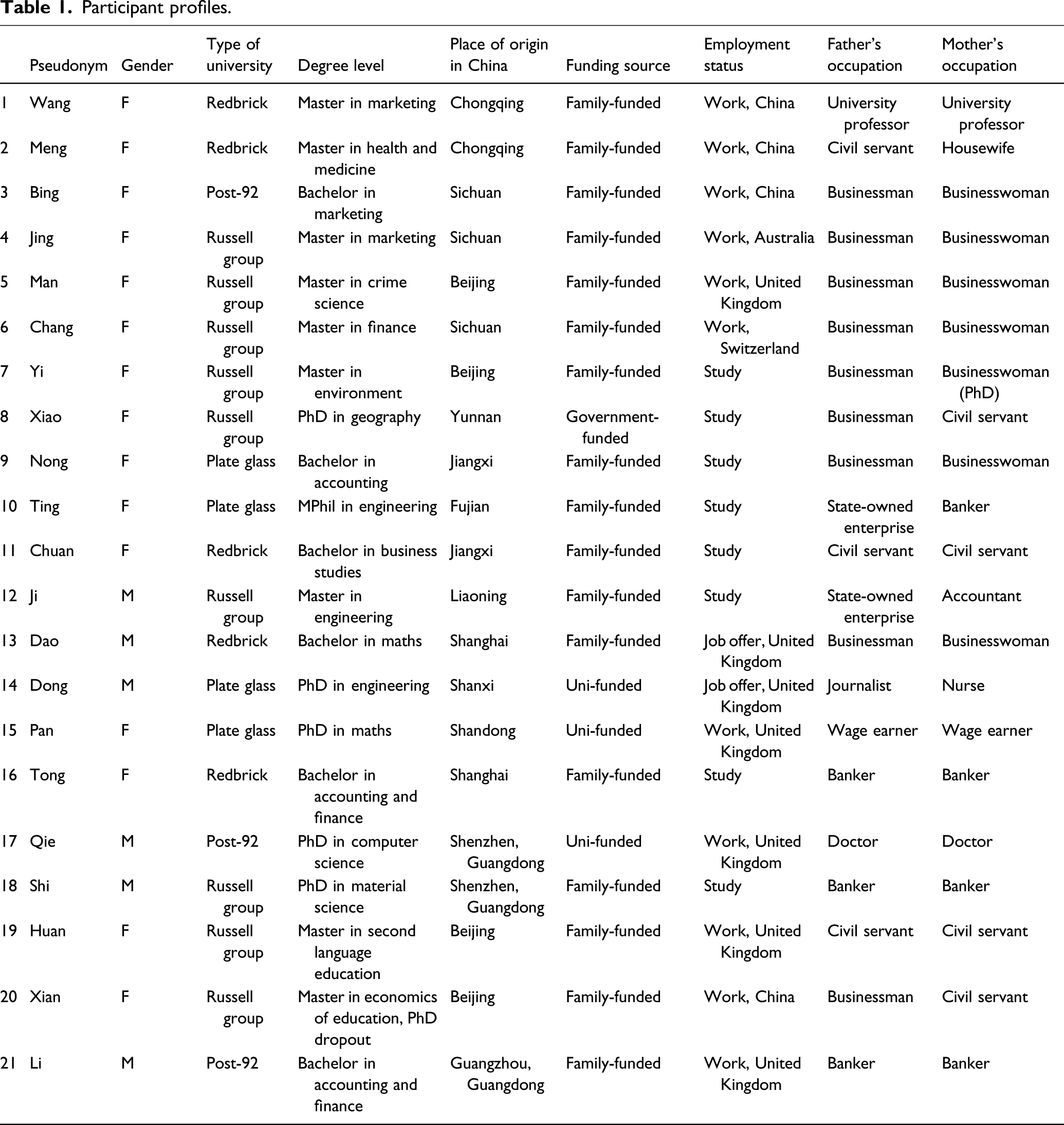
This sample captures participants’ pre-employment ambition (8/21) and on-the-job (13/21) reflections and reconfiguration of career imagination across time. This is not meant for comparing the two groups but intended to facilitate a data set that is sensitive to the temporal impact on career imagination among these participants. Both pre- and while-employment career narratives are, thus, of equal importance to the analytic purpose of this study. This characteristic of the sample therefore redresses the gap in existing literature, which has predominantly focused on the pre-employment stage but lacks insights into the evolvement of career imagination in the while-employment stages.
Most interviews were conducted online (via Skype or WeChat) or on the phone, with five conducted face to face. All interviews were conducted in Putonghua, transcribed verbatim, with selected quotes translated into English for this article. Interview data were coded thematically using the qualitative data analysis software ATLAS.ti. All names used are pseudonyms.
During the interviews, participants were asked to discuss their education experiences in the United Kingdom, China and other parts of the world. They were invited to discuss their aspirations for careers and experiences of job searches and work. They also imagined their ideal life and career. Aligned with the original research intent of investigating how these Chinese international students transition from study to work, patterns and strategies of such study-to-work transitions were observed and categorised based on their narratives: deferred gratification and temporal destructuring.
Deferred gratification
When planning and enacting their career trajectories, some participants chose to withstand unfavourable conditions for a period, with a view to reaping ‘rewards’ of autonomous career time in the future. Man and Li, for instance, decided to go through a ‘waiting’ period in order to engage in work that they felt truly passionate for.5 Originally from Beijing, Man finished her master’s in an elite London university. During her studies, she joined a university-wide entrepreneurship competition and won an award that granted her £3000 for her start-up and the university’s sponsorship for her Graduate Entrepreneur visa application. Although she confessed never thinking about working in Britain before this, Man eventually decided to persuade her parents to invest in her destination wedding planning business on the ground that she wanted to gain more work experience in the United Kingdom: I must invest £10,000, which I needed to prove to be held in my personal account before applying for that visa. I could not have that amount of money by myself…Also, my parents bought me a house in London, so I did not have to pay rent.
While the opportunity presented by Man’s unexpected win in the entrepreneurship competition may have taken her by surprise, Man’s readiness to embrace this Entrepreneur visa route was clearly backed up by her family’s abundant financial resources. Man’s financial privilege had now enabled her to imagine further career-wise: acquiring the indefinite leave to remain (ILR) in the United Kingdom. If my company can generate profits…or even allow me to speed up my application for the ILR, then I might do other things after that…Now my visa has imposed constraints on me, e.g. I cannot do any business in real estates, but I am quite interested in it. Once I do not have these constraints, I may do something else. But I might well return to China even after I have the ILR. [Why?] What I am doing now…is not that profitable, and is repetitive.
For Man, the constraints imposed by this Entrepreneur visa could be likened to obstacles on her way to freedom of time deployment. She repeatedly emphasised what she would be able to do once those restrictions were lifted. This sense of burden during her current stage as a visa holder thus contrasted sharply with the anticipated state of ease and of being in control: the freedom to do business in real estate that she was interested in and not be trapped by wedding planning that she found repetitive. In order to acquire the ILR, Man had to commit a minimum of five years’ time to her current wedding planning work. This protracted period of ‘waiting’ could be considered as a ‘time tax’ (Gasparini, 1995: 32) on the anticipated UK citizenship status which would facilitate her career time autonomy.
Compared with Man, Li was further down the line of citizenship acquisition. Arriving in the United Kingdom in 2005 for his sixth-form studies, Li entered a post-92 university where he developed a strong interest in luxury goods retail. When graduated in 2012, he was ‘lucky’ to be among the last batch of international students to qualify for a post-study work visa. He spent two years working as a luxury brand sales representative in London. By 2014, he had already been in the United Kingdom for 9 years; he persuaded his parents to invest in his milk tea business, so he could eventually obtain the ILR in 2018 and ‘get whatever jobs [he] wanted’.
Li’s milk tea business was instrumental to his successful acquisition of the ILR status and his new capacity to freely choose jobs that he fancied: another luxury goods sales representative job where he could meet ‘all kinds of different people’ and enjoy ‘the excitement and surprise of not knowing who the next customer is’. In comparison, he described the clientele of his start-up milk tea shop as ‘more predictable’ and ‘having less time to develop a relation’ with him. He recalled painful lessons such as being coerced into paying a hefty fine to the city council for litter that his shop did not throw. Therefore, the period between 2014 and 2018 was Li’s ‘waiting’ period, during which he endured unfavourable work conditions with an anticipated reward of the ILR and the subsequent freedom to pursue his favoured career.
Li’s and Man’s cases have demonstrated how the temporal structures of national migration governance intimately intersected with individual international graduates’ personal career planning and temporal experiences. Their respective periods of waiting and the work that they did during this time became instruments of a delayed gratification of time autonomy.
Notably, Li’s and Man’s waiting seemed qualitatively distinct from that of Jeffery’s (2010) lower middle class Indian men who waited for opportunities of employment with no definite endpoint in sight. Li’s and Man’s waiting periods were timed with a clearly delineated expected outcome. Such a ‘state of anticipation’, following Gasparini (1995: 30), gave Li and Man ‘control over the situation’ (p. 31), facilitated by their unproblematic access to resources, such as their parents’ financial support, and clear immigration rules specified by the UK border agency, which favours the ‘socio-economic elites’ (Lomer, 2018: 318). Therefore, Li’s and Man’s waiting status was characterised by ‘waiting in control’, with an anticipation of rewards: taking control of their career time. Their class privileges, as orchestrated by their habitus, allowed them to quickly grasp opportunities presented to them (e.g. to acquire the Entrepreneurship visa), to remain hopeful of a favourable anticipated outcome while enduring hardships and boredom in their respective ‘waiting’ periods.
Different from Man’s and Li’s experiences of waiting for their ILR, Xiao articulated a willingness to engage in work that was not necessarily ‘meaningful’ to her as a means to rapidly reach financial freedom: The end point of my ideal career is to have financial freedom. I would not need to work in order to make money and I can do things that I find truly meaningful, that to me is valuable…If I think it is worth my time…and through doing it I can get what I want, then it is of value to me…e.g. maybe…I will volunteer for an entire year in Africa, working in some Non-governmental organisations (NGOs) there, and help more people.
The high-speed career development and swift accumulation of financial capital thus would become pivotal for Xiao to be unconstrained by financial concerns, so as to freely engage in ‘unproductive’ work (i.e. volunteering in Africa) that is not ‘registered on the radar of commodified time’ based on capitalist logics (Adam, 2006: 124). Xiao’s career ideal, as informed by broader discursive frameworks about ‘meaningful’ work (Bailey and Madden, 2017), evokes what Bourdieu (2000: 224) depicts about skhole: time used freely for freely chosen, gratuitous ends which…may be those of work, but work that is freed, in its rhythm, moment and duration, from every external constraint and especially from the constraint imposed through direct monetary sanction.
While Xiao may be unsure about at which point she could reach her ‘financial freedom’, Man had a clearly defined point in time when she would hope to retire: The bottom line is that I should reach the level of living condition that my parents can provide for me now…in 10 years. Ideally I hope to finish my professional life at the age of 45…Perhaps by that time I would be getting really tired of work, or family reasons…My Dad retired from his own professional life at around 45 and now he just goes sightseeing and all that--this is the kind of life that I look forward to.
In order to emulate her father’s example, Man was keen to accumulate more work experiences now in the United Kingdom in order to develop ‘better’ and quicker later. This period before Man reaches the age of 45 denotes hard work, or indeed ‘repetitive’ work (in wedding planning), that would potentially tire her. Xiao and Man, therefore, both anticipated their gratification of career time freedom through enduring work that was not the most meaningful or enjoyable to them.
Temporal destructuring
Different from the ‘deferred gratification’ strategy adopted by the previous group, other participants engaged in ‘temporal destructuring’ by directly confronting the capitalist market logic that attempted to extend their ‘work time’ or the temporal structures that regulated their career path and pace. In imagining careers, some participants have demonstrated that having the capacity and space to slowly experience the richness of life can be more valuable than speedy accumulation of academic qualifications and entry into coveted professions, as prescribed by temporal structures that they were used to (see Atkinson, 2019). Xian, for instance, confessed that her experiences of studying in England had motivated her to ‘slow down’ her career pace. When I first arrived at [X university], I single-mindedly wanted to pursue a PhD, and after that I would join a university and become a lecturer. However, gradually this kind of life became not so exciting to me. I got to know many friends whose life experiences were so rich, which made me realise more possibilities for my future career. I asked myself, why did I have to be in such a hurry? This made me less instrumental (gongli), instead, what concerned me more was about how I could enrich my life, instead of wanting to reach certain purposes at certain time points…I hope that I won’t just get a PhD degree as soon as possible and finish such ‘high-efficiency learning’, and meander in a feeling about not being responsible to myself.
Realising that swiftly finishing her PhD degree and becoming a university lecturer was but one possible career path, Xian now considered such speedy career preparation as being ‘irresponsible’ to herself since this would deprive her of the opportunities to ‘enrich her life’. Xian’s idea of ‘enriching her life’ was tied curiously to her articulated sense of responsibility to herself, as opposed to others. This narrative could be interpreted through Yan’s (2010: 505) thesis of individualisation in China: The key to understand the Chinese self…lies in the Chinese understanding of the individual as the duality of a small self and a great self, namely, as a relationship between the individual and social group, instead of an autonomous and indivisible entity. (my emphasis)
Xian was underlining her consciousness and determination to stop conforming to the social expectations placed on her which regulated her career routes (e.g. becoming a university teacher) and pace (i.e. fast). Instead, she opted towards being ‘responsible’ to herself, the ‘small self’. Studying in the United Kingdom, therefore, exposed her to an alternative set of temporal structures and career possibilities, which are deemed beneficial by most other participants in this study.
Huan shared a similar story. Initially setting out to pursue a PhD at a Russell Group university, Huan decided to drop out of her PhD programme. She recounted how the internship during her first year of PhD studies helped pinpoint an alternative: I loved the research I did in [Y] Research Strategy Team but I learned that it did not require a PhD degree…I felt that instead of continuing to invest in something that I might not feel a sense of achievement for, I would rather do something that I really wanted to do.
Xian’s and Huan’s initial striving for swift academic progression was driven by their limited repertoire of career imagination. However, their increased career exposure in Britain enabled them to engage in ‘temporal destructuring’ (Leccardi and Rampazi, 1993): they searched for alternative career pace and paths that were not subjected to the uniform rhythms, pace and timetables prescribed for them by their families and the broader society in China. Instead, they strove to build their autonomy of career choice. Both decided to work in the not-for-profit sector, with Xian working in non-governmental organisations (NGOs) that serve deprived rural population in China and Huan working for an education institution in England. As discussed earlier, engaging in volunteer and low-income not-for-profit work is often deemed as an ‘unproductive’ use of time in contemporary capitalist societies. Xian and Huan’s career decisions thus could be interpreted as their agency to claim control of their career time and challenge perceived temporal impositions. Their accounts revealed the critical importance of an alternative set of temporal structures made possible in the United Kingdom, which Shi likewise embraced: I have been studying in Britain for a long time. I can no longer get used to the culture in China where everyone is following the same trends: getting married and having babies. I do not have many common topics with my old friends there. We hanged out together once, but it was not the same. They were talking about having babies and buying house(s). However, in the UK the culture is more tolerant of different lifestyles. I want to be myself instead of giving in to the social demands.
At the time of interview, Shi had acquired his ILR and was awaiting his doctoral viva. Like Xian and Huan, Shi felt constrained by and therefore endeavoured to resist the socially prescribed milestones and the lack of tolerance of diversity in China’s temporal structures.
While Shi was concerned about the rigid life goalposts that he felt compelled to reach, Qie was deterred by the anticipated overwork practices when he decided to reject three job offers from China: My classmates who have returned to China are in a pitiable position…some of them entered some good companies, e.g. Huawei, Tencent and Baidu – but they find it very stressful. In Huawei, they have compulsory overtime work, and some have lost all their hair…All these are quite scary…Your salary will surely be very high, but you may not be able to live long enough to spend the money that you make (youming zhuanqian, meiming huaqian) – this feels horrific.
The implicit expectation of overtime work is an aspect of work culture that is common among major companies in China (Wang and Shane, 2019), captured in the 996-model. This model became a contested topic on social media when the founder of the successful e-commerce platform Alibaba, Jack Ma, publicly defended the necessity of having his staff work from 9 a.m. to 9 p.m. for 6 days a week (Wang and Shane, 2019). This 996-model evokes what Snyder (2016: 6) pinpoints about the greedy nature of ‘flexible capitalism’ (a form of social production that has emerged in major capitalist societies such as the United States) and its demands placed on the workforce: Putting in long hours is often seen as a sign of commitment and dedication to the job. As a result, core employees are often both overemployed and overworked. They tend to work more hours than they would like and feel rushed.
For Qie, such overtime work presented a ‘scary’ and ‘horrific’ prospect as he would have to concede control of his personal time to his work time, submitting his ‘individual time’ to ‘the employer’s time’ (Thompson, 1967). The health implications, for example hair loss, may mean that he would also have to compromise his health and shorten his biological time, thus be deprived of the time to consume fruits (e.g. of goods and services) paid as the price of his overwork. Through the control of work patterns and timing, the 996-model could potentially dominate the temporality of Qie’s life. Rejecting these jobs offers in China and choosing to work in the United Kingdom where work–life balance could be achieved thus allowed Qie to preserve his time autonomy at that specific career stage.
However, this article is by no means depicting the United Kingdom as a paradise in offering ideal temporal structures that suit these Chinese students universally. Instead, what I emphasise is the pivotal role of having access to alternative temporal structures in career imagination. In fact, for Chang, her experience of working in London was what prompted her to reflect on her temporal demands within her career. Like Qie, Chang successfully secured a white-collar job in London after her master’s studies. However, she began to realise that her job was not what she expected: I was working in London as a fresh graduate with only £30K per annum. After paying for rent, tax, food and some entertainment, I basically could not have any savings. Besides, this job was all about auditing, and I did not find it interesting. I often had to work until late, with no money and no personal life, what was the meaning of all this?
Chang eventually relocated to Switzerland for a job that she has great passion for. She said, ‘Now I wake up every morning and feel I cannot wait to go to back to work, it is an ideal job’. Jing, who also relocated to Australia, shared similar sentiments. Chang’s and Jing’s experiences reveal how pivotal it is for these Chinese international students and graduates to be exposed to alternative possibilities of work environments, cultures, rhythms and pace. It was through such exposure and on-the-job experiences and reflection that they could discern what they valued the most (e.g. passion for their jobs and autonomy to deploy personal time) in their respective careers.
In fact, the fluid and evolving nature of career imagination has been further manifested through Qie’s trajectory. While Qie’s rejection of the overwork culture in China was further confirmed during his three years’ work experience in the United Kingdom, at the time of interview, he revealed that he was considering returning to work in China. Only that this time he was intending to establish his own start-up research lab by entering one of the attractive talent schemes of China: There are many high-end talent schemes like A Thousand Talent Scheme. If I join this scheme, my development in China would be fast…Basically they have all kinds of money to give me convenience.
Having acquired several patent rights and becoming a seasoned researcher and innovator in his field, Qie’s career ambitions have now evolved. He confided that once he set up his own research lab with the abundant funding and policy supports available, he would be able to set his own rules at work, thus allowing him to protect his personal/family time, while rapidly advancing his career. This way, he could continue to uphold his temporal ideal. As such, this group of participants challenged the hegemonic and rigid temporal structures imposed on them at their own specific timings and tempos, in search of their time autonomy in career imagination.
Discussion
Temporal career strategies and class privilege
These two temporal career strategies are not necessarily mutually exclusive. Instead, these Chinese international students/graduates may employ one strategy to reach the other: for example deferred gratification could be a way to subvert the conventional temporal structures imposed on them. Li, for example used deferred gratification to pursue not only his favoured career but also his favoured way of life. He confessed that he could no longer get used to the pace of work in China and that he preferred his lifestyle in the United Kingdom. His narrative thus mirrored those of Qie and Shi, especially in his decision to embrace the alternative temporal structures available in the United Kingdom. His ‘waiting’ could be likened to taking a detour that nonetheless bridged him to the destination of time autonomy. Similarly, Man took up her wedding planning business that she did not enjoy to eventually do what she preferred and reach retirement at her ideal age of 45, as influenced by her father’s example. Undoubtedly, as discussed earlier, both Man and Li could afford to wait because of their familial class privileges, including substantial financial investment and their habitual protention which allowed them to readily grasp the opportunity of the Graduate Entrepreneur visa and be confident in their decision to wait. Nevertheless, their ‘detour’-like decision of ‘waiting’ was also necessitated by the fact that it was difficult for them to secure a Tier 2 sponsorship from an employer in the United Kingdom. Man’s and Li’s deferred gratification strategy thus simultaneously revealed their privileges and relative constraints.
For Xiao, she adopted deferred gratification to eventually engage in ‘non-productive’ volunteer work that is devalued by capitalist logic (Adam, 2006), which is like what Xian and Huan decided to pursue. However, different from Xian and Huan who both embraced ‘temporal destructuring’ immediately post-graduation, Xiao chose to engage in work that she may not feel passionate for in order to reach temporal freedom. This distinction could be explained through these participants’ familial backgrounds and places of origin. Xiao is from a middle-class family at a second-tier city in Yunnan. While her family lives a ‘comfortable life’, they could not provide the kind of financial security that Xian and Huan enjoyed, both of whom were from affluent middle-class families in Beijing (Goodman, 2014).
Xiao’s relative disadvantage was echoed by Ting, who confided her concern about coming from a second-tier city, ‘compared with those originally from first-tier cities, I have no flat, no car and no saving to begin with’. Therefore, while all participants in this study are from middle class or upper middle class backgrounds, there are nuanced differences between participants who are from first-tier cities and more affluent financial backgrounds and those from provincial second-tier cities and less affluent middle-class backgrounds in terms of their career options and imagination.
For the group that engaged directly with temporal destructuring as a career strategy, they did not have to choose the deferred gratification option for different reasons. Chang and Qie were able to obtain Tier 2 visa sponsorship from their respective employers, while Huan capitalised on the spousal visa sponsored by her British husband. Xian chose to return to China to engage in NGO work and relied on her parents for financial support as the meagre salary from her work ‘could hardly cover [her] daily necessities’. In all these cases, the participants did not need to rely on the Entrepreneur visa route that Man and Li took up. Therefore, the choice of temporal career strategies was conditioned by the personal and familial circumstances of these participants, reflecting fine-grained class differences.
Time in career migration and social justice: Theoretical contribution
Responding to the theoretical gaps identified in existing literature, which has underdeveloped a temporal perspective in career imagination research (Cohen, 2014) and understood international students and their career development needs as homogeneous, individualised and present-focused (Collins and Shubin, 2017; Geddie, 2013; Waters, 2012), this article adopted a primarily Bourdieusian framework for approaching the temporal social structuring aspect of career imagination. This framework centres around how time, class and privilege intersect to shape these Chinese international students’ career imagination. As time is firstly conceived of as a form of cultural capital, access to time (e.g. ‘waiting’ time and free time to do ‘unproductive’ work) is inevitably differentiated for international students of different class backgrounds. Hence, while participants in this study could afford to ‘wait’ for their ILR, their peers from less advantaged backgrounds may not find this strategy practical or feasible. Similarly, as discussed above, some participants in this study could afford to engage directly with ‘temporal destructuring’ while some others had to take a ‘detour’ (e.g. Xiao). Secondly, this framework maintains that time is more than a resource; our relationship with and through time, that is the historicity aspect of the fields which we are embedded (Atkinson, 2019; Snyder, 2016), informs who we are, how we relate to others and what we consider as worth doing in our career imagination. This theoretical standpoint underpins much of the participants’ decisions to reject conventional, hegemonic temporal structures and embrace alternative ones as their transnational education and work experience in the United Kingdom and other countries continued to expose them to diverse possibilities. Crucially, time constitutes our being and is sedimented and imprinted in our dispositions, that is habitus (Atkinson, 2019; Boudieu, 2000, 2002). Hence, we observed Man’s and Li’s readiness to harbour the Entrepreneur visa route and play the ‘waiting’ game when opportunities arose. Their confidence and sense of being in control also aligned with the broader consensus among most participants: to own and control time (Nowotny, 1992) for achieving what they considered as a meaningful career and life. Such a habitus was constituted by and simultaneously orchestrated their access and use of abundant economic, social and cultural capital as well as their variegated exposures to multiple temporal structures across national borders. As such, this framework provides a much needed theoretical vocabulary for thinking about international students’ career imagination in a class and temporally sensitive manner.
Temporally sensitive research approach and implications
This study employed both pre-employment anticipation and on-the-job reflection and retrospection from participants to highlight that their career imagination is an ongoing and evolving project. The data reveal that some participants have substantially recalibrated their career ambition, for example Chang and Jing both realised that their initial career ideal of working in the United Kingdom did not match their temporal expectation of enjoying high quality personal time. Instead they found that working in Switzerland and Australia respectively fit their overall career temporal rhythms better. Qie’s initial decision of rejecting the overwork culture in China was reinforced after three years of work in the United Kingdom where he could enjoy better work–life balance. However, as his career progressed, he began to see new resources and opportunities (e.g. the high-end talent schemes) in China that could serve his temporal ideal, while advancing his career. Li’s deferred gratification strategy eventually allowed him to subvert the temporal structures imposed on him back in China and embraced the alternative work and lifestyle in Britain. He thus appeared to experience fewer adjustments in pursuing his career ambitions. Inclusion of on-the-job reflection, retrospection and prospection of international students is thus a useful way to unpack the embedded temporal dimension of career imagination, which has been missing in career support policy and practices, as well as empirical research (AGCAS, 2016; Huang and Turner, 2018).
These lively career imagination trajectories also demonstrate that international students are much more than lifeless graduate employment figures (Higher Education Statistics Agency, 2018). Their career imagination is fluid and contingent upon their specific personal and familial circumstances and sensitive to alternative temporal structures that they are exposed to. It is, therefore, pivotal to devise career support services that are conducive to support these students to understand their longer-term career needs and priorities. Importantly, it is advisable to cultivate their exposure to alternative temporal structures and pinpoint possible routes to achieving their career ambitions. The use of career case studies, such as the ones discussed in this article, could serve as useful reference points for international students to ascertain their own circumstances and devise corresponding temporally sensitive career strategies.
Conclusion
This article makes three contributions to the literature. Firstly, its Bourdieusian temporally sensitive theoretical framework provides necessary conceptual vocabulary to understand how international students’ career imagination is shaped by their class, privilege and access to time. This theoretical orientation facilitates exposition of the complex rationale behind the two observed career strategies, ‘deferred gratification’ and ‘temporal destructuring’ and accentuates nuanced inequalities pertaining to fine-grained familial class backgrounds and places of origin. Secondly, this article provides empirical cases that illustrate the evolving nature of international students’ career imagination. Such cases challenge extant policy and empirical literature’s tendency to consider international students and their career imagination as homogeneous, individualised and present-focused. Thirdly, and as a consequence, this article advances understanding about how temporally sensitive and better differentiated career support should be and could be tailored for international students at policy and practice levels.
Footnotes
Acknowledgements
The author is grateful for the generous sharing of the research participants. The author wants to thank the impeccable research assistant work carried out by Ms Zhe Wang who contributed substantially to data collection of this project. The author wishes to thank two anonymous reviewers for valuable comments on earlier drafts of this paper.
Declaration of Conflicting Interests
The author declared no potential conflicts of interest with respect to the research, authorship, and/or publication of this article.
Funding
The author disclosed receipt of the following financial support for the research, authorship, and/or publication of this article: This work was supported by the Keele University High Impact Research Fund (2018–19) and Keele Institute for Social Inclusion (2018–19).
