




Abstract
This paper contributes to work on the social life of time. It focuses on how time is doubled; produced by, and productive of, the relations and processes it operates through. In particular, it explores the methodological implications of this conception of time for how social scientists may study the doubledness of time. It draws on an allied move within the social sciences to see methods as themselves doubled, as both emerging from and constitutive of the social worlds that they seek to understand. We detail our own very different methodological experiments with studying the social life of time in London, engaging interactive documentary to elucidate nonlinear imaginaries of space-time in London’s pop-up culture (Ella Harris) and encountering time on a series of walks along a particular stretch of road in south east London (Beckie Coleman). While clearly different projects in terms of their content, ambition and scope, in bringing these projects together, we show the ability of our methods to grasp and perform from multiple angles and scales what Sharma (2014) calls ‘temporal architectures’. Temporal architectures, composed of elements including the built environment, commodities, services, technologies and labour, are infrastructures that enable social rhythms and temporal logics and that can entail a politicized valuing of the time of certain groups over others. We aim to contribute to an expanded and enriched conceptualisation of methods for exploring time, considering what our studies might offer to work on the doubled social life of time and methods, and highlighting in particular their implications for an engagement with a politics of time and temporality.
As a wide range of work highlights, time is increasingly understood as dynamic, multiple and complex. Time has and constructs a ‘social life’. Rather than existing as an external backdrop, time emerges from and structures socio-political relations and power dynamics, including interactions between human and non-human actors. In this sense, time is doubled; produced by, and productive of, the relations and processes it operates through. This conception of time has methodological implications, for it requires social scientists to ask how to study the doubled-ness of time. In considering this problem in this paper, we turn to an understanding of methods as themselves doubled; as both emerging from and constitutive of the social worlds that they seek to understand. In so doing, we aim to contribute to an expanded and enriched conceptualisation of methods for exploring time, building on an emerging body of research that works with visual, sensory and digital methods to engage with the social life of time. We detail our own very different methodological experiments with studying the social life of time in London, engaging interactive documentary to elucidate nonlinear imaginaries of space-time in London’s pop-up culture (Ella) and encountering time on a series of walks along a particular stretch of road in south east London (Beckie).
While clearly distinct projects in terms of their content, ambition and scope, we bring these methods together here because of how, in tandem, they show the ability of digital methods to grasp and perform ‘temporal architectures’ from multiple angles and scales. ‘Temporal architectures’, as Sarah Sharma (2014) explains, make tangible the politics of producing and maintaining certain temporalities. Temporal architectures are composed of elements including the built environment, commodities, services, technologies and labour: they are infrastructures that enable social rhythms and temporal logics and that can entail a politicized valuing of the time and the temporality of certain groups over others. Together, the methods we explore in this paper allow us to explore London’s temporal architecture from multiple vantage points, engaging with both everyday temporal routines and the prevailing temporal logics that make up the social life of time in London.
In the first part of the paper, we introduce the concept of temporal architectures in more detail and highlight its understanding of time as doubled. We connect this with the allied strand of work within the social sciences which sees methods as doubled. In the second section, we expand this discussion of time and methods as doubled and explore recent research that develops visual and sensory methods for studying time. In this section, we introduce our conception of how such methods both ‘grasp’ and ‘perform’ time. We see grasping as a means through which an attentiveness to time is methodologically cultivated, the process of sensing and make sense of the temporal. Performing, meanwhile, we use to refer to how such grasping is also an active creation (rather than neutral observation) of time. We elaborate these conceptual understandings of time and methods as doubled in the following two sections, which examine the methodologies and methods we developed in studying different aspects of London’s temporal architectures. In conclusion, we consider what these studies might offer to work on the doubled social life of time and methods, highlighting in particular their implications for an engagement with a politics of time and temporality.
The social life of time and the social life of methods
Work that takes seriously the notion that time is central to and has a social life includes inquiries into the pace or rhythms of particular places and situations (e.g. Fine, 2012; Halberstam, 2005; Lyon, 2018), investigations of the temporal logics of a zeitgeist or structure of feeling (e.g. Anderson, 2010, 2017; Berlant, 2011; Harvey, 1990; Jameson, 1991), concerns with the temporalities engaged by particular technological medium, labour cultures or protest movements (e.g. Adkins, 2019; Gregg, 2011; Sharma, 2013; Vostal, 2014), as well as questions around the temporalities experienced by or imposed on demographic groups delineated by gender, race, class, age, etc. (e.g. Adam, 2002; Hartman, 2008; Adams et al., 2009; Atkinson, 2013; Silverman and Ryalls, 2016; Sharma, 201; Sharpe, 2016). In her important work on time, Sharma (2014) proposes the concept of ‘temporal-architectures’, to account for ways of organising the temporal that arise from the social and also produce the social. Sharma defines ‘the temporal’ as lived time. The temporal is not a general sense of time particular to an epoch of history but a specific experience of time that is structured in specific political and economic contexts. The temporal operates as a form of social power and a type of social difference’ (Sharma, 2014: 9). Composed of elements including the built environment, commodities, services, technologies and labour, temporal architectures are infrastructures that emerge from and enable social rhythms and temporal logics, and that reflect and entail a politicized valuing of the time of certain people and processes over others. They enable a focus on time that ‘is about the micropolitics of temporal coordination and social control between multiple temporalities’ (Sharma, 2014: 7). For example, Sharma explores the temporal architectures of taxi cabs as a transport infrastructure, analysing how taxi drivers must wait, uncomfortably, in their cars for long stretches of time and disrupt their own sleeping rhythms in order to facilitate the temporal efficiency of others, being instantly available to customers as and when they require a lift.
Thinking about the social life of time via temporal architectures elucidates appropriate and fruitful focus points for methodological enquiries into temporality. In particular, we find it attunes us to the different temporal scales that pattern everyday life. The example of the taxi cabs demonstrates how the temporal operates at both minor and major scales, connecting the act of driving and catching a taxi with economic, social and political processes. Understood in terms of temporality, the taxi cab waiting at an international airport, for instance, illuminates local and global processes of business and mobility and how these map on to and re-make classed, raced and gendered differences. Exploring the diverse elements and functions of temporal architectures therefore requires a variety of methods, ones with different sensitivities, vantage points and scalar inflections. Furthermore, it requires methods that work with an understanding of social life as doubled; as productive of, and produced by, a plethora of practices and processes.
While new work on time emphasises its social life, conceptualisations of method have also shifted to see methods as having their own social lives. Methods are understood as live and lively, emergent from, and constructive of, the worlds they study, and hence recent work on methods has pushed for methods to be seen as performative, embedded in and productive of the worlds they grasp (e.g. Back and Puwar, 2012; Coleman and Ringrose, 2013; Law and Urry, 2004; Lury and Wakeford, 2012). In this vein of work, Law et al. (2011) have challenged what they term the ‘methodological complex’ that sees methods as tools. They argue that such a conception of methods is problematic because a ‘division of labour’ (2011: 3) is evoked that separates theory, method and substance, ‘so that research questions and issues are derived from theory (“as hypotheses” in more positivist approaches), and methods provide the tools that allow such questions to be tested, with respect to various “substantive” areas’ (2011: 3). This distinction works with and reinforces the assumption that there is a world ‘out there’ that, separate from the methods that study it, has particular and definite features that can be neutrally reported, and turned into data (2011: 3). Hence, a problematic ‘binary divide’ is produced which sees methods as tools that ‘bridge the gap’ (2011: 3) between representations and realities. Methods in this sense are neutral in that they pre-exist their use, do not interfere with the world they represent and produce data that is about, but separate to, the world.
Against this version of method, Law et al. propose what they term ‘the social life of method’, or, more accurately, the double social life of method; that ‘methods are fully of the social world that they research’ (2011: 4). The ‘doubledness’ of methods draws attention to two aspects of a process, which are distinct but not separable. One aspect of the doubleness of the social life of method is that ‘[m]ethods are constituted by the social world of which they are a part’ (Law et al., 2011: 5). In other words, ‘methods don’t come into being without a purpose’ and ‘they don’t come into being without advocates, or more exactly forms of patronage’ (Law et al., 2011: 5). While we might, suitably, consider how digital methods have become significant with the rise of digital technologies, Law et al. provide the example of how methods of mapping and surveying emerged in the 18th and 19th centuries to provide states with ways of knowing their territories at a time when geographical boundaries were changing (2011: 5), demonstrating that purpose and advocates are not new dimensions of methods but have always been integral to them.
The second aspect of the doubleness of the social life of method is that methods are in turn implicated in the social world. They are thus also of the social world in the sense that they constitute and organise it. Or, to use the jargon, that they don’t just represent reality out there; but that they are also performative of the social. (Law et al., 2011: 8)
Methods and the grasping and performing of time
We situate our own research within these allied movements of understanding both time and methods as involved in a doubled relationship with the social. Indeed, the recent ‘creative’ (Hawkins, 2013), ‘inventive’ (Lury and Wakeford, 2012), ‘live’ and ‘sensory’ (Back and Puwar, 2012) turns in the social sciences have seen a rise in methodological engagements with practices that seek to tune into temporality in its diversity (Coleman, 2017; DeSilvey, 2007; Back and Gunaratnam, 2013; Ivinson and Renold, 2013; Lyon and Carabelli, 2015; Massey, 2008; O’Callaghan, 2012). 1 These include a focus on rhythm, using rythmanalysis as a way into thinking about temporal patternings as elements of cultural, socio-political and socio-economic issues and situations including smoking (Markovic, 2019), financial markets (Borch et al., 2015) and the City as a financial centre (Nash, 2018), European mobility (Marcu, 2017) and urban places (Lyon, 2016; Simpson, 2012). For Dawn Lyon, illuminating the ‘rhythmic production of space’ in Billingsgate Fish Market through video methods, allows us to see the ‘“different temporal itineraries that constitute social space”’ (Sharma 2014: 5).
Methods for exploring time often work with film and/or time lapse photography, drawing on a long history of understanding these medium as particularly expressive and productive of temporality (Clarke and Doel, 2005). For example, Doreen Massey has worked with film (in collaboration with Patrick Keiler) to engage with ontological questions about temporality, fostering sensitivity to ‘becoming’ – the transformative evolution of all things, including things that seem still, such as flowers. Other creative methods are also being deployed in studying the social life of time, including in examining changing temporal logics and experiences on a social scale. In exploring the changing conception of temporality wrought by climate change, Caitlin DeSilvey has experimented with creative writing, producing ‘anticipatory histories’ that prepare people for change and disappearance (DeSilvey et al., 2011). The ‘Stories of Change’ project, led by geographer Joe Smith at the Open University, developed an interactive digital storytelling platform to explore public stories around energy and community in the past, present and future. Both projects work with nonlinear storytelling to evoke how climate change destabilizes the relationship between past and future, undermining the metanarratives of ‘progress’ that have typified the modern imagination and demanding consideration of ‘future unmaking’ (DeSilvey, 2012). However, while similar in some ways, the different mediums used in these projects allow them to focus in on different elements of these temporalities; DeSilvey’s written stories grasp and produce changing conceptions of time for a localized place and community, whereas the Stories of Change project uses a digital platform to foreground the global networks of processes, stakeholders and narratives that structure conceptions of energy futures on a societal scale.
For us, thinking together work about the social life of time, the social life of method, and creative, live and inventive methods is productive. It helps us to understand both how to approach time methodologically and the temporalities our methods will produce. That is, methods for exploring time both emerge from, and express, temporalities while also constituting and transforming them. This idea that mediums both emerge from and produce temporality is one that has been well recognised in relation to cultural and artistic mediums and technologies such as film and photography, which have long been understood to have a mutually transformative relationship with the social life of time (Clarke, 1997; Clarke and Doel, 2005, 2007; Crary, 1990, 2002; Harvey, 1990). Scholars have recognised creative medium as central to how shifts in temporal experience across history are responded to as well as produced. For example, early experiments with montage in film both responded to and reconfigured experiences of the changing temporalities of industrialising cities; expressing the disorientating speed and fragmentation of mechanised movements and in turn altering how cities were understood and reproduced .
Looking to the mutually transformative relationship between cultural media and temporality sheds light on how methods can both grasp and perform the temporal. Methods can grasp temporality in that they coincide with it, enhancing and developing attentiveness to it. Fredric Jameson argued that shifts in the spatiotemporal fabric of cities require new ‘perceptual equipment’ to be developed, because if there is a ‘mutation’ in the city unaccompanied by an ‘equivalent mutation in the subject’ a sense of disorientation ensues (Jameson, 1991: 38). In order to make sense of, and respond to, new spatiotemporal conditions, new modes of attention must therefore be developed and this happens, in part, through the cultivation of new technologies and practices of encounter (see Benjamin, 2008; Crary, 1990). Similarly, methods can reconfigure perception to attune us to particular elements of the social life of time. For example, the time lapses of flowers and the fish market produce an attention to their durations and rhythms and demonstrate their constant flux and motion. Importantly, and as Law et al. indicate, the technologies that orientate us within, and allow us to grasp, changing temporalities are not separate from them. Just as artistic movements like Dadaism emerged from, as well as expressed, their disjointed and fragmented urban context (Clarke and Doel, 2005), methods emerge from, as well as express, the worlds they are operative within. In this sense, they are of the social world. ‘Grasping’ coincides with the time it investigates because it emerges from it; it is not something done from the outside; but is imminent to that which it expresses.
Methods, like cultural medium, also perform temporalities, generating their own patternings and experiences of time. Temporalities are produced by methods and media both in terms of the time spent and rhythms inhabited in order to produce them, and in terms of the temporality experienced by those who engage with them, as well as in the temporalities that arise from the impacts those mediums have on how the world is understood and encountered. Long takes of flowers and time-lapses of a market are not neutral recordings or representations of a temporality that already exists, but are medium-specific techniques that are productive of their own temporalities. That is to say, in elucidating the temporalities of the places or subjects being studied, methods do not neutrally reflect or reproduce those temporalities, but grasp them in ways that are always generative: performing and producing their own temporalities. The long takes of flowers and the time-lapses of a fish market generate their own specific temporalities which involve (but are not restricted to) those of the subject at stake (particular flowers, markets), the technologies that grasp it (the video camera and its recording functions), the people who watch and experience the recorded edits and the time-spaces in which this watching and experiencing happen (a pre-organised event, an on-demand viewing, etc.). In these senses, methods perform time and in the process create particular ontological and epistemological versions of the world. Importantly, therefore, to recognise that methods perform, as well as grasp, the social life of time is to recognise that methods are political and can contest or reinforce particular temporal architectures or temporal logics.
Our propositions, then, about methods for exploring the social life of time, are threefold. First, we argue for methods that can engage with the social life of time in all its complexity and diversity. Drawing on Sharma’s concept of ‘temporal architectures’ helps to visualize what this entails; necessitating focus on the practices, technologies, infrastructures (material and affective) and so on, through which the social life of time is expressed and constructed, as well as on the power dynamics that temporal architectures rely on and undergird. Second, we emphasise the wide range of experimental and ‘live’ methods that research into time can employ and stress the importance of thinking about which methods can best coincide with, and foster attentiveness to, specific elements of the temporal. For example, in an era in which digital technologies are crucial in shaping many temporalities, digital methods might be an especially apt approach for expressing these temporal logics. Equally, the selection of methods needs to reflect the scales in which time is being approached. As our own examples will demonstrate, grasping and interrogating the social life of time in localized environments or on a city-wide scale require different sorts of methodologies. Third, if methods are now widely recognised as performative and political, we stress the importance of bringing this recognition to methods for studying time. It is crucial to consider the temporalities that our methods will make or unmake and to engage knowingly with their political stakes.
In the sections below we explore, in turn, our own methodological experiments in studying the social life of time, reflecting on the elements of temporal architectures they engage with, demonstrating the value of creative and inventive methods for examining these, and exploring their political implications. Both our investigations were into the urban temporalities of London, but they engage with different elements of London’s ‘temporal architectures’, and at different scales; one on the scale of walking and the body and the other on the scale of the temporal logics of a particular urban culture. Bringing these diverse investigations together demonstrates, we hope, the breadth of what empirical research on the social life of time entails, and of the range of methods that can be deployed to grasp and perform it.
Exploring time in London 1: Walking and the temporalities of Lewisham Way
In the first few months of 2017, as part of a Virtual Residency with the collaborative network Walking Lab, run by Stephanie Springgay and Sarah E. Truman, Beckie Coleman conducted a series of walks along Lewisham Way, starting at Lewisham College and finishing at Goldsmiths, University of London, or vice versa. The walks had a dual aim of studying the temporal architectures of this stretch of road. The first was to consider the objects, devices, materials and media through which temporality, and futurity especially, were encountered, including traffic lights, door bells, signs, shop opening hours, seasons, as well as more readily identifiable ‘clock time’ such as public clocks and timetables. The second was to explore the temporalities that the objects, devices, materials and media identified generated and gestured towards, including, for example, waiting, rushing, checking and repetition. While walking has been influential in the social sciences through concepts and practices of the flaneur/flaneuse, it has recently been gaining traction as a method (e.g. Bates and Rhys-Taylor, 2016; Puwar, 2010; Walking Lab). Much of this work understandably focuses on what walking as method opens up regarding the dynamics of space and place, with some also attending to memory and how spaces and places change over time (e.g. Back, 2016) and others focusing on how chronological time might be disrupted (e.g. Springgay and Truman, 2018).
Drawing on this work, Beckie asked two questions: What happens when walking concerns itself with how temporality is encountered and experienced? And, what happens when the methods through which the temporalities encountered and experienced are brought into focus? To address these research questions through the walks on Lewisham Way, Beckie worked and thought with a range of visual and sensory methods, including photography, video and sound recordings. In so doing, Beckie also wanted to reflect on how these mediums may document and produce the ‘same’ walk similarly and differently. That is, Beckie was interested in what and how different mediums draw attention to and perform specific aspects of the temporalities of Lewisham Way. These walking experiments were written up as eight blog posts, available at: https://walkinglab.org/author/rc/. It is fair to say that, understood in terms of Sharma’s concept of temporal architectures, Beckie’s concern was in the first instance with their ‘minor’ rather than ‘major’ aspects, in that she was focusing on a specific and relatively small part of London (rather than the city more generally), mundane technologies and her embodied experiences of them.
Beckie began her project on Lewisham Way by walking the stretch of road, about a mile long, many times, becoming accustomed to the flows of traffic and pedestrians, and focusing her attention on where and how time was signalled and encountered. Beckie then did a walk where she photographed her encounters with time, which included traffic signs, signs with the availability of services, digital signs with bus waiting times, timetables, memorials and signs marking the start of academic courses and the futures of graduates (see Figures 1 and 2). Following this, Beckie became interested in the temporalities of a doorbell that she had photographed, and then focused on pedestrian crossings and especially the temporalities of waiting, rushing and repetition that she experienced as produced by them (see Figures 3 and 4). Beckie worked with her smart phone photographic and video camera and a free sound recording app called Recorder to follow up on, and explore further, the temporalities that the photographs of walks drew her attention to.
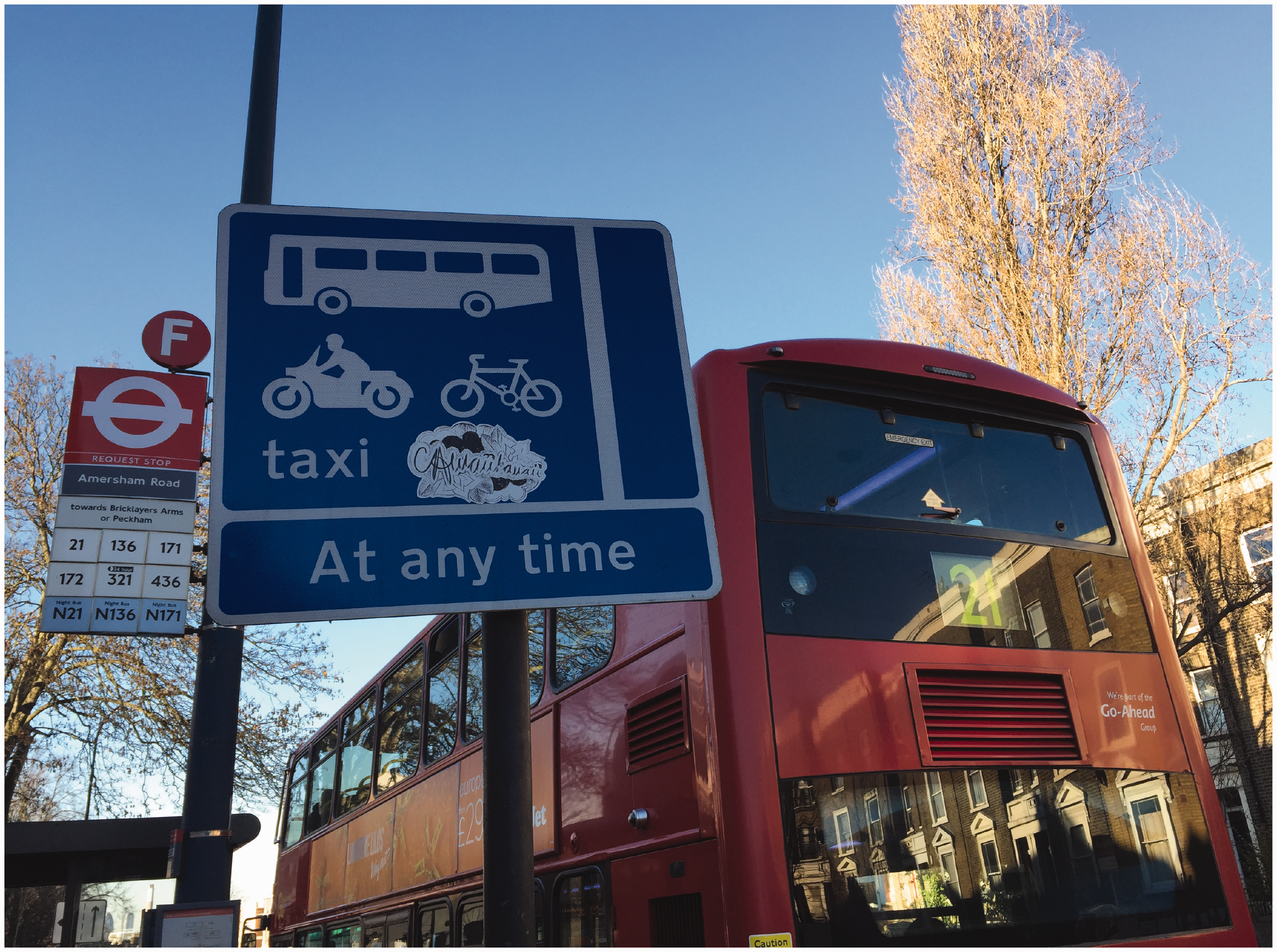
Encountering time: traffic and bus signs.
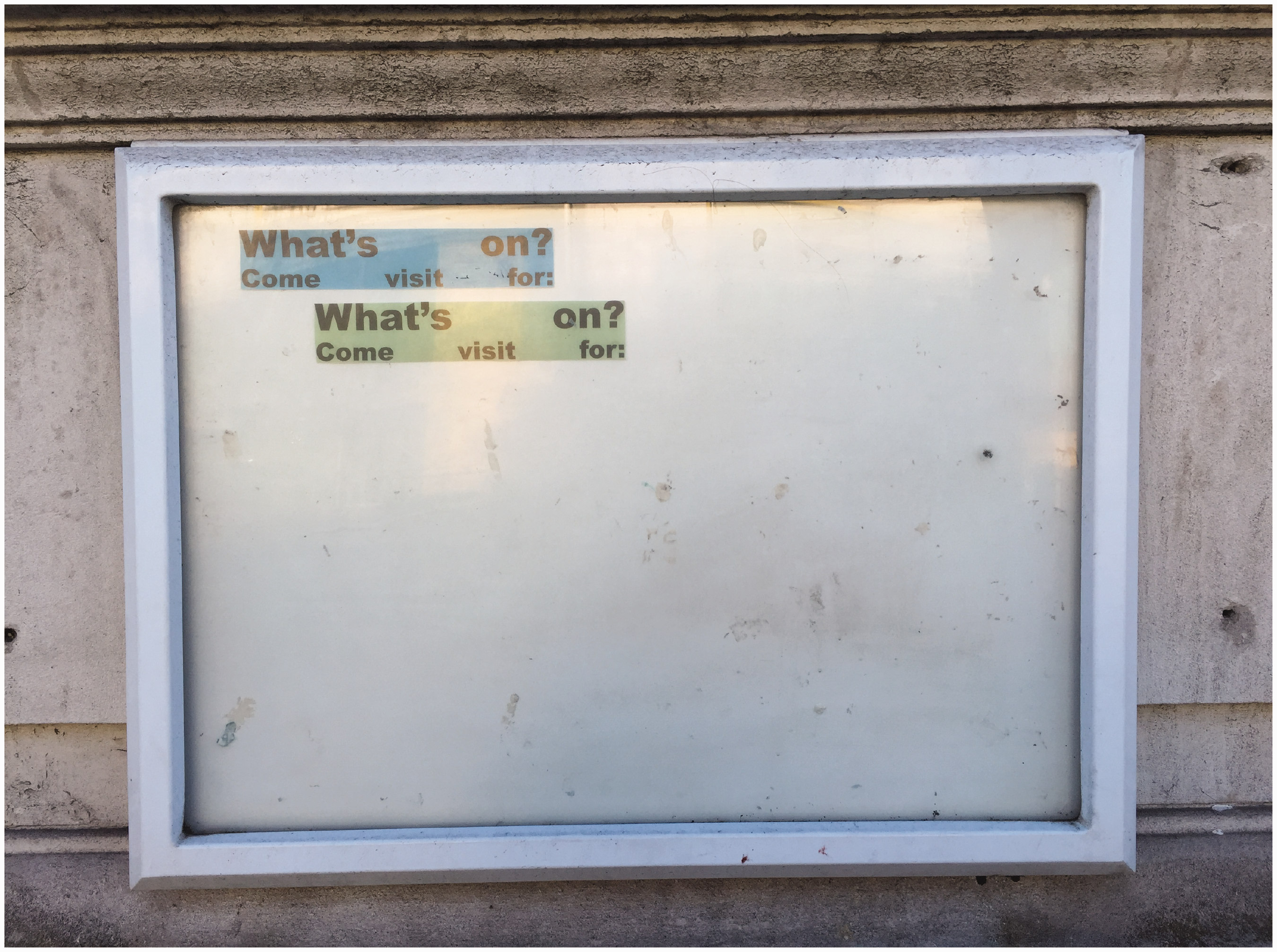
Encountering time: ‘What's On sign'.
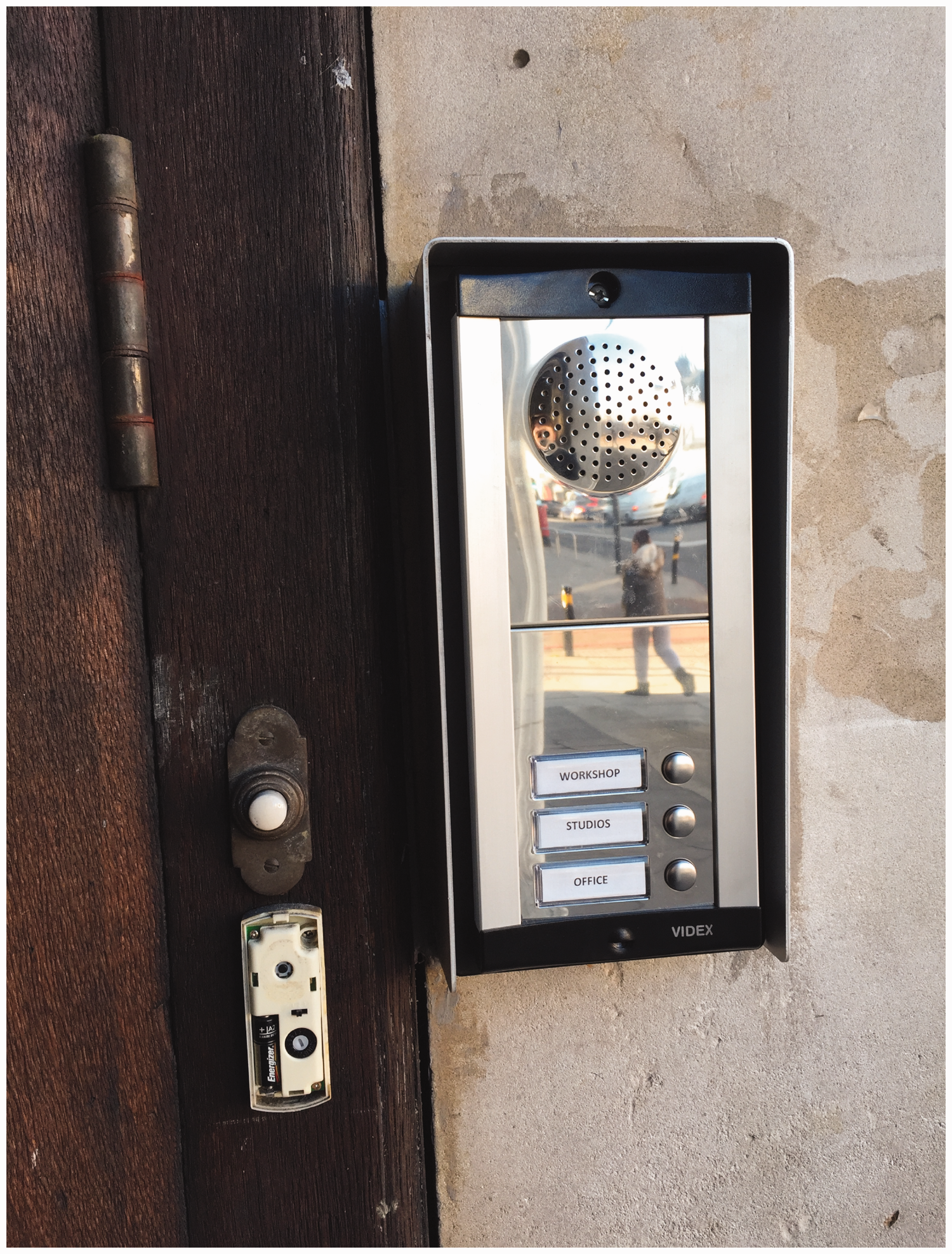
Encountering time: doorbell.
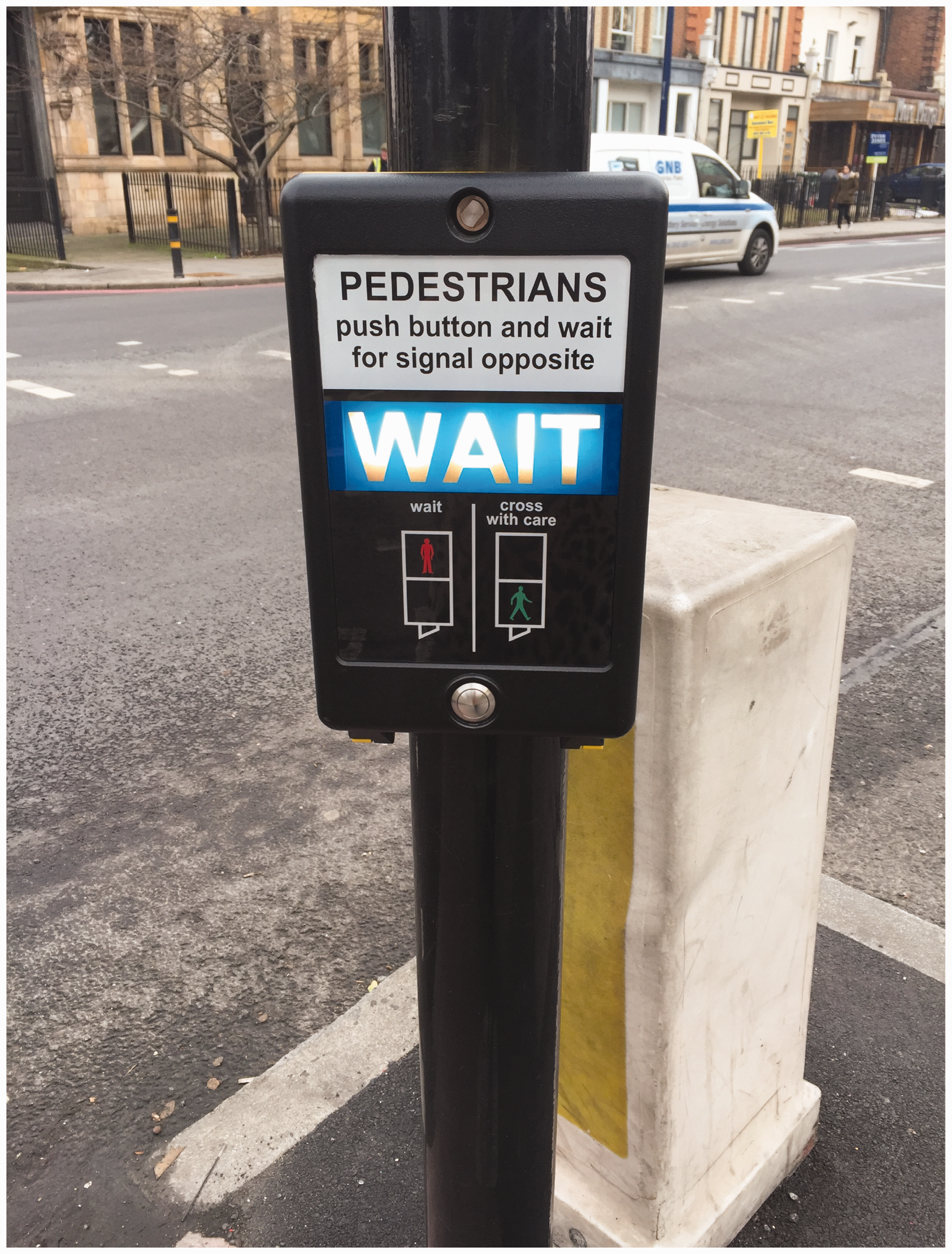
Encountering time: pedestrian crossing.
Working with different mediums – (digital) photography, videos and sound recordings – were ways in which Beckie elaborated her understanding of how time may be grasped differently. The different mediums ‘tuned’ her into specific temporalities by requiring or encouraging her to focus on different objects through which temporality is patterned and the rhythms they create. For example, the walk in which she documented her encounters with time through photographs concentrated her attention on a wide range of signs which indicated various temporalities: open and closing times, seasons and terms, waiting times, happy hours and so on. The signs themselves also varied in their formality and permanence, with some produced by governmental and local council services, others by national organisations (such as the Post Office) or local groups, and others hand-written and temporary. As still images saved onto her smart phone and an online photograph archive, the photographs also lent themselves to returning to later; Beckie swiped and clicked through them after the walk, considering the different ways in which she encountered time on the walks, and how, more generally, temporality was signalled and organised through them.
As well as the various signs, on the walk, Beckie had also photographed some of the pedestrian crossings that are situated along the length of Lewisham Way. She then did further walks where she photographed, videoed and made sound recordings of pedestrian crossing signs and crossings. Through these methods, Beckie became aware of two specific temporal experiences: waiting and rushing. For example, she made videos of waiting at a crossing, focusing on the flashing WAIT sign. In deciding to train the video camera of her phone onto this WAIT sign, parked and moving vehicles and pedestrians were brought into view. In other videos, Beckie recorded her movement across the road, which involved becoming more aware of the technologies that pace the rhythms of the crossing. For example, at some newer pedestrian crossings, an illuminated sign of the green person walking is accompanied by a clock that counts down the remaining seconds to cross the road. This technique both helps to hurry people across the road and allow them to assess whether or not they have time to cross, potentially discouraging them from stepping off of the pavement. Sound recordings drew her attention to both the soundscape of traffic, as it came to a halt at the red stop traffic light (see blog post 5) and to an evenly paced and relatively fast beeping noise that accompanies the clock that counts down, again measuring out the time a pedestrian has to cross the road. The different mediums through which Beckie studied the pedestrian crossings elicited the ways in which this mundane means of crossing the road is one instance of how time is encountered and organised in everyday life.
To investigate the idea that methods perform as well as grasp temporality in more detail, Beckie explored and experimented with the temporalities of waiting and rushing that she encountered through pedestrian crossings. As we have noted above, repeated video and sound recordings of a particular pedestrian crossing on Lewisham Way, drew Beckie’s attention to how she moved across it, and the visual and audio technologies that organise her movement. Three audio recordings of the crossing can be accessed here: https://walkinglab.org/encountering-temporality-vi-pedestrian-crossings-and-repetition/. Listening to the audio recordings, the repetition and regularity of the beeping that marks out the time given to cross the road becomes evident. Beckie’s footsteps – which can just be heard at different volumes on the different clips – also have a certain regularity to them, indicating that she walks at roughly the same speed on multiple occasions: Beckie never reached the other side before the beeps stop; she always has another two or three steps to go. However, the repeated recordings also indicate difference, not only because each crossing is made at a different time of day but also in other ordinary ways. For example, while the beeping and her footsteps have a certain regularity to them, the ways these sounds co-exist with those of the traffic that passes, stops and starts again, and with other noises including music, demonstrate that no two crossings are the same. The lengths of the clips also differ, depending on when she arrives at the crossing, how long she waits to cross and when she ends the recording. This interplay between repetition and difference becomes apparent through the sound recordings.
In this sense, the recordings attune our attention, and the methods grasp temporality. However, if performativity is understood as constitutive of the worlds they grasp, the recordings also perform temporality. As noted, the recordings are of different lengths: they thus ‘cut’ into a flow of time and in so doing compose a particular temporality. Moreover, to explore the performativity of method further, Beckie began working with some of the raw sensory data that is discussed above. In particular, she returned to the issue of waiting that she raised in her initial reflections on pedestrian crossings, and in particular David Bissell’s (2007: 278) account of waiting as a ‘relatively embodied activity or action’, involving ‘an enlivened corporeal sensibility where bodies are highly attuned to their immediate environment and themselves’. To think through this idea in more detail, Beckie edited the video and audio clips linked to above to focus attention on what her body, as viewer and listener to the clips, become attuned to in ‘the immediate environment and myself’.
This video, included here https://walkinglab.org/encountering-temporality-viii-reiterating-sensory-methods/, is an early experiment which takes the video image of the ‘WAIT’ sign of one pedestrian crossing and mixes it with the sound of waiting at another pedestrian crossing. The original video and sound have both been slowed down to 25% of their initial speed. In slowing the speed down, Beckie’s aim was to begin to amplify the sense of waiting that they both elicit. Her attention is drawn to the differing speeds at which pedestrians and cars move along Lewisham Way, as well as to the disjunction between the image and audio – at some points they seem to match up, while at other points, the sound pulls apart from the image, indicating traffic that cannot be seen. It is also drawn to the pulsing of the WAIT sign; an effect of the video camera rather than what the pedestrian crossing sign does ‘in real life’. She thinks about how this pulsing coincides, or not, with what she can see and hear. The video image ends before the audio, so that the beeps of the crossing become foregrounded, only here their speed indicates a rather drawn out movement. Indeed, the slower speed changes their pitch, making them strange and raising the question of what they are and refer to.
This experimentation with producing a new audio-video piece is performative of time. Its temporality is specific to the methods and media that produce it; or, in other words, the mediums of the smart phone video and audio recordings, and the editing techniques where video and audio are spliced together and slowed down generate a temporality that is specific to them. Different devices and techniques would generate a different temporality. This is important to our argument because it continues to highlight how methods are not neutral tools that document ‘reality’ but it is through (different) methods that (different) realities are, and are not, generated. Further, the slowed down edit of the video and audio clips elicits a sense in Beckie, which is pertinent to exploring waiting: that of boredom. She can feel bored, and a bit twitchy when watching this edit, not necessarily more or less than she can feel waiting at a pedestrian crossing (which usually depends on whether she is rushing somewhere or has time to dawdle), but in ways that nevertheless make her, and perhaps you too, think about such ordinary experiences of waiting.
As we have noted, the methods that Beckie experimented with indicate the politics of temporal architectures on a smaller scale. Drawing attention to the objects, devices and technologies via which the temporalities of one particular stretch of road are arranged can be understood in terms of a reorienting of social science’s focus on humans towards an appreciation of the significance of human–nonhuman relations (e.g. Bennett, 2010; Latour, 1992). The methods also require a consideration of the embodied and affective conditions of both walking and how movement across a pedestrian crossing is organised. Beckie was pregnant with twins while conducting the walks, forcing her to curtail the plans for the project as walking was uncomfortable, and to reflect more generally on the accessibility of walking as method for differently abled bodies (see for example, Bates, 2017, 2019). The embodied and affective experiences generated by waiting that Bissell points to where bodies become aware of their spatial and temporal situation also poses a series of questions concerned with everyday politics, including who waits and how. With the example of the pedestrian crossing, we might ask: What bodies walk along particular roads and what bodies drive (and in what vehicles)? Are these mobilities chosen or forced? Are (certain) vehicles prioritised over pedestrians? What environmental effects and affects on what bodies might these patterning of temporality involve? As Sharma’s work demonstrates, temporality is key to understanding issues regarding who and what is valued and how.
Exploring time in London 2: i-Docs and the Pop-up City
Between October 2014 and December 2015, Ella Harris conducted ethnographic research into pop-up culture in London, undertaking site visits, participant observation, interviews and video and photo methods. Ella’s aim was to explore the ways of thinking about space and time being developed in pop-up culture and to interrogate their political implications. Pop-up culture is a trend for temporary and mobile spaces including sites of consumption, leisure, artistic practice and performance. Prominent kinds of pop-up place, in London, include shipping container studios and shopping malls, supper clubs, pop-up cinemas and pop-up parks, most of which are enabled by the ‘meanwhile use’ lease template, by which landlords of vacant properties or plots can lease their spaces temporarily. Pop-up developed after the 2008 recession, responding to rising vacancy rates and funding cuts by encouraging charities, creative groups and small businesses to temporarily occupy empty spaces while the economy recovered. However, despite beginning as a ‘compensatory’ (Harris, forthcoming; Tonkiss, 2013) urban form pop-up’s popularity is now such that big brands like Nike or Selfridges deploy pop-up as a marketing and promotional technique. More recently, pop-up has expanded into the welfare sector, including pop-up emergency accommodation or pop-up health care and legal aid services. Pop-up is defined by its imaginaries of space-time, positioning itself as a spontaneous, mobile, temporary and interstitial urban form. Pop-up’s conception of urban temporality can be identified as nonlinear. It envisages a city defined by flux and unpredictable transformation in which time is open. Pop-up also envisages urban space as interactive, figuring the city as something that can be continuously and democratically constituted by citizens, who are invited to ‘pop-up’ in and thereby transform its fabric. Understood in terms of temporal architectures, Ella’s work explores its ‘major’ aspects in that it is concerned with relatively large-scale imaginations and transformations of the city.
In examining pop-up’s temporal logics, Ella experimented with i-Docs as a method. i-Docs are an emerging form of documentary. They are normally hosted online, taking a variety of formats that range from closely resembling a website, to being more like a traditional documentary film, through to having the advanced interactive capacities typical of a video game. Most fundamentally, what defines an i-Doc is its nonlinear organisation of film sequences and other multi-media content. The interfaces of i-Docs offer users multiple paths through, or modes of engaging with, their material, giving them a malleable, open-ended spatiotemporal format. When beginning her research into the pop-up city, Ella had intended to use video to engage with the temporalities of pop-up places. However, once she began the research, she realised that what was important about pop-up, in relation to time, was the temporal logics and imaginaries that emerged from pop-up places in combination, and the instrumentalities of those ways of conceiving and producing the temporal in the post-2008 climate that pop-up emerged from.
On a chance encounter with i-Docs, Ella was struck by the resonance between the spatiotemporal logics of i-Docs as a medium and pop-up’s own ways of articulating urban temporality. As well as using video to evoke the localized temporalities and aesthetics of particular pop-up places, Ella saw the potential for an i-Doc to express and elucidate the pervasive temporal imaginaries that emerge from pop-up culture as a whole, by communicating those through an i-Doc’s interface. It has been argued that, as a form typified by modularity, variability (Gaudenzi, 2013), complexity and choice (Nash, 2012), i-Docs foster sensitivity to the open ended, unpredictable and multiple possible trajectories of the world. Ella was interested in the connections between the spatiotemporal logics of i-Docs and that of pop-up culture; as phenomenon to have emerged within the same zeitgeist. Because of this resonance, she decided that making an i-Doc would help her to tune into and grasp pop-up temporalities, enabling her to focus on multiplicity, metastability and nonlinearity (see Harris, 2015). To create the i-Doc, Ella worked with a web developer who coded the i-Doc based on her designs and their dialogue. The i-Doc can be accessed using this link and the password TTC: http://thetemporarycity.com/. It includes 18 video clips, which total just under 45 minutes, as well as collages that form what she called the ‘outside pop-up city’ pages.
The video footage was gathered during a 14-month period of field work within which Ella attended three ‘types’ of pop-up events; supper clubs, pop-up cinema screenings, and events and activities in shipping container architectures. Ella then edited this footage into short (between 1 and 4 minutes) clips using Adobe Premier Pro. The clips either seek to capture the atmosphere of places and events, or are edits of interviews with their organisers. Filming in pop-up places helped Ella to grasp pop-up temporality because it required her to focus on the component features of pop-up’s temporal logics. Given she was filming with the aim of later evoking pop-up temporalities, choosing where to point the camera became a process of identifying objects or processes that were instrumental in producing pop-up’s sense of time. For example, in filming container shops and studios, Ella focused on the materialities and aesthetic of the containers, especially the adaptations and customizations that had been made to them. This enabled her to identify a sense of creative flexibility and ad-hoc adjustment as core to pop-up temporality.
Likewise, the editing process enabled a specific mode of attention. In editing any film, additions and removals have ramifications that spread throughout the film (Laurier, Strebel and Brown, 2011). Editors must be attuned to how shots or scenes early on in a film will transform the meanings of those that come later, and thus how their removal or alteration will impact on the film’s totality. Yet, editing i-Docs, as Adrian Miles has explored, is a somewhat different process, involving ‘assembling particular sets of possible relations’ (2014: 75). In producing clips that could be viewed in multiple orders and contexts, the multiple possible meanings of any given clip are retained for the user rather than shut down in the edit. As such, editing i-Doc clips requires attention to the multiple possible relations between content so required Ella to tune into the various intersections and commonalities between the places and events she had filmed. For example, she became increasingly aware of the prevalence of billboards advertising new housing at pop-up sites. Identifying these commonalities enabled Ella to grasp the broader temporal architectures of which pop-up is part; in that instance, the temporalities of redevelopment.
While producing the i-Doc’s clips, Ella also worked with the web developer to design its interface. Designing this interface was perhaps the most important element in grasping pop-up temporality. The interface is designed to express pop-up’s imaginaries of urban time, so deciding how to organise the interface was at once a reflection on the nature of that temporality. For example, Ella chose to base the main page of the i-Doc around a map of London in which clips are embedded at the locations they pertain to. Importantly, the map is not static but linked to a timer which determines when clips appear and disappear from it, generating the sense of pop-up as dynamic and unpredictable.
As well as grasping pop-up temporality, the i-Doc also performs temporality, most significantly by generating an experience for the user that is indicative of, but also distinct from, the temporality of pop-up culture itself. The i-Doc is accessed via a home page which has a brief description along with a button asking you to ‘enter’ (Figure 5). The word ‘enter’ signals to user that they are now entering an immersive online space in which a different mode of attention is required, more akin to spectatorship or play than to browsing a web page.
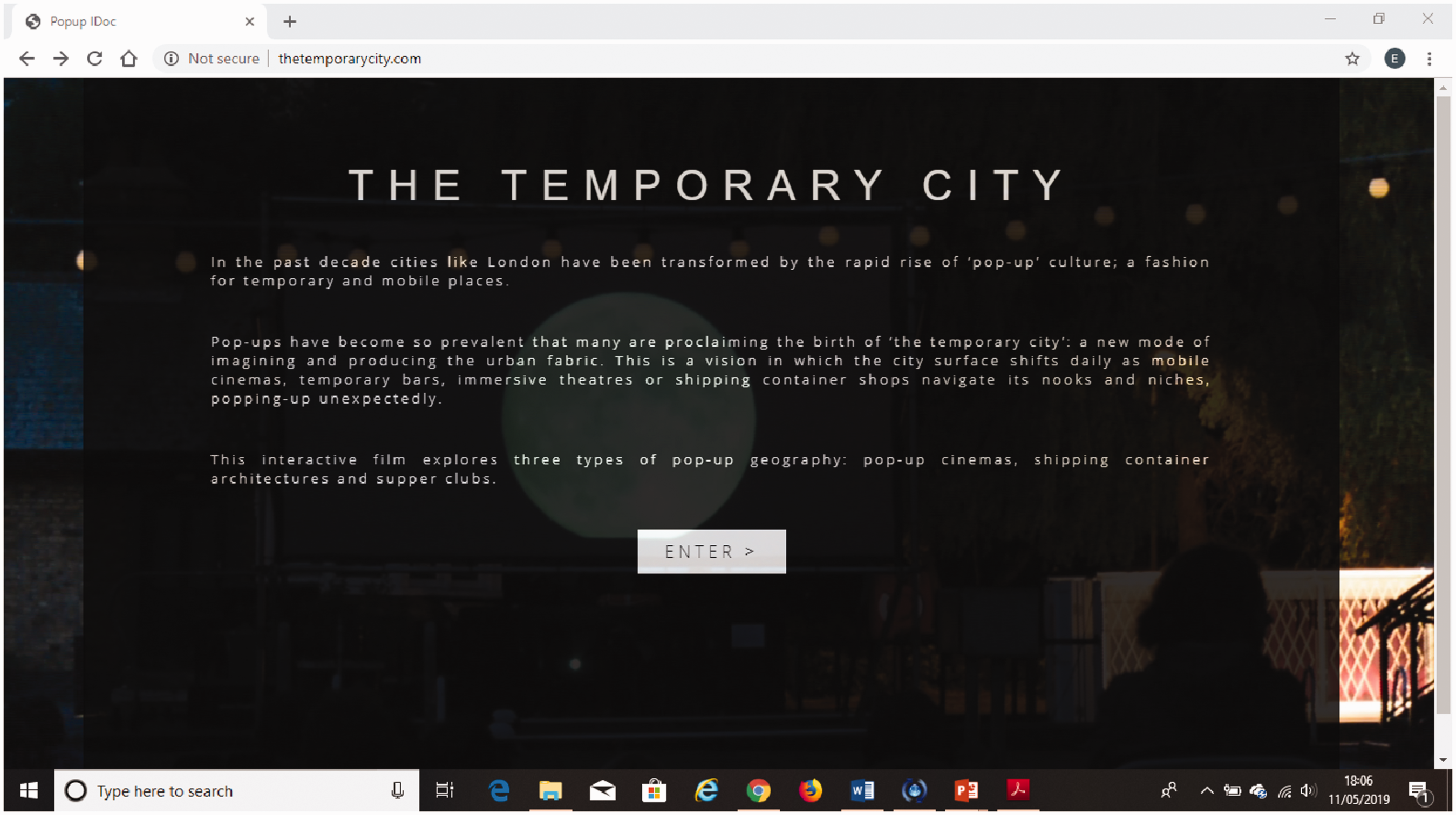
The home page for ‘The Temporary City’ i-Doc.
Once ‘inside’ the i-Doc, there are two main ways to view content; the main ‘play the pop-up city page’ and a secondary option to sort clips by category. The ‘play’ page is designed to evoke pop-up’s sense of flux, unpredictability and dynamism. On this page, icons signalling video clips are displayed on an adjusted map of London. There are three kinds of icon signalling the three kinds of pop-up Ella focused on; container spaces, pop-up cinemas and supper clubs. A calendar at the bottom of the page marks the passing of time as original icons disappear and are replaced by others. Clicking on an icon makes it start to play and at the end links are offered for the user to follow which lead either to other clips or to the ‘outside pop-up city’ pages; collages of images and text that Ella made on Photoshop (Figure 6).
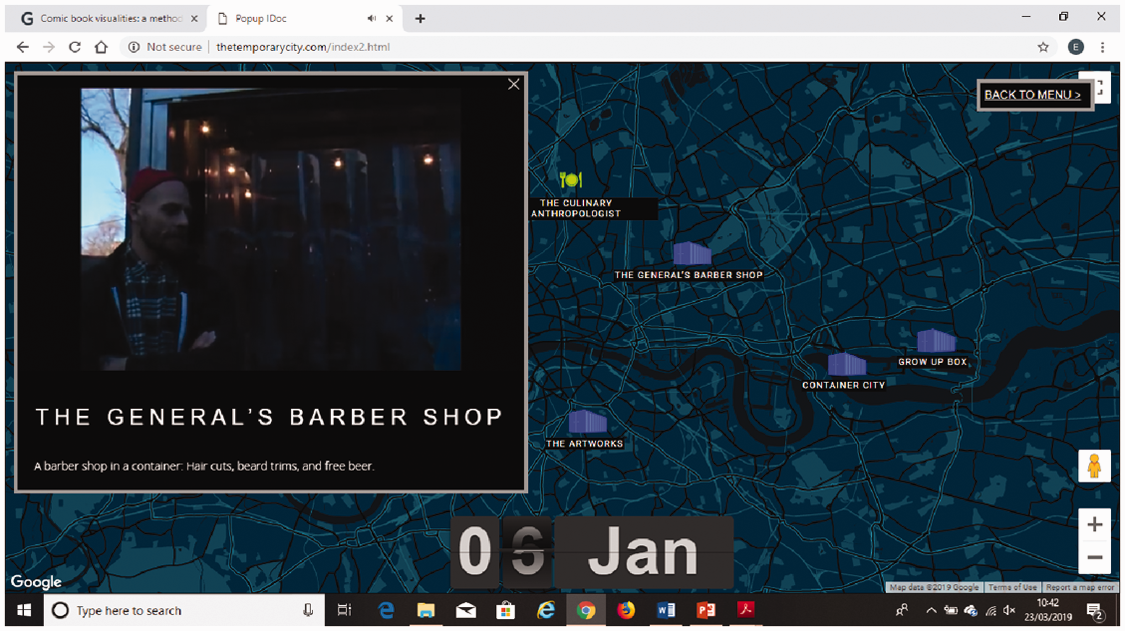
Inside the i-Doc's ‘play' page.
The turning pages of the calendar and the coming and goings of clips evoke the ephemerality and flux of the pop-up city and generate an underlying sense of anxiety. The pace of these processes is deliberately fast enough that users are unable to watch all the clips available on the map before they disappear, generating a sense of the bewilderment and unpredictability of pop-up temporality. The constant coming and going of clips means that users are required to constantly watch the map in order to see spaces as they emerge. This demands vigilance but also means that attention is distributed across the map rather than on the clip being watched at any given time, so that users can never fully commit or settle into a clip. ‘Playing’ the pop-up city is therefore a performance of temporality, one which offers the user an insight into the temporality of pop-up but does so by being and generating a temporality of its own.
Playing the pop-up city is also an experience that engages critical thought about pop-up. The play view evokes pop-up’s insistence on time’s democratic openness; the involvement of urban citizens in producing the city’s trajectories. Time does not begin to pass until the user clicks on a clip and choosing another clip is required to move the action on, so that the i-Doc ‘as an independent and standalone artefact does not exist’ (Gaudenzi, 2013: 14). This gives the user power in a sense, but also foregrounds the burden of their entrainment in pop-up’s rhythms. The necessity of the user to perform work in order for the i-Doc to function reflects the onus put on individuals within pop-up culture to keep the city functioning at a time of recession and austerity (Ferreri, 2015; Graziano and Ferreri, 2014; Harris, 2015).
The performance of temporality offered by the i-Doc is, then, also interrogative of pop-up and its politics. This interrogative orientation is enhanced by the inclusion of ‘outside pop-up city’ pages: collaged pop-up boxes (made in Adobe Photoshop) that are offered as options at the end of certain clips. They highlight processes that are not acknowledged in pop-up culture’s promotion, processes that include gentrification and the normalization of precarious labour. To give one example, the clip about The Artworks, a shipping container mall occupying a vacant site awaiting redevelopment, ends with an option to see ‘outside the pop-up city’. The page that opens up explains how the mall occupies the site of the former Heygate Estate, a council estate that was controversially decanted, sold at a loss by the council then knocked down, and (at that time) was waiting to be turned into expensive flats (Figure 7). It offers a critical insight into the functions of the artworks, showing how it is being used by the developers to rebrand the site and attract the middle class buyers the new flats are aimed at. This information problematizes the notion that pop-up’s transformations of sites are ‘temporary’ and shows the dishonesty of its imaginary of openness, given that pop-up here is deployed in processes of forced eviction and displacement that, while indeed opening up opportunities for the developers Lend Lease, shut down access to the city for others.
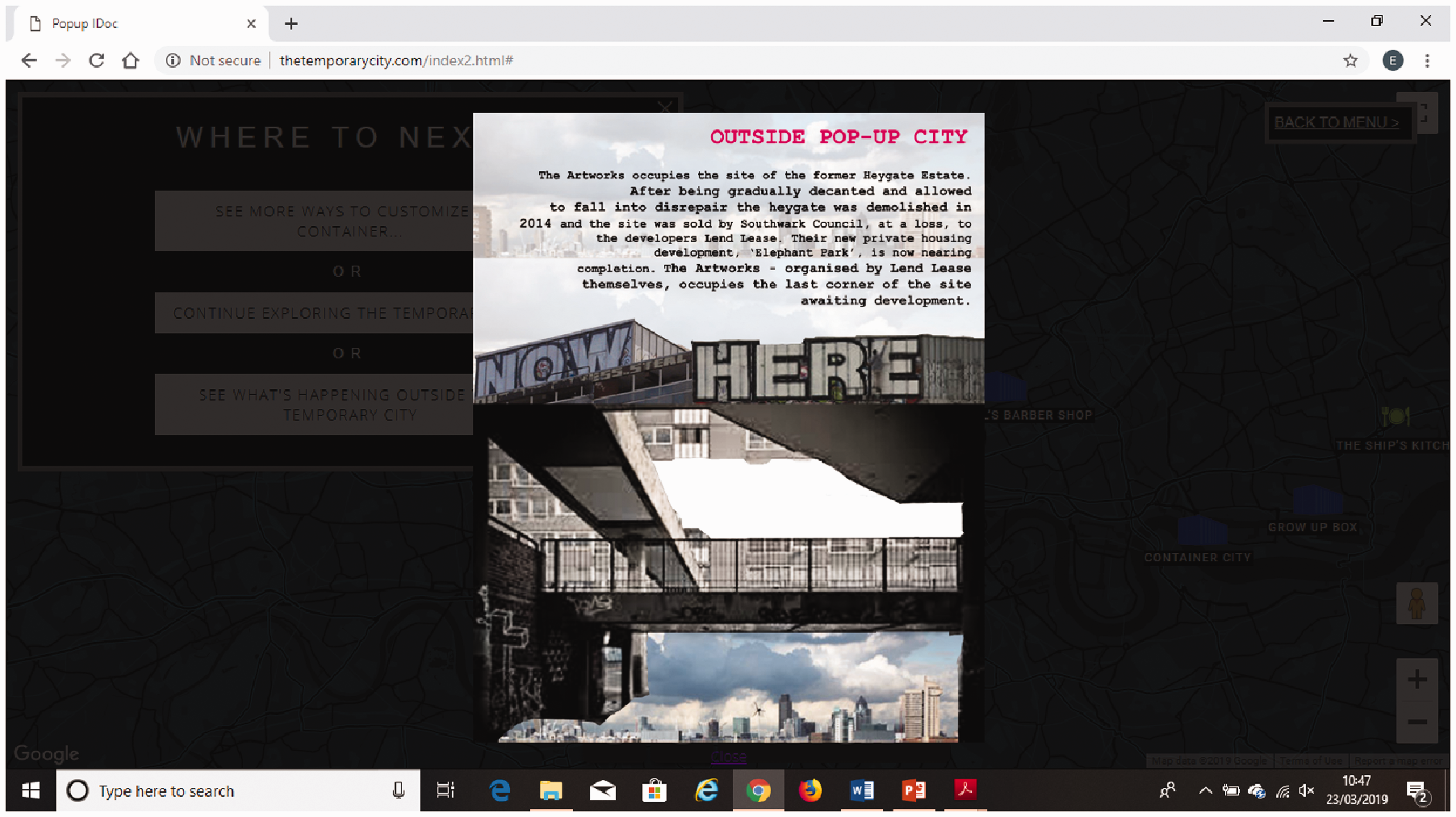
‘Outside pop-up city': the i-Doc's critical interventions.
The ‘ending’ of the i-Doc picks up this same critical thread. After 10 minutes in the i-Doc’s ‘play’ page, the i-Doc is interrupted by another pop-up window which takes over the whole screen and informs users that their time in pop-up city is up because development is due to commence. Users are encouraged to visit the ‘pop-up city showrooms’ and browse for luxury apartments (Figure 8). This abrupt, singular, ending (somewhat crudely) illustrates the fallacy of openness promised in pop-up’s nonlinear imaginary. It does this by revealing the teleological procession of the i-Doc itself that was (unbeknown to the user, who was presented with ostensible agency) driving its trajectories the whole time.
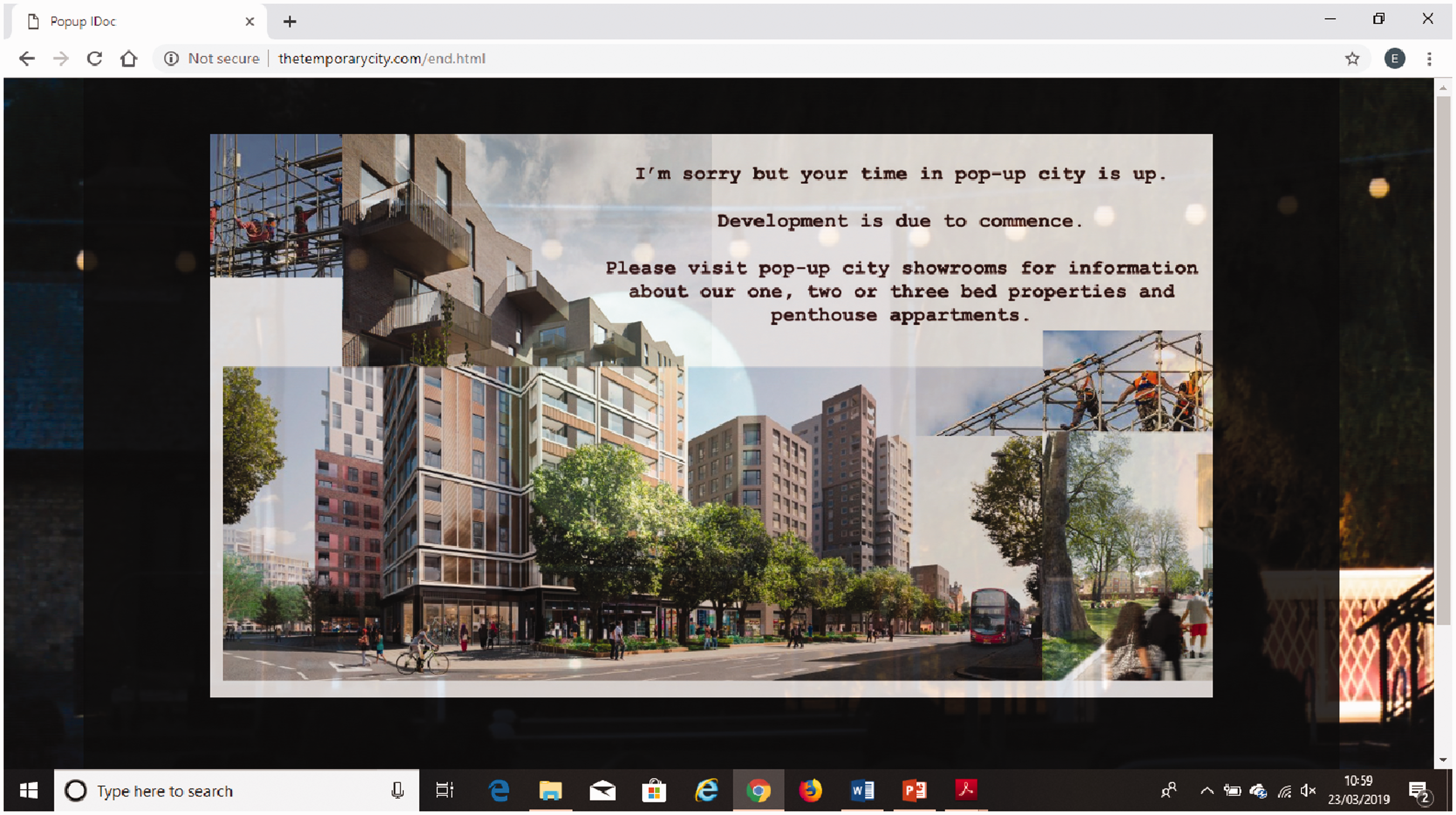
The i-Doc's ending.
The i-Doc, then, engages interactive capacities to generate an exploration of the discrepancies between what pop-up’s imaginaries of temporality promise and what they actually do, in terms of their contribution to the city’s temporal architecture. It encourages users to consider how, while pop-ups are presented as open opportunities for less powerful urban actors to transform places and produce the city, the efforts of these people are in fact co-opted towards the agendas of developers and governments. Pop-ups are used to distract from the impacts of recession and austerity in the city (by filling up vacant spaces) while catalysing gentrification and thereby ultimately displacing themselves by enabling the return of more profitable uses of urban space, such as large-scale private housing developments. In performing its own temporality, the i-Doc was able to reconnect the pop-up temporalities it grasped to processes that are forgotten or made invisible by pop-up culture itself. To engage with the i-Doc is to inhabit a temporality that is not just indicative of pop-up time but that expresses it while problematizing its logics, agendas and stakes. The i-Doc therefore plays a role in constructing future pop-up temporalities, as it changes how pop-up is conceived and approached.
Conclusion
In bringing together our two, very different, methodological investigations into the social life of time, we offer an insight into the diversity of what methods for studying time can encompass and can do. Reflecting the propositions of the introduction, our methods contribute to a broader understanding of what it means to research time, by engaging with the social life of time via an examination of aspects of the ‘temporal architectures’ of London. The methods we have explored in this paper demonstrate ways of engaging with the social life of time from varying scales and angles, allowing both detailed explorations of how temporality is constructed in localized social settings and engagements with temporal logics on an urban scale. They shed light on how the built environment, technologies, practices, material infrastructures and aesthetic and affective dimensions of the city express and produce the temporal, while each method does this from a very different perspective and scale: one in relation to the infrastructures and urban objects that structure the temporalities of walking and one in relation to the temporal logics embedded in a distinctive urban culture. Our examples also show the diversity of methods that can be employed in studying the temporal, and how methods can be selected to attune to particular elements of the social life of time; for example, using mixed methods to hone in on the affective experiences of the constructed temporalities of walking in a particular locale or by using a digital interface to critically engage with the temporal logics that emerge from and govern pop-up as an urban culture.
We have also reflected on what methods for exploring time can do. We have argued that methods perform as well as grasp the temporal, becoming a dimension of its social life, in ways that are politically significant and can be politically motivated. Recognising methods as emergent from the worlds, they seek to grasp means recognising that those methods can both naturalize and problematize that world. In the introduction, we explored how creative medium and technologies of spectatorship have, historically, reoriented people within changing temporal conditions (Jameson, 1991). Grasping and expressing changing temporalities can acclimatise us to them. However, such an acclimatisation can run the risk of shutting down critical reflection by normalising changing social rhythms and routines (Crary, 2002: 21). That is to say, if methods seek only to grasp the temporal, then they might orientate us within changing temporal conditions but do so in ways that are uncritical. Yet, if we hold on to methods as doubled, recognising and mobilizing their performative dimensions too, then our explorations of the temporal become politically productive, orientating us within changing temporalities in ways that are reflexive and interrogative.
What we attempt with this paper, then, is to explore what might be achieved by understanding the doubledness of the social life of time and the social life of method together. Indeed, while we have pointed to the different politics that our methods focused our attention on, seeing methods as performative also suggests the possibility of intervening in these politics. Both of our methods generate critical understandings of temporality by grasping time but also by performing temporalities of their own. In doing so, they open up the possibility of intervening in and altering the temporal architectures of London. As Sharma argues, ‘[u]nless a politics of time challenges and resists the boundaries of normalised time, it fails to be an adequate one’ (2014: 142). Through our methods, we might not only understand time more fully, but we might do time differently.
Footnotes
Declaration of Conflicting Interests
The author(s) declared no potential conflicts of interest with respect to the research, authorship, and/or publication of this article.
Funding
The author(s) disclosed receipt of the following financial support for the research, authorship, and/or publication of this article: Beckie's research was supported by a virtual residency from Walking Lab. Ella's research was funded by an AHRC Studentship and Research Training Support Grant and an ESRC Postdoctoral Fellowship. Both authors appreciate their funders.
