



Abstract
Background
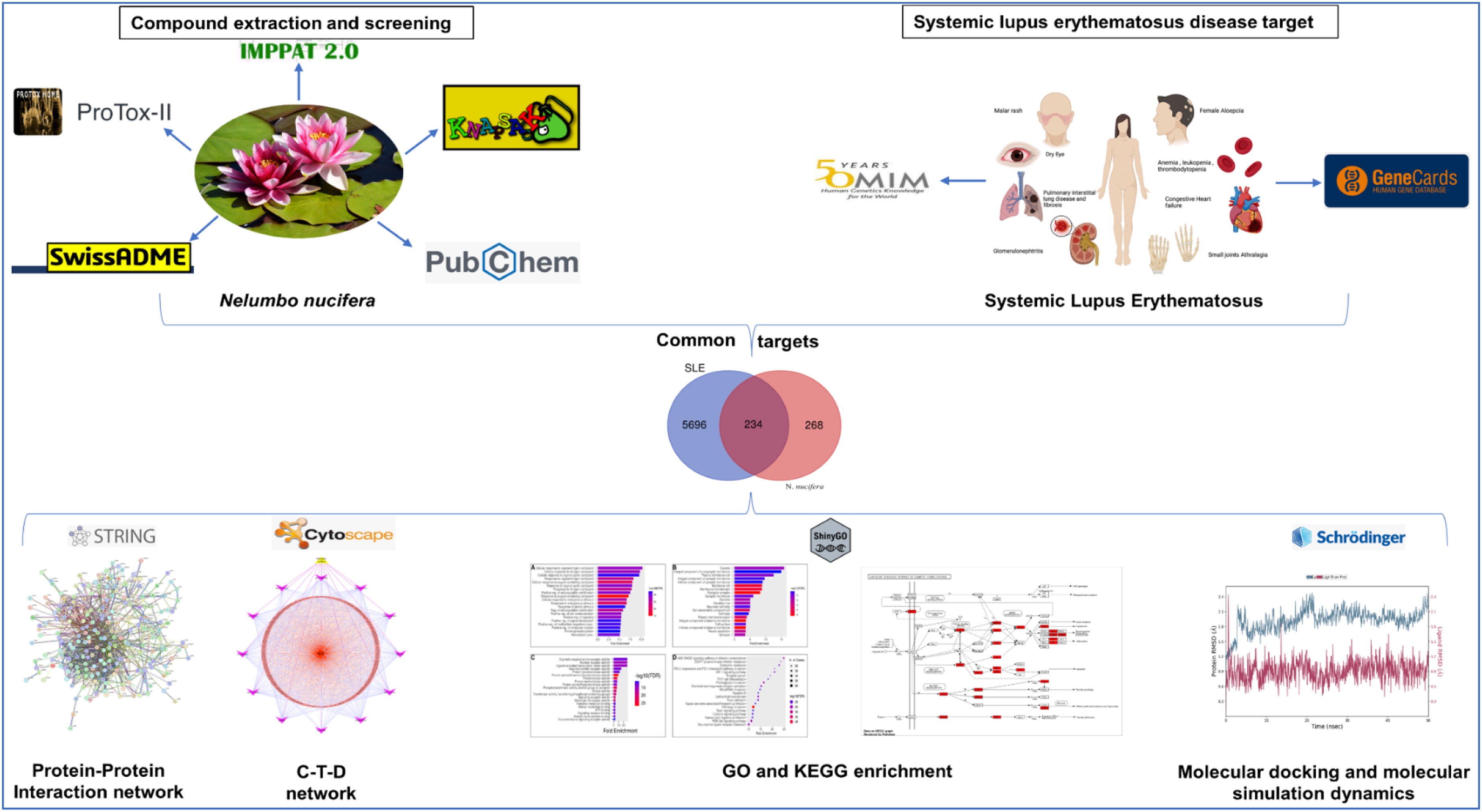
Systemic lupus erythematosus is a chronic autoimmune inflammatory disease characterized by multiple symptoms. The phenolic acids and other flavonoids in Nelumbo nucifera have anti-oxidants, anti-inflammatory, and immunomodulatory activities that are essential for managing SLE through natural sources. This study employs network pharmacology to unveil the multi-target and multi-pathway mechanisms of Nelumbo nucifera as a complementary therapy. The findings are validated through molecular modeling, which includes molecular docking followed by a molecular dynamics study.
Methods
Active compounds and targets of SLE were obtained from IMPPAT, KNApAcKFamily and SwissTargetPrediction databases. SLE-related targets were retrieved from GeneCards and OMIM databases. A protein–protein interaction (PPI) network was built to screen out the core targets using Cytoscape software. ShinyGO was used for GO and KEGG pathway enrichment analyses. Interactions between potential targets and active compounds were assessed by molecular docking and molecular dynamics simulation study.
Results
In total, 12 active compounds and 1190 targets of N. nucifera’s were identified. A network analysis of the PPI network revealed 10 core targets. GO and KEGG pathway enrichment analyses indicated that the effects of N. nucifera are mediated mainly by AGE-RAGE and other associated signalling pathways. Molecular docking indicated favourable binding affinities, particularly leucocianidol exhibiting less than −4.5 kcal/mol for all 10 targets. Subsequent molecular dynamics simulations of the leucocianidol-ESR1 complex aimed to elucidate the optimal binding complex’s stability and flexibility.
Conclusions
Our study unveiled the potential therapeutic mechanism of N. nucifera in managing SLE. These findings provide insights for subsequent experimental validation and open up new avenues for further research in this field.
Get full access to this article
View all access options for this article.
References
Supplementary Material
Please find the following supplemental material available below.
For Open Access articles published under a Creative Commons License, all supplemental material carries the same license as the article it is associated with.
For non-Open Access articles published, all supplemental material carries a non-exclusive license, and permission requests for re-use of supplemental material or any part of supplemental material shall be sent directly to the copyright owner as specified in the copyright notice associated with the article.
