




Abstract
Libraries can be valuable information and community hubs to address society’s growing mental health (MH) concerns and challenges. A comprehensive review of MH services libraries provide is lacking. We aimed to review MH-related services that public and academic libraries provide to patrons and identify factors that influence their implementation and success. We searched six academic databases and Google Scholar to identify peer-reviewed journal articles and searched Google to identify news articles published since 2010 reporting MH services that public and academic libraries provided to patrons. The searches identified 15 journal articles and 27 news articles. We analyzed these articles using the qualitative content analysis method. We found that libraries offered six categories of services: collection development and reference, space design, activities and materials, instruction, referrals and collaborations, and digital and online resources. Systematic evaluation of the services was rare. The provision and success of the services were influenced by features of the services, the library environment, the social environment, and users. The results indicate that the MH services that libraries provide are lacking. More effort is needed to design, develop, and systematically evaluate them to foster their development and sustainability.
Introduction
Concern for mental health (MH) is growing at an alarming rate nationwide. In 2022, 23.1% of adults aged 18 or older (estimated 59.3 million) lived with a mental illness (National Institute of Mental Health, 2024). Both the U.S. Office of the Surgeon General (2021) and the World Health Organization (WHO; 2022b) acknowledged that improving MH requires an “all-of-society effort,” including policy, institutional, community, and individual involvement. Libraries are uniquely positioned to contribute to this collective response. As trusted, accessible, and non-stigmatizing community institutions, libraries have a longstanding mission to advance community health, well-being, and health equity (Whiteman et al., 2018; Wilson et al., 2023). Historically, both public and academic libraries have supported community health-related needs by curating reliable and understandable health information, offering health literacy instruction, hosting wellness-focused programming, and responding to acute health emergencies (Hammock et al., 2023; Luo and Park, 2013; Whitney et al., 2017). Contemporary professional frameworks further conceptualize library service as relational and holistic. Approaches such as whole person librarianship emphasize attending to patrons’ emotional, psychological, and social contexts alongside information needs (Zettervall and Nienow, 2019), while trauma-informed library practice foregrounds safety, trust, and empowerment when serving communities experiencing distress or crisis (Tolley, 2020). Together, these perspectives position libraries as natural community-level partners for promoting help-seeking behaviors and supporting MH awareness and access (Philbin et al., 2019; Wahowiak, 2018; Whiteman et al., 2018).
Librarians observed a growing demand for MH services in communities among library patrons. A survey of 262 public library directors found that 50% admitted having regular interactions with patrons about mental illness (Whiteman et al., 2018). In interviews, public library staff and managers reported observing strong user needs for support in MH, such as stress, depression, aging, mental disorders, and parenting (Hall and McAlister, 2021; Lee et al., 2025). Academic libraries also observed increasing rates of depression and anxiety among current and incoming college students (Elharake et al., 2023). The Association of College and Research Libraries (ACRL) research planning and review committee recognized the demand and identified supporting student MH and well-being as one of the 2024 top trends in academic libraries (ACRL Research Planning and Review Committee, 2024).
In response, libraries have begun to experiment with a range of mental health–related services and interventions. For example, Grimes et al. (2023) reported a whole person librarianship service model where public librarians partner with social workers to provide MH services and interventions to patrons. Grimes et al. (2024) examined academic libraries’ leadership roles in student mental health support, emphasizing cross-campus collaboration, referral-based models, and trauma-informed programming.
Several literature reviews have been conducted to synthesize libraries’ efforts in providing MH support. Bladek (2021) reviewed wellness initiatives in academic libraries aimed at addressing student stress and well-being. Zanal Abidin et al. (2023) systematically reviewed the bibliotherapies—a structured yet flexible intervention that aligns with librarians’ expertise in reader advisory while requiring ethical awareness, referral boundaries, and sensitivity to trauma (Ward and Allred, 2024)—in public libraries as mechanisms for supporting community MH. Grimes (2024) reviewed the literature about MH and wellness challenges in communities, highlighted the need for Mental Health First Aid training along with additional MH training, and introduced MH programming in libraries to address these challenges.
These reviews provide valuable insights into how public and academic libraries respond to community MH challenges. However, Bladek (2021) focused on academic libraries’ responses to student wellness in general, not MH in particular; Zanal Abidin et al. (2023) focused on bibliotherapy services in public libraries; and Grimes (2024) reviewed some MH programming but did not investigate factors influencing the services. To inform future library programs and services that could better support community MH needs, a comprehensive review of how public and academic libraries approach MH services, service evaluation and outcomes, and factors that influence them is needed. The current review addresses this need by investigating the following research questions:
What services do public and academic libraries provide to address consumer mental health needs and challenges?
How were the services evaluated?
What are the challenges and barriers that public and academic libraries face in providing mental health-related services, and what are the facilitators?
Following the WHO, we defined MH as “a state of well-being that enables people to cope with the stresses of life, realize their abilities, learn well and work well, and contribute to their community” (World Health Organization, 2022a). Some examples of MH conditions include anxiety, depression, bipolar disorder, eating disorders, Schizophrenia, and substance abuse disorders (National Institute of Mental Health, 2025).
Research methods
We comprehensively searched for peer-reviewed journal articles reporting empirical studies on libraries’ services for MH and news articles reporting libraries’ MH-related programs or services. The searches identified 15 peer-reviewed journal articles and 27 news articles. We analyzed these articles using the qualitative content analysis method. This section describes the data collection and analysis processes.
Data collection and filtering
We searched six academic databases (i.e. PubMed, PsycINFO, Library and Information Science Source, Communication and Mass Media Complete, Elsevier, and Emerald), one journal (i.e. Health Information and Libraries Journals), and Google Scholar in June 2024. The keywords were combinations of terms, including mental health, libraries, librarians, and public health. The searches were limited to the title, abstract, and subject heading fields in the academic databases and journals. We examined the top 30 results from each search to identify relevant articles. We conducted an updated search in January and February 2025 to identify relevant articles published after the first search.
We screened the articles based on the following inclusion and exclusion criteria: (1) the included articles should be empirical studies or perspective papers that report patrons’ use of public or academic library services or programs specifically related to MH. If the services or programs were not only for MH, only the part about MH was analyzed. If the reported services or programs were not for patrons but for other populations, such as librarians, the articles were excluded. Studies on other types of libraries, such as school libraries, hospital libraries, or national digital libraries, were excluded because these libraries differ distinctly from public and academic libraries in the patrons they serve and their organizational structures. Review papers were excluded; (2) the included articles should be peer-reviewed journal articles. Opinion and communication articles were excluded as they often do not provide sufficient information about a particular service and its evaluation; (3) the articles need to be published in 2010 and after because most published work before 2010 was about bibliotherapy and there have been several systematic reviews focusing on bibliotherapy (Fanner and Urquhart, 2008; Zanal Abidin et al., 2023); and (4) the articles need to be in English.
In the screening process, three coders excluded irrelevant articles based on the titles and abstracts. We then each read the full text of a subset of the remaining articles and determined their relevance. When there were uncertainties about including an article, an additional coder was consulted. We also applied the citation tracking method to the included articles to identify additional relevant articles for inclusion. Moreover, we identified potentially relevant citations from review papers (e.g. Zanal Abidin et al., 2023). Together, 14 peer-reviewed journal articles were retained for analysis. One relevant article was identified during the second round of searching and screening in January and February 2025, resulting in 15 journal articles included in the analysis.
In the process of collecting and screening journal articles, we found that many library MH services were not reported in peer-reviewed journal articles but in news or library newsletters. We thus decided to include news articles for analysis. We searched the Google web search engine to identify news articles reporting library MH services. The news articles were included for analysis if they reported services or programs related to MH in public or academic libraries, were written in English, and were published in 2010 or later. The original search in July 2024 identified 14 news articles; the second-round search in January and February 2025 identified an additional 13 articles, leading to 27 news articles included for analysis.
Data analysis
We imported the included 15 peer-reviewed journal articles and 27 news articles to MaxQDA, a qualitative data analysis software, and analyzed them using the qualitative content analysis method (Miles et al., 2014). We coded basic information for each article, including publication date, country where the study took place, research methods, participants, sample size, and library type (public vs academic). The remaining coding was guided by our research questions. For RQ1, which is related to services that libraries provide to address consumer mental health needs and challenges, we first concisely described specific services and coded them into open codes. Then, we grouped them into service types, such as collection development, book recommendations, and presentations and workshops. We then further grouped them into service categories, such as space design and instruction. RS independently coded the services reported in both the journal and news articles; YZ then reviewed and validated all the codes. Discrepancies in codes and categories were discussed and resolved in weekly research group meetings.
For RQ2, which is related to the evaluation of the services, we coded measurement metrics and data collection methods and sources (e.g. service logs, interviews and surveys with patrons or librarians) when the evaluation was reported. We then organized outcome measures into categories, such as service usage, user experience, and changes in MH status. Only journal papers were coded because they reported evaluations and outcomes more systematically and were peer-reviewed. YZ independently coded the data. RS reviewed and validated all the codes. Discrepancies in codes and categories were discussed and resolved in weekly research group meetings.
For RQ3, which is related to barriers and facilitators of the services, we first focused on concisely describing facilitators and barriers, such as a lack of staff training and stigma. We then grouped them into categories based on the entities that they are associated with, resulting in four categories of factors: users, services, library environment, and social environment. YZ coded the journal articles. RS coded the news articles. They then validated each other’s codes. Similarly, discrepancies in codes and categories were discussed and resolved in weekly research group meetings.
Results
Sample characteristics
The sample included 15 peer-reviewed journal articles and 27 news articles published since 2010. Table 1 shows the sample characteristics.
Sample characteristics.
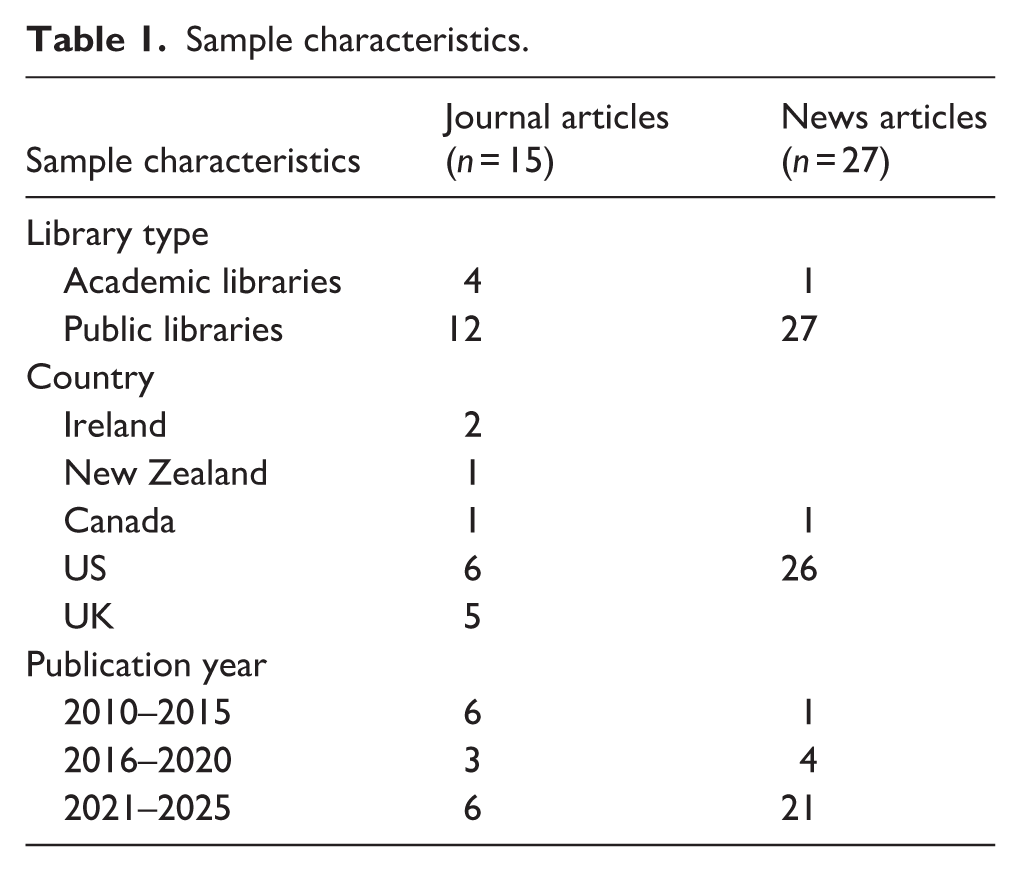
Among the peer-reviewed journal articles, 14 were empirical studies, and 1 was a perspective paper. The empirical studies used the following research methods: interviews (4/15), focus groups (2/15), surveys (4/15), intervention and evaluation (5/15), and website scans (2/15). The sample sizes for the interview and focus group studies ranged from 5 to 33; the sample sizes for the survey studies ranged from 12 to 607 (median = 45). The participants in the empirical studies included a wide range of stakeholders, including librarians, library security staff, library patrons (e.g. undergraduate students, service users), community key informants, healthcare staff (e.g. general practitioners, nurses, counselors, MH clinicians, health service executives), Table 1. social work staff, and psychologists.
Of the selected news articles, 16 were from a traditional news publication, such as The Washington Post, National Public Radio (NPR), and The Texas Tribune; 5 were from a professional library publication or organization site, such as the Library Journal and the American Library Association (ALA) Programming Librarian site; 4 were from health news sites, and 2 were bulletin/promotional posts included on official public library sites. The majority of the news articles (77.7%) were published in 2021 and after. One article did not include the publication year.
Services implemented
Six categories of services that public and academic libraries implemented to support patrons’ MH were identified: collection development and reference; space design; activities and materials; instruction; referrals and collaborations; and digital and online resources. Table 2 shows the specific services reported in the included articles.
Service categories, types, and specific services identified in the included journal and news articles.

Collection development and reference
Collection development and reference was reported in nine (21.4%) articles and showed two main forms: MH collection development and book recommendations. The collection development mainly included expanding existing MH collections and creating bibliotherapy and reading schemes. Bibliotherapy is a therapeutic method that utilizes self-help texts (Macdonald et al., 2013). Reading schemas, such as book prescription programs, offer MH assistance through the prescription of texts by MH and medical providers (Hutchinson, 2014; Neville, 2014; Walwyn and Rowley, 2011). Book recommendations, on the other hand, highlight or enhance the visibility of specific sources within collections through recommendations.
Space design
Six articles mentioned space design as a means to address MH issues. Three types of space design services were implemented. One was designating library space for MH and well-being, referring to services such as relaxation areas and nap stations. The second type was improving space quality, such as redesigning lighting (Cox and Brewster, 2020). The third type was libraries using their space to host MH services provided by external organizations and professionals. An example is hosting a community wellness hub staffed by an external MH organization (Oudshoorn et al., 2022).
Activities and materials
This category refers to activities, events, and materials made available to the public (13/42). Distinct types of services included wellness activities, book clubs and reading groups, exhibitions, and materials. A wide range of wellness activities were reported, such as MH resource fairs, art workshops, yoga and meditation sessions, story times, and music events. Book clubs and reading groups brought together community members and/or health professionals to conduct therapeutic reading. Exhibitions were mainly art exhibits addressing MH topics. Materials under this category differed from those in the collection development and reference category in that these items are not in circulation, do not need to be checked out, and do not form part of a formal library collection. Examples included take-home items like MH kits, self-care kits, and a tough topics bookmark for teens.
Instruction
MH services in the instruction category (10/42) included presentations and workshops, and training. Services under presentations and workshops ranged from presentations on MH and wellness topics to inviting guest speakers to speak on MH and holding community conversations to discuss MH needs with local community members. Training referred to specific MH training, such as MH first-aid training for patrons.
Referrals and collaborations
The referrals and collaborations category highlights connections with or collaborations with MH professionals (21/42). Types of services included the use of specialized library staff, on-site MH professionals, peer-to-peer advisors, and collaborative programming with MH organizations. Specialized library staff refers to the hiring of full-time staff with MH backgrounds. On-site MH professionals are MH professionals assigned to libraries through an external agency or a local MH organization. Examples of MH professionals included social workers, licensed clinicians, public health nurses, and MH clinicians. Peer-to-peer advisors are individuals with prior experience dealing with MH concerns who serve as guides to help others struggling with similar issues. Collaborative programming refers to libraries partnering with local MH organizations and professionals to create joint, collaborative programming. For example, the Toronto Public Library partnered with a local crisis center to offer low-barrier social services (Burman, 2024).
Digital and online resources
Nine articles reported a range of digital and online resources, from LibGuides, lists and guides, learning tools, and web links to telehealth, games, and applications. For example, Pacheco Flores (2022) reported a destressing Virtual Reality (VR) game aimed at teens; the Rowan Public Library in North Carolina provided virtual sessions with a licensed therapist (Institute of Museum and Library Services, 2020).
Service evaluation
About 73.3% (11/15) of the included peer-reviewed journal articles reported some form of evaluation of the reported services. The evaluations were primarily performed from two stakeholders’ perspectives: the user and library staff. Table 3 shows major categories of outcomes, examples of specific measures, and data sources.
Perspective and category of the evaluation of library mental health services.
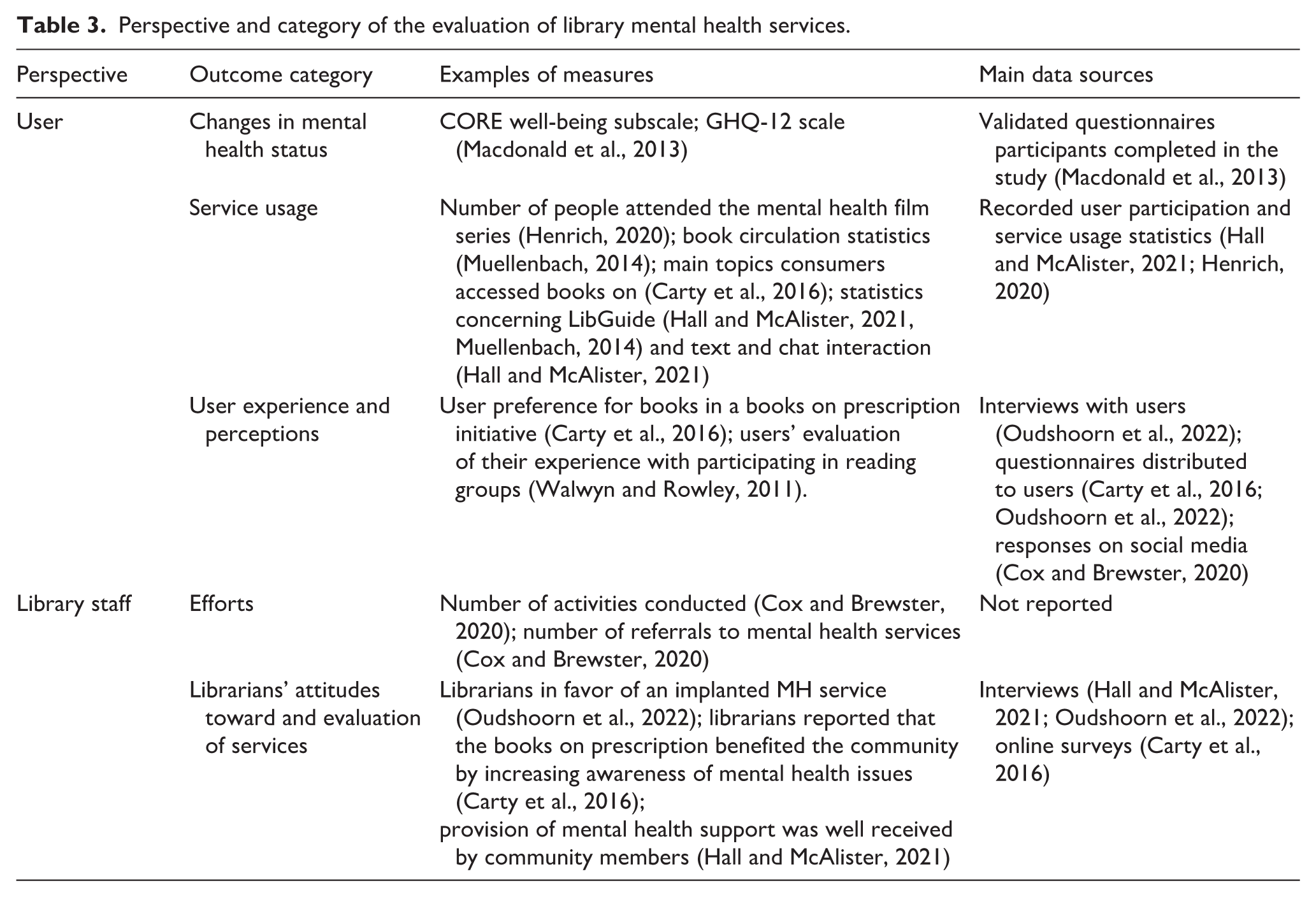
From the user’s perspective, service outcome measures clustered into three main categories: changes in users’ MH status, service usage, and their experience with and perceptions of the services. One study measured the changes in users’ MH status using two validated instruments, the Clinical Outcomes in Routine Evaluation (CORE) questionnaire and the General Health Questionnaire (GHQ-12), before and after a bibliotherapy intervention, and found significant associations between the number of book issues during the intervention phase and the level of improvement on the two scales (Macdonald et al., 2013). Nine journal articles measured service usage, that is, users’ participation in an event, such as a MH film series, or use of a service, such as checking out books in a bibliotherapy collection or accessing a LibGuide to MH resources. Three included journal articles measured user experience with and perceptions of the service. For example, Carty et al. (2016) reported users’ preference for the Books on Prescription initiative for shorter and less complex texts on a broader range of health topics based on users’ responses to a questionnaire. Walwyn and Rowley (2011) interviewed reading group participants who reported that the participation fostered social inclusion, boosted self-esteem and confidence, and increased companionship and a sense of community.
Service outcome measures from the library staff perspective clustered into two main categories: efforts and librarians’ attitudes toward and evaluation of services. For example, Cox and Brewster (2020) surveyed 53 academic libraries in the UK. They reported that more than a dozen libraries measured success by the number of activities conducted, whereas only two directly measured referrals to MH services. Four journal articles measured service outcomes by library staff’s attitudes toward or evaluations of services. For example, Oudshoorn et al. (2022) reported that library staff at a core urban library were overwhelmingly positive about an on-site MH wellness hub staffed by workers from an external MH organization as a resource for library patrons. Surveying and interviewing public and academic librarians, Hall and McAlister (2021) reported that librarians considered the provision of MH support to be well received by community members.
Barriers and facilitators to library MH services
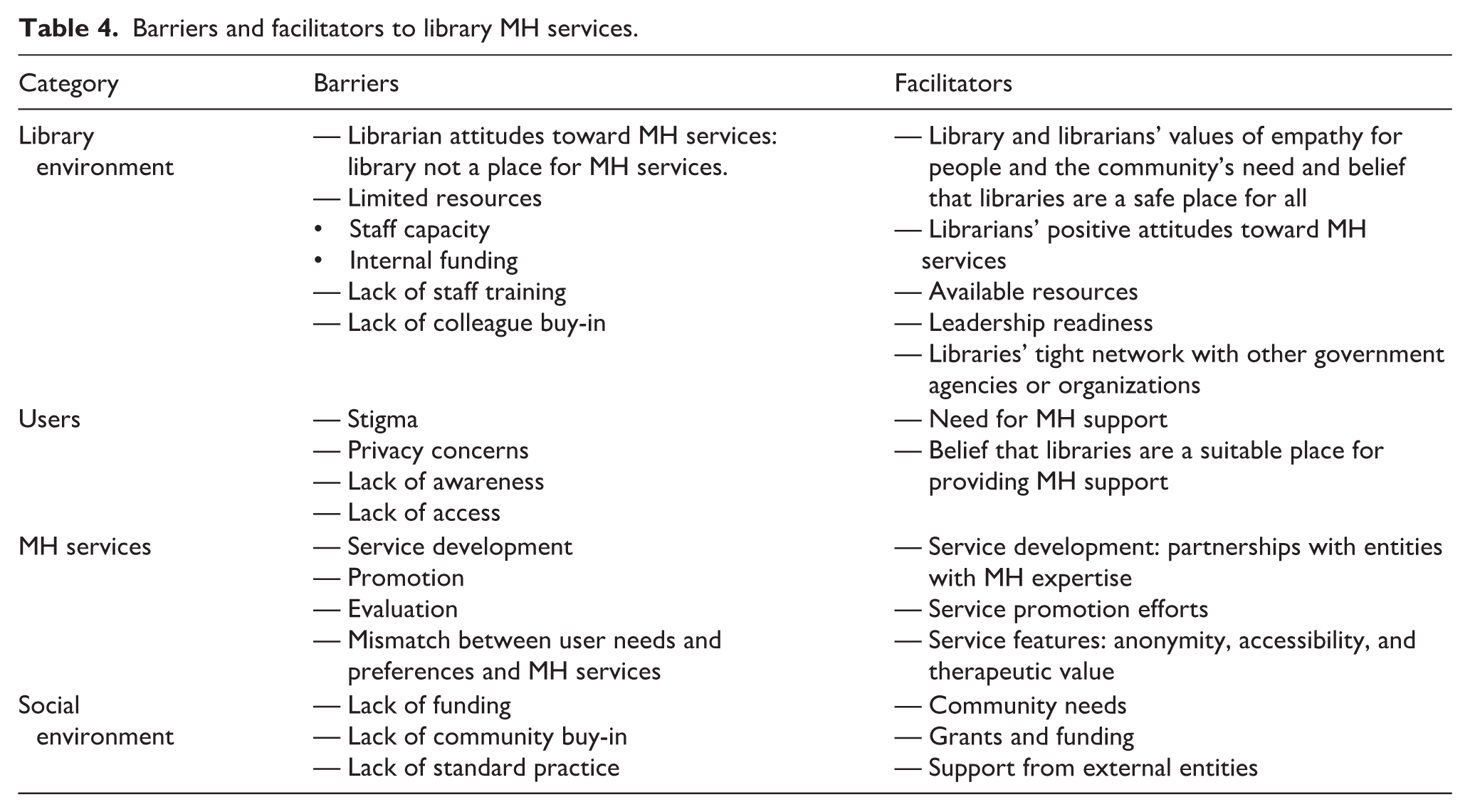
About 73.3% (11/15) of the included peer-reviewed journal articles and 25.9% (7/27) of the news articles reported barriers that libraries face in providing MH-related services; 53.3% (8/15) of the journal articles and 70.4% (19/27) of the news articles reported facilitators. The barriers and facilitators fell into four major categories: the library environment, the user, specific MH services or programs, and the broader social environment. Table 4 shows specific barriers and facilitators in each category.
Barriers and facilitators to library MH services.
Library environment
Library environment refers to the constellation of people, resources, values, and practices that shape how a library functions and delivers services.
Barriers
Four barriers related to the library environment were identified: librarians’ attitudes toward MH services, limited resources, lack of staff training, and lack of colleague buy-in. Librarians’ attitudes toward MH services were a barrier when librarians believed that MH services are not part of the library job and should be reserved for someone with specialized expertise (Benson, 2022; Knapp et al., 2023; Peet, 2019).
Limited resources mainly included funding and staff resources. MH services often have to compete with other programs for funding and staff. Under the current workload, staff often have limited capacity to handle MH-related work (Benson, 2022; St. David’s Foundation, 2022).
Lack of training was widely reported in the included journal and news articles. The lack of training led to librarians’ limited knowledge of health resources (e.g. service organizations and community resources), how to work with people or families affected by MH issues, and where to find more information (Carty et al., 2016). The lack of training further contributed to librarians’ lack of confidence in providing MH services (Knapp et al., 2023).
Lack of colleague buy-in refers to situations in which only one or a small group of librarians is interested in providing MH-related services, leaving the services’ sustainability at risk when the person leaves or lacks capacity (Gunderman and Stevens, 2015; Hall and McAlister, 2021). Besides interests, the lack of colleague buy-in might also be attributed to the specialized status of MH services wherein only one or two individuals were involved, setting them apart from the wider services and making their normalization more difficult (Hutchinson, 2014).
Facilitators
Five facilitators related to the library environment were identified: library and librarians’ values, librarians’ attitudes toward MH services, available resources, leadership readiness, and libraries’ tight network with other government organizations.
Library and librarians’ value of empathy for people and the community’s needs and belief that libraries are a safe place for all motivate libraries to provide MH services when they see an increasing need among patrons—particularly those who are vulnerable, isolated, or underrepresented—for MH support and a lack of community resources for such support (Knapp et al., 2023; Oudshoorn et al., 2022). With such a value, librarians tend to see libraries, particularly public libraries’ unique position and mission in engaging with these groups who might otherwise not reach out for care (Gunderman and Stevens, 2015; Knapp et al., 2023; Oudshoorn et al., 2022).
Librarians’ positive attitude toward MH services facilitates service provision. Hutchinson (2014) reported that librarians’ enthusiasm for their schemes bridged the gap between community members and the library management team and was key to its success. Oudshoorn et al. (2022) reported that librarians in their study had a favorable attitude toward a MH wellness hub staffed by a community MH organization and considered it facilitating library core services.
Resources reported as facilitating libraries’ implementation of MH services included physical spaces, existing programming, and technological resources. The physical library is a community hub and a natural place for community members to visit and hang out. Libraries’ existing programming is part of their existing infrastructure, including the services provided, spaces dedicated to them, and staff expertise and investment in them. Technological resources included broadband, laptops, iPads, Chromebooks, phone or computer chargers, and headphones. Knapp et al. (2023) reported that these three kinds of resources in their local public library effectively enabled the library to become a hub for teens in the community and facilitated the implementation of digital MH services.
Robust leadership’s interest in supporting MH services was reported as a key facilitator of the implementation of digital MH services in an urban public library (Knapp et al., 2023). The leadership in the library considered attention to patrons, particularly teens’ anxiety, important; they had a vision for the experimental digital MH program that is currently integrated with the existing teen service programming to be scaled into its own type of program in the long run; further, the leadership visioned MH programs to be an area of their focus.
Libraries’ tight network with other government agencies or organizations, such as local schools, park districts, and free community MH clinics, facilitates MH services. Knapp et al. (2023) reported that library staff at their public library conduct outreach each week at local schools to promote upcoming activities for teens and their caregivers. The library also forms connections with external organizations through intergovernmental agreements. For example, licensed social workers from a local teen services organization would come to the library for teen services throughout the week and were also available for MH crisis referrals.
Users
Users include library patrons and community members who do not necessarily use libraries but are potential users.
Barriers
Four user-related barriers were identified: stigma, privacy concerns, awareness, and access. In some cultures, and for some groups, mental illness remains a stigma. Several included studies reported that stigma contributed to the underuse of library book prescription schemes and bibliotherapy programs in public libraries (Hutchinson, 2014; Neville, 2014) and deterred teens from inquiring about relevant MH resources (Knapp et al., 2023).
Privacy concerns in the context of using library MH services primarily concerned whether patrons could retain anonymity while accessing the resources and services. The lack of anonymity limited patrons’ use of book prescription schemes (Hutchinson, 2014). It also limited teens’ access to MH resources in libraries, as these sources are often guarded by caregivers or other adults (Knapp et al., 2023).
Awareness refers to whether individuals are aware that libraries provide MH resources. Surveying 605 community-dwelling adults, Karki et al. (2024) found that very few users of public libraries knew that libraries offer MH and wellbeing services.
Lack of access refers to patrons having difficulty finding resources and lacking technologies and tools to access library resources or services. Knapp et al. (2023) found that teens lacked smartphones and internet connections to access public library MH resources. Hall and McAlister (2021) reported that not everyone in the communities their public libraries serve has access to the internet, which made conducting programming online difficult.
Facilitators
Facilitators related to users included the need for MH support and the belief that libraries are a place to provide it. Strong patrons’ need for more community MH support motivates libraries to develop related services and programs (Oudshoorn et al., 2022). Nevertheless, the need for support does not necessarily lead to the use of services. Patrons also need to believe that libraries, as hubs of cultural and social activities, are well-suited to promote MH and that library services could improve their MH and wellbeing (Karki et al., 2024).
Mental health services
MH services refer to specific MH-related services, programs, or activities that libraries provide to patrons.
Barriers
Four barriers related to specific MH services were identified: service development, promotion, evaluation, and mismatches between services and user needs or preferences.
Service development may present as a barrier to library MH services. Two reasons contributed to it: libraries’ lack of MH or technical expertise, and the lack of necessary community infrastructure. In reflecting on their bibliotherapy service, Hutchinson (2014) noted that more direct contact with general practitioners and other health care professionals in their area would have been beneficial for obtaining feedback on the program and developing services beyond it. Hall and McAlister (2021) found that it was challenging for public libraries to develop and deliver online programming when many people they serve had no Internet access.
Promotion is key to raising awareness and, subsequently, the utilization of MH services among patrons. Several studies attributed the low use of book schemas as a MH service to insufficient self-promotion (Hutchinson, 2014; Neville, 2014). Learning from the experience, the researchers suggested multiple promotion strategies, including enhancing online visibility to promote MH services as part of library mainstream services (Hutchinson, 2014) and more leaflets and directed marketing strategies (Neville, 2014). Further, insufficient MH professional involvement contributed to inefficient MH program promotion (Hutchinson, 2014; Neville, 2014). A multi-disciplinary, collaborative approach that involves professional health workers and coordinates services with them to legitimize and publicize MH services was proposed (Carty et al., 2016; Hutchinson, 2014; Neville, 2014). Program promotion was particularly challenging during COVID-19. Hall and McAlister (2021) reported that academic library staff faced difficulties promoting resources without in-person contact due to COVID-19.
Evaluation is important to the success, particularly the sustainability, of a program. It may present as a barrier for MH services for the following reasons. First, evaluation is costly. Libraries’ limited funding makes program assessment challenging, particularly when they have to commission independent researchers (Brewster et al., 2013). Second, a solid evaluation plan is often not built into a program. Libraries may fail to involve key stakeholders early in the program, leading to missed opportunities to revise it early on. For example, Hutchinson (2014) acknowledged that early involvement of general practitioners in assessing their bibliotherapy program might lead to a different service decision. Carty et al. (2016) acknowledged that a major limitation of their Books on Prescription initiative was the lack of feedback from consumers to assess the program’s reach and impact. Libraries may also neglect to develop evaluation rubrics early in program development, so that evaluating program success becomes an afterthought, making it difficult to measure and subsequently revise programs or partnerships (Henrich, 2020). Third, it is difficult to measure MH service outcomes (Brewster et al., 2013; Carty et al., 2016). Possible reasons included inconsistent and incomplete collection of service use data (Carty et al., 2016), the anonymous nature of libraries making it hard to track patrons’ use of services (Brewster et al., 2013), the difficulty of measuring “soft” outcomes such as improvement in MH (Brewster et al., 2013: 577), and a lack of evaluation models that can guide appropriate assessment of MH services while taking into account of confounding factors (Brewster et al., 2013).
Mismatches between user needs and preferences and MH services refer to situations where library MH services do not align well with user needs or preferences. In some cases, what was included in MH services was not what users would like to see or was not a good fit for the target group. For example, Knapp et al. (2023) reported that most library MH-related resources were not specific to teens. Brewster et al. (2013) reported that libraries’ bibliotherapy was built with a focus on specific texts, such as cognitive behavioral therapy (CBT) or the literacy canon, whereas patrons had a broader conceptualization of the collection in terms of genre or were simply too depressed to engage with titles in the collection.
Facilitators
Several aspects of a specific MH service served as facilitators for library MH services, including partnerships with entities with MH expertise, promotion efforts, and service features including anonymity, accessibility, and therapeutic value.
Collaboration with entities with MH expertise facilitates the success of MH services. Hutchinson (2014) reported that partnering with medical professionals in creating and validating their bibliotherapy scheme was fundamental to its success. The focus groups involving library, social work, and healthcare staff, conducted by Brewster et al. (2013), resonated with the idea that the library and healthcare expertise should come together for a successful MH service. Muellenbach (2014) reported a fruitful cross-library collaboration between a public and a medical library in offering a LibGuide and a book collection on MH topics to enhance their communities’ access to MH information. Oudshoorn et al. (2022) reported a mutually beneficial collaboration between an urban public library and a community MH organization in enabling a MH wellness hub staffed by the MH organization within the library.
Efforts to promote MH services could raise awareness and, thereby, increae their use. The promotion may be carried out within a library or through collaboration with partners such as local MH professionals. Muellenbach (2014) reported using multiple strategies to promote their MH programs, including working with public library marketing staff to design flyers and bookmarks that provide links to the LibGuide and the libraries’ online catalog and partnering with the state library to promote the programs in the state library’s health literacy campaign. Hutchinson (2014) reported that they used posters, leaflets, and online posts within the participating public libraries to ensure constant visibility of their bibliotherapy scheme. One library in the study also linked in with local health centers to increase awareness, which made the scheme more trustworthy.
Several features of MH services promote use: anonymity, accessibility, and therapeutic value. Brewster et al. (2013) reported that librarians attributed the popularity of their bibliotherapy schemes to their anonymity, which allowed users to access texts without having to self-justify. Neville (2014) deemed the accessibility of their healthy reading scheme—users can freely access information relevant to their diagnoses, including MH issues—at their local library, and its therapeutic value the most prominent explanation for the scheme’s value.
Social environment
The social environment refers to the broader social and economic context in which libraries are situated.
Barriers
Barriers related to the social environment for libraries to provide MH services included insufficient funding, limited community buy-in, and a lack of standard practices.
Funding is a barrier to libraries implementing and maintaining MH-related services. Public libraries, in particular, often struggle to find funding for MH resources, such as establishing social worker positions, while also fulfilling their other duties (Benson, 2022; St. David’s Foundation, 2022). Addressing this barrier requires continued advocacy and communication of patrons’ needs with funders, stakeholders, policymakers, and politicians at all levels of government (Oudshoorn et al., 2022).
Lack of community buy-in makes it difficult for libraries to offer MH services. Whether libraries should be places to meet the community’s MH needs, and whether such needs should be prioritized, are contentious not only within the library but also within the broader community (Knapp et al., 2023). In a survey of community members, Karki et al. (2024) reported that 17.6% of respondents felt that libraries are not at all suited for promoting patrons’ MH. Other studies also reported that some community members expressed concerns that providing MH support is an overreach on the part of the public library (Hall and McAlister, 2021; Knapp et al., 2023; Nellis, 2023)
A lack of standard practices reflects a lack of communication and a community of practice within the library community regarding the provision of MH services. This limit hampers libraries’ ability to develop best practices and create recognizable features for MH-related services. For example, Hutchinson (2014) contended that a lack of standard practices among participating libraries was an issue for their bibliotherapy program and that a best-practice approach to implementing such programs could have been developed had there been more communication among them. The authors further envisioned that a brand could be developed to enhance the legitimacy and visibility of such programs when such best practices are adopted on a larger scale.
Facilitators
Facilitators at the societal environment level included the community’s needs, funding, and support from other community organizations and institutions.
Libraries offer services in response to their community’s needs. Many librarians observed that communities’ needs are rapidly evolving and expanding beyond just access to media to access to services such as supporting discussions around social equity topics, such as economic disparity, food insecurity, and MH issues, such as stress and anxiety (Knapp et al., 2023; Knology, 2022; Muellenbach, 2014). Participants, including patrons and other community key informants in Oudshoorn et al. (2022: p. 32), echoed this observation, indicating that community members’ need for MH support is “outpacing available supports” within the community.
External grants and funding are often important enablers of library MH services. Public local and federal grants, such as those via the Network of the National Library of Medicine (NNLM), the ALA, the Institute of Museum and Library Services (IMLS), and state libraries, are an effective strategy to overcome funding barriers for MH services (Pacheco Flores, 2022; Knapp et al., 2023; Peet, 2019). For example, Muellenbach (2014) reported that funding from an NNLM outreach and collaboration grant made possible a partnership between a medical library and a public library to offer MH training for staff and services for patrons. Peet (2019) reported that a technology and education grant from NNLM supported a panel that involved parents of teens and educators on MH topics at their public libraries; it also helped augment their MH print collections and iPads loaded with MH resources.
Support from other community organizations and institutions, such as state libraries, could enable MH services. Surveying library websites, Hall and McAlister (2021) found that numerous state libraries facilitate access to the national Mental Health First Aid Training and Youth or Teen Mental Health First Aid training curricula for library staff. Many also offer research guides on MH topics and regionally developed programming and resources for public library staff, such as the Mental Health Initiative developed by the California State Library in partnership with several external agencies and institutions. Another example is that a public library in Central Texas formed connections with local city leadership and MH professionals so patrons could ask for support and information about available resources to help reduce the stigma around MH at the library (Knology, 2022).
Discussion
We identified 15 peer-reviewed journal articles and 27 news articles since 2010 that reported on the provision of MH services by public and academic libraries. We may have missed some articles, but our search strategies ensure that the sample is comprehensive. The sample size corroborates with prior research that “there is a lack of peer-reviewed, academic literature on library services to individuals with mental illness or mental health conditions” (Green, 2020: 124; Philbin et al., 2019). Our search strategy did not limit to patrons with MH conditions; thus, our search results further suggest a lack of peer-reviewed academic research on library services for individuals with MH concerns, calling for more research on how libraries can serve as effective community hubs to enhance public MH.
Despite the small sample size, the distribution of these articles over time suggests that libraries have a steady history of attending to patrons’ MH needs, and the efforts have been increasing in recent years. The following sections discuss our findings for the three research questions: services provided, evaluation, and factors influencing library MH services.
Mental health services: from collection development and reference, space design, activities, and literacy instruction to collaboration and technologies
We identified six categories of MH services: collection development and reference; space design; activities and materials; instruction; referrals and collaborations; and digital and online resources. Most of these categories encompass library core services, such as collection, reference, instruction, designating spaces for specific uses (e.g. nap, relaxation, and telehealth), as well as organizing wellness activities (e.g. yoga, book/reading clubs, and exhibitions). In the digital space, traditional services included library guides and links on library websites. Together, these services reflect libraries’ traditional roles and specialties in educating patrons and promoting their health literacy (Barr-Walker, 2016; Kavanaugh, 2021; Rubenstein, 2012). They also reflect libraries as contemplative (Pyati, 2019) and therapeutic spaces (Brewster, 2014), as well as community spaces for building connections that are critical for battling MH issues (Bossaller et al., 2024).
Nevertheless, libraries are taking up new forms of services specifically targeting MH. The effort is well reflected in the referrals and collaborations category. Typical forms of services included designating specialized library staff for MH services, hosting staff from outside with health backgrounds (e.g. social workers, licensed clinicians, counselors, public health nurses, and MH clinicians) to offer services, creating peer navigator and peer support and advising programs, and partnering with MH organizations to create collaborative programming. Whether libraries should be involved at all in addressing poor MH remains contentious in the library community (Ettarh, 2018). However, the popularity of this service category (reported in 21/42 articles) reflects that many librarians are willing to take on responsibilities related to MH, though this finding may be partly due to reporting bias. In some included articles, librarians stated their boundaries, indicating that they prefer for external expert partners and MH professionals to take the lead with MH service offerings (Neville, 2014; Oudshoorn et al., 2022). This preference requires libraries to develop and strengthen partnerships or collaborations with external entities and patrons themselves to serve patrons, positioning libraries to become even more networked organizations (Carayon and Smith, 2000). As a result, to create more accessible entry points for the public to address their MH needs, libraries need to pursue social innovation that can bridge organizational boundaries (Corrall and Jolly, 2019; Rowley, 2011).
Technology, such as digital platforms, tools, or resources, has been a driving force of library service innovations (Corrall and Jolly, 2019). Although only a limited number of technology-related cases were reported in the included articles, they are clear indicators that MH service innovations also took place in virtual spaces, exemplified by offering mobile applications (e.g. Headspace) for patrons and co-designing VR-based programs with and for patrons for destressing (Pacheco Flores, 2022; Knapp et al., 2023). It is worth noting that most of these services were designed for teens. It is sensible given this group’s high rate of technology adoption. However, given technologies’ accessibility (in terms of time and location) and the surging patrons’ demand for MH support, particularly those in vulnerable groups (Bossaller et al., 2024), libraries should consider expanding this service to other user groups, even this may require additional supporting efforts, such as infrastructure upgrade, service promotion, management, and maintenance, and user training (Gorham and Bertot, 2018).
In summary, libraries take diverse approaches to MH services. Most service types were based on traditional library functions built upon collections, reference services, literacy instruction, and space; however, there is a strong interest in more social, collaborative, and technology-supported approaches to MH services, indicating innovations in this space. Future work could attempt to reimagine MH services in libraries by explicitly positioning them as a core evolution of librarianship rather than an auxiliary or emergent activity and investigate how this view may reshape professional identity, service boundaries, and public-sector responsibilities. In light of the lens of social innovation (Gorham and Bertot, 2018), future work should also examine how to create an ecosystem of libraries, government agencies, local health organizations and institutions, and community members to form a strong, accessible, and sustainable library-centered MH public service. This ecosystem should be empowered by both organizational and technological innovations.
Evaluation of library mental health services
Evaluation was key to the continuity and sustainability of a program. Close to 80% of the included peer-reviewed journal articles reported some form of evaluation of the MH services they described. The evaluation was conducted from either the user’s or the librarian’s perspective, with most measures focusing on service offerings and use, such as circulation statistics, number of activities conducted, event attendance, and users’ and librarians’ experiences with and perceptions of the services. Only one study directly measured the effect of services on patrons’ MH status using validated questionnaires. The popular measures, coupled with the fact that the evaluation methods were primarily interviews, focus groups, and surveys, and that the sample sizes tended to be small, indicate a lack of rigorous evaluation of the existing MH services. This gap hinders the accumulation of knowledge about factors influencing the success of these services and ways to improve them. Future practice and research should aim to develop robust evaluation plans when designing and implementing MH services. Collaborating with information science or health science researchers could be a strategy to boost evaluation efforts. Nevertheless, it is important to acknowledge that using controlled experimental techniques in library service studies, or practicing evidence-based librarianship more generally, is inherently challenging as services are complex systems constrained by many local factors such as budget, staff, institutional culture, and community needs (Booth and Brice, 2004). This complexity renders challenges in designing evaluation matrices and further translating the findings into practice.
Factors influencing library MH services
Cox and Brewster (2020) developed a framework to examine how an academic library can support student MH and well-being. The framework included eight service aspects: inherent library value, library service impact, well-being as a library service, detection, hosting, signposting, library as a good partner, and library staff well-being. We took a different perspective and identified four categories of barriers and facilitators to the success of library MH services to inform service design and implementation. Facilitators and barriers were opposite sides of the same factor in most cases, with several exceptions where only the facilitator or the barrier side of the factor was reported. After aggregating them, we derived four categories of factors that influence library MH services: MH services’ own features, the library environment where the services are situated, the social environment where the libraries are situated, and the users of the services, as shown in Figure 1.
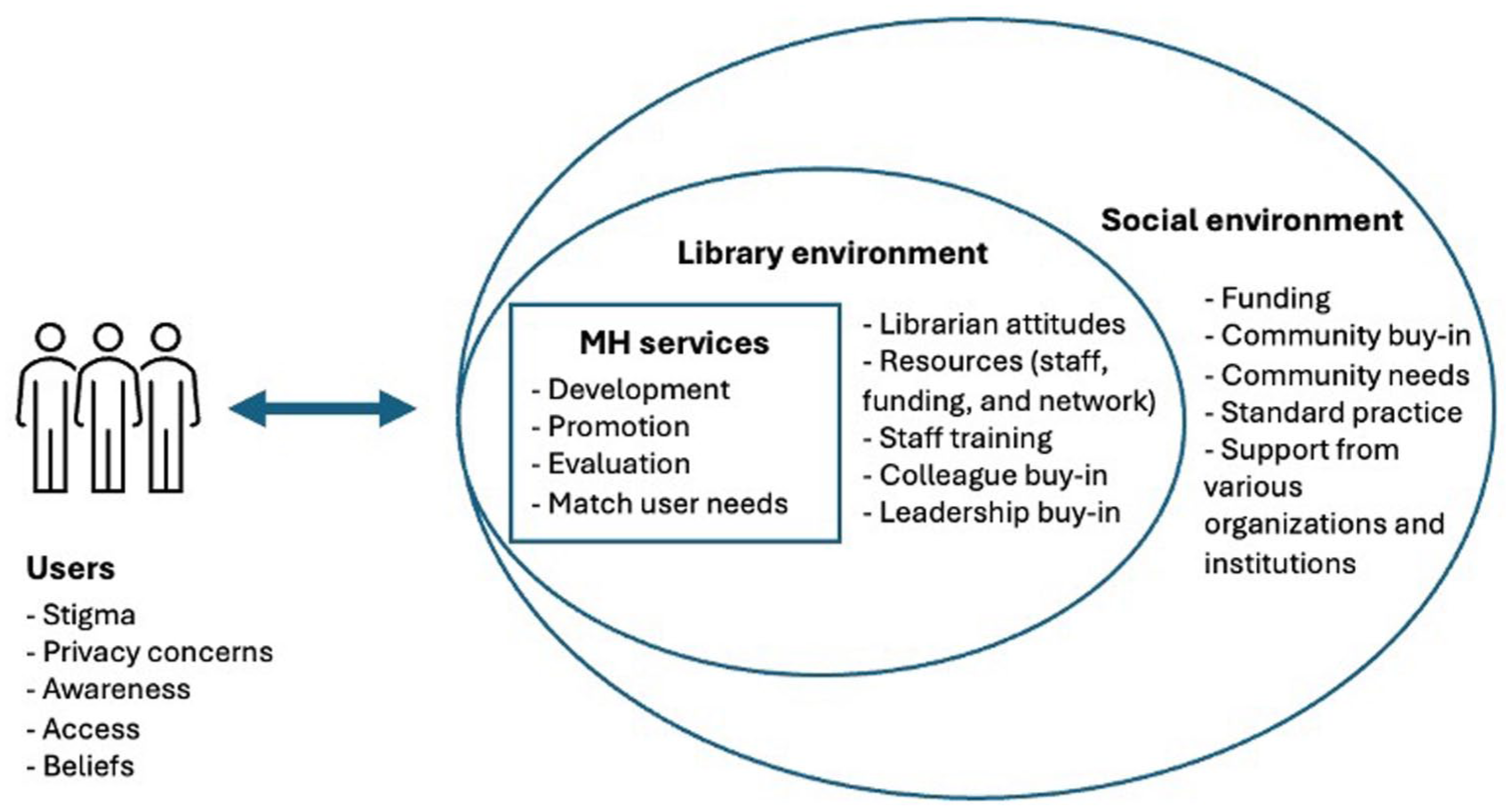
Factors influencing library MH services.
Regarding service features, successful library MH services require solid development, promotion, and evaluation efforts. Service development requires basic community infrastructure, such as internet access when services are online, and could benefit from collaborations with MH professionals or experts. Service promotion is key to raising patrons’ awareness and use of services. Self-promotion by libraries is needed; involving healthcare professionals can further enhance the credibility of the services. Evaluation could benefit from a solid built-in evaluation plan and a mechanism to incorporate stakeholders’ input during service development and implementation. Evaluation is costly, and measuring the outcomes of MH services (e.g. patrons’ MH improvement) is inherently challenging due to numerous potential confounding factors. Beyond development, promotion, and evaluation efforts, successful services should align with users’ needs for support, be anonymous and accessible, and have therapeutic value.
Five library environment factors influence the provision and success of MH services: librarians’ attitudes toward libraries as a place for MH services, resources, staff training, leadership, and colleague buy-in. Establishing MH services in libraries first requires librarians to view libraries not only as places to support equal access to information and lifelong learning, but also as places that can meet patrons’ additional psychosocial needs, such as needs for MH support. The power of this mindset is best manifested by the fact that some MH services were born out of librarians’ personal aspirations (Knapp et al., 2023; Oudshoorn et al., 2022). To sustain the services, leadership and colleague buy-in are necessary. Resources (including funding, staff, and networks with other organizations) and staff training would further increase the likelihood that the services will thrive.
Five social environment factors would influence library MH services: funding, community needs, community buy-in, standard practice, and support from other organizations and institutions. Libraries serve community needs. When communities they serve show strong needs for MH support, and external funding is available, services are more likely to be created. For services to be successful, community buy-in is also needed. Community members need to believe that libraries are the right place for receiving MH support and that such services should be prioritized. Standard practice is important for sustaining services. A community of practice consisting of libraries and librarians interested in supporting patrons’ MH needs should be formed to share knowledge and experiences and develop best practices. Finally, collaborations and partnerships with other organizations and institutions, including libraries at different levels, community MH organizations, and local government (Lenstra and Roberts, 2023), can enhance libraries’ abilities to offer services through mechanisms such as enabling MH service training for librarians and enabling librarians’ procurement of knowledge about MH and available local resources to support MH.
The characteristics of users that could influence the success of library MH services include their beliefs about whether libraries are a suitable place to provide MH support, their sense of stigmatization regarding MH, privacy concerns, awareness of the services, and ability to access the services. Patrons turn to libraries for MH support when they believe libraries are a place for it. Their willingness to use the services is further affected by their sense of stigmatization and concerns about privacy. Their actual use of the services also hinges on their awareness of and ability to access the services (e.g. having internet access).
Limitations
Only a handful of peer-reviewed journal papers were identified and included in the review, suggesting that the development of library MH services may be underreported in academic venues. In the identified articles, details of the services were sometimes not revealed, and the evaluation of the services was mostly not systematic. The current state of research calls for better documentation and reflection on library MH services, so that valuable evidence and lessons can be accumulated and a more comprehensive model of factors influencing library MH services can be derived to inform future practices. Further, we did not separate public and academic libraries in the analysis due to the small sample size. In future work, it is worthwhile to differentiate them given their differences in agenda, priorities, and stakeholder and patron groups.
Conclusion
MH is a growing concern in communities across the U.S. and was exacerbated by the COVID-19 pandemic and the rapidly changing social and economic climates. Libraries, as established and trusted institutions, can be effective hubs for MH services. We identified a wide range of MH services offered by public and academic libraries. The services went beyond libraries’ traditional functions of developing collections and promoting literacy to include more ambitious approaches characterized by partnership and collaboration with other institutions, particularly those with MH expertise, and the use of innovative technologies. Overall, the development of library MH services was under documented and rarely systematically evaluated, resulting in a limited understanding of how these services have influenced patrons’ MH. We identified four categories of factors—specific MH services, the library environment, the social environment, and the users—that influence the provision and success of library MH services. These factors can serve as a checklist to guide researchers and practitioners in designing and implementing MH services in libraries.
Footnotes
Acknowledgements
We want to thank Himani Patel for her contribution to the search and screening of the journal articles and the anonymous reviewers for their thoughtful input.

Ethical considerations
Ethical approval was not required for this review.
Funding
The authors disclosed receipt of the following financial support for the research, authorship, and/or publication of this article: This project was made possible in part by the Institute of Museum and Library Services (IMLS) National Leadership Grant LG-256676-OLS-24. The views, findings, conclusions or recommendations expressed in this article do not necessarily represent those of the IMLS.
Declaration of conflicting interests
The authors declared no potential conflicts of interest with respect to the research, authorship, and/or publication of this article.
Data availability statement
The data that support this paper are published journal papers and news articles, all of which are cited in the paper and can be located through the references.