




Abstract
This paper considers public policy and public library policy development and implementation by examining their impact on library services for unhoused people. Drawing on scholarship in librarianship, social work, public policy, and sociology, this analysis examines how public policy decisions impact how unhoused people are treated in community spaces including public libraries. It also traces public policy to criminalization and exclusion of unhoused people in communities. Finally, the paper examines 68 public library behavior policies using a thematic analysis to identify patterns that address how policies are framed, whether they contain expectations from the library to the community, the types and description of consequences for behavior infractions, and whether these policies and their enforcement differentially impacted and exclude unhoused people from accessing library services. Recommendations include involving unhoused people in library policy development, identifying approaches to policy enforcement that are transparent and accountable, and finding alternatives to contacting police or security in the event of conduct violations. This article calls on public libraries to revise exclusionary policies and reimagine their role in public space governance by critically examining library behavior policies and their impact on marginalized patrons, particularly unhoused people.
Introduction
Public libraries are often espoused as vital, enduring, and trusted institutions for their communities that provide services, support, and a safe place to be for anyone who walks through the doors. However, this narrative masks the ways in which libraries also participate in the exclusion and policing of marginalized populations, particularly unhoused patrons. Public libraries, nonetheless, are important for communities and patrons in crisis, as is evident from their responses to recent crises such as COVID-19, racial injustice pervasive in the United States, natural disasters like hurricanes, and the climate crisis (Alajmi and Albudaiwi, 2021; Mehra, 2021). In addition to supporting the needs of communities facing crises, public libraries offer services for individuals in crisis, including those who are unhoused. Important to public library work currently is a need to support the psychosocial needs of individual patrons dealing with a variety of personal concerns (Provence et al., 2021). Public libraries–community institutions that are typically funded via local or state taxes–are embedded in local and state government infrastructure. Subsequently, they are broadly influenced by public policy and its role in the development and sustainability of local and state governments. This paper considers how public policy influences (problematically at times) the development of community spaces, which in turn impact public library services and policies for unhoused people.
Being unhoused in the United States
Homelessness is pervasive in the United States. As of a point in time count in January 2024, 771,480 people in the United States were facing some type of homelessness (United States Department of Housing and Urban Development, 2024). Homelessness may be chronic, episodic, transitional, or hidden. People who are unhoused may be sheltered or unsheltered, individuals or families, veterans, or unaccompanied youth. The relationship between substance use, mental health, and homelessness is a complicated one, and those who are unhoused may struggle with mental health or substance use disorders, although tracing correlations between homelessness and mental health or substance use disorders is difficult (Mosel, 2025; National Coalition for the Homeless, 2017). Additionally, while sheltered homelessness saw an 8% decrease between 2020 and 2021, unsheltered homelessness has remained steady and even increased for specific populations over the past several years (United States Housing and Urban Development, ii). A recent report from the Urban Institute indicates that unsheltered homelessness increased sharply between 2015 and 2019, and that most of those increases were not the result of chronic homelessness, with an “all time high of 256,000 people experiencing unsheltered homelessness on a single night” in 2023 (Gillespie and Batko, 2024, Introduction). Additionally, the Urban Institute has noted increases in unsheltered homelessness among groups that were typically less likely to be unsheltered, “including women and people who identify as Black or Latinx” (Batko et al., 2020: 6). This indicates the intersectional and complex nature of homelessness: people who are unhoused face many different forms of oppression. The COVID-19 pandemic has also exacerbated housing insecurity and episodic homelessness in the U.S., as over 9 million people lost their employment in 2020 alone, and over 1 million people have lost their lives since 2020 (Bureau of Labor Statistics, 2021; Centers for Disease Control, 2025).
Additionally, evictions increased during this time, despite federal and local moratoria on evictions. As of July 2025, there were 1,026,413 evictions, as tracked in only 10 states by the Eviction Lab (2018), indicating a widespread housing crisis. The past several years highlights how governments responded to the COVID-19 pandemic by providing eviction moratoria, rent and mortgage relief and unemployment bonuses for those who were on the cusp of losing housing. In March 2020, Congress passed the CARES Act, which included an eviction and foreclosure moratorium. That moratorium was adapted and extended by the Centers for Disease Control through August 2021 (Centers for Disease Control, 2022). Structures of power within governments and communities often exploit trauma, incarceration, and disability. This perpetuates and magnifies the marginalization and disposability of unhoused people, and results in them being treated as though their lives as less valuable and their needs as undeserving of sustained support. Trauma and mental health challenges, often exacerbated by systemic failures and a lack of accessible support, are pathologized rather than addressed, which, in turn, justifies punitive and carceral approaches to “solving” the problem (Williams, 2022). Exacerbating the housing crisis even further, the end of pandemic era safety nets resulted in drastic increases in homelessness, according to a 2024 report (Auchincloss and Niamatullah, 2024). Finally, criminalizing homelessness and using incarceration as a tool to manage unhoused people reinforces cycles of poverty and housing insecurity, particularly for marginalized groups such as Black, Latinx, and disabled individuals, who are already disproportionately affected by these oppressive systems. Homelessness thus continues to be a pervasive and complex issue throughout the United States.
Public policy and homelessness
Public policy implemented for unhoused people is complex and rooted in social, economic, and cultural changes over the past decades. Public policy also creates steps that can often be barriers for people who need access to resources such as shelters, housing programs, and rental assistance. Complicating public policy developments further are the perspectives of policymakers, who often “hold beliefs that those in need created their own suffering and should employ self-reliance to get out of the situation” (Gorfido, 2020: 121). What results are barriers that do not support the ability for communities to provide access to services or support for unhoused people in a systematic, consistent way.
Public spaces, public libraries, and the exclusion of unhoused people
The development of communities, and their anchoring institutions such as public libraries, reflect public policy. Some research examining public policy and urban development have considered the ways in which public and community spaces exclude unhoused people. For example, critical work such as that from Selbin et al. (2018) considers how business improvement districts (BIDs) influence policy and advocacy initiatives that are used to police unhoused people out of public spaces. Ding et al. (2022) identified the tensions that arise with unhoused people riding public transit. Public transit provides a much-needed space for unhoused people to be, and it also provides transportation to helpful services. However, proximity to jobs and services is limited in urban areas, and there has been an increase in criminalization and displacement of unhoused people in transit (and other public) environments. For unhoused people, public spaces are tenuous ones.
A handful of studies in sociology and social work have introduced a critical perspective to understanding issues related to exclusion of unhoused individuals. Drawing on Foucault (1995), we can see how discipline and punishment of marginalized people in urban spaces is a form of social control. Public institutions and their staff, who are often helping professionals such as educators, social workers, and librarians, contribute to the surveillance and discipline of marginalized people. To avoid discipline, people must learn how to appropriately comply with social norms through training and policing that internalize and replicate dominant beliefs and values and exclude unhoused people. Grainger (2021) describes methods of exclusionary control in urban spaces by outlining a neo-Foucauldian perspective that points to “homeless management as an act of discipline” (p. 7). Grainger further expounds on the role of frontline workers in “using bargaining, influence, and tolerance” to support policing unhoused people in urban spaces (p. 7). City ordinances are designed to criminalize homelessness, particularly when it comes to self-care activities such as bathing, sleeping, eating, and panhandling (Grainger, 2021; Mitchell, 1997). Herring (2019) analyzes 3.9 million 911 and 311 phone calls to develop a model of “complaint-oriented policing” that describes third party policing that occurs via individual callers and calls from organizations.
The historical role of libraries in addressing poverty provides crucial context for understanding how current policies function as a covert extension of anti-unhoused sentiment. During the War on Poverty in the 1960s, libraries established initiatives to provide social support as community hubs for social service delivery, particularly in marginalized Black and Brown communities (Pateman and Vincent, 2016). While these types of initiatives were intended to address systemic inequalities, they were often short-lived, underfunded, and met with resistance from policymakers who feared libraries becoming too deeply involved in social welfare efforts. As public libraries expanded their role in social services, many implemented behavioral policies that, while not explicitly targeting unhoused patrons, operated as mechanisms of exclusion. Policies regulating hygiene, sleeping, and personal belongings reflect a continuation of historical patterns in which libraries have simultaneously offered aid and imposed restrictions on marginalized groups (Berman, 2007). These policies exemplify a broader trend in public policy where institutions ostensibly serve as inclusive spaces while tacitly enforcing barriers that deter the most vulnerable populations from full participation in community life.
The result is the enforcement of space and time and a shuffling of the burden of homelessness onto those experiencing it as they are shuffled around physical spaces. This shuffling causes extensive psychological harm. For example, unhoused people are often not welcome in front of businesses and are often moved to short-term spaces such as buses or public libraries. This model of policing moves beyond traditional Foucauldian surveillance and discipline by both harming and invisibilizing unhoused people (Foucault, 1995; Herring, 2019). Removing the visibility of unhoused people mitigates the space in which they exist and delegitimizes their presence in a community. All of these factors make it difficult for social workers and others to challenge these exclusionary discourses around homelessness by recognizing that unhoused people are integral to society and are therefore integral to policy and practice (Horsell, 2006).
Some recent research within librarianship concerns the role of the library as an institution supporting discipline, surveillance, and carceral care, specifically given the problematic nature of increased police presence and security in libraries (Moreno, 2022). Other recent commentary argues that police presence in libraries makes it difficult for library patrons to take advantage of the library as a free, safe space, despite the fact that it is often perceived as one (Garner, 2025; Nicoll, 2021). Additionally, collectives such as the Abolitionist Library Association advocate for challenging the surveillance state and divesting from the police. Ewalt (2019) examines the physical space and architecture of the Salt Lake City Main Public Library, describing it as a “neoliberal commonplace, or a site that orients visitors to themes of order, visibility, and policing, generating watchful civic subjects to manage “the event” of deviant publicity” (p. 104). The ways in which space, bodies, and visibility are managed and at tension with the very needs and lived experiences of unhoused people introduces a complex array of issues for public libraries. Whether consciously aware of it or not, public libraries can be complicit in contributing to a carceral state that is supported by public policy at state and federal levels. They do this by directly or indirectly supporting the policing of unhoused people in the public space of the library. This management of the behavior of unhoused people in public libraries excludes them from the library and the community.
At the intersections of gentrification, federal policy developments that guide housing and social programs, deinstitutionalization, and continual inflation costs are vulnerable community members who have nowhere to go and yet are continually policed and displaced. If unhoused people do not have a place to access sustained services and support, they are forced to rely on an assemblage of ad hoc resources to get by. Those resources are often most readily available in freely accessible spaces such as public libraries. Unhoused people are highly visible in public libraries, particularly in more urban areas. That visibility has led to the continued perception of patrons experiencing homelessness as problem patrons. It also indicates how important it is to critically examine public policy and public library services and their impact on unhoused people by considering ways in which the library space is managed and mitigated, and the role of public policy in that management. Policies may impact relationships between unhoused people and others in the library, including library staff and other patrons, whether they are housed or not. Policy development is also relevant for the kinds of relationships libraries develop with other community organizations or city departments, including for example social services organizations or local businesses.
Tracing the threads of public policy to public spaces brings us to the public library itself: a panoptical bastion of democracy that welcomes all and polices some. Policy development in public libraries is connected to the public policy that builds the infrastructure for the communities in which they exist. For example, some current trends in policy development in public libraries have centered on making the public library more financially accessible to the public via collection development, the removal or waiver of overdue fines, and changes to requirements for patron library cards and computer use.
As public spaces, public libraries face similar tensions in being open to all and yet being tacitly expected to police and manage patron behavior and spaces. Managing patron needs can introduce safety concerns, is sometimes difficult to navigate, and can impact library workers’ ability to complete day to day tasks (Williams and Ogden, 2021). While promoted as crucial for the safety of all library patrons, behavior policies are designed to police specific forms of behavior and may differentially impact vulnerable individuals most. Some alternatives such as training library staff in de-escalation, partnering with other community organizations, and hiring social workers are options that have reduced reliance on police and security calls in some libraries (Batko et al., 2020). Collaborations and outreach designed for vulnerable community members such as unhoused patrons reflect community trends rooted in federal policy that advocates for supporting them.
The history of public libraries is rooted in their perpetuated role as spaces that are designed to support the social betterment and well-being of communities. This framing obscures their role in reinforcing dominant norms, assimilating marginalized populations, and upholding exclusionary definitions of “deserving” community members. Despite being members of the community, unhoused people are often excluded and viewed as deviant, and as such have limited space in communities and their libraries (McKendry, 2013; Mitchell, 2011). For example, Pateman and Vincent (2016) point to perceptions of worthy and unworthy library patrons by describing the Victorian roots of public libraries as places to meet the needs of the “deserving poor” rather than the undeserving poor. The authors state that while to some degree libraries have met the needs of the “deserving poor,” the public library has failed to meet the needs of the “undeserving poor.” This includes unhoused people, transient populations, ethnic minorities, and refugees, among others (Pateman and Vincent, 2016: 2). Rather, public libraries tend to focus on the passive and easy to reach populations along with the core groups of regular library users. It is apparent from the literature that libraries and their staff question what role they should adopt when providing services to unhoused people.
Policy development in public libraries
Much of the policy development in public libraries can be traced back a few decades to a pivotal judicial case that impacted professional discourse regarding creating, implementing, and enforcing equitable policies in public libraries. In that case, in 1990, Richard Kreimer, a 41-year-old unhousedman, filed suit against the Joint Free Library and Morris Township in New Jersey (hereafter referred to as Morristown). In the suit, Mr. Kreimer claimed that his civil rights were violated because the library expelled him for “loitering and/or improper personal hygiene” (Morristown Library and Local Police, 1990). Mr. Kreimer further claimed that he was the victim of unconstitutional harassment by both the library and the police. A federal judge later ruled that the library did not have the right to exclude Mr. Kreimer from the library (Wiegand, 2015) but ultimately the courts ruled in favor of the library. The decision explained that several rules excluding patrons from using the library were unduly vague and in violation of the First Amendment. These included staring with an intent to annoy another person, not being engaged with library materials, or patrons with body odor so offensive that it is a nuisance to others.
After that pivotal case, the American Library Association (ALA) focused on addressing the legal ramifications of policies that created barriers for unhoused people, cautioning libraries to be careful in how policies are constructed and enforced because they could violate the First Amendment (Goedert, 1992). The reach of the Kreimer v. Morristown case went beyond provoking discussion to influencing policy decisions within professional library organizations. For example, in 1995, ALA developed the “ALA Policy Statement: Library Services to the Poor” to help libraries in this area of service provision. Scholars have extended the discussion by continuing to examine issues of rights, ethics, and access as they relate to public libraries’ provision of services to people who are living in poverty and/or experiencing homelessness (e.g. Bardoff, 2015; Berman, 2007; Mars, 2012; Muggleton, 2013). Most recently, a Supreme Court decision in City of Grants Pass v. Johnson (2024) has been widely criticized by organizations such as the Southern Poverty Law Center (SPLC) and American Civil Liberties Union (ACLU). These and other organizations argue that the decision to uphold policies such as those in Grants Pass, Oregon effectively criminalize houselessness, particularly because they allow cities to enforce anti-camping ordinances even when people have no other place to sleep. This decision gives cities permission to punish people for engaging in unavoidable actions that occur as a result of having nowhere else to go or sleep. This decision, especially in a place like Oregon, which has one of the highest growing rates of homelessness, is an example of policing homelessness rather than treating it as a humanitarian crisis (American Civil Liberties Union (ACLU) , 2024; Southern Poverty Law Center (SPLC) , 2024).
Guidelines for developing and enforcing equitable policies in public libraries became an important focus of the profession and are a central component in the ALA Code of Ethics, evident in the profession’s commitment to equitable policy and access and the affirmation of the inherent dignity and rights of every person (American Library Association, 2021a, 2021b). In addition, ALA maintains its commitment to “promot[ing] equal access to information for all persons and recogniz[ing] the need to respond to people experiencing poverty, which include[s] unhoused people” (2021). In this policy, B.8.10 Addressing Poverty, Economic Inequality, and the Responsibilities of Libraries (Old Number 61), ALA further advocates for promoting the removal of barriers for people in poverty, acknowledging the intersectional nature of being in poverty and underserved populations, and, most critically, the importance of reviewing behavior policies library procedures “to ensure they are not creating unintentional barriers to people experiencing poverty” (American Library Association, 2022). ALA provides some limited resources as well as selected policies for serving as part of its Libraries Respond efforts on the Services to Poor and Homeless People page (2022).
In 2017, the International Federation of Libraries and Institutions (IFLA) sponsored the development of their “Guidelines for Library Service to People Experiencing Homelessness,” which provides comprehensive guidelines targeted at helping libraries and library staff in their work of providing services to unhoused people (Winkelstein, 2017). The guidelines provide an overview of a variety of critical topics including defining homelessness, addressing stigma, barriers and overcoming them, the international context of homelessness, human rights, library services, partnerships, communication and advocacy, funding, and services for specific populations of unhoused people. Most importantly, the document provides guidance on developing, assessing, and implementing library policies and provides example policies for libraries. Other associations provide ad hoc resources that support efforts around policies that help remove barriers to access for unhoused people. The Association for Rural and Small Libraries Association (ARSL), for example, includes a link to the Colorado Library Consortium’s Policy Hub, a crowdsourced resource of policies that libraries can use for guidance in their own policy development.
From public policy to library policy
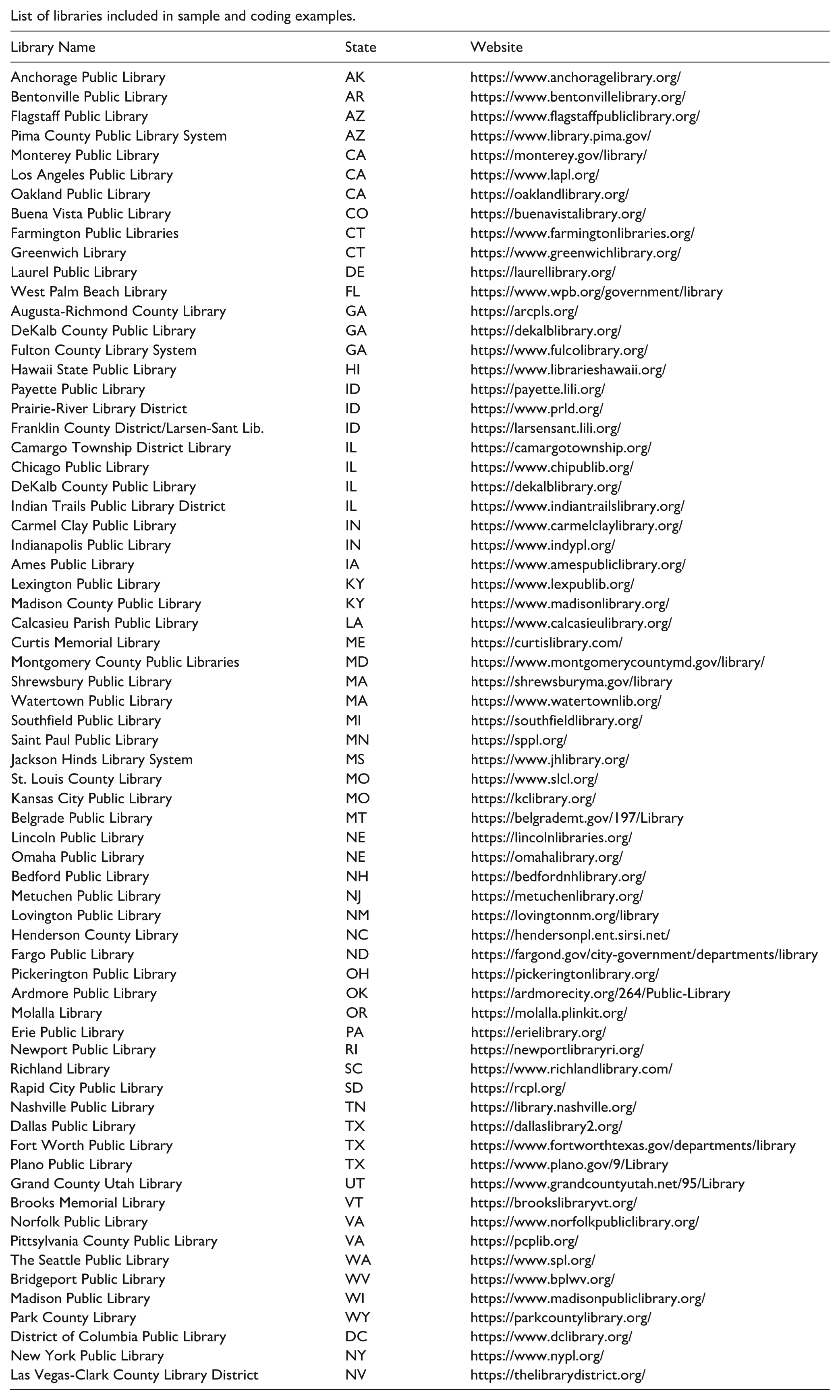
Public policy is evident in how communities treat unhoused people in public spaces, including downtown areas, public transit, local businesses, and community organizations such as public libraries. This treatment indicates that there is a pattern of excluding and punishing unhoused people for existing in those spaces. Reflecting on trends in public policy related to homelessness in the United States along with public library services for these populations and the resulting tensions in policing space provides a valuable lens for considering the reach of public policy. This section considers randomly selected behavior policies for 68 public libraries, including policies from urban, suburban and small/rural library systems. Policies were selected by randomly selecting a city in each of the 50 states and Washington, D.C., and then randomly selecting libraries in the U.S. to ensure a wide distribution of library types. Of the included sample of libraries (see Appendix 1 for a list of libraries and their websites), approximately 29% are urban (20 libraries), 44% are suburban (30 libraries), and 27% are rural (18 libraries). Public library behavior policies were examined to understand the following: (1) how the policy is framed; (2) whether the policy contains expectations from the library to the community; (3) the types and description of consequences for behavior infractions; and (4) whether these policies and their enforcement differentially impacted unhoused people.
A thematic analysis of public library behavior policies across various states revealed patterns that could disproportionately affect unhoused people. While many policies (e.g. those in Alaska and Delaware) begin positively by outlining user rights and expectations, a significant portion (approximately 60%) emphasize behavioral restrictions, such as prohibitions on sleeping, personal hygiene concerns (e.g. body odor policies in multiple states), and limits on personal belongings. These rules, while framed to maintain a welcoming environment, disproportionately impact unhoused patrons who may rely on libraries as safe spaces. Clear consequences, such as tiered suspensions or outright bans, are common, with around 50% of policies enforcing strict penalties for repeated violations. Policies targeting hygiene and sleeping—often unavoidable circumstances for unhousedindividuals—effectively function as exclusionary measures, limiting access to critical library resources like internet access, restrooms, and shelter from extreme weather. This highlights a structural barrier within public library policies that, though purportedly “neutral,” can reinforce social inequities. The analysis revealed two major themes that are apparent in the library behavior policies: (1) the way in which behavior policies are framed and (2) the legal and library access consequences that occur as part of mitigating behavioral infractions.
A majority of the 68 policies rely on language that frames the purpose of the policy and focuses on the value of adhering to it for the good of all. The policies are worded positively, stating that the policy is for the safety, security, and enjoyment of the library and that following the guidelines in the policy supports a welcoming environment for all patrons. Emphasizing the desire to support an equitable, fair, and comfortable space for all library users provides positive framing for patron code of conduct expectations set forth in the library. Library behavior policies differ in how they introduce expectations for patron conduct. Some, such as Anchorage Public Library (AK) and Laurel Public Library (DE), begin with positive statements emphasizing inclusivity and the rights of all patrons. These policies frame rules as a way to maintain a welcoming and safe environment. In contrast, others, like Flagstaff Public Library (AZ) and Bentonville Public Library (AR), focus primarily on prohibited behaviors upfront, detailing infractions such as loitering, excessive noise, and disruptive conduct. Buena Vista Public Library (CO) attempts a more balanced approach, listing expectations first but quickly shifting to violations and their consequences.
Considering the policies’ language regarding expectations from the library to the community revealed that less than a quarter (12, or 22%) explicitly included statements in support of the community. The majority of the policies examined do not include explicit statements of patron’s rights in terms of behavior, although this language may be present elsewhere in libraries’ policies or webpages. One notable example of a library that does include this language is the Pima County Public Library (2021), which establishes a commitment to library users regarding the way code of conduct violations are resolved. The library’s behavior policy states that staff are committed to making considerate requests, providing reasons for the request, offering options when available, and focusing requests on current incidents or behaviors without bias from previous, resolved events. This approach to policy language supports Wong’s (2009) suggestions to apply “sensitivity, care, and thoughtfulness” when writing library policies. Other policies include approved behaviors and expectations as precursors to prohibited behaviors. This helps set an inclusive tone for conduct expected in the library.
While the overall tone of the 68 library behavior policies focused on the value of adhering to them, some of the policies could be inconsistently enforced in a way that disciplines and invisibilizes unhoused people. Many of the prohibited behaviors are forms of exclusionary control as identified by Grainger (2021) and are even fairly similar to city ordinances designed for homelessness management. Furthermore, the recent Supreme Court decision supports municipalities’ criminalization of homelessness, which certainly extends to public libraries as well. Public policy is designed to stabilize, normalize, and manage unhoused people through a variety of support programs. This form of management is evident in public library behavior policies. One example of this includes policies that go beyond being clothed and include the requirement to wear clothing that conforms to community standards of attire. Being able to replicate and internalize social norms–down to one’s dress code– in order to appropriately comply with those norms is the kind of social control that limits the ability for unhoused people to exist in some community spaces, including libraries (Foucault, 1995; Mitchell, 2011). The prohibited conduct identified in this sample of policies were identified in IFLA’s identification of common policies that focus on “behaviour, odour and baggage/large bags of personal possessions” (p. 65). Those policies that may differentially impact unhoused people and that are prohibited in many of the policies examined here include the following, ranked by most to least common:
Requirements around bodily hygiene/odor that is a nuisance to other patrons
Sleeping in the library
Loitering/being in the building for extended periods of time
Dress code/appearance
Stipulations regarding carrying or storing belongings
Inappropriate use of furniture
Appropriate bathroom use (no bathing, washing or changing clothes)
Soliciting or panhandling
Most of the policies related to hygiene are focused on personal hygiene and excessive body odor. Only two policies (Anchorage Public Library and Montgomery County Public Libraries) specify the possibility of perfume as a body odor issue. In addition to outlining prohibited behaviors designed for the exclusion of people in crisis and potentially those experiencing homelessness, most policies examined include language pointing directly to police involvement as a consequence. In addition, several policies describe legal consequences or the potential for arrest if the behavior policy is not followed. Many policies implement tiered consequences, escalating from warnings to temporary suspensions and permanent bans. For example, Oakland Public Library (CA) states that violations of state or local laws may lead to law enforcement involvement, while Greenwich Library (CT) enforces hygiene-related restrictions, such as body odor policies, that disproportionately affect unhoused patrons. West Palm Beach Public Library (FL) enforces dress code rules, such as requiring shoes and shirts, which can also serve as barriers for those experiencing homelessness.
On the other hand, one of the strengths of these policies is that most of them also focus on what library patrons can do, or they make efforts to only have a short list of prohibited behaviors. As Seeman (2018) notes, this is important because “we can send the wrong message when our policies can be viewed as ones that solely thwart these bad actors rather than support the majority of the users who have no ill intent” (p. 36). As Provence et al. (2021) found, unhoused patrons and housed patrons have very similar needs, but those needs are often more pressing for unhoused patrons. Focusing on what behavior is acceptable and partnering to find ways to meet the needs of unhoused patrons is crucial in creating policies that are of benefit to all members of a community.
Prior research has pointed to the tensions that arise when public library workers balance personal and professional interests and needs with supporting the needs of unhoused people (Williams and Ogden, 2021). It is important to note that written policy and the enforcement or application of written policy also introduces a tension, insofar as policies are applied differentially within library systems and even within a single library, to specific patrons, and inconsistently by different employees. Recognizing that, there are some steps staff can pursue to lessen the harm these policies may have on all patrons, particularly unhoused patrons. Some of these steps include actions that some public library policies have already enacted and that are supported by IFLA guidelines (2017). This includes framing policies for all library patrons by writing policies that are first and foremost for the inclusion of unhoused patrons. Several library behavior policies take a community-centered approach, prioritizing patron rights, inclusion, and shared responsibility over punitive measures. For example, Anchorage Public Library (AK) begins by affirming the rights of all library users and setting expectations for positive behavior, creating a welcoming tone before addressing consequences. Similarly, Laurel Public Library (DE) emphasizes mutual respect by stating that patrons are expected to treat one another with courtesy, reinforcing a sense of shared responsibility. Lexington Public Library (KY) also frames its policy around maintaining a welcoming space, encouraging patrons to be courteous and considerate rather than focusing solely on restrictions. These policies stand out for promoting libraries as shared public spaces rather than places of strict enforcement, though many still include rules that may disproportionately impact marginalized patrons.
As Horsell (2006) noted, we must acknowledge that unhoused people are integral to our community and challenge exclusionary policy and practice within our institutions. One simple step toward doing this is by explicitly stating the library’s commitment to the community and to developing and reviewing policies that do not differentially impact marginalized patrons. Second, developing behavior policies that focus on the library’s commitment to transparency and accountability to patrons when enforcing policies is crucial. Finally, exploring alternatives to calling the police and contributing to efforts to those alternative paths may help reduce the stress on library workers and patrons alike. Prior research has demonstrated that public library staff are uncomfortable with performing labor that supports the social control of people in crisis, particularly if that involves the police, with whom library staff may have tenuous relationships due to racism in the community (Williams and Ogden, 2021).
Conclusion
Critiquing public policy, policy development in libraries, and a sample of public library behavior policies reveals connections between public policy and the ways in which communities manage and discipline marginalized people such as those experiencing homelessness. Public library behavior policy design and enforcement leads to direct and indirect policing of unhoused patrons. While many policies were framed in a positive way, both the prohibited behaviors and potential consequences of policy violation point to the problematic nature of behavior policies in public libraries. Public library staff have an opportunity to evaluate their policies–behavior and otherwise–to determine the extent to which their policies are written to exclude unhoused people.
Policies such as those provided by ALA and IFLA provide a good starting point for public libraries seeking to reconsider their approaches to behavior policy development and enforcement. Libraries can use these guidelines in the following concrete ways to better support unhoused patrons and reduce exclusionary practices:
Write policies to explicitly affirm the rights of all patrons, emphasizing inclusion and shared responsibility rather than restriction and punishment, with a critical review to ensure that policies are not unintentionally discriminatory;
Train staff to de-escalate while minimizing police involvement by creating protocols that avoid immediate suspension or police calls for non-violent infractions;
Engage unhoused people in policy development and/or partner with advocacy organizations led by unhoused people to inform decision-making;
Prioritize access over policy enforcement by reviewing whether policies like bag size limits, dress codes, or body odor clauses functionally exclude unhoused patrons and reframing policies to minimize harm;
Use the guidelines for staff onboarding and training.
Moving forward, libraries can deepen their commitment to equity by intentionally involving unhoused patrons in policy development through community needs assessments, strategic planning, and program design. Actively including these community members not only strengthens services but also ensures that library practices reflect the lived realities of those most affected by exclusionary policies. Adopting a trauma-informed approach to policy development (Tolley, 2020) can help libraries center dignity and care in their enforcement practices. Public library administrators should continually evaluate both the content of their policies and the processes by which they are enforced, maintaining transparency and accountability at every stage. Finally, it is critical to remember that public policy can be traced to how communities treat unhoused people, and public libraries tend to reflect that. Public policy has led to the development of many programs that both help and hinder unhoused people, and communities and their spaces, including public libraries, reflect that tension. However, it is possible to challenge these norms and structures by examining relationships with other community entities, including local businesses, police, and other city departments to critically evaluate how unhoused people are treated and disciplined in urban spaces. In doing so, public libraries can deepen their commitment to becoming welcoming places for all patrons.
Footnotes
Appendix 1
List of libraries included in sample and coding examples.
| Library Name | State | Website |
|---|---|---|
| Anchorage Public Library | AK | https://www.anchoragelibrary.org/ |
| Bentonville Public Library | AR | https://www.bentonvillelibrary.org/ |
| Flagstaff Public Library | AZ | https://www.flagstaffpubliclibrary.org/ |
| Pima County Public Library System | AZ | https://www.library.pima.gov/ |
| Monterey Public Library | CA | https://monterey.gov/library/ |
| Los Angeles Public Library | CA | https://www.lapl.org/ |
| Oakland Public Library | CA | https://oaklandlibrary.org/ |
| Buena Vista Public Library | CO | https://buenavistalibrary.org/ |
| Farmington Public Libraries | CT | https://www.farmingtonlibraries.org/ |
| Greenwich Library | CT | https://www.greenwichlibrary.org/ |
| Laurel Public Library | DE | https://laurellibrary.org/ |
| West Palm Beach Library | FL | https://www.wpb.org/government/library |
| Augusta-Richmond County Library | GA | https://arcpls.org/ |
| DeKalb County Public Library | GA | https://dekalblibrary.org/ |
| Fulton County Library System | GA | https://www.fulcolibrary.org/ |
| Hawaii State Public Library | HI | https://www.librarieshawaii.org/ |
| Payette Public Library | ID | https://payette.lili.org/ |
| Prairie-River Library District | ID | https://www.prld.org/ |
| Franklin County District/Larsen-Sant Lib. | ID | https://larsensant.lili.org/ |
| Camargo Township District Library | IL | https://camargotownship.org/ |
| Chicago Public Library | IL | https://www.chipublib.org/ |
| DeKalb County Public Library | IL | https://dekalblibrary.org/ |
| Indian Trails Public Library District | IL | https://www.indiantrailslibrary.org/ |
| Carmel Clay Public Library | IN | https://www.carmelclaylibrary.org/ |
| Indianapolis Public Library | IN | https://www.indypl.org/ |
| Ames Public Library | IA | https://www.amespubliclibrary.org/ |
| Lexington Public Library | KY | https://www.lexpublib.org/ |
| Madison County Public Library | KY | https://www.madisonlibrary.org/ |
| Calcasieu Parish Public Library | LA | https://www.calcasieulibrary.org/ |
| Curtis Memorial Library | ME | https://curtislibrary.com/ |
| Montgomery County Public Libraries | MD | https://www.montgomerycountymd.gov/library/ |
| Shrewsbury Public Library | MA | https://shrewsburyma.gov/library |
| Watertown Public Library | MA | https://www.watertownlib.org/ |
| Southfield Public Library | MI | https://southfieldlibrary.org/ |
| Saint Paul Public Library | MN | https://sppl.org/ |
| Jackson Hinds Library System | MS | https://www.jhlibrary.org/ |
| St. Louis County Library | MO | https://www.slcl.org/ |
| Kansas City Public Library | MO | https://kclibrary.org/ |
| Belgrade Public Library | MT | https://belgrademt.gov/197/Library |
| Lincoln Public Library | NE | https://lincolnlibraries.org/ |
| Omaha Public Library | NE | https://omahalibrary.org/ |
| Bedford Public Library | NH | https://bedfordnhlibrary.org/ |
| Metuchen Public Library | NJ | https://metuchenlibrary.org/ |
| Lovington Public Library | NM | https://lovingtonnm.org/library |
| Henderson County Library | NC | https://hendersonpl.ent.sirsi.net/ |
| Fargo Public Library | ND | https://fargond.gov/city-government/departments/library |
| Pickerington Public Library | OH | https://pickeringtonlibrary.org/ |
| Ardmore Public Library | OK | https://ardmorecity.org/264/Public-Library |
| Molalla Library | OR | https://molalla.plinkit.org/ |
| Erie Public Library | PA | https://erielibrary.org/ |
| Newport Public Library | RI | https://newportlibraryri.org/ |
| Richland Library | SC | https://www.richlandlibrary.com/ |
| Rapid City Public Library | SD | https://rcpl.org/ |
| Nashville Public Library | TN | https://library.nashville.org/ |
| Dallas Public Library | TX | https://dallaslibrary2.org/ |
| Fort Worth Public Library | TX | https://www.fortworthtexas.gov/departments/library |
| Plano Public Library | TX | https://www.plano.gov/9/Library |
| Grand County Utah Library | UT | https://www.grandcountyutah.net/95/Library |
| Brooks Memorial Library | VT | https://brookslibraryvt.org/ |
| Norfolk Public Library | VA | https://www.norfolkpubliclibrary.org/ |
| Pittsylvania County Public Library | VA | https://pcplib.org/ |
| The Seattle Public Library | WA | https://www.spl.org/ |
| Bridgeport Public Library | WV | https://www.bplwv.org/ |
| Madison Public Library | WI | https://www.madisonpubliclibrary.org/ |
| Park County Library | WY | https://parkcountylibrary.org/ |
| District of Columbia Public Library | DC | https://www.dclibrary.org/ |
| New York Public Library | NY | https://www.nypl.org/ |
| Las Vegas-Clark County Library District | NV | https://thelibrarydistrict.org/ |
Declaration of conflicting interests
The author declared no potential conflicts of interest with respect to the research, authorship, and/or publication of this article.
Funding
The author received no financial support for the research, authorship, and/or publication of this article.
