




Abstract
Based on Norwegian colonial history, complicity in neo-colonialism, discrimination in Norwegian society and the role of the public library, there is a necessity for questioning how the public library – an institution built on colonial history and imported systems – fulfils its social mandate. This study maps staff attitudes towards the implementation of decolonisation initiatives in Norwegian public libraries, contributing to academic discourse on decolonisation in Norway. Qualitative data was collected in an interpretivist paradigm using a multi-stage strategy with a latent approach and analysed thematically. Questionnaire responses collected from 35 public library staff across 9 of Norway’s counties informed semi-structured interviews with four participants via an iterative process. Data analysis revealed three themes: acknowledgement of coloniality, contradictions and subjectivity and responsibility and challenges to decolonisation. A lack of knowledge on how colonialism impacts public libraries amongst staff and a need for decolonisation was identified in terms of the acknowledgement of coloniality and disparities between participant responses. Despite this, positive attitudes were expressed towards fostering education regarding decolonisation and the possibility of implementing initiatives. It is concluded that there is a lack of discussion on decolonising Norwegian public libraries, and a prevalence of whiteness particularly in discussions of solidarity and neutrality, cementing coloniality in the institution. As such, intentionality emerged as a significant consideration in light of existing challenges and the potential identified in participant attitudes. This study therefore recommends further research to confirm findings and greater staff initiative to foster discussion and education for meaningful engagement with decoloniality.
Introduction
Decolonisation in Norwegian public libraries is a subject lacking discourse and recognition in the field, whilst being confined to the media, higher education and politics in social discourse. There is a stark juxtaposition between how Norway presents itself with exceptionalism to the international community through peace-brokering, welfare, the irrelevance of racism or colonialism and harsher realities that marginalised communities report (Eriksen and Stein, 2022; Harlap and Riese, 2022). This raises the question of how the Norwegian public library, considered an integration arena and meeting place for multicultural communities (Audunson and Aabø, 2013), grapples with the realities of serving their communities alongside their institutional history shaped by a western doctrine upholding colonialism. The following article reports on qualitative research into the openness of staff to engage in decolonising Norway’s public libraries.
Terminology
To avoid barriers to discussion, the term decolonisation must be defined (Høiskar, 2020). Ndlovu-Gatsheni (2015, as cited in Hansen, 2022: 16) describes that ‘decoloniality involves both a political and epistemological movement aimed at liberating people from colonial sub-positions, and a new way of thinking, knowing and doing’. The key terms here for public libraries are ‘thinking, knowing and doing’. Rathi and Wiebe (2020) point to the work of Linda Tuhiwai Smith where decolonisation includes ‘removing invisible facets and structure that exert colonial power’, which western institutions uphold. Another facet is that colonialism is ‘continually remade in the present’, insinuating that the passage of time cannot exempt complicity (Anderson and Christen, 2019: 119). Furthermore, discussions of race will be prevalent throughout this text, especially as scholars utilise Critical Race Theory to analyse libraries and discuss decolonisation. Racism and colonialism are strongly intertwined in terms of racial hierarchies, even within whiteness and migration due to colonial violence (see section 1.2). Therefore, they will be discussed in tandem.
In terms of importing terminology, it must be acknowledged that terms may be contextually based (Erdal, 2021). Prime examples of this are ‘people of colour’, or POC, ‘Black, Indigenous and people of colour’ or BIPOC, where Norway has a history with the term ‘melanin-rich’ (Harlap and Riese, 2022). With respect to the fact that literature from various contexts are referred to in this text, context-specific terminology will be used appropriately, albeit inconsistently. In other cases, the terms ‘racialised’ and ‘marginalised’, as opposed to ‘minorities’, will be used to signify social power structures as causation. However, it must be noted that terminology is subject to change, especially as certain terms centre whiteness (Cooper, 2020).
Norwegian complicity in colonialism: Current and historic
A current and ongoing struggle against colonialism in Norway is the illegal building of wind turbines by the partially state-owned company Statkraft in Fovsen-Njaarke (Statkraft, no date.). The building of which has been ruled to be illegal due to the breach of human rights against the Indigenous population as the land is used for reindeer herding (Supreme Court of Norway, 2021). In Norway, about 3300 Sámi people are involved in reindeer herding (Landbruksdirektoratet, 2025). Recent protests against the wind turbines resulted in 20 activists facing charges for civil disobedience following their occupation of the Norwegian Ministry of Petroleum and Energy, and the case will be proceeding to the supreme court (Elden Advokatfirma, 2024; Knutsen et al., 2025). This directly challenges the narrative of the irrelevance of decolonisation in Norway.
The land in the Fovsen-Njaarke case is a part of Sápmi, transnational land that was colonised by several countries, and is home to the Indigenous Sámi population who underwent colonisation, assimilation and Norwegianisation that escalated from the year 1720 (Grenersen, 2020). While there are various estimates that the size of the Indigenous population in Norway lies upwards of 60,000 people, it is difficult to be certain for several reasons. Not only does forced assimilation disincentivise people to register their ethnicity with the government, but the Norwegian government collects geographically based data related to the Sámi parliament’s region of influence, not data related to ethnic identity across the entire country (Kommunal- og moderniseringsdepartement, 2019).
Concerning present day policies, Grewal Gill (2020) discusses integration obligations marginalising immigrants into ‘others’, making it a neo-colonial practice. Norway, being part of the European Economic Area and Schengen Agreement, is an active member of ‘Fortress Europe’, where borders are strengthened against migration (Walia, 2021). Walia (2021) highlights that ‘liberal elite responses centre humanitarian benevolence and Europeans materialise as saviours, while refugees are burdened with the expectation of performing gratitude and assimilating into the racial social order and capitalist markets’ (Walia, 2021: 122). This can be viewed alongside the integration role of Norwegian public libraries and whether this can be considered a colonial practice (Audunson and Aabø, 2013). Additionally, Walia (2021: 122) argues that migration is a result of European colonialism where ‘ movement is ultimately a form of decolonial reparations’, highlighting how such relationships in public libraries can be significant for decolonisation.
The importance of this topic therefore lies in marginalised groups’ experiences in today’s society. Studies have found that melanin-rich people experience racism and that 15% of the population in Norway had observed discrimination or hate speech towards the Indigenous population, with upwards of 30% in Sápmi. (Erdal and Strømsø, 2020; Sannhets- og Forsoningskommisjonen, 2023; Yasar et al., 2024). These statistics challenge the idealistic depiction of Norwegian society, emphasising the need for further research into how this is expressed institutionally.
The role of public libraries in Norwegian society
As for Norwegian public libraries, they have distinct American influence due to the education of middle class Norwegians in North America, revolutionising libraries in multicultural cities to be used as tools of integration, and importing the Dewey Decimal Classification system (DDC; Frisvold, 2023: 58). The influence of such systems in Norway are significant as America’s own history of colonisation and oppression of marginalised peoples is reflected in predominant systems for categorising and classifying knowledge (Adler, 2017; Frisvold, 2023; Smith, 2012). The public library has also played a role in the language assimilation of the Indigenous population through Norwegianisation policies, and did not provide specialised services until the 1950s (Grenersen, 2016).
Today, public libraries in Norway are bound to their respective law, Folkebibliotekloven (2014), which states that public libraries in Norway are ‘delegated the task of promoting information, education and other cultural activities through active dissemination’ and that they shall be an ‘independent meeting place and arena for public conversation and debate’. [own translation]. The role of public libraries today can therefore be summarised in terms of fostering democratic values, social inclusion, decreasing digital inequalities and providing critical information for participative citizenship (Audunson et al., 2019). Research has also shown that this role is slightly different for immigrants and refugees as they can increase trust in public institutions and facilitate stronger Norwegian language learning (Vårheim, 2014). While this is a crucial role, Norway has been cited to promote multiculturalism, opposed to the assimilation policies of other European countries (Hatland et al., 2018). Olstad (2017: 342) discusses this further, drawing on multiculturalism as cultural collectives coexisting under a country’s laws and political systems. With respect to Folkebibliotekloven (2014), the promotion of cultural activities should theoretically encapsulate cultural collectives and this can be considered in regards to Walia’s (2021) discussion of migration obligations.
Research aims and objectives
This paper will shed light on the attitude of Norwegian public library staff towards decolonisation in relation to the public library’s role and core values. The following themes were explored via the literature review and empirical research: the prevalence of colonial structures and attitudes; perceptions of solidarity and neutrality in the role of the public library; diversity and inclusion in collection development and user events; current organisation systems and the potential for decolonisation; hiring processes and staff diversity in the public library; and staff perceptions of decolonisation in practice.
This study contributes to the wider discussion of decolonisation whilst highlighting and reflecting the critical work of scholars who experience marginalisation around the globe. In Norway, the author hopes this study – with respect to its limitations – will make a positive contribution to nationwide efforts to decolonise our public libraries in a sustainable and intentional manner.
Literature review
Throughout the literature search process, there was limited use of the term ‘decolonisation’, particularly in Norway, making it appropriate to explore interconnected terms such as racialisation, white supremacy, imperialism and integration. As such, the themes to be discussed include adjacent debates in Norwegian public libraries, whiteness and decolonisation in the Norwegian context, whiteness and colonialism in eurocentric public libraries, existing decolonisation initiatives from public libraries abroad and suggestions for moving towards decolonisation.
Adjacent debates in Norwegian public libraries
As discussed, there is a distinct lack of literature on decolonising Norwegian public libraries, with most of the decolonial research coming from education and ethnic studies. Regarding public library scholarship, discussions are focused on providing library services to immigrants, aiding in integration into Norwegian society and building trust in public institutions (Audunson et al., 2011; Audunson and Aabø, 2013; Kjendlie, 2019). This is in contrast to debates internationally on critically developing the role of the public library. Research conducted by Golten (2022) found that the majority of politicians and public library staff are positive to public libraries acting as inclusive integration arenas despite events for minorities being limited to language cafes. This study also went into ongoing discussions on the concept of neutrality in regards to the law requiring public libraries to be independent meeting arenas (Golten, 2022; Kvalnes et al., 2023). In a blog post published by Bibliotekarforbundet, Christian Lauersen calls for libraries to be anti-facist and active in fostering inclusion rather than attempting neutrality (Bergan, 2022). This challenges the stance of providing two sided debates in the public library, allowing far-right groups to occupy space, as discussed by Larsen (Kvalnes et al., 2023) in relation to the group SIAN who advocate against the ‘islamification’ of Norway. Lauersen’s stance, however, is somewhat supported by Engström (2022) who found that when studying Swedish public libraries, presentations of inclusiveness can adversely result in the silencing of marginalised groups. They argue that public libraries need to foster a plurality of public spheres, acknowledging the limitations of the singular public sphere. Counter to this, a study conducted by the Norwegian Library Association found that only one in five of participating librarians, most of whom held chief librarian positions, perceive the independent meeting arena role to be problematic (Norsk Bibliotekforening, 2023). Questions of integration, inclusion and neutrality are prevalent in the Norwegian field of Public Librarianship, however there is a lack of critical reflection on how these themes root back to whiteness and coloniality.
Whiteness and decolonisation in the Norwegian context
In reviewing literature regarding whiteness and decolonisation in Norwegian society and other public institutions, there is unanimous identification of egalitarianism and national exceptionalism as a paradox. This has been found in studies from the fields of sociology and education. In discussing the photo of the Norwegian King on the tram as an example of egalitarianism, Dankertsen and Lo (2023: 11) point to Gullestad (2002) who examines the idea of ‘likehet’ or sameness being a critical feature of value perception in Norwegian society, which is inegalitarian and an ‘ethnification of national identity’, that is, the paradox. They explain that this feature is unsustainable and challenges the idea of egalitarianism in a heterogeneous society. Eriksen and Stein (2022) specifically discuss national exceptionalism as a dimension of coloniality and its prevalence in the education system through studying student-teachers. They found that a majority of the student-teachers resisted in-depth discussions on racism and often dismissed minoritised and racialised youths’ experiences in Norway. Similarly, Harlap and Riese (2022) focused on race discourse in classrooms, finding that students perpetuate the idea that Norwegians cannot be racist, whilst equating Norwegian identity with whiteness. This is supported by a more recent study by Conolly et al. (2025), focusing on egalitarianism and coloniality within the education system, calling for decolonisation across the Nordics. In the education system as a whole, Thomas et al. (2023) identify that a lack of diversity amongst teachers remains a prominent barrier to addressing student needs, especially as Hansen (2022) notes that over 10% of students in Norway have one parent from the Global South. As for higher education, the SAIH Norwegian Students’ and Academics’ International Assistance Fund (2020) published a document on decolonising academia. This document discusses Norway’s colonial history, the lack of education on colonialism and how the provision of free education does not remove all barriers for marginalised groups. Furthermore, Hero (2021) discusses how exceptionalism is applicable to the Scandinavian utilisation of ‘achieving’ feminism and LGBTQ+ liberation as distraction from colonial complicity. However, a counter perspective, as discussed by Høiskar (2020), is decolonisation being an irrelevant ‘fashionable’ import in Norway, highlighting the lack of recognition of Norway’s colonial contributions and illustrating a divide between scholars.
Whiteness and colonialism in Eurocentric public libraries
The third theme identified is whiteness and colonialism in eurocentric public libraries, where the question of public library neutrality and challenges faced by minoritised groups are discussed. The majority of the literature centres Critical Race Theory (CRT) in their work. Gohr (2017) presents the case that neutrality cannot exist in public libraries unless they are able to include underrepresented ideologies, where claims of neutrality are rooted in white privilege and normativity. In a study regarding racialised youth in public libraries, Matthews (2020) explains the lack of access that neutrality causes. In the Norwegian context, and with a different perspective on public libraries as institutions, Jensen (2019) discusses neutrality and how a change in public library law has challenged whether racists can use the space as a platform for their hate speech, which is a prevalent debate amongst public librarians (see section 2.1). Jensen’s (2019) discussion concludes that public libraries cannot be neutral as their values are inherently radical. Whilst this seems in line with the international literature, there is less discussion of whether white privilege and normativity play a role in reducing access.
Considering challenges faced by minoritised groups, the literature covers a broad range of issues including barriers to entry, conformity and diversity documents. Gohr (2017) highlights that unacknowledged whiteness, as well as celebratory multiculturalism through diversity hires, results in minoritised groups being alienated and unsupported in the field. The article also critiques education requirements for librarianship as higher education privileges the majority and is the ideal form of merit, both of which are highly applicable in the Norwegian context. In addition to diversity hires, Espinal et al. (2018) emphasise that whiteness in the library forces minoritised groups to conform to the norms of the white majority, making the public library a challenging workplace and deterring applicants. To expand, several scholars are in agreement that diversity in public libraries is a ‘fabled notion’ where the worship of documentation, that is, those that ‘tackle’ diversity but primarily result in self-congratulation and blindness to the realities of marginalised groups, stems from white supremacy (Brown et al., 2021; Gohr, 2017; Matthews, 2020; Srivastava, 2005). Brown et al. (2021) argue that these practices in libraries burden minoritised groups with the labour of their own inclusion.
The literature reviewed also frequently discusses classification being a prominent barrier to supporting information and knowledge from minoritised groups. Smith (2012: 26) describes that ‘imperialism provided the means through which concepts of what counts as human could be applied systematically as forms of classification’. Adler (2017) and Cherry and Mukunda (2015) further critique classification systems as systematically racist and unwilling to support Indigenous knowledge. Adler (2017) explicitly makes an example of the DDC’s current organisation of race as libraries continue to edit a structure that was exclusionary from conception. Anderson and Christen (2019) also make reference to classification as a practice of settler colonialism due to its historical context. In the Norwegian context, there is once again a lack of literature from the field of library and information studies, however, a note has been made by the Sámi archives, as included in the state published report by the Truth and Reconciliation Commission, that archival structure poses a challenge to locating documentation regarding minorities (Sannhets- og Forsoningskommisjonen, 2023). Whilst archives and public libraries do not utilise the same systems, this example may be transferable to systems of classification, as reported internationally, as well as being relevant in the context of Norwegian public libraries.
Existing decolonisation initiatives and suggestions
There is a substantial body of literature discussing existing decolonisation initiatives implemented by libraries around the world for Norwegian librarianship to draw upon. In Dagbon, an organised traditional kingdom in Ghana, Plockey and Ahamed (2016) describe how Baansi librarians use performance as knowledge dissemination and utilise an Indigenous knowledge system. In Boston, Delgado (2024) writes about how immigrant-led programmes in the public library are more beneficial in meeting the needs of immigrants and celebrating multiculturalism. These programmes foster outreach and increased representation within the library. Furthermore, Kumasi (2021) discusses ‘InFLOmation’ where students assigned hashtags to MARC records based on hip hop music. This increased the classification scheme’s relevancy and representation. Vaughan (2018) discusses how another decolonisation initiative, the Mashantucket Pequot Thesaurus of American Indian Terminology Project, focuses on creating controlled vocabulary to make space for Indigenous knowledge, decolonising classification language and reducing hierarchy. Cherry and Mukunda (2015), whilst discussing the Brian Deer Classification Scheme, explain how western classification systems have a tendency to fragment Indigenous knowledge, making it important to gather knowledge to represent the relationships between Indigenous Peoples. Finally, Rathi and Wiebe (2020) evaluate decolonising Canadian public libraries, with a key evaluation being ensuring ethical stewardship of collections and Indigenous ownership. These are all key examples of ways in which Norwegian public libraries can create classification systems that centre groups that are underrepresented and on the margins of public library services, whilst also providing the opportunity for self-determination.
In order to move towards decolonising the public library, a majority of the literature provides suggestions for decentering whiteness in institutions. The main theme involves having conversations that will lead to committed action plans for overcoming white fragility, ensuring actualised benefits for local communities (Andrews, 2018; Espinal et al., 2018; Matthews, 2020; Thorpe, 2019). As for other suggestions, the articles diverge. In terms of decentering whiteness, Matthews (2020) suggests a community-led model while Gohr (2017) and Espinal et al. (2018) discuss changes in hiring practices, such as securing funding for diversification. On the other hand, Brown et al. (2021) advocate for the labour of diversity and decolonisation to be shifted away from marginalised librarians to their white counterparts. In terms of decolonising integration, Grewal Gill (2020) describes relationship building between newcomers and natives through storytelling, learning about the land and ensuring solidarity between the groups. Regarding classification schemes, Adler (2017) and Vaughan (2018) go on to recommend creating local participatory systems of organisation to provide reparations to Indigenous communities. With respect to the inclusion of Indigenous knowledge, Roy (2015) describes utilising an Indigenous ecology to alleviate tensions between Indigenous and western knowledge management. Furthermore, Thorpe (2019) details decolonisation as transformative praxis involving Indigenous Peoples to ensure self-determination, supporting Indigenous perspectives in the library and advocating for communities through lobbying. More specifically, Anderson and Christen (2019) focus on attribution and reframing knowledge hierarchies, ensuring repatriation for dislocated Indigenous voices. In the Norwegian educational context, several scholars call for amendment of literature lists and training for teachers in interrupting ‘Otherisation’, which is theoretically applicable to public libraries through their pedagogic role and LIS education (Harlap and Riese, 2022; Thomas et al., 2023). Whilst this is an important development in the Norwegian context, guidelines from the international literature are highly applicable to further ensure decoloniality in praxis through community involvement, hiring practices and classification schemes. Although, the likelihood of resistance is not entirely dismissable due to national exceptionalism and the ethnification of Norwegian identity.
Literature review in summary
To conclude, while there is readily available literature regarding decolonisation of public libraries, covering the issues created by whiteness and suggestions for decolonisation, the literature gap in Norway remains a prominent barrier to addressing institutional ties to colonialism. This is especially as debates in Norwegian public libraries centre themes such as neutrality and integration, without considering the colonial implications in the institution. This suggests that it would be beneficial to prioritise tackling decolonisation within these themes in the Norwegian context. Building on the literature in other countries, we can begin to question how this work can be applicable in Norway and analyse how librarians respond. This research investigates the attitudes towards decolonisation initiatives in Norwegian public libraries by exploring concepts of neutrality, integration, diversity and the practical implications of organisation systems and outreach programmes – all identified and discussed in this review. Based on the Norwegian literature reviewed, it can be hypothesised that there will be a certain level of resistance to discussing, let alone implementing, decolonisation initiatives.
Methodology
This research investigated the attitudes towards decolonisation initiatives in Norwegian public libraries, utilising a qualitative approach within an interpretivist paradigm. Informed by previous research on conceptions of decolonisation (Eriksen and Stein, 2022; Sibanda, 2021), two data collection techniques were conducted in a multi-stage strategy. The dataset was analysed using thematic analysis with a latent approach (Creswell, 2014). This methodology aligns strongly with the research objectives, enabling the mapping of attitudes and colonial thought processes amongst participants. Interpretivism acknowledges that reality is socially constructed and contextually based (Moon and Blackman, 2014), a lens which allows the researchers to consider the varying internal colonial contexts in Norway, where the value of responses also lies both in what is and is not said.
Ethics approval was granted by the University Research Ethics Committee on May 20th, 2024. Written informed consent from all participants was obtained to conduct and publish this study, information has been anonymised to protect participant identities and the dataset is available upon request. However, a prominent ethical consideration is the positionality of the researcher, a white Norwegian woman, and the fact that research has historically been a tool of colonialism. This can be considered an ethical paradox, making it essential for the researcher to engage with all ‘underlying assumptions, motivations and values’ for the project (Smith, 2012: 21).
An online questionnaire followed by semi-structured interviews were the two stages of the research strategy, with focus on ensuring participants had room for reflection throughout the data collection process. Use of the questionnaire data to (a) identify frequent themes, contradictions, misinterpretations to inform the interview guide and (b) recruit interview participants, were benefits of this strategy. The questionnaire was directly sent to 65 Norwegian public libraries and generous participants shared the link through internal networks. Thirty-five responses were received from 9 of Norway’s 15 counties, including the northernmost county of Finnmark as well as southernmost county of Agder. Regarding geographic representation, 54.3% of the participants were from Oslo and Akershus (see Figure 1).
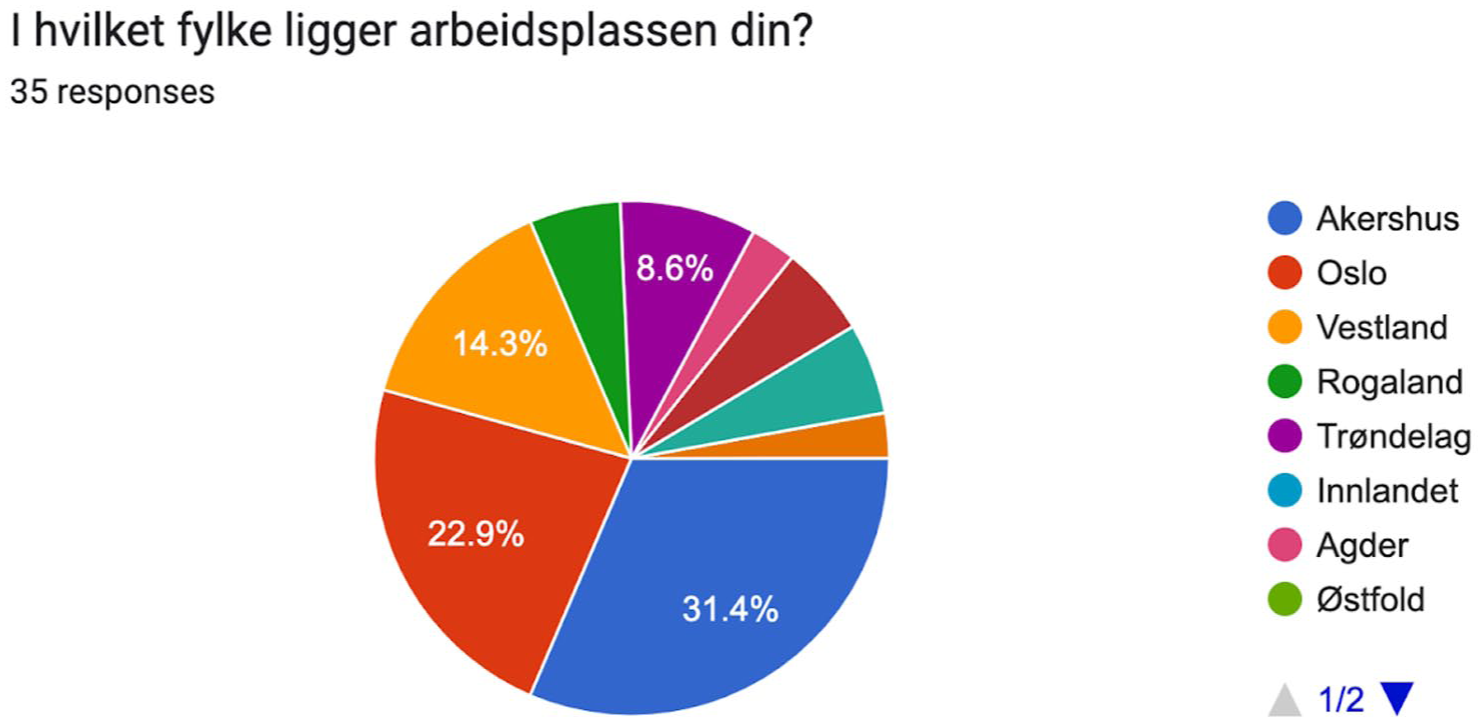
In which county is your workplace located?
The questionnaire included explicitly and inexplicitly decolonial questions; where initial questions gauged awareness and attitudes towards decolonising public libraries and subsequent questions covered neutrality, solidarity, organisation systems, collections development, signs and advertisements, as well as hiring practices.
To ensure a breadth of perspectives – Norway’s internal colonial history is concentrated in the northern counties – five questionnaire participants were selected for the interview stage via purposive sampling (Mason, 2018). Due to illness, only four interviews were conducted. Interviews were semi-structured with the intention of minimising any power imbalance between researcher and participant, making it necessary to establish trust and reassure participants before the interview began (Bauer and Gaskell, 2000). As decolonisation requires rethinking knowledge structures and research methodologies, this was a consideration made within the study’s limitations.
Interviews were recorded and primarily conducted through Google Meets, with one participant preferring to meet in person. Each interview was conducted in Norwegian and then transcribed and translated into English by the researcher, a native Norwegian speaker. Norwegian has a relatively poor vocabulary, making certain words and metaphors untranslatable or have double meanings.
The data, from both the questionnaire and interviews, is analysed thematically using a latent approach as outlined by Braun and Clarke (2006). Similarly to the methods of data collection, this was an iterative process. Value is placed in both what is explicitly and implicitly stated, which topics are focused on and which are avoided within the sociocultural context. Whilst hesitant to use post-colonial discourse analysis as it is argued to be a ‘convenient invention of Western intellectuals which reinscribes their power to define the world’ (Smith, 2012: 14), the analysis is based on scholarship relating to coloniality and whiteness in institutions, including the tenets of Critical Race Theory (Leung and Lopez-McKnight, 2021). This tenet informed the theme ‘Deflections and Comparisons’ and the tenet that racism is a normal feature of our societies, informed the theme ‘Acknowledgment of Coloniality’.
Findings
Findings relating to Norwegian public librarians’ attitudes towards decoloniality and decolonisation initiatives are presented as three key themes:
Acknowledgement of Coloniality: covering explicit discussions of coloniality in Norwegian society and institutions and acknowledgements of a lack of information or understanding to draw decisive conclusions.
Contradictions and Subjectivity: including contradictions between examples given by participants and their attitudes towards decolonisation, as well as the subjective nature of neutrality in praxis.
Responsibility and Challenges to Decolonisation: examining demonstrations of deflected responsibility for decolonisation, including the challenges that public libraries face.
Note: Interviewee 4 utilised their right to edit the transcribed interview to ensure accurate portrayal of their contribution.
Acknowledgement of coloniality
Regarding the understanding of decolonisation amongst study participants, only 48.6% of respondents understood the term − 34.3% did not (Figure 2) .
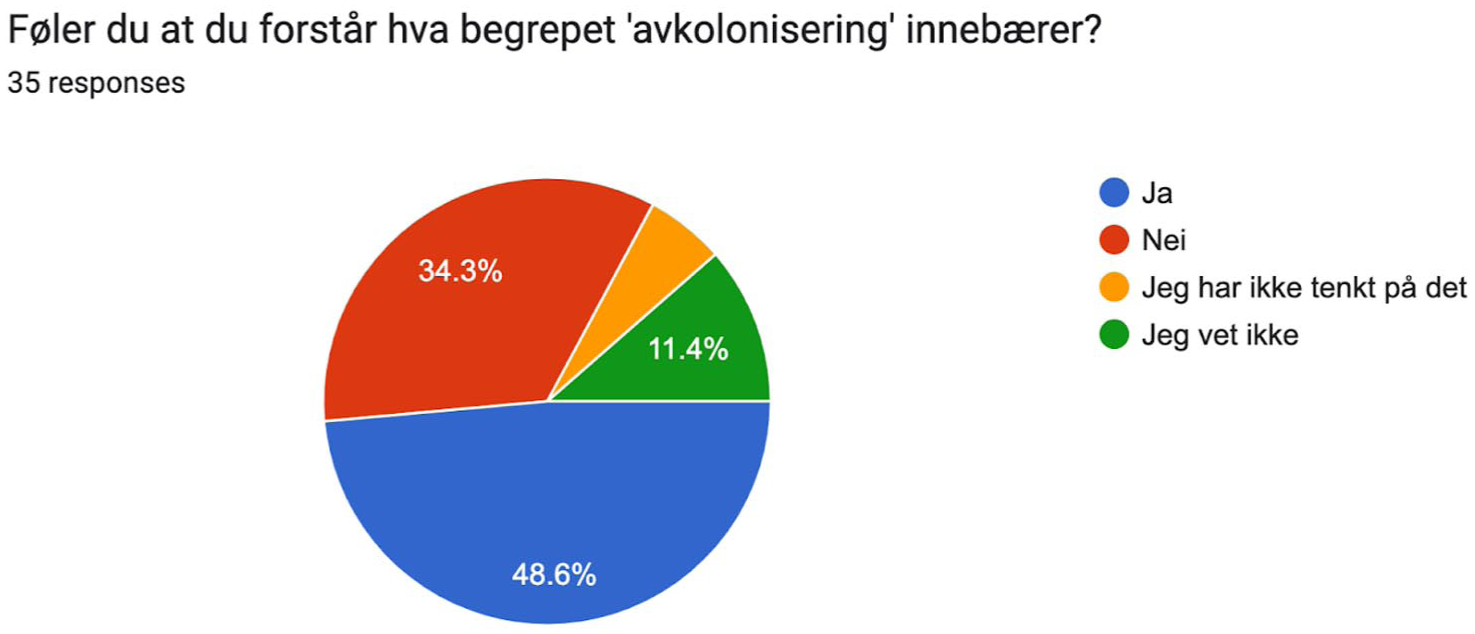
Do you feel that you understand what the term ‘decolonisation’ entails?
Furthermore, only 31.4% of participants felt that decolonisation is relevant for Norwegian public libraries, compared with the 62.8% majority who did not know or had not given it much thought (Figure 3). While this highlights a lack of understanding of decolonisation, it also suggests a lack of understanding regarding how colonialism impacts public institutions. Despite this data, those who chose to expand upon their responses, in addition to interview participants, acknowledged some form of colonialism in public libraries and beyond.
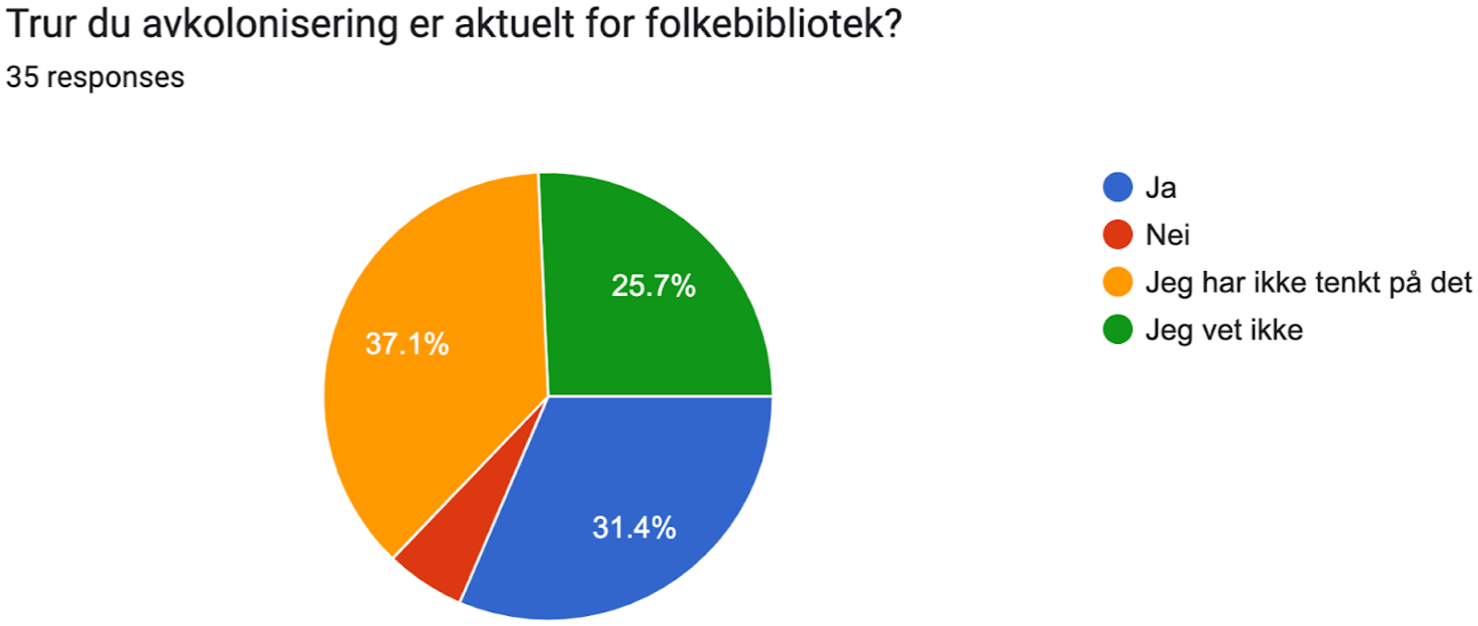
Do you think decolonisation is relevant for public libraries?
One participant noted that despite the efforts of public librarians, the institution continues to reflect greater society.
We stretch ourselves far to meet all as individuals and in the same way, but the foundational structure in library studies and municipalities is that we will be affected by the majority’s attitudes and views. (Questionnaire respondent)
Demonstrating how embedded colonialism is within the institution itself, another participant explained how library collections and services can reinforce colonialism regardless of the attitudes held by individuals.
Even if we remove people that make choices in collections, dissemination, and meeting the public, there will still be services such as AI that are created from source material that can in many cases be the result of colonialism. (Questionnaire respondent)
Discussing public libraries in Sápmi, Northern Norway, another participant highlighted how discourse surrounding colonialism varies due to geohistorical context and local political climates.
We still have a culture and history about not wanting to talk about decolonisation in public libraries as opposed to other regions in Norway. We still talk about it from time to time, but it needs to be talked about more, so that we can acknowledge our past, present, and future. (Interviewee 4)
Despite these acknowledgements of coloniality, interviewees shared the perception that there is limited consideration of colonialism in the public library and decolonisation has a ways to go. This is demonstrated in the quote below referring to colonialism within the DDC.
It’s not something that I reflect on in my everyday life and I don’t think the users do either [. . .] but if that’s a result of the fact that we kind of have. . . an internalised colonial thought process or I don’t think its on that level, it’s definitely not conscious, either with myself or my users. (Interviewee 3)
In contrast to other participants, interviewee 2, discussed diversity within public libraries solely on the basis of gender equality. Race and ethnicity were only mentioned when reflecting on uncomfortable interactions with children of colour and the participant’s assumption that her gender and whiteness were a significant factor.
I think it has a bit to do with gender roles and attitudes. . . Some children just won’t listen to you and they’ll call you a racist because that’s an easy card to draw because they are a child and have a different minority background than you as a privileged white woman. (Interviewee 2)
Whilst the above does not explicitly acknowledge coloniality, it does reveal how whiteness centred in discussions of diversity and decolonisation. The same participant also limited a conversation surrounding workplace representation to gender and the progress the field has made regarding that.
It’s a very female dominated field and that’s just how it is, but where I work we have two men working here and four women so it’s a pretty equal gender split, not everyone has it that way but I feel like it’s gotten a bit better. (Interviewee 2)
Where participants did consider the prevalence of staff with marginalised backgrounds in their workplace, it was acknowledged that a wage disparity endures between white workers and those with global majority heritage.
Yes [we have staff with marginalised backgrounds], but only in low-paid positions. (Questionnaire respondent)
This exemplifies not only socioeconomic implications in the sector, but also suggests that public libraries reinforce social disparities through their limited efforts to combat such implications. Overall, while the questionnaire returned few explicit discussions of coloniality, respondents were more engaged in discussing diverse collections as opposed to a diverse and representative makeup of staff; as the following response demonstrates: Try to be conscious to have a little bit of everything to make sure that the collection is representative for many. Especially regarding minorities (ethnic, sexual) and Indigenous Peoples. (Questionnaire respondent)
Existing efforts were less positively noted by one respondent who criticised the lack of offers for various marginalised groups, stating the following: We provide too few media in marginalised languages. Also too few events that are specifically created for marginalised groups. (Questionnaire respondent)
This perspective sits in stark contrast to the 82.9% majority who felt that their public library provides diverse collections (Figure 4).
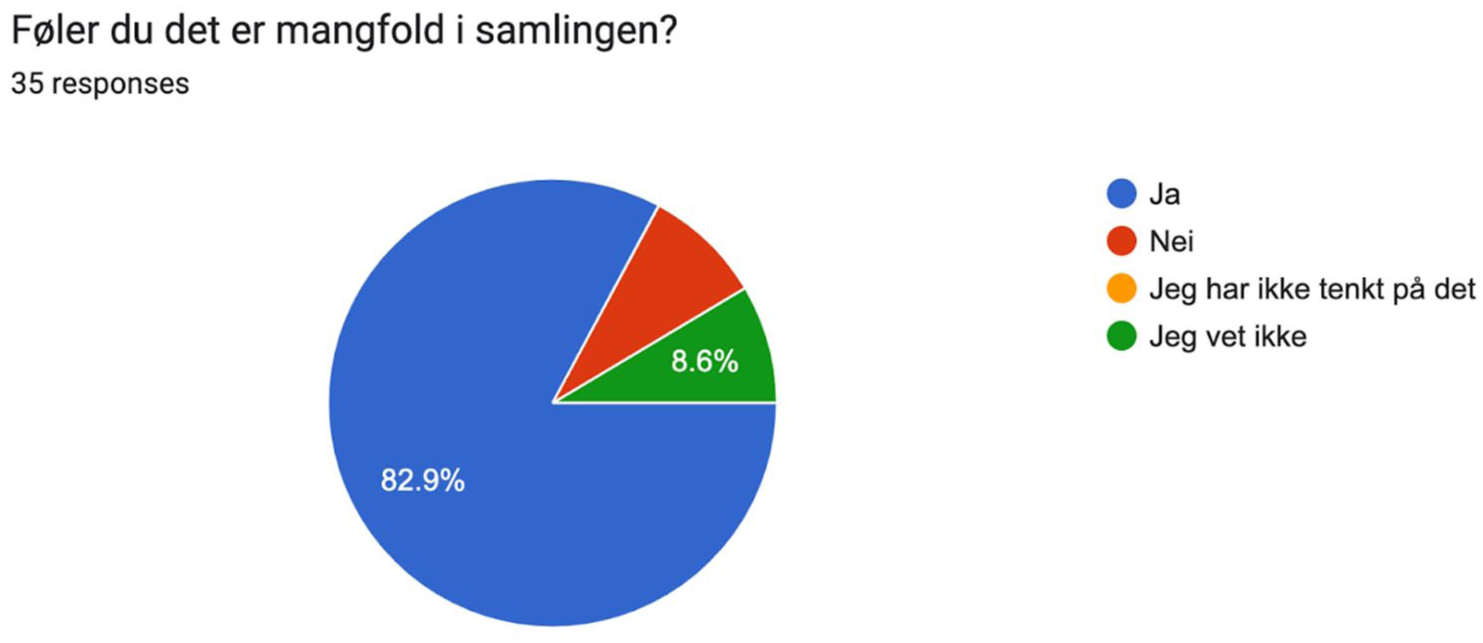
Do you feel there is diversity in the collections?
Furthermore, it encourages us to consider the role that events for marginalised communities have in terms of decolonisation. Their character and prevalence across Norwegian public libraries are especially noteworthy, as is their close connection with integration. Most participants viewed integration events as positive contributions with Language cafes being commonly cited as events to increase cross-cultural exchanges and offer free Norwegian language learning. One respondent, however, viewed the topic as an area of discussion that the library could facilitate as opposed to an unproblematic offering.
The library plays an important role in being an open door with an invitation to discuss [integration and assimilation], where the everyday northern Norwegian doesn’t really think about these questions (Interviewee 4).
Overall, respondents recognised or demonstrated coloniality in the public library. In discussing marginalisation and diversity, intersecting themes were noted, including gender and wages, deepening our understanding of whose experiences are centred in Norwegian public libraries. Additionally, there is evidence of stark contrasts between participant reports on the provision of public library services to groups experiencing marginalisation due to colonialism, bringing into question whether this is a result of the prevalence of coloniality, geography, local history, or other factors that impact public libraries around Norway.
Contradictions and subjectivity
Neutrality was frequently discussed with only 31.4% of survey respondents considered public libraries to be unbiased institutions (Figure 5).
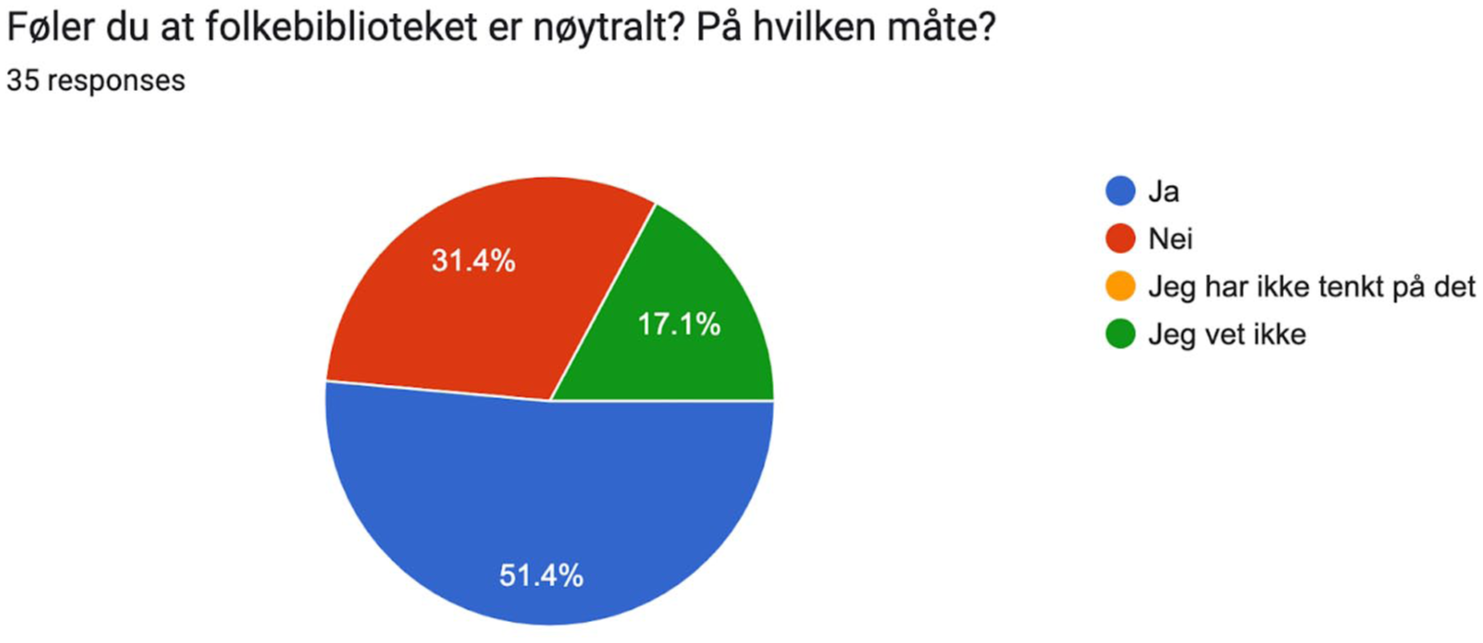
Do you feel that the public library is neutral? In what way?
In fact, the findings show that most participants believed that public libraries should refrain from being political.
I don’t think that the library should be political because you can then shut out people who might really need access to the library. (Interviewee 3)
These findings reveal a strong idolisation of neutrality and objective delivery of services, which appears to sit in juxtaposition to the previous discussion of diverse collections. One participant stated that neutrality entails leaving behind personal opinions, though this did not appear to include political opinions that are widely accepted or evoke an emotional response.
I guess it’s something else if it’s something I feel very strongly about, I am very for Pride for example, that’s not something I’m completely against [. . .] But that’s kind of a different topic, usually I am very neutral in things. (Interviewee 2)
Another interviewee provides further insights into the subjective nature of neutrality in Norwegian public libraries with specific reference to the LGBTQ+ community.
Within attraction in terms of marketing and communication, we are conscious that we need to be in solidarity with LGBTQ+ people, and it’s important as well, but they are not the only marginalised groups in Norway. (Interviewee 4)
Conversely, some participants felt neutrality should not exclude democratic values and solidarity with marginalised groups, despite the notion that public libraries should remain apolitical. The following extract captures one participant’s attempt to reconcile this contradiction.
Neutrality is. . . that’s something we should strive for, but not for just any price. . . if you are entirely neutral then you are not taking a stand against racism, against discrimination, and those are kind of the values that make up a democracy, right? (Interviewee 3)
Others, however, believed that the public library is not able to be neutral, and that neutrality can be harmful for welcoming a diverse user group, especially regarding colonialism: Younger generations are the ones that are meant to come into the library and feel welcome. To show that we have a certain view of [colonialism], that we are aware. . . because I know that the discussion is that the library is supposed to be neutral and independent and not push any ideological perspectives. . . but. . . it’s a public library, it might not be what is at the forefront even if it’s foundational. . . but we, our users that visit us are so diverse. . . and I think when they see the world in a certain light then maybe the library isn’t as equipped to be the provider of neutral information (Interviewee 1)
Questionnaire respondents discussed the above referring to two recent international conflicts, highlighting a contradiction in how Norwegian public libraries have handled, or even allowed, acts of solidarity, drawing attention to race as a factor.
My experience is that it’s easier for the library to stand in solidarity with Ukranians opposed to Palestinians, for example. It seems that it’s easier to be in solidarity with white people than brown people. (Questionnaire respondent)
These acts of solidarity, or lack thereof, provide insights into what and who is allowed to take up space in the public library. That islamophobic group SIAN was – with controversy – permitted to host an event at a public library in Kristiansand is testament to the arbitrary nature with which ‘neutrality’ is adhered to.
‘Since we host groups such as SIAN and don’t get to show support to Palestine, or share Palestinian literature there are some that feel that we ‘choose sides’’. (Questionnaire respondent)
When asked about this contradiction, it became clear that while participants had noticed it, this was not something concretely reflected upon. Two interviewees admitted to not considering this particular issue despite previous reflections on the prevalence of whiteness in public institutions.
That with Ukraine was very. . . the libraries were really on the ball then. But in a way all the public outrage against war crimes is often based on whiteness, so it’s not surprising that you can find that tendency in libraries but it’s not something that I have reflected on much, but I wouldn’t be astonished if it is based on whiteness. (Interviewee 3) I haven’t thought much about it because I stand very neutral and I don’t have political opinions when I am at work (Interviewee 2)
This final statement about neutrality is once again a theme that another participant explains may be a hindrance to solidarity altogether due to the strong general consensus in society.
A huge proportion of the Norwegian population still don’t know what it means in practice to be in solidarity with marginalised groups, because we are caught in being neutral. If I said this out in a local newspaper, they would probably crucify me. (Interviewee 4)
The major takeaway here is how the concept of neutrality impacts attitudes and opinions on solidarity with marginalised groups. This in turn creates contradictions between statements, with general societal consensus being decisive to what is considered neutral.
Responsibility and challenges to decolonisation
The impact of third parties in the decision making power of public libraries was a challenge frequently described by participants. At times, this was read as a deflection of responsibility, highlighting the limitations of the libraries’ role and the importance of consensus. One interviewee noted the geohistorical effects on attitudes and the state’s power.
I think it’s very strange because as a Northerner [. . .] when we were outside and playing, we had gotten new Tova gloves and they were a product of Sámi craftsmanship. So it’s very contradicting [. . .] it’s right in front of us in our everyday language, and we use it, we wear it, but it’s not something we talk about in education. And I think that has to do with our own feelings around it and the state’s power in this. (Interviewee 4)
Another participant viewed decolonisation as beyond the remit of the public library, suggesting that the publishing industry should spearhead initiatives to decolonise knowledge.
But that’s kind of the [role of the] publishing industry or academic libraries that work with students and other types of institutions, because public libraries are for all of the public in a way. So I don’t think that is necessarily our responsibility. We can of course disseminate [materials regarding decolonisation], if it becomes available to us. (Interviewee 2)
This insinuates that individual libraries’ influence over collection development and events programmes is limited; seemingly contradicting the fundamental principles of the public library. This is, however, only one barrier that public libraries face, according to participants. The public library also faces a lack of consistency where the need for consensus and leadership is crucial for decolonisation, noting possible limitations of grassroots initiatives.
Head librarians, the leading professional groups, in collaboration with research [need to lead decolonisation], simply because it’s so sensitive and it’s a big intervention to rattle what the library is meant to be. . .because if it’s grassroots, that’s good, but that’s just change until that person quits. (Interviewee 1)
Despite findings that underline the need for leadership to take responsibility, leadership itself may be a challenge to decolonisation, as highlighted by previously presented findings regarding wage disparities and the racial implications below: Everyone in leadership is white and doesn’t understand. (Questionnaire respondent)
Participants’ geographic location amplified certain barriers to decolonisation. Funding issues were ubiquitously discussed, though participants from smaller libraries noted how maintaining the trust of regular users can impact the allocation of budgets to public libraries at municipal levels, as well as the limitations of part-time positions.
At least in the two district libraries I work at there are some regular visitors that trust those of us that work here. So I think that if they have a whole other opinion than what we have and we show it very loudly then they will have a different impression of us or lose trust. (Interviewee 2) I have 10 hours a week to do all the tasks tied to a library. So I think in my specific situation, or in the form of running a library, it might not be practically feasible. (Interviewee 3)
This also highlights an assumption and/or fear that decolonisation would entail an immediate overhaul of all current processes, rather than gradual, yet radical, changes. Furthermore, the most definitive challenge for decolonising public libraries voiced by all participants is the lack of discussion on the impacts of colonialism in the institution. Again, this places significance on the need for general consensus as a prerequisite for decolonisation.
We talk very little about colonisation, it’s a bit difficult I think for workers to take a hold of as a group, we decide things together and to come with that kind of viewpoint can be a bit. . . it feels like it’s being forced in. . .it’s absolutely not a debate or anything. . . at least not the communities I am in. (Interviewee 1)
It is evident that the attitudes of public librarians towards decolonisation and their willingness to actively participate in initiatives is dependent on geographical factors, resources and other actors, not all of which are within the public library’s sphere of influence. The need for building general consensus through research or debate, and changes in leadership, are crucial for meaningful developments in decolonising Norwegian public libraries.
Summary of findings
In summary of the three themes presented, responses present a dichotomy. Participants expressed both a lack of understanding of what decolonisation is, and what it entails in the context of public libraries, as well as acknowledgements of coloniality and its prevalence in society. Whilst some participants did present frustrations towards coloniality in public libraries, the majority engaged more enthusiastically with familiar terminology, for example, viewing diversity and representation as key to the public library’s social mandate. Even so, there are respondents who exemplified centring whiteness in such discussions, representing another end of the spectrum of attitudes. This is also illustrated by contradictions in discussing neutrality and solidarity. As for challenges that hinder decolonisation, examples ranged from deflected responsibility, funding issues and location based limitations. The overarching theme was the need for debates, general consensus and leadership to decolonise the library, with individual initiatives lacking the impact necessary for wider institutional change.
Discussion
Conclusions and potential for decolonisation
In order to draw conclusions from the results presented and themes identified, overarching issues must be addressed, including the prevalence of whiteness in discussions of intersecting identities, as well as the insistence on neutrality and the potential for decolonisation in regards to attitudes. There is little discussion regarding decolonisation in Norwegian public libraries. Considering the lack of literature found utilising terminology regarding colonialism in Norway, and existing research into Norwegian exceptionalism in educational institutions (Eriksen and Stein, 2022), this conclusion was anticipated. This lack of discussion contributes to the limited understanding of what decolonisation entails identified amongst participants. This is a recurring theme throughout this discussion and presents a significant barrier to decolonising the institution. Consequently, this paper argues that in order to progress with decolonisation, it is necessary for ongoing debate to be fostered within Norwegian Librarianship, a condition which this research contributes in creating.
Whiteness and feminism
Throughout presenting the theme ‘Acknowledgement of Coloniality’, whiteness was a central tenet to several of the conversations that took place. The majority of participants had not considered decolonisation as relevant to public libraries, and consequently, discussions reverted to diversity. A Critical Race Theory approach sees this semantic reversion from ‘decolonisation’ to ‘diversity’ as a way for the typical white female librarian to feel safer, more familiar, and less radical being involved in such discussions (Leung and Lopez-McKnight, 2021). Also deserving of further exploration is the prevalence of whiteness when discussing gender diversity and the dismissal of possible racism in favour of gender discrimination. This was by no means exhibited by the majority of participants, it does however demonstrate how whiteness impacts the public library, even subconsciously during a discussion of decolonisation. Additionally, the intersection between gender and whiteness – or white feminism – is an unsurprising find as ‘distinct moral accounts of the self’ can prevent intersectional anti-racist discussions of feminism, both historically and in present multicultural societies (Srivastava, 2005: 30). Considering that an overwhelming majority of participants experience their collections to be diverse, it is unsurprising to also find evidence of white feminism, especially as only 8.6% reported their collections to lack diversity (Figure 4). The idea of diversity documents being fabled ties into the phenomenon of white feminism as such a lens may impact what is considered diverse enough and to what extent such documents affect or change library praxis (Brown et al., 2021; Gohr, 2017; Matthews, 2020). Additionally, such forms of diversity can reduce the intention of decolonising public library praxis into what is deemed acceptable and comfortable by the white majority of staff, making it necessary for public libraries to increase education amongst library staff on what decolonisation entails.
Questionnaire responses highlighting the lack of materials and event provisions aimed towards marginalised groups are also valuable, especially in view of their stark contrast with the majority who perceive their collections as diverse. It is important to note that only one participant described themselves as being from a marginalised group, and while data pertaining to ethnicity, race or sexual orientation was not sought to be collected, this is indicative of potential issues regarding diverse staffing in Norwegian public libraries. Taking into account questionnaire responses noting wage disparities between library workers, this is particularly significant, as the very practice of diversity hiring is a form of celebratory multiculturalism; the consequences of which can culminate in alienation of library workers who experience marginalisation in predominantly white societies (Gohr, 2017). To combat such alienation, considerations should be made regarding how Norwegian public libraries can actively work towards reducing, and eventually eliminating, the reflection of socioeconomic disparities within the institution.
Contradictory solidarity and political neutrality
The prevalence of whiteness is arguably present in the theme ‘Contradictions and Subjectivity’ in relation to solidarity. The most common example of solidarity identified in this research was with the LGBTQ+ community, as opposed to groups that are more directly impacted by colonialism as a whole. Whilst this may have been due to the fact that data was collected during June (Pride month) making such solidarity a relevant example, it is discussed by participants as an exception to neutrality. As such, it can be concluded that general social consensus on LGBTQ+ solidarity, and the greater prevalence of whiteness in that community in Norway, may be a decisive factor. This was highlighted by interviewee 4 who noted that such acts of solidarity have to do with ‘marketing and communication’. Similar exceptions were recognised in participant responses regarding timely Ukrainian solidarity compared to Palestinian solidarity in the face of political neutrality. Here, the contradiction lies in the lack of recognition that solidarity with any marginalised group is in fact political, rather than certain groups being exceptions in the name of neutrality, reinforcing whiteness and coloniality. Again, this was not exhibited by all participants, as there are library staff who expressed critiques to current practices. However, the prevalence of such conversations are worth discussing further. Gohr’s (2017) assertion that white privilege is foundational to neutrality goes towards rationalising the political exception shown to the LGBTQ+ community in Norwegian public libraries. Furthermore, Hero (2021) argues that exceptionalism within Scandinavian countries, where feminism and liberation of the LGBTQ+ community is portrayed to have been achieved, contributes to hiding colonial complicity in one form or another, as well as strengthening the idea that this single variation of society is the most desirable form. This is also known as homocolonialism (Rahman, 2014) and relates to the previously discussed theme of Norwegian exceptionalism being applicable to public libraries (section 2.2).
As for explicit discussions of neutrality, the findings presented in ‘Contradictions and Subjectivity’ are supported by the literature. Reflected in the positive attitudes expressed towards the idea of neutrality as an important part of the public library’s social mandate, such attitudes may hinder decolonisation as literature suggests that the concept of neutrality is unable to exist in public libraries (Matthews, 2020). It was found that only a handful of participants were explicitly critical of neutrality, again highlighting the limited understanding of how coloniality is present and impacts institutions. The extent to which participants express the need for neutrality in public libraries can therefore be considered a barrier to decolonisation, especially regarding the contradictory perceptions of solidarity. Furthermore, Jensen (2019) provides insights into how neutrality aids in platforming far-right, and particularly islamophobic, groups such as SIAN, with public libraries choosing to provide two-sided debates for the sake of neutrality (Larsen, 2023). This two-sidedness and consequent lack of equity in neutrality was raised by a questionnaire respondent who noted restrictions on public libraries expressing Palestinian solidarity, in comparison to public libraries hosting SIAN events. This is evidence that such contradictions have not gone unnoticed by public librarians, therefore, conclusions can be drawn that while neutrality is a barrier to decolonisation, it is also the cause of disservice and inequitable offerings to marginalised groups in Norwegian public libraries. The findings of neutrality positivity also connect with unacknowledged whiteness existing in public libraries (Gohr, 2017).
A further topic in which this theme was identified was participants’ positivity towards integration; particularly integration events that centre Norwegian language learning. This is where a significant aspect of decolonisation of the public library entails decolonising what integration means in practice; its obligatory nature and risk of ‘otherisation’, as well as ensuring decolonial intentionality in the designing of events and services (Grewal Gill, 2020). These findings align with Golten’s (2022) research who found positivity amongst politicians and library staff towards integration. As a result, I argue that Norwegian public libraries participate in a form of neo-colonialism, which makes education necessary to understand and deconstruct integration practices, their context, and their role in perpetuating colonialism. Relatedly, Delgado’s (2024)research found that immigrant-led events were significantly more beneficial to meeting the needs of immigrants in the public library. Applying this in Norwegian public libraries, would see that in addition to broadening services for immigrants, intentional decentering the librarians’ role in establishing events for immigrant groups and communities to decolonise these spaces.
Potential in the face of challenges
This research indicates that overall, participants exhibited positive attitudes towards decolonisation initiatives, with only a few explicitly against decolonising the public library. It is important to note, however, that due to the limited understanding of what decolonisation entails, these results could be subject to change upon further education amongst participants. Despite positive attitudes, participants expressed anxiety and reluctance connected with the feasibility and practicality of engaging with decolonisation initiatives. Recurring themes included limited resources, dwindling funding and the power of public librarians have in relation to the greater media industries, especially as the Norwegian state has influence over what gets disseminated and drives public narrative. Sensitivity proved challenging in libraries located on colonised land where Indigenous peoples experience higher frequency of hate; therefore context specific approaches may be more appropriate (Sannhets- og Forsoningskommisjonen, 2023). These discussions raised questions regarding the immediate necessity of decolonisation initiatives and deflections of responsibility to third parties and leadership. Where participants expressed the desire to increase solidarity with marginalised groups, connections were made with the disproportionate whiteness at leadership level. Scholarship confirms that resource limitations impact the ability of the public library to create vibrant and authentic cultural programmes aimed at immigrants as the success of such programmes are reliant on local knowledge and resources belonging to various communities (Delgado, 2024). This is a possible explanation for the lack of materials and events directed towards marginalised groups aside from language cafes. Additionally, supports findings of location-based challenges, including the limited working hours noted by interviewee 3. Scholars emphasise the need for recognition of the labour and resources required for decolonisation, as it is a time and resource-demanding institutional change (Thorpe, 2019). It is therefore unsurprising that this study identified intimidation amongst participants, especially with regards to decolonising the DDC and other classification schemes. While it could be easy to conclude that continuous focus on developing existing local organisation systems with community participation, would be a beneficial and less intimidating route for decolonising public libraries, the issue of intentionality needs to be reemphasised for initiatives to be considered decolonial. Despite the intimidation noted by participants, the strength of positive attitudes suggest there is potential for decolonising Norway’s public libraries. Unfortunately, the need for general consensus in research and leadership may be the only route ensuring scale of upheaval necessary for decolonisation.
Reflection through conversation
While not discussed as a distinct theme in the results chapter, the most surprising finding was the level of reflection exhibited by participants as well as their willingness to unpick their initial responses. Interview participants frequently reflected on their own opinions, thoughts and potential biases throughout the conversation, even without follow up questions being asked. This, at times, resulted in conflicting views and attitudes that may have contributed to the contradictions and subjectivity identified as an overarching theme in the analysis. Despite the lack of previous discussions around decolonisation in the field, the prevalence of reflection indicates that education and debate could be beneficial for the future of decolonisation of Norwegian public libraries. Thorpe (2019) is amongst the scholars advocating for greater critical reflection in order to ensure Indigenous self-determination and decolonisation of institutions. As literature supports the need for critical reflection and responsibility, public libraries – in accordance with their social mandate – are well placed to provide the environment within which to work towards a decolonial future.
Research limitations
As previously discussed, the lack of understanding of decolonisation and the terminology used within this study may have limited the quality of participants’ responses. This project included an information sheet for interviewees and a description at the beginning of the questionnaire, yet it was clear that several participants lacked the knowledge to provide answers that were sufficiently representative of their attitudes. This was demonstrated through participant comments and the absence of direct discussion of coloniality, which resulted in a reliance on related topics and terminology, such as diversity, representation and integration, to more accurately determine attitudes. Whilst all data collected – from questionnaires and interviews – was highly valuable, indicating the level of understanding of decolonisation amongst public library staff, it is possible that provision of more information or education would have garnered substantially different responses.
Conclusions
Concluding remarks
This study mapped the staff attitudes towards decolonisation initiatives in Norwegian public libraries through inquiring into the prevalence of colonial thought processes and attitudes, staff perceptions of neutrality, the role of the public library, diversity in collections and events, representation and staff perceptions of decolonisation in practice. Inquiry into these areas, and subsequent thematic analysis, revealed a limited awareness of what decolonisation entails. Despite this lack of knowledge, the majority of participants’ held positive attitudes towards decolonisation initiatives. There was also evidence of openness and intrigue amongst participants, which indicates a certain level of potential for decolonising Norwegian public libraries in the future.
This research brought into focus several challenges that need to be addressed. Funding issues, a lack of resources, limited working hours and a lack of knowledge on the topic of decolonisation, colonial history and implications for public institutions, all hinder the potential for decolonisation identified in participant attitudes. These challenges appeared amplified in libraries on colonised land, due to the sensitive nature of colonialism, public resistance to the topic and its practical feasibility. The principle issue, however, is that of whiteness within the insistent strive for neutrality, and the subjectivity within that. Evidence was found to suggest that neutrality further cements coloniality into the public library as an institution, preventing critical reflection in terms of solidarity, impacting perceptions of what decolonisation would entail and what is considered feasible, as well as the survivability of grassroots initiatives. It is not convincing that public libraries are able to treat various groups equitably, as opposed to equally. This leads to the conclusion that not only is there a need for decolonising Norwegian public libraries, but that there is far to go in terms of accepting its necessity, especially as general consensus in the field is deemed critical amongst participants.
Recommendations
The following recommendations have been made based on the conclusions from this study together with existing scholarship on decolonising public institutions:
Research – The limitations and challenges that public libraries experience impede the possibility of independent initiatives spearheaded by library staff. Based on the need for field consensus for decolonisation, as well as the reliance on third parties for leadership, increased research into decolonisation for Norwegian public libraries by academic groups, unions and independent researchers, would be beneficial.
Discussion – The lack of discussion around decolonisation is a significant hindrance. Furthermore, critical reflection amongst library staff has been identified as advancing decolonisation efforts. Open discussion needs to be encouraged in order to foster an environment for critical reflection; increased publications or individual initiatives could contribute to creating these conditions. Peer-to-peer education could also help determine which initiatives can be incorporated within current capacities. Finally, discussions amongst library staff can support the public library’s ability to act as an equitable space for local communities.
Education – In the Norwegian context of public libraries, internal and external colonial history needs to be actively disseminated by public library staff to encourage discussion, debate and education in line with the public library’s lawful social mandate. Through research and discussions amongst public library staff and users, education can be fostered and formally implemented for public libraries via action-plans.
While there are many other initiatives that can be incorporated, recognition of the necessity for decolonisation has to come first through deconstructing inherent beliefs and biases. Following that, successful initiatives presented in previous scholarship (section 2.5) can be seconded, for instance, the implementation of a community-led model that would allow equitable space for Indigenous and foreign knowledge and representation through self-determination (Thorpe, 2019). This could also involve decolonising integration through disseminating stories between groups.
Further research
Due to the constraints in which this research was conducted, there are several limitations worth discussing further in terms of future research. Eriksen and Stein’s (2022) research on student-teachers and their ability to interrupt coloniality in Norwegian education included hosting an information session prior to conducting interviews; this approach would be valuable in further research where participants display limited understanding of what decolonisation entails. As the scholars concluded that the provision of knowledge is unable to interrupt coloniality on its own, it would be valuable to determine how the insights gained from this study could be altered, whether reflection would increase or attitudes be changed.
Further research on a larger scale would also be necessary to confirm the conclusions drawn in this study as there is likely a bias among those who chose to participate. Additionally, the majority of responses were limited to two counties, and while these have the highest population density in the country, this study initially aimed to achieve greater geographic representation (Statistisk sentralbyrå, 2023). Such research would present the opportunity to investigate further the nuances and sub-topics within decolonisation and public libraries in the Norwegian context. This could include research into resistance towards discussing decolonisation, attitudes towards integration/assimilation, staff diversity, the impact of higher education LIS curricula on colonial narratives and user perceptions of the prevalence of colonialism. Since the data collection period for this research, the Norwegian government has published a report and plan on the prevention of discrimination and hate towards the Sámi population including a resource checklist for libraries to contribute to prevention of discrimination (Kultur-og likestillingsdepartementet, 2025). Whether this checklist is fully implemented, how it is implemented and to what extent it is effective towards preventing discrimination is yet to be seen, and is an important avenue for future research.
All in all, this study intended to fill the research gap in Norwegian librarianship, contributing to a wider discussion on decolonisation. The findings of this study illustrate the necessity of such discussions and increased education on the prevalence of colonialism in the institution.
Footnotes

Ethical considerations
This study was approved by the University of Sheffield Information School Research Ethics Committee (approval no. 059836) on May 20th, 2024.
Consent to participate
All participants provided written informed consent prior to participating in this study. All interview participants additionally provided informed consent verbally prior to interviews being recorded.
Consent for publication
All participants provided written informed consent for their data to be used for publishing purposes.
Funding
The authors received no financial support for the research, authorship, and/or publication of this article.
Declaration of conflicting interests
The authors declared no potential conflicts of interest with respect to the research, authorship, and/or publication of this article.
Data availability statement
The datasets generated during and/or analysed during the current study are available from the corresponding author on reasonable request.