




Abstract
School libraries are undergoing a monumental shift as they adapt to meet the ever-changing needs of students. This study investigated student perceptions of their school library, focussing on its role in supporting reading, research, and technology use. An explanatory mixed methods design was employed, involving a survey of students from a primary school in South East Queensland, followed by three semi-structured focus group interviews. While all participating students felt supported by their library to read and access books, they reported receiving less help with finding information to support schoolwork and using computers, a shift from earlier findings. The focus group interviews highlighted the importance placed by students on a quality book selection and the library’s role in facilitating learning of new technologies. The lack of a dedicated teacher librarian emerged as a pivotal factor influencing students’ perceptions of the school library. The findings contribute to existing literature, with insights for improving the functionality and perception of school libraries.
Keywords
Introduction and background
A scholar from the library of Alexandria may have recognised a library from only a 100 years ago for what it was, but the same may not be said for most libraries today (Streatfield and Markless, 2012). We find ourselves in the middle of a shift as libraries adjust to meet millennium old expectations of being safe places for the storage and use of texts, with new demands to provide the space and 21st Century resources deemed necessary for learning (Streatfield and Markless, 2012; Weduwen and Pettegree, 2021).
School libraries epitomise this change, with many being renamed as resource centres or learning hubs, signifying the shift away from traditional libraries (Morris, 2020; Tait et al., 2019). In this era of rapid change, many libraries are seen as no longer functional, valuable, or useful, and this is evident through the defunding and closure of libraries around the world. In America, school libraries are being defunded, repurposed, abandoned and closed (Kachel, 2015). A similar problem is occurring in the United Kingdom where almost one-fifth (that is, 8000) of public libraries have been closed in a single decade (Flood, 2019). While mass library closures of this kind have not occurred to the same extent in Australia, fewer teacher librarians are being hired and funding for school libraries has reduced (Dix et al., 2020). Public libraries also face serious funding issues (Australian Library and Information Association [ALIA], 2024), which may indicate the beginning of a similar trajectory. Despite these trends, existing research overwhelming supports the benefits of school libraries for students (Chan, 2008; Hughes et al., 2014), underpinning the central focus of the current study.
Purpose
This study aimed to explore upper primary school students’ perceptions of help from their school library. Employing an explanatory sequential mixed methods design, the research involved the collection of survey data followed by focus group interviews. A validated Likert scale survey used by Todd and Kuhlthau (2005) was implemented to identify students’ perceptions of their library’s helpfulness with reading, research (i.e. getting and using information), and technology, while the focus group interviews offered further explanation of these perceptions. The project was conducted at a time of rapid change to shed light on the shifting role of the library at a contemporary primary school.
Research question
The specific research questions guiding the project were:
How do Australian upper primary school students perceive the helpfulness of their school library for learning in reading, information access, and computer usage?
What factors influence these students’ perceptions about their school library?
The study’s focus on student perceptions of school libraries makes an important contribution to the existing literature, which has traditionally prioritised the perspectives of teachers, librarians, and principals (Hughes et al., 2014). Given that school libraries exist to benefit students’ learning, understanding their perspectives on the helpfulness of these libraries can inform decisions regarding their future roles, their operations, and staffing.
Literature review
Research into the roles and usefulness of school libraries was considerable in the first decade of the 21st Century. Largescale studies and literature reviews routinely found positive correlations between student academic achievement and their use of and access to well-resourced school libraries (Chan, 2008; Hughes et al., 2014; Lonsdale, 2003). Positive impacts of school libraries were found consistently in these studies including students’ higher academic attainment, improved reading and literacy, and broader general knowledge (Lonsdale, 2003). In Australia, this research culminated in a report and review of literature by the Australian Parliament House of Representatives Standing Committee on Education and Training [(APHRSCET] (2010), which concluded, “The research is done, the evidence is in. School libraries make a difference” (p. 35). In this section, we review this literature, explaining specific benefits of school libraries and issues that can undermine their effectiveness.
Academic benefits of school libraries
School libraries play an important role in supporting students’ academic achievement, particularly by enhancing student skills in reading, research, and technology use. The core business of libraries is typically considered the provision of access to books, and effective school libraries provide a wide range of texts and reading materials to students (Lonsdale, 2003). Students who have access to well-resourced school libraries have, on average, better reading comprehension and higher levels of enjoyment of reading than those without access (APHRSCET, 2010; Chan, 2008; Godfree and Neilson, 2018; Hughes et al., 2014). Recent research by Loh et al. (2022) found that quality selections of books in school libraries can further support reading for pleasure for students. Overall, research has found positive associations between well-resourced school libraries and student reading outcomes.
Another important role of school libraries, particularly for high school and university students, is providing an ideal space and resources for research (Fagan et al., 2021). In primary school contexts, there is some evidence, particularly before widespread access to handheld computers and the internet, that students valued the library as a place for finding new information (Todd and Kuhlthau, 2005). A lack of research in the past decade makes it unclear how contemporary primary school students are using school libraries for research; however, one recent study indicated that young students were more likely to use the internet on personal digital devices rather than information texts for research (Szymkowiak et al., 2021). The changing ways in which people engage in research processes, coupled with the gap in the literature around how primary school aged students learn about and engage in research, highlights the need for new research in this area.
A growing body of research in the US, known as the school library impact studies, has consistently demonstrated positive links between well-resourced school libraries staffed by teacher librarians and student achievement across various demographics and content areas (e.g. Gretes, 2013; Lance and Kachel, 2018). For instance, students in schools with strong library programmes have been found to score higher on standardised tests in reading, writing, and mathematics, and have higher rates of school graduation (Coker, 2015; Lance and Schwarz, 2012). In addition, the impact studies have found that “the benefits associated with good library programmes are strongest for the most vulnerable and at-risk learners, including students of colour, low-income students, and students with disabilities” (Lance and Kachel, 2018, p. 15), highlighting the important role of school libraries in promoting equity in education.
In Australia, the widespread uptake of personal laptops and handheld devices has had major implications for the previous role of libraries as a repository of factual information for research purposes. Many libraries have met these rapidly changing needs by developing proactive responses and strategies to support their clientele (Leorke et al., 2018). In turn, school libraries evolved to become a place of learning about and through technologies. Many school libraries embraced the mass uptake of personal digital devices in society, and were modified to provide students with the space, support, and resources to learn about emerging technologies and improve their skills (Ejikeme and Okpala, 2017; Harper, 2016; Moorefield-Lang and Coker, 2019; Szymkowiak et al., 2021). Together, this research shows the value of school libraries in supporting students’ changing needs across many areas of schooling.
Additionally, the notion of libraries as a ‘third space’ has emerged in literature. Third spaces can be thought of as social spaces that are neither home nor work (Grey, 2017; Korodaj, 2019). In contemporary schools, libraries are well suited to fulfil this need for students as they offer a place for collaboration and self-directed learning outside the classroom (Maxwell and French, 2016). Research by Korodaj (2019) and Maxwell and French (2016) found that students value the physical space offered by libraries, which in turn improves student engagement and learning. This underscores the multifaceted nature of libraries that aim to foster new learning experiences beyond their traditional functions.
Teacher librarians
The most effective school libraries are often run by dually qualified teacher librarians (Brumwell, 2017). Bringing reading practice, motivation, and book selection together, teacher librarians play an essential role in supporting students with their reading by curating collections, expertly recommending books to students, and implementing instructional programmes (Brumwell, 2017; Pedro et al., 2021; Todd and Kuhlthau, 2005; Wine et al., 2023). In Australian school libraries, the presence of qualified teacher librarians has been found to be associated with higher rates of student literacy development and standardised test scores for reading and writing (Hughes et al., 2014).
Teacher librarians have also been found to play an important role in supporting struggling and reluctant readers by recommending books tailored to student preferences and learning needs, which in turn fosters a culture of reading for pleasure (Merga, 2019a). Despite the many well-known benefits of teacher librarians work, there are increasing barriers to this work, such as school staffing limitations and constrained budgets, and insufficient recognition of the well known and in many cases unique supports provided by teacher librarians (Merga, 2019b).
Teacher librarians also positively impact student learning in the realm of technologies (Ejikeme and Okpala, 2017; Lupton, 2016; Wine, 2016). Through their design and teaching of programmes, teacher librarians have been found to develop students’ research skills using technology and access to relevant resources in the library (APHRSCET, 2010; Godfree and Neilson, 2018; Hughes et al., 2014; Lonsdale, 2003; Spisak, 2021). Historically, libraries have been valuable resources for students. However, with the rise in access to computers and the internet, it is now the human dimensions of libraries that most support student learning and research abilities. Despite this, recent findings show that only 23% of all South Australian school libraries are managed by a qualified teacher librarian (Dix et al., 2020). In the US, there has been a 19.5% reduction in full time equivalent teacher librarians between 2009-10 to 2018-19, despite increased employment of all other types of educators and increased student enrolments (Lance and Kachel, 2021). This is incongruous with research that has consistently highlighted the value of teacher librarians.
Student perceptions
Several studies have focussed on the perceptions of school staff regarding school libraries, including those of principals, teacher librarians, and classroom teachers (Hartzell, 2001; Henri and Boyd, 2007; Hughes et al., 2014; Spisak, 2021). Such research is underpinned by the assumption that perceptions of school staff are important; these are the people who decide directly how school libraries are accessed and used (Spisak, 2021). While not the focus of the present study, such explorations of their perceptions often had nuanced results depending on participants and context of study (Small et al., 2010), highlighting the importance of considering multiple stakeholder views when making decisions about school libraries.
Research into student perceptions and opinions about school libraries has been rarer. The lack of attention given to understanding student perspectives is a common phenomenon in educational research; historically, students and children have not been included to the same extent as adults in research (Danby and Farrell, 2004; Graham et al., 2015; Noddings, 2018). Of the research that has focussed on student perceptions of school libraries, one largescale study has been most influential. In the early 2000s, Todd and Kuhlthau conducted the Student Learning Through Ohio School Libraries Research Study, investigating more than 13,000 students’ perceptions of help offered by Ohio school libraries (Todd and Kuhlthau, 2005). Their study involved a survey of 75 questions arranged into seven scales (i.e. getting information, using information, general knowledge, computers, reading, independent learning, and academic achievement), followed by a single open-ended question. A review of The Ohio Study and other studies was commissioned by the Australian School Library Association [ASLA] (Lonsdale, 2003), leading to the study’s replication in Australia by Hay (2005) with 6,718 students. Todd and Kuhlthau (2005) and Hay (2005) found that students perceived their school libraries to be helpful in several ways, with the highest levels of help associated with research and the use of computers within the library. The studies provided a snapshot of student perceptions of school libraries in two nations early in the 21st Century. Much has changed in the two decades since these studies, with major societal changes impacting young people’s reading and use of technology, such as the widespread availability of the internet, the proliferation of smart devices like phones and tablets, and the increased access of digital texts and e-books. At a time of considerable change to school libraries, it is crucial to re-examine student perceptions to understand their current needs, and how libraries can best support their reading, learning and technology usage.
Research methodology
The present mixed methods study aimed to contribute to the literature on this research problem, utilising an explanatory sequential design (Creswell and Plano, 2018). Mixed methods research provides the opportunity for comparison of results between studies whilst also providing more in-depth human perspectives and insights often lost in numerical data (Creswell and Creswell, 2023; Fetters et al., 2013; Johnson et al., 2007; Johnson and Onwuegbuzie, 2004). The study was underpinned by the pragmatic paradigm, selecting methods best suited to addressing the research questions (Creswell, 2020).
Research design
The initial quantitative phase generated data through the validated Likert Scale survey drawn from Todd and Kuhlthau’s (2005) study. The subsequent qualitative focus group interviews were conducted to elaborate and explain the phenomena found in the quantitative phase (See Figure 1).

Explanatory sequential design (Creswell, 2020).
The explanatory sequential design is common in mixed methods research in education, often selected for its ability to diminish the risk of misinterpreting data or trends in the data due to a small sample size (Creswell and Plano, 2018). Following this design, researchers are able to discuss patterns in the quantitative findings with participants during the qualitative phase (see Appendix 2).
Participants and context
The research was conducted with Year 4, 5 and 6 students in one primary school in South East Queensland, Australia. The participating school was a State (i.e. Government funded) school, with classes from Prep (i.e. the first year of primary school in Australia when children are 5 years of age) to Year 6 (i.e. when children are 12 years of age). Every Australian school is scored according to its Index of Community Socio-Educational Advantage (ICSEA; Australian Curriculum, Assessment and Reporting Authority, 2025). The average ICSEA score for an Australian primary school is 1000, and the ICSEA of the participating school at the time of the study was 1007, making it what might be considered a relatively typical, average Australian school. In terms of the distribution of socio-educational advantage, 61% of the students were in the lower half of advantage, compared to the Australian average of 50% of students. Forty-two percent of students had a language background other than English (i.e. they spoke another language at home). In terms of the school’s standardised NAPLAN test scores, at the time of the study, the average Year 3 student score was below or well below students with similar background in all tested areas (i.e. reading, writing, language conventions, and numeracy tests), while Year 5 students were below for writing but close to the scores of students with similar background for the other tested areas (Australian Curriculum, Assessment and Reporting Authority, 2025). At the time of the study, the school had approximately 750 students from Prep to Year 6 (Australian Curriculum, Assessment and Reporting Authority, 2025). Additionally, it is important to note that the school did not employ a teacher librarian when the research took place.
As the site of our investigation, this school provided an opportunity to explore student perceptions in the absence of a teacher librarian, which is a growing trend in primary/elementary schools internationally (Dix et al., 2020; Lance and Kachel, 2021). Given the well-known positive correlation between schools with qualified teacher librarians and student achievement (Gretes, 2013; Lance and Kachel, 2018), the findings of the present study offer useful insights into how students without direct access to a teacher librarian perceived and used their school library.
All students in Year 4, 5 and 6 at the participating school had the opportunity to complete the quantitative survey, provided they had parental consent. The research was explained to the students and advertised in the school newsletter and in a letter sent home to parents. Ultimately, 17 students (11 boys and 6 girls) returned their consent forms and completed the survey, with four in Year 4, seven in Year 5 and six in Year 6. It is important to note that the small sample size of 17 students in this study limits the generalisability of the quantitative findings. However, the purpose of the survey was not to conduct advanced statistical procedures or produce generalisable findings. Instead, it was used as a tool to efficiently collect demographic and contextual information from the participants that could be followed up in more detail in the focus group discussions. This information helped to provide a richer understanding of the participants and their experiences visiting a primary school library that did not employ a teacher librarian.
All 17 students who completed the survey participated in three focus group interviews, split by year level. These interviews provided rich, in-depth insights into student perceptions, which are often lost in quantitative surveys. As supported by Adler et al. (2019), engaging between four and seven students in focus group interviews is appropriate when working with children, ensuring that each student’s voice is heard and that the discussion remains manageable. This qualitative focus strengthens the study by offering detailed, context-specific understand and nuanced perspectives that complement the quantitative data.
Quantitative phase
The quantitative phase drew on the survey instrument developed by Todd and Kuhlthau (2005). The full survey consists of 75 Likert scale questions followed by one opened-ended question, organised into seven scales that cover several types of help that school libraries can offer students. This study focussed on student perceptions related to four of the original scales, which were identified as being strongly influenced by societal changes in the past two decades (e.g. the proliferation of handheld digital devices). These scales included help with reading, getting information, using information, and the use of computers. In total, the students were asked 25 questions for the quantitative phase of the study (see Appendix 1).
The quantitative phase was guided by the survey findings, enhancing the validity of the subsequent analysis. Students were also asked demographic questions (i.e. year level, gender, and frequency of library visits). Following Todd and Kuhlthau (2005), the quantitative data were analysed in two ways: first, responses were converted to a scale from zero to four to calculate the mean level of help for each question and for the overall scale. Second, the percentage of students who reported at least some help was calculated for each statement and for the entire survey (Ivankova et al., 2006).
Qualitative phase
For the qualitative phase, three audio-recorded semi-structured focus group interviews were conducted and transcribed. Following the explanatory mixed methods design, students were asked questions related to the results of the survey to provide further insight into the data (Creswell, 2020). Due to the semi-structured nature of the interviews, additional themes and topics were explored as they were raised by students. Each focus group interview lasted for between eight and 13 minutes.
The focus group data were initially analysed using a deductive approach. Data segments were categorised into three predetermined codes (Myhill and Newman, 2023): reading, research (getting and using information), and computers, corresponding to the scales drawn from Todd and Kuhlthau’s (2005) survey. The coding was completed using Lumivero’s NVivo 14 computer software. Deductive analysis is well suited for explanatory mixed method designs as it enhances consistency in reporting qualitative and quantitative results within predetermined themes (Braun and Clarke, 2006). Following the initial analysis, data segments within each scale underwent further inductive analysis. This hybrid approach, combining predetermined codes with the flexibility of inductive coding, aimed to offer a more comprehensive understanding of the data (Fereday and Muir-Cochrane, 2006).
Ethical considerations
Certain ethical considerations are important for any human research, including respect for participants, informed consent for audio or video recording, voluntary participation that can be withdrawn at any time, and avoiding potential harms by ensuring anonymity and protection of data (Vanclay et al., 2013). These considerations informed the study’s design at a foundational level. Beyond this, ethical consideration was given to the age of the participants, including considering students’ ability to provide informed consent and the potential for a perceived power imbalance between children and the researchers (Graham et al., 2015). Accordingly, it was essential to obtain each participant’s informed assent and informed parental consent. This process was supported by primary school staff, who provided all parents of children in the target year levels with the information sheets that were approved through the University of Queensland’s Human Research Ethics Committee and the Department of Education, Queensland. Parents were also provided with the researchers’ contact information if they requested additional information.
Students were informed of their right to cease participation in the survey at any time, including after they started, and four students did withdraw their participation partway through the survey. The focus group interviews raised additional ethical considerations, such as a potential of a perceived power imbalance between participants and the first author, who conducted them, which can be difficult to navigate (Adler et al., 2019). To mitigate this, the first author fostered a casual, relaxed atmosphere during the interviews, and opted for focus group interviews rather than individual interviews. Questions were formulated in a simple and neutral way, and although no instances of discomfort or distress occurred, the researcher was prepared to adjust questions or even stop the focus group if needed (Adler et al., 2019). At the start of each interview, the first author explained the confidential nature of the focus groups, encouraging students to freely share their views about the school library but not to discuss what others said following the interviews.
As a final consideration related to data management, all data were de-identified, they could not be re-identified, and all student responses are now stored securely through a University of Queensland secure data platform. This helped to protect participant anonymity and potentially sensitive information about their views concerning their school library. Together, these considerations and practices sought to decrease risks to safety and comfort for the participants and increase the reliability of findings.
Results and discussion
The mixed methods study was purposefully designed to explore students’ perceptions of the school library and their suggestions for its improvement. Given the relatively small student population at the focus school, a low survey response rate was anticipated. While this limits the generalisability of the findings, the survey played several crucial purposes in the mixed methods study. Specifically, the quantitative phase provided a simple basis for comparing findings through descriptive statistics, facilitated the selection of students from each year level for focus group interviews, and guided the formulation of interview questions.
Key focus 1: Reading
In the survey, the reading scale comprised five statements for students to rate on a five-point Likert scale. The students reported higher levels of help with reading compared to other areas. The statement with the lowest mean score in this scale was: The school library has helped me be a better writer (see Table 1).
Perceptions of the school library’s help with reading.
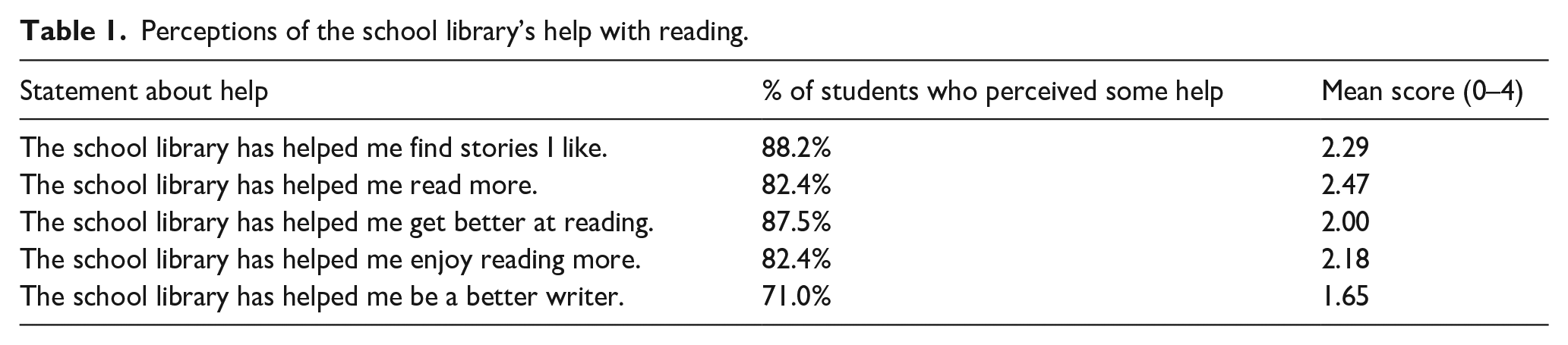
Once again, given the limited sample size of 17 participants from one Australian primary school, the percentages presented in the table should be interpreted with caution and are not intended to be generalised to other students. Demographic survey data provided insights into students’ library usage patterns. 10 of the 17 students reported visiting the library once a week only, during their compulsory library session. As corroborated by the focus group interview results below, the main purpose of these sessions was considered to be for students to borrow books, emphasising the library’s central role as supplier of reading materials for these students.
Following the study’s explanatory mixed methods design (Creswell, 2020), the quantitative findings informed the development of subsequent focus group interview questions. For the reading questions, we were particularly interested in learning why students felt the library encouraged more reading but did not necessarily improve their reading skills. The focus groups interviews revealed students’ belief that reading abilities and enjoyment were inherent traits, largely uninfluenced by library resources.
Some people are better than other people at reading. (Year 4 Student)
Maybe the good readers are, like, choosing some other books they like and not the hard books, just easier, like, they’re not picking the most complex books. (Year 5 Student)
Student responses suggested a perceived link between reading ability and book selection, which in turn impacted on the usefulness of this reading for schoolwork. One student commented:
They’re [weaker readers] not trying harder books and pushing and trying better stuff (Year 4 Student)
This perspective reflected the view of several students that the school library catered mainly to pre-existing reading abilities rather than actively fostering skill development. For those with stronger abilities, the library could offer more challenging books, which would support stronger schoolwork. Those with weaker abilities would gravitate to less challenging books with less potential for enabling reading development.
Such views stand in contrast with established research demonstrating that students with access to a school library have improved academic achievement (Chan, 2008; Hughes et al., 2014). It is currently unclear what associations there are between the sorts of books a child selects at their school library and their general reading development, making this an area for further investigation.
Book selection emerged as a significant theme, with many students expressing a desire for a more extensive and diverse collection of both fiction and non-fiction books in their school library. Two year 6 students commented:
I’d add some more books to the library. Because if you’re in Year 6, you’ve probably read half the books and you’re, like, really bored of them. And you want something new to read. (Year 6 Student)
[I would add] Like any books because kids read different things. (Year 6 Student)
Several participants emphasised the importance of having complete book series. A Year 4 student explained:
Some books need to have updates . . . like, they need to get more books . . . so they can keep the books updated with the other versions of the book. Like Dog Man and Captain Underpants and stuff like that. (Year 4 Student)
This preference aligns with research indicating that many students prefer to read books that are part of a larger series, due to the familiarity of characters and plotlines (Loh et al., 2022). When asked how the school might strengthen the library’s book selection, 1 year 5 student suggested a book request system:
They could give out a, like, throughout all the probably older classes, like, fives and sixes and fours. They could give out a sheet of paper. And the kids could write down what books they would like to get in the library. . . and if they’re appropriate, they could add them in the library. (Year 5 Student)
The suggestion for increased student agency in book selection is supported by research demonstrating its positive impact on reading engagement and library use, allowing librarians to curate collections tailored to students’ interests (Brumwell, 2017; Pedro et al., 2021). The focus group interviews revealed that most students perceived the library’s book range as limited and lacked any capacity for students to request new additions.
Closely related to book selection was the library’s physical layout. The space was organised in four distinct sections: junior fiction; senior fiction; non-fiction; and an area for hosting clubs. Figure 2 offers a bird’s-eye view of this arrangement.
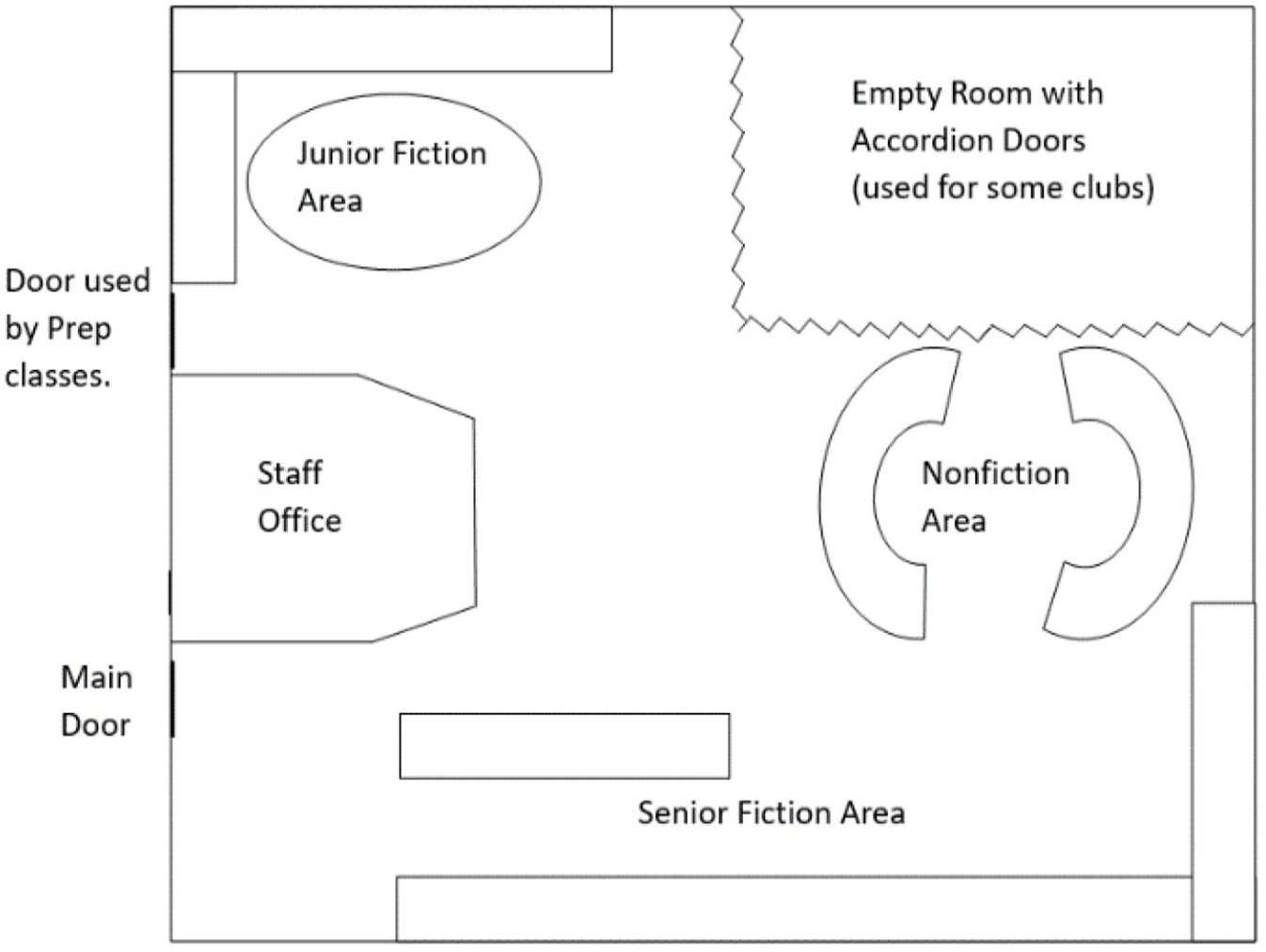
Approximate layout of the library.
The physical separation of books into junior fiction and senior fiction categories may have influenced student perceptions of book difficulty (Harper, 2016; Koen and Lesneski, 2019). This impact was apparent in 1 year 5 student’s description of the library’s book range:
They don’t have a very wide range of difficulty. Because if you if you only have easy (points to the junior fiction section) and hard books (points to the senior fiction section), there’s (pause), if someone’s not very good at reading they’ll be stuck on easy ones. Since they can’t jump to hard, they’re gonna take so long to get to the hard books. (Year 5 Student)
The layout appears to have created a perceived dichotomy between ‘easy’ and ‘hard’ books. This potentially limited students’ awareness of intermediate reading options.
In the focus groups, students made few comments about library staff. In fact, no student mentioned receiving book recommendations from library staff tailored to their interests and abilities. This may be explained by the school’s decision not to employ a dually qualified teacher librarian, unlike school libraries in the previous studies. The absence of a teacher librarian may have contributed to students’ perceptions of inadequate book selection, as curating suitable collections and promoting them to students are key roles of teacher librarians (Wine et al., 2023). Our finding resonates with the trends observed in the school library impact studies (e.g. Lance and Kachel, 2018; Lance and Schwarz, 2012), particularly concerning the connection between the role of the teacher librarian and student support to access and use information effectively for learning. The impact studies pointed to the benefits of schools employing qualified teacher librarians who are uniquely placed to foster powerful links between school library programmes, resources, and student achievement. Teacher librarians have multifaceted roles, including not only traditional library management but also direct teaching of classes, collaboration with teachers, and support with technology integration. In the absence of a dedicated teacher librarian, students in our study missed out on receiving guidance from an expert in children’s literature, teaching, and typical child development when selecting books to read from the library collection; advice that might have lifted their engagement with reading and the perceived usefulness of the library for learning. This study’s findings underscore the important role played by teacher librarians in facilitating information literacy and learning in the school library. Despite this limitation, both quantitative and qualitative data indicated that reading remained the library’s core function, primarily serving as a space for reading and borrowing new books.
Key focus 2: Research
This study investigated two aspects related to information literacy in the school library context: students’ research skills for getting information, and those for using information in their studies. The following sections present our findings for getting and using information under the combined heading of research.
Getting information
Participants in the study indicated that their school library provided the least help with this aspect (see Table 2).
Perceptions of the school library’s help with getting information.
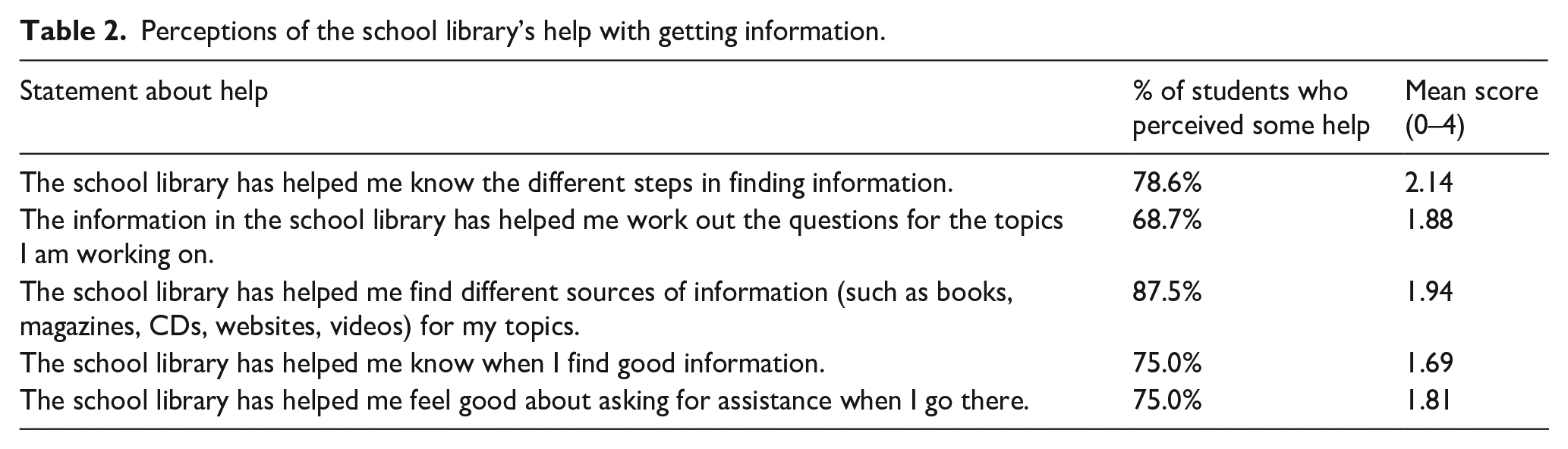
Overall, a smaller proportion of students reported receiving help with getting information from their school library in this study when compared with reading. To find out more, this topic was discussed in the focus group interviews. Here, it became clear that whilst students perceived the library as a potentially useful place to find information, they had not personally used it in this way:
Interviewer: If you had to try and learn something new for school, like about a new topic, would you come to the library?
(Year 4) Student 1: Probably.
(Year 4) Student 3: Yeah, probably.
Interviewer: Yeah? Can you think of a time you did do that? Something at school that you [Cut off by Student 1]
(Year 4) Student 1: Never done that.
(Year 4) Student 2: I’ve never done that.
Notably, students indicated that they would hypothetically use the library for research but had not done so in practice. They attributed this discrepancy to their increased access to and use of digital technology in learning, which lessened their need for physical library resources:
I just look on Google and find the book, then the information, then I’ll, like, copy all this down. (Year 4 Student)
Seesaw [App used by the school] said use the definition, use the dictionary definition of the certain items so. . . I just copied it and pasted from the dictionary. (Year 4 Student)
Such comments are consistent with previous research indicating that students in contemporary classrooms rely less on physical texts for research, preferring to search the internet (Szymkowiak et al., 2021). This trend is likely exacerbated by the absence of computers in the school library, and the provision of personal iPad for each student’s schoolwork. One year 4 student characterised the extent of technology use in their learning context:
‘This is an iPad school; the only thing that it feels like we’re doing all day is iPads’. (Year 4 Student).
A surprising theme emerged across the three focus groups regarding information retrieval: students’ passion for the now-removed library Online Public Access Catalogue (OPAC) computer, affectionately dubbed the book dictionary. Several comments highlighted this tool for locating books in the library catalogue:
A book dictionary, yeah, to help you find books. (Year 4 Student)
Yeah, since there was a laptop here for people to search up, like, what books there are. (Year 5 Student)
The one over there; it was used to help us find books. (Year 5 Student)
Interviewer: What did you use them [computers in the library] for?
(Year 6) Student 2: Searching for books.
Interviewer: Yeah? Anything else?
(Year 6) Student 2: No.
Despite not being asked about this computer directly, students in every focus group brought up the OPAC computer during the interviews. In particular, the Year 5 focus group engaged in a lively discussion:
Year 5 Student 1: I remember doing that; I used to search up, like, you could set up the different categories. You can. . . you didn’t have to, like, just search name. You could search on the author name, the genre, everything; it was like you could search up anything. You could search stuff, like. . . Could you search up the illustrator (directed at other students)?
Year 5 Student 4: Yeah.
Year 5 Student 2: Oh, sure. Yeah.
Year 5 Student 3: I think, yeah.
Interviewer: Do you wish you still had that computer?
Year 5 Student 3: Yes.
Year 5 Student 2: Yes.
Year 5 Student 4: Yes.
Year 5 Student 1: That computer was very helpful.
The students’ desire for the return of the OPAC computer despite their access to iPads offers interesting insight into the nature of information seeking. This finding suggests that the students valued the ability to independently search for and locate information, and saw the OPAC computer as a tool that empowered them to take ownership of their information seeking. This reflects research by Loh et al. (2022) and Thomas et al. (2020), who found that equipping students with skills to use and search the library independently had significant benefits. These skills enabled children to find books and resources without direct assistance from an adult. Without the OPAC computer or a teacher librarian, finding useful information to support learning in this library became more difficult.
Students in each focus group commented that the OPAC computer had been removed due to inappropriate use, such as searching for unsuitable terms or some students ‘hogging’ the computer. Students suggested various strategies to reinstate the OPAC computer, further highlighting the value they placed on it.
But um, there has to be a rule. . . Or they could stop hogging it. (Year 5 Student)
You could have like a service desk; you could have someone that searches up the books. (Year 5 Student)
Students indicated that the library previously had more staff, which allowed them to access the OPAC computer more easily:
There were two teachers, or two subs in here. One could be over there so that people aren’t typing up rude stuff. (Year 5 Student)
This comment raises an important aspect of research into school libraries. The school lacked a teacher librarian—someone dually qualified in librarianship and teaching. Research strongly supports the idea that teacher librarians and human resources in libraries are highly beneficial for students, particularly in learning research skills (APHRSCET, 2010; Godfree and Neilson, 2018; Hughes et al., 2014; Lonsdale, 2003; Spisak, 2021). Consequently, students at this school did not have access to a specially trained adult to support their use of the library for getting new information. With the removal of the OPAC computer, students were literally and figuratively left to their own devices, limiting the library’s overall utility for information retrieval. Overall, while the students valued the ability to use the library independently, they perceived a lack of reliable tools to find information and resources for school projects.
Using information
Also under the heading of research, the study investigated how the library supported students to use information for learning. The findings in this area are closely linked to those discussed above for getting information, as a person’s ability to use information clearly depends on them initially finding information in the library. Table 3 shows the results for this aspect.
Perceptions of the school library’s help with using information.
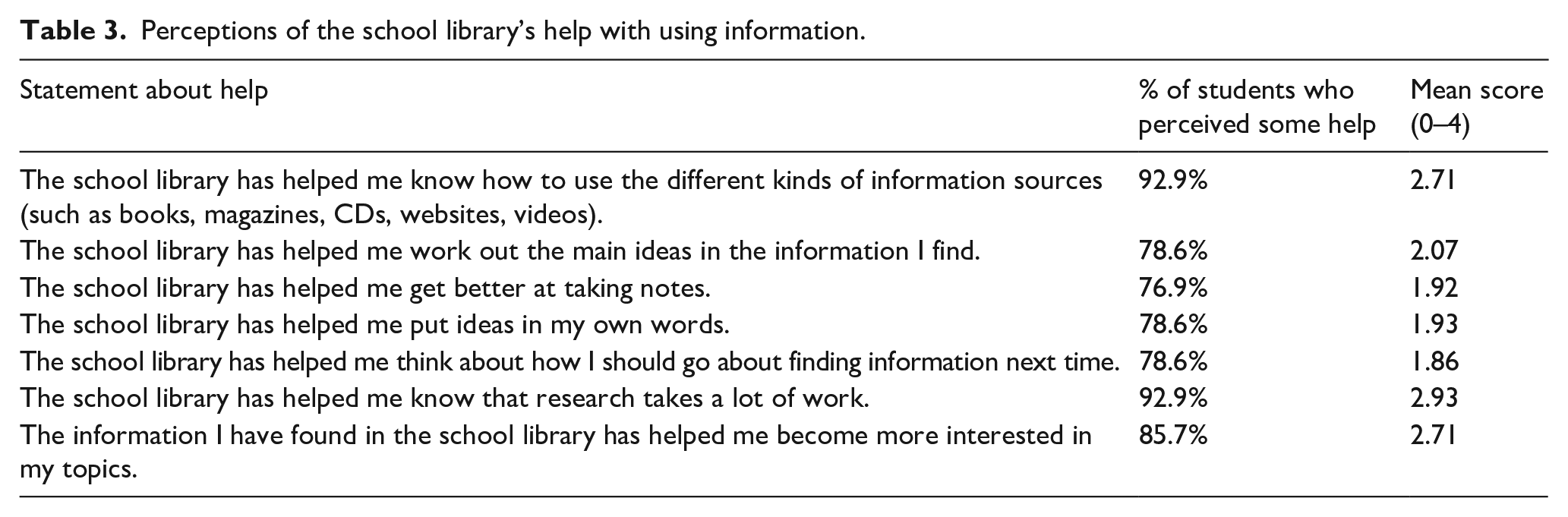
In the focus groups, no student mentioned receiving help to use information found in the library, likely influenced by contextual factors. Students visited the library weekly, escorted by the Physical Education teacher, but were not directly taught in the library. According to Godfree and Neilson (2018), Spisak (2021), and several others (e.g. APHRSCET, 2010; Hughes et al., 2014; Lonsdale, 2003), the learning experience and support offered by a teacher librarian have the most significant impact on student learning in school libraries. The absence of a teacher librarian, lack of instructional time in the library, removal of the library’s OPAC computer, and students’ ready access to the internet via personal devices all appeared to impact students’ perceptions of receiving help in finding and using information in the library. Decisions made by school leadership, such as not employing a teacher librarian and removing the OPAC computer and computers previously used for research and writing, made it more challenging for students to use the library for finding and using information.
Key focus 3: Computers
The final focus of the study related to how the library helped students to use computers to support learning and schoolwork. While school libraries were widely used as technology hubs in schools in the 2000s and 2010s (Hay, 2005; Todd and Kuhlthau, 2005), major changes in the digital landscape since then led us to anticipate that students’ responses about this aspect would differ considerably. Accordingly, fewer students in this study indicated receiving at least some help from the library to use computers and technology (see Table 4).
Perceptions of the school library’s help with computer use.
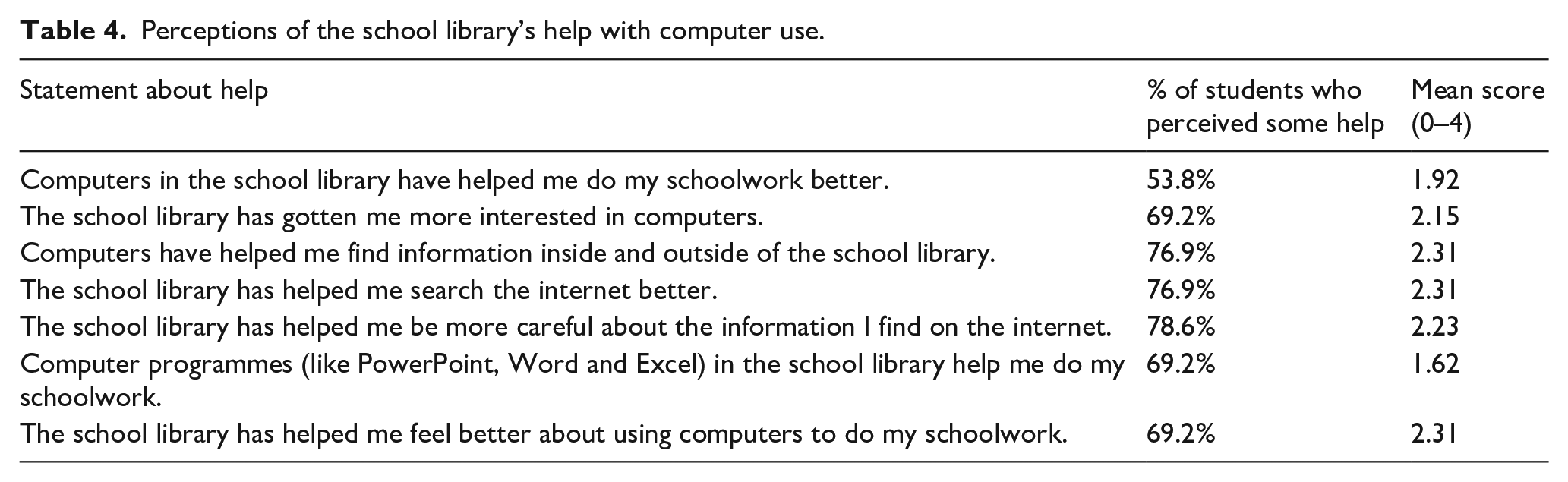
When considered by year level, there was a notable difference in these results: the Year 6 students often rated the library as very helpful, whilst Year 4 students reported receiving no help. This discrepancy was explored further in the focus groups, revealing that the removal of computers from the library impacted these perceptions, as highlighted by the following student comments:
Because they’d [Year 6 students] have been in higher grades, when they were there. And they know how to use them [the library computers]. (Year 4 Student).
I was in Grade 1 or prep [when there were computers in the library], so I didn’t get to use them. (Year 4 Student)
Year 4 students had only been in their first years of school when the computers were removed, while Year 6 students had experienced several years of using library computers before they were removed. Some students were unaware that the library ever had computers, aside from the OPAC computer removed in early 2023. Those who remembered the library computers mostly reported using them for playing computer games rather than school-related activities. For example:
There were laptops and computers, and you could play games like Minecraft and that. (Year 6 Student)
The students did not express a desire for the return of these computers. Despite wanting the OPAC computer back, they perceived their personal iPads to be more useful for supporting schoolwork than library computers.
Interviewer: So, if there were computers still here, do you think you would use them, or would you just still use your iPad?
(Year 4) Student 2: Yeah, probably not.
(Year 4) Student 4: Probably not.
(Year 4) Student 3: Probably not.
(Year 4) Student 1: Probably iPad.
Students further highlighted that library computers were unnecessary when all students had access to their own school iPad. However, students expressed a desire to be allowed to use their iPads in the library.
(Year 4) Student 1: I’d come here with my iPad.
Interviewer: You’d come here with the iPad?
(Year 4) Student 3: Yeah.
Interviewer: Do you do that already?
(Year 4) Student 3: No
(Year 4) Student 1: It’s quiet in here.
(Year 4) Student 2: And we’re not allowed to.
(Year 4) Student 1: I want to.
This indicates that students perceived the library primarily as a place for quiet reading or selecting books to borrow rather than as a space for learning or technology use. Research highlights the concept of libraries as third spaces—neither home nor work but a safe social place for various activities (Grey, 2017; Korodaj, 2019). During the focus group interviews, students discussed the library’s use for different technological clubs and activities:
In Year 5 we used to come up here for a Technology Unit to use the Bee Bots [programmable robots] and know how they work. (Year 5 Student)
And when they had drone club up in here, we had to make something to be delivered by drone and we had to fly drones in here. (Year 6 Student)
It was evident from these comments that this library’s role in the school had shifted several times in recent years. However, for most students at the time of the study, the library primarily served as a quiet space to store the school’s book collection—a museum with little human activity rather than a vibrant learning or technology hub. Teacher librarians, with their specialised skills in managing and supporting children’s learning with new technologies, play an important role in enhancing the usefulness of school libraries (Ejikeme and Okpala, 2017; Lupton, 2016; Wine, 2016). Effective collaboration between librarians, teacher librarians, and teachers is essential for addressing the learning needs of students in contemporary primary schools, particularly struggling and reluctant readers. Teacher librarians offer expertise in literacy resources and differentiated support for learners (Merga, 2019b), and it is quite possible that student perceptions of the helpfulness of their school library would increase with the employment of a dedicated teacher librarian. This may also improve the school’s NAPLAN test scores, which were lower than those of similar Australian primary schools at the time of the study (Australian Curriculum, Assessment and Reporting Authority, 2025). The absence of a teacher librarian at this school was likely a key factor limiting the library’s helpfulness.
Conclusion and implications
This study explored Year 4, 5, and 6 students’ perceptions of help from a school library without a teacher librarian. The findings highlight the evolving roles played by school libraries in the digital age. While students in the study reported receiving more help with reading, borrowing books had become the primary function of the library. Students overall perceived their library to be less helpful for research (i.e. getting and using information) and for using computers. The students’ perceptions were influenced by the absence of a teacher librarian, the removal of research tools that allow for independent information seeking like the OPAC computer, and the shift towards personal digital devices.
The study found that students viewed the library mainly as a place for book borrowing rather than as a dedicated space to develop their reading skills. Most students believed the library helped them read more, but fewer saw it as directly contributing to their reading development. The students also did not predominantly view the library as a space for supporting their research skills, or somewhere to engage with technology for learning. Helping to explain these findings, library staff did not directly foster students’ reading, research, or computer skills, limiting the helpfulness of the library for learning purposes.
Students expressed a strong desire for a wider and more diverse selection of books, with a greater variety of fiction and nonfiction texts. The perceived lack of student agency in book selection was a clear limitation. Addressing this issue by implementing a book request system driven by students could enhance their engagement in reading and thereby increase the library’s support for reading.
Despite the benefits of the mixed methods design, the study had several limitations, including a small sample size of 17 students from a single school, which limits the generalisability of the findings. The study also only used four of the seven scales from the original Todd and Kuhlthau (2005) survey.
The findings suggest a need for further research investigating how students perceive their school libraries across different contexts and larger sample sizes. Further studies could also compare student perceptions between schools that employ teacher librarians and those that do not, given the documented importance of teacher librarians (Hughes et al., 2014; Wine et al., 2023) and trends of their decreasing employment (Dix et al., 2020).
Practically, the research highlights the importance of involving students in decisions about their school libraries. It also points to the consequences of not employing teacher librarians who are uniquely skilled in supporting students’ reading, research, and technology skills. In this context, the lack of engagement between library staff and students led to a situation where students had little input on the library’s layout, contents, or use, potentially limiting the library’s positive impact on learning (Godfree and Neilson, 2018; Hughes et al., 2014). Strong connections between library staff and students are essential to help school libraries serve student needs and support them to make the most productive use of their time in the informative and literary worlds that libraries afford.
As school libraries continue to evolve, it is essential for them to adapt and innovate in their roles and physical layouts to support student engagement and learning. By acknowledging and responding to student perceptions and preferences, decision makers can ensure that school libraries remain valuable assets that promote learning and foster curiosity in an increasingly digital age.
Footnotes
Appendix 1: Survey Questions (drawn from Todd and Kuhlthau,2005 )
Scale 1: Help with reading
Scale 2: Help with getting information
Scale 3: Help with using information
Scale 4: Help with using computers
Appendix 2: Semi Structured Interview Questions
Help with reading:
Help with research (getting and using information):
Help with using computers:
Declaration of conflicting interests
The author(s) declared no potential conflicts of interest with respect to the research, authorship, and/or publication of this article.
Funding
The author(s) received no financial support for the research, authorship, and/or publication of this article.
