



Abstract
Studies have shown that public libraries, one of the most trusted social institutions, play an important role in helping immigrants adjust to their host country. Although there have been quite a few international studies reporting the role that public libraries play in newcomers lives in the host country, few studies, especially in the context of the U.S., comprehensively reported local public libraries’ role in newcomers’ social integration. Previous studies on immigrants’ usage of public libraries have mainly focused on highlighting public libraries as meeting places that facilitate social capital creation for newcomers or describing the usage of public libraries among newcomer populations. Using a qualitative research design, 30 semi-structured interviews were conducted with Bangladeshi immigrants living in Queens, New York. The study finds that the Queens Public Library (QPL), one of the largest public library systems in the U.S., played an important role in many Bangladeshi immigrants and their families’ social integration into New York after arrival. The library space serves more than a meeting place or a place for social capital creation. The findings suggest that local public libraries serve as important places for newcomers’ social integration by offering a range of services and programs that meet the diverse needs of immigrants after their arrival, including educational, employment, technological, and reading. Bangladeshi immigrants also reported using public library spaces to cope with migration-related stress for themselves and their families.
Keywords
Introduction
Public libraries, one of the most trusted social institutions globally, play an important role in helping immigrants adjust to their host countries. Some research worldwide (e.g. Audunson et al., 2011; Johnston, 2016; Shepherd et al., 2018; Shuva, 2023; van der Linden et al., 2014; Vårheim, 2014) emphasizes the significant role that public libraries play in newcomers’ adjustment in a new country, including serving as meeting places (e.g. Audunson et al., 2011), a place for political integration (e.g. Johnston and Audunson, 2019), and public libraries as an institution for newcomers’ settlement (e.g. Shuva, 2023).
New York City is home to over 3.1 million immigrants (Pavilon and Virgin, 2022), and many newcomers to New York move from countries with vulnerable public library systems (e.g. Afghanistan, Bangladesh, and Uganda). Despite public libraries in New York City having some of the best library services and programing for diverse populations, including immigrants, there is a lack of academic research on the role of public libraries in immigrants’ integration in New York after arrival. Penninx (2019) defined integration as “the process of settlement of newcomers in a given society, to the interaction of these newcomers with the host society, and to the social change that follows immigration.” According to the Migration Policy Institute (n.d), immigrant integration is “the process of economic mobility and social inclusion for newcomers and their children. As such, integration touches upon the institutions and mechanisms that promote development and growth within society, including early childhood care; elementary, postsecondary, and adult education systems; workforce development; health care; provision of government services to communities with linguistic diversity; and more.” In the context of this study, the public library as a place for social integration refers to the many services and programs offered by local public libraries, such as language and job assistance and educational services aiming at supporting immigrants’ settlement and integration in the new society. Local public libraries may also serve as a place for helping newcomers deal with migrational stresses and for social capital building that helps newcomers to be part of the host country. It is beyond the scope of this paper to define immigrants’ integration. Readers interested in the many dimensions of integration concepts and theories can consult Penninx and Garcés-Mascareñas (2016), Penninx (2019), Spencer and Charsley (2021).
Although some studies conducted in many cities around the world (e.g. Audunson et al., 2011; van der Linden et al., 2014) report the usage of public libraries among immigrant communities and the role it plays in their lives, there is a lack of recent academic research in the context of New York on how diverse immigrant communities use local public library services and resources and what, if any, role do local public library services play in their integration. Given that New York welcomes immigrants from across the globe, it is important that we explore the usage of libraries among diverse immigrant communities to better understand public library usage and the role local public libraries play or could play in immigrants’ integration. Moreover, although previous studies on immigrants have highlighted the value of public libraries as meeting places that help build social capital for newcomers, few have explored the role of public libraries beyond serving as meeting places. This paper starts to fill these gaps with a systematic study of how one of the largest immigrant communities in Queens, Bangladeshi immigrants, use public libraries in New York. It specifically examines local public library use among Bangladeshi community members after their arrival and documents the role that public libraries play(ed) in their integration.
Research questions
The following research questions guided this study.
RQ1. How do Bangladeshi immigrants use public libraries after arriving in Queens, New York?
RQ2. What role do public libraries play (or do not play) in supporting immigrants’ social integration?
Literature review
When immigrants move to a new country, they leave behind social networks and social capital. Newcomers to a new country may face significant challenges in building social capital and may experience acculturative stress. Not surprisingly, there has been an increasing focus among LIS researchers globally on understanding the role of public libraries in helping newcomers build social networks and social capital in host countries. Studies show how libraries work as “meeting places” for newcomers and how the social networking created at the library helps newcomers with inclusion and integration into the new society. Many of these studies (e.g. Audunson et al., 2011) utilized the concept of “social capital” popularized by Putnam (1995, 2000), in addition to other concepts, to highlight how the use of local public libraries in the host country helps newcomers build social capital in a new country. Putnam’s (2000) concept of bridging and bonding social capital helps us understand public libraries’ role in creating bridging social capital, mainly how public libraries help newcomers interact with multicultural societies in cities like New York. Bonding social capital is usually formed among individuals with similar socioeconomic characteristics through relationships between closely knit groups, such as families and friends. On the other hand, bridging social capital refers to connections between individuals from different communities, including those with diverse cultural, socioeconomic, or other backgrounds.
In one of the most cited papers on public libraries as meeting places, Audunson (2005) introduced the concepts of high intensive and low intensive meeting places. High intensive meeting places are typically regarded as arenas in which we engage in our most important involvements and values. On the other hand, low-intensive meeting places are arenas where individuals can interact with people who may possess values and interests different from their own. For newcomers, low-intensive meeting places such as public libraries in a multicultural society allow them to encounter people belonging to different cultures and values. Using the concepts of high intensive and low intensive meeting place, Audunson et al. (2011) described the role played by public libraries in Norway in supporting women immigrants’ integration into Norway, including serving as a place for building social capital, learning a new language, and learning about the local culture. The study found that the library served as both high and low intensive meeting place and contributed to building social capital for women immigrants.
There have been many studies in the last two decades globally that highlight how library programing and services help newcomers settle in a new country. Few of these studies have been conducted in European countries. For example, Johnston (2016) emphasized the significant role played by the Malmö City Library for newcomers, as it assists them in enhancing their Swedish language skills and proficiency while acquiring various types of everyday life information to build social networks and capital. Another study by Johnston (2018) emphasized that conversation-based programing in public libraries may support social integration for newcomers to Denmark, Iceland, Norway, and Sweden. Johnston and Audunson (2019) revealed the potential of conversation-based programing to promote political integration of immigrants into the receiving country. The library programs enabled participants to enhance their language skills, build and expand their social networks, and engage in discussions on everyday life matters.
Other studies across the globe, such as Khoir et al. (2017) and Shepherd et al. (2018), have also reported how libraries facilitate social capital creation among diverse immigrant populations. Khoir et al. (2017) reported that public libraries serve as meeting places and facilitate the building of social capital among Asian immigrants in Australia. Shepherd et al. (2018) found that public libraries in Canada played multiple roles in the settlement of newcomers by providing services and programing, including providing a space to study, improving language proficiency, and helping newcomers build social capital.
In the U.S. context, there has been little recent empirical research exploring the role of public libraries in immigrants’ social integration, despite the fact that approximately 14% of the U.S. population consists of immigrants. Although an earlier study by Fisher et al. (2004) did not comprehensively focus on understanding the role of public libraries in immigrants’ social integration, it did report the benefits immigrants received from using Queens Borough Public Library (QBPL). Burke (2008), using U.S. federal data from the 2002 Current Population Survey (CPS), reported the usage of local public libraries among various immigrant groups and the underlying factors affecting public library use among immigrants. Branyon’s (2017) study on immigrant women report local public libraries supporting language acquisition and cultural acclimation and working as place for comfort and consolation during difficult times, and meeting reading needs of the participants and their families. Based on a narrative literature review, Grossman et al. (2022) confirm public libraries offer programs and services that help immigrants with language acquisition and cultural acclimation in the host country. Vårheim (2014) reported a shift in social trust levels among first-generation Mexican immigrants who attended English as a Second Language (ESL), computer, and civics classes in six U.S. public libraries. These individuals initially exhibited minimal trust in anyone outside their family and friends. However, upon participating in library programs, they demonstrated greater trust in libraries, librarians, fellow students, and other library patrons.
Several studies on immigrants’ usage of public libraries and the role public libraries play have been conducted in the Canadian context. For example, participants of a mixed method study by Shuva (2023) reported the usage of public libraries in Canada after arrival, including using local public libraries to meet education and reading needs. The author highlighted how public libraries play an important role as one of the institutions of newcomers’ settlement in Canada. A recent study in Canada by Gupta et al. (2022) reported on library usage among South Asian users and the barriers faced by these groups. An earlier study by van der Linden et al. (2014) highlighted how public libraries in Canada serve as essential sources of information and support for immigrants throughout the various stages of settlement.
Although when immigrants move to a new country, they try to learn host country language and culture to better integrate with the host society, studies (e.g. Nomura and Caidi, 2013; Tsushima and Guardado, 2024) show immigrants continue to make effort to maintain and nurture their heritage language and culture. Research shows one of the reasons immigrants use local public libraries in the new country is to get access to multilingual collections and programing (Atlestam et al., 2011; Dali, 2004; Khoir et al., 2017). Immigrants’ preferences of reading books in native languages are evident in the studies such as Atlestam et al. (2011) and Dali (2004, 2012Initially [after arr). Public libraries in many countries play a crucial role in helping immigrants adjust to life by offering language classes, cultural programs, and resources in both host and heritage languages (Grossman et al., 2022). They offer multilingual, multicultural resources and services to help immigrants bridge with their home country language and culture (Dilevko and Dali, 2002; Little and Murray, 2024). Studies in LIS continue to advocate for building strong multilingual collections to support diverse immigrant communities with their reading needs (Dilevko and Dali, 2002; Ly, 2018).
As the brief literature review suggests, few studies have fully captured the role that public libraries play in newcomers’ social integration in adopted countries. Although several studies have been conducted in countries that accept immigrants, including refugees, many have focused on investigating the role of public libraries as meeting places for newcomers to build social networks and social capital in the host country. As is evident in the literature review, very few studies in the context of the U.S. have comprehensively examined the usage of public libraries among various immigration populations and the role of public libraries in social integration. In the context of New York, although New York is home to some of the largest and busiest public library systems in the world serving diverse communities, including immigrants, there is little recent academic research exploring the usage of local public libraries and their role in helping newcomers adjust to life in New York society. It is essential to examine how immigrants use public libraries and the role that public libraries play or could play in newcomers’ settlement in American society to better understand the value of local libraries in immigrants’ lives in New York. Excerpted from a study on public library usage among Bangladeshi immigrants in Queens, this study reports the use of public libraries among Bangladeshi immigrants after arriving in New York and the role of local public libraries in their settlement in American society.
Research methods
Interviews are suitable methods for gathering data on people’s experiences, attitudes, perceptions, opinions, and beliefs, and for comprehensively understanding the phenomenon under study (Brinkmann, 2014; DeJonckheere and Vaughn, 2019). In order to explore public library usage and reading practices among Bangladeshi immigrants in Queens, after ethics approval from author’s institution, between August 2023 and September 2023, the author conducted 30 semi-structured interviews with Bangladeshi immigrants living in Queens, New York. Bangladesh immigrants form one of the largest immigrant communities in Queens. Although Bangladeshi immigrants live in various cities in the U.S. (e.g. Detroit and Washington, DC), the largest number of Bangladeshis (approximately 93,000) live in New York City (Pew Research Center, 2021), and a majority of those reside in Queens, NY (Asian American Federation, 2019; NYC Mayor’s Office of Immigrant Affairs, 2021). Bangladesh, a South Asian country, shares numerous cultural practices with India and Pakistan and faces similar socioeconomic problems. It is beyond the scope of this study to discuss the history and pattern of Bangladeshi immigration in the U.S. Readers interested in learning about the Bangladeshi diaspora in the U.S. may consult Ahmed (2021) and Akhter and Yang (2023).
In this study, of 30 interviews conducted, two interviews were conducted face-to-face, seven via Zoom and 21 via telephone. All interviews were audio-recorded for transcription. The interviews lasted between 24 and 59 minutes. The semi-structured interview guide consisted of questions related to participants’ use of the public library immediately after arrival to Queens, their use of settlement services, their public library usage while they were in Bangladesh as well as questions related to their reading practices. This paper reports the findings on the public library usage that occurred immediately after arrival to Queens. Therefore, although many of them were long-term immigrants at the time of the interview, they reported their public library usage as newcomers to New York.
Although the study was on Bangladeshi immigrants’ public library usage in Queens, similar to previous studies on immigrants’ usage of local public libraries (e.g. Gupta et al., 2022; Shuva, 2023), the authors did not recruit participants from the Queens Public Library branches. To reduce some bias, such as recruiting participants who were not regular public library users at the time of the interview but did use the local public library after arrival to New York, the author decided to recruit participants outside library premises. As a core focus of the study was to explore the public library usage among Bangladeshi immigrants, the potential participants needed to visit the local public library at least once after arrival to New York so that they were able to share their experience using the local public library.
In this study, all participants mentioned using the QPL after arrival and described their experiences of using various branches of the QPL. Established in 1896, Queens Public Library is one of North America’s largest public library systems, serving diverse patrons in New York. In 2023, more than 5,600,000 visitors visited QPL branches, and QPL circulated over 7,700,000 books, periodicals, and digital materials in addition to numerous programs and services offered to its patrons. For more information about QPL, please visit https://www.queenslibrary.org/about-us/queens-public-library-overview.
In this study, participants were given the option to participate in the interviews in Bengali or English. Not surprisingly, since Bengali was the participants’ native language, they preferred to participate in the Bengali interviews. Only three interviews were conducted in English, and Bengali words/sentences were frequently used. The participants were given $50 cash for a face-to-face interview or $50 eGift cards for telephone/zoom interview for their valuable time participating in the study.
To be eligible to participate in this study, the participants had to meet the following criteria:
• Were Bangladeshi
• Were between the ages of 18–65
• Were residents of Queens, New York
• Used public libraries in Queens at least once after moving from Bangladesh to Queens, New York
• Were a parent of a child(ren)
• Were proficient in either Bengali or English
The author recruited participants using a mixture of “convenience” and “purposive” sampling approaches. As evident in recent studies on immigrants’ public library usage (e.g. Shuva, 2023) that many immigrants use public libraries for their children, the author purposefully selected participants with child(ren) to better understand Bangladeshi immigrants and their families public library usage and reading practices after moving to the U.S. The study did not recruit older adults (65+) since they are the focus of another study the author will soon begin working on. Future studies should consider researching public library usage by young immigrants without children/families and immigrant teenagers, among other groups.
The author used several recruitment strategies to recruit participants, such as attending Bangladeshi community programs and events organized by Bangladeshi co-ethnic organizations and Bangladeshi community members, advertising in one of the most widely circulated Bengali newspapers published in Queens, and posting recruitment posters on various co-ethnic social media sites. The author, a Bangladeshi citizen and a fluent Bengali speaker, held an insider position. Because of the author’s insider status, he quickly built rapport with the interview participants and gathered rich insights into their public library usage and reading practices. Building rapport is critical for conducting comprehensive qualitative interviews, because it enables researchers to obtain detailed insights into the subject matter being studied (McGrath et al., 2019; Sivell et al., 2019). Due to the author’s background and personal experiences, he could quickly grasp the respondents’ answers to interview questions and inquire further about their library usage experience in the U.S. and Bangladesh. His familiarity with Bangladeshi systems, culture, and politics has made this possible.
This paper was written part of a fellowship by the author’s university, where the paper was read by a group of researchers with varied methodological training in the social sciences. The comments received on drafts of this manuscript helped the author address questions concerning insider bias, identified strengths and weaknesses of the study, contributed to revised coding, and overall increased the rigor of the author’s research.
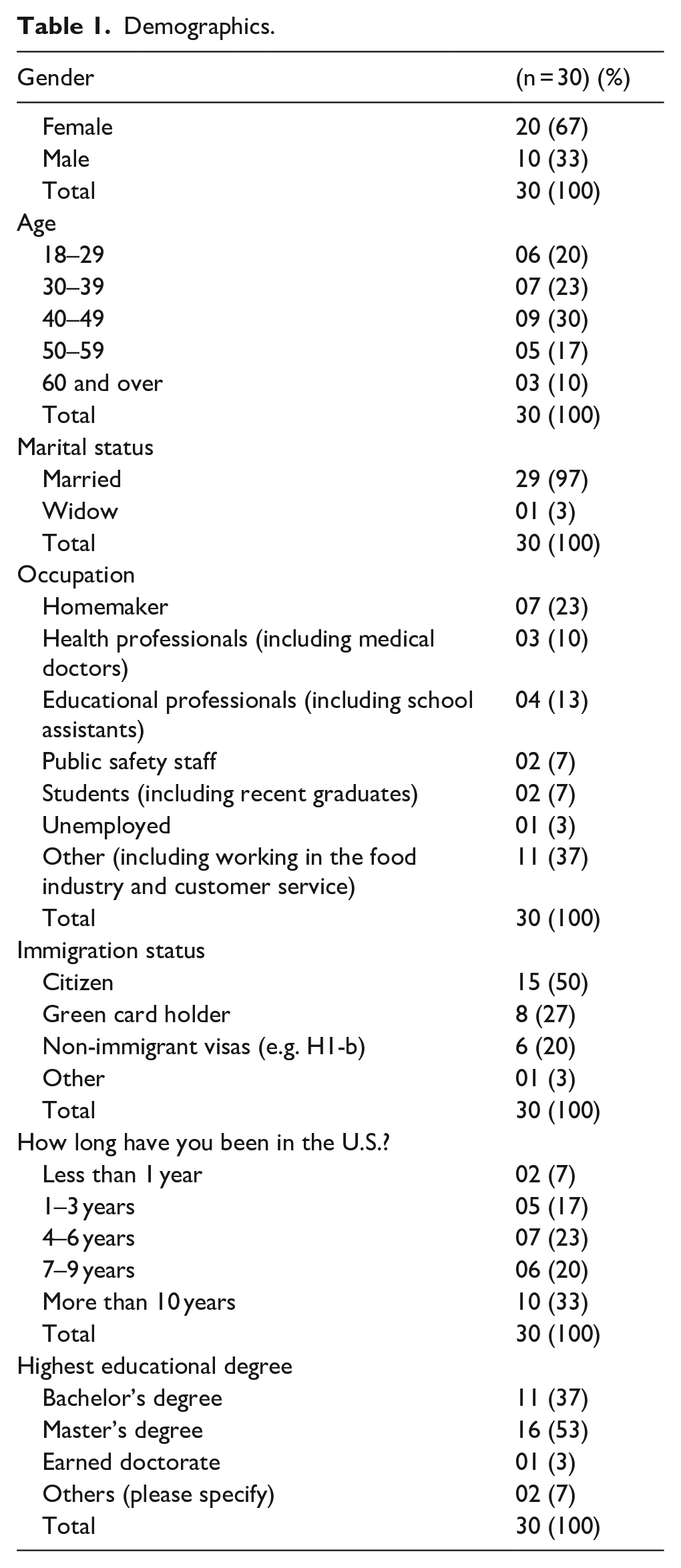
Of the 30 participants, 20 were female (67%) and ten were male (33%) (see Table 1). Most participants were married and between the ages of 18–49 (73%). Participants reported a variety of professions, including homemakers, health professionals, and working in the educational sector. Half of the participants (50%) were American citizens, and most (70%) reported being in the U.S. between1–9 years. Most of the participants reported achieving a university degree.
Demographics.
Interview data were coded using NVivo 14. Braun and Clarke’s (2006) six-phase “thematic analysis” guided the interview data coding and analysis. The interview data were transcribed by a U.S.-based professional transcription company and checked for accuracy by the author. Transcribed interviews were read and reread, and initial coding was conducted, generating initial codes through NVivo 14. The codes were then combined into potential themes, and their relevancy was checked with the coded extracts. Potential themes were revised and renamed multiple times. The final phase involved organizing the codes logically for analysis and presentation, and the author translated all quotes from Bengali to English while preserving the participants’ voices, including grammatically incorrect words. In most cases, few or no edits were made in the interviews conducted in English. Also, in most of the cases, no edits were made in the English sentences/words uttered by participants in interviews conducted in Bengali. In this study, pseudonyms were used in place of participants’ actual names. For interviews conducted in English, the term “English” was placed in brackets next to the participants’ names.
The study has some limitations. Many participants had been in the U.S. for more that over 5 years and therefore, the stories told by the participants regarding their use of public libraries and their roles in their lives may have been distorted by memory. However, because of their length, they could also reflect on the benefits that they received from using local public libraries. Another limitation is related to the recruitment of the participants. Participants were selected using non-probability sampling approaches and recruited mainly through social media and the author’s community networks in New York. Therefore, participants may not be representative of the Bangladeshi immigrant communities in New York. As reported by the participants, most obtained university degrees, making it a highly educated sample. They may not represent the usage/non-usage by vulnerable immigrant populations with limited or no education. It would be interesting to study immigrants with limited educational and language proficiency and how they perceive local public libraries, how they use them, and what role local public libraries play in their lives. Despite these limitations, this study, one of the recent studies on immigrants’ public library usage in the U.S., reports how Bangladeshi community members use public libraries after their arrival and the role that public libraries play(ed) in their integration.
Findings of the study
Participants were asked to report their experiences using the Queens Public Library after arriving in Queens, New York, including the services they had used. Based on participants’ perspectives, it was clear that the library played an important role in the settlement and social integration of many Bangladeshi immigrants in Queens. Participants recalled using various services, including technology-based services and training, English language assistance, job preparation assistance, and preparation for citizenship. Overall, local public libraries worked as places for newcomers’ settlement and social integration in New York. In the following section, the author presents data on how Bangladeshi immigrants in Queens used public libraries and the role those public libraries played in their social integration and inclusion in New York society. For better organization and readability, the findings are divided into three major categories. (i) Library as a place for immigrants’ settlement in the host country, (ii) Library as a place for meeting people and building social capital, and (iii) Library as a place for meeting educational, reading, and entertainment needs.
Library as a place for immigrants’ settlement in the host country
Many public libraries across North America that serve immigrant populations offer a variety of programs and services that aim to help immigrants settle into the host country. In this study, the author constructed several themes highlighting how libraries help newcomers with their social integration in the new country after their arrival. Although public libraries offer various services for diverse communities, many are aimed at supporting the population of newcomers, such as language programing and citizenship assistance. To increase the readability of the findings, several settlement roles that libraries served are grouped under the major category of “library as a place for immigrants’ settlement in the host country.”
Library as a place for getting assistance with job searching and preparations
In this study, many participants reported using various job-related programs offered at the QPL and how they benefited participants’ job preparation. They acknowledged differences in the CV/resume formats in the U.S. compared to Bangladesh and their need for familiarity with job search resources, including job-specific search engines in the U.S. For example, Parvin, who dreamed of working in airport customer service, reported getting help from the QPL, including learning about job-specific search engines. Parvin worked at one of the airports in New York at the time of the interview.
I dreamed of working at the airport, but I did not know how to get that job. When I went to QPL, I do not remember the name of the lady; she was [name of the ethnic group] and told me to check “Aviation Job Search,” where you would see many job postings for JFK and LaGuardia. She helped me prepare my CV for customer service positions. She helped me a lot in this regard. [. . .] I asked her, do you know how you get jobs at the airport? She said, “Go check that website; you will see aviation jobs.” I told her I don’t know how I will do that [search]. She sat beside me and helped me find that website. [. . .] I did not know about the link [website]. I did not know how to apply or what to do. (Parvin)
Several other participants reported using QPL job assistance services, including job skills training offered by the QPL. For example, a public safety staff member at the time of the interview, Dulal, reported taking the Occupational Safety and Health Administration (OSHA) certification and resume help at the QPL.
I did the training there [at QPL][. . .] I completed OSHA, the certification for the job [public safety]. I then built my resume there. (Dulal)
Another participant, Mim, claimed to have obtained a useful list of job search websites for part-time and full-time jobs from the QPL Central Library, which she was unaware of previously. An experienced information technology professional from Bangladesh, Khokon, who had been in Queens for 4 months at the time of the interview, was looking for a job in New York. He mentioned using the job preparation and assistance services at the QPL, including resume services.
My resume [in Bangladesh] was expansive [long]. My resume needed to be precise here. I was unable to use the appropriate keywords. Because I was going to the QPL, I was able to use the [right] keywords. As a result, my resume looks good and professional. It looks good to me [now]. (Khokon)
Another participant, Champa, who was working as a teacher assistant at the time of the interview, wanted to prepare for teacher-assistant positions in New York City after arrival. She was unaware of what she needed to do. Her relatives suggested visiting local public libraries to obtain information and resources to prepare her for teacher assistant exams. Following her relative’s advice, Champa visited the library and obtained information and resources on the Assessment of Teaching Assistant Skills (ATAS) exams. She told the author that newcomers do not have the ability to buy books after their arrival. It is possible for newcomers to access these expensive resources because of their access to local public libraries.
Library as a place to cope with migrational mental health issues, gain mental peace, comfort, and happiness
In this study, several participants reported story after story of how the Queens Public Library space helped them and their families adjust to the new society and with their mental health after moving to New York, as many had no family or relatives in New York and felt very lonely after their move to the U.S.
We used the library more at that time [immediately after moving to New York]. My daughter was in 5th grade. We moved here, leaving everything behind [in Bangladesh]. She used to read many books [after moving here]. At that time, we frequently visited [QPL]. [. . .] I took them to library activities frequently so that they did not feel lonely. I wanted them to adjust to this [new country]. I did that [took my children to the libraries]. [. . .] They used to be quiet at home and used to feel sad [because of the move.] They did not experience this [sadness] at the library. At the very least, I realized that. That’s why I used to take them to [QPL]. They were not bored. (Suraiya)
Like Suraiya, Bipasha, and Momo also echoed how visiting the library after moving to Queens helped their and their family’s mental health.
Initially, I felt depressed moving here, leaving my home country [. . .] [At the library] I used to chitchat with everyone that supported me, not to feel lonely. (Bipasha) [Visit to the QPL] They were very helpful [for mental health]. Because I don’t have many family members here. My husband, me, and my children. As no people [relatives] were nearby, I used to find time weekly to visit the public library. They [my kids] would spend some time, would read plus their friends were also visiting [the library branch]. I wanted this to happen [visiting the library], especially during the winter. (Momo)
Several participants reported using the local library to address their sadness or frustration.
Everyone needs at least a little bit of “me time.” I am taking care of my children 24/7 but I do not have any personal things. This can frustrate you. I would say I did not have that kind of frustration because I had a little bit of “me time.” I used to go to the library and read books comfortably. (Salma). When I am a little down, rather than going somewhere, I prefer to go to the Queens Public Library. (Razib)
Quite a few participants reported their and their families’ excitement and enjoyment in visiting local public libraries.
Initially [after arrival], my experience was very interesting. Because after going there [QPL], my children used to be so happy seeing colored pencils, coloring books, activities, and lots of beautiful books. So, looking at their happiness, I became excited, as they enjoyed it a lot. (Rabeya) I had to take care of my child [after arrival]. I couldn’t work because my husband was doing PhD [. . .] I was responsible for taking care of my family. I was just always home. When I took my child to the library, I saw a different environment. Kids were enjoying a lot [. . .] During the summer, I enjoyed a lot with my children [visiting the library]. (Jesmin)
Library as a place for meeting technological needs
Not surprisingly, many Bangladeshi families after arrival needed help to afford internet services and computer training courses after arriving in New York and relied heavily on the services offered by the QPL. For example, Parvin and Binu described how borrowing QPL WiFi hotspots helped them and their families access the internet.
They [QPL] offer WiFi [hotspots]. They are very useful. When I moved to a new house, I didn’t have an internet connection. So, I got it [a Wi-Fi hotspot]. That service was very good. (Parvin). I went to the library [after arrival], and we borrowed the WiFi hotspot that we had used for a long time. (Binu)
Some participants reported the value of basic computer classes offered at various QPL library branches free of cost. For example, Rabeya, a housewife at the time of the interview, told the author that basic computer courses were beneficial to her.
I was a housewife in Bangladesh, and as I was a housewife, what I knew about computers, I forgot everything over time. After moving here, I saw [computer courses] you can do free of cost, you don’t have to pay anything. You can do a course free of cost [at the QPL]. What more can you expect? Because initially [after moving here], I didn’t have any job. I can’t [couldn’t], you know, pay for something like this. If I wanted to learn those outside, I would have to pay a huge amount of money and dollars, but this was absolutely free. This is an opportunity for newcomers like us, who face great difficulties after moving here, and for those who have not yet started their jobs. (Rabeya)
Another participant, Parvin, who works at one of the airports’ customer care centers, described how the programs helped her gain basic computer knowledge after arriving in the U.S. and how the knowledge she gained was still helpful for her current work.
[She reported all services she received from the QPL after arrival.] Moreover, I wasn’t good at computers. Therefore, I completed the computer basic course [at QPL after arrival] [. . .] In terms of help with the job, when we were in Bangladesh, during our education, my husband and I did not use the computer much. I now work in customer care. I need to enter the names and ticket numbers. That [the course] really helped me a lot. (Parvin)
Some participants also reported using free printing and scanning services, as well as the internet services at the QPL. For example: Initially, after arrival, I used to go to the library mainly for internet use. You can use the internet using your [library] card. I didn’t have a computer at home. (Robi) I needed some papers to scan, so I asked the library [staff] how I would do so and they showed me. (Salma)
Library as a place for getting language help
Many participants in this study described using English language programs offered at QPL after arrival in Queens, New York, and how that benefited them by adjusting to the English language environment. For examples: I did not know English very well. So, I attended their free English classes. [. . .] I would say [learning] English is mandatory [for the newcomers]. I wasn’t good at English. I got a lot of help [attending English language programming at QPL], where they [taught] how to speak grammatically correct English words. (Parvin) When I came with my one child, I didn’t know anything [English language]. I gave birth to another child. After the birth, I did not go outside [of home]. I then enrolled in the ESL program [QPL]. I then saw how people speak [English]. Honestly, I did not know small words like hi, hello, thank you, and good [before attending the program]. (Jesmin)
Library as a place to bridge with home country language and culture
Many libraries serving multilingual and multicultural populations offer services and programing to help communities maintain their connections with their home countries by offering multilingual resources and organizing multicultural programs. Several participants in this study appreciated the books and resources in Bengali held in different branches of the QPL and the Bengali cultural programs organized by some QPL branches. They described how the local library comforted them by offering resources and programs in Bengali to bridge the home country’s culture after moving to New York City. For examples: When I came from Bangladesh, obviously when we come from Bangladesh, we miss our country so much. [. . .] In the Bengali section of the public library, I felt like I was in the little corner of my country. [Bangladesh]. I issued Bengali books. So, if there was a Bengali cultural program [at QPL] that at least comforted me, you know that okay, I am connected to my home country. That was comforting. (Salma) When I visit the section [Bengali book section], I feel like I am in Bangladesh [. . .] It feels really great. Whenever I go [to the library], I borrow these books [Bengali books]. (Parvin).
Library as a place for getting help with citizenship
Similar to many libraries in North America, the QPL offers citizenship and immigration assistance to new Americans and prospective citizens. Some participants reported getting help with their American citizenship preparation. For example, Parvin reported getting huge citizenship help from the QPL.
The most help I received [from the QPL] was the citizenship application [assistance]. I was not working in 2018; a lot of money would be needed [to apply for citizenship]. I was talking to a [name of a co-ethnic QPL librarian]. She told me to apply for citizenship. I told her I could not manage the money to apply [. . .] She told me, “We [QPL] offer free citizenship application help. We have our own lawyers.” I then took everything [the required documents] there. They processed my application completely. They then offered me a citizenship exam [preparation]. That helped me a lot. After that, in 2019, I received my citizenship. (Parvin)
Afsana told the author that the QPL helped them prepare for American citizenship.
When I was not a citizen, [I wondered] what I needed to do to get citizenship and what books I needed to read; I received all that help from the library. (Afsana)
Library as a place for meeting people and building social capital
In this study, several participants reported meeting new people from their own culture and outside the library premises and making friendships. For example, Parvin, who knew no one in Queens, recalled meeting new people, including library staff and people from other cultures, and getting help with her initial settlement in Queens through the social networks she made at the library.
At that time [after moving to Queens], I did not know anything. I did not have relatives. So, how to enroll children in school, which school would be better for my children, and what tutors would be better, they offered me [information]. I did not understand how I would do homework [for children]. So, there were Bangladeshis and Spanish people who helped me, and they did not give me the feeling that I was new there. They accepted me so nicely that I still have a relationship with them. I feel like the Queens Library is part of my family. I still feel it, and I regularly visit [the QPL]. (Parvin).
Another participant, Razib, claimed to have met strangers on library premises and later became friends with many of them. He also recounted that his dad, who moved to New York from Bangladesh after retirement, heavily used QPL regularly and spent time with friends he met at the library premises. His dad, who was an educational professional and a poet, met several poets at the library and was able to participate in a literary award in the U.S., which he received. Until his death, he went to the library daily after breakfast. At the time of the interview, Champa, an educational assistant and an American citizen, recalled taking her children to library programing in Queens and meeting people with various cultural backgrounds, including people from Pakistan, India, and the U.S. She claimed that after COVID-19, those gatherings were discontinued.
Unsurprisingly, several participants reported building co-ethnic networks on library premises. Given that most of the Bangladeshi immigrants in this study used QPL branches (e.g. Queens Public Library at Central), where the Bangladeshi population was predominant, they met many Bangladeshi people in those branches. Some participants even claimed to be comfortable making friends with their co-ethnic networks compared to other immigrant groups.
I did not know a lot of people [co-ethnic] who were living seven blocks or six blocks away. [. . .] We did not know them. [QPL] is such a good place. When everyone came to [QPL], we met, and our friendships improved. I still have those friendships [connected to the people I met at the library] [. . .] I have been in America for 16 years, and the friendship I made at that time [at the library], I still have [still connected]. (Bipasha) I met many people [at the QPL]. I still have connections with them [. . .] As we are Bengali native speakers, we mingle more with our own cultural people [community]. That is why I met more Bengali people [at QPL]. (Maria)
Library as a place for meeting educational, reading, and entertainment needs
Several participants reported meeting their and their children’s educational, reading, and entertainment needs by using services offered by the QPL, including using their reading rooms, getting access to materials, and attending educational activities for children after arrival. For example, Harun, a retired government employee, recalled getting books to help prepare for the GMAT to meet the eligibility requirements for graduate admissions in the U.S. I had a master’s degree from back home, so I wanted to put in knowledge, but I did not have any work experience. So, I decided to pursue my master’s here, and I realized that I’ll have to take the GMAT. So, I started to borrow GMAT books from that same library, and sometimes, I spend my time in the library, but mostly I, you know, rented [borrowed], brought it home and did my study part at home. (Harun, English)
Many interview participants described using library space for reading, doing homework, assignments, or other educational activities. Doli, a recent graduate, recalled using the QPL space to do homework, class assignments, and presentations, as well as group work. Farzana, a graduate student at the time of the interview, reported using the QPL library reading space for her education during her undergraduate over her college library as she needed to stay closer to her mother, as her mother was staying home alone and was not adapting well in the new country. She reported heavy use of the library branch, which was a 10-minute walk from her home, instead of taking two buses to use her college library and being anxious about her mother.
The Queens Public Library offers various programing and services for young children, including Pre-K programing, to help them develop their early literacy skills. Many participants reported how various programing and activities for children in different branches of QPL helped with their children’s education and learning in New York. For example, Razib recalled how the QPL worked as her daughter’s first school and the benefits she received from attending QPL programs before enrolling in public school in Queens.
Her [my daughter’s] first school, you know, is the Queens Public Library. There is a program; I believe Pre-K, I mean for nursery for 2.5-3 years [children], they have a program for [practicing] schooling for your children [. . .] That preparation for schooling [part of the Pre-K program] gives children mental strength that school is not a place of fear. She went to school at four years. I found that all her friends were crying, but MashaAllah [God has willed it], my daughter did not cry. Instead, she tried to convince [comfort] others. The program she attended for one and a half years, I mean the idea she received about the school atmosphere [by attending the program] at the Queens Public Library. Her fear had already gone [by the time she started formal schooling]. (Razib)
Newcomers moving to the U.S. from countries with different education and curricula may need to assist their children with schoolwork. Newcomers in NYC may not be able to afford private tutoring. Some participants reported using the homework assistance offered at the QPL.
After school, I took my child to the [library] to do the homework, as she did not have a teacher [tutor]. Because when I moved to America, I didn’t have the [financial ability] that I would give her [private] tutors. So, I got help with her homework there [in the library]. (Bipasha) My children used to visit public libraries to complete their homework. They got a lot of help from the public library. [. . .] When I couldn’t help my son with his homework, my friends told me to send my children to the library to get homework help [. . .] The library branch was a little far from our home, and we faced commuting issues, yet they visited the library [for homework help]. (Maria)
In addition to homework assistance, QPL offers a variety of services and programing (e.g. storywalk and summer programs) for children and their families. Several participants reported participating in various library activities for their children. For example: I have been visiting Queens Library since 2009. At that time, my daughter was young. My visit to the library began with her visit. So, I used to take her. There were several programs for kids and summer programs. Moreover, they have computer facilities for children; children can explore various things, play, and even explore games. Furthermore, there are many educational things that are helpful for children. (Afsana)
One of the core functions of public libraries across the globe is to offer books and other materials to meet the reading needs of the community. In this study, almost all participants reported using the QPL to meet their own and their families’ reading needs. Many Bangladeshi immigrants in this study heavily utilized QPL resources and reading spaces to meet their educational and learning needs. For example, Farzana described how QPL helped with her educational needs in the U.S. My family’s financial situation at the time was a little on the rougher side, so I was under a program. I don’t remember the name of it, but they paid for it. They paid for my tuition and everything, but they didn’t pay for my textbooks. So, because of that, I was always in the library, whether I was borrowing books from [name of the educational institution], but I was mainly borrowing from the Queens Public Library, so I would always stay there and in the library to study after school because my mom, she was such a big fan of [name of the co-ethnic T.V. network], all these and I couldn’t [focus on study at home]. Our house was small, so I couldn’t study very well, just in the background. So, I would go to the public library. (Farzana, English).
Similarly, Salma told the author that she was regularly borrowing books and using library spaces for reading: From the very beginning [after arrival], I visit libraries, sit for some time, and read books. Then I issue books. That is my regular thing, which is issuing [borrowing] books and reading books at home [. . .] So, the library is a great place for that, you know, go there, and read quietly. Read peacefully and comfortably as long as you want until the library is closed; there are no issues. (Salma)
Many participants reported borrowing books from the library to meet their and their children’s reading needs.
I go to the public library for them [my children] for their books. In the same way, I saved money for books [textbooks], I tell them to go to the public library [. . .] You don’t need to buy books. (Lucky) From time to time, they [my children] had to borrow books from there and I had to assist them in managing their time. I was borrowing those books. I was returning those books. (Harun, English)
Some participants also claimed that the QPL met their entertainment needs after their arrival. They reported borrowing C.D.s/DVDs and watching movie screenings at different local library branches after arrival. From the participants’ perspectives, the QPL served as a place to meet the entertainment needs of Bangladeshi immigrants and their families in the U.S. For examples: I used [borrowed] a variety of CD cassettes [from the QPL]. I stayed at home at that time [after arrival]. During that time, I used a variety of audio and video cassettes. (Jesmin) When I first arrived, I couldn’t pass the time. So, I used to get movies from the library and used to watch them. (Afsana) They [QPL] used to screen movies on Saturdays at that time [after their arrival]. So, free movies with a big screen [. . .] If we could go to Queens Public Library, we could watch those movies on a big screen with a projector. Some quality time was there. (Razib).
Discussions
This study reported Bangladeshi immigrants’ public library usage after arrival to Queens. Bangladeshi immigrants in this study told story after story of their library usage after arrival and how that use was helpful for their integration into American society. The participants reported using public libraries for various reasons, including meeting their educational, reading, and entertainment needs, getting language help, and meeting technological needs. Many participants also reported how public libraries helped them with their job preparations and searching, building social capital, connecting them with their home country’s language and culture, and dealing with migrational mental health. The findings of this recent study corroborate with studies conducted in many countries that report public libraries helping newcomers gain host country language skills (e.g. Johnston, 2016; Shepherd et al., 2018), building social capital (e.g. Audunson et al., 2011; Vårheim, 2014), assistance with employment (e.g. Shuva, 2023), meeting educational, reading, entertainment, and other needs (e.g. Gupta et al., 2022; Shepherd et al., 2018), bridging home country language and culture (e.g. Audunson et al., 2011; Branyon, 2017), preparing for citizenship (e.g. Grossman et al., 2022) and overall, public libraries working as an institution of newcomers social integration in a new country (e.g. Shuva, 2023).
A significant number of studies in LIS for the last two decades extensively researched libraries as meeting places for newcomers that facilitate social capital creation in host societies. Because of some important studies (e.g. Audunson, 2005; Audunson et al., 2011; Vårheim, 2014), there has been little debate about whether libraries work as meeting places or facilitate social capital creation. The findings of this study suggest that libraries work more than a place for social capital creation. It works as one of the institutions of “social integration” for newcomers, helping them integrate into the host society by providing various services, including employment, language, and citizenship assistance. Bangladeshi immigrants reported QPL functioning as a place to deal with their migrational mental stress, help them connect with their home country’s language and culture, and help them build social capital in the U.S., among other functions.
Despite large-scale studies (e.g. Horrigan, 2015) reporting significant usage of public libraries by various populations, including immigrants, there is limited recent academic research on diverse immigrant communities that capture the usage of local public libraries by immigrants and the role the local public libraries play in immigrants’ lives after arrival to the U.S. For immigrants coming from developing countries, public libraries may be the only place to meet their and their families’ educational, reading, and entertainment needs in the U.S., as they may not be able to afford to buy books and other resources in the U.S. Moreover, many newcomers may not be able to afford to rent a house where they and their children can have their own places to read quietly. In this study, many Bangladeshi immigrants described the financial challenges they faced after arrival in New York and how QPL helped them meet their educational, reading, and entertainment needs. They reported significantly depending on QPL to get books and other resources for themselves and their families. Some participants also reported using the QPL space for their education. It is important to note here that Bangladeshi residents of New York City generally have lower family per capita incomes than the city’s overall population, and they experience higher poverty rates than all other New York City residents (Asian American Federation, 2019). Bangladeshi households in New York are also more likely to be overcrowded than households in general (Asian American Federation, 2019). Therefore, without access to QPL, many Bangladeshi immigrants would not be able to meet their and their family’s informational, educational, and other needs. In the context of this study, QPL functioned as an institution to support Bangladeshi immigrants’ various needs, including reading and technological needs. Previous studies (e.g. Gupta et al., 2022; Shepherd et al., 2018; Shuva, 2023) also report immigrants using local public libraries in the host country to meet their informational, educational, technological, and other needs.
When immigrants move to a new country, they face several settlement challenges, including acculturative and migrational stress (e.g. Dali, 2013a; Ndumu, 2019). Several participants of this study described how QPL spaces played an important role in dealing with migrational stress for them and their families. They reported visiting QPL frequently to tackle their depression and loneliness and to comfort them after moving to New York. They also reported using QPL frequently to help their children tackle their loneliness and sadness after moving to New York. Participants of this study also appreciated multilingual collections and programing at QPL and how that made them feel connected to their heritage language and culture and made them happy. Previous studies (e.g. Audunson et al., 2011; Chai, 2022) also reported local libraries functioning as places for consolation and comfort for diverse immigrant groups. Studies (e.g. Nomura and Caidi, 2013; Tsushima and Guardado, 2024) highlight immigrants desire to maintain and nurture home country language and culture. Similar to this study, several studies in LIS show the preferences and use of multilingual collections by diverse immigrant communities (e.g. Atlestam et al., 2011; Dali, 2004, 2012; Khoir et al., 2017). Studies show public libraries in many cities with immigrant populations offer multilingual collections and multicultural programing for diverse immigrant groups to help them bridge with home country language and culture and meet their reading needs (Dilevko and Dali, 2002; Grossman et al., 2022; Little and Murray, 2024). Although there has been some increase in immigrants’ public library usage research, how public library space helps newcomers deal with their migrational stress, helps them feel calm, comfortable, and happy, and help them connect with heritage language and culture has not received proper attention in recent studies. Future studies should consider comprehensively exploring how public library usage helps diverse immigrant groups tackle migrational stress and their families after arrival to new country in addition to the services and resources (e.g. employment and language assistance) offered to them to help them adjust to their lives in a new country.
The findings of this study suggest that QPL branches serve the many functions of informal “third places,” a concept developed by Oldenburg (1989/2023). Participants reported meeting in QPL branches for informal conversations, participating in various activities, and enjoying the use of public library spaces. There have been several studies that show how public libraries work as third places for diverse communities (e.g. Lawson, 2004; Wyatt and Leorke, 2024). However, there has been little research on immigrants that reports public libraries functioning as third places for newcomer populations. Although coffee shops, bookstores, and bars are among the great good places, as described by Oldenburg (1989/2023), that have the potential to support the well-being of individuals, access to these third places may not be an option for many newcomers’ community such as Bangladeshi immigrants, given the financial challenges they face after moving to a new country. For example, in New York, a report shows that many immigrants live in poverty (Asian American Federation, 2019; Shih and Khan, 2021) and Bangladeshi residents of New York City generally have lower family per capita incomes than the city’s overall population (Asian American Federation, 2019). This means some immigrant communities, such as Bangladeshi immigrants, may not be able to avail the benefits (e.g. meeting people and having pleasurable conversations) some of the third places offer, such as coffee shops, because of the struggle to make ends meet. Therefore, for immigrant communities struggling with financial challenges, local public libraries offer free programs and services that are useful for their well-being, that encourage pleasurable conversations, that help deal with stresses, and, overall, a place that immigrants can utilize for themselves and their families. While third places such as coffee shops and bookstores are important places, they may not be frequented by people struggling with financial challenges. Previous studies (e.g. Aabø and Audunson, 2012) found that libraries serve as first (home) and second places (workplace) in some contexts, as many patrons do activities such as using library space as a place for their work. This was beyond the scope of the study to comprehensively explore how public libraries function as third places for immigrant communities. Future studies should investigate whether local public libraries work as first, second, and/or third places and how local public libraries help immigrants with their well-being.
Some findings of this study would need further exploration by future public library researchers. For example, many Bangladeshi immigrants reported using QPL mainly for their children only. This may not be the case for immigrant communities coming from strong public library systems. Previous studies on immigrants such as Audunson et al. (2011), van der Linden et al. (2014), and Shuva (2023) report a lack of familiarity with library services in developed countries among immigrants from vulnerable public library systems. In the context of Bangladeshi immigrants, it is important to note that in Bangladesh, there are only 71 government public libraries (one library for about 2.4 million people), and they are less developed than the libraries in developed countries such as Australia, Canada, and the U.S. Moreover, public libraries in Bangladesh have not yet been able to introduce a fully-fledged online library system. Therefore, Bangladeshi immigrants may have limited familiarity with many services offered by local public libraries in New York (e.g. online resources, readers’ advisory services, etc.). The findings related to immigrants using local public libraries mainly for their children are important for public library professionals serving immigrants as it encourages them to think about how to best familiarize immigrant communities with the library services in developed countries. Further studies are warranted among other immigrant communities coming from developed and developing countries to explore whether there are differences in usage based on people’s previous library experience and culture. Studies on peoples’ experiences would help LIS professionals design need-based library services and help them create community outreach plans to connect newcomers’ communities with local public libraries.
Another finding that needs further exploration is related to libraries functioning as high intensive and low intensive meeting places for immigrants, the concepts developed by Audunson (2005). Previous studies in LIS (e.g. Audunson et al., 2011) found local public libraries functioning as low intensive and high intensive places for immigrant communities. In this study, it is evident that QPL also functioned as high intensive and low intensive meeting places where Bangladeshi community people were meeting others from their coethnic groups and outside of their culture and making lasting friendship. Given that most of the participants were living in the neighborhood where Bangladeshi population was predominant, they mostly reported meeting Bangladeshi community members at the library. Some even expressed their comfortability connecting with Bangladeshi community members over other immigrant communities. Therefore, although some participants reported meeting other immigrant communities in library premises, for Bangladeshi immigrants, QPL worked mainly as high intensive place. It would be interesting to explore whether other communities in New York or other large cities such as Toronto find the similar finding where immigrants mostly meet people from their coethnic networks in local libraries.
The study highlighted the value of researching various communities to better understand their library usage and its role in their lives. The findings clearly suggest that public libraries work more than a place for social capital creation for immigrants. The author urges public library researchers to explore how various immigrant communities use public libraries and what role local public libraries play in their social integration. The more studies we conduct on other immigrant groups, the better we will understand their usage of local public libraries. Those studies may also help us better understand immigrants’ perceptions about public libraries and their previous experiences using them. Exploring diverse immigrant groups’ pre- and post-arrival library usage would give us comprehensive understanding of whether there are any differences in library usage among immigrant communities across the globe and whether previous experiences play any role in their interactions with the local library systems in their host countries.
Conclusion
Although many Americans may afford to have access to technology-based services and meet their and their family’s informational, educational, psychological, and other needs without visiting local public libraries, for many communities, including immigrants and people living under poverty, the library is the only place to meet their and their family’s myriad informational, educational, technological and other needs. This study highlighted the role local public libraries played in supporting Bangladeshi immigrants’ adjustments to New York society. Bangladeshi immigrants in this study described their usage of QPL after arrival and how that usage helped them with the social integration in the U.S. This study did not capture all the social integration roles that public libraries play or could play, such as a place for political integration (e.g. Johnston and Audunson, 2019), nor all the services such as readers’ advisory services (e.g. Dali, 2010, 2013b) used by diverse immigrant populations. Using the lens of “public library as a place for immigrants’ social integration,” future studies should comprehensively explore the various roles of local public libraries in newcomers’ social integration in the host country. The author believes that conducting studies on diverse immigrant populations is important to holistically understand the diverse usage of local libraries among various immigrant groups, and the role that local public libraries play in their social integration in their host countries. How do immigrants use public libraries? What role do public libraries play in immigrants’ social integration in a new country context? What perceptions do immigrants have of public libraries? What challenges do new immigrants and their families face while accessing public libraries? Addressing these questions will help us to better understand library usage among diverse immigrant communities, the role that public libraries play in their integration, and areas to improve services for immigrant populations.
Footnotes
Acknowledgements
The author thanks the editor and the anonymous reviewers for their careful read and insightful comments that significantly helped revising the paper. The author gratefully acknowledges the contribution of the Faculty Fellowship Public Program (FFPP) sponsored by the Office of the Dean for Recruitment and Diversity, CUNY, that enabled the author to work on this paper during Spring 2024. The author would like to express his sincere gratitude to FFPP mentor Professor Lina Newton of Hunter College for her exceptional mentorship, careful read, and constructive feedback during the preparation of this manuscript. Special thanks to FFPP fellows for their useful feedback during the preparation of this paper. Finally, the author extends his deepest appreciation to the participants of this study for their willingness to share their experiences which was essential for the success of this study.
Declaration of conflicting interests
The author declared no potential conflicts of interest with respect to the research, authorship, and/or publication of this article.
Funding
The author disclosed receipt of the following financial support for the research, authorship, and/or publication of this article: Support for this project was provided by a PSC-CUNY Award (# 66081-0054), jointly funded by the Professional Staff Congress and the City University of New York.
