




Abstract
The present study contributes to information behavior research by examining how people seek and share information related to the threat of nuclear war. To achieve this, a sample of 1279 posts submitted to Quora—a social Q&A site—were scrutinized by means of qualitative content analysis. The analysis was based on identification of three question types indicative of attempts to seek information and five answer types expressive of information sharing. The findings indicate that the online participants mainly presented opinion questions, while the role of fact questions remained marginal. While sharing threat-related information, the participants primarily offered opinion answers. To a lesser extent, the repertoire of answers also included explanation, prediction, fact, action directive and encouragement answers. The predominance of opinion answers is understandable because there is no recent experience about the use of nuclear weapons against civil targets. Therefore, much of threat-related information shared in online discussion necessarily originates from people’s personal views of what a nuclear war and its effects could be like. The findings highlight that people mainly seek opinions of other people, rather than factual information about the threat of nuclear war.
Keywords
Introduction
The COVID-19 pandemic has significantly increased our awareness of the fact that we live in a risky world affected by diverse hazards and disasters. The Russo-Ukrainian war offers a recent example of a man-made disaster that has resulted in an enormous amount of human suffering. The war is a particularly worrying because Russia is a leading nuclear power state which has not foreclosed the possibility of using nuclear weapons to protect the country’s vital interests. This risk may materialize particularly if Ukraine with its allies would make an attempt to reconquer Crimea. Even a limited use of nuclear weapons can cause long-time damage to living environments in Europe, due to the nuclear fallout. The escalation of the war to a nuclear exchange between Russia and the United States could be fatal for humanity all over the world. From this perspective, it is understandable that the threat of nuclear war elicits worry among many people.
Like asteroids, nuclear war is a low-frequency but high-impact threat (Rendall, 2022: 783). Threats of this type tend to receive less attention than they deserve because they have not materialized recently. So far, nuclear weapons have used only twice when the United States bombed Hiroshima and Nagasaki in 1945 in the end of World War 2. In 1962, during the Cuba Missile Crisis, the world was on the edge of nuclear exchange. In the 1980s, during the Cold War between USA and Soviet Union, the risk of nuclear war was heightened considerably, due to near-misses and precarious false alarms (Armitage, 2022: 3). Currently, nine nuclear-armed states, that is, USA, Russia, China, India, France, the United Kingdom, Israel, Pakistan and North Korea possess altogether 12,700 nuclear weapons (Bollfrass and Herzog, 2022: 10). In recent years, the missile tests conducted by North Korea have elicited worry about the risk of using nuclear weapons. However, the Ukrainian crisis raised the risk to a new level. Reflecting the critical situation in January 2022, shortly before the outbreak of the war, the Bulletin of the Atomic Scientists’ editorial board announced that the Doomsday Clock is set at 100 seconds before midnight, which is the “closest it has ever been to civilization-ending apocalypse because the world remains stuck in an extremely dangerous moment” (Mecklin, 2019: 3). On February 24, 2022, the day Russia launched its full-scale invasion of Ukraine, President Vladimir Putin warned that “whoever tries to impede us, let alone create threats for our country and its people, must know that the Russian response will be immediate and lead to the consequences you have never seen in history” (Bollfrass and Herzog, 2022: 7). Such wording is traditionally considered to imply a threat to use of nuclear weapons. Putin went even further on February 27, 2022, announcing that Russia’s deterrent forces, which include nuclear weapons, are placed on a “special regime of alert” (Horowitz and Wachs, 2022).
Even though it is believed that in reality, Russia will not use nuclear weapons and that Putin just rattles his “nuclear saber” to intimidate Russia’s enemies, many people consider the threat of nuclear war to be real (Williams, 2022). The threat haunts in people’s minds and motivates them to seek and share information about the probability and consequences of war of this type. In information behavior research so far, there is a paucity of studies examining how people seek and share information about the threat of man-made catastrophic events. Most of the prior investigations have examined information seeking and sharing in the context of natural disasters such as floods and earthquakes (Rahmi et al., 2019), hurricanes (Lopatovska and Smiley, 2014) and bushfires (Choo and Nadarajah, 2014). The lack of prior studies on information seeking and sharing dealing with the threat of nuclear war is probably simply due that such threats have not materialized recently. There are also a few studies examining threat-related information seeking and sharing in contexts of man-made disasters such as terrorist attacks (Nellis, 2009) and mass shootings (Semenza and Bernau, 2022). However, the context of nuclear war is different because it represents a threat of a large-scale man-made event that has not yet materialized in times of an ongoing international crisis. Since there is no recent real-world experience about nuclear strikes against civil targets, it is evident that much of threat-related knowledge possessed by people is based on their personal views of what a nuclear war and its effects could be like. On the other hand, threat-related information is not solely based on people’s personal opinions because there is factual information available about certain issues affecting the nature of nuclear war, for example, the destructive force of nuclear weapons tested in experiments.
To examine the nature of threat-related information seeking and sharing in times of a heightened risk of nuclear war, an empirical study was made by analyzing a sample of posts submitted to Quora—a major social question and answer (Q&A) platform. The posts incorporate questions indicative of people’s attempts to seek information from fellow participants about this topic. Online participants may seek factual information about nuclear weapons, as well as opinion-based views on the likelihood of nuclear strikes, for example. The fellow participants answering such questions can offer factual and opinion-based information; in addition, they may provide emotional support for people worrying about the threat of nuclear war. The empirical findings elaborate the picture of the ways in which people seek and share information about a low-frequency but high-impact threat that in an unpredictable way can materialize in the future and fundamentally change the life of millions of people.
The rest of the text if organized as follows. First, in order to create background, issues related to threat-related information seeking are reviewed, followed by the explication of the research framework, research questions and the empirical research setting. Thereafter, the findings of the empirical analysis will be reported. The last sections discuss the research results and reflect their significance.
Background: literature review
Threat-related information seeking in the context of disasters
In general, threat refers to “a condition that is appraised as a danger to one’s self or well-being or to a group” (American Psychological Association (APA), 2023). The appraisals of threat are particularly common in times of hazardous events and disasters. They tend to give rise to uncertainty—an uncomfortable state that can be relieved by seeking information about phenomena that are interpreted as threatening (Heath and Gay, 1997). The drive to seek information is especially strong when the outcomes involved with uncertain events are potentially harmful (Lachlan et al., 2009). For example, the Theory of Motivated Information Management suggests that information seeking is primarily motivated by a desire to reduce worry associated with the potential threat. (Litman and Lunsford, 2010: 640). Worry informs individuals of the existence of threat and makes them prepare for the danger (Tallis and Eysenck, 1994).
The nature of threat-related information seeking can also made understandable by drawing on the theories of coping. The pioneering work of Lazarus (1993) on human coping responses to stress divide coping into three stages: (1) primary appraisal of the threat, (2) secondary appraisal (i.e. plan for responding to the threat), and (3) coping response (i.e. actual behavioral response). Folkman and Lazarus (1980) identified two general types of coping: problem-focused and emotion-focused. The problem-focused approach attempts to alter the source of the stress. In the case of a threat of a nuclear war, we may think that problem-focused coping can incorporate, for example, attempts to seek information about how to survive the first weeks after a nuclear strike. In contrast, emotion-focused coping centers on dealing with the emotions that follow a stressful situation (Zhang et al., 2018: 2142). To this end, an individual may seek information that relieves worry caused by the threat of a nuclear attack. Thus, people who are experiencing threat-induced negative feelings, may not only seek information but also emotional support from others.
So far, the Risk Information Seeking and Processing (RISP) model has been particularly popular in studies exploring how people acquire threat-related information about natural hazards and pandemics in particular. The RISP model suggests that information seeking is a volitional process of selecting a particular information-seeking channel to gather threat-related information (Griffin et al., 1999). Information seeking is primarily motivated by perception of information insufficiency, that is, a subjective gap between perceived current knowledge, that is, what people already know and sufficiency threshold, that is, what people need to know (Kahlor, 2010). The RISP model also posits that information insufficiency can be triggered by affective emotions such as anxiety and worry aroused by a threatening phenomenon. For example, when COVID-19 outbroke, people were likely to develop negative emotions about this unknown virus, and such emotions could motivate people to seek related information on the internet (Li and Zheng, 2022: 72–73). A related model, that is, the Framework for Risk Information Seeking (FRIS) proposes that risk perception and personal involvement account for the perceived need for additional information in a risk setting (Gutteling and de Vries, 2017). Risk perception (“does a threat exist?”) refers to the cognitive aspects of risk judgment, the individual assessment of probability, and seriousness of the consequences. Personal involvement (“is the threat relevant to me?”), or personal risk, relates to the judgment that the particular threat (and its consequences) will be relevant to the person or important to others in the person’s immediate environment.
There is a plenty of empirical studies on threat-related information seeking in the contexts of natural disasters such as pandemics (e.g. Li et al., 2022), earthquakes (e.g. Kahlor et al., 2019) and hurricanes (e.g. Yang and Zhuang, 2020). Some of these investigations examine preparatory information seeking taking place before a hazard, for example, bushfire (Choo and Nadarajah, 2014), while others report how people seek information before, during and after the disaster, for example, a hurricane (Lopatovska and Smiley, 2014). For the present study, studies focusing on information seeking about the threats of man-made disasters are more relevant. Terrorist attacks offer a typical example of such events because different from natural disasters, they have an element of human intent. Crijns et al. (2017) investigated how Belgian citizens seek information about terrorism threats. Television and radio were the most popular information sources, followed by the websites of national newspapers. Information seeking was determined by the cognitive assessment of the risk. Unsurprisingly, a higher cognitive assessment of the terrorism threat resulted in more active information seeking.
So far, there is a paucity of studies examining how people seek information about the threats caused by war. An early example is the investigation where Zeidner and Ben-Zur (1993) examined the Israeli experience with the threat of missile attacks during the Persian Gulf War in 1991. The study respondents used a mixture of problem-solving coping, wherever possible, and various forms of emotional coping. The most salient coping tactics included active seeking of information from the media and seeking social support for emotional reasons. In a related investigation, Rosenbaum and Benyosef (1995) explored the effects of seeking threat-relevant information as a situational coping strategy on level of fear and distress symptoms of Israeli civilians under the threat of missile attacks during the above war. The findings indicate that from the standpoint of those in Israel who were subjected to the threat of the missile attacks, the stressor was uncontrollable. People felt vulnerable and helpless even when they were in the sealed room because it did not provide protection against the missiles with a conventional warhead that were being launched. On the other hand, people who excessively searched for war-related information were more fearful and suffered from more distress symptoms than did those who searched less for such information. These findings suggest that when an aversive event is largely uncontrollable, the use of a monitoring coping strategy can heighten distress.
The nature and effects of nuclear war
There are two main scenarios of nuclear war: intentional and inadvertent (Baum, 2022). In the former case, one side of the war launches a first-strike nuclear attack. In an inadvertent nuclear war, one side mistakenly believes it is under nuclear attack and launches nuclear weapons. For example, faulty radar signals can lead to an accidental nuclear attack. Risk of nuclear war of both types has heightened during the Ukrainian conflict. However, it is believed that as long as NATO does not directly intervene in Ukraine and the Russian regime does not feel existentially threatened, intentional use of nuclear weapons remains unlikely (Horowitz and Wachs, 2022). Nevertheless, one of the worrying issues is that under the regime of Putin, Russia has started cultivating the notion of a limited nuclear strike. This means the possibility of using low-yield tactical nuclear weapons to deter involvement of the third parties in conflicts in which Russia has vital interests at stake (Ramzy, 2022: 9). This setting is highly risky because the US President Biden has warned Putin of potentially “catastrophic consequences” if a tactical nuclear weapon were detonated in Ukraine; “the use of even a low-yield nuclear weapon will trigger a compelling American response” (Haine, 2022: 3). Despite of this warning, the risk of Russia using tactical nuclear weapons against Ukraine to terminate the war is an alarming possibility (Budjeryn, 2022: 342).
As there are no recent instances of using nuclear weapons against civil targets, attempts have been made to simulate the nature and effects of nuclear war. A 2019 simulation from Princeton University’s Program on Science and Global Security shows a plausible step-by-step escalation of nuclear war between the US and Russia that starts in Europe (Tiron, 2022). Under the simulation, Russia launches a nuclear warning shot from the city of Kaliningrad to halt US-NATO advances. NATO retaliates with a single tactical nuclear air strike. As the nuclear threshold is crossed, fighting escalates to a nuclear exchange in Europe, with Russia sending 300 nuclear warheads, and NATO responding with 180 nuclear warheads. NATO then responds with 600 strategic nuclear warheads. Immediate casualties from these strikes would reach at least 91 million, with deaths from nuclear fallout and other long-term effects significantly increasing the casualty number. The acutely lethal effects from the fallout would last from days to weeks, to allow radiation levels to decrease. It is also estimated that a large-scale nuclear war would disrupt the global climate so badly that billions of people could starve to death (Savitsky, 2022). This is because hundreds or thousands of nuclear explosions would release millions of tons of soot, blocking sunlight and inducing global environmental effects. A nuclear exchange would initiate a severe nuclear winter, with much of the northern hemisphere facing below-freezing temperatures even during the summer (Diaz-Maurin, 2022). All in all, changes in the atmosphere, surface, and oceans following a nuclear war would have massive long-term consequences on global agricultural production and food availability.
Since the 1980s, there are a few studies examining how people react to the threat of nuclear war. Hamilton et al. (1987) found that college students were more distressed than parents about the threat of this kind. In a related investigation, Hamilton et al. (1988) examined the death anxiety and cognitive or emotional responses to the threat of nuclear war among college students. Although students indicated that it was unlikely that they would survive a nuclear war, those with high death anxiety reported a significantly lower desire to survive such a war. More recently, two online surveys conducted in 2018 revealed that Americans estimated that the probability of being affected by nuclear attack in the course of their lifetimes is about 50% (Lytle and Karl, 2020: 318–319). On the other hand, the findings suggest that even if people assign a sizable probability to the occurrence of nuclear war during their lifetimes, they probably do not expect it tomorrow or next week; rather, it may be regarded as probable in the long run (Rendall, 2022: 766).
Research framework and research questions
The review of prior studies suggested that threat-related information seeking is a context-sensitive phenomenon that occurs particularly in times of disasters, both natural and man-made. For the present study, two research streams discussed in the literature review are particularly relevant in this regard. First, studies on how individuals cope with uncertainty (Lachlan et al., 2009; Lazarus, 1993; Litman and Lunsford, 2010) suggest that threat-related information seeking is triggered by uncertainty. It results in the appraisals of the threat, that is, the cognitive judgment of whether a threat exists, the probability of the threat materializing and the seriousness of the consequences of a realized threat. Uncertainty also gives rise to negative emotions such as worry and anxiety. These cognitive and affective factors motivate people to seek threat-related information in order to relieve uncertainty. The review of prior studies also suggests that in times of the ongoing Ukrainian war in particular, the risk of nuclear strikes has heightened considerably, thus giving rise to worry about the frightening possibility of what a nuclear war could do. Second, the present study made use of the conceptualization of risk information seeking presented by Gutteling and de Vries (2017). In this regard, the construct risk perception (“does a threat exist?”) is particularly relevant. It refers to the individual assessment of probability, and seriousness of the consequences of a situation involving exposure to danger. In addition, personal involvement (“is the threat relevant to me?”) is pertinent for the research framework of the present study because this construct relates to the judgment that the particular threat (and its consequences) will be relevant to the person or important to others in the person’s immediate environment.
While developing the research framework of the present study, the above assumptions of prior studies summarized above were used as a point of departure. Most importantly, it was assumed that uncertainty about the alarming possibility of nuclear war is an uncomfortable state, and that seeking information about the threat-related issues is an important way of reducing uncertainty. However, as the studies reviewed above focus on threat-related information seeking, the research framework of the present study was substantiated by incorporating the element of information sharing. To this end, Westbrook (2015) study on information seeking and sharing in social Q&A forums among people threatened by intimate partner violence (IPV) was particularly useful. For an individual, IPV is a real threat that has already materialized or may be materialized in the future, while nuclear war is a threat that has not yet realized. Despite this difference, seeking and sharing threat-related information can have similar features in both contexts, for example, looking for facts about the nature of the threat and offering emotional support.
To examine how people seek and share information in Q&A forums, Westbrook (2015) developed a typology depicting the questions and answers presented by the online participants. Firstly, the typology specifies diverse types of questions indicative of information needs that prompt information seeking. The typology of questions is useful because it offers a possibility to operationalize the online contributors’ articulations of threat-related information needs and seeking. Westbrook (2015: 604–606) identified four question types. From the perspective of the present investigation, the following two types are relevant. Fact questions focus on the nature of objective states of affairs. In the case of IPV, the examples of fact questions included “how long does a domestic violence charge in Florida stay on record?” Advice questions deal with problem-solving, for example, “my friend is having domestic violence at her home, what should I do?” Westbrook (2015) typology was complemented by introducing a new question type identified from the empirical data of the present study, that is, opinion questions. They deal with other people’s personal views on an issue by asking, for example, “do you think there will be a nuclear war?”
Secondly, Westbrook (2015: 606–609) typology covers information sharing which occurs when online contributors offer answers to questions presented by the fellow participants. Fact answers provide information about the objective states of affairs, for example, “domestic violence is one of the charges that cannot be expunged from your record.” Explanation answers offer clarifications and reasons. They provide information about why and how certain thing happen, for example, “stalking is not domestic violence. It’s just that he’s interested in you.” Action directive answers provide guidance about how to act in the future, for example, “contact the DA’s office if you sustained any injuries that required medical attention.” Finally, encouragement answers offer emotional and social support, for example, “remember, this is your life. The choices and decisions you make determine what kind of life you have.” Westbrook’s typology was substantiated by identifying a new category, that is, prediction answers. In Westbrook (2015) investigation, answers of this type were analyzed in the context of explanation answers and encouragement answers. The preliminary analysis of the empirical material of the present study indicated, however, that prediction answer is an important category in its own right; thus, it was used as a separate answer type.
Even though Westbrook (2015) developed her typology to examine information seeking and sharing dealing with personal threat of IPV, the above question and answer types are applicable for the analysis of the threat of nuclear war, too. This is because the types are generic in nature and thus can be used to examine information seeking and sharing about diverse topics. The applicability of the typology is enhanced by that both Westbrook’s study and the present investigation examines information seeking and sharing occurring in social Q&A forums. Based on the above specifications, the research framework of the present study is illustrated in Figure 1.
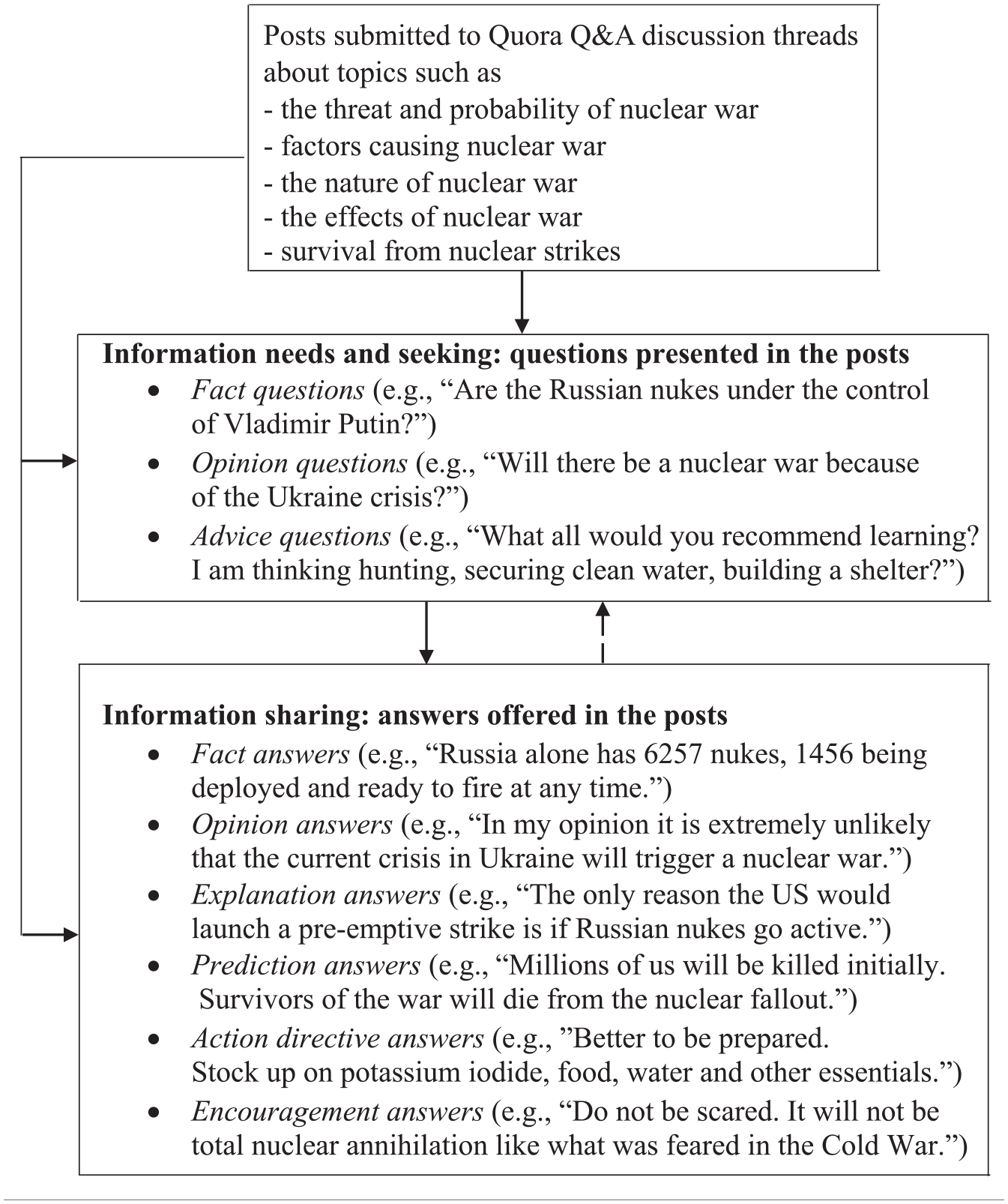
The research framework.
Figure 1 suggests that in Q&A discussion threads, the participants may discuss diverse topics related to the threat of nuclear war. In addition to the threat of nuclear strikes, the discussion may reflect the nature of nuclear war, its effects and the survival from nuclear attacks, for example. The posts submitted to Quora can incorporate fact, opinion and advice questions indicative of attempts to seek treat-related information. Information sharing occurs when fellow contributors offer answers to questions presented during the discussion. As illustrated by the examples taken from the empirical data of the present investigation, the answers can include facts, personal opinions, explanations, predictions, suggestions for action and encouragement. It is possible that the answers give rise to further questions which in turn elicit additional responses, as the online discussion goes on.
Research questions
Drawing on the framework depicted in Figure 1, the present study seeks answers to the following research questions.
• RQ1. In which ways do online participants seek information about issues related to the threat of nuclear war by presenting fact, explanation, and advice questions?
• RQ2. How do the fellow participants share information about the above issues by offering fact, opinion, explanation, prediction, action directive and encouragement answers?
Empirical data and analysis
To answer the above research questions, empirical data were gathered from Quora—a major Q&A website (https://www.quora.com/). Quora was found in 2009 and it is headquartered in Mountain View, California. Quora users can submit questions and comment on answers that have been submitted by other contributors. Quora relies on user reporting, but sometimes the content posted by users is checked by human moderators. The most popular topics discussed on Quora include Technology, Movies, Health, Food, and Politics. As of 2023, Quora is visited monthly over 300 million active users (Ruby, 2023).
There are several hundreds of discussion threads in Quora dealing with nuclear war. The topics of these threads vary widely, ranging from nuclear war as a crime to speculations about whether a nuclear war could reverse climate change. As the present study focuses on the issues related to the threat of nuclear war, the topics of discussion threads potentially relevant for empirical analysis were predefined accordingly. Using the search phrase of threat of nuclear war, altogether 143 potentially relevant discussion threads were identified in the beginning of February 2023. Of these threads, 48 were excluded because they contained only the opening post submitted by the initiator of the thread. The remaining 95 threads were read tentatively to obtain an overview of the questions and answers submitted by the contributors. Many of these threads were short, containing 1–10 posts concentrating on a specific issue, for example, the possibility of another Cold War. Therefore, a decision was made to prefer longer discussion threads whose posts offer a more versatile picture of the issues related to the threat of nuclear war, for example, the destructive properties of nuclear weapons, the causes of nuclear war, and the effects of nuclear strikes. Another criterion used in the selection of the discussion threads was that the posts submitted to a thread should contain at least two question types and two answer types specified in Figure 1 above.
By these criteria, eight discussion threads with altogether 1729 posts were chosen for analysis. Of these, however, 442 posts were excluded from the further study because they dealt with off-topic issues such as the Chernobyl nuclear power plant accident in 1986. The remaining 1287 posts contained altogether 89 questions and 1196 answers presented by the online participants. The above sample appeared to be sufficient for needs of the study because the data became saturated. Therefore, the inclusion of additional discussion threads would not have essentially changed the quantitative and qualitative picture of the questions and answers indicative of threat-related information seeking and sharing. Altogether 925 individual participants contributed to the discussion during the period of January 2017–January 2023. Most of the 1287 posts were submitted after the break of the Ukrainian war, thus reflecting people’s recent worries about the possibility of nuclear strikes. There were a few really active participants; of them, the most frequent contributor submitted no less than 61 posts. On the other hand, the majority of the participants, that is, 619 contributors wrote only one post. Although the discussion topics attracted a relatively large number of participants, most of them were occasional contributors who did not delve into the discussion in more detail.
The coding of the empirical data was an iterative process in which the data were scrutinized several times by the author. In the first phase of the coding, seven main topics discussed in the eight threads were inductively identified from the empirical material. The topics include, for example, threat and probability of nuclear war, causes of nuclear war, the effects of nuclear war, and the survival from nuclear attacks. Thereafter, the questions and answers presented by the online participants were coded by making use of the categories specified in Figure 1 above. During the coding, the coding process was kept open so that new categories emerging from the data were allowed. As a result, a new question type, that is, opinion question and a new answer type, that is, prediction answer were identified. The coding categories of questions and answers are specified in Table 1.
The coding categories of the questions and answers.
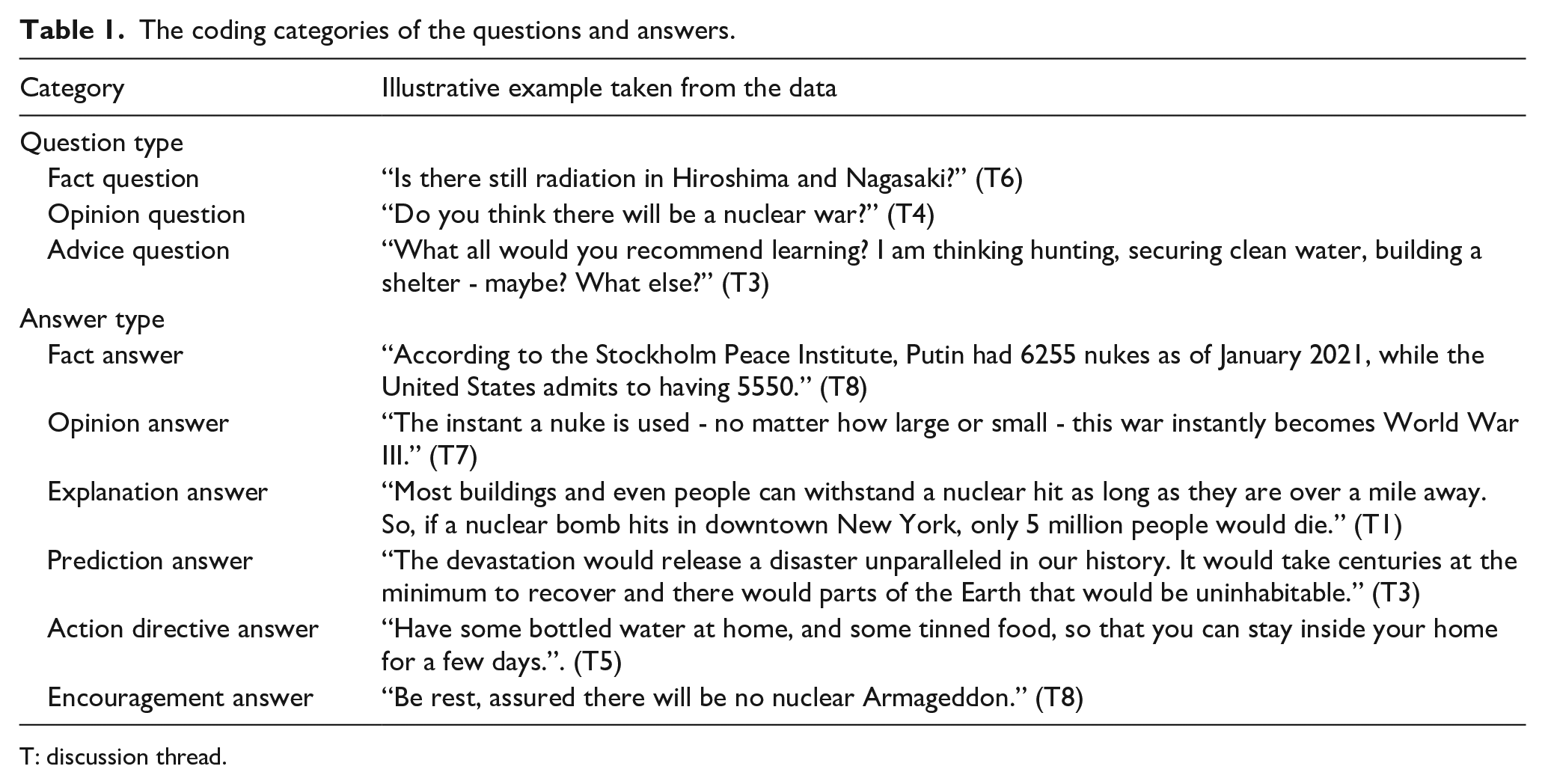
T: discussion thread.
A question or answer was coded only once for a criterion category, for example, opinion question or opinion answer once it was identified for the first time in the post. In long posts, the same criterion, for example, opinion answer was often identified in several segments of the same post if the answerer offered information about more than one topic, for example, probability of nuclear strikes, effects of nuclear war and survival from nuclear attack. In these cases, the category of opinion answer was coded separately for each topic. Typically, however, an answer concentrated on one topic within a post. This is mainly due to that most answers were relatively short, containing 1–4 sentences per post. Overall, no significant problems were faced while coding the data. However, there were a few exceptions. It was not always possible to unambiguously define whether a post offers an advisory answer or encouragement answer because a piece of advice and an encouraging notion may overlap, as exemplified by answers such as “Don’t stress about things you can’t control” (T5). The borderline cases were solved by selecting a code that in the particular context of the ongoing discussion best describes the main content of an answer. To strengthen the reliability of the coding, the initial coding was refined by repeated reading of the data. During this process, the methodological recommendation of Miles and Huberman (1994: 65) was followed: the careful checking of the codes is a useful method for the lone researcher if the code-recode consistencies reach at least 90%. Following this advice, the coding was refined until it was found that the codes appropriately describe the data and that there are no anomalies.
In order to examine the relative share of the coding categories, percentage distributions were calculated. Thereafter, the data were scrutinized by means of qualitative content analysis (Lincoln and Guba, 1985: 339–344). To this end, the constant comparative method was employed to capture the variety of articulations of the questions and answers presented by the participants. More specifically, this was achieved by identifying similarities and differences in the ways in which the contributors presented questions and answers of various types. Thereafter, similar and different articulations per question type and answer type were systematically examined within each discussion topics. This approach enabled a detailed analysis of how the contributors articulated, for example, opinion questions dealing with the effects of nuclear strikes and how they put into words the prediction answers characterizing the effects of nuclear bombing.
Since the posts submitted to Quora are freely accessible to anyone interested, they can be seen as contributions which are intended to elicit public interest in the issues of nuclear war. Due to their public nature, the posts can also be utilized for research purposes, provided that the identity of an individual contributor is protected. To achieve this, the posts were equipped with technical codes. For example, in the code P624-T6, P624 refers to the 624th poster in the alphabetical list of the 925 contributors, while T6 refers to discussion thread 6. Finally, to anonymize the data, all information dealing with the nicknames of the online contributors and the submission dates for the posts were deleted from the illustrative quotes presented in the findings section of this study.
Findings
Seeking threat-related information
As noted above, the online participants presented altogether 89 questions indicative of the attempts to seek information about the issues related to the threat of nuclear war. More specifically, the posts incorporated 81 opinion questions, seven fact questions and one advice question. Table 2 specifies how the seven main topics of discussion were represented in the 89 questions posed by the participants.
The percentage distribution of the topics of questions presented by the participants (n = 89).
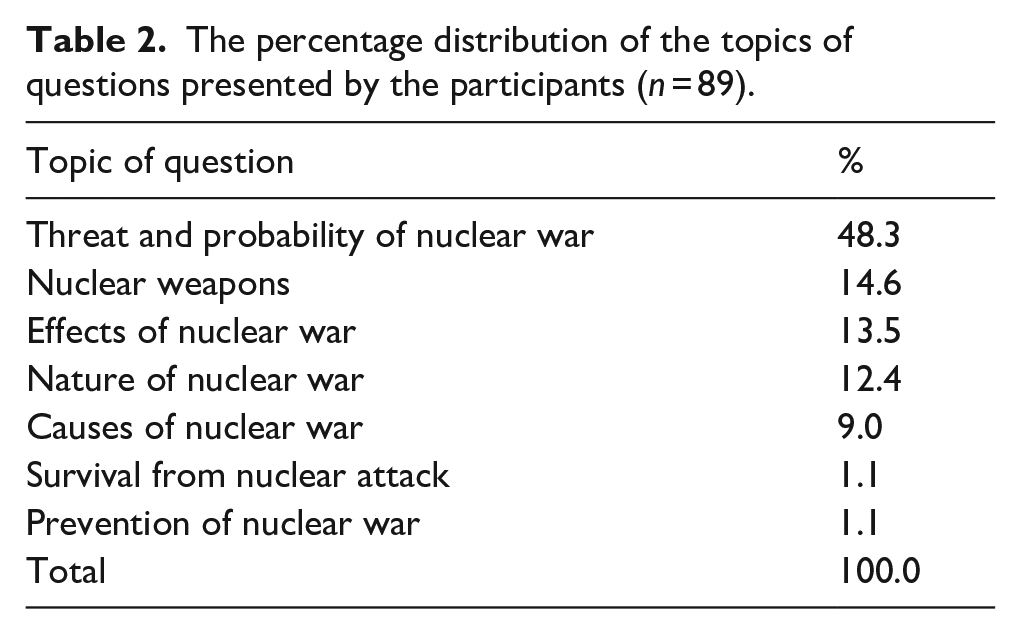
Almost every second question dealt with the threat and probability of nuclear war. All of these questions asked the opinions of fellow participants, as illustrated by the following examples.
What do you think the actual odds are of nuclear warfare happening in our lifetime? (P886-T4) Will there be a nuclear war because of the Ukraine crisis? I haven’t slept or eaten much because I feel the end of the world is coming. (P23-T5)
The fact questions dealt mainly dealt with the properties of nuclear weapons, for example, the destructive force of explosions.
Explosive force falls away by the cube of the distance, even better. Is there a physics reason why force falls away by one power greater? (P38-T1)
Other topics such as the nature, causes and effects of nuclear war mainly elicited opinion questions.
Is nuclear winter a real possibility or actually very hard to bring about? (P151-T4)
Sharing threat-related information
The 89 questions attracted altogether 1196 answers from the contributors. The percentage distribution of the topics of answers is presented in Table 3.
The percentage distribution of the topics of answers offered by the participants (n = 1196).
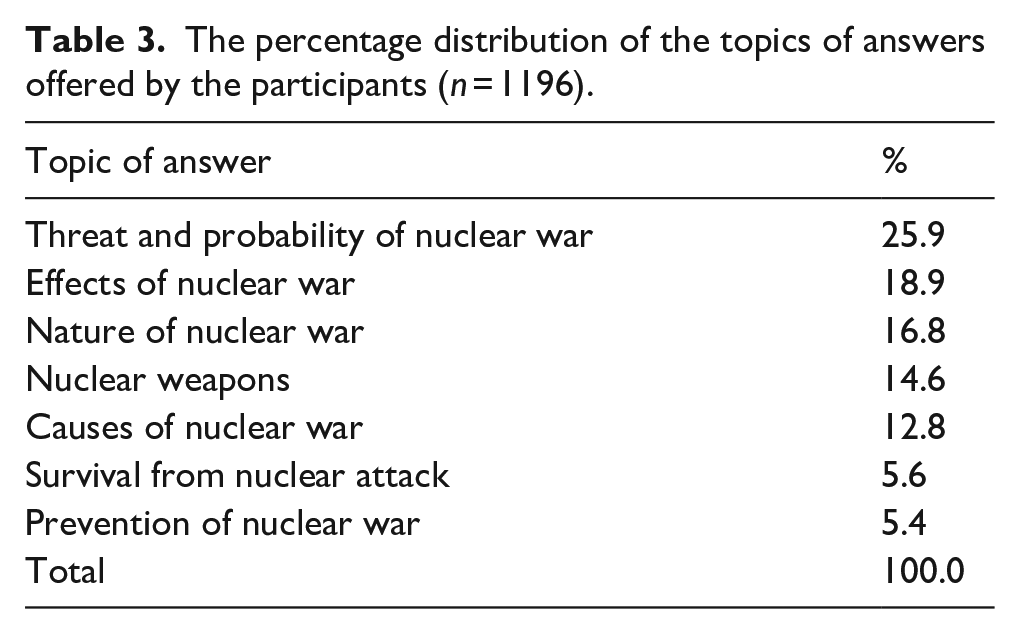
The participants were most active to offer answers dealing with the threat and probability of nuclear war, as well as the effects of nuclear war. Moreover, they frequently answered questions focusing on the nature of nuclear war and nuclear weapons. The comparison of the topics of the questions and answers suggest that overall, they match quite well. The most popular questions and answers dealt with the threat and probability nuclear war and the effects of war of this kind. On the other hand, both questioners and answerers were less interested in topics related to the survival from nuclear attack and the ways in which nuclear war could be avoided.
The percentage distribution of answer types is presented in Table 4.
Percentage distribution of the answer types (n = 1196).
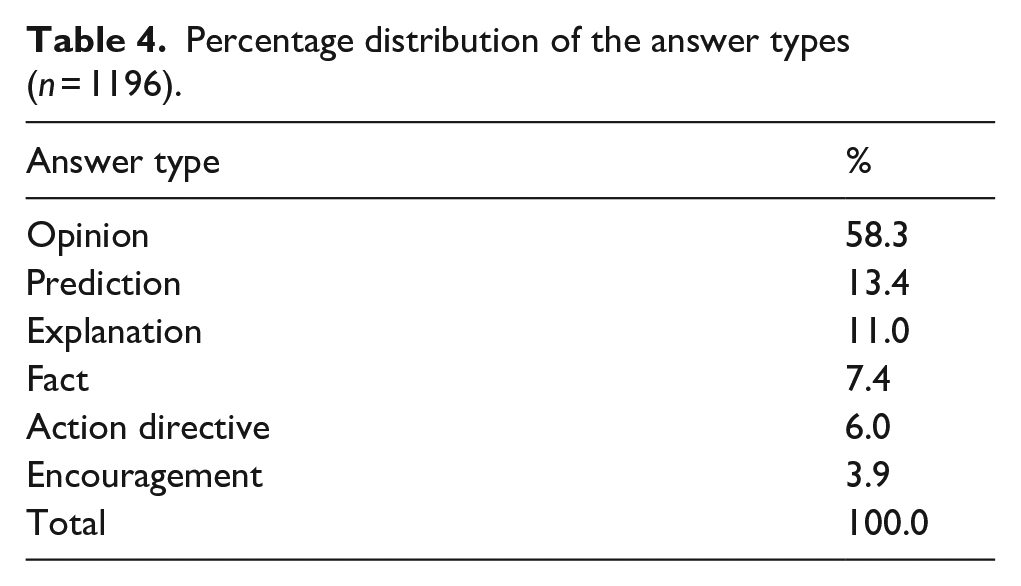
Opinion answers dominated over other types of responses. Quite frequently, the participants also offered prediction answers and explanation answers. The share of fact answers, action directive answers and encouragement answers remained quite small. The qualitative features of the answers will be elaborated further below.
Fact answers
As Table 4 indicates, only 7.4% of the answers offered by the participants were factual in nature. However, the qualitative features of answers of this type will be discussed first because they offer background information about the nuclear weapons and their delivery systems, for example, missiles. Factual information of this kind helps to put the threat of nuclear war on a firmer ground because the facts are indicative of the magnitude of the nuclear arsenal and its destructive potential. Fact answers often drew on descriptive information available in publicly available sources such as Wikipedia.
There are now more warheads now in storage or pending destruction than there are in the strategic stockpiles of the US and Russia. The US has about 1400 while Russia has about 1600. - Wikipedia. (P746-T4)
Descriptive factual information was also offered to characterize the effects of nuclear bomb explosions. Information of this kind is descriptive of the extent to which an individual may survive a nuclear attack.
Fallout is a short-lived problem in most places. Using the 7/10 rule of exponential radionuclide decay, after just 49 days the radiation will be 1/10,000 the level it was an hour after the bombs went off. After a year and a half, the radiation will have dropped below 1/100,000 of that initial level. (P443-T1)
In some cases, the answers contained a combination of factual information and opinion-based views, that is, a hybrid of factual and opinion-based information.
Soviet missile accuracy is now estimated to be within 5 miles. Back then, ours was about 1000-5000 ft. Today, it is much better - the exact number is classified but a pure guess would be in the 10-30 ft range - about one or two car lengths. (P91-T2)
In the above answer, factual (numerical) information is complemented with subjective evaluations such as “much better” and “a pure guess.” Nevertheless, opinion-based elements offer additional value to the fact answer because they put the “pure” facts in a practical context and illustrate the capabilities of the nuclear weapons.
Opinion answers
An overwhelming majority of the responses were opinion answers; no less than 58.3% of all responses were of this type. Typically, opinion answers offer descriptive information about the topic of a question, for example, the participant’s view on the effects of nuclear war. Opinion answers also provided comparative or evaluative information, often based on the contributors’ critical views on the quality of the nuclear weapon delivery systems, for example.
I can only imagine that Russia’s ballistic missiles are not being maintained properly. (P396-T6)
For questioners worried about the possibility of nuclear strikes, opinion answers depicting the feelings of threat experienced by fellow participants may be particularly interesting. In this regard, the responses submitted by the Ukrainian participants offer authentic evidence of the seriousness of the threat of nuclear strikes.
I am a resident of Ukraine and I see this threat as not an abstract one, since Russian missiles have already flown into my city more than once. Each of which is capable of carrying a nuclear warhead from several kilotons to hundreds of kilotons. (P516-T4)
In this context, it was argued that the main source of threat is President Putin. It was feared that he may behave in an unpredictable way particularly if it becomes apparent that Russia will lose the war. The worry about the nuclear strikes was also mirrored against memories of watching frightening movies about nuclear war during the Cold War. The memories were revived when Russia invaded Ukraine.
I was absolutely freaked out by the TV movie “The Day After” in the early 1980s. I was convinced that I would never see adulthood and that humanity would certainly collapse. (P862-T6)
Closely related, the probability of nuclear war was one of the most popular topics of the opinion answers. Despite the threat of nuclear strikes, most contributors believed that the likelihood of a global nuclear exchange is relatively low. Nevertheless, the risk of a limited nuclear strike cannot be foreclosed.
I would put the chance of limited nuclear use/tactical nuclear weapon at 30/70. 30 for 70 against but the odds are changing daily. (P344-T2)
What kind of factors would materialize the risk of nuclear war? This is one of the questions closely related to the threat and probability of nuclear strikes. While considering this issue, the answerers emphasized that the key factor is the willingness of the presidents of Russia and USA to use nuclear weapons or refrain from their use. On the other hand, it was acknowledged that the judgment of the presidents’ real motives is just guesswork.
We have no idea what Putin is going to do. No one does. At this point, I don’t think even Putin knows what he is going to do. (P156-T-8)
However, many participants believed that in the final end, the motive to refrain from using nuclear weapons is stronger than the motive to use them. One of the most popular speculations was that Putin’s main motive is to bluff in order to intimidate Ukraine and its allies. However, it is uncertain whether such threats should be taken seriously.
Rhetoric is not reality. Most probably all of what Putin says is a threat, not a statement of actual intent. (P698-T5)
The answerers emphasized that even a limited nuclear strike would be a catastrophe. In addition to immediate casualties, attention was directed to the long-time effects such as the nuclear winter and radiation. These issues elicit further questions about the survival of people after the nuclear attack. Most of the answerers painted a gloomy picture of the living environment polluted by the fallout.
Even without targeting cities, use of tactical nukes means Europe is turned into a radioactive wasteland. (P466-T4)
Explanation answers
In general, answers of this type explicate reasons of why and how something happens. Often, answers of this type contain expressions such as “if . . . then,” “due to,” or “because”. Explanation answers were particularly popular while reasoning about why a nuclear war is a real threat for humanity.
As long as there are nukes, there is a risk. If the risk is greater than zero, then a nuclear war is only a matter of time. (P301-T8)
The motives of using nuclear weapons or refraining from their use was also made understandable by offering explanation answers. Overall, the answerers believed that there are no reasonable grounds to draw on the use of nuclear weapons. Unsurprisingly, many of the explanation answers speculated why Putin would resort to nuclear weapons.
If Putin takes the view that he cannot win, he may decide that he has nothing to lose and take the whole world with him. (P790-T8)
Another popular topic of the explanation answers was the effects of nuclear war and survival from nuclear attack.
Unless the building you are in is collapsed by the wind or you fail to leave if it catches on fire, you are probably going to be fine (P624-T6)
Prediction answers
As nuclear war is an event that may take place in the future, the answerers also offered predictive views on how war of this kind may break out, proceed step by step and cause damage. Most of the prediction answers drew on the contributors’ personal views on the nature, likelihood and effects of nuclear war. The answerers mainly speculated the threats and probability of nuclear strikes particularly during the Ukrainian war.
Zelensky will get NATO jets and use them to attack Russian territories. Then, Russia will respond with nukes, China on-side. (P785-T3)
The effects of nuclear attacks was a popular topic in posts offering prediction answers. Pessimistic scenarios were more frequent; it was predicted that the damages caused by nuclear war will irrevocably change the everyday life for a long period of time.
We can expect tens of millions will be killed instantly, and absolute pandemonium as millions more suffer and die due to injuries, food, water, medical, and critical goods shortages, and ensuing local, regional, and very likely national breakdown of law and order, at least temporarily, as need drives open conflict for resources. (P141-T6)
Interestingly, some of the prediction answers were not solely based on the contributors’ opinions but were also supported by factual information obtained from an external source of information.
Everything in fireball zones will burn. Glass, cars, people, hell, even asphalt will catch fire, creating a particularly nasty smoke mixture nicknamed “black carbon.” An estimated 180 teragrams (180,000,000,000 kilos) of black carbon would be produced just from a US-Russia exchange. [3] [3] Nuclear Winter May Bring a Decade of Destruction - Eos (P231-T1)
The information source referred to above is a popular scientific article written by Sarah Derouin, published in 2019 in Eos—an electronic science news magazine issued by the American Geophysical Union. Even though prediction answers consisting of a combination of opinion-based views and factual estimation were seldom offered, they may be found more credible than responses merely drawing on personal speculation.
Action directive answers
Answers of this provide advice for fellow participants worrying about the threat of nuclear war. Two main types of advice were offered. First, there were suggestions to rethink one’s ways to approach worrisome situations and critically consider whether the threat of nuclear war is exaggerated in the media in particular.
I suggest that the priority is to not look at the news obsessively. You don’t need to check it every 15 minutes, or even every 2 hours. When we look at the news all the time, we tend to think that the most recent events are the most significant. So, some really trivial incident can become magnified in our minds, simply because it just happened and we are making it part of a worst-case scenario. (P698-T5)
Second, the participants offered practical guidance for the preparation of an eventual nuclear strike.
Have some bottled water at home, and some tinned food, so that you can stay inside your home for a few days. Have a charged power bank and maybe a radio or a smartphone wrapped in tin foil, to withstand the electro-magnetic pulse. Find out where the nearest shelters are. (P620-T5)
Encouragement answers
Closely related to the action directive answers, the participants offered emotional support by submitting encouragement answers. Again, most of the responses of this type dealt with the threats of nuclear war and the attempts to survive it. Many of the encouragement answers made use of the personal experiences obtained during the Cold War when the threat of nuclear war was heightened considerably.
When I was a kid throughout the Cold War, they had us running and hiding under desk, etc. It gave every last one of us really bad posttraumatic stress disorder. I worried so much about it during my life, the stress killed me 10 times as much as anything else. Now I could give two shits. You got to just breathe and let life move along. (P462-T8)
The questioners worrying about the threat of nuclear strikes were also encouraged by pointing out that they their fears and worries are not something exceptional or a thing to be ashamed of.
Remember these things: you are not alone. It is not down to you being stupid. (P417-T3)
In addition, it was reminded that there are mutually agreed deterrents between nuclear powers preventing them to use of nuclear weapons. As one of the answerers reminded, there is no reason to fear because “You are safe with MAD doctrine. Mutual assured destruction.” (P854-T3) This doctrine is based on the assumption that nuclear powers know that they will both be destroyed by a nuclear war; therefore, no one will risk it. Interestingly, some of the questioners expressed their gratitude for the encouragement obtained from the fellow participants. This suggests that the encouragement answers can provide both informational and emotional support.
Man, what an enlightening thread. Thank you so much! Although I understand we in Ukraine should stay alert to dangers of the nuclear weapons, it somewhat gives a peace of mind, a little bit. Because once you understand things better, it is not as scary as you thought it was. (P315-T6)
Discussion
The present study refined the picture of information seeking and sharing dealing with the threat of low-frequency but high-impact events resulting from man-made disasters. The topic of the investigation is unique also in that no prior studies have examined how people interactively seek and share information about the threat of nuclear war in social Q&A forums. The study sought answers to two research questions. First, it was asked, in which ways do online participants seek information about issues related to the threat of nuclear war by presenting fact, explanation, and advice questions? The findings indicate that people submitting questions to Q&A discussion threads primarily seek opinions of other people about the nature, likelihood and effects of the threatening event, that is, nuclear war. To compare, the questioners relatively seldom make attempts to seek factual information about issues of this kind. Moreover, they are less interested to obtain advice about how to deal with the threat in practice. Although the empirical material used in the present study did not allow the analysis of the participants’ motivations for information seeking, we may think that the relatively low interest in seeking factual information is simply due to that there is no recent data about the real-life consequences of a nuclear strike against a military or civil target.
The second research question dealt with threat-related information sharing: how do the fellow participants share information about the above issues by offering fact, opinion, explanation, prediction, action directive and encouragement answers? The results demonstrate that an overwhelming majority of responses were based on the answerers’ personal opinions and speculations, while the share of fact answers was relatively low. The predominance of opinion answers reflects the fact that there are no recent instances of the use of nuclear weapons against civil targets. Therefore, much of information available in opinion answers necessarily originates from people’s personal views and speculations of what a nuclear war could be like. As some of the opinion answers revealed, such views can originate from the memories of movies dramatically depicting the effects of nuclear war. On the other hand, opinion answers can be supported by factual information acquired from Wikipedia or popular scientific articles, for example. This finding parallels with Gazan’s (2010: 698–699) observation that in collaborative online discussions occurring in social Q&A communities, expressions indicative of opinions may also incorporate other informational elements such as facts, thus forming what Gazan characterized as “hybrids of fact and opinion.”
To compare, the answerers quite seldom offered explanation answers. This is probably due to that the formulation of answers of this type is cognitively demanding because the answerers have to identify cause-effect relationships and justify the explanation so that it seems plausible in the eyes of the questioners. The formulation of prediction answers is less demanding because the answerer can draw on personal speculation about how a nuclear war will break out in the future, how the nuclear exchange proceeds and what kind effects it may cause. A prediction answer can be more credible if it is supported by factual information obtained from an external source, for example, an article depicting a scenario of nuclear war and its effects. Answers of this kind appeared to be rare, however. The answerers also offered action directive responses and encouragement answers indicative of informational and emotional support. All in all, answers of this type were quite common-sensical in nature, that is, suggestions to prepare oneself for a nuclear strike by reserving food and water, and not worrying about large-scale events that an individual cannot control.
Finally, fact answers occupied a relatively modest share of all responses offered by the participants. This is simply due to that factual, experimental and verifiable information about issues related to the threat of nuclear war is publicly available from a relative narrow area. Such information mainly deals with historical events such as the first nuclear bombings during World War 2, the post-war nuclear bomb tests and general properties of nuclear weapons and their delivery systems. Information of this kind may be found in public sources such as Wikipedia. Understandably, however, strategically important information about the recent arsenal of nuclear weapons, their delivery systems, and plans of using nuclear weapons is strictly protected for security reasons and thus not publicly available.
As the topic of the present investigation is unique, there are no prior investigations offering possibilities for the direct comparison of the findings. Nevertheless, a few comparative notions can be made. The findings support the assumptions of the Theory of Motivated Information Management (Litman and Lunsford, 2010) and the coping theory developed by Lazarus (1993). Both theories suggest that information seeking is ultimately motivated by a desire to reduce worry associated with a potential threat. As the illustrative examples taken from the posts indicate, articulations of worry were clearly identifiably both in the questions and answers presented by the online participants. The findings also have similarities with the results obtained from empirical studies on information seeking and communication in the context natural and man-made disasters. In these contexts, people subjected to threat tend to seek information about the source of danger, for example, earthquake, missile strike, nuclear attack, as well as the effects of a materialized threat (e.g. Crijns et al., 2017; Lachlan et al., 2009; Rosenbaum and Benyosef, 1995; Yang and Zhuang, 2020). On the other hand, all of these studies emphasize that fact that in times of large-scale disasters in particular, people subjected to a danger tend to feel that it is difficult to identify the exact features of the threat. Therefore, in contexts such as these, the seeking of threat-related information, as well as the sharing of such information is necessarily limited and often fragmentary.
At the level of an individual citizen, the findings also have practical implications for the disaster preparedness. As reflected in the action directive answers offered by the participants, individuals worried about the threat of a nuclear strike should prepare themselves mentally for the possibility that such situations may arise. It is important to stay calm, avoid panic, and realistically assess the news about the threat of nuclear war. Second, it is useful to build an emergency supply kit, including sealed food, water, medicine, radio and smartphone. It is also important to find out where the nearest shelters are and how to get there. At the community level, public libraries may significantly contribute to disaster preparedness. Blakemore (2018) offers a useful example about how America’s libraries helped patrons prepare for nuclear attacks during the Cold War. Libraries served as clearinghouses for pamphlets, books, and audiovisual materials about how to survive a nuclear strike. For example, The New York Public Library collected civil defense booklets that laid out how to drill for an atomic bomb and survive after one fell. Librarians also encouraged civil defense groups to use their facilities for recruitment, training, and first aid classes. It is evident that activities and initiatives such as these are even more important at a time when there is a risk that the Russo-Ukrainian conflict escalates into a nuclear war.
Conclusion
Nuclear war exemplifies a low risk but high-impact event whose effects may be frightening for humanity at a global scale. The findings of the present investigation highlight that people can relieve the uncertainty caused by the threat of nuclear war by seeking and sharing information in social Q&A discussion forums. They mainly serve as ways to seek opinions of other people, rather than facts about threatening events. The findings also suggest that Q&A discussion can result in a relatively good match of questions and answers since the participants primarily ask and provide opinion-based information. In addition to informational support, the discussions also provide emotional encouragement and practical advice.
As the present study focused on a sample of discussion threads concentrating on a specific topic, that is, issues related to the threat of nuclear war, more research is required to refine the picture of threat-related information seeking and sharing occurring in social Q&A forums. One of the tasks of further research is to scrutinize in more detail the nature of answers offered in online discussion by devoting attention to how the responses differ regarding the nature of threat and the consequences of a materialized threat. Key areas requiring further research include, for example, nuclear plant accidents and terror attacks. Moreover, natural disasters closely associated with climate change, for example, floods, forest fires and hurricanes offer relevant topics for further research. In the present study, the answerers were more or less in agreement about the frightening nature of the threats and their consequences. However, it is possible that responses characterizing threats of other kind, for example, climate change may contain more variation and offer conflicting views. This is because climate change and its consequences is a contested topic. As there are fundamental disagreements between those who emphasize human-caused climate change and those who deny it, it is probable that opinion polarization will be higher in such debates compared to discussion about the threats of nuclear war. Finally, as it is evident that only a part of threat-related information behavior occurs in social media forums, it would be useful to conduct comparative studies by examining how people seek such information from other sources and how they share it through their contact networks, for example.
Footnotes
Declaration of conflicting interests
The author declared no potential conflicts of interest with respect to the research, authorship, and/or publication of this article.
Funding
The author received no financial support for the research, authorship, and/or publication of this article.
