



Abstract
This study investigates how workplace learning is enacted to make a novice Kente (a hand-woven fabric in Ghana) weaver information literate in the Kente-weaving landscape. Ethnography was used as the research design. Interview and participant observation were used as the data collection methods. For the interview, semi-structured interview techniques were used to solicit information from all three levels of weavers (Master, junior and novice weavers) in Bonwire Kente Centre in Ghana. Out of the 62 weavers at the Bonwire Kente Centre, 24 weavers representing 8 each from each level of weavers were purposively chosen. The findings of this study show learning is enacted to make a novice Kente weaver information literate of the Kente-weaving craft by the affordance of guidance provision, conversations, observation and learning by doing. This study contributes to the information literacy literature and workplace learning that learning and becoming information literate do not relate solely to the cognitive activities of the mind, but also to the body through the affordance of the workplace.
Introduction
From the socio-cultural perspective workplace learning research focus on the ongoing individuals’ interactions and participation in work practices (Billett, 1995, 2001, 2004; Bonner and Lloyd, 2011; Isah, 2012; Isah and Byström, 2017; Lloyd, 2009; Nordsteien and Byström, 2018). Workplace interaction is the means through which individuals co-construct knowledge and recognise the social setting and practices in which they are participants (Campbell, 2019: 5).
In the workplace, learning is mostly informal (including incidental) or non-formal where it takes place through practice-experiential-based individuals activities (Beckett and Hager, 2002: 115: 12; Eraut, 2000: 12–13; European Commission, 2001: 32–33; Marsick and Watkins, 1990; Somerville and Abrahamsson, 2003: 21). The workplace landscape is a place of work where people share a practice. According to Lloyd and Somerville (2006: 191), it is in the workplace landscape that ‘real learning’ (knowing) takes place. They explain that novices’ participation in the work practices coupled with their interactions with experts affords them learning opportunities. Learning is enacted in the form of access to corporeal and social affordances of information. The workplace landscape facilitates novices’ transition from acting in the classroom to being competent practitioners (Lin and Bound, 2011:36; Lloyd and Somerville, 2006: 191). This implies that individuals can never know or become competent in a practice (profession) unless they interact and participate practically in the practices of the workplace landscape.
Kente (a hand-woven fabric in Ghana) knowledge is conceived to be cognitive and an individual possession residing in the minds of the weavers (Asmah et al., 2015: 115; Cook and Brown, 1999: 383; Fusein and Kugbllenu-Mahama, 2018: 727). As opposed to the practice view that knowledge is situated and involves competent participation in the social and practical activity as claimed by Nicolini (2012: 5), Kente knowledge is conceived to be cognitive and an individual possession residing in the minds of the weavers (Asmah et al., 2015: 115; Cook and Brown, 1999: 383; Fusein and Kugbllenu-Mahama, 2018: 727). Asmah et al. (2015: 115) describe the knowledge of the history of Kente weaving as being embedded in the minds of the local weavers in Bonwire. Fusein and Kugbllenu-Mahama (2018: 727) also describe Kente weavers as people with Kente knowledge in their minds. They maintain that the indigenous Kente knowledge in a Kente-weaving landscape can be lost through the death or migration of knowledgeable weavers should this knowledge not be documented or coded. This advocacy for knowledge management in the Kente-weaving landscape treats Kente knowledge as something which can be captured, stored and transferred in textual or digital form out of its context.
The above conceptualisations of knowledge in the mind of the weavers raise a fundamental question on learning in the Kente-weaving landscape: How do novice Kente weavers learn? According to Gherardi and Miele (2018: 151), knowledge does not exist distinctly from social relations and social practices. Therefore, conceiving Kente knowledge only as a cognitive activity rather than practical and competent participation overlooks the other sources of information which relate to corporeal and social activities. Alluding to Lloyd and Somerville (2006: 188), the above conceptualisations of Kente knowledge in the minds of the weavers would ignore the ‘whole person’ in the weaving landscape, the social and the contribution of information literacy to learning in the Kente-weaving landscape.
There are numerous information landscapes which means that there are also diverse ways by which one can become information literate. Hence, if information scientists ignore the ways of learning in other landscapes by perceiving information literacy as a sequence of objective skills, decontextualised, they risk ignoring the ways of learning in other landscapes in becoming information literate (Lloyd, 2006). Despite that there are explorative studies on Kente (Boateng, 2018; Cohen, 2019; Nunoo et al., 2021; Robinson et al., 2021), no adequate explanation prevails on how learning is enacted to enable novice weavers to become information literate and therefore knowledgeable or competent weavers in the Kente workplace landscape. Also, how novice weavers engage with information to become information literate in the Kente-weaving landscape appears to be non-existent in the literature. It is from this background that the objective of this study aims to investigate how learning takes place to make a novice weaver information literate in the Kente-weaving landscape. Specifically, the research question for this study is as follows: How is learning enacted to make novice Kente weaver information literate in the Kente-weaving landscape?
The study offers a new perspective on learning and information literacy in the informal setting. The study aims to contribute to knowledge about how this traditional craft is learnt and how traditional craftspeople come to know what they know. To understand what Kente weaving involves, the context of the Kente workplace landscape is introduced. Subsequently, the conceptual framework and the literature review conceptualise information literacy and workplace learning. The reported findings follow the discussion on the methodology of the study.
Kente workplace landscape
The Kente workplace landscape is a place where hand-woven fabric called Kente, a traditional fabric, is woven in Ghana. The tools and materials such as loom, shuttle, heddle, yarns, treadle, reed; bobbin, pulley and swordstick are used to create narrow pieces of cloth (see Figure 1). The weaving places include the following communities: Bonwire, Adanwomase, Denase, Ntonso, Kpetoe and Tewobaabi. In Bonwire, the weavers gather at a common workplace known as the Kente Centre to weave and champion the flow of Kente knowledge (see Figure 2). According to Sabutey (2009), there are three types of weaving practitioners in the Bonwire Kente Centre: master, junior and novice weavers. The practices (techniques) of the weaving context include warp preparation (warping), weft preparation (winding yarns on the bobbin), picking, reeding, shedding, beating up; heddling and tie-up (Adom, 2016; Amissah and Afram, 2018; Temesgen, 2019). There are various patterns in the Kente-weaving landscape. Among these colourful patterns are Babadua, Nkyimkyim, Rotoa, Akonya, Akyεm, Aprεmu and Npoankron (see e.g. Figure 3).
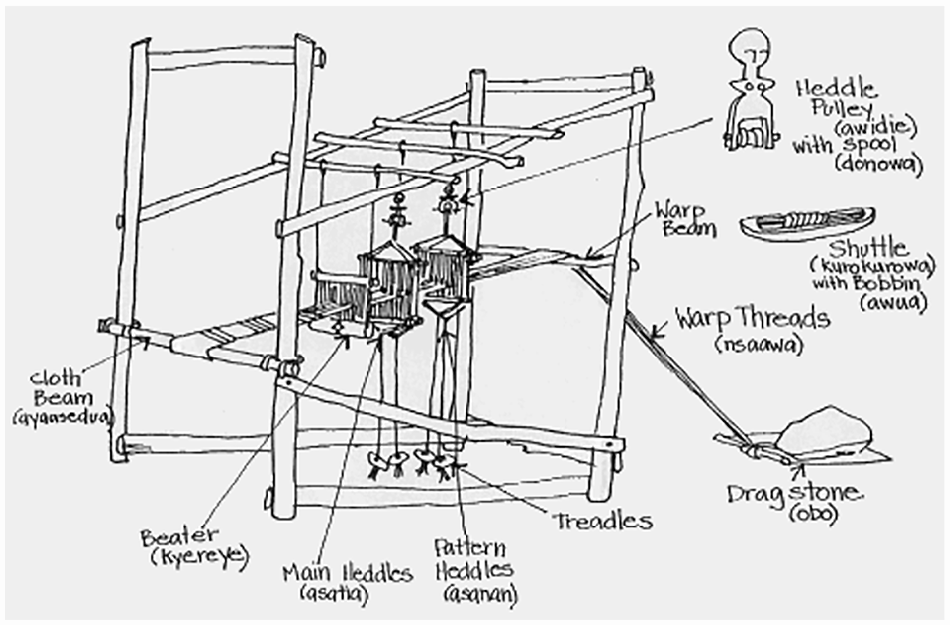
Parts of the loom.
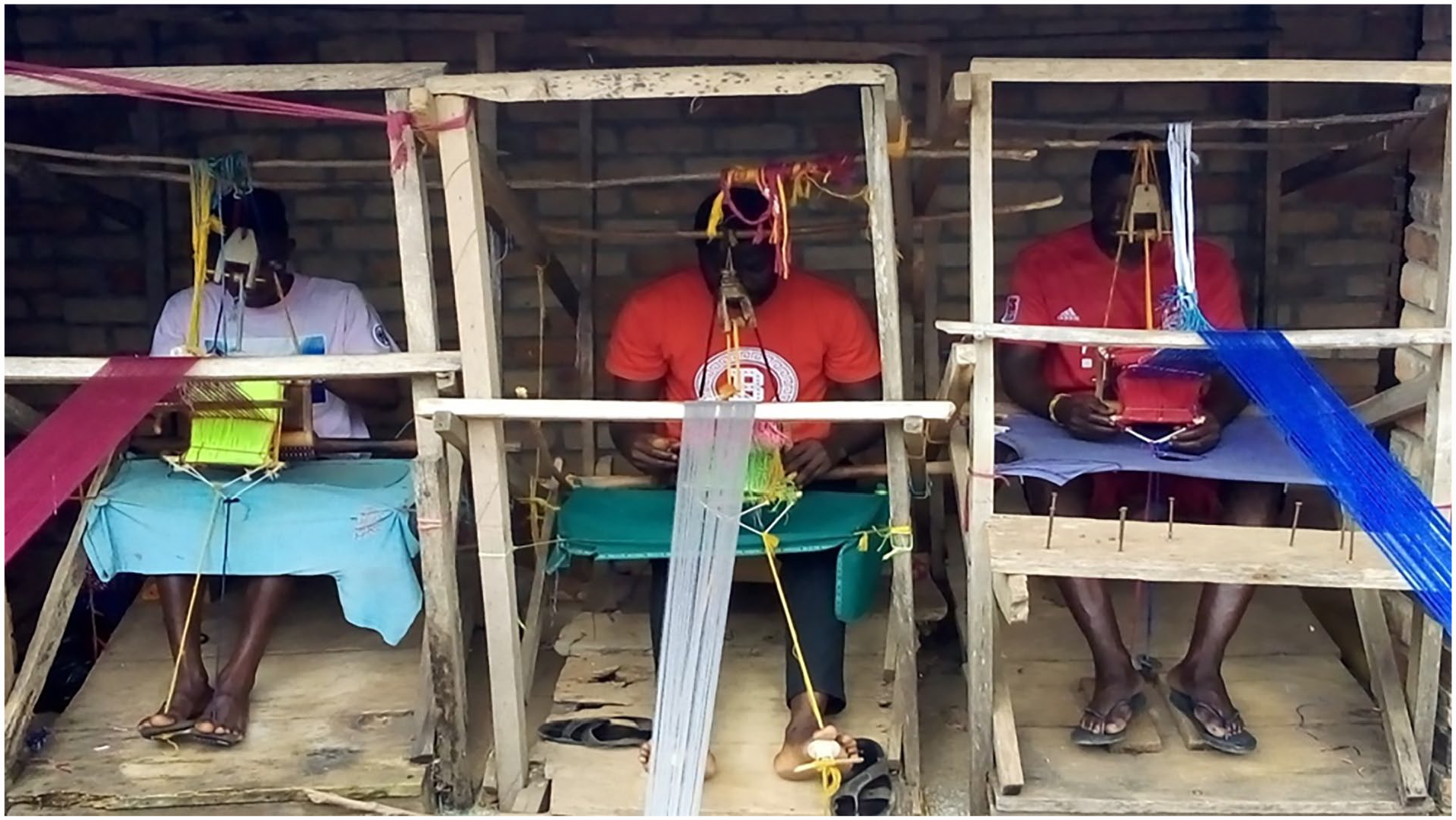
A novice weaver in the middle of two master weavers in wooden looms.
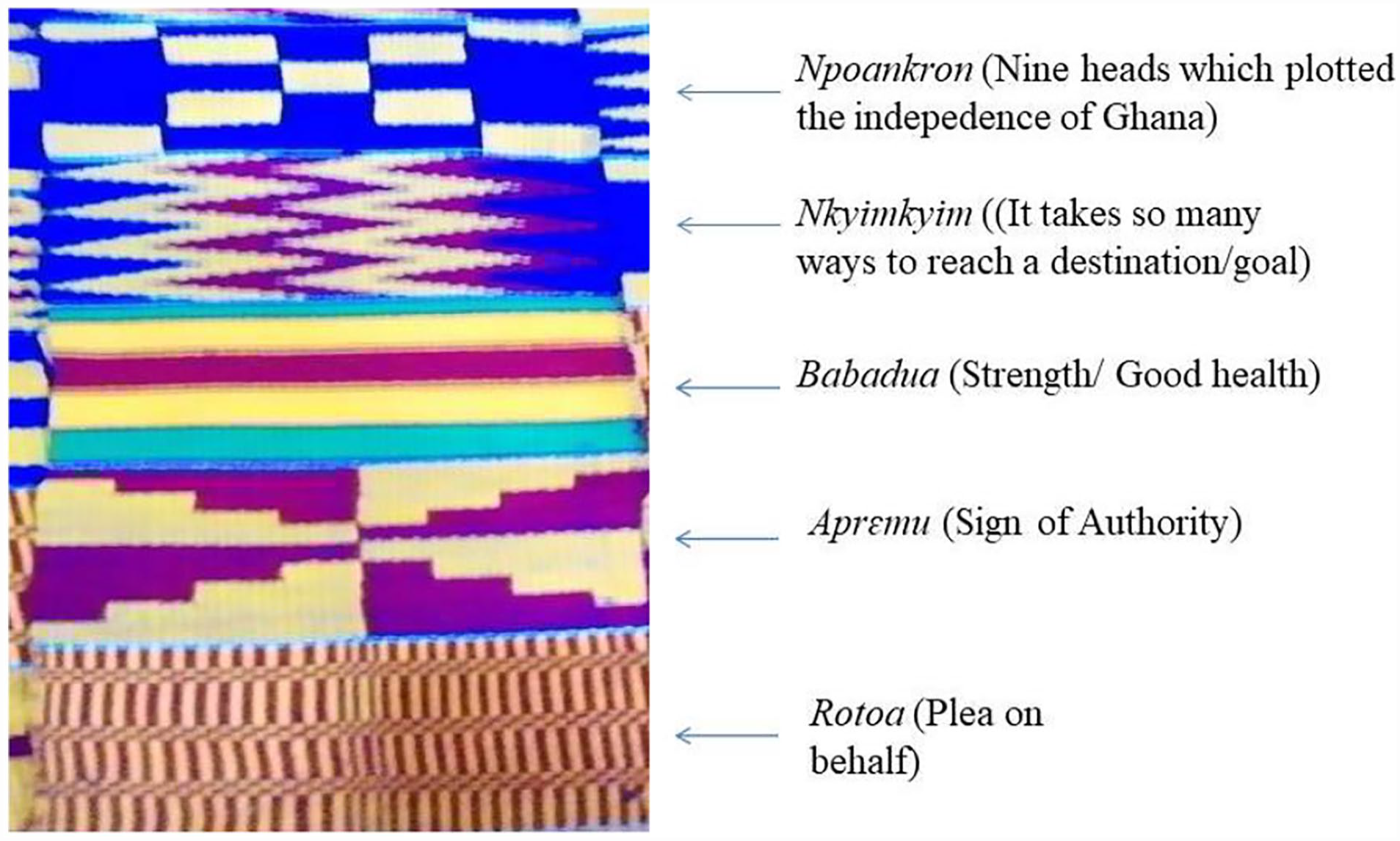
Fatia fata Nkrumah (Fatia matches Nkrumah) fabric with the embedded patterns and their meaning. Adapted from Agyemang et al. (2022).
The colours of Kente are not hand-dyed. The colours of the yarns used for the weft and warp determine the colours of the Kente. Custom or individual weavers’ aesthetic taste dictates the colour choice for the warp or weft designs (Sabutey, 2009: 112).
Information literacy explained
In this study, Lloyd’s (2006, 2007) definition, where information literacy is conceptualised as an information practice framed by socio-cultural elements in a setting is taken as a point of departure. She defines information literacy to be knowing what constitutes an information landscape by drawing meaning through interactions, processes and experience with all the sources and forms of information that are sanctioned in a specific landscape (Lloyd, 2006: 570). By the term all the sources and forms of information that are sanctioned, information is understood beyond the textual modality; it includes social and corporeal modalities that enable knowing the workplace landscape, in this case, the Kente-weaving landscape. The concept of the corporeal modality of information brings to the fore terms like embodied knowing. As an information practice, information literacy encompasses the information experiences that shape people through their engagement in social practices (Lloyd, 2006; Olsson and Lloyd, 2017; Talja, 2005). Lloyd’s definition brings to the fore the concept of affordance. Affordance is described as the opportunity a setting provides (Gibson, 1979a, 1979b: 27). Affordance is information experience in the workplace through which formal, informal, or incidental learning takes place (Lloyd, 2010a: 170). Under this definition, the information experience that enables know-how, know-that and know-why constitutes information literacy. According to Billett (2002: 35–36), affordance is provided through work practices and activities such as direct and indirect guidance. In the workplace, affordance is described as the opportunity provided to people to engage in work activities and interactions that are central and valuable to make meaning and understanding of workplace practice (Billett et al., 2004: 233; Lloyd, 2005: 233).
An information literate person is a person who is deeply conscious, linked and fluent with an information landscape (Lloyd, 2004: 222–223; Lloyd, 2010b: 56). Being conscious and fluent is synonymous with knowing or being competent to partake in practice. Becoming information literate is reliant on the affordance the information landscape (for that matter workplace) offers (Lloyd, 2005: 232–234).
Situated learning theory
This study is guided by Lave and Wenger’s (1991: 15) situated learning theory. The situated learning theory is a social practice theory that explains how people become competent practitioners in a community of practice. The situated theory holds the assumption that learning is continuous and increasing participation in a community of practice (Lave and Wenger, 1991: 49). Lave and Wenger’s (1991: 15) situated learning theory challenges the traditional notion that perceives learning as an individual activity. The theory perceives learning as a social process of meaning-making that is situated in both the historical and cultural context (Farnsworth et al., 2016: 140). That is, rather than as an individualised knowledge formation process, learning is conceived in terms of the relational and interactive process that enacts knowing (Gherardi, 2001; Hakkarainen et al., 2004; Orlikowski, 2002: 11). This, according to Morley (2016: 161), emphasises the notion that practice sharing advances learning and professional identity formation. According to Lave and Wenger (1991:35, 53), learning is not a reifiable process that happens to be located somewhere in practice, rather, it is an integral and vital part of generative social practice which involves the whole person (body and mind) regarding social communities. It is seen as a progressive process of engaging, imagining and aligning with the practices of a landscape (Wenger-Trayner and Wenger-Trayner, 2014).
The usage of the situated learning theory as the theoretical framework of this study is justifiable as it provides the analytical lens to conceptualise the Kente-weaving landscape (site) as a community of practice where learning takes place. The concept of community of practice provides the analytical lens to conceptualise the boundary of the Kente-weaving landscape within which competence, and the assessment and achievement of said competence, is readily defined in the community of practice. Also, the situated learning theory provides a framework to theorise information literacy as a social enterprise. The theory would also help to explain that information literacy is not an individually derived competence activity but is derived as a result of participation in the community. Consequently, this will help to explain that knowing, and for that matter, information literacy in the Kente-weaving landscape, is not just an individual and cognitive processing of the mind. Rather, it is an embodied understanding gained through actual work participation which leads to the construction of identities.
The situated learning theory was used to guide the activities that enable learning and how learning takes place through access to information to make novice weavers competent and information literate of the Kente-weaving practices.
Information literacy and workplace learning
Several studies have noted how novices of a community learn and therefore become competent through interactions and participation in workplaces: midwives, quartermasters, meat cutters and tailors (Lave and Wenger, 1991), firefighters (Lloyd and Somerville, 2006), ambulance officers (Lloyd, 2009), sales assistants (Moring, 2011), archaeologists (Olsson, 2016), librarians (Pilerot and Lindberg, 2018), nurses (Nordsteien and Byström, 2018) and hairdressers (Agyemang and Boateng, 2019). These studies focus on individuals’ interaction in achieving a shared and common goal. They also provide an overview of how novices become competent practitioners through their encounters with the information affordances of the workplace. Novices learn to develop competence in the workplace through observing others:
Novice chefs access corporeal information on the proper way of cutting vegetables by observing master chefs (Wellton et al., 2019: 413).
Novice engineers are afforded corporeal information by observing colleagues and incidents at the workplace to develop the different kind of competencies that is difficult to acquire through explanations (Billett, 2010: 47).
Through observation, novice archaeologists access corporeal information on the proper way to handle the trowel to lift fragile artefacts at the workplace (Olsson, 2016: 413–415).
Novice car restorers observe to access the embodied knowledge of other participants to know undocumented phenomena (Lloyd and Olsson, 2019).
Novice tailors access information on complex practices such as measurement taking, fabric cutting and designing through observing master tailors and other experienced apprentices (Acquaah-Harrison, 1997: 41).
Novice miners access information on safety by observing experienced miners (Somerville and Abrahamsson, 2003: 25).
Novice hairdressers observe the masters’ work-in-action to acquire the skills (Agyemang and Boateng, 2019: 117; Tracey et al., 2005: 7).
Novices in crafts such as pottery observe and imitate master craftspersons as they are in action (Bose, 2018: 46; Chapaev et al., 2019; Gowlland, 2012: 363; Ludlow, 2020: 12).
Craft making involves the development of motor skills (Veeber et al., 2015: 22; Yliverronen and Seitamaa-Hakkarainen, 2016: 2). As the novices observe the master craftsperson they get the motor-based understanding of the action (Marchand, 2008: 263). According to Marchand (2008: 263), motor-based understanding constitutes a knowing-how from the body. This suggests that as the master craftsperson demonstrates, information is afforded to novices. Thus, observation enables novices’ access to the master craftsperson’s embodied knowledge and to nuance ways of knowing motor skills. Observation provides novices access to the corporeal information needed to imitate and thereby develop their motor skills of craft practice. Like the other workplaces or professions, novice craftspersons slowly conform to the mastery of the craft (Ludlow, 2020: 8; McCarthy and Pinches, 2016: 391, 404). The novices discover ‘self-evident’ things that move them towards mastery of the craft (Ludlow, 2020: 8; McCarthy and Pinches, 2016: 391, 404).
Olsson (2016: 414) suggests that through observation at the workplace, hands-on experience which could not be offered by classroom instructions is gained. The development of competence is the result of access to work-practices-learning cues afforded through observation. The cues are some sort of corporeal affordances of information that novices access to perform the situated practices competently. The cues afforded by observing are aligned with Buckland’s (1991: 351) conceptualisation of information as knowing (knowledge). The cues, therefore, make a difference or change to the novices’ knowing-in-practice (information literacy in practice).
It must be noted that it is not only novices that get informed through observation; experts get informed as well. Experts’ observation of novices’ work-in-practice affords them with information to know the knowing gap novices are lacking. For example, in the study of firefighters, Lloyd and Somerville (2006) and Lloyd (2010c) observed that experts identify information gaps in the novices’ practices when novices were asked to perform basic firefighting tasks. This, therefore, suggests that observation enabled the experts to identify the information gaps in the novices’ acquired skills which were still needed to be competent in firefighting. The firefighter novices are therefore assigned to expert firefighters to fill the information gap (Lloyd, 2010c).
Verbal conversation is another form of interaction that enables the co-construction of knowledge while recognising the situated practices (Campbell, 2019: 5). Novices get to learn through conversations (i.e. discussion, feedback, suggestions and comments) with experts at the workplace:
Through conversation, experienced archaeologists provide meaning and interpretations to archaeological finds in the fields to novice archaeologists (Olsson, 2016: 413).
Through the interplay of giving and receiving feedback and comments from established colleagues, novice engineers and nurses get to know the practice of the workplace (Billett, 2010: 47–48).
Through discussion, novice teachers internalised and reflect on expert teachers’ comments, feedback and suggestions on alternative teaching methods to improve their competence (Jin et al., 2021: 1).
Novice craftspersons such as potters receive feedback, such as well-informed judgement of performance from master craftspersons during and after the completion of a task. The feedback informs the novice to learn the proper way of doing a task and build on previous skills to conform to the craft (Gibb, 2005; Gowlland, 2012:363; McCarthy and Pinches, 2016: 391; Newell, 1991: 232; Taylor, 2019: 300).
During conversations at the workplace, experts mediate and provide information affordances that enable novices to learn the practices of the workplace. Experts narrate stories (information on important past incidents or accidents) and deconstruct events of work practices (e.g. explain why things are done or happen in a certain way) to drive the information literacy practice of novices (Lindh, 2018: 326–377; Lloyd and Somerville, 2006: 194–195; Moring, 2011: 12–13; Somerville and Abrahamsson, 2003: 25–26). This shifts novices’ access to information from the textual information affordances of the classroom to the social and corporeal information affordances that represent the reality of the workplace (Dodgson and McCall, 2009; Lloyd, 2009: 407; Lloyd and Somerville, 2006: 194–195; Moring, 2011: 12–13). Access to social and corporeal information helps to develop novices’ competence to perform work practices.
In the workplace, novices ask experts ‘hard questions’ to get more informed and experience to change their identity from novices to competent practitioners (Agyemang and Boateng, 2019: 117; Gerber, 2001; Lepistö and Lindfors, 2015: 3; Lin and Bound, 2011: 36–37; Somerville and Abrahamsson, 2003: 25; St. Jean et al., 2018: 290). For example, in the underground mining workplace, knowing about safety is gained through questioning experienced practitioners as well as taking their guidance (Gerber, 2001; Somerville and Abrahamsson, 2003: 25). However, knowing in the workplace is not always one-way traffic (i.e. experts afforded to novices). For example, in the study on chefs, Cormier-MacBurnie (2010: 78) and Wellton et al. (2019: 413) found that novice chefs contribute to master chefs’ experiences of cooking. They observed that master chefs also learn when novices question and provide suggestions for the ways things are done in the kitchen. Similarly, in the craft landscape, Patchett (2017: 32) and Ludlow (2020: 10) suggest that master craftspersons, though competent are continually shaped by the craft practices of the landscape. For example, Gowlland (2012: 364) found that potters (whether novice or master) learn continuously among themselves.
Through conducting experiments, what is otherwise referred to as ‘trial and error’, craftspersons realise the skills and know-how to apply to each technique (both old and new) (Gibb, 2005; Kokko and Räisänen, 2019: 29, 39; Lepistö and Lindfors, 2015: 3; Ludlow, 2020: 12). Novices’ competencies are developed through the ‘learning by doing’ phenomenon. This is most often a result of imitation of what has been observed. This suggests that craftspersons access information through ‘trial and error’ to ascertain the best way to perform a task or technique. Herein, ‘trial and error’ becomes a way of knowing the craft. For example, Lin and Bound (2011: 36), Fafeita and Lloyd (2012: 94) and Wellton et al. (2019: 413) observed that novice chefs develop knife-cutting competency through repetitive trial and error. Through their engagement in basic chores such as chopping and peeling, novice chefs learn the proper way to cut foodstuffs (Fafeita and Lloyd, 2012: 94). Also, according to James (2006), Lin and Bound (2011: 36) and Fafeita and Lloyd (2012: 94) by participating in work practices, novice chefs are exposed to different tasks and food preparations in the kitchen and this enables them to gain experience and understanding of the different techniques in food preparation. This suggests that novice chefs are afforded corporeal information and social information on the ingredients and the know-how to prepare different kinds of foods. Access to the social and corporeal information in the kitchen enables novice chefs to become competent chefs in the future. Marsick and Watkins (1990: 12) describe this form of learning as incidental learning. Also, novices learn from the accidents resulting in participating in practice. For example, Somerville and Abrahamsson (2003: 26) found that novice miners develop safety awareness from the personal pains and injuries they suffer from mistakes and accidents. This brings to the fore the importance of knowing and observing work protocols.
Lepistö and Lindfors (2015: 3), Patchett (2017: 33), Klekot (2020: 220) and Ludlow (2020: 10) suggest novice craftspersons, for example, potters develop their skills by doing, thus the practical application of concepts techniques and materials in the workplace. This suggests that the work (i.e. doing) provides knowing affordances of information. Dufva (2017: 129) elaborates on this notion stating: ‘making by hand develops not only maker’s handicraft skills but also her/his knowledge’. This suggests reciprocity in doing at the workplace; as novice craftspersons do, they are being transformed to embody the skills of the craft (McCarthy and Pinches, 2016: 392). Sennett (2008: 268) calls this ‘rhythm of routine’. Thus, novices through repetitions of skills, embody the practice, making the skills theirs (Holmes, 2015: 482; Ludlow, 2020: 8; Sennett, 2008: 295). Therefore, novices are changed by the information they experience at the workplace to situate themselves among master craftspersons. Novices come to ‘know’ and therefore become competent through what they see and receive in the workplace (McCarthy and Pinches, 2016: 392).
Methodology
This study used ethnography as the research design. Ethnography is a qualitative design of inquiry in which the researcher describes and interprets the shared patterns of behaviour, actions, values, beliefs and language of an intact culture-sharing group in its natural site over a prolonged period (Creswell and Creswell, 2018; Harris, 1968). Ethnography involves collecting data over a prolonged period on the field (Leith, 2018: 37; Rashid et al., 2015: 3).
To gain access to the field, the researcher contacted a gatekeeper of the Bonwire Kente Centre to facilitate a meeting between the researcher and the weavers of the Bonwire Kente Centre to discuss the rationale behind the research. In that meeting, the researcher explained to the weavers that participation is voluntary and that participants can opt out of the research at any stage, but nobody did. The researcher won the trust of the weavers and approval was granted when they realise that the researcher hails from a nearby village where Kente fabric is also woven, though not on such an extensive scale as in Bonwire. This was because the researcher was regarded as a brother. Without exception, the researcher was welcomed enthusiastically by the weavers and was encouraged to feel free to ask anybody any questions during the conduction of the research. The researcher requested the participants sign consent forms.
Interview and participant observation were used as the data collection methods. Guided by the situated learning theory both the interview and participant observation were focused on what enables access to information to make a novice weaver learn to become information literate and therefore competent in the Kente-weaving landscape. For the interview, semi-structured interview techniques were used to solicit information from all three levels of weavers (Master, junior and novice weavers) at Bonwire Kente Centre.
Novice weavers are newcomers and learners at Bonwire Kente Centre. Junior weavers are those weavers who can produce basic and intricate Kente designs with little or no supervision. Master weavers are experts with knowledge of the know-how, and philosophies resulting from several years of practice. They have the know-how to make a judgement on Kente-weaving practice (Sabutey, 2009: 151). Out of the 62 weavers at the Bonwire Kente Centre, 24 weavers representing 8 each from each level of weavers were purposively chosen. The researcher spent an average of 31 minutes on each interview at the Bonwire Kente Centre. The interviews were recorded using an audio recorder and then transcribed into text by the researcher himself.
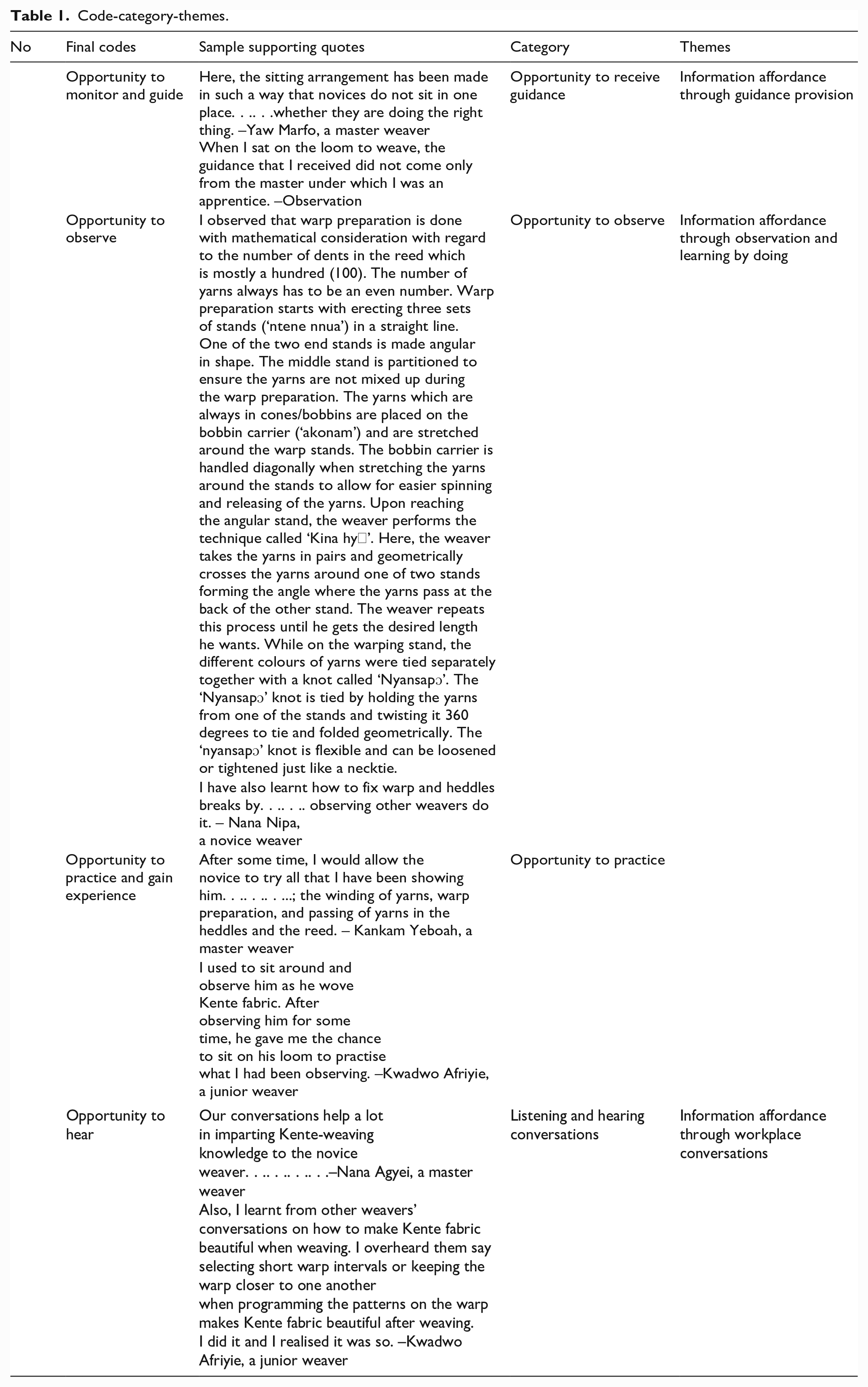
For the participant observation method, the researcher employed the ‘participant as observer’ role to collect data in the field. The ‘participant as observer’ role was adopted by the researcher by accepting the position of becoming an apprentice and progressing to that of a master weaver for 6 months in the field. The analysis of the data set was done according to Saldana’s (2013: 13) codes-category-theme model for qualitative inquiry. The model provides the link from the codes through the category and to the theme. Saldana explains that a code is a word or phrase that is used to describe the salient and evocative trait for a portion of data. The data can comprise interview transcripts or field notes emanating from participant observation (Saldana, 2013: 13). With reference to the situated learning theory, the field notes and interview transcripts were coded together with the mentality of looking out for relevant activities (sayings and doings) that enable learning through the access to information to explain how novice weavers become information literate and therefore competent as a result of participation in the community. The focus of the coding was based on what is evidential as well as what is implied by the data set. Coding in the thematic analysis was done manually. Alluding to Saldana (2013: 8), codes that shared similarities and regularities were clustered into broader a category. Categories are compared with each other and those that are similar are consolidated to form a theme. The following are excerpts from the codes-category-theme analysis (Table 1). Pseudo-names were used in attributing quotes to any participant.
Code-category-themes.
Findings
The findings of this study show that novice weavers’ learning in becoming information literate is deepened by the affordance of the Kente-weaving landscape (workplace). This study confirms Lloyd’s (2010a: 169) observations that affordance provides access to information. The affordance in the Kente-weaving landscape deepens novice weavers’ information literacy or competence. Novice weavers access information through the affordance of guidance provision, conversations, observation and learning by doing.
Information affordance through guidance provision
The Kente-weaving landscape provides the avenue for novice weavers to be monitored and guided. Yaw Marfo, a master weaver, explains: Here, the sitting arrangement has been made in such a way that novices do not sit in one place; rather they sit around a junior or master weaver. Every novice sits nearer to a junior weaver or master weaver so that their work progress can be monitored by someone more advanced than them. This enables the novices to be noticed and corrected when they are making mistakes at the early stage. Master weavers at times go around inspecting the work of the novice and junior weavers to see whether they are doing the right thing.
The sitting arrangement enables master weavers to have access to novice weavers in terms of monitoring and inspecting their work progress to correct them when they make mistakes. As noted by Billett (2002: 35–36), work practices provide advantages that enable direct and indirect guidance. Alluding to the work practices, the affordance to enable information access to novice weavers is provided through the sitting arrangement. The notion of correction afforded novice weavers connotes information access to the novice weavers in terms of deepening their ‘know-how’ to become competent weavers or information literate in the weaving landscape. The access to Kente information through guidance is not limited to apprenticeship only; being present at the workplace provides the opportunity to be guided by the competent weaver. Nana Agyei, a master weaver, acknowledges the role of guidance: Here, every competent person or master weaver can teach any novice weaver whether he is his apprentice or not. When a novice is weaving Kente and he is not doing the right thing, and master weaver who notices would correct him on how to do it right, regardless of him being his apprentice or not. . .. . .. . .. . .. . . For example, the other time when I reported to work, I noticed one novice weaver who was performing the tie-up technique in the loom. From how the novice weaver had done the tie-up in the loom, all the fabric he would have woven would have turned upside down. So I notify him and told him to stand out of the loom; I sat in the loom to do the correct tie-up technique for him.
Similar to Nana Agyei’s statement, the following observations in the field notes reflect this: When I sat in the loom to weave, the guidance that I received did not come only from the master under which I was an apprentice. Other weavers including junior weavers guided me and gave me directives on how to go about the weaving.
Novice weavers do not receive guidance from their direct masters only. Rather, any master weaver who notices a problem or fault with any novice weaver’s work would provide guidance. An example is given in the above statement on how the master weaver afforded tie-up information to a novice weaver by demonstrating the method to him. Concerning guidance provided by master weavers, Kwasi Appiah, a novice weaver noted the following: I am still learning Kente weaving; it is not everything that I know and am capable of doing. So the master weavers correct me when they see a mistake with the weaving works I engage in. You see that I have stopped weaving right now. I was told to stop the weaving by one master weaver. He saw some mistakes in my work that need to be corrected. He saw me struggling to tie up the warp yarns on the cloth beam. He told me to wait for my master as I do not have the experience to do it.
Similar to Kwasi Appiah’s statement, Yaw Oppong notes that the presence of the master weavers enables novice weavers to access information through the guidance they receive in the workplace. He had this to say: As you see right now, I am surrounded by many competent weavers, so if there is anything wrong or amiss with my work or if I am facing any challenge, they would intervene and assist me. For example, many learners have a challenge in fixing warp and heddles breaks; they always need help from experienced weavers to show them how to fix them. That is how I learnt how to fix the warp and heddle breaks. I learnt how to fix them . . .. . .. . .. . .. . .as he was assisting me to fix the warp and heddles breaks some time ago.
From Kwasi Appiah and Yaw Oppong’s statements above, it is noted that master weavers intervene when novice weavers are confronted with challenges like warp and heddles breaks as well as tie-up technique difficulty. The intervention suggests the affordance of information to the novice weavers to learn how to address challenges like warp and heddles breaks. It is therefore no surprise that Yaw Oppong learnt how to fix warp and heddles breaks through this medium. It is implied here that the guidance support that the master weavers provide in the Kente-weaving landscape affords novice weavers access to Kente information which in turn equips them to develop and deepen the ‘know-how’ or competence of weaving Kente.
Information affordance through observation and learning by doing
The exposure through observation suggests the benefit of information to novice weavers. The opportunity to observe the Kente-weaving practices (procedures and techniques) enables novice weavers to become information literate in the Kente weaving landscape. Novice weavers are afforded information to develop skills or know-how through observation. The following field notes give more information on how information literacy of the warp preparation practice takes place through observation: I observed that warp preparation is done with mathematical consideration with regard to the number of dents in the reed which is mostly a hundred (100). The number of yarns always has to be an even number. Warp preparation starts with erecting three sets of stands (‘ntene nnua’) in a straight line. One of the two end stands is made angular in shape. The middle stand is partitioned to ensure the yarns are not mixed up during the warp preparation. The yarns which are always in cones/bobbins are placed on the bobbin carrier (‘akonam’) and are stretched around the warp stands. The bobbin carrier is handled diagonally when stretching the yarns around the stands to allow for easier spinning and releasing of the yarns. Upon reaching the angular stand, the weaver performs the technique called ‘Kina hyε’. Here, the weaver takes the yarns in pairs and geometrically crosses the yarns around one of two stands forming the angle where the yarns pass at the back of the other stand. The weaver repeats this process until he gets the desired length he wants. While on the warping stand, the different colours of yarns were tied separately together with a knot called ‘Nyansapɔ’. The ‘Nyansapɔ’ knot is tied by holding the yarns from one of the stands and twisting it 360 degrees to tie and folded geometrically. The ‘nyansapɔ’ knot is flexible and can be loosened or tightened just like a necktie.
Novice weavers observe how the warp is prepared. Specifically, the novice weavers observe how the three stands are erected. Through observation, information on how the bobbin carrier is handled diagonally, stretched and spun around to perform the ‘Kina hyε’ technique is passed on to the novice weavers. Moreover, how the ‘Nyansapɔ’ knot is tied is observed when the warp is being prepared. The field notes show that the yarns are held, twisted and tied 360 degrees geometrically in the preparation of the warp. Besides the warp preparation, novice weavers are allowed to observe how the heddling technique is performed. Kwame Bonsu, a junior weaver, elaborates on how a novice becomes competent in heddling technique:
Here, the novice weaver observes how the warp ends are passed through the ‘eyes’ . . . of the heddles. . . For every ‘eye’ of the heddles whether front or back, two warp yarns are passed through alternatively for the single weave. For the double weave, four warp yarns are passed through the ‘eyes’ of the first set of heddles front and back alternatively till the warp yarns are all used up. The four warp yarns are then divided into two pairs (two yarns each) to pass through the second pair of heddles just as in the single weave. If the warp yarns are not passed through the ‘eye’ of the front and back of the pair of heddles alternatively, it would be difficult to press down the treadle to open up the warp.
Bonsu’s statement shows that in learning to become competent or information literate in the heddling technique, the novice weaver observes to access the information on how the heddling is done. Specifically, the tricks of how the warp ends are passed through the ‘eyes’ of the heddles are observed to enable the novice weaver to develop the know-how of the heddling technique. Concerning how the reeding technique is done, the following observation was made in the field notes: I observed that the warp ends are taken in a set of two pairs (making four warp ends), a pair each from both the front and back heddles. A set of two pairs (four warp ends) are placed through each dent of the reed till all warp ends are used up. I observed that a broomstick is used to do the reeding technique. The combined two pairs of warp ends are placed on the reed and the broomstick is used to push them through each dent and pull through from the other end of the reed.
The information needed to make the novice weaver information literate on how the reeding technique is experienced by observing the practice of reeding at the Kente workplace. It is obvious from the field notes that a set of two pairs of warp ends are passed through the dents of reed from both the front and back heddles using a broomstick.
About how a novice weaver becomes information literate in the stretch and tie-up techniques, the following observation was made in the field notes: I observed that the stretch and tie-up techniques involve making two types of knots namely ‘Agonoyε’ and ‘Nyansapɔ’. The Agonoyε knot is tied around the reed to the cross beam. The Agonoyε knot is an adjustable knot that enables the reed to be positioned or adjusted to suit the weaver. For the heddle, both the ‘Agonoyε’ and ‘Nyansapɔ’ knots are tied at one end each through the pulley on the cross beam. Also, I observed that the stretch and tie-up techniques involve pulling the warp through the reed and performing a technique called ‘Eterebɔ’. The ‘Eterebɔ’ technique involves dividing and making three ‘Nyansapɔ’ knots from the warp on a wooden bobbin against the cloth beam. After the ‘Eterebɔ’ technique, ‘Nyansapɔ’ knot is tied on a wooden stick called ‘Abotidua’ to the drag stone.
To develop competence and become information literate in the stretch and tie-up techniques, the novice weaver is expected to observe how the ‘Agonoyε’ and ‘Nyansapɔ’ knots are tied to the reed, heddles, cloth beam and the drag weight (stone). By observing, information is accessed to enable novice weavers to develop their information literacy on how these knots are tied. The description shows that both the ‘Agonoyε’ and ‘Nyansapɔ’ knots are tied at one end each through the pulley on the cross beam.
To become information literate and capable of fixing the challenges and defects associated with weaving a fabric, this study found out that novice weavers are allowed to observe and access information on how to address and fix some common weaving challenges and defects. Agyare Ansukun, a junior weaver, explained this point in the statement below: After some time, the master weaver would show the novice weaver how to fix some weaving challenges such as warp and heddles breaks. For the heddle breaks, the preceding nylon threads that make the ‘eyes’ of the heddles should be counted and separated to identify the specific thread to tie or fix. Mostly, for every ‘eye’ of the heddles, two warp yarns pass through, so when there is a warp break, the specific warp yarn that is broken or torn would have to be looked for, trace through the reed, heddles and the set patterns and tied with the other end to continue the weave.
From Agyare Ansukun’s statement, it is obvious that novice weavers learn how to fix weaving challenges and defects by observing master weavers do it. Specifically, how the challenges of warp and heddle breaks are fixed have been described. To fix the challenges of warp and heddle breaks, a novice weaver is expected to observe how the nylon threads making the ‘eyes’ of the heddle are examined to identify the specific thread through the reed, heddles and the set patterns to tie.
Aside from observation, information is accessed by novice weavers through learning by doing. The act of learning by doing provides novice weavers the opportunity of gaining experience in Kente weaving. Learning by doing, gives the novice weavers practical information on what they have been observing at the Kente workplace. Kankam Yeboah, a master weaver, acknowledges this point of practical application: After some time, I would allow the novice to try all that I have been showing him. . …; the winding of yarns, warp preparation, and passing of yarns in the heddles and the reed.
In the above statement, Kankam Yeboah, a master weaver narrates how he enables his apprentice to access information by allowing them to put into practice what they had been observing him do. Among the activities novices learn to do by performing or practicing is the winding of yarns on the bobbins, warp preparation, heddling and reeding. This enables novice weavers to gain practical experience. Experience is gained through accessing corporeal information by participation. As novice weavers participate in the weaving practices, they gain experience of the weaving practice. Kwadwo Afriyie, a junior weaver, comments on his experience with practical involvement: I used to sit around and observe him as he wove Kente fabric. After observing him for some time, he gave me the chance to sit on his loom to practise what I had been observing. He always stood beside me. . … He showed me how to reverse the weave anytime he realised that I made a mistake. The chance he gave me to sit in the loom to practice what I have learnt from observing him helped me to gain experience to weave Kente properly.
Kwadwo Afriyie’s statement suggests that master weavers observe the novice weavers as they try to perform the weaving practices and practically increase their information literacy of Kente weaving. In other words, master weavers can make a judgement on the information novice weavers are lacking to afford them or correct them to develop or deepen their ‘know-how’ of weaving Kente. The opportunity to do or practice what has been observed is a way to access information and gain experience in that it provides novice weavers the opportunity to make mistakes but also to learn from their mistakes. Owusu Adonten, a novice weaver, gives his view on learning by doing: I remember that I pleaded with one weaver to allow me to help him with the winding of yarns on the bobbins when I saw him doing it. Through the chance, he gave me I mastered how to use the bobbin winder to wind yarns on the bobbin.
Adonten’s statement attests to how the ‘know-how’ use of the bobbin winder is practised and improved. It is evident from the samples of extracts above that novice weavers access information to increase their ‘know-how’ knowledge of the Kente-weaving practice through observing and learning by doing the practices of the workplace.
Information affordance through workplace conversations
Novice weavers’ presence in the Kente-weaving landscape, interacting and participating in the practices of the workplace provides novice weavers the opportunity to access Kente information through listening and hearing conversations about Kente to improve their ‘know-how’ and thereby make them competent weavers. The conversations in the Kente-weaving landscape provide opportunities for novice weavers to ask questions to increase their understanding of the practices of the workplace. Nana Agyei, a master weaver, comments on the benefit of conversation: Our conversations help a lot in imparting Kente-weaving knowledge to the novice weaver. The conversation paves way for the novice weaver to ask questions concerning things he does not understand for answers. The novice weaver is free to ask any master weaver about Kente weaving he does not understand. Our conversations here give the novice weavers more information about Kente weaving.
The conversations assist novice weavers to increase their understanding of the weaving practices. Conversations also pave the way for novice weavers to solicit information from master weavers. During conversations, novice weavers are free to ask questions to access the necessary information to deepen their knowledge of the weaving practice. Aside from soliciting information by asking questions, information can also be accessed by overhearing the conversations of other weavers. Kwadwo Afriyie, a junior weaver, explains the benefits he gained from conversations and overhearing other weavers talk: Also, I learnt from other weavers’ conversations on how to make Kente fabric beautiful when weaving. I overheard them say selecting short warp intervals or keeping the warp closer to one another when programming the patterns on the warp makes Kente fabric beautiful after weaving. I did it and I realised it was so.
In conversing in the Kente-weaving landscape, comments that improve novice weavers’ ‘know-how’ are extremely helpful to novices. Kwame Bonsu, a junior weaver had this to say: Master weavers most often comment and pass judgment on woven fabric. If a woven fabric is of quality or otherwise they would say it. For example, if a weaver does not beat up the fabric well to make it compact when weaving, he would be chastised and criticised by the master weavers for weaving inferior fabric. Such comments or judgments master weavers pass on a woven fabric help novice weavers to know what constitutes a well-woven or quality fabric.
Concerning weaving a quality Kente, master weavers sometimes give comments on other weavers’ work while in the action of weaving in the loom. Kwabena Amoako, a master weaver, comments on the benefits of taking advice: Sometimes you may hear somebody say to a weaver inside a loom to beat up the fabric at a particular point to get the compactness of the fabric (‘ntoma wei deε, bɔ so ma no nyε den’). In such an instance if an apprentice hears this statement to beat up and sees the subsequent action thereof, he would learn how beating up using the reed is done to get desired compactness and weight of a woven Kente fabric.
The sharing of weaving advice to novice and junior weavers does sometimes happen. The act of sharing advice allows novice weavers to expand their insight concerning a specific technique. The above statement suggests that sharing information concerning how to beat up the fabric to get compactness is most helpful to any novice weaver. In addition, the conversations focus on the tools of the Kente-weaving landscape. The conversations that focus on the tools, assist novices to learn the names and uses of the tools. Oti Boateng, a junior weaver, gives his view: Through mingling with the weavers here, the novice weaver can know the name of the tools as they would be mentioned and used to produce Kente.
The tools of the weaving practice are part of the daily conversations in the Kente-weaving landscape. The statement suggests that through conversations, information on the names of the tools and their uses is shared with novices. Aside from the tools, there are conversations around the patterns and history of the Kente fabric. This is reflected in the field notes: I noticed the names of the Kente fabrics and the embedded patterns are part of the daily conversations. These names are mentioned when weavers are conversing with clients and sometimes among themselves. Names of the various Kente fabric and patterns are also mentioned to tourists in the Exhibition room. I noticed that the conversation around the names of the fabric and patterns imparted me as it was through that I got to know some of the names of the fabrics and their embedded patterns.
The conversations among weavers and weavers’ conversations with clients and tourists allow novice weavers to learn the names of the fabric and their patterns. An example of such Kente fabric is the Fatia fata Nkrumah. Kwabena Amoako, a master weaver, notes: There is a Kente fabric called Fatia fata Nkrumah. The Fatia fata Nkrumah Kente fabric has some patterns. . .. . .
Amoako’s statement gives an example of Kente fabrics. The patterns and meanings of the Fatia fata Nkrumah Kente fabric are shown in Figure 3. Also, through conversation, the reason behind the names of some Kente fabrics is learnt. The following observation from the field notes illustrates the point: I noticed that some of the Kente fabrics and patterns are named after the weavers who first wove such fabric or patterns. Also, there are stories of how some of the Kente patterns came into being. An example of such fabric is Torku kra ntoma (Literally means Torku’s soul fabric). The story is told that a fetish priest fore-told Torku that he would die the very day he finished weaving a specific fabric and it did happen. Hence, that specific type of fabric is named after him.
Through conversation, stories about the history and background of the Torku kra ntoma Kente fabric is shared. Awareness of the background knowledge concerning some fabrics, such as Torku kra ntoma, shows the depth of knowledge of the weaver regarding the Kente landscape.
Discussion
The findings show learning takes place to enable novice weavers to develop and deepen their ‘know-how’ and ‘know-that; and ‘know-why’ knowledge required of the Kente-weaving landscape. The findings show that the Kente-weaving landscape provides the avenue for novice weavers to receive apprentice positions and as a result, receive the necessary guidance and monitoring that will result in novices eventually becoming information literate of the Kente-weaving practices. The findings show that by being an apprentice, the novice weaver not only receives information from his direct master but also from other competent weavers, including junior weavers. Where the novice weaver struggles or makes a mistake in weaving, master weavers or any other competent weavers nearby can correct him by giving him the necessary information to improve his skills in the practice of Kente weaving. Novice weavers receive guidance when confronted with tying-up technique difficulty. Such information enables novice weavers to develop the ‘know-how’ regarding tie-up technique.
The findings show that the novice weaver is afforded information through observation and learning by doing to develop the know-how of the weaving practices (procedures and techniques) as well as challenges and defects fixing necessary to become information literate. The Kente-weaving landscape provides novice weavers with the opportunity to observe the activities and therefore to learn practical skills. This finding is in line with Wellton et al. (2019: 413) who find the proper way of cutting vegetables is provided by master chefs through observation by novice chefs. Similar to the finding of Wellton et al. (2019: 413), the proper way to learn and develop skills pertaining to the Kente-weaving procedures and techniques is by accessing information while observing master weavers and other competent weavers in the Kente-weaving landscape. In the same manner, studies by Agyemang and Boateng (2019: 117) and Tracey et al. (2005: 7), show that the development of the ‘know-how’ in an information landscape is reinforced by observing the work practices of the masters provided to the novice weaver. Through observation, the novice weaver accesses information to deepen the know-how of Kente-weaving practices warp preparation, heddling and reeding, stretch and tie-up techniques as well as the challenges of warp and heddles breaks. For example, involving the warp preparation technique, the novice weaver observes and learns that it is performed by observing how a master weaver handles and stretches the bobbin carrier (Akonam) diagonally around erected a three-set of stand (Ntene nnua) in a straight line. He also observes and accesses the information of the ‘Kina hyε’ technique by observing how the master weaver geometrically crosses yarns around the angular stand. Besides, the ‘Agonoyε’ and ‘Nyansapɔ’ knots are learnt by observing to access information on how yarns are tied to the reed, heddles, cloth beam and the drag weight (stone). The ‘Agonoyε’ and ‘Nyansapɔ’ knots are tied at one end each through the pulley on the cross beam. During warp preparation, the ‘Nyansapɔ’ knot is tied by holding and twisting the yarn by a 360 degree. Also, the ‘Eterebɔ’ technique which is involved in the stretch and tie-up practices is learnt by accessing the information on how three ‘Nyansapɔ’ knots are tied from the warp on a wooden bobbin against the cloth beam in the loom.
Like novice potters as found by Lepistö and Lindfors (2015: 3), Patchett (2017: 33), Klekot (2020: 220) and Ludlow (2020: 10), by doing, the novice weavers learn by having access to information, which in turn enhances their practical knowledge and therefore enable them to become information literate of the Kente-weaving landscape. Like with other crafts, by observing and imitating actions (Gibb, 2005; Kokko and Räisänen, 2019: 29, 39; Lepistö and Lindfors, 2015: 3; Ludlow, 2020: 12), the novice accesses information on how master weavers examine the nylon threads making the ‘eyes’ to identify the broken warp or heddle and tie it when learning the skills in fixing weaving challenges of warp and heddle breaks.
Also, by doing, the novice weaver provides the master weaver with information on his weaving challenges to enable the master weaver to assist. The result of the study is consistent with Lloyd and Somerville (2006) and Lloyd (2010c) who found that experts identify knowing gaps in the novices’ practices when novices-in-training are required to perform basic firefighting tasks. The results show that master weavers always stand beside novice weavers to observe them as they practically apply what they have been observing. The master weaver is therefore on hand to notice any mistake, inform the novice weaver and assist him in learning the correct method.
Workplace conversation help augments novice weavers’ ‘know-how’ and ‘know-that’ of Kente weaving. The findings show that novice weavers hear tips for weaving Kente beautifully from the conversations of other weavers. The tips include selecting short warp intervals when setting the patterns on the warp. Also, in the conversations among weavers or weavers’ conversations with clients and tourists, the names of the tools, Kente fabrics and patterns and background information are referred to assist the novice in learning to become information literate. The Fatia fata Nkrumah and Torku kra ntoma Kente fabrics are given as examples in the findings. This confirms Billett’s (2010: 48–49) findings that conversation around artefacts affords knowing opportunities. The study shows that the information accessed through workplace conversation furnishes novice weavers with insight into the activities of the Kente-weaving landscape. Consistent with the studies of Moring (2011), St. Jean et al. (2018: 1), Campbell (2019) and Jin et al. (2021), the findings show that conversation at the workplace enables novices to be informed, knowledgeable, and therefore able to perform work practices competently. Per the findings, the conversations in the Kente-weaving landscape also provide an opportunity for novice weavers to ask questions concerning Kente weaving for clarification. This finding is in line with other studies like Lepistö and Lindfors (2015: 3), St. Jean et al. (2018: 290), and Agyemang and Boateng (2019: 117), where novices ask questions to garner information and gain experience to change their status from novices to competent practitioners.
Conclusion and future research
This study focused on how learning is enacted to make the novice Kente weaver information literate in the Kente-weaving landscape. This study draws attention to-the-most-often-ignored social and corporeal information and affordance in the information literacy literature. The socio-cultural context of the informal workplace landscape affords the social and corporeal modalities of information. The social and corporeal modalities of information enable novices to learn and become competent practitioners of the informal workplace landscape. The study shows that becoming information literate in the Kente workplace landscape goes beyond knowledge construction through the work of the mind of an individual. Becoming information literate in the Kente craft is enacted through access to the information affordance by way of observing, doing, and conversing as well as the provision of guidance in workplace practices to develop the competence of the Kente craft. The Kente workplace landscape determines competence and the kind of information about weaving practices that can be accessed to equip a person with the know-how, know-that and know-why to become information literate.
Though the practices of the Bonwire Kente Centre are embedded within the cultural and historical traditions of the Bonwire community and therefore could be regarded as indigenous knowledge, the focus of the study does not allow for the discussion to include craft as an indigenous knowledge that flows among community members. This is because the study focuses on the Kente weaving craft as a profession in the context of a workplace landscape (the Bonwire Kente Centre). The attention was on how learning takes place in the Kente-weaving workplace and not the Kente-weaving community. Following this, further study can look at Kente weaving from the indigenous knowledge systems perspective where Kente weaving is seen as a community “property’ that is shared in the Bonwire community.
Footnotes
Declaration of conflicting interests
The author(s) declared no potential conflicts of interest with respect to the research, authorship, and/or publication of this article.
Funding
The author(s) received no financial support for the research, authorship, and/or publication of this article.
