




Abstract
Over the last 40 years, New Zealand libraries and information management institutions have been undergoing cultural change in an attempt to improve the services and resources made available to Māori clients. Previous studies have demonstrated that Māori have not been regular users of these institutions, so a critical part of the transformation process has focused on the promotion of the benefits that library and information institutions can provide. This has led to institutions reviewing how they can incorporate distinctively Māori elements within their existing structures. A critical part of this innovation has been the introduction of te reo Māori into areas such as signage, intellectual access, website and online catalogue designs and client services. This article reports on research that has focused on how Māori language into services, and the challenges and opportunities that its usage has for Māori clients and the libraries and information management institutions in New Zealand.
Introduction
In New Zealand, although the English language is recognised under common law and is the predominant language, there are only two official languages, te reo Māori (Māori language) (See Appendix 1 for a glossary of all Māori terms and their translations) and New Zealand Sign Language. As the most widely spoken language, English has since colonisation and settlement in the 19th century been at the forefront of the services offered by New Zealand library and management institutions. As official languages, te reo Māori speakers and those using sign language means that they can use these when engaging with local and central government agencies, legal and parliamentary systems. As public organisations, library and information institutions have since the 1980s been supporters of biculturalism, Te Tiriti o Waitangi (Treaty of Waitangi) and providing access to mātauranga Māori (Māori knowledge), with the usage of te reo Māori becoming an increasingly important component of this support. This article provides information about the history, decline and redevelopment of te reo Māori, and why it is important to Māori, New Zealand and library and information institutions. It then considers the range of literature relevant to how libraries and information institutions have engaged with Māori and Māori language. The main body of this article then reports on a research project that was designed to gain an understanding of how these institutions are contributing to the revitalisation of te reo Māori, including the barriers, challenges and successes that have been encountered. The discussion section considers the implications of the results of the research and identifies how services and resources in te reo Māori can be strengthened further in the future.
A short history of te reo Māori
Te reo Māori is the Indigenous language of New Zealand. It is part of the Austronesian language family. Māori migrated from Eastern Polynesia approximately 800 years ago, and although te reo Māori bears some similarities to other Eastern Polynesian languages, it is unique to New Zealand. Māori lived in relative isolation until regular contact with the Western world became normalised after the first expedition by Captain James Cook and the HMS Endeavour in 1769. After Cook’s voyage, sealers, whalers and traders became frequent visitors to New Zealand, and the Bay of Islands was particularly attractive for those seeking rest and recreation. In 1814, the Church Missionary Society established a mission station intending to civilise and convert Māori to Christianity. Before the arrival of the missionaries, te reo Māori was an orally transmitted language, and in 1815, Kendall produced the first book written in te reo (Kendall, 2015), which he used as a textbook in the mission schools that were established from 1816 onwards. Literacy was embraced enthusiastically by Māori, and although even to this day oral transmission of knowledge has continued to remain important, the introduction of literacy had a dramatic impact on Māori knowledge systems. By 1840, the number of settlers had increased dramatically, and the ability to control the European population had become more complex. With the prospect of a further influx of settlers through the New Zealand Company’s mass migration plans to establish a settlement in six different parts of the country, it was decided that a formal agreement needed to be established between Great Britain (on behalf of Queen Victoria) and Māori. This led to the signing of Te Tiriti o Waitangi in February 1840 and the subsequent annexation of the whole country in May of that same year. The Treaty itself was prepared in English and was then translated into te reo Māori, with all but 39 of the Māori signatories signing a te reo Māori version. Unfortunately, the texts of the two versions vary considerably and these variations effectively meant that the two parties to the agreement (Crown and Māori) were signing different documents. Of particular importance was the difference in the first article where in the English version, Māori ceded sovereignty to Queen Victoria, but the word that was used in the Māori version was kawanatanga, (which translates as governance). The difference between the two terms remains a point of contention in the 21st century, along with what was intended by the terms in the second article, which focused on protection (English version) and tino-rangatiratanga (rights of self-determination) (Māori version). Library and information institutions, particularly those that are part of the government and local government sectors are required through the law to give effect to Te Tiriti o Waitangi and factor these obligations into the services and resources they provide. Although the use of te reo Māori in these institutions is not compulsory it is a highly visible and powerful way of demonstrating a commitment to Te Tiriti o Waitangi and Māori clients.
Literature review
Published literature is scarce on the engagement of Māori with libraries, and this in itself is indicative of the low level of library and information research being conducted in New Zealand. The reports by MacDonald (1993) and Szekely (1997) formed the first two parts of the Te Ara Tika (the right path) project and are seminal works on the relationships between Māori and library and information institutions. MacDonald’s work focused on the library profession and its views on biculturalism and services to Māori. MacDonald spoke to librarians in the public library sector about their perceptions regarding Māori use. The comments from these librarians indicated that they thought Māori used a wide range of library services but mainly for reference or fact-finding purposes rather than recreational needs and that there was a heavy demand for Māori cultural information. MacDonald’s report was ground-breaking at the time and seen as hugely significant for the library profession in New Zealand. However, the reliance on anecdotal evidence from librarians about Māori information requirements was a weakness of the study and demonstrated a need for stronger empirical research that engaged with Māori communities to gain their perspectives. The latter point was in part addressed in Szekely’s (1997) research. This research was centred on identifying Māori information needs as expressed by Māori that participated in six different hui (meetings) throughout New Zealand. Participants at the hui focused on their experiences of using libraries and the problems they faced in accessing information. The report resulted in 33 recommendations for the commissioning associations. The report is valuable for emphasising that Māori information needs are as diverse as the needs of any other particular user group. These needs incorporate everything from professional career needs to personal needs such as parenting, hobbies, health, etc. The need for Māori cultural information identified in MacDonald (1993) was reinforced by Māori users who participated in the hui for the second Te Ara Tika project.. Neither MacDonald nor Szekely had a strong focus on te reo Māori, but the latter did report that there was a desire from hui participants for more material (especially manuscripts) to be made available, and a greater amount of bilingual signage and for more te reo Māori speaking staff to be employed by libraries.
An earlier survey (Garraway and Szekely (1994)) also surveyed New Zealand libraries to identify what they were doing in their institutions to promote biculturalism. Included in their survey were questions about the use of bilingual (Māori – English) signage and the adoption of Māori names by the libraries. Although the report is quite dated now, it does provide a benchmark of how te reo Māori was being used in libraries at that time and is useful for assessing the degree of progression over the last 30 years. The survey question related to signage and Māori names received 34 responses, with nearly half of these indicating that they had adopted names and/or installed bilingual signage.
Further research was commissioned in 2005, which developed into the third part of the Te Ara Tika project (Simpson, 2005). Unlike the earlier two studies by MacDonald (1993), and Szekely (1997), this research was clearly related to the usage of te reo Māori in libraries. Its focus was predominantly to identify how intellectual access through the usage of Māori subject headings should be structured and applied. Amongst the findings of the report was the recognition that te ao Māori (Māori worldview) should be reflected in the structure of the subject headings used to describe mātauranga Māori (Māori knowledge) and that te reo Māori should be the first language of the thesaurus.
Surveys of Māori users were undertaken by Auckland City Libraries (1995, 2002) and Manukau Libraries and Information Services, (Szekely, 2002). These surveys revealed a variety of differences between users and non-users of libraries, that related to age, educational achievement, te reo Māori and Māori cultural engagement practices. Szekely (2002:51) highlights the major differences between users and non-users in the Manukau survey, these indicated ‘that Māori that were younger, better educated and more attuned to their culture were more likely to use libraries’. Non-users of the Manukau Library were characterised as being reluctant due to ‘uncertainty over the use of technology, poor reading ability, and a disinclination to ask for assistance’.
Johnston (2007) noted that despite the focus on bicultural issues in the library literature in the 1980s onwards, very few of these articles had considered te reo Māori in their coverage. In a similar vein, Stevens (2004) was concerned about the capacity of libraries to provide culturally and linguistically appropriate services to Māori clients.
Bryant’s (2016) research into the use of Ngā Ūpoko Tukutuku/Māori Subject Headings, showed that although there were many positive aspects of their usage by librarians, there remained a need for fuller integration into all aspects of library practice and services, not just cataloguing. Bryant also highlighted the desire by librarians for further training about the application and coverage of Ngā Ūpoko Tukutuku.
Hayes (2013) study into how kaupapa Māori (Māori focused approach) contributes to bicultural strategy showed that although there was recognition that public libraries needed to do more in the ‘bicultural space’ the systems, policies and strategies were still very heavily Western in their approach, and that adoption of kaupapa Māori principles including the incorporation of te reo Māori could change this focus to the benefit of all. His research demonstrated that practices regarding bicultural strategies and professional practice were varied, as was the usage of te reo Māori, but there was a genuine interest from public library staff to improve their language abilities.
Lilley (2013, 2019) investigated the websites of public libraries, and university libraries to see how they were using their online presence to engage their Māori communities, with the 2019 project also looking at how Australian university libraries were promoting themselves to their Aboriginal and Torres Strait Islander communities. In both studies, Lilley identified that there was an inconsistency in how libraries incorporated information about their services and resources to their Māori (and Aboriginal and Torres Strait Islander) clients.
In summary, this review of the literature has demonstrated that there is a paucity of literature available on how libraries and information management institutions have engaged with te reo Māori and more broadly with bicultural services.
Methodology
This study is part of a much larger project looking at the contribution that galleries, libraries, archives and museums (GLAMs) are making to the revitalisation of te reo Māori in New Zealand. The study has been conducted using a mixed methods approach that included a survey, observational visits, personal interviews and a desktop analysis of websites. The data gathered was then themed, coded and analysed using a kaupapa Māori lens.
Questionnaire
Using Qualtrics as the survey instrument, the questionnaire was distributed to the leaders of all public, higher education and research libraries in New Zealand. These were identified through entries on library websites, directory resources and social media posts. In total, the survey was sent to 130 libraries (See Appendix 2). The purpose of the questionnaire was to get an understanding of how each institution was engaging with te reo Māori and to identify their successes, challenges and plans regarding the implementation of Māori language initiatives. The questionnaire included open and closed questions exploring how te reo Māori was represented in their library. Specific questions focused on the respondents stating what type of library they are, identifying the number of staff that identify as Māori, how many of their staff were able to speak and understand te reo Māori, how te reo Māori was used in signage, publications and displays or exhibitions, whether staff are supported to learn or improve their te reo Māori skills, and whether te reo Māori was represented in their strategic documents.
Visits to libraries
Visits to libraries have occurred over 3 years. The purpose of each visit was to observe and investigate how te reo Māori was being used in that institution, and how this was represented in the services and resources they offer. Particular attention was paid to how signage was used externally and internally, including wayfinding and directional use, and any examples of descriptive use (e.g. exhibition panels) that were present.
Interviews
Inter-personal interviews were conducted with library staff at selected institutions, and these aimed to learn more about their approach to incorporating te reo Māori into their library’s services, resources and their official strategies, policies and reports. To ensure that a wide range of opinions were captured the interviewees came from a range of different library types and various sizes. As the results will show these interviews included institutions that had no visual presence of te reo Māori in their public spaces.
Desktop analysis
The desktop analysis of library websites covered all public, higher education and research libraries, to assess the level of te reo Māori being used on these sites and its frequency of use by library staff when communicating through these media.
Results
Questionnaire
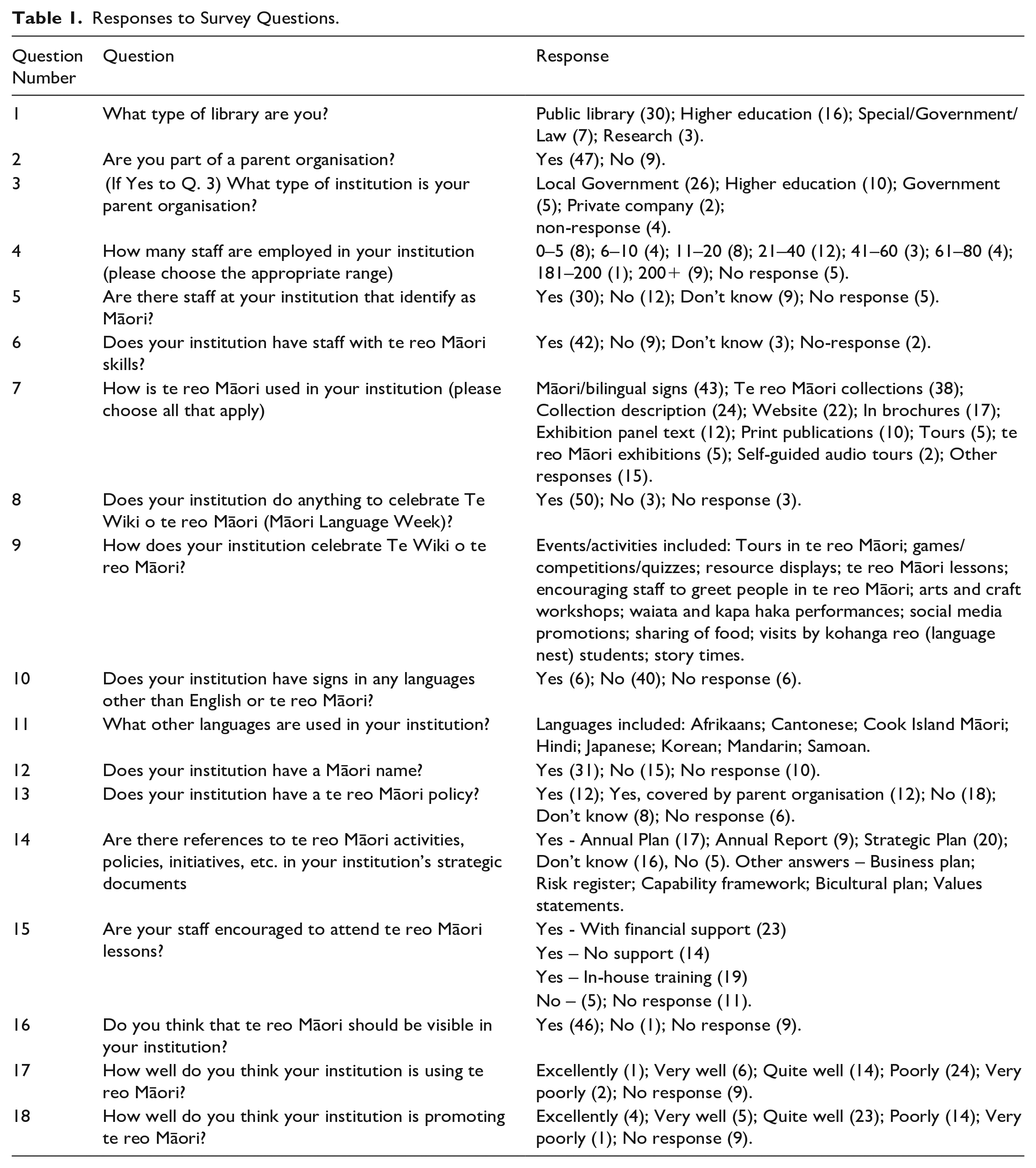
The Qualtrics questionnaire was fully completed and returned by 51 libraries, with another five libraries only partially completing the survey for a return rate of 45%. The survey results provided a strong overview of the status of te reo Māori services and resources in libraries in New Zealand and are presented in Table 1 and discussed in more detail in the paragraphs that follow.
Responses to Survey Questions.
Library profiles
More than half (n = 30) of the returns were from the public library sector, followed by higher education libraries (n = 16) and 10 libraries that were either hybrid institutions (n = 7) or from the special and government library sectors, and 3 that identified as research libraries (n = 3). There were 47 libraries that indicated they were part of a parent organisation like a university or a local government. The size of each library responding was ascertained by the number of staff they employed, and as shown in the table the results were quite even between smaller (those with 20 or less employees) (n = 20)), and medium libraries (those with 21–80 employees) (n = 19)) and a slightly smaller number of large libraries (81 employees and over) (n = 10)). This distribution provides a level of confidence that the results are representative of the wider public and higher education library sectors in New Zealand.
Māori staff
The survey revealed that 30 libraries knew that they had staff that identified as Māori and 42 indicated that they had staff that had te reo Māori skills. Of the nine responses that stated that they didn’t know whether any of their staff identified as Māori or not, eight of these indicated they had staff with te reo Māori skills. There were only 12 libraries that stated that they had no staff that identified as Māori; of these six indicated that they staff with te reo skills.
There may be more individuals that identify as Māori in these institutions, but their managers are not explicitly aware of this. The survey did show that there were institutions where it was stated that there was no Māori staff or it was not known whether there were or not, that had staff with Māori language skills. This again might confirm that there is Māori staff in these institutions or that there are non-Māori staff members in those libraries with these skills.
Those libraries that answered ‘no’ to having Māori language skilled staff is not surprising as this is not a skill that is thought to be widespread in libraries or even in wider New Zealand’s workforce. It is perhaps more surprising that there were several who stated that they didn’t know whether they had te reo Māori speakers, as it would be expected that staff with these skills would be making use of them in the workplace and would therefore be visible. However, it is entirely possible that the person completing the survey was not acquainted with the skills of all staff in the organisation. The difference between the two figures could also be explained by there being non-Māori staff who have these language skills. However, the survey did not ask for the ethnicity of those with language skills to be distinguished, and it is becoming increasingly more common for non-Māori to be developing te reo Māori skills.
Usage of te reo Māori in institutions
There were 31 libraries that indicated that they had a te reo Māori version of their library’s name and 15 that answered no to this question, with the other 10 institutions not providing an answer. Libraries were also asked in what ways they were using te reo Māori in their institution. The questionnaire provided a list of possible uses and an option to provide other examples if they were not featured in the list.
There were 43 libraries that declared that they used bilingual, or Māori language signage in their facilities, including directional and way-finding signage and labels for collections and services, with 22 of these being public libraries, 13 higher education libraries and 6 coming from the research or special library sectors, and 2 that chose the ‘other’ category.
The number of libraries with te reo Māori collections was 38, with 19 of these public libraries and 13 from the higher education library sector, and 6 from the special and research library sectors.
There were 17 libraries that specified that the brochures they produce include information printed in te reo Māori. There were also 10 libraries that included te reo in other print publications, including exhibition catalogues and library reports
There were 12 institutions that indicated that they had exhibition panel texts featuring te reo Māori including six public libraries, five higher educational libraries and one special library. These typically would be in the form of labels for artworks, or to explain significance of items being displayed
Only 22 libraries claimed that they used te reo Māori as part of their website. This does not reflect what was discovered in the analysis of websites undertaken as another part of this project. However, only 14 libraries indicated that they were using te reo Māori in their social media posts, which also seems quite low and might reflect that they only use it on an occasional basis like during Māori language week and not on a continuous basis.
The question related to the use of intellectual access points indicated that there were only 24 libraries that said that they were using meta-data, or Māori focused subject headings such as Ngā Upoko Tukutuku to describe their collections. This is surprisingly low especially as the desktop analysis of websites and online catalogues showed that usage of Ngā Upoko Tukutuku had a relatively high uptake.
There were five institutions that declared that they offered tours in te reo Māori, with three of these being in the higher education sector and the other two in public libraries. Two of the higher education libraries offered self-guided audio tours, in addition to guided tours.
Te reo Māori exhibitions (most likely a display of books and other resources) were only chosen by five of the libraries that responded. This seems to be a particularly low figure as most public and academic libraries normally have a display of te reo Māori resources during Te Wiki o te reo Māori (Māori language week). The latter is demonstrated by the 50 libraries that indicated that their institutions organised and activities to celebrate the language’s importance.
Fifteen institutions indicated they were using te reo Māori in other ways, than the options they were given to select from and were offered a textbox to explain how else they were using te reo. Upon analysis, there were some overlaps between some of these uses and what they had to select from, but the text box provided some additional room for comment. So, amongst the other uses, five libraries stated that they were at the early stages of planning or implementing bilingual signage in their facilities. Other activities in libraries included two libraries that incorporated te reo into their toddler time events. There was one library that actively used te reo Māori in their information literacy and public programming to various Māori immersion educational groups and kaumatua (elders).
Only one library indicated that they had a te reo Māori interface available on their cataloguing system, which is consistent with what was identified in the desktop analysis of websites.
The use of te reo Māori in email, including in email signatures was reported by three libraries. There were also four libraries that provided opportunities for staff to converse with each in te reo or provided te reo Māori speaking spaces in their libraries at specific times, including one institution that had te reo Māori language lessons taking place in their library.
The survey also asked respondents to indicate whether they had a te reo Māori policy or not. There were 50 responses to this question, with 12 libraries stating that they had their own te reo Māori policy, and 12 others indicating that they were covered by their parent organisations policy. There were 18 libraries that answered no, with the other eight indicating that they didn’t know (presumably that they or their parent organisation have a policy or not).
Staff training
Survey respondents were also asked whether they encouraged their staff to learn te reo Māori and if so whether they provided them with any form of support to do this. Of the 45 replies, only five institutions said they didn’t encourage staff to learn te reo. Of the other 40 institutions, 14 said that although they encouraged staff to attend lessons, they did not offer any further support. However, four of these do also provide in-house training sessions in te reo Māori, while another five libraries did not encourage staff to learn te reo Māori but did say that they provided in-house training sessions for those that wished to learn (presumably during the working day). In all, 19 institutions offered some form of in-house te reo Māori training, with nine of these same institutions providing support for staff to attend externally run courses. The other 10 provided no other support. In total 23 libraries provided support for their staff to attend the sessions either through the payment of course fees and/or time off for study.
There were nine participants that selected ‘other’ and shared information about what this consisted of. These included that their staff attended classes within their wider parent organisation, including opportunities to attend pōwhiri (formal welcome ceremonies), kapa haka (Māori performing arts) and waiata (sung poetry) sessions. In one institution there had been te reo Māori classes in the past, but all staff members were encouraged to attend Treaty of Waitangi courses. There was also a library that hired a tutor to teach te reo Māori at different levels with a limit of 10 individuals per class, with any spare places being made available to individuals external to their library.
Self-assessment
In the last part of the survey respondents were asked how to rate how well they thought their library was doing in using, and promoting te reo Māori, and invited to make some final comments about the place that te reo Māori has in the library sector .
In terms of using te reo Māori, the majority of those that answered this question rated their library as performing poorly (n = 24) or very poorly (n = 2). In terms of those who thought they were doing quite well or better, only one library rated itself as using te reo Māori excellently, with 14 indicating they thought they were doing ‘quite well’, with six other institutions rating themselves as doing ‘very well’. There were nine libraries that chose not to answer this question. In contrast, there appeared to be more confidence expressed by libraries about how they are promoting the usage of te reo Māori, with 32 of them declaring they were doing quite well or better, with four of these institutions rating themselves as doing excellently. There were, however, 14 libraries that rated themselves as doing poorly and another that declared that they were doing very poorly.
Final comments from respondents
There were 21 final comments shared by respondents to the survey. These comments reinforced the commitment that these libraries have to the usage and promotion of te reo Māori in their institutions. It was clear that for some institutions they believe that their parent organisations are not doing enough and that their library by default was showing leadership in this area. Other comments reiterated the status of te reo Māori as an official language of New Zealand, and that this meant that the library sector had no choice but to fully embrace it within its institutions. A few respondents also commented that their library wished to do more but their language capacity was low and that they had struggled to recruit staff with te reo Māori skills, which had reduced their ability to be more effective in this area.
Website analysis results
As stated earlier, the websites of all of New Zealand’s public, research and higher education libraries were accessed and analysed to identify whether they were using te reo Māori on the site and if so, how it was being used. In total 86 websites were accessed, with 58 of these being from the public library sector and the remaining 29 from the higher education and research library sectors. As websites are always subject to change, it is appropriate to qualify this assessment to say that all websites were accessed in March 2022 and are a snapshot of their status during this period. The websites were analysed using an evaluation tool designed for this research. This involved analysing each website to identify whether it included, a mihi (welcome) or whakatauki (proverb) to welcome users to the site; display of Māori name for the library; bilingual or separate options for menu navigation; bilingual labels for different sections of the website; usage of Ngā Upoko Tukutuku (Māori Subject Headings) in their online catalogue.
Only nine libraries welcomed website users with either a mihi or whakatauki with six of these from the public library sector and the other three from the higher education/research library sector. The use of a mihi or whakatauki are easy ways for te reo Māori speakers to recognise that the Māori language is valued by the library. For this to be truly an effective indicator of its value it should be supported by the use of te reo Māori in other parts of the website.
There were 43 libraries that displayed a Māori name for their institution including 25 public libraries and 18 higher education /research libraries. There is an increasing trend of institutions particularly in the education, health and wider local and central government sectors to adopt either bilingual or te reo Māori names.
Website navigation
The use of bilingual or separate te reo Māori and English language interfaces was also very low with only four libraries identified as providing interfaces that incorporated te reo Māori. In contrast, 14 libraries used bilingual or te reo Māori labels/headings for sub-pages on their websites. However, several of the sites that did do this were inconsistent in their use, and some only used them on the pages devoted to Māori resources or services. A deeper analysis of those websites that used bilingual or te reo Māori labels in their menus, showed that the use of these was typically only on the top layer, with sub-headings and labels in the lower layers mainly in English.
Library catalogues
The use of te reo Māori on online library catalogues was also investigated, with a particular interest in whether the catalogues were using Ngā Upoko Tukutuku as an additional form of subject access for their mātauranga Māori resources. These were being used by 77 of the libraries that were assessed. A level of inconsistency was noticeable in the use of these headings, with the catalogue entries for some items having fewer headings than those contained in the records being used in the catalogues of other libraries. This inconsistency could be explained by the age of the cataloguing records, with those with fewer headings probably having been downloaded at an earlier stage than the others. It was also noted that there was very little in the way of information about the availability of these headings or several of these libraries or how users could incorporate them into their searches.
There were four other libraries but their online catalogues were inaccessible as they were password protected, so checking for these features was not possible.
Other notable features were libraries that had te reo Māori interfaces (through the Koha library system), Māori names for search engines, and the ability to limit search results by language (te reo Māori). For the latter, 50 libraries with online catalogues allowed searchers to use the ‘limit by language’ qualifier, although this option was not always immediately evident to users, with this option often only being available in ‘Advanced Search’ mode. Quite noticeable however was that 15 of the public libraries that were part of the Kotui (national public library catalogue consortium) had not activated the ‘Advanced Research’ option on their local application of the system and thus not enabling the ‘limit by language’ that was available to be used.
Interpersonal interviews
Interviews with librarians were carried out over 2 years and were often accompanied by a visit and tour of the institution they worked in (not always possible due to restrictions imposed by the COVID-19 pandemic). The objective of the interviews was to gain an understanding of the motivation behind the implementation of te reo Māori usage into their institutional facilities, services and resources. In some institutions, this involved interviews with more than one individual due to the different responsibilities held by staff and how te re Māori was being used within the organisation.
Specific questions were asked about how and why their institution decided to use te reo Māori, who was involved in the decision-making process, what barriers they encountered when implementing their usage of te reo Māori, what their own te reo Māori capacity was and how were staff members being supported to improve their language abilities, and what the reaction of library users had been to the usage of te reo Māori. Each institution was also given an opportunity to identify an example of te reo Māori usage they were particularly proud of.
Analysis and coding of the interview results revealed some interesting themes. One very interesting theme coming through the interviews was that the increased usage of te reo Māori in naming and signage within libraries was the result of proactive efforts and not due to demand from Māori users. When probing further on why this was occurring there were a variety of responses, which included staff acting as champions of te reo Māori, recognition that it was the right thing to do, a commitment to promoting te reo Māori as an official language of New Zealand; and as a desire to decolonise the library space. About the champions, the interviews showed that these were not always staff that identified as Māori (as not all libraries had Māori staff) but was the initiative of non-Māori staff. One of the issues that this caused was that these staff members often didn’t have sufficient knowledge of the language to get beyond some very basic signage. However, this was viewed as a positive factor by some of the respondents as it allowed them to develop relationships with local hapū (sub-tribes) and draw on the expertise of people with these skills elsewhere in their organisation (e.g. council, or higher educational institution) thus creating stronger relationships with their Māori communities. Another issue related to this was the loss of momentum when staff left that had been te reo Māori or driving other bicultural initiatives and had not been replaced by someone with similar interests or abilities. The cost of signage was another matter that was raised in several of the interviews. Comments about this related to the fact that new signage was often difficult to justify in budgets that were tight and led to cuts having to be made in other areas. Those whose buildings were new or had undergone major refurbishment were able to get bilingual signage included in the building specifications thus avoiding having to pay for them at a later stage. In other libraries, they used temporary signage as an alternative. These mostly consisted of laminated A4-sized sheets of paper with the signage printed. One librarian did point out that there were advantages to this type of signage as it gave them greater flexibility over space and shifting collections around. This flexibility was also useful when mistakes were found or pointed out on the signage. The te reo Māori skills of staff were identified as a major issue for several of the libraries, where efforts had been made to recruit Māori staff with fluency in te reo Māori but had been unable to do so, with comments also being made that attracting Māori to apply for positions (with or without te reo Māori abilities) was quite challenging, especially for positions requiring a professional library qualification, with one respondent stating that they had been unsuccessful on two separate occasions, and finally had managed to appoint when they had relaxed their requirements around the need for a library qualification. Every interview indicated that staff (not all) in their library were trying to learn te reo Māori, including attending te reo Māori courses at local and distance education providers. Some libraries were providing in-house training sessions, or staff members were attending regular classes provided by their parent organisations.
Visits and observations
Staff members were not interviewed at every institution that was visited. However, these visits were used as an opportunity to observe how te reo Māori was (or was not) being used in libraries. Interest was paid to all forms of signage (directional and positional), whether there were separate te reo Māori collections, brochures, newsletters, or other handouts available in te reo Māori, displays, or exhibitions where te reo Māori were being used. A spreadsheet recorded my observations, with this also indicating where I had observed exemplary practice. In total, 30 libraries were visited over 2 years. A record of my observations was recorded on a spreadsheet, so that comparisons and trends were able to be easily identified. The observations identified a wide range of practices being undertaken including libraries that on the surface appeared to be doing either nothing or only making a minor amount of effort. The most noticeable te reo Māori features in a library are signs (bilingual or Māori only), with limited or non-usage also very noticeable. Like what was shared in the interview results, there was frequent usage of temporary signs, but not in every part of the library where signs were placed. Although not fluent in te reo Māori, the researcher was conscious that not all signs used correct language, with macrons missing on long vowels, or the use of transliterated English words where there were more appropriate te reo Māori terms. Often the temporary signs only had te reo Māori on them and not the English translations, thus making these signs look like an after-thought and in some instances slightly amateurish in appearance. In other libraries where more professional signage was being used, there was inconsistency in the style of te reo Māori being used, again relating to whether macrons were used or not. The te reo Māori signage found in the higher education institutions was technically more linguistically sophisticated than that in many of the public libraries, but the condition of the signs in some of these libraries was quite run-down, thus negating their effectiveness.
In the libraries that had them, a Māori focused collection was easily located with these being available in approximately three-quarters of the libraries that were visited. Several libraries also provided their clients with a separate sequence of te reo Māori materials, with this also occurring in collections for children, where picture books in te reo Māori were in a separate section adjacent to other picture books.
Discussion
Funding received from the Royal Society’s Marsden Fast Start Award has provided an excellent opportunity to evaluate how te reo Māori is being used in libraries in New Zealand through a multi-dimensional study. This is the most comprehensive research undertaken to date on this issue. The use of interviews, observational visits and desktop analysis has supplemented the data that was gathered through the survey to provide a clearer picture of how, what, when and why te reo Māori is being used by libraries.
The data gathered demonstrates that there has been a visible increase in the use and application of te reo Māori over the last three decades when compared to the results published by Garraway and Szekely (1994). Most noticeable has been the adoption of Māori names for institutions, and the determination to increase the use of bilingual signage. The use of these is a key indicator to Māori clients that their language is important, and that the library is highly likely to have materials that are relevant to Māori. For those who have knowledge of spoken and written te reo Māori, the use of bilingual signage provides an alternate form of intellectual access and wayfinding to the English signs being used. It was interesting to see that although many libraries had adopted or been gifted a Māori name, this was not always visible on their building or easy to find on their website, with it more likely to be found on their online catalogue. This might however be more to do with the costs (and logistics) associated with erecting new signage. The non-appearance or obscurity on websites is more likely to be due to the web templates used by parent organisations that can be highly prescriptive and not leaving any room for libraries to include additional information and/or branding. The use of bilingual signage is very encouraging, and in many of the institutions visited, this signage was professional and displayed. This was particularly noticeable in new or refurbished library buildings, with the cost of signage often being included in the fit-out of the interior. However, it was also noticeable that many libraries had temporary bilingual signage, either using laminated A3 or A4 signs (normally with just the te reo Māori printed on it) or bilingual signs that had been covered over with a correction to the te reo Māori on the sign. The latter was explained as an incident where the te reo used on the original sign was incorrect and had not been identified at the time it had been installed. An example of this was older signs that did not have a macron over the ‘a’ in Māori When talking to library managers and their staff about the reason for temporary and not permanent signage, the cost was frequently mentioned as a barrier. Another reason cited was the need for the library to be a flexible space, with collections often being moved. It was also interesting to see in some institutions that there were examples of different signage designs. This was represented by some signs being monolingual (English only), others being bilingual English and Māori (but with the Māori reflecting earlier linguistic patterns such as macrons over long vowels not being included), and fully fledged bilingual signs. The level of inconsistencies in signage design is highly unfortunate and might be interpreted by some clients as the library not valuing te reo Māori. However, in many instances, this would be unfair as the fact that bilingual signage does exist demonstrates a commitment to making the language more visible. The reasons for the state of the signage were often financial (too expensive to replace), or it was temporary until new permanent signage can be installed.
Another feature of the signs was that the quality of te reo Māori was quite high, with very little usage of transliterations from English. Although there is frequent usage of transliteration within the te reo Māori lexicon, in most instances libraries are using traditional words, or contemporary terms that are descriptive rather than straight translations of the English terms. However, one transliterated word that was consistently used was rūma (room) words, and in some instances without the macron. Although most languages have words that are derived or adapted from other languages, Te Taura Whiri o Te Reo Māori (Māori Language Commission) in its early days discouraged the use of transliterations in favour of words that were characteristically Māori (Kelly, 2018).
The number of libraries with te reo Māori collections was not as high as I would have expected, and one of the possible reasons for the lower number might be that te reo Māori items are interfiled either in their collection of all Māori resources (if they have a separate Māori collection), or the libraries feel that they don’t have enough te reo Māori resources to warrant a separate collection.
It became evident from the various data-gathering efforts that there was a strong level of interest and commitment to promoting te reo Māori in the library sector, but this enthusiasm was tempered by the admissions that were made in many of these institutions that they wanted to do more, but either did not have the support or ability to move beyond the basics of language acquisition. Like so many of the other factors already discussed, this was due to a lack of financial resourcing, or not having staff with the necessary knowledge of te reo Māori to assist them. This demonstrates that the presence of a te reo Māori champion within the organisation has the potential to make a substantial difference to the performance of the library in this area. Unfortunately, the non-availability of such individuals is a problem that affects not only libraries, but it is also a reality for other institutions in the cultural heritage sector. This is where either a Māori language strategy or policy could make a difference, especially if there are key performance indicators that need to be measured and achieved. The ability to tie these indicators to financial planning and resource allocation exercises could ensure that te reo Māori activities and practices receive the support they require to continue developing.
Future directions
In addition to the issues highlighted in the previous paragraph, if institutions are looking at how they can improve their use of te reo Māori in their facilities, and the services and resources they provide, it is vitally important that if they haven’t already done so, that they establish strong relationships with their local Māori community. This will assist in determining what they (the community) see as being critical, including the use of dialects, and any specific terms that they might use for services or resources. The development of these relationships could also lead to other mutually beneficial arrangements, including representation on advisory or governing boards, higher participation in cultural events taking place in the library and the community, and guidance about specific tikanga (Māori customary practices) when handling taonga (treasured items) that are held in the library.
In 2019, the New Zealand government published Maihi Karauna (Te Puni Kōkiri, 2019), which laid out the strategy for language revitalisation of te reo Māori. Included within the strategy was a goal that by 2040, at least one million New Zealanders would have the ability and confidence to talk about basic things in te reo Māori. They defined basic things as including ‘the ability to hold brief and meaningful exchanges about common experiences shared between people, an understanding of a basic vocabulary of everyday words with generally accurate pronunciation, and an understanding of words for important Māori cultural concepts, places and practices likely to be referenced in New Zealand English or te reo Māori’ (Te Puni Kōkiri, 2019: 12–13). If this goal is to be reached then te reo Māori and its usage will have to be much more visible than it currently is. As public institutions that have high visitation rates, libraries have an excellent opportunity to promote themselves as te reo Māori champions. The outcomes from this research project provide these institutions with a pathway to developing services, resources and facilities that make this possible in partnership with Māori communities.
Conclusion
The results from the research that has informed the development of this article have demonstrated that library and information institutions in New Zealand place a great value on promoting and using te reo Māori. This is reflected in the services, resources and facilities (including signage) that they offer to their clients. However, it has also become obvious that the delivery of these services and resources is inconsistent from one institution to the next. This is primarily due to issues around te reo Māori capacity of staff, lack of financial support and resource allocation, and the inflexible nature of the facilities where libraries and information institutions are located in. Having staff fluent in te reo Māori who can act as champions of language initiatives is critical to building and maintaining momentum not only relating to language but in other areas involved in providing resources and services to Māori clients.
Footnotes
Appendix 1
Appendix 2: Survey questionnaire
Declaration of conflicting interests
The author declared no potential conflicts of interest with respect to the research, authorship, and/or publication of this article.
Funding
The author disclosed receipt of the following financial support for the research, authorship, and/or publication of this article: This work was supported by the Royal Society of New Zealand Te Apārangi Marsden Fast Start Award [VUW1825].
