



Abstract
Public libraries support a range of health and wellbeing activities, however little research has been done into the provision of library adult walking groups. This paper reports on a unique study exploring how widely adult walking groups are provided through Scottish public libraries, as well as library staff perceptions of the benefits, challenges and opportunities of these services. A rich qualitative research approach was used, involving Freedom of Information requests to the 32 Scottish local authority regions, an online questionnaire with 106 complete responses, and 8 follow-up interviews with Scottish public library staff, with and without walking group experience. Thematic analysis was used to identify key themes from collected data. Results show that adult walking groups are not widely provided through Scottish public libraries. However, respondents identified benefits for user groups, including but not limited to: improvements to participants’ health and social wellbeing; and increased engagement with library services. A range of opportunities for public libraries were highlighted, including staff interest, partnership working and a current focus on health and wellbeing. Challenges encompass resource restrictions, variations in partnership working and lack of effective networking. This original study provides valuable insights into the provision of public library walking groups in Scotland. It suggests that many factors can potentially influence the success of this library health and wellbeing service, with a range of different possible approaches. Results indicate that successful provision of a public library walking group may require close partnership working; adequate networking and information-sharing between public library staff; as well as sufficient resources; and staff interest. This exploratory study provides transferable insights and a basis for future research.
Keywords
Introduction
Public libraries are widely recognised as being welcoming and inclusive, attracting people of all ages, backgrounds and cultures to use them in a multitude of ways (Aabø and Audunson, 2012). There is evidence that reading is beneficial to health and wellbeing (The Reading Agency, 2015) so it could be argued that public libraries have always played a role in this area. However, their role in providing services to facilitate the health and wellbeing of their communities have been steadily developing, and they could be considered ideally positioned to offer health-related information and services, particularly to more vulnerable groups and those who engage less with health care services (Whiteman et al., 2018).
For example, within Scotland, UK the most recent public library strategy identifies within its future strategic aims the need to improve community wellbeing, reinforcing how important these establishments can be in this regard (Scottish Library and Information Council [SLIC], 2021). The ‘Health on the Shelf’ report commissioned by the SLIC (2020) explored public library health and wellbeing provision across Scotland. A key finding was the considerable variety of health and wellbeing services offered by Scottish public libraries, including the WalkON walking, talking and reading groups for adults. These groups, provided by some libraries in Fife, one of the Scottish regions, are reported to be successful, providing a positive impact to those involved (Improvement Service, 2016). Walking is well-evidenced to be an activity that promotes health and wellbeing (NICE, 2012: 11) and the literature provides many examples of how walking in a group can provide additional benefits to participants.
However, public library-supported adult walking groups as a research topic have so far received little attention. It is unknown how widely this type of service is offered, or what the experiences and opinions of staff are regarding the associated benefits, challenges and opportunities.
The present study addresses these aspects related to Scottish public libraries through a qualitative approach, combining data from a questionnaire, interviews and Freedom of Information (FOI) requests, to offer an innovative exploration of library walking group provision from different perspectives. This study is the result of a MSc dissertation in Information and Library Studies at the University of Strathclyde, Scotland, conducted by the first author over summer 2021, under the supervision of the second author.
Our findings contribute to existing knowledge about Scottish public library health and wellbeing provision, specifically the support of adult walking groups. Public libraries are rooted in their locality and increasingly engaged with social welfare activities; success typically requires partnerships between librarians, their communities and relevant stakeholders. We propose several influencing factors, with a range of different approaches offering potential for success, including supportive partnership development and networking, information-sharing between Scottish public library staff, assessment and evaluation frameworks, as well as sufficient resources and staff interest. This study also more generally expands the research into public library walking groups, which may be of interest beyond Scotland.
Related work
This section provides a review of the literature on health and wellbeing at the public library, walking groups, walking promotion in Scotland and partnerships. These themes were considered important to inform all aspects related to adult public library walking groups in Scotland. Selected academic and grey literature published in English are discussed, reflecting an increase in relevant research. Due to limited research from the United Kingdom, an overview of the worldwide literature is included.
Health and wellbeing at the public library
In the United Kingdom, the support of health and wellbeing through public libraries is evident through the multitude of health and wellbeing activities on offer (Hicks et al., 2010; Public Health Wales, 2012). Additionally, libraries and their services are recognised as playing an important role in initiatives such as book prescription, a form of social prescribing linking individuals to non-medical assistance for health issues (Teuton, 2015). Libraries are also considered important in alleviating loneliness and social isolation and the harmful mental and physical effects that can result from a lack of social connection (Scottish Government, 2018).
Within the multitude of public library activities that impact health and wellbeing are those involving physical activity. Carson (2019), states that ‘Libraries are no longer just there to meet a patron’s standard literacy needs; we are now helping people improve their physical literacy skills as well. . .’ (p.159). Recognising the paucity of research into physical activity provision through public libraries, Noel Lenstra has published several papers exploring the subject. Through an exploratory survey of public libraries in North America, he discovered a wide provision of ‘movement-based programs’ (Lenstra, 2017: 219), including yoga, dancing and gardening. Although the results couldn’t be generalised, he found that these movement activities attracted new library users, as well as promoting an improved sense of community. The work by Carson (2019) and Lenstra (2017) offers an insight into the prevalence of public library physical activity programmes, although the present study is the first to explore trends outside of North America.
Considering the outcomes of public library physical activity programmes, results from studies by Lenstra and Oguz (2020) and Flaherty and Miller (2016) indicate both the positive impact that they can have on participants, as well as the potential appetite that exists for these kinds of services.
Walking groups
Whilst research into public library-supported physical activities is limited, the support of walking groups has received even less attention in the academic literature. Lenstra and Carlos (2019) discovered several different types of library-supported walking, which varied from groups purely focussing on walking, to ‘Storywalks’ aimed at families, and other walks engaging individuals in literature or local heritage. Wurmann (2016) describes a range of outdoor walks developed by Winnipeg public libraries involving either engagement with literature or history. These papers suggest that walking is being supported by some libraries, but crucially indicates that further research is needed to build a clearer picture of activities in this area.
It is important to consider the benefits of walking groups, and why they deserve attention as a potential activity for libraries to support. The National Institute for Health and Care Excellence (NICE) guideline on walking and cycling recommends walking programmes as a way to increase community walking activity. Walking is evidenced as a means of improving physical and mental wellbeing and reducing the risk of developing many preventable disease, as well as an activity that most individuals can participate in (NICE, 2012). Several agencies and individuals are required to support walking programmes and increase activity (NICE, 2012), indicating that supporting and promoting walking is something that many organisations could be engaging in.
Although walking is an activity that most individuals can participate in independently, Marselle et al. (2013) suggest that outdoor walking with others is largely preferable to walking alone. Continuation rates for walking groups has been shown to be high (Hanson and Jones, 2015), suggesting they may provide individuals with a sustainable solution to health and wellbeing improvements.
Considering the health value of outdoor walking groups, there is clear evidence that they can benefit individuals with pre-existing health conditions (Hanson and Jones, 2015). Hanson and Jones (2015) identified from their systematic review of 42 studies that improvements in blood pressure, heart rate, BMI, cholesterol levels and depression are some benefits from participation. This high-quality evidence suggests that many individuals facing health issues could benefit from involvement.
Despite these health benefits, the social value of groups on individuals’ health and wellbeing has been suggested as the key reason for continuation, with participants often making strong social connections (Grant et al., 2017: 1709). From their small study, Grant et al. (2017) analysed that their walking groups provided; ‘new loci for linking, bridging, and bonding; strengthened friendships and support; mutual monitoring of health and well-being; practical support; and help with personal growth’ (p. 1708). It therefore appears that walking groups can result in significant social benefits to participants to impact on their health and wellbeing.
Despite the many reported benefits, the need for increased inclusivity in outdoor walking groups has been highlighted (Rigby et al., 2020). There are concerns that they may not be reaching those in society that would benefit the most (South et al., 2017: 25). Pollard et al. (2020) state that ‘walking interventions tend to recruit well-educated, middle-aged white women’ (p. 8). Studies also note there can be a lack of consideration given to practical issues such as walking location and walk accessibility (Pollard et al., 2020; South et al., 2017: 22). As recommended in the NICE guidelines, thought needs to be given to allow maximum accessibility and inclusivity to all groups within a community (NICE, 2012: 21). Considering the community reach and accessibility of the public library, this suggests that there may be benefits to these establishments supporting adult walking groups.
Walking for Scotland’s health and wellbeing
It is clear that walking groups may be a route to attract sustained engagement with walking, and promote long-term gains. These longer-term improvements to health and wellbeing are a clear strategic focus for Scotland as outlined in the ‘Public Health Priorities for Scotland’ (COSLA and Scottish Government, 2018) and the ‘Optimising Older People’s Quality of Life’ framework (Cohen et al., 2014: 12–13).
The ‘National Walking Strategy’ details Scotland's commitment to increasing walking activity, as well as improving the provision of suitable and enjoyable walking environments to achieve wide-reaching health and economic benefits to the country. The costs due to ill health associated with inactivity are high, so it is considered that investment to improve walking opportunities will be considerably less than the costs associated with ill health (Scottish Government, 2014: 12).
Paths for All (2020) is the organisation primarily involved in promoting walking across Scotland. Their goal to, ‘get Scotland walking: everyone, everyday, everywhere’ (p. 2) highlights a vision to increase levels of walking across the country. Additionally, the ‘Walk Back Better’ manifesto makes a case for continuing to promote and invest in walking moving forward from the COVID-19 pandemic (Paths for All, 2021). It is therefore evident that there is a significant focus on improving walking activity across Scotland, as well as support available to develop walking initiatives. This may be a potential opportunity for any organisation interested in supporting walking groups.
Partnerships
The nature of partnerships in the library and cultural sector can be multifaceted and varied; the terminology itself is interpreted with diverse meanings, in particular regarding the degree of intensity of the collaboration and its transformational capacity (Innocenti, 2017). Partnerships can take diverse shapes and flavours depending on several factors that include, but are not limited to, context, aims and modalities of the partnership, time frame and actors involved. They also present a variety of potential risks, for example differences in procedures and common working criteria, capacity, commitment and lack of resources, compatibility, dominating partners (ibidem).
Frequently mentioned in the literature are the advantages of developing effective partnerships, both for successful library health and wellbeing activities, and for success in community walking groups. Rewards include the knowledge and skills of other professionals, funding and other resources and means of attracting new users (Hicks et al., 2010: 35).
SLIC (2020: 56–57) reported that projects involving strong partnerships resulted in greater levels of success. However, they also found a lack of evaluation of health and wellbeing services, and identified this as an issue in being able to demonstrate value to potentially entice future financial or other support (SLIC, 2020: 17). The English public library report similarly highlighted that evaluation is essential to demonstrate value and attract partnerships (Hicks et al., 2010: 5). Therefore, it appears that routine and effective evaluation is a key component to public libraries being able to establish effective partnerships for health and wellbeing provision.
‘A Collective Force for Health and Wellbeing’ is the current action plan highlighting the role that Scottish public libraries have in supporting community health and wellbeing through working alongside public and third sector agencies (Scottish Library and Information Council et al.,, 2019). Within Scotland, there are clear signs suggesting that in the future communities will be taking a much greater role in supporting healthcare through a multitude of non-medical means, to enable and empower individuals and reduce reliance on health services (Alliance, 2017: 4–5). It would therefore appear that there may be increasing opportunities for partnerships to develop and support health and wellbeing initiatives through Scottish public libraries in the future.
Methodology
This study was led by two overarching research questions: How widely are adult walking groups provided by public libraries across Scotland?; and What are the benefits of adult walking groups provided by public libraries, and what challenges and opportunities are faced in relation to providing this service in Scotland?
Given the exploratory nature of a research aiming to determine the provision of library walking groups across Scotland, as well as the experiences and opinions of public library staff, a qualitative research approach was used. Three different data collection instruments were used: an online questionnaire; follow-up interviews; and Freedom of Information (FOI) requests. Since ‘the use of multiple data collection techniques compensates for any limitations of individual techniques’ (Pickard, 2017: 21), this methodology allowed for triangulation, providing a more valid and comprehensive insight into adult walking group provision in Scottish public libraries.
Ethical approval for this research was gained through the University of Strathclyde, Computer and Information Sciences departmental Ethics Committee. Data management complied with institutional requirements, and all data was securely stored.
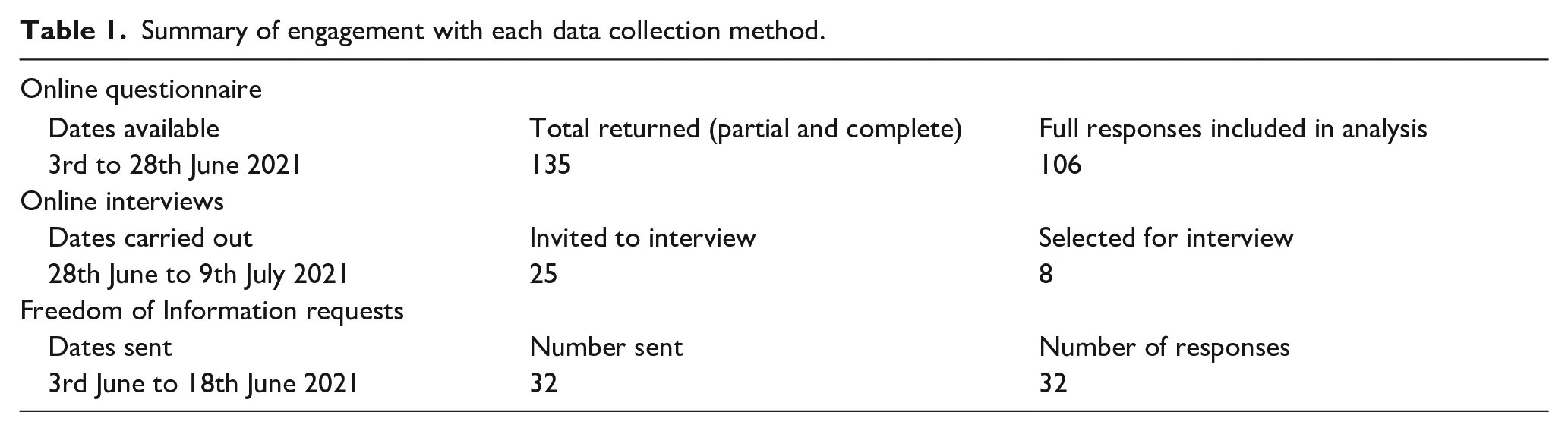
Table 1 provides an overview of the level of engagement with each data collection method.
Summary of engagement with each data collection method.
Online questionnaire
An online questionnaire, developed on Qualtrics survey software, was distributed to public library staff across Scotland, and was available between 3rd and 28th June 2021.
Due to the lack of research in the field, no prior questionnaires were available to base the present tool on. Therefore, the key themes emerging from the literature were used as a basis for creating the questions. The majority of questions were closed, with some open questions and some scaled responses, including Likert scales which are useful for measuring ‘intensity of feelings’ (Bryman, 2012: 166). The questionnaire was constructed to allow completion by both individuals who had experience of library adult walking groups and those without, displaying additional follow-up questions based on certain responses. Following some demographic questions, respondents were asked about their awareness of public library walking groups and whether their library provided them, either at that time or prior to COVID-19 restrictions. Based on this response, participants were then directed down one of two different paths of questions. Those with experience of walking groups were asked about: their opinions on the benefits and challenges of groups; the importance of public library involvement; the involvement and value of partner agencies; and inclusion of literature as part of the group. Those without experience were asked about: their interest in finding out more about such groups; and their perceptions of any benefits and challenges of this type of service.
Following a pilot study, the questionnaire was amended and then distributed. The final questionnaire can be viewed in Appendix A. Selection criteria included working within a public library in any role, and working in Scotland. To reach as many Scottish public library staff as possible, a combination of nonprobability sampling methods was used. Purposive sampling initially recruited relevant participants, and snowball sampling through asking that the survey be shared with other staff within the library or region, was an additional means of increasing participants. The survey was distributed via several emailing lists by the Scottish Library and Information Council (SLIC), as well as by the researcher to individual public library or regional library email addresses depending on online availability. Email reminders were sent to enhance the response rate. Additionally, the survey was posted and shared by professional groups on Twitter, as well as being shared by staff on JISC mailing lists.
All questionnaire responses were exported to a spreadsheet; incomplete replies were removed, leaving 106 for analysis. The data from the open response questions was saved to Word documents and uploaded to NVIVO 12 to allow for thematic analysis. Since this approach seeks ‘to find repeated patterns of meaning’ (Braun and Clarke, 2008: 86) within the data in order to develop themes, it was ideal to allow a full interpretation of the open responses.
Interviews
Due to time constraints, follow-up interviews were conducted with 8 of the 27 individuals who had indicated at the end of the questionnaire that they would be interested in participating. Since opinions and experiences from staff at all levels across Scotland were sought, the selection was based on geographic area and job role. The interviews were carried out online, using either Zoom or Microsoft Teams, which still enabled face to face interactions, when meeting in person due to COVID-19 restrictions would have been difficult. They also allowed staff from all regions of Scotland to participate equally.
The seven interview stages outlined by Kvale (1996) of ‘thematizing, designing, interviewing, transcribing, analysing, verifying and reporting’ (Pickard, 2017: 196–197) provided a structure to the interview process. Key themes identified from the questionnaire responses provided a basis for designing the interview guide, allowing question guides to then be developed.
Following a pilot of the interviews to ensure clarity and ease of understanding, samples of respondents with and without experience of walking groups were interviewed to provide a rounded exploration of the subject area. The semi-structured format allowed flexibility to change the order, as well as to ask additional questions as required (Bryman, 2012: 471). Participants were provided with the interview question guide in advance, to allow them to feel comfortable knowing the interview content. With consent, all interviews were recorded, allowing both an accurate record of the interview and full focus on the participant.
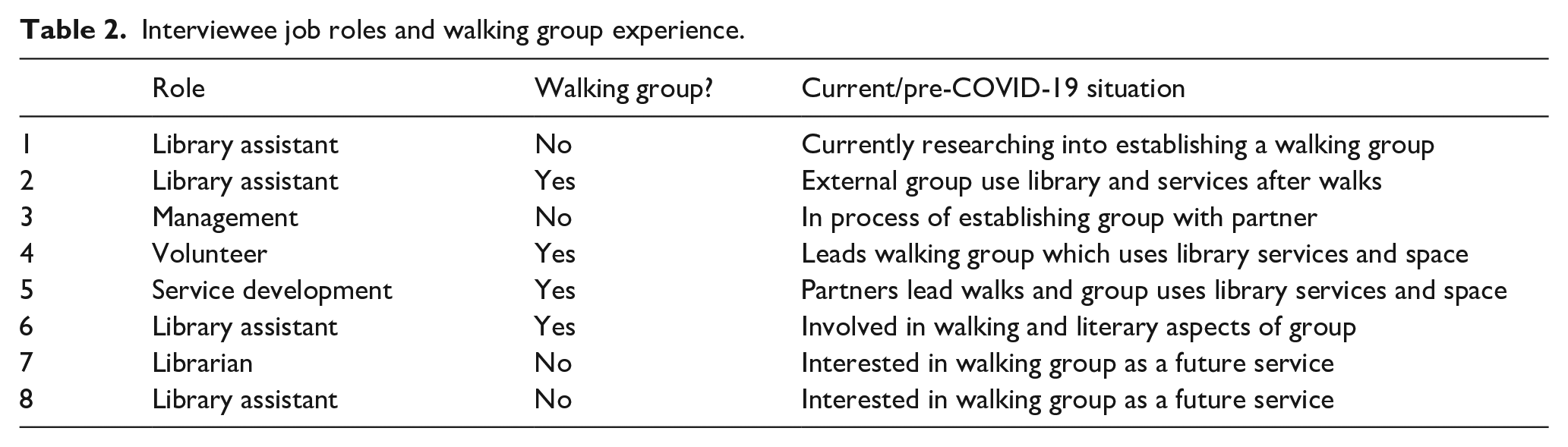
Each interviewee’s job role and walking group experience is outlined in Table 2.
Interviewee job roles and walking group experience.
Automatic transcriptions of the eight interviews were downloaded, checked and edited for accuracy, saved onto Word documents and uploaded to NVIVO 12 to facilitate the remaining stages of thematic analysis.
As with the qualitative questionnaire data, thematic analysis of the interview responses was approached in the six stages outlined by Braun and Clarke (2008), including: engaging closely with the data to develop a key awareness of the content; identifying codes in the data; then using these codes to form initial, and then revised themes until final themes representing the significance of the data were formed. An inductive approach was taken, whereby codes were identified from the data rather than fitting the data into pre-determined codes, to provide a full insight into staff experiences and opinions on library adult walking groups.
Freedom of information requests
Freedom of Information (FOI) as a research method has been successfully used in public libraries studies (MacDonald and McMenemy, 2012). In the UK, FOI legislation specifically ‘encourages organisations to make as much information available as possible, by default’ (McMenemy, 2012: 232) and it has been successful in opening up councils to public scrutiny (Cherry and McMenemy, 2013).
In this work, FOI requests were made to each of the 32 Scottish local authority regions, to gather information on the provision of walking groups through the libraries in each area. Since according to Part 1 (1) of the Freedom of Information (Scotland) Act 2002, ‘A person who requests information from a Scottish public authority which holds it is entitled to be given it by the authority’ (Legislation.gov.uk, 2022), and requests have to be responded to within 20 working days (Information Commissioner’s Office [ICO], n.d.), it was felt that FOI requests should provide an effective way of accessing this information.
One request template was developed that could be sent to all regions as ‘By using a standardised FOIA request, data obtained from public authorities can be standardised’ (Savage and Hyde, 2014: 309). All requests were initially sent to local authority FOI departments; however where library services were provided by a separate trust, the local authorities replied indicating that the request would instead have to be made to this organisation. The requests were made in writing, providing the researchers’ names and email addresses, as are legal requirements (ICO, n.d.), and were done either by email or online form, based on the preferences of the organisation. The following information was requested:
The number of public libraries providing a walking group service for adults (prior to the disruptions caused by COVID-19 if services had not resumed).
Any evaluation data and/or reports of public library adult walking groups.
Responses to the Freedom of Information requests were received via email from all 32 Scottish regions within 20 working days from the initial request, with no follow-up emails required. This timescale was surprising given the expected delay due to potential capacity issues caused by COVID-19 staffing disruptions. As they were received, information was entered into a spreadsheet, which allowed for ease of comparison between regions.
Data analysis and discussion
The key, high-level findings emerging from the online questionnaire, interviews and FOIs analysis include:
Partnerships are essential to success, with networking being the first important step supporting deeper forms of collaboration.
A significant number of library staff members are broadly interested in this topic.
Walking groups are seen as more than physical programmes – they are perceived as social wellbeing and health programmes.
Most libraries endeavour to weave literature and media into library walking programs.
In the following sections we discuss those findings in detail, and contextualise them with relevant studies.
Online questionnaire analysis
Our analysis includes 106 completed questionnaires engaging 28 out of the 32 (87.5% ) Scottish local authority regions. Some regions provided several responses, others provided only one or two responses and four regions gave no responses. Whilst this is a small percentage of Scottish public library staff, since the majority of Scottish regions engaged, a wide range of experiences and opinions was obtained.
Most respondents (49%) were library assistants, with other responses coming from librarians (31%), management (14%), service development (5%), volunteers (2%) and 5% reported to be in other roles.
Our study shows that 57% of respondents were aware that some public libraries in Scotland provide walking groups for adults, although only 25 respondents (24%) worked in libraries providing this service. For the 81 respondents without experience of these groups, Figure 1 shows their interest in providing them, with 57% indicating an interest, suggesting some appetite for future support of this type of activity. Of the 7% who expressed no interest, most mentioned limited staffing as an issue in their library.
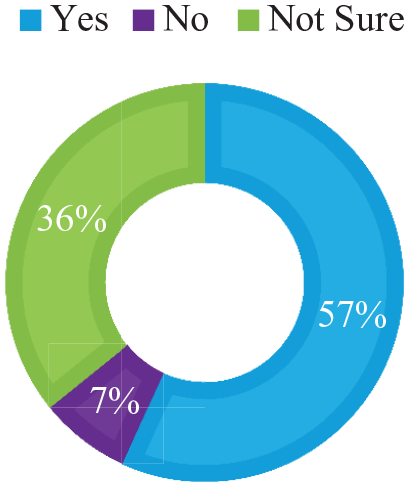
Interest in providing library walking groups.
Those without experience of library adult walking groups were given statements to rate regarding the perceived value of them, and their interest in finding out about them (Figure 2). The majority considered them valuable although there was some spread of agreement to this statement. There were however largely positive responses related to finding out more about groups in other libraries, as well as about support for developing a group. This suggests that there may be some uncertainty about the value of groups for those who do not have experience of them, although there certainly seems to be an appetite to find out more.
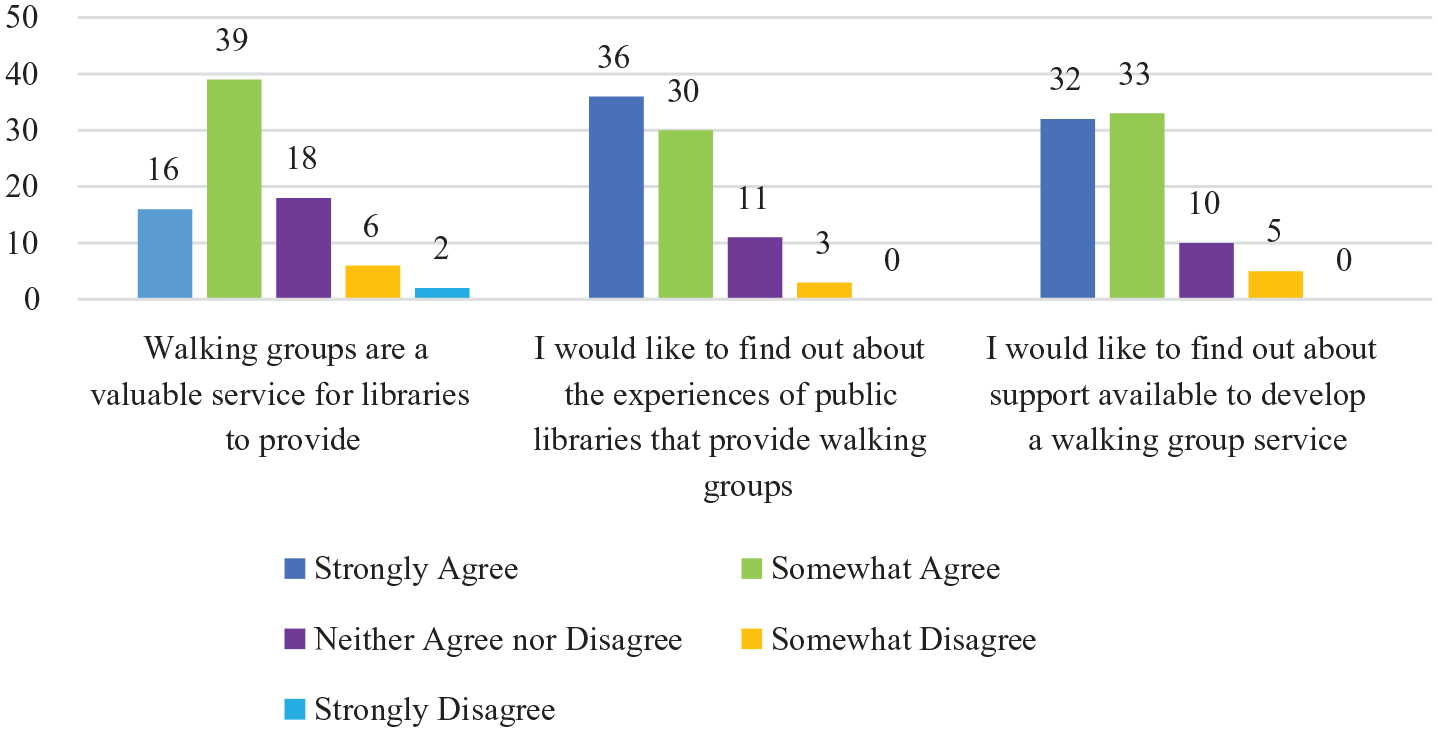
Responses to statements regarding Interest in public library walking groups.
Thematic analysis of the qualitative questionnaire data identified five key themes which are discussed below: Supporting health and social wellbeing; Engagement with library services; Collaborative service; Practical considerations; and Libraries’ role within communities.
Supporting health and social wellbeing
Supporting health and social wellbeing was mentioned over and over again as a benefit to walking group provision. When we think about how libraries support social wellbeing, usually in-person convening within the building of the library comes to mind. However, our study demonstrates that the social value of libraries can also encompass the surrounding neighbourhoods in which libraries are located, particularly when walking groups of this sort are in place.
Frequently commented on was the potential for library walking groups to improve social contact and alleviate social isolation. Some quotes from respondents without experience of a group highlight these thoughts:
Walking groups could be a useful tool in tackling loneliness.
We are operating a combat loneliness agenda, so encouraging an activity where people mix in a safe group would fit well.
This recognition of the issue of social isolation and the potential for library walking groups to play a part in tackling it aligns well with the Scottish Government’s strategy, ‘A Connected Scotland’, which identifies that all organisations and individuals play a part in alleviating this widespread problem (Scottish Government, 2018: 4).
Comments made by respondents with experience of library walking groups supported these anticipated benefits to social wellbeing, with the value to physical and mental health also being highlighted:
Have been able to support inactive adults in taking part in a physical activity, boosted mental wellbeing, helped connect socially isolated adults, also benefits for staff leading groups in connecting with outdoors.
These positive comments are supported by the responses to the statement exploring opinions on the benefits of walking groups to participants, with 24 out of 25 viewing them as beneficial to those who take part.
The unique connection that library walking groups can provide between walking and literature was also viewed as important:
Walking outdoors is calming and reading books is escaping.
An opportunity to join a book group and a walking group at the same time.
Research identifies the wellbeing effects of reading (The Reading Agency, 2015), so walking groups provided by libraries may be able to offer additional benefits compared to groups without a library connection. When this aspect was explored in the questionnaire with those who have experience of walking groups, the importance of having a literary component was evident, with 21 out of 25 respondents (88%) identifying the importance of engaging with literature (Figure 3). For example, in the Fife Walk ON groups (a partnership between ‘Active Fife’ and Fife libraries – OnFife, 2021) there is typically a book chat following the walk, based on an informal reading group session, which provides the opportunity to introduce participants to new books and authors in a supportive environment.
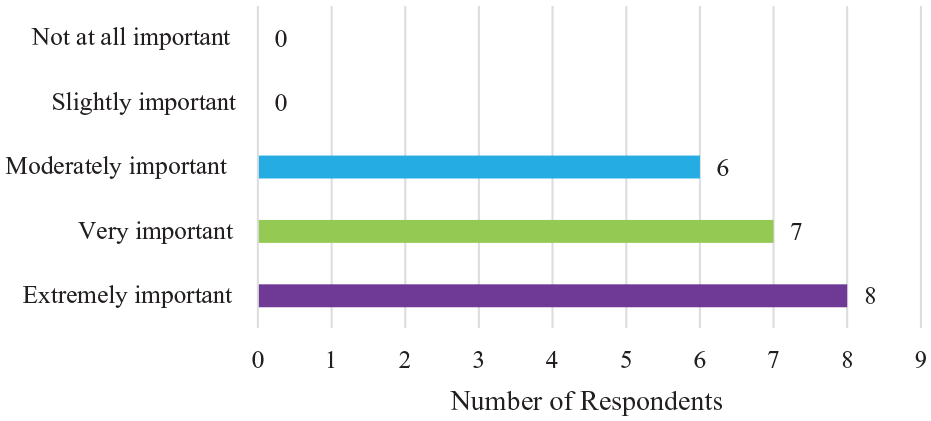
Responses regarding the importance of engaging with literature.
Engagement with library services
There was an overwhelming view that the potential for walking group participants to engage with library services could attract new library users. These quotes from respondents who currently do not provide a walking group highlight this:
May increase our 'reach' to additional service users.
Could change people's perception of what the library is there for, enhancing its role as a community hub.
As noted in Figure 4, the vast majority of individuals with experience of library walking groups agree that the library benefits as a result of the groups.
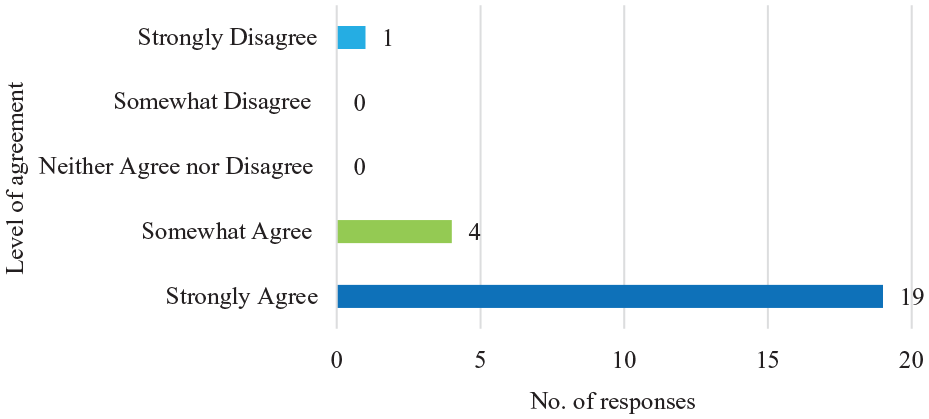
Responses to statement about benefits to the library.
This echoes findings by Lenstra (2017: 225) that library movement programmes attract new library users. With ongoing financial challenges affecting Scottish public libraries (SLIC, 2019: 4), it can be assumed that increasing engagement with library services will be beneficial in demonstrating their value.
Collaborative service
There were numerous mentions of working with partners; including external organisations, council departments and volunteers. Several respondents with experience of walking groups indicated these had started as a joint venture between the library and another organisation.
Nineteen out of 25 respondents with waking group experience (76%) indicated that partners had been involved at some point, most frequently related to the initial development and running of the groups. The vast majority of these (13) felt that this involvement was extremely important; for others this was either moderately (3) or very (3) important.
Of the respondents who offered advice based on their experiences of walking groups, partnership working was frequently mentioned, either related to walk leader training or to partners leading the walks so that this role does not fall to library staff:
Try to work in partnership with an organisation. . .they have the expertise, and you provide the venues.
Try to partner with a 3rd sector organisation or local fitness initiative.
One respondent working in library services without a walking group felt that partners should adopt the leading role in the provision of such a service:
I feel that our role may be best placed to support/ work alongside these groups in communities, rather than leading them.
It is therefore evident that partnerships are considered essential in facilitating the successful operation of many public library walking groups. This correlates to what was discovered in the ‘Health on the Shelf’ report where successful partnerships led to an increased likelihood of success of initiatives (SLIC, 2020: 55–56).
Libraries’ role within communities
The ethos of a public library as a place at the heart of a community that is welcoming and inclusive to all, was viewed by several as an advantage to the potential support of adult walking groups, correlating with the research identifying the ‘accessibility and trustworthiness’ of public libraries as being important in engaging users (Morgan et al., 2016: 2034). The following is one of several similar comments:
Yes, it is a public space where most people know its location and are not intimidated with going there. Often with good transport links and car parks. Positive familiarity gives a feeling of security and helps people to have confidence when trying new things.
Despite many positive comments, for a few respondents, there was definite uncertainty of the idea, not understanding why public libraries would be linked with walking groups:
Very happy for groups to meet at the library but do not see it as the library's job to set up and manage such groups.
I don't understand how it would work and what the library role is in the walking group.
One comment expressed a strong opinion about the library’s role:
I believe that walking groups/health groups, in general, are a benefit to the public but I don't believe that it's a library's responsibility to provide these. There is a habit among local authorities of palming off additional responsibility for a variety of health, social, and wellbeing concerns onto libraries, regardless of whether these are things which might be better handled by a more specialised department or project.
Whilst these opinions were in the minority, there may be other Scottish public library staff who did not respond to the questionnaire and who question the involvement of the library in such activities. The sentiment expressed in the latter comment corresponds with a point made in the literature suggesting that ‘even with additional training, library staff cannot replace highly skilled health or social service professionals’ (Morgan et al., 2016: 2034). However, these authors do identify the key role that libraries can play as partners in health-related initiatives.
Three comments were made regarding groups that had started in the past and been unsuccessful, indicating that not all groups succeed. Additionally, several responses from individuals whose libraries do not offer groups expressed concern that there are already groups within their local area and support for a new one may therefore be difficult. This finding is not surprising given that walking groups are offered by many organisations across Scotland.
It may be argued that if walking groups in libraries require partnerships, then indeed it is not a library's primary responsibility to provide walking groups. It is instead the library's job to be open to opportunities to partner with others to bring about this community service. Himmelman (1996) suggested that partnering strategies build upon each other in a ‘continuum of complexity’, which requires increasing degrees of sharing risks, responsibilities, resources and rewards ‘depending on the degree to which three limitations to working together – time, trust and turf – can be overcome and a common vision, commitments to share power and accountable actions are agreed upon’ (Himmelman, 1996: 27). We discuss further opportunities and challenges for partnerships for public libraries below.
Practical considerations
Concerns over practical aspects of walking groups were also raised, with issues such as health and safety, managing walking abilities and training highlighted. Resource issues, in particular staffing, were a concern for both respondents whose libraries provide walking groups and those who do not.
Some respondents also indicated that they would be happy to share their experiences and advice with others, suggesting there would be support available for libraries considering starting a group.
Interview analysis
The following five key themes emerged from the follow-up interviews with eight selected participants (Table 2) and are discussed below: Existing and future groups, Supporting community wellbeing, Impact on the library, Partnerships and Practical considerations.
Existing and future groups
Participants with experience of walking groups described differing services, from groups entirely led by library staff or volunteers, to those where external organisations lead the walk, with the library providing a start and endpoint. All groups use the library as a social venue after the walks, with three out of the four engaging participants in planned discussions about books or engagement with other literature.
Three of the four interviewees with experience of library walking groups spoke about their participants, with all indicating that they are of a similar demographic:
Well, I can tell ages would be mostly like more elderly maybe like 65 - 70 plus. They were all retired. . .
all ladies, all retired.
the way it turned out our demographic is older widows.
This participant profile corresponds with what has been reported in the literature as commonly engaging with walking groups. Whilst it has been identified that these individuals tend to more actively seek to participate in walking groups (Pollard et al., 2020: 8), it may indicate that the groups are not necessarily engaging all who would benefit. The following quote from a volunteer leading a group highlights the desire for library walking groups to be promoted to those most in need:
Sometimes that would be lovely if doctors could signpost you and say this person would benefit from joining your group but that doesn't happen, but sometimes I feel you'd love to reach out to people who really would benefit.
Essentially, this is addressing the potential for social prescribing to engage individuals into walking groups. This was an interesting opinion, given that social prescribing is used to link individuals to some other public library services (Peachey, 2020: 41).
Supporting community wellbeing
Most interviewees discussed that walking groups fit well with the increased focus that Scottish public library services have on community health and wellbeing at present. A few indicated that walking groups may actually be more relevant to meet community needs in the post-pandemic period. This corresponds with one of the key messages in the recent Carnegie UK Trust report which states that ‘public library services have huge potential to support individuals and communities as they navigate the short, medium and long-term impacts of the COVID-19 pandemic’ (Peachey, 2020: 39), with provision for physical and mental health specified. One interviewee, who is keen to establish a group, considers that it would be an ideal outreach activity, stating that:
the covid recovery has this emphasis on health and wellbeing.
The health and wellbeing benefits of library walking groups were highlighted by each of the interviewees. The opportunities for social engagement were considered important by those who had experience of walking groups, with examples of people living on their own enjoying the social contact that the group provided. Others talked about having observed new friendships flourish as a result of the groups:
. . . there's six or so of the ladies who meet up for coffee now on alternate weeks on a week when we don't have the walk on. They go and get together and you know chat and have coffee, so the social aspect has been absolutely tremendous.
These findings echo the literature which identifies that both the interactions whilst walking, as well as opportunities for social engagement, can offer significant benefits to the wellbeing of participants (Grant et al., 2017: 1708).
Impact on the library
Attracting more users, and subsequent increased awareness and use of other library services were key points mentioned regarding how the library could benefit from walking groups. Whilst the interviewees currently not providing walking groups anticipated that this would be important, those providing groups strongly indicated the value in this. The following quotes highlight the outcomes that groups have had:
. . .increased footfall every week during the winter.
They become aware of other things, that the library does and what they're doing. Also the benefit from the regular attendance and the borrowing of the books which puts their issue figures up.
. . .people would come in, people who perhaps had never thought of going to the library they come across books that they would never have imagined that they'd be interested in, so they take out more books and they tell other people. So yes, we become better known. And they would bring in other people so our you know our influence sort of rippled out.
These anecdotes, therefore, suggest that libraries can benefit as a result of group participants meeting and using library services. With the increased use of ebooks as one interviewee pointed out, fewer people may physically visit their library, so services that attract people to attend may provide vital quantitative evidence of library use to demonstrate the value of public libraries (SLIC, 2017: 9)
Partnerships
It became evident when speaking to the interviewees with walking group services that all groups are a partnership effort between the library and another organisation or individual. This external support takes different forms, from entirely leading the walking element, to providing approved leader training for staff.
One interviewee, in the process of setting up groups highlighted that an advisor from the local council was playing a key partnership role:
Working with her, I wouldn't have such a physical role in it, but I would do more the library side where we're getting trained walking leaders.
Partnership working in some form, therefore, appears to be key to establishing and running library adult walking groups. However, although the training provider ‘Paths for All’ (2020) was mentioned by a few interviewees, otherwise the partners involved and their role seems to vary from group to group and region to region. This is aligned with the ‘Health on the Shelf’ finding that partnerships develop on a local level (SLIC, 2020). Whilst this may be effective in meeting local needs, it is likely to make implementing similar services in other regions more challenging.
The interviews additionally highlighted an appetite from those interested in future walking groups to find out about the experiences of other libraries operating this service:
Sourcing information from other libraries on how they run and how they work and what's good and what's not worked in the past. . .
Two interviewees in the process of researching future walking groups spoke about networking with other public library staff in their region or across Scotland. One mentioned using the communication platform Basecamp (see https://basecamp.com/) to find out experiences from across Scotland. Another interviewee with existing groups also mentioned the value of this method:
If I had been starting a walk and talk just now, I would probably go on basecamp and just put a quick message out to see if there's anybody else out there that's doing the same thing. . .
Although this wasn’t a planned area of exploration, discussion about networking with other interviewees suggested that not all staff are aware of, or using Basecamp, with some indicating they would choose to network by email or social media instead. It, therefore, appears there is a lack of awareness of the most effective way to seek and share information across Scotland regarding walking groups. Networking is identified by Himmelman (1996) as the initial contact dimension of partnerships, a preliminary scoping of the partnership, in a crescendo of engagement and pooling of resources pinnacling in collaboration:
Networking, defined as ‘exchanging information for mutual benefit’;
Coordination, ‘exchanging information and altering activities for mutual benefit and to achieve a common purpose’;
Cooperation, ‘exchanging information, altering activities and sharing resources and to achieve a common purpose’;
Collaboration, ‘exchanging information, altering activities, sharing resources and enhancing the capacity of another for mutual benefit and to achieve a common purpose’ (Himmelman, 1996: 27–28).
Networking is therefore a propaedeutic activity – and also a recursive one – to open the way to and sustain deeper forms of partnerships. Every form of partnership begins with exchanging information (technically, but also semantically and organisationally), which is the crucial base for moving forward. We suggest that by closely collaborating with their communities, librarians organising walking groups may engage with a deeper dimension of partnership: co-production. This is defined as a diverse, community-connected model of public service provision, particularly suiting smaller organisations working in a less structured manner (Boyle and Harris, 2009: 11).
Practical considerations
Several practical concerns arose, including resource availability, particularly staffing, with one interviewee highlighting the current pandemic recovery period as adding to the problem:
. . .it probably will be more difficult now because like everywhere, during lockdown we’ve lost members of staff. Staff have retired so I think it will be more difficult for us to organise groups and so on going forward. Though until we start to do those things again, we’ll not know how badly we’ve been affected.
A further practical concern mentioned was the difficulty of libraries measuring success of walking groups beyond simply looking at the number of attendances. In the words of one interviewee:
. . .how do you measure that success that wasn’t just numbers? That was a bit more difficult. . .not just numbers but that other side of it, how people have felt, things you can’t really count.
We’d like to know how many people we reach but it’s difficult as you don’t want to take a register at the start of every meeting. But then people could be coming every week, people could come once and never come back, but it's hard to calculate. . .
Although this issue was only raised by one interviewee, it is significant to highlight, as effective evaluation is vital for public libraries to demonstrate their value (SLIC, 2017). Hicks et al. (2010: 44–45) similarly discovered challenges in effective evaluation in their study of English public library services, with difficulty measuring the longer-term outcomes of services to individuals.
Freedom of information
With all 32 regions providing a response to the FOI request, a full picture of library walking groups across Scotland was obtained. The collated responses are displayed in Table 3. Five out of 32 regions indicated that their libraries provide walking groups, with Fife providing the highest number at eleven libraries. East Renfrewshire indicated that they offer groups at four libraries although not as regular events. Both East Lothian and Highland stated that groups meet at the libraries although these are provided by other organisations or individuals rather than the library. Interestingly both Inverclyde and Midlothian are in the process of establishing groups, and Scottish Borders had just started their group before the initial COVID-19 lockdown. This suggests some increasing interest in walking groups as a library service.
Responses to FOI requests.
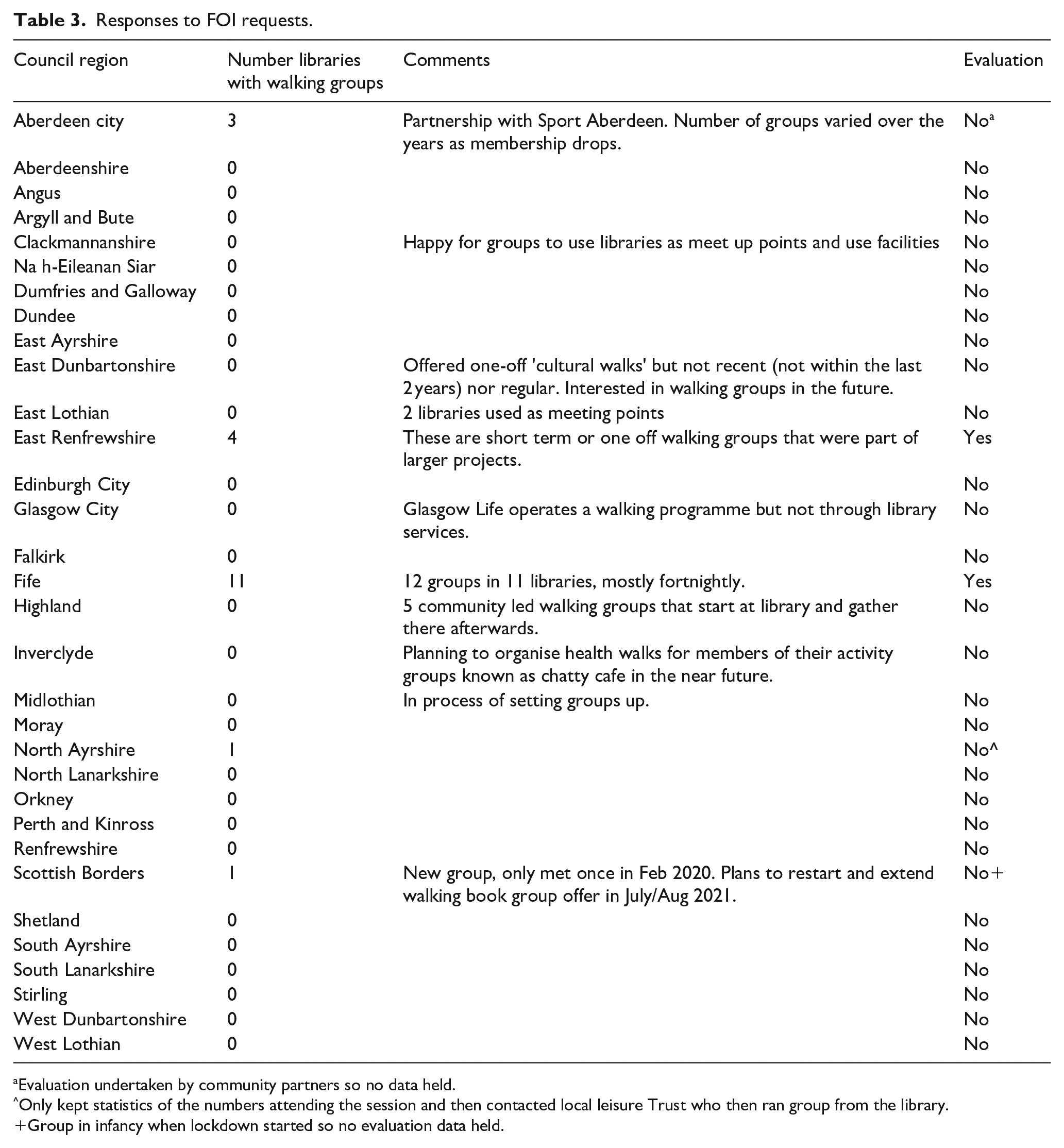
Evaluation undertaken by community partners so no data held.
Only kept statistics of the numbers attending the session and then contacted local leisure Trust who then ran group from the library.
Group in infancy when lockdown started so no evaluation data held.
Evaluation data was provided by two regions: East Renfrewshire; and Fife. East Renfrewshire captured limited quantitative and qualitative feedback from participants following walking group projects, with largely positive results (East Renfrewshire Leisure and Culture, 2019). Fife provided project evaluation data from their groups, consisting of both qualitative and quantitative information, highlighting the benefits to participants, the library as well as the wider community (OnFife, 2021). The lack of available evaluation suggests that libraries involved in groups in any way, are not always benefitting from evidence to demonstrate the value of their involvement.
Comparison of data across survey, interviews and FOI responses
Through identifying the regions providing walking groups on the questionnaire responses, it was possible to compare this information with the FOI responses. The information largely corresponded, although there were some differences; questionnaire responses from Glasgow City, Dumfries & Galloway and South Lanarkshire all indicated involvement in walking groups, although the FOI responses highlighted no group provision in these areas. It seems likely that groups in these areas may utilise libraries as meeting points, or it may be that groups operate in partnership with other organisations; both situations may have been deemed by those answering the FOI requests as unrelated to library services. The combination of questionnaire and FOI responses therefore allowed a more thorough picture to evolve.
For the eight regions that were identified through the FOI responses or the questionnaires as having involvement in groups, there was a mixed picture of how library services operated, with some being part of the local council and others being part of a leisure trust. It does not therefore appear that being part of an organisation that involves sport and leisure is imperative to providing a library walking group.
The themes identified from the questionnaire data largely correspond with those from the interview data, with the interviews capturing richer, more detailed qualitative information and the questionnaires providing a greater range of opinions than was possible from the comparatively small number of interviews.
It is therefore evident that the use of the three data collection methods, used in conjunction with the literature enhanced the validity of the study findings.
Research limitations
Data collection and participant engagement were both successful in this study, however any study normally comes with limitations, and this study is no exception. We acknowledge that the online questionnaire completion is likely to have been higher for those with an interest in the subject, and that COVID-19 may have had some influence on the number of staff available to participate, as anecdotally not all library staff were back to work at the time of the questionnaire distribution. Greater numbers of interview participants may have led to differing insights; however, the limited MSc dissertation timescale dictated the time that could be dedicated to recruiting interview participants. Qualitative research findings cannot be generalised to the population as a whole. However, given the lack of previous research into the topic, this exploratory study has provided significant, transferable insights and a basis for future research.
In terms of the FOI responses, it is possible that not all libraries providing some aspect of walking group services were identified. It is evident that there were some inconsistencies between the questionnaire responses and the FOI information; however, the FOI responses coupled with the questionnaire data appeared to provide a good overall picture of provision across Scotland.
Although the second author has also been a librarian in the past, both authors do not have experience of working in public libraries, or in the Scottish library sector. This means that better understanding of aspects such as operational differences in library services across Scotland, and the use of information-sharing platforms emerged as the study progressed, rather than being known from the start. However, being from outside the public library sphere may have been beneficial in allowing a more objective and neutral approach to the study.
Conclusions and recommendations
Given that public library walking groups have received little in the way of academic research, this study provides useful insights into the Scottish context, as well as capturing valuable staff opinions into the benefits, challenges and opportunities of this type of service. Our research and methodological approach may therefore be of interest to library practitioners, decision and policy makers, librarianship and information science scholars, in Scotland and beyond.
With the Freedom of Information responses identifying only five out of thirty-two Scottish regions as providing small numbers of library adult walking groups either at present or in the pre-pandemic period, and the questionnaires discovering that a further three regions have or have had some group involvement, it can be concluded that adult walking groups are not widely provided by Scottish public libraries.
Benefits of library walking groups were strongly highlighted by the library staff responding to the questionnaire and interviews, with perceptions that these groups provide benefits to participants, though offering an activity, environment and social contact that can enhance their health and social wellbeing. The potential for the library to benefit also emerged strongly as an opinion, with possible increases in library footfall and issue numbers as a result of the groups. It would be recommended however, to have a ‘standardised set of evaluation guidelines’ (SLIC, 2020: 45) to objectively capture the impact of groups on individual participants, the library and participating staff, both in the short and longer term.
It is clear that there are both challenges and opportunities in relation to public libraries supporting library walking groups for adults, which are often intertwined.
Firstly, our study has uncovered an appetite from some public library staff in finding out more about library walking groups, as well as some interest in establishing this service. Combining this with a willingness from some staff to share their experiences could provide a fantastic opportunity to support future group development. It appears however, that across Scotland, there is currently no standardised way of networking and information-sharing that is widely known to staff. Establishing a designated information-sharing network regarding public library walking groups may provide a means to do this. Widespread publicity for staff within the public library sector would also be required to promote awareness of this.
It is evident from the data that partners are widely used and often instrumental in the provision of library walking groups, through aspects such as delivering the walking element, or training staff. However, the data suggests that since partnerships can vary enormously, this may present a challenge to libraries starting a new group, as appropriate partners may be difficult to identify and there is no standardised role for them to adopt. Since evaluation has been shown to be a key way of demonstrating value to partners (SLIC, 2020: 17), it is recommended that consideration is given to the most effective and appropriate means of evaluation to demonstrate impact.
The current focus on health and social wellbeing in public libraries, presents a further opportunity for the development of new services such as adult walking groups. The research data also suggests that health and wellbeing provision may now be even more important in helping communities to recover from the impact of COVID-19 and associated restrictions. There are concerns that resources may be even more restricted than in pre-pandemic times, making the establishment of new services challenging. Nevertheless, within Scotland there is a national focus on increasing walking activity levels, with Paths for All (2021) calling the government to ‘Increase investment for delivery of walking behaviour change programmes that particularly target the most vulnerable and help to reduce inequalities’ (p. 2), suggesting there may be support and opportunities available.
The central location and inclusivity of the public library may engage individuals into groups who may not do so otherwise. However, without social referring into groups, it is unclear whether this is actually the case. The use of social referring into walking groups – through close partnership working with health and social care services – could potentially have a much wider impact on community health and wellbeing.
Walking groups already in existence within the library area were a concern highlighted, which may provide a challenge to recruiting sufficient participants. However, approaching walking groups in the area already in existence to identify the potential to partner with them, may then provide the library with a ready-made group that could offer benefits to both parties.
A final challenge is staff uncertainty regarding the idea of library-supported walking groups, with some responses questioning whether it is the public library’s role to be involved. Given that the current study is likely to have largely engaged individuals with experience or interest in the idea of walking groups, it is acknowledged that there may be public library staff members who do not consider the idea favourably. Staff interest and support of the idea are likely to be crucial to group success. However, it is important to recognise that partnerships are essential to success: walking groups provide opportunities to bring about this community service involving library staff members as partners with relevant stakeholders. Libraries' contribution to health and wellbeing is also important for advocacy. Fujiwara et al. (2015) showed that public library use is associated with higher personal wellbeing and fewer GP visits, estimating that library membership could save the National Health Service (NHS) England £1.32 per person a year. The ‘Health on the Shelf’ report commissioned by SLIC (2020) calculated that Scottish public libraries are saving the NHS in Scotland £3.2m every year. It is therefore vital that public libraries are empowered to deliver quality public services as a key part of community planning.
The results from this study suggest that there are many factors influencing the provision of adult walking groups by public libraries, with a range of different approaches offering potential for success. These include supportive partnership development, adequate networking and information-sharing between Scottish public library staff, assessment and evaluation frameworks and sufficient resources and staff interest. Further research in this area may explore social referring into walking groups, identify user requirements for developing an information-sharing network on public library walking groups, and define assessment and evaluation guidelines.
By becoming partners in library based walking groups and other health and wellbeing activities, and presenting their evidence-based impact in the community, public libraries may contribute to support wellbeing, address health inequalities (Local Government Association, 2022) and advance health equity.
Footnotes
Appendix A: Questionnaire
I agree to being a participant in the project
Less than 10,000
10,001–50,000
50,001–250,000
250,001–500,000
More than 500,000
Unsure
Management
Librarian
Library assistant
Service development
Volunteer
Other (please specify) _______________________________________________
For the questions that follow, please consider the services that were in operation prior to COVID-19 restrictions being implemented.
Extremely important
Very important
Moderately important
Slightly important
Not important at all
Yes
No
Yes [If selected, directed to Block B of questions]
No [If selected, directed to Block C of questions]
[BLOCK B: LIBRARIES WITH WALKING GROUPS]
Yes
No
Not sure
Extremely important
Very important
Moderately important
Slightly important
Not at all important
Extremely important
Very important
Moderately important
Slightly important
Not at all important
Yes
No
Not sure
Yes
No
Not sure
Yes
No
____________________________________________
Acknowledgements
We are grateful to Dr David McMenemy (University of Glasgow) and Dr Marilyn Lennon (University of Strathclyde) who provided useful feedback while preparing this manuscript, and to the two anonymous reviewers and the editor Prof Anne Goulding for the very insightful and constructive comments on this paper. We would like to extend a special thanks to the Scottish Library and Information Council (SLIC) who assisted in distributing the survey, and to those surveyed and interviewed for sharing their experiences which have provided our study's key insights on their library walking groups activities in Scotland.
Declaration of conflicting interests
The author(s) declared no potential conflicts of interest with respect to the research, authorship, and/or publication of this article.
Funding
The author(s) received no financial support for the research, authorship, and/or publication of this article.
