



Abstract
Next to their traditional role as places for information provision and knowledge transmission, public libraries increasingly also function as important social infrastructures contributing to the everyday life in cities. As such, they can help to address systemic challenges such as social fragmentation, loneliness, exclusion and precarity. However, the library not merely is a social infrastructure, but becomes one each operating day through continuous labour by a network of stakeholders. This paper specifically examines library staff and their routinised practices to provide, perform and maintain the library as social infrastructure. The empirical research was carried out in four public libraries in the Netherlands and focussed on staff members who were in a 1-year post-graduate programme to become a community librarian, and their close colleagues. It consisted of two phases: first librarians were shadowed at work, followed by a focus group interview on the multiple problems librarians encounter to (re)make their library into social infrastructures. These include coping with limited space, collaborating with other institutions, difficulties to reach out to the community, financial struggles and differentiating interpretations of the library’s primary function.
Keywords
Introduction
Public libraries are long-acknowledged places for information provision and knowledge transmission, but they increasingly also function as important social infrastructures contributing to the everyday life in cities. They can stimulate a sense of community, social cohesion, integration, physical safety and mental wellbeing, which is much needed in times of increasing exclusion and societal gaps (Klinenberg, 2018; Latham and Layton, 2019; Schloffel-Armstrong et al., 2021; Van Melik and Merry, 2021). Different urban populations encounter each other in public libraries, including social minorities such as older, unemployed or homeless people (Peterson, 2021; Robinson, 2020). Libraries provide access to social capital, networks and care, contributing to the resilience of local communities (Aabø and Audunson, 2012; Engström and Rivano Eckerdal, 2019; Mattern, 2014).
However, the crucial capacity of public libraries as social infrastructure does not evolve ‘naturally’, but needs to be actively performed by a network of stakeholders, including government authorities, librarians, patrons and other organisations such as care providers. In this article, we specifically zoom in on library staff as those actors deploying different practices to counter urban challenges like illiteracy, social fragmentation, loneliness, exclusion, precarity and alienation from the welfare state. In other words, we do not merely focus on what the library as social infrastructure is, but how it continuously comes into being through sayings and doings of librarians (Yousefi, 2017).
As such, we position our research at the intersection of human geography and library and information studies (LIS), by answering the following research question: how does the transition towards be(com)ing a social infrastructure affect the routinised practices of library staff and vice versa? Previous geographical and sociological studies elaborately discuss the changing nature of libraries, illustrating how library as spaces have evolved from lieu du livre (places of books) to lieu du vivre (spaces of living) (Klinenberg, 2018; Peterson, 2021; Schloffel-Armstrong et al., 2021). Often, these studies focus on different users and activities that take place in the library, such as knitting (Robinson, 2020), and how they are accommodated through space. In turn, LIS studies have also increasingly examined the library as (social) place (e.g. Aabø and Audunson, 2012; Buschman and Leckie, 2007; Mathiasson and Jochumsen, 2020). Moreover, LIS studies have extensively researched the profession of librarianship and illustrated that is continuously evolving (Barniskis, 2016; Cherinet, 2018; Pilerot and Lindberg, 2018). However, changing librarianship is often discussed from the perspective of digitalisation and information use, highlighting the changing roles and practices of librarians in a digital era (Ahmad et al., 2019; Cherinet, 2018; Pinfield, 2001). Although (dealing with) digitalisation is certainly an important part of the work of librarians, we feel less attention is devoted to their responsibility to the community and how their profession changes now libraries increasingly (have to) function as social infrastructures (with notable exceptions such as Seale and Mirza, 2020; Van Melik and Merry, 2021). Hence, combining human geography with LIS research allows us to examine the relation between changing library space and a changing library profession.
The research is empirically situated within the Netherlands, where the library law of 2015 (Wet stelsel openbare bibliotheekvoorziening) stipulates that all communities must have a library, 1 because everyone should have the right to have access to a library, as they play a vital role in people’s personal development. The law also specifies five functions a library should fulfil: (1) providing knowledge and information, (2) offering possibilities for personal development and education, (3) stimulating reading and acquaintance with literature, (4) organising encounter and debate and (5) becoming acquainted with art and culture. The last two functions were specifically added to highlight that libraries ought to be more than collections of books, and also provide opportunities for encounter, debate, art and culture. This trend of public libraries housing all sorts of socio-cultural activities can also observed in many other countries, such as Sweden, New Zealand and the UK (Latham and Layton, 2019; Schloffel-Armstrong et al., 2021).
Below, we first theoretically outline the library as social infrastructure. Following Rivano Eckerdal’s (2018) notion of ‘librarising’, we not only focus on the library as a noun, space or infrastructure, but also as a verb, a practice or ‘infrastructuring’ (Korn et al., 2019). In other words: we regard the library as much a place of books, computers and other materialities, as an outcome of multiple behaviours, routines and emotions. The research design section subsequently describes how the empirical research was carried out in four public libraries in the Netherlands and focussed on staff members who were part of a 1-year post-graduate programme to become a community librarian. We first shadowed them to observe and discuss their daily work practices and then organised a follow-up focus group interview. The findings illustrate the daily struggles that community librarians encounter, such as coping with limited space, collaborating with other institutions, difficulties to reach out to the community, financial problems and differentiating interpretations of the library’s primary function. In the final section, we conclude and reflect what these results imply for librarianship and library research, education and policy.
Social infrastructure and community librarianship
Over the past decade, research on the role of infrastructures in societal transformation has blossomed, labelled as the ‘infrastructural turn’ in social sciences (Amin, 2014). Increasingly, the term infrastructure is not only used to describe large technical systems that facilitate resource and energy flows such as (rail) roads, ports and power lines, but also socio-cultural institutions such as public libraries, community centres, museums and public gardens. The term ‘social infrastructure’ was popularised by Klinenberg (2018: 11), who describes it as: ‘the physical places and organizations that shape the way people interact’. He states that in order to form meaningful connections within a community, one needs infrastructure that makes these connections possible. Kelsey and Kenny (2021) argue that social infrastructures have long been neglected, especially in ‘left-behind towns’ in the UK, as governments prioritise investments in physical rather than social infrastructure. However, in order to address systemic challenges such as deep political disenchantment, loneliness and a decreasing sense of belonging, they call for more investments in social infrastructures ‘where meaningful relationships, new forms of trust and feelings of reciprocity are inculcated among local people’ (Kelsey and Kenny, 2021: 11).
The public library is often mentioned as a prime example of a social infrastructure that contributes to the social life of cities (Klinenberg, 2018; Latham and Layton, 2019; Power et al., 2022). Libraries are relatively open, accessible and inclusive (Van Melik and Merry, 2021); they increasingly serve as spaces of encounter (Engström and Rivano Eckerdal, 2019; Peterson, 2017, 2021; Robinson, 2020; Williams, 2020), providing access to networks, cultural capital and interpersonal care (Aabø and Audunson, 2012; Power et al., 2022; Vårheim, 2014). Barclay (2017: 270) therefore argues that the space of the library – in and of itself – is perhaps the most valuable amenity it has to offer, instead of its role as information provider: ‘Just what is so special about public library space? It is special because it is unique. No space quite like public library space has managed to survive the changes wrought by an increasingly privatised and security-obsessed world’. Next to functioning as information infrastructure, libraries increasingly offer a wide-range of non-book-based services, including art classes, cultural events, craftwork, film screenings, board games, coffee hours and lunch meeting, meditation and yoga classes (Barniskis, 2016; Lenstra, 2019; Robinson, 2020; Van Melik and Merry, 2021). Libraries are reinventing themselves: as community centres, innovation labs and makerspaces (Klinenberg, 2018; Barniskis, 2016). Hence, they have become a place where information and social infrastructure overlap (Mattern, 2014).
As libraries transform into social infrastructures, this implies that what is constructed as the daily work of librarians is shifting as well. It is therefore important to not merely focus on what the library as social infrastructure is, but also how it comes into being through sayings and doings (Yousefi, 2017). Rivano Eckerdal (2018) coined the term ‘librarising’ versus ‘library’, to highlight that these civic institutions are ‘constantly becoming’ organisations, where staff, visitors and artefacts continuously intertwine, readjust and rearrange in response to systemic challenges like austerity, illiteracy and social and cultural exclusion. As opposed to the nouns library and infrastructure, the verbs librarising (Rivano Eckerdal, 2018) and infrastructuring (Korn et al., 2019) substantiate that social infrastructures such as the library are constantly in flux, open-ended, changing and contested. As Power et al. (2022: 12, emphasis added) state: ‘Infrastructures require maintenance in order that they obdure (. . .) Shadow care infrastructures 2 research seeks to make this work visible. This includes attention to the labours through which care infrastructures are maintained and held together’.
Following Simone’s (2004) notion of people as infrastructure, we therefore draw attention to librarians as important actors providing, performing and maintaining the library as social infrastructure. They enact the ‘doing of the library’ (Rivano Eckerdal, 2018: 13). Previous LIS research has elaborately described the profession of librarianship and how it evolves over time, especially as information experts in the digital era (e.g. Ahmad et al., 2019; Pinfield, 2001; Pilerot and Lindberg, 2018). However, their daily activities might be even more affected by the library’s transformation towards a social infrastructure. Barniskis (2016: 114) describes how librarians’ roles have been reframed over time from ‘information experts to community advocates, teachers and as match-makers for people to meet one another and new ideas’. ‘Doing’ a social infrastructure requires staff to increasingly perform care, social work and ‘emotional labour’ (Rodger and Erickson, 2021; Wojciechowska, 2022), but also to demonstrate and legitimise the library’s values beyond its role as information provider as ‘convincing storytellers’ (Pilerot and Lindberg, 2018: 260) or ‘bookkeepers of social activities’ (Van Melik and Merry, 2021: 15). Consequently, librarians’ skills are also shifting, with present-day job advertisements for librarians unanimously mentioning communication, negotiation, collaboration and cultural intelligence as important requirements (Cherinet, 2018). These skills are necessary, as community-led librarianship (CLL) implies that librarians ‘seek to work with, not for, community members to better meet what they need and want from their public library’ (Freeman and Blomley, 2019, original emphasis). Therefore, library staff should not just be information experts but also ‘social antennas’ who know what is at stake in the neighbourhood.
To investigate the process of librarising or ‘doing the library’, we focus on the everyday routinised practices of staff working as community librarians. A practice-oriented framework departs from the idea ‘that in order to understand higher-order [. . .] economic and social outcomes [. . .] it is necessary to first closely observe and understand the micro-social activities (i.e. practices) carried out and performed by people living, labouring and creating in the everyday economy’ (Jones and Murphy, 2010: 376). Practice theory approaches have become very popular as way to study social phenomena. Inspired by the work of amongst others Bourdieu (1977) and Giddens (1984), so-called second generation practice theorists have defined practices and illustrated how and where they are performed (Spaargaren et al., 2016). Reckwitz (2002: 249), for example, defines practices as routinised behaviours consisting of ‘forms of bodily activities, forms of mental activities, ‘things’ and their use, a background knowledge in the form of understanding, know-how, states of emotion and motivational knowledge’. This enumeration illustrates that practices consist of different elements. Shove et al. (2012) distinguish three: materials, competences and meaning. Materials are non-human objects such as tools and hardware, but also the body in itself, which only becomes a living being through our practices. Competences are described as one’s know-how, background knowledge and understandings. Lastly, meaning ‘represents the social and symbolic significance of participation at any one moment’ (Shove et al., 2012: 24); it is the reason why someone performs a practice and how it is perceived.
Studying librarians’ daily practices has become common in LIS research, particularly regarding their information use (see e.g. Lloyd, 2011; Pilerot and Lindberg, 2012). Some everyday library practices are relatively traditional, boring or mundane, like sorting books, counting money and printing (Williams, 2020); other practices are relatively new and in the process of be(com)ing routinised, such as organising lunch meetings for elderly patrons or rap workshops for youth (Van Melik and Merry, 2021), or virtual bowling competitions like the Library Lanes project described in Klinenberg’s (2018) Palaces for the People. Such practices illustrate the freedom some librarians enjoy to ‘dive in’ and ‘try things out’ in response to community demand (Barniskis, 2016), or as Klinenberg (2018: 56) states: ‘The library staff has more autonomy to develop new programming than I’d expected from an established public institution’. Nevertheless, new practices can be difficult to develop and perform. Freeman and Blomley (2019), for example, discuss the roll out and subsequent roll back of Edmonton Public Library’s new sleeping policy. Embracing the community-led service philosophy, the library wanted to be as inclusive as possible and abolished its no sleeping policy. This resulted in the library de facto serving as day shelter for homeless men causing clear tensions with and resistance from other library users. Eventually, the no sleeping policy was reintroduced, illustrating the difficulties of developing new practices and serving multiple publics (Van Melik and Merry, 2021).
Below, we analyse our empirical data by applying Shove et al.’s (2012) conceptualisation of practices as shared elements of materials, competences and meanings. Materials consist of the physical space of the library, including its furniture, books, computers and other objects. Materials can have multiple functions, for example a bookshelf can be used to store books, but also to provide privacy (Williams, 2020). Materials can also hamper certain practices and stimulate others, such as carpets that create more silent spaces to study but are very inconvenient when the library is used for woodworking activities (Barniskis, 2016). Competences include the expertise, skills and knowledge of library staff in performing their daily activities. As described above, these competences are not constant, but change over time as librarian’s roles are reframed (Barniskis, 2016; Koh and Abbas, 2015). Consequently, librarians can also lack certain competences that are increasingly required but were not part of their training, such as knowledge of social work (Van Melik and Merry, 2021). Meaning is about the different – often competing – conceptions of what the library is and whom it should serve: are they considered relatively quiet spaces where reading is the main activity (Aabø and Audunson, 2012) or community centres full of activities? Is their main function information provision or should they be regarded as social care infrastructures (Power et al., 2022)? Competing conceptions can exist within the community amongst different users groups (when the occupation of one group such as the homeless men described by Freeman and Blomley (2019) hampers others from using the library), amongst librarians (who potentially disagree about the services libraries should offer) and amongst government officials and what they expect from libraries (Boughey and Cooper, 2010).
According to Rivano Eckerdal (2018: 1409), each of these elements is equally important to describe librarising practices: ‘In a library-assemblage, elements include the librarians, library assistants, the patrons, the physical space, furniture, objects including books, journals and computers, digital resources, inter alia OPAC, search engines and social media platforms and the articulations that are produced and used within the assemblage. All these elements make up the assemblage and librarians are not assigned any specific position or legitimacy’. Moreover, library practices are not static; they are (re)produced every time they are performed. In what follows, we therefore describe particular library practices in which materials, competences and meanings align in specific ways at specific times. Nevertheless, as we discuss in the next section, these should be considered as more than snap-shot moments.
Research design
To investigate the routinised practices of staff to provide, perform and maintain the library as social infrastructure, we combined participant observations at four libraries in the Netherlands with a focus group interview with community librarians. We decided to focus on library staff who explicitly showed interest in be(com)ing a community librarian. Therefore, we recruited research participants via OnderwijsNext, an organisation which offers a 1-year post-graduate programme ‘community librarianship’ (Cubiss, 2020). Inspired by the work of David Lankes, Professor of Librarianship at the University of Texas, OnderwijsNext focusses on reschooling ‘classic’ librarians into community workers, ‘to improve society through facilitating knowledge creation in their communities’ (Cubiss, 2020). In contrast to some other European countries, the Netherlands does not offer full library and information studies at the level of university or university of applied sciences, only programmes like OnderwijsNext ‘community librarianship’. 3 Librarians are therefore often not educated in library studies, but have a background in for example communication or sociology, and as such, some feel the need for extra training. The community librarianship programme was first developed in 2017 and now annually attracts about 5–15 librarians.
Research participants were recruited amongst the class of students who started their training in September 2021, during one of their (online) meetings. We also tried to recruit alumni from the previous cohort, but none of them responded to our request. 4 From the seven students in the class of 2021, five were willing to participate in the research, all of which identify as female. Four librarians agreed to be shadowed for one working day; three participated in the focus group interview (Table 1). The five respondents all work in different libraries, although some are part of the same library network. For example, Kim and Mary both work for the same library organisation in a large Dutch city, but each in another neighbourhood branch. While they work in a very urban environment, the other respondents represent smaller libraries located in towns rather than cities. This geographical variation is important to note, as this implies that the studied libraries serve different communities, and – as a consequence – have different challenges and budgets to be(come) a community library. Although we acknowledge this importance of spatial context, we do not reveal the precise location of the studied libraries in order to respect the anonymity of both staff and visitors. Hence, all names in this paper are pseudonyms.
Overview of respondents.
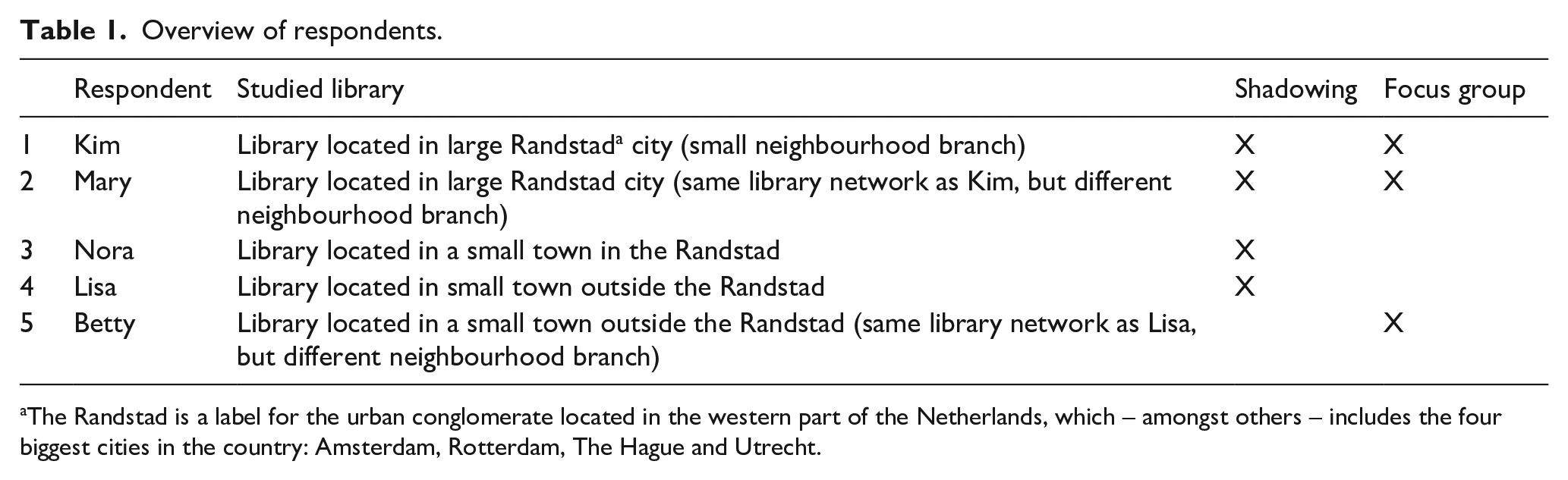
The Randstad is a label for the urban conglomerate located in the western part of the Netherlands, which – amongst others – includes the four biggest cities in the country: Amsterdam, Rotterdam, The Hague and Utrecht.
After successful recruitment, the first phase of the research consisted of participant observations in four different libraries by one of the authors. We explicitly applied a specific type of observation called ‘shadowing’, which Gill et al. (2014: 70) describe as ‘a kind of one-on-one ethnography; shadowing provides a window into the everyday interactions and practices’. In this method it is important to study practices-in-action (McDonald, 2005) by following the participants as a shadow; seeing what they see and doing what they do. This makes it a great way of investigating daily practices, since researchers are not just studying but also becoming part of the activities themselves. 5
We followed Kim, Mary, Nora and Lisa; each for 1 day. However, unlike an actual shadow, we did communicate with the respondents during the observations. These talks were ‘on the job’; spontaneous, non-recorded and often interrupted by work activities. They should not be seen as single interviews, but as multiple conversations occurring in the course of the day. We mainly spoke to the shadowed librarians, but also to close colleagues present on the work floor – talking in total to ten library staff members, who were all informed about the research and each signed a consent form. 6 Though conversations were mostly informal and unstructured, a memorised topic list steered the interviews. Themes discussed included library space, staff composition, community demand, finance, daily practices and the library’s role as social infrastructure. Detailed notes of the observations and conversations were taken both during and after the observations, resulting in a limited number of literal quotations yet rich empirical data. This was complemented with desk research consulting annual reports, mission statements, websites and other relevant documents of the studied libraries.
Of course, regardless of the length of the research, shadowing is always limited and temporary, a so-called ‘snapshot moment’ (Gill et al., 2014: 84). Therefore, Gill et al. (2014) recommend that the researcher stays in contact with the respondents and asks for reflection. Following this advice, we decided to organise a focus group interview with all shadowed librarians during the second phase of the research, which gave our respondents more time to think about their daily practices and to discuss them with their peers. 7 As Gill et al. (2008: 293) emphasise, focus groups are best used to ‘to clarify, extend, qualify or challenge data collected through other methods’. Moreover, focus groups are an excellent tool for sparking debate amongst participants who share similar experiences (Cameron, 2005). To encourage interaction between the participants, we did not prepare a specific script, but only used a small topic list to make sure all the findings from the first phase of the research were included in the discussion. These mainly covered problems encountered by librarians and how these relate to the library’s function as social infrastructure, such as coping with limited space, collaborating with other institutions, efforts to reach out to the community, financial struggles and different interpretations of the library’s primary function. The focus group interview was recorded and transcribed with consent of all participants; quotes are translated from Dutch to English by the authors.
The data was collected between January and March 2022. Explicitly mentioning this timeframe is important, as COVID-19 restrictions were still relevant at the time. As almost everywhere in the world, Dutch libraries were forced to close during the first lockdowns in 2020 (Corble and Van Melik, 2021). This closure sparked a political debate about the function of libraries as essential infrastructures, increasingly acknowledging that public libraries are not merely providers of books, but also of care. This view of the librarian as essential worker of care also became apparent in other countries and other types of libraries, such as academic librarians in Canada (Seale and Mirza, 2020). During later lockdowns in the Netherlands, libraries never completely closed again, but remained open for specific groups or activities only; often on appointment, under strict hygienic regulations and for limited duration. Hence, the library was differently valued in different phases of the pandemic. At the time of our fieldwork, the studied libraries were open, social activities were allowed for small groups (<75 persons) and the 1.5 m distance rule had just been released. This implied that the full capacity of libraries as social infrastructures could not be observed. However, the situation also had advantages, as less crowded circumstances allowed library staff to reflect more extensively on how and why they performed certain practices instead of observing how they actually perform the practice. In Yousefi’s (2017) words, we therefore focussed more on the sayings than the doings of library staff.
Routinised practices of community librarians
During our shadowing observations, different types of practices could be distinguished. Like Pilerot and Lindberg (2018) we found both ‘integrative’ practices typical for librarianship, such as advising patrons how to seek information and more general ‘dispersed’ practices that can also be observed outside the library, such as caring. Some practices were small or subtle, such as greeting each visitor upon entry in the library. Others were more extensive, such as Mary describing a recent activity she organised called ‘Football in the library’, consisting of penalty shootouts on the parking lot and a football quiz and FIFA video-game tournament inside, as a way to attract youth to the library (cf. Van Melik and Merry, 2021). We observed Nora pitching an idea to her colleagues to organise a clothing fair in the library, to promote knowledge on sustainability, attract new customers and create a space of encounter. Providing care is important to all research participants; each of them regards helping people as her most important job. This was also clearly visible during the participant observations. Kim helped a family navigate the children’s computer, so their daughter could play a game. Lisa assisted an older woman who had difficulty figuring out how to use the computer to fill in an online form. Such requests have become more apparent since the COVID-19 pandemic, when people came to the library seeking help to make a test appointment or download a proof of vaccination (cf. Corble and Van Melik, 2021; Seale and Mirza, 2020). Below, we continue to describe different examples of ‘doing the library’ through Shove et al.’s (2012) conceptualisation of practices as shared elements of materials, competences and meanings.
Materials: Making space
As Barclay (2017) argues, the space of the library might be one of its most important attributes. We observed many practices of staff literally ‘making space’ by rearranging the library in such a way that it becomes a welcoming space, for example by positioning a table near the entrance to invite patrons to sit down for a while. In one of our studied libraries, the table was conveniently located next to the coffee machine, where visitors can get a free cup of coffee or tea. Nora expressed her frustration that this is not the case in her library: ‘Look at this, the first thing you see is a giant stack of bookshelves! Not welcoming at all. And then we’re supposed to be a social, welfare library. . .’
Tables in the library are certainly used for social purposes, for example by one older woman who comes to the library every day for the ‘puzzle boot’ and a chat with other visitors. Yet, this can cause clashes. One man was working on his laptop at the table, but immediately left when a group of older women started chatting while drinking a cup of coffee. Larger libraries often provide silent rooms to physically separate more noisy social activities from opportunities to work and study in a quiet environment. But even in those libraries, conflicts over space occur, as Lisa explained: One time during exam week, there were so many high-school students that wanted to use the silence rooms, that fights broke out. Nothing physical fortunately, but still, it shows their importance. Somebody left their bag in the room while they were gone, like a towel on a beach chair. Yeah, then the other kids came complaining, you have to find some way to deal with that as a librarian.
Like Williams (2020) who described how a chair in the Women’s Library in Sydney provided much more than a place to sit, we also observed that materials in the library can have multiple functions. Bookshelves are obviously used to store books, but also to make the library more enclosed. Lisa described how she organised a brainstorm session with teenagers to investigate their needs. They expressed their desire for a more secluded space, where youth could hang-out invisible to other visitors. Our observations clearly illustrated this need, when we saw two teenage girls practicing TikTok dances on a quiet afternoon. They were hiding behind the shelves and whispering, perhaps thinking that staff would not appreciate them dancing in the library. However, like the FIFA tournament discussed above, librarians purposefully try to attract youth to the library. Three of the four libraries have a very popular touch table with a built-in tablet and one library placed a gaming console next to the youth book section. The rationale is that even if young people only dance or game in the library, they still become familiar with the library space for potential future use (cf. Van Melik and Merry, 2021).
Mobile shelves offer the opportunity to make the library more enclosed, but also to open it up for larger events. Of the four studied libraries, only one has a dedicated space for larger activities. The other libraries make use of flexible interior designs to make room for other activities. All three can also use communal space outside the library premises, as they are part of a large multicultural centre. However, there are often high costs involved, as Lisa revealed: If we want to organise an activity for a larger group, we need to rent the theatre next-door, but there is often no budget, so we are forced to organise the activity here in the library. We move some book shelves, set some chairs and we’ll get by. But there was this one time when a LOT of people showed up unexpectedly, that was way too crowded (emphasis added).
In sum, all participants acknowledged the importance of organising social activities in the library, but found it difficult to combine these activities with more traditional library uses like reading and studying. Available space is often a limiting factor, even when library furniture can be used in a flexible manner and when more space is available next-door – but against high rents. Tables, shelves and other materialities such as game consoles are strategically placed to create a more welcoming atmosphere and are often used for multiple purposes.
Competences: Reframing librarianship
All research participants felt the intrinsic need for more training to function as a community librarian and therefore decided to follow OnderwijsNext’s 1-year post-graduate programme. During their training, they particularly learned how to find, build and listen to communities. All participants were positive about the programme’s curriculum and liked how it triggered a new way of ‘thinking with’ rather than for the community (cf. Freeman and Blomley, 2019). Three participants were fully supported by their respective organisations to follow the programme, but Lisa’s manager first needed to be convinced of its usefulness. After attending one of the online classes, the manager changed her mind: ‘That social library role is something we’ve been working on for a few years now, it’s not like we’re an old-fashioned library. It is just that whole ‘community building’ that’s new to us’ (emphasis added).
An important competence of current librarians therefore is to recognise, build and support small-scale, self-sustaining communities. A community is often defined as a group of people with a common interest, usually tied to a social or educational goal of the library. This can range from groups interested in sustainability issues to book or knitting clubs. Word-of mouth is an appropriate way to attract new visitors to a community, according to Mary: ‘During the story time activity, I tell the kids to inspire their friends to come as well. I now often see the same faces as the last time, plus a few new ones. For me that’s also a sign that I’m doing something right, both in reading and in promoting’.
As part of their training programme, all participants had to find or create such a community within their respective municipalities and try to bring them into the library. This was not always easy. Kim explained how she experienced difficulties trying to set up a Facebook group to reach out to new people and keep them updated on specific library activities: ‘We tried to start a Facebook group, and in the beginning, it was quite lively. But after a while it just, kind of stranded. We were still posting, but we hoped it would be interactive and people would post themselves too’. The latter did not happen, and it also proved hard to reach out to new people to join the Facebook group who did not already visit the library. This failed attempt illustrates the importance of learning what is at stake in the community; to think with rather than for the community, as Lisa explained: Programming is currently a one-way street: “We find this is good for you, so we’ll organise it for you”, instead of asking the communities for their preference. Librarians are your antennas. Some time ago, there were a lot of questions and requests for books about high sensitivity, that’s a sign! That should be the purpose of a community librarian, recognising and anticipating [on community demands].
In addition, community-based programming is frustrated through certain internal requirements of libraries that have multiple branches. Kim, for example, described how she is not allowed to explicitly cater to certain neighbourhood needs: ‘[Within the library network] all libraries in the city need to be uniform. I can’t organise an activity specifically for this neighbourhood, because then the others need to have the same kind of activity’. This seems to be a contradiction in the work of community libraries: they need to listen to their communities, but at the same time arrange activities that can be copied to other communities as well.
Reaching out to and helping new communities requires very practical skills. One of Nora’s colleagues admitted she never made an invitation poster before, while we observed Kim finding the right power tools and ladder to hang up a poster, something she also had never done before. More importantly, however, is the different kind of knowledge that is required to serve particular communities. During our observations, a man approached Mary asking for help with filling in an unemployment form. As mentioned earlier, such requests have become relatively common in Dutch libraries, due to the pandemic but also the opening of so-called IDO (Informatiepunt Digitale Overheid) desks since 2020, where people can get help with questions related to digital government services. Usually, there is a government official present on a set day, but often people visit the desk on other days as well. Some librarians have received IDO trainings, but these do not equal a full education in law or social work. Mary responded to the visitor that she did not possess the required knowledge to help him, and also expressed in one of conversations that she did not feel comfortable with so much personal information being shared with her. Lisa feels less distressed but still finds it ‘weird’ that ‘they [patrons] just spurt out all their personal information, passwords and everything! They trust the library to do the right thing’. Not being able to help in this particular situation was visibly frustrating to Mary; she felt really bad that she was not qualified for this specific task. This illustrates Williams’s (2020: 3) statement that: ‘the library is not a site of formalised care provisioning, but rather an ordinary space’.
Overall, the sayings and doings of our participants confirm previous studies that discuss the reframing of librarians’ roles (Barniskis, 2016; Van Melik and Merry, 2021). Next to their traditional collection-related tasks, librarians now function as social media experts, event organisers, marketeers, tax advisors and social workers. Consequently, the required competences of community librarians are indeed becoming much broader (cf. Cherinet, 2018). Community librarianship courses like the one offered by OnderwijsNext teach library staff new ways of ‘thinking with’ rather than for the community; however, they seem insufficient to train staff for complex social issues.
Meanings: Negotiating change
Dutch libraries are clearly in transition towards becoming a ‘social library’, as Lisa’s manager expressed earlier. Van Melik and Merry (2021: 3) state that ‘this transition (. . .) is what society needs, but also what is necessary for the library itself to avoid becoming extinct. Shrinking subsidies, changing demographics, decreasing membership and the rise of digital technologies all combine to force libraries to reinvent themselves: as community centres, innovation labs and makerspaces’. Yet, as with most transitions, there is notable opposition on different levels within the library; from management to fellow co-workers.
All participants have experienced sceptic attitudes regarding community librarianship from their colleagues. As described above, Lisa had to convince her manager about the necessity to follow the community librarianship programme. She also felt that her library’s programmers hardly listen to their community, but mainly impose their own ideas what the library should do and stand for. Mary indicated that her managers are well-aware of the importance of community-led librarianship, but do not know how to translate this into concrete library practices; their indecisiveness trickles down onto the work floor and creates frustration. For Nora, convincing management was even one of the main reasons to follow the post-graduate programme: getting the ‘title’ of community librarian would help her justifying certain decisions to the director. She described how she needs to explain the ‘new’ role of the library to her colleagues on a daily basis: Every day, I’m constantly reminding people how important it is to listen to community, rather than imposing your own ideas of what is right onto them. They [managers and marketing department] just don’t see it the same, or they don’t want to see it (. . .). Marketing doesn’t even listen to me! They put ‘sustainability’ on the poster, even though my research into the community shows it’s exactly that kind of wording that scares people away! I told them this, but they did it anyway.
In turn, Betty expressed how difficult it is to convince – mostly older – conservative colleagues about the importance to innovate. Nora also expressed that ‘young’ and ‘fresh’ personnel with a different ‘mindset’ is necessary to make a change in the library, while Lisa did not find age to be a limiting factor. Both opinions confirm Barniskis’ (2016) finding (pp. 118–119) that innovative library practices are more common among librarians without lengthy careers in library administration, regardless of their age.
The difficulties of negotiating change in the library is also expressed through finance. Even though the library is increasingly seen as an essential infrastructure that offers much more than books, recent statistics from the Association of Public Libraries in the Netherlands show that 41% of their library members faced budget cuts (of on average 10%) between 2020 and 2021 (Vereniging Openbare Bibliotheken, 2019). This means they often have to cut down on those activities that strengthen the position of the library as social infrastructure. Therefore, even if the library is willing to invest in community librarianship, they might not always be able to. Lisa’s manager confirmed this: ‘Money plays a role here, we’re not the same as the libraries in the Randstad. I do not have the money for two or three full-time community librarians. Getting that knowledge [of the community librarian programme] is very valuable though’.
Although librarians actively seek to increase the library’s income through collaborations with third parties, such as local businesses sponsoring particular activities, Dutch public libraries still mostly rely on municipal subsidies. As a consequence, convincing the responsible alderman is part of the daily activities of our participants. Nora described how this is not an easy task: ‘You almost need to have a sales-pitch ready, to convince the government of the value and uses we have, they can only spend their money once. We bring so much that they often do not see’. This resembles Van Melik and Merry (2021: 15) who use the term ‘social bookkeeping’ to describe librarians’ struggles to demonstrate and legitimise the library’s social impact. Lisa complained about how everything needs to be accounted for. After helping one elderly woman with her paperwork, she spent several minutes to fill in an online questionnaire to proof how long and with what purpose she helped the woman, in order to receive funding for these tasks. Such bureaucratic administration frustrates our participants, who rather perform than legitimise their caring practices.
These examples illustrate the differentiating interpretations of what the library is and whom it should serve, both inside and outside the library (cf. Pilerot and Lindberg, 2018). Community librarians constantly have to negotiate change, as they encounter scepticism and resistance from both colleagues and municipal funders, who all need convincing storytelling to become committed to the library’s role as social infrastructure.
Library-assemblage
For analytical purposes, we have investigated routinised library practices by applying Shove et al.’s (2012) framework of materials, competences and meanings. However, these three elements are difficult to disentangle, as they are bound up with one another and each is equally important in the so-called ‘library-assemblage’ (Rivano Eckerdal, 2018: 1409). We conclude this result section by describing one anecdote illustrating their entanglement.
The anecdote returns to Mary’s frustrations about her lacking competence to help a patron with his unemployment form described above. Recent television commercials and newspaper advertisements explicitly refer people to the library if they have specific government-related questions, for example concerning taxes, care provision, job searching, pension requests and payment of traffic fines. However, not all public libraries have such an IDO information desk yet, nor does each librarian have the required expertise. Clearly, Mary did not feel qualified for such a complex request. However, in the end, she did help the man by referring him to a care organisation in the same multifunctional centre. She explained: ‘Maybe that’s also part of our new social role, to be some sort of conduit. The library is quite approachable, we can help people in need get somewhere where they could get help’. In two of the four studied libraries, there were certainly opportunities for such easy referrals to welfare organisations in or near the library, as they literally shared the same building or were only separated from the library through a glass wall. However, despite these favourable material conditions, collaborations with such organisations turned out to be scarce. Our participants attribute this to a lack of willingness to collaborate amongst library directors. This confirms research from Bibliotheeknetwerk (2022), which shows that even though 9 of 10 Dutch libraries are located in a multifunctional accommodation there is still limited collaboration with partners in the same building, for example with respect to sharing personnel, knowledge or finance.
Moreover, even if librarians have the required competences and do not need to refer patrons to other organisations, the physical space of the library is often not yet equipped for requests that require privacy. Separate rooms are scarce in the studied libraries, and – if present – sometimes lack certain facilities. Lisa, for example, explained that the room reserved for more private conversations in her library had bad Wi-Fi, making it unsuitable for digital help. Moreover, time is often a constraint. During our observations, an older woman called to check if someone was available for help with scanning a form. Lisa appreciated her call, stating it is often difficult to assist people as there are many other patrons with specific requests. This also raises the question which library practices need prioritisation. According to Mary, some colleagues have different interpretations of the library’s primary function: There are colleagues that say things like “Yeah I would like to help them, but I have to do my job, I don’t have time right now.” Then I think: “But this is your job! These PEOPLE are your job!”. If someone needs your help, you just make time, people always come first. Other tasks can wait (emphasis added).
This anecdote illustrates that the care practice of offering help with government-related questions is therefore not just dependent on the competence of the librarian, but also – amongst others – on material time-space constraints and varying meanings of both staff and visitors on what the library should offer.
Conclusions and discussion
Public libraries have become sites where both information and social infrastructures increasingly overlap (Mattern, 2014; Van Melik and Merry, 2021). In this paper, we have examined how the library’s transition towards be(com)ing a social infrastructure affects the routinised practices of library staff and vice versa. By using a practice-oriented lens and shadowing and (group) interviewing staff who are currently following a community librarianship-programme in the Netherlands, we could reveal how different materials, competences and meanings are intertwined.
The transition towards be(com)ing a social infrastructure has certainly changed the ‘hardware’ of libraries, which now offer fewer physical books and more mobile usages of library space. Furniture is increasingly flexible to allow staff to spatially reorganise the library to accommodate a wide-range of non-book-based services. Yet, despite this flexibility, librarians still often lack space to host the various uses for the library. Some activities are conflicting, for example regarding noise-levels, even when the library is divided into different ‘zones’. Some requests such as government-related questions require separate rooms that provide privacy, which are often not available. Sharing space with other organisations within or near the same building would be a solution, but is often expensive due to high rents. Alternatively, some library activities could take place elsewhere, such as the community centre or neighbourhood park. Finding creative ways to extend the library beyond its physical walls might relief some spatial pressures, but could also be an appropriate way to reach out to the community and attract new users, as it might lower or literally take away the threshold to enter the library. At the same time, there is the risk of confusion of what a public library is and should do, if library activities are organised elsewhere or in collaboration with other partners. We already found a lack of consensus regarding the library’s meaning between library management and community librarians. In other words: next to hardware, also the ‘mindware’ of all involved stakeholders about the library’s function needs readjustment. Libraries need to make more explicit what social services they offer, through marketing but also by listening and attuning to the community’s needs instead of their own assumptions.
The most fundamental requirement, however, seems to be a change in the ‘software’ for libraries to truly function as social infrastructure. The expectations of the roles of librarians are multiple; they are ‘policy advisors, researchers, technologist, innovators, consultants, partners, and entrepreneur’ (Cherinet, 2017: 101). Our research revealed that despite good intentions, librarians often lack certain competences to perform all these tasks and to keep up with the continuously changing nature of their job. As mentioned above, there are no full LIS programmes offered at Dutch universities (of applied sciences), only programmes like OndewijsNext ‘community librarianship’ and in-house courses offered to library staff. These programmes and trainings are important, yet do not seem comparable to, for example, a full bachelor in LIS or social work. Although we are no educational experts, it might be worthwhile to reconsider LIS education in the Netherlands based on a benchmark study of LIS curricula in other countries.
Understanding how the library comes into being as social infrastructure implies we should not only focus on activities that take place in the library, but also take into account all the enabling and hampering aspects, such as available space, potential collaborations with other welfare institutions, financial struggles and consensus regarding the library’s primary function. Like any other infrastructure, the library consist of many different elements (books, shelfs, policies, events, etc.) that require constant maintenance; it is an assemblage in itself (Rivano Eckerdal, 2018). However, the library should also be considered as part of a wider assemblage; it is only one node in the complex web or ‘interconnected system’ of care provision, where someone’s access to one infrastructure depends on another (Power et al., 2022). For example, Power et al. (2022) describe how the library as social infrastructure provides care to a homeless woman on its own (e.g. offering warmth, privacy), but also connects her to other relevant infrastructures (e.g. to electricity so she can charge her phone and make photocopies to apply for housing). Care is relational and requires a collective sense of responsibility; public libraries should explore more how they can collaborate with other (welfare) organisations in or near the library. We found some evidence of referrals to and collaborations with such (third) parties, but believe that more opportunities can be found through partnerships with for example day care centres for older people, debt counselling, etc.
Our research has focussed on the everyday routinised practices of five library workers who are currently undertaking training to become community librarians Recruiting via OnderwijsNext made sure that the research participants were aware of, and actively involved in, the library’s transition towards be(com)ing a social infrastructure. However, this selection procedure means we excluded libraries and librarians that are not (yet) pursuing this new role, as well as more experienced community librarians who have been working in such a role for longer time. Moreover, the observations took place on a single day in each studied library, while activities, users, staff composition, etc. can vary vastly each day. The shadowed librarians might also have behaved differently knowing they were being watched. Lastly, the research was carried out under partial COVID-19 restrictions, which limited our direct observations of larger group activities. However, rather than seeing this as an unrepresentative timeframe, we believe that the pandemic taught us that society severely needs robust social infrastructures such as public libraries (Van Melik and Merry, 2021). The quieter circumstances during our fieldwork also allowed for uninterrupted conversations and the opportunity to elaborately reflect upon the librarians’ daily activities, including those important (caring) tasks that were (temporarily) lost during the pandemic. Using Power et al.’s (2022) terminology, the pandemic therefore made visible important care practices that were previously in the ‘shadow’.
Taken all of the above into account, this paper should be regarded as an explorative study that serves as starting point to further investigate how librarianship keeps on evolving in response to societal changes and systemic challenges such as social fragmentation, exclusion and loneliness, also after the pandemic. 8 It revealed that what is expected from libraries and their staff becomes increasingly complex and versatile (Cherinet, 2017). The ever-changing nature of the library means that its current transition (from a more collection-focussed to a ‘social’ library) has no specific ending. Instead, the library keeps on evolving – navigating between bottom-up community needs and top-down government policies. This ‘librarising’ (Rivano Eckerdal, 2018) requires new skills and flexibility from library staff. Their practices become more difficult, but also more meaningful and beneficial to society. As any other infrastructure, libraries need constant repairment and maintenance. However, in so doing, as Williams (2020) argues, they also contribute to redressing specific forms of injustices – and thus to a repairment of the world.
Footnotes
Acknowledgements
Thanks to OnderwijsNext for acting as gatekeeper and allowing us to recruit research participants amongst their students, and to facilitate the focus group interview within their teaching programme. Also much gratitude to our colleagues from the ILIT (Infrastructuring Libraries in Transformation) research consortium, particularly Dr. Lisa Engström for her feedback on previous versions of this paper. Lastly, our gratitude goes to the two anonymous reviewers, whose comments have improved our paper.
Declaration of conflicting interests
The author(s) declared no potential conflicts of interest with respect to the research, authorship, and/or publication of this article.
Funding
The author(s) disclosed receipt of the following financial support for the research and/or authorship of this article: This research is funded through ERA-NET Cofund Urban Transformation Capacities (ENUTC), specifically by NWO (Nederlandse organisatie voor Wetenschappelijk Onderzoek), dossier number 438.21.448.
Notes
Author biographies
 . She has previously published in, amongst others, Social & Cultural Geography, City & Community, Urban Geography and Journal of Geography in Higher Education.