



Abstract
This paper aims to diagnose the information culture of the university administration. Although university administrative work is commonly associated with bureaucracy, it is a bureaucracy of people in which employees demonstrate a set of competitive group information behavior focused on knowledge sharing and information use in day-to-day tasks. A group of 345 respondents, representing office staff from three institutions in Poland, answered the survey related to information culture. The research framework included 16 information behaviors, grouped by four levels of information and knowledge management and four types of information culture. The results were examined using statistical packages to perform the Kruskal-Wallis H test, Spearman’s rank correlation coefficient, and ordinal/linear regression analysis. Professional Bureaucracy culture is the dominant characteristic of the information behavior of university administrations, but its functioning is supported by three parallel information cultures included in the research model. The main limitation of the study is that it covers only lower-level employees’ information practices. The applied scale, based on professional stratification within the university administration, is highly sensitive regarding different institutional contexts covered in the information culture diagnosis. To support the development of Professional Bureaucracy, it is necessary to support internal openness of behavior (socialization), internalization of knowledge, and external networking.
Keywords
Introduction
The purpose of this paper is to diagnose the information culture of university administration in the context of bureaucracy. Information culture (IC) is a pattern of knowledge-based relationships that contributes to the standards of collective information behavior and effective information practices (Abrahamson and Goodman-Delahunty, 2013; Wang, 2006: 213). The IC term is varied depending on the context. Most often, information culture is considered a time-varying characteristic of collective information behaviors that are manifested in the processes of information and knowledge management in an institution, taking place in the context of the continuous evolution of information needs, conscious or unconscious development of employees’ knowledge, the improvement of the management system, and the long-term process of building intellectual capital in the organization (Choo, 2013: 775–776; Widen and Hansen, 2017). So far, research on information culture has been carried out in various types of organizations, but it should be noted that there is no current quantitative research focused on group information behavior in the context of administrative work, and, at the same time, there is very little to know about university administration in this matter. The most recent qualitative studies about IC in higher education institutions are concerned less with the behavior itself and more with information management, policymaking, information overload, and leadership attitudes (Deja, 2019; Lauri et al., 2020; Virkus and Salman, 2021). There is little known about the lower-level perspective of administrative employees on bureaucracy, which is the main gap addressed in this paper.
In an earlier study, Oliver (2004) showed that in higher education, also in the area of university administrative activities, effective work in the field of information management requires people in management positions to understand the internal culture of an institution, including information culture. It is difficult to adapt the internal information policy in university administration to new technological solutions and information management procedures or to constantly changing demographic, financial, political, and technological conditions in the organization’s environment, without an awareness of the information behavior of employees that will directly handle such organizational issues (Oliver, 2008; Terenzini, 2013). For this reason, the main research goal is to study the relationship between the information culture and bureaucracy of university administration in empirical research.
Literature review
Personnel bureaucracy and information culture
In the administrative context of creating a university information policy, it is a common practice to diagnose the direct effects of the organizational culture on general performance and continuous focus on the stakeholders’ needs (Dobrzyńska, 2016). University administration employees react to the expectations regarding the institution by external (public administration agencies in the Polish case) and internal stakeholders (students and scholars), but also as a team, collectively (in cooperation), they develop their internal interpretations of the needs and competencies to carry out information processes, thus adjusting the information system to the goals set by the institution, as in any organization that has developed its own information culture (Ginman, 1987; Janiak, 2016). University administration employees may then implement several information management policies and processes, but they do so following the norms of information behavior typical for their information culture. Administrative work focused on the integrity of information resources and academic support is a part of the institution’s information and knowledge management, to which they try to adapt in their behavior (Oliver, 2017).
Administrative work is commonly associated with the concept of bureaucracy, which in technologically developed organizations is an approach to accounting, control, and management in an institution where the central role has information governance and policymaking, but also it is visible “technocracy,” where bureaucracy is not only supported by IT systems but it is grounded in those systems for internal control (Christensen and Mandelkern, 2022). The goal of bureaucracy as a style of information and knowledge management is to keep the institutions’ autonomy, even under the pressure of more general systemic bureaucratization (Bauer and Ege, 2016; Knill and Bauer, 2016), but, at the same instant, it can also impede the autonomy of employees’ work. The bureaucracy shapes bureaucratic behaviors in which peoples’ norms and values are based on internal cohesion, records keeping, and minimal work autonomy, which often changes into different information behavior, related to information control (Jiwani and Krawchenko, 2014).
Looking at Oliver (2004, 2008) studies, bureaucratic behaviors in universities are visible in the case of public universities in various countries. She stated that there were similarities in the information behavior of the employees that sought to ensure information security and the integrity of the documentation processes, which were in line with the concept of bureaucratic culture. Mark Murphy’s research on the bureaucratization of universities confirms that knowledge and information are treated very instrumentally in these institutions, as a means of preventing the loss of finances or the loss of a stable economic and social status (Murphy, 2009). In such a context, Oliver diagnoses different types of bureaucratic approaches to organizing information and knowledge management at the university. The use of information resources that differ among universities is grounded in such issues as the degree of people’s distance to power, the degree of accepting or avoiding uncertainty by administrative employees, and types of organizational structure (Oliver, 2004), which in practice also have an impact on how people share their knowledge and use it to effectively communicate and transfer good practices (Deja, 2019).
Particularly noteworthy is the type of “personnel bureaucracy,” in which employees are dispersed in structures so extensive that their relationships with the management staff are limited to identifying the key figures that account for their work, and by that they are creating smaller “families”—employee groups. At the same time, employees do not need to use the information to avoid uncertainty in decision-making because decisions are more centralized around key figures (Oliver, 2004). However, such a multilevel structuring also has its purpose—general multilevel control of employee competencies and responsibilities. Deja (2019) has shown that while some characteristics are typical for the sizes of different institutions, personnel bureaucracy might be seen as general administrative behavior in institutions undergoing systemic reform. As in the Honk Kong case in Oliver’s study, the Polish case also has a general collective ground, in which personnel bureaucracy unfolds in faculties, institutes, and central interfaculty units of universities (Deja, 2021). The other types of bureaucracy described by Oliver are Full bureaucracy; Implicit structured bureaucracy; Workflow bureaucracy. These are more systemic approaches to information management that are also structurally conditioned.
What drives bureaucracy at universities is the desire to increase process control, as trust in full internal accountability often takes the form of a vicious circle of bureaucratic behavior by personnel. Murphy (2009) suggested that as long as control is not applied in the broader strategy for the autonomous development of an institution, it will not be possible to achieve a balance between control and freedom of action in university administration. In Oliver’s research, it can be noticed that the type of bureaucracy matches the general characteristics of the organization as an anthropological profile. Such characteristics most often result from the conditions created by the geopolitical environment of the university (mostly bureaucratic) and decisions resulting from the cultural context of a given country (Oliver, 2008). In this paper, I argue that personnel bureaucracy is a kind of bureaucracy that, in the context of information behavior and the combination of information cultures, is an element of the sociological construct of Professional Bureaucracy, that is, professional attitudes and expert knowledge aimed at effective accounting in universities (Lunenburg, 2012; Mintzberg, 1979).
Competitiveness of information behavior
In this paper, the general focus is on the unstudied issue that behind the bureaucracy of the university and its various forms there will be competitive information cultures creating a sociological mix of many informational behaviors with different orientations to the needs of stakeholders. For universities, it is possible to diagnose collaborative information behavior that creates the so-called departmental silo, which brings together employees and people in midlevel management positions (Keeling et al., 2007), as well as proactive behavior aimed at acquiring partners and external financing (Deshpande et al., 2017; Hogan and Coote, 2014), innovation and project management support (Clark, 2020; Yuko, 2021), networking (Olvido, 2021), and mentoring (Johnson et al., 2020), as well as activities strictly focused on external accountability (Hartnell et al., 2011; Vick et al., 2015).
Such a mixture of approaches in various departments of university administration indicates the existence of implicit structures. Those are responsible for the formation of Professional Bureaucracy, adhocracy, and sometimes also simple structured bureaucracy, which, apart from the general machine bureaucracy or technocracy of the university, are created to manage information flows other than in vertical centralization (Mintzberg, 2007). Employees in university administration might be drawn by different bureaucratic structures within the organization. As in Mintzberg (1993), even if one of such profiles as Simple structure, Machine bureaucracy, Professional Bureaucracy, Divisionalized bureaucracy, or Adhocracy might be a dominant normative factor of information behavior this does not mean that this division is tight and the various types of bureaucracy do provide a similar output coming from information culture of employees, which might result from, high-level competence of employees, the orchestration of processes and competitiveness of human attitudes in the organization (Ellingsen and Monteiro, 2003).
According to Max Travers, the modern university administration is a type of “new bureaucracy”—strongly rooted in the idea of university accountability, which is expensive and does not necessarily correspond to traditional academic values in universities, which manifest themselves in people’s behavior (Travers, 2007). Therefore, any attempt at process standardization might be balanced by the competitiveness of information cultures, for example, more open-minded behavior based on mutual adjustments in the decentralization of decisions, more independent and flexible activities coming from standardization of skills, but also standardization might compete with direct supervision, or well-coordinated output creation (Lunenburg, 2012), for example, in networking as an important part of the university’s autonomy (Olvido, 2021).
Information culture and bureaucracy diagnosis could be framed in similar levels of descriptions of component interactions as in engineering design, which means that human relations in bureaucracy could be observed from the perspective of structures, functions, and behaviors (Ariyo et al., 2006). In Mintzberg’s (1993) model the bureaucracy can be seen as a form of organizational structure—which is a problem that managers of an information system must solve, and functions—which orchestrate the process management and efficacy that must be achieved (Eckert et al., 2010). However, Travers (2007) and Oliver (2008) have much more focus on bureaucratic behaviors—that represents solutions and practices in information flows that might be desirable or not—contrary to structures or functions in information system design (Eckert et al., 2010). The presented approach should be useful for library and information science specialists at universities, such as academic librarians and knowledge brokers, or scholars and university management to better understand bureaucratic affairs from the perspective of information behavior of administration.
The idea of diagnosis of the information behavior of the lower-level employees in professional situations comes from the fact that they are constantly influenced by the wider context of organizational structures and teamwork, which are normative factors of informational behavior in an organization. It might influence the formation of an information culture in the whole university. The administrative staff of the university is a sort of professional operating core that creates a complex but stable environment for information management services (Lunenburg, 2012). The approach presented in this study contrast with current research on information culture and university bureaucracy as group informational behaviors most often compete due to the different information needs occurring in a team or individually (Allen, 1997: 116). Competitiveness of behavior may also refer to the cooperation and behavior of many groups of employees in the organization, assuming that each group of employees is separated by a different context of information needs and uses different communication channels used to inform various stakeholder groups in the institution (du Preez, 2019).
The main research problem in this study is the competitiveness of information behaviors that characterize the information culture of university administration and may explain different approaches to a bureaucracy, as administrative employees are linked by institutional goals or strategies and are bound by information and knowledge, so they create their own information cultures, and daily, in smaller groups, they satisfy very different information needs or display different individual bureaucratic behaviors. To what extent these behaviors are similar, and based on norms and values of information behavior between employees, will show the strength of the information culture (Deja, 2021). The research questions are as follows.
What types of group informational behavior characterize the information culture of university administration?
How do types of information culture correspond to administrative processes and different settings of bureaucracy?
How can information culture influence the formation of Professional Bureaucracy at the university?
What is the state of the information culture of selected universities in Poland regarding Professional Bureaucracy?
Theoretical background
Based on the literature review (Grant and Booth, 2009), it was possible to (1) determine a framework of information culture that is based on a concept of norms in group information behavior, and (2) identify how they can be understood as a theory, and (3) how they can be operationalized into a survey.
In this study, the focus is on information culture, understood as group information behavior regarding knowledge and information, which are the strategic resources of the university as an organization. The intensification of information behavior can be measured by the professional distance between administrative employees, as the context of bureaucracy is derived from social distances in organizations (Hofstede, 2011). Sapa (2020) defined two terms, collaborative information behavior, and collective information behavior, that have been used so far to describe the concept of group information behavior. The distinction between collaboration and collectivism in information behavior results from a different research perspective. While observing the collaboration of people, it is important to focus on group tasks and achieve common goals in group interactions, constituting a given type of culture. In collective behavior, the observation generally concerns the joint creation, for example, of new knowledge in an open community, as a group of people indirectly related—distanced—so they are contextually bound by similar knowledge and practices, but not task-related. Therefore, in a collective approach to culture, people are not necessarily in direct and personal contact with each other but are bound by the information system and institutional goals, and their interactions are indirect and focused mostly on participation in similar information processes, like in a bureaucratic environment (Sapa, 2020).
Collaborative behaviors of university administration employees are organized to achieve goals with similar methods of action—characteristic of a given type of culture. However, the competitiveness of informational behaviors is closer to the idea of collectivism, because the example of higher education institutions shows a multitude of goals and methods of cooperation, in which cooperation within a group is one of the methods of knowledge sharing. The collective of employees in bureaucratic structures pursues many goals in parallel on different levels of organizational attribution (Deja, 2019), hence is more akin to a research problem stated above.
Attributes of information culture
The attributes of information culture are levels of observation that a researcher can choose to look at information and knowledge management by dividing mezzo-level processes (general practices) into increasingly detailed micro-processes (tasks such as seeking, gathering, etc.) as areas of information behavior in culture. Looking at seven previous studies of information culture in the organization, the attributes of information culture allowed researchers to define and select contexts of information behavior, like a set of organizational areas to observe the information behavior of employees. Attributes systematize the process of diagnosing information culture according to the designated areas of university information activity (Table 1), such as Attribute I is the information management system; Attribute II is the information resources; Attribute III is the information processes; Attribute IV is the information use. Similar attributes of the observation of information behavior were given by Choo (2013), concerning information-seeking processes: Widén (2000), in the field of identifying information needs; Collins (2010), in the field of knowledge transfer between people and institutions; and Wright (2013), in the area of employee competencies and relations.
The organizational attributes of information culture.
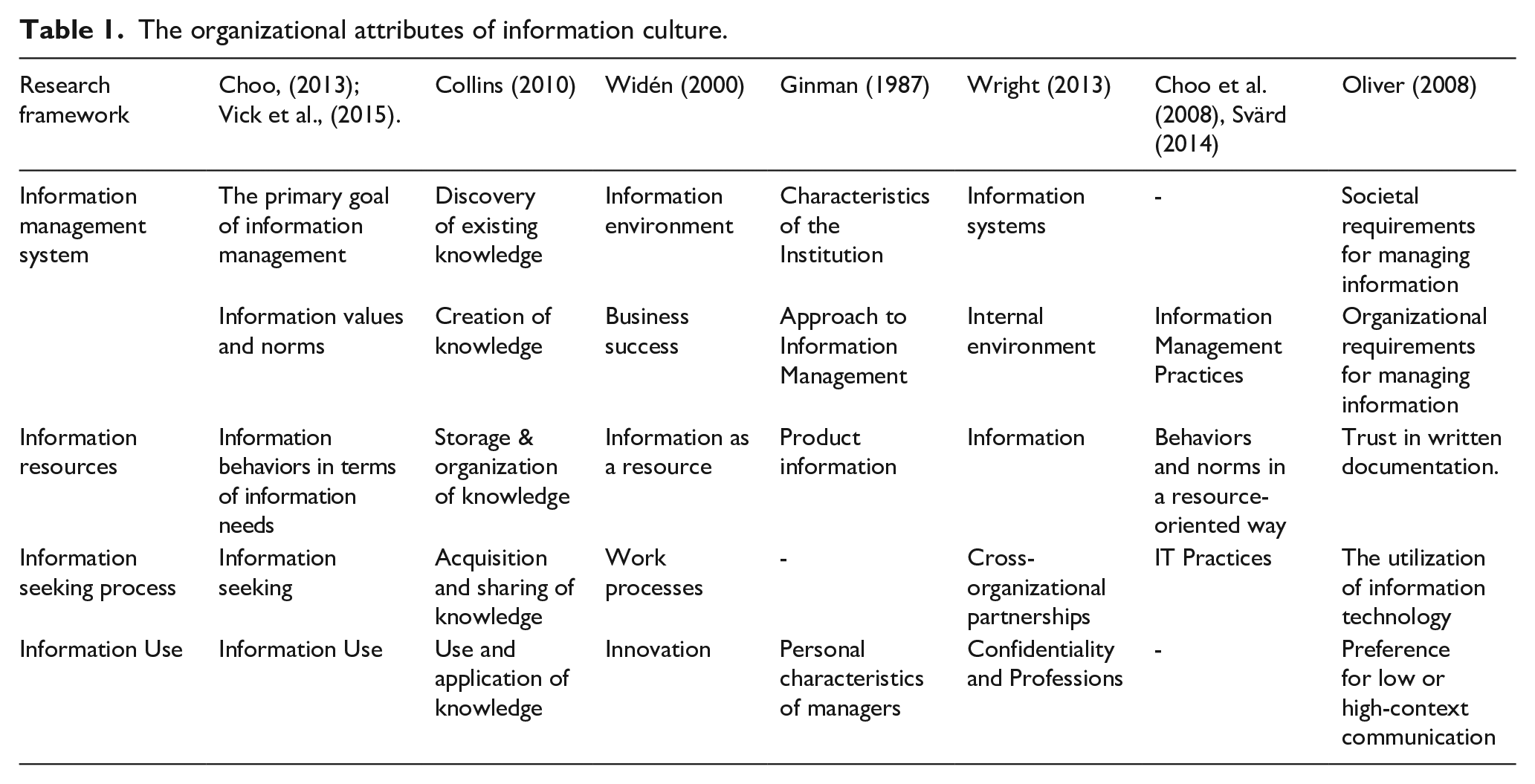
The attribute “Information management system” is the first level of observation of information behavior that combines both main goals and a need-orientation approach to information management because the main objective of the personnel bureaucracy is to satisfy external and internal needs (Volkwein, 1999, 2008; Yuko, 2021). Therefore, the information management system will be present in every type of information culture, differing in information flow in the horizontal and vertical management structures, depending on the dimension of information and knowledge management, influencing the behavior of employees and the formation of various types of information culture (Choo et al., 2008). The main question related to this attribute is: “What is the main information orientation in administrative work?”
The second level of observation of information behavior in university administration is “Information resources.” Delaney (2009) noted that in the area of higher education administration, information resources are mainly filed with codified knowledge of employees contained in training materials, instructions, procedures, guides, methodologies, and even tools that support the interpretation of information in decision-making processes. Such resources are mainly used in an internal orientation, that is, to ensure the consistency and security of information processes. However, if institutional needs meet external stakeholder requirements, employees use IT systems to improve the university’s reporting and accounting process (Delaney, 2009). IT systems are the main information resource of today’s higher education institutions, but they also support the flow of printed documents and communications. Due to the existence of university IT systems, institutional knowledge logically integrates the institution’s information resources with its semiautomated processes of documentation and records management (Janiak, 2016: 35). The main questions related to such an attribute are “Where is the information sought?” and “How is the main information resource used?.”
The third attribute is the information-seeking process as a part of the information process in which the state of employees’ knowledge is a motivator for action and decision-making (Choo et al., 2008; Svärd, 2014). Knowledge, from the procedural perspective, is a set of justified beliefs that increase a person’s ability to take action; including activities aimed at reducing knowledge gaps (Alavi and Leidner, 2001: 109). Wells et al. (1999) noted that information seeking and gathering are particularly important processes for administration because they arise from the need to support university students and staff and the need to document all university activities in their institutional information resources and then use them for maintaining the transparency and accountability of universities (Wells et al., 1999). The main question related to this attribute is: “How is information seeking conducted with the use of internal and external information resources?”
Numerous studies on the influence of information culture on the use of information in the decision-making process have been reported during the literature review (Abrahamson and Goodman-Delahunty, 2013; Choo et al., 2006, 2008; Svärd, 2014; Vick et al., 2015; Wright, 2013). One of the main goals of organizing an information system is to support the transfer of information to the management staff so that their decisions become more effective (Abrahamson and Goodman-Delahunty, 2013; Katopol, 2007: 65). Information and knowledge management processes lose their value and are even pointless if they are ultimately not taken into account in decision-making (Davenport and Prusak, 2000). The knowledge of people processing data is to ensure the high quality of information transferred to the university’s management staff. The quality of information (focusing on meeting the quality criteria in the context of the user’s requirements) is a factor in reducing the general uncertainty in an institution (Katopol, 2007: 139). The attribute describing information use should include descriptions of informational behaviors in which employees try to provide high-quality information, and the form of these efforts depends on the type of information culture they represent (Abrahamson and Goodman-Delahunty, 2013). The main question associated with this attribute is: “How do employees support decision-making using institutional information resources?”
Types of information culture in university administration
RQ 1. “What types of group information behavior characterize the information culture of university administration?” was answered by setting the theoretical background of group information behavior and the design of structural attributes to observe them in four types of information culture, serving as the main four characteristics that were next operationalized to diagnose information culture in the context of bureaucracy in university administration. Following the logic behind Marchand et al.’s (2002) information orientation concept, it was possible to distinguish and separate internal versus external and open versus controlled perspectives of the lower-level administration staff on bureaucracy and information flows in the university.
Silo
The concept of an organizational silo is often associated with the bureaucracy of higher education institutions (Keeling et al., 2007), mainly due to the multilevel, vertical organizational structures. The idea of creating a silo is based on an internal and closed circulation of knowledge between employees at similar levels of the hierarchy. In the silo culture, the information environment of the institution is the internal circle of knowledge exchange between all employees, regardless of their status in the hierarchy. In a Silo culture, employees more willingly and more often, for example, within one department, look for ways to solve a problem among themselves, rather than looking for inspiration in the external environment. Therefore, it is the opposite of the proactive culture Choo (2013), Choo et al. (2008), in which there is also a direct exchange of knowledge between employees, but the efficiency of the process depends on drawing a clear line between us (employees) and them (external environment) (Burke, 2004). In a Silo, it is assumed that internal information has the desired clarity of communication resulting from mutual understanding and trust in colleagues.
Widen and Hansen (2017) noticed that in some organizations, the search for information occurs only in a specific situation or difficulty and when employees discover problems on an ongoing basis as an ad hoc process (Widen and Hansen, 2017). Information needs might result from the lack of knowledge about the state of didactic processes or when it is necessary to make a good decision regarding the promotion of an academic employee, and such situations activate group information processes. According to Hartnell et al. (2011), the goal of such behavior is the integration of a group of employees by making them aware of the value of their colleagues’ knowledge (Hartnell et al., 2011). Taylor et al. (2013) noticed that the formation of a Silo in a university is mainly related to the separation of one’s information resources, as well as having separate educational programs, its own criteria for evaluating classes, and the achievements of academic staff. The creation of the Silo is also influenced by a decentralized information system and open knowledge sharing within one’s circle of trusted people. Such information management is in opposition to the centralized system of competence control in vertical organizational structures (Taylor et al., 2013: 72).
Innovation village
The culture of the Innovation Village is dominated by open attitudes and the search for innovative solutions in the external environment. It is a type of culture that appears in the literature devoted to higher education institutions, mainly regarding research administration. In an institution where innovation transfer processes are administered, employees also openly share their knowledge with employees from other institutions, for example, with the business sector and funders (Deshpande et al., 2017). The university administration should be ready to support this process. Suellen Hogan and Leonard Coot observed that employees in such an external relationship count on a mutual inflow of information that will help them develop knowledge about the environment, as well as improve their services and meet the information needs of external stakeholders, following their standards of information sharing (Hogan and Coote, 2014). An example may be the close and open cooperation with institutions allocating grants to academics, where proactive behavior also dominates in administration in the case of research management (Vick et al., 2015).
Professional bureaucracy
Professional Bureaucracy is an environment closed to a direct transfer of knowledge between employees and focused on controlling processes and job performance. The tasks and competencies of the employees are controlled by procedures and regulations. Documents that influence information governance, for example, information policy related to applicable instructions, are a resource of internal knowledge. According to Travica (2005), such documents are a contribution to the knowledge of university administration, whose goal is to correct the conduct of information processes. Such a people-oriented bureaucracy gives management staff control over the changes in the information system, gives them insight into the scope of employees’ competencies, and general control over documentation, training, and other resources related to physical assets (Collins, 2010: 139–140).
Professional Bureaucracy is based on vertical internal information flows. Therefore, the flows of information are directed inwards, dominated by top-down guidelines and management that regulate the scopes of duties lower in the professional stratification of administration. Leimer and Terkla (2009) found that such a controlled type of access to information in higher education is needed to ensure the exact location of a competent person performing the process, as well as transparency of responsibility for information and the development of competencies in organizational structures (Leimer and Terkla, 2009). The key information resource of an institution is internal documentation, in which classification techniques have been adopted to support accountability and secure the flow of information to specific units and persons. Choo (2013) described this type of change as a process that occurs outside of the awareness of lower-level employees (Choo, 2013).
Supremacy
Supremacy is a type of information culture in which the information environment is transparent, and the employees are focused on generating information about the achievements and activities of the university, mostly about scholarly output and student achievements. In many ways, Supremacy is like Professional Bureaucracy, largely because of vertical information flow and control of responsibilities related to accountability. However, it differs in the external orientation of information seeking and use. Supremacy focuses on generating information under the external requirements of the environment, to present your activities in the best possible way. As in the market culture in the competing value model, supremacy consists of gaining a position in the external environment of the organization through information transparency that exposes the achievements of the organization (Hartnell et al., 2011). Information transfer occurs primarily outside of the organization to meet the requirements dictated by the external legal and organizational situation of the higher education system. This affects the organization of information flows in a horizontal orientation, from bottom to top. Employees are assigned precisely to defined tasks and perform strictly defined information processes, consistent with their competence. However, compared with Professional Bureaucracy, the purpose of this competence control is different. It is to ensure fast, timely, and complete transfer of information to the outside world and accountability. The architecture of the information system as the main information resource is adapted to external requirements to facilitate quick and precise reporting in line with the requirements of external stakeholders. As in the market culture, a specialist in a given field is a person motivated to achieve their goals in the best possible way in the external and internal environment of the organization (Hartnell et al., 2011).
Method
Sample and data collection
The study uses a dataset that was collected through an online survey and was initially part of a study whose goal was to test the usability of a conceptual diagnostic model of information culture in higher education institutions (Deja, 2021). The data presented here have been partially used before in model testing. For this paper, additional data were collected from three institutions, using 16 items in an Information Culture Assessment Form (Appendix). A stratified sampling technique was applied to derive the study sample. The universities were selected from 13 institutions in Poland that agreed to participate in the survey. The basis for participation was the clear outline of organizational characteristics related to the three types of bureaucracy and structural similarities regarding the division into central administrative units under the authority of rectors and vice-rectors and departmental administrative units under the authority of deans.
Thirteen universities were categorized according to three strata based on structure size, similar IT-based communication, and three broad fields of study: Medical universities, Polytechnics and Science colleges, and Classical universities, after which one university was selected from each field stratum. The survey was administered using the Microsoft Forms online platform at the Jagiellonian University in Krakow, Poland. After removing incomplete responses, and outliers and evenly distributing responses by random selection of observations—115 for each organization, the final dataset consisted of 345 responses. Institutions were assured of the anonymity of the results.
University A is a medical university with the smallest number of five faculties, the second is a polytechnic organized into eight faculties, and the third institution is a classical university, which is a large university with 17 faculties. The categorization was determined based on the author’s 5 years of observation related to the author’s previous research (Deja, 2019, 2021), university cultural differences set by Gillian Oliver, and a comparative criterium by Geert Hofstede (Hofstede, 2011; Oliver, 2008). Institution A is characterized by the implicitly structured bureaucracy with close and direct relations with management, but there is a lack of interest in information resources in terms of avoiding uncertainty in decision-making. Management was not interested in controlling processes or results but is more involved in supporting the job performance of the employee and opening the communication system with lost control. Institution B is a Workflow bureaucracy, characterized by an employee often in contact with mid-level management, where the efficacy of information processes and ad hoc control are important. Management is focused on process efficiency and general university outcomes. There is a high interest in external information in terms of avoiding uncertainty in the decision-making process. Institution C is a type of full bureaucracy, where authorities have a clear distance from mid-level management and administration workers; their contacts are limited by technological infrastructure and procedures favoring a closed records management system. It is a hierarchical structure in which management wants to avoid uncertainty in decision-making by tightening the control of processes and at the same time ensuring normalization and a precise schedule of duties.
Measurement scale
In higher education institutions, differences between groups of employees can be observed analogously to the model of objective social distances by Bichi (2008), based on perceived distances—the difference in needs, expressed distances—the difference in terminology, and experienced distances—the difference in knowledge (Bichi, 2008). Administrative divisions favor the creation of connotations between the behaviors, competencies, and information needs of colleagues and key figures in the occupational stratification of employees. Based on the analysis of these connotations, it was possible to determine the degree of transparency of information behaviors between employees in a wider and wider range of administration at the university. The grades on this scale are 0. I don’t know (1) Yes, but I cannot specify, (2) Own position, (3) A group of closest associates and other specialists, (4) A group of all persons employed in my unit, (5) Direct superiors, (6) Employees of other administrative units and division managers, (7) University board, deans, senate, and rector’s authorities. The usefulness of this scale, verified by the statistical reliability test of results, was also part of the research framework.
The objective social distance scale in a higher education institution has been called the objective professional distance scale because, in the context of the diagnosis of information culture, the behavior of employees resulting from their professional and effective problem-solving in the institution is important, and not relationships based on emotions and sympathies, which may also constitute barriers to achieving effectiveness. The affective motivations of employees to undertake joint action are impermanent (Szymański, 2011). The professional (objective) distance measures the strength of connections between people that occur in the permanent structures and the social-professional hierarchy of university administration. The organizational structure in university administration exists objectively and divides employees according to their subcultures. Greater professional distance between the respondent and people displaying a given type of behavior means more difficult involvement of the employee in the relationship, for example, less frequency of interactions between two people. Therefore, the information behavior of colleagues is more often visible to the respondents; the more frequent, stronger, and certainly more transparent the relations between them strengthen the information culture. This means that despite the objectively existing formal divisions between employees, there is a strong information culture in the institution that connects employees.
Measurement items
The survey was based on 16 items describing information behavior related to four attributes, divided into four questions related to the types of information culture. The questionnaire is included in the Appendix. They were operationalized based on the literature review, the questions posed regarding attributes, and supported by the characteristics of collective informational behavior in four types of information culture. Sixteen items constitute four independent variables (Silo [SI], Innovation Village [IV], Professional Bureaucracy [PB], Supremacy [SU]) in the model, which were measured by the ordinal professional distance scale from 1 to 7 (described above). The dependent variables are the type of institution bureaucracy and the central structure versus the departmental structures of the university regarding the administrative employment of respondents.
Data analysis
Because a social distance scale based on ordinal values was used, nonparametric statistics should be applied to analyze the data (Nochaiwong et al., 2021). However, if the sample is sufficiently large, then the use of parametric statistics can lead to the same conclusions as those drawn from applying nonparametric statistical inference (Mircioiu and Atkinson, 2017). This is the reason for the use of linear regression as an alternative to interpreting the results of ordinal regression to broaden the interpretation of the results.
The internal consistency reliability test (Viladrich et al., 2017) was applied to analyze the unidimensional set of items from the four culture subscales of the Information Culture Assessment Model (ICAM). Using JASP statistical software and an IBM SPSS 27 package, it was possible to perform tests with Cronbach’s alpha and McDonald’s omega coefficients, the Kruskal-Wallis H test, Mann-Whitman U test, Spearman’s rank correlation coefficient, ordinal and linear regression analysis (in SPSS). The Kruskal-Wallis H test is a nonparametric alternative to ANOVA, better suited to describe statistical differences between median values of the ordinal scale used in dependent variables (Kerby, 2014); in this case, related to types of information culture. The fixed factor is an independent variable that describes the three types of universities in the study. In addition to this categorization, the Mann-Whitney U test (non-parametric alternative for Students’ T-Test) was used to check whether there is a statistical difference between the extent to which the behaviors of different cultures are seen from the perspective of employees in central structures and the departmental structures of universities. These two tests were used to answer the second research question (RQ 2). The answer to the third research question (RQ3) was supported by Spearman’s rank correlation rho coefficient, ordinal and linear ordinal regression analysis with pseudo-R-squared (coefficient of determination). The fourth research question (RQ 4) was considered in the context of the descriptive statistics and discussion presented at the beginning and after the results section.
Limitations of the study
The main limitation of the study is that it covers only the lower-level employees’ perspectives, to be able to compare their experiences with group-specific information behaviors on the scale of professional distance. Therefore, the perspective of the actors involved in the information processes is examined, and not the opinion of the people responsible for the orchestration of the information system. The reason is to provide a scale that measures the strength of information culture by the dispersion of information behavior in organizational structures, and not the desired perception of information culture in the eyes of decision-makers, where the Likert scale is much more suitable.
Results
Both the McDonald’s omega (0.816) and Cronbach’s alpha (0.816) unidimensional reliability tests showed very high consistency in the 16 questionnaire items (Appendix). In this respect, the mean and median indications obtained are a very reliable reflection of the components that describe each type of culture. Four types of information culture were characterized by four items each with reliability tested from 0.68 to 0.82 (Table 2). Looking at the mean and median values in Table 2, we can state that in the three institutions, the Professional Bureaucracy culture is the most widespread and coherent norm of information behavior in university administration (x̄ > 5.65; Mdn = 6; SD < 0.9). In contrast, the Innovation Village culture is two degrees of scale less widespread in all three institutions (Mdn = 4).
Descriptive statistics of information culture diagnosis.
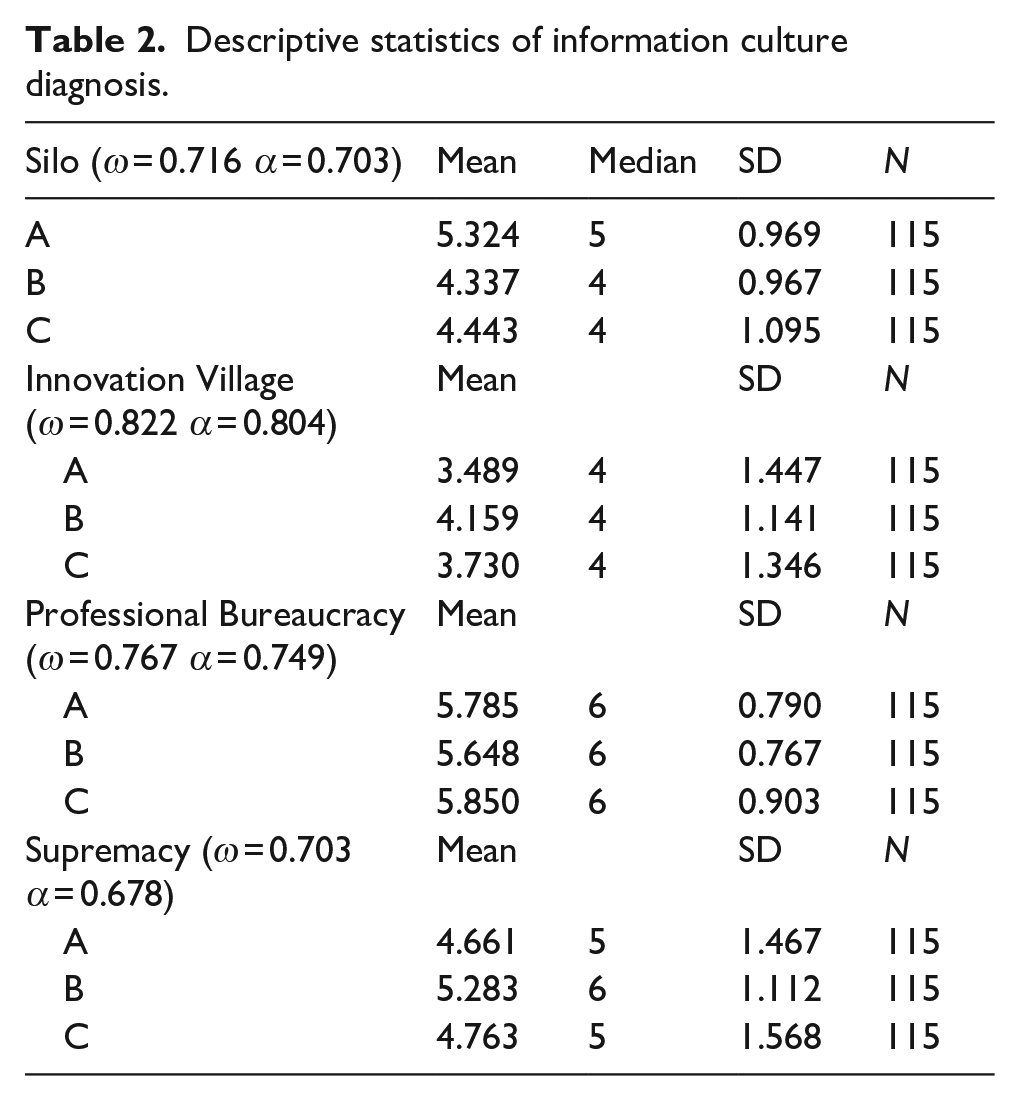
In institution A, with the less fragmented organizational structure, Silos and Professional Bureaucracy are the dominant cultures. Institution B is characterized by equally less open behavior (SI|IV Mdn = 4) and more control-oriented behaviors (PB|SU Mdn = 6). However, looking at the mean value related to IV culture, it is the highest rated of all institutions (x̄ = 4.16), which is also visible in the case of the mean value of Supremacy culture (x̄ = 5.28). In the case of institution C, the strongest culture is Professional Bureaucracy, with the highest rate of all other institutions (x̄ = 5.85; Mdn = 6), but not with such a strong culture of Supremacy as in the case of institution B (Mdn = 5).
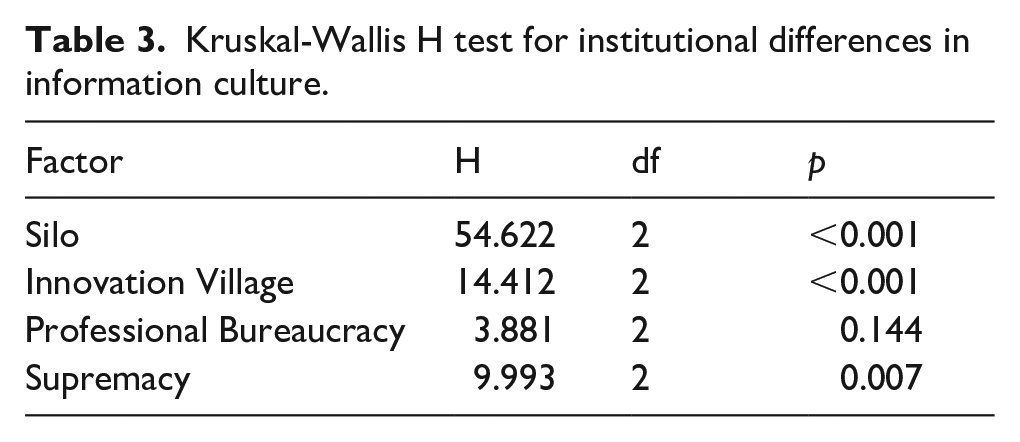
The strength of the culture of Professional Bureaucracy (Table 3) was the same in all three institutions and did not differ statistically (p < 0.144). Silo and Innovation Village were the most diverse of the three institutions (H > 14.4, p < 0.001). A statistically significant difference was also confirmed in the case of the Supremacy culture (p = 0.007), but in this case, the differences were not as pronounced (H = 9.99).
Kruskal-Wallis H test for institutional differences in information culture.
A detailed comparison of median values in Dunn’s post hoc test for nonparametric statistics, based on the ordinal scale, is presented in Table 4. Statistically significant differences were most visible in the direct compression of Silos in institutions A to B and A to C, but there was no significant difference in Silo culture between institutions B and C, where Silo culture is mostly visible at departmental levels, and departments are more separated in organizational structures. Institutions A and C, the smallest and largest of the three studied, do not have significant differences in the levels of Innovation Village and Supremacy cultures. The smallest differentiation occurs in the case of Professional Bureaucracy, in which only in the case of institutions B and C is the difference at a low level of significance. This also confirms that Professional Bureaucracy is a very constant and dominant element of the behavior of administration employees for each of the examined institutions.
Dunn’s posthoc comparisons of information culture in institutions under research.
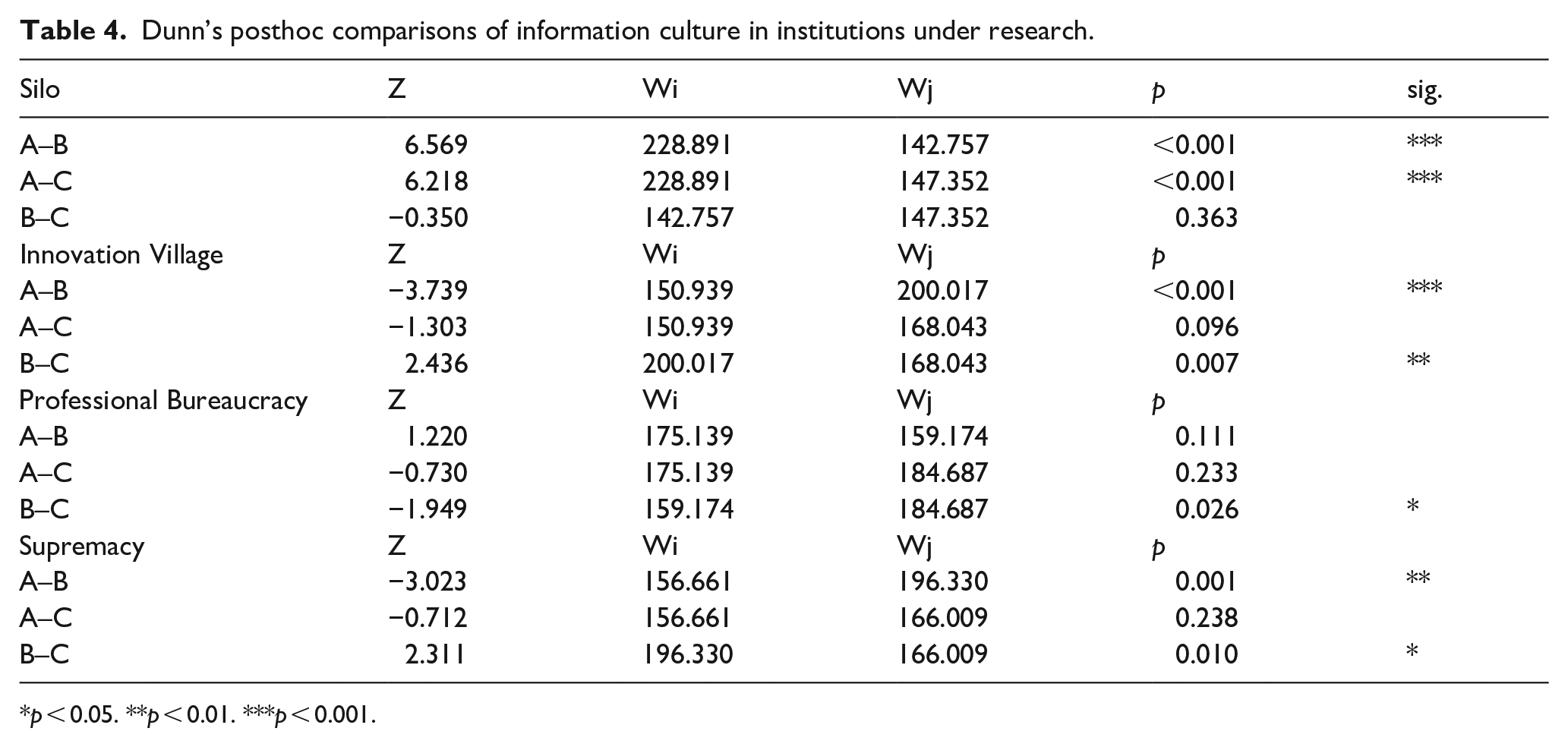
p < 0.05. **p < 0.01. ***p < 0.001.
Results were also compared in the case of the different strengths of each culture from the perspective of employees in the central administration and the departmental administration of the university (Table 5). In the Polish case, departments are under the authority of the dean and faculty have partial autonomy over the decisions of the rectors and central administration. Central administration reports directly to the rector and vice-rectors, being the vertical divisions of their authority at the university. Rank-Biserial correlation in the Mann-Whitney U test indicates that there are about 30% more pairs of observations that confirm statistically significant lower median values describing each culture at the departmental level of administration compared with central administration. In 64% of the observations of Silo culture, collaborative behaviors were visible to the greatest extent among direct supervisors of respondents in the central administration, whereas in the departments it was only on the respondents’ unit level. In 65% of the observations of Innovation Village culture, proactive behaviors were visible mostly among the whole unit level in the central administration, and only with closest friends at the departmental level. In 66% of observations of behavior characteristics of Professional Bureaucracy and Supremacy cultures, respondents could observe controlling behavior in cross-unit cooperation in central administration, but in the case of Supremacy, the accountability information behavior of departments was just recognizable at a respondents’ unit level.
Mann-Whitney U test comparing central and departmental information culture.
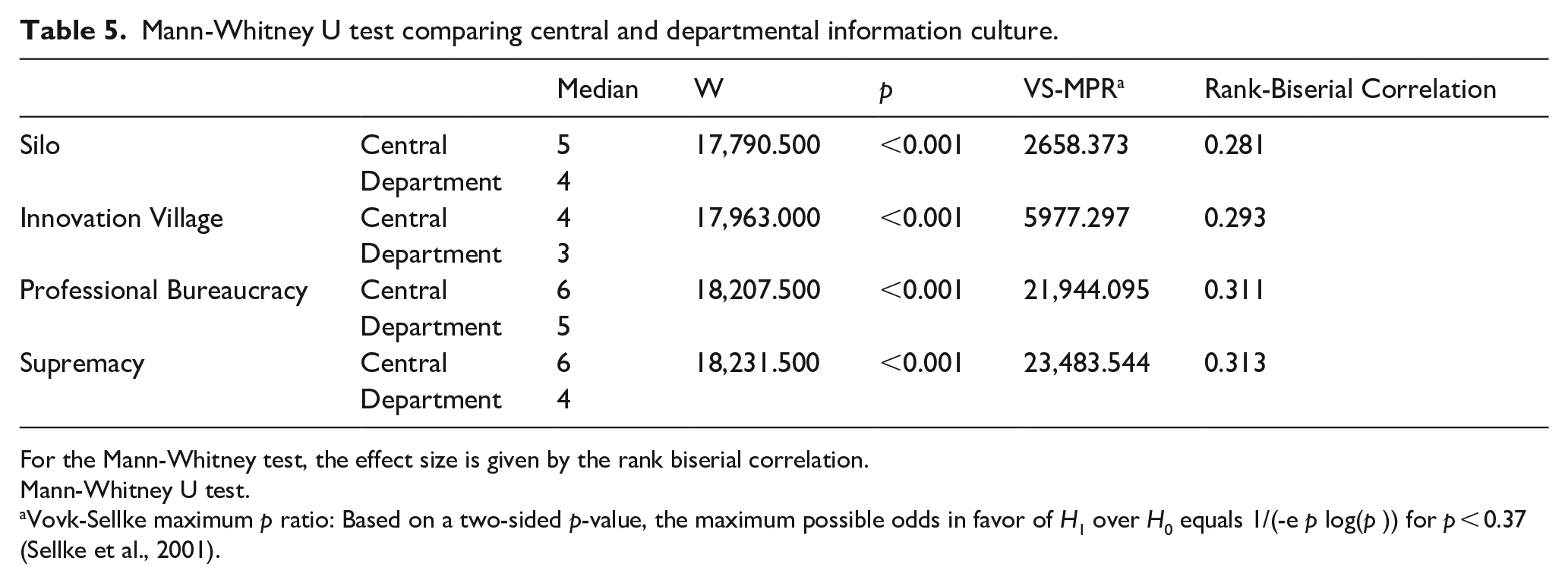
For the Mann-Whitney test, the effect size is given by the rank biserial correlation.
Mann-Whitney U test.
Vovk-Sellke maximum p ratio: Based on a two-sided p-value, the maximum possible odds in favor of H1 over H0 equals 1/(-e p log(p )) for p < 0.37 (Sellke et al., 2001).
Moreover, the results indicate that there is several times greater chance of showing the difference between the central and departmental administration in the case of the cultures of Professional Bureaucracy and Supremacy (VS-MPR > 21,944) compared with Silo and Innovation Village (VS-MPR ⩽ 5997).
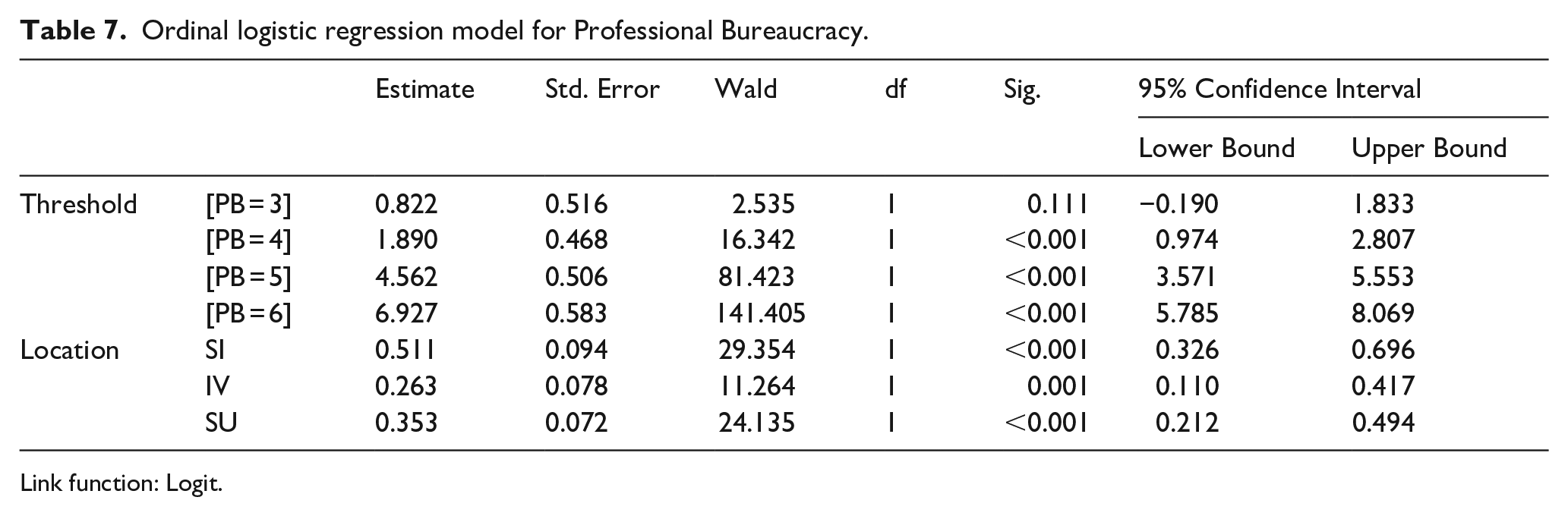
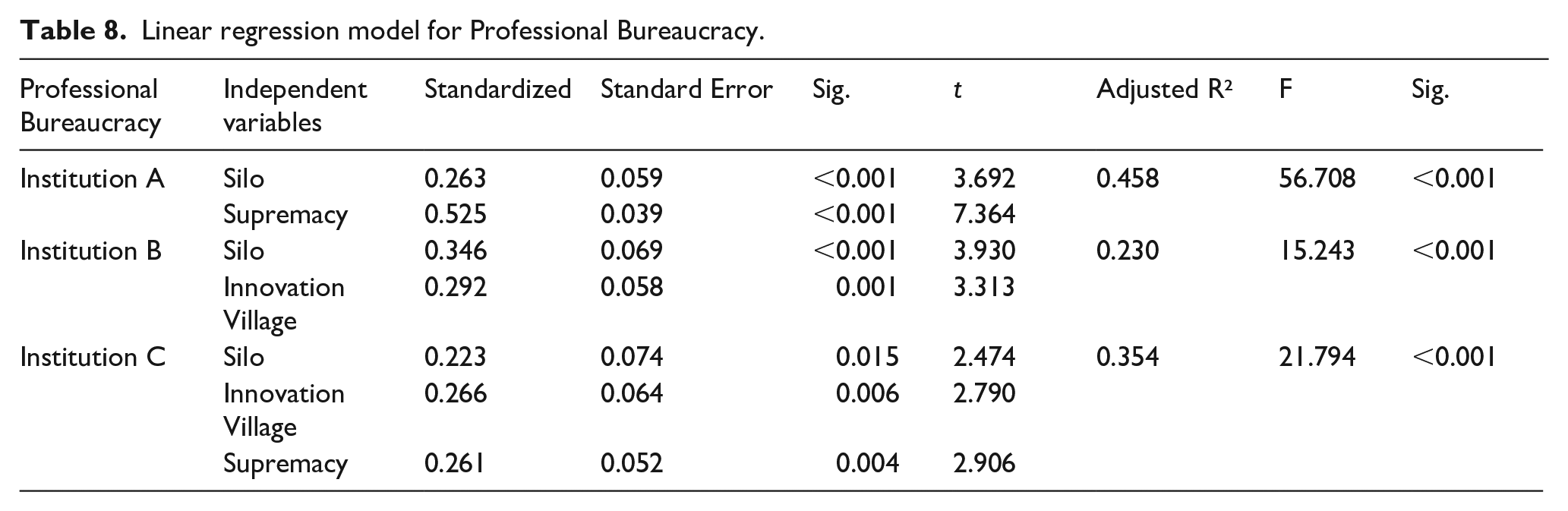
To show the full potential of the applied professional distance scale and to describe the competitiveness of the types of information culture in the institutions studied, an ordinal regression analysis based on ranks was carried out. Following the principle that ordinal data should be treated as nonparametric variables, Spearman’s rho correlation analysis (Table 6) and ordinal logistic regression analysis (Table 7) were performed and were then enriched with linear regression analysis (Table 8).
Spearman’s correlations between measures of information cultures.
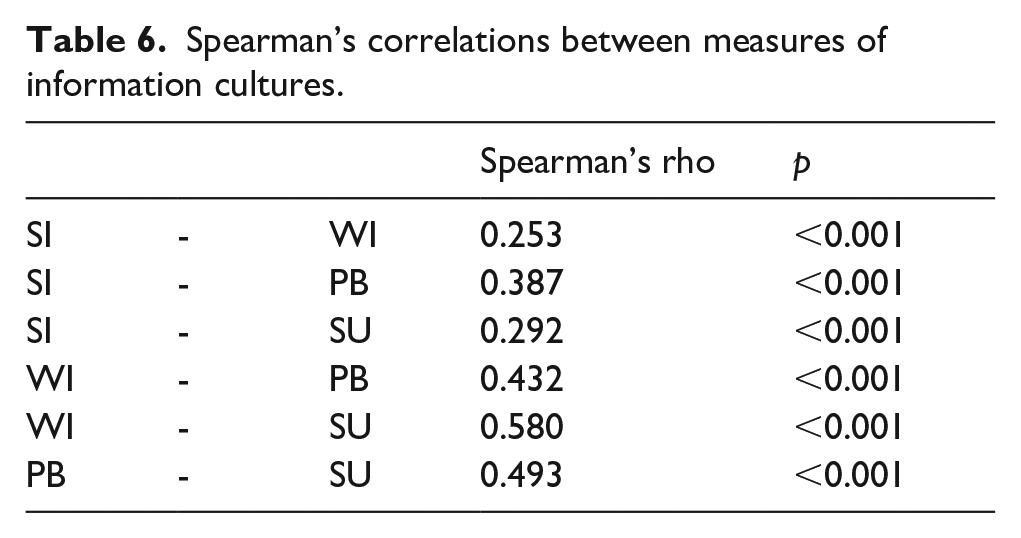
Ordinal logistic regression model for Professional Bureaucracy.
Link function: Logit.
Linear regression model for Professional Bureaucracy.
The first analysis showed that there are statistically significant and nonaccidental relationships between the level of spread of all four types of culture. It is worth noting the high level of relationship between the culture of Professional Bureaucracy and the other three types of information culture (rho ~ 0.39–0.49). On the other hand, the strongest correlation occurs between the information behaviors related to the external information orientation of the Innovation Village and Supremacy cultures (rho = 0.58).
Comparing the obtained results to the concept of competitiveness of cultures in Cameron and Quinn’s (2013) organization, it is worth noting that the competitiveness of cultures, in general, does not mean that they are opposed to each other, or they exclude each other as polarized behaviors or even the opposite, that they are completely convergent to each other. Competitiveness assumes that there is partial autonomy of the individual information behavior of employees, and the normative factors will force people to co-develop information practices occasionally or cyclically in an institution where information culture is the result of human interactions.
Considering the results of H Kruskal-Wallis’ test and the correlation analysis, it is worth looking at Professional Bureaucracy as a dependent variable in the regression analysis, because it is not so much the result of organizational differences, but the effect of competitiveness other three information cultures. The variability of Professional Bureaucracy depending on the organization can be effectively predicted by the strength of all remaining three information cultures. In particular, high levels of PB, that is, at the unit level and in interunit interactions, and at the senior management level. To a lesser extent, at the level of very close employee relations (Table 7). In particular, the strongest predictor is the Silo culture (β = 0.511; 95% CI 0.327–0.696), which means that Professional Bureaucracy is highly related to open communication, which is very reasonable considering that the inefficiency of bureaucracy is usually balanced by group work (Deshpande et al., 2017). Supremacy is a moderate predictor of PB culture (β = 0.353; 95% CI 0.212–0.494), and the smallest amount of variation in PB results can be predicted by Innovation Village ((β = 0.263; 95% CI 0.110–417). The general level of dependency of the PB on three other types of information culture can be considered a strong relationship base on Negelkerke’s R2 = 0.423. This means that even due to the ordinal type of measurement, even 42% of the variation in PB is predicted by other cultures.
As an addition to the ordinal regression model, the linear model was proposed based on the mean values of each result of the Information culture measurements (Table 8). The transformation of the ordinal scale to the mean values is primarily aimed at assessing whether a similar level of Professional Bureaucracy culture in all three institutions can be grounded or predicted by variation in the three types of information culture and whether this dependence differs in each institution.
The regression equations of all three organizations are significant. In each institution, the set of two or three types of information culture explains a significant amount of variation in the PB culture. In the case of Institution A, the adjusted R2 is 0.458, mostly based on the results of Silo and Supremacy, where Innovation Village is not a good statistical predictor. It is a high level of dependency from the Silo culture related to open sharing and informality in group behavior (β = 0.263), and from the Supremacy culture related to transparency and integrity in group behavior (β = 0.525). In institution B the adjusted R² is much lower at 0.230, and not supported by Supremacy, which was not a significant predictor in that case, but the Silo and Innovation Village were. The mixture of proactiveness, open sharing, and informality in the behaviors related to Silo (β = 0.364), and Innovation Village (β = 0.292), can be considered statistical predictors of PB in medium-sized institutions. Only in the case of Institution C, all three types of information culture can be considered good predictors of Professional Bureaucracy in university administration (adjusted R² = 0.354).
Discussion
Regarding RQ 1. “What types of group information behavior characterize the information culture of university administration?,” through literature review, it was possible to find four attributes of information culture. Attributes of information culture create the core of the research framework as they add structure and levels to the observation of group information behavior. They are a direct analogy to seven key empirical studies of information culture (Table 1), which also found a similar stratification of observation of information behaviors. Following the logic of an open versus controlled information flow, and internal and external information orientation in information management, similarly to the model of Marchand et al. (2002), it was possible to distinguish separate perspectives of the lower-level staff on bureaucracy. In a further review of the literature, those orientations were used to formulate four main characteristics and types of information culture Silo, Innovation Village, Professional Bureaucracy, and Supremacy, which, according to the developed model are competitive with each other. These four types of culture fill a gap in the literature that lacked a consistent characterization of the competing patterns of informational behavior of lower-level employees in the bureaucratic structures of the university administration.
Theoretical implications
Regarding RQ 2. “How do types of information culture correspond to administrative processes and different settings of bureaucracy?,” it is worth distinguishing each case of a studied institution to show how different settings of bureaucracy might be related to information culture.
Looking at results in Institution A, the Silo culture was the most emphasize here and strongly associated with Professional Bureaucracy. The main actor in the opinion of employees is competent to supervise employees and control a small amount of information processed in bureaucratic work. Group work and the need for clear, direct communication in such small organizations are partially motivated by the isolation of the environment in Silos and an attempt to disconnect from the situation in the university environment. In these institutions, most often there is a person who has a perfect understanding of what is happening in the institution’s environment and who specializes in a given task and is responsible for a given type of information. It is an information and knowledge management style in which “one actor” has the greatest knowledge of the team’s competencies and tries to exercise direct control over a small team of specialists.
A similar approach to organizing a centralized information management system was previously observed in small institutions by Desireé Cranfield and John Taylor in the case of higher education institutions in the US (Cranfield and Taylor, 2008; Taylor et al., 2013). For smaller higher education institutions the analogy to Mintzberg’s “Simple structure bureaucracy” can be south as there is visible direct supervision of vertical and horizontal flows of information (Mintzberg, 1993). It reflects the concept of direct but also centralized knowledge management (Cranfield and Taylor, 2008; Deja, 2019). In smaller institutions, either the number of faculties is small and decentralization of control over institutional knowledge is unprofitable, also the main subunit of the university structure are institutes, and their role in university information management is less significant (Deja, 2021).
In the case of Institution B, the external information orientation, with a mix of proactive and controlled attitudes, is the balance for Professional Bureaucracy. Most often, the mid-level management staff in universities consist of the desire to improve the ways of using information and monitoring changes in the external environment, which is of interest to higher-level management staff at universities as the results show, although to a lesser extent than Supremacy behavior. Strengthening the culture of Innovation Village in medium-sized universities such as institution B comes from the individual attitudes of management staff, which are not as transparent for many administration employees as the competitive attitudes in Supremacy culture, and that does not favor the development of a Silo culture (x̄ = 4.34).
The proactive attitude usually concerns people who are more predisposed to perform managerial activities, which then changes the attitude of team members to look for innovation, inspiration, and opportunities to establish partnerships with the institution’s external environment (Hwang et al., 2015; Marchand et al., 2002). The information culture profile in Institution B is the most similar to Professional Bureaucracy in structures described in Mintzberg’s (1993) model because the administration tries to standardize the skills of lower-level staff and decentralized both vertical and horizontal information flows Hwang et al. (2015) similarly noticed that proactive attitudes are rather characteristic of the behavior of individual employees with expert knowledge that constitute the operating core in an institution.
The results in Institution C showed the lowest levels of manifestation of the Silo culture in the institution, indicating that the cooperation of lower-level employees concerns closed units, isolated from each other in large structures (Mdn = 4). For people who often participate in external cooperation between institutions, the internal bureaucracy may not only be incomprehensible but the widespread use of accounting activities at universities may also escape their attention. In turn, people who work internally with documentation and data may lose the context of their work in the broader context of external accountability and institutional cooperation. While the Professional Bureaucracy behaviors are still the strongest and most widespread here, the less significant results of other information culture profiles indicate similarity to Mintzberg’s technostructure, standardization of work processes, and limited horizontal decentralization of information flows, resulting in less transparent actions and creation of structural bureaucratic machine (Mintzberg, 1993). Those results correspond with the observations of McGoey (2007). She noticed that decisions made in a highly structured bureaucratic environment are often illogical or the logic is very unclear for lower-level employees, and the purpose of such an activity—for example, information security and accountability—may be regarded as apparent (McGoey, 2007).
Practical implications
Regarding RQ 3. “How can information culture influence the formation of Professional Bureaucracy at the university?,” the results show that in each organization we might expect different levels of dependency between Professional Bureaucracy and the other three types of information culture. When the need is not very complex, as in smaller institutions, and the data from the IT system is updated regularly, as in the medium-sized institution, the administration is constantly ready to transfer information thanks to direct supervision or standardization of skills. The observed situation in a large institution, in which Silo, Supremacy, and Innovation Village support bureaucracy, is justified when the complexity of the required information is greater than expected and information procedures lack efficacy. This situation strengthens the information practices related to the collaboration of smaller groups of employees, temporary shifts to Mintzberg’s structural adhocracy, and the creation of communities of practice. The support staff delegated in the administration work on mutual adjustments of procedures and practices and creates an atmosphere (not culture) of selective decentralization which eventually turns to the standardization of processes.
Only in the case of institutions B and C, it was shown that behavior in the Innovation Village might have a small but significant impact on Professional Bureaucracy. It might be small because the visibility of such actions might also be less transparent for people in lower-level hierarchies of administration. On the other hand, individual decisions in management positions are made under the internal information policy, that is, according to internal norms and procedures, as already indicated in his research in Swedish institutions Johan Frishammar, so the partial relationship between Innovation Village and Professional Bureaucracy is fully understandable (Frishammar, 2003).
The results confirmed that, due to the existence of three different styles of bureaucratic information management, people’s bureaucracy is based on the competitiveness of different types of information culture with different perspectives of effectiveness and decision-making, and this competition shapes the Professional Bureaucracy of the university administration. The administration employees who most often noticed the presence of informational behavior within the Silo culture might have the freedom to exchange knowledge and informal information with a group of close co-workers and believed that it strengthened their confidence in the correct performance of bureaucratic tasks. Such attitudes might then be essential as supportive factors for Professional Bureaucracy when day-to-day procedures were inefficient.
The university’s Professional Bureaucracy is rooted in processes related to documentation which is a proprietary and confidential resource, and the protection and control of this resource is the main axis of information activities; while other information behaviors are aimed at ensuring the continued easy-dynamic use of information to take internal strategic decisions (Berrío-Zapata et al., 2016; Thaden, 2007). Reddy and Jansen (2008) noted that the main factor in the normalization of collective action in terms of internal orientation in an institution is how complex the external information needs are, and how extensive the requirements for the information reported are (Choo, 2001; Reddy and Jansen, 2008), which probably was not the case of Institution C, more likely in Institution B. The universities often did not keep up with the changes in the external environment, and in a way, it is a fault of bureaucratic organization, where the administrative staff mostly must come out with initiatives spontaneously to respond to changes in the university’s environment. Such actions of groups of practitioners or COPs (communities of practice) often arise spontaneously or systematically in higher education institutions as specialist advisory groups suggesting solutions to strategic problems (Deshpande et al., 2017).
Regarding RQ 4. “What is the state of the information culture of selected universities in Poland regarding Professional Bureaucracy?,” the Silo culture is the only one that in the presented model has a supportive role in the Professional Bureaucracy of all three organizations. Professional Bureaucracy is consistently the strongest characteristic of human behavior in these institutions. The explanations for this situation might lie in the observations coming from the study of Sonnenwald and Pierce (2000). They noticed that the information in the case of close cooperation in separated units can be stored mainly according to individual preferences and in their position-specific resources, which sporadically influences the formation of the so-called contested collaboration. The Silo observed at three universities in Poland resembles more “dense social networks” or “a system of frequent communication between participants of the information system,” in which groups of employees specializing in a different issue are bringing specialists together, but mostly in unit task-related activities (Sonnenwald and Pierce, 2000). Huvila and Widén-Wulff (2006) indicated that different styles of decision-making might come from different settings of teamwork and during meetings of specialists, and this is particularly important in the formation of close ties and new informal communication channels.
Moreover, while standardization of processes in vertical information flows dominates information management in higher education institutions in Poland it also separates people to create silos. Going further, with a well-organized information resource in an external public environment, it is sometimes convenient for employees with expert knowledge to rely on external sources of information in the process of communicating with the environment. This gives them the independence to create openly accessible presentations and search for statistics, obtain information about the organization of didactics, or use public resources to create relations with the social and economic environment of the university, for example, to improve communication with service providers (Madukoma and Opeke, 2013). Such activities in the external information orientation of Innovation Village and Supremacy in Polish universities are significantly more common in large institutions with clear separation of central administration from the departments (Table 5). In departmental administration, tasks are much more focused on day-to-day student and faculty issues, which also are favorable for the independent development of Silo culture.
For the future reproductivity of this study and model operationalization (Appendix), it is worth looking at the outcomes of information culture in university administration. In the presented results the outcome is the culture of Professional Bureaucracy and how instrumentally information is used there. The level of PB is similar in all three institutions, but in the moderated level it depends on a different set of competing information cultures of Silos, Innovation Village, and Supremacy. Similar outcomes in information use were specified by Choo et al. (2008) and also Abrahamson and Goodman-Delahunty (2013).
Information use in the context of university administration is related to Professional Bureaucracy because activities related to documentation and accountability are strictly controlled and subject to the information use procedures. Contrary to Choo’s study, the proactive attitudes of Innovation Village are much less fitted to be predictors of PB culture in all cases of the studied institutions. Overall Professional Bureaucracy break through the internal Silos of individual administrative units, integrates the knowledge of various specialists, and represents the strategy of action or changes that most often concern the accountability of universities (Supremacy) and not the creation of sustainable channels for networking (Innovation Village).
Conclusions
The purpose of this study was to diagnose the information culture of the university administration. Using the seven-point scale of objective professional distance, it was possible to efficiently, and with a high level of reliability, diagnose all four types of information culture in higher education administration: Silos, Innovation Village, Professional Bureaucracy, and Supremacy. Their formation in university administration results from four orientations of employees’ informational behavior—open and controlled, as well as internal and external.
The presented study is one of the few examples of research on the information culture of an organization, especially in the context of the university administration. Its limitation, but also its potential, is that it considers the perspective of people employed at lower levels in the management hierarchy. This perspective is important for strategic information management because information culture assessment is crucial for effective strategic change and helps to understand process audits, risk assessment, and solution analysis (Akinyemi et al., 2021). Thanks to such a diagnosis, managers can take into account the full potential of the integrated relationship and shared values of people. The implications of this study are therefore in line with observations of Virkus and Salman (2021), that academic leaders “should increase their focus on creating a positive and collegial work environment” and “allowed others to participate in key decisions or encourage open communication” (Virkus and Salman, 2021). As the results of my research show, these are the attitudes that are naturally applied by lower-level administrative workers to create conditions for Professional Bureaucracy.
Footnotes
Appendix
Information culture assessment form.
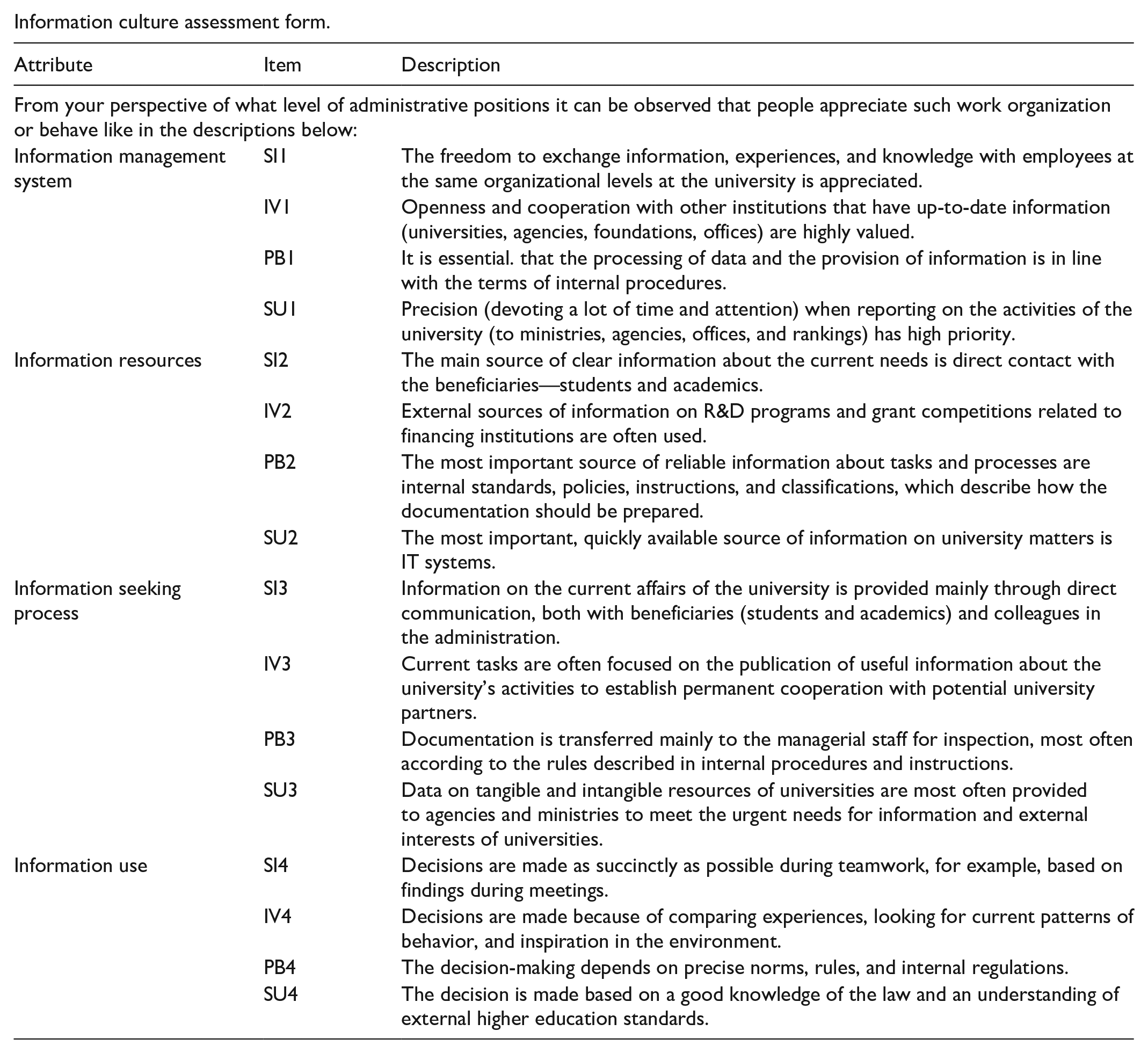
| Attribute | Item | Description |
|---|---|---|
| From your perspective of what level of administrative positions it can be observed that people appreciate such work organization or behave like in the descriptions below: | ||
| Information management system | SI1 | The freedom to exchange information, experiences, and knowledge with employees at the same organizational levels at the university is appreciated. |
| IV1 | Openness and cooperation with other institutions that have up-to-date information (universities, agencies, foundations, offices) are highly valued. | |
| PB1 | It is essential. that the processing of data and the provision of information is in line with the terms of internal procedures. | |
| SU1 | Precision (devoting a lot of time and attention) when reporting on the activities of the university (to ministries, agencies, offices, and rankings) has high priority. | |
| Information resources | SI2 | The main source of clear information about the current needs is direct contact with the beneficiaries—students and academics. |
| IV2 | External sources of information on R&D programs and grant competitions related to financing institutions are often used. | |
| PB2 | The most important source of reliable information about tasks and processes are internal standards, policies, instructions, and classifications, which describe how the documentation should be prepared. | |
| SU2 | The most important, quickly available source of information on university matters is IT systems. | |
| Information seeking process | SI3 | Information on the current affairs of the university is provided mainly through direct communication, both with beneficiaries (students and academics) and colleagues in the administration. |
| IV3 | Current tasks are often focused on the publication of useful information about the university’s activities to establish permanent cooperation with potential university partners. | |
| PB3 | Documentation is transferred mainly to the managerial staff for inspection, most often according to the rules described in internal procedures and instructions. | |
| SU3 | Data on tangible and intangible resources of universities are most often provided to agencies and ministries to meet the urgent needs for information and external interests of universities. | |
| Information use | SI4 | Decisions are made as succinctly as possible during teamwork, for example, based on findings during meetings. |
| IV4 | Decisions are made because of comparing experiences, looking for current patterns of behavior, and inspiration in the environment. | |
| PB4 | The decision-making depends on precise norms, rules, and internal regulations. | |
| SU4 | The decision is made based on a good knowledge of the law and an understanding of external higher education standards. | |
Declaration of conflicting interests
The author declared no potential conflicts of interest with respect to the research, authorship, and/or publication of this article.
Funding
The author disclosed receipt of the following financial support for the research, authorship, and/or publication of this article: Open access publication financed from the strategic program “The Excellence Initiative – Research University” at the Jagiellonian University, Faculty of Management and Social Communication.
