



Abstract
Following the establishment of a multilingual children’s library section in Sheffield, England, this paper explores logistical and emotional considerations concerning the set-up and running of the library, and its role within the community. Adopting a case study approach, data are derived from book stock and borrowing statistics, feedback from multiple events (including multilingual storytelling and story writing events, and a reading scheme), as well as a library staff and a parent focus group. Data were analysed thematically according to logistical and emotional concerns, with subthemes – such as borrowing patterns, identity, belonging and physical and metaphorical ‘space’ being identified within the data. The research highlights shortcomings in cataloguing facilities, and in the way in which ‘successes’ are measured in library management and research, while adding significantly to our understanding of the contribution multilingual resources and events in public libraries makes to a community’s sense of identity and belonging. The notion of real and metaphorical ‘space’ for multilingualism as part of library provision forms a vital addition to the way libraries might consider their roles in diverse societies.
Introduction
The multilingual children’s library discussed in this paper, and the related activities, resulted from an evolving relationship between Sabine, a university researcher focussing on multilingualism, identity and belonging and the local library team. Following a highly successful multilingual storytelling event, plans began for the inclusion of books in other languages in the main children’s library (sourced via donations due to financial pressures, as outlined below), and an accompanying research project, where Sabine was able to collect both qualitative and quantitative data to highlight the impact such a space might have on the city’s families, in terms of identity and belonging, while offering an honest evaluation of the logistical efforts the project took. This paper thus provides a case study of the multilingual children’s library (or rather, a multilingual section in the main children’s library) in Sheffield, a city in the north of England. The focus of the study is on the first 16 months of the library (November 2018–March 2020, before COVID-19 forced the closure of library services), to give a clear account of the library under ‘normal’ operating conditions, while future papers may focus on issues related to multilingual library provision during Covid.
The research is presented in a case study design, analysing statistical data, stakeholder focus groups with library staff and library users, as well as evaluation data from events. Together, these data aim to answer the following research question:
What are logistical and emotional considerations, affordances and difficulties associated with the establishment of a multilingual children’s library?
The study adopts a sociocultural perspective (Sundin and Johannisson, 2005), viewing the library as both a physical (Lefebvre, 1968/2010; Massey, 2005) and metaphorical (Bhabha, 1994) space. Through the lens of social justice (MoChridhe, 2020; Skutnabb-Kangas, 2017), the paper explores the emotional links to identity and belonging the library has for its users. At the same time, it provides an honest and detailed overview of logistical and practical implications inherent in the work. The research is unique in contributing holistic, detailed and long-term data from a multilingual perspective, providing a new lens through which to view librarianship and information science in the era of super-diversity (Vertovec, 2007), where ever more people from ever more diverse backgrounds share their lives in the same space.
Libraries and their role for multilingual families
Historically, libraries have been considered accessible, safe spaces for families to spend time (Little, 2017), with library stock predominantly geared towards majority or societal languages. The specific role of multilingualism in libraries is less well documented. In the late 1960s, Lambert (1969) conducted a study on the uptake of multilingual provision in public libraries. He found that, while materials were well used when available, they were not requested when they were not, concluding that there was no demand. Lambert’s study is an early example of the difficulties in understanding underlying issues around multilingual library provision, especially when research is conducted from within a monolingual mindset (Clyne, 2005), that is from a lack of understanding of how multilingual people live in and experience society. The uptake of multilingual stock where available implies a demand, but the lack of such requests does not, conversely, imply a lack thereof. Instead, it may be related to a lack of understanding of the provision offered, or an aversion to engage with authority figures, or other reasons warranting further exploration, a gap this study seeks to address. While research literature around multilingual children’s libraries is scarce, individual cases have attracted attention, such as the work of Pura Belpré, the first Puerto Rican public librarian in New York, a leader in bilingual community outreach work from the 1920s onwards (Sánchez-González, 2013). In the UK context, Mynott et al. (2001) highlighted increased provision for children from multicultural backgrounds as one of four developmental needs for libraries (the others being improved use of ICT for literacy development, support for children with special educational needs and better use of local and regional literacy initiatives, with the latter arguably being a category the multilingual children’s library in Sheffield also met). It is important to note, though, that ‘multicultural’ does not necessarily mean ‘multilingual’.
More recent research has focussed on digital collections (Bilal and Bachir, 2007; Hutchinson et al., 2005; Jeong, 2016), focussing on increased access to multilingual resources, with some studies showing family preferences for events such as digital storytime (Mills et al., 2015). The practicalities of maintaining a multilingual library catalogue are explored by Rigby (2015), who writes about cataloguing practices that support a trilingual community in Nunavut, Canada and practical concerns about including information in Inuktitut as well as English and French. Rigby (2015) describes the political connotations of such work, and explores the roles of libraries in supporting language survival and maintenance in local communities. Kelly and Bolanos (2020) research the impact of bilingual (English/Spanish) storytime in a public library in Memphis, Tennessee, where many families have a South American background. In a context where there is a single, recognised group of minority language speakers, with a sociopolitical and/or colonial history, such arguments have clear grounds in social justice, with a single minoritised group fighting for their right to a public space (Lefebvre, 1968/2010). In contrast, the study at hand sought to support all local community members in creating a library that felt inclusive to them, thus embracing a far more open – and complex – remit that is previously unexplored in the literature, and thus an original contribution to the research landscape.
Access to multilingual books has been rightly framed as a social justice issue. MoChridhe (2020), in the US context, however, argues that facilitating access to resources is not enough. In his view, subsidiary conditions must enable the reading of such resources, and the engagement in cultural practices. Within the context of the multilingual children’s library discussed here, such subsidiary conditions might include the events surrounding the library. In exploring the impact of the multilingual children’s library, logistical considerations are therefore just part of the picture, and a holistic approach is needed to explore the relationship between the physical and metaphorical ‘space’ the library created in the community, including links to identity and belonging.
Relating literacies and libraries to identity and belonging
The theoretical lens of socioculturalism as a means to explore bilingual development has historically been utilised to explore children’s growing linguistic competence in the context of accessing and belonging to multiple social spheres (Schieffelin and Ochs, 1986). The body of literature around children needing to be able to access literature which represents them is growing (Brooks, 2006; Stewart, 2017), and with it, our understanding that access to these resources enables children’s identity development. Through reading, children have the opportunity to affirm how their experiences fit with the wider human world (Brooks, 2006), and find literary characters to identify with (Elkin et al., 2003; Sims, 1983). Elkin et al. (2003) draw out the affordances of books in enabling readers to experience situations ‘by proxy’, providing a safe environment to enter new worlds and test emotional reactions and attachments. Multilingual children often inhabit more than one sociocultural sphere, and as such, an unequal access to resources or languages can negatively impact their sense of belonging to one or more aspects of their heritage (Little, 2020). Exploring the affordances of a multilingual library thus contributes significantly to the global understanding of children’s and families’ sense of identity and belonging in this context.
As our understanding of sociocultural perspectives grows, so does our understanding of ‘literacy’ in these contexts. Kiramba (2017) warns that ‘literacy is not neutral but a social practice arising out of delimited cultural needs and goals’ (p. 268). Purcell-Gates et al. (2011) highlight how culturally varying literacy practices lead to children developing different skill sets, not all of which are equally ‘valued’ in formal education contexts. Supplementing the availability of books in a multilingual children’s library with events such as story-telling and -writing therefore not only supports families from language backgrounds where written resources are scarce, but also those who place an increased cultural emphasis on oracy. It gives children an opportunity to have their home funds of knowledge (Moll, 2019) valued publicly, as the data will illustrate. It further helps to normalise multilingualism and supports a social justice approach, since such events are the norm for children who speak the majority language.
Of importance to this paper are connotations of identity and belonging in relationship to libraries and the communities they serve. Again, research specifically linked to multilingualism is scarce, with research on marginalised groups traditionally focussing on the elderly (Cavanagh and Robbins, 2012) and the homeless (Hodgetts et al., 2008). More generally, Klopfer and Nagata (2011) explored the sense of belonging community members felt in relation to Echigawa library in Japan, and found that facilitating opportunities for conversations and meetings created a sense of community. Notably, though, research exploring local communities’ connection to their library typically does not take into account the linguistic and cultural demographics of these communities. Lo et al.’s (2019) study, for example, exploring libraries in Hong Kong, Taipei and Shanghai, gives demographics on age, gender and education level only, rather than focussing on linguistic and cultural diversity. Where research explores the role of libraries among immigrant communities, the focus is typically on acquisition of the societal language and ‘integration’ into the host society (Branyon, 2017). What is missing from this research is the social justice approach to ‘integration’, which specifies that integration does not mean assimilation, but instead helps people from migration backgrounds to holistically operate within all linguistic and cultural spheres that are part of their identity. Grossman et al. (2022) highlight that, while library users from migration backgrounds value access to English language books and lessons, they critique the lack of access to resources in their own language. As such, a focus on multilingualism in library research is vital to continue meaningful work on how libraries serve ever-more-diverse communities, and thus an important contribution this paper makes to the understanding of libraries and their users.
The importance of ‘space’ for multilingualism
The research field around space and spaces historically explores how various spaces are and should be occupied, often with a focus on shared spaces and social justice (Lefebvre, 1968/2010; Massey, 2005). However, in order to arrive at a suitable understanding of ‘space’ for multilingualism, it is important to also consider metaphorical space, such as Bhabha’s (1994) third space theory. This section will explore some of these theories briefly, in order to highlight the complexities involved.
Lefebvre (1968/2010) argues that cities are classist in their design, excluding those from lower socioeconomic backgrounds from both public (such as libraries) and private spaces. Embracing Marxist principles, he has been criticised for oversimplifying the complexities of nuanced, modern societies (Pierce, 2022). Massey’s (2015) conceptualisation of space is more pluralistic, and incorporates a dynamic interpretation of space which not only incorporates the physical, but also the temporal. The issue with a lot of research around geographical space is the assumption that space is occupied by ‘either/or’, rather than ‘and/also’, that is space having a primary occupant, who is privileged or dominant (Pierce, 2022). Massey (2015) argues that, for social justice to occur, spaces must be open, to be occupied, now and in future, by various occupants. This openness is crucial to the underpinning philosophy of social justice, and was also crucial in the development of the multilingual children’s library, which was deliberately situated in the main children’s library, embracing a plurality of space. Unlike the issues concerning Lefebvre and Massey, however, the multilingual families using the library are not solely ‘other’, their multilingualism makes them ‘also/and’ in their use of the library, benefiting from books in English and their home/heritage language.
Bhabha’s (1994) Third Space Theory focusses on a metaphorical space, which is not occupied by one culture or group of people in particular, but instead serves as an ‘in-between’ space where diverse groups of people may meet. In the context of the multilingual children’s library, Bhabha’s Third Space Theory is useful in viewing each family as individual in their needs, cultures and languages, thus framing the library as a supportive, pluralistic Third Space, with a focus on openness towards other languages and cultures.
This paper makes a significant contribution to the understanding of the relationship between the experience of multilingualism – visually and audibly – and public spaces. It focusses on key stakeholders of the multilingual children’s library, adding to our holistic understanding of the ways in which a multilingual children’s library not only serves readers, but also has potential to encourage social cohesion, as well as a sense of identity and belonging.
Methodology
The study adopts a sociocultural approach in focussing on the relationship between the library and the wider community. Sociocultural theory lends itself to the exploration of communities and identity-related research (Sundin and Johannisson, 2005), and has been applied in library and information science research to explore, for example, barriers to information-seeking (Savolainen, 2016), and the role of the public library in the community (Klopfer and Nagata, 2011; Lo et al., 2019). In this instance, a case study approach is the most appropriate route to holistically explore the library’s difficulties, successes and role in general, as outlined below.
Research context
The research took place in Sheffield, in the north of England, which, at the most recent available census (2011), had a population of 552,698. More recently, Statista (2020) ranked it as the ninth largest ‘urban agglomeration’ in the UK, with 730,158 inhabitants. The city has a strong industrial heritage linked to the steel industry, and a long-standing and vibrant history of immigration (Runnymede Trust, 2012). In England, one in five primary school children are registered as speaking English as an additional language (Department for Education, 2020). On average, 14% of the UK population were born abroad (House of Commons Library, 2021) and 28% of children under the age of 18 have at least one parent who was born abroad (Migration Observatory, 2020). These figures show that, when viewed collectively, children growing up multilingually make up a large minority in the UK, making literacy provision that takes into account their full heritage and identity a core developmental and educational need.
Presenting the ‘case’
The data presented here are from a longitudinal case study, spanning the first 16 months of the library (November 2018–March 2020, when library services were interrupted due to COVID). Case studies are recognised as a rigorous research approach, allowing for in-depth exploration of themes and issues via multiple data points (Stake, 2005). Case studies from other library contexts (Kiel et al., 2015; Mugwisi et al., 2018) highlight the importance of viewing the library and its provision within a wider operational context. The ‘case’ examined for the purposes of this paper is the multilingual children’s library, a section sharing the same space as the general (English-language) children’s library, leading to a blurring of boundaries that is both welcome and complex. At the beginning of the project, it was clear that the section should be fully integrated into the library itself, rather than segregated spatially or otherwise, to ensure the plurality of space envisaged by Massey (2005) and avoid the ‘othering’ of some library users. This means that the books in the multilingual collection are fully embedded in the library overall, sharing a computer system, catalogue and physical space with other books in the children’s library. The multilingual events that were part of the project form only a part of those linked to the children’s library overall. Separating the books and events out for the purposes of presenting a ‘case’ then, seems to engage in the very segregational practice the project sought to overcome, whilst at the same time facilitating the intellectual space necessary to focus on underrepresented issues. In order to reconcile these potentially opposing ideas, it is worth noting that, while the events and statistics presented as part of this paper are specifically linked to the multilingual section of the library, the people linked to the study – both library staff and library users – were invited to consider the multilingual children’s library from their position as library professionals, library users and/or parents respectively. As such, views gained, while focussed on the multilingual children’s library, originate within participants’ wider sociocultural experience.
In order to present the multilingual children’s library holistically, the case study draws on the following qualitative and quantitative data:
Quantitative: Statistical data (re: borrowing patterns, stock numbers, languages, etc.) drawn from the library itself
Qualitative: Formal feedback from a variety of public engagement events that formed part of the project (three multilingual storytelling events, one multilingual readathon, one multilingual story-writing event and an award ceremony for those who completed the multilingual reading scheme, totalling over 900 participants).
Qualitative: Observational data (notes) from the same events.
Qualitative: Data from a focus group conducted with three key library members of staff (length: 49 minutes)
Qualitative: Data from a interviews and focus groups (one single interview, one pair interview and one focus group of three) with six multilingual parents who frequent the multilingual children’s library (total length: 115 minutes)
Since most of the children frequenting the multilingual children’s library were young, their views are mainly captured from observations at events, and via parents.
Participants and recruitment
Participants varied throughout the project, depending on type of data collection, with the ethical implications of this discussed below. In terms of recruitment, participants who commented or gave feedback for events were self-selecting, first through their attendance at the event, and further, by volunteering to share feedback. Mair and Whitford (2013), in their literature review of event research, highlight the growing recognition of the importance of such research in order to ascertain impact. With the multilingual children’s library aiming to impact positively on the local community, data from event visitors thus form an important component of the project.
Participants for formal focus groups were invited either based on their professional connection to the multilingual children’s library (library staff), or because they volunteered, following an invitation on social media. Three library staff members and six parents contributed to this aspect of the data collection.
Ethical and language-related considerations
Due to the variety of data, ethical considerations were paramount in ensuring that participants felt able to give consent to their information being used. Children were asked permission, too, with an indication of assent (smiling, nodding, waving, etc.) being deemed appropriate for the younger children (Oulton et al., 2016). All formal data collection using participants’ own words (via feedback forms and focus groups) has formal, signed consent in place. Although pseudonyms are used, in some instances, participants’ roles will make actual, full anonymisation impossible – this was discussed with participants, who gave their consent with this caveat in mind. The study received ethics approval from the authors’ academic institution.
Any study focussing on multilingual participants needs to consider language-related aspects of research design (Ganassin and Holmes, 2013). It was impossible to know in advance what languages would be represented among visitors of events. Through a close collaboration with the city’s heritage language schools, contact to families was facilitated, with heritage language school staff and volunteers functioning as linguistic and cultural brokers (Lee et al., 2014). Nevertheless, not being able to cater for all relevant languages, and conducting the parent focus group in English, has potential implications for data limitations, which future studies hope to address.
Data analysis
Since the research produced a variety of data, approaches to data analysis had to be equally varied. Matusov (2007) explores the notion of the ‘unit of analysis’ in sociocultural research. He argues for the acknowledgement of incompleteness and complexity, treating each unit of analysis as only part of the puzzle, which makes most sense when viewed as part of a network of interactions and experiences. This approach lends itself well to the study in question, where some participants might have contributed data via multiple data points (e.g. via feedback during an event, as well as participating in a focus group), and where quantitative elements (e.g. borrowing figures) require an accompanying narrative from the qualitative data collection to become meaningful. Furthermore, data analysis had to support both the identification of logistical and pragmatic considerations, as well as aspects of emotional importance relevant to local communities. In the first instance, therefore, qualitative data were thematically coded (Braun and Clarke, 2006) into these two paradigms (logistical/pragmatic considerations on the one hand, and emotional considerations on the other). The codes, subcodes and main data associated with these codes can be found in Figure 1.
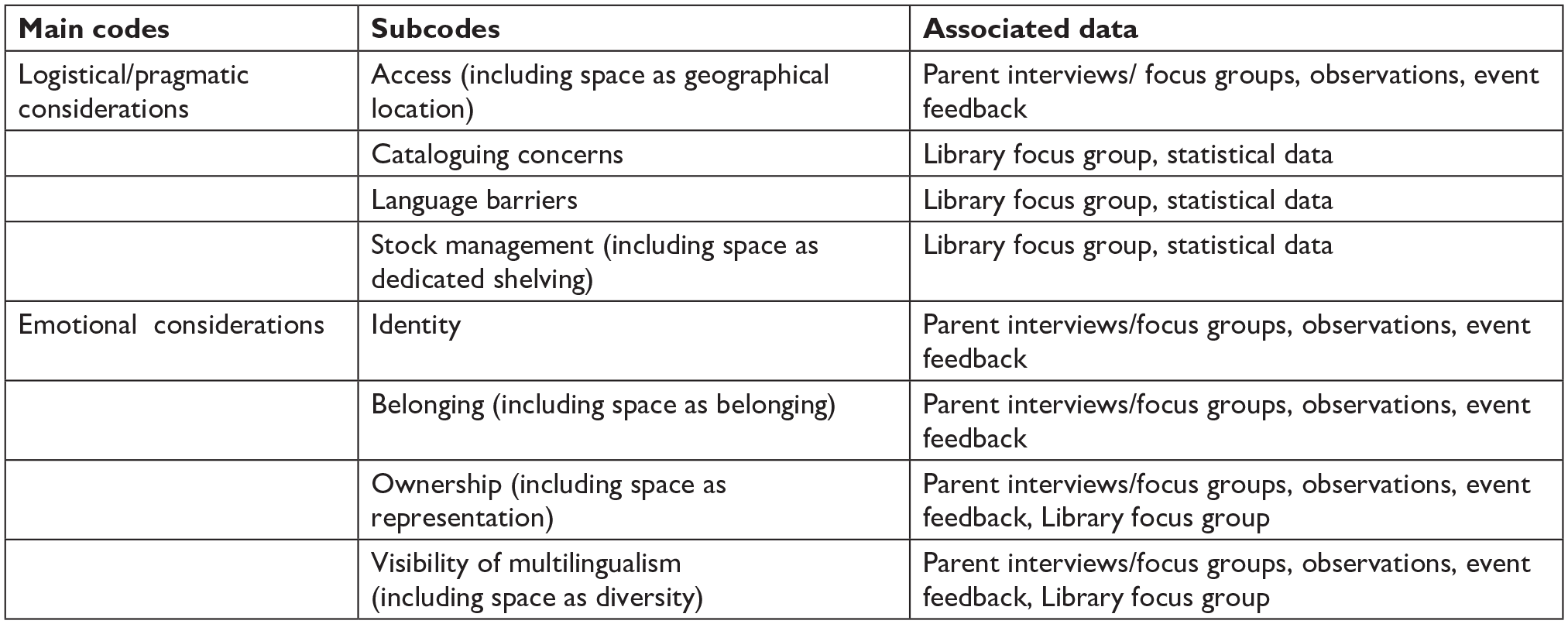
Relationship between data and codes.
Logistical/pragmatic considerations and emotional considerations did at times overlap, and one particularly important consideration highlighted below is linked to the coding around space, encompassing both logistical/pragmatic considerations around access, as well as understanding the emotional importance local communities attach to having a physical space where multilingualism is visible/audible. Cross analysis was necessary to explore relationships between the data, and triangulation of different data points. Available quantitative data (stock numbers, borrowing statistics) were analysed using descriptive statistics, and supplied with context from qualitative data, to provide a holistic overview.
Findings
Following a brief note on the classification of language – and the issues inherent in this – the findings first explore logistical considerations, drawing on statistical data available from stock and borrowing figures, underpinned by qualitative data, before turning to the role of the library as a physical and metaphorical space and the implications of these conceptualisations of space in driving children’s and families’ sense of identity and belonging.
A word on languages
Grouping languages together has political connotations, especially when languages with strong colonial histories are linked to geographical locations (e.g. identifying French and Spanish as ‘European Languages’, thus reinforcing colonial histories for large native speaker populations elsewhere). Such simplifications negate the identities and origins of families and library users, even though they do, on the surface, simplify reporting. Languages which are taught in English schools (predominantly French, German and Spanish) have a higher profile in the social conscience, as well as being linked to vibrant industries regarding publishing and translation. Any attempt to simplify ignores sociopolitical contexts and may inadvertently perpetuate dominant discourses, falling victim to communicative conventions (Canagarajah, 2005). Nevertheless, classifications can be helpful to highlight social inequities. For this reason, where language groups are differentiated in this paper, comparisons are made between ‘Languages recognised as official languages in Europe’, and those that are not. The former group includes French, German and Spanish as the primarily-taught languages in schools, and also those languages that are typically (though not exclusively) supported by strong publishing industries and more accessibility in terms of sourcing books, as well as being geographically closer to the UK. This does not, however, negate the need for problematisation and recognition regarding the space some of these languages occupy in other nations across the world. Further differentiation is drawn out in individual sections, as appropriate.
Logistical considerations
Stock and cataloguing
Due to financial pressures, books were sourced via donations only, from publishers, authors, illustrators, translators, heritage language schools and the general public. When the library launched in October 2018, 719 monolingual books in 37 languages had been donated, although only 342 had been catalogued at this point. In some instances, donations from certain languages significantly outweighed others, and were not in relation to the number of potential readers, and so some books were withheld from being catalogued. In addition, the existing stock of bilingual picture books (55 books across 21 languages) was shifted to the multilingual section. Thirty months later, the library had a catalogued stock of 642 monolingual books across 41 languages, as well as the aforementioned 55 bilingual picture books. The fact that more books were donated than ended up in the catalogue reflects the quality/suitability of donated stock, and available staff time to complete the cataloguing, an issue further discussed below. At the end of data collection, the stock was distributed across languages as follows (see Figure 2):
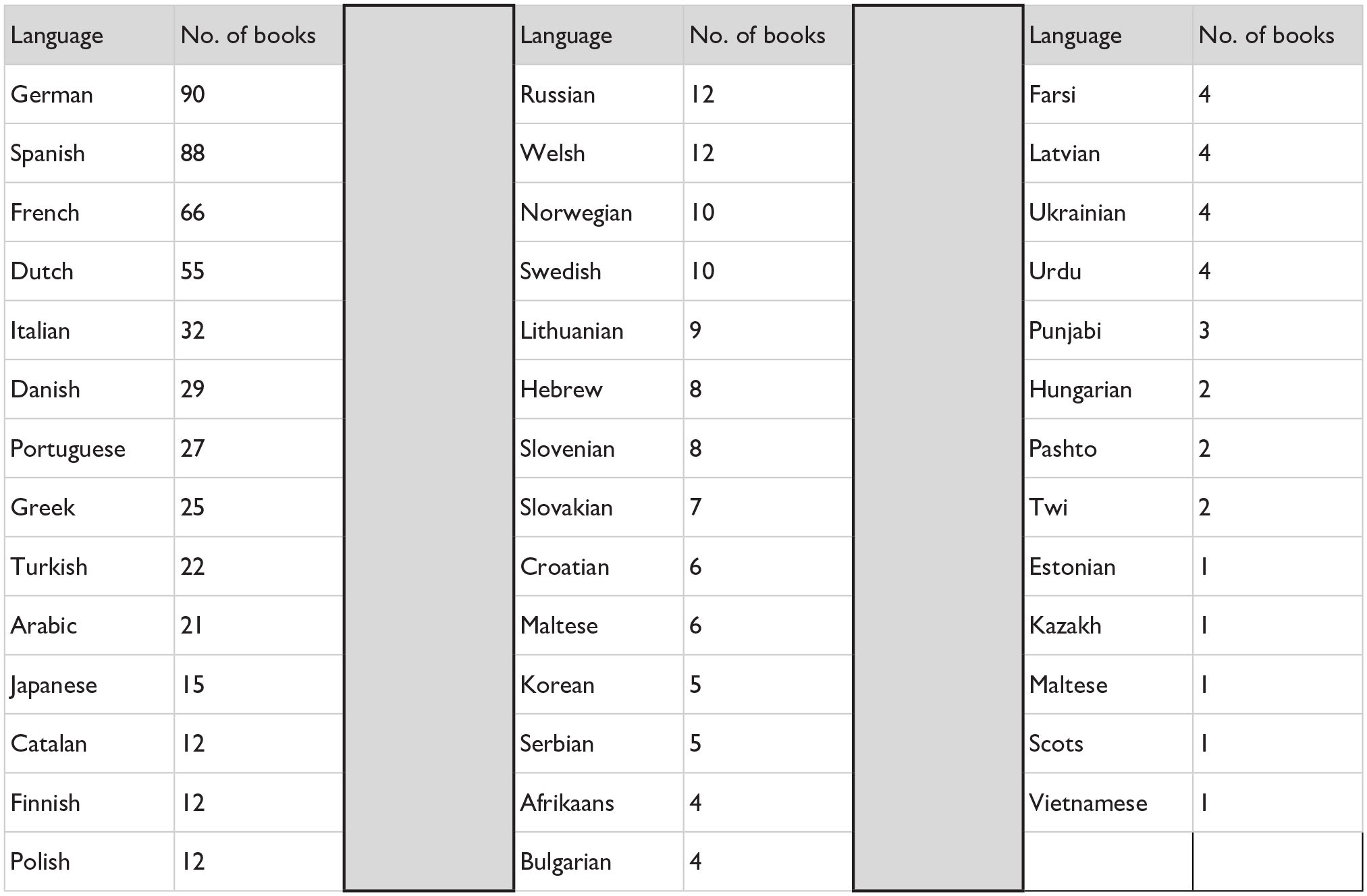
Stock numbers across languages.
While books spanned the entire age range across childhood, picture books and books for younger readers were generally more common, especially in languages where only a few books were present.
Stocking the library based on donations was a result of systemic and long-standing funding cuts to library services, which has impacted on many levels of provision (Muir and Douglas, 2001). These cuts had an impact not just on funding for stock, but also on staff availability and skill to cope with the additional demand of a multilingual library section. As the Collections and Audience Development Manager explained in the focus group:
Years of austerity [in relation to] our back office, the processes and staffing crisis, you know, has completely hollowed [us] out, and it required much more effort and ultimately money than I expected.
It is not surprising that, even with stock being donated, the multilingual library presented real funding challenges in terms of having staff available to catalogue stock. Typically, cataloguing is outsourced, however, this was not an option for the multilingual library. While donations from publishers and authors were largely translations of books originally authored in English, and thus straightforward to catalogue via ISBN numbers, other donated books presented issues, which sometimes began with staff not recognising what language the book was in. The local community helped via social media to identify languages, titles and authors from photos shared. The cataloguing system further struggled with various scripts, requiring Latinised spellings for various languages, which are rarely unilaterally adopted. One children’s librarian explained: ‘finding the time to get [the books] on stock, how we do that with our systems and how we incorporate that into our systems, [. . .] that took some time’.
Several pathways around simplifying the process were explored, however, inflexible statutes made them impossible to implement. Therefore, while community members volunteered to help with cataloguing, only council staff are allowed to access council computers, which was frustrating for community members, who felt they were prevented from playing a vital role in helping ‘their’ library flourish, indicating a strong sense of identification with and ownership of the library. Staff were not able to dedicate long stretches of time to cataloguing, instead it was completed during quiet times in the library, making it ‘ad hoc’ and difficult to schedule. To simplify the process, donations were finally required to feature accompanying information in English, namely (at the very least) author name, title and language. Library staff identified this information as vital in forming the basis of a donation policy for other libraries seeking to create a multilingual collection from donations.
The importance of cultural brokers within the community was highlighted in the methodology (Lee et al., 2014), however, it became apparent that the university link itself, and thus my role as the researcher, constituted brokerage, facilitating connections with the local community. This was highlighted by the Collections and Audience Development Manager: ‘I can’t stress enough how useful it is to have that help. Because we just don’t have the people going out there and building those bridges or whatever’. Therefore, while one person cannot reasonably be connected to all multilinguals in a city, having a go-between who is well-connected with key people in various local communities, who in turn functioned as brokers to their wider community, was a key success factor of the project, highlighting the importance of operating within existing local networks.
Usage patterns
Borrowing figures are a traditional standard of establishing usage patterns in library contexts, not just to track reading (Maynard et al., 2008), but also to consider the economic value of public libraries (Sumsion et al., 2002). Between the launch of the multilingual children’s library in November 2018 and the beginning of lockdown in the UK in March 2020 (16 months), 1041 books were borrowed from the multilingual library collection. Of these, 87% of books were in languages spoken as official languages in Europe. Looking at the top-12 most-borrowed languages, only two languages not classified as official languages in Europe make it onto the list, namely Japanese and Arabic (see Figure 3).
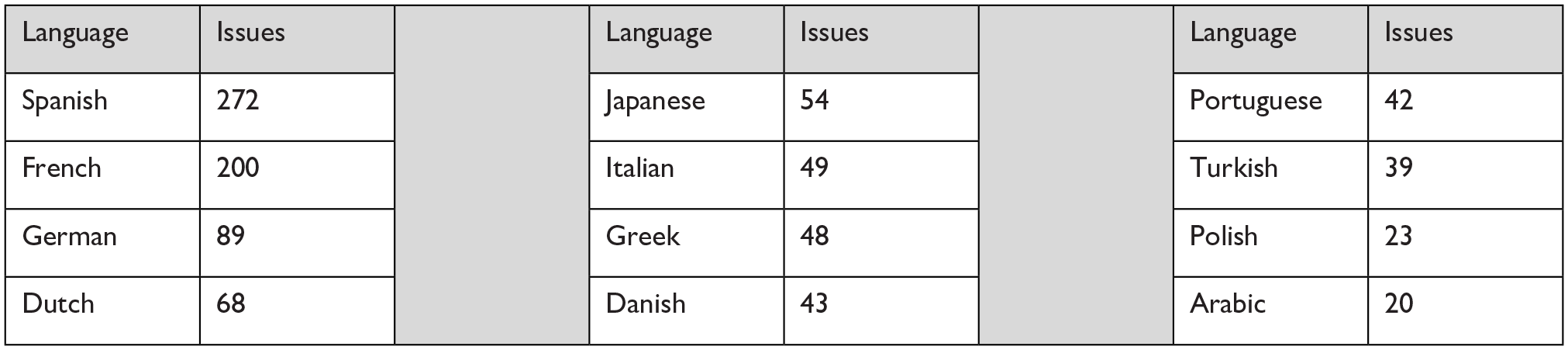
Top 12 languages according to books borrowed.
Looking at borrowing figures alone is problematic against a backdrop where some languages are represented much more strongly than others. As one staff member commented:
Relying on donations means you’ve got no say on what stock comes in and what languages come in. So we can have one Turkish book and then 25 Spanish books, and it’s a real misbalance. And there’s a few books that will never get used and then there are some books that are never in.
Understanding the relationship between stock and borrowing figures thus adds an important dimension to the data analysis. Therefore, a secondary analysis calculated the number of times books in a specific language were borrowed on average. The following table therefore presents a different ‘top-12’, according to most check-outs per book available in a language. Due to equal ranking, the top 14 languages are presented (see Figure 4).
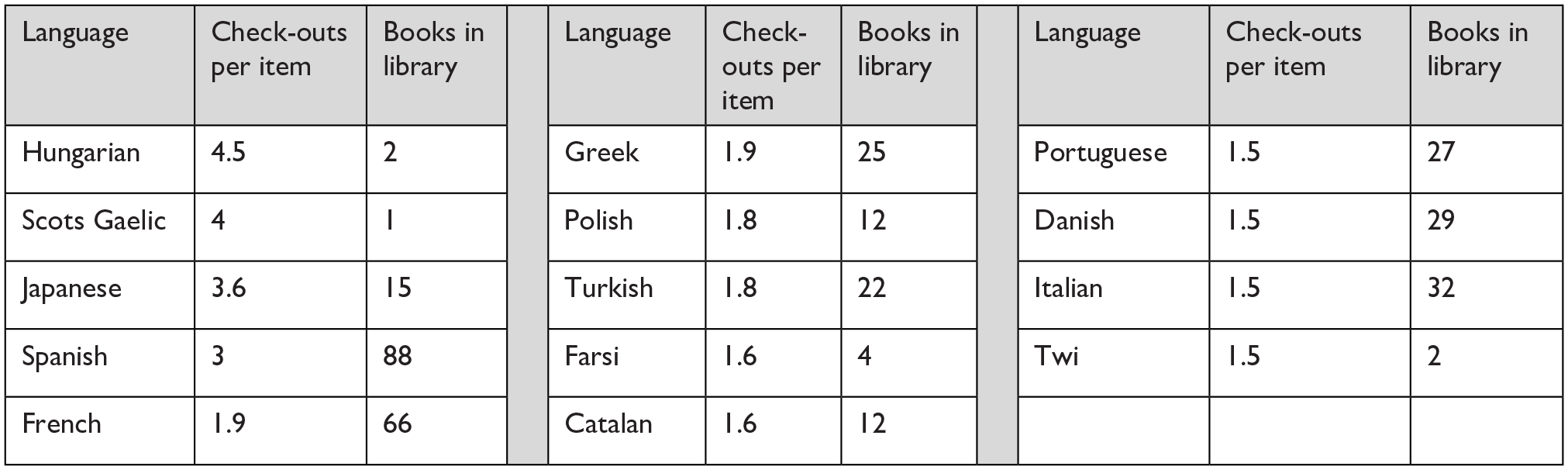
Top 14 languages according to average check-outs-per-item.
In this analysis, while still featuring many official languages spoken in Europe, borrowing figures are more diverse, illustrating the needs of community members whose languages may not have a strong publishing industry, or where books may be more difficult to obtain. This analysis highlights the demand for books in languages spoken in the community that have a less strong publishing industry (e.g. Twi and Farsi), while also reminding us to maintain a focus on languages spoken among migrant communities from Eastern Europe and the Middle East (Hungarian, Polish and Turkish). Finally, the inclusion of Scots Gaelic in this list may show the importance of resource provision not only to migrant communities from outside the UK, but also its potential role for the maintenance of the UK’s indigenous languages, although further research would be needed to support this. Finally, these two forms of analysis raise issues with regards to how libraries might measure the ‘success’ of a particular book, since, in the case of books in non-dominant languages, a more detailed analysis would be needed, taking into account the overall pool of speakers in the community and the number of books available to this group.
During focus group conversations, the number of books available in different languages was mentioned both by library staff and by parents. Library staff problematised having some languages with only very few books:
It’s like how you advertise it, because you say ‘well we are offering this service for all of you who don’t speak English who want to come and read books in your language’ and then they get there and there’s one book, or if that book’s out there’s nothing. It’s how you work that, that’s quite difficult. It’s sometimes better to say ‘we’ve got this many books, these are the languages, and we’ve got so many of each’.
Ana, one of the parents, commented on the limited availability of Spanish books:
I remember being, like, really excited of finding something in Spanish, and [. . .] I was like ‘oh I wonder if there will be more in Spanish’, but those were that and that was it.
Bearing in mind that Spanish has the second-highest number of books in the library (88), but also the highest number of check-outs (272), it is clear that managing expectations is a core aspect of stock building and maintenance, whilst also encouraging in showing demand.
Moving forward, both library staff and parents mentioned the idea of targeted donation drives. The Collections and Audience Development Manager suggested that, based on current understanding of demographic, and emerging borrowing figures, future stock should be targeted where the need is greatest, with languages currently underrepresented, and languages showing high borrowing figures. Ana, who had herself donated some Spanish books, mentioned that a targeted donation drive would bring the community together, and also explained:
A lot of these books [currently in families] perhaps were bought and brought through multiple trips to back home and so forth, but it’s also like an element of emotion, like not letting go in the family. So I think finding them a place in the library would be a nice thing.
It is known that multilingual children have different and more complex attachments to their books (Little, 2012), viewing books and languages as representative of developmental or migration-related milestones, so contributing to a library may help them increase their sense of community, ownership and belonging.
Understanding borrowing figures in context
There are several issues in relying on borrowing figures alone to understand usage patterns, and understanding the local community is a vital part of ensuring data are viewed in context. Within the sphere of this case study, two items of local knowledge are important to highlight how communities have an impact on multilingual libraries. On the one hand, the support of heritage language schools – several heritage language schools (typically operating on a Saturday) supported the library by participating in multilingual storytelling events and drawing attention to the library. While such support cannot be quantitatively measured, it is likely that, in this instance, it contributed positively to engagement particularly from the city’s Japanese- and Spanish-speaking communities, potentially explaining both the high number of books, and the comparatively high borrowing figures. On the other hand, it is important to understand what provision is already in place. In Sheffield, a nearby and well-established Polish library has been working hard to support the Polish-speaking community for many years, and at least one heritage language school (in Mandarin) operates its own library system. It would be too easy to look at figures and decide that certain needs do not exist, instead, it is important to recognise that these needs are currently being met in other ways, and, where possible, to collaborate to support the community to understand the facets and fluidity around community practices.
Finally, as well as showing the need for an understanding of the local community, the research itself showed that additional factors were at play, including issues that are vital in considering multilingual collections, and how their ‘success’ is measured. Staff had observed that books in the multilingual library were more likely to be read immediately and returned to shelves, rather than borrowed for reading at home, which resulted in false statistics. As one staff member outlined in the focus group:
A lot of people seem to use them in the library but don't always borrow them. It's a case with all our stock, but I think that area in particular seems to get a lot of use because it's always very messy.
Messy here is not a negative term, but rather proof of the section being well-used. When this was explored with parents, a number of reasons became apparent. While all families had borrowed multilingual books from the library, on occasion, a sense of community spirit meant multilingual books were more likely to be left for others, as Ana explained: ‘'I knew [my son would] read it once, he was not going to read it again. So to me it didn’t make sense to check it out and kind of take it away from another family who will use it’. Similarly, being able to read with children in the library addressed families’ needs regarding their sense of belonging. Tiesa, one of the parents, explained: ‘It’s the library, and for [my daughter] to see there are books there [in our language], not just at home, it means our language is important – we are important’. The borrowing statistics therefore show an incomplete picture of parents’ and families’ engagement with the library, precisely because being able to read the books in an official, public space (rather than in the home, where the heritage language might already be dominant) was important to the family’s sense of identity and belonging.
Understanding the importance of the multilingual library as a physical and metaphorical ‘space’
One aspect the study sought to explore is the importance of space – this includes both the physical location of the library and how this influences families’ logistical access and usage of space (Lefebvre, 1968/2010; Massey, 2005), but also the emotional connotations linked to having a highly visible, physical space with a focus on multilingualism, and the conceptualisation of the library as a ‘third space’ that facilitated the meeting of different cultures (Bhabha, 1994). This section will first explore the physical space, before moving on to the metaphorical one, considering aspects of access, identity and belonging.
The physical space
Although Lefebvre (1968/2010) argues for minority groups to ‘take over’ the city, convenience, rather than activism, was the main consideration when it came to how families used the library. Physical location influenced usage, with several parents citing other libraries being closer to their family home. Nevertheless, the central location meant that visits could be combined with other business in the city centre. Ana explained: ‘I will go and do some shopping and my husband will go with our son [to the library] and say ‘look I’ll wait for you there’, so [my son] will get bored you know being at the store’. Tiesa would typically visit her local libraries, but said: ‘We are using more frequently their local ones (libraries) but I have been to a couple of events there, to Multilingual Children’s Library, and just swap the books’. Similarly, Abigail explained that, although central in principle, the fact that the library was not near their home meant
it’s like [the multilingual books] seemed to be like almost out of reach [. . .] I used to say ‘well we can go in for 10 or 15 minutes or so’ because obviously it was depending on the bus. So that used to be a little bit of an influence because our bus came every hour so it was a little bit like a nightmare obviously.
Concerning is the fact that none of the parents engaged in focus groups were aware of, or used, the library offer of ordering books to other branches – the library catalogue is available online, and can be accessed and navigated from home, with books available to be delivered to local branches and to be returned anywhere. When I explored this in focus groups, five of the six parents said they had looked for multilingual books in their local libraries, but not found any, and had not considered asking for advice. Even when books were borrowed from the multilingual children’s library, they were typically not returned via other, more convenient libraries. As Abigail stated: ‘for some reason I think in our minds once you borrow it you need to come back to the place’. Whereas Lambert (1969) interpreted a lack of uptake in multilingual library services as lack of interest, it is obvious that lack of use of the inter-branch loan system is more likely due to lack of understanding of services offered. This highlights the practical importance of a multilingual display of books, to facilitate access, as well as the need for additional information on how multilingual families may use the library catalogue to serve their language needs.
The library also drew in new audiences, as Rafaela points out: ‘I think the first time I went to the library was because of the multilingual library to be fair’. As Grossman et al. (2022) highlighted, access to books in home languages is identified as a need among library users from migration backgrounds, and the provision of such books can bring both new users into the library, and encourage families to make a special journey to access them.
The metaphorical space and its impact on identity and belonging
A particularly important aspect of the research was the impact of ‘space’ – both physical and metaphorical space – on the emotional infrastructure of families and communities. As such, feedback was gathered on various events, including multiple multilingual storytelling events, a story-writing event and an award ceremony linked to a multilingual reading programme, which was implemented as part of the pilot. In this programme, children received a ‘reading passport’ where they could log six books – in any language other than English – to receive a certificate and medal.
As well as the physical space dedicated to the multilingual collection, the metaphorical space around events and time dedicated to supporting multilingual families in the city had an impact on feelings of identity and belonging for the city’s multilingual families, as well as normalising the city’s multilingual and multicultural status among the general public. The plurality of space (Massey, 2005) that supported the simultaneous occupancy of the library by people from multilingual backgrounds led to the library serving as a ‘third space’ (Bhabha, 1994), where cultures and languages could meet and be experienced. As such, a monolingual English speaking member of the general public commented after attending a multilingual storytelling event: ‘I had never heard Urdu before – it’s a lovely language’, while typically, families from any cultural background would listen to the stories if they happened to be in the library, whether they spoke the language or not. One family commented: ‘we came for the Dutch story, but we stayed for six more – it’s so interesting’. As such, the multilingual library has a role to play in supporting social cohesion in multicultural communities, breaking down barriers and drawing individuals together.
The multilingual library also facilitated children as creators and distributors of language: over a series of three story-telling events, as well as a multilingual readathon (where one picturebook was read in as many languages as possible), children displayed an increasing sense of ownership of the library, as well as their linguistic heritage, transforming from listeners to readers/performers of their language. During a multilingual story-writing workshop, where children were encouraged to bring as many of their home languages as they could, children could be overheard quizzing their parents on their own linguistic heritage. One girl asked her father about his own Gujarati heritage, in order to find additional languages to incorporate into her story. Other families were observed where parents helped with spellings in heritage/home languages, to facilitate the story-writing. The activities helped families to maintain heritage/home languages, creating a metaphorical space where linguistic and cultural heritage was valued in contexts outside the family, and children’s multiliteracies could be further developed (Little, 2021, 2022).
The efforts surrounding the library helped children to externalise their multilingualism as a skill, and receive external validation for something that is typically not valued or formally recognised, especially in children’s school experiences (Cunningham and Little, 2022; Purcell-Gates et al., 2011). Following the award ceremony, where children who had completed six books in a language other than English received a certificate and a medal, one mother’s evaluation stated:
I can see that Maya was very pround [sic] of her achievement and it was excellent to be recognised by people other than the parents that she is able to read the books in other languages. After the event, she had an opportunity to talk about her medal and cerfiticated [sic] to her family and friends. She also took them to her school this morning to share her achievement with her school teacher and friends. The teacher praised her for being able to speak and read more than one language.
This quote highlights not only the positive emotional vocabulary used (proud, achievement, praised, recognised), but also the wide-reaching opportunity that formal recognition of a child’s multilingualism affords the child, reaching family, friends and spanning both school and home. The certificate not only provided an opportunity to talk about multilingualism in a positive way, but also legitimised multilingualism to take up space within formal education contexts. The phrase ‘recognised by people other than her parents’ speaks to often-repeated comments from other parents about the project offering an opportunity to take family multilingualism out of the home into public spaces. During one of the multilingual storytelling events, for example, one mother commented that she volunteered to read because it meant the first opportunity for her child to hear the home language in a public setting, witnessed and valued by others. The multilingual children’s library, and the related activities, thus strengthened links to local communities (Klopfer and Nagata, 2011) and their funds of knowledge (Moll, 2019), and can bridge children’s various spheres of identity, that is home, school and society in general (Little, 2021).
The presence of the library in and of itself held meaning for parents, in terms of visibility and political message it sent, and all parents expanded their thoughts from the library itself to the city it – and they – were part of. Tiesa explained:
I think [the library] made it feel like it’s, you know even if it’s only a tiny group of Lithuanians [in the city], but like you know there is a section for it in the library, in the main City Library, you know kind of makes you feel proud.
Ana highlighted that such recognition of cultural and language diversity was both welcome, and special:
It meant that being in a city that recognises the cultural diversity and language diversity kind of. . ..it kind of felt good, it felt like you are. . ..I mean we both [parents] are foreigners, immigrants right, we are quite far from home and it sort of felt that there’s a sense of. . ..I mean to me created like a sense of certain uniqueness.
Rafaela echoed these sentiments, tying it to a sense of belonging:
In some ways it makes you feel more like you belong because you think ‘well the library has a section with books in different languages, for people that are living in Sheffield’. In some ways I think it makes you feel, at least in my case, I feel like I belong more. Because, you know, there is this service for people from other backgrounds in the city.
Library staff also commented on the integrative elements of the library, highlighting how true catering for diversity can only be achieved once such service is normalised. A children’s librarian explained: To me that makes it, it’s now, ‘it’s part of our lives now, it’s what we come in and do, take some books in Spanish’, with the children’s library manager confirming ‘it’s what they expect, and should expect’.
Conclusion
The research set out to explore the logistic and emotional connotations that a multilingual children’s library experienced. While a single case study by its very nature has its limitations around generalisability, the issues raised highlight important foci for future work. Unsurprisingly, the lack of funding to buy books and systemic funding cuts to staffing had a significant impact on the logistic implementation. Further research across other libraries is needed to give a more holistic overview on the impact financial restraints have on provision for multilingual communities. Lack of a clear donation policy is a barrier that can be overcome, and targeted donation drives, rather than an open-door policy to donations, can help both to address shortages in specific languages and provide connections with targeted local communities. A key finding was the understanding that traditional borrowing statistics may not adequately capture the use of multilingual libraries, since families are influenced both by their desire to share the books with their children in the library itself (i.e. a public space), and their awareness of a lack of resources, making it more likely that books are read in situ and replaced on the shelf, without ever being checked out via the library system. Similarly, borrowing figures for books in non-dominant languages have a different potential ‘pool’ of readers, so more complex analysis needs to take place to take into account readership, and the availability of books to this readership. Finally, the library embedded events and reading schemes with a clear multilingual focus. The initiatives and analysis highlighted in this paper thus argue for a critical look at ‘success’ measures within the context of multilingual libraries. These need to take into account not only the immediately measurable (check-outs, footfall at events), but also the less tangible (reasons behind check-outs, role of library to maintain family languages, multilingualism in public spaces, etc.). Since this study is limited to a single library, future research will help to develop this work into a holistic evaluation framework for multilingual libraries.
The role of cultural brokers, such as heritage language schools, who create links between different community groups, is vital to ensure emotional investment. The running of events also helped significantly to establish a sense of ownership and belonging, with both adults and children contributing as readers, thus making multilingualism visible/audible in the community, which was also valued by other library users. A reward system in the form of a multilingual reading scheme provided children with an artefact (certificate/medal) that they could use to bridge their various social spheres, highlighting their multilingualism as a valuable asset, and developing pride in their skills. The library, as a space itself, thus contributed to the sense of identity and belonging among local communities, establishing the concept of both the library and, by extension, the city itself, as welcoming to people from diverse backgrounds.
The research makes an important contribution to the conceptualisation of multilingual libraries as both a physical and a metaphorical space, and the consideration of the plurality of space as a social justice issue (Lefebvre, 1968/2010; Massey, 2005). As next steps, further research is needed from other contexts to broaden the scope of this upcoming research field, including dedicated multilingual libraries, library sections, school libraries and mobile libraries, to ensure that multilingual and multicultural needs are met by libraries, against a backdrop of ever-more-diverse societies.
Footnotes
Declaration of conflict of interests
The author(s) declared no potential conflicts of interest with respect to the research, authorship, and/or publication of this article.
Funding
The author(s) disclosed receipt of the following financial support for the research, authorship, and/or publication of this article: This research has been funded under a satellite grant of the OWRI Open Worlds Research Initiative project: “Cross-language dynamics: reshaping community”, funded by the Arts and Humanities Research Council, Grant Number AH/N004647/1.

Author biographies
Sabine Little is a Senior Lecturer in Languages Education at the University of Sheffield. Her research focuses on the relationship between multilingualism, identity, and belonging. Her work on the multilingual library was awarded the international Brenda Eastwood Award for Diversity and Inclusion.Rebecca Murray is a Lecturer in Sociological Studies at the University of Sheffield and a member of the University of Sanctuary steering committee. Rebecca’s practice and research focuses on the role of post-compulsory education in mitigating the impact of forced displacement.