



Abstract
Prison library staff play a central role in supporting prisoners with their educational, informational, recreational and cultural needs during incarceration. Their role is unique within the wider library profession, as they require both expertise in library and information management as well as the skills and knowledge required to operate in a prison environment. There has been little research exploring the experiences and perspectives of library staff who manage and deliver prison library services in the United Kingdom (UK). This paper addresses this gap in knowledge and seeks to amplify the voices of those working in an often overlooked profession. Findings are drawn from the first phase of a broader doctoral study which explored prisoner engagement with library services. A mixed-methods approach was taken, combining both a questionnaire and follow-up interviews with prison library staff across the UK. The questionnaire received 31 responses from library staff and 10 respondents participated in a follow-up interview. Findings offer a contemporary overview of the management and delivery of prison library services in the UK and underline common themes and concerns among prison library professionals, namely the implications of dual management, the impact of the unique social context in which they work and the importance of communication and liaison in providing effective library services. The paper concludes with recommendations for combatting the professional isolation felt by those working in this sector and for the promotion of prison library services both within and outside the prison.
Keywords
Introduction
The most vital link in the operation of [prison] libraries is having competent, well-trained, enthusiastic, and patient library staff. . . (Lehmann, 2000b: 1)
The role of the prison librarian is unique within the wider library and information profession, for it requires both expertise in library and information management and the humanistic skills required to work in a challenging prison environment (Krolak, 2019; Lehmann, 2000a). In their discussion of minimum staffing standards in Colorado prisons, Boyington and Barnes (2021: 287) state that there is a ‘great difference in access for residents and quality of services when a library has skilled staff.’ Not only are prison library staff responsible for facilitating access to resources and services that meet the informational, educational, recreational and cultural needs of prisoners (United Nations Educational, Scientific and Cultural Organization [UNESCO] Institute of Lifelong Learning [UIL], 2020) but the unique rapport between library users and trusted library staff members helps to create a safe and comfortable library environment where prisoners can easily express their needs (Krolak, 2019). Research by Finlay and Bates (2021) found this rapport to be the cornerstone of the prison library, where prisoners felt humanised by library staff in a way that was not felt elsewhere in the prison. This crucial role is however often misunderstood by those working outside of the profession and the library is rarely prioritised within the wider prison regime (Boyington and Barnes, 2021). This paper seeks to amplify the voices of those working in what Conrad (2016: 9) describes as a ‘neglected profession’ by exploring the experiences and perspectives of prison library staff working in the United Kingdom (UK).
Accounts of staff experiences of overseeing and delivering prison library services are found mostly in publications stemming from the United States (US), where practitioners in the field have documented their experiences and offered valuable advice for those considering correctional librarianship as a career pathway (e.g. Clark and MacCreaigh, 2006; Lehmann, 2000a; Singer, 2000; Vogel, 1995, 2009). Less is known about the experiences and perspectives of prison library staff in the United Kingdom. Stevens’ (1995) doctoral study explored the role of prison libraries in the rehabilitation process and included in-depth interviews with professional librarians and library officers in England and Wales, but little research has been carried out since then which focuses on staff experiences of prison library provision. This paper provides a contemporary insight into the management and delivery of prison library services in the UK. In doing so, it brings to the fore some of the challenges faced by staff working in a punitive and risk-laden environment where the necessary focus on safety and security often infringes upon library users’ rights to information and education access. Findings are drawn from the first phase of a broader doctoral study which examined prisoners’ engagement with library services in the UK (Finlay, 2020). They highlight common themes and concerns among prison library professionals, namely the implications of dual management, the impact of the unique social context of the prison and the importance of communication and liaison in providing effective library services. These findings are discussed alongside participants’ hopes and concerns for the future of the prison library profession. The paper concludes with recommendations for combatting the professional isolation felt by those working in the sector and for promoting prison library services both within and outside the prison.
The prison librarian: Roles and responsibilities
The need for professional staffing of prison libraries is acknowledged in prison library literature and guidelines, as well as wider prison education research and policy documents (e.g. Council of Europe, 1990; Lehmann and Locke, 2005; UIL, 2020). Recommendations put forward in a recent global review of education in prisons include the need for a well-resourced library staffed by accredited library professionals, noting that this is ‘central to educational activities’ in the prison (UIL, 2021: 91). Krolak (2019: 26) describes the prison librarian as being ‘key to the success of the prison library.’
Often working as a sole member of staff within the library, the prison librarian is responsible for a range of functions which in any other library is likely to be distributed among different staff members (Clark and MacCreaigh, 2006). This includes (but is not limited to) collection management and budget management, ordering stock and supplies, cataloguing, book-mending, liaising with both internal and external staff and volunteers to facilitate informal learning programmes and events, supporting prisoners with literacy skills and promoting reading for pleasure (Krolak, 2019; Lehmann, 2000a; Rimmer, 2015; Vogel, 2009). While providing services akin to those of a public library, the security-laden context in which the prison library functions makes this a challenging role for library staff. Prison library staff must be particularly cognizant of having clear professional boundaries and consistently mindful of security and safety (Rimmer, 2015). They should also have a strong interest in serving underserved populations and be able to advocate for and promote library services to staff and prisoners who may not understand the full extent of what a library offers (Lehmann, 2000a; Vogel, 2009). IFLA’s Guidelines for Library Services to Prisoners also acknowledge this unique aspect of the role and the need for library staff to understand the ‘many and complex needs’ of prisoners and possess ‘the necessary human and interpersonal skills’ required to work in a prison (Lehmann and Locke, 2005: 10). Lehmann (2011: 495) notes these skills to be ‘assertiveness, flexibility, emotional stability, helpfulness, sincerity, high tolerance for stress, and a sense of humor’ as well as being able to ‘adjust quickly to changing situations’. The importance of interpersonal skills in prison cannot be overstated. Prison researchers have found that levels of ‘respect, fairness and humanity’ demonstrated by prison staff are key in creating a humane environment (Liebling, 2011: 533) and that staff-prisoner relationships are a crucial factor in whether a prison sentence is ‘survivable or de-humanising’ (Crewe, 2015: 52).
Challenges of providing prison library services
Most prison libraries are based on a public library model, with the aim of offering the same level of services to prisoners as are provided in their local communities (Lehmann and Locke, 2005). However, the contextual setting in which these services are delivered invariably prohibits the prison library from reaching this goal fully. Prison library literature often alludes to the opposing values of prisons and libraries (Boyington and Barnes, 2021; Vogel, 2009). Finlay and Bates (2018: 122) note that incarceration ‘inherently limits the freedom, privacy and autonomy of individuals – three ingredients that are key to the provision of effective library services.’ Censorship of library material is common and often dependent on subjective decisions by prison officials (Cauley, 2020). The volatile and unpredictable nature of the prison environment can disrupt scheduled library events and inhibit access to the library space, and prisoners working elsewhere in the prison or participating in education classes may not be free to attend the library during its opening hours (Finlay, 2020). The lack of priority assigned to the library within the prison regime can lead to the it being ‘absorbed by or taken over by other units’ (Conrad, 2016: 4), adding to the frustration and isolation felt by library staff working in this setting.
Existing prison library literature makes clear that one of the most challenging aspects of working in a prison library is the isolating nature of the role, both within the prison and within the wider library profession. In interviews with 11 prison librarians working in states across the US, Conrad (2016: 165) found that each interviewee ‘alluded to or mentioned solitude as something they dealt with regularly.’ The siloed environment of the prison often prohibits interprofessional communication and collaboration among prison departments and staff (Dugdale et al., 2022; Moore and Hamilton, 2016). Beyond the prison setting, prison library staff have also reported feeling isolated from the ‘library community at large’ (Clark and MacCreaigh, 2006: 46). Lack of access to technology and the internet in prison can cut prison library staff off from key developments in the wider sector. While some opportunities exist for Continuing Professional Development (CPD), often provided through a professional body, working as a sole member of staff can make it difficult to attend external library training or events and librarians ‘can often feel isolated physically as well as professionally’ (Bowe, 2011: 441). This paper will consider the isolation felt by prison library staff in the UK and discuss opportunities for addressing professional isolation.
Research context
The findings presented in this paper represent three separate prison jurisdictions in the UK, that of Her Majesty’s Prison and Probation Service (HMPPS) in England and Wales, the Scottish Prison Service (SPS) and Northern Ireland Prison Service (NIPS). While administrative powers have been devolved to both Scotland and Northern Ireland to govern their respective justice systems, each have similar policies regarding library provision to people in prison. Prison Rules in each jurisdiction decree that all prisoners have a legal right to access the prison library and library resources during their sentence, although offer little further detail about how library services are provided and the extent of library access. The Prisons and Young Offenders Institutions (Scotland) Rules 2011 state that library services should take into account prisoners’ ‘educational, informational and recreational interests’ (Scottish Prison Service, 2011, Rule 88.2). Rule 54(2) of the 1995 NIPS Prison Rules add the caveat that all prisoners should be allowed to access a library ‘subject to the requirements of security, control and good order’ (Department of Justice Northern Ireland, 1995). A recent framework on education and library services published by the Ministry of Justice (MoJ, 2019) recognises that prison libraries in England and Wales should have a ‘focus on supporting learning, improving literacy and other barriers to resettlement’ as well as providing prisoners with ‘opportunities for wider cultural engagement’ (p. 4). Further details of library access and services offered by the prison library are usually outlined in service level agreements drawn up between the individual prison and local County Council or Public Library Authority.
The UK’s Library and Information Association (CILIP) is the professional body responsible for supporting and advocating for staff members across all sectors of the library and information profession. Within the broader organisation sits a Prison Libraries Group which advocates for prison libraries and offers support and networking opportunities for prison library staff. It holds an annual training event in London and has developed written resources to support staff such as the Prison Libraries Training Pack (CILIP Prison Libraries Group, 2018). A survey of prison library staff carried out by CILIP in 2014 received 91 responses across the UK and offered a comprehensive overview of how prison libraries are managed, how the library fits into the prison structure and regime and what access there is to IT for both staff and prisoners (CILIP, 2015). The resulting report noted that 74 of the 91 prisons were operating below the recommended staffing levels set out in the Prison Service Instruction (PSI) 45/2011 1 which was in force at that time and that staff hours were less than 50% of the recommended hours in seven prisons (CILIP, 2015). 2 This current study provides more recent insights into library provision in the UK and further illuminates these statistics through the use of qualitative data to gain a rich and detailed understanding of staff experiences of working in prison libraries.
It should also be noted that this research took place prior to the COVID-19 pandemic. Since data collection took place, significant changes have taken place in the day-to-day provision of library services to people in prison. The pandemic led to the closure of most prison library spaces and challenged library staff to find new and innovate ways of ensuring prisoners still had access to library resources. Across prison sites in the UK, trolley services provided resources directly to cells, request forms were completed by prisoners, activity sheets were distributed and some reading groups still ran by correspondence (Fuller, 2021; Krolak, 2020). Discussing these adapted services, one librarian in Northern Ireland reported that ‘against this uncertainty and upheaval, the library became a lifeline for many’ (Stanfield, 2021). Many of the challenges described in this paper, including disrupted access to the library space and resources, are ones which have been exacerbated during long periods of lockdown and will continue to be issues of concern for library staff as face-to-face library services resume in prisons.
Research design
The present study discusses findings nested within a broader PhD study which examined the role of library services in the learning experiences of people in prison (Finlay, 2020). Prior to case study research with prison library users in Northern Ireland and Scotland, this doctoral study explored staff experiences of providing prison library services across prisons in the UK. A mixed methods triangulation design (convergence model) was chosen to better understand how library services are managed and delivered across prison sites in the UK, and how prison library staff experience and perceive their role. Creswell and Plano Clark (2006: 65) note the purpose of this model ‘is to end up with valid and well-substantiated conclusions about a single phenomenon.’ Quantitative data was collected through use of an online questionnaire distributed to prison library staff across the UK and substantiated by qualitative data collected in interviews with a subsection of questionnaire respondents. As the primary goal was to generate a rich understanding of staff experiences, findings from interview data are given more prominence in this paper.
Data collection took place between March and June of 2018. An online questionnaire was distributed using the JISC Prison Libraries mailing list, to which many UK-based prison library staff are subscribed. It was divided into four sections, which consisted of a combination of closed and open-ended questions: Institution and job role; overview of library services; relationship between the library and education department; and the purpose and value of library services. While respondents had the choice to remain fully anonymous, they were asked to provide an email address if willing to participate in a follow-up telephone interview. Although guided by an interview schedule, the interviews were semi-structured, allowing for new topics to be raised and discussed. Full ethical approval was obtained from Ulster University prior to data collection.
Research sample
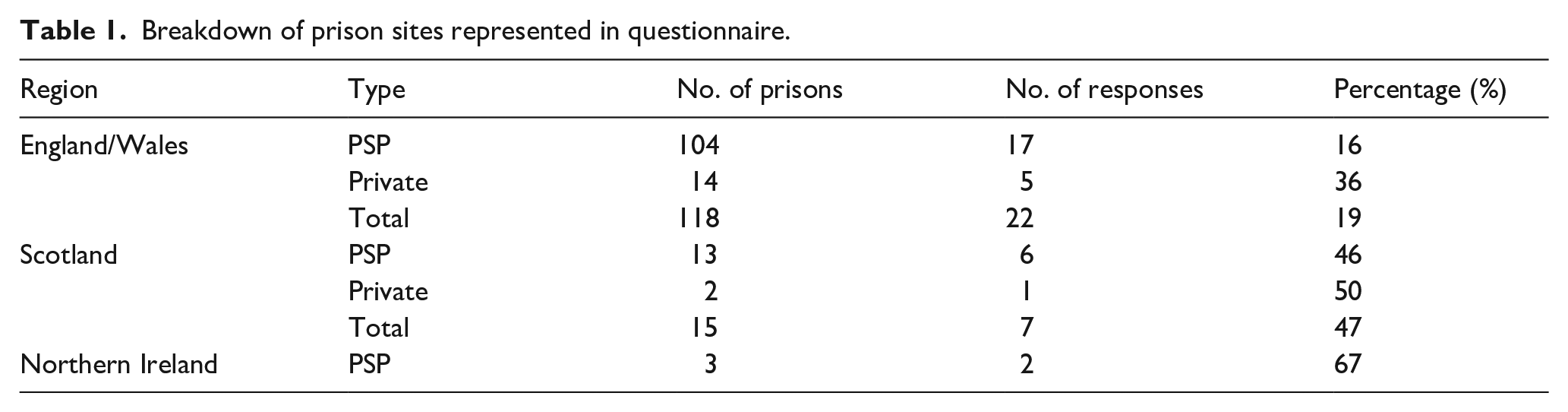
A total of 31 library staff members across jurisdictions returned questionnaire responses. These responses represent 19% of the establishments in England and Wales, 47% of prisons in Scotland and 67% of prisons in Northern Ireland (Table 1), spanning all categories of prisons. Table 1 also indicates how many responses came from public sector prisons (PSP) and private prisons. While the majority of prisons in England, Wales and Scotland are public sector prisons, others are contracted out to private companies such as Sodexo, Serco and G4S Justice Services (Beard, 2021). These prisons are still subject to inspection by the HM Chief Inspectorate of Prisons and must adhere to Prison Rules, meaning that they are still legally required to provide access to a library space and library services. It is necessary to differentiate between institutions as there may be implications for how each library is funded and managed, and the range of services and resources offered to prisoners at each site.
Breakdown of prison sites represented in questionnaire.
Follow-up interviews were held with 10 of these respondents, representing a small sample of prison library staff working in England, Wales and Scotland in both privately funded and public sector prisons. While they held a variety of job titles, each interviewee was either the only or most senior staff member working in the library. All held professional library qualifications. All but one staff member worked in men’s prisons, with one participant working in a prison which held both men and women prisoners. Table 2 offers an overview of the prison site and library staff roles.
Demographics of interview participants.
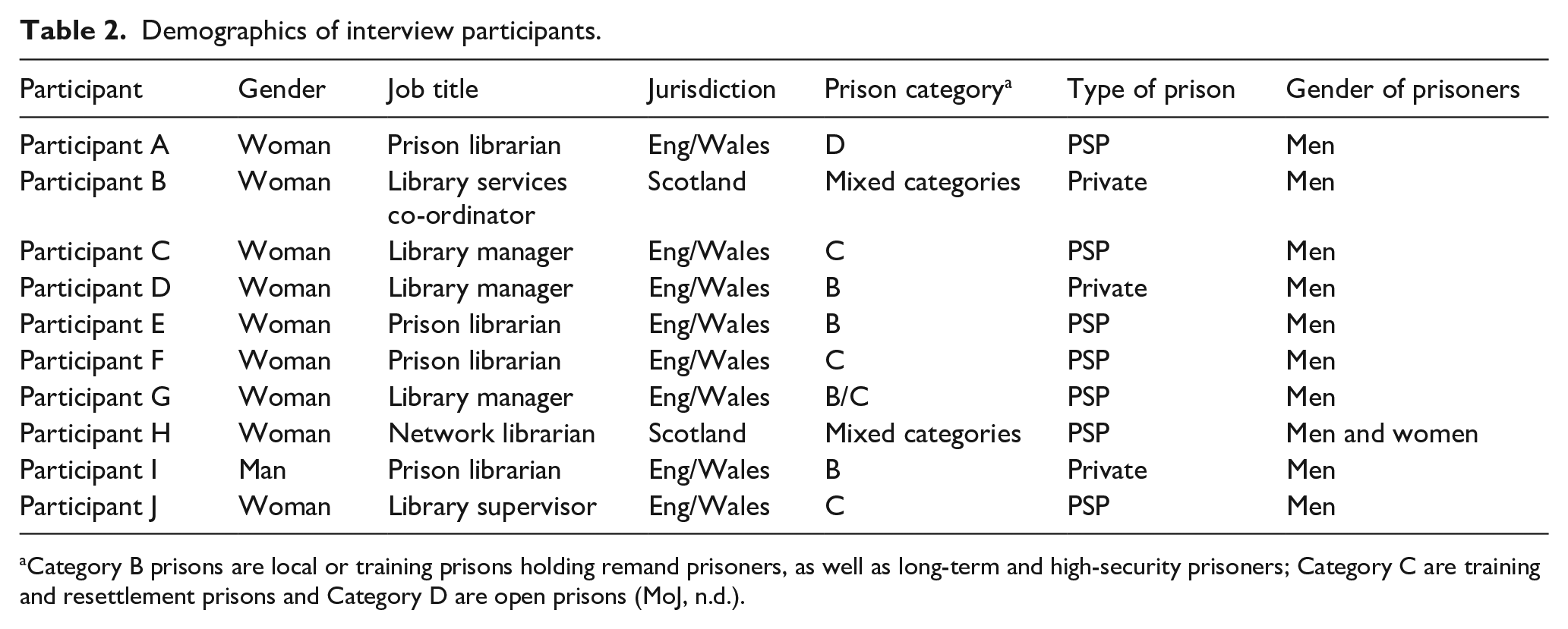
Category B prisons are local or training prisons holding remand prisoners, as well as long-term and high-security prisoners; Category C are training and resettlement prisons and Category D are open prisons (MoJ, n.d.).
Data analysis
Data collected from questionnaires were statistically analysed, making use of SPSS software to generate descriptive statistics. These statistics are displayed visually throughout this paper and are discussed alongside interview findings. Interview data was analysed thematically, following Braun and Clarke’s (2006) six-phase framework to find meaningful patterns in the data which helped to address the research questions of the wider PhD study. As there has been little contemporary research on staff perspectives of providing library services in the UK, an inductive approach was taken to coding the data in which themes were selected based on the data collected rather than to fit pre-existing codes (Fereday and Muir-Cochrane, 2006). Each telephone interview was audio-recorded and transcribed verbatim, which helped facilitate familiarisation of the data. Transcripts were then uploaded to NVivo to facilitate the coding process. After systematically applying codes to the dataset, these codes were grouped into themes which were then examined and revise to ensure relevance to the aims of the PhD study.
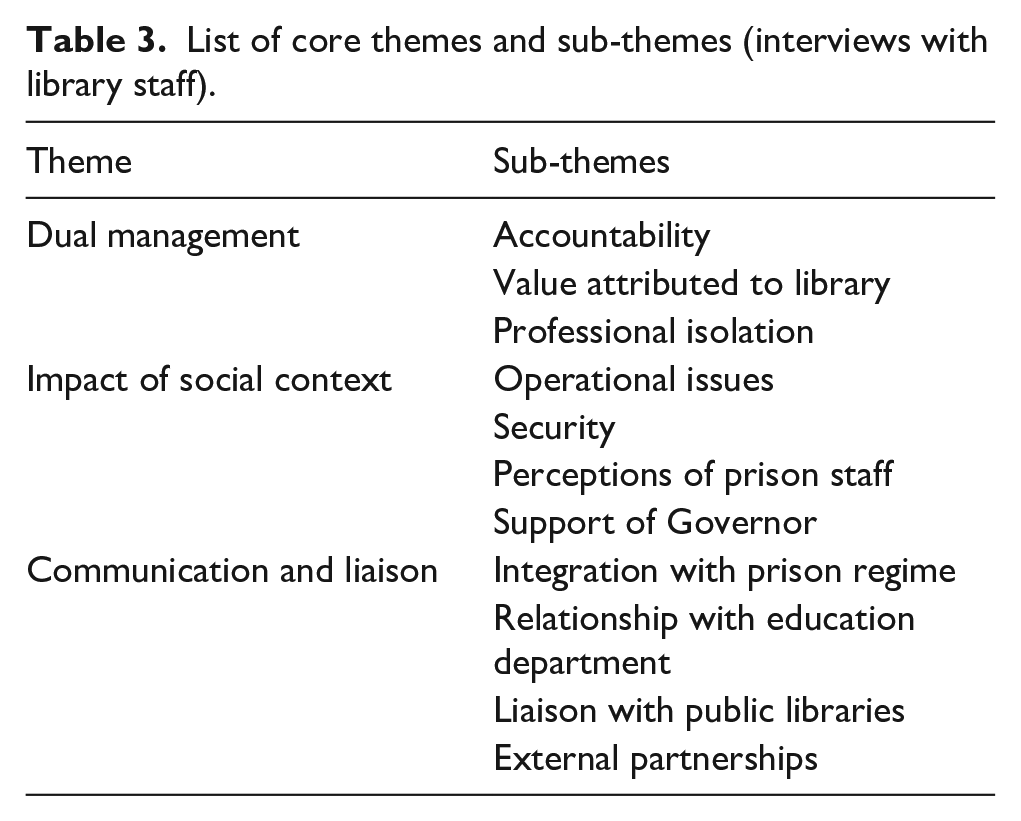
This paper addresses three of the main themes which emerged from analysis of interview data as they relate to staff experiences of providing library services (Table 3). Following a discussion of staff perspectives of the role and value of prison libraries, this paper will explore the implications of dual management, the impact of the unique social context of the prison and the importance of communication and liaison in providing effective library services.
List of core themes and sub-themes (interviews with library staff).
The value of library services
All library staff were asked about the objectives of prison libraries, the main reasons they felt prisoners chose to engage with library services and the value/outcomes of this engagement.
Figure 1 shows questionnaire responses about the main objectives of the prison library. This open-ended answer was coded to show the most common answers. In line with existing literature and policy documents, most respondents (93%) named meeting information needs as one of the main objectives of the prison library. This was followed by supporting educational needs (48%) and providing opportunities for reading for pleasure (38%). Respondents also referred to the safe, neutral space offered by the library describing it as ‘a welcoming oasis within what is undoubtedly a very difficult environment’ (Respondent 7) and ‘an oasis of calm in a noisy, smelly difficult environment’ (Respondent 9). When asked directly about the physical space of the library, 88% of questionnaire respondents strongly agreed with the statement that the library offers an important space in the prison environment.
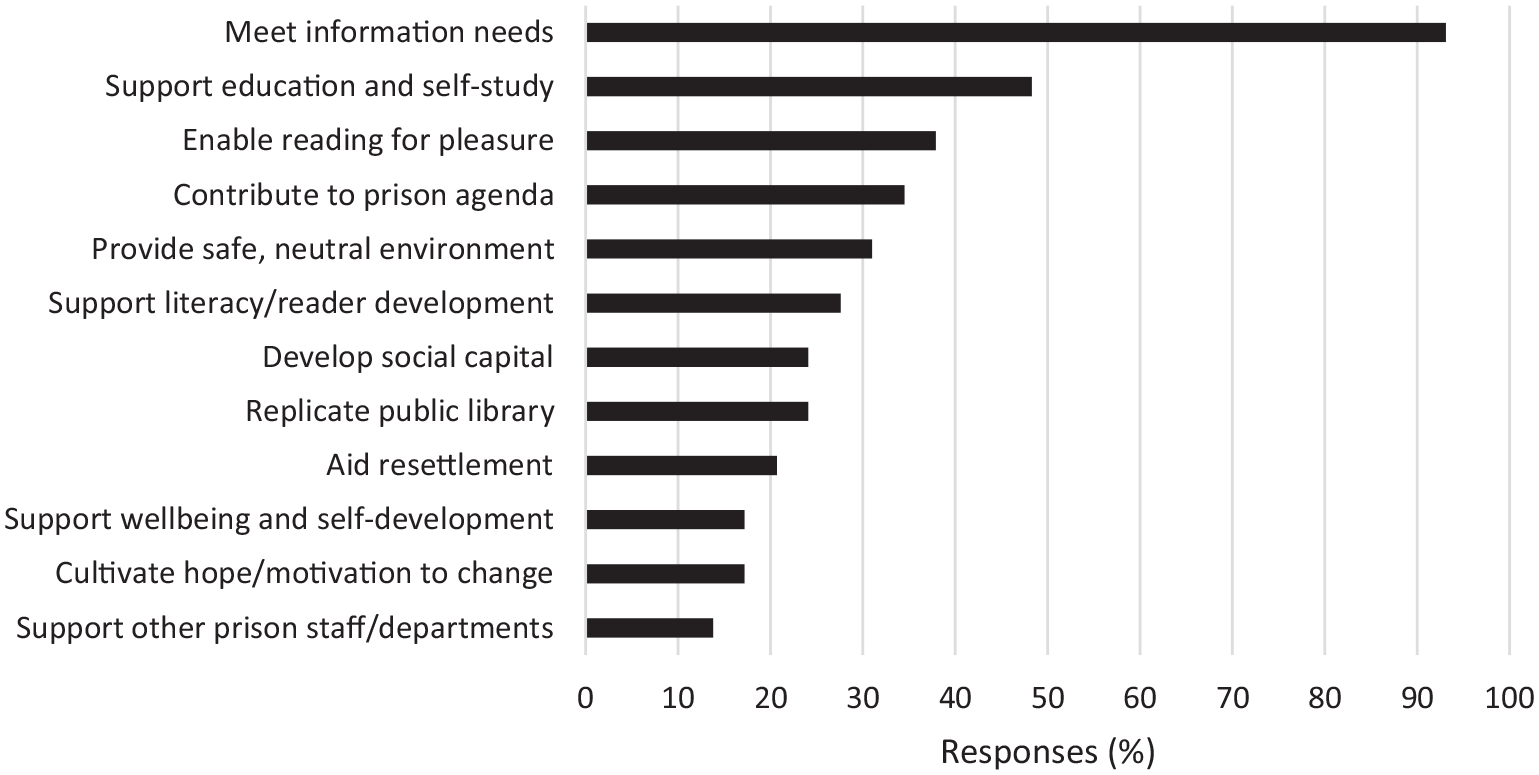
Objectives of the prison library (n = 29).
Library staff repeatedly described the library as a lifeline for some prisoners. Interview participants provided anecdotal evidence of how libraries contributed to the wellbeing of library users: Like when they leave and they say, “you do know, you know, this library saved my life?” (Participant D) Really you can see first-hand how much it helps these guys get through their day. There’s a lot of devastation and loneliness and isolation and I think you are key in helping with that, just by offering a service. (Participant I)
Staff were asked if they thought engagement with library services could positively contribute to an individual’s journey of desistance from crime. Sixty per cent of 30 respondents answered positively, with the remainder noting that they contributed ‘somewhat’ to desistance. It was acknowledged that this is a very difficult thing to measure, and while it may contribute to desistance, this would be alongside many other things: Generally not on its own, but it provides a supportive environment for those who genuinely want to change, and a safe space in which to do it. (Respondent 7)
Figure 2 shows some of the ways in which questionnaire respondents consider library engagement to contribute to desistance. Staff encouragement and empowerment of prisoners was the most common answer (32%), with staff underlining the significance of being non-uniformed staff within the prison. Respondent 1 commented, ‘we are seen as non-prison workers. . .they will confide in us and ask for advice or just want someone to listen.’ Staff also referred to the way in which reading and socialisation with others can generate new and different opinions and spark new learning interests: The library can allow a person to learn about the world in a way they never got involved with previously. Some prisoners have expressed fascination at the range of subjects and topics that exist! Many are open to reading and learning about new things - whichever way the wind takes them. (Respondent 28) The library supports an individual to think, relax, be distracted, empathise with others etc. through reading, exposure to ideas, socialization. (Respondent 29) Books, information and informal learning broaden horizons, entertain and expose the potential to make different choices in the future. (Respondent 19)
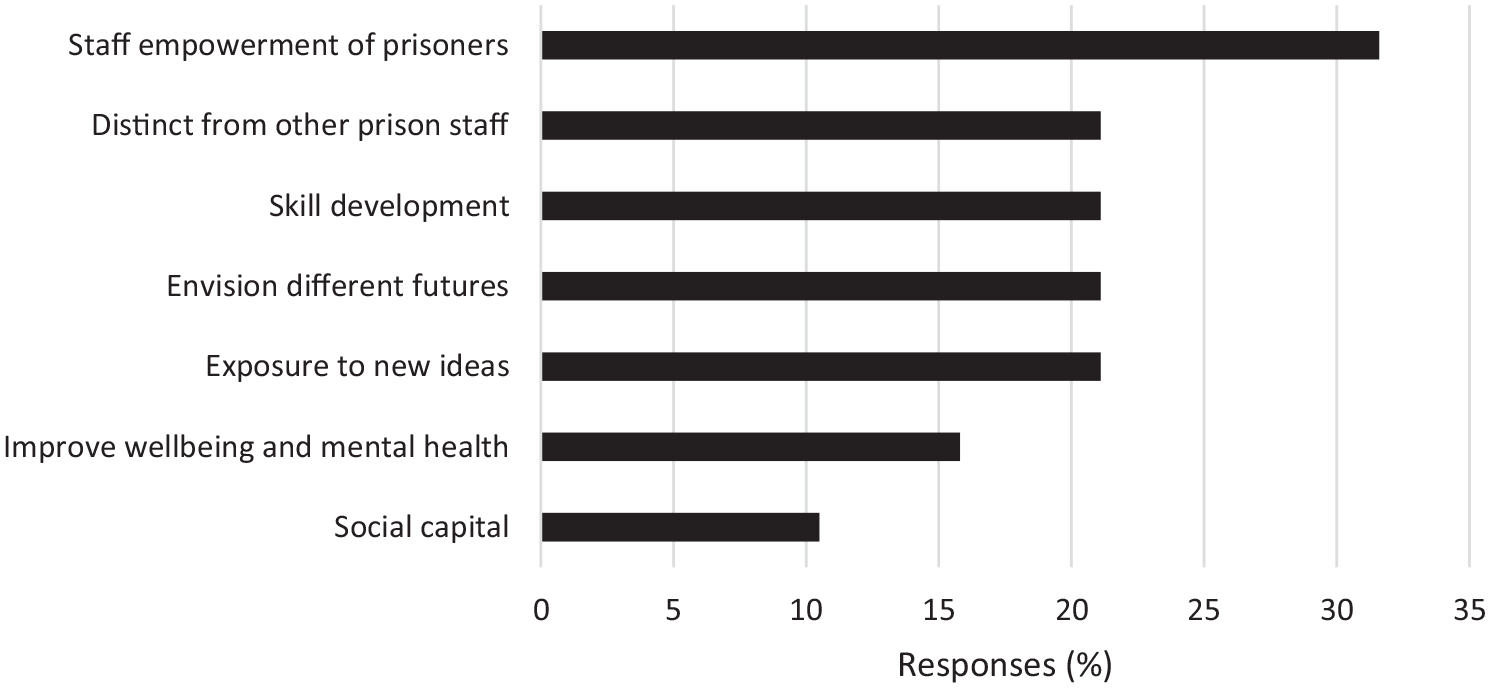
How prison libraries can support desistance (n = 19).
Interview participants spoke of the increased confidence of those who engaged with informal learning activities and book discussion groups, and their hopes that this confidence might encourage them to use libraries on the outside: I think people will join a reading group once they’ve been brave enough to sit and speak out about something. One of them said it gave them confidence to do that, whereas before he wouldn’t have dreamt about saying what he thought about the book. (Participant D) I like to think if they’ve had a good experience of the library inside, they’ll feel safe to use it outside. I think it probably increases their confidence being in here, and they might be more confident to use service when they get out. (Participant J)
Alongside examples of positive engagement with library services, staff also recognised that not all prisoners choose to make use of library services and resources. Various reasons were suggested for this lack of engagement, including prior negative experiences of learning and resulting negative associations with any kind of learning environment. Some prisoners may not feel confident enough to use the library due to low levels of literacy, while others are simply unaware of what the library offers or cannot access the library space due to clashes with other activities in their daily schedule.
Dual management: Implications for accountability and visibility of library services
One of the main themes which emerged from analysis of interview data was that of the dual management experienced by prison library staff and implications for service delivery, namely how it affects the perceived value of the library within the prison, accountability of library staff and professional isolation.
Most prison libraries in the UK are run under a Service Level Agreement (SLA) or Memorandum of Understanding (MoU) between the individual prison and the corresponding County Council or Local Authority responsible for providing library services. An SLA ‘sets out each side of the contract and what our responsibilities are’ (Participant E). Participants noted having to report both to a line manager within the prison and their local PLA, thus effectively having ‘two masters’ (Participant J). This is in line with CILIP’s earlier findings that management varied across sites but in many prisons it was shared between a senior manager in the PLA and a prison service manager (CILIP, 2015: 8).
Interview participants described comparable experiences of the implications of this management structure, highlighting both its benefits and drawbacks. It was felt that neither the prison nor the PLA had full responsibility for library provision, and this led to a lack of vested interest in the prison library service from either side: It has its pros and cons. We have an inside manager and an outside manager. Neither side knows much about the other side. We’re like piggy in the middle, but we know more than anything. (Participant J) My direct line manager. . .He’s a nice enough guy, but he’s a prison guy you know, he’s prison. Before he was our manager, he did some other role which was security-based, and he’s much more of a prison person, his background is prison, he’s not really focused on what we do. Trying to get to see him is really difficult. (Participant D)
A lack of accountability to either manager was alluded to frequently, and this was exacerbated by the lack of targets or Key Performance Indicators required to be met by the library. This was viewed positively by some staff members as it meant they had more autonomy to make decisions about which programmes, activities or events to facilitate in the library. It enabled staff to be creative with little pushback from senior management. At the same time however, it resulted in library achievements being overlooked and added to a general lack of awareness among prison staff about what a prison library offers: We’re not a focus because, well, an organisation in general is measured on various performance indicators. . .and if we don’t have that many – we don’t really have any as such – they're not going to look at us much. (Participant F) . . .because we have no targets, there is no real pressure to perform. . .The library is the first thing to be knocked on the head when the prison is short-staffed. (Participant J)
Not only does it result in the library being overlooked within the prison, it also leads to the library being overlooked in wider policy discussions and reform strategies. When the Coates Report, Unlocking potential: A review of education in prison was published by the Ministry of Justice in 2016 (see Coates, 2016) there was no mention of the role of the library in supporting the learning experiences of prisoners. This was a point of contention for one staff member: I mean the Coates Report didn’t really mention it. I searched for it and no mention of library and I just thought, really? (Participant F)
A questionnaire respondent also noted: I was disappointed by the fact that libraries were barely (if at all?) mentioned in the Coates Review. Outcomes are less measurable than say, education, and this gives us more freedom but less clout. (Respondent 7)
Library staff also spoke of the neglect and isolation they felt due to a lack of interest from their line managers. This sense of isolation was sometimes compounded by the lack of integration with other departments in the prison, and the fact that they either worked alone in the library or had a very small team of staff. This sense of isolation is one which pervades all themes discussed in this paper.
Challenges of providing prison library services
The social context
Despite the goal to provide library services similar to those offered in a public library, prison libraries are differentiated by their operating environment and the often more crucial needs of their library users (Johnson, 2021). The context in which prison libraries operate inherently results in them being a ‘sole venture’ in the library world, as described by a staff member in this study. Operational issues and security concerns, as well as perceptions from other prison staff and the level of support from the main Governor all impacted on staff experiences of providing library services.
Operational issues in the prison were the most noted barrier to library access. Staff shortages meant that officers were often unable to escort individuals to the library during their allocated visiting times, and if an unexpected incident occurred elsewhere in the prison, library visits may be cut short: Staffing is a problem. . .if the officers have to go, the men have to go back as well (Participant C)
Timetabling issues were also identified as preventing regular access to library services: It’s all timetabled and our timetable is quite tight realistically because we are trying to see a lot of prisoners. . .unfortunately it doesn’t leave us with a lot of time. (Participant E)
One participant referred to the ‘bugbear’ of library visits sometimes clashing with other scheduled workshops. While staff were still able to bring resources to these individuals, she noted ‘nothing replaces a visit to the library’ (Participant H).
Security concerns within the prison can negatively impact upon access to library resources, especially technology and digital resources. Only five libraries represented in this study offered access to some kind of virtual learning environment, although a further six noted that this was provided by the education department rather than the library. The majority of questionnaire respondents (74%) agreed that prisoners did not have sufficient access to IT resources in the library. Referring to internet access, one interview participant noted: Online is just impossible – I think that would take a long time for any prison in the UK for prisoners to access online information. It might happen in the future but it’s a long time off. (Participant A)
Prison staff perceptions of the library can also have an indirect impact upon the provision of library services. Interview participants discussed how the library becomes low priority within the prison when its purpose and value is misunderstood: Access is always a challenge in any establishment, because obviously they have their priorities and we have to fit in with that. (Participant F) I think people have different priorities. I mean, we’re only a small part of the prison. If you look on the wings, you see people being stabbed and all sorts, then you’re talking about books and you can understand why some people say, ‘that’s low priority’ but it’s all significant. I think, if you’re stuck in a cell for a long period of time, a book can mentally help you. (Participant I)
Frustration was voiced about the lack of understanding among senior management in relation to the library: . . .they think a library could just as well be a trolley of books. . .A library is not a trolley of books. I don’t care how often you’ve watched the Shawshank Redemption. So that one is a limit that I’ve had a few arguments – discussions – about. (Participant B)
Other staff members did speak positively of the support shown by senior management and the implications of this support for the provision of library services. The participants who spoke most positively about their services were those whose Governor or Director took a sincere interest in the library, and recognised its potential to positively impact upon the lives of prisoners.
. . .the main Governor is hugely interested in the library and has dramatically improved access. The Governor has actually said to me, he said ‘you can judge the success of a prison by its library. If the library’s running well, the prison’s running well.’ . . .we are very lucky, it certainly has made a huge difference to us. Basically he’s moving forward with us, he’s doing everything he can, he hasn’t just set it in motion, he’s monitoring it weekly basically to make sure that things happen as he wants them to happen, which is fabulous for us. (Participant H) A great director makes a massive difference. . .not even just in being recompensed for what you do, but it was the support, the exposure. (Participant I)
An isolated profession: The need for communication and liaison
Another core theme was that of the importance of communication and liaison, including integration within the prison regime (and particularly the relationship with education staff), liaison with public libraries and external relationships and partnerships.
The extent to which prison library staff liaised with other prison departments varied across prison sites. One staff member reflected on the lack of integration within her institution: This prison is very silo working, there is no joined-up-ness. The communication between departments is very poor, and it seems to have always been like this, no matter who the Governor is. Education is about bums on seats, because they’re so affected by policies inflicted from on high. (Participant J)
While it was common for libraries to order educational books and resources for teachers, some library staff also noted that they supplied books to other departments or workshops within the prison, such as books about health and workouts for those working in the gym. Prison officers and other staff members were sometimes encouraged to borrow from the library: All members of staff can join the library as well. Some of them have become good borrowers. It’s for everyone here. (Participant C) Some of the staff use the library – we’re open to them. Not the governing governor, but another governor is always using it and using inter-library loans, which is good because the men see him in here as well so that’s good. (Participant D)
Some participants specified working closely alongside the art department and employability advisors, particularly when prisoners were nearing the end of their sentence. The most frequent relationship discussed was that between the library and the education department within the prison. Questionnaire respondents were asked if the library was officially considered to be part of the education department in their prison setting, to which 48% stated yes and 52% stated no. A follow-up question asked whether they personally felt that the library was part of the wider education department. Interestingly, six respondents differed in their responses to the previous question. For example, although Respondent 23 noted that the education department was seen by others as a ‘separate entity’ to the library, she very much considered the library to be part of the education department: ‘Absolutely! And I have fostered relationships with individual tutors and support their classes where I can.’ In contrast, Respondent 25 (working in a private prison) noted that while the library was officially seen as part of the education department in the prison, she did not view it in this way: ‘We are never included in class planning, or with individual prisoners’ learning plans.’ The location of the library in relation to the school sometimes hindered collaboration efforts. Respondent 9 commented, ‘As the Education Department is a long way from the library it is a bit too much of an effort to use the library by education staff and their students.’ A lack of time was also noted as a barrier to integration: It’s also another thing to do with time. . .maybe the education department would like to come here and do projects but unfortunately that’s not possible because I have too many people waiting to use the library. But certainly they know it’s here and it’s a resource. (Participant E)
The library which worked most closely with the education department was also the library which seemed to be most valued and supported in the prison. The librarian referred to strong support from the Governor and that the library was deemed to be the ‘hub’ of the education department: Our last manager allowed us to totally integrate, and one of the teachers said ‘You know basically we’ve changed the department completely, the library’s become the hub of the education department, which we feel very strongly about. . .We work with them basically all of the time, we interact with them all of the time. (Participant H)
It was also pointed out that the consistency and level of liaison ‘very much depends on personalities’ (Respondent 25) and ‘tends to happen informally depending on the individual teaching staff’ (Respondent 6). Open-ended responses indicated the various ways in which they worked together to support prisoners:
Some classes are held in the library, most notably ESOL and literacy classes;
Class visits to library to conduct research;
Working together on certain literacy projects, for example reading challenges, family literacy programmes, book discussions and creative writing sessions;
Running author/speaker events together;
Working on projects run by visiting university departments;
Liaising with art teachers on competitions;
Attending relevant meetings together;
Sharing good practice stories.
One participant spoke of the benefits of literacy groups visiting the library as part of their class sessions: That’s really good, because that builds reading confidence and that gets them used to the library. Quite often they will develop to be library users on their own, once they’ve left the class and moved on to work or something. (Participant I)
The ways in which prison libraries worked alongside local public libraries are outlined in Figure 3. The most common support from public libraries was through the provision of resources, followed closely by the development of library policies. Only 13% noted working together with libraries on re-entry initiatives. When later asked if prisoners were encouraged to use public libraries once released from prison, 61% responded positively and only 7% answered that this was not at all discussed with prisoners. Ways in which prisoners were encouraged to use the library on release ranged from simply promoting outside services to prisoners, to ensuring that they are signed up and provided with a library card before release. Respondent 14 noted a ‘joint venture’ between the prison and the PLA where public library staff visit the prison and show a PowerPoint presentation to prisoners about the services available to them and encourage them to become members. According to Respondent 19, staff from a nearby public library had recently reported ‘an upsurge in registration from former inmates.’ Respondents 15 and 29 who noted that they only ‘somewhat’ promoted public library use acknowledged that they hoped to develop a closer relationship with public libraries in the future.
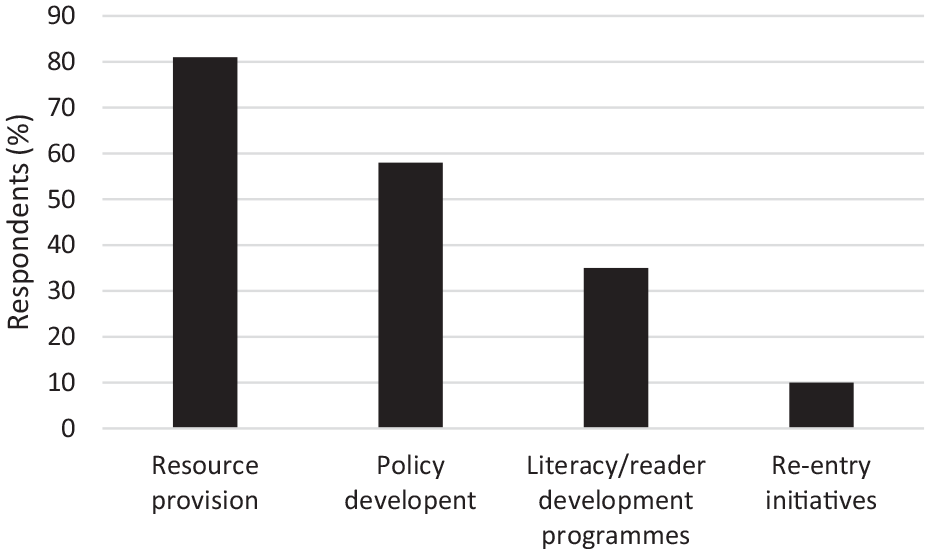
Collaboration with local public libraries (n = 30).
One interview participant attributed the separation between her library and the public library to the geographical location of the prison, describing her library service as ‘a little bit out of sight, out of mind’ (Participant C). Another spoke of her frustration that the public library service did not support or reach out more to the prison: It would be good once your research is done, if you could identify this gap and encourage local public libraries to take the initiative to contact the local prison to see what they could offer and do to liaise with each other rather than it having to be the prison librarian contacting them. (Participant A)
All participants noted working to some extent with external volunteers and organisations either for provision of resources or contribution to literacy programmes and events run within the library.
We try to have some kind of monthly event. . .This month’s was actually a wellbeing drop-in, where we got outside people in, professionals, to weigh them and talk to them about diet etc. We’ve had author talks, we’ve had poetry workshops, things along that line. . .and we’re soon going to start a creative writing workshop. (Participant D)
A final example of communication is that between prison library professionals working in different institutions. It has been established that the prison library can be an isolating place to work, and this isolation is deepened by the lack of communication between other professionals working in similar job roles. Some staff members referred to the prison library JISCMail list as a way to email other prison library staff when they had a query about a work-related matter, and the annual CILIP Prison Libraries Group Training Day was also valued as a way for staff to meet up and discuss their profession once a year. Despite these methods of communication, library staff still expressed a desire to increase their interaction with other professionals and to share their workplace experiences: What would be interesting would be to have the opportunity to talk to other library staff more about what they do, pick their brains and get some ideas. (Participant C) I think the research is really useful for us as well because you do get to find out what other prisons are doing. (Participant F)
Implications of findings: Hopes and concerns for the profession
Findings have underlined some of the challenges and frustrations which exist when providing library services in restrictive regimes, but also the strong belief held by library staff about the value of their work and the positive outcomes for prisoners who engage with library services. Concerns and aspirations for the prison library profession underpinned conversations with library staff in this study. Library staff were keen to increase liaison with local public libraries, particularly in the pre-release and resettlement stages for prisoners. It was acknowledged that the severe budget cuts and library closures in recent years (particularly in England) added to the challenge of fostering good relationships with nearby public libraries. As well as increased collaboration with public library staff, participants also expressed a desire for further integration with other prison departments and inclusion in departmental and planning meetings. Findings have shown the benefits of working alongside others in the prison and in particular the education department. It can lead to more holistic support of prisoner learning, and help to raise awareness among staff and prisoners of what the library offers. Participants underlined the need for improved resources and library spaces to support a user population with critical literacy, recreational and language needs. They further expressed a desire for more consistency across prison library services nationally, recognising that the level of access to libraries and the range of resources differed across prison sites: It would be nice if there was a greater consistency across the board in levels of what we offer. Especially because we transfer people all the time – the guys will move on from here and go somewhere else and it will be different. In an ideal world, it would be seamless. (Participant J) I think there needs to be a better structure that applies to the whole framework. Every prison needs to follow the same sort of structure, and until that I think it’s just always going to be the case of, people say ‘oh well that prison’s got it better because they’ve got this and that.’ Every prison needs to have the same opportunities. I hope one day it becomes that. I just hope they’re not eradicated! (Participant I)
The overriding concern expressed by staff members was the fact that the library and the positive outcomes of library engagement are so often overlooked, both within the prison and among the wider library profession, resulting in a lack of inclusion in relevant policy documents and strategic planning. Ultimately, they were hopeful for increased awareness of the value of their services:
I want to see the profile of prison libraries raised everywhere! (Participant J)
The libraries being seen and being treated as an integral part of the whole process, from the guys’ induction, during sentence time, pre-release, release and resettlement – I think the library should be seen as a very important part of that. That’s what I would like to see. (Participant A)
Measuring the outcomes of prison library engagement is a crucial way of showing their value for library users. Collecting routine statistics about, for example, library footfall, participation in library events, book loans and book requests can help to show levels of engagement with library services, which events or programmes are best attended by library users and which books are most popular or in most demand. While these statistics are important, it is necessary to move beyond statistics to learn from individual experiences of engaging with library services. Usherwood (2002: 1128) notes, ‘Statistics are just a small part of the reality of the library, and any meaningful demonstration of its value has to go beyond simple quantification.’ A mixed methods approach, including collection of statistics and user feedback, is therefore encouraged to develop a comprehensive understanding of prison library provision and engagement (Colorado Library Consortium, 2020).
Collaborating to serve the whole person
According to Lehmann (2000a,), ‘new prison librarians have a better chance for success, if they have additional education or work experience in other areas such as psychology, criminology, teaching, social work, or counselling’ (p. 126). This speaks to the unique setting in which prison library staff work and the varied and complex needs of the users they serve. Prison library researchers have begun to draw on the theory and practice of Whole Person Librarianship as a better way to understand how library services impact upon the whole person while in prison, including their mental, physical and spiritual health (Garner, 2019; Mishra et al., 2022). The theory and practice of Whole Person Librarianship originated in the public library sphere, where there is an evolving practice of social workers working in public libraries and collaborating with library staff. Recognising the overlap in values of librarianship and social work, this movement urges library workers to learn from social work principles and practices in order to better serve the wide-ranging needs of library users in the community (Zettervall and Nienow, 2019). Whole person librarianship has successfully shown how the library profession can learn from the main principles of social work to enhance their services to patrons and how collaboration between library workers and social workers can help to better support the growing psychosocial needs of library users, including mental health, poverty, homelessness and substance abuse (Wahler et al., 2021). In a prison context, where these needs are at their most critical, library professionals have the opportunity to draw on the expertise not just of social workers, but of psychologists, teachers, criminologists and others with a deep understanding of the prison system and of the social challenges faced by incarcerated individuals. Communication and collaboration between staff members opens avenues for new understanding and can help library staff to tailor resources and services to better meet the needs of their users.
It is clear from this current study that opportunities for communication and collaboration across departments are not easily found in the prison context. This is an issue which extends beyond the prison library. In their study on supporting resettlement into the community, Moore and Hamilton (2016) refer to ‘silo mentalities’ which exist throughout the prison system, where a flawed organisational structure results in a lack of contact between departments or understanding of their respective spheres of work (p. 120). Yet, the importance of such interprofessional practice is vital and should be a priority throughout the prison system. Dugdale et al. (2022: 340) note that ‘Supporting prisoners is an interprofessional practice where many agencies/professionals overlap in their work and collaborate.’ For library staff, not only can interprofessional practice help to provide more effective library services that support the whole person, but it also has the potential to raise the profile of the prison library by making others aware of the full range of services offered by the library.
This study has also drawn attention to the need to combat isolation that exists within the wider prison library profession. The existing JISC Prison Libraries mailing list and CILIP’s annual Prison Libraries Group Training Day were mentioned as a useful resource and event for liaising with other prison library staff. Beyond this, it is recommended that a more comprehensive series of CPD and training opportunities be developed for prison library staff. The COVID-19 pandemic has shown the potential for increased collaboration through online platforms, which could be utilised to delivered a nationwide series of webinars and workshops created both for those working in prison libraries, and library staff in other sectors whose role involves supporting the provision of prison library services. As well as ensuring prison library staff have equal access to CPD opportunities as staff in other sectors, this would also provide a crucial space for staff interaction and the sharing of ideas. An interesting example is described by Boyington and Barnes (2021) who write about the experience of library staff in the Colorado Department of Corrections (CDOC). Colorado State Libraries have invested significant time and money into staff development, including an online summit solely for CDOC library staff, which ‘provided opportunities for geographically isolated staff members to connect to one another and form communities of practice’ (p.286). Similar online events were held by Ulster University in June 2022, including both a symposium on prison libraries and an online CPD workshop for those working in prison libraries which again enabled communication between staff members who rarely have the opportunity to communicate and share good practice (Ulster University, 2022).
Conclusion
This paper offers a rare insight into the day-to-day experiences of prison library staff in the UK, giving a voice to those who are often overlooked within their workplace and their wider profession. It has outlined some of the inherent challenges of working in a siloed environment where safety and security are paramount, and where access to library services is rarely prioritised. It has also shown the implications of working under dual management where neither manager fully understands the service or staff responsibilities. Increased communication with local public libraries and collaboration with other prison departments can help to mitigate this lack of understanding and promote the value of prison library services. It is important to find a way of demonstrating library outcomes, without having to provide meaningless quantitative data to the prison which does not accurately reflect prisoners’ engagement with its services. The isolation felt by library staff from the wider library and information profession must also be addressed. Increased access to professional development opportunities can both help to remain informed about technological advances in the wider profession as well as offer opportunities to liaise with staff in other prisons to share experiences and good practice. Prison libraries are gateways to information in an information poor environment and provide a safe space in which to pursue educational, cultural and recreational pursuits. Yet, without skilled library staff to manage these services and support library users, the library is at risk of being reduced to ‘a room full of books’ (Boyington and Barnes, 2021: 289). It is imperative that prison library staff have the support and professional development opportunities needed to continue providing this essential service to people in prison.
Footnotes
Acknowledgements
The author would like to thank Dr Jessica Bates from the School of Education at Ulster University for her helpful feedback prior to the submission of this paper.
Declaration of conflicting interests
The author declared no potential conflicts of interest with respect to the research, authorship, and/or publication of this article.
Funding
The author received no financial support for the research, authorship, and/or publication of this article.

Notes
Data availability statement
The data that support the findings of this study are available from the corresponding author upon reasonable request.