



Abstract
This study examined the knowledge hiding behaviour (KHB) of undergraduates of a university in southwestern, Nigeria, as well as the individual and social factors influencing their knowledge hiding behaviour. The study adopted the descriptive survey design. Random sampling was used to select 390 undergraduates across the faculties of the university. A structured questionnaire was used to collect data. Findings revealed that the undergraduates engaged in knowledge hiding. The study also identified the various methods the students used to hide knowledge, among which are pretense of lack of knowledge, avoiding interactive classes, reading alone and unwillingness to release lecture notes, among others. The results show that the individual factors (distrust and psychological ownership), as well as the social factors (negative or lack of mutual reciprocity, lack of social interaction and lack of social identification), predicted the KHB of the students. The study concluded that the undergraduates engaged in knowledge hiding in so many ways and for many reasons. The individual factors of the students, as well as the social factors surrounding them, predicted their KHB. The study made some recommendations for research and practice.
Keywords
Introduction
The field of knowledge management is a field that has received a lot of attention in the last decades as attention is given to the importance of knowledge sharing (KS) for individual and organisation and societal survival. The benefits associated with knowledge sharing are numerous which many studies have been able to establish. Empirical studies have shown that organisational performance is significantly improved by transferring knowledge, which makes organisations encourage the KS practice by developing various reward systems, improving social networks and relationships among employees (Manzoor et al., 2021; Škerlavaj et al., 2010) and encouraging the culture that supports KS (Connelly and Kelloway, 2003). However, the KS field still faces practical and theoretical challenges, primarily among, is the management of undesired individual behaviours, such as knowledge hiding and hoarding behaviours. Knowledge hiding (KH) and knowledge hoarding behaviours are actions impeding the flow of knowledge transfer in the organisational environment and have been found to weaken interpersonal and organisational level performance (Evans et al., 2015; Kang, 2016; Qureshi and Evans, 2015; Serenko and Bontis, 2016).
Despite the many efforts to promote and encourage KS in organisations, many organisations still do not achieve remarkable successes (Akpoviroro et al., 2018; Hung et al., 2011) as not all individuals are favourably disposed to sharing knowledge and, in many cases, personnel are not keen or encouraged to share their knowledge - even when the organisational design has simplified the KS process. This leads to an attempt to hide, withhold or conceal requested knowledge (Connelly et al., 2012). This reluctance is an obstacle to innovation, development and good performance. Unwillingness may even occur when people are encouraged and rewarded to share knowledge (Bock et al., 2005; Issac and Baral, 2018).
Knowledge hiding and knowledge hoarding behaviours are separate and independent concepts within the scope of KS; however, the two concepts target behaviours of knowledge withholding; hence, have some degree of overlap. KH is ‘an intentional attempt by an individual to withhold or conceal knowledge that has been requested by another person’ (Connelly et al., 2012: 65). It refers to a dyadic relationship between one individual requesting knowledge from another, who in response withholds that knowledge. However, in addition to denying requested information, individuals may also choose to hoard important unrequested information (Serenko and Bontis, 2016; Steinel et al., 2010). Knowledge hoarding is defined as the simple withholding of knowledge, which has not been requested by any specific individual (Bilginoğlu, 2019; Webster et al., 2008). Knowledge hoarding, is merely the act of retaining knowledge, often without realising it may be of value to others; hence, ‘an individual’s deliberate and strategic concealment of unrequested information and knowledge’ (Evans et al., 2015: 2).
Although KH and knowledge hoarding share important conceptual links and overlapping definitions (Serenko and Bontis, 2016), they have particular characteristics that distinguish them from each other. KH involves explicitly requested knowledge, while knowledge hoarding refers to the concealment of unrequested knowledge. Thus, the degree of intentionality and the request criterion are the main elements differentiating the two concepts (Serenko and Bontis, 2016; Silva de Garcia et al., 2022). According to Connelly et al. (2012), the concepts are both theoretically and empirically distinguished. Theoretically, the two concepts differ in three main aspects: intentionality, request and scope. Empirically, they are weakly correlated and demonstrate discriminant validity among their indicators. Concerning these discriminatory aspects, knowledge hoarding is characterised as being a less intentional form of concealment, referring to knowledge not requested by specific others and by having a smaller behavioural scope, than KH (Connelly et al., 2012). This type of knowledge may be impossible to request, yet essential for organisational survival. Unlike knowledge hoarding which entails a less intentional form of concealment (Holten et al., 2016), because it does not seem to be motivated by an intention to disguise some requested knowledge (Webster et al., 2008), KH is more dysfunctional (Trusson et al., 2017). KH constitutes a threat to the continuity of individuals’ and organisations’ knowledge base and productivity. KH can also damage interpersonal relationships in organisations by creating an atmosphere of distrust among employees and ultimately reducing the organisation's productivity and performance (Hernaus et al., 2019).
It is, however, important to point out that KH and KS are not opposites of each other; rather, they are two distinct conceptually constructs, and the incentives behind each are different (Connelly et al., 2012). While KS is an intentional attempt by an individual to share knowledge, KH is an active and intentional attempt to withhold or conceal knowledge that others have requested (Anaza and Nowlin, 2017; Connelly et al., 2012; Peng, 2013). It could also imply an attempt by an individual to give less information or knowledge (Demirkasımoğlu, 2016), or an act of keeping requested knowledge purposely secret (Hislop, 2003). Even though KH is found to be a well-known phenomenon in organisations as employees use different strategies to hide their knowledge; it is also a common occurrence among individuals. Studies have even shown that KH and KS could be done simultaneously by an individual (Ford and Staples, 2008; Silva de Garcia et al., 2022). KH can have different motivations, which vary from, for example, protecting oneself or someone else’s feelings, to social exclusion, to simple laziness. Many times, KH happens when knowledge is considered to be a means of power or leverage, probably most likely by goal-oriented individuals (Johannessen, 2018). KH impedes individual and organisation growth, innovation and development. Černe et al. (2014) proved that KH behaviour was found to be a negative factor in workers’ creativity, innovation and performance.
It has been found that most researches on organisations are related to KS, while KH has seldom been investigated. However, studies (e.g. Connelly et al., 2012, 2019; Demirkasımoğlu, 2016; Hernaus et al., 2019; Muhenda and Lwanga, 2014) have shown that KH occurs in institutional bodies, such as academic institutions. KH has been found in higher education institutions, which are otherwise supposed to be institutions of learning, and where KS is expected to be given priority. KH in academic settings is described as a mixed-motive behaviour that contains elements of both collaboration and competition (Hernaus et al., 2019). KH in academic institutions reduces creative ability, academic performance and innovativeness (Černe et al., 2014) as academics are not expected to hide knowledge but to share it.
Some previous research has identified several factors that influence KH in organisational settings and also among academicians, with most of these studies focussing on behavioural factors from different behavioural theories. Factors, such as psychological traits (Pan et al., 2018), perceived organisational politics (Malik et al., 2019), competitiveness within the organisation (Hernaus et al., 2019), personality traits (Anand and Jain, 2014; Demirkasımoğlu, 2016; Iqbal et al., 2020), lack of rewards for KS, internal competition and psychological entitlement (Issac and Baral, 2018; Wen and Ma, 2021), social relationships (Su, 2020), among others have been identified to influence KH. It has also been found that individuals may also hide knowledge when they consider several potential costs that they may have to bear personally due to sharing their knowledge, for example, the loss of status or power (Cress et al., 2005; Gagné et al., 2019; Silva de Garcia et al., 2022). However, most of these factors have been identified at the organisational level, mostly in non-academic institutions, with little consideration given to identifying factors that influence KH, especially among students who are expected to share knowledge among themselves in the course of learning. The study was, therefore, designed to investigate the knowledge hiding behaviour (KHB) of undergraduates of a university in southwestern, Nigeria and the factors that influence their KHB. The specific objectives are to:
i. investigate if the students hide knowledge,
ii. investigate the reasons why the students hide knowledge,
iii. identify the individual factors that predict knowledge hiding among the students and
iv. identify the social factors that predict knowledge hiding among the students.
Literature review
There is versed literature on KS, while scant literature was found on KH, especially among academics. The review of literature, however, shows the level of studies that have been carried out in the area of KH. Our literature review identifies the gaps in the literature, provides the foundation for the conceptual framework and informs the methodology adopted for this research. The pieces of literature are organised chronologically, while the methodology, key findings, limitations of the studies and future research directions were highlighted and discussed.
The study of Connelly et al. (2012) provides valuable insight into the concept of KH by explaining why employees are unwilling to share their knowledge even when organisational practices are designed to facilitate sharing. Their study also developed a multidimensional measure of KH, which subsequent studies have improved on. Connelly et al. study was into three parts. The first study used an event-based experience sampling methodology (ESM) to assess the daily KHB of employees and verify the existence of KH in organisations, thereby establishing a preliminary link between distrust and KH intentions. The first study also discovered possible strategies that employees used to hide knowledge from coworkers. Drawing upon the results of the first study, the second study was designed to create a measure to capture KH behaviour, examine the dimensionality of KH, establish the reliability of the items used to assess this construct and explore the discriminant validity of KH by ascertaining if KH behaviour is demonstrably separate from related behaviours, such as knowledge hoarding and knowledge sharing. With evidence pointing to the existence and dimensionality of KH, the third study was an exploratory study that sought possible predictors of KH behaviour and examined some possible interpersonal and situational factors that affected employees’ KH in organisations. The results of the three studies suggested that KH occurred in the organisations daily, and that distrust influenced future intentions to withhold knowledge. The study also identified several predictors of KH in the organisations and suggested that KH was comprised of three related factors: evasive hiding, rationalised hiding and playing dumb. Each of the hiding behaviour was predicted by distrust, and each also had a different set of interpersonal and organisational predictors. Connelly et al. (2012) however, suggested that future studies could ascertain what other interpersonal dynamics, aside from distrust, could influence KHB. Another study by Connelly et al. (2019) also advocated for additional research on the factors that contribute to an individual’s decision to hide knowledge; hence, this study.
Peng’s (2013) study provided a first empirical attempt to understand when and how knowledge-based psychological ownership affects KH. The study built and tested a theoretical model linking knowledge-based psychological ownership with KH through territoriality. The descriptive survey research design was adopted and data were collected from 190 knowledge workers of an information technology industry company in Shanghai, China, through a three-wave web-based survey. Results showed that KH occurred in the organisation and that knowledge-based psychological ownership positively influenced KH. The study suggested that to reduce KH, organisations should focus on practices that can decrease employees’ self-perception of possession of knowledge and territoriality and those that can strengthen employees’ psychological ownership of organisations. Peng’s (2013) study also confirmed the existence of KH in organisations and highlighted the influence of psychological ownership of knowledge on KHB. The study suggested that future research should focus on exploring the influence of knowledge-based psychological ownership in another environment, which this current study also considered.
The study of Demirkasımoğlu (2016) was conducted in an academic environment. The study investigated KH among 386 academicians from education and engineering colleges in Turkish universities by analysing the types of knowledge the academics hid, and the relationship between personality traits of the academics and their KHB. The survey research design was adopted. The KHB of the academics was measured to define evasive hiding, lack of sharing, playing dumb, rationalised hiding and knowledge hoarding. Results suggested that KHB existed in academia, though not a prevalent phenomenon. The academics’ relatively highest KHBs were related to ‘rationalised hiding’ followed by ‘evasive hiding’ and’ playing dumb’. The academics ‘played dumb’ to their superiors whereas they acted ‘rationalised hiding’ to co-workers. The study showed some of the variables that influenced KH in Turkish universities, which could also apply to universities in Nigeria; hence, some of the variables were adopted for this study. However, Demirkasımoğlu concluded that even though many KH cases were reported in the literature, KH was not a prevalent phenomenon in Turkish academia.
The study of Kumar Jha and Varkkey (2018) identified some factors that influenced KH among research and development (R and D) professionals of pharmaceutical firms in the western state of India. The study confirmed the findings of Connelly et al. (2012) on the antecedents of KHB, such as distrust, KS climate, task-relatedness and the types of strategies used by knowledge hiders in an organisation, such as playing dumb and rationalised hiding behaviour. The study also identified some new antecedents of KH in the workplace, especially in the R and D setting, such as knowledge self-efficacy, lack of recognition, fear of losing importance, job insecurity and future reciprocation of knowledge from others. In addition, four hiding strategies that were used by the employees to hide knowledge from their fellow members, such as playing innocent, being misleading/evasive hiding, rationalised hiding and counter-questioning, were identified. Distrust among colleagues emerged as the primary factor triggering KHB among team members. In addition, ways of hiding knowledge used by the employees were identified and new forms of strategies named ‘counter-questioning’ were also found. The study of Kumar Jha and Varkkey used a qualitative method of inquiry to capture the experience of respondents. They, however, suggest that future studies may adopt quantitative methods to extend their findings or investigate factors that influence KH in another setting. Hence, this current study adopted a quantitative method to study KH in another setting, which is academia.
Labafi (2017) also conducted a qualitative study to investigate the influence of KH as an obstacle to innovation in the software industry. Experts from different specialised fields in a computer firm in Isfahan, Iran were surveyed. Thematic analysis was used as the research method for the interpretation of data. The study found that the software engineers reduced the level of individual and organisation interpersonal relationships with their colleagues to prevent exposure to hidden knowledge. Several factors were identified as predictors of KH which are behaviour characteristics, the complexity of knowledge, power of the requesting person, organisational incentives for KS, lack of clear responsibility for KS, sense of internal competition, level of trust in colleagues, the effect of new media, learning ability of the knowledge demandant, level of personal contacts with colleagues, avoiding information presentation, deceiving colleagues, violence and negative feedback from the organisational environment. Because the study of Labafi adopted a qualitative approach, some other factors contributing to KH in an organisation were identified, which previous studies that adopted the quantitative approach did not consider. This present study, therefore, considered some of the factors (organisational incentives for KS, sense of internal competition, level of trust in colleagues, level of personal contacts with colleagues, deceiving colleagues) in the investigation of the KHB of students in Nigeria.
Lastly, the study of Mangold (2017) also provided some contributions to the study of KH. Mangold used a purposeful, cross-sectional sampling method to investigate the KHB of employees from a global organisation in the automotive industry in Germany. Virtually all interviewees reported that a certain degree of competition existed in their organisation and stressed that the motivation of employees to achieve superior levels of performance made them engage in intentional KH. This implies that the employees’ KHB was not merely a simple refusal to transfer knowledge but an intentional behaviour to refuse to share knowledge. The study did not only find support for antecedents consistent with previous research (competition, reciprocal behaviour and poor personal relationships between perpetrator and target) but also antecedents that were new and sometimes unexpected. The study also found that employees’ KH was influenced by distrust, reciprocal KH in terms of tit for tat and beliefs of knowledge ownership. The study extended previous research by introducing new reasons to engage in KH such as gaining a competitive advantage over peers, maximising own benefits or diminishing the performance of others, compliance to social norms or leader’s demands, lack of personal benefits, or fear of adverse outcomes, desire for retaliation of prior misconduct of the knowledge seeker, personal dislike and employees’ perceptions of knowledge as an asset. The author also suggested the need for future research to provide further empirical findings into the antecedents of KH.
A recent study by Nguyen et al. (2022) examined KHB and its antecedents and consequences among 281 Vietnamese employees working during the COVID-19 pandemic. The study was premised on the organisational crises leading to shutdowns, mergers, downsizing or restructuring to minimise survival costs caused by the COVID-19 pandemic. They envisaged that employees may tend to experience a loss or lack of resources and thus more likely to engage in KH to maintain their resources and competitive advantage. Drawing upon the Conservation of Resources and Transformational Leadership theories, data was collected from 281 Vietnamese employees working during the COVID-19 pandemic. The results showed that role conflict, job insecurity and cynicism positively impacted the KHB of the employees, while KHB negatively affected job performance and mediated the antecedents of KH on job performance. The study found that KH led to a reduction in employee job performance, which confirmed the adverse impacts of KH on job performance as other studies (e.g. Singh, 2019) have also highlighted.
The review of the literature showed that studies have been carried out extensively on KH mainly among employees in various organisations in other parts of the world, whereas no known study was found for Nigeria. Besides, adequate attention has not been given to investigating KH in the Nigerian academic, where preliminary observations revealed that KH occurs. Also, some of the factors influencing KH identified by past studies need to be studied; hence, the reason for undertaking this research, so that recommendations could be made to mitigate the occurrence of KH in academics. Adopting the Social Exchange Theory, the Psychological Ownership Theory and the Social Capital Theory, the influence of the commonly identified factors such as distrust, psychological ownership, lack of social interaction and lack of social identification on the KHB of students were investigated in this study.
Research framework and development of hypotheses
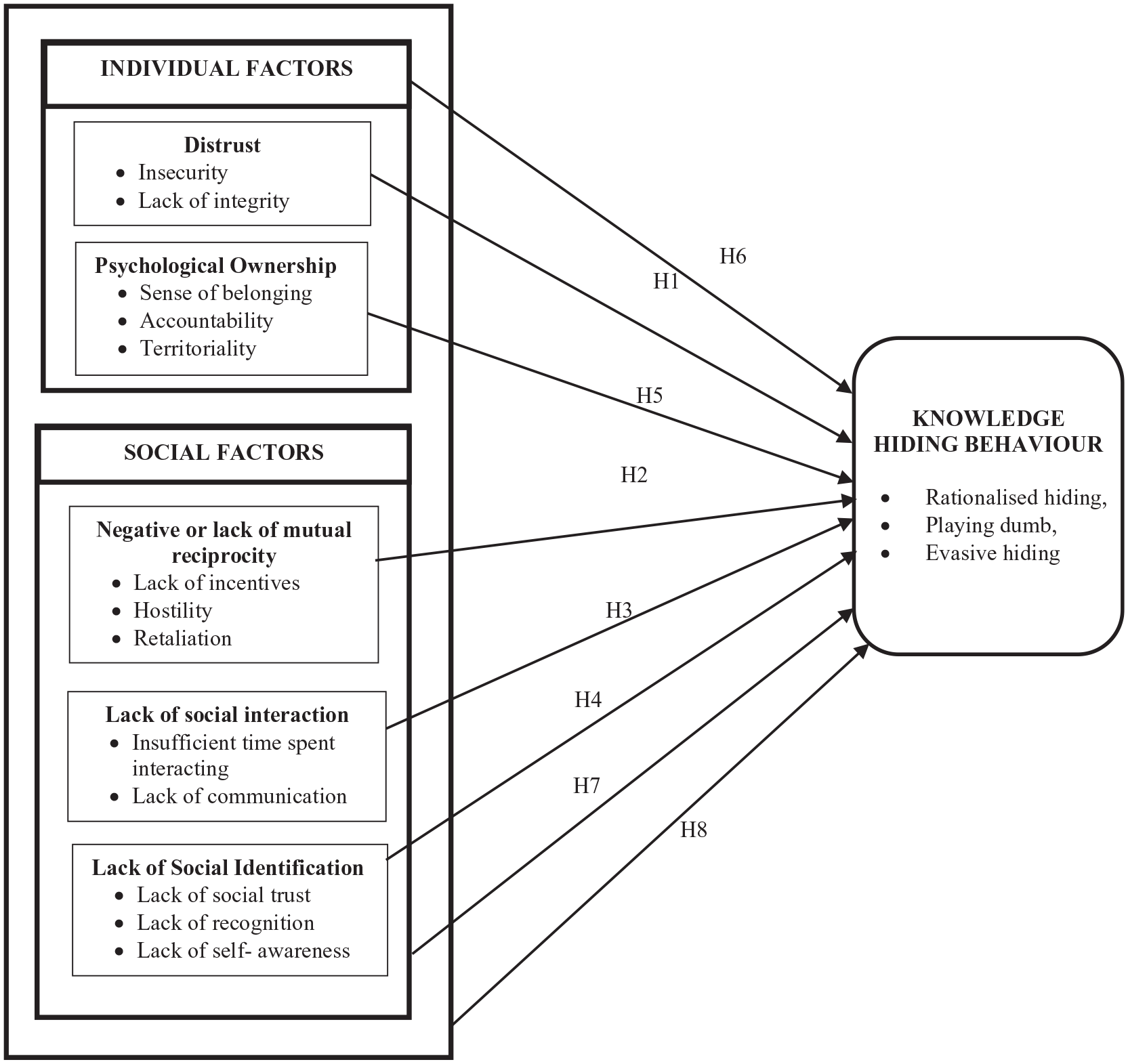
Many theories have been used to investigate knowledge sharing and hiding, among which are the Social Exchange Theory (SET), the Social Capital Theory (SCT), the Theory of Reasoned Action (TRA), the Theory of Planned Behaviour (TPB), the Psychological Ownership Theory (POT) and the Big Five Personality Theory (BFPT). However, this study adopted the SET, the SCT and the POT to investigate the factors influencing the KHB of university students. This study adopted five independent variables categorised into individual and social factors to examine the KHB of university students. The individual factors are distrust and psychological ownership, while the social factors are negative or lack of mutual reciprocity, lack of social interaction and lack of social identification. The dependent variable is KHB. These variables are important for this study because they were derived from theories, models and variables used in the previous research and thus guided this study. The variables are discussed in the following section.
The social exchange theory
The SET is among the most influential conceptual paradigms for understanding human behaviour in an organisation. Homans (1968) introduced the concept of social behaviour which is based on exchange. Homan also presents the notion that exchanges are not limited to material goods but also include symbolic value (e.g. approval and prestige). Homan’s viewpoint was that people seek a normative balance between cost and rewards, not focussing on profit maximisation at the expense of others. The SET is a commonly used theoretical base for investigating an individual’s KHB (Blau, 1964; Connelly et al., 2012). Dyadic interactions in organisations are generally governed by an unspoken social exchange between individuals (Blau, 1964; Mitchell et al., 2012). Connelly et al. (2012) employed the SET to investigate KH in organisations and suggested that the history of reciprocity among colleagues may affect the likelihood of an employee engaging in KHB. This study was premised on the assumption that previous KHBs among colleagues may affect the likelihood of a person also engaging in KHB; and because KH occurs between two or more individuals, the quality of the relationship between these individuals is likely to affect how an individual responds to a request for knowledge from another. It is assumed that lack of reciprocity may underlie ineffective social exchanges or interactions (Blau, 1964; Wang et al., 2014), and as such, may affect people’s KHBs, which can lead to interpersonal distrust (Černe et al., 2014; Connelly, et al., 2012; Kumar Jha and Varkkey, 2018; Mangold, 2017). For instance, an individual who has had his/her previous requests for knowledge rebuffed may withdraw from interactions with others and may retaliate by also hiding knowledge. This study, therefore, investigated the prediction of distrust, lack of negative reciprocity and social interaction on KHB.
Distrust
Distrust is defined as a ‘lack of confidence in the other, a concern that the other may act to harm one, and that the other does not care about one’s welfare, intends to act harmfully, or is hostile’ (Grovier, 1994: 140). Distrust is engendered when ‘an individual or group is perceived as not sharing key cultural values’ (Sitkin and Roth, 1993: 371). Interpersonal distrust leads to KHB in the institution (Connelly et al., 2012; Wu et al., 2022). Studies have confirmed that knowledge creators hide knowledge from seekers, especially if they do not trust them (Afshan et al., 2022; Černe, et al., 2014; Mangold, 2017; Peng et al., 2019). Connelly et al. (2012) identified that distrust is a key predicting factor of KHB in an organisation; the more employees distrust the person they are interacting with, the greater their intention to withhold knowledge from them in the future. Furthermore, Kumar Jha and Varkkey, (2018) also stated that knowledge creators hide knowledge from seekers, especially if they distrust them. Employees having experienced KH are most likely to retaliate by hiding their knowledge also, thereby creating a vicious cycle that further restricts the creation of new knowledge within an organisation. Distrust is considered one of the factors that could predict KH among undergraduates; hence, the first hypothesis was proposed:
H1: There is a significant relationship between distrust and KHB.
Reciprocity
In social interaction and exchange, positive relationships draw on norms of reciprocity and expectations of trust, honesty and mutual aid (Buller and Burgoon, 1996). For instance, a person who voluntarily and spontaneously engages in positive behaviour towards another person will implicitly enjoy a similar yet unspecified reciprocity behaviour, and over time, as the nature of the exchanges expands, obligations are fulfilled and new ones are created, trust between the parties builds. Reciprocity is said to be a universal component of the moral codes governing behaviour (Gouldner, 1960) that promotes social exchange and strengthens the social system (Irum et al., 2020; Mohsin et al., 2022; Zaheer et al., 2022). Reciprocity provides an explanation for behaviour that at once complements but also fundamentally differs from explanations based on incentives and the pursuit of self-interest (Belmi and Pfeffer, 2015). Mutual reciprocity can be defined as a situation in which a person is expected to cooperate with individuals who do something for that person first, and the norm of mutual reciprocity plays a large role in explaining interpersonal behaviour in many social situations. Lack of mutual reciprocity has been shown to have a huge effect on the important mechanism for exercising interpersonal influence (Mohsin et al., 2022).
Reciprocity is categorised into two types: positive reciprocity and negative reciprocity (Caliendo et al., 2010; Serenko and Bontis, 2016; Shaw et al., 2019). Positive or mutual reciprocity is said to be an individual’s tendency to return positive treatment for positive treatment. Positive reciprocity embodies an altruistic spirit which implies that people will return positively to a perceived friendliness. Negative or lack of mutual reciprocity, represent an individual’s behavioural tendency to return negative treatment for negative treatment or be hostile (Caliendo et al., 2010; Cropanzano and Mitchell, 2005; Shaw et al., 2019). It reflects a kind of self-serving spirit that also emphasises that people will retaliate against perceived unfriendliness. Individuals who hold high levels of negative reciprocity beliefs are often sensitive to negative interpersonal information and tend to exert self-serving motivation (Cropanzano and Mitchell, 2005; Mitchell et al., 2012), hence tend to hide knowledge. For instance, when an individual realises that colleagues intentionally conceal their knowledge, they may also retaliate in the same manner by hiding their knowledge. This study adopts lack of incentives, hostility and retaliation as the measuring variables for negative or lack of mutual reciprocity. Therefore, we proposed that negative or lack of mutual reciprocity experienced by the undergraduates could prevent them from sharing knowledge, hence the next hypothesis was proposed:
H2: There is a significant relationship between negative or lack of mutual reciprocity and KHB.
Lack of social interaction
KH is a social interaction culture, involving the non-exchange of knowledge, experiences and skills. Social interaction represents the strength of relationships, the amount of time spent and the frequency of communication among members of a community (Chiu et al., 2006); a situation where the behaviour of an individual is consciously reorganised by the behaviours of another individual through the exchange of knowledge, and vice versa. Social interaction is said to be the elementary process in all social organisations. Several studies (e.g. Chiu et al., 2006; Hasgall, 2012; Wasko and Faraj, 2005) provide empirical support for the influence of social interaction on an individual’s behaviour towards knowledge. Liang et al. (2008) explain that social interaction ties among members of a community allow a cost-effective way of accessing a wider range of knowledge sources; hence, lack of social interaction could hinder KS. Based on this, we proposed another hypothesis. The variables used for measuring the lack of social interaction are time spent with colleagues and communication frequency among the students.
H3: There is a significant relationship between lack of social interaction and KHB.
The social capital theory
The concept of social capital was proposed in management science by Nahapiet and Ghoshal (1998) and has been used to investigate the concepts of KS and KH (Silva de Garcia et al., 2022; van Dijk et al., 201). In the knowledge management field, the social capital framework incorporates both structural (network ties) as well as relational and cognitive social capital; that is, social trust, reciprocity, shared vision and peer influence (Lorenz and Buhtz, 2017). Social capital is defined as those resources inherent in social relations which facilitate collective action. Lin (2001) refers to social capital to be resources embedded in a social structure that is mobilised in purposive action. The SCT suggests that social capital is the network of relationships possessed by an individual or a social network, and the set of resources embedded within it, strongly influences the extent to which interpersonal KS occurs (Nahapiet and Ghoshal, 1998). Trust, norms, network ties, social identification, shared language and goals are social capital factors that could affect knowledge transfer. Through close social interactions, individuals can increase the depth, breadth and efficiency of mutual knowledge exchange. Nahapiet and Ghoshal (1998) define social capital with three distinct dimensions: structural (the overall pattern of connections between actors), relational (the kind of personal relationships people have developed with each other through a history of interactions such as trust, sanctions, expectations, identity, norms and social interaction) and cognitive (those resources providing shared representation, interpretations, codes and narratives). Social identification could influence KS, while lack of social identification could influence KH; hence, lack of social identification was adopted as a social factor that could influence the KHB of students.
Lack of social identification
Social identification describes a psychological state that users are not separate individuals but members of a collective society. Social identification captures an individual’s self-awareness of membership in a group and the emotional and evaluative significance of this membership (Lorenz and Buhtz, 2017). Identification acts as a resource influencing the motivation to combine and exchange knowledge. Social identification is the process whereby individuals see themselves as one with another person or group of people. In this study, social identification refers to the students’ sense of belonging and positive feelings towards one another in their learning environment. Valuable knowledge is embedded in individuals and individuals may not be willing to share knowledge unless the receivers are recognised as their groupmate and the contribution is conducive to their welfare. The perception of social unity and togetherness of the community elevates people’s activeness to share knowledge and increases the depth and breadth of shared knowledge (Chiu et al., 2006), while a lack of perception of social unity and togetherness could hamper KS. Therefore, another hypothesis was proposed:
H4: There is a significant relationship between lack of social identification and KHB.
The psychological ownership theory (POT) and KH
Psychological ownership reflects an individual’s awareness, thoughts and beliefs regarding the target of ownership. It is ‘a state in which individuals feel as though the target of ownership or a piece of that target is “theirs”, That is, “it is mine”’ (Pierce et al., 2003: 86). It is a cognitive-affective construct that is based on individuals’ feelings of possessiveness and of being psychologically tied or attached to objects that are material and immaterial (Pierce et al., 2001). Psychological ownership represents a relationship between an individual and an object (both material and immaterial), and in which the individual perceives the object) to have a close connection with the self (Pierce et al., 2001, 2003; Pierce and Jussila, 2010). Pierce et al. proposed the POT to explain the feelings of connection or the psychological state of ownership in the business context. Pierce et al. (2003) argued that the sense of ownership is manifested in the meaning and emotion associated with ‘my’, ‘mine’ and ours’. The state of psychological ownership is complex and consists of both affective and cognitive components, and the cognitive state is coupled with an emotional or affective sensation.
Researchers (e.g. Ispirli, 2014) have identified various dimensions of psychological ownership that are categorised under two independent forms borrowed from the regulatory focus theory, which are promotion and prevention. Individuals with promotive psychological ownership feelings consider improvement to the organisation as self-fulfilling and always show a willingness to change; hence, are more susceptible to sharing knowledge with colleagues. However, those with preventative psychological ownership tend to avoid knowledge sharing due to conservative reservations about change and the desire for having things as they are (Ispirli, 2014). The promotion-orientated dimensions of psychological ownership comprised self-efficacy, self-identity, accountability and a sense of belongingness. The prevention orientation comprised the territoriality dimension. The sense of efficacy as a dimension of psychological ownership is about the personal intention to do a task and owning the responsibility to achieve success (Avey et al., 2009; Guo et al., 2022). The accountability dimension makes individuals with high psychological ownership feelings expect others to be able to account for their impacts on the ownership target (Ispirli, 2014). A sense of belongingness is about feeling ‘at home’ with the target of ownership; that is, humankind always desires to inhabit a peaceful and risk-free, familiar and secure, controllable and defendable place. Territoriality implies possessive feelings over physical spaces, ideas, roles and relationships within the organisational context (Brown and Robinson, 2011; Guo et al., 2022).
Some previous studies (e.g. Pierce et al., 2001, 2003; Vandewalle et al., 1995; Van Dyne and Pierce, 2004) have associated psychological ownership with increased job satisfaction, employee involvement, organisational commitment and organisational citizenship behaviour. However, people may also tend to hide knowledge when they have strong psychological ownership feelings over knowledge. Individuals may be unwilling to share the target of ownership with others because they may experience a loss of control and negative emotions if they share it with others (Pierce et al., 2003). Also, individuals can form ownership feeling over a target if they have constant control over it, invest much time or energy in it or are familiar with it (Batool et al., 2022; Guo et al., 2022; Li et al., 2015; Peng, 2013; Pierce and Jussila, 2010). That is, the perception of a sense of belonging, accountability and territoriality could result in increasing KHB. For instance, Batool et al. (2022) found that stronger feelings of psychological ownership led to both positive work behaviour (i.e. knowledge sharing) as well as negative work behaviour (i.e. knowledge hiding). Mangold (2017) found that psychological ownership is one antecedent of KHB. Kumar Jha and Varkkey (2018) also stated that psychological ownership is more likely to have strong territoriality over knowledge which results in KHB. The students’ psychological ownership is a state in which the students feel as though the knowledge they have is theirs; hence, we propose in this study that the psychological ownership of knowledge by the students could influence their KHB, using sense of belonging, accountability and territoriality as the measurements.
H5: There is a significant relationship between the feeling of psychological ownership and KHB.
KH behaviour
KH behaviour is an action impeding the flow of knowledge transfer and has been found to weaken interpersonal and organisational level performance (Evans et al., 2015; Xu and Jiesen, 2022). Connelly et al. (2012) categorised KH into three: Rationalised hiding, Playing dumb and Evasive hiding. Rationalised hiding is a situation in which the hider provides a reason or justification for the failure to share the requested knowledge by explaining the difficulty of providing the requested knowledge or just blaming another person or party for the failure. Playing dumb is a situation whereby the hider pretends as if he does not know and is ignorant of the relevant knowledge, while Evasive hiding is a case in which the hider provides information that is not correct or a deceptive promise to provide a complete answer in the future, however, in reality, there is no plan of doing it. Perpetrators who use this technique may also simply try to convince the knowledge seekers that the knowledge required is simple (while it is quite complicated) and enforce them that they can try to acquire it by themselves (Anand and Jain 2014). This study assumes that all the individual and social factors could jointly predict KHB. Thus, we also proposed that:
H6: There is a joint significant relationship between the individual variables (distrust and psychological ownership) and KHB (evasive hiding, rationalised hiding and playing dumb).
H7: There is a joint significant relationship between the social variables (negative or lack of mutual reciprocity, lack of social interaction and lack of social identification) and KHB (evasive hiding, rationalised hiding and playing dumb).
H8: There is a joint significant relationship between all the independent variables (distrust, psychological ownership, negative or lack of mutual reciprocity, lack of social interaction and lack of social identification) and KHB (evasive hiding, rationalised hiding and playing dumb).
Figure 1 presents the conceptual framework, showing the relationships between the independent variables and the dependent variable. The factors are categorised as individual and social factors.
The conceptual framework.
Methodology
The study adopted the descriptive research design aimed at describing accurately and systematically the target population, situation or phenomenon and to have a deeper understanding of the factors that predict students’ KHB. The population of the study is undergraduates of the University of Ibadan, Oyo State, Nigeria. The university has 16 undergraduate faculties with a total population of 15,394 during the 2018/2019 session (source: Academic Planning Unit). Slovin’s formula was used to calculate the sample size, n = N/(1 + Ne2), where (n) represents the sample size; (N) represents the given total population size and (e) represents the margin of error. Therefore, n = 15,394/(1 + 15,394 * (0.05)2) = 389.87. Thus, the sample size is 390. Thereafter, 2.5% of the undergraduates across the 16 faculties cutting across the Humanities, Science, Social Sciences, Technology, Clinical Sciences and Basic Medical Sciences, were randomly selected, giving a sample size of 390.
A questionnaire was used for data collection. The questionnaire, which contained closed-ended questions, had items adapted from previous studies. Previously validated items were adapted to measure distrust (Connelly et al., 2012; Jessup et al., 2020; Rusk, 2018), psychological ownership (Peng, 2013), negative or lack of mutual reciprocity (Omotayo and Babalola, 2016; Serenko and Bontis, 2016), lack of social interaction (Chiu et al., 2006; Lasode and Ogunsola, 2019; Liang et al., 2008), lack of social identification (Chiu et al., 2006; Lasode and Ogunsola, 2019; Liang et al., 2008) and KHB (Connelly et al., 2012; Demirkasımoğlu, 2016). The questionnaire was divided into three sections, where section A collected data about the students’ demographics, section B collected data on KH behaviour and section C collected data on the factors influencing KHB. Four-point Likert scale of measurement (4 – strongly agree), (3 – agree), (2 – disagree) and (1 – strongly disagree) was used. The questionnaire was examined by two lecturers at the university for face and content validity. In addition, the reliability of the instrument was pre-tested among 20 postgraduate students of the university. The Cronbach’s alpha (α) coefficients reveal that all the variables have coefficients above 0.7, which is the acceptable reliability level (distrust with four items = 0.839, social interaction with four items = 0.908, mutual reciprocity with three items = 0.836, social identification with five items = 0.912, psychological ownership with six items = 0.824 and KHB with fourteen items = 0.702).
Three hundred and ninety copies of the questionnaire were distributed to the faculties of the respondents. Most of the respondents filled the instruments immediately because the researchers and the assistants targeted their free period for the administration. Those who could not fill immediately gave an appointment for collection. Eventually, 381 copies of the questionnaire were retrieved, filled properly and useful for analysis; which translated to a 97.7% response rate. Ethical procedures were followed during the design and administration of the instrument. Respondents were well informed about the study and were given the free will to participate in the study, and their anonymity was protected in the presentation of the results.
Results
The Statistical Package for Social Science version 20 (SPSS 20) was used to analyse the data. Descriptive statistics (frequency, percentage mean and standard deviation), as well as Linear and Multiple regression analysis, were carried out to determine the relative and joint relationship among the variables and the contributions of the independent variables to the dependent variable.
Socio-demographic profile of the students
The frequency and percentage distribution for the demographic characteristics show that 249 (65.4%) were males, while 132 (34.6%) were females. Those within the age bracket (20–25) were the most represented (58.3%). Most were 100-level students 118 (28.3%) and from the Faculty of Education (20.0%).
Knowledge hiding behaviour of the students
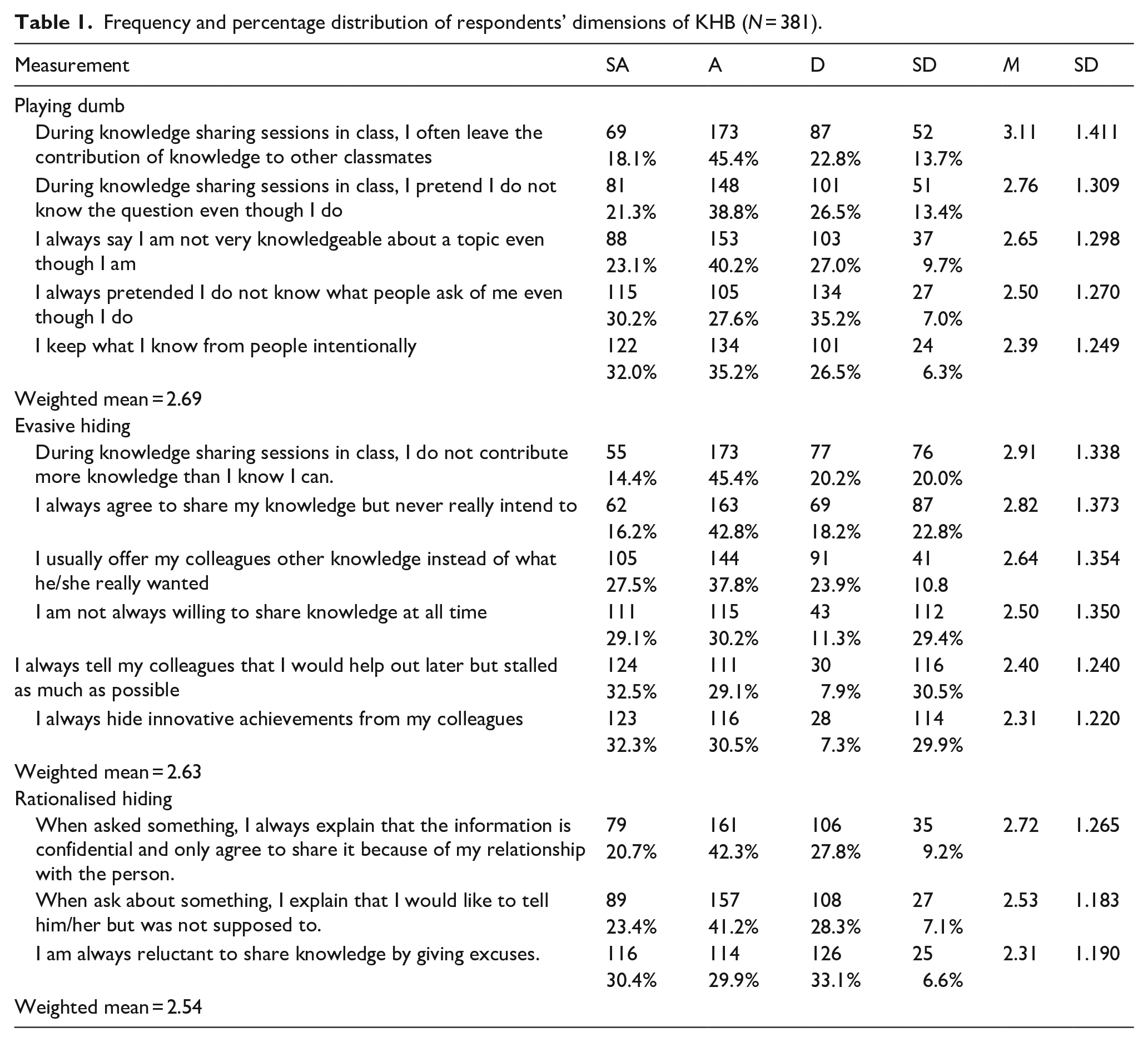
Table 1 shows the responses to the three dimensions of KH exhibited by the students. We categorised KH according to Connelly et al. (2012) dimensions. Most of the students agreed that they hid knowledge along the three dimensions. Most agreed to the first KH factor described as playing dumb (five items). This shows that the students did deceive their colleagues by pretending to be ignorant of the relevant knowledge. The results of the second dimension (evasive hiding) with six items also show that most of the students were involved in knowledge deception, by providing incorrect information or a misleading promise of knowledge, even when they had no intention to do this. Most of the students were also involved in the third dimension of KH, labelled rationalised hiding (three items). This type of hiding does not necessarily involve deception, but justifications were provided for failing to provide the requested knowledge. Overall, the responses revealed a moderate level of KH.
Frequency and percentage distribution of respondents’ dimensions of KHB (N = 381).
Reasons for KH
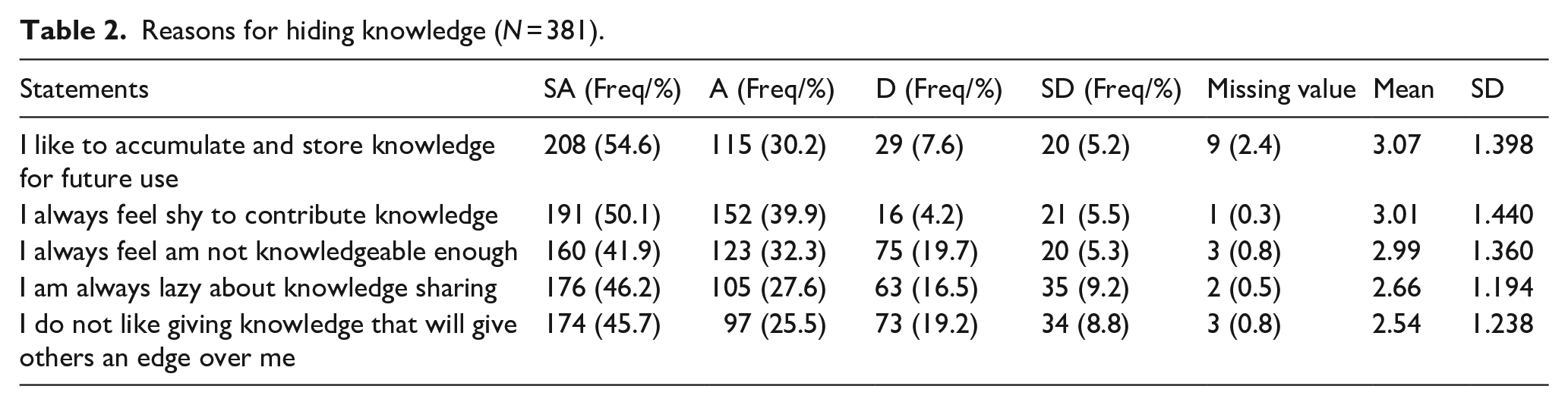
Table 2 presents the results for the reasons for hiding knowledge. Most of the students agreed that they ‘like to accumulate and store knowledge for future use’, ‘feel shy to contribute knowledge’, ‘not knowledgeable enough’, ‘lazy about knowledge sharing’ and ‘do not like giving knowledge that will give others an edge over them’. All the mean values of the statements are in the range of 3, showing that the respondents agreed with all given statements. This implies that the students had so many reasons for engaging in KH, such as fear of loss of knowledge, inadequate knowledge, lack of zeal for KS and fear of losing relevance/prestige, among others.
Reasons for hiding knowledge (N = 381).
Factors influencing KHB
The factors influencing KH were tested by the hypotheses. The hypotheses were tested in the null forms at a 0.05 level of significance. Linear and multiple regression analyses were used to determine the relative and joint relationship at a 0.05 level of significance.
Individual factors influencing KHB
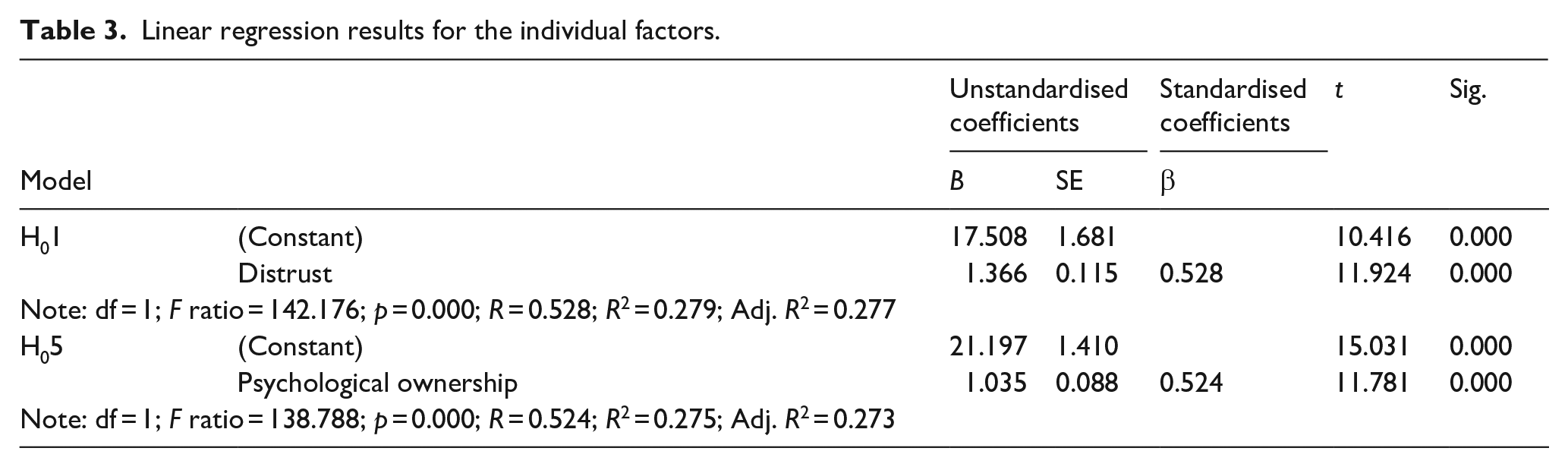
The results of the analysis of the individual factors (distrust and psychological ownership) are presented in Table 3. The results show that distrust and psychological ownership have t-values above 1.96 level and p-values below 0.05 indicating a significant relationship with KHB, because if t-statistics are greater than 1.96 with two tailed-tests under a 5% significance level, then the path coefficient is significant (Wong, 2013). Hence, distrust and psychological ownership predicted the students’ KHB (p < 0.05). Thus, null hypotheses 1 and 5 were rejected. The R2 also shows that distrust explained 27.9% of the variance in KHB of the students and that if distrust is to be increased by one standard deviation from its mean, then the KHB of the students would be increased by 0.528 standard deviations from its mean value if all other relationships are supposed to remain constant (β = 0.528). Also, psychological ownership explained 27.5% of the variance in the KHB of the students (R2 = 0.275), and if the variable is to be increased by one standard deviation from its mean, then the KHB of the students would be increased by 0.524 standard deviations from its mean value if all other relationships are supposed to remain constant (β = 0.524).
Linear regression results for the individual factors.
The results of hypothesis 6 which tested for joint a significant relationship between the individual variables (distrust and psychological ownership) and KHB are shown in Table 4. The joint ANOVA results show that individual variables (distrust and psychological ownership) jointly predicted the KHB of the students (p = 0.000 < 0.05), therefore null hypothesis 6 was rejected. The model summary revealed that the R2 = 0.378, which implies that distrust and psychological ownership in this regression model, accounted for 37.8% of the overall individual factors that predicted the KHB of the students. The results also show that distrust and psychological ownership have individual significant relationships with KHB (p < 0.05) when considered together. A unit increase in distrust would yield a 0.937 unit increase in KHB (B = 0.937), holding other variables constant. Likewise, a unit increase in psychological ownership would yield a 0.702 increase in KHB (B = 0.702).
Multiple regression results for the relationship between the individual factors and KHB.
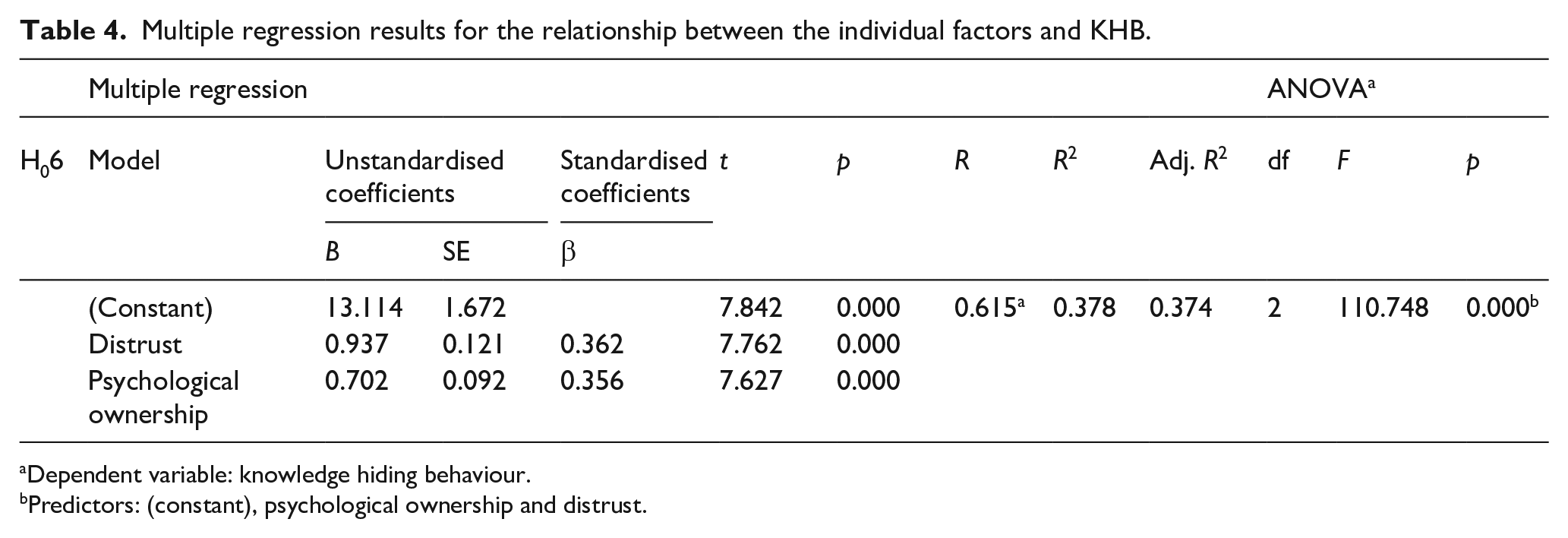
Dependent variable: knowledge hiding behaviour.
Predictors: (constant), psychological ownership and distrust.
Social factors influencing KHB
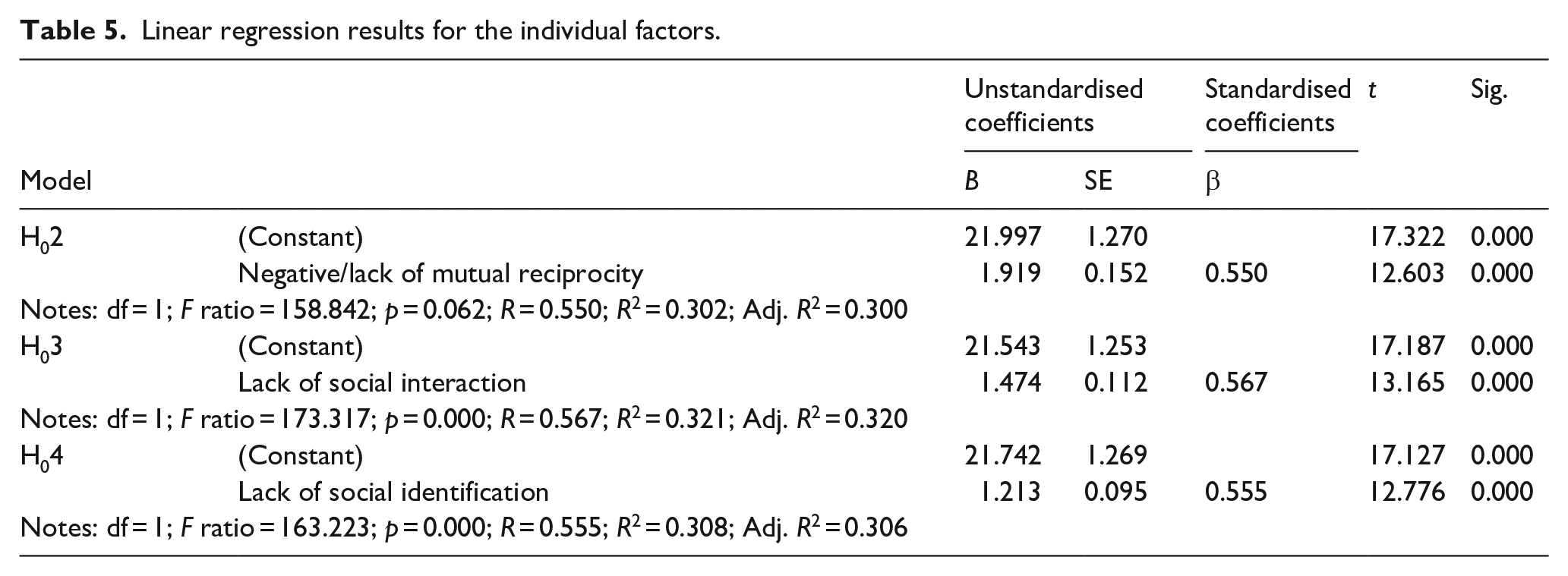
The social factors are negative or lack of mutual reciprocity, lack of social interaction and lack of social identification. The results of the analysis of the social variables are presented in Table 5. The results show that all the social factors are positively associated with KHB (p < 0.05) and the t-values confirm this; therefore, null hypotheses 2, 3 and 4 were rejected. The R2 for negative or lack of mutual reciprocity (0.302) means that the variable explained 30.2% of the variance in KHB of the students and that if the variable is to be increased by one standard deviation from its mean, then the KHB of the students would be increased by 0.550 standard deviations from its mean value if all other relationships are supposed to remain constant (β = 0.550). Also, lack of social interaction explained 32.1% of the variance in KHB of the students (R2 = 0.321), and if the variable is to be increased by one standard deviation from its mean, then the KHB of the students would be increased by 0.567 standard deviations from its mean value if all other relationships are supposed to remain constant (β = 0.567). Likewise, lack of social identification explained 30.8% of the variance in KHB of the students (R2 = 0.308), and if the variable is to be increased by one standard deviation from its mean, then the KHB of the students would be increased by 0.555 standard deviations from its mean value, if all other relationships are supposed to remain constant (β = 0.555).
Linear regression results for the individual factors.
The results of hypothesis 7 to test for a joint significant relationship between the social variables (negative or lack of mutual reciprocity, lack of social interaction and lack of social identification) and KHB are shown in Table 6. The joint ANOVA results show that the social variables (negative or lack of mutual reciprocity, lack of social interaction and lack of social identification) jointly predicted the KHB of the students (p = 0.000 < 0.05), therefore null hypothesis 7 was rejected. The model summary shows that the R2 = 0.378, which implies that the three variables account for 37.8% of the overall social factors that predicted the KHB of the students. The results also show that all the social factors have individual significant relationships with KHB (p < 0.05); hence, predicted KHB of the students. A unit increase in negative or lack of mutual reciprocity would yield a 0.915 unit increase in KHB (B = 0.915), holding other variables constant. Likewise, a unit increase in lack of social interaction would yield a 0.625 increase in KHB (B = 0.625), and a unit increase in lack of social identification would yield a 0.384 increase in KHB (B = 0.384). Negative or lack of mutual reciprocity has the highest contribution to the model.
Results of multiple regression of relationship between the social factors and KHB.
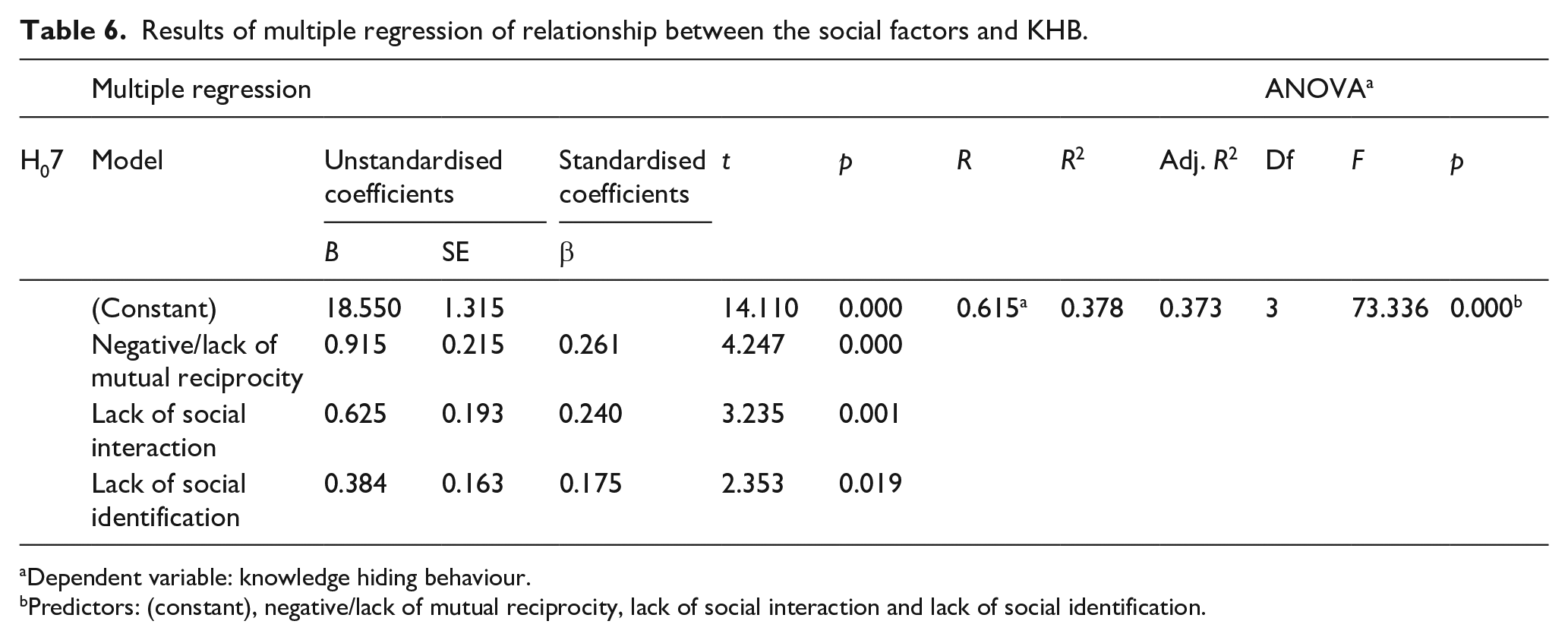
Dependent variable: knowledge hiding behaviour.
Predictors: (constant), negative/lack of mutual reciprocity, lack of social interaction and lack of social identification.
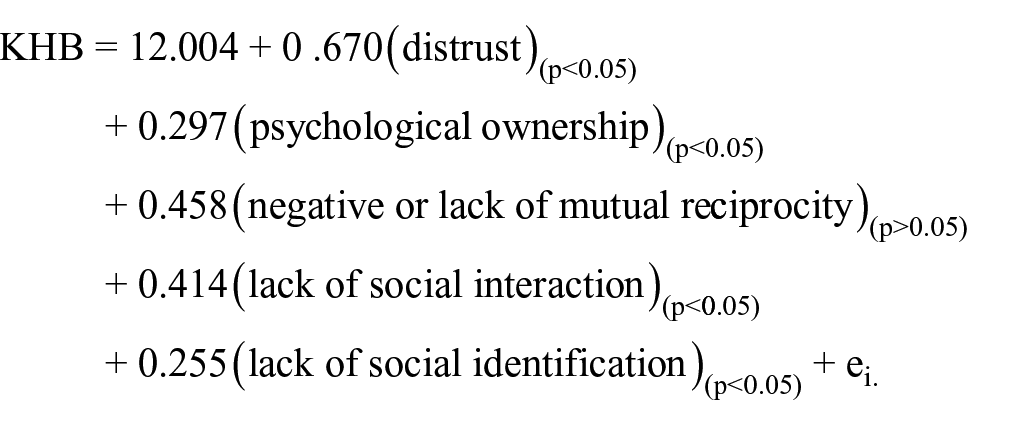
When all the variables were computed together, the ANOVA results revealed that all the five independent variables jointly predicted the KHB of the students (p = 0.000 < 0.05; Table 7); therefore, null hypothesis 8 was rejected. The model summary shows that the R2 = 0.441, which implies that the five variables account for 44.1% of the overall factors that predicted the KHB of the students, while some other factors not included in this study accounted for the remaining 55.9%. The results also show that all the variables included in the regression model have individual significant relationships with KSB (p < 0.05), except for lack of social identification (p = 0.105 > 0.05). Distrust has the highest contribution to the model (B = 0.670, β = 0.257).
Results of multiple regression of relationship between the social factors and KHB.
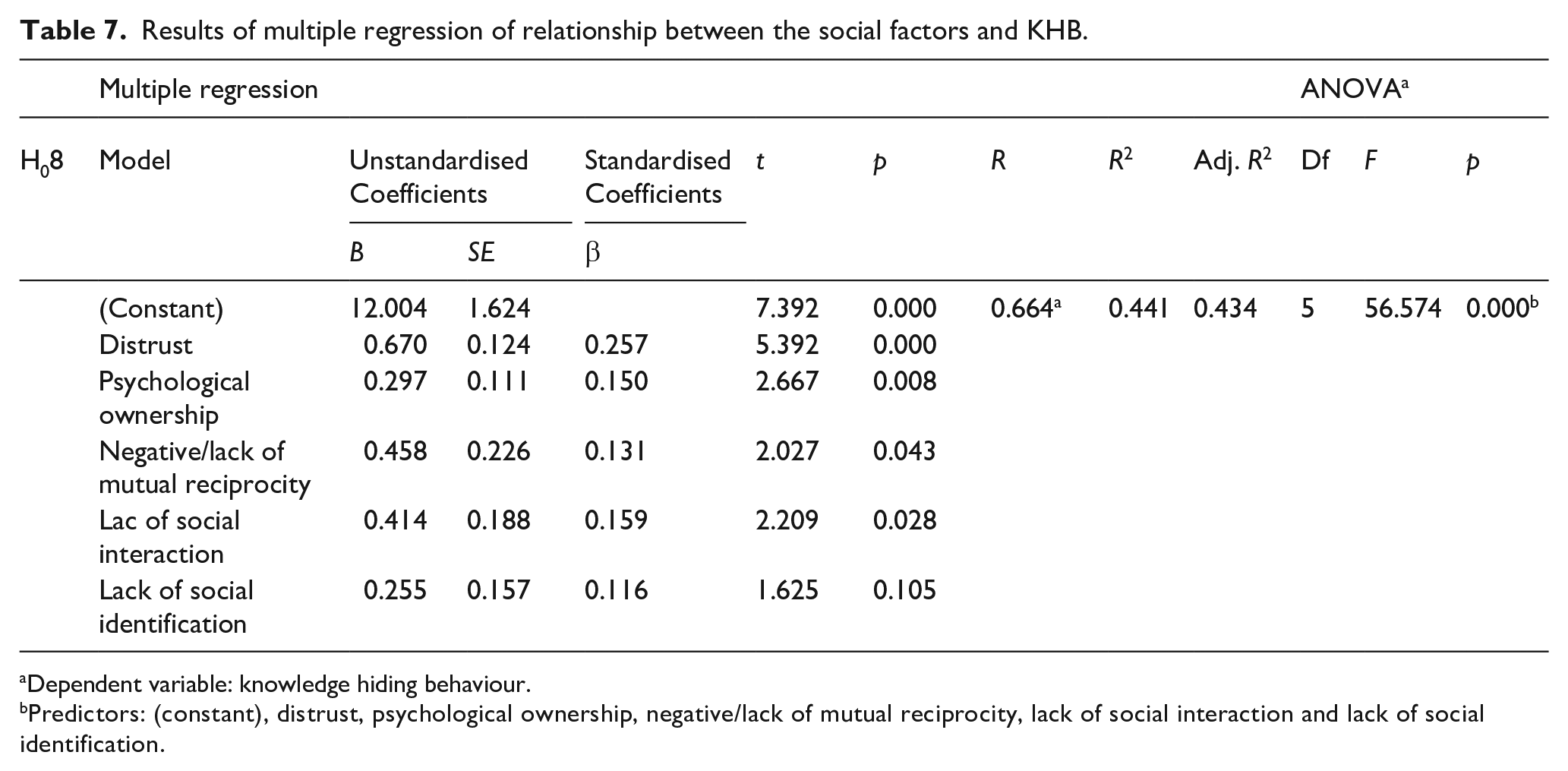
Dependent variable: knowledge hiding behaviour.
Predictors: (constant), distrust, psychological ownership, negative/lack of mutual reciprocity, lack of social interaction and lack of social identification.
A statistical model that predicts values of the outcome variable based on the predictor variable is presented.
From the regression model:

where
Y = predicted value of knowledge hiding behaviour
b0 = the value of Y when all of the independent variables (X1 through X5) are equal to zero,
b1 through b5 = the estimated regression coefficients,
X1, X2, X3, X4, X5 = distrust, psychological ownership, negative or lack of mutual reciprocity, lack of social interaction, lack of social identification factors respectively and
ei = the error term.
Therefore:
Discussion of findings
Findings from this study indicated that the students engaged in KH along the three dimensions (playing dumb, evasive hiding and rationalised hiding) identified by Connelly et al. (2012), and some other studies such as Burmeister et al. (2019), Demirkasımoğlu (2016) and Kumar Jha and Varkkey (2018). The students’ responses revealed a moderate level of KHB, which supports the findings of Demirkasımoğlu (2016) who reported that KHB was not a prevalent phenomenon in academia. Most of the students had so many reasons for engaging in KH, such as fear of loss of knowledge, inadequate knowledge, lack of zeal for KS and fear of losing relevance/prestige, among others. These findings align with the findings of Černe et al. (2014), Riege (2005), Peng, (2013) and Serenko and Bontis (2016). For instance, Peng (2013) explained that an individual may hide knowledge when such an individual has formed an ownership feeling over the knowledge or when such a person has constant control over the knowledge or has invested much time or energy in it. In this situation, the individual will be unwilling to share the knowledge for the fear of loss of control. Riege (2005) also identified some potential individual barriers to KS, which included apprehension of fear that sharing may reduce or jeopardise one’s job security, lack of time to share knowledge, taking ownership of intellectual property due to fear of not receiving recognition and accreditation from superiors and colleagues, among others. Also, some of the students might have engaged in KH because they compete with each other and strive to come out with good grades. Acquiring good grades could give them a better edge in securing jobs especially when most Nigerian employers prefer to employ first-class and second-class upper graduates than those with lower grades. These days, most advertised vacancies in Nigeria specify that candidates should not have a grade lower than second class upper division.
The findings of the study also revealed that all the individual (distrust, psychological ownership) and social (negative or lack of mutual reciprocity, lack of social interaction, lack of social identification) factors predicted the KHB of the students. These results conform with the findings of some earlier studies. Our results indicate that the students hide knowledge from those they distrust. The study confirms distrust as a more proximal variable than others for predicting the KHB of the students. Distrust has been associated with negative interpersonal outcomes, such as KH, by much empirical research such as Afshan et al. (2022), Connelly et al. (2012), Černe et al. (2014), Kumar Jha and Varkkey (2018), Mangold (2017), Peng et al. (2019) and Wu et al. (2022). For instance, Connelly et al. (2012) identified distrust as a key predicting factor that influences KHB in an organisation. KH manifests among individuals intentionally due to personal interest and distrust in others; hence, interpersonal relationships among the students could be jeopardised by mutual distrust, while KH can also create more or reciprocal distrust loop distrust making them unwilling to share knowledge (Černe et al., 2014; Peng et al., 2019). Hence, efforts need to be made to entrench a culture of trust among the students.
Our study also confirms the influence of psychological ownership on KH as previous studies (e.g. Batool et al., 2022; Peng, 2013; Singh, 2019) have established. The study has confirmed the ownership feeling for knowledge is another proximal variable that predicted the KHB of the students. Hernaus et al. (2019) study revealed that personal competitiveness is a driving factor of KH within mistrusted academic relationships. Individuals tend to use their knowledge to get an edge over others, especially in a competitive environment which some studies (e.g. Anaza and Nowlin, 2017; Asatryan et al., 2013; Otache and Edopkolor, 2022) have proven. Our results implied that the students have developed a very strong psychological ownership over their knowledge because they feel that the knowledge that is ‘theirs’ is important for their academic performances. They may have formed an ownership feeling over their knowledge because they have invested funds, time and energy into it. And because there is competition in academics, they may be unwilling to share the target of ownership with others because of the fear of poor academic performance, loss of awards, prizes, recognition or control.
Reciprocity explains behaviour that is linked with the pursuit of self-interest. Mutual reciprocity plays a large role in explaining interpersonal behaviour in many social situations, while a lack of mutual reciprocity has been shown to influence interpersonal relationships. This present study has also linked negative or lack of mutual reciprocity with KH. Our findings show that the students could have been experiencing negative or lack of mutual reciprocity, which also made them tend to return negative treatment for negative treatment as highlighted by Cropanzano and Mitchell (2005) and also confirmed by Butt and Ahmad (2019).
The results of our study concerning the influence of lack of social interaction on KH also confirm the findings of previous studies on the importance of establishing social interaction for mutual KS practices. Numerous researchers and practitioners have noted that the ability of an individual to share knowledge depends on his communication skills because effective communication (both tacit and explicit knowledge) is fundamental to effective KS (e.g. Davenport and Prusak, 1998). Hence, social interactions promote KS, while lack of social interaction could hamper KS. There also have been several prominent studies on social network issues (e.g. Mitchell et al., 2012; Nahapiet and Ghoshal, 1998) that highlighted, for example, a clear correlation between people’s social networks, their direct personal contacts, their personalities (introverted vs extroverted) and their ability to interact with others with KS. The implication is that there is a need to provide more social interactions among the students, especially those that belong to the same set or class. University management can endeavour to improve KS among students by demonstrating support for KS, and by increasing students’ opportunities for social interactions as suggested by Connelly and Kelloway (2003) and Trusson et al. (2017).
It was expected that the students would not engage in KH because they are in an academic environment where they relate with their classmates, programme mates, hallmates and lecturers. Ordinarily, they would be expected to share knowledge during classes, tutorials, examinations and in other fora, because they are in an environment where learning and knowledge sharing are the main activities engaged in. However, our study found that a lack of social identification predicted the KHB of the students. However, when the variables were considered together in the regression model, only the lack of social identification did not show a significant relationship with KHB. Social identification or interpersonal affiliation shared by community members has been shown to increase the willingness to share knowledge and resources with other members, provide support and commit to group-based goals. Members of the same community would be more likely to perceive themselves as colleagues, and thereby, form participation intentions concerning KS. However, KS may be hampered where there is no sense of social identification. Our findings indicate that sense of belonging and identification in the institution could be associated with the formation of more complex psychological states among the students, which provide significant support for the importance of nurturing a sense of ownership towards educational programmes that would be of immense benefits to the students as well as the institution.
Theoretical and practical implications
Theoretically, this study has been able to extend the frontiers of knowledge on KH in an academic environment. The study responds to earlier calls by some studies, such as Connelly et al. (2019), to further investigate some other antecedents as well as the interpersonal dynamics of KH. This study also builds a theory on KH by borrowing constructs from the SET, the SCT and the POT to investigate the KHB of students in a tertiary institution. The study also confirms the influence of distrust, psychological ownership, negative or lack of mutual reciprocity, lack of social interaction and lack of social identification as factors that could influence KH in academics. The research framework proposed and tested could also be used by further studies in other academic or work settings.
The practical implication is that University management can help reduce KH among students by demonstrating support for KS. Efforts should be geared towards introducing activities and practices that decrease an individual’s self-perception of possession of knowledge. Most importantly, the feeling of psychological ownership could be overcome by enlightening the student that no one knows it all; that even though knowledge might be power; it is much more powerful when it is shared, and that knowledge is not lost by sharing. Lecturers should be encouraged to engage students by including more interactive classes, discussion sessions, online fora, group assignments and study groups to foster collaborations and familiarity among the students, boost social interaction, reciprocity, a sense of belongingness, communication frequency and ultimately KS. The findings of the research provide insights to academic librarians that knowledge hiding exists in the academic environment. And since the main focus of academic libraries is information and knowledge management, the findings have implications for academic librarians to design or adopt user education methods that will emphasise the importance of knowledge sharing among students. More specifically, academic libraries should be made to design education and library users’ orientation, such as bibliographic instruction, information skills teaching, online instruction, course-related instruction and other instructional methods for new and current library users, which should enable students to make more effective, efficient and independent use of knowledge resources, and which should emphasise the need for KS. Individuals’ knowledge-based psychological ownership could be reduced by adopting some knowledge management tools, promoting teamwork through group assignments, stressing the collective ownership of knowledge and advancing institutional commitment. There is also the need to provide more social interactions among the students or increase students’ opportunities for social interactions, especially those that belong to the same set or class. Efforts need to be made to entrench a culture of trust among the students. The perception of social identification, unity, belongingness and togetherness of the student was expected to elevate their activeness to share knowledge; hence, the need for university management to provide more opportunities for the students to engage and have a sense of belonging.
Limitations and future research direction
It should be noted that this study has some limitations. First, the nature of the issue being investigated necessitated the use of self-report data; and because KH is considered undesirable compared to KS, its self-reported rating may be lower than the respondents’ actual intention (Hernaus et al., 2019). Hence, future studies could apply other methods to overcome the possibility of under-reporting. Interviews or observations could be used to complement the questionnaire method of data collection. Second, all model variables were measured using one survey instrument, thus possibly inducing common method bias (i.e. simultaneous measurement of predictor and criterion variables), which could have inflated the strength of the observed relations (Podsakoff et al., 2003). Third, the study was carried out in a collectivist culture and the respondents were somewhat homogenous; as such, there is a potential threat to the generalisability of the findings for all students. Therefore, a comparative study across universities in Nigeria may provide different results or allow to make generalisations. Fourth, because we focussed on a university in the southwestern region of Nigeria, our insights might be culturally biased. For that reason, it would be valuable to consider cross-national KHBs related to idiosyncratic academic settings. Fifth, future research in KH may also benefit from longitudinal studies designed to reduce the limitations of survey methodology, while consideration could be given to investigating the types of knowledge that the students hide (explicit vs tacit) as Hernaus et al. (2019) argue that people are more likely to hide tacit knowledge rather than explicit knowledge.
Conclusion and recommendations
There is no doubt that one of the key contributing factors to students’ excellent performance is a conducive learning environment that aids the KS process among them. Our research confirms that KH occurs in academia as some undergraduates engaged in KH in so many ways and for so many reasons. Some individual factors (distrust and psychological ownership), as well as some social factors (negative or lack of mutual reciprocity, lack of social interaction and lack of social identification), predicted the KHB of the students. Because the academic environment should be such that promotes KS, it is recommended that the academia can reduce KH by decreasing individuals’ self-perception of possession of knowledge, and efforts geared towards focussing on practices that can decrease students’ self-perception of possession of knowledge. It is well understood that knowledge creators cannot be forced to share their knowledge; however, a conducive knowledge environment can be built to foster a culture of trust, social interaction, reciprocity and social identification. University management needs to understand and appreciate the different types of KH strategies used by students, and thereby devise strategies to dissuade KH.
Footnotes
Funding
The author(s) received no financial support for the research, authorship, and/or publication of this article.
