



Abstract
This study reports on a series of focus groups of UK public library users to understand how the forced closure of UK libraries caused by the COVID pandemic and the increased use of replacement digital services affected their library use. We specifically focus on digital exclusion and whether this increased as the result of physical library services being inaccessible. We show that although digital exclusion did increase as the result of library closures, digital exclusion was not the best way to characterise our participants’ experiences and digital choices was a more suitable concept. We show how public library users adapted to library closures, how they coped with these closures, and how they intend to use library services in the future. Our participants reported different patterns of use of digital and physical library services, had different experiences of these two modes of library service, and described their value in different terms. We explore what they valued in physical and digital services and show how simple arguments that digital services can replace physical ones do not match the experiences or wishes of those who use these services.
Introduction
The public library is contested ground. They are valued public institutions with clear roles in stimulating literacy, promoting education, providing access to cultural heritage, and acting as trusted sources of information (Johnston et al., 2022). However, whilst these over-arching goals are common across various countries, when it comes to implementing and prioritising them there is less uniformity about how this should be done and how the various demands on public libraries are reflected in librarians’ professional training and conceptualisation of the role of a library in civic life (Johnston et al., 2022).
Two specific areas of innovation are relevant in relation to the recent COVID pandemic, those that Söderholm and Nolin (2015) characterised as the digital and social turns. The digital turn refers to the increased use of digital services in public libraries, such as ebooks, online catalogues, and social media. The social turn refers to libraries serving as social hubs and extensions of other physical spaces such as home or work, with Söderholm and Nolin claiming that we are in a ‘third-wave’ of public library community engagement characterised by ‘[c]ommunity hubs, open social space, diversity’ (p. 253). In most countries, the COVID pandemic stimulated the digital turn, increasing the use of digital services, whilst suppressing the social one thus reducing the ability to use the physical library space. This allowed us to experience what it would be like to live without physical libraries and only be provided with digital library services. In this paper we examine this experience in the UK with specific focus on digital versus physical library use.
Public libraries have a core role in digital engagement and digital inclusion. As well as providing direct access to the Internet for those who lack it by other means, libraries also provide support and training on accessing online information and services. The COVID pandemic necessitated the closure of UK public libraries leaving those who relied on public library access to the Internet stranded and forced those who preferred physical access to information and literature to move to primarily digital access methods.
To investigate the impacts on digital exclusion created by these forced library closures, we conducted a series of focus groups consisting of samples of UK public library users to investigate the following research questions:
What was the lockdown experiences of those who did and did not use digital library services?
Did the forced closure of UK public libraries result in increased digital exclusion?
To what degree did digital services ameliorate the loss of physical services during the pandemic?
Our results show that digital exclusion did increase during periods of lockdown but that lack of digital use and digital exclusion are not synonymous. Rather our participants reported different patterns of use of digital and physical library services, had different experiences of these two modes of library service, and described their value in different terms. We show how digital and physical library services are conceived of differently by library users and explain why these two modes of library service should be seen as complementary rather than different modes of the same service.
Literature review
Digital exclusion and related terms such as digital divide denote unequal access to and unequal ability to use the digital technologies that are necessary to fully participate in society (Schejter et al., 2015); conversely, digital inclusion and related terms such as digital participation refer to processes that try to alleviate digital exclusion. Concerns over digital exclusion and the consequences of this form of social exclusion have formed a consistent thread in the Information Science and Social Justice literature and, despite widening Internet access, there have been increasing concerns that moves towards digital-only solutions increase the negative effects of digital exclusion.
We can point to several dominant themes in the literature:
Digital exclusion is clustered
Those who face digital exclusion typically fall into specific demographic groups, with some groups such as those who are older (van Deursen and Helsper, 2015), economically disadvantaged, and or who live in rural settings (Philip et al., 2017) being frequently cited as those for whom digital exclusion is more likely (Scheerder et al., 2017). Digital exclusion may be a consequence of personal circumstances, for example those in temporary, shared or rented accommodation may not be able to obtain broadband connections (Greer et al., 2019), those in prison (Reisdorf and Jewkes, 2016) are restricted in Internet access, and economic poverty reduces the likelihood of having broadband access (Reddick et al., 2020). People may face multiple reasons for digital exclusion, as Helsper and Reisdorf (2017) put it ‘there is rarely a straightforward relationship where one indicator trumps all others as an explanation of digital exclusion’. Barriers to digital inclusion may include lack of knowledge of how to access digital resources, lack of training, lack of finances, but these are related in complex ways so that simple variables alone do not tell the whole story and if we solve one variable, such as poor Internet connections in rural areas, then others, such as age, are still present and may still affect digital inclusion (Blank et al., 2018).
Digital exclusion is highly linked to other forms of social disadvantage and exclusion
Some reasons for digital exclusion, such as poverty, impact in a general way on individuals’ lives and digital exclusion is part of a wider pattern of exclusion (Greer et al., 2019; Helsper and Reisdorf, 2017). Some groups face compound disadvantage where previous disadvantages, for example, poor literacy, result in digital exclusion being an additional form of exclusion (Townsend et al., 2020) that may be especially prominent in the case of some groups, for example those who have disabilities, where multiple adverse factors (greater financial constraints, being more likely to live alone, physical or mental challenges) each can negatively affect digital inclusion (Scholz et al., 2017). A particular concern therefore is that ‘digital exclusion is becoming increasingly concentrated among vulnerable populations’ (Greer et al., 2019).
Those who are digitally excluded are often the target of initiatives where digital is the solution
Many government services such as health services or state benefits are now being offered through digital means and, in some cases, digital is the only option. Those who need these services are often digitally excluded due to demographic factors outlined above. In addition, some mental health conditions are related to cognitive functioning, including attention and memory impairments which can affect digital interaction such as web searching, task switching, retaining and recalling information, and ignoring distractions (e.g. adverts) to focus attention (Bernard et al., 2016). This can create a paradox by which those who are most in need of these services are the ones who are most likely to be in a state of digital exclusion and least able to use them.
In many countries, the public library system is one of the core ways to reduce digital inequalities through infrastructure and training (Bertot et al., 2016; Noh, 2019; Real et al., 2015; Ruiu and Ragnedda, 2016). The recent COVID pandemic severely limited the ability of many libraries to provide physical access to digital technology and training and, at the same time, forced library users to switch en masse to digital access for basic library functions such as borrowing books. Therefore, the question arises of how the forced closure of libraries impacted on digital exclusion?
Methods
Focus groups are a commonly used method for qualitative data collection in library research (Khoo et al., 2012; Pickard, 2017; Sørensen, 2020; Von Seggern and Young, 2003; Walden, 2006) and a range of studies have used them to explore the values, experiences, and attitudes of public library users (Appleton et al., 2018; Chapman, 2013; Colibaba and Skinner, 2019; Fisher et al., 2010; Strover, 2019). The ‘focus’ comes from exploring a limited range of topics within a facilitated discussion setting (Walden, 2006). Focus groups are particularly useful for gathering experiential data (Palmer et al., 2010), they have the potential to gather a wide range of insights in a single data collection session (Pickard, 2017), and the group dynamics that arise when sharing experiences can allow for insights not possible from one to one interviews (Palmer et al., 2010).
In this study we conducted two sets of focus groups; one set with users of UK public libraries who were able to use digital library services during forced library closures and one set with library users who did not use these services. The meetings with the former group were held online using the Zoom video meeting software, the meetings with the latter group were held physically in public library meeting rooms. We shall refer to the groups held through Zoom as the online groups and the ones conducted in libraries as the face-face groups.
Timings, recruitment and participants
Participants for the online focus groups were recruited through posts to mailing lists and social media sites relating to libraries and reading. Interested participants were sent an explanation of the focus groups’ purpose, a description of the ethical processes that would be followed, and the themes that would be discussed. The face-face groups were recruited through fliers to public libraries, these fliers contained a description of the main themes to be covered in the groups. For the face-face groups, ethical processes and consent were dealt with before the group discussion started.
The online groups took place in June and early July 2021. At this stage in the UK many library services were reopening, albeit with great variation. Ideally, we would have conducted the face-face groups at the same time, however the COVID rules that were in place for the remainder of 2021 meant that face-face groupings of this size were not possible, either due to local library restrictions or national restrictions on meetings in indoor spaces. The earliest that these groups could take place was March 2022, a time when libraries were mostly open, when meetings could be held in person but also a time when COVID numbers were still very high and when many people in the UK were still being asked to work from home. In both cases, this was a period of flux when the effects of COVID on participants’ lives were still fresh.
We did not collect any demographics from any participants except what was volunteered or observable. Focus groups are qualitative in nature and do not collect enough data to generalise across demographics, so we explored individuals’ experiences and report on demographic data only when relevant to that person’s experiences. We can report, however, that most participants in both sets of groups were female and from a broad range of ages and backgrounds.
The participants in the online groups lived in a variety of UK towns, villages, and cities; those in the face-face groups were all resident in Edinburgh, Scotland’s capital city with a population of about 500,000, or Airdrie, a small town in lowland Scotland with a population of about 37,000.
There were three online focus groups with a total of 22 participants, and three face-face focus groups with a total of 13 participants. The online groups were larger and so lasted 90 minutes, the face-face groups lasted 60 minutes.
Session structure
All focus groups had a similar structure, and the questions were piloted with a separate group whose data is not used here. Each session started with a welcome, during which ethical processes and data handling were reiterated, then there was a discussion of the main themes for the group, followed by a closing session with final contributions and a chance for the participants to ask any questions. All participants received £25 for their participation. The same member of the research team acted as moderator for all focus groups to ensure consistency and one other member attended the online groups to manage the software. The questions and themes were agreed and discussed by all team members.
The purpose of the focus groups was presented as helping library services understand participants’ experiences during COVID-related public library closures to help libraries and local/national governments plan for future library services. When discussing digital services, we did not define digital services or restrict our definition of what digital meant. Although most participants referred to eBooks, there were discussions on other digital services including online catalogues, library websites, streaming services, and social media. At no point did the moderators make any value judgement on their own perception of digital or physical services.
For the online group, who were users of digital library services during lockdown, the main themes explored were:
What was their library use before lockdown?
How did library closure affect their library use, including questions on any challenges of moving to digital, and unexpected benefits of digital?
What will be their future use of libraries?
For face-face group, who were not users of digital library services during lockdown, we explored:
What was their library use before lockdown?
How they dealt with library closure due to COVID including questions on what they did instead, any use of digital, reasons for not using digital, and consequences of not having a library service?
What will be their future use of libraries?
The first and last questions were asked of all participants, the others were open for broader discussion with prompts to develop this discussion and occasionally direct questions to individuals to bring them into the broader discussion.
Analysis
The face-face focus groups were audio-recorded, the online ones were video and audio-recorded. All were professionally transcribed. During the online focus groups many participants used the chat function and this material was included in the analysis. Two participants sent further information related to the focus group themes by email and this was included in the analysis. All data was anonymised.
After each focus group there was a discussion amongst all team members on the outcomes, findings, and implications. The transcripts were available to all team members. The analysis itself was conducted by one team member, the one who acted as moderator, and all team members contributed to the development and presentation of the findings that are presented in the next section.
Our initial aims were to compare the experiences of those who moved to digital use of libraries during lockdown against the experiences of those who did not make this transition. Although our recruitment processes were successful in that most participants fell into these groups, it was also clear that many people had mixtures of uses, for example, some people read only physical books in lockdown but also used digital audiobooks, others used physical reading material for pleasure but were digital users for work or study, etc. Those who did use digital did not always use it for preference but out of necessity and whilst some people rejected digital services for library use, they were digitally active for other areas of their lives.
In our analysis therefore, we will compare the two groups when comparisons of mostly-digital library use against mostly-non-digital are warranted. For the rest of the analysis, we work across the groups’ responses. Our analyses are based on thematic coding of participant responses under the main headings presented in the following section.
Limitations
The constraints of working within COVID restrictions meant that there are specific limitations to this research. Whilst the online groups contained participants from across the UK, the face-face ones only took place within two Scottish towns. The choice here was either to wait until COVID rules had lessened and we could do groups in other UK locations, but with the risk that memories had faded, or do what we could do whilst the COVID experience was still fresh in people’s minds. We opted for the latter. We do not claim that the experiences reported here are representative in a statistical sense but rather they describe a set of experiences of regular library users with themes recognised by many irrespective of location. From comparing the two data sets we believe that the face-face groups have a broadly similar usage of public libraries to the online groups but that the face-face groups were being offered a richer library experience than that experienced by many in the online groups who felt that their local service was being hollowed out.
Our face-face groups are relatively small. In part this is also a side-effect of COVID rules about sizes of meetings allowed in libraries but also it proved more difficult to recruit for these meetings, perhaps due to concerns over physical social gatherings. However, we felt that they provided rich and diverse data about library use.
All participants were self-selecting. As such they represent people who care about library development and are active library users. There will be other library users who use library services in shallower ways and only part of our data may pertain to them. We are also aware that some members of the population were not represented in our focus groups, for example, those who are housebound, those who are served only by mobile libraries, those who need support to access libraries, etc. Some of our participants had friends and family members who fall into these groups and could talk about their experiences, but we realise this is not the same as their direct inclusion.
Findings
We will gather our findings under two main sections: firstly, before, during, and after lockdown to help understand the lockdown experience and then a discussion of the relative advantages of physical and digitally offered library services as expressed by our participants.
The lockdown experience
In the sections below we present findings on participants’ use of libraries before lockdown, their adaptations during lockdown, and how the lockdown experience has changed their future library use. We use lockdown as a convenient shorthand for the period when their local libraries were physically closed, even if some services were in operation, rather than the formal period of government-imposed restrictions on socialisation. In discussion, lockdown was seen as a recognisable term to describe this unusual period of service interruption between two more stable states of library operations.
Before lockdown
Before lockdown our participants were generally active and regular library users, and many used multiple local libraries. Some had very specific library habits, for example, only borrowing physical books, whilst others engaged with a range of library services.
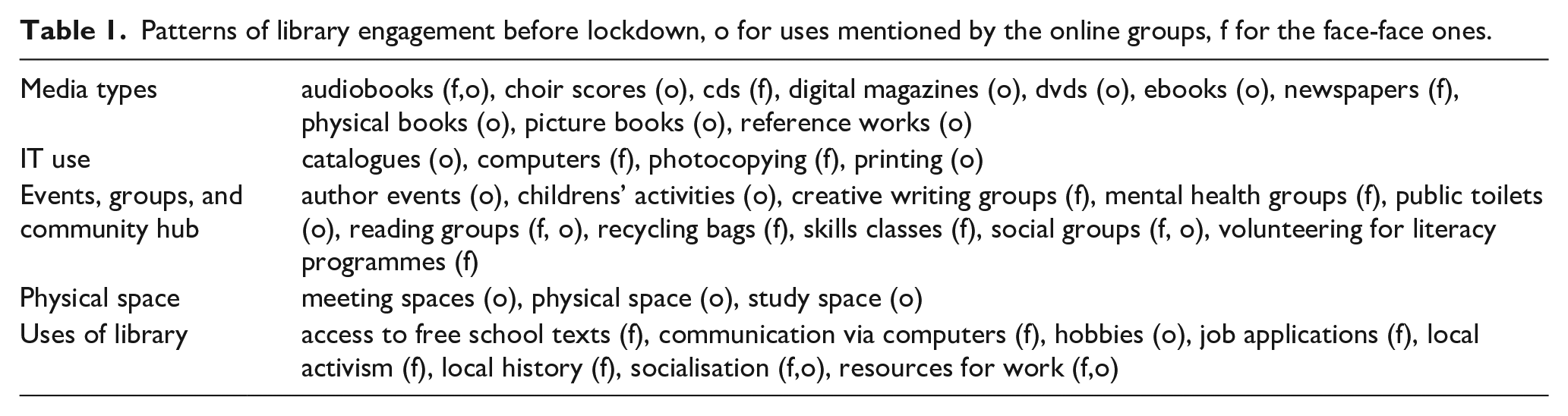
Table 1 summarises the responses by our focus group participants to the question of how they typically used their public library before lockdown. We have ordered into categories of: (1) types of media mentioned by participants including physical and digital media; (2) IT use including online catalogues, printing, and general computer use; (3) various events, groups, and acting as a community hub, including library-organised events such as author events, social and skill-based groups, and the library as a source of local information, as a way of distributing other resources (such as recycling bags, hearing aid batteries, etc.) and as a place that will have a free public toilet; (4) the importance of the library as a physical space for meetings or study, and the importance of being in shared, physical space whilst using the library; and (5) the uses of their library beyond what was mentioned in other categories, including access to material for work, study and leisure material that are not otherwise affordable, computer-aided communication, job applications, finding information for activism, local culture and general socialisation.
Patterns of library engagement before lockdown, o for uses mentioned by the online groups, f for the face-face ones.
During lockdown
In each focus group we explored how participants adapted to life without a physical library during the periods when libraries were closed.
We saw a mixture of strategies:
Increased use of digital. This included activities, such as reading groups, which were previously conducted in physical settings moving to online versions. Participants reported mixed success in this; for some, the move to digital helped keep a valued activity going and allowed participants who moved out of a local community to keep engaging with the activity, whilst others reported these digital events as being less well attended and it seemed harder for some to gain information on these activities unless participants were socially well connected. It seemed generally harder to find out what was online compared to what happened in physical environments. The theme of increased use of digital also included participants starting to use previously unused digital devices such as eBook readers. This strategy occurred in both groups but was more predominant in the online groups, many of whom were already regular digital users.
‘Begging and borrowing’ was referred to by one participant as her strategy to obtain physical books. Many participants described similar strategies of taking advantage of opportunities, including lulls in the national lockdowns, to stockpile reading material. For several participants lockdown was a time of increased reading, sometimes up to several books a week, so obtaining new reading material became vital, especially as the length of lockdown periods were uncertain. Local communities sometimes facilitated obtaining reading material through community book boxes but other sources of reading material, such as charity shops, were also closed. Several participants described taking advantages of breaks in lockdown to get ‘bags of books’ and used phrases such as ‘emergency book bags’ that describe the urgent nature of obtaining reading material.
Making do describes strategies based around re-reading existing collections of books or different use of existing collections such as switching preferred genres to take advantage of previously unread material. For example, one participant finally read some of her husband’s crime novel collection. This theme overlapped with Begging and Borrowing as participants sometimes borrowed material from friends or family that were not of interest but were felt to be better than nothing. The cost of books was mentioned by several participants as a barrier to obtaining new reading material during lockdown. One participant described creating a ‘pop-up’ library in a local bookshop by using the space to browse and read (but not buy) books. The irony that bookshops were open when public libraries were closed was not lost on participants. These strategies were more commonly described by the face-face groups.
Relying on others’ digital resources. This category describes the necessary use of others to do what was possible before using the physical library, for example, schools obtaining subscriptions to digital resources previously freely available using the public library, using friends’ smartphones instead of library computers to apply for jobs, etc. Some of these strategies required innovation and good social capital but what characterises them is the reliance on others’ goodwill and financial capital to provide solutions that were previously freely available. The end results may be the same in that participants could complete the same tasks but they represented a lack of empowerment and often a sense of obligation in order to access the same resources that participants could previously access through libraries.
The face-face group in particular described the closure of their libraries in stark terms: ‘I felt bereft’, ‘it was as limb had been cut off’, and some services (such as the popular request service or inter-library loans) were completely lost to them. These comments indicate that reading is not simply a leisure activity but one, for many participants, that fills an existential need. Both groups felt the lack of the social and community aspects of libraries, including the negative effects of the lack of libraries on those who were very reliant on the physical library.
When examining what made digital easier, participants reported that good communication (especially pro-active library services), personal agency (being willing to explore digital), and previous successful use of digital were all enablers to increased digital use. New digital initiatives by library services were also positively welcomed, for example the family history website ancestry.com was made freely available by many library services during lockdown. Barriers to digital use included lack of interest in digital, lack of good communication from library services (out of date information and information only provided digitally so not useful by those not digitally engaged), technical barriers, and not having digital devices. Library communication and general responses to COVID were seen as very variable by participants.
After lockdown
We asked all participants how they planned to use their local library services now that forced library closures were over and things were returning to normal. At the time of the online groups, services were returning to normal although there was a return to lockdown later; the situation was unsettled during the time of the face-face groups but all participants had a functioning local public library.
In the online groups, most participants were planning to return to what was their normal prior use of libraries, which was mostly physical library use and several were planning to blend in more digital usage including new types of digital activities. Only two felt their future use would move primarily from physical to digital, one to due to ill-health reducing her ability to visit physical libraries and one felt that lockdown ‘just speeded up for me a change that was already happening’ due to her impoverished local library service. In the face-face groups, several participants were going to use more digital in addition to their physical library use.
We asked participants to reflect on the lockdown period, how this had changed their library use (if at all) and how they wished to see their library service develop. Participants were very eloquent in support of what they saw as useful library innovations, often driven by necessity to support a library community, such as Click-and-Collect, big extensions of home delivery services for shielding users, and the creation of new digital services. Some of these made the library more accessible as they overcame restricted library opening hours. Others reported unexpected benefits of wider digital use, including discovery of new resources such as eComics. These benefits were typically only expressed by the online groups. Even those who primarily used digital resources wished to protect physical libraries as they felt libraries were more vulnerable if only particular groups of the community used them and recognised the use of physical libraries by many groups. They clearly saw the digital as part of the library offering rather than a separate entity.
Innovation was a key discussion and knowledge of some library innovations, including the widely used Click-and-Collect service, was patchy and the level of innovation in different parts of the country appeared very different to participants. One participant queried the degree to which library staff were allowed to innovate and another questioned whether digital innovation led to solutions of a different nature to physical innovations.
The most common response to this question across all groups however was a desire to return to their normal physical libraries in the pre-COVID form.
Digital versus physical
Throughout our discussions, a recurrent theme was the nature of digital and physical and the relative merits of each. In the sections below we summarise the participants’ views on both.
Advantages of digital
Many digital resources were mentioned positively. eBooks in particular were seen as a useful complement or backup to physical reading material. Specific features that were mentioned as positives were the immediate availability of texts, the ease with which one can switch between books, good support teams, and the light weight of eBook readers. Some participants also felt that the waiting list systems on library apps were more manageable than with physical libraries and that digital offered a wider set of resources. There were generally mixed views on the ease of use of these apps however. Other advantages included increased privacy about what material was being borrowed and not having to interact with library staff.
Some participants mentioned the wider digital offering including skills sessions run through Facebook or streaming services, the ability of digital to connect physically distant people and thereby create new communities, and the possibility to stream author events to make them more widely available. Digital was also seen by one participant as more eco-friendly than physical resources.
Several participants mentioned online catalogues as a useful feature to enable searching library resources.
Disadvantages of digital
There were several negatives expressed regarding digital use, many of which came from the online groups who had more experience of digital library services.
Some negatives were regarding general usability, for example, catalogues were seen as error-intolerant and some features of eBook apps such as the search function were seen as annoying as it offered authors and books not available from the local library.
Many people reported not wanting to use digital because of over-use of digital in other parts of their lives, having concerns over the effect of too much screen reading on their eyes, concerns over accessibility, lack of interoperability (e.g. some apps not being capable of being used on some devices), and screen size. Some participants felt the lack of interaction with library staff was a negative feature of digital use. Whilst some felt the digital stock was wider than the physical ones, others felt the opposite. This finding may arise from large differences in digital stock provision across UK public libraries during the COVID period (McMenemy et al., 2022).
Advantages of physical
Both groups gave more positives for physical libraries than mentions in any other category. These can be grouped under several themes.
The biggest theme is library as a shared community space. Here many examples were given. An important one was that physical libraries cater for many groups including those who are disabled, elderly, homeless, or otherwise potentially vulnerable (but with occasional mixed views on whether libraries were universally welcoming to such populations), and that libraries were multi-cultural. These views represented, in the words of our participants, a way of publicly encapsulating a local community. Mobile libraries and services to housebound library patrons extended the library community and this sense of place. That libraries are accessible and open was seen as key to their role in self-empowerment and to their roles as literally and metaphorically safe spaces to meet. This echoes discussions in, for example (Barclay, 2017), that physical spaces are an important part of libraries’ social value.
Libraries were also seen to act a community information hub, with noticeboards offering information on local events and organisations, being a source of advice on benefits and local services and being valuable meeting places for informal meetings or planned events and social groupings. A library’s stock recommendations and themed displays offer a way to provoke conversations about societal issues through recognising major events such as International Women’s Day or Black History Month. In discussion many participants mentioned aspects of a physical library not easily replicated in digital forms such as local events (celebrating holidays such as Halloween or literary events such as the launch of a new children’s book) or craft activities.
That libraries were social spaces was very clear from many comments as was the role of a library within a library patron’s social world; many participants reported a library visit being ‘an event in itself’ and having to ‘get up to take your books back being a reason to get up in the morning’ and that library visits are often part of the natural rhythm of an individual’s social activities. School visits to libraries being an event was also mentioned by several participants.
Physicality was a recurrent theme. Feeling visible in a physical space was seen as an important sense of validation. The serendipity afforded by a physical social space was also a strong theme ranging from unexpected interactions with other library users or becoming aware of a local event or possibility. This serendipity also extended to browsing the stock and the sense of being offered possibilities whereas algorithmic recommendations on book apps seemed to constrain rather than extend offerings.
Several participants mentioned the importance of the physicality of libraries through social interactions within a physical space, and the physical affordances of books and bookshelves in terms of finding information. The physical affordances, particularly flicking back and forward in a physical book, was mentioned by several participants. The designed nature of books as artefacts and the enjoyment of the sensory properties of physical books was also mentioned by many as fundamental to their reading experience.
That the libraries are (mostly) secure, friendly, and staffed by helpful staff was seen as important especially library staff’s knowledge of their local community. This could be seen in small ways, for example, knowing which books a patron may like, to sustained community interactions that led to broader innovations to library services. Library staff were seen to have a strong role in facilitating patrons through things like technical support, helping with official documentation, and acting as a source of local knowledge.
Disadvantages of physical
There were a small number of disadvantages expressed about the library services. That physical stock and services can only be accessed during opening hours was seen as the major disadvantage of physical libraries. Other negatives referred mostly to local management of libraries: limited time on computers, security staff making the library unwelcoming, local groups, such as children’s groups, interfering with focussed concentration. Whilst volunteers were seen as a useful complement to trained library staff, services that lacked a trained librarian were felt to generally offer poorer services and there were concerns that library services in poorer areas were more deprived in stock.
Discussion
In this section we summarise the main aspects of our findings under the two broad headings of Digital and Social Exclusion, in which we discuss the degree to which exclusion was a feature of our participants’ COVID experience, and Physical and Digital Value, in which we discuss the relative characteristics of these two modes of library service provision.
Digital and social exclusion
Our initial positioning of this research was an exploration of the use of digital technology during lockdown and whether digital exclusion increased during the lockdown period due to the lack of physical library services. If we take digital exclusion as defined above – unequal access to and the ability to use digital technologies that are necessary to fully participate in society – then it is clear that some participants did suffer from increased digital exclusion in that they lost the ability to engage in specific digital activities due to the loss of access to library computers, IT support, or digital resources available only through library computers. These participants were not ones who lacked the ability to use digital services but needed the physical access to library computers to use digital services. These losses were non-trivial and placed these participants at a real disadvantage.
It was also clear that those who were able and willing to use digital services gained more and lost less when libraries were closed. This partly resulted from the natural trend during the pandemic to develop digital services to replace physical ones (McMenemy et al., 2022). It perhaps also resulted from lack of financial agency. We did not ask any participants about their financial status but did observe that only the face-face participants mentioned the costs of books and lack of finances as a barrier to obtaining digital access during the pandemic. Based on our evidence we can assert, therefore, that digital exclusion did increase during the pandemic due to lack of physical library services and the increased digital offerings to those that were already digitally enabled: the gap widened at both ends of the digital exclusion range.
Digital choices not digital exclusion
Based on our discussions, we found that digital exclusion was not a useful concept to describe the main experiences of our participants. There is an issuing of framing in much of the discussion of digital services in libraries in policy and professional discourses, alongside similar arguments made in other sectors, that digital offerings are interchangeable with physical offerings and that the lack of use of the digital offerings is problematic and must be ‘solved’. This was not the experience of our participants. Many were making informed choices about their use of library services and general reading activities during lockdown and the reasons for not using digital were not about lack of ability or lack of digital access, rather they were often considered and informed choices. Whilst ‘not liking digital’ can sometimes be a socially acceptable way of expressing a lack of ability on how to use digital services, many participants who did not want to use digital library services were very experienced digital users in other parts of their lives and had experienced a wide variety of digital technology including video-conferencing and virtual reality. They saw digital as a useful complement to a wider library service for those who wished to use it but felt that digital was not a replacement for physical library services.
To see digital as the solution tends to frame lack of digital use as a problem but what we heard from our participants was that digital and physical are very different modalities and that the reasons for choosing one over another may be complex. This is not to undermine the valuable role of libraries in providing digital training and access, but rather to point to the fact that even if library users can use digital services, they may choose not to use them even if this means not using the library at all.
Neither was social exclusion a useful concept here. We did not explicitly use this concept during our focus groups, rather we explored the consequences of not having a physical library. However, we do not believe that any of our participants would have recognised themselves as socially excluded, rather they were socially engaged to varying degrees and what the libraries provided was increased ways to be socially engaged. Some did mention that libraries were critical to their social engagement, but we doubt from our conversations that the concept of exclusion was one that they would have been used to describe themselves. When social exclusion was described, it was usually to refer to others and we feel this was characteristic of why social exclusion was not a good fit for our discussions: viewing library users as part of demographics (child, elderly, disabled, etc.) can be useful in ensuring accessible libraries and appropriate services but few of us think of ourselves in terms of such demographics, rather we see ourselves as rounded individuals who may have certain requirements and needs that are different to others.
Libraries and their role in overcoming social isolation was mentioned by many participants, again usually, but not exclusively, referring to others, but physical libraries were best seen as social enablers. That is, physical libraries were seen as enabling a multi-layered set of experiences and possibilities to interact with one’s local community from simply being acknowledged to deep and sustained engagements. The lack of this enabling diminished participants’ social worlds but they did not result in them feeling socially excluded.
Physical and digital value in UK public libraries
There is a lively debate in modern librarianship about the role of libraries within society. Studies have focussed on either librarians’ perceptions of the purpose of library services or those of the library users. An example of the former is the study by Johnston et al. (2022) who surveyed librarians in Denmark, Germany, Hungary, Iceland, Norway, Poland and Sweden and found that providing ‘equal access to knowledge resources, literature and cultural experiences’ as the most important reason in six out of seven countries with promoting learning, providing meaningful leisure time and providing social space also ranking highly. How these roles are fulfilled may argue towards more or fewer digital initiatives depending on how the role is interpreted and the librarians’ own skills and experiences. As Vårheim et al. (2020) points out, in the library discourse the role of physical versus digital is often seen as opposites, compared to museum settings where they are seen as complementary.
In our groups, even with those who were strong users of digital services, we found overwhelming support for physical library services and the many benefits that come from such services. This mirrors earlier findings in pre-pandemic studies of library users. The closest is that conducted by Appleton et al. (2018) who conducted focus groups in UK public libraries over the period 2015–2016. Here the context was on the value of libraries. They found four main themes emerged: (1) the epistemic role of libraries; (2) the primacy of print; (3) public libraries as safe, inclusive community spaces; (4) community ownership of public library services, and citizenship.
In our study we did not find much on the epistemic role of libraries in that few participants talked about what libraries were for, however many participants did value the role of libraries in developing literacy, providing access to cultural heritage, and being a source of information for work and study. Appleton et al. also found that people preferred print even when they were confident computer users and that lack of digital use was not necessarily a sign of a lack of digital literacy. We also found that public libraries were a safe, inclusive space and there was a strong sense of community ownership, at least for those libraries that were seen as well-functioning and welcoming. Some participants did mention poorly serviced libraries and there were some negative experiences. Our findings around the value of physical libraries then approximates to what they found in pre-pandemic environments. It also echoes other investigations of how the social value of public libraries can be measured, for example, (Stenstrom et al., 2019; Sørensen, 2021). What we can offer in addition is a more direct contrast between what is valued in physical and digital services. As mentioned previously, although many participants talked mainly about eBooks, we treated digital as the broad range of digital services offered by libraries. Söderholm and Nolin felt that ‘[f]rom a patron perspective, the division of physical and digital is increasingly blurred and meaningless’. To a degree this is true from our data: many participants used blends of digital and physical. However, they talked about them in different ways.
Our analysis, summarised in Table 2, focusses on the characteristics of these two modalities as described by our participants.
They felt that interactions within physical libraries were perceived as more fluid than with digital services which were perceived as more task-focussed. That is, that digital library services were often based around the use of apps which support a single purpose, such as reading, or a single activity such as a reading group. Physical library interactions in contrast were perceived as more fluid in that the physical library space allows for easy change between activities such as browsing, reading, chatting, etc. or moving from one activity such as a reading group into another library space without exiting the library.
They also felt that the notion of community in physical interactions were seen as more local in focus than digital services which were more global in nature. Many of the examples provided about why physical libraries were important were around local interactions, such as local amenities, the library being a social space, the library staff as knowledgeable of their community and patrons; in contrast the value of digital was often about distal activities, for example, connecting physically distant people, obtaining work, or attending streamed non-local events. Digital could be used to disseminate local information but there was a general sense that what happened inside the library was local and what happened outside – the digital – was non-local, even if accessed via the library computers. Here we see strong support for Söderholm and Nolin’s (2015) community focussed social turn.
The speed of interactions with digital devices seemed to emphasise fast activities, in particular task-switching such as switching between books, and immediate access to library stock. The interactions with physical libraries with physical libraries emphasised slow interactions such as leisurely browsing. This also pertains to the level of effort required to use the services; digital library services, for those who have the right equipment, require little effort, whereas physical library services require more planning and time commitment to use. This in turn made it seem more of an event and one which was often embedded within other slow, social activities.
They also found that the nature of serendipity and exploration was seen as very different: in physical libraries serendipity was seen to be high and there was perceived to be broader opportunities for serendipitous encounters with other people and with new material. The serendipity was also supported by specialist displays, by themed events and activities, and a sense that serendipity was somehow curated by library staff and afforded by the physical space. In digital environments, serendipity was seen to be lower and more often mentioned in the context of algorithmic recommendations which were felt to offer less surprise. There was also a sense that unexpected discoveries were more opportunistic in digital environments and less facilitated by other people.
Contrasting values of physical and digital modes of library services.
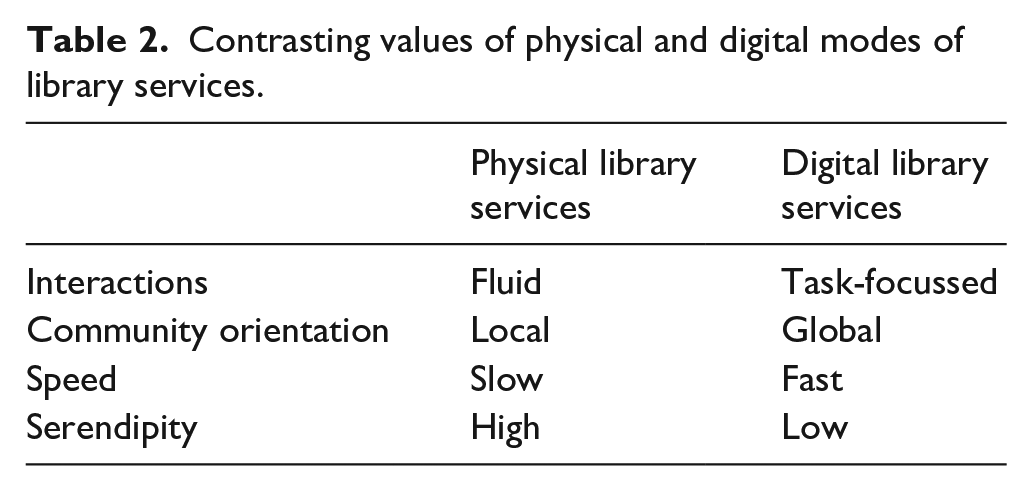
Therefore, we can say that the value attributes are different between these two different modes of library use. The value attributes that our participants mostly commonly associated with physical libraries were ones that describe the experiences of using a library, those that describe digital services were more about digital as a tool or product. This goes to help explain why the two modes of library services are not interchangeable but complementary and, even when library patrons use both modes, they value them in different ways.
Conclusion
Our findings from these focus groups highlight what aspects of digital and physical services are valued by those who use UK public libraries. We explain how participants were affected by COVID library closures, how they coped with these closures, and how they intend to use library services in the future. We show how digital and physical library services are conceived of differently by library users and that simple arguments that digital services can replace physical ones do not match the experiences or wishes of those who use these services.
Footnotes
Acknowledgements
We are extremely grateful to the library patrons who gave their time to this study and for their insightful comments and personal testimonies and to our library colleagues who hosted the face-face groups. We are very grateful to Andrena McMenemy who freely gave her time and talents to transcribe these focus groups in order to support public library research. The anonymous reviewers made very useful suggestions for which we are thankful.
Funding
The author(s) disclosed receipt of the following financial support for the research, authorship, and/or publication of this article: This research was funded by the Arts and Humanities Research Council grant reference number AH/V014730/1 and we are thankful to them for funding this research into UK Public Libraries.
