




Abstract
This article explores the tensions and contradictions in the potential success of maker-learning in Higher Education (HE) as supported in academic library makerspaces. Insights are formed from an in-depth, Cultural-Historical Activity Theory framed case study on a well-established North American HE academic library-based makerspace service. Lessons are drawn from the organisational tensions that emerged as challenges in its development. Participants were from the library service, students and academics from different disciplines that make significant use of the library makerspace. The ‘relational agency’ and ‘common knowledge’ of academic librarians in bringing together academic and student perspectives on the utility of maker-learning is found to be key. Maker-learning is observed to be an intertwined embodied/haptic, social/dialogic and rational/critical expansive cross-disciplinary system in a Zone of Proximal Development. Evidence of attempts to address the themes of inclusivity, diversity and sustainability to achieve ethical-maker-learning outcomes are discussed and developed. The article then expands on Ratto’s Critical Maker pedagogy utilised by the case study library service. I conclude with the proposal of a potentially transformative new concept for supporting cross-disciplinary maker-learning systems, ‘Critical Material Literacy’ (CML), whereby technical and material awareness connects with progressive concerns for people and the planet. This new theoretical concept is designed to start proactively addressing the key case study themes, with academic librarians becoming critical agents in creating ethical-maker knowledge hubs.
Keywords
Introduction
I developed a strong interest in the educational potential for maker-learning for my doctorate through my professional responsibilities leading Academic Librarian and Digital Services Teams for a UK university whose work includes a technology experimentation group (activities include 3D printing, virtual reality and photogrammetry). The possibilities of expanding our technology experimentation service through having a creative space became of interest. Makerspaces are community-based spaces for people to learn, explore and share using high-tech (e.g. digital fabrication/3D printing, electronics, robotics and virtual reality) or low-tech tools (sewing, woodworking), (Curry, 2017). Makerspaces can be based in communities, schools, museums and universities (Anderson, 2012). The makerspace I focus on in this case study is the second one built (Campus 2) at the North American research site university, a much larger one than the one that was initially created (Campus 1 – essentially a 3D printing service) both in terms of available space and technologies available (including electronics, cutting and milling and textiles equipment). As an early example of HE based academic library makerspace that has progressed services significantly, the service has been influential in the US and beyond to library services with maker-learning ambitions. The new space was designed for varied training and maker activities, including 3D printing, laser cutting, robotics, soldering and embroidery. In my 1-week on-site case study (21st–26th October 2019), I found 49 course-based classes and 58 maker workshops being run, including Technology in the Arts, Science Fiction and Steampunk, Communication for Engineering and Technology, Digital Sculpting, Design Thinking and Critical Making for Sustainability, all with high attendance.
Literature review
The case for HE libraries to support maker-learning
According to the UK’s Society of College, National and University Libraries (SCONUL) report on ‘Mapping the future of academic libraries’ that looks at the next 10 years (Pinfield et al., 2017), academic libraries operate in a fast-changing environment that is consistently challenging their current and future worth. The report showed that to adapt to the new Higher Education (HE) landscape, many UK academic libraries are shifting their strategic emphasis from collections to services. These services are contextual and focused on the specific Higher Education Institution (HEI) needs. However, although a growing phenomenon (especially in the US), support for academic library makerspaces is currently still outside the scope of many HE library services. Professional librarians may legitimately ask: why should we have this service in a library? Academic librarian and makerspace service manager Rogers (2016) made the case that, although maker technological skills may be challenging to many librarians, the ethos of academic libraries fits with maker-learning. Rogers positions librarians’ ethos as promoting open access, democracy, diversity, education and lifelong learning, all of which align well with the makerspace concept. As Rogers (2016) notes, ‘Makerspaces surface at the confluence of library strengths: community, technology, and creative learning space’ (p. 4).
The emergence of maker-culture
The origin of the ‘Maker Movement’ can be seen in the emergence of the similar concepts of ‘Hackerspaces’ developing in the 1990s and ‘Fab Labs’ from 2001. The three terms are often used now interchangeably (Davies, 2017). The term makerspace became popularised by Dale Dougherty’s (CEO of Maker Media) Make Magazine in 2011 with an emphasis on playful, creative experimentation (Dougherty, 2013). By 2016 over 1300 makerspaces had been established worldwide, 14 times increase from the number in 2006, including approximately 100 in the UK (Sleigh et al., 2015). These initially developed in communities and subsequently museums and libraries. Makerspaces in public libraries are now a popular movement worldwide, moving the library service on from a passive information storage model such that ‘libraries take on new significance at the heart of our communities as places of action, as well as thought’ (Willingham and De Boer, 2015: 8). The library makerspace as a cultural hub develops in different ways depending on community needs and opportunities. An innovative example can be seen in Colchester; the ‘Waiting Room’ combines a library, makerspace, performance space and an Open Kitchen for food producers to try new things (Willingham and De Boer, 2015: 8). The idea of ‘success’ as creating viable or commercial products is not essential to most makerspaces since learning through tinkering and making mistakes is encouraged. However, there have been examples of innovative new technologies that have been created in makerspaces (e.g. ‘Newborn incubator helping save premature babies in rural villages’, Kraft, 2014). This kind of real-world impact shows that makerspaces can be useful socially as well as educationally.
Makerspace research
A key study that inspired my own maker-learning research interests was the Royal Society of Arts (RSA) Action and Research Centre’s report based on a mixed methodology of desk research, data mining, interviews and visits to 12 UK makerspaces: ‘We argue that the act of making is one means of regaining mastery over technology – not just because it enables us to be more self-reliant but also because it can boost our sense of agency’ (Dellot, 2015: 5). The RSA report highlighted self-fulfilment, learning and entrepreneurial opportunities as potential beneficial outcomes from the creative engagement with technology that can occur in makerspaces. More inclusive targetted skills-based projects were highlighted, such as the ‘Digital Skills for Women’ from the Mad Lab in Manchester (Dellot, 2015: 27). Thus, I identified the potential significance of this research for HE based library and digital services in exploring the possibility of helping to meet globally prevalent HE inclusivity and diversity targets through makerspace services.
Different perspectives on the utility of maker-learning
Dellot (2015) identified makerspaces as being able to foster critical learning about different social possibilities through the exploration of diverse ways of living that are more focussed on ethical production rather than consumption (Dellot, 2015: 31). Dellot makes the strong claim that makerspaces may be ‘a new institution through which to reimagine capitalism’ (Dellot, 2015: 45). Davies’ (2017) ethnographic study of hacker and makerspaces across the US emphasised the collective, emancipatory possibilities emerging in makerspace culture through communities where people can meet (not just online) and productively collaborate: ‘for those we spoke to, participating in hacker and makerspaces was experienced as emancipatory and personally empowering’ (p. 167). A more business-focussed approach to maker-learning can be found from entrepreneurial perspectives: ‘The openness of a shared space, access to social technologies, and community of social support helped members develop entrepreneurial skills and self-efficacy’ (Hui and Gerber, 2017: 223). Holman argued against makerspaces realistically transferring the means of production: ‘conventional manufacturing is still really good at making high-quality and mass customised products’ (Holman, 2015: 19). The inherent cultural tensions and contradictions in the maker movement were drawn out clearly by Davies: ‘Hacking and making are simultaneously revolutionary and ancient. . . counter-cultural and anti-consumerist and mainstream business opportunities’ (Davies, 2017: 154). Therefore, we can see that without careful service design and support planning for a maker-learning environment in an HE environment, this central tension between the counter-cultural and neo-liberal elements of the maker-movement could be imported wholesale into higher education with potentially problematic results.
Critical views on maker-learning: inclusivity, diversity and sustainability
Inclusivity
Holman (2015) questioned how inclusive the maker movement is: ‘according to Maker Media’s own surveys, the movement is overwhelming male, well-educated and affluent’ (Holman, 2015: 4). Other researchers have asked how women can be encouraged to enter these often-male dominated DIY environments. Faulkner and McClard pointed out that ‘studies indicate that men make up as many as 81% of all makers, a percentage similar to the gender breakdown of major tech companies’ (Maker Market Study, 2012; quoted in Faulkner and McClard, 2014: 188). They state that, even if makerspaces can attract more women by including more craft-based activities, there are still social prejudices that privilege technology and engineers over artists or craftspeople in terms of cultural values. Lewis (2015) looked at makerspace literature and observes how unconscious male bias, technical jargon and women’s self-identity may restrict easy participation in these garage-like DIY spaces. Therefore, we can see how patriarchal control may lead to the male domination of typical STEM and computer subjects being culturally reproduced in makerspaces. Library makerspace researchers have also found ‘uncritical approaches to making risk deepening socio-technical divides along the lines of race, class and gender’ (Mann, 2020: 227) that can only be resisted by critical individual reflection and collective activity.
Diversity
Feminist perspectives have illuminated how culture defines who counts as a maker (e.g. Shivers-McNair, 2020). A fundamental criticism of makerspace learning has been put forward by engineering Professor Debbie Chachra who sees maker culture as redolent of traditional patriarchal values, with making placed above the more caregiving activities involved in teaching, constructive criticism and learning support: ‘[maker culture’s] success. . . devalues the traditionally female domain of caregiving, by continuing to enforce the idea that only making things is valuable’ (Chachra, 2015: n.p.). However, her identification of the traditionally female domain is a stereotype that can be seen as a somewhat limited view of feminine virtues. As well as concerns about gender bias, maker culture can be critiqued in a socio-critical class aware manner as to how ‘making’ is defined and what it means to make in a particular cultural context. Gollihue (2019) explained how a maker culture framed by electronic practices in middle class, academic and corporate environments ignores a cultural history of non-academic shared learning and making in agricultural settings, using her farm upbringing as an example.
Sustainability
Though the RSA report is a positive appraisal of the possibilities with makerspaces, challenges are not ignored. These include environmental issues (e.g. the abundant use and production of plastic in 3D printing). Concern was raised by Dellot (2015) about how ethical makerspaces will be unless strong collective leadership addresses the issue of sustainability with the materials used. The maker movement has more recently seen elements emerge with a strong focus on environmental sustainability. For example, in London’s Maker-Mile (2017) the open-source project of Precious Plastic was developed (Preciousplastic.com, 2020) by Dave Hakkens. Precious Plastic reengineers plastic rubbish into everyday essentials such as bowls, cups and tables. Evidence of the issue of sustainability being taken seriously in the maker-movement could also be seen from the workshop at the Machine Room makerspace in London (Smith and Light, 2016) that looked at cultivating sustainable developments in makerspaces involving approximately 80 makers from the UK and Europe. Best practice was shared regarding sustainable eco-making, upcycling, repair and re-use projects and other contributions to the circular economy. More recently, further evidence of sustainability being addressed can be seen in the ‘ecoMaker’ project presented at the fourth International Symposium on Academic Makerspaces (Roeder et al., 2019). This German-based project is aimed at both educational institutions with makerspaces and the maker community. The project provides an open-source blueprint for turning makerspaces into eco-friendly product creation centres. As part of ‘Eco Sprints’, makers were asked to identify eco-friendly alternatives for each defined part and function of a product or product prototype; for example, an alternative design for a desk lamp with ‘an energy-saving bulb and a wooden stand’ (Roeder et al., 2019: 2).
Critical Making
An attempt at an ethical maker-learning pedagogy (taught at the case study site as I shall go on to show) addressing the above issues has been developed through Matt Ratto’s ‘Critical Making’ (Ratto, 2012, 2016; Ratto et al., 2014) developed at the University of Toronto’s Faculty of Information Critical Making lab. Critical Making can be described as a kind of moral and values-based Constructionism (Harel and Papert, 1991; Papert, 1990) as it is an experiential learning process involving the manipulation of objects, that also involves critical reflection on the values in the design process and materials used in the shared act of making: Perhaps critical making is most adequately defined as a simultaneously constructionist and diffractive process of learning: a tacit, material, and conceptual transformation. (Hertz and Ratto, 2019: 14)
Critical Making thus links lived experiences with technologies to social critiques, including incorporating the critical history of technology, activism and anti-neo-liberal politics. The aim of critical thinking through embodied, material-engaged learning was initially more important than creating a tangible or usable object: ‘Critical Making frames a need to incorporate technical work alongside critical social analysis and makes a claim that doing so can both extend current scholarly critiques and direct them into society’ (Ratto, 2012: 2). A recent example from the Critical Making Lab shows how its open design practice has extended beyond the purely critical. Kleiner (2019) reports on how Ratto worked with doctors at the Toronto General Hospital to create a lab with the remit to translate 3D imaging, modelling and micromanufacturing techniques into clinical and educational practice. This work resulted in outcomes that included accurate 3D-printed hearts that allowed doctors to better examine heart defects before operating to repair them, thus providing effective pedagogical models for immediate practical application.
It is worth noting Critical Making overlaps with another Library and Information Science (LIS) concept familiar to many academic librarians (and relevant to my own praxis), Critical Information Literacy. Information Literacy can be defined as the ability to ‘think critically and make balanced judgements about any information we find and use’, thus enabling people to ‘reach and express informed views and to engage with society’ (Chartered Institute of Library and Information Professionals, 2018). Critical Information Literacy (Tewell, 2015: 1) extends the concept of Information Literacy to an explicit focus on social justice concerns related to libraries and information dissemination. Critical Information Literacy is itself emergent from ‘Critical Pedagogy’ with its focus on teaching that examines the social construction and political dimensions of knowledge. Thus, information production can be problematised such that library users may think critically about such forces that shape collections, and what voices and perspectives might be missing. The Critical Pedagogy I am most indebted to for my praxis is the emancipatory educational theory of Brazilian educator Freire (1970, 1992). Freire’s emphasis is on empowering learners to transform their world through a logical understanding of present systems and the need to avoid: a neutral education, heart and soul devoted to the technical training of the labour force - dedicated to the transmission of content in all the emaciation of its technicity and scientism. (Freire, 1992: 126)
The academic library makerspace
Makerspaces may be a natural fit within engineering courses where the importance of space for experiential learning, problem-solving and the creation of prototypes are already an assumed baseline requirement for pragmatically effective learning. Yet, the library as an open, welcoming, non-pressurised third space has an opportunity to collaborate on new makerspace projects that create an open access, cross-disciplinary, social learning space. Barrett et al. (2015) highlighted the advantage, in terms of broader access, of creating a makerspace in an academic library as a central location for multidisciplinary activity. Their US-based study showed this location choice was increasingly becoming a reality: ‘Perhaps the most common location where maker spaces are housed on college and university campuses is the library’ (Barrett et al., 2015: 14). Most of the academic library makerspace research to date is based in North America, where the maker movement originated and is at its strongest. Links to the wider maker movement and culture are sometimes apparent: ‘While academic library makerspaces tend to target student users, reaching out to non-student makerspaces and maker communities was viewed as a valuable exercise’ (Benjes-Small et al., 2017: 434).
Academic library makerspace case studies in the literature from North America show how many have developed from essentially 3D printing services. Crum et al. (2017) described how Northern Arizona University’s successful ‘Makerbot Innovation Center’ expanded its service to include older and emerging technologies (e.g. sewing machines and laser cutters). Challenges beyond initial space and staffing requirements in creating and developing an academic library makerspace service, as identified by Lee (2017), included the cost of new technologies and how the space will be governed and shared. A case study from the DeLaMare Science and engineering library at the University of Nevada Reno libraries (Radniecki and Klenke, 2017) showed how the service repurposed existing library instruction models to include teaching on 3D modelling and scanning, design, and intellectual property. However, challenges were found here. Despite the high demand for one-to-one support, there was a low turnout for workshops. Research on the current trends and goals of New England College and Research Library makerspaces (Davis, 2018) found common objectives of promoting new hands-on participatory literacies and an emerging focus on social justice and humanistic issues: ‘Above all, respondents focussed on the pedagogical opportunities on the one hand, and the potential for outreach and social justice on the other’ (Davis, 2018: 108). Nichols et al. (2017) argued that the makerspace offers an unprecedented working space for digital humanists who no longer must buy their own technology or reach out to other departments for innovative projects. They give the example of a Virtual Harlem project which focussed on the community in the 1920s and 1930s during the Harlem Renaissance.
Knowledge gap and research aim
As outlined in the literature reviewed above, there are significant challenges to creating a worthwhile makerspace in an academic library. There was a need for an in-depth investigation to see if a genuine synthesis of different professional and disciplinary views on maker-learning from the practical and skills-based to the more social justice and humanistic perspectives can be achieved. The professional interest at the core of my research questions was therefore to investigate the evolution of the case study HE library maker-service through initial tensions, including different user group needs, to observe how successful their attempt had been to create an inclusive, sustainable service welcoming to all, and benefiting from diverse perspectives.
Case study design
Theoretical framework
Activity Theory
As shown from my literature review Makerspaces are inherently activity-based social learning spaces where people learn experientially through trial and error with emerging technologies to achieve maker project aims. In recent years many scientists and systems thinkers have acknowledged the need to balance more reductionist gene-based views of human development with the importance of our collective social and cultural learning (e.g. Capra and Luisi, 2014; Henrich, 2016; Laland, 2017; Mesoudi, 2011; Sapolsky, 2017). As human knowledge has become ever more complex through techno-scientific progress humanity has become increasingly reliant on technologies many of us do not fully understand (as one of the participants in my case study stated: ‘If you give an iPhone to a high school student, [and ask them] ‘where do you start on building this?’, they would be entirely clueless’). Thus, whereas in earlier human development technologies could be passed down through collective tribal know-how, in the modern world we are often passive consumer of technologies with very little understanding of how they work or their social or environmental impact.
The view of humanity building higher-order intelligence through collective social learning can be traced historically to ‘Activity Theory’, first developed in the work of the Russian psychologist Lev Vygotsky and subsequently colleagues and followers (e.g. Alexander Luria, Alexei Leontiev). This approach theorises how social development involves a subject using both mental and physical mediational means to extend abilities and achieve goals in the problem space of activity thus achieving developmental gains (outcomes). These mediational means include tools and signs that influence agent and social structure, such as writing, language, gesture, diagrams, concepts and machines (all of which are present in maker-learning). As the power of collective human agency is a core part of Vygotsky’s thought, his dialectical model is removed from ‘the domain of crude social determinism’ (Daniels, 2015: 35). ‘Higher-order’ thinking is achieved through building, from mediated tool-based development, language that helps to scaffold new scientific concepts, learnt collectively and internalised: ‘If. . . Vygotsky is correct, and he surely is, without language there would be precious little complexity to human thought’ (Laland, 2017: 176). The key element of Vygotsky’s Activity Theory relevant to understanding maker-learning is his concept of The Zone of Proximal Development (ZPD). The ZPD is defined by Vygotsky ‘as the potential development as determined through problem-solving. . . in collaboration with more capable peers’ (Vygotsky, 1978: 86). Thus, a student can learn through tool-based activities scaffolded by a sense-making dialogue with a more knowledgeable teacher or peer whilst working on a problem, developing new understanding at a higher level. As I shall go on to show the ZPD can be applied to critical making with the aim of ethical outcomes through a reflective/dialogic critical maker-learning process reinforced by haptic awareness of materials and technologies.
Limits to Activity Theory
The ZPD can be criticised by recent learning and development theories for being too focused on dialogical learning and the development of scientific concepts. Most notably, ‘Embodied Learning’ theory raises an interesting challenge to sociocultural and cultural-historical perspectives. Embodied Learning theory is based on a view that recognises ‘thinking’ is never purely in the brain but instead grounded in sensory and motor experiences from the whole body. The idea that the human ‘mind’ is a fully embodied phenomenon has been developed in the cognitive and learning sciences in recent decades but was initially suggested by phenomenological perspectives. Notably, Heidegger (1962) proposed the idea of ‘handiness’ as the ontological categorical definition of beings as they use objects for tasks. In Merleau-Ponty’s (1962) ‘Phenomenology of Perception’, material tools are understood as sometimes becoming extensions of our minds. These ideas have more recently been applied to the study of tools as cognitive extensions of our body schema: ‘The tools and resources we use literally become incorporated into the body’s working definition of itself’ (Claxton, 2015: 292). The hand has been identified as a crucial human tool we use to manipulate objects and to increase cognitive effectiveness: ‘Manual perception, just like visual and auditory perception, helps discriminate the relevant from the accidental’ (Radman, 2013: 388). Thus, in a maker-learning context, I have found the tools available are often explored physically and haptically prior to, or at the same time as, intellectually, and imaginatively. However, although ‘Embodied Learning’ helps to focus on learning on the theoretical level of individual bodies it can be holistically connected to more rationally based learning within and between people (such as in the ZPD). As Claxton (2015: 239) has argued, ‘in practice, these non-intellectual, more embodied ways of learning and knowing blend together with thinking of a more rational and explicit kind’. In my case study a holistic view of maker-learning is therefore drawn from my observations whereby tacit embodied/haptic learning is thoroughly intertwined with the learning of a more social/dialogic and rational/explicit kind.
Methodology
Cultural-Historical Activity Theory
In this case study, I draw from a later development of Activity Theory, Cultural Historical Activity Theory (CHAT, developed by Engeström, 1987; Engestrom, 1999a, 1999b). The concept of the ZPD was expanded by Engeström (1987) to a collective cross-boundary level. Therefore, in an educational context, ‘teaching and learning are moving within the zone only when they are developing historically new forms of activity’ (Engeström, 1987: 147). In my case study, the ZPD does not operate only between students and academics but in a professional context between academic library staff, academics from different disciplines and students. This has enabled me to focus on the organisational evolution in the library makerspace service through the relationships between library staff, academics and students, their tools and goals and the tensions that have had to be overcome for the service to expand. A key concept with CHAT is that ‘thinking occurs as much among as within individuals’ (Cole, 1996: 43). Although this is a position I accept, it is essential not to over socialise the individual through a CHAT lens. As philosopher David Bakhurst notes, ‘the choice before us is not to conceive minds either as atomistic, self-contained and self-sufficient mental worlds or as shifting constructs of discursive forces’ (Bakhurst, 2011: 45). Therefore, I have also looked to Anne Edwards’ CHAT related Relational Concepts (2017) Edwards describes how successful professional cross-practice work is dependent on respecting and understanding the standpoint of others (‘relational expertise’, Edwards, 2017) and taking action with others (‘relational agency’, Edwards, 2017) mediated by the ‘common knowledge’ (Edwards, 2017) of what matters to each participating professional from their values and moral commitments; forming ‘an additional form of expertise. . . to expand understandings of the work problem as an object of joint activity’ (Edwards, 2010: 13).
Population of interest
This case study took place at a North American university’s academic library service makerspace. For my research sample, I selected a variety of types of stakeholders and advertised through agreement with the case study university. I purposefully selected volunteers to reflect different users and different opinions on the value of maker-learning. Risk management/IRB approval was achieved through the doctoral research process. Below are the names of the participants and their roles (pseudonyms are used). As well as semi-structured interviews, data was also obtained from further participants through non-participatory observation (see methods section below).
Participants
Library staff
Adrian – Head of Making and Innovation Studio
Chris – Experiential Learning Librarian
Daniel – Head of Department: Learning Spaces and Services
Mariana – Graduate Extension/Teaching Assistant, and PhD student in Communication, Rhetoric and Digital Media
Academic staff
Hazel – Associate Professor of English, Language Writing, Rhetoric, Digital-Media
Maddie – Associate Professor of English: Women writers 16/17thcentury English Literature, History of illustrated texts, Contemporary graphic novel
Peter – Associate Professor of English (Digital Humanities)
Charlotte – Teaching Assistant Professor Biological Sciences, Genetics, Cell Biology and Immunology
Miranda – Teaching Assistant Professor Biological Sciences, Genetics, Cell Biology and Immunology
Students
Nathan – Technology, Design and Engineering student and makerspace helper
Edward – Engineering student, Bioengineering and Bioprocessing
Rachel – Graphic Communications Student
Jack – Graphic Communications Student
Ivy – Textile Design Student
Methods
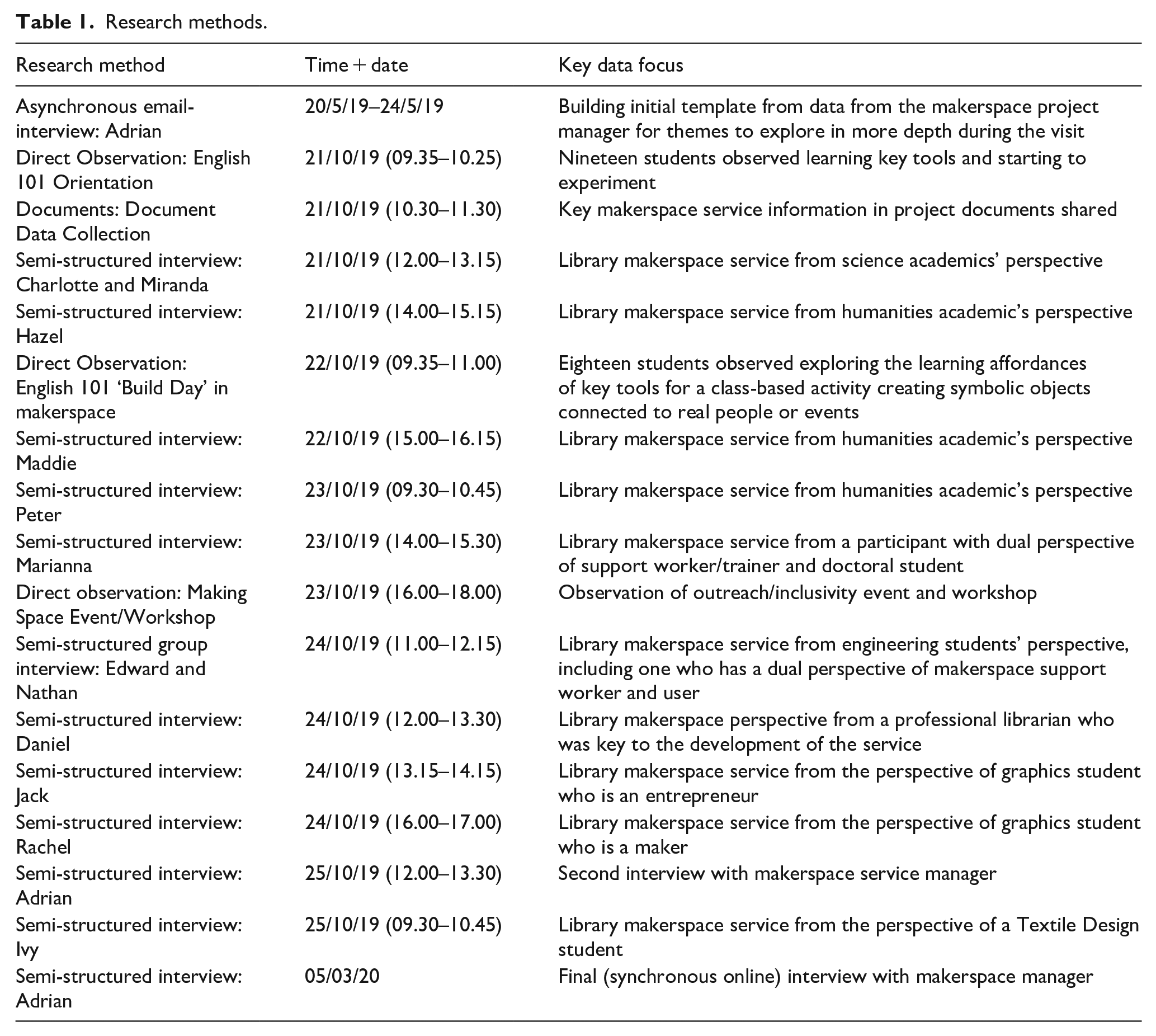
As Yin (2009) outlines, construct validity is achieved in case studies through multiple research methods and perspectives on the same phenomena. The same facts are observed from different participant views and using various methods and sources as appropriate. I employed semi-structured interviews (all face-to-face except the first and last with the makerspace manager online before and after my visit), non-participatory direct observation of makerspace activities with field notes, and document analysis (the makerspace project funding case, expansion case and progress data) for this case study. The research was undertaken between May 2019 and February 2020. Full details of methods used/dates/times are in the Table 1. Question schedules can be found in the appendix; all interviews were recorded and fully transcribed for the manual Template Analysis process outlined below.
Research methods.
Research question
How can an academic library makerspace develop as an inclusive, sustainable cross-disciplinary learning space and service within a higher education institution?
Sub-questions
How did the library makerspace service evolve beyond initial challenges and tensions to aim to support expansive, inclusive, embodied cross-disciplinary learning?
How are any apparent contradictions between the learning objectives of different user groups addressed in the library makerspace service?
Is the lack of diversity in STEM challenged by this library makerspace service?
What are the main tensions and contradictions that need to be addressed to further scaffold critical maker-learning in the library makerspace service?
Template Analysis
My approach to analysing the text generated by my research instruments draws on Template Analysis (Brooks et al., 2015; King, 2016). Template Analysis invites initial preliminary a priori coding from the first stages of research and intentionally draws from the researcher’s experience in an applied manner. These a priori suppositions are then used as a lens but challenged, adjusted, discounted and replaced when found inappropriate. This approach can be considered a type of ‘subtle realism’ ‘which acknowledges that a researcher’s perspective is inevitably influenced by his or her inability to truly stand outside one’s own position. . . but nonetheless retains a belief in phenomena that are independent of the researcher and knowable through the research process’ (Brooks et al., 2015: 5).
Case study findings
History
The original library makerspace at the case study university was a small space at the main library on Campus 1. A tension quickly emerged as students wanted to print their own designs but could not enter the room as staff carried out tasks (a tension between rules and learning objectives in CHAT terms) ‘so it really wasn’t good as an education piece’ (Daniel). There was also a lack of variety of new technologies (there being mainly 3D printers) and student interest growing for engagement with other emerging technology which required more space (e.g. laser cutters, sewing machines). Thus, Adrian’s new larger makerspace model followed guiding principles that included democratising access to new maker technologies through improving accessibility, supporting next-generation skills and providing a place for critical and creative thinking across disciplinary boundaries. Adrian and Daniel aligned the makerspace service project’s plans with the broader university’s strategic goals for career and economic foci, encouraging student innovation whilst justifying makerspace costs. The new makerspace project also bypassed some potential tensions by forming an appropriate staffing model, including student helpers. Daniel and Adrian highlighted how the kind of staff hired were crucial to the accessibility and inclusivity of the space and to push for more curriculum integration across multiple course areas (e.g. Textiles, Sciences and English). They found technical knowledge alone was insufficient for someone to support learning in the makerspace. As well as good communication skills, relational skills were needed to make the necessary connections across different academic disciplines. This was shown clearly by student helper Nathan, who subtly helped students when they were ‘stuck’. As reported by engineering student Edward, Nathan also allowed makerspace users to find their own feet and become more agentive over time, thus developing ‘self-efficacy’ (Bandura, 1997, 2001).
Cross-disciplinary maker-learning in the ZPD
Learning in this makerspace could be framed in terms of Vygotsky’s concept of the Zone of Proximal Development (ZPD) introduced above, whereby a student can learn through a sense-making dialogue on a problem with a more knowledgeable teacher or peer. For example, as a Textile Design student, Ivy was very interested in finding out what was possible through haptically manipulating the material, ‘it’s very much using the knowledge that I have in a way that can be challenged’. The time she spent waiting for 3D prints was used for testing new possibilities, such as creating holographic tubing pieces used in her work. However, Ivy also described how she learnt from a student studying Biological Systems Modelling who was designing a 3D printed model of a molecular formation puzzle for science learning activities. ‘It was interesting to see how the 3D printers could be used to make something that people could learn from’ (Ivy). Jack, a student with strong entrepreneurial ambitions, highlighted the cross-disciplinary makerspaces’ learning affordances from his perspective: ‘If you give an iPhone to a high school student, [and ask them] ‘where do you start on building this?’, they would be entirely clueless’. From a scientific perspective, Miranda described the makerspace as ‘another laboratory’ to explore with others. From their scientific-pedagogical viewpoint, Charlotte and Miranda mentioned a constructivist (Piaget, 1936) inspired relational and dialogic teaching model they used for maker-learning (Process Orientated Guided Inquiry Learning [POGIL], 2020). POGIL is a small team-based learning method. The teacher acts as a facilitator, with activities designed to be self-managed by the team, with the instructor there to help them construct their understanding in a scaffolded learning process. Charlotte and Miranda had also created a new online forum for sharing scientific maker-learning ideas.
From a Humanities perspective, I observed further different kinds of maker-learning. For example, for an English class-based activity in the makerspace, students were asked to create symbolic objects of autobiographical importance to them (to then write about). The most realised concept I came across was from a Hispanic student inspired by a song from the musical Hamilton. The student was 3D-printing a tree, an apple and a table and placing them artfully together to symbolise how immigrants may pick the food on the ‘high’ social table, but they often do not get to eat it. Help offered by makerspace staff during this class-based activity was often through an embodied/ haptic demonstration of the technology, rather than just verbal, demonstrating the best way to handle and manipulate technologies. This observation reinforces Library and Information Science (LIS) researchers Olsson and Lloyd’s view that ‘information landscapes are not only shaped and represented socially and dialogically but also reflected corporeally’ (Olsson and Lloyd, 2016). Hazel made the point beyond practical skills: the critical library makerspace affordance may be less about technical skills and more about a significant shift in how some students viewed technology with ‘the opportunity to think about technology as being something you make rather than something you use’(Hazel). This shift in student awareness to a maker mindset required careful dialogic support as part of the ZPD as Mariana explained, ‘I try to meet students where they are at’ (in terms of current interests and technical awareness when talking about and demonstrating maker technologies). Freely available online information, whether product-based resources, community of interest fora or individual blogs, were also used by students also acted as mediating online tools in an extension of the ZPD for students.
Peter described innovative Digital Humanities and Critical Making maker projects with objectives and outcomes that could be artistic, exploratory and critical, ‘bringing out the assumptions, protocols and even cultural conditions of the objects that they evoke’ (Peter). Peter gave examples of Digital Humanities projects, including a ‘surveillance book’. A motion-sensing camera was placed to look over the back of The Adventures of Sherlock Holmes. This was connected to a Raspberry Pi microcomputer that was programmed to capture pictures whenever it sensed movement in front of the book: ‘It became an extension of a discussion we had about marginalia, about if you think about the book as an object, what can you know about its life in the hands of readers or its passage through the world’ (Peter). Ideas such as this, if adapted, may be of interest to academic library services that wish to link innovative pedagogy to digital literacy issues such as copyright, intellectual property and the open access movement. Contradictions could be seen between examples such as this of imaginative, creative and critical engagement with makerspaces and a more business-focussed maker-learning. For example, from an entrepreneurial point of view, Jack felt that ideally, more sophisticated maker services were needed with more expert, business-focused guidance. However, this approach was found in another makerspace at this university Jack had used: ‘The Entrepreneurship Garage’, which potentially justified the library maker-learning service having a different model.
Common knowledge in cross-disciplinary maker-learning
The learning affordances from the cross-disciplinary relationally built ‘common knowledge’ (Edwards, 2017) forming in the makerspace were emphasised by all participant types, from students reflecting on the serendipity of finding more knowledgeable others (Rachel, Ivy) to professional and academic staff promoting and seeing the advantages of sharing knowledge across disciplines for different perspectives (Adrian, Chris, Daniel, Mariana, Hazel, Maddie). In Chris’s role as Experiential Learning Librarian, the ‘relational agency’ (Edwards, 2017) required was through exploring with others, asking ‘what is it you want to do?’ (Chris), rather than letting the technology itself or any fixed point of authority lead information exchanges around maker-learning. These observations were in accordance with DiGiacomo and Gutiérrez’s (2016) concept of ‘relational equity’ as being integral to the maker-learning process as all participants shared information horizontally. Maddie espoused the benefits from a humanist perspective, ‘the library is becoming an even more crucial part of the university ecosystem, almost a lab space for humanists’ (Maddie). Increased awareness of the cross-disciplinary nature of the new library makerspace was also achieved through the yearly library-led Make-a-Thon open to all, a weekend of maker-based innovation to research, design and prototype solutions to sustainability issues held in February. Prototypes from project groups of students from different courses are evaluated by judges from the community and local companies with prizes including $2000 to the winning team (e.g. winning projects have included a device to measure energy consumption at home through a mobile app).
Critical Making and Digital Humanities
Instilling a worth and purpose for making in terms of trying to encourage students across all disciplines to do meaningful projects was a goal of Adrian’s, who looked to address many of the inclusivity, diversity and sustainability concerns I found. Adrian highlighted how Critical Making was taught along with more instrumental Design Thinking (Hasso-Platner-Insitut of Design, 2020). As introduced above, Ratto’s (2014) Critical Making approach works at the boundary between humanities and engineering, often with the aim of ethical, socially progressive awareness and projects. For Hazel, the overlap between Critical Making and Digital Humanities was apparent in emerging maker-learning projects. Hazel gave examples of projects she had worked on, including Victorian-era muscle development kits. The kit (which used electric shocks through the body to make the user more muscular) was reproduced to help students think about Victorian views on masculinity. Hazel and Maddie also work on a project called ‘Intimate Fields’: ‘It’s based around the early modern idea of the posy which is a little text that people would pass around as. . . love notes’ (Maddie). From her perspective as a literary scholar, Maddie was interested in the posy as a genre and how it was embedded in material culture, ‘gloves, stitched garments, rings. I was interested in it as a physical computing project that could take existing posies and remix them’ (Hazel). The key technology they found was a near-field chip and reader: ‘we had rings that had embedded chips in them we could put existing posies into, and we had a set up where you could touch the ring to a reader that would generate a remixed new posy and then print it out’ (Hazel). In this example, we can see an element of re-enchantment in the learning process with the creation of an intriguing, tactile maker-learning object, inviting us to engage with historical expressions of love as patterns of discourse remixed into new forms.
Meeting inclusivity, diversity and sustainability aims
Rather than being seen as a Community of Practice (Lave and Wenger, 1991; Wenger, 1998) with a particular shared activity of concern, I found more disparate maker projects in this HE-based case study, often not focused on a specific technology or ‘practice’. The library makerspace did provide a general maker community and sense of belonging, often to students who may not easily find ‘another place that’s home’ (Daniel). Still, although no data was available all participants acknowledged middle class/white engineering students currently made up most makerspace users. Much was being done by library staff and academics to make the service more inclusive and open to diverse identities and learning interests. Academic participants described a kind of interpretive collaboration that took matters beyond immediate technical problems to more creative possibilities. Maddie testifies to this: I think that the library has a bigger picture of you; IT is very focused on solving a problem. . . and not necessarily good at communicating how tools could be used by humanists in interesting or new ways. They’re not interpreters.
Maddie described her puppetry project where students were required to ‘remediate’ some graphic novels into shadow puppetry. The makerspace service provided an opportunity to support a ‘quirky’ project popular with her students. As well as varied educational needs, I also observed some clear examples of engaging with diverse student identities. For example, a kind of material-artistic-conceptual transference could be seen in a project mentioned that involved a student with medical issues who wished to express ‘the kind of human dimension of medicalisation, she created this . . . skirt, and you could unclip the pockets and as you did lights came out’ (Hazel). The library makerspace was used to work out how to stitch LEDs into the garment. This example shows how more artistic and philosophical endeavours can be part of the conjunction of crafts and technology in maker learning. This finding was in keeping with an insight from the philosopher Alva Noe, drawn from the educational philosopher John Dewey’s understanding of the nature of art as a kind of experiential learning: ‘art is experience, for Dewey. Artists don’t make things. They make experiences’ (Noe, 2015: 205).
As was clear from the academics and students interviewed, library service efforts to make the makerspace inclusive had met with some success, but there was still much work to do. If maker-learning is often associated with instrumental STEM concerns, there is still room for an interesting dialectical tension that can be explored in HE based maker-learning to expand emancipatory possibilities. Key elements of the data from this case study, such as the perspectives of Hazel on digital literacy and Peter’s emerging critical but still engaged views of maker-learning, suggest that a broader, more inclusive view of maker-learning is possible within a university makerspace. The library service had a ‘Making Space’ programme to address inclusivity and gender diversity issues in entrepreneurial maker culture through public talks and workshops. While I was there, the designer of the Rap Godz board game, Omari Akil, provided an inspiring talk on moving from a computer science career into board games, trying to challenge the white hegemony seen across board game culture with a new game designed around rap music history and culture. After the talk, the large, diverse audience was invited to the makerspace for a ‘Hyperspeed Game Design Session’. Activities such as this provide clear evidence of how this, and potentially other academic library makerspaces, can widen participation and interest in maker-learning through a broad cultural programme of maker-related events.
Hazel had a particular concern about ecological sustainability issues regarding maker-learning and the need to understand the ‘material aspect of the digital’ (Hazel), including the carbon footprint of much makerspace technology. She discussed the benefits of new sociological learning models emerging beyond Critical Making, in particular ‘New Materialism’ with its holistic interpretation of social, natural and green materialist aims ‘where materiality is a term that applies more evenly to humans and non-humans’ (Bennett, 2010: 111). However, Peter explained how maker-learning could be environmentally aware, giving the example of using the library makerspace for a class on steampunk that connected with a visit to a local scrap exchange and challenged the casual approach to sustainability of many makerspaces.
A critical ontology of cross-disciplinary maker-learning
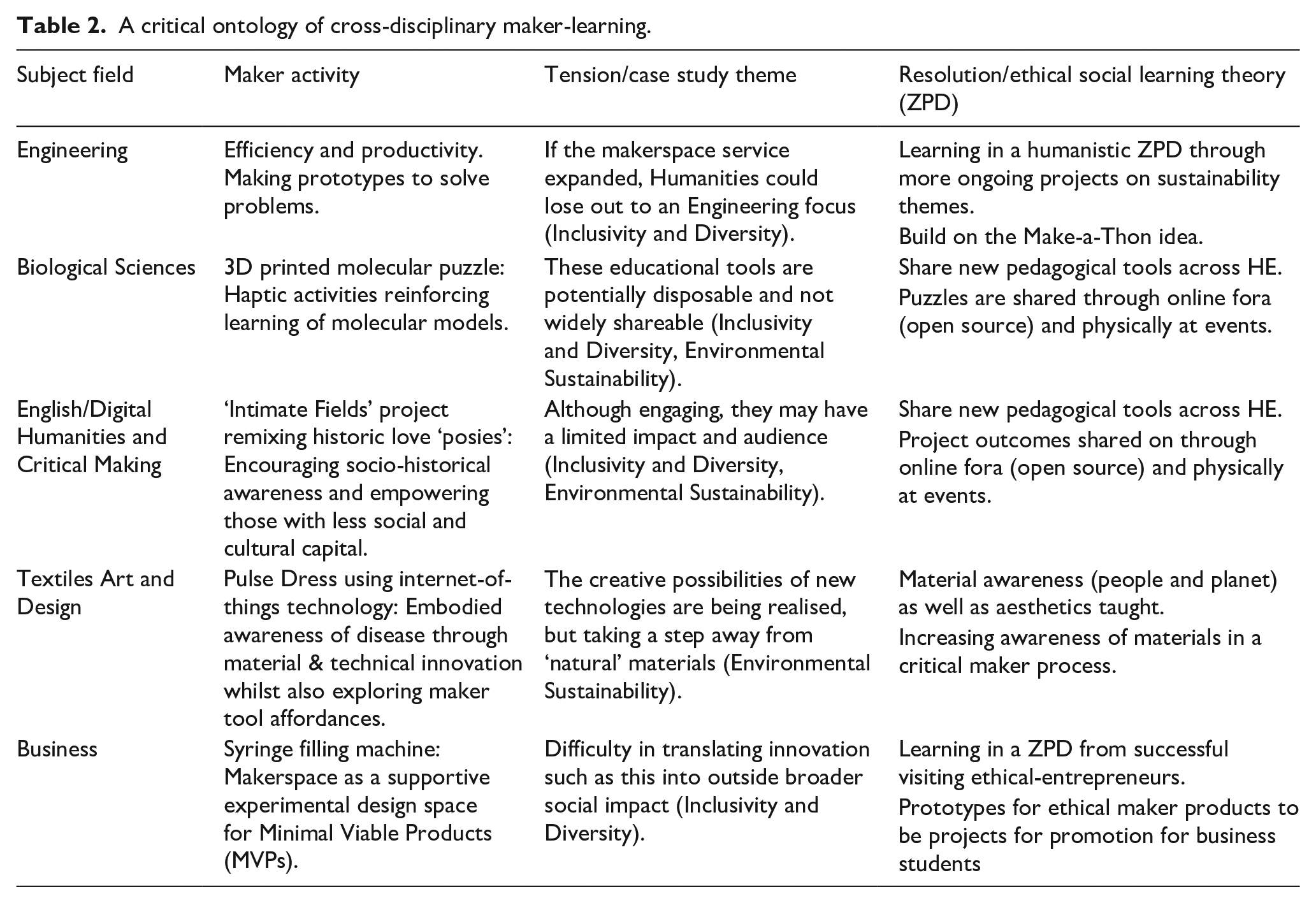
Regarding my main research question, ‘How can an academic library makerspace develop as an inclusive, sustainable cross-disciplinary learning space and service within a higher education institution?’, it was apparent from the case study findings the makerspace service had made good initial progress. Still, there was much to discuss in terms of expanding developmental possibilities. To achieve the potentially profound transdisciplinary maker-learning aims shared by critical makers, ongoing tensions around inclusivity, diversity and sustainability must be addressed with regard to the complex ethical contradictions within the interdependent systems of people/processes/materials/technologies/ecology found within ‘maker-learning’. These key tensions prompted the following analysis at the level of ontology in an attempt at disclosing emergent possibilities from the HE based maker-learning phenomenon as found in my case study. Table 2 summarises the tensions/ contradictions in the maker-learning models of the subject-based systems that create limits to the current activities offered and initial suggestions for solutions.
A critical ontology of cross-disciplinary maker-learning.
Discussion
The above table shows some initial ideas to resolve tensions/contradictions in maker-learning from the case study site to start meeting more ambitious progressive, cross-disciplinary targets. These include:
– further ZPDs emerging in ongoing locally focussed environmental projects
– cross-university and disciplinary communities of interest sharing maker-learning tools encouraging inclusive and diverse critical making
– encouraging reflection on humanistic values (people and planet) alongside aesthetics
– increasing material awareness through haptic interaction with more sustainable materials
– encouraging more visits from successful ethical entrepreneurs.
It is therefore apparent how increasing the scope of maker learning through cross-disciplinary and cross-university lines within an ethical humanistic frame might lead to more dynamic new learning environments driven by curiosity, creativity, passion and purpose: We need learning environments that invite, excite, and inspire learners . . . Any effort intended to unlock human potential that is predicated on a content-transmission idea will prove ineffective. (Barab et al., 2020: 133)
As I have shown, there is much interest in maker-learning from multiple disciplinary perspectives and growing awareness from academic libraries and others scaffolding maker-learning of the need to engage with environmental and social justice concerns (see literature review, Davis, 2018; Nichols et al., 2017). The maker movement has recently seen makers emerge with a strong focus on environmental sustainability (e.g. Preciousplastic.com, 2020). With the aim of engaging learners in being part of a new critical and sustainability focussed HE based maker-learning and as an original contribution to maker-learning theory, I have employed insights from my case study to build a new concept of ‘Critical Material Literacy’ to be engaged with in transdisciplinary maker-learning systems (useable by academics, professional staff and/or students in multiple contexts). This theory is in keeping with a Freirean and Vygotskian recognition that we (humanity) are historically and socially situated beings who require an education that is more than just a pedagogy of content transmission. As the Vygotsky scholar Anna Stetsenko observes learning and development also involve locating ourselves in our cultural-historic moment and finding agency in purposeful collective activity according to our values: ‘the future – embodied and enacted in people envisioning and committing to it – powerfully shapes our being, knowing and doing in the present’ (Stetsenko, 2017: 236).
Critical Material Literacy
A definition of my concept of Critical Material Literacy is below, this is followed by a diagram and explanation of how academic librarians can create a culture and system to support suggested new modes of learning. This looks to build on Ratto’s (2012) thought by addressing the central tension of the lack of current impact from critical maker projects by creating a critical and practical system that can be used as a pedagogical tool across disciplines:
Critical Material Literacy (CML) can be defined as proactively developing ongoing knowledge on the social and environmental impact of the materials used in making processes across all areas of human activity. The aim of CML teaching is for people and planet focussed material literacy to be expansively developed in society. This exploratory cross-disciplinary concept is relevant to all disciplinary perspectives as an educational tool. CML can be taught abstractly as a concept either face to face or online but can be reinforced as a learning system through embodied/ haptic interaction with materials in critical maker processes. These processes are not just undertaken for solely academic purposes, but wherever possible with the practical aim of creating ideas and prototypes for more sustainable and inclusive cultural artefacts, products and technologies to benefit all in society both locally and globally.
Below is a diagram showing how academic libraries can look to scaffold Critical Material Literacy, followed by a discussion of how it can be enacted in practice:
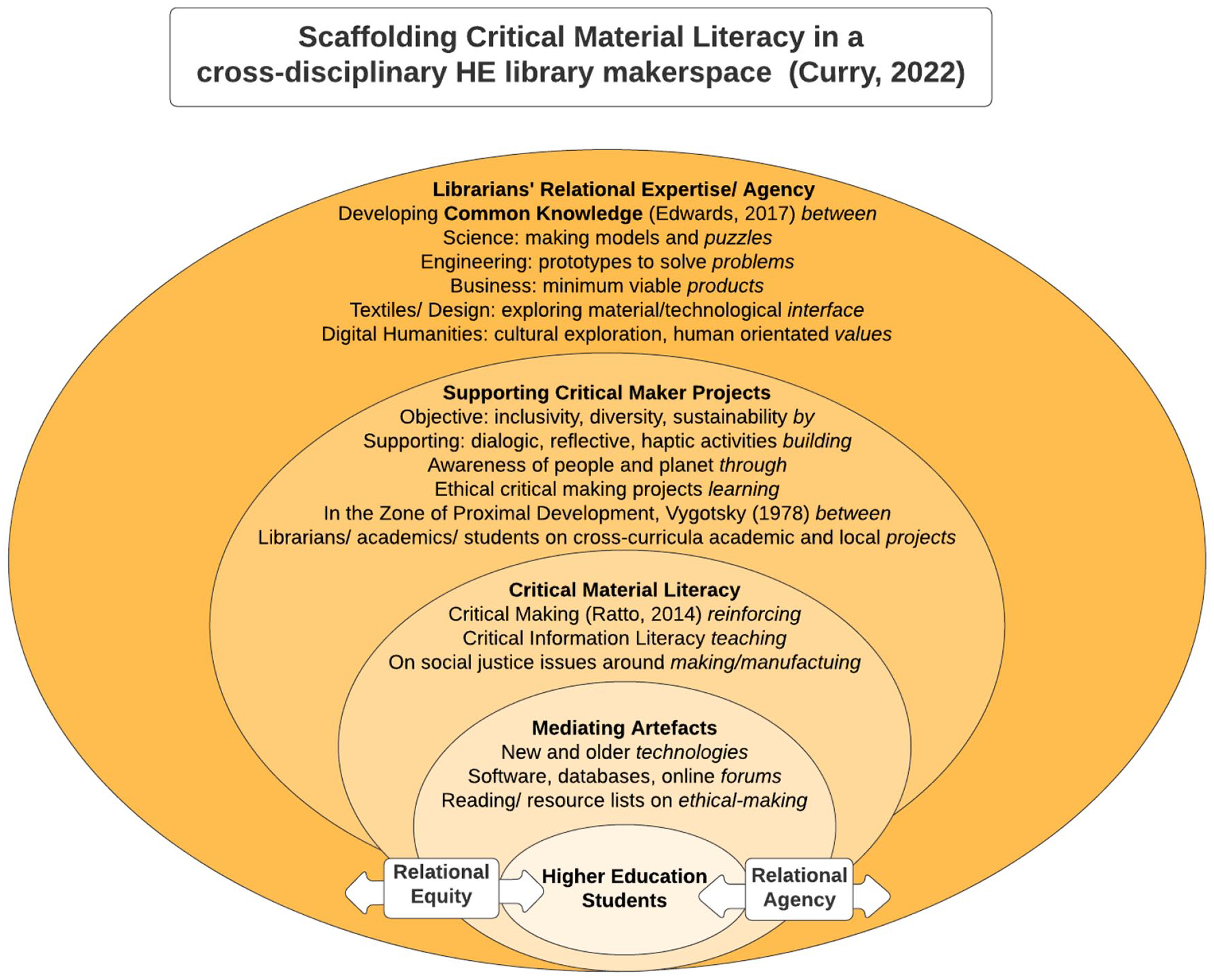
Critical Material Literacy: Theory and practice
The above diagram makes explicit a theoretical framework that combines observations from the case study maker-service with an ambitious conceptual map for critical maker-learning across multiple HE learning systems led by academic libraries. From the outside academic librarian’s relational agency and expertise (Edwards, 2017) is essential in helping academics and students build common knowledge of what is valued from different disciplinary maker-learning perspectives. For example, students making scientific models and puzzles could learn from business minimum viable products theory or look to share ideas in more humanistic ways as open-source teaching aids; engineering could learn from the Digital Humanities on more ethical ways of being to explore Critical Design Thinking, and all viewpoints could learn from the patient exploration of what materials can do and their aesthetic possibilities from design and textiles students. The next layer shows how the major challenges of ethical maker-learning (inclusivity, diversity and sustainability) can be explored through dialogic, reflective and haptic activities exploring Critical Material Literacy through Critical Making projects in the ZPD between librarians, academics and students. The mediating material tools of makerspaces could also become a practical physical toolkit to extend Critical Information Literacy teaching around ethical-maker-learning with social justice concerns for people and the planet. Therefore, academic libraries can become ethical-maker-learning knowledge hubs as part of wider systems of technology-based maker teaching and learning. Activities could include curricula, cross-curricula and practical projects linking with local ethical/entrepreneurial and charitable projects (examples of how this could work below). The mediating artefacts of maker-learning are next to the HE student in the diagram, showing how their makerspace exploration is scaffolded by information made readily available by librarians, including curated reading and resource lists on ethical-making. Relational agency (Edwards, 2017) and relational equity (DiGiacomo and Gutiérrez, 2016) are shown at the base of the diagram, running through all layers, emphasising how the makerspace can allow for relational bi-directional learning and development on a horizontal plane.
A straightforward way to engage with CML for academic libraries with makerspaces would be to review all the materials used and the technologies currently employed through a sustainability lens. Linking back to the literature review, we can see increasing activity around sustainable making that could be connected to (e.g. recycling waste 3D prints through a Precious Plastics shredder, Preciousplastic.com, 2020). Academic library makerspaces could build useful ethical and sustainable information sources into reading and resource lists for ethical making. Academic librarians could also be involved in connecting ethical maker-learning to their disciplines where of interest (as summarised in the outside layer of the diagram above), demonstrating the ongoing worth of subject specialism in academic librarianship (Curry and Farmilo, 2019). For example, healthcare students, professionals and academics may be interested in the example of Careables.org (2021), which unites healthcare professionals with makers to create tailor-made solutions for patients such as bespoke wheelchairs and recent equipment-making for Covid-19 safety. CML can therefore be amongst new cross-disciplinary theories engaged as part of a movement to a more transformational view of academic librarians’ value in higher education as they lead in creating meaningful cross-disciplinary learning spaces. This proposal is in keeping with Anna Stetsenko’s recently theorised ‘Pedagogy of Daring’ that calls for more courage from educators in our turbulent times, positioning the goal of education as ‘a project of providing conditions and tools for persons to become agentive actors and co-creators in society, culture and history’ (Stetsenko, 2017: 249). Thus, my understanding of the ZPD agrees with Vygotskian scholars who have always seen it as inherently emancipatory: ‘the ZPD is precisely where the voice of the marginalised is heard and developed throughout cognitive development’ (Hardman, 2021: 231).
More ambitious plans with CML teaching could therefore be explored. For example, a lesson plan inviting challenging conversations could include an exercise where students consider the social and environmental implications of an iPhone’s components, including handling parts of a deconstructed phone (or 3D printed replicas) adding haptic to theoretical awareness. This kind of maker learning activity could be effectively combined with a more traditional trawl of recent journal articles and internet sites to look at the impact of the iPhone-construction process from sociological, environmental and economic perspectives (e.g. children’s working conditions in iPhone production systems mining rare earth materials, Amnesty.org, 2021). Haptic technological deconstruction combined with Critical Information Literacy teaching can lead to a process of Freirean empowerment in the ZPD of new maker- learning systems. CML and Critical Information Literacy can therefore become key pedagogic tools in teaching from a more holistic/systems view of life: ‘we need to remember that sustainability. . . is not an individual property but an entire web of relationships’ (Capra and Luisi, 2014: 390). Thus, a critical maker session on deconstructing an iPhone could end with the positive example of ‘Fairphones’ (conceived initially in a FabLab, Fairphone.com, 2021), which addresses worker rights and wellbeing, product longevity and waste reduction in the manufacturing process. CML aims to help fulfil an insight from Freire’s later writing where he argued for ‘increasing solidarity between the mind and the hands. . . to the degree that our bodies are actively implicated in the remaking of our world’ (Darder, 2021: xxv). CML and similar new concepts from academic librarians and other educators could expand critical maker-learning into a new transdisciplinary conceptual gateway for HE to fulfil its ‘essential role in sustainability’ (Žalėnienė and Pereira, 2021: 99), thereby contributing to meeting global UN Sustainable Development Goals (SDGs). Nor can helping to meet SDG targets be separated from the issues of inclusivity and diversity discussed in this case study, as it is the poorest and most marginalised communities that will be potentially irreparably damaged by climate change without strident effort towards ‘environmental integrity, economic vitality and a just society, for present and future generations’ (UNESCO, 2018).
Conclusion
The findings from my case study show academic librarians’ relational agency (Edwards, 2017) was key to the development of the case study HE library makerspace service, bringing together academics and students from across disciplines in nascent cross-disciplinary maker-learning projects with sustainability and inclusivity foci. The observations, insights and possibilities from this case study also demonstrate how academic library services can further enable more progressive cross-disciplinary Critical Making with a focus on Critical Material Literacy (CML). CML teaching and training would be focused on sharing and discussing material awareness related to inclusivity, diversity and sustainability issues in maker processes (both local and global). Through scaffolding CML learning academic libraries could become hubs of information, practice and collective knowledge building for ethical making. CML activities and resources joined with Critical Information Literacy teaching can thus become a grounding for new library and information systems offering a dynamic mixture of embodied activity-based social learning, ethical reflection and dialogic evaluation of maker processes and products. As the technology researcher Stephanie Hare opines: ‘strengthening our education and conditioning in technology ethics can empower us to be more than just a cog in someone else’s machine’ (Hare, 2022: 197). Therefore, the ambitious pedagogical aim of HE library-based CML teaching and knowledge building I argue for here is to attempt to ensure no students leave university as wholly uncritical/passive consumers of new technologies and products.
Footnotes
Appendix
Funding
The author received no financial support for the research, authorship, and/or publication of this article.
