




Abstract
While digital infrastructure is clearly a critical factor in addressing the digital divide for rural society, it is only one component in realising the benefits of information and communication technology (ICT). It is increasingly acknowledged that citizens, governments, and businesses need to develop skills and motivations to use technologies. It is also recognised that young people and their rural communities are among those who gain the least from opportunities to engage in and benefit from an ever-evolving digital society. As with other areas of rural development, local community institutions and actors assume their own leadership in developing initiatives to overcome challenges and advance digital literacy and in this regard, public libraries have led and continue to hold considerable potential to champion this area. This article reports on the experiences of a 14-month community-based collaborative research project with public libraries engaged in a process of developing coding clubs for children and youth in rural Manitoba, Canada. Our research sets out to answer the questions: first, whether it is viable for public libraries to cultivate advanced digital skills among rural youth and contribute to bridging the rural-urban digital divide by running coding clubs following the CoderDojo model? And second, what are the critical conditions to ensure the success of public library coding clubs? In examining some of the experiences encountered in adopting the coding club as a model of digital literacy building, we discuss wider themes for rural public libraries interested in advancing digital literacy building within their communities.
Introduction
Internet access and digital skills are critical to rural communities. Research has demonstrated that rural communities acutely experience the digital divide, with services typically slower and inferior in quality, and costing substantially more compared with urban centres (Kelly and Hynes, 2018; Townsend et al., 2015). While rural broadband infrastructure is critical in removing geographic limitations to communication, knowledge access, service delivery and economic transactions (Hallstrom et al., 2017; Townsend et al., 2015), it is only part of the narrative to realising the benefits of Internet access. It is increasingly acknowledged that rural citizens, governments, and businesses need to develop skills and motivations to use technologies, not merely possess them. Research shows that access alone will not guarantee usage or benefits of broadband (Cawley and Hynes, 2010; Whitacre et al., 2014), and that the socio-economic benefits of the Internet only become real once the Internet is put to use (Beckinsale and Ram, 2006; Conley and Whitacre, 2015; Hallstrom et al., 2017; Townsend et al., 2016). In response, researchers are increasingly calling for more emphasis on the adoption side of digital technologies and looking for solutions and opportunities to build digital skills and use (Helsper and Van Deursen, 2015; Information and Communications Technology Council & Media Smarts, 2014; Roberts et al., 2016; Salemink et al., 2015). The extent to which children and youth are effectively equipped for the ever-advancing digitisation of society is also a subject of considerable research and debate (e.g. Ito et al., 2009). The research in this paper concluded just as the Covid-19 pandemic began and the critical importance of digital skills and access to technology, especially in rural areas has been particularly evident during this global crisis (Holpuch, 2020; Li, 2020; Malik, 2020; Weeden and Kelly, 2020; WP Editorial, 2020).
In this paper, we present findings from a 14-month community-based collaborative research project with public libraries in rural Manitoba, Canada, a largely agricultural region where opportunities for digital adoption have been slow to emerge. Based on a community-based research (CBR) project to develop ‘coding clubs’ for children and youth, we report on the experiences of working with public libraries in using this model to stimulate digital capacity and adoption among rural young people. Our research questions informing the study are: first, whether it is viable for public libraries to cultivate advanced digital skills among rural youth and contribute to bridging the rural-urban digital divide by running coding clubs following the CoderDojo model? And second, what are the critical conditions to ensure the success of public library coding clubs?
In the next section, we provide an overview of the literature on digital literacy, skills and the relatively recent model of coding clubs as a method of engagement with young people; and second, the unique and changing role of public libraries in this wider context of literacy. We follow this with an overview of the research study, before discussing key findings and some wider themes for rural public libraries interested in advancing digital literacy building within their communities.
Digital literacy, skills and the coding club model
Researchers of education, digital literacy and computer science all emphasise the importance of digital skills in the 21st century (Garneli et al., 2015; ITU, 2018a; Papavlasopoulou et al., 2017). The skill and knowledge to use digital tools is essential both for individuals specifically and for communities generally to take advantage of the opportunities of these technologies (Hadziristic, 2017; Roberts et al., 2015; Townsend et al., 2013). The more digital literacy people have and the higher their skill in using these technologies, the more digital opportunities they pursue (Livingstone and Helsper, 2007). There are multiple definitions of digital literacy in the literature (Balea, 2016; Eynon and Geniets, 2016; Hadziristic, 2017). These definitions include a range of technological, information-based, social and creative skills needed to use digital technologies (Gold and Bode, 2017; Helsper and Eynon, 2010; van Deursen and van Dijk, 2014). Scholars and policymakers agree on core digital literacy concepts that include the ability and knowledge to use digital technologies to participate or navigate in our digital society (Garcia et al., 2015; Hadziristic, 2017; Steeves, 2014; Van Deursen et al., 2016).
Researchers and educational institutions place substantial emphasis on digital skills (Fraillon et al., 2020; Garneli et al., 2015; Huynh, 2018; Passey et al., 2018). Until recently, much scholarly focus has been placed on the technical skills needed for operating digital technologies (Ferrari, 2012; Hargittai and Hsieh, 2012) but while these are essential, it is argued that technical skills alone are not enough (Gold and Bode, 2017; Hadziristic, 2017; Helsper, 2012; Van Deursen et al., 2016). Increasingly, researchers have begun to focus on contextual and content-based skills needed in the 21st-century in addition to the technical tool-based set (Eynon and Geniets, 2016; Helsper and Eynon, 2013; van Deursen and van Dijk, 2014). Combined with informed decision-making, applying digital technologies to explore, research and develop solutions is one critical benefit identified throughout the literature (Digital Literacy Fundamentals | MediaSmarts, 2018; Fraillon et al., 2020; Government of the United Kingdom, 2019; Hadziristic, 2017; TechManitoba, 2020; Van Laar et al., 2017; WEF, 2020). The ability to create digital content is another essential component in the adoption and use of digital technologies (Carretero et al., 2017; Digital Literacy Fundamentals | MediaSmarts, 2018 ; Fraillon et al., 2020; TechManitoba, 2020; Van Laar et al., 2017; WEF, 2020).
In this focus on digital adoption, there has been particular focus on the variation among young people in how well equipped they are for the ever-advancing developments in digital society and economy. One position holds that the entire cohort of youth today is a group with advanced digital skills – the putative ‘digital youth’ (Ito et al., 2009) – that is challenging the education system, as well as requiring a different style of learning due to their digital immersion (Prensky, 2001; Tapscott, 1999). Appearing to seamlessly pick up new communication technologies (Prensky, 2001), digital skills are seen as automatically ascribed to this group since these youth live in a digital reality forged of video games, digital music, and smartphones. Research reveals, however, that not all of today’s youth have a broad range of digital skills (Bennett et al., 2008; Helsper and Eynon, 2010; Livingstone and Helsper, 2007) but rather that the skills they have tend to focus primarily on entertainment and recreation rather than skills for employment, education, or civic-related activity (Hargittai, 2010; Helsper and Eynon, 2010). Researchers have found that while youth use technology intuitively and regularly, they do not often have the depth of work-related ICT skills expected of them as the digital generation (Laronde et al., 2017; Steeves, 2014). In the face of emerging technologies, youth need to continue developing their skills as they are the most likely to experience workplace disruption and new employment opportunities (Lamb and Doyle, 2017).
Against this wider backdrop, coding is frequently identified as key to a recognised vital set of digital skills. Coding, or computer programming, are the terms used to describe writing instructions for computers to perform a task or set of tasks determined by the coder. The coding skillset focuses on understanding how computer software works and how to instruct computers to follow directions. One set of authors states that ‘Rogramming’ should be the fourth ‘R’ to accompany the popular Reading, Writing and ‘Rithmetic (Woodward and Fayed, 2016). A consistent theme is that while not all students will become programmers, all students should know how to code since coding can have a wide range of benefits. (Garneli et al., 2015; Papavlasopoulou et al., 2017; Sáez-López et al., 2016; Sheridan et al., 2016). These benefits include the development of digital confidence and human capital (Papavlasopoulou et al., 2017; Sáez-López et al., 2016; Sheridan et al., 2016) as well as building critical workforce skills (ACTUA, 2018; Djumalieva and Sleeman, 2018; ITU, 2016; Lamb and Doyle, 2017). Coding fosters creative capital as well as enhancing social capital through peer-based learning (Garneli et al., 2015; Sáez-López et al., 2016; Sipley and Hall, 2015; Woodward and Fayed, 2016) ) Learning to code increases an individual’s ability to understand and engage in a digital society, constituting a form of ‘political capital’ (Corneliussen and Prøitz, 2016; Dubow et al., 2017; Information and Communications Technology Council & Media Smarts, 2014). Basic coding requires individuals to use a programming language to compile instructions for computers. Even beginner coders are exposed to and develop essential computational skills such as system design, debugging and critical thinking (Garneli et al., 2015; Woodward and Fayed, 2016). ‘Scratch’, one of the primary visual programming languages for children, was intended by its inventor to do precisely that: teach children to think critically and learn to problem solve (Sheridan et al., 2016). Researchers are finding that building digital confidence is a useful outcome of learning to code (Sáez-López et al., 2016).
Being a creator is essential in the 21st century, and being able to contribute content rather than merely passively consume it is invaluable in today’s digital world (ACTUA, 2018; Sáez-López et al., 2016; Van Laar et al., 2017). Learning to code involves youth designing and developing games, animated stories, or music videos (Garneli et al., 2015). Coding requires learners to develop creative solutions for problem-solving (Woodward and Fayed, 2016), further boosting the levelling up of their creative capacity. These skills are in such high demand that coding bootcamps are popping up globally (ITU, 2016). Europe alone will see half a million unfilled positions in the digital technology field related to a shortage of candidates with advanced digital skills such as coding (ITU, 2018a). In Canada, both youth and their parents are keenly aware of the importance of coding. A recent survey found that 92% of youth and parents believe that competence with digital technologies is essential for future careers. A majority of the youth (70%) are interested in careers that involve coding (ACTUA, 2018). In addition to programming skills, learning to code builds animation and multimedia production skills. Introductory programming languages like ‘Scratch’ encourage youth to explore game design, animated storytelling and music video creation (Adams and Webster, 2012; Sáez-López et al., 2016). Animation and media production are two other highly valued digital skills for employees in the present and future digital economy (Djumalieva and Sleeman, 2018).
Recognising the importance of coding as a core element of digital literacy (Corneliussen and Prøitz, 2016; Huynh, 2018; Papavlasopoulou et al., 2017), schools around the world have been incorporating coding into their curricula (Corneliussen and Prøitz, 2016; Meerbaum-Salant et al., 2013; Smith et al., 2014; Ward, 2016). Unfortunately, the demand for coding in schools still outpaces available resources, including qualified teaching personnel (Garneli et al., 2015; Huynh, 2018). The ACTUA (2018) survey with Canadian youth and parents revealed that a minority of Canadian students have access to coding classes, and most students (54%) would like more coding instruction within schools. Canadian schools are struggling to meet the demands and needs of youth for coding and other digital skill acquisition. With demand for coding skills exceeding the current ability of schools to deliver, coding clubs are appearing outside the codified education system to help fill the demand. These clubs are often delivered as community programming at public libraries or other community centres (Corneliussen and Prøitz, 2016; Huynh, 2018; Sheridan et al., 2016; Ward, 2016).
Research shows that coding clubs are in demand across Canada, with more than 66% of youth ‘interested’ in coding clubs and 20% ‘extremely interested’ in learning to code outside of school (ACTUA, 2018). Unfortunately, similarly to school coding classes, coding clubs are still not meeting the rising demand, even though more than 50% of youth want more access to both formal and informal learning opportunities (ACTUA, 2018). More opportunities are needed both inside and outside of schools to help youth build digital literacy generally and coding skills specifically. Research in Canada shows that the opportunity to build digital skills is even more limited in rural areas, where distance and poor broadband infrastructure create access challenges (Huynh, 2018). Scarcity of available digital education and training programmes creates further hurdles for learning opportunities (Huynh, 2018).
Developed in Ireland, CoderDojo (coderdojo.com) is one recently emergent model of coding club that has the potential to help fill this opportunity gap. CoderDojo incorporates a ‘belt’ system corresponding to beginner, intermediate, and advanced ‘Scratch’ skills. The CoderDojo belts are bracelets that come in three colours – yellow, green, and blue – with each colour representing a level of competency in Scratch coding. The belts contain a USB key, and the memory increases with each level from 2 GB to 4 GB to 8 GB. The belting system provides specific criteria for youth to learn and build on and provide evidence of youth progressing in their digital skills. Each ‘Dojo’, or established CoderDojo club, ideally has adult leadership for both the technical and coordination, to serve as Champions for the club (CoderDojo.com). Within this framework of adult support, participants are strongly encouraged to problem solve on their own or with assistance from their peers, rather than depending on adult instruction. There are now more than 2100 ‘Dojos’ worldwide, engaging more than 58,000 youth in coding and digital technologies (CoderDojo, 2019). While there are over 2000 Dojos worldwide when this research began in 2018, there were none located in the province of Manitoba and only one located in the prairie region of Canada (CoderDojo, 2019).
In this context of literacy, what role do public libraries play? Across the world, evidence suggests that public libraries have been leaders in helping rural communities bridge the digital divide (Curry et al., 2004; Jaeger et al., 2012; Strover et al., 2019). In many communities, especially rural, libraries remain one of the few, if not only, sources of free public Internet access (Curry et al., 2004; Jaeger et al., 2012; Lai, 2011; Strover, 2019). While some Wi-Fi-cafes exist and public hotspots are increasing, libraries continue to stand out in offering these services for free (Jaeger et al., 2012; Rimmer, 2014; Strover, 2019). Scholars have noted that libraries have been successfully evolving along with their communities and adapting their programming and services accordingly (Coward et al., 2018; Houghton et al., 2013; Montague, 2015; Perryman and Jeng, 2020; Rimmer, 2014; Strover, 2019; Willet, 2016; Wyatt et al., 2018). Rather than becoming obsolete or irrelevant, public libraries are increasingly offering digital access and information focussed programming (Strover, 2019; Willet, 2016). In larger centres, some libraries are also offering access to cutting edge digital technology such as maker-spaces and 3D printing (Agresta, 2014; Bilandzic, 2016; Strover et al., 2019).
Public libraries have long provided literacy training. While book clubs, summer reading programmes, and writing workshops reflect the types of literacy building in which libraries have traditionally engaged (Houghton et al., 2013), now that digital literacy has become so essential, libraries are offering digital literacy programming as well, such as technology training in business and office software (Mehra et al., 2017), social media (Forcier et al., 2013), web literacy (Coward et al., 2018) and digital making (Bilandzic, 2016). The transition to a digital world is not without challenges for libraries. New digital technology must be sourced, and digital literacy programmes require staff with digital skills. Libraries are now striving to do more in a time when austerity and reprioritization of government services is resulting in many reduced budgets (Forcier et al., 2013; Perryman and Jeng, 2020; Strover et al., 2019). These challenges are often the most pronounced in rural libraries where resources stretch over larger geographies, and digitally skilled staff or training opportunities are harder to come by (Curry et al., 2004; Lai, 2011; Perryman and Jeng, 2020; Wilson, 2008). Libraries need to be creative and innovative to continue their role as leaders in digital adoption (Montague, 2015).
Research study
This paper focuses on the second and final research phase of a larger study on ‘digital youth, community capitals, and rural communities’. The final research activity was a 14-month community-based research project (CBR) undertaken with the Western Manitoba Regional Library (WMRL) to establish coding clubs for children and youth. CBR is a participatory-based research approach where the research is focussed on capacity-building, development and contributing to the community in which the research takes place (Halseth et al., 2016). The first phase of the research involved key informant interviews with rural leaders (including teachers, directors of youth organisations, local government and business) and five focus groups with rural youth (35 youth from four communities), providing a range of perspectives and experiences about digital literacy in rural Manitoba. The CBR stage built on the findings from the first stage which highlighted the need for increased digital skills and technology use for rural youth. The CBR activities were designed and carried out by the first author, who has a background in digital technology and community development. The CBR activities were included in the full project research ethics application and approved by a university research ethics committee.
The research observations, interviews and survey in the CBR were carried out in partnership and with consent from the participating libraries. In this project, the librarians fulfilled the coordination and administrative roles for the CoderDojos and volunteers served as the technical Champions to help teach coding. The research in this paper includes participant observation notes from 37 coding club sessions and informal and formal interviews with the eight librarians and coding club champions leading the clubs. A final source of data was a feedback questionnaire co-designed with the librarians to elicit feedback from participating youth. The WMRL became a partner in this project because the library’s administration was already actively seeking a way to offer digital literacy programming for youth, but no library staff members possessed the necessary skills. Through the library’s 2018 call for qualified volunteers, the first author of this article became aware of the library’s intended initiative and volunteered to take on a leadership role in planning and facilitating a CoderDojo programme, while the WMRL agreed to participate in the research aspect.
The WMRL serves the library needs of southwestern Manitoba, a sparsely populated and predominately agricultural region approximately 150 km from east to west, and 200 km from north to south, located in the geographic centre of Canada. The WMRL is based in the City of Brandon which has a population of 48,859 (Statistics Canada, 2017). With a total of six branches, the WMRL serves five rural municipalities in addition to Brandon. The three branches that participated in this project were Brandon, Neepawa and Glenboro-South Cypress. The Town of Neepawa lies 75 km northeast of Brandon and has a population of 4609. The Neepawa Library is staffed by two employees at all times. The Glenboro-South Cypress Library has only one employee and is located 85 km southeast of Brandon. The Glenboro-South Cypress Library serves both the town of Glenboro and the surrounding rural municipality of South Cypress, for a total population of 1565.
The first WMRL CoderDojo began in the Brandon Public Library. The second started in Glenboro-South Cypress after 5 months and the third in Neepawa 2 months after that. The coding club CBR across the three library locations involved librarians and youth as the two main groups of participants. The librarians were responsible for helping design and organise the coding clubs in each location. The librarians were also responsible for helping to run the clubs as part of the library’s programming. Each participating library branch led the recruitment of youth for their branch’s club. Each of the libraries conducted recruitment in different ways. Brandon Library advertised in the same way it would for any of its youth programmes, via social media, electronic newsletter and website event calendar. Glenboro-South Cypress, the smallest library and the smallest of the communities, recruited youth through word of mouth and by asking youth who regularly attended the library. Neepawa used a combination of word of mouth and a publicly displayed poster to recruit youth. All three libraries emphasised that the club was targeting youth over the age of seven. Parents needed to sign up their youth and bring them to the programme.
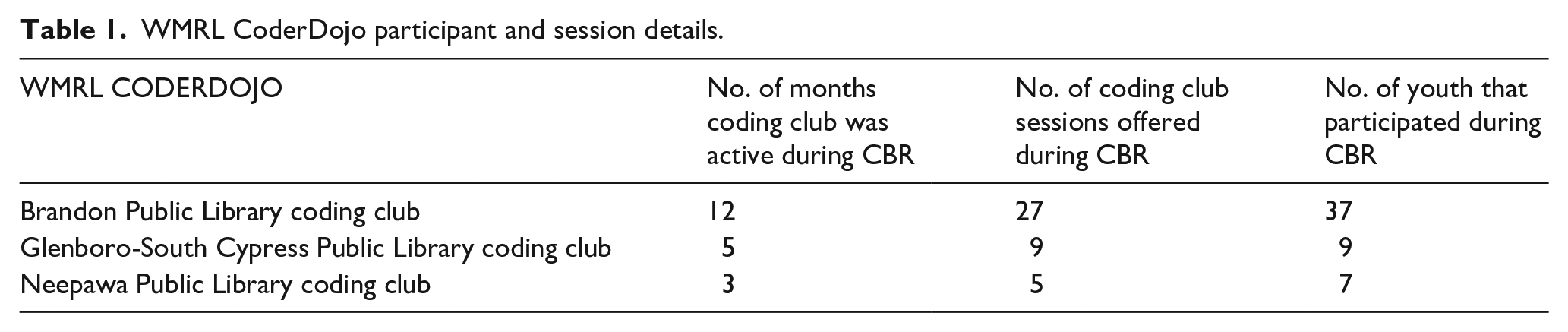
During the 14 months of research, starting in November 2018, the WMRL held 45 coding sessions with 53 children and youth (aged 7–14 years) participating in at least one session. One youth in Brandon participated in the Brandon CoderDojo for the entire 14 months of the CBR. Thirty-three other youth have also participated over several phases of intakes with the BrandonDojo. In both Glenboro-South Cypress and Neepawa, all ten youth that started in April and June 2019 were still participating in those clubs at the end of the CBR research in December of 2019, and nine new youth had started between those two clubs. Table 1 provides a breakdown of the number of sessions and youth by each coding club.
WMRL CoderDojo participant and session details.
Findings
Embracing the importance of digital literacy
From the outset, the WMRL librarians demonstrated enthusiasm and foresight in their desire to develop digital literacy among young people. Library staff identified a distinct shortage of digital opportunities in the three communities involved, where there existed ‘digital deserts’ for building skills and digital technology exploration. In the absence of other outlets, there was consensus among the librarians that their institutions should be involved in setting up and delivering coding clubs as a form of capacity building. Hosting and delivering the coding clubs provided a useful showcase for how libraries could build digital skills for their members and communities. Reflections from the rural librarians and champions illustrate the attraction that coding clubs could provide, as the following quote illustrates: It’s difficult in small towns to find opportunities for all ages of kids, and the library is always trying to attract school aged children. . .. It seems they get so involved in their sports in their after-school activities that they forget that there’s other pursuits, other than sports and, you know, inter murals . . . a lot of the kids are not interested in that. And it’s nice to be able to offer them something a little bit more outside the mainstream that they may not be able to get at school . . .coding is something that libraries are starting to do more and more of. Because it, it deals with learning and being creative and stretching your imagination. Neepawa Librarian
One of the champions, who runs a software company, was equally passionate about the importance of developing homegrown digital talent to build the rural economy through the digital sector. In the following extract, she explains the difficulties of achieving sufficient digital aptitude through reliance on the mainstream education system in rural Manitoba where resources are particularly stretched: As a person who runs a software company in a rural community, it’s easier for us to look at employing less experienced kids or recent graduates who are from a rural community. To recruit to Glenboro-South Cypress Manitoba to work for a tech firm, we have to grow our own and this program is the first step on our path . . . Are we going to be known as the have not province that used to do agriculture or are we going to be known as a tech and business centre. . .rural schools do not have the resources to offer the types of courses that perhaps more urban centres can . . . we struggled to keep chemistry teachers, so it’s unlikely that we’re going to have a comp sci professional in the classroom, you know, or at least on any regular kind of basis. . . . Think we have an awesome, awesome school principal in our community. He is an excellent, excellent school principal and he sees the future, but his hands are tied by a lack of resources. He has to educate the kids in our school with a very bare minimum, and a dedicated coding course just isn’t on the radar . . .when they’re struggling to deliver you know the basic academic subjects. Glenboro-South Cypress champion
Several of the librarians described the evolution to delivering digital literacy programmes as both a natural and an essential progression for libraries, building on the groundwork of traditional library programming: libraries are traditionally places of books. That’s what people think of when they think of libraries, but more broadly, I think what books contain is what’s actually the value of libraries, so that’s information, and that’s learning literacy. It’s an exchange of information and ideas, and all of those things can be accomplished in means other than books or in addition to books . . .coding and technology is just one example of a way for people to learn and explore and explore literacy. It includes traditional literacy as you have to be able to read and write to be able to figure out programs and instructions, . . . but then also digital literacy and navigating through online systems or software systems. WMRL Director of Library Services
Solving digital access through community partnerships
When starting the coding clubs, the WMRL librarians and champions consistently flagged that one of the critical barriers to getting the clubs off the ground was the lack of digital technology. The technology barriers were consistent for each club. Given the cost of computers, it was a challenge to ensure that each youth participant had access to a laptop, and that they could access the Internet with that laptop. The affordability of technology, as mentioned here, is a common factor in the digital divide and can impact an individual’s ability to participate in the digital society (Gallardo et al., 2018; Livingstone and Helsper, 2007). The librarians viewed it as their responsibility to ensure that all youth had access to laptops in line with the WMRL’s commitment to inclusion and accessibility: we think libraries are in a really good position to be able to offer programs that feel, and I hope are, accessible to anyone who wants to come to them. That was part of our challenge in a way, that it’s a free program. And so, we’re looking at where we can access different funds. It’s free because I think it opens it up to kids who maybe aren’t able to go to other kinds of programs, those things can be expensive like team sports can be crazy expensive. There’s a lot of barriers for them, and I hope that we’re removing those barriers here for kids that want to code like we’re supplying some of the laptops, which is great. Not every child has a laptop. WMRL Programming and Outreach Librarian
While the libraries were devoted to ensuring all participants had access to a laptop, it required some creative solutions to make this a reality. Efforts by librarians and champions resulted in local community organisations providing surplus laptops in one community and the sharing of school laptops in another community. These solutions required the librarians and champions to reach out to their partners to explore and identify potential solutions. As the first coding club to get started, the Brandon Public Library needed to secure at least 10 laptops. To achieve this, the Brandon Dojo champion engaged with a local government institution that she worked at to request a donation of surplus laptops. This request was successful, and the institution provided 11 devices that were no longer be used. The champion describes how she approached this task: There was letter samples and templates [on the CoderDojo website] and who to ask for in-kind donations. So, I just went to my organization and tried it with them. The organization that I work for and I knew the fellow who was head of it. I used the template and just added a couple of notes of my own here. ‘What do you think, have you got anything that I can pick up?’ And he said, ‘I have 11 laptops for you’ [Brandon CoderDojo champion]
The champion also engaged a board member from a local non-profit organisation of which she was a member to test and update the licencing on the laptops. These efforts resulted in seven usable laptops, which allowed the Brandon Library to begin offering a CoderDojo programme. After several months of running a successful and in-demand coding club, the library purchased six new Chromebooks for the club and library staff to use. The older laptops were then made available as needed to the coding clubs that were starting up at the Glenboro-South Cypress and Neepawa libraries. This solution harnessed the social capital of the Brandon Champion with the government institution and with colleague to deliver a solution that overcame the initial technology access barrier for the coding clubs.
To develop and deliver their coding clubs, Glenboro-South Cypress and Neepawa libraries connected with other community leaders and organisations to address challenges in setting up and running the programme. In Glenboro-South Cypress, the library partnered with a local technology company and the public school to address the device and capacity issues. In Neepawa, the local school proved critical in advertising the club through the school newsletter. The Neepawa librarian identified that almost all of the interest in the coding club came from parents who saw the notice in the newsletter. For Glenboro-South Cypress Library, the community partnership aspect was central to its Dojo’s ongoing delivery and the library’s ability to offer a more advanced programming environment. The impact of the partnership between the Glenboro-South Cypress Library and the local technology company was noted by the youth mentor at the club who was very aware of the unique opportunity presented: I think that’s really lucky that we have a place like that [Glenboro Tech Company], where we can get people to set up our computers and Internet routers and help with CoderDojo. It’s real lucky that we have some place that we can go where actual people . . .know how to code and program and can teach other people or the younger generations how to code and program. [Glenboro-South Cypress youth mentor]
In Glenboro-South Cypress, the older Dojo participants were allowed to code at the technology company after hours, using company computers if needed. The champion, the co-owner of the technology company, provided older computers and computer parts to the youth for use at home. The Glenboro-South Cypress champion also noted that it would not have been possible to have the two clubs in that small community without the support of the local school which helped in a range of ways. For the younger youth housed in the Glenboro-South Cypress Library, Chromebooks from the school were borrowed for each class and then returned. The librarian in Glenboro-South Cypress stated that the school in that community could not offer a coding programme but recognised the need for it and supported it by lending out Chromebooks for use during the club. In a rural community of less than 2000 people, the partnership between these three organisations can be viewed as a necessity in the ability to deliver advanced digital skills for youth in a rural setting. Individual organisations or leaders in this rural community are unlikely to have been able to deliver the coding club independently.
Overcoming digital capacity challenges of librarians
The participating libraries each understood the importance of offering digital skill building through coding programmes, but librarians understood their own digital skill limitations to offering digital programming. At the beginning of the project, lack of digital capacity among staff, as well as the need for committed and digitally skilled volunteers to serve as mentors and champions, made it challenging to set up the coding clubs: The other challenge was providing staffing for the program or . . . adult leadership for the program because it was so different from other programs we’ve offered at the library. The library staff were pretty hesitant to get involved at first. I think they just felt like they didn’t know that this was going to be valid and they didn’t feel that they were qualified to help, WMRL Director of Library Services And this is my second go around [starting a coding club], the first time it didn’t work at all. I couldn’t find any volunteers. You could put out like a little blurb looking for a volunteer in your area and nothing ever came of that. Then I even put out like a kind of a call for volunteers within the town and everybody was interested in participating, but not actually helping to run the program. A lot of the parents were just more along the lines, ‘I don’t know how to code’ and when you tell them, ‘well, it’s actually pretty easy’, they are still like ‘no’. Glenboro-South Cypress Librarian
The success of the coding clubs in this instance was due to the recruitment of volunteers with the capacity and interest for teaching coding. Both Champions in Brandon and the Champion in Glenboro-South Cypress had the ability and interest to help teach coding to local youth and it was this participation that enabled all three libraries to overcome the initial capacity barriers. Librarians in both Neepawa and Brandon indicated that the participation and mentorship support of the community-based researcher and author of this article was essential for getting the clubs up and running. However, once the clubs were established, the librarians started to build their own digital capacity. Over time, the librarians made a concerted effort to develop their Scratch skills in the same fashion as the youth in their clubs, achieving yellow belt accreditation. The WMRL’s director was also determined to build the library’s digital skills capacity among the staff going forward. In Glenboro-South Cypress, the community champion co-led a computer programming business and had the background and resources to help lead coding activities with youth. In all three participating communities, volunteers with coding capacity and desire were essential in executing the development and delivery of these coding clubs.
Building digital skills through coding
The participating youth were introduced to the Scratch computer language and developed their programming skills through exploration and experimentation, creating programmes that used different coding functions. To enable exploration and trial and error, game-building tutorials were used to help youth increase their understanding of Scratch (CoderDojo, 2019), which the young people used to create games based on instructions. Even the very young were able to develop computer games or programmes by learning how to use Scratch: Gave one of the students (she is only 7) her yellow belt today - she has worked really hard on her ‘Scratch cat goes skiing’ game - and while she doesn’t necessarily understand all of the intricacies of the code she worked on the debugging and was able to meet all of the requirements for a yellow belt - an impressive effort from a young kid - she read and copied all the code as she went through the tutorial on ‘raspberrypi.org’ and sounds like she really enjoys the CoderDojo - hopefully she will continue in the fall as her mom was not sure how much she will attend during the summer. Notes from coding club session in Brandon, June 2019
During the CoderDojos, youth were encouraged to showcase their finished projects on a shared WMRL digital studio, which allowed other youth, as well as the librarians and champions, to try out their programmes. The three coding clubs shared the digital studio, and youth were able to play and look at the code for programmes from the other Dojos. The youth usually shared their more polished or complete projects, and programmes used for achieving belt status were explicitly requested to be shared. By the end of the research, youth had shared 40 projects in the studio. 1 In addition to games, participants developed a range of other programmes, including stories, informative presentations, and music videos.
A significant ability to develop advanced skills was evident in the depth of digital content created. There were examples of children as young as 7 or 8 who created more advanced programmes. One of the youth in the 10–12 age range worked out a random math formula to simulate wind in a target shooting game he made.
We had a couple of newbies who seemed to really catch on pretty quick and then you had the youth who coded wind into his game, which was pretty awesome to see as it was kind of fun watching them get excited about different things and then teaching each other how to do different things. [Glenboro-South Cypress Librarian]
The use of storyboarding, planning, and drawing ideas before creating the code further illustrates the creative outputs for coding club youth: There was a wide variety of programs showcased by the kids - two were working on a story (interesting that they were side by side and had similar characters and background), one was creating a quidditch game and was in-fact doing some of the graphics herself and problem solving the coding with her parents! One other kid seems to enjoy putting together music video type programs and worked hard to upload music and have content on the screen. Finally, the kid who had to go to swimming showcased one of the games that he created on his own - where he hid a bat on screen and then the user had to move another sprite around to try and find it and when touching it appeared - a novel idea and he worked on it at home himself. [Notes from coding club session in Neepawa, June 2019]
To create more active involvement and responsibility in the Brandon Dojo, the librarian and mentor began encouraging youth to set up the laptops themselves at the beginning of each session. Youth also had to set up and use the projector when showcasing their programmes: I think another challenge to but something that I think we’ve been able to work out was like enforcing a routine, so everyone comes in they set up their own laptop and I feel like that has made a big difference. That was a good thing to put it back on the kids like ‘you’re responsible to set up’. WMRL Programming and Outreach Librarian
At the end of the research project, of the 53 youth who took part, 22 (39%) had attained yellow belt status, while 4 (8%) gained green belt and 2 (4%) achieved blue belt. From fieldnotes at the end of the CoderDojo CBR project, it was observed that youth with green belts or higher wanted to start exploring other programming languages: ‘I also checked in to see what youth want to learn in terms of languages in the new year. JavaScript and Python were the main ones and C++ was another one that’s definitely down the road and so those are things that we’re going to have to start learning together’ (Notes from the coding club session in Brandon, December 2019). In addition to discussing new programming languages, the ability and desire to explore digital technologies grew. The delivery of the coding clubs in these three libraries had successfully increased coding and other digital skills among the 53 participating youth and fostered a culture of creation and learning within the clubs.
Creating the place and space for youth to learn digital skills together
One of the contributing factors to the popularity of the coding clubs was the ability of libraries to create a place and space for youth to learn digital skills as a group. The idea of youth exploring digital technologies and learning together is a core part of the CoderDojo concept. From the outset, the Brandon champion, who was instrumental in getting the first library club up and running, emphasised the coding clubs’ peer-learning aspect: What I liked about the coding club idea, what I saw on the videos [about CoderDojos], was not only could kids be on a laptop and connect with folks online - other kids online - but they could sit side by side and figure out problems together and develop friendships without having to do the typical ‘Hi, what’s your name?’ which adults do really well, but kids are less comfortable with. Brandon CoderDojo champion
The librarians and champions noted how important it was for the participants to have the opportunity to explore digital technology with other like-minded youth. In small rural communities, youth with digitally-oriented interests can often feel isolated. The Glenboro-South Cypress librarian illustrates this point: [CoderDojo is] an opportunity for kids to socialize together in a different way than we do with technology. . . . I have two boys. Obviously one of my kids is in this program and it’s nice to see him socializing with technology, as opposed to being at home playing video games. . . . they’re going to be doing technology and playing, you know, and learning how they’re doing it as a group in a social setting. I think that’s really another benefit . . .. I hope that other parents are feeling that way as well, that they are learning skills as well as having an opportunity to be social with it and not just be at home using technology alone. Glenboro-South Cypress Librarian
As part of the feedback survey given to youth, one question asked why the youth liked coding. Some responses included the social and sharing aspect of the clubs: ‘I’ve always loved games, and I’ve always wanted to make my own games that I could share with my friends and have them enjoy. I love computers and learning how they work!’ (Youth Feedback Survey response). Youth also indicated that they wanted more opportunities to connect with other young people during the coding clubs, and specifically with participants in the clubs located in the other communities. When asked about what other activities youth would like to see at the CoderDojos, participants ranked activities that included collaboration and connection with other coding clubs higher than independent activities. Hosting the coding clubs in public libraries provided both the space and institutional capacity needed to deliver group-based learning outside of traditional school programming.
Discussion
While it is clear that large digital infrastructural initiatives are needed to help address the digital divide in rural communities, we argue that small digital projects like the one described here are also necessary and can be impactful. While this project is arguably locally specific and small scale in nature, it demonstrates in our experience that public libraries, as core literacy and rural community stakeholders, are key to the digital literacy building process in rural communities despite constraints they might face in terms of resources and experience. This CBR research initiative was successful in terms of creating viable opportunities for children and youth to acquire meaningful coding skills, demonstrating that with support and commitment, it is possible to roll out advanced digital projects for rural youth through public libraries, and by inference through other public institutions. Learning to code involves problem-solving and creative thinking and requires the creation of digital content.
A key starting point for this initiative is the strong vision and commitment shown by the librarians in promoting a digital society and citizenry. While none of the librarians leading the Dojos possessed prior experience with coding, they supported the clubs’ creation, provided organisational support, enhanced their own digital skills, and regularly participated in the club. In preparing a stronger digital readiness in rural society, the leadership demonstrated in this case foregrounds public libraries and librarians as key stakeholders in building a culture of engagement with young people. Our findings support the existing literature on libraries as crucial stakeholders in building a digital society (Coward et al., 2018; Houghton et al., 2013; Perryman and Jeng, 2020) and especially in rural communities, where libraries provide digital resources and supports that might not otherwise be available (Jaeger et al., 2012; Warren, 2019). In addition to digital infrastructure and support, public libraries are increasingly providing digital literacy training, building on the traditional literacy programming they offer, and shifting to digital programming such as maker spaces and coding clubs (Bilandzic, 2016; Strover, 2019). The research from this project indicates that rural community leaders and stakeholders understand the importance of contemporary digital skills and also reveals the lack of previously extant opportunity in rural areas. To ensure the clubs had the initial technology access required and local interest, the libraries harnessed social capital and community partnerships. Collaboration amongst local organisations and leaders is essential for most rural development initiatives (Skerratt, 2018), and these coding clubs were no exception. It is therefore important for rural organisations to work collaboratively to find supports and foster collective actions.
A key message is that there are benefits to choosing coding clubs as a means to harness digital skill-building. Researchers have indicated that learning to code will help build critical digital workforce skills (Djumalieva and Sleeman, 2018; Lamb and Doyle, 2017), develop problem-solving and critical thinking skills (Papavlasopoulou et al., 2017; Van Laar et al., 2017), increase digital confidence (Sáez-López et al., 2016; Sheridan et al., 2016), and foster digital creativity (Garneli et al., 2015; Woodward and Fayed, 2016). Importantly, as an enjoyable way to learn, clubs offer the type of ‘genre of participation’ described by Ito et al. (2009) as ‘geeking-out’ where digital technologies directed towards interest and hobby purposes spark young people’s imagination, curiosity, and passion. This type of investment in technology can involve intense gaming, media production, the development of specific content, comprehensive research and knowledge building, or sharing around a particular topic. These coding clubs were a success due to fact that the participating libraries continued to move forward even though the technology capacity and access was not initially in place. By recruiting skilled volunteers and establishing or harnessing community partnership, the libraries in this project were able to create the required space and place for participating youth to experience all of these benefits.
As described in Ito et al.’s (2009) findings and framework, challenges in accessing digital infrastructure and digital skills in rural communities impact more than just availability and use of digital technologies. These challenges also limit the motivation for youth to use digital technologies to their full potential or to explore and dig deeper into both the technologies themselves and the new opportunities, knowledge and networks they provide. This context helps explain some of the success of the library-based coding clubs discussed in this article, identifying that providing space and mentorship for youth to explore digital technologies is essential for in-depth engagement in those technologies. Among the spin-off benefits of learning to code in a club setting is the club’s facilitation of peer-based learning (Corneliussen and Prøitz, 2016; Sipley and Hall, 2015), tapping into social capital and building social bonds as young people learn new skills (Reimer et al., 2008). Within a coding club environment, such as the ones created by the WMRL libraries, youth are often instructed to turn to one another first for solutions, exploring and creating collaboratively in a peer-based learning environment (Butler et al., 2018; CoderDojo, 2019; Vickery, 2014; Ward, 2016). Finally, teaching youth to code in rural communities provides the opportunity to build leadership skills among young people themselves who in turn can help sustain the longer-term organisation and development of digital programmes throughout society.
While rural libraries face similar digital challenges as other rural institutions, notably digital infrastructure and capacity limitations, with leadership, support and lessons learned from research studies similar to our own, they can successfully deliver digital skill building opportunities for local youth and the communities they serve.
Footnotes
Acknowledgements
The authors wish to thank the editor and anonymous reviewers for their very helpful suggestions in the review process.
Declaration of conflicting interests
The author(s) declared no potential conflicts of interest with respect to the research, authorship, and/or publication of this article.
Funding
The author(s) received no financial support for the research, authorship, and/or publication of this article.
